Downloaded 13 times
![Curiosity at Gale Crater, Mars:
Characterization and Analysis
of the Rocknest Sand Shadow
D. F. Blake,1
* R. V. Morris,2
G. Kocurek,3
S. M. Morrison,4
R. T. Downs,4
D. Bish,5
D. W. Ming,2
K. S. Edgett,6
D. Rubin,7
† W. Goetz,8
M. B. Madsen,9
R. Sullivan,10
R. Gellert,11
I. Campbell,11
A. H. Treiman,12
S. M. McLennan,13
A. S. Yen,14
J. Grotzinger,15
D. T. Vaniman,16
S. J. Chipera,17
C. N. Achilles,2
E. B. Rampe,2
D. Sumner,18
P.-Y. Meslin,19
S. Maurice,19
O. Forni,19
O. Gasnault,19
M. Fisk,20
M. Schmidt,21
P. Mahaffy,22
L. A. Leshin,23
D. Glavin,22
A. Steele,24
C. Freissinet,22
R. Navarro-González,25
R. A. Yingst,16
L. C. Kah,26
N. Bridges,27
K. W. Lewis,28
T. F. Bristow,1
J. D. Farmer,29
J. A. Crisp,14
E. M. Stolper,15
D. J. Des Marais,1
P. Sarrazin,30
MSL Science Team‡
The Rocknest aeolian deposit is similar to aeolian features analyzed by the Mars Exploration
Rovers (MERs) Spirit and Opportunity. The fraction of sand <150 micrometers in size contains
~55% crystalline material consistent with a basaltic heritage and ~45% x-ray amorphous material.
The amorphous component of Rocknest is iron-rich and silicon-poor and is the host of the volatiles
(water, oxygen, sulfur dioxide, carbon dioxide, and chlorine) detected by the Sample Analysis at
Mars instrument and of the fine-grained nanophase oxide component first described from
basaltic soils analyzed by MERs. The similarity between soils and aeolian materials analyzed at
Gusev Crater, Meridiani Planum, and Gale Crater implies locally sourced, globally similar
basaltic materials or globally and regionally sourced basaltic components deposited locally at
all three locations.
T
he Mars Science Laboratory (MSL) rover
Curiosity began exploring the surface of
Mars on 6 August 2012 (universal time co-
ordinated); until 13 September 2012, it conducted
an initial engineering checkout of its mobility sys-
tem, arm, and science instruments. Curiosity spent
sols 57 to 100 (1) at a location named Rocknest,
collecting and processing five scoops of loose, un-
consolidated materials extracted from an aeolian
sand shadow (2).
Five scoops of material from the Rocknest
sand shadow were individually collected and
sieved (<150 mm) by the Sample Acquisition,
Sample Processing and Handling–Collection
and Handling for In situ Martian Rock Analysis
(SA/SPaH-CHIMRA) instrument (3). Scoops 1 and
2 were processed by CHIMRA and discarded
to reduce (by entrainment and dilution) any ter-
restrial organic contamination that may have
remained after a thorough cleaning on Earth (4)
and to coat and passivate the interior surfaces of
the collection device with Mars dust. Portions
(40 to 50 mg) of scoops 3 and 4 were delivered
to the Chemistry and Mineralogy (CheMin) in-
strument (5) and the “observation tray,” a 7.5-cm-
diameter flat Ti-metal surface used for imaging
and analyzing scooped and sieved material with
Curiosity’s arm and mast instruments. Portions of
scoop 5 were delivered to both CheMin and the
Sample Analysis at Mars (SAM) quadrupole mass
spectrometer/gas chromatograph/tunable laser
spectrometer suite of instruments (6).
We describe the physical sedimentology of
Rocknest and suggest possible sources for the
material making up the sand shadow. We use
Alpha-Particle X-ray Spectrometer (APXS) and
CheMin data to determine the amounts and chem-
istry of the crystalline and amorphous components
of the sand shadow and compare these results with
global soil measurements from the Mars Explora-
tion Rovers (MERs) and to basaltic martian mete-
orites analyzed on Earth.
Results
Description and Interpretation of the
Rocknest Sand Shadow
The Rocknest sand shadow (7) is an accumula-
tion of wind-blown sediment deposited in the
lower-velocity lee of an obstacle in the path of
the wind. The orientation of the sand shadow in-
dicates that the constructive winds were from the
north. The surface is composed of dust-coated,
predominantly rounded, very coarse (1- to 2-mm)
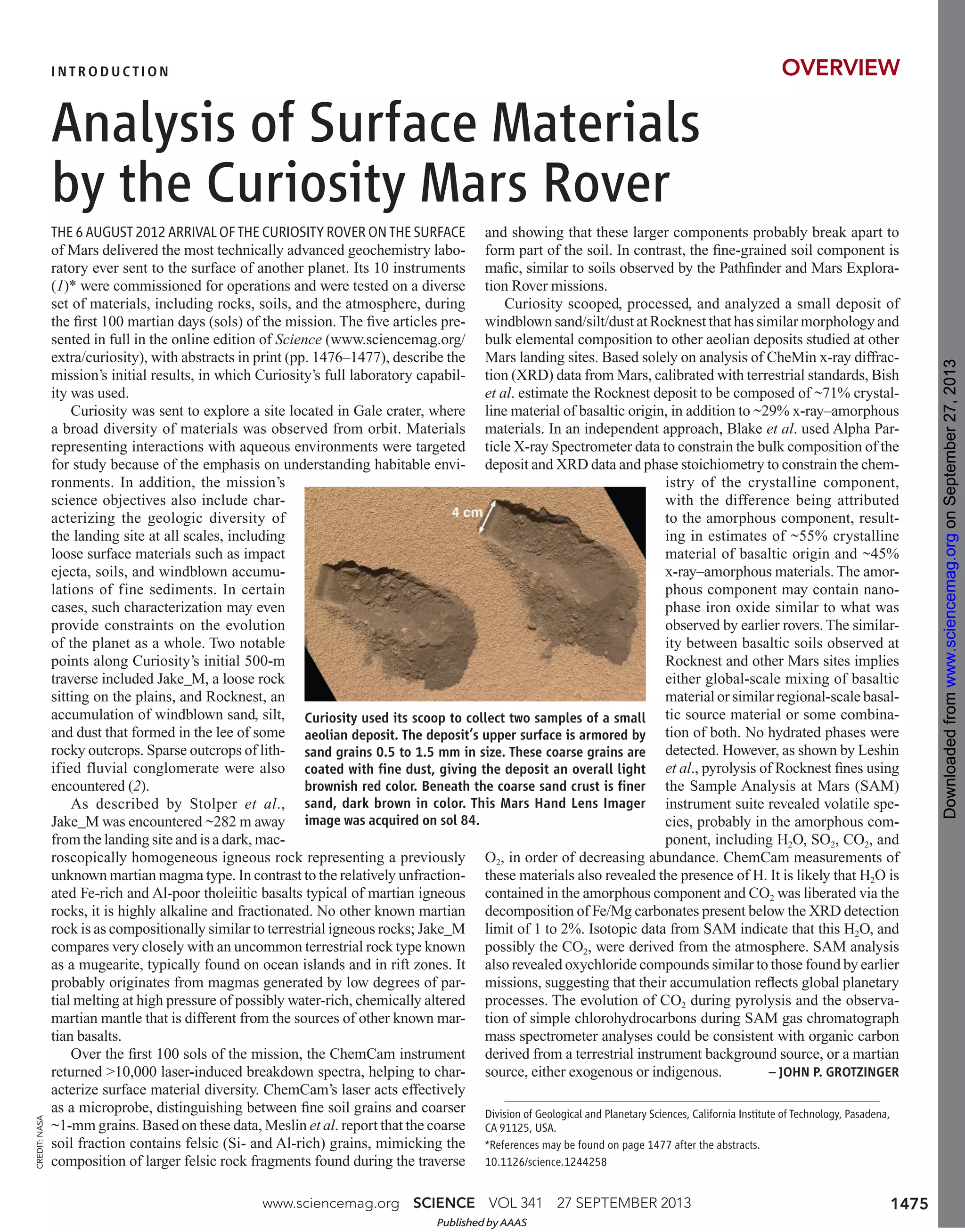
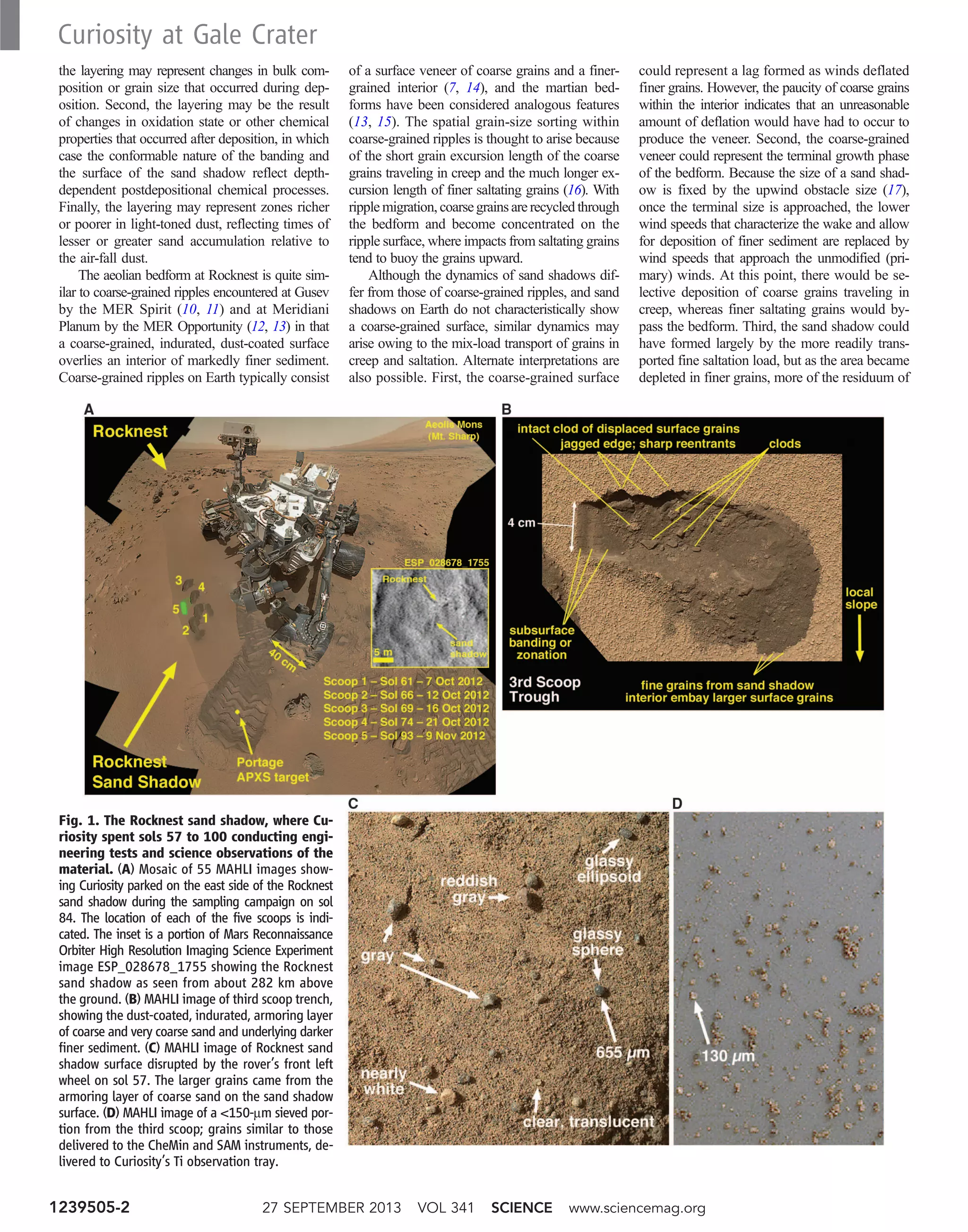
sand grains (Fig. 1A). Trenches created during
the scooping show that these larger grains form
an armored surface ~2 to 3 mm in thickness (Fig.
1B). Beneath the armored surface, the bedform
interior consists of finer-grained material whose
size distribution extends through the resolution
limit of Mars Hand Lens Imager (MAHLI) im-
ages (~30 mm per pixel under the conditions of the
observation) (8). Because of CHIMRA’s 150-mm
sieve, the larger grains that armor the surface
could not be analyzed by CheMin.
Coarse sand grains that fell from the crust
into the scoop-troughs lost their dust coating
and show diversity in color, luster, and shape.
Among the grains are gray and red lithic frag-
ments, clear/translucent crystal fragments, and
spheroids with glassy luster (Fig. 1C). Some grains
showed bright glints in the martian sunlight,
suggesting specular reflections from mineral crys-
tal faces or cleavage surfaces [similar features
were observed by the optical microscope on board
the Mars Phoenix Lander (9)]. MAHLI images
of a sieved portion of material deposited on the
observation tray (3) showed a variety of particle
types from clear to colored to dark, angular to
spherical, and dull to glassy-lustered (Fig. 1D).
During the scooping process, fragments of the
armored surface were cohesive to the extent that
“rafts” of surface crust were laterally compressed
and displaced forward, and fragments of the crust
fell into the scoop hole as cohesive units (Fig. 1B).
The surface crust was also fractured and broken
into rafts during scuffing by rover wheels (a pro-
cess by which an excavation is made into the sub-
surface of unconsolidated regolith by rotating a
single rover wheel). Material beneath the crust
also had some cohesion, as shown by the over-
steep walls of the scoop scars (much greater than
the angle of repose and vertical in some cases).
The sand shadow has a discernible internal
structure. On the headwall and flanks of each
scoop trench, a lighter-tone layer is apparent
~1 cm beneath and parallel to the dune surface
(Fig. 1B). The origin of the layering is not un-
derstood, and three hypotheses are viable. First,
RESEARCH ARTICLE
1
National Aeronautics and Space Administration (NASA) Ames
Research Center, Moffett Field, CA 94035, USA. 2
NASA Johnson
Space Center, Houston, TX 77058, USA. 3
Department of Geolog-
ical Sciences, University of Texas, Austin, TX 78712, USA. 4
Depart-
ment of Geology, University of Arizona, Tucson, AZ 85721,
USA. 5
Department of Geological Sciences, Indiana University,
Bloomington, IN 47405, USA. 6
Malin Space Science Systems,
San Diego, CA 92191, USA. 7
U.S. Geological Survey, Santa Cruz,
CA 95060, USA. 8
Max-Planck-Institut für Sonnensystemforschung,
37191 Katlenburg-Lindau, Germany. 9
Niels Bohr Institute,
University of Copenhagen, 2100 Copenhagen, Denmark. 10
Center
forRadiophysicsandSpaceResearch,CornellUniversity,Ithaca,NY
14850, USA. 11
University of Guelf, Guelph, Ontario, N1G2W1,
Canada.12
LunarandPlanetaryInstitute,Houston,TX77058,USA.
13
State University of New York–Stony Brook, Stony Brook, NY
11790, USA. 14
Jet Propulsion Laboratory/California Institute of
Technology, Pasadena, CA 91109, USA. 15
California Institute of
Technology, Pasadena, CA 91125, USA. 16
Planetary Science
Institute,Tucson,AZ85719,USA.17
ChesapeakeEnergy,Oklahoma
City, OK 73102, USA. 18
University of California, Davis, CA 95616,
USA. 19
Institut de Recherche en Astrophysique et Planétologie
(IRAP), UPS-OMP-CNRS, 31028 Toulouse, France. 20
Oregon State
University, Corvallis, OR 97331, USA. 21
Finnish Meteorological
Institute, Fl-00101 Helsinki, Finland. 22
NASA Goddard Space
Flight Center, Greenbelt, MD 20771, USA. 23
Rensselaer Poly-
technic Institute, Troy, NY 12180, USA. 24
Geophysical Laboratory,
Carnegie Institution of Washington, Washington, DC 20015, USA.
25
University Nacional Autonóma de México, Ciudad Universitaria,
04510 México D.F. 04510, Mexico. 26
Department of Earth and
Planetary Sciences, University of Tennessee, Knoxville, TN 37996,
USA. 27
The Johns Hopkins University Applied Physics Labora-
tory, Laurel, MD 20723, USA. 28
Princeton University, Princeton,
NJ 08544, USA. 29
Arizona State University, Phoenix, AZ 85004,
USA. 30
SETI Institute, Mountain View, CA 94043, USA.
*Corresponding author. E-mail: david.blake@nasa.gov
†Present address: Department of Earth and Planetary Sciences,
University of California, Santa Cruz, CA 95064, USA.
‡MSL Science Team authors and affiliations are listed in the
supplementary materials.
www.sciencemag.org SCIENCE VOL 341 27 SEPTEMBER 2013 1239505-1](https://image.slidesharecdn.com/analysisofsurfacematerials-130927072926-phpapp02/75/Analysis-of-Surface-Materials-by-Curiosity-Mars-Rover-Special-Collection-5-2048.jpg)
![coarser grains would be incorporated into trans-
port, with the coarse-grained surface arising through
subsequent deflation.
None of these interpretations explains the gen-
eral absence of observed coarse grains in the in-
terior; the contrast in grain size between the surface
and the interior is more marked in the Rocknest
sand shadow and in some of the coarse-grained
ripples observed by MERs than in many Earth
examples. This may reflect the greater impact en-
ergy of saltating grains on Mars compared with
Earth and their ability to transport dispropor-
tionally larger grains in creep (18). Regarding the
apparent absence of interior coarse grains, the small
scooped areas may not be representative of the en-
tire bedform, and interior horizons of coarse grains
could easily have been bypassed. In addition, as seen
with coarse-grained ripples on Earth, the amount of
coarse sediment occurring in the interior varies
and decreases with the supply of coarse grains.
Regardless of the origin of the coarse-grained
surface, this armored surface would stabilize
the bedform during all but the strongest wind
events. In turn, the armored surface would allow
time for surface induration to develop, further sta-
bilizing the sand shadow. The similarity of the
armoring and induration of the sand shadow at
Rocknest to coarse-grained ripples encountered
by Spirit and Opportunity suggests that the pro-
cesses of grain transport and stabilization are
similar across equatorial Mars and that Mars’
winds (in recent eras) rarely were strong enough
to transport sand grains of 1- to 3-mm diam-
eter. To move the grains at the current atmo-
spheric pressure of 0.02 kg/m3
, the wind velocities
would need to be ~36 m/s (80 mph) and ~52 m/s
(116 mph), with and without saltation, respec-
tively. Under conditions of high obliquity, dur-
ing which time the atmospheric pressure could
increase to 0.04 kg/m3
, these values would de-
crease to 26 m/s (58 mph) and ~37 m/s (83 mph),
respectively (see Materials and Methods). The
potential antiquity of the Rocknest sand shadow
is highlighted by comparing it with granule ripples
on Meridiani Planum, where cratering postdates a
field of pristine granule ripples and the crater count
suggests an age of 50,000 to 200,000 years (19).
Mineralogy of the Rocknest Sand Shadow
Analysis and interpretation of the mineralogy of
the Rocknest sand shadow is given in Bish et al.
(20). Rocknest consists of both crystalline and
x-ray amorphous components. The crystalline
component is basaltic, composed of plagioclase
feldspar, forsteritic olivine, and the pyroxenes
augite and pigeonite (20). All of the minor phases
are consistent with a basaltic heritage, with the
exception of anhydrite and hematite. By constrain-
ing the compositions of the individual crystalline
phases on the basis of their measured unit-cell
parameters, the chemical compositions of the
minerals of Rocknest were determined (21, 22).
The crystalline component of Rocknest is
chemically and mineralogically similar to that
inferred for martian basalts across the planet
and many of the basalts found in martian me-
teorites (Table 1) and, apart from somewhat
lower Fe and K, broadly similar to estimates of
the average martian crust (23). These basalts all
contain (or have chemical compositions consist-
ent with) the minerals olivine, augite, pigeonite,
and plagioclase feldspar. The mineral propor-
tions of the crystalline component of Rocknest
are virtually identical to those calculated for the
unaltered Adirondack class basalts from Gusev
Crater (CIPW normative mineralogy from their
APXS analyses) (Table 1) (24, 25). Chemically,
the mafic minerals of the Rocknest sediment (oli-
vine, augite, and pigeonite) are all consistent with
high-temperature chemical equilibria among Ca,
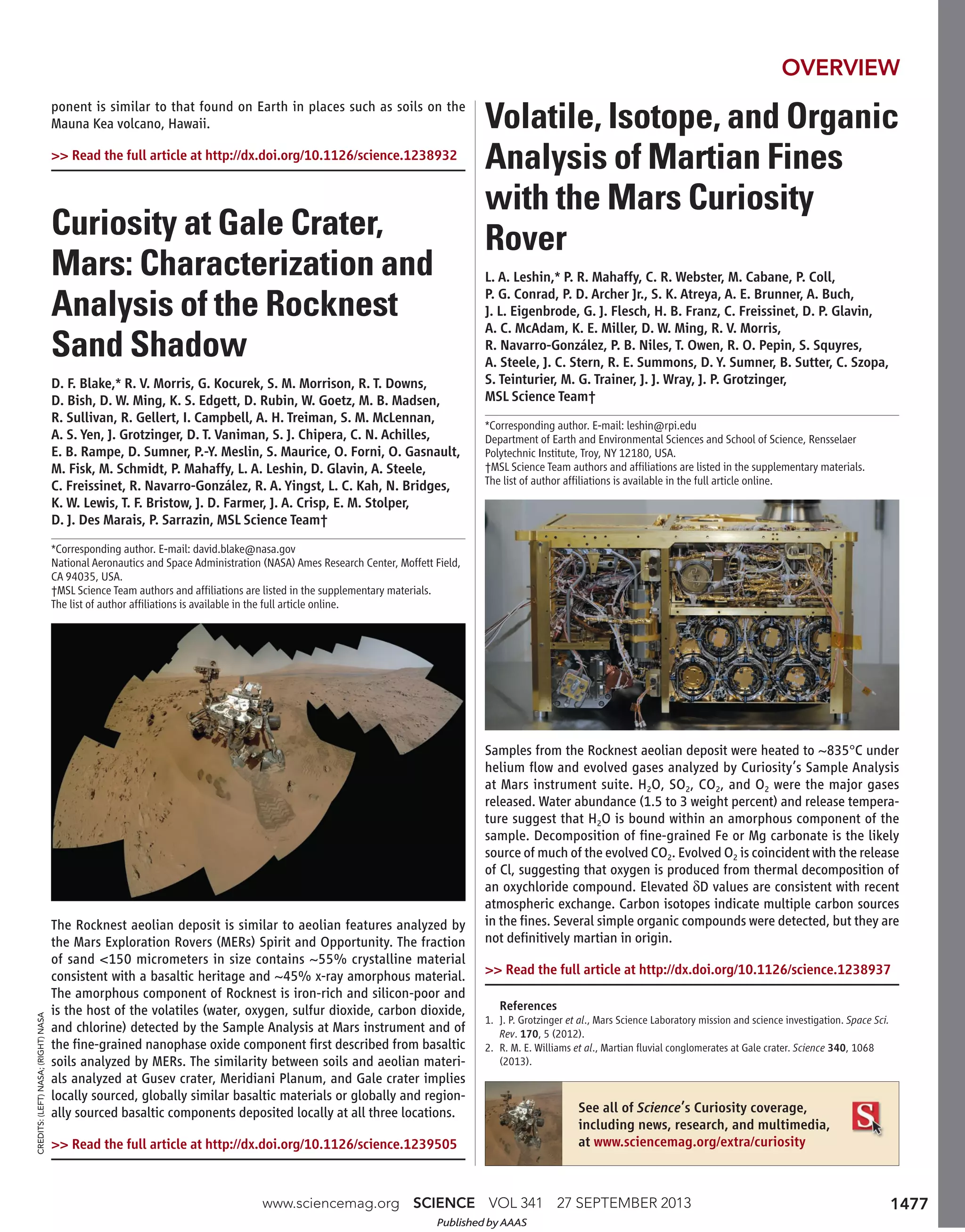
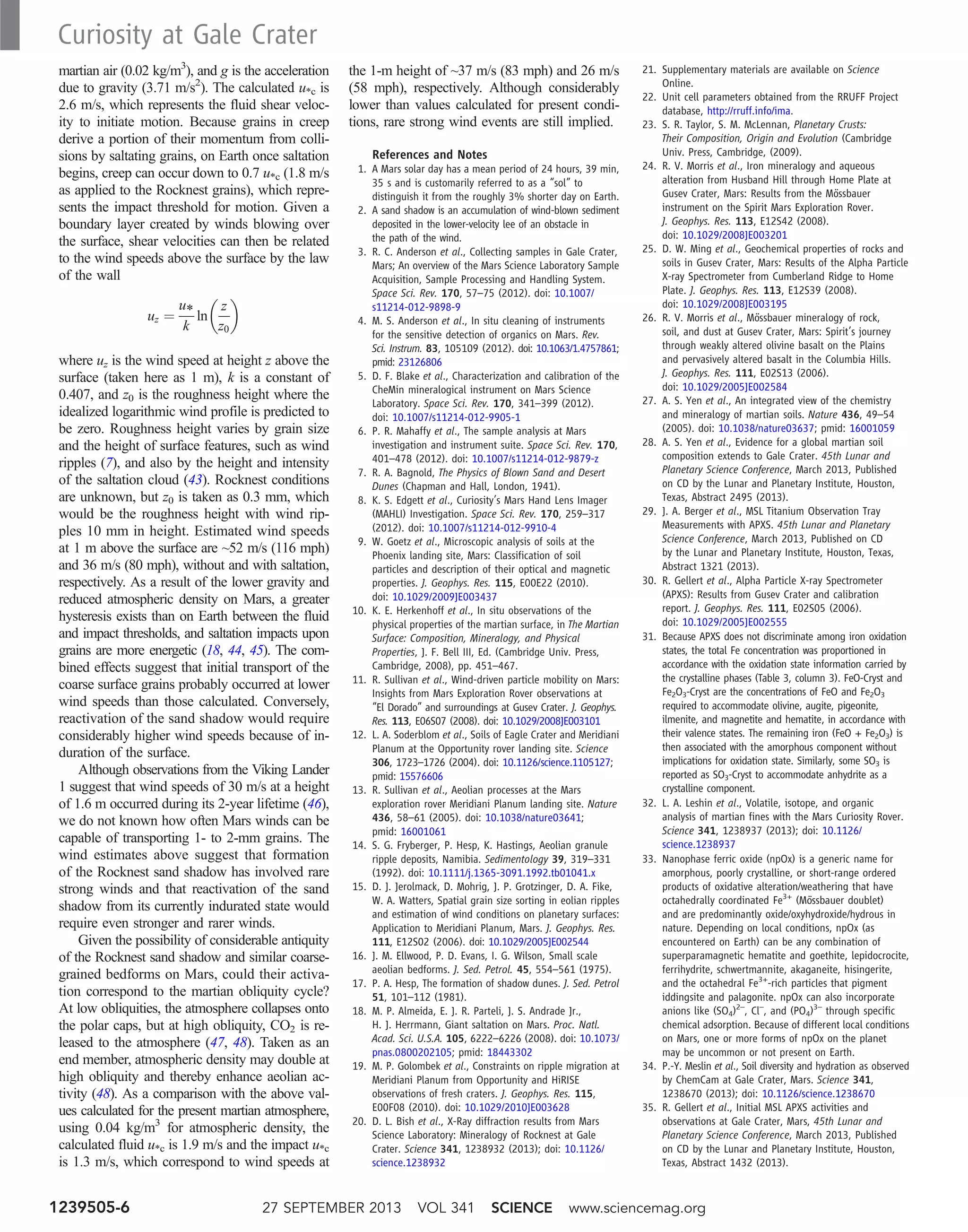
Fe, and Mg at 1050 T 75°C (Fig. 2). This con-
sistency with chemical equilibria suggests, but
does not prove, that these minerals and the plagio-
clase feldspar all derived from a common basaltic
source rock, which was broken down into indi-
vidual grains or lithic fragments and transported
to Rocknest from regional source areas.
Bulk Chemistry of the Rocknest
Sand Shadow
APXS provided an independent means of deter-
mining bulk chemistry of material in the Rock-
nest sand shadow. A measurement was made in
a wheel scuff named Portage, which was largely
devoid of surface crust (Fig. 1A). The chemical
composition (taking into account analytical un-
certainty) is within 2 SD of MER APXS analyses
of basaltic soils (Table 2). The APXS chem-
istry of basaltic soils analyzed by the MERs at
Gusev Crater and Meridiani Planum landing sites
(Table 2) are within 1 SD of each other except
for MgO and Na2O, which are the same within
2 SD (24–28). The MER compositional averages
exclude soils that contain a substantial local com-
ponent (high SO3 and high SiO2 for Gusev and
high Fe2O3 for Meridiani). The near identity of
compositions of the Rocknest, Gusev, and Merid-
ian basaltic soils implies either global-scale mix-
ing of basaltic material or similar regional-scale
basaltic source material or some combination
thereof.
Table 1. Mineralogy of Rocknest soil [CheMin x-ray diffraction (XRD)]
and normative mineralogies of basaltic materials from Gusev Crater
and of martian meteorites. (Rocknest data are amorphous-free values.)
Rocknest soil by CheMin (20), average of scoop 5, proportions of crystalline
phases normalized to 100%; values in italics uncertain. CIPW norms (weight) for
Gusev basaltic materials from MER APXS chemical analyses (26), ignoring S and
Cl; Fe3+
/Fetot for Backstay and Irvine taken as 0.17, the value for an Adirondack
basalt surface ground flat with the MER Rotary Abrasion Tool (RAT) (26). CIPW
norms (wt %) of martian meteorites from bulk compositions; Fe3+
/Fetot as
analyzed for Shergotty and Elephant Moraine (EETA) 79001A, estimated at
0.1 for Northwest Africa (NWA) 6234 and 0 for Queen Alexandra Range (QUE)
94201. K-spar is sanidine for the Rocknest soil, and normative orthoclase for
others. Low-Ca Pyx is pigeonite for the soil and normative hypersthene for
others. High-Ca Pyx is augite for the soil and normative diopside for others.
Fe-Cr oxide includes magnetite, hematite, and chromite. All phosphorus in
analyses are calculated as normative apatite. Mg no. is the % magnesium
substituting for iron in the olivine structure, An refers to the % Ca substituting
for Na in the plagioclase structure.
Location Gale Gusev Meteorites
Sample
Rocknest
sand shadow
Adirondack Backstay Irvine Shergotty
NWA
6234
EETA
79001A
QUE 94210
Quartz 1.4 0 0 0 0.2 0 0 3
Plagioclase 40.8 39 49 32 23 19 19 32
K-spar 1.3 1 6 6 1 0.5 0 0
Low-Ca Pyx 13.9 15 14 21 46 30 47 15
High-Ca Pyx 14.6 15 5 13 25 16 16 38
Olivine 22.4 20 15 16 0 27 13 0
Fe-Cr oxides 3.2 6 4 6 3 4 2 0
Ilmenite 0.9 1 2 2 2 2 1 4
Apatite – 1 3 2 2 2 1 6
Anhydrite 1.5
Mg no. 61 T 3 57 62 55 51 63 63 40
An 57 T 3 42 29 19 51 50 60 62
www.sciencemag.org SCIENCE VOL 341 27 SEPTEMBER 2013 1239505-3
RESEARCH ARTICLE](https://image.slidesharecdn.com/analysisofsurfacematerials-130927072926-phpapp02/75/Analysis-of-Surface-Materials-by-Curiosity-Mars-Rover-Special-Collection-7-2048.jpg)
![In contrast to the APXS measurement at
the Portage wheel scuff, both CheMin and SAM
measurements were carried out on the sieved,
<150-mm-size fraction of soil. To discriminate
potential differences between the fines deliv-
ered to CheMin and SAM and the bulk material
analyzed in the wheel scuff, APXS chemistry
was obtained from portions of sieved material
deposited on the observation tray. APXS spectra
from the bulk and sieved material are nearly iden-
tical, with the exception of a prominent Ti peak
and increased background from the observation
tray (reflecting Ti metal of the tray). Addition-
ally, Ca, Mn, and Fe signals in spectra from the
observation tray are lowered proportionally as
a function of their atomic number, which sug-
gests that a fraction of these grains is smaller
than the APXS sampling depth (29). Slightly ele-
vated S and Cl, with a S/Cl ratio similar to that
found in soils by MERs (30), suggest a potential
enrichment of these two elements in the <150-mm
fraction delivered to the observation tray.
To determine the amount and composition
of the amorphous component, mass balance cal-
culations were performed using the chemical
composition of the bulk sample, the chemical
compositions of the individual phases (e.g., pla-
gioclase, sanidine, and olivine) and the relative
proportions of those phases in the crystalline
component. The empirical formulas of the major
crystalline phases (Table 3) and their chemical
compositions (table S2) were calculated from
cell parameter data (20, 21) (table S1). The chem-
ical formulas and compositions of the minor
crystalline components were assigned by stoi-
chiometry (e.g., ilmenite as TiFeO3). The rela-
tive proportions of amorphous and crystalline
components and their respective bulk compo-
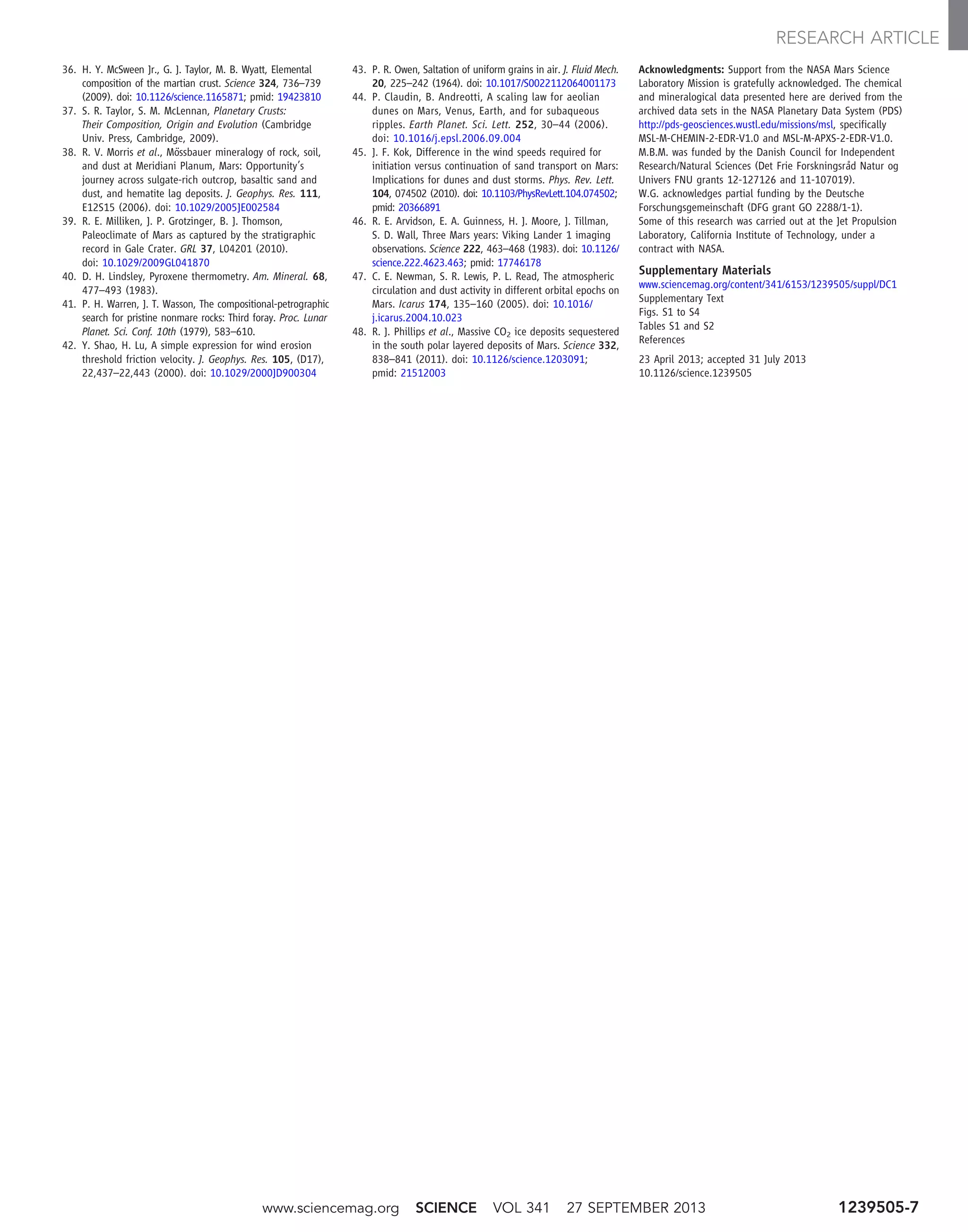
sitions are summarized in Table 4, with Rocknest
having ~45 weight percent (wt %) amorphous
and ~55 wt % crystalline components (31). The
chemical compositions and proportions of amor-
phous and crystalline components were calculated
on a light-element–free basis. The relative propor-
tion of the amorphous component will in reality
be greater than 45 wt % because the volatile in-
ventory is associated with that component (32).
Abundance estimates for the x-ray amorphous
component of a sample may vary considerably,
depending on the method used for their determi-
nation. Bish et al. (20), for example, used a full
pattern-fitting method together with known amor-
phous standard materials analyzed in the labo-
ratory to determine the amount of amorphous
or poorly crystalline material contained in the
CheMin x-ray diffraction pattern. Their reported
value of ~27 wt % T 50% (1 SD range of 13 to
40 wt %), as calculated from diffraction and
scattering data alone, is somewhat lower than
the ~45% calculated from mass balance consid-
erations, but both values are within the combined
analytical uncertainty of the two techniques.
The inferred chemical composition of the amor-
phous component (Table 4) contains ~23% FeO +
Fe2O3, suggesting that ferric nanophase oxide
[npOx (25, 26, 33)] is present in abundance.
Similarly, S (principally contained within the amor-
phous component) is closely associated with the
npOx in dunes at the MER sites (24, 27) as well.
Abundances of SO3 and Cl are correlated in soils
from Gusev and Meridiani, which implies that
both are associated with npOx in the amorphous
component because these elements are not asso-
ciated with Mg, Ca, or Fe in crystalline phases.
The elements Cr, Mn, and P were associated
with the amorphous component (Table 4), but
Table 2. Basaltic soil compositions from APXS analyses for Rocknest Portage, Gusev Crater,
and Meridiani Planum.
Rocknest Gusev Meridiani
Number 1* 48†
29†
SiO2 (wt %) 42.88 T 0.47 46.1 T 0.9 45.7 T 1.3
TiO2 1.19 T 0.03 0.88 T 0.19 1.03 T 0.12
Al2O3 9.43 T 0.14 10.19 T 0.69 9.25 T 0.50
Cr2O3 0.49 T 0.02 0.33 T 0.07 0.41 T 0.06
Fe2O3 + FeO 19.19 T 0.12 16.3 T 1.1 18.8 T 1.2
MnO 0.41 T 0.01 0.32 T 0.03 0.37 T 0.02
MgO 8.69 T 0.14 8.67 T 0.60 7.38 T 0.29
CaO 7.28 T 0.07 6.30 T 0.29 6.93 T 0.32
Na2O 2.72 T 0.10 3.01 T 0.30 2.21 T 0.18
K2O 0.49 T 0.01 0.44 T 0.07 0.48 T 0.05
P2O5 0.94 T 0.03 0.91 T 0.31 0.84 T 0.06
SO3 5.45 T 0.10 5.78 T 1.25 5.83 T 1.04
Cl 0.69 T 0.02 0.70 T 0.16 0.65 T 0.09
Br (mg/g) 26 T 6 53 T 46 100 T 111
Ni 446 T 29 476 T 142 457 T 97
Zn 337 T 17 270 T 90 309 T 87
Sum (wt %) 99.85 99.88 99.88
Cl/SO3 0.13 T 0.02 0.12 T 0.02 0.11 T 0.01
*Gellert et al., 2013 (35); analytical uncertainty. †T1SD of average.
Table 3. Empirical chemical formulas of the four
major phases identified in the Rocknest soil
estimated by crystal-chemical techniques.
Phase Formula
Olivine (Mg0.62(3)Fe0.38)2SiO4
Plagioclase (Ca0.57(13)Na0.43)(Al1.57Si2.43)O8
Augite (Ca0.75(4)Mg0.88(10)Fe0.37)Si2O6
Pigeonite (Mg1.13(9)Fe0.68(10)Ca0.19)Si2O6
Fig. 2. Pyroxene compositional quadrilateral, showing the chemical and thermal relations be-
tween the major igneous minerals in the Rocknest sand shadow. Compositions of augite, pigeonite,
and olivine in the Rocknest dune material, plotted on the pyroxene quadrilateral. En, enstatite, Mg2Si2O6;
Di, diopside, CaMgSi2O6; Hd, hedenbergite, CaFeSi2O6; and Fs, ferrosilite, Fe2Si2O6. Pyroxenes are plotted
within the quadrangle, based on CheMin XRD unit-cell parameters; olivine is plotted below the quad-
rilateral at the appropriate molar Mg/Fe ratio (20). Ellipses for each mineral approximate the uncer-
tainties in mineral compositions from their unit-cell parameters. Gray background lines represent the
surface of the pyroxene solvus, with temperatures in °C (40). Red lines are approximate equilibrium tie
lines from the augite centroid composition to compositions of olivine and pigeonite, based on similar
tie lines in an equilibrated anorthosite in lunar sample 62236 (41).
27 SEPTEMBER 2013 VOL 341 SCIENCE www.sciencemag.org1239505-4
Curiosity at Gale Crater](https://image.slidesharecdn.com/analysisofsurfacematerials-130927072926-phpapp02/75/Analysis-of-Surface-Materials-by-Curiosity-Mars-Rover-Special-Collection-8-2048.jpg)
![they could instead be present as crystalline phases
(e.g., Ca-phosphate and chromite) at abundances
below the CheMin detection limit and/or as sub-
stitutional impurities in the major crystalline phases
(e.g., Mn and Cr in pyroxene).
The SAM instrument analyzed Rocknest for
volatile species and organic molecules (32), and
it detected, in order of decreasing abundance,
H2O, SO2, CO2, and O2. The crystalline phases,
aside from a minor anhydrite component, do not
include these species as a part of their structure,
so they must either be present in the amorphous
component or be present in the crystalline com-
ponent at levels below the XRD detection limit,
or both.
ChemCam spot observations in the scoop
walls of Rocknest are characterized by the strong
emissions from elemental hydrogen, although
ChemCam is not sensitive to its bonding state (34).
Comparison of this result with those of CheMin
and SAM suggests that ChemCam detections
of hydrogen most likely correspond to the H2O
associated with the amorphous component de-
tected by CheMin.
Discussion
Global, Regional, and Local Sources
The crystalline phases in the Rocknest fines are
consistent with a basaltic source and fit well
within the measured qualitative mineralogy of
basaltic martian meteorites and the normative
mineralogy of Adirondack class olivine basalts
at Gusev Crater (25) (Table 1). If the Rocknest
assemblage of basaltic crystalline and amorphous
components is locally derived, it is distinct from
mafic float rocks analyzed to date by APXS and
ChemCam in Gale Crater (34, 35). This obser-
vation suggests that the similarity in the chem-
ical compositions of aeolian bedforms (basaltic
soil) at Gale, Gusev, and Meridiani (Table 2)
might result from global-scale aeolian mixing
of local-to-regional basaltic material that may
or may not have variable chemical composi-
tions. This process would require sufficiently
strong winds occurring with sufficient frequen-
cy over a long enough time to achieve global or
regional-scale transport of grains by saltation and
suspension.
An alternative explanation for the compara-
ble chemical compositions of aeolian bedforms
at Gale, Gusev, and Meridiani is that the chem-
ical compositions of martian basalts are similar
at regional scales everywhere on the planet. The
Rocknest sand shadow could reasonably have
locally sourced 1- to 2-mm particles, with finer-
grained regional basaltic material plus a contri-
bution from global dust. The similarity of soil
compositions (Table 2) suggests that the basaltic
fine-grained materials at Gusev, Meridiani, and
Gale Crater provide a reasonable approximation
to the bulk composition of the exposed martian
crust (36, 37).
It is tempting to suggest that the light-toned
martian dust is largely represented by the Rocknest
amorphous component. However, we have no
data to show that the <150-mm size fraction (clay
to fine-sand size fraction) of material analyzed
by CheMin has its finest material preferential-
ly enriched in amorphous material. The evi-
dence from MER for basaltic soils suggests that
the chemical composition of the fine-grained,
light-toned soil is approximately the same as the
coarser-grained, dark-toned soils [e.g., table 10
in (38)].
The central mound of Gale Crater (Mt. Sharp
or Aeolis Mons) exhibits reflectance spectra sug-
gesting the presence of crystalline hydrated sul-
fate minerals and phyllosilicates (39), but neither
was seen in Rocknest (above the 1 to 2% level).
The absence of material from Mt. Sharp could
arise from the wind pattern during formation
of the Rocknest sand shadow; it is oriented so
as to imply sediment transport from the north,
and Mt. Sharp is east and southeast of Rocknest.
Materials and Methods
Calculation of Wind Speeds Required
to Form the Rocknest Sand Shadow
The wind velocity required to move the coarse
grains of the sand shadow by creep can be cal-
culated. The critical shear velocity (u*c) of the
wind needed to transport 1-mm-diameter (d) grains
is given by (42) as
u*c ¼
ffiffiffiffiffiffiffiffiffiffiffiffiffiffiffiffiffiffiffiffiffiffiffiffiffiffiffiffiffiffiffiffiffiffiffiffiffiffiffiffiffiffiffiffiffiffiffiffiffiffiffiffiffiffiffiffiffiffiffiffi
0:0123 sgd þ
0:0003 kg=s2
˜nf d
!v
u
u
t
where s ¼ ˜ns=˜nf , ˜ns is the density of the grains
using basalt (3000 kg/m3
), ˜nf is the density of
Table 4. Chemical composition and proportion of XRD amorphous component in Rocknest Portage from APXS and CheMin data.
Origin Remove XRD crystalline component* Composition
APXS† APXS+
CheMin
Plagio-
clase
San-
idine
Olivine Augite
Pigeon-
ite
Ilmen-
ite
Hema-
tite
Mag-
netite
Anhy-
drite
Quartz
Amor-
phous‡
Crystal-
line
SiO2, wt % 42.88 42.88 30.88 30.42 25.95 21.63 17.51 17.51 17.51 17.51 17.51 16.76 37.20 47.59
TiO2 1.19 1.19 1.19 1.19 1.19 1.19 1.19 0.93 0.93 0.93 0.93 0.93 2.06 0.47
Al2O3 9.43 9.43 2.85 2.72 2.72 2.72 2.72 2.72 2.72 2.72 2.72 2.72 6.04 12.24
Cr2O3 0.49 0.49 0.49 0.49 0.49 0.49 0.49 0.49 0.49 0.49 0.49 0.49 1.09 0.00
FeO+Fe2O3
§
19.19 10.43 10.43 10.43 10.43 10.43 10.43 10.43 10.43 10.43 10.43 10.43 23.14 -0.10
FeO-Cryst||
— 7.37 7.37 7.37 3.31 2.29 0.59 0.35 0.35 0.00 0.00 0.00 -0.01 13.48
Fe2O3-Cryst¶
— 1.39 1.39 1.39 1.39 1.39 1.39 1.39 0.79 0.00 0.00 0.00 -0.01 2.55
MnO 0.41 0.41 0.41 0.41 0.41 0.41 0.41 0.41 0.41 0.41 0.41 0.41 0.91 0.00
MgO 8.69 8.69 8.69 8.69 4.97 3.72 2.19 2.19 2.19 2.19 2.19 2.19 4.86 11.86
CaO 7.28 7.28 4.65 4.65 4.65 3.19 2.87 2.87 2.87 2.87 2.53 2.53 5.61 8.67
Na2O 2.72 2.72 1.62 1.60 1.60 1.60 1.60 1.60 1.60 1.60 1.60 1.60 3.56 2.03
K2O 0.49 0.49 0.49 0.40 0.40 0.40 0.40 0.40 0.40 0.40 0.40 0.40 0.89 0.16
P2O5 0.94 0.94 0.94 0.94 0.94 0.94 0.94 0.94 0.94 0.94 0.94 0.94 2.09 -0.01
SO3 5.45 4.96 4.96 4.96 4.96 4.96 4.96 4.96 4.96 4.96 4.96 4.96 11.01 -0.05
SO3-Cryst#
— 0.49 0.49 0.49 0.49 0.49 0.49 0.49 0.49 0.49 0.00 0.00 -0.01 0.90
Cl 0.61 0.61 0.61 0.61 0.61 0.61 0.61 0.61 0.61 0.61 0.61 0.61 1.35 -0.01
Sum 99.77 99.77 77.47 76.77 64.52 56.47 48.80 48.30 47.70 46.55 45.71 44.96 99.77 99.77
∑(FeO+Fe2O3) 19.19 19.19 — — — — — — — — — — 23.14 16.03
∑(SO3) 5.54 5.54 — — — — — — — — — — 11.01 0.90
Relative to whole sample 22.3 0.7 12.3 8.0 7.6 0.5 0.6 1.2 0.8 0.8 45.3 54.7
Relative to XRD crystalline 40.8 1.3 22.4 14.6 13.9 0.9 1.1 2.1 1.5 1.4 — 100.0
*Plagioclase, An57; Olivine, Fo62; Augite, En44Fs20Wo36 (Mg/Fe, 2.2 atomic); Pigeonite, En56Fs35Wo8 (Fe/Mg, 1.6 atomic). †APXS chemistry from Gellert et al. (35). ‡Cr2O3 and
MnO calculated with the amorphous component. §Total Fe as FeO+Fe2O3 because APXS does not distinguish oxidation states. ||FeO required for Fe2+
crystalline phases (olivine,
augite, pigeonite, ilmenite, and magnetite). ¶Fe2O3 required for Fe3+
crystalline phases (hematite and magnetite). #SO3 required for crystalline SO3 crystalline phase (anhydrite).
www.sciencemag.org SCIENCE VOL 341 27 SEPTEMBER 2013 1239505-5
RESEARCH ARTICLE](https://image.slidesharecdn.com/analysisofsurfacematerials-130927072926-phpapp02/75/Analysis-of-Surface-Materials-by-Curiosity-Mars-Rover-Special-Collection-9-2048.jpg)
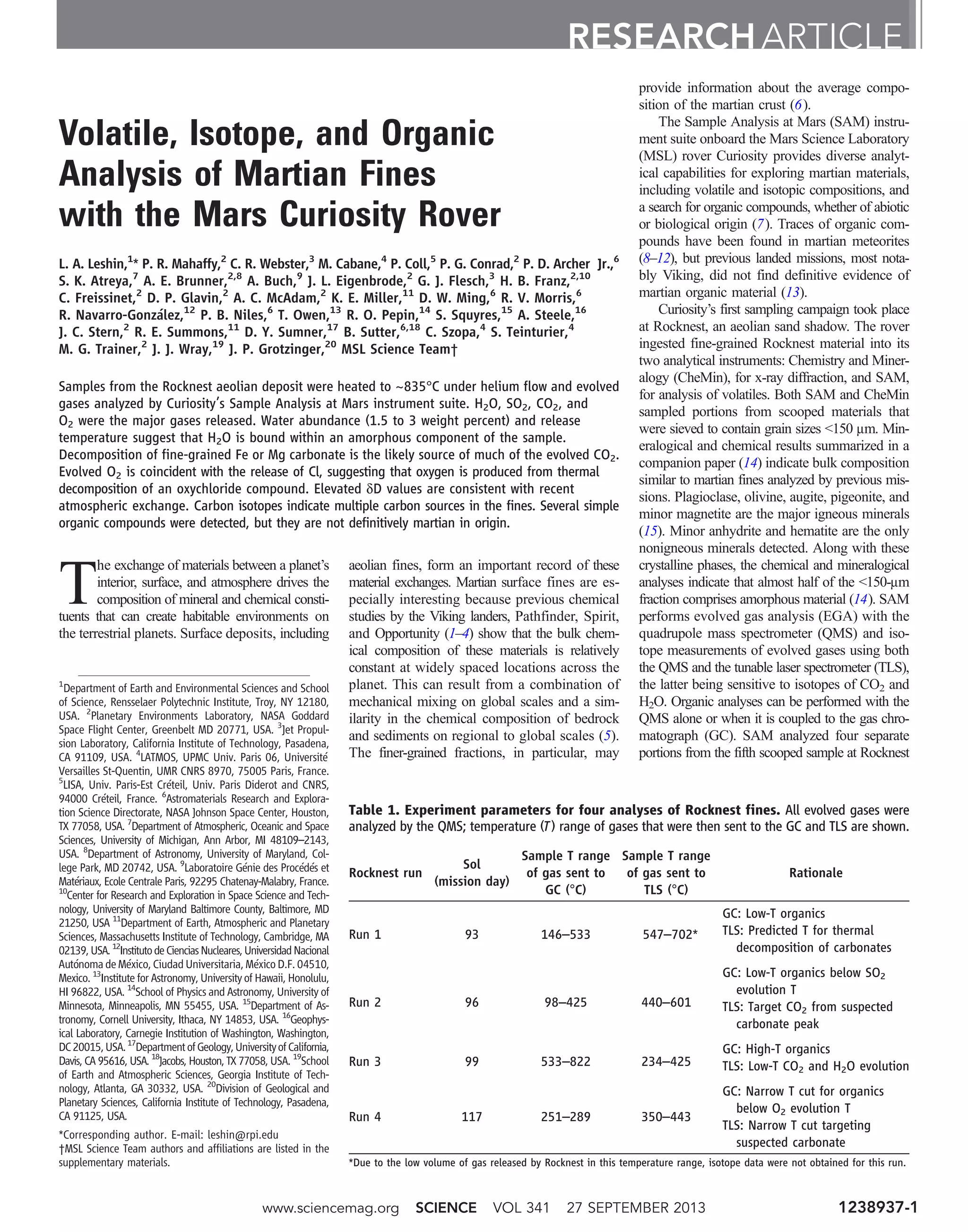
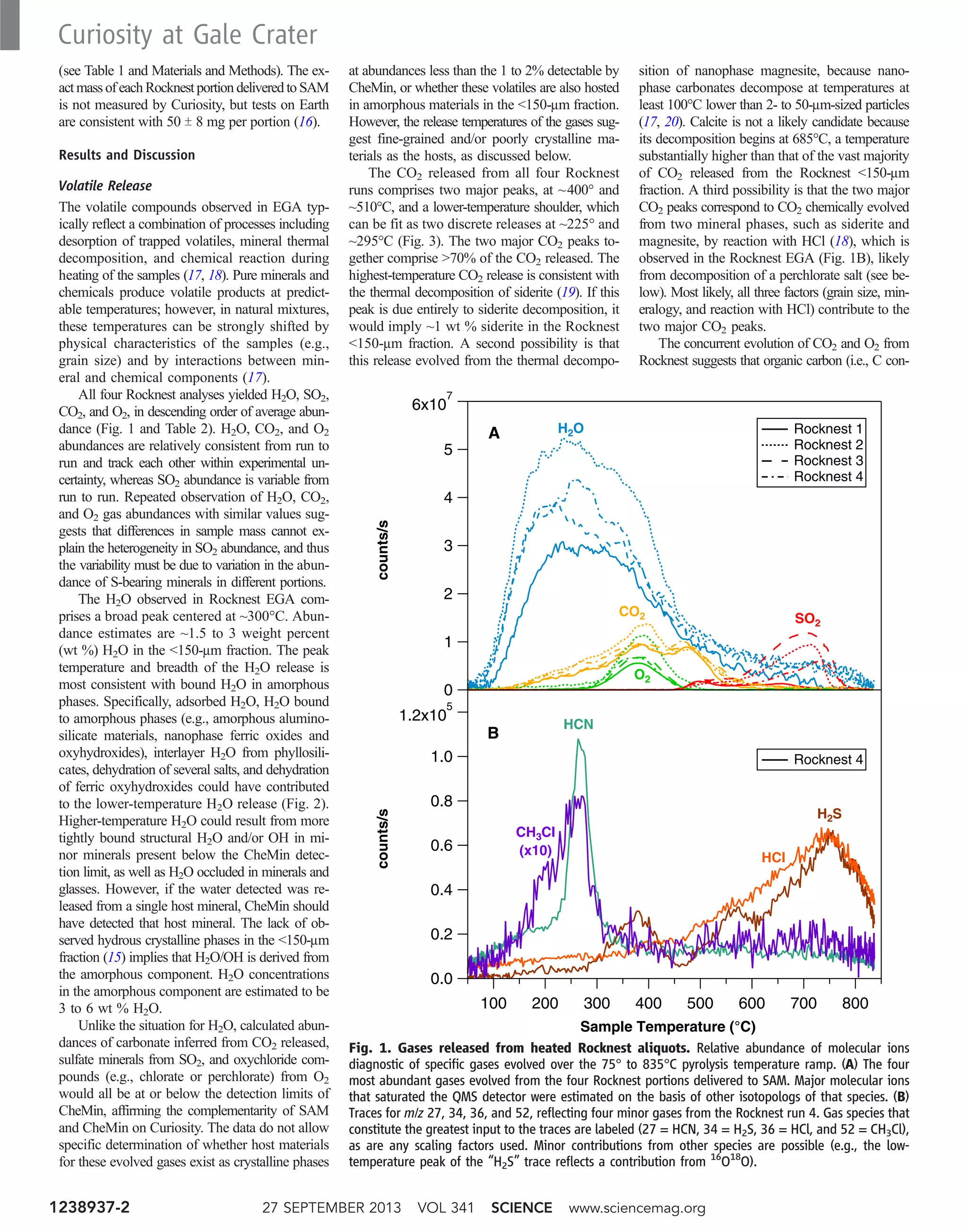
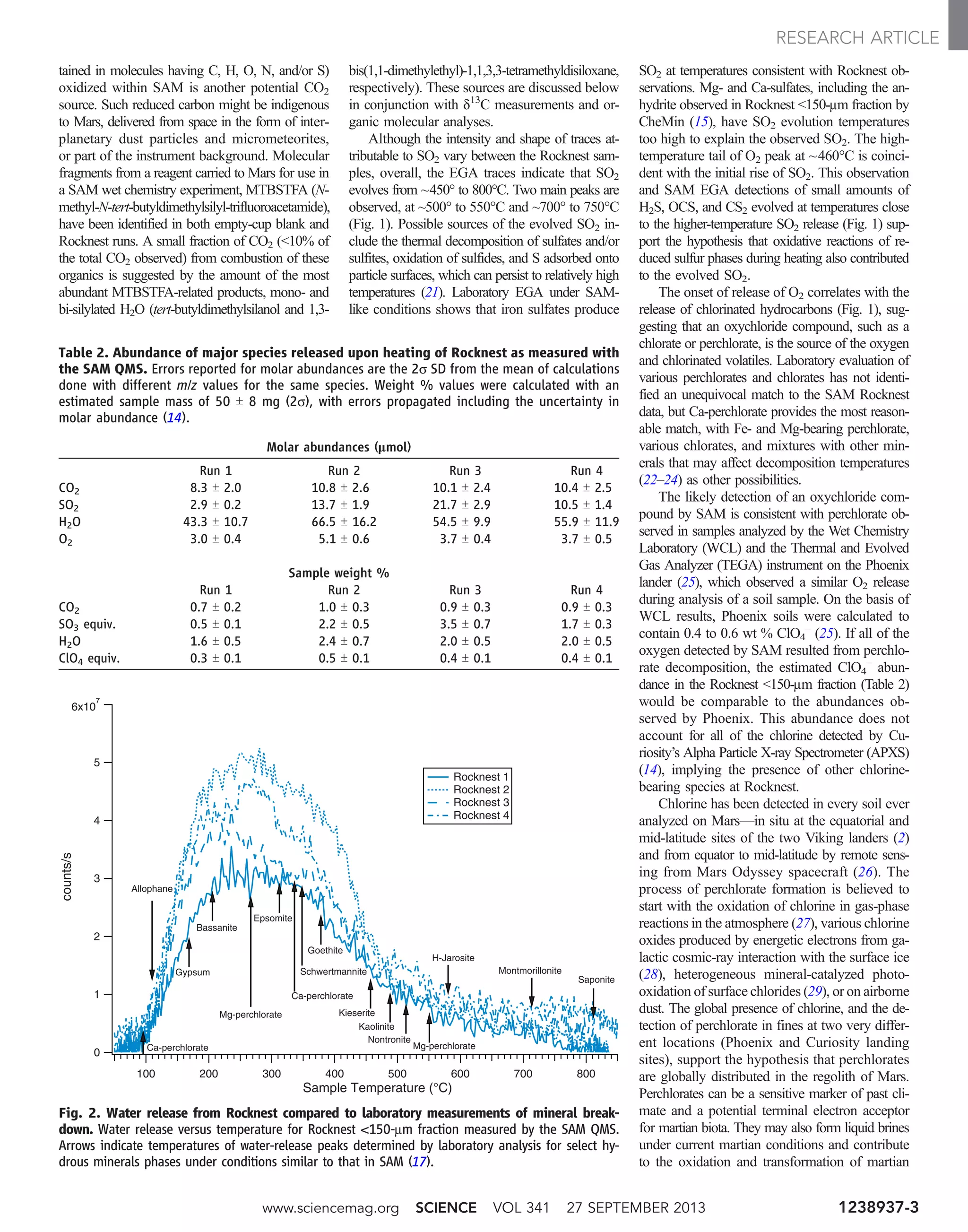
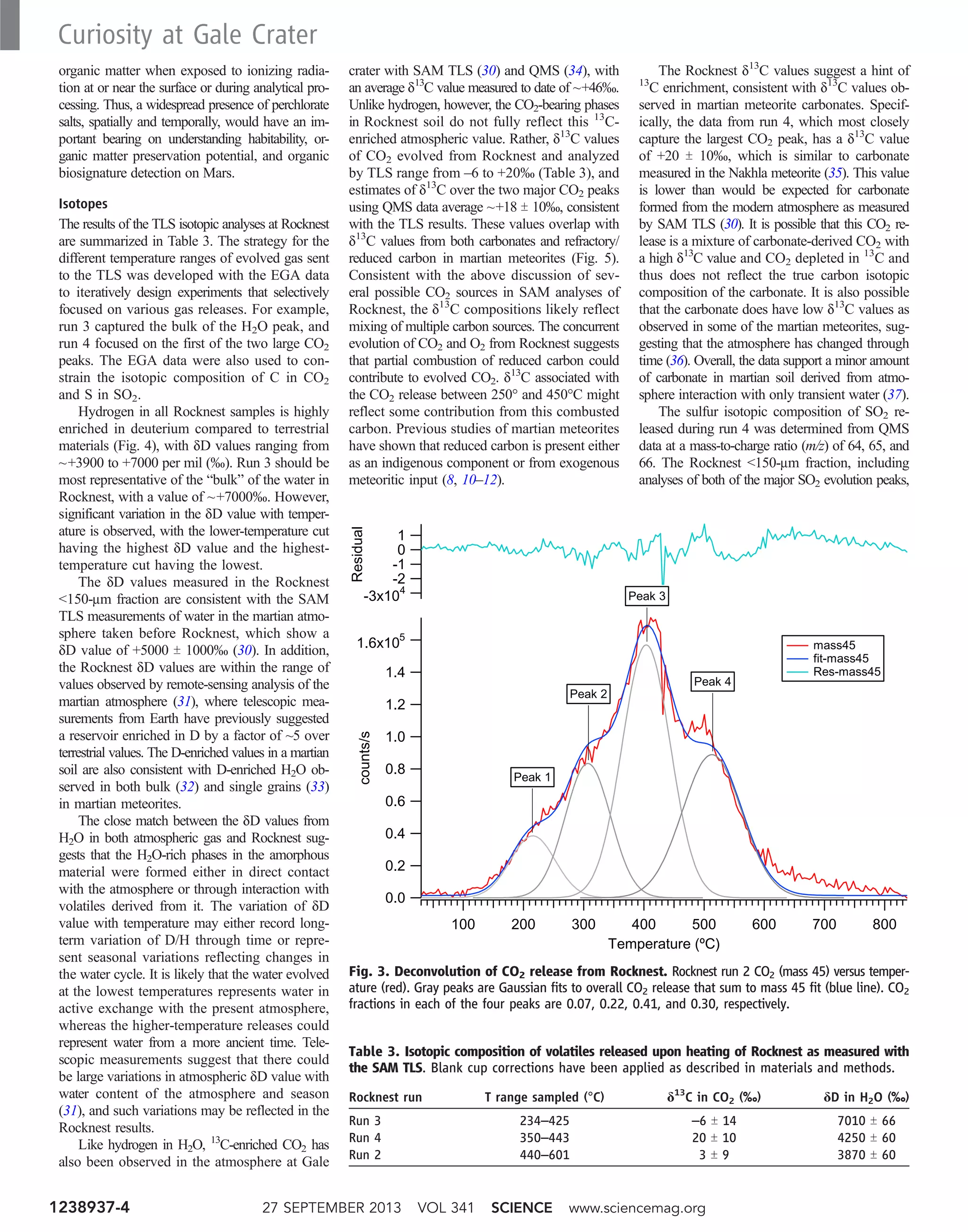
![through a capillary flow restrictor. This experi-
ment is referred to as evolved gas analysis and
produced data in the form of pyrograms for in-
dividual ions defined by their m/z ratios. The main
split of evolved gas was then passed through gas
manifolds heated at 135°C to either the hydrocarbon
trap for GC analysis or the TLS Herriot cell for
isotopic and mixing-ratio measurements of H2O,
CO2, or O2, or vented to Mars. For each analyt-
ical run, different temperature cuts of gas were
selected to go to the GC or TLS, but in no case was
the gas sent to both at the same time. Temperature
cuts for the GC and TLS are listed in Table 1.
Figures 2 and 3 show detailed analyses of the
H2O and CO2 releases, respectively. The plot of
H2O release in Fig. 2 is generated with the QMS
data from m/z 20, because the molecular ion for
H2O (m/z 18) is saturated in these runs. The re-
lease temperatures of various hydrous mineral
phases marked on the plot are derived from lab-
oratory measurements performed under condi-
tions similar to those for the EGA in SAM. These
were typically determined for single minerals,
and mineral mixtures and grain-size effects can
change these values. Nonetheless, the broad H2O
release peak is not clearly indicative of any one
mineral phase. Figure 3 shows evolved CO2 (m/z
45) as a function of temperature for Rocknest
run #2, for which four discrete peaks can be fit
to Gaussian peak shape to model the summed
CO2 release. The integrated areas for the fitted
peaks are used to quantify the contributions from
each release event to the total abundance of evolved
CO2. Although it is not possible to assign defin-
itively specific species to each of the four peaks,
oxidized organics (terrestrial or martian) and sev-
eral types are carbonate are discussed in the text
as likely contributing to the CO2 peaks, especially
the two major peaks.
Methods for Molar Abundance Calculations
Molar abundances were primarily computed by
referencing measurements on Mars to pre-launch
SAM calibration runs of quantified samples of
calcite (CaCO3) and a hydrated iron sulfate
(FeSO4·4H2O) (6). A calibration factor [counts
per second (cps)/mol] was determined for the
relevant m/z value in laboratory standard runs
by integrating under the evolved gas curve and
dividing by the number of moles evolved from
the sample, assuming complete decomposition.
Under nominal SAM operating conditions,
the most abundant ion of major species (e.g., m/z
18 for H2O) often saturates the detector. Given a
fixed detector range, this makes the instrument
more sensitive to low-abundance materials. To
quantify amounts with high abundances, doubly
ionized molecules, ion fragments, and isotopes
were used to calculate evolved gas abundances.
For example, m/z 44 (CO2
+
) saturated the de-
tector for most of the Rocknest runs because the
amount of CO2 evolved exceeded detector lim-
its. To quantify the abundance of CO2, m/z 12 (C+
),
m/z 22 (CO2
2+
), and m/z 45 and 46 (isotopologs
of CO2) were used instead of m/z 44. The num-
ber of moles of CO2 evolved from Rocknest sam-
ples was determined by taking an average of the
total areas calculated for each m/z listed above.
The error was calculated as 2s SD from the mean.
For H2O, m/z 19 and 20 were used because m/z
17 and 18 were saturated, in both Rocknest and
earlier laboratory calibration runs. To calculate SO2
abundances, m/z 66 and 50 were used (isotopologs
of SO2 and SO) because m/z 64 and 48 saturated
in calibration runs.
There are two additional complications en-
countered when calculating H2O abundances.
First, FeSO4·4H2O begins to lose H2O as soon it
is exposed to lower pressures, which is before the
QMS begins monitoring gas evolution. Fortu-
nately, there is a very distinct and repeatable H2O
release at slightly higher temperatures (~200°C)
with a measurable mass loss. This H2O release
was used to calibrate Rocknest data. Second, Mars
has a much higher D/H ratio than Earth, which
can affect peak integration values, especially for
m/z 19 (HDO). We corrected for this effect when
calculating the water abundances on Mars using
QMS data during EGA. The differences in the
d18
O, d13
C, and d34
S isotopic values between Earth
and Mars are small compared to the other un-
certainties involved in these abundance calcula-
tions and, therefore, were not included.
Oxygen abundance values were calculated
in a slightly different way because none of the
minerals run during prelaunch testing released
O2. However, a separate prelaunch characteriza-
tion run was done with an equimolar gas mix of
O2, CO2, Ar, and N2. These data were used to
determine relative calibration factors for the major
atmospheric species, as discussed in Mahaffy et al.
(34). Such calibration factors yield a value for rel-
ative ionization rates for O2 and CO2 at equivalent
abundances, which were applied to the EGA data
to determine calibration factors for O2 in cps/mol.
Isotope Data Reporting Convention
All isotope results are presented in standard delta
notation (dD, d13
C, d34
S) with respect to Vienna
standard mean ocean water (VSMOW) for hy-
drogen, Vienna Pee Dee belemnite (VPDB) for
carbon, and Vienna Cañon Diablo troilite (VCDT)
for sulfur. Here, d(‰) = [Rmeas/Rstd – 1] × 1000,
where Rmeas is the measured isotope ratio (heavy/
light), and Rstd is the ratio of the relevant refer-
ence standard.
TLS Operational Conditions
and Data Reduction
TLS is a two-channel tunable laser spectrometer
that uses direct and second harmonic detection
of infrared laser light absorbed after multipass-
ing a sample cell. For the results reported here,
the sample cell path length is 43 passes of a
~19.5-cm cell length, or 840 cm. TLS scans over
individual rovibrational lines in two spectral re-
gions near 2.78 mm; one centered at 3590 cm−1
for
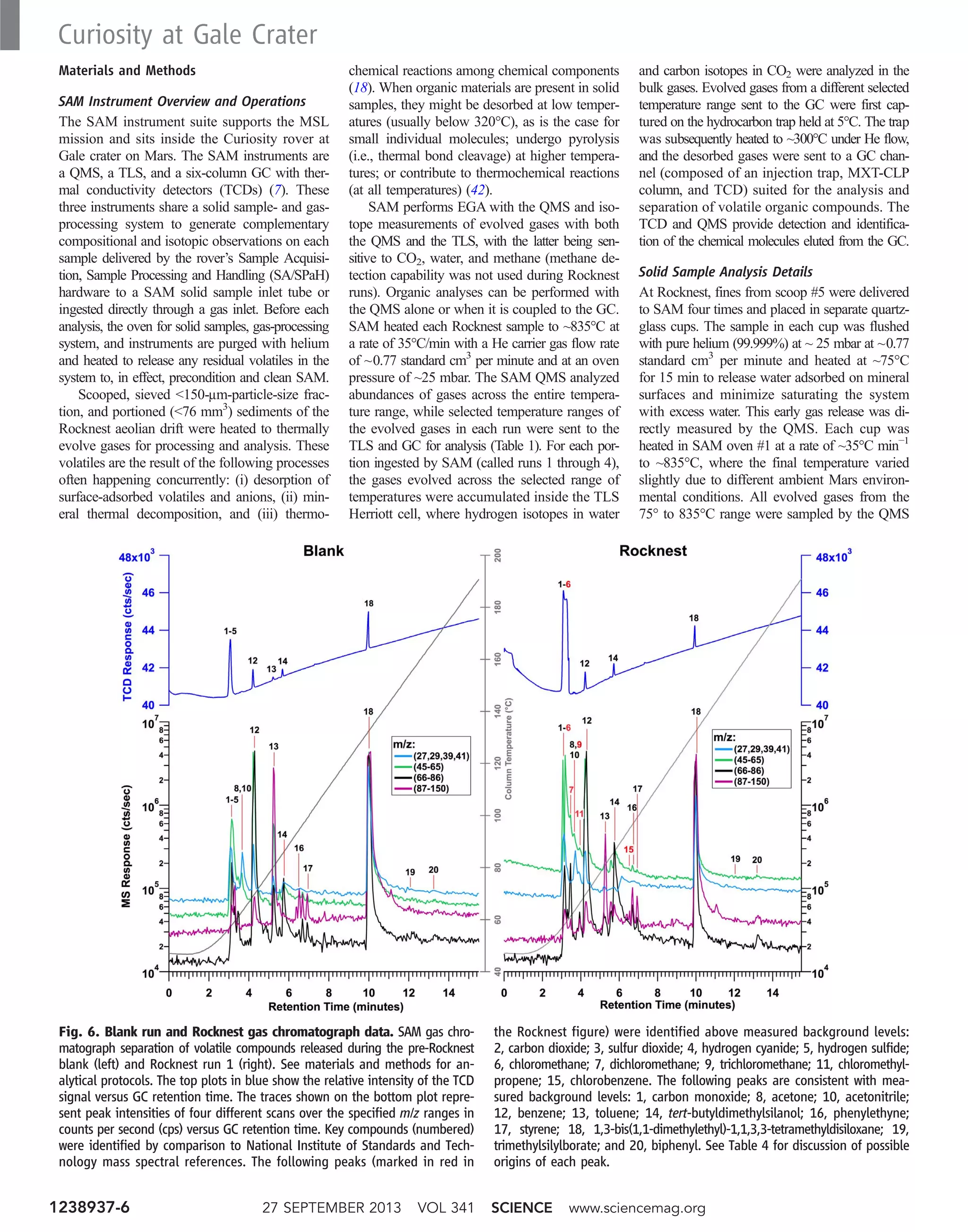
Table 4. Inorganic and organic volatile species detected by the SAM GC-MS upon heating of
Rocknest and their possible origins. MTBSTFA (N-tert-butyldimethylsilyl-N-methyltrifluoroacetamide)
and DMF (dimethylformamide) are both carried within SAM for future derivatization experiments.
Tenax TA is a porous polymer adsorbent resin used to concentrate organic compounds on the SAM
hydrocarbon traps. Those sources that are known to be terrestrial in origin are shown in italics.
Compounds in bold are observed above measured background levels.
Peak no. from
Fig. 6
Compound Possible origin(s)
1 Carbon monoxide Unknown
2 Carbon dioxide
Martian carbonates/carbon?,
MTBSTFA or DMF
3 Sulfur dioxide Martian S-bearing minerals
4 Hydrogen cyanide
MTBSTFA + perchlorate or high-T
martian source?
5 Hydrogen sulfide Product of S-bearing minerals
6 Chloromethane MTBSTFA or martian carbon? + perchlorates
7 Dichloromethane MTBSTFA or martian carbon? + perchlorates
8 Acetone MTBSTFA or DMF
9 Trichloromethane MTBSTFA or martian carbon? + perchlorates
10 Acetonitrile MTBSTFA or DMF
11 Chloromethylpropene MTBSTFA + perchlorates
12 Benzene Tenax TA
13 Toluene Tenax TA
14 tert-Butyldimethylsilanol MTBSTFA + water
15 Chlorobenzene HCl + Cl2 + Tenax TA
16 Phenylethyne Tenax TA
17 Styrene Tenax TA
18
1,3-bis(1,1-dimethylethyl)-
1,1,3,3-tetramethyldisiloxane
MTBSTFA + water
19 Trimethylsilylborate MTBSTFA + glass beads
20 Biphenyl Tenax TA
www.sciencemag.org SCIENCE VOL 341 27 SEPTEMBER 2013 1238937-7
RESEARCH ARTICLE](https://image.slidesharecdn.com/analysisofsurfacematerials-130927072926-phpapp02/75/Analysis-of-Surface-Materials-by-Curiosity-Mars-Rover-Special-Collection-19-2048.jpg)
![CO2 isotopes, and a second centered at 3594 cm−1
for both CO2 and H2O isotopes. The lines used in
both regions have no discernable interferences.
In the 3594-cm−1
region, the CO2 and H2O lines
used interleave across the spectrum without inter-
ference, allowing determination of isotope ratios
across widely varying CO2 and H2O abundances in
both atmospheric and evolved gas experiments. For
carbon isotopes, the values given are the weighted
means of two separate pairs of lines, one pair from
each region. Further data-processing details and
calibration are described in the supplementary ma-
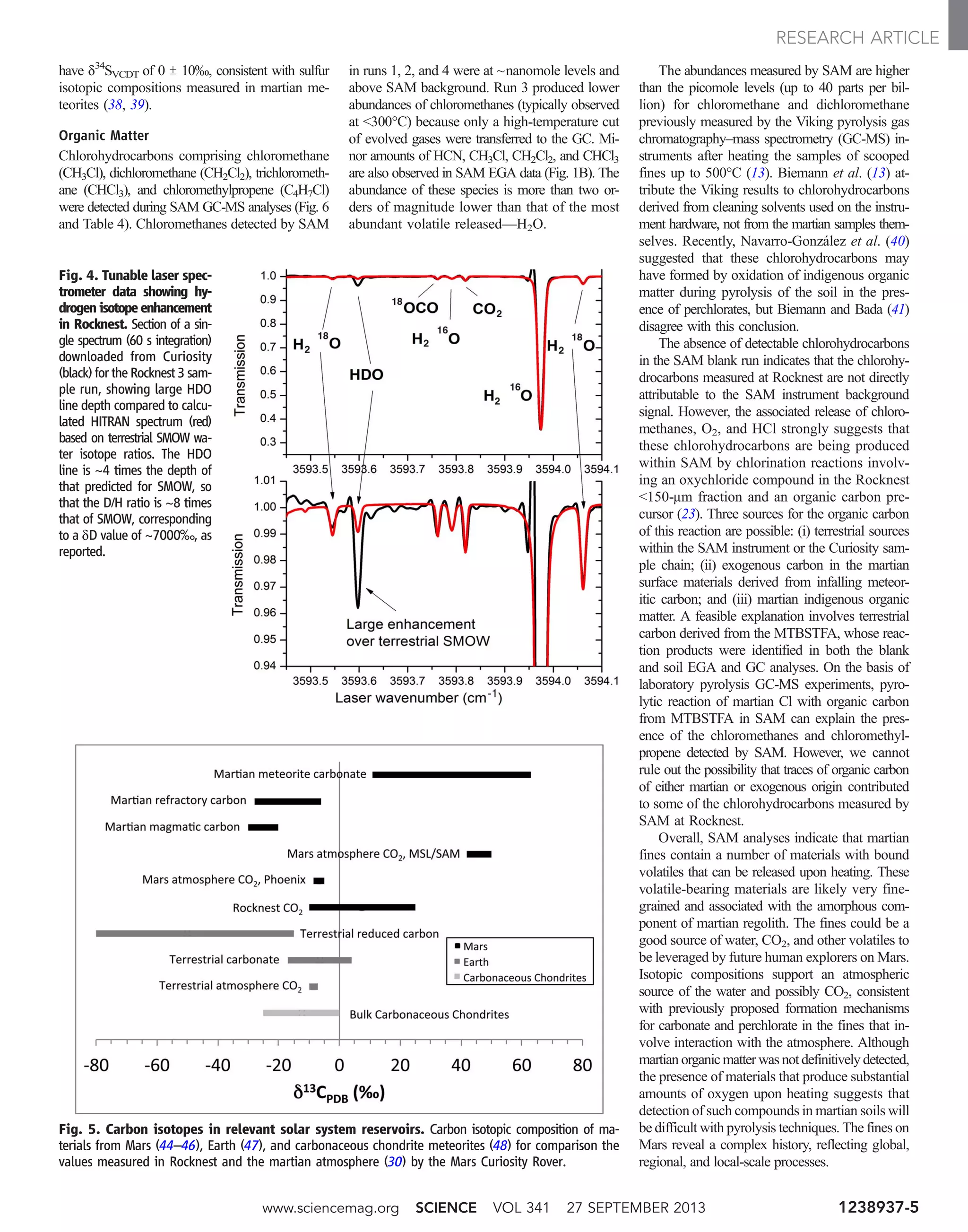
terials accompanying Webster et al. (30). Figure 4
is a good example of a TLS flight spectrum used
for isotope ratio measurement, showing the large
enhancement of the HDO line over that expected
(HITRAN database) for terrestrial water.
The TLS sample cell (Herriott cell) is first
pumped out by using the SAM turbomolecular
pump with empty cell pressures of CO2 and
H2O that are insignificant compared to either
EGA or “blank cup” runs. At some predeter-
mined time during either the four EGA or single
blank cup runs, temperature cuts of evolved
gas are sent to the TLS (Table 1), where they
produced Herriott cell pressures of 4 to 9 mbar
of principally helium, with evolved water and
carbon dioxide as minor components. Before
the Rocknest EGA runs reported here, a blank
cup run was conducted under the identical con-
ditions (He flow, temperature cut, pressure, etc.)
but without solid sample in the pyrolysis oven.
Resulting signals (abundances) for CO2 and
H2O were not large compared to the Rocknest
abundance values, and isotope values are sim-
ilar to those of the samples, but nonetheless it
is appropriate to make a correction. This cor-
rection was weighted by the relative abundance
of the gas of interest. Specifically, the H2O
abundances in the blank were ~3% of the total
water measured, and the CO2 abundances were
~5 to 10% of the total CO2 measured in Rocknest
aliquots. Blank cup values for measured d13
C in
CO2 was –80‰ and dD in H2O was 3880‰. The
TLS measured results are therefore the combi-
nation of an underlying background (blank cup)
contribution and the Rocknest sample contribu-
tion in proportions dependent on the relative
abundances of water and carbon dioxide from
each. Because the blank cup abundances of these
gases is much smaller than those evolved from
the Rocknest samples, the corrections to the mea-
sured isotope ratios are usually small. Given the
small abundance of H2O and CO2 in the blank,
the blank isotope values have relatively large un-
certainties, and these are propagated through the
correction calculation. The results given in Table 3
are the Rocknest sample isotope ratios after cor-
rection for the blank cup values.
QMS Isotope Value Calculations
Isotope ratios from QMS data obtained through
EGA of solid samples are computed from the
time-integrated signal at isotopologs for the com-
pounds of interest. For CO2, the 13
C/12
C ratio is
determined from m/z 45 and 46, with correction
for oxygen contributions based on the most rele-
vant TLS measurements of the oxygen isotopic
composition in CO2. The values of d13
C given
in the main text were computed on the basis of
an estimated d18
O value of –28‰, as determined
by the TLS for CO2 released during Rocknest 4,
because the gas sample sent to TLS during this
run was the most representative of the peak CO2
release from Rocknest samples. The carbon
isotopic composition of CO2 during these runs
cannot be calculated from the more typical pairs
of m/z 12-13 or 44-45 because of interference
from MTBSTFA background at m/z 13 and de-
tector saturation at m/z 44.
For SO2, the 34
S/32
S ratio is computed from
m/z 64-66, with correction for oxygen contribu-
tions (assumed d18
O of 50 T 5‰) based on TLS
measurements of the oxygen isotopic composi-
tion of both CO2 and H2O in the martian atmo-
sphere. For both CO2 and SO2, 17
O contributions
were estimated from the assumed d18
O on the
basis of a D17
O of 0.32‰, the average for martian
silicates (43).
GC-TCD and GC-MS Operational Conditions
The SAM GC hydrocarbon trap consists of three
layers: nonporous silica beads, Tenax TA adsorbant
(porous 2.6-diphenylene oxide polymer resin),
and Carbonsieve G adsorbant (graphitized car-
bon) (7). Gases were passed through the hydro-
carbon trap that had been cooled to 5°C and
selectively condensed onto glass beads or adsorbed
on the basis of volatility, molecular size, and chem-
istry. Thermal desorption at 300°C for 4 min under
He (0.5 standard cm3
per minute, 0.9 bar) re-
leased analytes from the hydrocarbon trap in the
opposite direction. Analytes then collected on a
Tenax TA injection trap of the GC. The injection
trap was then flash heated to 300°C. All four
Rocknest GC analyses used the MTX-CLP col-
umn (30-m length, 0.25-mm internal diameter,
0.25-mm film thickness), which has a polydime-
thylsiloxane with phenyl and cyanopropyle film
(7) and is designed for separating mid–molecular
weight hydrocarbons. The column temperature was
programmed from 50° to 220°C at 10°C min−1
and He carrier gas was held at a constant column
inlet pressure of 0.9 bar. Gases eluting from the
GC were nondestructively detected by the TCD
and then ionized by electron impact at 70 eV in
the QMS source, which fragmented molecules in
a predictable fashion. The QMS scanned for ions
in a m/z range of 2 to 535 using the Smart Scanning
algorithm previously described (7). The GC-TCD
result is shown as a single chromatogram for all de-
tected molecules in which the retention time (x axis)
is normalized to the GC retention time. GC-MS re-
sults are given as individual ion chromatograms
and mass spectra for isolated peaks, in which the
mass spectra were generated with a custom data-
processing program.
The identification of the chlorohydrocarbons
in the GC-MS data was based on the retention
times and comparisons of the mass fragmentation
patterns to the NIST11 library. The abundances
of the chlorohydrocarbon compounds (~10−2
to
1 nmol) were determined by comparing the fitted
peaks in the Rocknest data to those of known
amounts of hexane measured during preflight
calibration runs on SAM GC, corrected for differ-
ences in ionization efficiency (34). These abun-
dances are also corrected for the gas fraction sent
to the hydrocarbon trap with EGA data (Table 1).
EGA, GC-TCD, and GC-MS
Background Measurements
Within SAM, there are several common sources
of organic molecules that are typical of sim-
ilar, nonflight instruments. These include (i) wet
chemistry reagents used for derivatization (i.e.,
MTBSTFA and DMF) and thermochemolysis
[i.e., tetramethylammonium hydroxide in metha-
nol (TMAH)] and their breakdown products; (ii)
the Tenax TA, a porous, 2.6-diphenylene oxide
polymer resin adsorbant that slowly degrades with
use into benzene, toluene, tropylium ion, biphenyl,
and other single–aromatic ring structures; and (iii)
the polymer films inside the capillary columns that
promote selective molecular separation. The mol-
ecules from these sources are known and make
up what is referred to as instrument background
signal, which is expected to change over the course
of the SAM instrument’s lifetime and is continu-
ously monitored by analysis of empty sample
cup or “blanks.” Contributions of aromatics from
the Tenax TA traps to TCD and QMS (post-GC)
data have been determined on the basis of their
absence in EGA data. The blank analysis run be-
fore Rocknest fines was the first analysis per-
formed since prelaunch testing, and it showed the
presence of DMF, MTBSTFA products, Tenax TA
products, and terrestrial water (Table 4). TLS mea-
surements of D/H in water indicated that further
heating and purging of the system largely elimi-
nated the terrestrial water.
References and Notes
1. J. Brückner, G. Dreibus, R. Rieder, H. Wanke, Refined
data of Alpha Proton X-ray Spectrometer analyses of soils
and rocks at the Mars Pathfinder site: Implications for
surface chemistry. J. Geophys. Res. Planets 108, 8094
(2003). doi: 10.1029/2003JE002060
2. B. C. Clark et al., Chemical composition of Martian fines.
J. Geophys. Res. 87, 10059 (1982). doi: 10.1029/
JB087iB12p10059
3. R. Gellert et al., Chemistry of rocks and soils in Gusev
Crater from the alpha particle x-ray spectrometer. Science
305, 829–832 (2004). doi: 10.1126/science.1099913;
pmid: 15297665
4. H. Wänke, J. Bruckner, G. Dreibus, R. Rieder, I. Ryabchikov,
Chemical composition of rocks and soils at the pathfinder
site. Space Sci. Rev. 96, 317–330 (2001). doi: 10.1023/
A:1011961725645
5. A. S. Yen et al., An integrated view of the chemistry
and mineralogy of martian soils. Nature 436, 49–54
(2005). doi: 10.1038/nature03637; pmid: 16001059
6. S. R. Taylor, S. M. McLennan, Planetary Crusts: Their
Composition, Origin and Evolution (Cambridge Univ.
Press, Cambridge, 2009).
7. P. R. Mahaffy et al., The Sample Analysis at Mars
Investigation and Instrument Suite. Space Sci. Rev.
170, 401–478 (2012). doi: 10.1007/s11214-
012-9879-z
27 SEPTEMBER 2013 VOL 341 SCIENCE www.sciencemag.org1238937-8
Curiosity at Gale Crater](https://image.slidesharecdn.com/analysisofsurfacematerials-130927072926-phpapp02/75/Analysis-of-Surface-Materials-by-Curiosity-Mars-Rover-Special-Collection-20-2048.jpg)
![Soil Diversity and Hydration
as Observed by ChemCam
at Gale Crater, Mars
P.-Y. Meslin,1,2
* O. Gasnault,1,2
O. Forni,1,2
S. Schröder,1,2
A. Cousin,3
G. Berger,1,2
S. M. Clegg,3
J. Lasue,1,2
S. Maurice,1,2
V. Sautter,4
S. Le Mouélic,5
R. C. Wiens,3
C. Fabre,6
W. Goetz,7
D. Bish,8
N. Mangold,5
B. Ehlmann,9,10
N. Lanza,3
A.-M. Harri,11
R. Anderson,12
E. Rampe,13
T. H. McConnochie,14
P. Pinet,1,2
D. Blaney,10
R. Léveillé,15
D. Archer,13
B. Barraclough,16
S. Bender,16
D. Blake,17
J. G. Blank,17
N. Bridges,18
B. C. Clark,19
L. DeFlores,10
D. Delapp,3
G. Dromart,20
M. D. Dyar,21
M. Fisk,22
B. Gondet,23
J. Grotzinger,9
K. Herkenhoff,12
J. Johnson,18
J.-L. Lacour,24
Y. Langevin,23
L. Leshin,25
E. Lewin,26
M. B. Madsen,27
N. Melikechi,28
A. Mezzacappa,28
M. A. Mischna,10
J. E. Moores,29
H. Newsom,30
A. Ollila,30
R. Perez,31
N. Renno,32
J.-B. Sirven,24
R. Tokar,16
M. de la Torre,9
L. d’Uston,1,2
D. Vaniman,16
A. Yingst,16
MSL Science Team†
The ChemCam instrument, which provides insight into martian soil chemistry at the submillimeter
scale, identified two principal soil types along the Curiosity rover traverse: a fine-grained mafic
type and a locally derived, coarse-grained felsic type. The mafic soil component is representative
of widespread martian soils and is similar in composition to the martian dust. It possesses a
ubiquitous hydrogen signature in ChemCam spectra, corresponding to the hydration of the
amorphous phases found in the soil by the CheMin instrument. This hydration likely accounts
for an important fraction of the global hydration of the surface seen by previous orbital
measurements. ChemCam analyses did not reveal any significant exchange of water vapor between
the regolith and the atmosphere. These observations provide constraints on the nature of the
amorphous phases and their hydration.
T
he composition, mineralogy, and volatile
inventory of the martian soil constitute an
open record of the igneous history of the
martian crust, its meteoritic bombardment, and
the physical and chemical weathering processes
that transformed primary igneous rocks into sec-
ondary products [e.g., (1–3)]. They reflect the
aqueous history of Mars and the evolution of its
climate. Physical weathering, transport, and sort-
ing processes have redistributed crustal constit-
uents in the soil, thus making its composition
difficult to decipher by remote sensing observa-
tions. However, these processes also make the
crust composition accessible through local in situ
measurements.
From orbital observations (neutron, gamma-
ray, and near-infrared spectroscopy), the martian
surface is known to hold 2 to ~10 weight per-
cent (wt %) of water-equivalent hydrogen at
mid- and low latitudes (4–6). Thermodynamic
models of ice stability [e.g., (7)] and equilibra-
tion models of various hydrous minerals [e.g.,
(8, 9)] have ruled out some simple explanations
for the origin of this water reservoir. Although
hydrated sulfates and clay minerals have been de-
tected from orbit, they cover only a small fraction
of the entire surface (10–12) and, to the extent of
what can be observed by remote sensing, are
limited to bedrock outcrops (13, 14), whereas the
hydration of the topmost microns of the regolith
probed by the Visible and Infrared Mineralogical
Mapping Spectrometer (OMEGA) aboard the Eu-
ropean Space Agency’s Mars Express orbiter is
global and usually unrelated to bedrock exposures
(6, 15). Therefore, the nature and origin of this
global hydration remain largely unknown. Deter-
mining its nature is important for understand-
ing the relationship between the regolith and the
atmosphere as well as the aqueous history of
Mars overall.
Before the Mars Science Laboratory mission,
the bulk chemical composition of the soil was
characterized in situ at five different locations
on Mars by Viking 1 and 2 (16, 17), Mars Path-
finder (18), and the Mars Exploration Rovers
(MERs) both at Meridiani Planum (19) and in
Gusev Crater (20). Both bright dust and dark soil
deposits on opposite sides of the planet were
found to be very similar (21). The Gamma Ray
Spectrometer (GRS) onboard the Mars Odyssey
orbiter provided data about the elemental compo-
sition of the martian surface (4) and revealed
large-scale heterogeneities, suggesting both local
and regional sources for the surficial materials
(22). Analyses of martian meteorites gave detailed
information on the composition of the martian
crust and interior (23). The composition of the
martian surface was also estimated indirectly
from its mineralogical characterization (24–26),
but the cross section for very fine particles in
these observations is often inordinately small. These
investigations covered very different spatial scales,
but no in situ information on martian soil chem-
istry was available at the subcentimeter scale (in
areal extent), except for its volatile inventory in
organic and volatile inorganic compounds by the
Viking and Phoenix landers (~100-mg samples
were analyzed by the Viking Molecular Analysis
Experiment) (27, 28). This higher resolution is
crucial to unraveling the chemical and physical
processes that formed the martian soil. Understand-
ing the soil fine-scale chemistry, including its hy-
dration, is an important objective of the ChemCam
instrument onboard the Curiosity rover.
The laser-induced breakdown spectrometer
(LIBS) on the ChemCam instrument (29, 30)
provides insight on martian soil and dust chemi-
cal variability at the submillimeter scale. The
small sampling area of the ChemCam laser (~350
to 550 mm depending on distance) allows it to
isolate various soil components and identify mix-
ing trends that bulk measurements might aver-
age together. The spectroscopic measurement
of each individual soil, or “LIBS point” (31), is
typically obtained from a series of 30 to 50 laser
shots. Because each shot produces a LIBS spec-
trum of a deeper portion of the soil than the
previous shot, it is possible to retrieve a profile
of chemical composition to depths of a few mil-
limeters in soils and a few tens of micrometers in
rocks. The uncertainty budget of the LIBS mea-
surements is small enough for such types of analy-
ses to be performed. This yields analyses deeper
than the probing depth of thermal, near-infrared,
and x-ray spectrometers but shallower than GRS
RESEARCH ARTICLE
1
Université de Toulouse, UPS-OMP, IRAP, 31028 Toulouse,
France. 2
CNRS, IRAP, 9 Av. Colonel Roche, BP 44346, F-31028
Toulouse cedex 4, France. 3
Los Alamos National Laboratory,
Los Alamos, NM 87545, USA. 4
Muséum National d’Histoire
Naturelle, Laboratoire de Minéralogie et Cosmochimie du
Muséum, 75005 Paris, France. 5
LPGN, CNRS, UMR6112, Uni-
versité Nantes, 44322 Nantes, France. 6
GeoRessources, CNRS,
UMR7356, Université de Lorraine, 54506 Vandoeuvre lès Nancy,
France. 7
Max Planck Institut für Sonnensystemforschung, 37191
Katlenburg-Lindau, Germany. 8
Indiana University, Bloomington,
IN 47405, USA. 9
California Institute of Technology, Pasadena,
CA 91125, USA. 10
Jet Propulsion Laboratory, California Insti-
tute of Technology, Pasadena, CA 91109, USA. 11
Earth Obser-
vation Research Division, Finnish Meteorological Institute,
00101 Helsinki, Finland. 12
U.S. Geological Survey, Astrogeology
ScienceCenter,Flagstaff,AZ 86001, USA. 13
NASAJohnson Space
Center, Houston, TX 77058, USA. 14
University of Maryland, Col-
lege Park, MD 20740, USA. 15
Canadian Space Agency, Saint-
Hubert, Quebec J3Y 8Y9, Canada. 16
Planetary Science Institute,
Tucson, AZ 85719, USA. 17
NASA Ames Research Center, Moffett
Field, CA 94035, USA. 18
Applied Physics Laboratory, Johns
Hopkins University, Laurel, MD 20723, USA. 19
Space Science
Institute, Boulder, CO 80301, USA. 20
ENS, 69007 Lyon, France.
21
Mount Holyoke College, South Hadley, MA 01075, USA.
22
Oregon State University, Corvallis, OR 97331, USA. 23
Institut
d’Astrophysique Spatiale, 91405 Orsay, France. 24
Commissariat
à l’Energie Atomique et aux Energies Alternatives, Centre de
Saclay, 91400 Gif-sur-Yvette, France. 25
Rensselaer Polytechnic
Institute, Troy, NY 12180, USA. 26
ISTerre, 38041 Grenoble,
France.27
Niels BohrInstitute,University of Copenhagen, 2100
Copenhagen, Denmark. 28
Optical Science Center for Applied
Research, Delaware State University, Dover, DE 19901, USA.
29
Center for Research in Earth and Space Science, York Univer-
sity,Toronto,OntarioM3J1P3,Canada.30
UniversityofNewMexico,
Albuquerque, NM 87131, USA. 31
Centre National d’Etudes
Spatiales, 31400 Toulouse, France. 32
Department of Atmospheric,
Oceanic and Space Science, University of Michigan, Ann Arbor, MI
48109, USA.
*Corresponding author. E-mail: pmeslin@irap.omp.eu
†MSL Science Team authors and affiliations are listed in the
supplementary materials.
www.sciencemag.org SCIENCE VOL 341 27 SEPTEMBER 2013 1238670-1](https://image.slidesharecdn.com/analysisofsurfacematerials-130927072926-phpapp02/75/Analysis-of-Surface-Materials-by-Curiosity-Mars-Rover-Special-Collection-23-2048.jpg)
![nuclear techniques, which can profile a few tens
of centimeters. ChemCam is sensitive to the pres-
ence of hydrogen and can therefore investigate
its spatial and temporal variability, providing
constraints on the H2O budget of the martian
surface.
Results
With 139 LIBS points acquired on soil targets
during the first 90 sols of the mission (~3600
spectra) (Fig. 1A), ChemCam has collected a
data set that is well suited to statistical analysis.
Here, a soil target is defined as a loose, uncon-
solidated material that can be distinguished from
rocks, bedrock, or strongly cohesive sediments
(32). Images taken with the Remote Microscopic
Imager (RMI) show a diversity of soil targets
analyzed by ChemCam that range from homo-
geneous soils made of fine-sand particles (Fig.
1C) to mixtures of fines and pebbles with typical
grain sizes of 4 mm, classified as “fine gravels” in
terms of the Wentworth-Krumbein scale (Fig. 1, B
and D).
Soil Chemical Diversity
A cluster analysis of the spectra based on an in-
dependent components analysis (ICA) (33, 34)
and chemical quantification obtained with a partial
least-squares technique known as PLS2 (34–36)
revealed that the soils observed during the first
90 sols at Gale crater follow a compositional trend
between two major end members: a mafic com-
ponent (cluster 1 or “mafic type”), and an alkali-,
aluminum-, and silica-rich component (cluster 2
or “felsic type”). Cluster analysis reveals that two
main groups of targets are indeed discriminated
by their Si, Al, and Na components (Fig. 2 and
Fig. 3A). Compositions obtained with PLS2 are
consistent with this analysis (Fig. 3B). A third
cluster shares a relatively high Mg component
with the mafic type but has a lower H and a
higher Na component. Its composition is inter-
mediate between the two former end members.
The mean composition of cluster 1 is close to the
APXS (Alpha Particle X-ray Spectrometer) com-
position of Portage (a soil target in a rover wheel
scuff measured by both instruments) and to the
composition of the dust measured by ChemCam
on rock surfaces, although the latter was found to
show less chemical variation (Table 1) (37). The
felsic type is similar in composition to the high-Si
minerals measured by ChemCam in neighboring
rocks, such as Stark, a pitted, pumice-like rock,
and Link, classified as a fine-pebble fluvial con-
glomerate (Fig. 3B) (38–40). Felsic-type soil tar-
gets are mostly found in the hummocky region in
the vicinity of the landing site (Bradbury Rise)
A B
DC
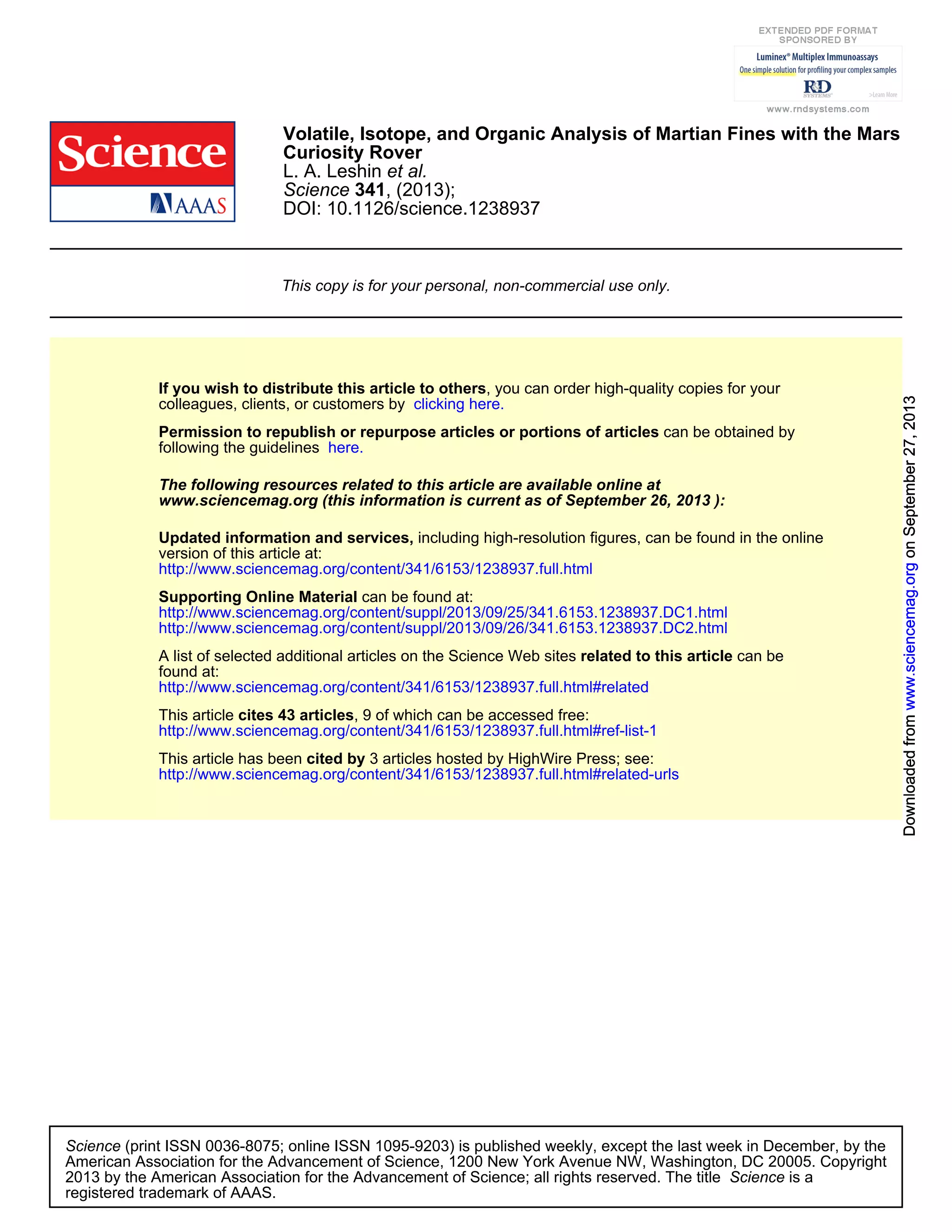
Fig. 1. ChemCam soil targets. (A) Rover traverse and location of ChemCam
soil targets for the first 100 sols [image credit: NASA/JPL-Caltech/Univ. of Arizona].
Names appearing in orange correspond to locations where ChemCam points
belonging to cluster 2 (felsic type) were found. Points belonging to cluster 1 (mafic
type) were found in all locations. (B to D) Three examples of soil targets imaged by
the RMI: (B) vertical transect across a trench dug into the Rocknest sand shadow,
covered with ~1-mm grains (Epworth3, sol 84); 15 ChemCam points were acquired
from the bottom to the center of the image; the cross hairs only represent some of
the LIBS spots; (C) homogeneous, fine-grained soil (Crestaurum, sol 83); (D) het-
erogeneous soil containing ~3-mm pebbles (Beaulieu, sol 33). The eight points of
target Crestaurum and Beaulieu point #1 belong to cluster 1. Beaulieu points #2,
#3, and #4 belong to cluster 2. Beaulieu point #5, at the intersection between a
small pebble and the surrounding fines, belongs to cluster 3. Some points of
Epworth, on top of the Rocknest sand shadow (B), also belong to cluster 3.
27 SEPTEMBER 2013 VOL 341 SCIENCE www.sciencemag.org1238670-2
Curiosity at Gale Crater](https://image.slidesharecdn.com/analysisofsurfacematerials-130927072926-phpapp02/75/Analysis-of-Surface-Materials-by-Curiosity-Mars-Rover-Special-Collection-24-2048.jpg)
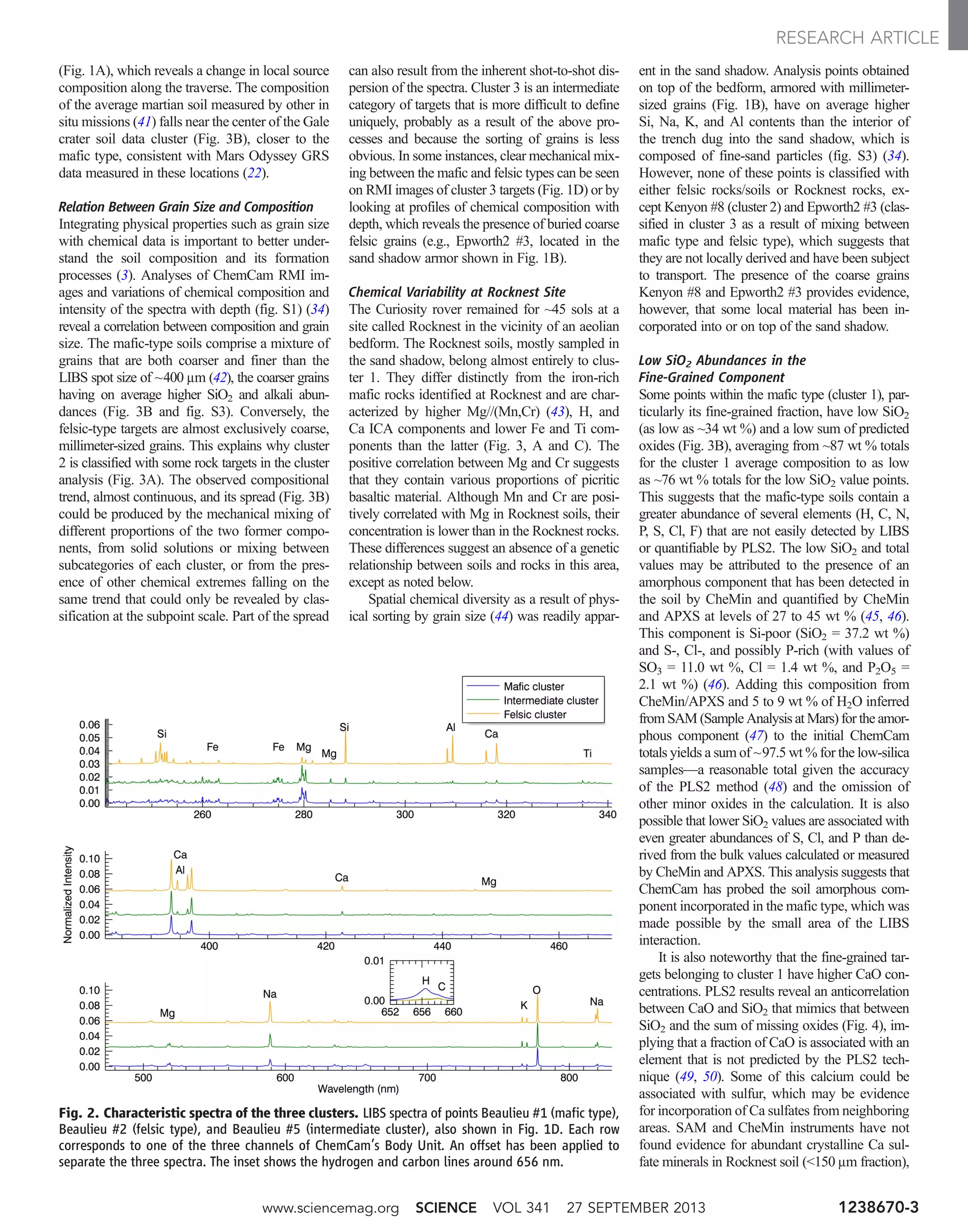
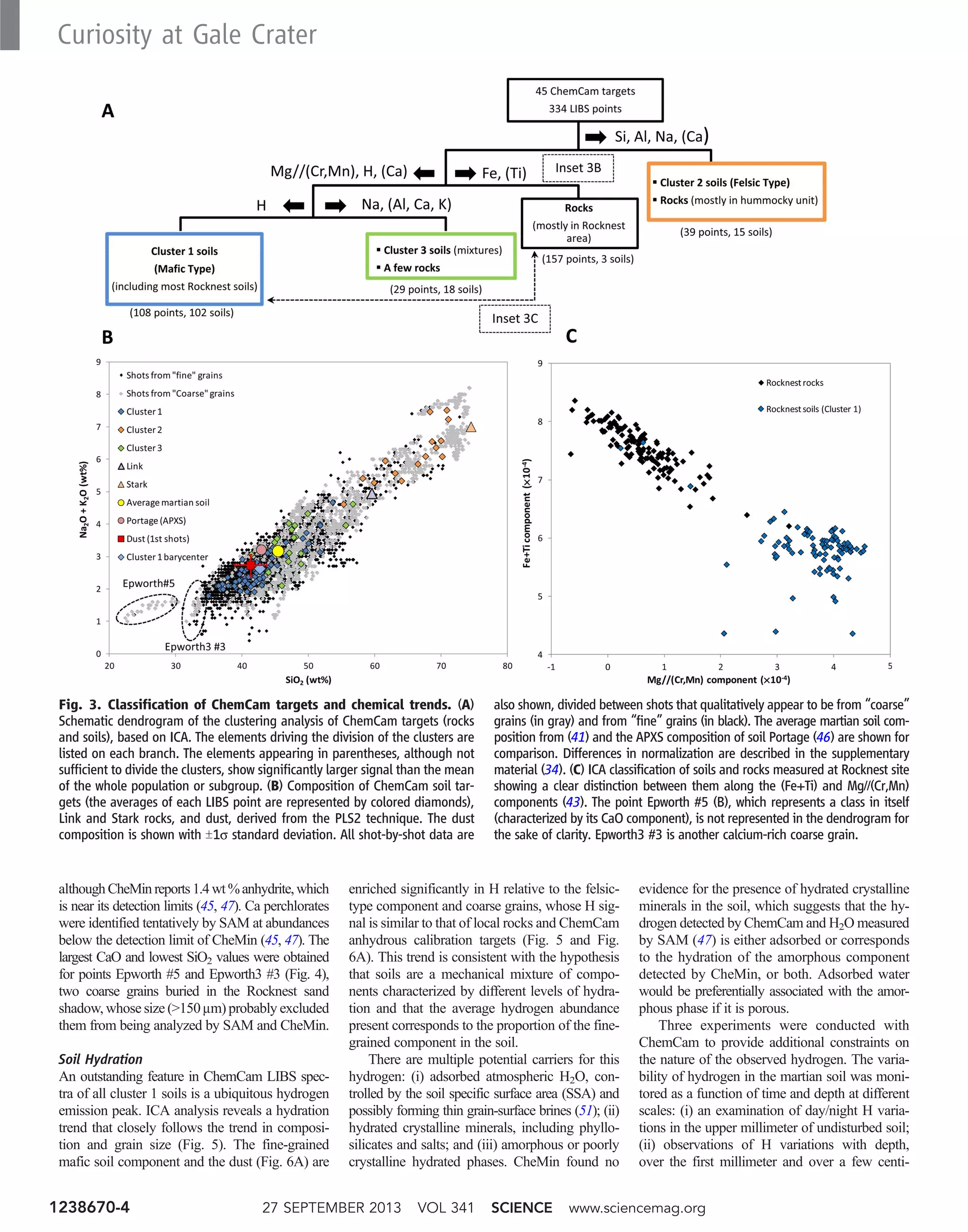
![meters, when a scoop in the Rocknest sand shadow
was excavated; and (iii) observations of H var-
iations with time, over a few days, of a freshly
exposed soil to look for signs of desiccation. The
first experiment was performed on a fine-grained
soil target, Crestaurum (Fig. 1C), at the surface of
an aeolian bedform. Day and pre-dawn measure-
ments of H showed very consistent values and no
H enrichment in the first shots, which are most
likely to be affected by diurnal exchange of H2O
or frost deposit (Fig. 6A). The second experiment
was performed on a large set of points, both in
undisturbed soil and in the interior of the ~3-cm-
deep trench in the Rocknest sand shadow; no sta-
tistically significant variations were seen within the
first millimeter probed or between the different
points (Fig. 6, B and D). This suggests that the H2O
content measured by SAM may be extrapolated to
the surface of similar undisturbed soils. In the third
experiment, similar points within the interior of the
trench monitored over a 25-sol period, 11 sols after
the soil was exposed, did not reveal statistically
significant variations (Fig. 6C). These results,
together with preliminary estimates of the sensitiv-
ity of ChemCam measurements (52), suggest that
the diurnal exchange of H2O with the atmosphere
leads to variations of H2O abundance of less than
~1.1 wt % for the type of soils we analyzed under
humidity conditions prevailing at Gale crater near
solar longitude Ls ~ 200°. Either the equilibration
of the interior of the sand shadow with the surface
atmosphere occurred faster than 11 sols, or the
gradient of water-equivalent hydrogen with depth
was less than ~0.25 wt % over a few centimeters.
Discussion
Origin of the Soils
The abundance and distribution of light-toned
pebbles with high Si, Na, and Al contents along
Table 1. Soils and dust composition and comparison to previous inves-
tigations. PLS2 mean compositions of clusters 1 and 2 (with standard deviations
in parenthesis), dust (ChemCam first shots) (37), and comparison to the average
martian soil (41) and to the APXS composition of Portage (46). PLS2 root-mean-
square error of prediction (RMSEP) for each element is indicated in the rightmost
column. Differences in normalization between ChemCam and APXS data, which
are discussed in the supplementary material, can result in slightly greater abun-
dances measured by the APXS (34). ChemCam abundances for Al and Fe are less
reliable, and Fe may be underestimated by a few wt %. Cr and Mn can be
quantified by univariate analysis, but not accurately by PLS2.
Cluster 1
(mean)
Average
martian soil*
Portage
soil (ChemCam)
Portage soil
(APXS)
Dust
(ChemCam)
Dust
(MER APXS)†
Cluster 2
(mean)
PLS2
RMSEP
SiO2 43.5 (3.8) 45.41 45.0 (4.4) 42.88 T 0.47 42.0 (2.4) 44.84 T 0.52 66.0 (5.0) 7.3
TiO2 0.6 (0.2) 0.90 0.6 (0.2) 1.19 T 0.03 0.8 (0.2) 0.95 T 0.08 0.1 (0.1) 0.7
Al2O3 11.4 (1.1) 9.71 11.9 (1.4) 9.43 T 0.14 10.9 (0.8) 9.32 T 0.18 11.6 (1.6) 3.0
FeOT 13.8 (1.1) 16.73 13.6 (1.5) 19.19 T 0.12 13.7 (1.1) 16.96‡ T 0.74 6.2 (3.7) 5.7
MgO 7.5 (1.5) 8.35 7.8 (1.8) 8.69 T 0.14 7.3 (0.8) 7.89 T 0.32 1.4 (1.1) 4.0
CaO 8.0 (1.4) 6.37 7.7 (1.8) 7.28 T 0.07 7.8 (1.1) 6.34 T 0.20 7.5 (2.7) 4.2
Na2O 2.2 (0.4) 2.73 2.3 (0.5) 2.72 T 0.10 2.0 (0.3) 2.56 T 0.33 4.0 (0.4) 0.8
K2O 0.6 (0.2) 0.44 0.6 (0.2) 0.49 T 0.01 0.7 (0.2) 0.48 T 0.07 2.1 (0.5) 0.9
Cr2O3 — 0.36 — 0.49 T 0.02 — 0.32 T 0.04 — —
MnO — 0.33 — 0.41 T 0.01 — 0.33 T 0.02 — —
P2O5 — 0.83 — 0.94 T 0.03 — 0.92 T 0.09 — —
SO3 — 6.16 — 5.45 T 0.10 — 7.42 T 0.13 — —
Cl — 0.68 — 0.69 T 0.02 — 0.83 T 0.05 — —
Sum of oxides
not quantified
by PLS2
8.36 7.98 9.82
Residual§ –3.0 –2.4 –4.2
Total 87.6 99 89.5 99.85 85.2 99.2 98.9 11.4
*From (41). †From (54). ‡FeO = 10.42 T 0.11 wt %, Fe2O3 = 7.28 T 0.70 wt %. §Difference, expressed as [(total APXS) – (sum of oxides not quantified)] – (total PLS2), between
adjacent columns. This residual is partly due to the difference of normalization, as APXS data are normalized on a water- and carbon-free basis (34).
Epworth 3#3
Epworth 3#3
Epworth #5
Epworth #5
A B
Fig. 4. Chemical correlations in the Rocknest soil. (A) Correlations be-
tween the sum of missing oxides and SiO2, suggesting that the low SiO2 values
are associated with missing elements. (B) Anticorrelation between CaO and
SiO2. Shot-by-shot PLS2 values of Rocknest soil are plotted together with shots
from Epworth #5 and Epworth3 #3, two coarse grains found on top of and in
the interior of the sand shadow, showing relatively large CaO abundances.
www.sciencemag.org SCIENCE VOL 341 27 SEPTEMBER 2013 1238670-5
RESEARCH ARTICLE](https://image.slidesharecdn.com/analysisofsurfacematerials-130927072926-phpapp02/75/Analysis-of-Surface-Materials-by-Curiosity-Mars-Rover-Special-Collection-27-2048.jpg)
![the rover traverse suggest that material with felsic
composition is common near the landing site but
limited to the pre-Rocknest hummocky unit. The
surface of Bradbury Rise is characterized by the
presence of fluvial sedimentary conglomerates,
onlyoneofwhich(Link)wasobservedbyChemCam
(39). Its clasts have a range of SiO2, Al2O3, and
alkali compositions close to that of alkali feldspar
(38–40), consistent with the composition of some
felsic-type pebbles. This observation supports the
interpretation that loose and cemented clasts in
the hummocky region have a common origin. In
this case, the felsic-type pebbles would have one
of two origins: They could have resulted from in
situ weathering of the sedimentary conglomerates,
or they could have been transported and deposited
from the same source region without being ce-
mented. The abundance of such pebbles reinforces
the view that the hummocky unit could contain
abundant feldspar-rich crustal material that has
not been probed by past instruments (38, 40) and
possibly originates from the crater rim (39). The
pebbles with largest SiO2 concentrations may rep-
resent lithic fragments from silica-rich, pumice-like
rocks similar to Stark (38, 40).
The mafic soil component was found not only
in the Rocknest sand shadow and in aeolian bed-
forms, but throughout the rover traverse (Fig. 1A).
It differs chemically from any of the rocks analyzed
in the hummocky unit, supporting the idea that it
is not locally derived at the scale of this geological
unit. Its composition is similar to that of soils and
dust measured elsewhere on Mars. Its presence
in soils at Gale crater must reflect the efficiency
of large-scale processes such as aeolian transport
and impact gardening. It could reflect the wide-
spread presence of regions with similar basaltic
composition, possibly characterized by lower re-
sistivity to physical and chemical weathering. On
the other hand, investigations at other landing
sites also found relatively little influence from
local bedrock composition (21), rock composi-
tions found at Gale crater differ from other sites
(38), and Mars Odyssey GRS found large provinces
characterized by different compositions (22, 53);
these findings could indicate that the mafic soil
component in fact represents an average of dif-
ferentcompositionsas aresultoflarge-scalehomog-
enization processes. It was suggested, for instance,
that this ubiquitous material was made of two un-
related components: a component derived from
relatively young olivine-rich basalts degraded under
relatively anhydrous conditions and a component
containing clay minerals, amorphous silica, and
sulfur- and chlorine-rich nanophase ferric oxides
resulting from the alteration of ancient rocks under
hydrous conditions (2). This type of scenario could
be consistent with CheMin characterization of the
Rocknest soil [although CheMin did not detect
the presence of phyllosilicates in that soil (45)] and
with the evidence for the presence of a hydrated
amorphous component.
The dust analyzed by ChemCam is basaltic,
and its composition is similar to that measured by
the MER APXS at the surface of bright soils (54)
(Table 1). Both its composition (including an
SiO2 abundance greater than that of the amor-
phous component) and its chemical homogeneity
(i.e., small point-to-point variability, reflected
in a standard deviation lower than that of clus-
ter 1) suggest that its chemical alteration was
limited, in agreement with previous observations
of the presence of olivine minerals by the MERs
(54–56). Fine by-products of the physical weath-
ering of larger basaltic grains during their transport
(57), or aeolian abrasion of rocks, would be con-
sistent with these observations. On the other hand,
the hydration measured by ChemCam, and the
high S, P, and Cl content probably associated with
nanophase iron oxides inferred from MER APXS
analysis (54, 55), hint at the presence of weather-
ing products, although adsorption could also
play an important role given their small size. The
homogeneity of the dust composition observed
by ChemCam could therefore also reflect the
very small scale of the dust particles with respect
to the size of the LIBS spot.
The fact that none of the points analyzed on
the Rocknest bedform armor is classified with
Rocknest or Bradbury Rise rocks (except Kenyon
#8)suggeststhatthemillimeter-sizedpebblestraveled
some distance from another source region before
ending their course at Rocknest. This is consist-
ent with their subangular to subrounded shape,
which is indicative of the mechanical erosion they
have undergone (fig. S2).
Hydration of the Amorphous Phase
and Specific Surface Area of the Soil
Although the nature of the amorphous compo-
nent detected by CheMin in the 150-mm frac-
tion of the Rocknest soil remains unclear, its
x-ray diffraction pattern resembles that of ba-
saltic glass with some allophane, a short-range
ordered hydrous aluminosilicate (45). Chemi-
cal data, however, suggest that the latter is likely
a surrogate for Fe3+
-bearing amorphous phases,
such as Fe-allophane, hisingerite (58), or nano-
phase iron oxides (45, 46). Interpretations of
orbital data also suggest the presence of allophane-
like silicate phases and ferrihydrite at the surface
of Mars (26, 59, 60), although Al-rich allophane
is not consistent with APXS chemical data (46)
and requires conditions of moderate pH (≥5) to
form (61).
The large fraction of poorly ordered ferric
materials and their association with hydrogen
and other volatile species suggest a similarity
to terrestrial andisols. These soils develop in
volcanic ejecta (such as volcanic ash, pumice, or
cinders) and/or in volcaniclastic materials usu-
ally rich in volcanic glass; they are characterized
by a colloidal fraction dominated by short-range
ordered minerals or noncrystalline phases, espe-
cially allophane, imogolite, and noncrystalline
oxyhydroxides (e.g., ferrihydrite), or Al/Fe-humus
complexes often together with opaline silica
(61, 62). The strong sorption capacity of andisols
Fig. 5. ICA classification of soils and rocks along Na and H components. A hydration trend
from cluster 2 to cluster 1 soils and going through cluster 3 is observed, away from the rocks (the x and y
axis represent the covariance between each of the spectra and the independent components) (34). It
suggests mechanical mixing between fine hydrated particles and drier coarse grains.
27 SEPTEMBER 2013 VOL 341 SCIENCE www.sciencemag.org1238670-6
Curiosity at Gale Crater](https://image.slidesharecdn.com/analysisofsurfacematerials-130927072926-phpapp02/75/Analysis-of-Surface-Materials-by-Curiosity-Mars-Rover-Special-Collection-28-2048.jpg)
![due to the presence of these amorphous phases
could be relevant to Mars. Sorption of phos-
phate in andisols, for instance, has been shown
to inhibit the crystallization of ferrihydrite to
more crystalline goethite and hematite (61). High
sorption capacities could also make the regolith
an important contributor to the atmospheric
H2O cycle (63, 64). In andisols, allophane and
iron (oxy)hydroxides contain substantial amounts
of adsorbed H2O because of their large spe-
cific surface area (SSA) (65) and the presence
of surface hydroxyl groups that act as strong
adsorption sites through hydrogen bonding (66).
Similarly, the abundance of these hydroxylated
phases may dominate the SSA of the martian
soil and thus the level of atmospheric H2O stored
in the regolith. Laboratory experiments per-
formed on ferrihydrite and on phyllosilicate-poor,
allophane-rich palagonitic dust from the flanks
of Mauna Kea volcano, Hawaii (67, 68), show
indeed that these materials can hold relatively
large amounts of adsorbed H2O (a few wt %)
under martian conditions, even at low relative
humidities and with relatively fast exchange
kinetics (69).
Some differences with the martian soil are
therefore unclear. Indeed, the average level of hy-
dration of the amorphous phases (5 to 9 wt %),
measured by SAM (47) to a temperature of 835°C,
contrasts with the relatively small amount of
H2O measured at temperatures less than 150° to
200°C, a typical range of temperatures where
H2O adsorbed in allophane-rich material is re-
leased (70). This also contrasts with the lim-
ited time variability of H2O abundance measured
by ChemCam in the near-subsurface and inferred
from orbital observations of the atmospheric
water column (71).
Determining the level of regolith-atmosphere
exchange of H2O, and thus its SSA, is also im-
portant to understand why the D/H ratio of soils,
measured by SAM, is close to atmospheric val-
ues (26). Estimates of the SSA of the martian
soil can be deduced from ChemCam day/night
experiment results (see Materials and Meth-
ods). We find an upper limit for the SSA of the
fine-grained component of 30 to 45 m2
g−1
(Fig. 7) (34), which does not contradict the only
SSA estimate available to date of 17 m2
g−1
de-
rived by the Viking Gas Exchange Experiment
(72). The relatively low SSA suspected for the
Fig. 6. Temporal and spatial variability of the hydrogen signal. (A)
Depth profile of the H line intensity (signal to background, S/B) for the
Crestaurum target analyzed on sol 74/75 [sol 74, 11:30 a.m. local mean solar
time (LMST), and pre-dawn of sol 75, 4:40 a.m. LMST]. The ratio between the
mean night and day S/B is 1.003, indicating no sign of water enrichment at
night. The average S/B of seven onboard calibration targets, used as a blank, is
also displayed. The first five shots reveal the presence of hydrated dust on their
surface. The large error bars for these shots are probably due to differences in
dust coverage. The H S/B profile of Beaulieu point #2 (Fig. 1D), which belongs
to the felsic type, is also shown for comparison. It does not significantly differ
from the blank. (B) Hydrogen S/B ratio over the first 30 shots and averaged over
62 homogeneous, fine-grained samples. Error bars are T1s (standard deviation
of the N averaged samples). (C) Variations of the hydrogen S/B ratio in the
interior of the trench as a function of the sol number (the trench was dug on sol
61). Each black point represents the average S/B of one of the LIBS points
acquired on the target. The standard deviation around the mean of each target
is ~0.2. (D) Histograms of the two populations of spectra acquired in the in-
terior of the trench (green) and in undisturbed surfaces (yellow), and charac-
terized by the same Na component. The x axis represents the H component of
the ICA analysis.
www.sciencemag.org SCIENCE VOL 341 27 SEPTEMBER 2013 1238670-7
RESEARCH ARTICLE](https://image.slidesharecdn.com/analysisofsurfacematerials-130927072926-phpapp02/75/Analysis-of-Surface-Materials-by-Curiosity-Mars-Rover-Special-Collection-29-2048.jpg)
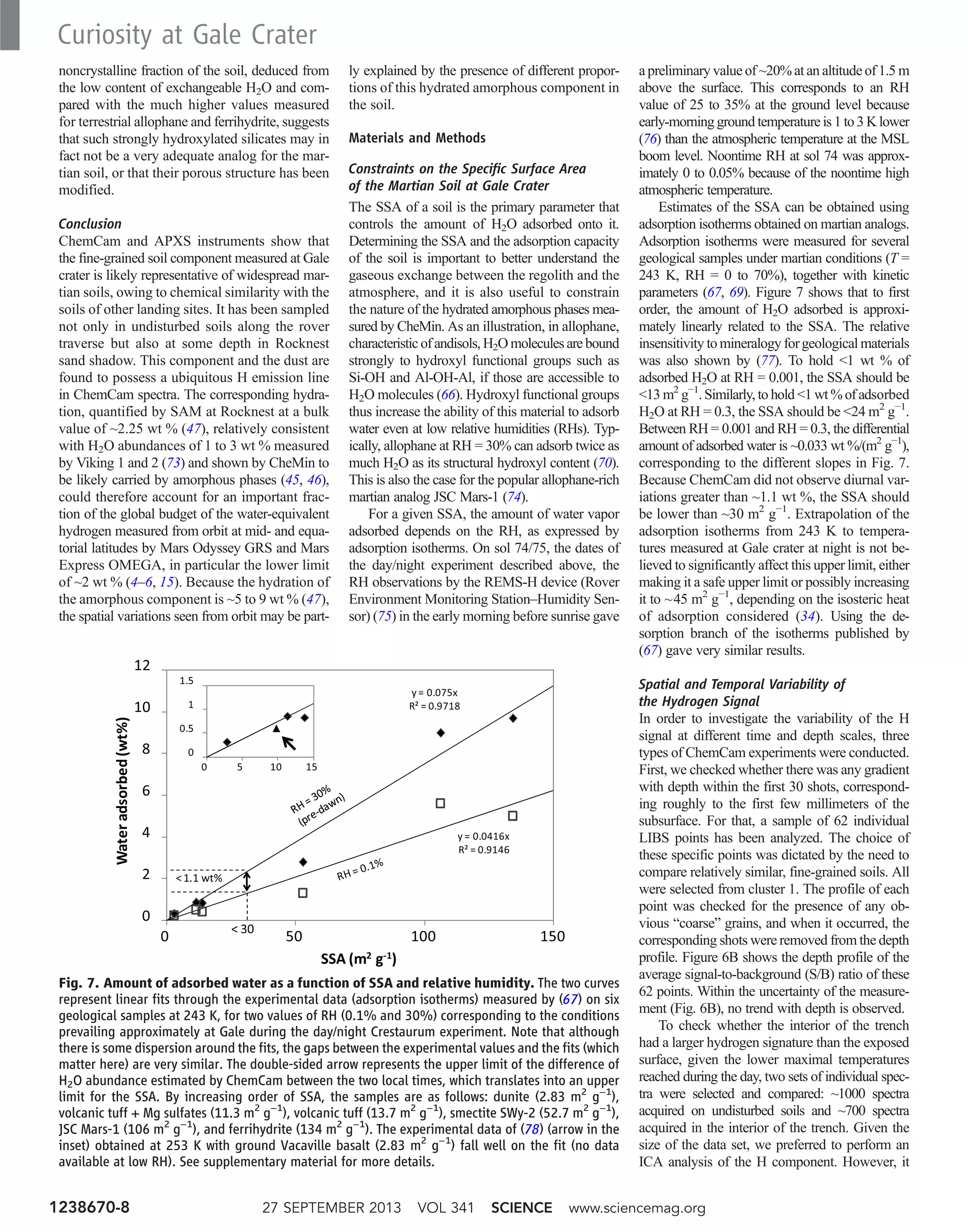
![was shown that all points plot on a mixing line
between (high Na, low H) and (low Na, high H)
(Fig. 5). Thus, to be comparable, the samples
should have a similar Na component. The spectra
corresponding to the fine-grained soil samples were
selected in a range of low Na component values
[the Mg//(Cr,Mn) component was also tested and
gave exactly the same result]. The histograms
showing the distribution of the H component for
these two populations are presented in Fig. 6D. A
Kolmogorov-Smirnov statistical test showed that
there was no significant difference between the
two populations. Therefore, we conclude that the
interior of the trench does not show evidence of
an H2O enrichment compared to the undisturbed
surface, within the sensitivity of the measurement
(34). This has an implication with regard to the
relevance of the extrapolation of the SAM results
to a more global scale. It means that the hydrogen
content measured by SAM is comparable to the
hydrogen measured over an exposed surface, typ-
ically seen by orbital measurements. We do not see
evidence for a two-layer model at this scale (a few
centimeters). Nonetheless, this analysis does not
rule out the possibility that the interior of the
trench was more hydrated when it was excavated,
and it lost its additional H2O in the 11 sols be-
tween the scooping and the first measurement by
ChemCam on sol 72.
Finally, we have monitored the evolution of
the H signal of a freshly exposed soil (the trench in
Rocknest ripple) over a 25-sol time span, 11 sols
after it was scooped. The intent was to detect a
possible desiccation of the exposed material. The
average hydrogen S/B ratio of each LIBS point
obtained for a series of four targets is plotted in
Fig. 6C as a function of time, the x axis represent-
ing the sol at which the targets were measured:
Schmutz (9 LIBS points, on sol 72), Kenyon (10
LIBS points, on sol 81), Epworth3 (12 first LIBS
points, on sol 84), and Kenyon_high_albedo (10
LIBS points, on sol 97). Again, for each point,
spectra attributed to “coarse” grains were removed.
No statistically significant variation of the H signal
was observed with time.
References and Notes
1. M. H. Carr, The Surface of Mars (Cambridge Univ. Press,
Cambridge, 2007).
2. H. Y. McSween Jr., I. O. McGlynn, A. D. Rogers,
Determining the modal mineralogy of Martian soils.
J. Geophys. Res. 115, E00F12 (2010). doi: 10.1029/
2010JE003582
3. I. O. McGlynn, C. M. Fedo, H. Y. McSween Jr., Soil
mineralogy at the Mars Exploration Rover landing sites:
An assessment of the competing roles of physical sorting
and chemical weathering. J. Geophys. Res. 117, E01006
(2012). doi: 10.1029/2011JE003861
4. W. V. Boynton et al., Concentration of H, Si, Cl, K, Fe,
and Th in the low- and mid-latitude regions of Mars.
J. Geophys. Res. 112, E12S99 (2007). doi: 10.1029/
2007JE002887
5. S. Maurice et al., Mars Odyssey neutron data: 1. Data
processing and models of water‐equivalent‐hydrogen
distribution. J. Geophys. Res. 116, E11008 (2011).
doi: 10.1029/2011JE003810
6. R. E. Milliken et al., Hydration state of the Martian
surface as seen by Mars Express OMEGA: 2. H2O content
of the surface. J. Geophys. Res. 112, E08S07 (2007).
doi: 10.1029/2006JE002853
7. O. Aharonson, N. Schorghofer, Subsurface ice on Mars
with rough topography. J. Geophys. Res. 111, E11007
(2006). doi: 10.1029/2005JE002636
8. T. Tokano, D. Bish, Hydration state and abundance of
zeolites on Mars and the water cycle. J. Geophys. Res.
110, 2156–2202 (2005). doi: 10.1029/2005JE002410
9. C. I. Fialips et al., Hydration state of zeolites, clays, and
hydrated salts under present-day Martian surface
conditions: Can hydrous minerals account for Mars
Odyssey observations of near-equatorial water-equivalent
hydrogen? Icarus 178, 74–83 (2005). doi: 10.1016/
j.icarus.2005.04.020
10. F. Poulet et al., Phyllosilicates on Mars and
implications for early martian climate. Nature
438, 623–627 (2005). doi: 10.1038/nature04274;
pmid: 16319882
11. J. F. Mustard et al., Hydrated silicate minerals on Mars
observed by the Mars Reconnaissance Orbiter CRISM
instrument. Nature 454, 305–309 (2008). doi: 10.1038/
nature07097; pmid: 18633411
12. J. Carter, F. Poulet, J.-P. Bibring, N. Mangold, S. Murchie,
Hydrous minerals on Mars as seen by the CRISM and
OMEGA imaging spectrometers: Updated global view.
J. Geophys. Res. 118, 831–858 (2013). doi: 10.1029/
2012JE004145
13. J. Carter, F. Poulet, J. P. Bibring, S. Murchie,
Detection of hydrated silicates in crustal outcrops in
the northern plains of Mars. Science 328, 1682–1686
(2010). doi: 10.1126/science.1189013; pmid: 20576889
14. B. L. Ehlmann et al., Subsurface water and clay mineral
formation during the early history of Mars. Nature 479,
53–60 (2011). doi: 10.1038/nature10582; pmid:
22051674
15. D. Jouglet et al., Hydration state of the Martian surface as
seen by Mars Express OMEGA: 1. Analysis of the 3 mm
hydration feature. J. Geophys. Res. 112, E08S06 (2007).
doi: 10.1029/2006JE002846
16. B. C. Clark et al., The Viking X ray fluorescence
experiment: Analytical methods and early results.
J. Geophys. Res. 82, 4577–4594 (1977). doi: 10.1029/
JS082i028p04577
17. B. C. Clark et al., Chemical composition of martian
fines. J. Geophys. Res. 87, 10059–10067 (1982).
doi: 10.1029/JB087iB12p10059
18. H. Wänke, J. Brückner, G. Dreibus, R. Rieder, I. Ryabchikov,
Chemical composition of rocks and soils at the Pathfinder
site. Space Sci. Rev. 96, 317–330 (2001). doi: 10.1023/A:
1011961725645
19. R. Rieder et al., Chemistry of rocks and soils at Meridiani
Planum from the Alpha Particle X-ray Spectrometer.
Science 306, 1746–1749 (2004). doi: 10.1126/
science.1104358; pmid: 15576611
20. R. Gellert et al., Chemistry of rocks and soils in Gusev
Crater from the alpha particle x-ray spectrometer. Science
305, 829–832 (2004). doi: 10.1126/science.1099913;
pmid: 15297665
21. A. S. Yen et al., An integrated view of the chemistry and
mineralogy of martian soils. Nature 436, 49–54 (2005).
doi: 10.1038/nature03637; pmid: 16001059
22. O. Gasnault et al., Quantitative geochemical mapping of
Martian elemental provinces. Icarus 207, 226–247
(2010). doi: 10.1016/j.icarus.2009.11.010
23. H. Y. McSween Jr., What we have learned about Mars
from SNC meteorites. Meteoritics 29, 757–779 (1994).
doi: 10.1111/j.1945-5100.1994.tb01092.x
24. P. R. Christensen, J. L. Bandfield, M. D. Smith,
V. E. Hamilton, R. N. Clark, Identification of a basaltic
component on the Martian surface from Thermal
Emission Spectrometer data. J. Geophys. Res. 105,
9609–9621 (2000). doi: 10.1029/1999JE001127
25. A. D. Rogers, O. Aharonson, Mineralogical composition of
sands in Meridiani Planum determined from Mars
Exploration Rover data and comparison to orbital
measurements. J. Geophys. Res. 113, E06S14 (2008).
doi: 10.1029/2007JE002995
26. F. Poulet et al., Abundance of minerals in the
phyllosilicate-rich units on Mars. Astron. Astrophys. 487,
L41–L44 (2008). doi: 10.1051/0004-6361:200810150
27. K. Biemann et al., Search for organic and volatile
inorganic compounds in two surface samples from the
chryse planitia region of Mars. Science 194, 72–76 (1976).
doi: 10.1126/science.194.4260.72; pmid: 17793082
28. P. H. Smith et al., H2O at the Phoenix landing site.
Science 325, 58–61 (2009). pmid: 19574383
29. S. Maurice et al., The ChemCam Instrument Suite on the
Mars Science Laboratory (MSL) Rover: Science objectives
and mast unit description. Space Sci. Rev. 170, 95–166
(2012). doi: 10.1007/s11214-012-9912-2
30. R. Wiens et al., The ChemCam instrument suite on the
Mars Science Laboratory (MSL) rover: Body unit and
combined system tests. Space Sci. Rev. 170, 167–227
(2012). doi: 10.1007/s11214-012-9902-4
31. Hereafter, a “shot” corresponds to a single spectrum, and
a “LIBS point” is a series of spectra acquired at the same
laser ablation crater (i.e., sampling location).
32. No implication of the presence or absence of organic
materials or living matter is intended, nor is the genesis
of the deposit.
33. O. Forni et al., Independent component analysis
classification of laser induced breakdown spectroscopy
spectra. Spectrochim. Acta B 86, 31–41 (2013).
doi: 10.1016/j.sab.2013.05.003
34. See supplementary materials on Science Online.
35. S. Clegg, E. Sklute, M. D. Dyar, J. E. Barefield,
R. C. Wiens, Multivariate analysis of remote laser-induced
breakdown spectroscopy spectra using partial least
squares, principal component analysis, and related
techniques. Spectrochim. Acta B 64, 79–88 (2009).
doi: 10.1016/j.sab.2008.10.045
36. R. C. Wiens et al., Pre-flight calibration and initial
data processing for the ChemCam laser-induced
breakdown spectroscopy instrument on the Mars Science
Laboratory rover. Spectrochim. Acta B 82, 1–27
(2013). doi: 10.1016/j.sab.2013.02.003
37. The composition of the dust was derived from the average
of all the first spectra acquired on rock targets, which are
very often different from the spectra of the underlying
material and are found to be very homogeneous. They
also share with soils a strong H signature. A small
contamination of the underlying material in the first
ablation cannot be totally ruled out.
38. R.C. Wiens et al., Compositions determined by ChemCam
along Curiosity’s traverse from Bradbury station to
Glenelg in Gale crater, Mars. Lunar Planet. Sci. Conf. 44,
abstract 1363 (2013).
39. R. M. E. Williams et al., Martian fluvial conglomerates
at Gale crater. Science 340, 1068–1072 (2013).
doi: 10.1126/science.1237317; pmid: 23723230
40. V. Sautter et al., Igneous composition variations
determined by ChemCam along Curiosity’s traverse
from Bradbury to Rocknest area at Gale crater, Mars.
Geophys. Res. Abstr. 15, EGU2013–12753 (2013).
41. S. R. Taylor, S. M. McLennan, Planetary Crusts: Their
Composition, Origin, and Evolution (Cambridge Univ.
Press, Cambridge, 2009).
42. These grains will be qualified qualitatively as “coarse”
in the following analysis, in contrast to samples
whose spectral features are typical of material that is
fine-grained at the LIBS scale (34). The beam size is
~400 mm at 2.8 m, average distance to the soil targets
analyzed with ChemCam.
43. The notation “//” means that the ICA component relates
to the Mg abundance, not to the abundance of Cr and
Mn, and indicates that the latter elements are positively
correlated with Mg in Rocknest soils.
44. G. Kocurek et al., Rocknest sand shadow at the Curiosity
field site: Morphology, origin, and stabilization. Lunar Planet.
Sci. Conf. 44, abstract 1375 (2013).
45. D. L. Bish et al., X-ray diffraction results from Mars
Science Laboratory: Mineralogy of Rocknest at Gale
crater. Science 341, 1238932 (2013).
46. D. F. Blake et al., Curiosity at Gale crater, Mars:
Characterization and analysis of the Rocknest sand
shadow. Science 341, 1239505 (2013).
47. L. A. Leshin et al., Volatile, isotope, and organic analysis
of martian fines with the Mars Curiosity rover. Science
341, 1238937 (2013).
48. The RMSEP on the sum of total oxides is ~11.5 wt %.
49. S. Clegg et al., High calcium phase observations at
Rocknest with ChemCam. Lunar Planet. Sci. Conf. 44,
abstract 2087 (2013).
www.sciencemag.org SCIENCE VOL 341 27 SEPTEMBER 2013 1238670-9
RESEARCH ARTICLE](https://image.slidesharecdn.com/analysisofsurfacematerials-130927072926-phpapp02/75/Analysis-of-Surface-Materials-by-Curiosity-Mars-Rover-Special-Collection-31-2048.jpg)
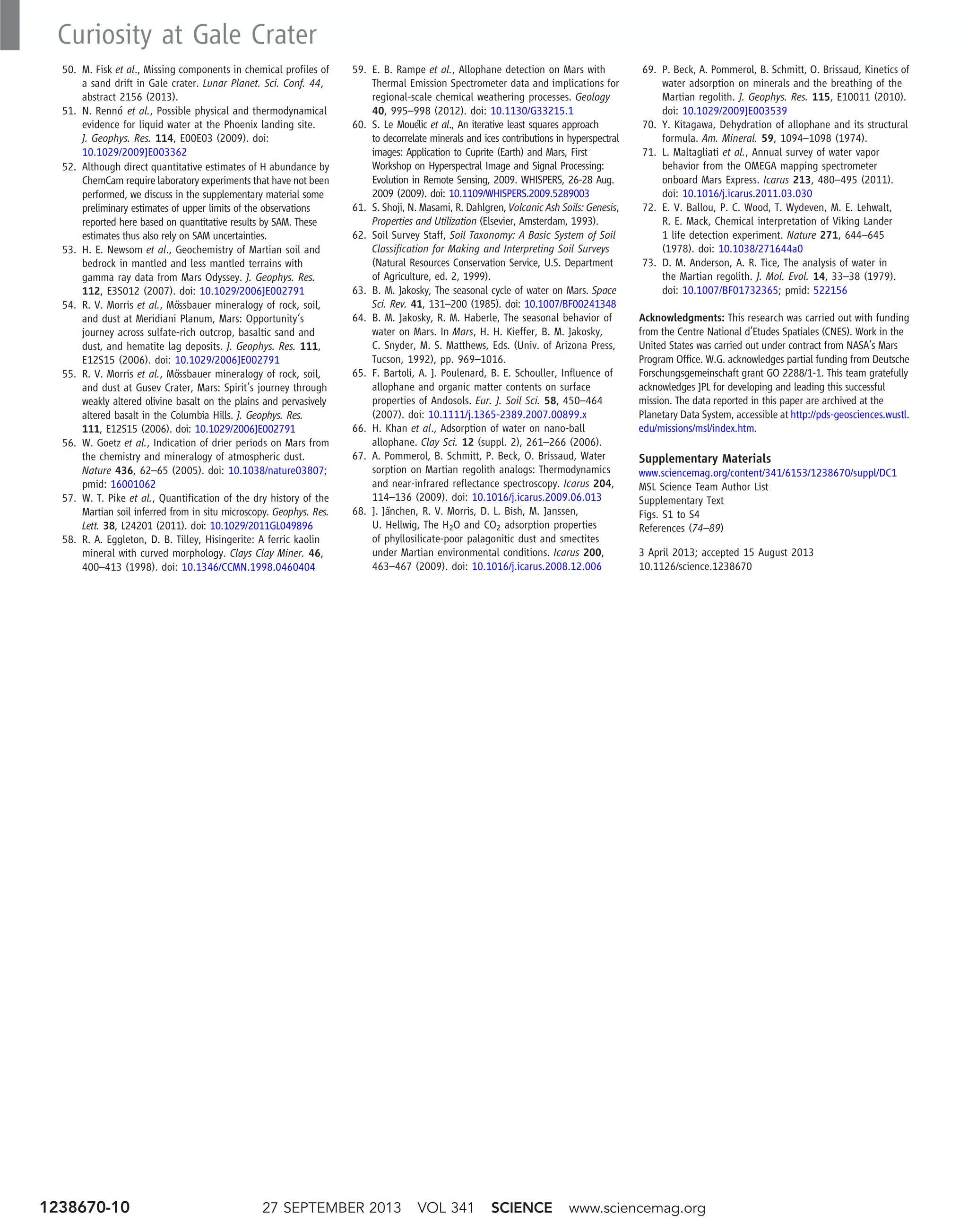
![The Petrochemistry of Jake_M:
A Martian Mugearite
E. M. Stolper,1
* M. B. Baker,1
M. E. Newcombe,1
M. E. Schmidt,2
A. H. Treiman,3
A. Cousin,4,5
M. D. Dyar,6
M. R. Fisk,7
R. Gellert,8
P. L. King,9
L. Leshin,10
S. Maurice,5
S. M. McLennan,11
M. E. Minitti,12
G. Perrett,8
S. Rowland,13
V. Sautter,14
R. C. Wiens,4
MSL Science Team†
“Jake_M,” the first rock analyzed by the Alpha Particle X-ray Spectrometer instrument on the
Curiosity rover, differs substantially in chemical composition from other known martian igneous
rocks: It is alkaline (15% normative nepheline) and relatively fractionated. Jake_M is
compositionally similar to terrestrial mugearites, a rock type typically found at ocean islands and
continental rifts. By analogy with these comparable terrestrial rocks, Jake_M could have been
produced by extensive fractional crystallization of a primary alkaline or transitional magma at
elevated pressure, with or without elevated water contents. The discovery of Jake_M suggests that
alkaline magmas may be more abundant on Mars than on Earth and that Curiosity could encounter
even more fractionated alkaline rocks (for example, phonolites and trachytes).
R
ock “Jake_M” [(JM); named for Jet Propul-
sion Laboratory engineer Jake Matijevic]
was the first sample imaged with the Mars
Hand Lens Imager (MAHLI) and analyzed with
the Alpha Particle X-ray Spectrometer (APXS)
on the Mars Science Laboratory (MSL) (1, 2).
Although the rock is an isolated fragment lack-
ing field context (encountered ~282 m from the
Bradbury landing site and analyzed on sols 46
and 47, where 1 sol is a martian day), its dark color
and apparently fine-grained texture suggested, be-
fore analysis, that it was a relatively homogeneous
(on a millimeter-to-centimeter scale) igneous rock
and thus an appropriate sample with which to ini-
tiate the APXS analytical program and to analyze
with ChemCam (3) using laser-induced breakdown
spectroscopy (LIBS). Here, we report chemical analy-
ses of JM and an interpretation of their meaning
for its petrogenesis.
Results and Discussion
Petrography
Jake_M is roughly pyramidal in shape (~50 cm
on each of its three base edges and ~50 cm tall)
(Fig. 1). The rock is dark gray and thinly coated
by light-toned, reddish-brown dust. Its upper sur-
faces have rounded hollows that are probably
due to wind erosion and 1- to 3-mm pits that
could be vesicles. The lowest ~2 cm of the rock
has smoother surfaces that may reflect primary
layering or the effects of wind erosion. Near-
vertical fractures (~10 cm long) project upward
from the base. Feldspar microphenocrysts have
been tentatively identified in MAHLI images (4),
but individual mineral grains could not other-
wise be distinguished in optical images, perhaps
due to the dust cover and/or polish by wind. Com-
positional variations among the 14 individual
locations (see Fig. 1 and fig. S1) analyzed by
LIBS using ChemCam show that the rock is het-
erogeneous on a length scale of ~0.5 mm. The het-
erogeneities observed by LIBS analyses suggest
the presence of plagioclase (broadly consistent
with oligoclase), Ca-rich pyroxene, olivine, and
Fe-Ti-rich oxide(s) (3) (see also figs. S1 to S4).
Bulk Composition and Classification
The three APXS analyses (Table 1) were collected
on two different spots; the listed uncertainties on
the average [calculated after normalizing each anal-
ysis to 100 weight % (wt %), excluding SO3, Cl,
and trace elements] are due to variations between
the three analyses that may partially reflect real
differences between the two analyzed spots. The
surface of JM was not brushed or abraded be-
fore analysis [in the supplementary materials, we
compare the JM analyses to both unbrushed (i.e.,
“as is”) and physically abraded rock surfaces
analyzed by the Mars Exploration Rovers (MERs)].
The CIPW norms (5) (Table 1) are based on the
average JM composition and were calculated using
molar Fe3+
/(total Fe) ratios of 0 and 0.15. Although
this range of Fe3+
/(total Fe) ratios brackets the
ratios expected in basaltic melts at the estimated
oxygen fugacity ( fO2) values of basaltic shergottites
[e.g., (6)], recent modeling suggests that mantle
melting at higher fO2s may have occurred early
in the planet’s history (7). However, even for a
Fe3+
/(total Fe) value of 0.3, normative nepheline
is still ~15 wt %.
Based on either its calculated norm or inspec-
tion of its major-element composition, JM has a
basaltic composition, and it is probably an igneous
rock (although we cannot tell whether it is from
a lava flow, an intrusion, a pyroclastic flow, or a
RESEARCH ARTICLE
1
Caltech, Pasadena, CA 91125, USA. 2
Brock University,
St. Catharines, Ontario L2T 3V8, Canada. 3
Lunar and Planetary
Institute, Houston, TX 77058, USA. 4
Los Alamos National Lab-
oratory, Los Alamos, NM 87545, USA. 5
Institut de Recherches
en Astrophysique et Planétologie, 31028 Toulouse, France.
6
Mount Holyoke College, South Hadley, MA 01075, USA.
7
Oregon State University, Corvallis, OR 97331, USA. 8
Univer-
sity of Guelph, Guelph, Ontario N1G 2W1, Canada. 9
Research
School of Earth Sciences, Australian National University, Acton,
ACT 0200, Australia. 10
Rensselaer Polytechnic Institute, Troy,
NY 12180, USA. 11
The State University of New York, Stony
Brook, NY 11794, USA. 12
Applied Physics Laboratory, The Johns
Hopkins University, Baltimore, MD 20723, USA. 13
University of
Hawaii, Honolulu, HI 96822, USA. 14
Laboratoire de Minéralogie
et Cosmochimie du Muséum, 75005 Paris, France.
*Corresponding author. E-mail: ems@gps.caltech.edu
†MSL Science Team authors and affiliations are listed in the
supplementary materials.
Fig. 1. Raw image of Jake_M taken by the left mast camera (mastcam) (identification number
0046ML0212000000E1) with overlain images from MAHLI at 26.9-, 6.9-, and 4.4-cm offsets from
the front of the lens. The MAHLI projection on the left was taken at 4.4 cm (identification number
0047MH0011002000E1). Shadowing by the turret reduced the contrast in the inset MAHLI images,
causing color differences with the mastcam image. The solid red circles labeled JM1 and JM2 indicate the
locations of the two APXS spots (1.7-cm diameter). ChemCam raster spots are represented by yellow open
circles; actual spot sizes are ~0.45 mm. [Credit: NASA/Jet Propulsion Laboratory–Caltech/Malin Space
Science Systems]
www.sciencemag.org SCIENCE VOL 341 27 SEPTEMBER 2013 1239463-1](https://image.slidesharecdn.com/analysisofsurfacematerials-130927072926-phpapp02/75/Analysis-of-Surface-Materials-by-Curiosity-Mars-Rover-Special-Collection-34-2048.jpg)
![volcaniclastic sediment deposited after minimal
fractionation or alteration of primary igneous
materials). Moreover, with its ~16 to 17% nor-
mative nepheline (Table 1) and its position on an
alkali-silica diagram (Fig. 2), JM is an alkaline
rock [with an alkalinity index (8) higher than
other known martian rocks]. JM is also evolved
(likely due to crystal fractionation) relative to
most other known martian igneous rocks (Fig. 3):
It has a low MgO content (4.4 wt %), albitic nor-
mative plagioclase (oligoclase, ~An15), a molar
Mg/(Mg+Fetotal) ratio of ~0.43, ~40 parts per mil-
lion (ppm) Ni, and ~270 ppm Cr (Ni and Cr values
are from the two long-duration analyses listed in
Table 1). Based on its MgO content, JM is more
fractionated than most other martian rocks—of the
analyses plottedin Fig.3,onlythebasaltic shergottite
Los Angeles (9), the rocks Wishstone and Cham-
pagne analyzed by the MERs (10), and the two
estimated soil-free Pathfinder rock compositions
(11, 12) have similar or lower MgO contents.
For terrestrial igneous rocks, chemical com-
position is generally not the sole criterion for
classification. For JM, we have no other infor-
mation and although it plots slightly above the
nominal mugearite field on the alkali-silica dia-
gram (this field is shown as the blue polygon in
Fig. 2), the composition of the normative plagio-
clase (i.e., oligoclase; broadly consistent with
the ChemCam results), the substantial normative
nepheline and orthoclase, and the fact that it
overlaps compositionally with many terrestrial
rocks that have historically been called mugearites
(Fig. 2B and fig. S5) lead us to classify JM as a
mugearite (13). Mugearites are well-defined and
widely distributed, though relatively uncommon, in-
termediate (i.e., fractionated) members of the ter-
restrial alkali-olivine basalt, hawaiite, mugearite,
benmoreite, trachyte-phonolite magma series found
in locations such as ocean islands and continental
rifts (14–16). They generally contain normative
nepheline, but nepheline as a phenocryst phase is
relatively rare (14), so the absence of a nepheline
signature in the ChemCam results is not incon-
sistent with JM’s normative composition. Although
JM actually plots in the nominal phonotephrite
field in Fig. 2, in other respects the compositional
comparison of JM to terrestrial rocks that have
been called phonotephrites is no better (and ar-
guably worse) than to rocks called mugearites
(figs. S5 and S6).
Comparison to Other Martian Igneous Rocks
Although there is overlap in some oxide concen-
trations, taken as a whole, the JM composition is
distinct from all other known martian igneous
rocks (Figs. 2 and 3). In particular, compared
with JM’s Na2O and K2O contents of ~7 and
~2.1 wt %, respectively (Table 1), all martian me-
teorites and martian igneous rocks analyzed by
Pathfinder and the MERs are considerably lower
in sodium and potassium: The highest previous-
ly analyzed Na2O contents are only ~4 to 5 wt %
[Backstay, Humboldt Peak, Northwest Africa
(NWA) 7034 meteorite, Wishstone, Champagne,
and one of the estimated soil-free Pathfinder com-
positions) (Fig. 3F), and the highest K2O con-
tents of relatively unaltered martian rocks (17)
are only ~1 wt % (Backstay, Humboldt Peak,
Madeline English, and the soil-free Pathfinder
compositions) (Fig. 3G). However, there is evidence
from the nakhlite meteorites of K-rich martian
liquids: (i) the presence of K-rich kaersutite in
melt inclusions (18), (ii) highly fractionated glassy
mesostasis in the nakhlites (19), and (iii) K-rich
bulk melt-inclusion compositions (20). Most
martian meteorites and analyzed martian igne-
ous rocks have higher MgO and FeO* contents
and lower Al2O3 contents than JM (Fig. 3, C and
D) [see also (21)]. Although there are exceptions
for individual elements (e.g., the soil-free Path-
finder compositions, Wishstone, Champagne, and
Los Angeles for MgO; Backstay, Wishstone, Cham-
pagne, and NWA 7034 for FeO*; and Wishstone
and Champagne for Al2O3), no known martian
rock overlaps JM in all three of these elements.
The Ni (22 to 59 ppm) and Cr (~270 ppm) con-
tents of JM are among the lowest values for an
unbrushed rock surface found on Mars to date;
moreover, because martian dust is typically en-
riched in Ni by ~10 times the JM values (22), JM
probably contains even lower Ni than is suggested
by the APXS analyses.
Although some Gusev samples are alkaline [i.e.,
they plot above the alkaline-subalkaline bound-
ary curve in Fig. 2 (23) and have normative
Table 1. Composition and CIPW norms of Jake_M. 1 and 2 after JM
indicate the two locations analyzed on the rock (see Fig. 1); 2n indicates
the nighttime analysis on spot 2. Values in parentheses for JM1, JM2, and
JM2n are assessments of 2s uncertainty based on counting statistics and
data reduction in terms of the least number of units cited [i.e., 50.7(6) =
50.7 T 0.6]; for further details see (2). n.d., not detected; N/A, not applicable.
The average represents the unweighted mean of the three compositions,
each normalized to 100% excluding SO3, Cl, and trace elements; values
in parentheses are the standard deviations. Norm, normative minerals in
weight %. The column labeled “0 Fe3+
” shows the calculated CIPW norm, as-
suming that all Fe in the average bulk composition is Fe2+
; the column labeled
“0.15 Fe3+
” shows the calculated CIPW norm, assuming Fe3+
/(total Fe) = 0.15.
Normative constituents: Pl, plagioclase (sum of normative anorthite and albite);
Or, orthoclase; Ne, nepheline; Cpx, sum of normative diopside and hedenbergite;
Ol, sum of normative forsterite and fayalite; Ilm, ilmenite; Mt, magnetite; Ap,
apatite; Chr, chromite; %An, 100 × Ca/(Ca + Na)molar in the normative
plagioclase; Mg# ol and Mg# cpx = 100 × Mg/(Mg + Fe)molar in normative
olivine and high-Ca pyroxene, respectively; (Mg#)ol
= 100 × Mg/(Mg +
Fe)molar of the liquidus olivine calculated using an olivine-liquid KD,Fe2+-Mg
[(FeO/MgO)ol
/(FeO/MgO)liquid
] of 0.34 (80, 81).
Weight % JM1 JM2 JM2n Average Norm 0 Fe3+
0.15 Fe3+
SiO2 50.7(6) 49.3(9) 48.9(5) 51.6(9) Pl 32.3 34.4
TiO2 0.50(3) 0.65(6) 0.73(3) 0.65(12) Or 12.5 12.5
Al2O3 16.1(5) 14.6(7) 14.6(2) 15.7(9) Ne 17.4 16.2
Cr2O3 0.03(1) 0.09(3) 0.04(1) 0.04(1) Cpx 20.0 19.8
FeO 9.44(7) 10.61(11) 10.94(9) 10.8(8) Ol 14.9 11.6
MnO 0.14(1) 0.17(2) 0.21(1) 0.18(4) Ilm 1.2 1.2
MgO 3.6(4) 4.6(7) 4.60(12) 4.4(6) Mt N/A 2.6
CaO 6.09(7) 6.54(11) 6.78(8) 6.7(4) Ap 1.6 1.6
Na2O 7.1(3) 6.6(5) 5.59(14) 7.0(3) Chr 0.06 0.06
K2O 2.22(4) 2.01(6) 1.89(3) 2.12(17) %An 15.2 14.2
P2O5 0.50(7) 0.60(12) 0.85(4) 0.68(19) Mg# ol 43.0 49.7
SO3 2.46(9) 3.05(16) 2.81(8) N/A Mg# cpx 43.0 49.7
Cl 0.88(3) 1.03(5) 0.95(3) N/A (Mg#)ol
68.0 71.6
Total 99.80 99.80 99.90 N/A N/A N/A N/A
Ni (ppm) 22(17) n.d. 59(17) N/A N/A N/A N/A
Zn (ppm) 216(13) 341(25) 318(15) N/A N/A N/A N/A
Br (ppm) 88(8) 94(11) 107(7) N/A N/A N/A N/A
Temp –3°C –2°C –55°C N/A N/A N/A N/A
Duration 30 min 12 min 30 min N/A N/A N/A N/A
27 SEPTEMBER 2013 VOL 341 SCIENCE www.sciencemag.org1239463-2
Curiosity at Gale Crater](https://image.slidesharecdn.com/analysisofsurfacematerials-130927072926-phpapp02/75/Analysis-of-Surface-Materials-by-Curiosity-Mars-Rover-Special-Collection-35-2048.jpg)
![nepheline; e.g., Humboldt Peak] or transitional
(i.e., they plot near the boundary curve and have
only small amounts of either normative nepheline
or hypersthene; e.g., Backstay, NWA 7034), no
relatively unaltered samples are as alkali-rich
relative to the alkaline-subalkaline boundary
curve in Fig. 2 or as rich in normative nepheline
as JM. Note that despite their positions in Fig. 2,
Wishstone and Champagne are not nepheline-
normative, due to their extremely high bulk P2O5
contents of 5.2 to 5.3 wt %. Only if P2O5 were
~1 wt %, a value more typical of Gusev crater
rocks, would these rocks be as strongly nepheline-
normative as their positions on Fig. 2 might sug-
gest. [See also (24) for a discussion of how changing
the normative phosphate-bearing mineral from
apatite to Ca-merrillite affects the proportions of
the other normative components.]
Comparison to Terrestrial Compositions
As shown by a comparison between JM and lavas
from Tenerife (one of the Canary Islands), there
is an excellent correspondence between JM and
fractionated alkaline basaltic rocks on Earth (Fig. 3
and figs. S5 to S8). JM lies on or near the oxide-
MgO trends for Tenerife for all oxides except
TiO2. As is the case for JM, when compared with
Tenerife lavas with the same MgO content, nearly
all of the martian rocks plotted in Fig. 3 have
substantially lower TiO2 contents than the Tenerife
lavas, and this low TiO2 appears to be a char-
acteristic of martian rocks generally. Neverthe-
less, even the TiO2 content of JM is not outside
the range of fractionated terrestrial alkaline igneous
rock compositions (fig. S7A), and both JM and
nonalkaline martian rocks overlap with terres-
trial tholeiites in TiO2-MgO space (fig. S7B).
Although JM is slightly elevated in total alkalis
relative to the Tenerife trend (Fig. 2) and at the
upper end of the field defined by mugearite lavas
(reflecting JM’s high Na2O content) (Fig. 3F and
fig. S5F), terrestrial alkaline suites span a wide
range of total alkali contents at a given silica (or
MgO) content, with some being lower than that of
JM [e.g., St. Helena (25)] and others being higher
[e.g., Tristan da Cunha (25)].
The chemical similarity between JM and ter-
restrial igneous rocks is surprising given that
the chemical compositions of SNC (Shergotty,
Nakhla, and Chassigny) meteorites and of igneous
rocks analyzed using APXS on the surface of Mars
(after correction for or removal by brushing or
abrasion of surface-correlated components such
as dust) differ systematically, in many respects, from
those of terrestrial igneous rocks [e.g., (26, 27);
see also (21)]. These distinctions remain even when
martian meteorites are compared with Fe-rich
terrestrial lavas (28). However, even JM’s Fe/Mn
ratio is within the range of comparable terrestrial
igneous rocks [fig. S8; terrestrial and martian bulk
rock and olivine and pyroxene Fe/Mn ratios have
historically been considered diagnostic of each
planet (29–32)]. Overall, if JM had been found on
Earth, we would be hard pressed to tell from its
whole-rock chemical composition that it is martian.
In the discussion below, we use the fact that JM
plots essentially on the alkaline rock series from
Tenerife (Figs. 2 and 3) as an aid to understand-
ing one possible model for its petrogenesis.
Based on the differences in S and Cl con-
tents from undisturbed versus physically abraded
martian rock surfaces, it is likely that much of
the S and Cl in the APXS analysis of JM reflects
a surficial component such as dust [after abrasion,
SO3 and Cl contents of Gusev crater rocks and
outcrops generally drop by ~40 to 90% (10)]. How-
ever, there are haüyne-bearing terrestrial lavas,
historically called “tahitites” (33), with major-
element compositions that are broadly similar to
JM and with elevated S and Cl contents. Analyses
of such haüyne-bearing lavas (containing 50 to
58 wt % SiO2 on a volatile-free basis) from the
Georoc database (25) have 0.6 to 2.4 wt % SO3
and up to 0.8 wt % Cl [and some phonolitic lavas
from Tenerife contain haüyne; e.g., (34)]. Thus,
although it cannot be quantified at this time, it is
possible that non-negligible amounts of the S and
Cl in the JM analysis are indigenous to the mag-
ma from which JM formed rather than a second-
ary, surface-correlated feature.
Petrogenesis of JM
Hypotheses for the origins of igneous rocks rarely
rely on isolated chemical compositions but are
constrained by field relations, petrography, and
the compositional trends defined by related rocks.
We lack these data for JM, but we are able to say
with some confidence what its compositional fea-
tures would signify if it formed by processes
Fig. 2. Alkali-silica diagram. Compositional boundaries and rock names
are from (72); the mugearite field is shown in blue. The dashed curve shows
the alkaline-subalkaline boundary curve from Irvine and Baragar (23). (A)
Colored symbols (see the key) show the three JM analyses (Table 1), normalized
to 100 wt % without SO3, Cl, and trace elements; basaltic martian meteorites
[the shergottite “Los Angeles” (9, 73) and the basaltic breccia NWA 7034 (74)
are shown as distinct symbols]; martian rocks analyzed by the MERs (10, 75–77)
and interpreted as igneous (including volcaniclastics); and the two soil-free
Pathfinder compositions calculated by Wänke et al. (11) and Foley et al.
(12). Errors bars associated with the NWA 7034 and Pathfinder compositions
reflect either 1s uncertainties (NWA 7034) or the projection methods used
to calculate a soil-free composition (Pathfinder). Note that NWA 7034 may
be a polymict breccia (78, 79). Larger filled colored circles labeled “Adirondack”
through “Champagne” in the key denote specific Mars surface rocks analyzed
by the MERs. (B) Comparison of the three JM analyses (Table 1) with lavas
from Tenerife in the Canary Islands (25) and with terrestrial lavas that have
been called mugearites, including some from Tenerife (25). Only Georoc (25)
analyses with oxide sums between 97 and 102.5 wt % are plotted, and all
have been normalized to 100 wt % on a volatile-free (including sulfur and
chlorine) basis.
www.sciencemag.org SCIENCE VOL 341 27 SEPTEMBER 2013 1239463-3
RESEARCH ARTICLE](https://image.slidesharecdn.com/analysisofsurfacematerials-130927072926-phpapp02/75/Analysis-of-Surface-Materials-by-Curiosity-Mars-Rover-Special-Collection-36-2048.jpg)
![similar to those that have produced comparable
terrestrial rocks. Although an infinite number of
petrogenetic models could be constructed to
account for a single rock composition such as
JM, we emphasize again the strong composi-
tional correspondence between JM and terres-
trial mugearites (including JM’s position close
to the liquid line of descent of Tenerife magmas).
This correspondence provides a plausible context
for interpreting the composition of JM and is at
least permissive that the petrogenetic processes
responsible for the compositional trends observed
in these terrestrial lavas could be applicable to the
evolution of JM.
Evolved terrestrial alkaline rocks, including
mugearites, are generally produced by extensive
crystal fractionation of alkaline or transitional mag-
mas. Whereas in some cases this fractionation ap-
pears to occur in the upper mantle, based on the
presence of peridotite xenoliths in some mugearites
and related rocks (35–37), it more commonly occurs
in crustal magma chambers or at even shallower
depths within a volcanic edifice [e.g., (15, 16, 38)].
With this in mind, we used MELTS software
(39, 40) to simulate fractional crystallization of a
primitive Tenerife melt composition over a range
of pressures (1 to 6000 bars), water concentra-
tions (0 to 3 wt %), and oxygen fugacities [quartz-
fayalite-magnetite (QFM) – 1 to QFM + 2].
A crucial constraint on the fractionation re-
quired to explain the trend of Tenerife magmas
is the monotonic increase in the Al2O3 contents
of the observed rocks with decreasing MgO con-
tent (at least down to 2 wt % MgO). As shown by
MELTS calculations (Fig. 4), this monotonic
change all the way down to 2 wt % MgO cannot
be produced by fractionation from a dry primitive
basanite at 1 bar: Under these conditions, plagio-
clase saturation is reached at ~7.8 wt % MgO,
long before sufficient fractionation has occurred
to produce residual liquids with MgO contents in
the 2% range. As a result, residual liquids at 1 bar
with MgO contents like those of JM (4 to 5 wt %)
contain only 14 to 15 wt % Al2O3 (i.e., less than
the ~15 to 19 wt % Al2O3 in JM and terrestrial
mugearites) (fig. S5). To produce residual melts
with monotonically increasing Al2O3 contents at
these MgO contents, plagioclase crystallization
must be suppressed. It is well known that ele-
vated water contents and elevated total pressure
individually or together can suppress plagioclase
crystallization (41–44). MELTS calculations
confirm this: Starting with the primitive basanite
at 4 kbar dry, the MELTS calculations predict that
plagioclase saturation is delayed relative to 1 bar
crystallization, being reached only at liquid MgO
contents of ~4.8 wt % (Fig. 4). In contrast, and as
expected, clinopyroxene saturates earlier in the
fractionation sequence relative to the calculated
trend at 1 bar (Fig. 4). With the addition of 1 wt %
H2O to the parental basanite at 4 kbar, plagioclase
crystallization is even further suppressed: Figure
4 shows that the model fractionation sequence
reaches plagioclase saturation only at ~2 wt %
MgO and that clinopyroxene appearance is also
somewhat delayed relative to the 4-kbar anhydrous
calculation. Note that the points along the model
liquid lines of descent that mark the appearance of
Fe-rich spinel are only slightly affected over the
ranges in pressure and water content investigated
here (Fig. 4 and fig. S11). These calculations were
all done at an fO2 fixed relative to the QFM buffer
[i.e., at QFM + 1, an fO2 consistent with estimates
from Fe-Ti oxides in Tenerife volcanics (38)];
under more oxidizing or reducing conditions, Fe-
rich spinel would appear earlier or later in the
calculated liquid line of descent.
Although the 4-kbar dry simulation of the
Tenerife parental basanite suppresses plagio-
clase crystallization sufficiently to account for
the high Al2O3 contents of JM and of rocks from
Fig. 3. Oxide-MgO variation diagrams (weight %) comparing Tenerife lavas, the three Jake_M
compositions (Table 1), and various martian igneous rock compositions (see caption to Fig. 2
for references and filters applied to the Tenerife lava compositions). (A) SiO2-MgO; (B) TiO2-MgO;
(C) Al2O3-MgO; (D) FeO*-MgO; where FeO* denotes all Fe as FeO; (E) CaO-MgO; (F) Na2O-MgO; (G) K2O-
MgO; and (H) P2O5-MgO. Error bars are as in Fig. 2.
27 SEPTEMBER 2013 VOL 341 SCIENCE www.sciencemag.org1239463-4
Curiosity at Gale Crater](https://image.slidesharecdn.com/analysisofsurfacematerials-130927072926-phpapp02/75/Analysis-of-Surface-Materials-by-Curiosity-Mars-Rover-Special-Collection-37-2048.jpg)
![Tenerife with 4 to 5 wt % MgO, the simulated
fractionation trend provides a poor fit to the more
evolved lavas from Tenerife (Fig. 4), which would
require even further suppression of plagioclase
crystallization to account for their even higher
Al2O3 contents. In contrast, the 4 kbar simula-
tion with 1 wt % H2O in the parent magma re-
produces the observed trend in Al2O3 all the
way down to ~2 wt % MgO (Fig. 4), reproduces
reasonably well the trends of all of the other
oxides (fig. S11), and matches the water con-
tents measured in melt inclusions from Tenerife
lavas with phonolitic compositions (45). The sim-
ulation at 4 kbar with 1 wt % H2O in the parental
basanite magma, which reaches the MgO content
of JM after ~57% crystallization and with ~2.3
wt % H2O in the JM-like residual melt, provides
the best fit to the overall Tenerife trend (see fig.
S12, which illustrates the degree to which the
calculated liquid lines of descent reproduce the
compositional trend of the lavas as pressure and
initial water content vary). Similar calculations by
Beier et al. (46) using lavas from Sete Cidades
volcano, Sao Miguel (in the Azores) produced
comparable results, requiring 0.5 wt % H2O in the
parent liquid and fractionation at 5 kbar to repro-
duce the overall observed liquid line of descent.
The point of these simulations and their
comparisons to JM and to the overall Tenerife
liquid line of descent (Fig. 4 and fig. S11) is not
whether a precise match can be achieved. As good
as they are, MELTS calculations are no substi-
tute for experiments in determining a fractionation
path and its sensitivity to pressure, water content,
other volatiles, and oxygen fugacity [e.g., the cal-
culated best-fit liquid line of descent does not
include amphibole and yet, amphibole is present
in the more fractionated Tenerife lavas (38)].
Moreover, it is unreasonable to suppose that JM’s
bulk composition represents exactly a liquid com-
position or that the parent magma would be iden-
tical in all respects to one from Tenerife (as pointed
out above, the Na2O and TiO2 contents of JM
and the Tenerife trend do not match perfectly).
The point of the comparison is simply that the
overall trend of the Tenerife liquid line of descent
is captured reasonably well only if plagioclase
crystallization is suppressed relative to low-
pressure, dry conditions and that several kilobars
of pressure (corresponding to up to a few tens of
kilometers depth within Mars) and water con-
tents in the parent magma on the order of 1 wt %
H2O do this successfully. If the pressure were less
than ~1 kbar, the fits worsen because, under these
conditions, not enough water is able to dissolve
in the melt to suppress plagioclase crystalliza-
tion sufficiently to reproduce the monotonic en-
richment with fractionation observed in Al2O3
among the most highly evolved rocks from Tenerife.
Nevertheless, as stated above, the 4-kbar anhy-
drous trend provides a reasonable fit to the JM
compositions, and thus we cannot say with any
confidence that the fractionation of JM requires
~1 wt % H2O in the parental magma. Although
the model 1-bar fractionation trend at 4 to 5 wt %
MgO is low in Al2O3 relative to JM, if we allowed
for moderate plagioclase accumulation in JM or
increased uncertainties in JM’s stated composi-
tion, even fractionation under these conditions
could not be ruled out. However, we can say with
reasonable certainty that terrestrial magmas that
are compositionally similar to JM require frac-
tionation at both elevated pressure and water
content. One way to resolve this for JM would be
if more evolved alkaline lavas are discovered on
Mars and whether these, like comparable terres-
trial magmas, have even higher Al2O3 contents
than JM. If so, this would strengthen the require-
ment for a moderate-pressure, hydrous liquid line
of descent to explain JM because it would be
difficult to match such elevated Al2O3 contents at
low pressure or without dissolved water. Although
they are not definitive, the pits on the surface of
JM (Fig. 1) may be wind-eroded vesicles, which
would be consistent with hydrous fractiona-
tion. Likewise, the inferred water content of JM
(~2 wt %, if we accept the analogy with Tenerife
magmas) is also consistent with previous efforts
to constrain the petrogenesis of martian magmas,
which have concluded that they contained up to
several weight % dissolved H2O (47–49). Mea-
surements of water in amphiboles in Chassigny
(50) also suggest that the mantle source region of
Chassigny may have been relatively wet. In con-
trast, however, Filiberto and Treiman (51) have
argued that magmas parental to the martian mete-
orites were chlorine-rich and water-poor; that is,
0.3 wt % H2O. Although extensive work has been
done on the partitioning of Cl between silicate
melts and H2O-rich fluids [e.g., (52, 53)], it is not
clear from available experimental data [e.g., (54)]
whether Cl suppresses plagioclase crystallization
to a similar degree as H2O.
To explore whether any known martian igne-
ous rocks could represent acceptable parent liquids
for JM, we also performed MELTS calculations
on Backstay, Humboldt Peak, and NWA 7034. In
these cases, because there is no suite of lavas to
constrain the liquid line of descent as in the case of
the Tenerife calculations, we used MELTS simula-
tions only to determine whether parent liquids
corresponding to these known martian igneous
rocks could fractionate to produce a residual liq-
uid corresponding to JM and, if so, what condi-
tions would be required. None of the martian rock
compositions have high enough alkali contents to
produce a close match to JM under any condi-
tions (figs. S13 to S24). However, if we arbitrarily
increased the alkali contents by amounts such that
on fractionation the modeled alkali contents of the
fractionated liquids matched those of JM at an
MgO content of ~4 to 5 wt %, the alkali-enriched
Backstay composition could produce a reasonable
Fig. 4. Oxide-MgO variation diagrams
(weight %) showing Tenerife lavas, the
three Jake_M compositions, and three
MELTS calculations. (A) Al2O3-MgO and
(B) CaO-MgO; MELTS fractional crystallization
calculations (colored curves) are described in
the text (1 bar, anhydrous; 4 kbar, anhydrous;
4 kbar, 1 wt % water in the parental liquid
composition; all three calculations were done
at fO2 = QFM + 1). Phase abbreviations: pl,
plagioclase; Fe-sp, magnetite-rich spinel;
cpx, clinopyroxene; ol, olivine; Cr-sp, chromite-
rich spinel. Arrows point to the appearance of
phases along the MELTS-modeled liquid lines
of descent. Compositions of the Tenerife lavas
are from (25) (see caption to Fig. 2); starting
composition for the MELTS modeling is the
averageofTenerifelavaswith12to13.5 wt %
MgO and is reported in the supplementary
materials, along with further details of the
MELTS calculations.
www.sciencemag.org SCIENCE VOL 341 27 SEPTEMBER 2013 1239463-5
RESEARCH ARTICLE](https://image.slidesharecdn.com/analysisofsurfacematerials-130927072926-phpapp02/75/Analysis-of-Surface-Materials-by-Curiosity-Mars-Rover-Special-Collection-38-2048.jpg)
![approximation of JM after a few tens of percent
crystal fractionation (although we note that the re-
quired arbitrary increases in alkalis are not trivial).
Origins of Alkaline Magmas on Mars
We have no constraints on conditions required on
Mars to produce the parental alkaline or transi-
tional liquids from which JM is presumed to
have evolved by extensive crystal fractionation. On
Earth, such parental magmas have been attributed
to a variety of conditions and processes, includ-
ing melting of lherzolite + CO2 T H2O at elevated
pressures [e.g., (55–57)], melting of metasomatized
lithospheric mantle [e.g., (58–60)], and melting
of pyroxenites and amphibolites [e.g., (60–62)].
Models for the origin of previously described al-
kaline and transitional martian magmas have called
on melting of a more alkali-rich mantle source [rel-
ative to that of the shergottites (63)] and/or hydrous
fractional crystallization of transitional magmas
at pressures of a few kilobars (64).
Ratios of moderately volatile alkalis to refrac-
tory lithophile elements in martian rocks have
been used to infer that the primitive martian man-
tle was richer in Na and K than the terrestrial
mantle by as much as a factor of 2 [e.g., (65–69)].
On this basis alone, although few alkaline martian
rocks have been documented thus far, it would
not be surprising if alkaline magmas derived
from relatively alkali-rich sources (either prim-
itive martian mantle or mantle that has been
metasomatized by low-degree melts of relatively
primitive mantle) were more common on Mars
than they are on Earth [on Earth, alkaline lavas
are rare from a planetary perspective, representing
an estimated 1 volume % of terrestrial igneous
rocks; e.g., (70)]. Note that based on trace-element
and radiogenic-isotope ratios, the average sources
of most shergottite meteorites are inferred to have
been depleted and, in some cases, highly depleted
(i.e., melts have been extracted from these source
regions before the melting events that produced
the shergottites). This depletion of their sources
could explain the low alkali (and alumina) con-
tents that are characteristic of the shergottites. If
the liquids extracted during these earlier deple-
tion events were enriched in alkalis (i.e., because
they formed as partial melts of relatively primitive
martian mantle) and were emplaced into the crust
and lithospheric mantle, they could have enriched
and metasomatized portions of the martian mantle.
Melting of such enriched sources might then have
produced the magmas parental to alkaline rocks
such as JM. The overall K-rich nature of rocks
analyzed by the MSL mission thus far (71) could
reflect the presence of such an enriched region in
the mantle underlying Gale crater.
References and Notes
1. J. P. Grotzinger et al., Mars Science Laboratory: First 100
sols of geologic and geochemical exploration from Bradbury
Landing to Glenelg. Lunar Planet. Sci. Conf. 44, abstract
1259 (2013).
2. R. Gellert et al., Initial MSL APXS activities and
observations at Gale Crater, Mars. Lunar Planet. Sci.
Conf. 44, abstract 1432 (2013).
3. A. Cousin et al., ChemCam analysis of Jake Matijevic,
Gale Crater. Lunar Planet. Sci. Conf. 44, abstract 1409
(2013).
4. M. E. Minitti et al., Mars Hand Lens Imager (MAHLI)
observations of rocks at Curiosity’s field site. Lunar
Planet. Sci. Conf. 44, abstract 2186 (2013).
5. W. Cross, J. P. Iddings, L. V. Pirsson, H. S. Washington,
Quantitative Classification of Igneous Rocks (Univ. of
Chicago Press, Chicago, 1903).
6. M. Wadhwa, Redox conditions on small bodies, the Moon
and Mars. Rev. Mineral. Geochem. 68, 493–510 (2008).
doi: 10.2138/rmg.2008.68.17
7. J. Tuff, J. Wade, B. J. Wood, Volcanism on Mars controlled
by early oxidation of the upper mantle. Nature 498,
342–345 (2013). doi: 10.1038/nature12225;
pmid: 23783628
8. J. M. Rhodes, Geochemical stratigraphy of lava flows
sampled by the Hawaiian Scientific Drilling Project.
J. Geophys. Res. 101, 11729–11746 (1996).
doi: 10.1029/95JB03704
9. C. Meyer, The Martian Meteorite Compendium (2012);
http://curator.jsc.nasa.gov/antmet/mmc/index.cfm.
10. R. Gellert et al., Alpha Particle X-ray Spectrometer
(APXS): Results from Gusev crater and calibration report.
J. Geophys. Res. 111, E02S05 (2006). doi: 10.1029/
2005JE002555
11. H. Wänke, J. Brückner, G. Dreibus, R. Rieder,
I. Ryabchikov, Chemical composition of rocks and
soils at the Pathfinder site. Space Sci. Rev. 96, 317–330
(2001). doi: 10.1023/A:1011961725645
12. C. N. Foley, T. E. Economou, R. N. Clayton, W. Dietrich,
Calibration of the Mars Pathfinder Alpha Proton X-ray
Spectrometer. J. Geophys. Res. 108, 8095 (2003).
doi: 10.1029/2002JE002018
13. A. Harker, The Tertiary Igneous Rocks of Skye. Memoirs
of the Geological Survey of the United Kingdom
(James Hedderwick and Sons, Glasgow, 1904).
14. I. D. Muir, C. E. Tilley, Mugearites and their place in alkali
igneous rock series. J. Geol. 69, 186–203 (1961).
15. I. S. E. Carmichael, F. J. Turner, J. Verhoogen, Igneous
Petrology (McGraw-Hill, New York, 1974).
16. M. Wilson, Igneous Petrogenesis (Unwin Hyman, London,
1989).
17. R. V. Morris et al., Iron mineralogy and aqueous alteration
from Husband Hill through Home Plate at Gusev crater,
Mars: Results from the Mössbauer instrument on the Spirit
Mars Exploration Rover. J. Geophys. Res. 113, E12S42
(2008). doi: 10.1029/2008JE003201
18. V. Sautter, A. Jambon, O. Boudouma, Cl-amphibole
in the nakhlite MIL 03346: Evidence for sediment
contamination in a martian meteorite. Earth Planet.
Sci. Lett. 252, 45–55 (2006). doi: 10.1016/j.
epsl.2006.09.024
19. J. M. D. Day, L. A. Taylor, C. Floss, H. Y. McSween Jr.,
Petrology and chemistry of ML 03346 and its significance
in understanding the petrogenesis of nakhlites on
Mars. Meteorit. Planet. Sci. 41, 581–606 (2006).
doi: 10.1111/j.1945-5100.2006.tb00484.x
20. A. H. Treiman, The parent magma of the Nakhla (SNC)
meteorite, inferred from magmatic inclusions.
Geochim. Cosmochim. Acta 57, 4753–4767 (1993).
doi: 10.1016/0016-7037(93)90198-6
21. H. Y. McSween Jr., G. J. Taylor, M. B. Wyatt, Elemental
composition of the martian crust. Science 324,
736–739 (2009). doi: 10.1126/science.1165871;
pmid: 19423810
22. A. S. Yen et al., Nickel on Mars: Constraints on meteoritic
material at the surface. J. Geophys. Res. 111, E12S11
(2006). doi: 10.1029/2006JE002797
23. T. N. Irvine, W. R. A. Baragar, A guide to the chemical
classification of the common volcanic rocks. Can. J.
Earth Sci. 8, 523–548 (1971). doi: 10.1139/e71-055
24. T. Usui, H. Y. McSween Jr., B. C. Clark III, Petrogenesis
of high-phosphorus Wishstone Class rocks in Gusev
crater, Mars. J. Geophys. Res. 113, E12S44 (2008).
doi: 10.1029/2008JE003225
25. Georoc database; http://georoc.mpch-mainz.gwdg.de/georoc/.
26. H. Y. McSween Jr., What have we learned about Mars
from SNC meteorites. Meteoritics 29, 757–779 (1994).
doi: 10.1111/j.1945-5100.1994.tb01092.x
27. A. Ruzicka, G. A. Snyder, L. A. Taylor, Comparative
geochemistry of basalts from the Moon, Earth, HED
asteroid, and Mars: Implications for the origin of the
Moon. Geochim. Cosmochim. Acta 65, 979–997 (2001).
doi: 10.1016/S0016-7037(00)00599-8
28. J. Filiberto, Similarities between the shergottites and
terrestrial ferropicrites. Icarus 197, 52–59 (2008).
doi: 10.1016/j.icarus.2008.04.016
29. E. Stolper, H. Y. McSween Jr., J. F. Hays, A petrogenetic
model of the relationships among achondritic meteorites.
Geochim. Cosmochim. Acta 43, 589–602 (1979).
doi: 10.1016/0016-7037(79)90167-4
30. H. Wänke, G. Dreibus, Chemical composition and
accretion history of terrestrial planets. Philos. Trans.
R. Soc. London Ser. A 325, 545–557 (1988).
doi: 10.1098/rsta.1988.0067
31. J. Karner, J. J. Papike, C. K. Shearer, Olivine from
planetary basalts: Chemical signatures that indicate
planetary parentage and those that record igneous
setting and process. Am. Mineral. 88, 806–816 (2003).
32. J. Karner, J. J. Papike, C. K. Shearer, Comparative
planetary mineralogy: Pyroxene major- and minor-
element chemistry and partitioning of vanadium between
pyroxene and melt in planetary basalts. Am. Mineral. 91,
1574–1582 (2006). doi: 10.2138/am.2006.2103
33. A. Lacroix, Les lavas à haüyne d’Auvergne et leurs
enclaves homoeogènes. Comptes Rendus CLXIV,
581–587 (1917).
34. J. Andújar, F. Costa, J. Martí, J. A. Wolff, M. R. Carroll,
Experimental constraints on pre-eruptive conditions of
phonolitic magma from caldera-forming El Abrigo
eruption, Tenerife (Canary Islands). Chem. Geol. 257,
173–191 (2008). doi: 10.1016/j.chemgeo.2008.08.012
35. J. F. G. Wilkinson, R. A. Binns, Hawaiite of high pressure
origin from northeastern New South Wales. Nature 222,
553–555 (1969). doi: 10.1038/222553a0
36. A. J. Stolz, Garnet websterites and associated ultramamfic
inclusions from a nepheline mugearite in the
Walcha area, New South Wales, Australia. Mineral.
Mag. 48, 167–179 (1984). doi: 10.1180/minmag.
1984.048.347.02
37. D. H. Green, A. D. Edgar, P. Beasley, E. Kiss, N. G. Ware,
Upper mantle source for some hawaiites, mugearites and
benmoreites. Contrib. Mineral. Petrol. 48, 33–43 (1974).
doi: 10.1007/BF00399108
38. G. J. Ablay, M. R. Carroll, M. R. Palmer, J. Martí,
R. S. J. Sparks, Basanite-phonolite lineages of the
Teide-Pico volcanic complex, Tenerife, Canaray Islands.
J. Petrol. 39, 905–936 (1998). doi: 10.1093/
petroj/39.5.905
39. P. M. Smith, P. D. Asimow, Adiabat_1ph: A new public
front-end to the MELTS, pMELTS, and pHMELTS models.
Geochem. Geophys. Geosyst. 6, Q02004 (2005).
doi: 10.1029/2004GC000816
40. M. S. Ghiorso, R. O. Sack, Chemical mass transfer in
magmatic processes. IV. A revised and internally consistent
thermodynamic model for the interpolation and
extrapolation of liquid-solid equilibria. Contrib. Mineral.
Petrol. 119, 197–212 (1995). doi: 10.1007/BF00307281
41. H. S. Yoder, C. E. Tilley, Origin of basaltic magmas:
An experimental study of natural and synthetic rock
systems. J. Petrol. 3, 342–532 (1962). doi: 10.1093/
petrology/3.3.342
42. D. C. Presnall et al., Liquidus phase relations on the
join diopside-forsterite-anorthite from 1-atm to 20 kbar:
Their bearing on the generation and crystallization of
basaltic magma. Contrib. Mineral. Petrol. 66, 203–220
(1978). doi: 10.1007/BF00372159
43. D. H. Eggler, Water-saturated and undersaturated
melting relations in a Paricutin andesite and an estimate
of water content in the natural magma. Contrib. Mineral.
Petrol. 34, 261–271 (1972). doi: 10.1007/BF00373757
44. P. J. Wyllie, Magmas and volatile components. Am. Mineral.
64, 469–500 (1979).
45. G. J. Ablay, G. G. J. Ernst, J. Marti, R. S. J. Sparks, The
~2ka subplinian eruption of Montana Blanca, Tenerife.
Bull. Volcanol. 57, 337–355 (1995).
46. C. Beier, K. M. Haase, T. H. Hansteen, Magma evolution
of the Sete Cidades volcano, São Miguel, Azores. J. Petrol.
47, 1375–1411 (2006). doi: 10.1093/petrology/egl014
27 SEPTEMBER 2013 VOL 341 SCIENCE www.sciencemag.org1239463-6
Curiosity at Gale Crater](https://image.slidesharecdn.com/analysisofsurfacematerials-130927072926-phpapp02/75/Analysis-of-Surface-Materials-by-Curiosity-Mars-Rover-Special-Collection-39-2048.jpg)
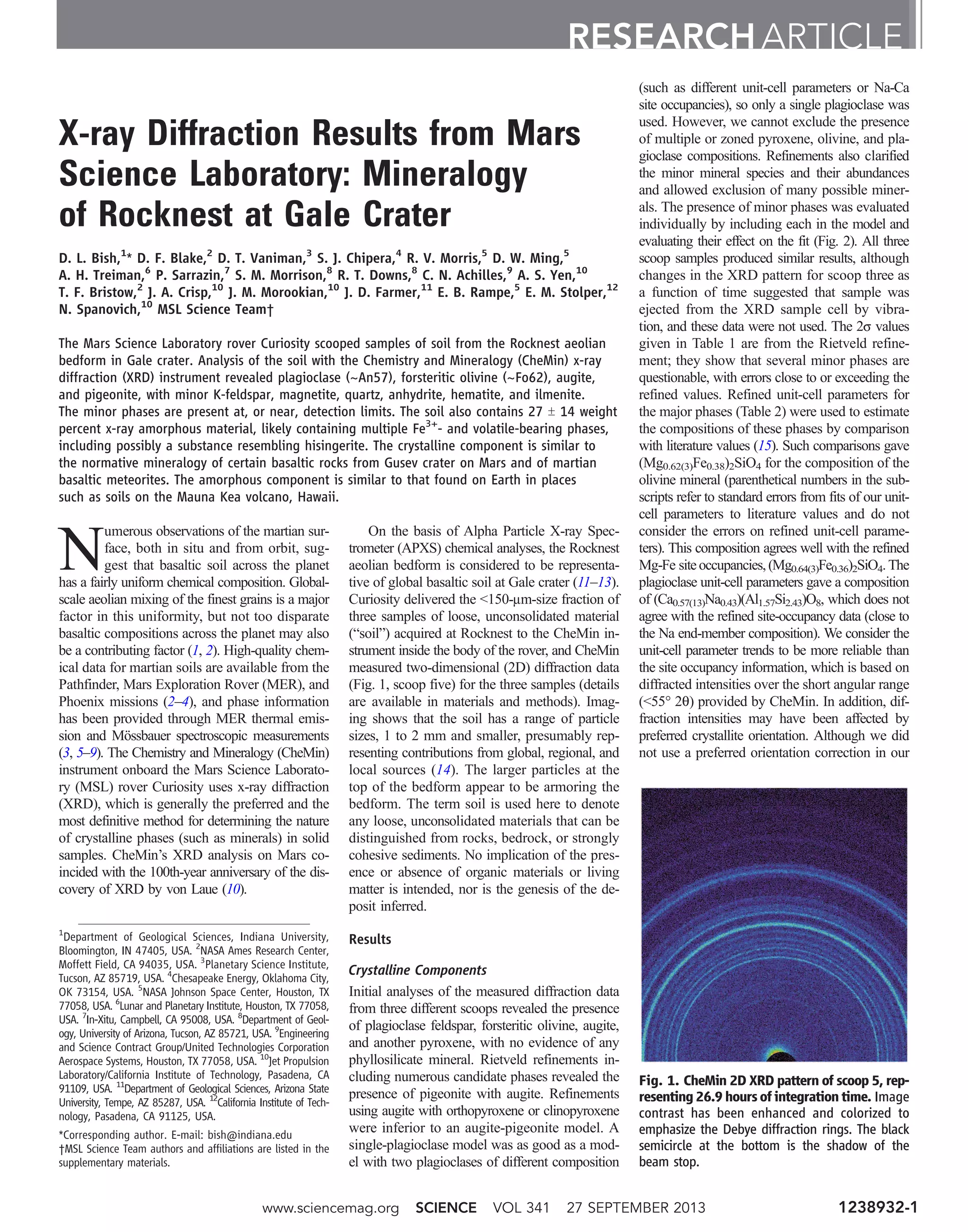
![final refinements, we did see indications of minor
orientation effects in the data, as evidenced by
small improvements in Rietveld fits when a
preferred orientation correction was used for pla-
gioclase. Refined unit-cell parameters for pigeonite
gave a composition of (Mg1.13Fe0.68Ca0.19)Si2O6,
compared with octahedral site-occupancy refine-
ment results of (Mg1.71(15)Fe0.13Ca0.16)Si2O6. Refined
unit-cell parameters for augite gave a composition
of (Mg0.88(10)Fe0.37 Ca0.75(4))Si2O6, which is broadly
consistent with octahedral site-occupancy refine-
ment results of (Mg0.58(15)Fe0.71Ca0.71)Si2O6. Unit-
cell parameters suggest atomic Mg:Fe ratios for
augite and pigeonite of 2.4 and 1.7, respectively.
Comparable ratios imply the two pyroxenes origi-
nated from the same magma, rather than having
experienced post-crystallization alteration (such as
pigeonite inversion) or being from different source
regions (16).
We also evaluated the presence of a variety of
Ca-, K-, Fe- and Mg-sulfates; halides; Ca-, Mg-,
and Fe-carbonates; phosphates; and Ca- and Mg-
perchlorates (many of these hydrated). It is straight-
forward to include each of these phases in the
Rietveld model and evaluate its potential contri-
bution to the diffraction pattern, both visually and
based on the fit parameter (Rwp). Using this ap-
proach, we found no evidence for the presence
of any of these phases, other than those listed in
Table 1, several of which have 2s uncertainties
greater than the refined abundances. If halides,
perchlorates, carbonates, phosphates, or other
sulfate phases are present as crystalline phases,
they are below the detection limits of the CheMin
instrument [1 to 2 weight percent (wt %)]. Al-
though data from the Sample Analysis at Mars
(SAM) instrument suite suggest the presence of
a small amount of perchlorate (0.3 to 0.5 wt %) in
the Rocknest soil (17, 18), models that included
Mg-perchlorate·6H2O and Ca-perchlorate·4H2O
refined to 0 wt % for these phases; thus, we find
no diffraction evidence for either of these phases.
Amorphous or Poorly Ordered Components
The elevated background in the 15 to 40° 2q range
in Fig. 2 results from the presence of one or more
amorphous or poorly ordered components. The
low-angle background is also elevated signifi-
cantly above that seen with empty cells. Hence,
we also analyzed the CheMin XRD data using a
modified version of the FULLPAT program (19),
which allows direct determination of the abun-
dance of amorphous components. The FULLPAT
analyses explicitly used patterns for both ordered
and amorphous phases, and the entire diffraction
patterns, including background, were fit. The
abundances of crystalline and amorphous phases
(Table 3) were normalized to sum to 100 wt %
in accordance with the adiabatic method (20),
and scoops four and five gave an average amor-
phous content of 27 wt %. The uncertainty on
individual amorphous values may be as high as
50 wt % relative. Of the amorphous standards in-
cluded in the analysis, only one allophane and a
basaltic glass gave positive concentrations. The
materials used as standards for amorphous mate-
rials were chosen as reasonable representatives
of expected materials in the Mars aeolian bedform.
However, the exact nature of the amorphous com-
ponent remains unclear. Although a synthetic SO3-
and Cl-free Gusev-composition basaltic glass
was the dominant amorphous component in our
FULLPAT fit, it may be just one of many amor-
phous components that have similar XRD pat-
terns, and these analyses do not unambiguously
identify the amorphous component (or compo-
nents). Similarly, allophane may be an XRD sur-
rogate for another amorphous phase such as the
Fe3+
-bearing phase hisingerite, and the sample
may contain a small amount of such material.
The Rocknest soil contains glassy-luster spherules
that may have an impact or pyroclastic origin (21),
but our results do not necessarily indicate that
the amorphous component in Rocknest soil is
dominated by basaltic glass; other observations
suggest otherwise. MER Mössbauer analyses of
basaltic soils from Gusev and Meridiani show sub-
stantial abundances of an amorphous phase con-
taining Fe3+
[generically referred to as nanophase
ferric oxide (npOx)] (7), and taken together, the
MSL CheMin and SAM data suggest that the
Gusev amorphous phase (or phases) is volatile
rich (containing, for example, H2O/OH or SO3)
(18). The abundances (Table 1) and chemistry
(from unit-cell parameters) of the crystalline
phases identified by CheMin, coupled with mass-
balance considerations from APXS analyses of
Rocknest soil, suggest that the amorphous com-
ponent is SO3- and Cl-bearing (11, 22). Last, if
MER-like levels of Fe3+
are present in Rocknest
soil, then the amorphous component must also
be the carrier of the Fe3+
(with the exception of
Fig. 2. Rietveldrefine-
ment results for scoop
5 (final Rwp = 4.3%;
Rwp = weighted pro-
file residual from the
Rietveld refinement).
Observed (blue) versus
calculated (red) pattern,
with difference curve (obs-
calc) at the bottom (gray).
The difference peak at
~25.6° 2q is due to scat-
tering from the aluminum
light shield. Minerals in-
cluded in the refinement
model are listed in Table 1.
Table 1. Crystalline components (amorphous-
free, normalized to 100%) of the Rocknest
scoop 5 soil.
Mineral Weight (%) 2s (%)
Plagioclase (~An57) 40.8 2.4
Forsterite (~Fo62) 22.4 1.9
Augite 14.6 2.8
Pigeonite 13.8 2.8
Magnetite 2.1 0.8
Anhydrite 1.5 0.7
Quartz 1.4 0.6
Sanidine* 1.3 1.3
Hematite* 1.1 0.9
Ilmenite* 0.9 0.9
*At or near detection limit
27 SEPTEMBER 2013 VOL 341 SCIENCE www.sciencemag.org1238932-2
Curiosity at Gale Crater](https://image.slidesharecdn.com/analysisofsurfacematerials-130927072926-phpapp02/75/Analysis-of-Surface-Materials-by-Curiosity-Mars-Rover-Special-Collection-43-2048.jpg)
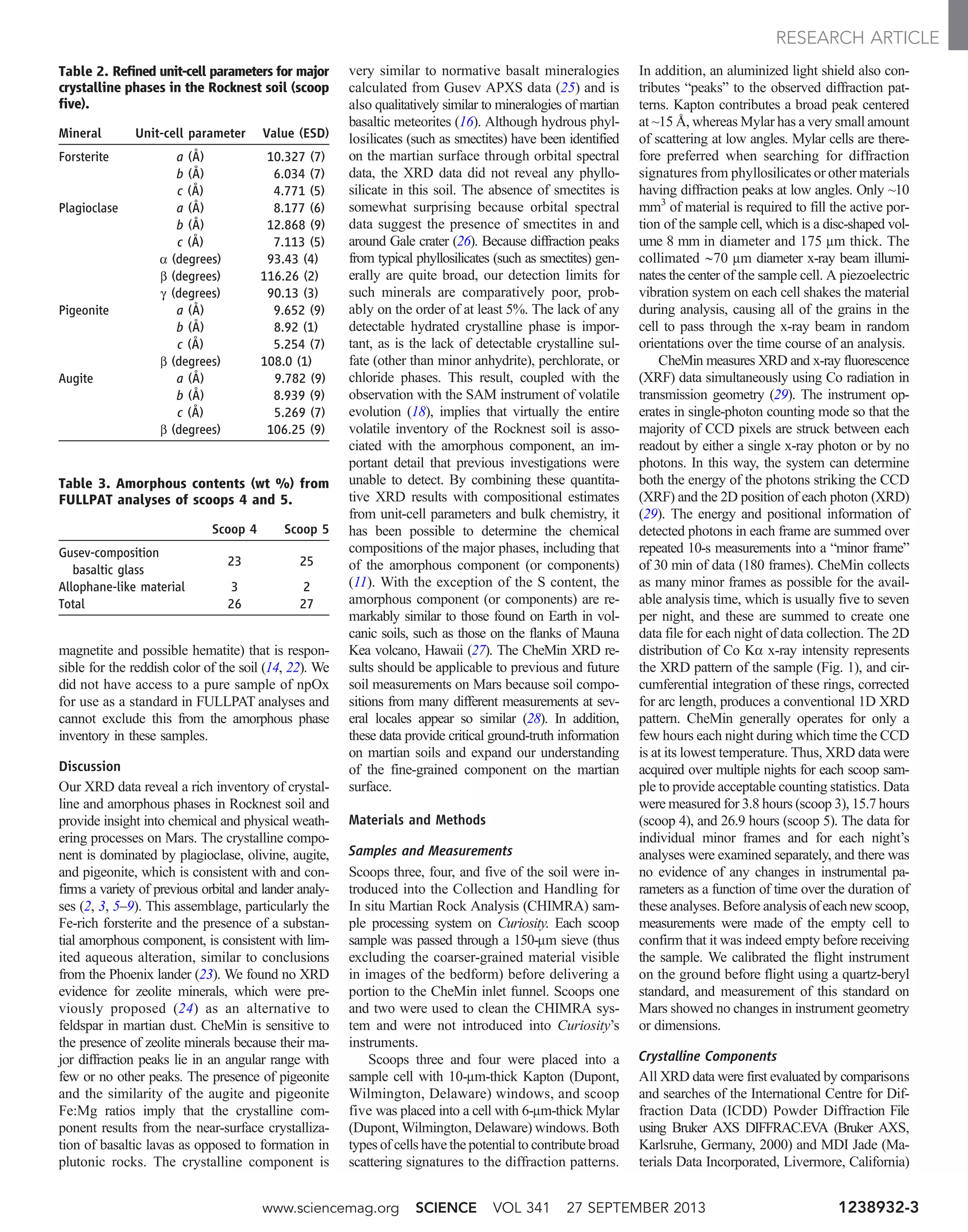
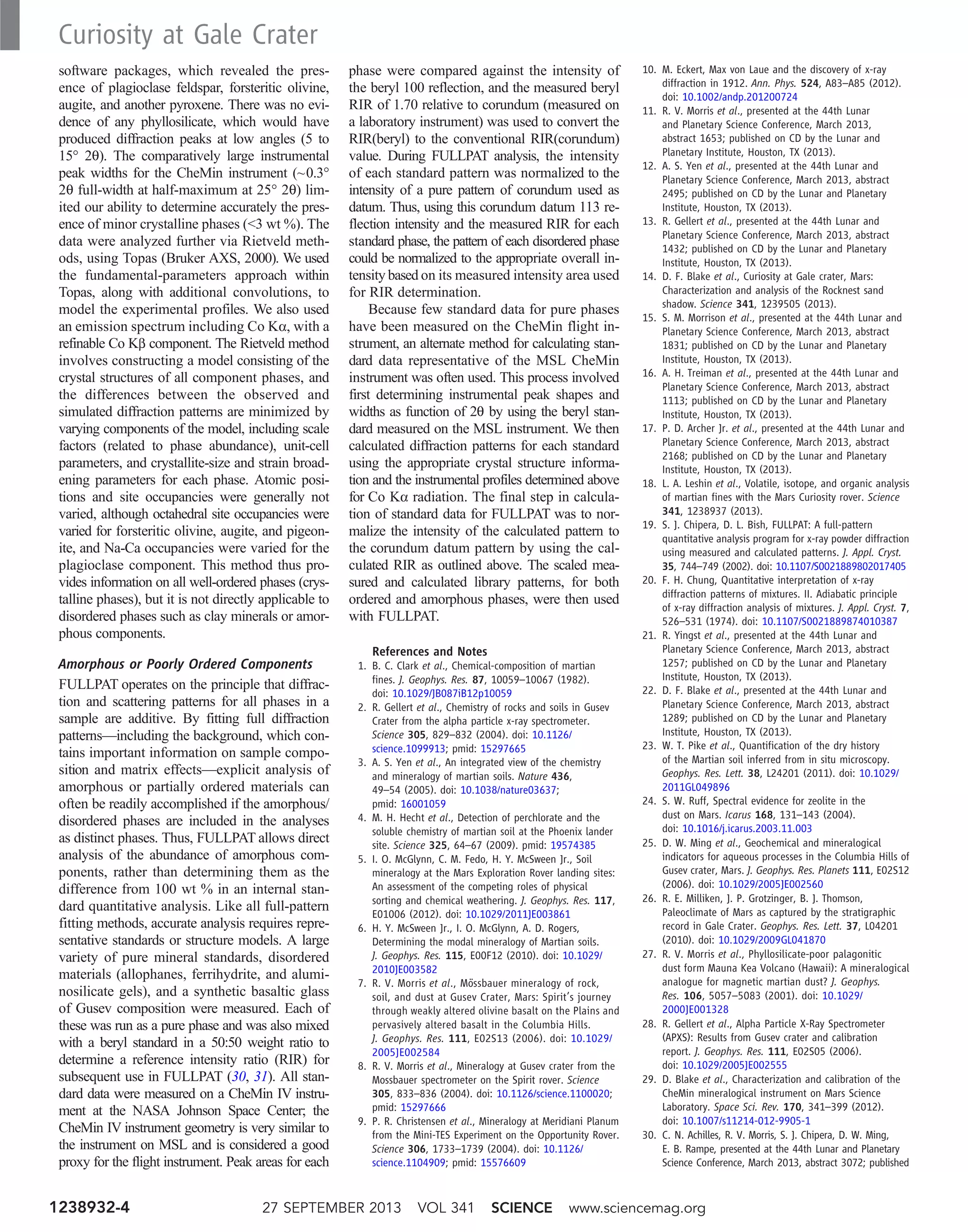


Curiosity used its instruments to analyze materials along its traverse on Mars, yielding three key results: 1) It found a unique alkaline volcanic rock called "Jake_M" that is compositionally similar to rare mugearite rocks on Earth. 2) It analyzed windblown deposits and found two soil types - a common mafic type similar to global Martian soils, and a locally derived felsic type from broken down bedrock. 3) Chemical analysis of the soils found evidence of hydration in the amorphous soil components, suggesting absorbed water plays a role in Mars' global hydration signal detected from orbiters.


