HIV self-testing
A/Prof Rebecca Guy
Surveillance, Evaluation and Research Program
The Kirby Institute, UNSW Australia
HIV testing rates
• Guidelines (STIGMA)
– Annual testing in all gay and bisexual men (GBM)
– 3-6 monthly testing in higher-risk GBM
• GBM
– 87% GBM ever tested (GCPS)
– 53% GBM re-test in 12 months (ACCESS NSW 2014)
– 54% higher risk men re-test in 6 months (ACCESS NSW 2014)
– 10-12% HIV undiagnosed (Holt 2014; Mallitt 2012)
– 31% infections transmitted by undiagnosed GBM (Wilson 2009)
• People from CALD background
– 50% surveyed in NSW ever tested (CALD survey)
• Early diagnosis and treatment can reduce population
incidence (Jannson 2014)
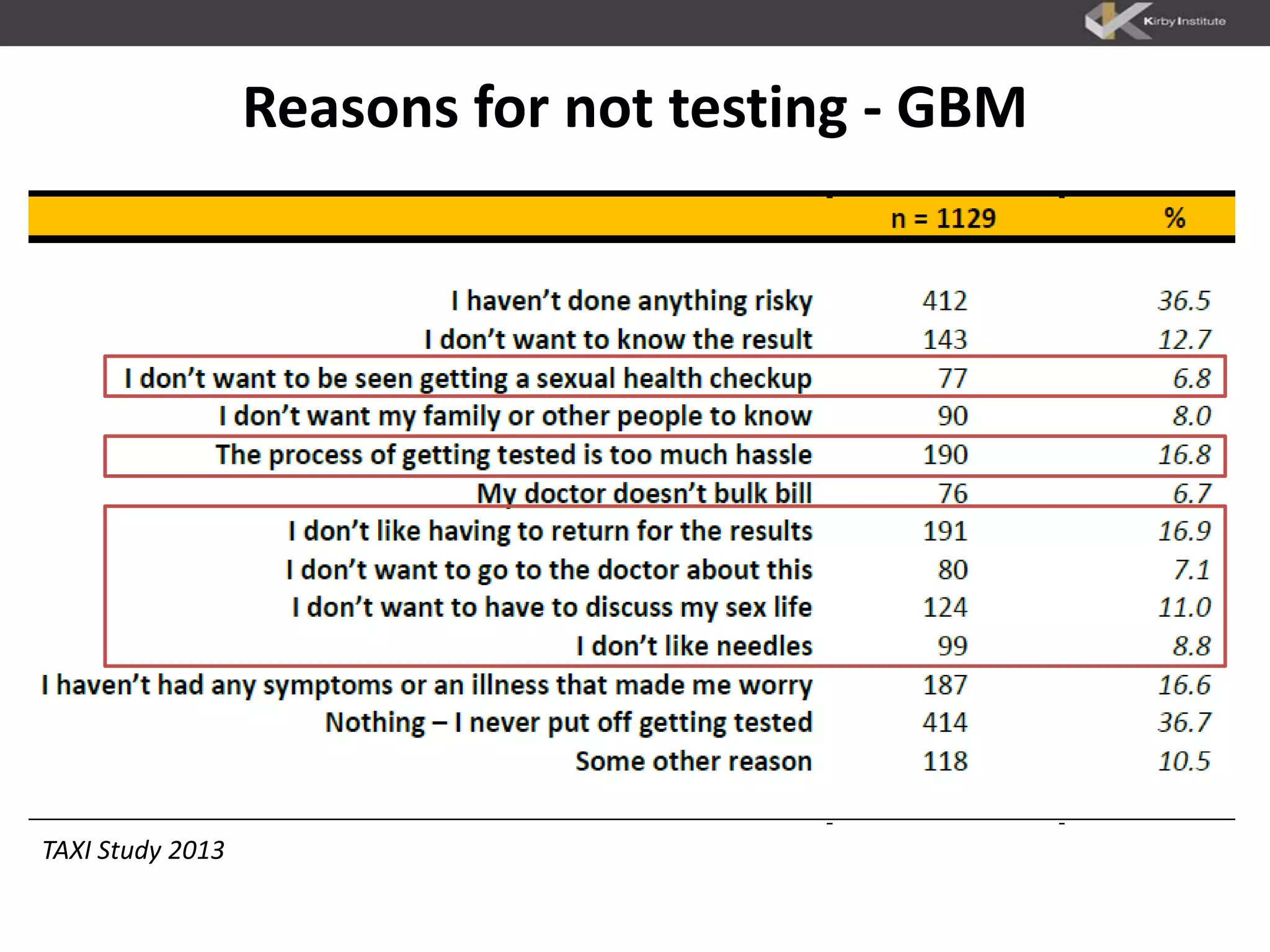
Reasons for not testing - GBM
TAXI Study 2013
Reasons for not testing - CALD
0%
10%
20%
30%
40%
50%
60%
I have always had a
steady partner
I do not like having
blood tests
I am scared of getting
a positive HIV test
result
I have done nothing
that would put me at
risk
I do not like having a
discussion with the
doctor about getting
tested
I do not like
needles/syringes
It is difficult to find
the time to get tested
It costs too much
Males Females
Potential benefits
• Public health benefit if (Guy 2015):
– Any additional HIV test due to self-test
– Previously untested men use self-test
• Partner testing
– >80% higher-risk GBM would test a partner using self-test
if available (Carballo-Die´guez 2012)
– 100 sexual partners tested, 10 HIV infections diagnosed, 6
were unaware of their infections
– Very few problems occurred (Carballo-Die´guez 2012)
– 57% Australian GBM likely to test a partner (FORTH)
Perceived interest
Australian GBM
More likely to test if self-test available
(GCPS 2011)
46%
Likely to test more frequently if self-test
available (Bavinton 2013; Chen 2010)
63-67%
Likely to purchase self-test if available (TAXI
2013)
71%
Likely to purchase self-test from chemist
(FORTH 2014-15)
86%
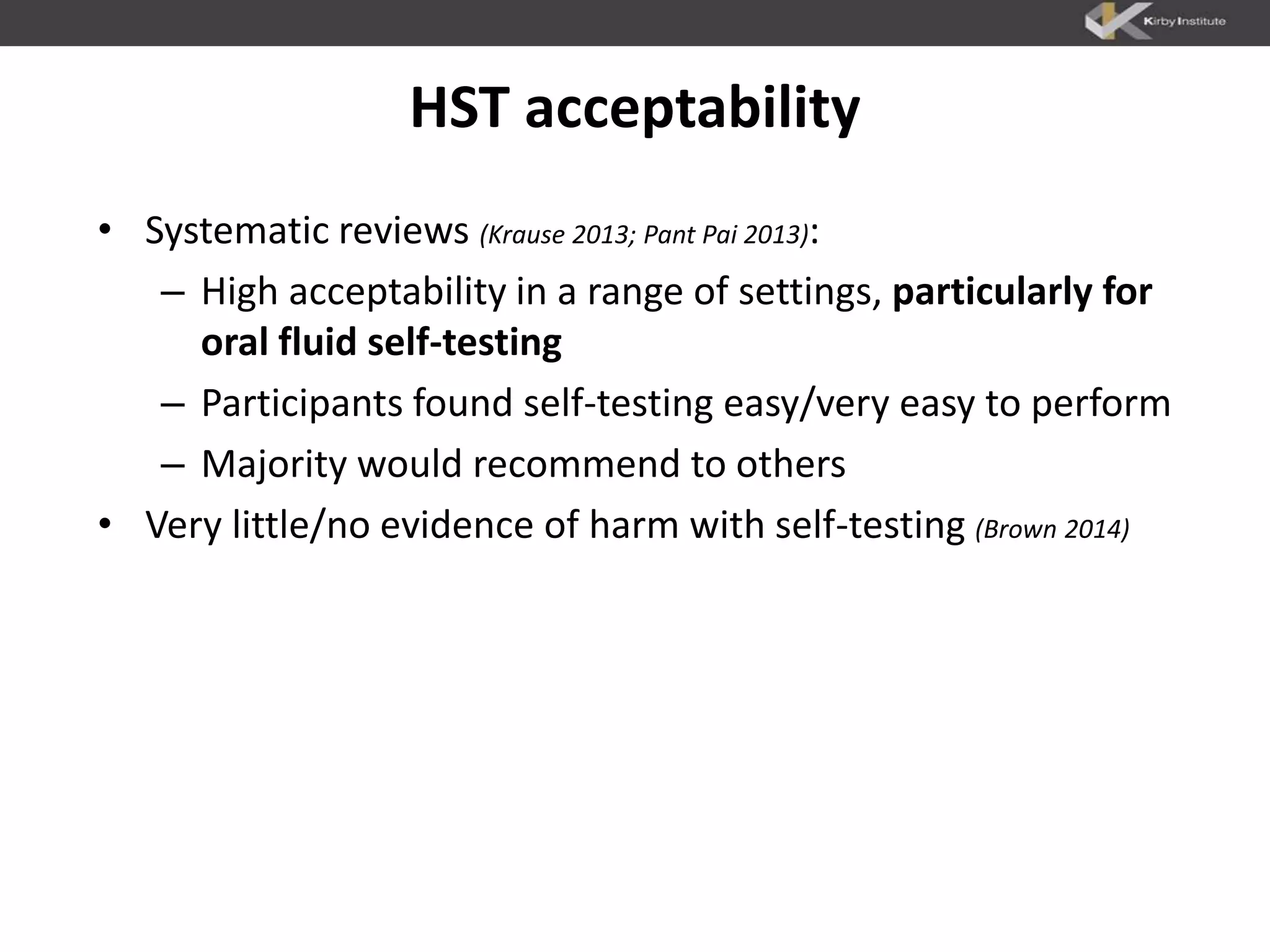
HST acceptability
• Systematic reviews (Krause 2013; Pant Pai 2013):
– High acceptability in a range of settings, particularly for
oral fluid self-testing
– Participants found self-testing easy/very easy to perform
– Majority would recommend to others
• Very little/no evidence of harm with self-testing (Brown 2014)
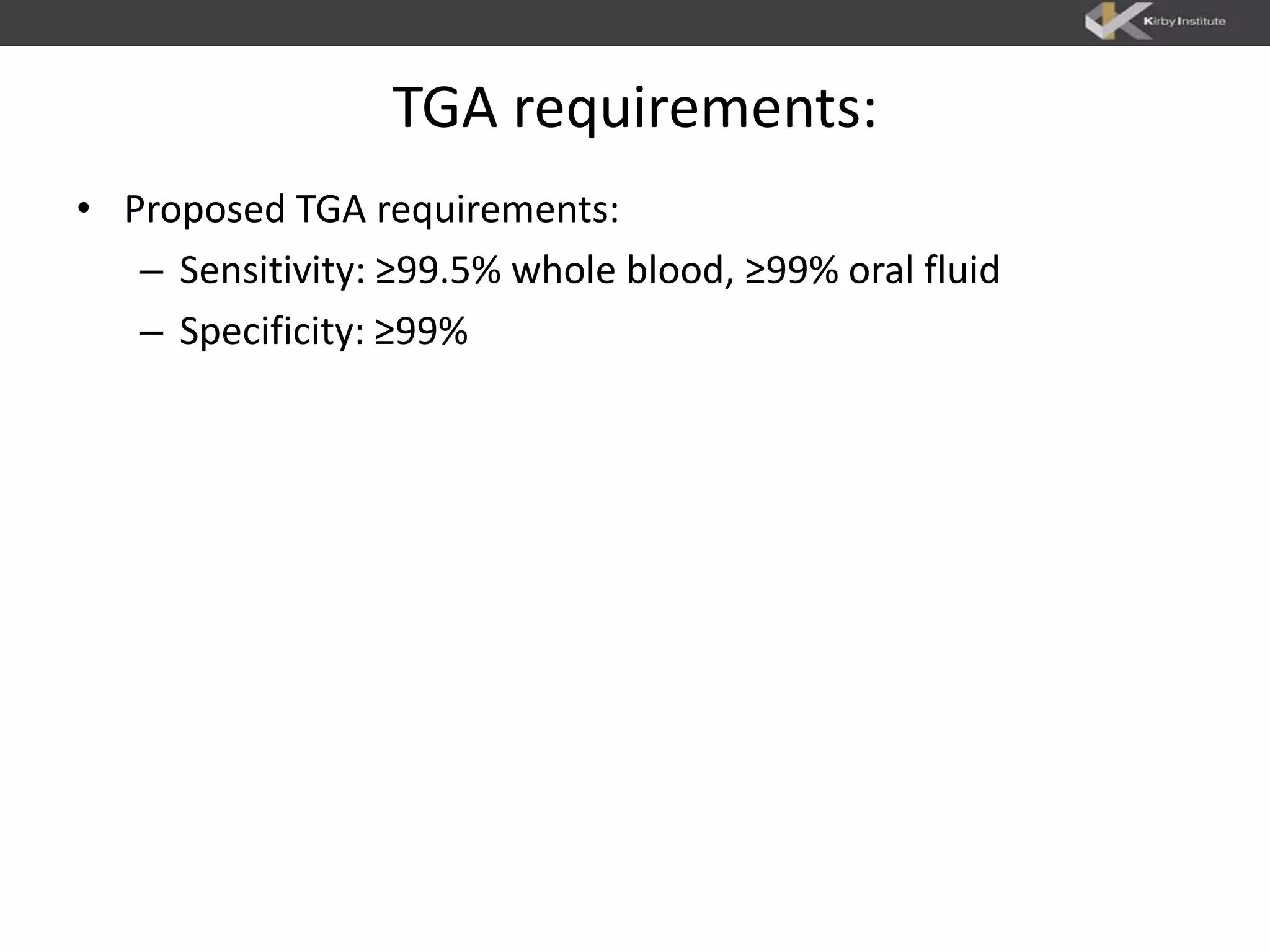
TGA requirements:
• Proposed TGA requirements:
– Sensitivity: ≥99.5% whole blood, ≥99% oral fluid
– Specificity: ≥99%
TGA requirements:
• However, it is recognised that the same level of sensitivity
and specificity may not be achieved in a self-testing
environment.
• The suitability of these studies will be assessed on a case-by-
case basis and will depend on how well the manufacturer has
mitigated any risks and demonstrated that the overall
benefits of the product outweigh any residual risks
associated with its use. Demonstration of the benefit of a test
and effectiveness of risk mitigation measures in the self-
testing environment may be supported by a documented
review of relevant published literature
TGA requirements:
1. The specimen collection process must be straightforward
2. The test must be easy to perform
3. Clear and simple instructions on how to perform and interpret the test
4. Clear warnings on the risk of false negative results if testing is
performed in the 'window period' (and a clear explanation of what the
window period is)
5. Clear indication that HIV self-testing is for presumptive screening only
and the need to consult a medical practitioner for confirmatory testing
of positive results by a laboratory test
6. How to contact locally available support and counselling services
including phone lines and websites.
7. Information on behaviour that may place an individual at an increased
risk for HIV infection and the need to test frequently if there is an
ongoing risk, including a warning that a negative result does not indicate
that engaging in high risk behaviour is safe
8. Information to promote safe sex and safe injecting practices and the
need for individuals engaging in high risk behaviours to undergo testing
for other sexually transmitted infections and blood borne viruses.
Approved HSTs (not in Australia)
OraQuick In-Home HIV test (OraSure Technologies, Bethlehem,
PA, USA) approved by the FDA in 2012
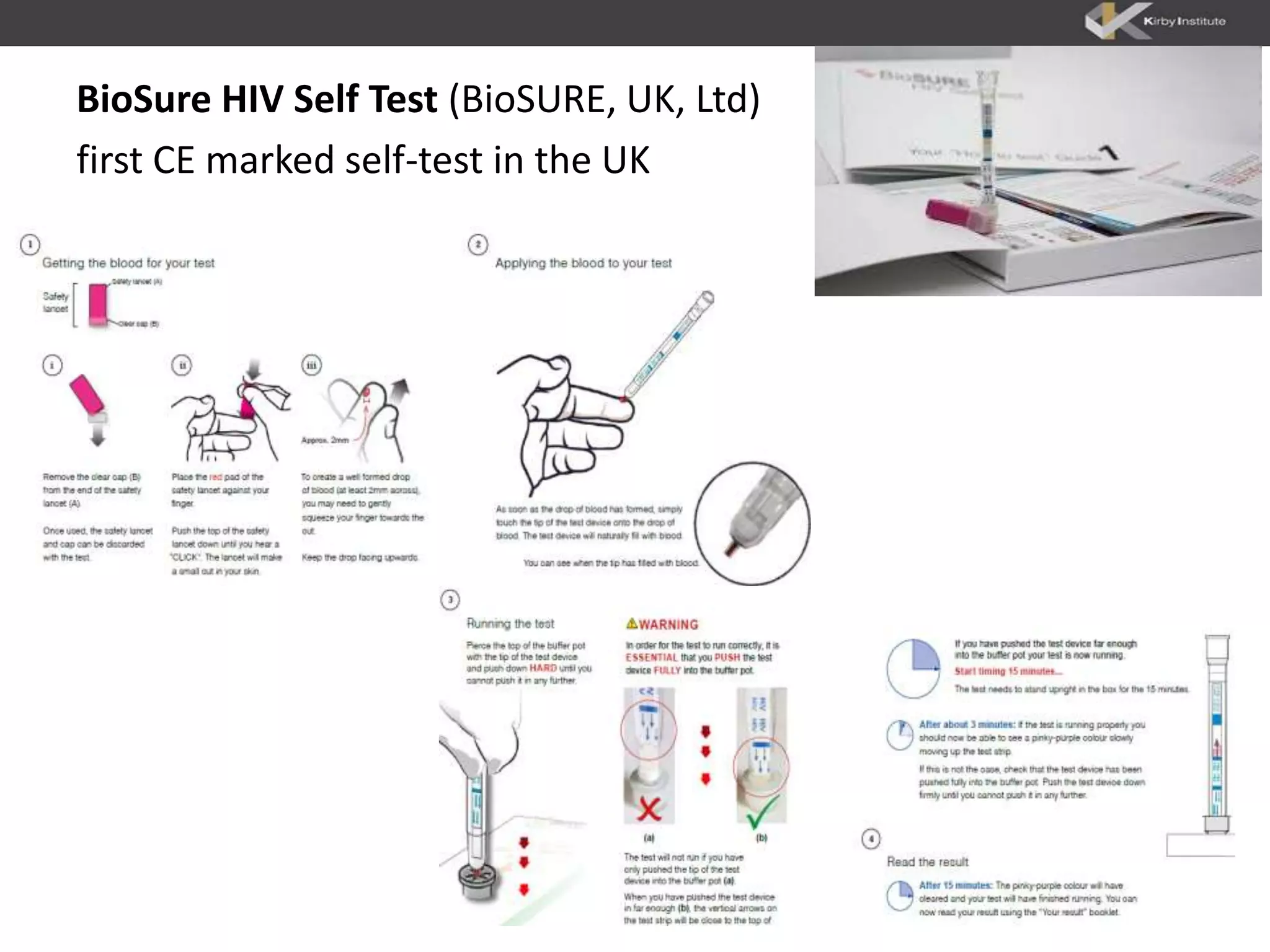
BioSure HIV Self Test (BioSURE, UK, Ltd)
first CE marked self-test in the UK
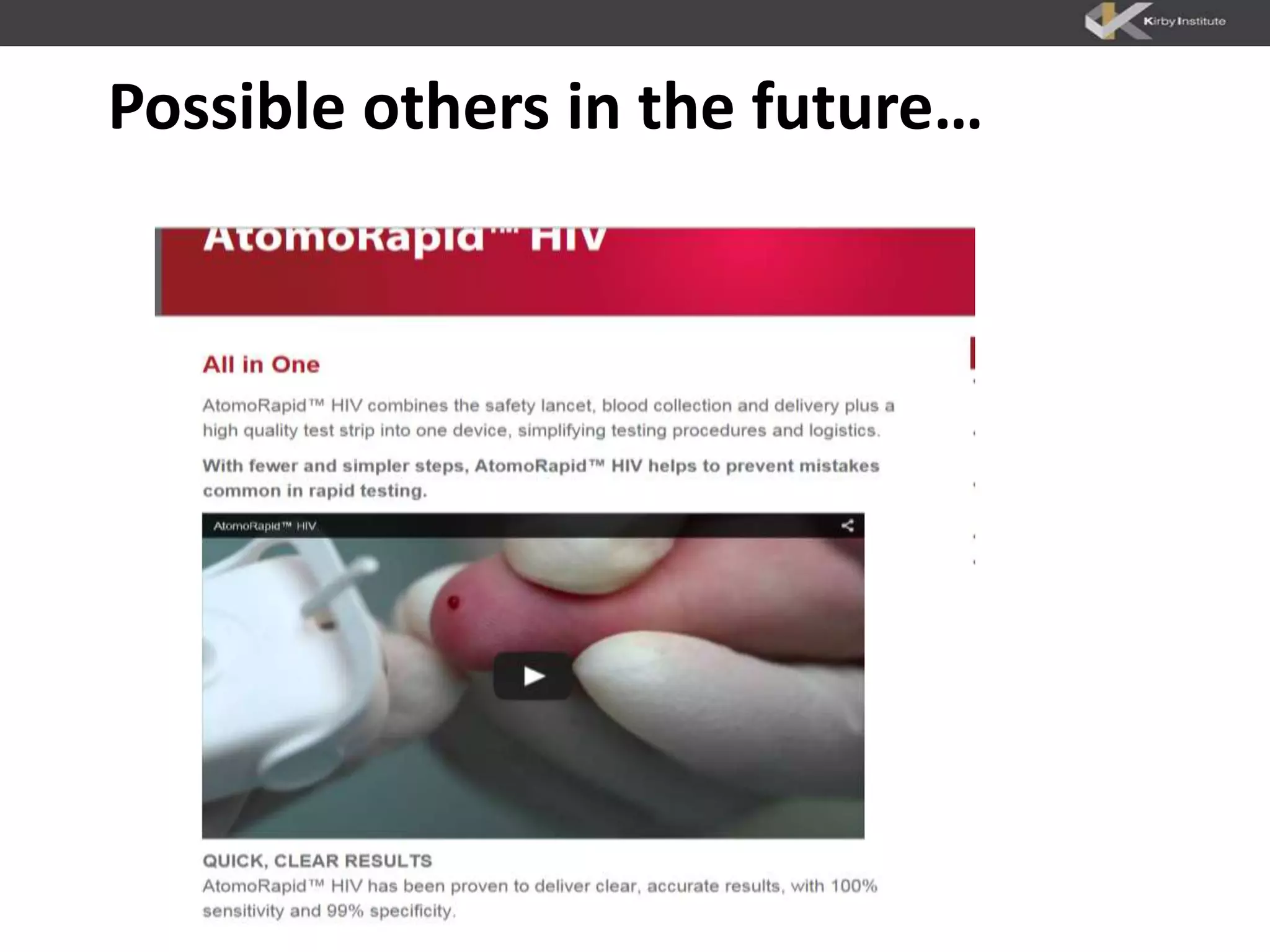
Possible others in the future…
OraQuick vs BioSure
OraQuick BioSure
Device 2nd gen 2nd gen
Specimen Oral fluid Finger-prick
Sensitivity 99.3% (98.4-99.7) 99.7% (98.9-100)
Window period 3 months* 3 months*
Specificity 99.8% (99.6-99.9) 99.9% (99.6-100)
Field evaluations (untrained users)
Sensitivity 91.7% (84.24-96.33) N/A
Specificity 99.98% (99.89-100) N/A
Performance if 10,000 self-tests performed
Positivity True Positive False Positive
High (2.0%) 200 2 (1:100)
Low (0.2%) 20 2 (1:10)
*25-35 days based on published studies (Branson 2011)
Linkage to care and surveillance
• OraSure’s unobserved user study
– No serious adverse events
– 96% of HIV positive said they would follow-up with a
doctor or clinic
Supplementing vs replacing
• If self-testing replaced clinic-based testing HIV prevalence
among GBM will increase (Katz 2014)
• HOWEVER…….
• Interviews with Australian GBM, self-testing is seen as: (FORTH;
Bilardi 2013)
– Supplemental to existing testing routine
– Avenue for more frequent testing
– 92% GBM would get STI check-up at about the same or
higher frequency when they get access to self-tests
Cost
• OraQuick: US$40 (plus delivery if purchased online)
• BioSure: £30 (free delivery)
• GBM in developed countries have expressed willingness to pay for
self-test:
• BUT ONLY ABOUT HALF WOULD ONLY PAY $20
– Australia: 42% up to A$20 (FORTH)
– Canada: 41% up to US$20 (Pant Pai 2013)
– US: 57% up to US$20 (Katz 2012)
– Spain: 55% up to €19 (de la Fuente 2012)
– Singapore: 88% between US$7-13 (Lee 2007)
Organisations involved
Kirby Institute
Melbourne sexual health clinic
Sydney sexual health clinic
Cairns sexual health clinic
CSRH
VAC
ACON
Study Design
• Does access to HIV self-testing
– Increase frequency of testing?
– Reduce STI testing?
– Acceptable?
• Wait-list control RCT (50% clinic first then switch)
• 24 months follow-up
• Sites:
– Melbourne SHC, Sydney SHC, Cairns SHC
– VAC/GMHC, ACON
• Sample size: 350 participants including 50 infrequent
testers (not tested in last 2 years)
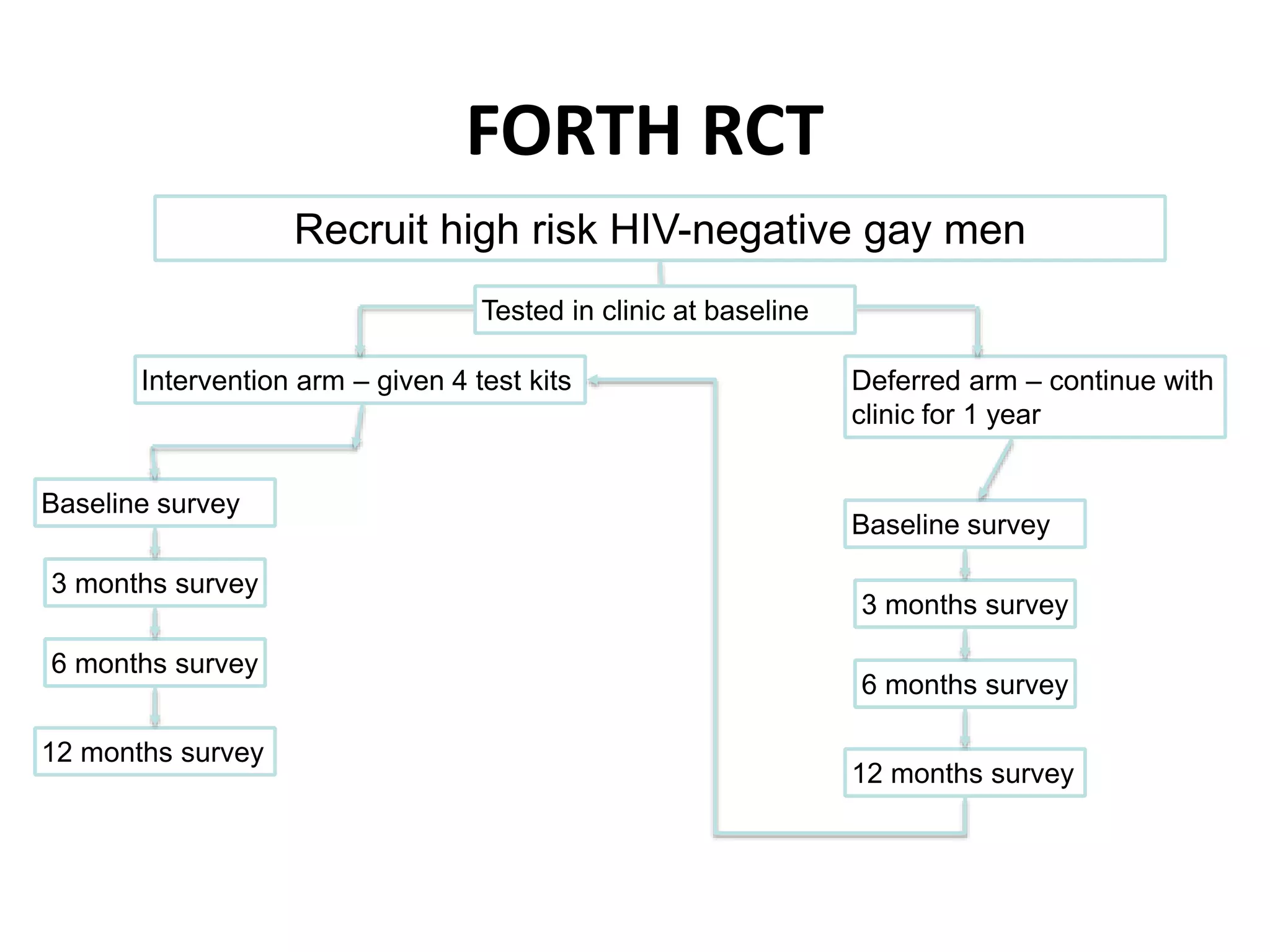
FORTH RCT
Recruit high risk HIV-negative gay men
Intervention arm – given 4 test kits Deferred arm – continue with
clinic for 1 year
Baseline survey
3 months survey
6 months survey
12 months survey
Tested in clinic at baseline
Baseline survey
3 months survey
6 months survey
12 months survey
Conclusions
• HIV self-testing not yet available in Australia
• Australian GBM have expressed interested in accessing
HST
• High acceptability and easy of use from overseas studies
• Potential benefits
• Acceptability studies with CALD populations?
• Delivery mechanisms/cost?

HIV self-testing

  • 1.
    HIV self-testing A/Prof RebeccaGuy Surveillance, Evaluation and Research Program The Kirby Institute, UNSW Australia
  • 2.
    HIV testing rates •Guidelines (STIGMA) – Annual testing in all gay and bisexual men (GBM) – 3-6 monthly testing in higher-risk GBM • GBM – 87% GBM ever tested (GCPS) – 53% GBM re-test in 12 months (ACCESS NSW 2014) – 54% higher risk men re-test in 6 months (ACCESS NSW 2014) – 10-12% HIV undiagnosed (Holt 2014; Mallitt 2012) – 31% infections transmitted by undiagnosed GBM (Wilson 2009) • People from CALD background – 50% surveyed in NSW ever tested (CALD survey) • Early diagnosis and treatment can reduce population incidence (Jannson 2014)
  • 3.
    Reasons for nottesting - GBM TAXI Study 2013
  • 4.
    Reasons for nottesting - CALD 0% 10% 20% 30% 40% 50% 60% I have always had a steady partner I do not like having blood tests I am scared of getting a positive HIV test result I have done nothing that would put me at risk I do not like having a discussion with the doctor about getting tested I do not like needles/syringes It is difficult to find the time to get tested It costs too much Males Females
  • 5.
    Potential benefits • Publichealth benefit if (Guy 2015): – Any additional HIV test due to self-test – Previously untested men use self-test • Partner testing – >80% higher-risk GBM would test a partner using self-test if available (Carballo-Die´guez 2012) – 100 sexual partners tested, 10 HIV infections diagnosed, 6 were unaware of their infections – Very few problems occurred (Carballo-Die´guez 2012) – 57% Australian GBM likely to test a partner (FORTH)
  • 6.
    Perceived interest Australian GBM Morelikely to test if self-test available (GCPS 2011) 46% Likely to test more frequently if self-test available (Bavinton 2013; Chen 2010) 63-67% Likely to purchase self-test if available (TAXI 2013) 71% Likely to purchase self-test from chemist (FORTH 2014-15) 86%
  • 7.
    HST acceptability • Systematicreviews (Krause 2013; Pant Pai 2013): – High acceptability in a range of settings, particularly for oral fluid self-testing – Participants found self-testing easy/very easy to perform – Majority would recommend to others • Very little/no evidence of harm with self-testing (Brown 2014)
  • 8.
    TGA requirements: • ProposedTGA requirements: – Sensitivity: ≥99.5% whole blood, ≥99% oral fluid – Specificity: ≥99%
  • 9.
    TGA requirements: • However,it is recognised that the same level of sensitivity and specificity may not be achieved in a self-testing environment. • The suitability of these studies will be assessed on a case-by- case basis and will depend on how well the manufacturer has mitigated any risks and demonstrated that the overall benefits of the product outweigh any residual risks associated with its use. Demonstration of the benefit of a test and effectiveness of risk mitigation measures in the self- testing environment may be supported by a documented review of relevant published literature
  • 10.
    TGA requirements: 1. Thespecimen collection process must be straightforward 2. The test must be easy to perform 3. Clear and simple instructions on how to perform and interpret the test 4. Clear warnings on the risk of false negative results if testing is performed in the 'window period' (and a clear explanation of what the window period is) 5. Clear indication that HIV self-testing is for presumptive screening only and the need to consult a medical practitioner for confirmatory testing of positive results by a laboratory test 6. How to contact locally available support and counselling services including phone lines and websites. 7. Information on behaviour that may place an individual at an increased risk for HIV infection and the need to test frequently if there is an ongoing risk, including a warning that a negative result does not indicate that engaging in high risk behaviour is safe 8. Information to promote safe sex and safe injecting practices and the need for individuals engaging in high risk behaviours to undergo testing for other sexually transmitted infections and blood borne viruses.
  • 11.
    Approved HSTs (notin Australia) OraQuick In-Home HIV test (OraSure Technologies, Bethlehem, PA, USA) approved by the FDA in 2012
  • 12.
    BioSure HIV SelfTest (BioSURE, UK, Ltd) first CE marked self-test in the UK
  • 13.
    Possible others inthe future…
  • 14.
    OraQuick vs BioSure OraQuickBioSure Device 2nd gen 2nd gen Specimen Oral fluid Finger-prick Sensitivity 99.3% (98.4-99.7) 99.7% (98.9-100) Window period 3 months* 3 months* Specificity 99.8% (99.6-99.9) 99.9% (99.6-100) Field evaluations (untrained users) Sensitivity 91.7% (84.24-96.33) N/A Specificity 99.98% (99.89-100) N/A Performance if 10,000 self-tests performed Positivity True Positive False Positive High (2.0%) 200 2 (1:100) Low (0.2%) 20 2 (1:10) *25-35 days based on published studies (Branson 2011)
  • 15.
    Linkage to careand surveillance • OraSure’s unobserved user study – No serious adverse events – 96% of HIV positive said they would follow-up with a doctor or clinic
  • 16.
    Supplementing vs replacing •If self-testing replaced clinic-based testing HIV prevalence among GBM will increase (Katz 2014) • HOWEVER……. • Interviews with Australian GBM, self-testing is seen as: (FORTH; Bilardi 2013) – Supplemental to existing testing routine – Avenue for more frequent testing – 92% GBM would get STI check-up at about the same or higher frequency when they get access to self-tests
  • 17.
    Cost • OraQuick: US$40(plus delivery if purchased online) • BioSure: £30 (free delivery) • GBM in developed countries have expressed willingness to pay for self-test: • BUT ONLY ABOUT HALF WOULD ONLY PAY $20 – Australia: 42% up to A$20 (FORTH) – Canada: 41% up to US$20 (Pant Pai 2013) – US: 57% up to US$20 (Katz 2012) – Spain: 55% up to €19 (de la Fuente 2012) – Singapore: 88% between US$7-13 (Lee 2007)
  • 19.
    Organisations involved Kirby Institute Melbournesexual health clinic Sydney sexual health clinic Cairns sexual health clinic CSRH VAC ACON
  • 20.
    Study Design • Doesaccess to HIV self-testing – Increase frequency of testing? – Reduce STI testing? – Acceptable? • Wait-list control RCT (50% clinic first then switch) • 24 months follow-up • Sites: – Melbourne SHC, Sydney SHC, Cairns SHC – VAC/GMHC, ACON • Sample size: 350 participants including 50 infrequent testers (not tested in last 2 years)
  • 21.
    FORTH RCT Recruit highrisk HIV-negative gay men Intervention arm – given 4 test kits Deferred arm – continue with clinic for 1 year Baseline survey 3 months survey 6 months survey 12 months survey Tested in clinic at baseline Baseline survey 3 months survey 6 months survey 12 months survey
  • 22.
    Conclusions • HIV self-testingnot yet available in Australia • Australian GBM have expressed interested in accessing HST • High acceptability and easy of use from overseas studies • Potential benefits • Acceptability studies with CALD populations? • Delivery mechanisms/cost?

Editor's Notes

  • #5 Thailand, Cambodia, Zimbabwe, Ethiopia, Sudan, and South Africa