Domain Disputes
Overview of UDRP Procedures
6/5/2015
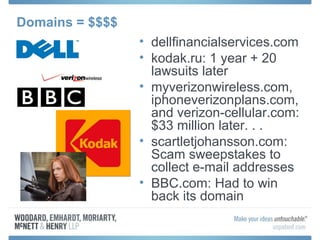
Domains = $$$$
• dellfinancialservices.com
• kodak.ru: 1 year + 20
lawsuits later
• myverizonwireless.com,
iphoneverizonplans.com,
and verizon-cellular.com:
$33 million later. . .
• scartletjohansson.com:
Scam sweepstakes to
collect e-mail addresses
• BBC.com: Had to win
back its domain
Why Dispute/Defend a Domain?
• Domain Hijacking (“Cyber Squatting”):
Register to resell
• Typo Squatting: Registering common
misspellings of famous domains to resell or
confuse consumers
• Reverse Domain Hijacking: Making false
cyber squatting claim to force domain transfer
• Confusion: Domain is like TM and site
markets similar products
UDRP Nuts and Bolts
• Uniform Domain-Name Resolution Policy (UDRP)
• Jurisdiction: Why UDRP?
– Registrant must "represent and warrant", registering
"will not infringe upon or otherwise violate the rights
of any third party”
– Registrant agrees to participate in UDRP process
• Who Can File: Any legal entity
– Owning a registered trademark
– Licensed to use a registered trademark
– Able to establish rights in a well known prior
trademark, or
– show an unregistered use
UDRP Nuts and Bolts: Cont.
• Available Relief:
– The transfer of the domain name: No opportunity
to recover damages
– top level domain names ("gTLDs": e.g. .com;
.info; .biz; .mobi; .net; .org)
– names corresponding to the codes of countries
("ccTLDs")which have adopted the UDRP
– Countries not adopting UDRP handled locally
• Cost: Depends on Forum and Panel Size
– WIPO Arbitration Center: $1500/$4000
– National Arbitration Forum: $1300/$2600
– Budget $1500 to $5000 (or more) attorney time
depending on complexity
UDRP Nuts and Bolts: Cont.
• Timing: Complaint through final Decision
– Average around 60 days, less if no response
– Extensions of time available for “extenuating”
circumstances
– Actual domain transfer estimate additional 2-4
weeks
• Losing Domain holder has 10 days after
decision to file a lawsuit before transfer
• Must request transfer! Not automatic
The Complaint: Prove Three Elements
• Domain name is identical or confusingly
similar to a trademark or service mark in which
the complainant has rights
• Domain name holder has no rights or
legitimate interests in respect of the domain
name
• The domain name has been registered and is
being used in bad faith
The Complaint: Identical or Confusing
• Only similarity between the trademark and the
domain name is considered
• The panel makes a visual and verbal
comparison taking the trademark's distinctive
nature into account.
• Panel does not consider the products or
services (in this step) – not a substantive
likelihood of confusion analysis
The Complaint: No Legitimate Interest
• Must try to prove a negative
• Offer evidence of lack of rights:
– Parked domain: Not using it?
– Content of site: Is it a real company doing
business?
– Passing off?
– Commonly known by domain name?
• Burden of proof then on domain holder to
dispute complainant's evidence and show
legitimate interest
• Not an exclusive list: Bring any evidence
The Complaint: Used in Bad Faith
• Sell/rent to the Complainant/TM owner or to a competitor
for value beyond out-of-pocket costs directly related to the
domain
• Prevent the Complainant/TM owner from reflecting the
mark in a corresponding domain name (must show
pattern of such conduct)
• Trying to disrupt the business of a competitor
• Trying to intentionally attract, for commercial gain, Internet
users by creating a likelihood of confusion with the
complainant's mark as to the source, sponsorship,
affiliation, or endorsement
• Can show other evidence: Not an exclusive list
The Response: Disprove Only One Element
• Domain name is not identical or confusingly
similar: Sometimes tough to do.
• Have rights or legitimate interest:
– Put on proof of business activity using the mark
– More time is better
• Not registered in bad faith
– No need to prove bad faith if shown legitimate
interest in the mark
– Argue it, but Panel may stop at legitimate interest
• Laches: A recent defense but effective one.
– Complainant new about the domain and did nothing
until now. Longer is better! (ex. <15 years)
– Harm to legitimate interest of domain holder very
helpful
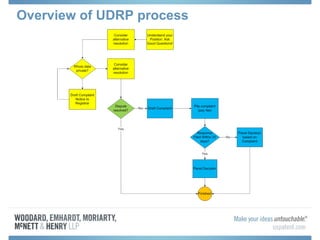
Overview of UDRP process
Practice Tips
• Read the rules and the policy! (and
supplemental rules for your forum!)
• Start with current copy of model
complaint/response
• Threaten registrar to give up domain holder’s
info: May be able to resolve early
• Understand the issues and try to resolve early
• Not a Trademark lawsuit: Stay on point
• Use past UDRP cases in arguments
• Exhibits: Include them! More is better
Uniform Rapid Suspension (URS)
• Quicker/Cheaper: $350-$500, 20-25 days
• Applies only to new gTLDs, or ccTLDs adopting URS
• Additional defenses written into URS:
– Domain is descriptive, and making fair use
– Domain is operated as a tribute or criticism in FU
– Domain not part of a pattern
• No opportunity to amend complaint
• Higher Standard of Proof:
– Complaint denied where Panel finds contestable issue
– lack of clear and convincing evidence
• Cannot assert common law TM Rights
• Domain is suspended, not transferred
• Why use it? Registered TM vs. clear cybersquatting

Domain Dispute Presentation

  • 1.
    Domain Disputes Overview ofUDRP Procedures 6/5/2015
  • 2.
    Domains = $$$$ •dellfinancialservices.com • kodak.ru: 1 year + 20 lawsuits later • myverizonwireless.com, iphoneverizonplans.com, and verizon-cellular.com: $33 million later. . . • scartletjohansson.com: Scam sweepstakes to collect e-mail addresses • BBC.com: Had to win back its domain
  • 3.
    Why Dispute/Defend aDomain? • Domain Hijacking (“Cyber Squatting”): Register to resell • Typo Squatting: Registering common misspellings of famous domains to resell or confuse consumers • Reverse Domain Hijacking: Making false cyber squatting claim to force domain transfer • Confusion: Domain is like TM and site markets similar products
  • 4.
    UDRP Nuts andBolts • Uniform Domain-Name Resolution Policy (UDRP) • Jurisdiction: Why UDRP? – Registrant must "represent and warrant", registering "will not infringe upon or otherwise violate the rights of any third party” – Registrant agrees to participate in UDRP process • Who Can File: Any legal entity – Owning a registered trademark – Licensed to use a registered trademark – Able to establish rights in a well known prior trademark, or – show an unregistered use
  • 5.
    UDRP Nuts andBolts: Cont. • Available Relief: – The transfer of the domain name: No opportunity to recover damages – top level domain names ("gTLDs": e.g. .com; .info; .biz; .mobi; .net; .org) – names corresponding to the codes of countries ("ccTLDs")which have adopted the UDRP – Countries not adopting UDRP handled locally • Cost: Depends on Forum and Panel Size – WIPO Arbitration Center: $1500/$4000 – National Arbitration Forum: $1300/$2600 – Budget $1500 to $5000 (or more) attorney time depending on complexity
  • 6.
    UDRP Nuts andBolts: Cont. • Timing: Complaint through final Decision – Average around 60 days, less if no response – Extensions of time available for “extenuating” circumstances – Actual domain transfer estimate additional 2-4 weeks • Losing Domain holder has 10 days after decision to file a lawsuit before transfer • Must request transfer! Not automatic
  • 7.
    The Complaint: ProveThree Elements • Domain name is identical or confusingly similar to a trademark or service mark in which the complainant has rights • Domain name holder has no rights or legitimate interests in respect of the domain name • The domain name has been registered and is being used in bad faith
  • 8.
    The Complaint: Identicalor Confusing • Only similarity between the trademark and the domain name is considered • The panel makes a visual and verbal comparison taking the trademark's distinctive nature into account. • Panel does not consider the products or services (in this step) – not a substantive likelihood of confusion analysis
  • 9.
    The Complaint: NoLegitimate Interest • Must try to prove a negative • Offer evidence of lack of rights: – Parked domain: Not using it? – Content of site: Is it a real company doing business? – Passing off? – Commonly known by domain name? • Burden of proof then on domain holder to dispute complainant's evidence and show legitimate interest • Not an exclusive list: Bring any evidence
  • 10.
    The Complaint: Usedin Bad Faith • Sell/rent to the Complainant/TM owner or to a competitor for value beyond out-of-pocket costs directly related to the domain • Prevent the Complainant/TM owner from reflecting the mark in a corresponding domain name (must show pattern of such conduct) • Trying to disrupt the business of a competitor • Trying to intentionally attract, for commercial gain, Internet users by creating a likelihood of confusion with the complainant's mark as to the source, sponsorship, affiliation, or endorsement • Can show other evidence: Not an exclusive list
  • 11.
    The Response: DisproveOnly One Element • Domain name is not identical or confusingly similar: Sometimes tough to do. • Have rights or legitimate interest: – Put on proof of business activity using the mark – More time is better • Not registered in bad faith – No need to prove bad faith if shown legitimate interest in the mark – Argue it, but Panel may stop at legitimate interest • Laches: A recent defense but effective one. – Complainant new about the domain and did nothing until now. Longer is better! (ex. <15 years) – Harm to legitimate interest of domain holder very helpful
  • 12.
  • 13.
    Practice Tips • Readthe rules and the policy! (and supplemental rules for your forum!) • Start with current copy of model complaint/response • Threaten registrar to give up domain holder’s info: May be able to resolve early • Understand the issues and try to resolve early • Not a Trademark lawsuit: Stay on point • Use past UDRP cases in arguments • Exhibits: Include them! More is better
  • 14.
    Uniform Rapid Suspension(URS) • Quicker/Cheaper: $350-$500, 20-25 days • Applies only to new gTLDs, or ccTLDs adopting URS • Additional defenses written into URS: – Domain is descriptive, and making fair use – Domain is operated as a tribute or criticism in FU – Domain not part of a pattern • No opportunity to amend complaint • Higher Standard of Proof: – Complaint denied where Panel finds contestable issue – lack of clear and convincing evidence • Cannot assert common law TM Rights • Domain is suspended, not transferred • Why use it? Registered TM vs. clear cybersquatting