Research
   Project


Information-learning
      activity


           Wendy Ariel
             n0158992
              CLN650
Using the Green Lane Diary,
    students can:
    • Learn about the world’s
        environmental problems
        and solutions
    • Discover how to live a
        greener life
    • Start an action research
        project
    • Track their actions in the
        diary

The diary includes:

•   inspirational stories and ideas to help children
    come up with ideas about their own action
    plans

•   comprehensive information on a wide range of
    environmental topics

•   links to many websites where the children are
    able to find additional information.

•   A Green Lane Diary app is also available this
    year, so that students have direct access to
    these links from the iPads.
5 Es Instructional Model

 engage
 explore
 explain
 elaborate
 evaluate
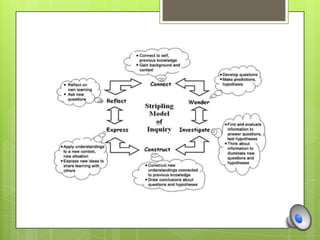
QUESTIONING FRAMEWORK
 KWHLAQ             (Barell, 2008)


   What Do I Know?
   What Do I Want To Know?
   How Do I Find Out?
   What have I learned?
   What action will I take?
   What new questions do I have?
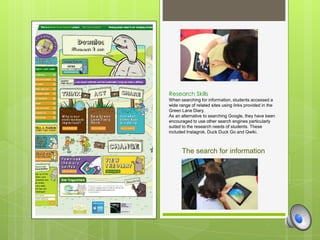
Research Skills
When searching for information, students accessed a
wide range of related sites using links provided in the
Green Lane Diary.
As an alternative to searching Google, they have been
encouraged to use other search engines particularly
suited to the research needs of students. These
included Instagrok, Duck Duck Go and Qwiki.


      The search for information
Posters made from recycled
         materials
Badges designed and created by students to be used
     as prizes for reducing waste in the school


                                               BADGES
This ILA is aligned with the Australian Science Curriculum as follows:

Science Understanding
•   Living things, including plants and animals, depend on each other and the environment to
    survive (ACSSU073)

Science as a Human Endeavour
•   Science involves making predictions and describing patterns and relationships (ACSHE061)
•   Science knowledge helps people to understand the effect of their actions (ACSHE062)

Science Inquiry Skills
•   With guidance, identify questions in familiar contexts that can be investigated scientifically
    and predict what might happen based on prior knowledge (ACSIS064)
•   Suggest ways to plan and conduct investigations to find answers to questions (ACSIS065)
•   Safely use appropriate materials, tools or equipment to make and record
    observations, using formal measurements and digital technologies as appropriate
    (ACSIS066)
•   Represent and communicate ideas and findings in a variety of ways such as
    diagrams, physical representations and simple reports (ACSIS071)
Question 1 : What do you know about the topic?
Example of development of
knowledge from Questionnaire 1 to 3


          Question 1 response by
                Student X
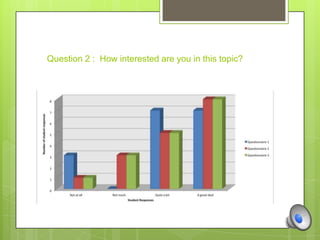
Question 2 : How interested are you in this topic?
Question 3 : How much do you know about this topic?
“When students know how to ask their own
questions, they take greater ownership of their
learning, deepen comprehension, and make
new connections and discoveries on their
own.”
                       (Rothstein & Santana, 2011)
Question 4: When searching for information, what do you find easy to do?


 Examples of Student’s Responses
 •   “Finding the best sites” (Student X)
 •   “Searching for the right information” (Student Y)
 •   “Reading all the information and putting it together to make sense” (Student Z)
 •   “Understanding the information in the book” (Student Z)
 •   “I’ve got enough information, I just need to spread the word to everyone else in the
     school.”
Question 5 : When you search for information, what do you find difficult to
do?


  Examples of Student Responses:
  “scanning through the text for information” (Student X)
  “deciding which information is needed and which isn’t” (Student Y)
  “getting back to a website after using a link” (Student Z)
  “I couldn’t get on to Instagrok because the computer didn’t have Google Chrome installed” (Student Z)
Adapted from Bloom’s Revised Taxonomy
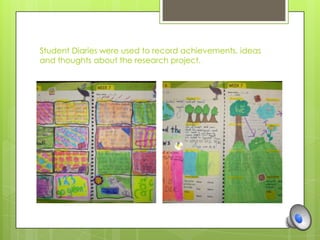
Student Diaries were used to record achievements, ideas
and thoughts about the research project.
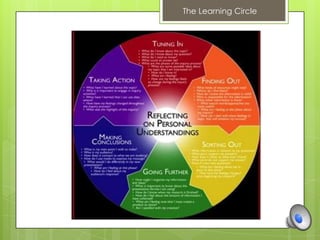
The Learning Circle
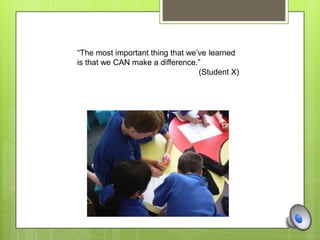
“The most important thing that we’ve learned
is that we CAN make a difference.”
                                  (Student X)

Powerpoint Presentation

  • 1.
    Research Project Information-learning activity Wendy Ariel n0158992 CLN650
  • 3.
    Using the GreenLane Diary, students can: • Learn about the world’s environmental problems and solutions • Discover how to live a greener life • Start an action research project • Track their actions in the diary The diary includes: • inspirational stories and ideas to help children come up with ideas about their own action plans • comprehensive information on a wide range of environmental topics • links to many websites where the children are able to find additional information. • A Green Lane Diary app is also available this year, so that students have direct access to these links from the iPads.
  • 4.
    5 Es InstructionalModel  engage  explore  explain  elaborate  evaluate
  • 5.
    QUESTIONING FRAMEWORK  KWHLAQ (Barell, 2008)  What Do I Know?  What Do I Want To Know?  How Do I Find Out?  What have I learned?  What action will I take?  What new questions do I have?
  • 6.
    Research Skills When searchingfor information, students accessed a wide range of related sites using links provided in the Green Lane Diary. As an alternative to searching Google, they have been encouraged to use other search engines particularly suited to the research needs of students. These included Instagrok, Duck Duck Go and Qwiki. The search for information
  • 7.
    Posters made fromrecycled materials
  • 8.
    Badges designed andcreated by students to be used as prizes for reducing waste in the school  BADGES
  • 9.
    This ILA isaligned with the Australian Science Curriculum as follows: Science Understanding • Living things, including plants and animals, depend on each other and the environment to survive (ACSSU073) Science as a Human Endeavour • Science involves making predictions and describing patterns and relationships (ACSHE061) • Science knowledge helps people to understand the effect of their actions (ACSHE062) Science Inquiry Skills • With guidance, identify questions in familiar contexts that can be investigated scientifically and predict what might happen based on prior knowledge (ACSIS064) • Suggest ways to plan and conduct investigations to find answers to questions (ACSIS065) • Safely use appropriate materials, tools or equipment to make and record observations, using formal measurements and digital technologies as appropriate (ACSIS066) • Represent and communicate ideas and findings in a variety of ways such as diagrams, physical representations and simple reports (ACSIS071)
  • 10.
    Question 1 :What do you know about the topic?
  • 11.
    Example of developmentof knowledge from Questionnaire 1 to 3 Question 1 response by Student X
  • 12.
    Question 2 :How interested are you in this topic?
  • 13.
    Question 3 :How much do you know about this topic?
  • 14.
    “When students knowhow to ask their own questions, they take greater ownership of their learning, deepen comprehension, and make new connections and discoveries on their own.” (Rothstein & Santana, 2011)
  • 15.
    Question 4: Whensearching for information, what do you find easy to do? Examples of Student’s Responses • “Finding the best sites” (Student X) • “Searching for the right information” (Student Y) • “Reading all the information and putting it together to make sense” (Student Z) • “Understanding the information in the book” (Student Z) • “I’ve got enough information, I just need to spread the word to everyone else in the school.”
  • 16.
    Question 5 :When you search for information, what do you find difficult to do? Examples of Student Responses: “scanning through the text for information” (Student X) “deciding which information is needed and which isn’t” (Student Y) “getting back to a website after using a link” (Student Z) “I couldn’t get on to Instagrok because the computer didn’t have Google Chrome installed” (Student Z)
  • 18.
    Adapted from Bloom’sRevised Taxonomy
  • 19.
    Student Diaries wereused to record achievements, ideas and thoughts about the research project.
  • 21.
  • 22.
    “The most importantthing that we’ve learned is that we CAN make a difference.” (Student X)