Application Portfolio
Modernization
Phi Huynh - Microsoft MVP
Thang Chung – NashTech Solution Architect
1
2
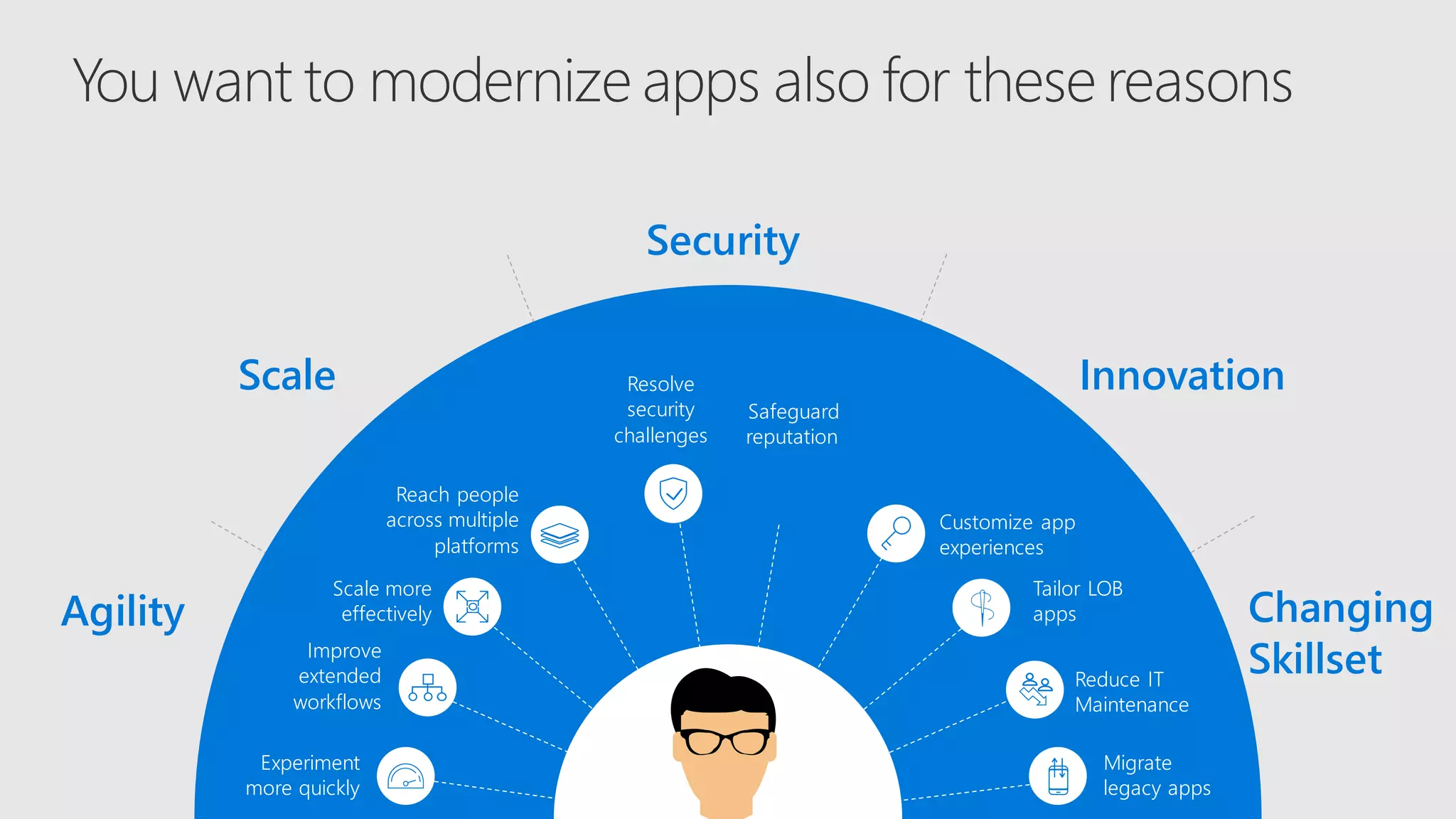
You want to modernize apps also for these reasons
Scale Innovation
Security
Agility Changing
Skillset
Scale more
effectively
Improve
extended
workflows
Tailor LOB
apps
Customize app
experiences
Reduce IT
Maintenance
Experiment
more quickly
Reach people
across multiple
platforms
Safeguard
reputation
Resolve
security
challenges
Migrate
legacy apps
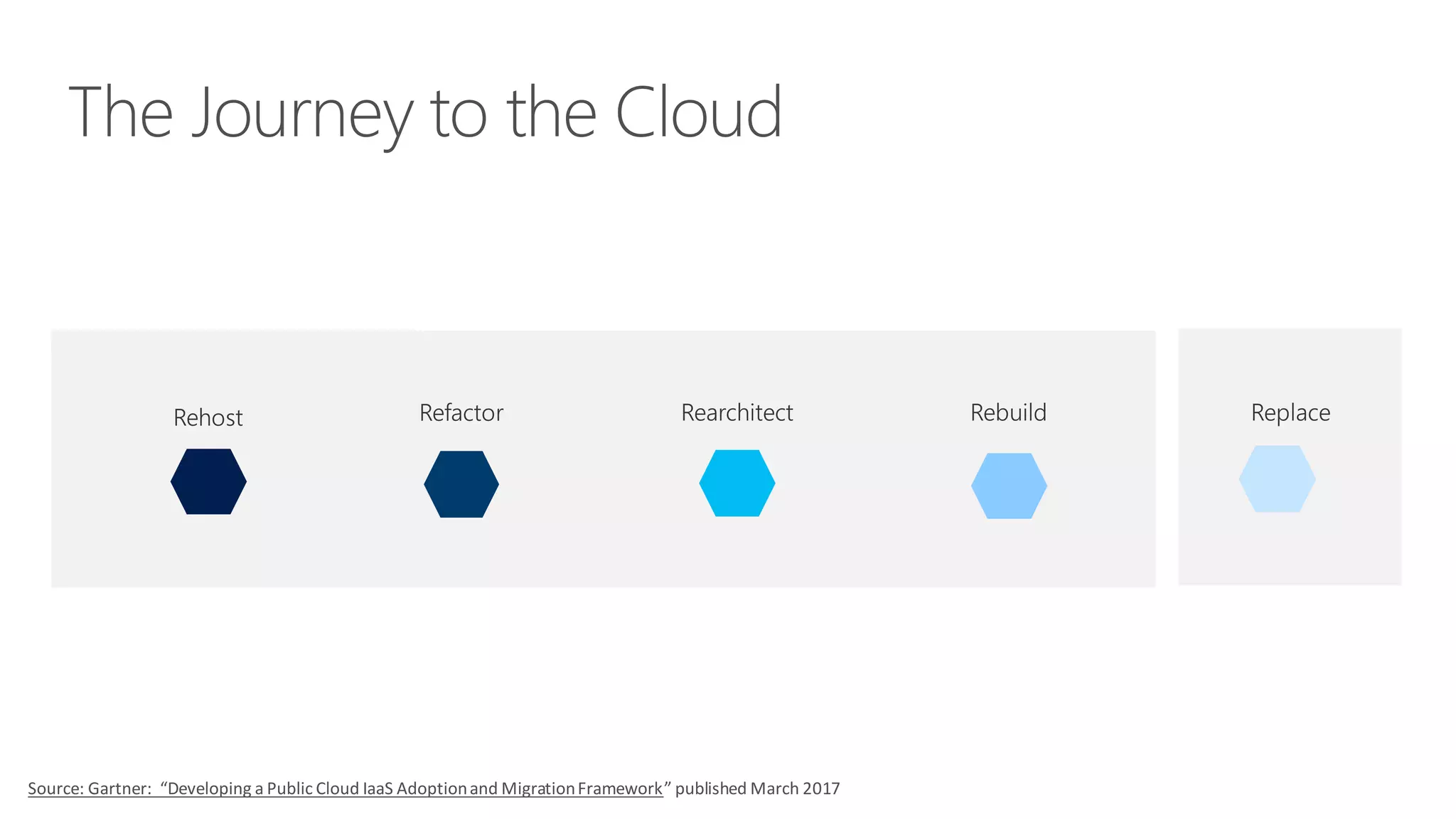
Source: Gartner: “Developing a Public Cloud IaaS Adoptionand MigrationFramework” published March 2017
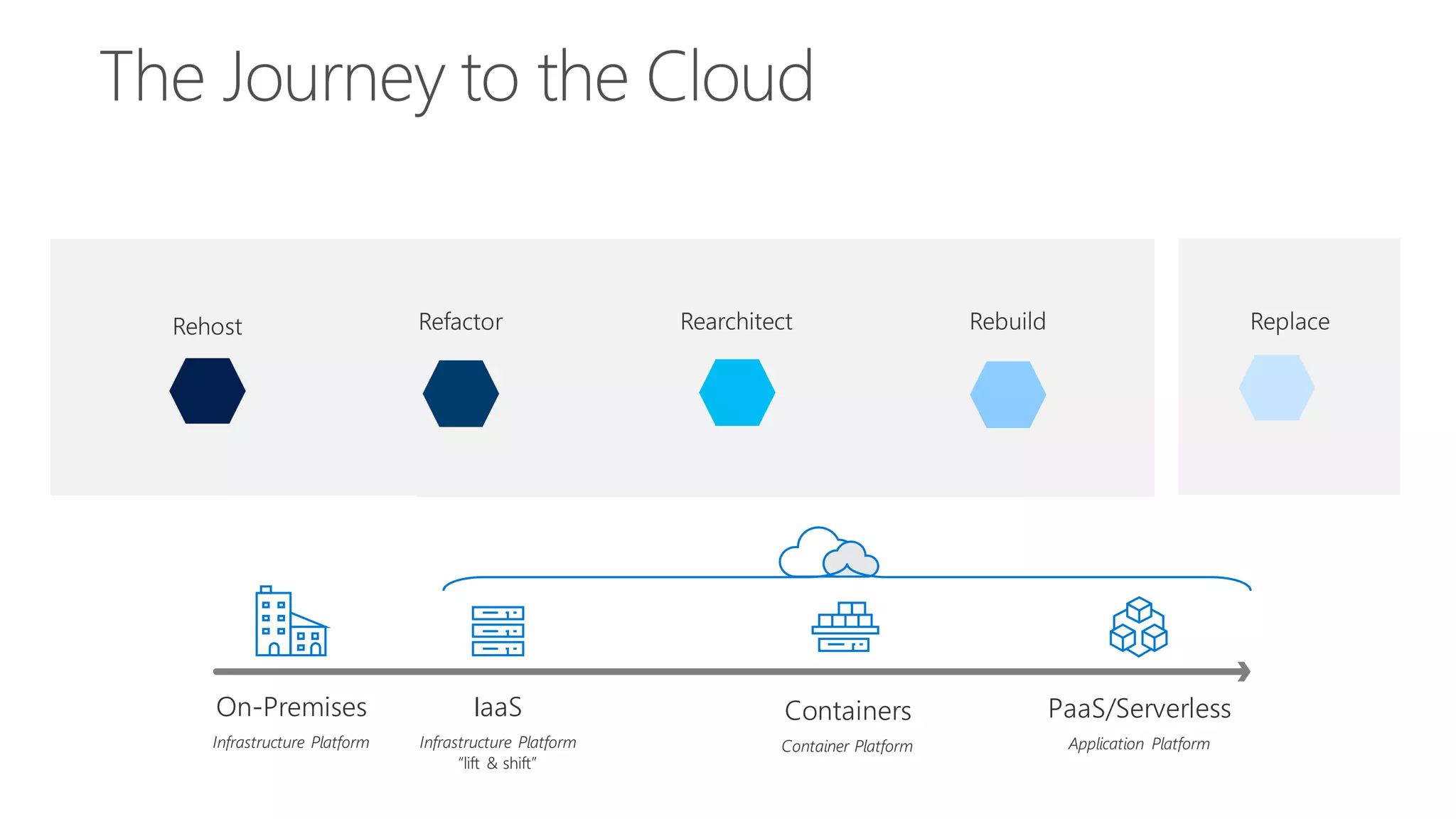
Containers
Container Platform
On-Premises
Infrastructure Platform
PaaS/Serverless
Application Platform
IaaS
Infrastructure Platform
“lift & shift”
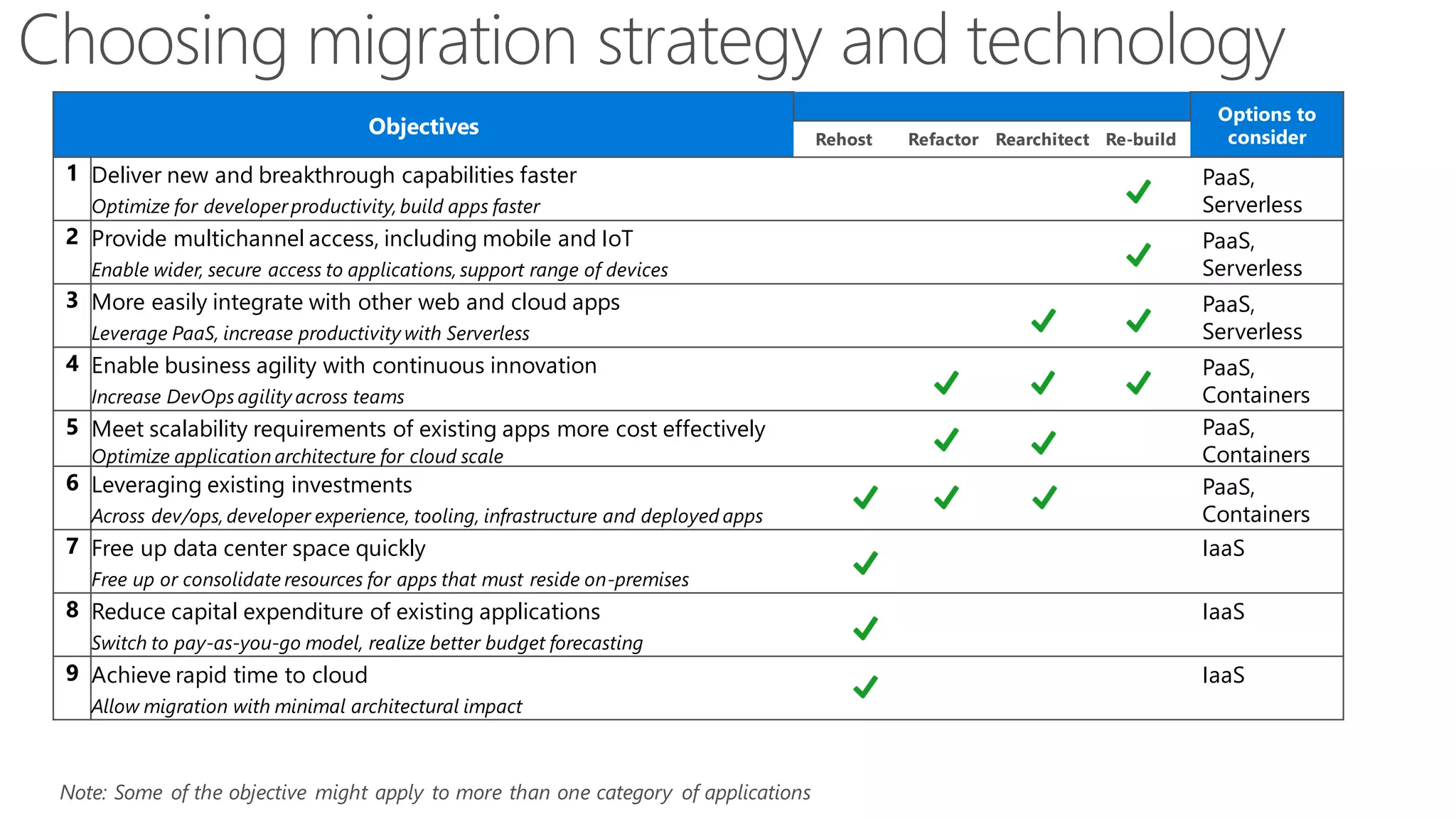
Objectives
Options to
considerRehost Refactor Rearchitect Re-build
1 Deliver new and breakthrough capabilities faster PaaS,
ServerlessOptimize for developerproductivity, build apps faster
2 Provide multichannel access, including mobile and IoT PaaS,
ServerlessEnable wider, secure access to applications, support range of devices
3 More easily integrate with other web and cloud apps PaaS,
ServerlessLeverage PaaS, increase productivity with Serverless
4 Enable business agility with continuous innovation PaaS,
ContainersIncrease DevOps agility across teams
5 Meet scalability requirements of existing apps more cost effectively PaaS,
ContainersOptimize application architecture for cloud scale
6 Leveraging existing investments PaaS,
ContainersAcross dev/ops, developer experience, tooling, infrastructure and deployed apps
7 Free up data center space quickly IaaS
Free up or consolidate resources for apps that must reside on-premises
8 Reduce capital expenditure of existing applications IaaS
Switch to pay-as-you-go model, realize better budget forecasting
9 Achieve rapid time to cloud IaaS
Allow migration with minimal architectural impact
Note: Some of the objective might apply to more than one category of applications
…To
→ Office 365
→ SharePoint Online
→ CRM Online
→ VSO
→ ADL + PowerBI
→ Best 3
rd
-party SaaS
From…
→ Office servers
→ Portals and SPS
→ Any relationshipmgmt
→ Active Source
Control & WIT
→ Data warehouses
→ Industry standard
verticals
Use or convert to a SaaS
(1st or 3rd party) solution
Retire it, right-size, eliminate environments
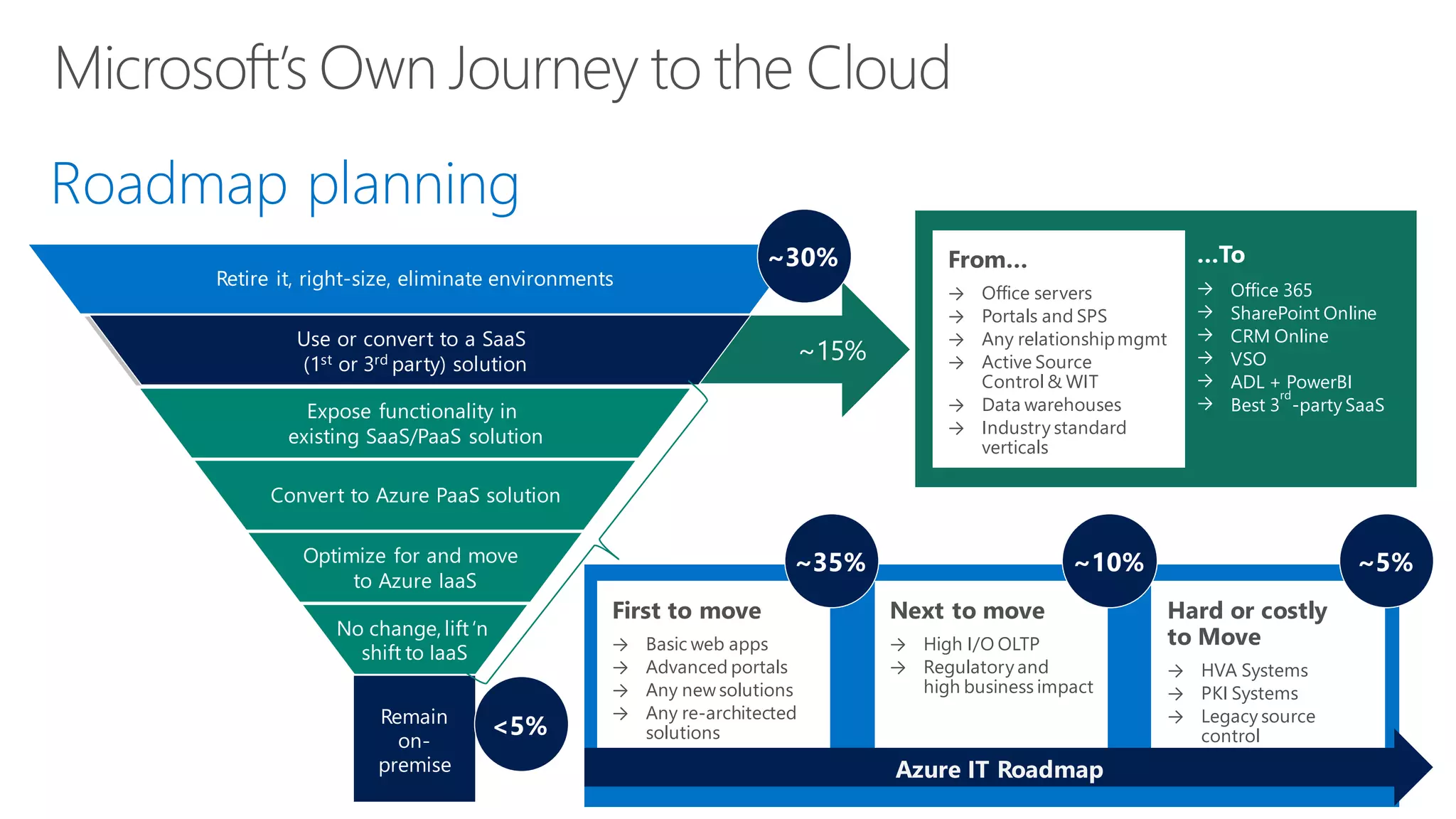
Roadmap planning
~15%
…To
→ Office 365
→ SharePoint Online
→ CRM Online
→ VSO
→ ADL + PowerBI
→ Best 3
rd
-party SaaS
From…
→ Office servers
→ Portals and SPS
→ Any relationshipmgmt
→ Active Source
Control & WIT
→ Data warehouses
→ Industry standard
verticals
Use or convert to a SaaS
(1st or 3rd party) solution
First to move
→ Basic web apps
→ Advanced portals
→ Any new solutions
→ Any re-architected
solutions
Next to move
→ High I/O OLTP
→ Regulatory and
high business impact
Hard or costly
to Move
→ HVA Systems
→ PKI Systems
→ Legacy source
control
Azure IT Roadmap
Remain
on-
premise
Expose functionality in
existing SaaS/PaaS solution
Convert to Azure PaaS solution
Optimize for and move
to Azure IaaS
No change, lift‘n
shift to IaaS
<5%
~35% ~10% ~5%
Retire it, right-size, eliminate environments
~30%
Benefits
• Drives higher ROI (435% from migration to IaaS).
Try our TCO Calculator.
• No need to manage data centers
• Enjoy flexible and scalable infrastructure
When to consider
• Ideal when your goal is to improve operational
efficiencies, and free up data center space
• Maintenance apps for which the hardware is not
worth additional investment
• Compute-intensive applications that are built for
parallelism but don't require high-performance
interprocess communications (IPC) and have
independent datasets, and applications for which
load balancing already increases scalability and
availability.
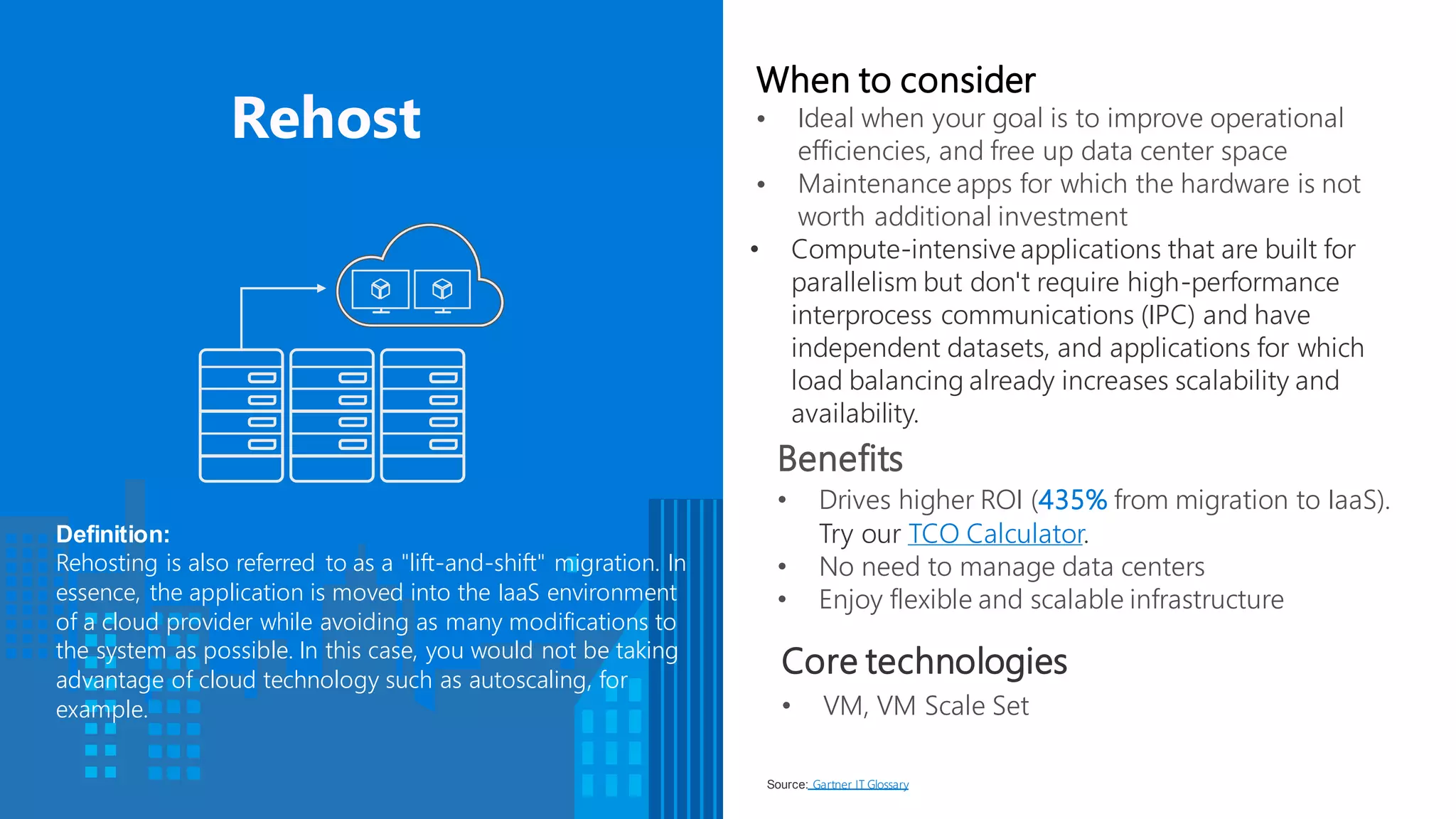
Definition:
Rehosting is also referred to as a "lift-and-shift" migration. In
essence, the application is moved into the IaaS environment
of a cloud provider while avoiding as many modifications to
the system as possible. In this case, you would not be taking
advantage of cloud technology such as autoscaling, for
example.
Source: Gartner IT Glossary.
Core technologies
• VM, VM Scale Set
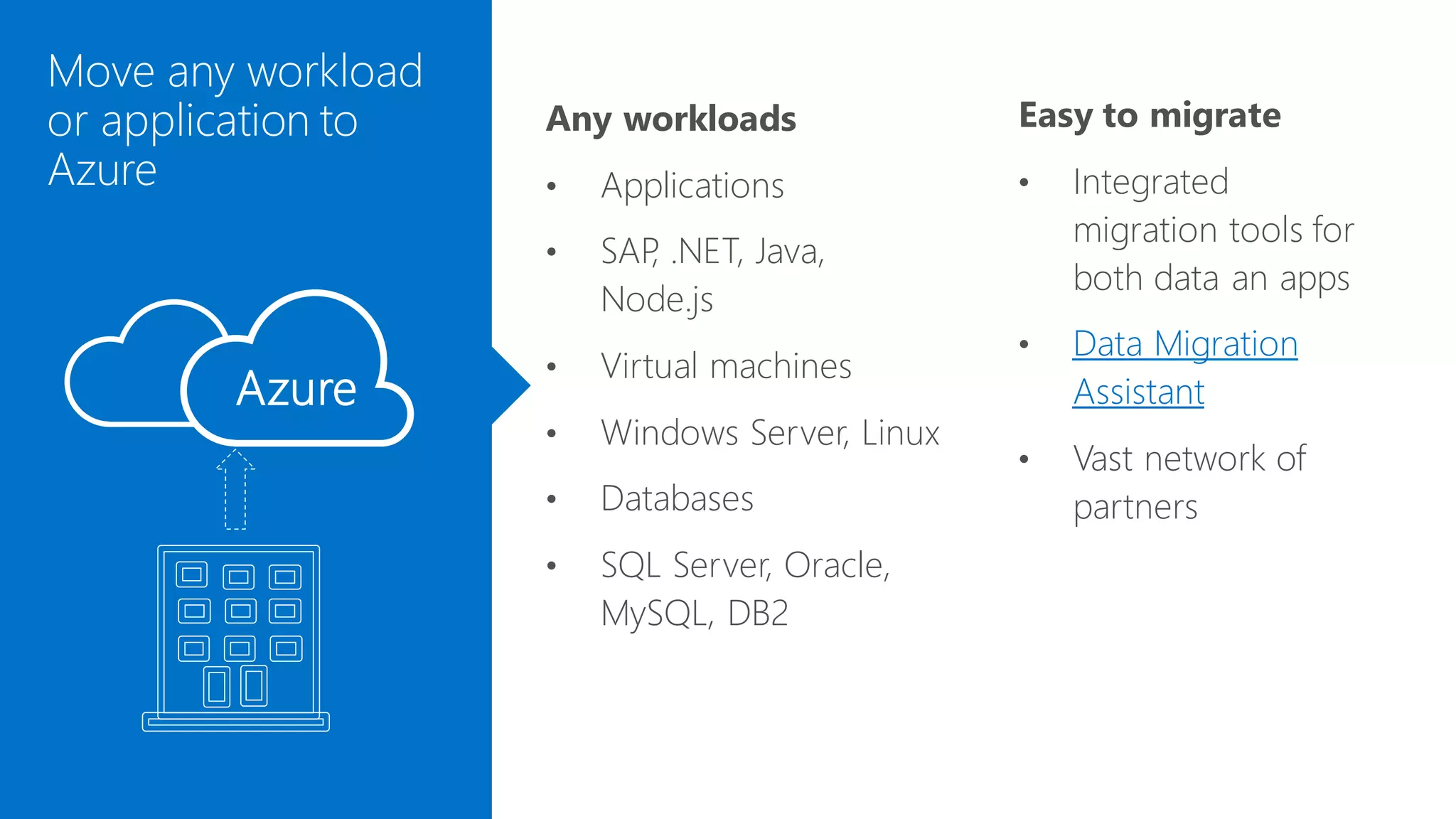
Move any workload
or application to
Azure
Azure
Any workloads
• Applications
• SAP, .NET, Java,
Node.js
• Virtual machines
• Windows Server, Linux
• Databases
• SQL Server, Oracle,
MySQL, DB2
Easy to migrate
• Integrated
migration tools for
both data an apps
• Data Migration
Assistant
• Vast network of
partners
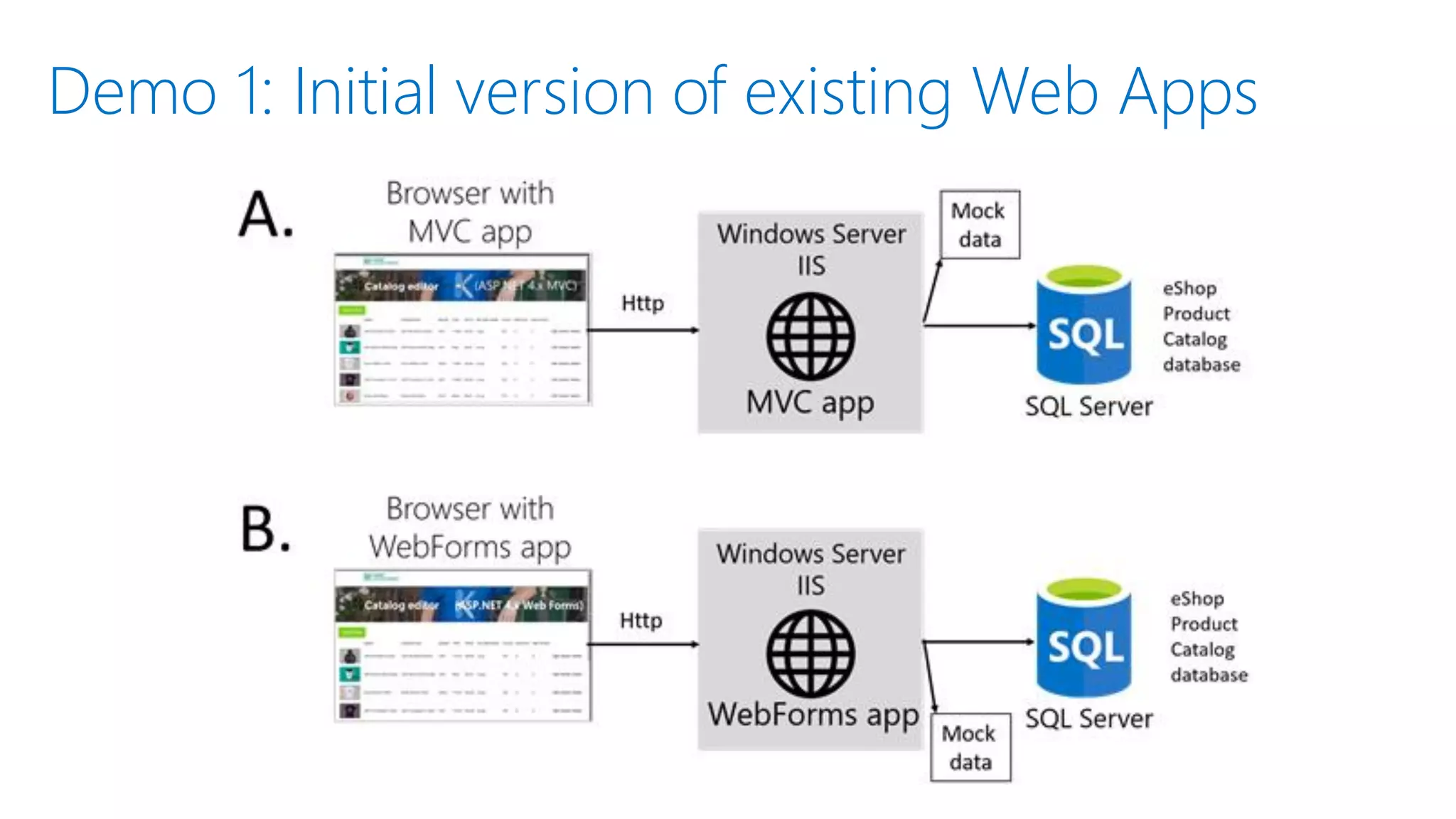
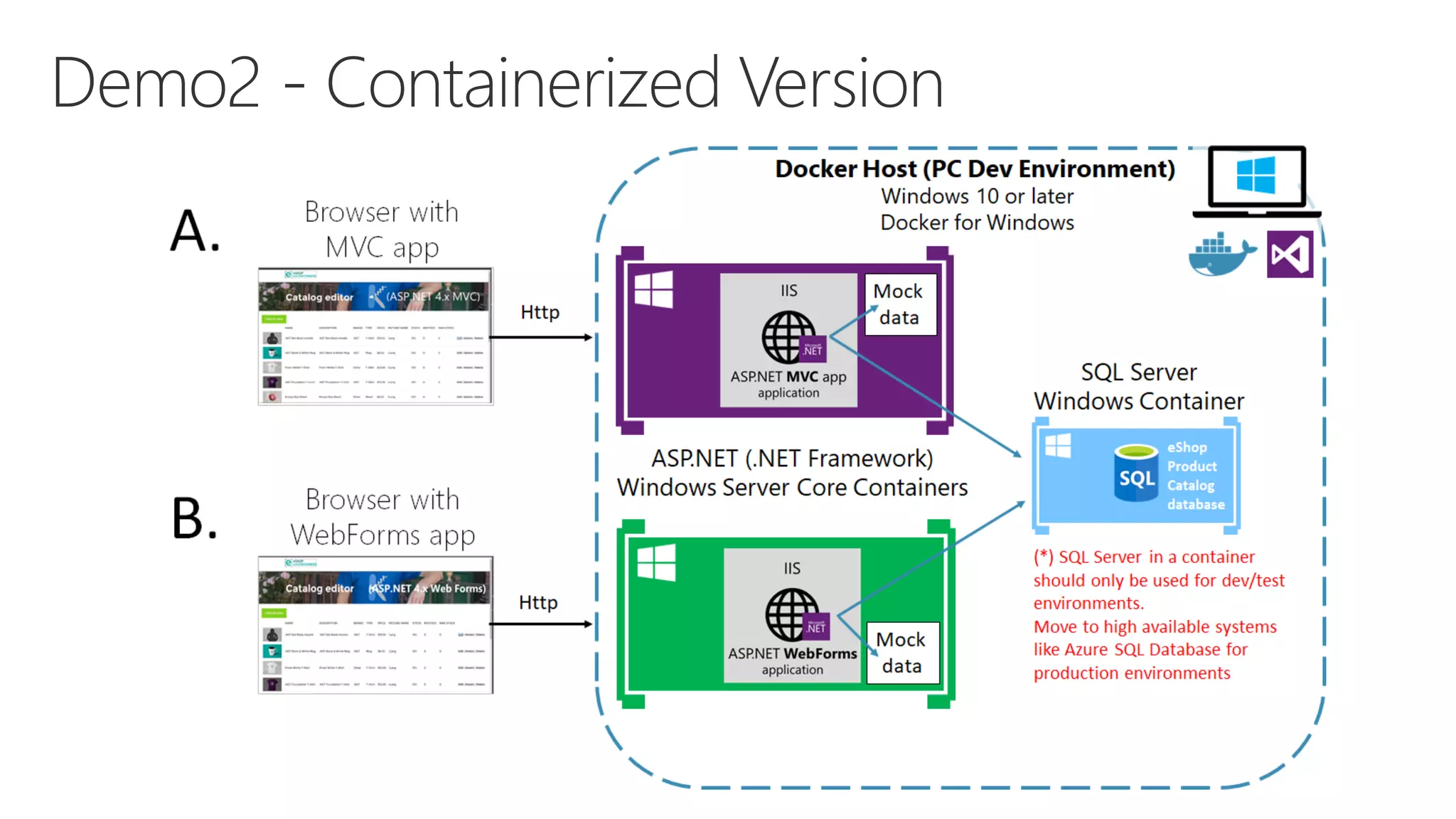
Demo 1: Initial version of existing Web Apps
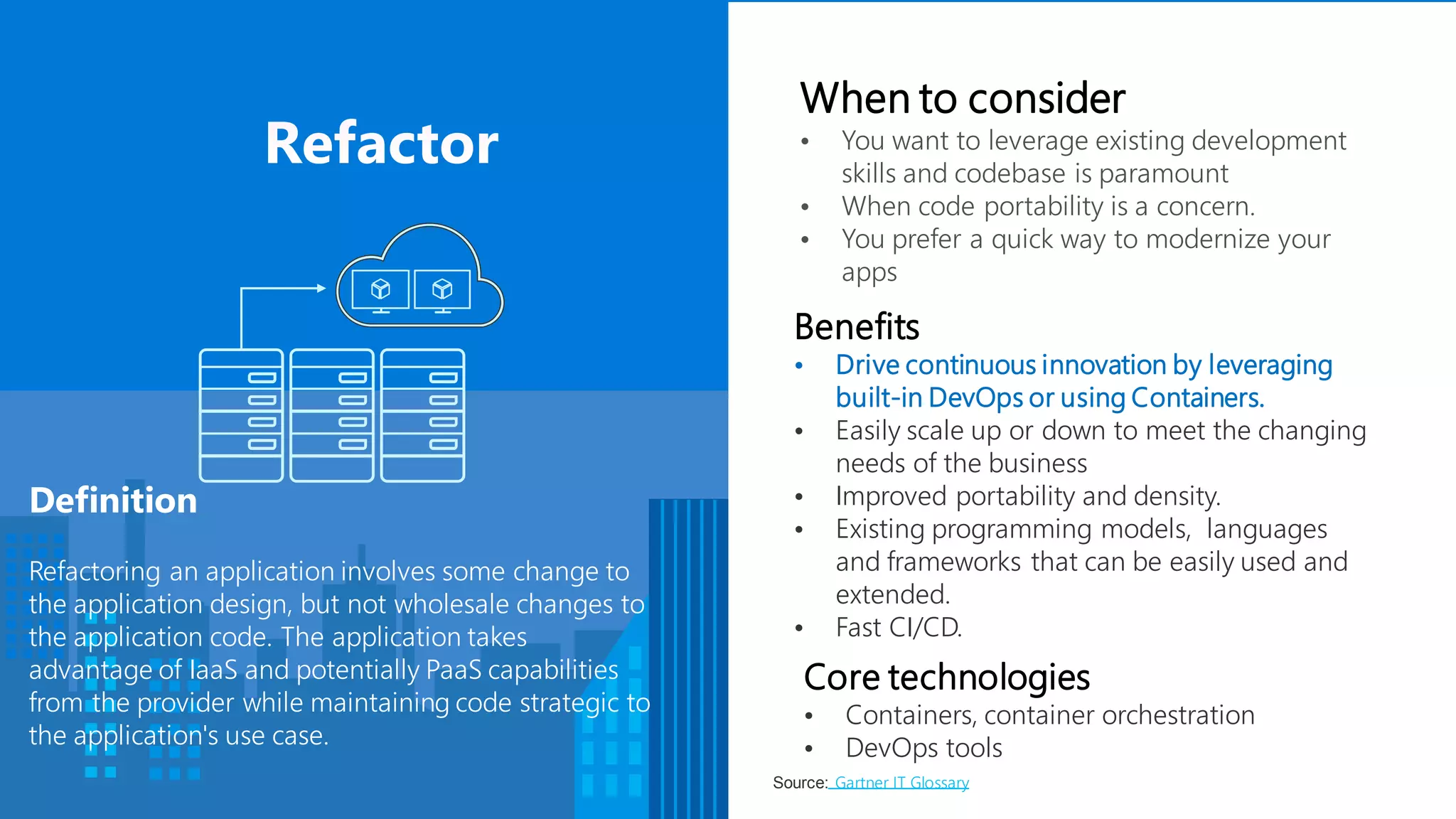
Benefits
• Drive continuous innovation by leveraging
built-in DevOps or using Containers.
• Easily scale up or down to meet the changing
needs of the business
• Improved portability and density.
• Existing programming models, languages
and frameworks that can be easily used and
extended.
• Fast CI/CD.
Definition
Refactoring an application involves some change to
the application design, but not wholesale changes to
the application code. The application takes
advantage of IaaS and potentially PaaS capabilities
from the provider while maintaining code strategic to
the application's use case.
When to consider
• You want to leverage existing development
skills and codebase is paramount
• When code portability is a concern.
• You prefer a quick way to modernize your
apps
Core technologies
• Containers, container orchestration
• DevOps tools
Source: Gartner IT Glossary
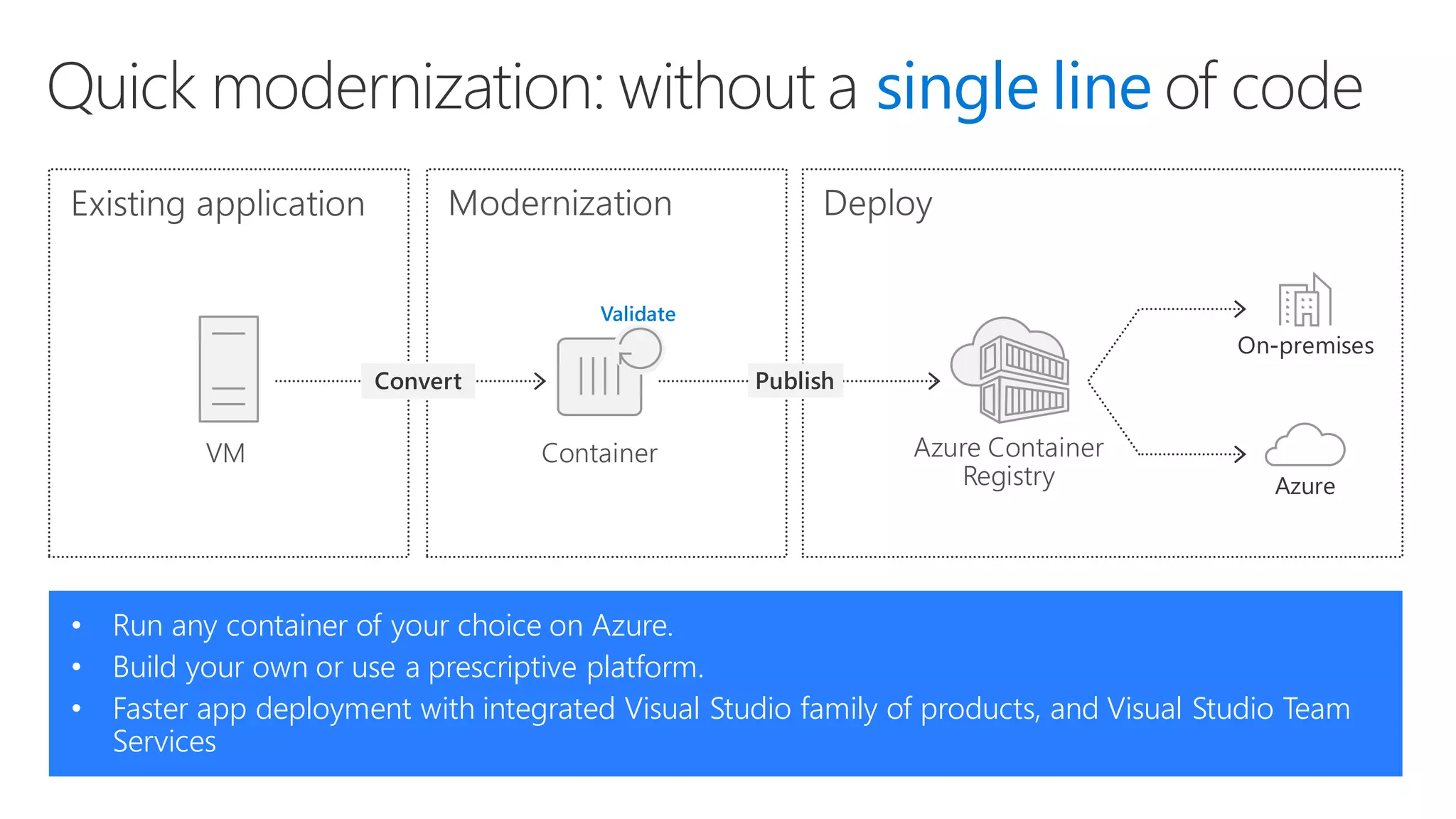
single line
• Run any container of your choice on Azure.
• Build your own or use a prescriptive platform.
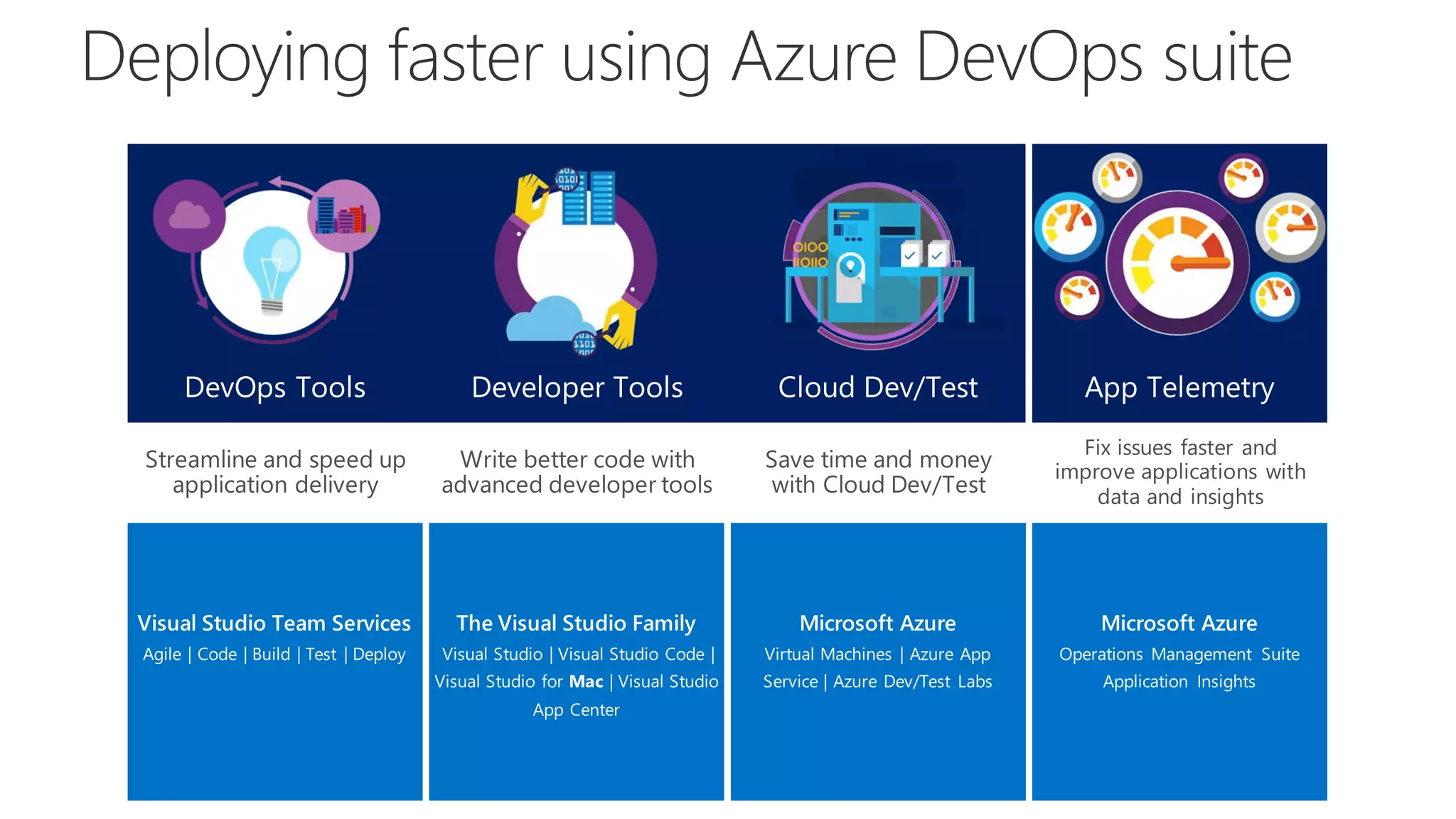
• Faster app deployment with integrated Visual Studio family of products, and Visual Studio Team
Services
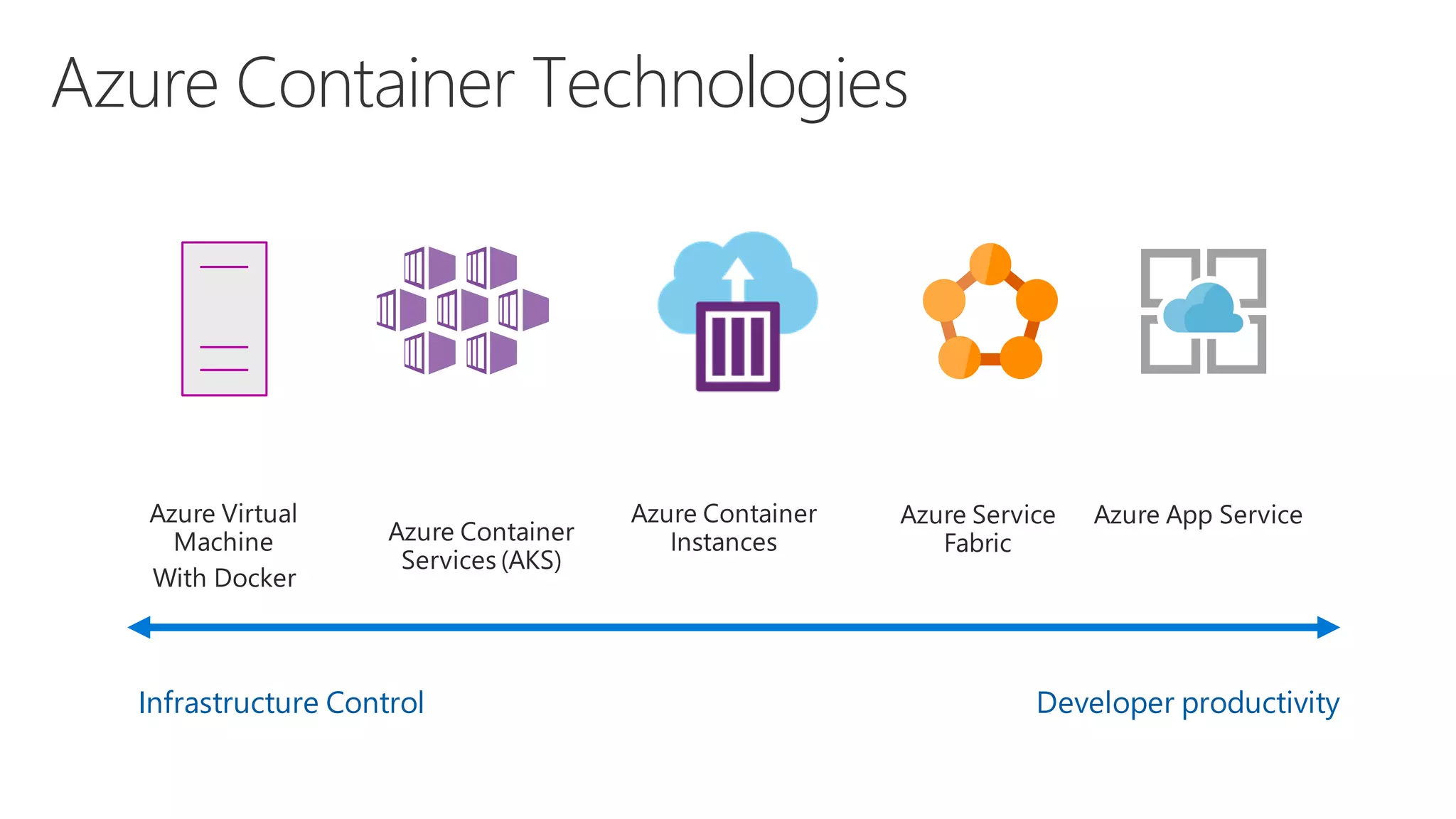
Azure Container Technologies
Infrastructure Control Developer productivity
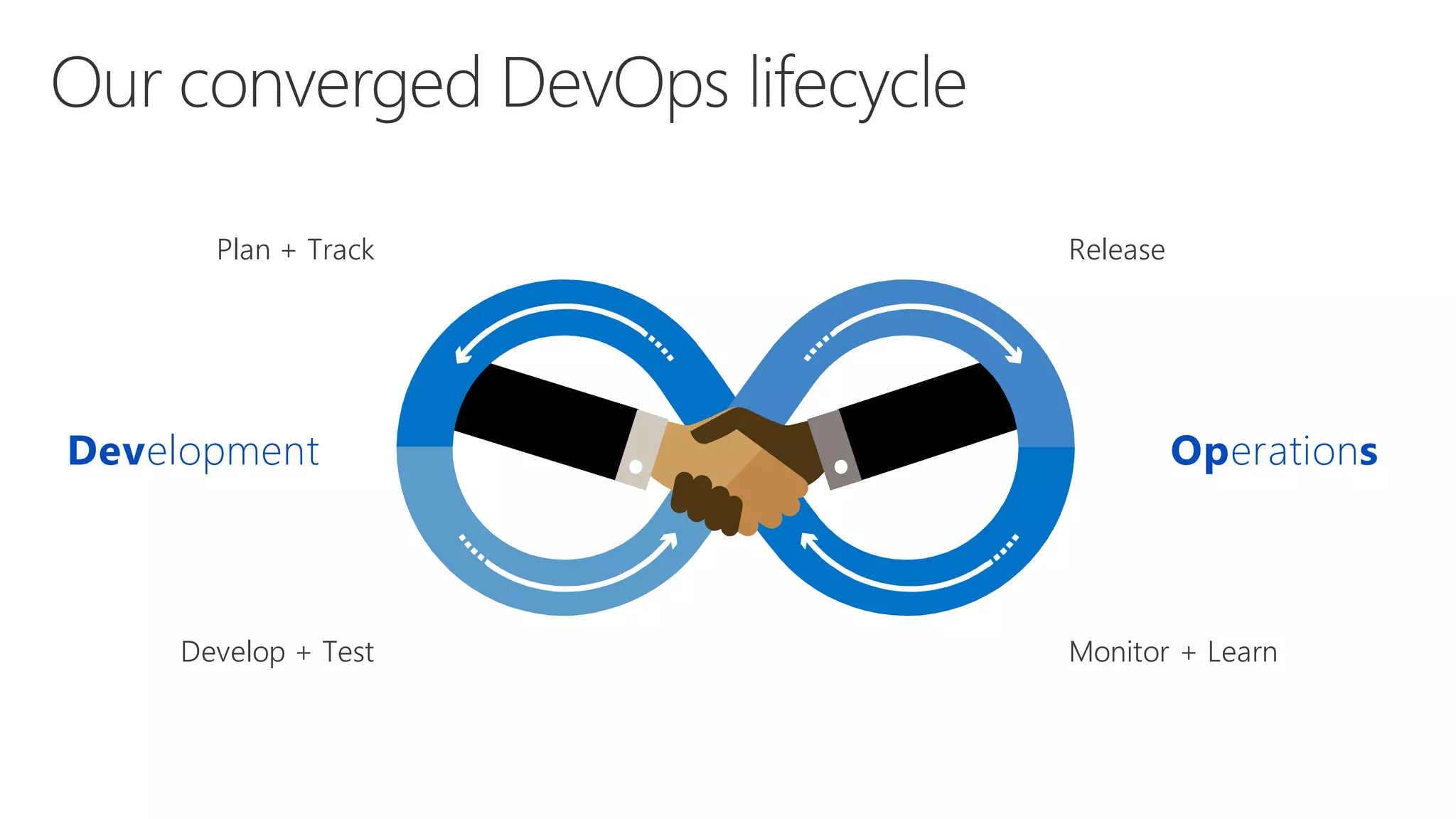
Develop + Test
Plan + Track
Monitor + Learn
Release
Development Operations
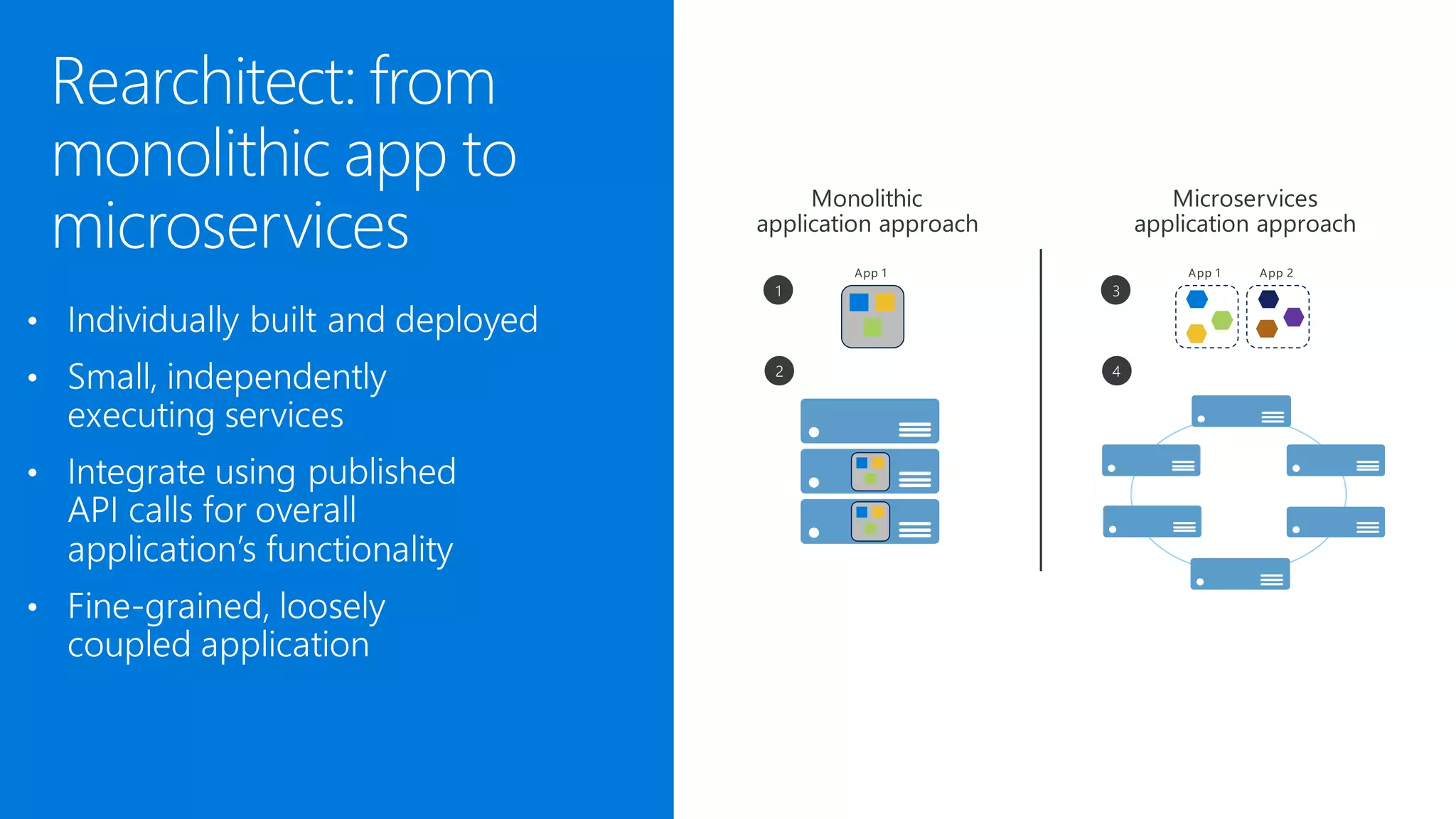
• Deliver new capabilities and modernization through
modified codebase and a monolithic to micro
services architectural revision.
• Reduce the volume of code needed to express a
capability while still leveraging existing investments.
• Agility and scale.
When to consider
• When apps need a major revision to
incorporate new capabilities or take
advantage of the cloud-native capabilities.
Benefits
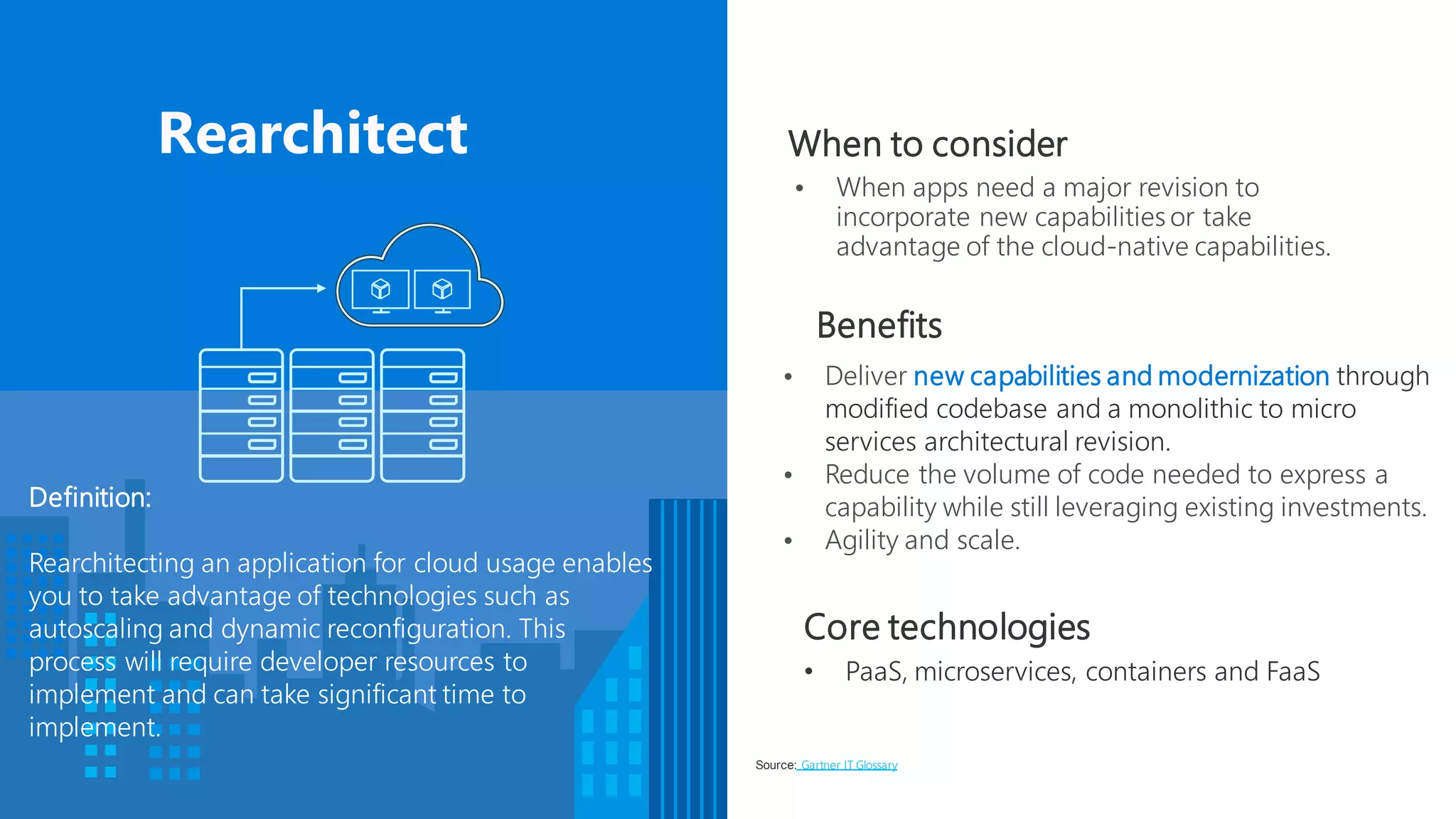
Definition:
Rearchitecting an application for cloud usage enables
you to take advantage of technologies such as
autoscaling and dynamic reconfiguration. This
process will require developer resources to
implement and can take significant time to
implement.
Source: Gartner IT Glossary
Core technologies
• PaaS, microservices, containers and FaaS
Benefits
• Reduce TCO
• Fully leverage the cloud native capabilities and
build applications faster
• Expedite your business innovation
When to consider
• You want to build for cloud-native PaaS
environments from ground up.
• Leverage previous investment in a
cloud platform, e.g. when customer
data has already moved to the Cloud.
• Rapid prototyping is crucial or the scope of
a current application is too limited in terms
of functionality and lifespan.
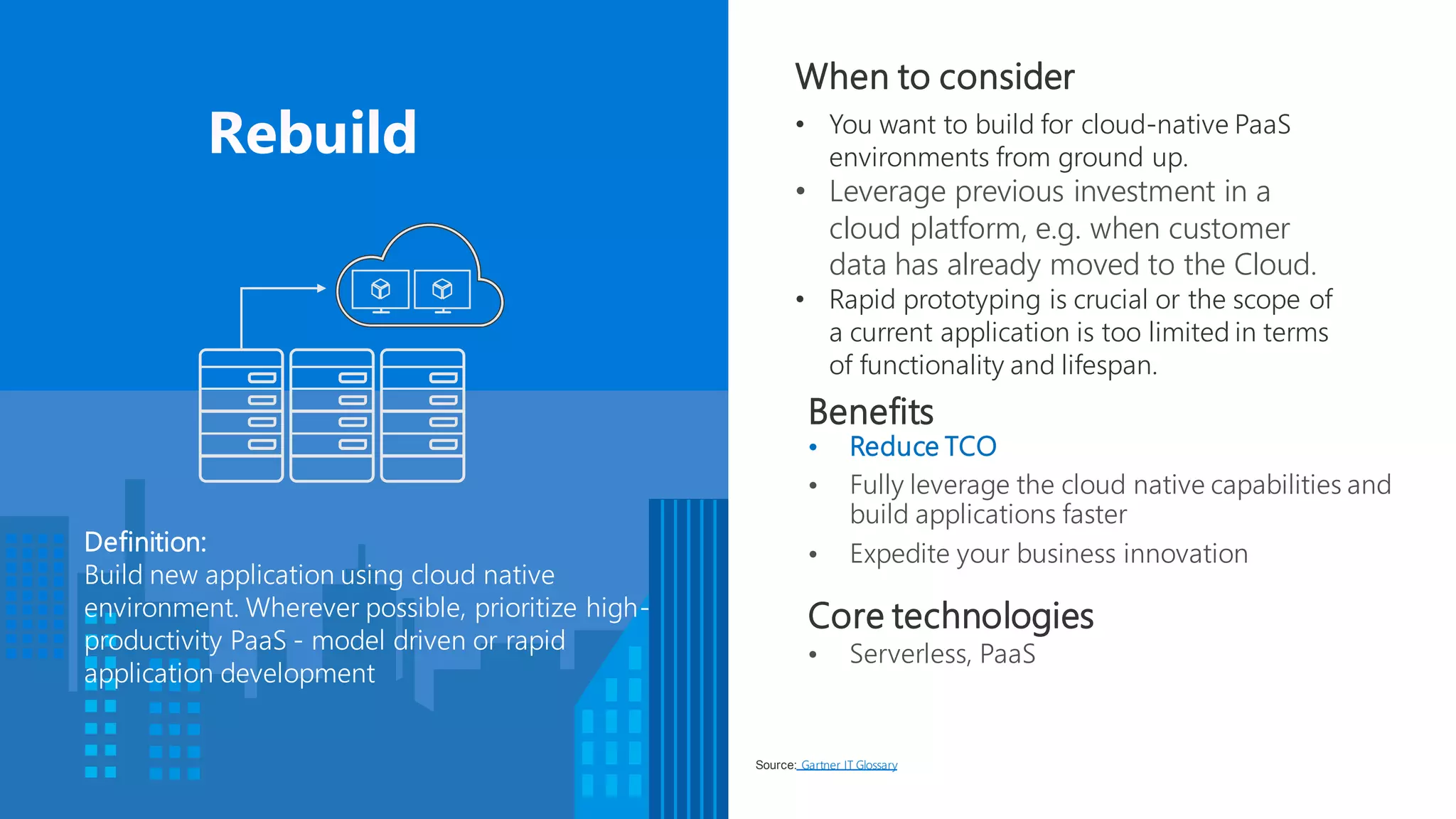
Definition:
Build new application using cloud native
environment. Wherever possible, prioritize high-
productivity PaaS - model driven or rapid
application development
Source: Gartner IT Glossary
Core technologies
• Serverless, PaaS
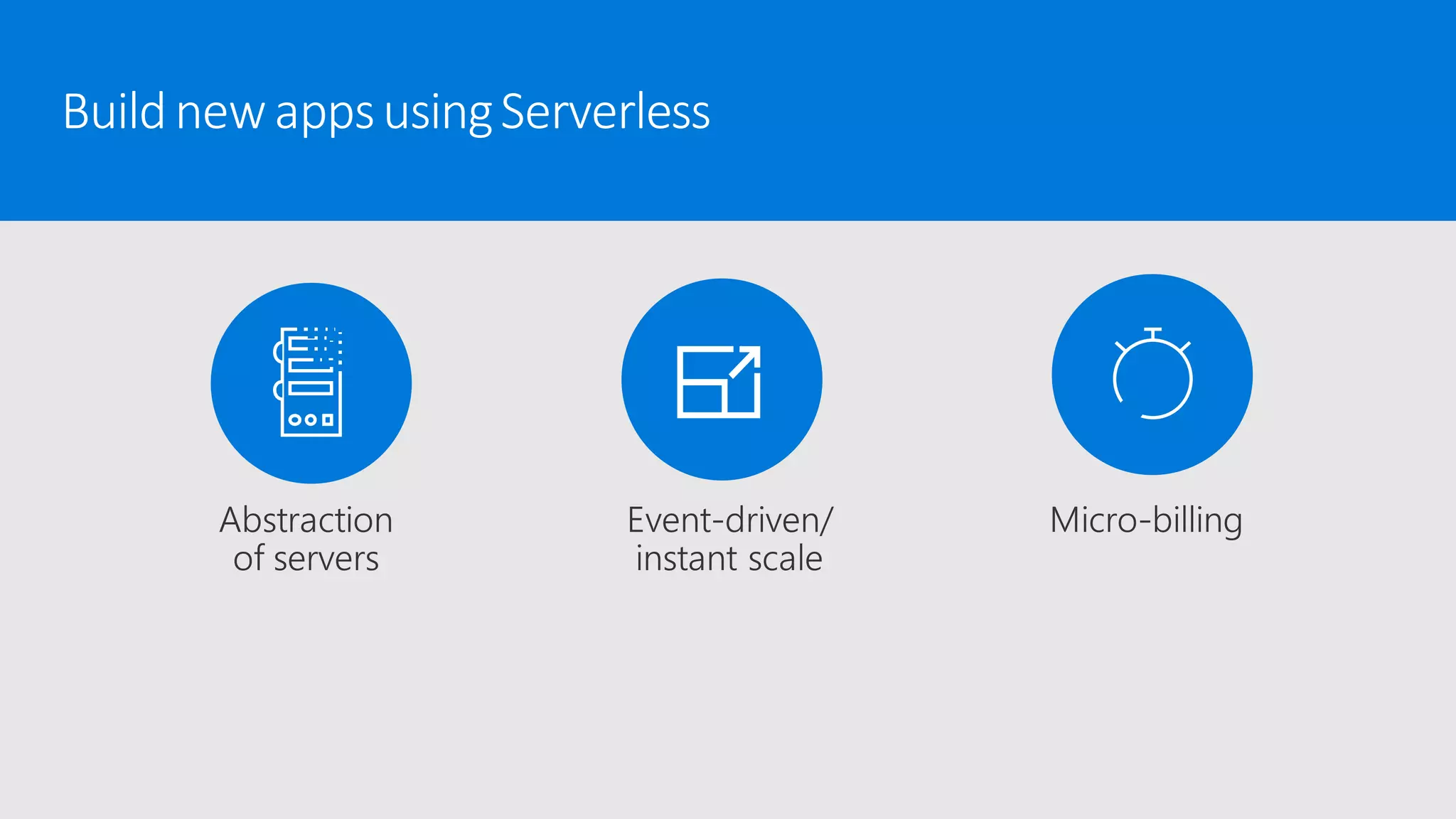
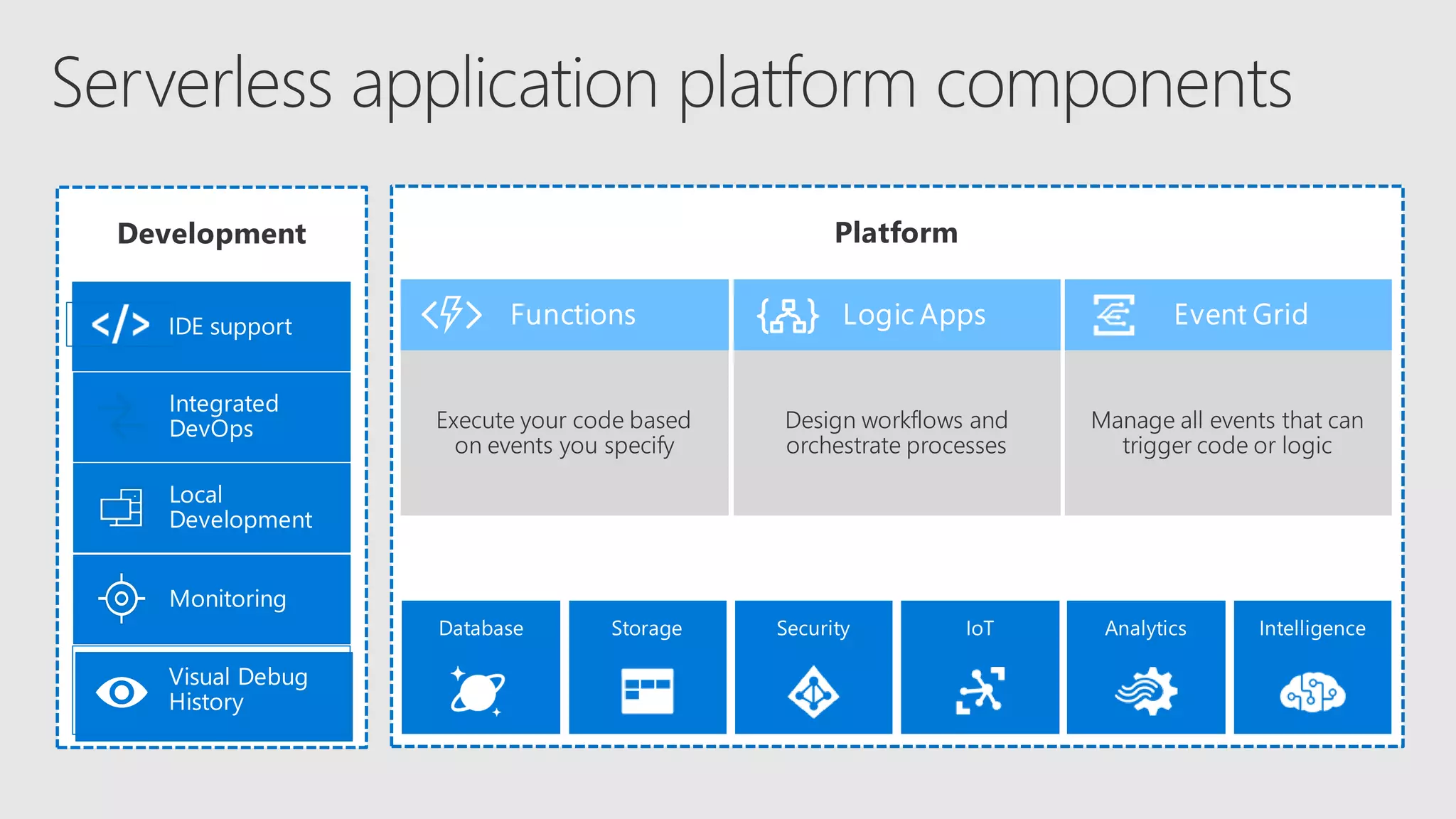
BuildnewappsusingServerless
...?
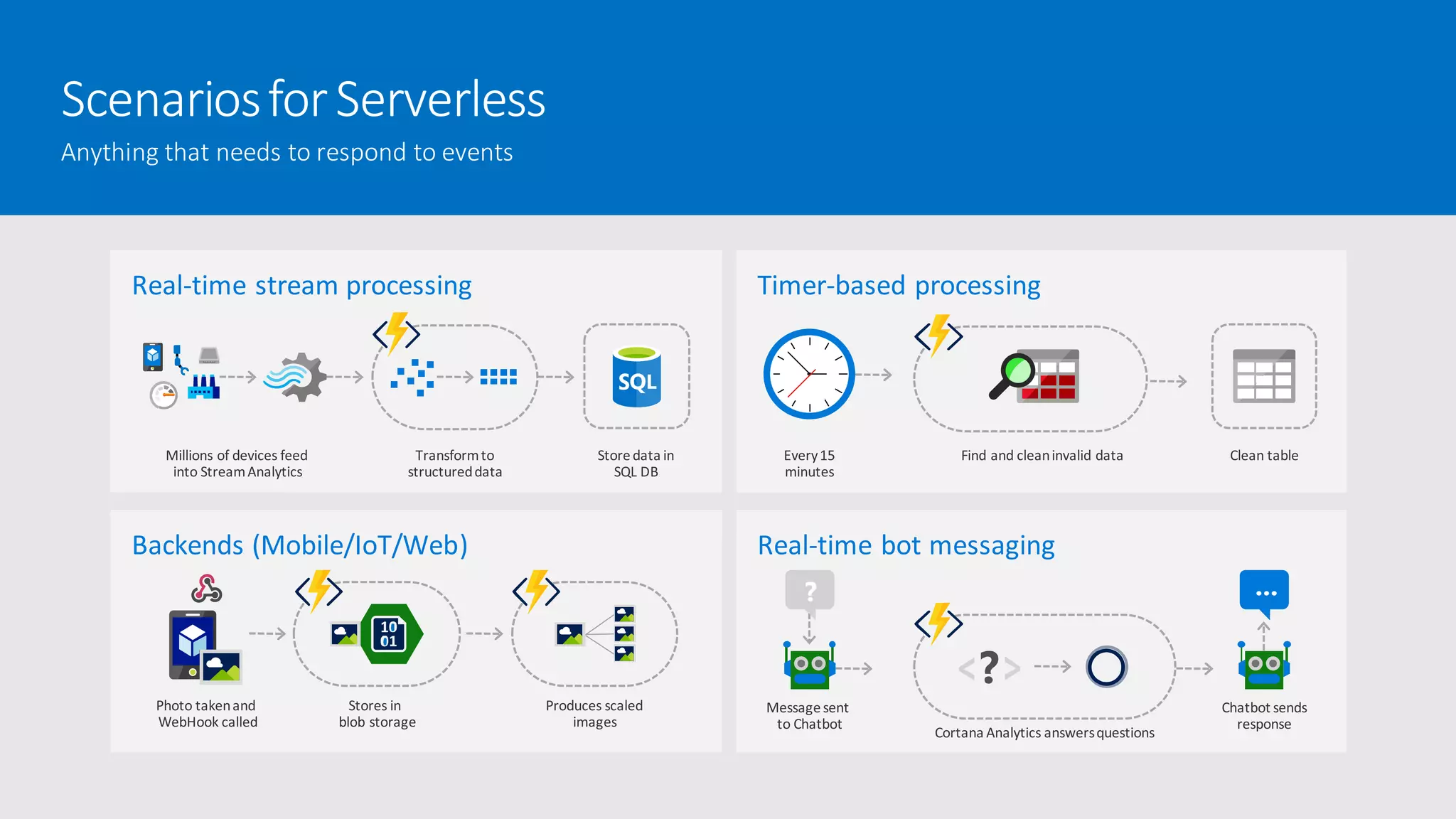
ScenariosforServerless
Anything that needs to respond to events
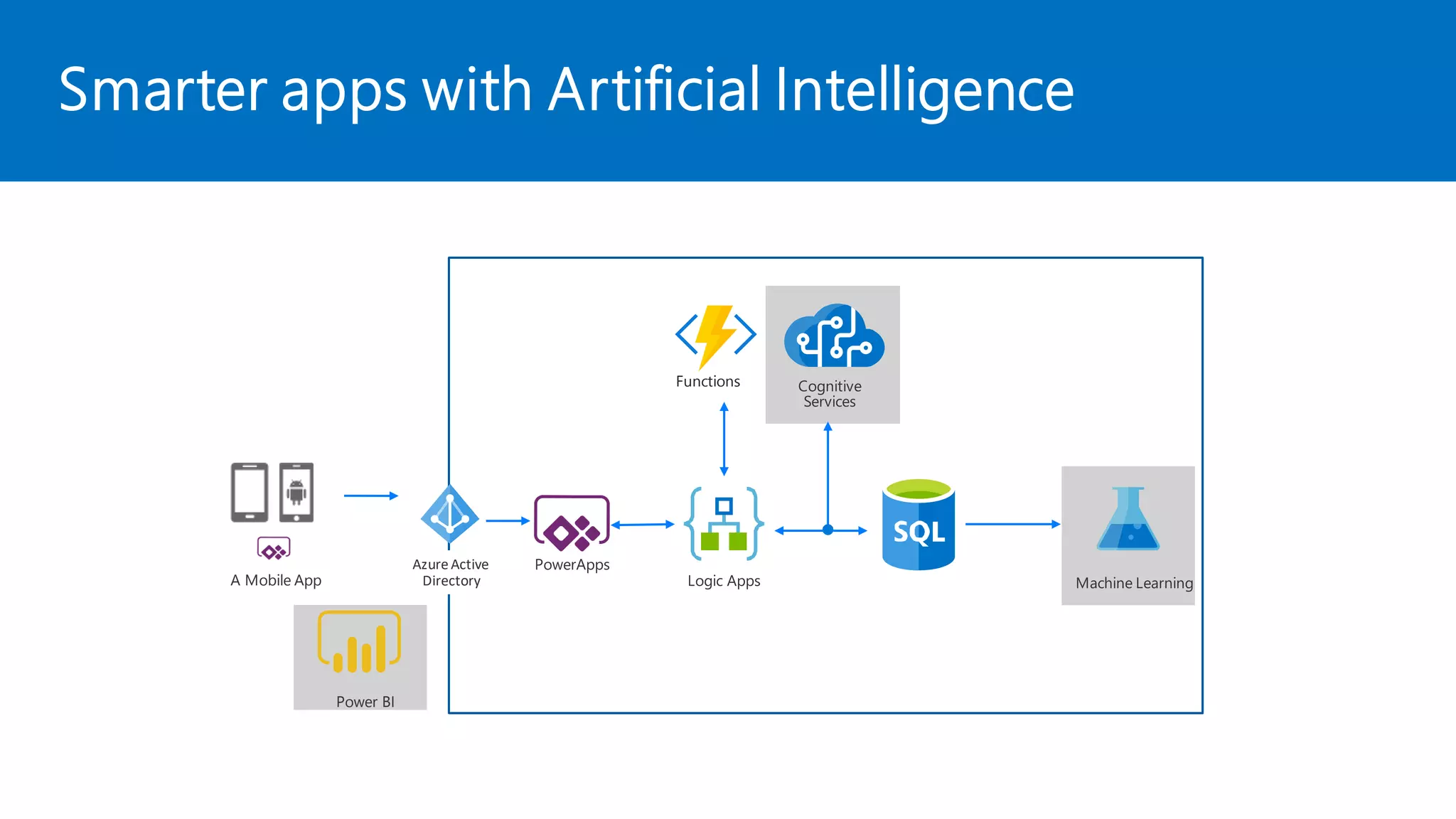
AzureActive
Directory
Functions
A Mobile App
Power BI
•
TrustedProductive IntelligentHybrid
Azure. Cloud for all.
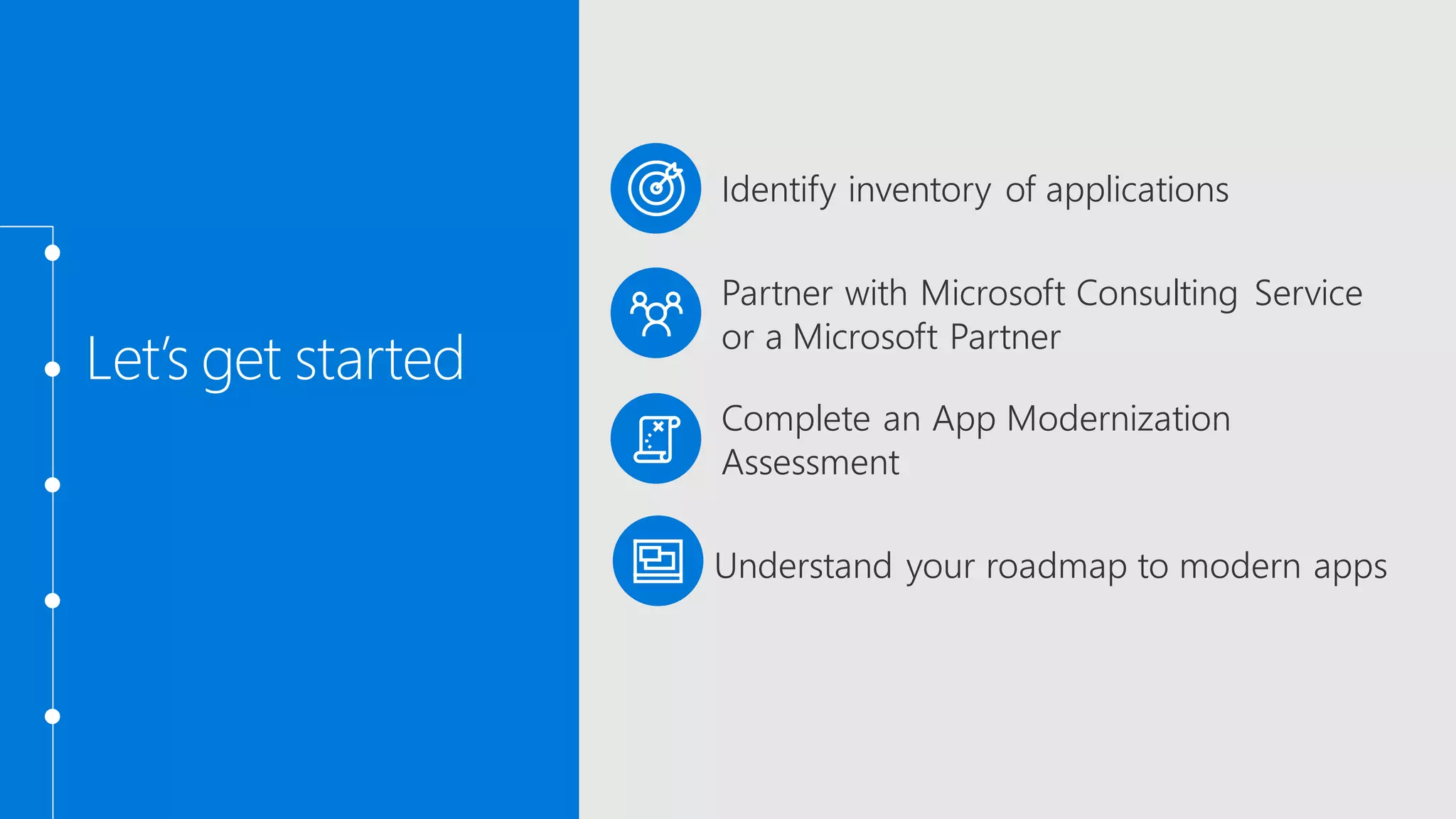
Let’s get started
Understand your roadmap to modern apps
Partner with Microsoft Consulting Service
or a Microsoft Partner
Identify inventory of applications
Complete an App Modernization
Assessment
Azure App Modernization

Azure App Modernization

  • 1.
    Application Portfolio Modernization Phi Huynh- Microsoft MVP Thang Chung – NashTech Solution Architect
  • 5.
  • 6.
    You want tomodernize apps also for these reasons Scale Innovation Security Agility Changing Skillset Scale more effectively Improve extended workflows Tailor LOB apps Customize app experiences Reduce IT Maintenance Experiment more quickly Reach people across multiple platforms Safeguard reputation Resolve security challenges Migrate legacy apps
  • 7.
    Source: Gartner: “Developinga Public Cloud IaaS Adoptionand MigrationFramework” published March 2017
  • 8.
  • 9.
    Objectives Options to considerRehost RefactorRearchitect Re-build 1 Deliver new and breakthrough capabilities faster PaaS, ServerlessOptimize for developerproductivity, build apps faster 2 Provide multichannel access, including mobile and IoT PaaS, ServerlessEnable wider, secure access to applications, support range of devices 3 More easily integrate with other web and cloud apps PaaS, ServerlessLeverage PaaS, increase productivity with Serverless 4 Enable business agility with continuous innovation PaaS, ContainersIncrease DevOps agility across teams 5 Meet scalability requirements of existing apps more cost effectively PaaS, ContainersOptimize application architecture for cloud scale 6 Leveraging existing investments PaaS, ContainersAcross dev/ops, developer experience, tooling, infrastructure and deployed apps 7 Free up data center space quickly IaaS Free up or consolidate resources for apps that must reside on-premises 8 Reduce capital expenditure of existing applications IaaS Switch to pay-as-you-go model, realize better budget forecasting 9 Achieve rapid time to cloud IaaS Allow migration with minimal architectural impact Note: Some of the objective might apply to more than one category of applications
  • 10.
    …To → Office 365 →SharePoint Online → CRM Online → VSO → ADL + PowerBI → Best 3 rd -party SaaS From… → Office servers → Portals and SPS → Any relationshipmgmt → Active Source Control & WIT → Data warehouses → Industry standard verticals Use or convert to a SaaS (1st or 3rd party) solution Retire it, right-size, eliminate environments Roadmap planning ~15% …To → Office 365 → SharePoint Online → CRM Online → VSO → ADL + PowerBI → Best 3 rd -party SaaS From… → Office servers → Portals and SPS → Any relationshipmgmt → Active Source Control & WIT → Data warehouses → Industry standard verticals Use or convert to a SaaS (1st or 3rd party) solution First to move → Basic web apps → Advanced portals → Any new solutions → Any re-architected solutions Next to move → High I/O OLTP → Regulatory and high business impact Hard or costly to Move → HVA Systems → PKI Systems → Legacy source control Azure IT Roadmap Remain on- premise Expose functionality in existing SaaS/PaaS solution Convert to Azure PaaS solution Optimize for and move to Azure IaaS No change, lift‘n shift to IaaS <5% ~35% ~10% ~5% Retire it, right-size, eliminate environments ~30%
  • 11.
    Benefits • Drives higherROI (435% from migration to IaaS). Try our TCO Calculator. • No need to manage data centers • Enjoy flexible and scalable infrastructure When to consider • Ideal when your goal is to improve operational efficiencies, and free up data center space • Maintenance apps for which the hardware is not worth additional investment • Compute-intensive applications that are built for parallelism but don't require high-performance interprocess communications (IPC) and have independent datasets, and applications for which load balancing already increases scalability and availability. Definition: Rehosting is also referred to as a "lift-and-shift" migration. In essence, the application is moved into the IaaS environment of a cloud provider while avoiding as many modifications to the system as possible. In this case, you would not be taking advantage of cloud technology such as autoscaling, for example. Source: Gartner IT Glossary. Core technologies • VM, VM Scale Set
  • 12.
    Move any workload orapplication to Azure Azure Any workloads • Applications • SAP, .NET, Java, Node.js • Virtual machines • Windows Server, Linux • Databases • SQL Server, Oracle, MySQL, DB2 Easy to migrate • Integrated migration tools for both data an apps • Data Migration Assistant • Vast network of partners
  • 13.
    Demo 1: Initialversion of existing Web Apps
  • 14.
    Benefits • Drive continuousinnovation by leveraging built-in DevOps or using Containers. • Easily scale up or down to meet the changing needs of the business • Improved portability and density. • Existing programming models, languages and frameworks that can be easily used and extended. • Fast CI/CD. Definition Refactoring an application involves some change to the application design, but not wholesale changes to the application code. The application takes advantage of IaaS and potentially PaaS capabilities from the provider while maintaining code strategic to the application's use case. When to consider • You want to leverage existing development skills and codebase is paramount • When code portability is a concern. • You prefer a quick way to modernize your apps Core technologies • Containers, container orchestration • DevOps tools Source: Gartner IT Glossary
  • 15.
    single line • Runany container of your choice on Azure. • Build your own or use a prescriptive platform. • Faster app deployment with integrated Visual Studio family of products, and Visual Studio Team Services
  • 16.
    Azure Container Technologies InfrastructureControl Developer productivity
  • 18.
    Develop + Test Plan+ Track Monitor + Learn Release Development Operations
  • 21.
    • Deliver newcapabilities and modernization through modified codebase and a monolithic to micro services architectural revision. • Reduce the volume of code needed to express a capability while still leveraging existing investments. • Agility and scale. When to consider • When apps need a major revision to incorporate new capabilities or take advantage of the cloud-native capabilities. Benefits Definition: Rearchitecting an application for cloud usage enables you to take advantage of technologies such as autoscaling and dynamic reconfiguration. This process will require developer resources to implement and can take significant time to implement. Source: Gartner IT Glossary Core technologies • PaaS, microservices, containers and FaaS
  • 23.
    Benefits • Reduce TCO •Fully leverage the cloud native capabilities and build applications faster • Expedite your business innovation When to consider • You want to build for cloud-native PaaS environments from ground up. • Leverage previous investment in a cloud platform, e.g. when customer data has already moved to the Cloud. • Rapid prototyping is crucial or the scope of a current application is too limited in terms of functionality and lifespan. Definition: Build new application using cloud native environment. Wherever possible, prioritize high- productivity PaaS - model driven or rapid application development Source: Gartner IT Glossary Core technologies • Serverless, PaaS
  • 24.
  • 26.
  • 28.
  • 29.
  • 33.
  • 34.
    Let’s get started Understandyour roadmap to modern apps Partner with Microsoft Consulting Service or a Microsoft Partner Identify inventory of applications Complete an App Modernization Assessment