An Idiot’s Guide to the Australian Preferential Voting System
The House of RepresentativesAlso known as the “lower house”, consisting of local MPs
There are currently 150 electorates (or divisions, or seats), thus each represents approximately 150,000 people
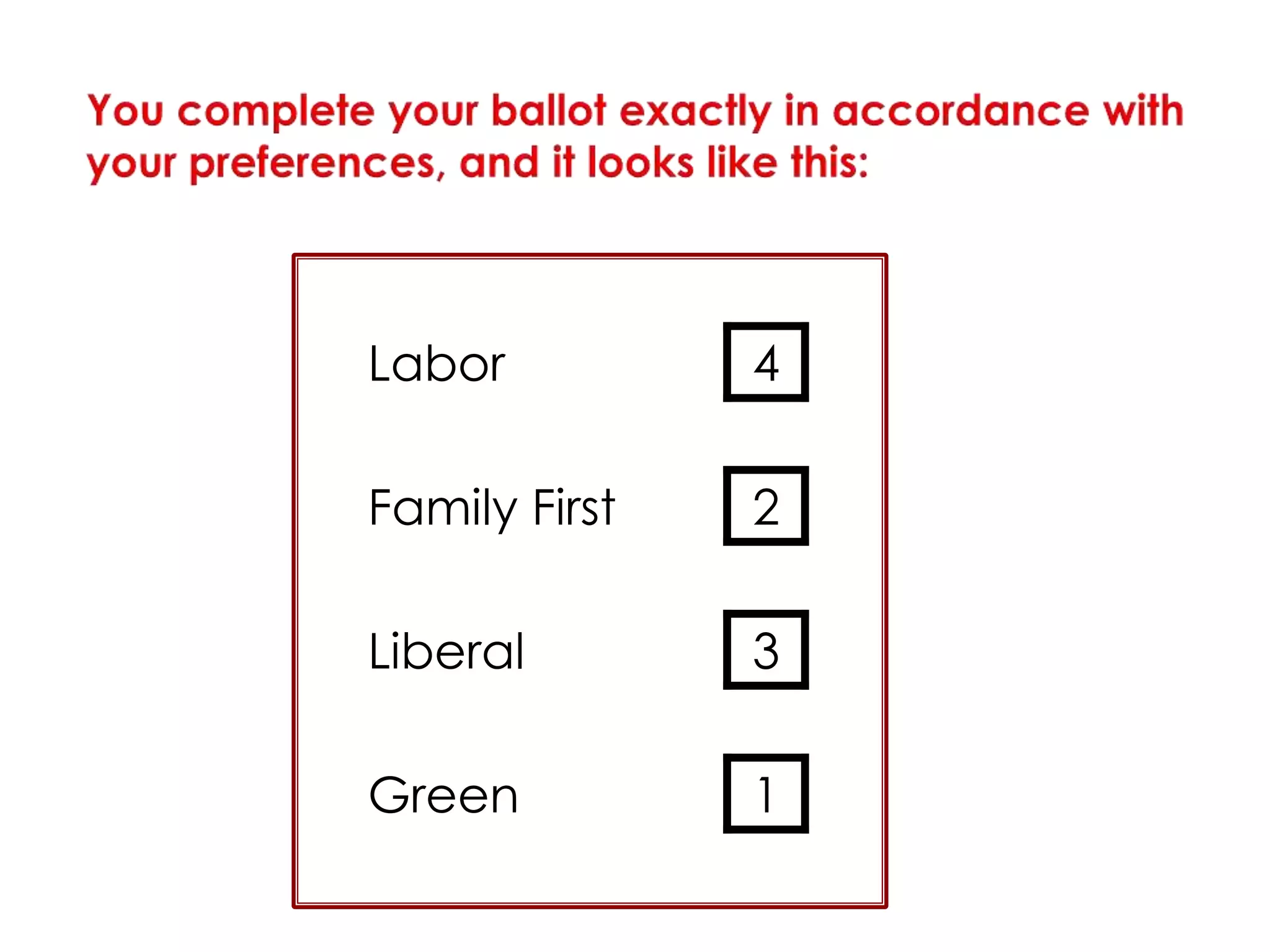
The lower house predominantly consists of members of the two major partiesAssumptionsTo explain how voting works, let’s assume that:in your local electorate, there are four candidates: Labor, Liberal, The Greens, and Family Firstyour ideological preferences are The Greens, then Family First, then Liberal, then Laborthere are 120,000 valid votes in your electorate
You complete your ballot exactly in accordance with your preferences, and it looks like this:
Counting first preferencesAfter the polls close, all 120,000 valid ballots are collectedall first preferences (ie all the number 1s) are talliedif any candidate receives 60,001 or more first preferences, they become your local MP and no further counting is required
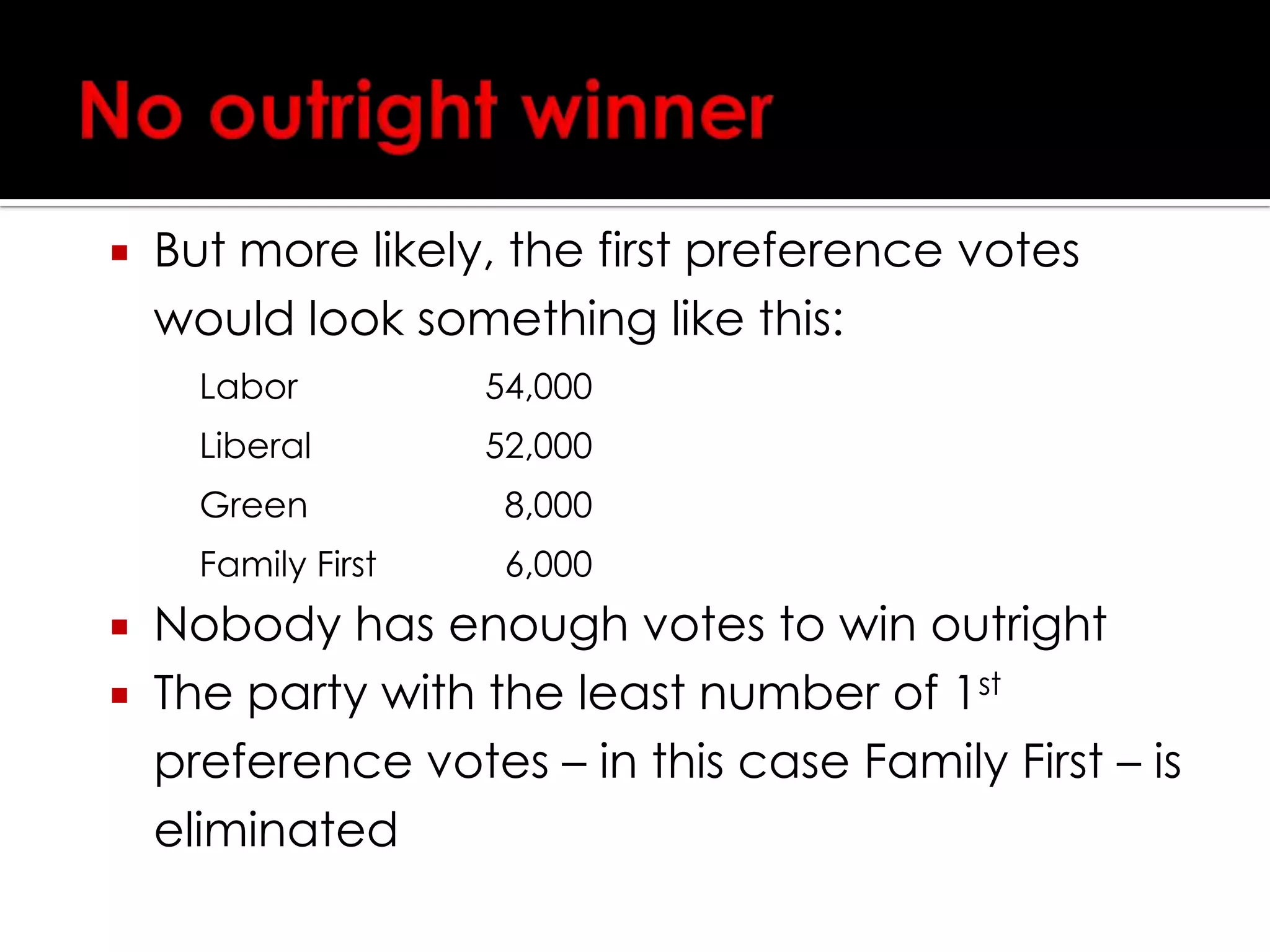
No outright winnerBut more likely, the first preference votes would look something like this:Labor	54,000Liberal	52,000Green	8,000Family First	6,000Nobody has enough votes to win outrightThe party with the least number of 1st preference votes – in this case Family First – is eliminated
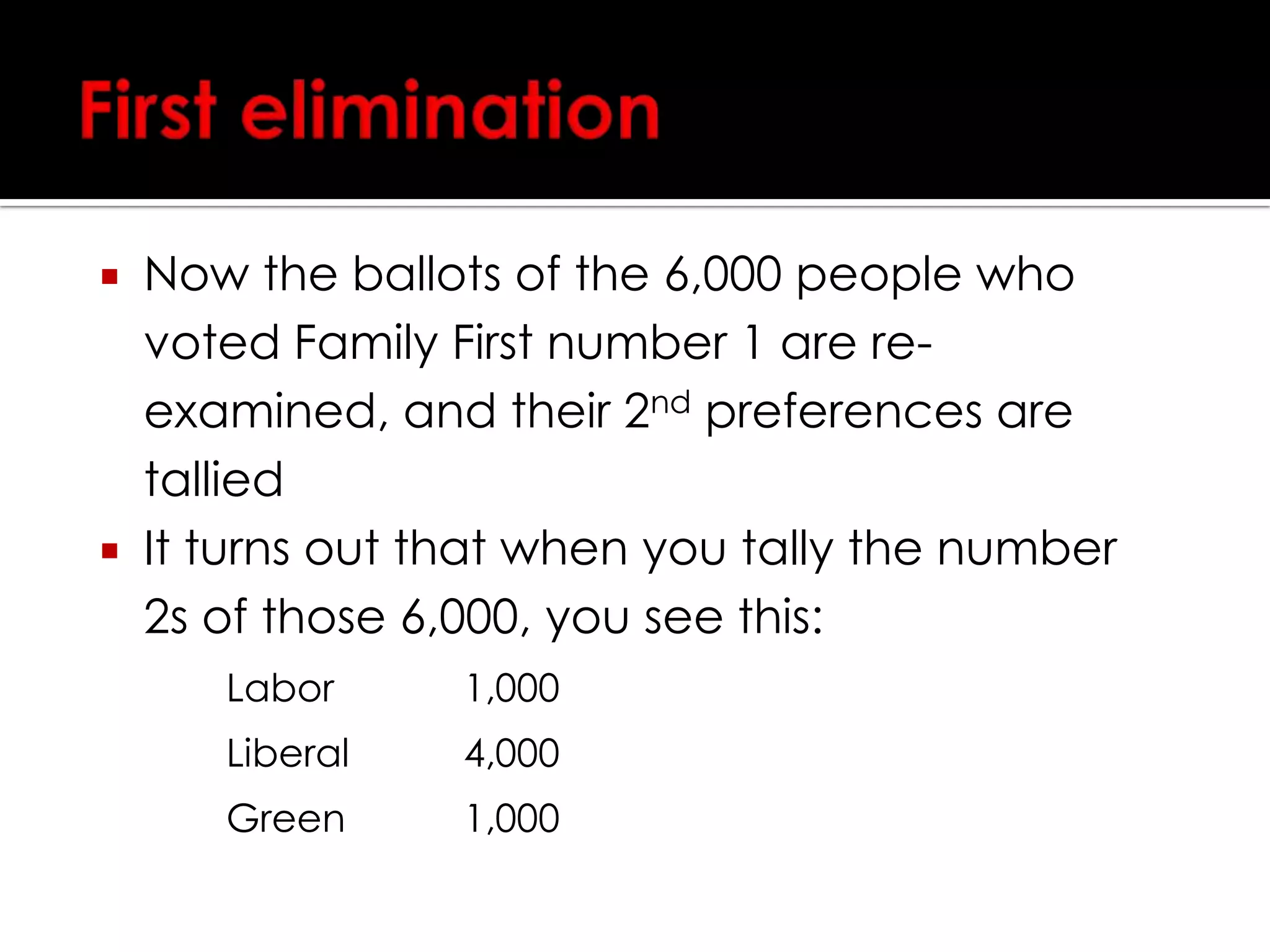
First eliminationNow the ballots of the 6,000 people who voted Family First number 1 are re-examined, and their 2nd preferences are talliedIt turns out that when you tally the number 2s of those 6,000, you see this:Labor	1,000Liberal	4,000Green	1,000
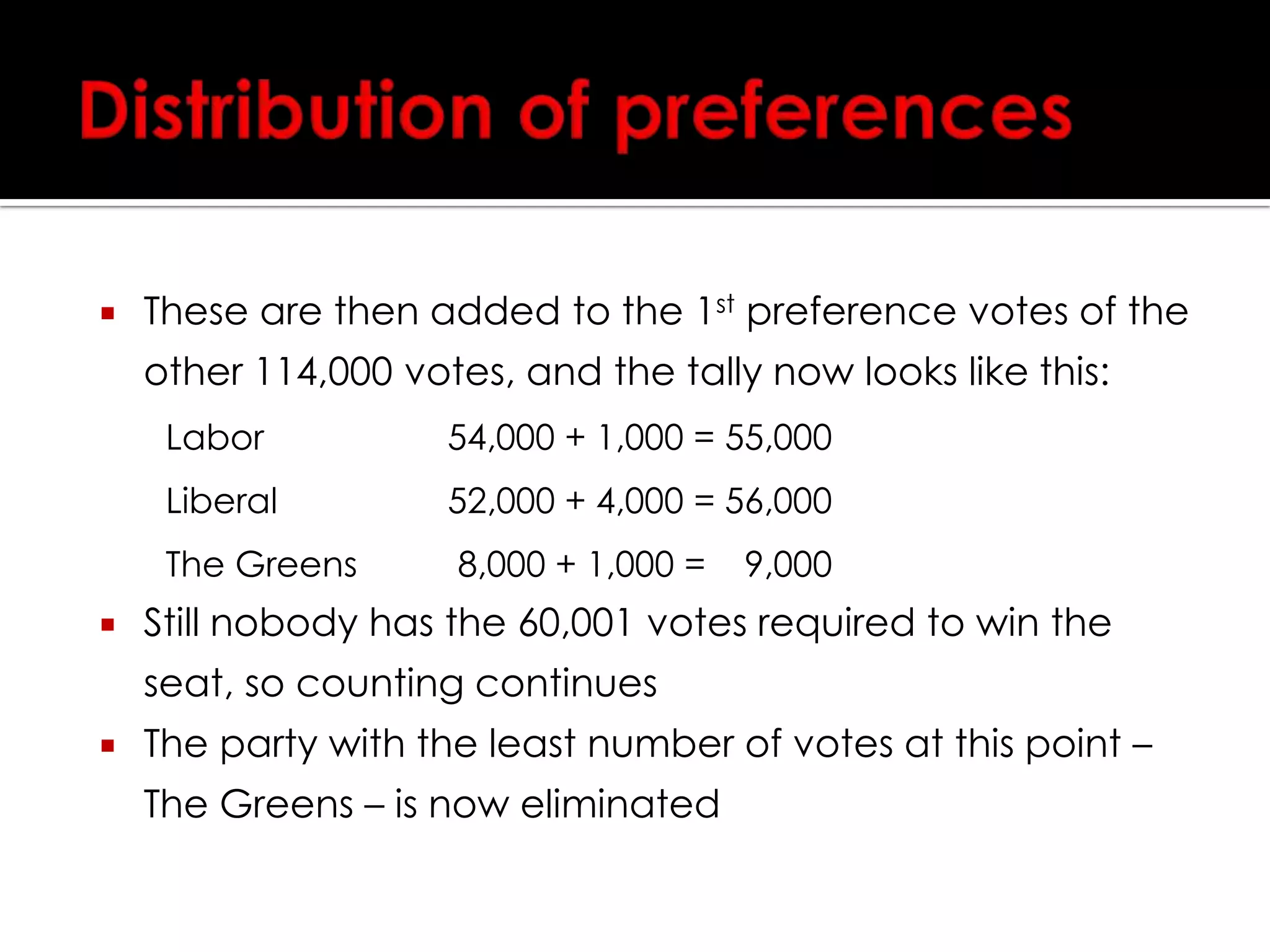
Distribution of preferencesThese are then added to the 1st preference votes of the other 114,000 votes, and the tally now looks like this:Labor   	  54,000 + 1,000 = 55,000  Liberal    	52,000 + 4,000 = 56,000  The Greens    	8,000 + 1,000 =    9,000Still nobody has the 60,001 votes required to win the seat, so counting continuesThe party with the least number of votes at this point – The Greens – is now eliminated
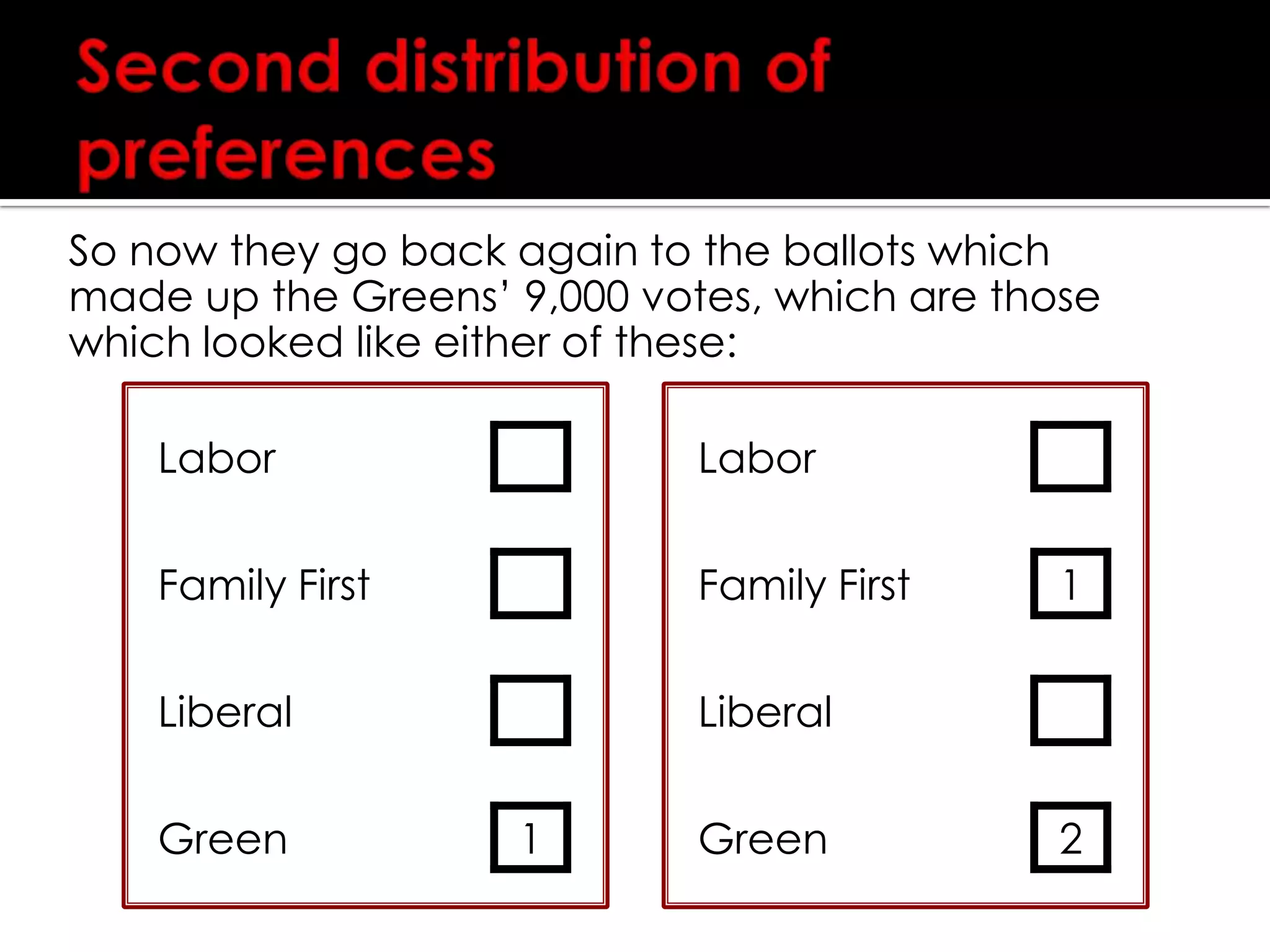
Second distribution of preferencesSo now they go back again to the ballots which made up the Greens’ 9,000 votes, which are those which looked like either of these:
Winning the seatNow they count up the next preference of those voters, and find:Labor	6,000  Liberal	3,000Adding this to the previous votes:Labor	55,000 + 6,000 = 61,000  Liberal	56,000 + 3,000 = 59,000Labor now has more than the 60,001 votes required to win the seat
The SenateOr “upper house”Each state has 12 senators (2 for each territory), elected in accordance with the percentage of the vote which they attract in their state/territoryThere are 76 senators in total, so there is a senator for approximately every 300,000 people (on average)
Senate ballot papers – why so huge?Senate ballot papers generally have a lot more boxes on them than House of Representatives ballots, for two reasons:Each party has multiple candidates, andMinor parties have a much better chance of winning a Senate seat, so this is where all the minor parties put up candidatesSo if you’re electing 6 senators (except for a double dissolution, only half the senators are put to a vote each election), the major parties may put up 5 candidates each, and the minor parties 2 candidates each, for a total of 14 candidatesIn reality, there can be, and often are, dozens of candidates
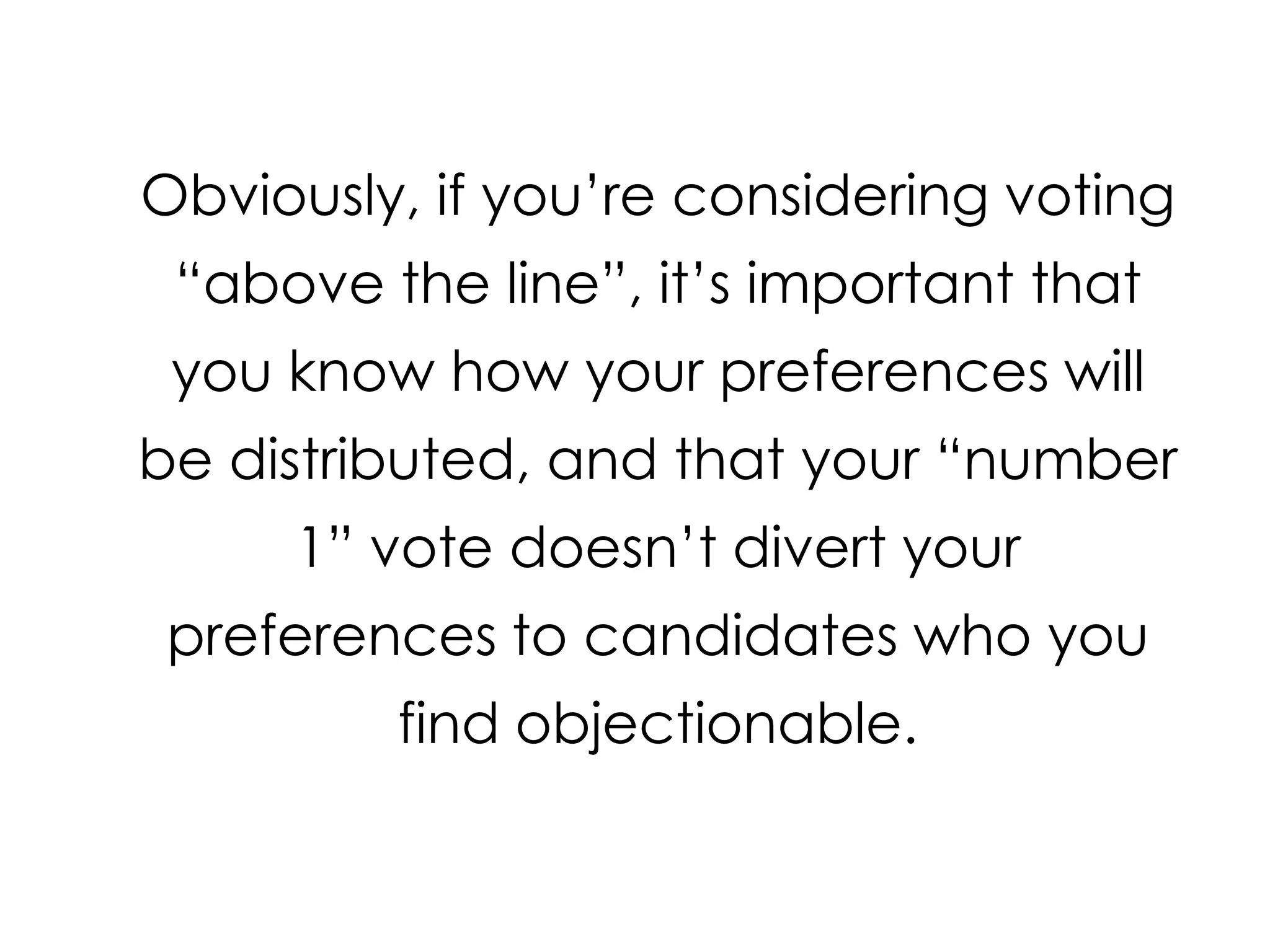
Voting “above” and “below” the lineThe standard way of voting for the senate is to number all 14 boxes from 1 to 14, in order of preference (“below the line”)Because there can be so many senate candidates, and numbering all of them can be time-consuming, the option of voting “above the line” was introducedWhat this means is that if, as in your example, you like The Greens, and are happy for The Greens to direct how your preferences will be distributed, then you can simply put a number 1 next to The Greens “above the line”
Obviously, if you’re considering voting “above the line”, it’s important that you know how your preferences will be distributed, and that your “number 1” vote doesn’t divert your preferences to candidates who you find objectionable.
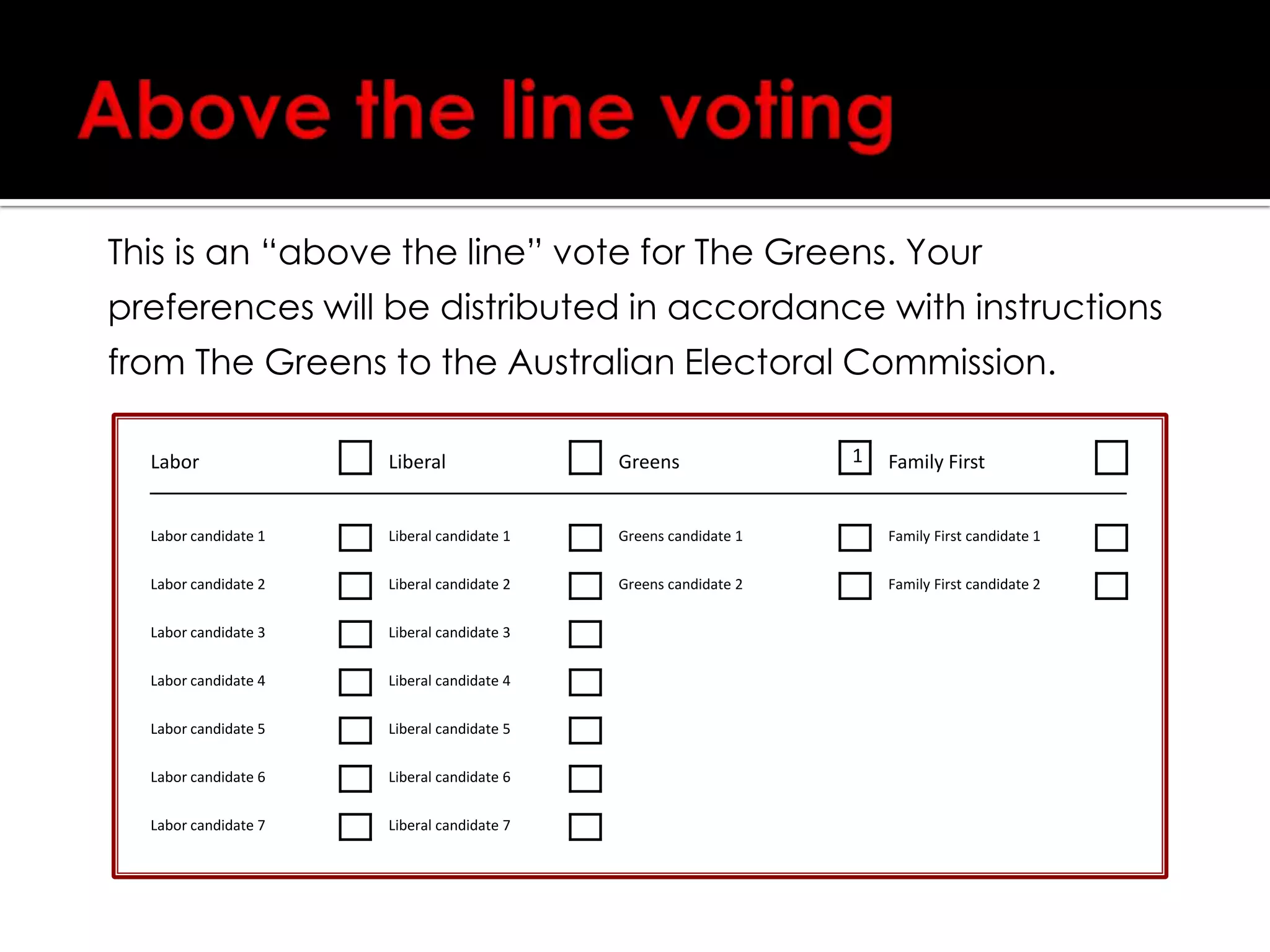
Above the line votingThis is an “above the line” vote for The Greens. Your preferences will be distributed in accordance with instructions from The Greens to the Australian Electoral Commission.
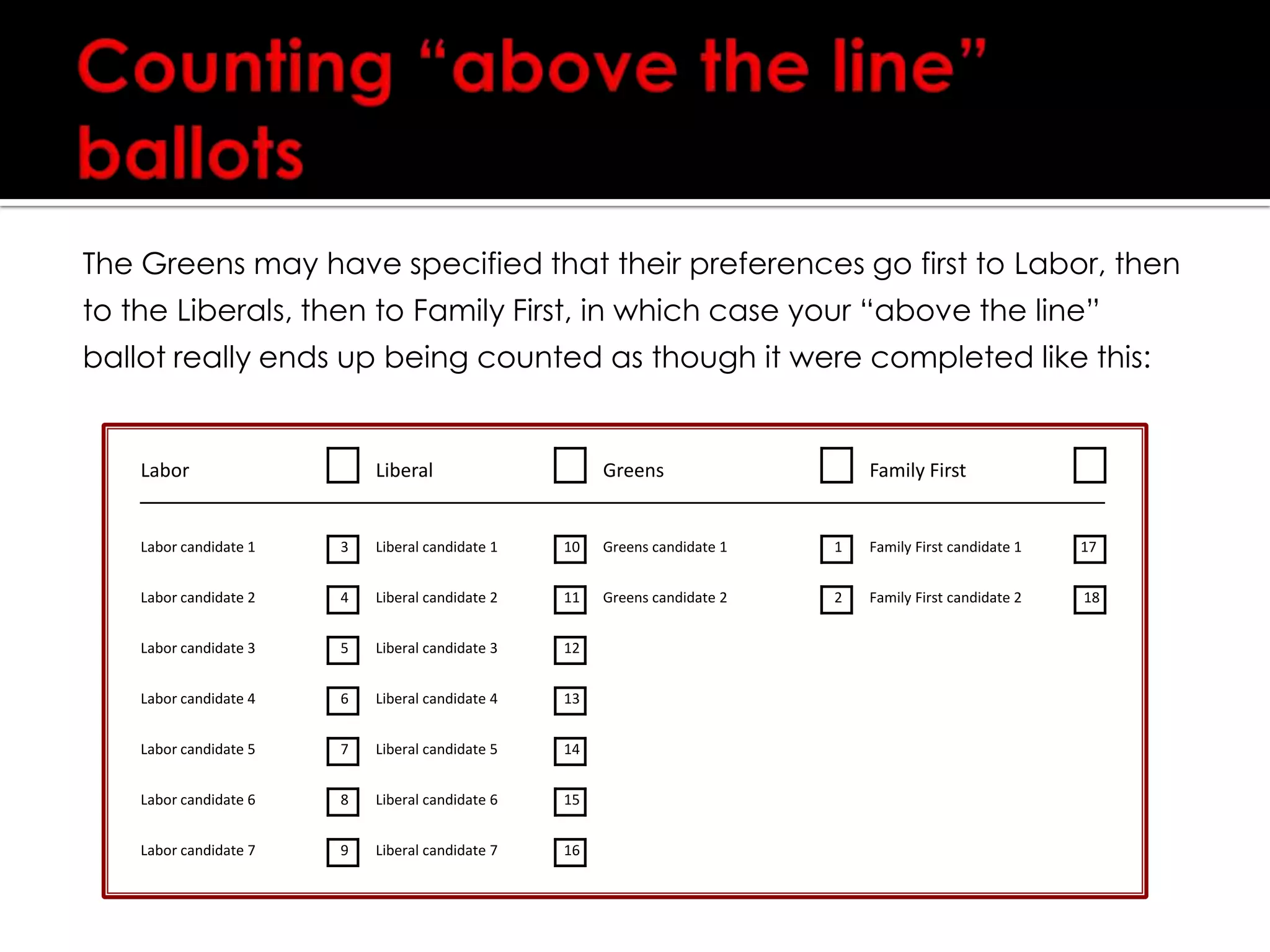
Counting “above the line” ballotsThe Greens may have specified that their preferences go first to Labor, then to the Liberals, then to Family First, in which case your “above the line” ballot really ends up being counted as though it were completed like this:
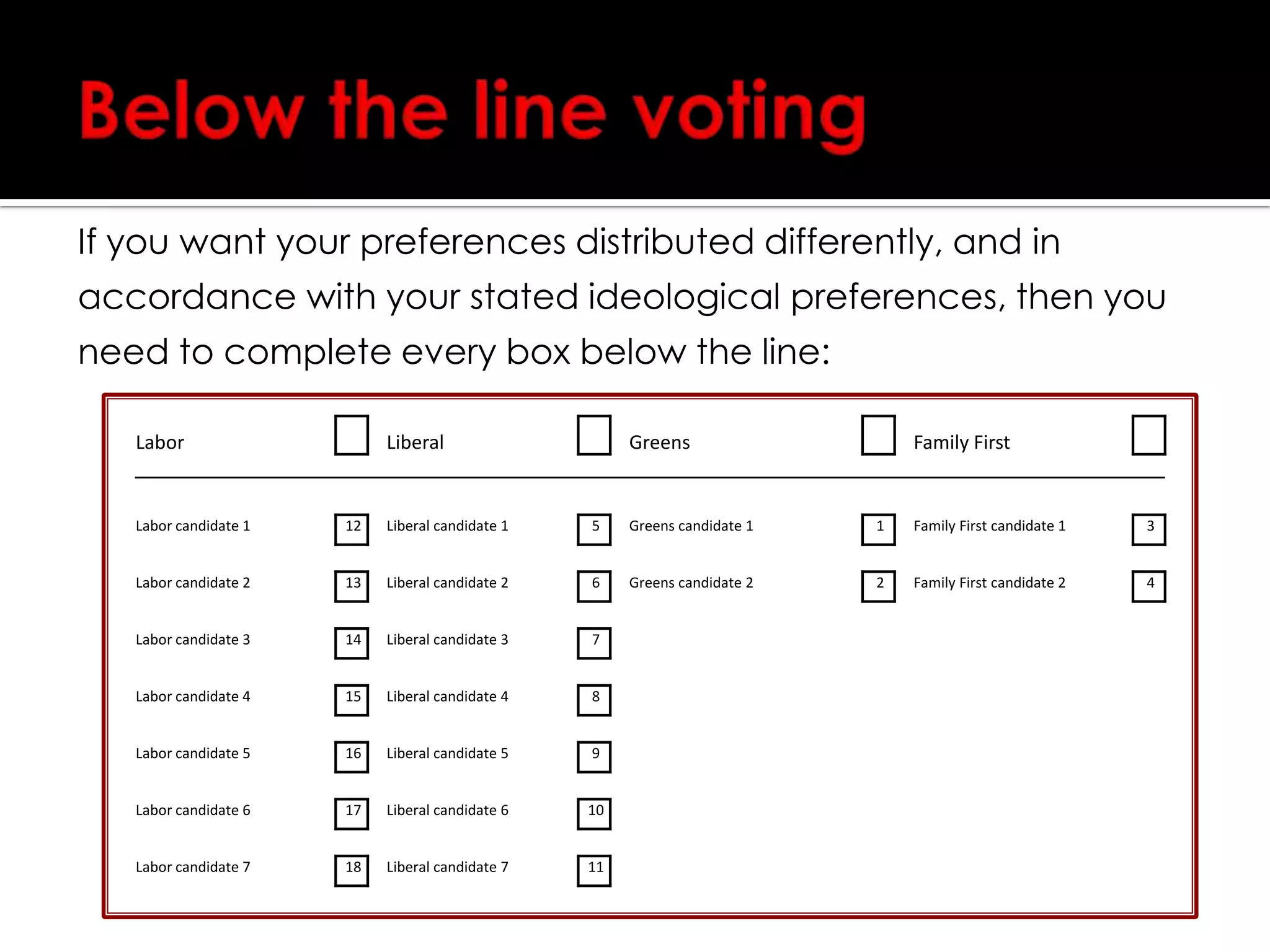
If you want your preferences distributed differently, and in accordance with your stated ideological preferences, then you need to complete every box below the line:Below the line voting
Now, counting senate votes...This one’s quite a bit more complicated, but very interesting. Hold on!There is a certain number of votes which have to be attained in order to gain a Senate seat. It varies by state, but for these purposes, let’s say that it’s 300,000 votes.So firstly, all the number 1s - below the line – are counted on all the senate ballots.
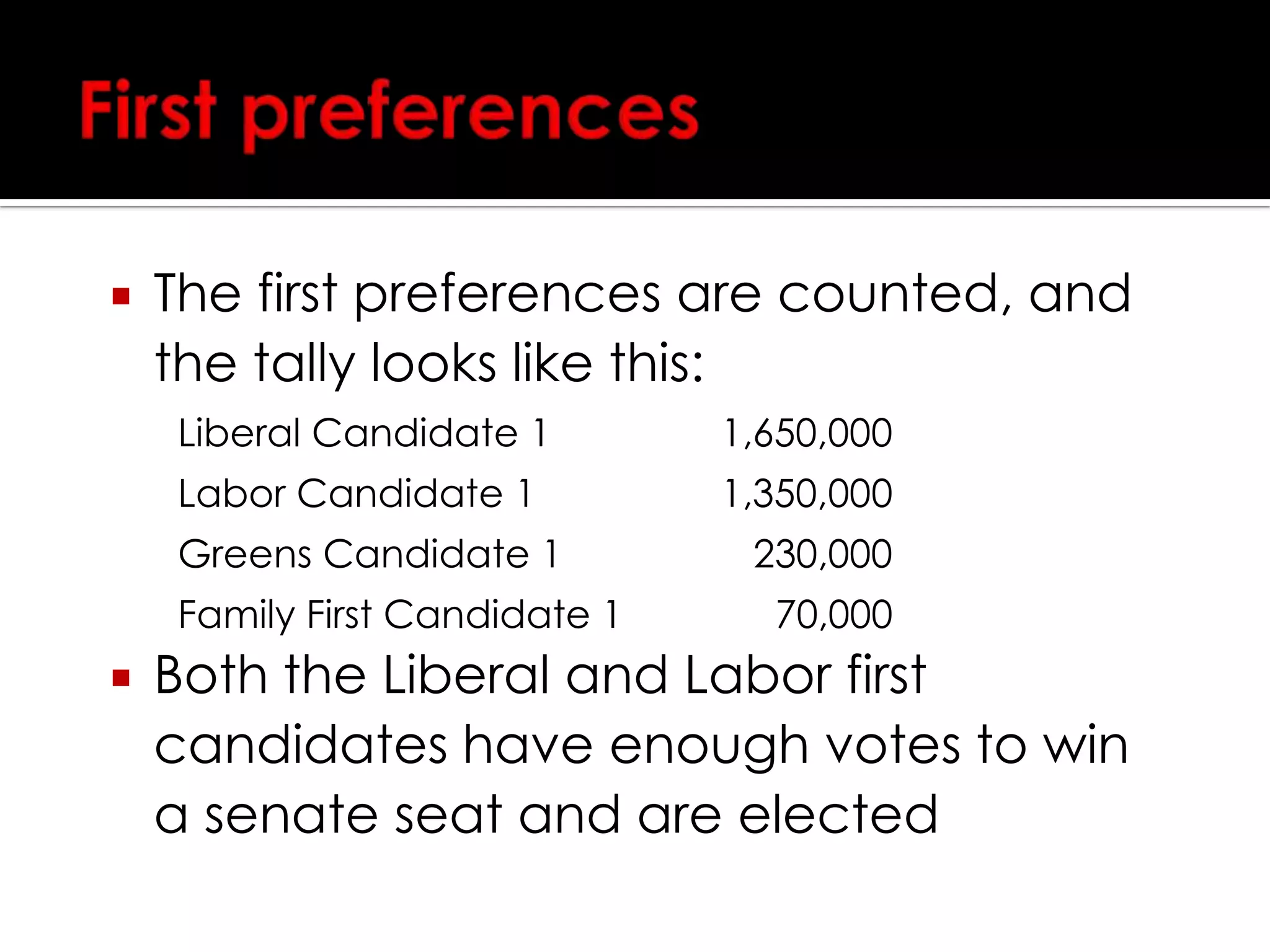
First preferencesThe first preferences are counted, and the tally looks like this:  Liberal Candidate 1	1,650,000Labor Candidate 1	1,350,000  Greens Candidate 1	230,000  Family First Candidate 1	70,000Both the Liberal and Labor first candidates have enough votes to win a senate seat and are elected
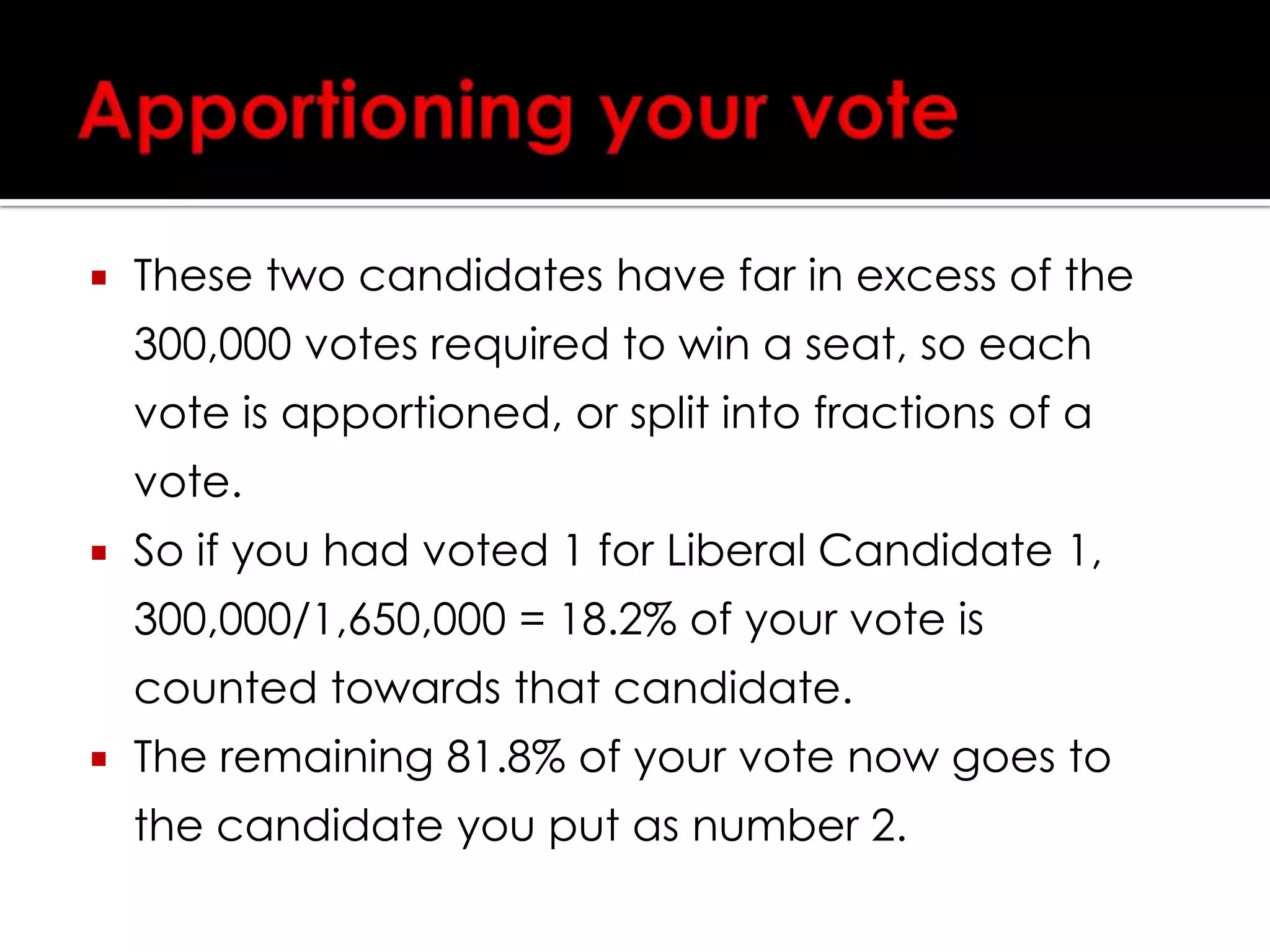
Apportioning your voteThese two candidates have far in excess of the 300,000 votes required to win a seat, so each vote is apportioned, or split into fractions of a vote.So if you had voted 1 for Liberal Candidate 1, 300,000/1,650,000 = 18.2% of your vote is counted towards that candidate.The remaining 81.8% of your vote now goes to the candidate you put as number 2.
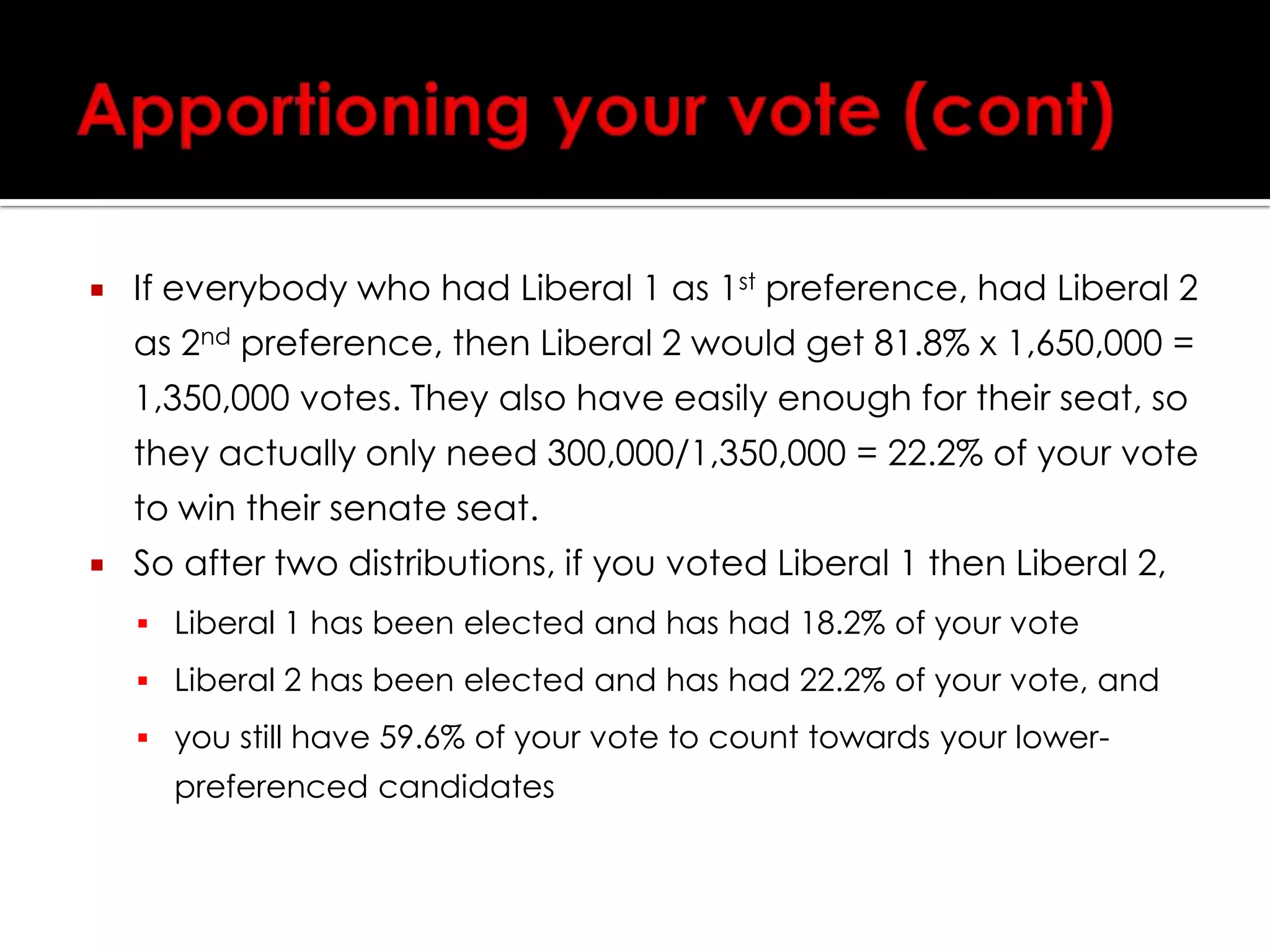
Apportioning your vote (cont)If everybody who had Liberal 1 as 1st preference, had Liberal 2 as 2nd preference, then Liberal 2 would get 81.8% x 1,650,000 = 1,350,000 votes. They also have easily enough for their seat, so they actually only need 300,000/1,350,000 = 22.2% of your vote to win their senate seat.So after two distributions, if you voted Liberal 1 then Liberal 2, Liberal 1 has been elected and has had 18.2% of your voteLiberal 2 has been elected and has had 22.2% of your vote, and you still have 59.6% of your vote to count towards your lower-preferenced candidates
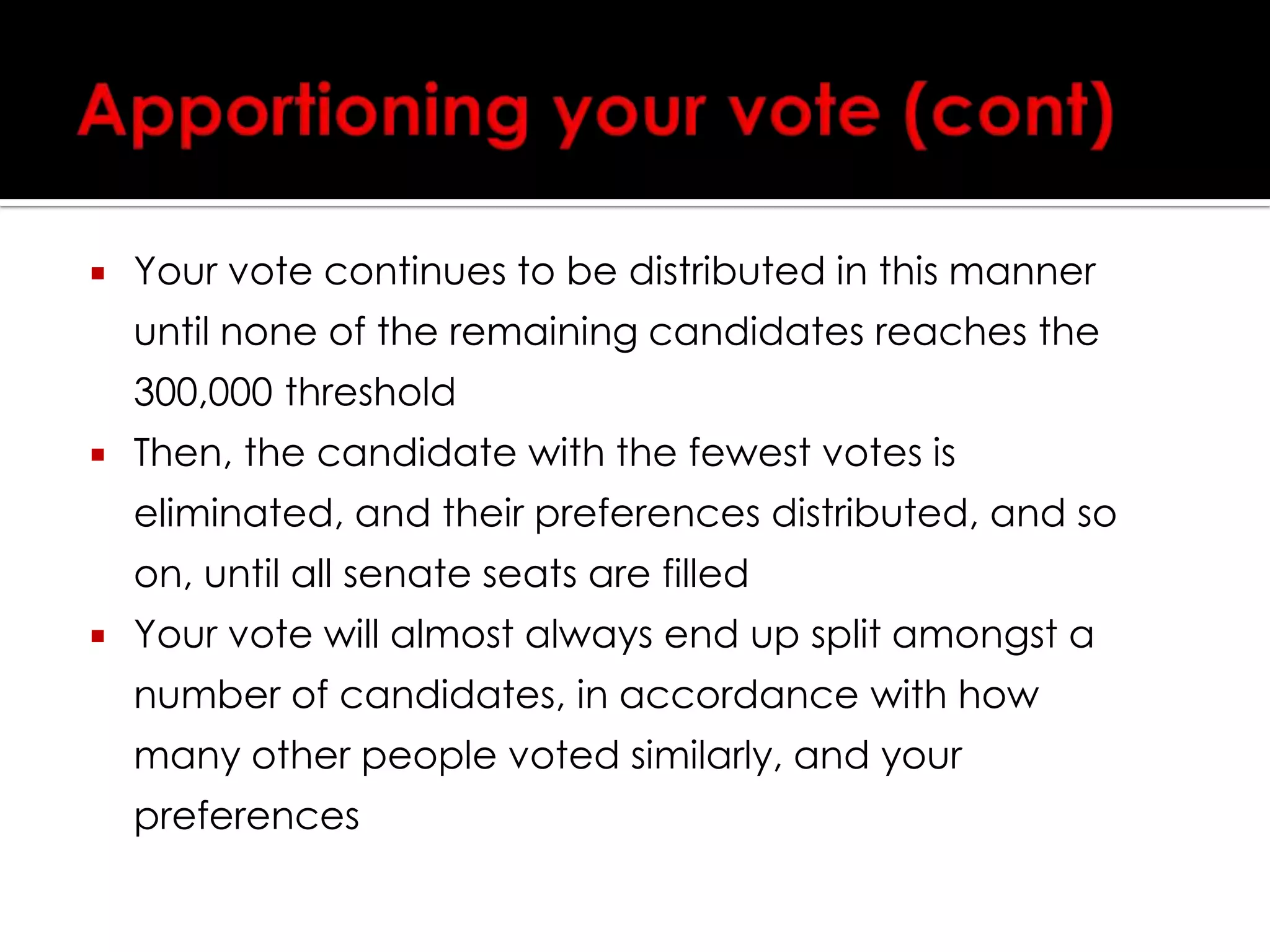
Apportioning your vote (cont)Your vote continues to be distributed in this manner until none of the remaining candidates reaches the 300,000 thresholdThen, the candidate with the fewest votes is eliminated, and their preferences distributed, and so on, until all senate seats are filledYour vote will almost always end up split amongst a number of candidates, in accordance with how many other people voted similarly, and your preferences
Take-home messages!It isn’t really possible to “waste” your vote, provided you make a valid vote. So vote in the order that’s consistent with your preferences, even if it’s for a minor party.Don’t vote “above the line” for the Senate unless you’re comfortable with the way that your number 1 party will distribute your preferences!

An outline of the australian preferential voting system

  • 1.
    An Idiot’s Guideto the Australian Preferential Voting System
  • 2.
    The House ofRepresentativesAlso known as the “lower house”, consisting of local MPs
  • 3.
    There are currently150 electorates (or divisions, or seats), thus each represents approximately 150,000 people
  • 4.
    The lower housepredominantly consists of members of the two major partiesAssumptionsTo explain how voting works, let’s assume that:in your local electorate, there are four candidates: Labor, Liberal, The Greens, and Family Firstyour ideological preferences are The Greens, then Family First, then Liberal, then Laborthere are 120,000 valid votes in your electorate
  • 5.
    You complete yourballot exactly in accordance with your preferences, and it looks like this:
  • 6.
    Counting first preferencesAfterthe polls close, all 120,000 valid ballots are collectedall first preferences (ie all the number 1s) are talliedif any candidate receives 60,001 or more first preferences, they become your local MP and no further counting is required
  • 7.
    No outright winnerButmore likely, the first preference votes would look something like this:Labor 54,000Liberal 52,000Green 8,000Family First 6,000Nobody has enough votes to win outrightThe party with the least number of 1st preference votes – in this case Family First – is eliminated
  • 8.
    First eliminationNow theballots of the 6,000 people who voted Family First number 1 are re-examined, and their 2nd preferences are talliedIt turns out that when you tally the number 2s of those 6,000, you see this:Labor 1,000Liberal 4,000Green 1,000
  • 9.
    Distribution of preferencesTheseare then added to the 1st preference votes of the other 114,000 votes, and the tally now looks like this:Labor 54,000 + 1,000 = 55,000 Liberal 52,000 + 4,000 = 56,000 The Greens 8,000 + 1,000 = 9,000Still nobody has the 60,001 votes required to win the seat, so counting continuesThe party with the least number of votes at this point – The Greens – is now eliminated
  • 10.
    Second distribution ofpreferencesSo now they go back again to the ballots which made up the Greens’ 9,000 votes, which are those which looked like either of these:
  • 11.
    Winning the seatNowthey count up the next preference of those voters, and find:Labor 6,000 Liberal 3,000Adding this to the previous votes:Labor 55,000 + 6,000 = 61,000 Liberal 56,000 + 3,000 = 59,000Labor now has more than the 60,001 votes required to win the seat
  • 12.
    The SenateOr “upperhouse”Each state has 12 senators (2 for each territory), elected in accordance with the percentage of the vote which they attract in their state/territoryThere are 76 senators in total, so there is a senator for approximately every 300,000 people (on average)
  • 13.
    Senate ballot papers– why so huge?Senate ballot papers generally have a lot more boxes on them than House of Representatives ballots, for two reasons:Each party has multiple candidates, andMinor parties have a much better chance of winning a Senate seat, so this is where all the minor parties put up candidatesSo if you’re electing 6 senators (except for a double dissolution, only half the senators are put to a vote each election), the major parties may put up 5 candidates each, and the minor parties 2 candidates each, for a total of 14 candidatesIn reality, there can be, and often are, dozens of candidates
  • 14.
    Voting “above” and“below” the lineThe standard way of voting for the senate is to number all 14 boxes from 1 to 14, in order of preference (“below the line”)Because there can be so many senate candidates, and numbering all of them can be time-consuming, the option of voting “above the line” was introducedWhat this means is that if, as in your example, you like The Greens, and are happy for The Greens to direct how your preferences will be distributed, then you can simply put a number 1 next to The Greens “above the line”
  • 15.
    Obviously, if you’reconsidering voting “above the line”, it’s important that you know how your preferences will be distributed, and that your “number 1” vote doesn’t divert your preferences to candidates who you find objectionable.
  • 16.
    Above the linevotingThis is an “above the line” vote for The Greens. Your preferences will be distributed in accordance with instructions from The Greens to the Australian Electoral Commission.
  • 17.
    Counting “above theline” ballotsThe Greens may have specified that their preferences go first to Labor, then to the Liberals, then to Family First, in which case your “above the line” ballot really ends up being counted as though it were completed like this:
  • 18.
    If you wantyour preferences distributed differently, and in accordance with your stated ideological preferences, then you need to complete every box below the line:Below the line voting
  • 19.
    Now, counting senatevotes...This one’s quite a bit more complicated, but very interesting. Hold on!There is a certain number of votes which have to be attained in order to gain a Senate seat. It varies by state, but for these purposes, let’s say that it’s 300,000 votes.So firstly, all the number 1s - below the line – are counted on all the senate ballots.
  • 20.
    First preferencesThe firstpreferences are counted, and the tally looks like this: Liberal Candidate 1 1,650,000Labor Candidate 1 1,350,000 Greens Candidate 1 230,000 Family First Candidate 1 70,000Both the Liberal and Labor first candidates have enough votes to win a senate seat and are elected
  • 21.
    Apportioning your voteThesetwo candidates have far in excess of the 300,000 votes required to win a seat, so each vote is apportioned, or split into fractions of a vote.So if you had voted 1 for Liberal Candidate 1, 300,000/1,650,000 = 18.2% of your vote is counted towards that candidate.The remaining 81.8% of your vote now goes to the candidate you put as number 2.
  • 22.
    Apportioning your vote(cont)If everybody who had Liberal 1 as 1st preference, had Liberal 2 as 2nd preference, then Liberal 2 would get 81.8% x 1,650,000 = 1,350,000 votes. They also have easily enough for their seat, so they actually only need 300,000/1,350,000 = 22.2% of your vote to win their senate seat.So after two distributions, if you voted Liberal 1 then Liberal 2, Liberal 1 has been elected and has had 18.2% of your voteLiberal 2 has been elected and has had 22.2% of your vote, and you still have 59.6% of your vote to count towards your lower-preferenced candidates
  • 23.
    Apportioning your vote(cont)Your vote continues to be distributed in this manner until none of the remaining candidates reaches the 300,000 thresholdThen, the candidate with the fewest votes is eliminated, and their preferences distributed, and so on, until all senate seats are filledYour vote will almost always end up split amongst a number of candidates, in accordance with how many other people voted similarly, and your preferences
  • 24.
    Take-home messages!It isn’treally possible to “waste” your vote, provided you make a valid vote. So vote in the order that’s consistent with your preferences, even if it’s for a minor party.Don’t vote “above the line” for the Senate unless you’re comfortable with the way that your number 1 party will distribute your preferences!
  • 25.
    Your vote ispowerful. Use it responsibly.Tracey Bryantraceybryan9@gmail.com20th August 2010