

Cooperative Freedom Morten F Paulsen An Online Education Theory By Teresa Rafael Presentation based in.
In accordance with Keegan There are six major elements define a distance education program
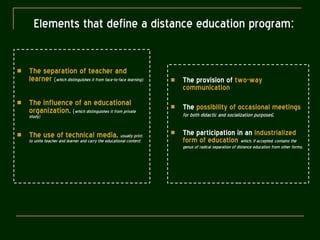
Elements that define a distance education program : The separation of teacher and learner   ( which distinguishes it from face-to-face learning); The influence of an educational organization ,   ( which distinguishes it from private study) The use of technical media ,  usually print, to unite teacher and learner and carry the educational content; The provision of  two-way communication The  possibility of occasional meetings   for both didactic and socialization purposes ;  The participation in an  industrialized form of education   which, if accepted, contains the genus of radical separation of distance education from other forms .
Use of CMC  ( Mason and Kaye (1990))   three major implications for distance education The breaking down of conceptual distinctions between  distance education and place based education; The changing of traditional roles  of faculty, administrative and support staff, and adjunct tutors; The  provision of an opportunity , which never existed before, to create a network of scholars, “space” for collective thinking , and access to peers for socializing and erendipitous exchange.
Distance Education Theories three theoretical positions Theories of autonomy and independence (1991 ), Moore  perceives dialogue as interaction between learner and instructor Theories of industrialization Peters’ (1988) the teaching process is gradually restructured through increasing mechanization and mass production .  Theories of interaction and communication Holmberg’s theory is developed with a focus on correspondence courses and one-to-one communication. Consequently, it does not give much consideration to group communication.
The Theory of Cooperative Freedom can be  classified as a theory of autonomy and independence It is  influenced by Knowles’s (1970)  theory of andragogy asserts that  adult learners perceive themselves as self-directing human beings  and  define themselves  in terms of their  personal achievements and experience
The Theory of Cooperative Freedom adult and juvenile distance learners   are perceived as: motivated, self-directing students  with a desire to control their learning outcomes.
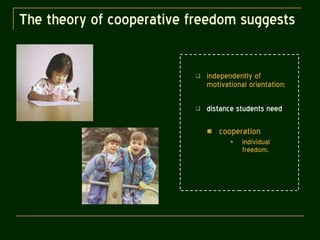
The theory of cooperative freedom suggests independently of motivational orientation;  distance students need  cooperation  individual freedom .
Houle (1984) education is a cooperative  rather than an operative  art : it implies voluntary interaction among individuals during learning .
Cooperation can be   Hard to achieve  in distance education.  loneliness results  from  limited access to student peers collaboration  is even  harder  to achieve than cooperation However, audio conferencing, video conferencing, and computer conferencing have been devised to  facilitate cooperation at a distance. Therefore the term  cooperation  is deliberately chosen in this theory.
The  theory  of cooperative freedom professes  that  students  should  have a high level of freedom   to choose  rather than be restrained by a rigid distance education program freedom is crucial in distance education
For many people the  need  for  Continuing education   lifelong learning is increasing
Today’s students need  flexible education  that allows them to combine job, family, and education in a  manageable way
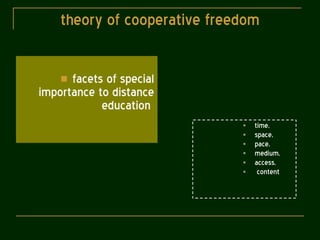
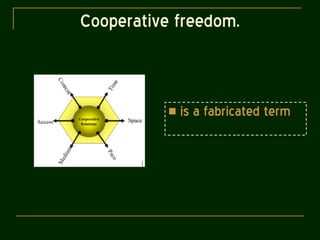
theory of cooperative freedom facets of special importance to distance education  time,  space, pace, medium, access, content
Cooperative freedom. is a fabricated term
Freedom of time Communication Asynchronous the  message is stored  in the communication medium until the receivers find it convenient to retrieve it.
Freedom of time Communication Synchronous inflexible , but allows people to communicate in real time, as they do face-to-face or on the telephone Scheduling  communication varies in  flexibility .
Freedom of time A  high level of freedom   allows students to  communicate  whenever it is  convenient for them.
Ideally online education  completely  independent of time It is  available  24 hours a day, 365 days a year. It gives  instantaneous access to information is  no need to synchronize   the operation  among communication partners
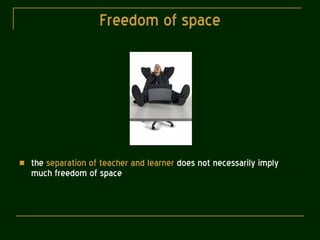
Freedom of space the  separation of teacher and learner  does not necessarily imply much freedom of space
Freedom of space Distance education programs  with a high level of freedom  let students choose  where they want to study. Online education  can be  accessed worldwide ,  wherever there is an Internet connection
Pacing Pacing  can be  individual  or  collective implies  meeting deadlines  for starting a course,  examinations, assignments Deadlines , however, can be flexible or rigid.
Freedom of pace. A high level of freedom  allows students to choose the pacing  they prefer. they should be  allowed to spend the time  they require  to complete a course Other people would like to  choose when to start a course and how fast to progress in it.
Pacing techniques  (Wells -1992) three pacing techniques  available with CMC Group assignments  that urge coherent pacing within group a technique that denies students access to information before they have completed all  prerequisite assignments . limited time  access to services such as conferences, databases, and guest speakers
Freedom of medium   Nipper (1989) three  generations  of distance education: first generation  uses  correspondence teaching  based on  printed and written material second generation is based on  broadcast media , third generation  uses  computer conferencing systems . Each generation utilizes the  media devised in earlier   generations
Programs with a high level of freedom provide students with  access to several media or sources of information : print, video, face-to-face meetings, computer conferencing, etc. support  different learning styles  prevent exclusion  of students
Freedom of access “ open education” Escotet (cited in Keegan 1986) less restricted, exclusive , privileged  than traditional education;  as flexibly paced; encourage new relationships  between professors and students;  wille to  credit the value of students’ life experiences A  flexible system  can enroll all students who want to study
Accessibility: programs  that aspire to a high level of freedom must  eliminate discrimination  on the basis of social class, entry qualifications, gender, age, ethnicity, or occupation
Accessibility: programs should not ask  students  to document prior education ; students should decide  for themselves  whether they are capable of pursuing the course of study
Freedom of content A high level of freedom allows  students to  choose  among a range of  courses  and to  transfer credits  between programs and universities. Online education  has the  potential   to  increase inter-college collaboration It could  imply a free flow of virtual mobile students  in Europe and across the globe
Freedom, Flexibility and Cooperation Freedom is a multi-dimensional construct .  All  distance education programs  will have some  freedom in each dimension. Each  dimension  should be regarded as: Continuous  rather than dichotomous, relative , not absolute.
Factors that constrain learning flexibility flexibility could be : unmanageable, not acceptable, not affordable,  not realistic . “ One person’s time flexibility is another’s time delay.” Burge (1991) the  traditional college more flexible  than the distance education institution  with regard to content and medium . Scarce resources  and rigid educational regulations often  inhibit flexible distance education
cooperative learning pedagogical challenges How can  senior students  who are in the final stage of a course  benefit from collaboration  with junior students who have just enrolled on the course? Individual freedom is  hard to combine  with an  industrialized  model of  education   can  hardly compete  in terms of cost-effectiveness with  industrialized mass education
Conclusion Future adult students  will  seek  individual flexibility   and freedom . These aims are  difficult  to combine But when integrated with other media online education can be the  means of joining   individual freedom  collective unity  into truly flexible, cooperative distance education programs .
work powered  by  Teresa Rafael Universidade Aberta PPEL /MPEL October 2009   based on   Morten F. Paulsen   Cooperative Freedom: an Online Education Theory Images :  Adobe photoshop Powered by Google

Cooperative Freedom

  • 1.
    Cooperative Freedom MortenF Paulsen An Online Education Theory By Teresa Rafael Presentation based in.
  • 2.
    In accordance withKeegan There are six major elements define a distance education program
  • 3.
    Elements that definea distance education program : The separation of teacher and learner ( which distinguishes it from face-to-face learning); The influence of an educational organization , ( which distinguishes it from private study) The use of technical media , usually print, to unite teacher and learner and carry the educational content; The provision of two-way communication The possibility of occasional meetings for both didactic and socialization purposes ; The participation in an industrialized form of education which, if accepted, contains the genus of radical separation of distance education from other forms .
  • 4.
    Use of CMC ( Mason and Kaye (1990)) three major implications for distance education The breaking down of conceptual distinctions between distance education and place based education; The changing of traditional roles of faculty, administrative and support staff, and adjunct tutors; The provision of an opportunity , which never existed before, to create a network of scholars, “space” for collective thinking , and access to peers for socializing and erendipitous exchange.
  • 5.
    Distance Education Theoriesthree theoretical positions Theories of autonomy and independence (1991 ), Moore perceives dialogue as interaction between learner and instructor Theories of industrialization Peters’ (1988) the teaching process is gradually restructured through increasing mechanization and mass production . Theories of interaction and communication Holmberg’s theory is developed with a focus on correspondence courses and one-to-one communication. Consequently, it does not give much consideration to group communication.
  • 6.
    The Theory ofCooperative Freedom can be classified as a theory of autonomy and independence It is influenced by Knowles’s (1970) theory of andragogy asserts that adult learners perceive themselves as self-directing human beings and define themselves in terms of their personal achievements and experience
  • 7.
    The Theory ofCooperative Freedom adult and juvenile distance learners are perceived as: motivated, self-directing students with a desire to control their learning outcomes.
  • 8.
    The theory ofcooperative freedom suggests independently of motivational orientation; distance students need cooperation individual freedom .
  • 9.
    Houle (1984) educationis a cooperative rather than an operative art : it implies voluntary interaction among individuals during learning .
  • 10.
    Cooperation can be Hard to achieve in distance education. loneliness results from limited access to student peers collaboration is even harder to achieve than cooperation However, audio conferencing, video conferencing, and computer conferencing have been devised to facilitate cooperation at a distance. Therefore the term cooperation is deliberately chosen in this theory.
  • 11.
    The theory of cooperative freedom professes that students should have a high level of freedom to choose rather than be restrained by a rigid distance education program freedom is crucial in distance education
  • 12.
    For many peoplethe need for Continuing education lifelong learning is increasing
  • 13.
    Today’s students need flexible education that allows them to combine job, family, and education in a manageable way
  • 14.
    theory of cooperativefreedom facets of special importance to distance education time, space, pace, medium, access, content
  • 15.
    Cooperative freedom. isa fabricated term
  • 16.
    Freedom of timeCommunication Asynchronous the message is stored in the communication medium until the receivers find it convenient to retrieve it.
  • 17.
    Freedom of timeCommunication Synchronous inflexible , but allows people to communicate in real time, as they do face-to-face or on the telephone Scheduling communication varies in flexibility .
  • 18.
    Freedom of timeA high level of freedom allows students to communicate whenever it is convenient for them.
  • 19.
    Ideally online education completely independent of time It is available 24 hours a day, 365 days a year. It gives instantaneous access to information is no need to synchronize the operation among communication partners
  • 20.
    Freedom of spacethe separation of teacher and learner does not necessarily imply much freedom of space
  • 21.
    Freedom of spaceDistance education programs with a high level of freedom let students choose where they want to study. Online education can be accessed worldwide , wherever there is an Internet connection
  • 22.
    Pacing Pacing can be individual or collective implies meeting deadlines for starting a course, examinations, assignments Deadlines , however, can be flexible or rigid.
  • 23.
    Freedom of pace.A high level of freedom allows students to choose the pacing they prefer. they should be allowed to spend the time they require to complete a course Other people would like to choose when to start a course and how fast to progress in it.
  • 24.
    Pacing techniques (Wells -1992) three pacing techniques available with CMC Group assignments that urge coherent pacing within group a technique that denies students access to information before they have completed all prerequisite assignments . limited time access to services such as conferences, databases, and guest speakers
  • 25.
    Freedom of medium Nipper (1989) three generations of distance education: first generation uses correspondence teaching based on printed and written material second generation is based on broadcast media , third generation uses computer conferencing systems . Each generation utilizes the media devised in earlier generations
  • 26.
    Programs with ahigh level of freedom provide students with access to several media or sources of information : print, video, face-to-face meetings, computer conferencing, etc. support different learning styles prevent exclusion of students
  • 27.
    Freedom of access“ open education” Escotet (cited in Keegan 1986) less restricted, exclusive , privileged than traditional education; as flexibly paced; encourage new relationships between professors and students; wille to credit the value of students’ life experiences A flexible system can enroll all students who want to study
  • 28.
    Accessibility: programs that aspire to a high level of freedom must eliminate discrimination on the basis of social class, entry qualifications, gender, age, ethnicity, or occupation
  • 29.
    Accessibility: programs shouldnot ask students to document prior education ; students should decide for themselves whether they are capable of pursuing the course of study
  • 30.
    Freedom of contentA high level of freedom allows students to choose among a range of courses and to transfer credits between programs and universities. Online education has the potential to increase inter-college collaboration It could imply a free flow of virtual mobile students in Europe and across the globe
  • 31.
    Freedom, Flexibility andCooperation Freedom is a multi-dimensional construct . All distance education programs will have some freedom in each dimension. Each dimension should be regarded as: Continuous rather than dichotomous, relative , not absolute.
  • 32.
    Factors that constrainlearning flexibility flexibility could be : unmanageable, not acceptable, not affordable, not realistic . “ One person’s time flexibility is another’s time delay.” Burge (1991) the traditional college more flexible than the distance education institution with regard to content and medium . Scarce resources and rigid educational regulations often inhibit flexible distance education
  • 33.
    cooperative learning pedagogicalchallenges How can senior students who are in the final stage of a course benefit from collaboration with junior students who have just enrolled on the course? Individual freedom is hard to combine with an industrialized model of education can hardly compete in terms of cost-effectiveness with industrialized mass education
  • 34.
    Conclusion Future adultstudents will seek individual flexibility and freedom . These aims are difficult to combine But when integrated with other media online education can be the means of joining individual freedom collective unity into truly flexible, cooperative distance education programs .
  • 35.
    work powered by Teresa Rafael Universidade Aberta PPEL /MPEL October 2009 based on Morten F. Paulsen Cooperative Freedom: an Online Education Theory Images : Adobe photoshop Powered by Google