© 2016 Bookari et al. This work is published and licensed by Dove Medical Press Limited. The full terms of this license are available at https://www.dovepress.com/terms.php
and incorporate the Creative Commons Attribution – Non Commercial (unported, v3.0) License (http://creativecommons.org/licenses/by-nc/3.0/). By accessing the work you
hereby accept the Terms. Non-commercial uses of the work are permitted without any further permission from Dove Medical Press Limited, provided the work is properly attributed. For permission
for commercial use of this work, please see paragraphs 4.2 and 5 of our Terms (https://www.dovepress.com/terms.php).
International Journal of Women’s Health 2016:8 405–419
International Journal of Women’s Health Dovepress
submit your manuscript | www.dovepress.com
Dovepress
405
O r i g i n a l R e s e a r c h
open access to scientific and medical research
Open Access Full Text Article
http://dx.doi.org/10.2147/IJWH.S110072
Exploring Australian women’s level of nutrition
knowledge during pregnancy: a cross-sectional
study
Khlood Bookari1
Heather Yeatman1
Moira Williamson2,3
1
School of Health and Society, Faculty
of Social Sciences, 2
School of Nursing,
Faculty of Science, Medicine and
Health, University of Wollongong,
Wollongong, NSW, 3
School of Nursing
and Midwifery, Higher Education
Division, Central Queensland
University, Noosaville, QLD, Australia
Background: The Australian Guide to Healthy Eating (AGHE) for pregnancy provides a
number of food- and nutrition-related recommendations to assist pregnant women in optimiz-
ing their dietary behavior. However, there are limited data demonstrating pregnant women’s
knowledge of the AGHE recommendations. This study investigated Australian pregnant
women’s knowledge of the AGHE and related dietary recommendations for maintaining a
healthy pregnancy. The variations in nutrition knowledge were compared with demographic
characteristics.
Methods: A cross-sectional study assessed eight different nutrition knowledge domains and
the demographic characteristics of pregnant women. Four hundred women across Australia
completed a multidimensional online survey based on validated and existing measures.
Results: More than half of the pregnant women surveyed (65%) were not familiar with the
AGHE recommendations. The basic recommendations to eat more fruit, vegetables, bread,
and cereals but less meat were poorly understood. An in-depth investigation of knowledge of
nutrition information revealed misconceptions in a range of areas, including standard serving
size, nutrients content of certain foods, energy density of fat, and the importance of key nutri-
ents in pregnancy. Univariate analysis revealed significant demographic variation in nutrition
knowledge scores. Multiple regression analysis confirmed the significant independent effects
on respondents’ nutrition knowledge score (P,0.000) of the education level, income, age, stage
of pregnancy, language, and having a health/nutrition qualification. The model indicated that
independent variables explained 33% (adjusted R2
) of the variance found between respondents’
knowledge scores.
Conclusion: Australian pregnant women’s knowledge regarding AGHE for pregnancy and
other key dietary recommendations is poor and varies significantly with their demographic
profile. The setting of dietary guidelines is not sufficient to ensure improvement in their nutri-
tion knowledge. It is essential that women receive support to achieve optimal and healthy diets
during pregnancy.
Keywords: Australian Guide to Healthy Eating for pregnancy, nutrition knowledge, pregnancy,
health
Introduction
An optimally nourishing diet is important for health during pregnancy. Poor diet places
women at a higher risk of unhealthy gestational weight gain,1
which can negatively
impact mothers’ and babies’ health, causing a range of poor maternal and infant
outcomes.2
Exposure of the unborn baby to maternal obesity, diabetes, and excessive
gestational weight gain can increase his/her risk of developing childhood obesity and
Correspondence: Khlood Bookari
School of Health and Society, Faculty
of Social Sciences, University of
Wollongong, Northfields Avenue,
Wollongong, NSW 2522, Australia
Email kb391@uowmail.edu.au
InternationalJournalofWomen'sHealthdownloadedfromhttps://www.dovepress.com/by123.136.118.67on17-Nov-2017
Forpersonaluseonly.
Powered by TCPDF (www.tcpdf.org)
Number of times this article has been viewed
This article was published in the following Dove Press journal:
International Journal of Women’s Health
16 August 2016
International Journal of Women’s Health 2016:8submit your manuscript | www.dovepress.com
Dovepress
Dovepress
406
Bookari et al
chronic diseases later in life.3,4
Yet, many women do not
sustain an optimal diet prior to and during pregnancy. Some
pregnant women’s diets lack key nutrients, including folate,
fiber, and iron.5
Their diets do not comply with official dietary
guidelines with respect to consumption of some major food
groups (including bread and cereals, fruit, vegetables, grains,
and protein foods [nuts, beans, eggs, and fish]), and many are
characterized as being high in processed meat, soft drinks,
and takeaway foods.5–10
A number of behavioral change theories such as the
planned behavior theory,11
social cognitive theory,12
and
transtheoretical model13
recognize the important role that
nutrition knowledge, attitudes, and motivations can play in
the process of food choices. Such theories assume a rational
relationship in the intersection of beliefs, attitudes, intentions,
and behaviors for “volitional behavior”. Sapp14
argued that
for individuals to adopt a rational approach to food intake,
they first needed to reach a “high threshold level of ‘how-to’
and ‘awareness’ nutrition knowledge”. Conversely, incom-
plete knowledge and false beliefs can lead to ill-formed
intentions and nonrational nutrition behavior. The same
could be said for dietary behavior in pregnancy. Women’s
accurate knowledge of dietary guidelines during pregnancy
may assist them to make appropriate food choices and to
achieve a balanced diet for themselves and their unborn
babies as it may assist them to reject false or nonevidence-
based messages or uninformed advice from family, friends,
and social media.
Pregnancy is an important time to increase women’s
awareness about healthy eating.15
Pregnant women recognize
diet as important to fetal health and are more likely to be
mindful of nutrition, seek health advice, and modify their
diets.16
Nutrition knowledge has been positively associated
with maternal dietary behavior17,18
and use of supplements.19
Nutrition education also has been shown to have beneficial
effects on pregnancy outcome,20
reducing the number of
infants born .4 kg, reducing the incidence of respiratory
distress syndrome, and producing shorter length of stay
in hospitals.21
Many countries around the world22,23
have established
dietary guidelines to improve eating habits of individuals
through their lifespan. Dietary guidelines are considered
a foundation of any strategy to promote the consumption
of healthy foods.9
In Australia, the Australian Dietary
Guidelines24
provide recommendations on health, weight
management and nutrition, and food safety for the general
population and specific information for pregnant women.25,26
The revised Australian Dietary Guidelines were published
in 2013 and included changes to the information provided
for pregnant women, such as the recommended number of
serves of fruit, vegetables, bread and cereals, dairy, and
meat and its alternatives, and the standard serve size for
bread and cereals group. The revised Australian Guide to
Healthy Eating (AGHE) for pregnant women references the
Institute of Medicine’s guidelines for weight gain during
pregnancy.25
A number of Australian government websites
provide useful, evidence-based information on healthy eat-
ing, weight management, management of discomfort, staying
active, the need for and potential dangers of supplementa-
tion, and the importance of key nutrients and food safety
during pregnancy.25–28
Having information available does not necessarily trans-
late into increases in pregnant women’s nutrition knowledge.
Little has been reported on Australian women’s knowledge of
these guidelines and other food- and nutrition-related recom-
mendations. The existing studies have focused on investigat-
ing either women’s awareness of specific single nutrients
required during pregnancy29–31
or their knowledge of AGHE
recommendations for adults in the general population.8
Women’s knowledge of food handling practices and weight
gain during pregnancy has also been examined separately in
the previous studies.32,33
Understanding pregnant women’s
level of knowledge of the AGHE and specific nutrition and
dietary recommendations during pregnancy is important for
guiding the development of effective approaches to support
women in maintaining a healthy diet and avoiding harmful
excessive weight gain during pregnancy.
A number of studies have noted demographic variations
in nutrition knowledge. Identifying groups of pregnant
women who might be at risk of having inadequate nutrition
knowledge could permit the adoption of well-targeted and
effective communication strategies regarding pregnancy
nutrition. A study32
indicated that higher levels of knowl-
edge about “high Listeria risk foods” were associated with
a number of sociodemographic characteristics of pregnant
women. These included first language (English), planned
pregnancy, and household income (.AU$50,000/yr). Other
studies8,29
found that women with higher educational levels
demonstrated the highest levels of “nutrition knowledge”,
“knowledge about the consequences of folic acid deficiency”
and “knowledge about the adverse health outcomes associ-
ated with low iodine intake” during pregnancy.
The purpose of this study was to:
1.	 surveypregnantwomen’slevelofknowledgeoftheAGHE
for pregnancy and relevant dietary and nutrition recom-
mendations for maintaining a healthy pregnancy; and
InternationalJournalofWomen'sHealthdownloadedfromhttps://www.dovepress.com/by123.136.118.67on17-Nov-2017
Forpersonaluseonly.
Powered by TCPDF (www.tcpdf.org)
International Journal of Women’s Health 2016:8 submit your manuscript | www.dovepress.com
Dovepress
Dovepress
407
Australian women’s level of nutrition knowledge during pregnancy
2.	 identify demographic differences related to knowledge
levels.
Methods
Study design
To recruit pregnant women, this cross-sectional study
used convenience sampling. To minimize the potential
for social desirability bias, the survey was designed to be
administered online and self-completed and the participation
was anonymous.
Survey development
A multidimensional survey was developed for this study
based on an existing survey34
and components from four
validated surveys.32,35–37
The survey explored five major
dimensions using a total of 109 items. The dimensions
assessed were pregnant women’s:
1.	 reported adherence to the five food groups and extras
(six items);
2.	 attitudes toward key nutrition topics (17 items);
3.	 level of motivation to maintain a healthy diet (four
items);
4.	 knowledge of the AGHE during pregnancy and a range
of diet-related matters (70 items); and
5.	 knowledge of guidelines for weight gain and its manage-
ment during pregnancy (12 items).
Demographic characteristics recorded included prior
pregnancies, stage of pregnancy, planned pregnancy, age,
marital status, level of education, household income, first lan-
guage, possession of a health/nutrition-related qualification,
whether seen by a dietitian/nutritionist, and the classification
of women’s body mass index (BMI) based on Institute of
Medicine 2009 guidelines.
The survey instrument was developed in early 2012 and
implemented between October 2012 and July 2013. As a
check on face validity, the survey questions were reviewed
individually by a supervisory team (one with an expertise in
public health nutrition and another with midwifery expertise)
and four accredited practising dietitians (including a maternal
health dietitian) to ensure they reflected the AGHE recom-
mendations for pregnant women published prior to Febru-
ary 2013 and the dietary and nutrition recommendations
for maintaining a healthy pregnancy as provided on the
Australian government website (prior to the same date).
A statistician (an accredited practicing dietitian and expert
on question construction) then reviewed the survey to ensure
that it did not contain common errors (eg, leading, confusing,
or double-barreled questions).
The survey was pilot tested first with five researchers
(dietitians) from the School of Health Science at the
University of Wollongong (UOW). This was followed by
pilot testing of the survey with a small convenience sample of
ten pregnant women to determine time for survey completion,
identify items that lacked clarity, and ensure that the instruc-
tions and contents were easily comprehensible and layout
was acceptable.38
Modifications were consequently made to
some existing questions (for clarity), and a few items were
added. The UOW Human Research Ethics Committee, which
included a dietitian, reviewed and approved the survey. All
authors were involved in revising the final version of the
survey and making changes based on the feedback received
during pilot testing.
The reliability was calculated for three dimensions of the
survey, including “women’s attitudes toward key nutrition
topics”, “women’s level of motivation to maintain a healthy
diet”, and “women’s knowledge of the AGHE during preg-
nancy and a range of diet-related matters”. Each dimension
was explored using a set of items intended to assess different
aspects of that single attribute. The reliability test was not
calculated for the remaining dimensions, which included
“women’s reported adherence to the five food groups and
extras” and “women’s knowledge of guidelines for weight
gain and its management during pregnancy”, as these two
dimensions contained multidimensional scale questions
(eg, open-ended questions, multiple choice). For the other
three dimensions, the α coefficients were slightly .0.8,
which suggests that the scales had good internal consistency.
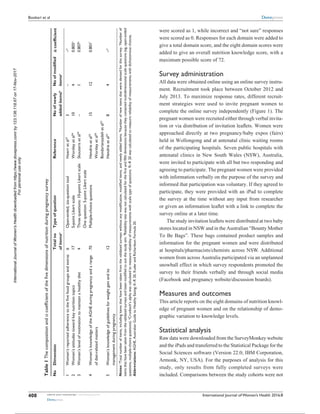
The information about the five dimensions of the survey and
the reliability results is presented in Table 1.
This article reports only on the fourth dimension:
women’s knowledge of the AGHE during pregnancy and
a range of diet-related matters. The nutrition knowledge
section contained eight domains assessing nutrition knowl-
edge (consisting of 70 items). Details of the survey domains
relating to nutrition knowledge and demographic informa-
tion collected and reported on in this study are in Table 2.
Knowledge was assessed with multiple-choice questions,
with a majority of questions (67) having one correct response
option, while two questions (on multivitamins and supple-
ments in pregnancy) had more than one correct response
option. The respondents were asked to choose from a range
of different scales answers such as “true, false, don’t know”;
“yes, no, not sure”; “high, low, not sure”; “less than one
serve, one serve, more than one serve, not sure”; or a choice
of four different food options and “not sure”. To score the
survey, correct responses to nutrition knowledge questions
InternationalJournalofWomen'sHealthdownloadedfromhttps://www.dovepress.com/by123.136.118.67on17-Nov-2017
Forpersonaluseonly.
Powered by TCPDF (www.tcpdf.org)
International Journal of Women’s Health 2016:8submit your manuscript | www.dovepress.com
Dovepress
Dovepress
408
Bookari et al
were scored as 1, while incorrect and “not sure” responses
were scored as 0. Responses for each domain were added to
give a total domain score, and the eight domain scores were
added to give an overall nutrition knowledge score, with a
maximum possible score of 72.
Survey administration
All data were obtained online using an online survey instru-
ment. Recruitment took place between October 2012 and
July 2013. To maximize response rates, different recruit-
ment strategies were used to invite pregnant women to
complete the online survey independently (Figure 1). The
pregnant women were recruited either through verbal invita-
tion or via distribution of invitation leaflets. Women were
approached directly at two pregnancy/baby expos (fairs)
held in Wollongong and at antenatal clinic waiting rooms
of the participating hospitals. Seven public hospitals with
antenatal clinics in New South Wales (NSW), Australia,
were invited to participate with all but two responding and
agreeing to participate. The pregnant women were provided
with information verbally on the purpose of the survey and
informed that participation was voluntary. If they agreed to
participate, they were provided with an iPad to complete
the survey at the time without any input from researcher
or given an information leaflet with a link to complete the
survey online at a later time.
The study invitation leaflets were distributed at two baby
stores located in NSW and in the Australian “Bounty Mother
To Be Bags”. These bags contained product samples and
information for the pregnant women and were distributed
at hospitals/pharmacists/chemists across NSW. Additional
women from across Australia participated via an unplanned
snowball effect in which survey respondents promoted the
survey to their friends verbally and through social media
(Facebook and pregnancy website/discussion boards).
Measures and outcomes
This article reports on the eight domains of nutrition knowl-
edge of pregnant women and on the relationship of demo-
graphic variation to knowledge levels.
Statistical analysis
Raw data were downloaded from the SurveyMonkey website
and the iPads and transferred to the Statistical Package for the
Social Sciences software (Version 22.0; IBM Corporation,
Armonk, NY, USA). For the purposes of analysis for this
study, only results from fully completed surveys were
included. Comparisons between the study cohorts were not
Table1Thecompositionandαcoefficientofthefivedimensionsofnutritionduringpregnancysurvey
NoDimensionTotalno
ofitemsa
TypeofquestionReferenceNoofnewly
addeditemsb
Noofmodified
itemsc
αcoefficient
1Women’sreportedadherencetothefivefoodgroupsandextras6Open-ended,six-questiontoolHoerretal37
3––d
2Women’sattitudestowardkeynutritiontopics175-pointLikertscaleWorsleyetal36
1040.805e
3Women’slevelofmotivationtomaintainahealthydiet4Threequestions:10-pointLikertscaleSkouterisetal34
–10.807e
Onequestion:5-pointLikertscale
4Women’sknowledgeoftheAGHEduringpregnancyandarange
ofdiet-relatedmatters
70Multiple-choicequestionsHendrieetal35
15120.801f
Worsleyetal36
Bondarianzadehetal32
5Women’sknowledgeofguidelinesforweightgainandits
managementduringpregnancy
12Hendrieetal35
84–d
Notes:a
Totalnumberofitems,includingitemsthathavebeentakenfromthevalidatedsurveyswithoutanymodification,modifieditems,andnewlyaddeditems.b
Numberofnewitemsthatweredevisedforthissurvey.c
Numberof
itemsthathavebeentakenfromthevalidatedsurveysandbeenmodifiedtosuitthestudyaim.d
Reliabilitytestwasnotcalculatedforthefirstandfifthdimensionsbecausetheycontainedmultidimensionalscalequestions(eg,open-ended
questions,multiple-choicequestions).e
Cronbach’salphawascalculatedtomeasurereliabilityofmeasurementswithscaletypeofquestions.f
K–R20wascalculatedtomeasurereliabilityofmeasurementswithdichotomouschoices.
Abbreviations:AGHE,AustralianGuidetoHealthyEating;K–R20,KuderandRichardsonFormula20.
InternationalJournalofWomen'sHealthdownloadedfromhttps://www.dovepress.com/by123.136.118.67on17-Nov-2017
Forpersonaluseonly.
Powered by TCPDF (www.tcpdf.org)
International Journal of Women’s Health 2016:8 submit your manuscript | www.dovepress.com
Dovepress
Dovepress
409
Australian women’s level of nutrition knowledge during pregnancy
possible as no record was kept of the different methods of
data collection. Cronbach’s alpha and Kuder and Richardson
Formula 20 were calculated to measure reliability of mea-
surements with scale type of questions and with dichotomous
choices, respectively.
Scores were calculated for each domain and also for the
overall nutrition knowledge (a total of the eight domains).
Women’s prepregnancy BMIs were calculated based on the
self-reported prepregnancy weight and height.39
Descriptive
and inferential statistics were used to describe and analyze
the data. One-way ANOVA and independent t-test were
used to assess the variations in the mean total scores of
nutrition knowledge based on categories of demographic
factors. Predictors of women’s nutrition knowledge were
identified via multiple linear regression analyses. Given the
relatively high number of factors, only factors that were
significantly associated with women’s nutrition knowledge
(in one-way ANOVA and independent t-test, P,0.05) were
included in the regression analysis to prevent overcompli-
cated presentation of the results.40
Then the association of
each predictor with the nutrition knowledge score when
adjusted for other predictors was identified using multiple
linear regression analyses. Significance was identified at
P,0.05.
Ethical approval
The study was approved by the UOW Human Research Ethics
Committee, South Eastern Sydney and Illawarra Area Health
Service, and South Western Sydney Local Health District
sites (Campbelltown/Liverpool hospitals). Participant’s
information sheet was included in the first page of the on-line
survey. The consent was implicitly taken by including the
following statement at the same page “By completing the
survey you agree to take part in the study”.
Table 2 The composition of the fourth dimension of nutrition during pregnancy survey: women’s knowledge of the AGHE during
pregnancy and a range of diet-related matters
No Nutrition knowledge
domain
Description No of
items
Correct
responses (score)
1 Recommended intakes of five
food groups and extras
One question asked women if they were familiar with the AGHE
for pregnancy
1 NAa
The recommended number of serves of the five core food groups (fruit,
vegetables, dairy foods, meat and its alternatives, and bread and cereals)
and extrasb
based on AGHE for pregnancy
5 5
2 Food sources of nutrients Foods high or low in sugar, salt, dietary fiber, and saturated fat 22 22
Macronutrient (fat) has the highest energy density
Food items that are rich sources of vitamin A, iron, iodine, and omega-3
fatty acids
3 Vitamins and other
supplements during
pregnancy
Mandatory supplements (ie, folic acid and iodine) during pregnancy 2 5c
Micronutrients that may pose a risk when taken during pregnancy
4 Healthy meal proportion
and serving size
Identification of food group proportions for a healthy meal pattern 14 14
Portion size of certain food items from each food group
5 Choosing everyday food Healthier and best options for foods that are:
– Low-fat, high-fiber, light meal
– Healthier serving options for spaghetti
Bolognese (more carbohydrate in spaghetti than fat in the sauce)
– Low in sugar
3 3
6 Diet–health relationship Management of pregnancy-related symptoms:
– Nausea and vomiting
– Heartburn
– Constipation
12 12
7 Importance of key nutrients
in pregnancy
Nutrient function in the body and risk of nutrients’ deficiency (for iodine
and omega-3 fatty acids)
2 2
8 Food safety practice
in pregnancy
Safe food to consume in pregnancy 9 9
Safe and unsafe food preparation and storage practice
Perception of listeriosis
Safe fish option to consume in pregnancy
Notes: a
Not applicable as this question was not included in the scoring process; the women were given two answers (yes or no) to choose from. b
Extras or “discretionary
choices”, including energy-dense but nutrient-low foods such as confectionery, jam, cakes, meat pies, and pastries. c
These two items had more than one correct response
options; the first question had two possible correct answers (folic acid and iodine) and the second one had three possible correct answers (vitamins A, D, and B6
).
Abbreviations: AGHE, Australian Guide to Healthy Eating; NA, not applicable.
InternationalJournalofWomen'sHealthdownloadedfromhttps://www.dovepress.com/by123.136.118.67on17-Nov-2017
Forpersonaluseonly.
Powered by TCPDF (www.tcpdf.org)
International Journal of Women’s Health 2016:8submit your manuscript | www.dovepress.com
Dovepress
Dovepress
410
Bookari et al
Figure1Thestudyrecruitmentstrategy.
Abbreviation:NSW,NewSouthWales.
InternationalJournalofWomen'sHealthdownloadedfromhttps://www.dovepress.com/by123.136.118.67on17-Nov-2017
Forpersonaluseonly.
Powered by TCPDF (www.tcpdf.org)
International Journal of Women’s Health 2016:8 submit your manuscript | www.dovepress.com
Dovepress
Dovepress
411
Australian women’s level of nutrition knowledge during pregnancy
Results
Study sample characteristics
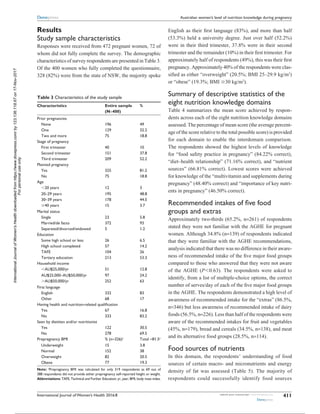
Responses were received from 472 pregnant women, 72 of
whom did not fully complete the survey. The demographic
characteristics of survey respondents are presented in Table 3.
Of the 400 women who fully completed the questionnaire,
328 (82%) were from the state of NSW, the majority spoke
English as their first language (83%), and more than half
(53.3%) held a university degree. Just over half (52.2%)
were in their third trimester, 37.8% were in their second
trimester and the remainder (10%) in their first trimester. For
approximately half of respondents (49%), this was their first
pregnancy. Approximately 40% of the respondents were clas-
sified as either “overweight” (20.5%; BMI 25–29.9 kg/m2
)
or “obese” (19.3%; BMI $30 kg/m2
).
Summary of descriptive statistics of the
eight nutrition knowledge domains
Table 4 summarizes the mean score achieved by respon-
dents across each of the eight nutrition knowledge domains
assessed. The percentage of mean score (the average percent-
age of the score relative to the total possible score) is provided
for each domain to enable the interdomain comparison.
The respondents showed the highest levels of knowledge
for “food safety practice in pregnancy” (84.22% correct),
“diet–health relationship” (71.16% correct), and “nutrient
sources” (66.81% correct). Lowest scores were achieved
for knowledge of the “multivitamin and supplements during
pregnancy” (48.40% correct) and “importance of key nutri-
ents in pregnancy” (46.50% correct).
Recommended intakes of five food
groups and extras
Approximately two-thirds (65.2%, n=261) of respondents
stated they were not familiar with the AGHE for pregnant
women. Although 34.8% (n=139) of respondents indicated
that they were familiar with the AGHE recommendations,
analysis indicated that there was no difference in their aware-
ness of recommended intake of the five major food groups
compared to those who answered that they were not aware
of the AGHE (P,0.63). The respondents were asked to
identify, from a list of multiple-choice options, the correct
number of serves/day of each of the five major food groups
in the AGHE. The respondents demonstrated a high level of
awareness of recommended intake for the “extras” (86.5%,
n=346) but less awareness of recommended intake of dairy
foods (56.5%, n=226). Less than half of the respondents were
aware of the recommended intakes for fruit and vegetables
(45%, n=179), bread and cereals (34.5%, n=138), and meat
and its alternative food groups (28.5%, n=114).
Food sources of nutrients
In this domain, the respondents’ understanding of food
sources of certain macro- and micronutrients and energy
density of fat was assessed (Table 5). The majority of
respondents could successfully identify food sources
Table 3 Characteristics of the study sample
Characteristics Entire sample
(N=400)
%
Prior pregnancies
None 196 49
One 129 32.2
Two and more 75 18.8
Stage of pregnancy
First trimester 40 10
Second trimester 151 37.8
Third trimester 209 52.2
Planned pregnancy
Yes 325 81.2
No 75 18.8
Age
,20 years 12 3
20–29 years 195 48.8
30–39 years 178 44.5
$40 years 15 3.7
Marital status
Single 23 5.8
Married/de facto 372 93
Separated/divorced/widowed 5 1.2
Education
Some high school or less 26 6.5
High school completed 57 14.2
TAFE 104 26
Tertiary education 213 53.3
Household income
,AU$25,000/yr 51 12.8
AU$25,000–AU$50,000/yr 97 24.2
.AU$50,000/yr 252 63
First language
English 332 83
Other 68 17
Having health and nutrition-related qualification
Yes 67 16.8
No 333 83.2
Seen by dietitian and/or nutritionist
Yes 122 30.5
No 278 69.5
Prepregnancy BMI % (n=326)a
Total =81.5a
Underweight 15 3.8
Normal 152 38
Overweight 82 20.5
Obese 77 19.3
Note: a
Prepregnancy BMI was calculated for only 319 respondents as 69 out of
388 respondents did not provide either prepregnancy self-reported height or weight.
Abbreviations: TAFE, Technical and Further Education; yr, year; BMI, body mass index.
InternationalJournalofWomen'sHealthdownloadedfromhttps://www.dovepress.com/by123.136.118.67on17-Nov-2017
Forpersonaluseonly.
Powered by TCPDF (www.tcpdf.org)
International Journal of Women’s Health 2016:8submit your manuscript | www.dovepress.com
Dovepress
Dovepress
412
Bookari et al
as high or low in added sugar for most items, including
strawberry yoghurt (69.8%, n=279), muesli bar (79.2%,
n=317), bananas (83.2%, n=333), and 35% orange juice
(89.2%, n=357). Some misperceptions were evident for
a number of areas: salt content of pasta, with only 55.2%
(n=221) identifying it as low in salt; dietary fiber content
of cornflakes, with only 56.5% (n=226) identifying it as a
low source of fiber; and saturated fat content of avocado,
with only 60% (n=240) of respondents identifying it as a
low source of saturated fat. When asked to identify food
sources high or low in salt, half of the items were answered
correctly, including sausages as high in salt (87.2%, n=349)
and spinach as low in salt (90.8%, n=363); however, only
12.8% (n=51) of the pregnant women correctly identified
wholegrain bread as high in salt.
The respondents were able to identify food sources high
in iron (63.7%, n=255), iodine (65.2%, n=261), and omega-3
fatty acids (90%, n=360) but less able to correctly identify
foods that were a high source of vitamin A (38%, n=152).
The majority of women (62%, n=248) did not identify liver
as a high source of vitamin A, among a list including cheese
and sweet potato. Seventy-eight percent of respondents
(n=314) were unable to recognize that fat is the macronutri-
ent that has the most kilojoules (calories) compared to sugar
and alcohol.
Healthy meal proportion and serving size
The respondents were asked to identify correct constitu-
ent proportions for a healthy meal from pictures showing
plates with different proportions of the various food groups.
The respondents were also asked to identify the standard
portion size of certain food items from each food group.
The majority of the women (75.5%, n=302) were able to
recognize the plate that represented a healthy dinner plate.
The respondents were unable to identify the standard serv-
ing size of the following food items: grapes (54% incorrect,
n=216), cheese (64.8%, n=259), strawberries (74%, n=296),
cooked rice/pasta (82.5%, n=330), and yogurt (90%, n=360).
Just over half of the respondents were able to select the
standard serving size for breakfast cereal flakes or porridge
(50.5%, n=203) and chocolate bars (55.8%, n=223), while
67% (n=268) correctly identified the standard serve size for
meat pie.
Table 4 Descriptive statistics of women’s nutrition knowledge domains
Nutrition knowledge domain % mean
(correct answers)
Mean Total score SD
Food safety practice in pregnancy 84.22 7.58 9 1.72
Diet–health relationship 71.16 8.54 12 2.18
Food sources of nutrients 66.81 14.70 22 3.23
Choosing everyday food 58.00 1.74 3 0.66
Recommended intakes of five foods groupsa
and extras or “discretionary choices”b
50.20 2.51 5 1.01
Healthy meal proportion/serving size 49.50 6.93 14 2.22
Multivitamin and supplements during pregnancy 48.40 2.42 5 1.11
Importance of key nutrients in pregnancy 46.50 0.93 2 0.71
Notes: a
Fruit, vegetables, dairy foods, meat and its alternatives, and bread and cereals. b
Including energy dense but nutrient-low foods such as confectionery, jam, cakes,
meat pies, and pastries.
Abbreviation: SD, standard deviation.
Table 5 Women’s awareness of food sources of certain macro-
and micronutrients and energy density of fat
Food source is high/low
of following nutrients
Correct
answers
Correct,
n (%)
Incorrect,
n (%)
Sugar
Bananas Low 333 (83.2) 67 (16.8)
Strawberry yoghurt High 279 (69.8) 121 (30.2)
Orange 35% juice High 357 (89.2) 43 (10.8)
Muesli bar High 317 (79.2) 83 (20.8)
Salt
Sausages High 349 (87.2) 51 (12.8)
Pasta Low 221 (55.2) 179 (44.8)
Spinach Low 363 (90.8) 37 (9.2)
Wholegrain bread High 51 (12.8) 349 (87.2)
Dietary fiber
Cornflakes Low 226 (56.5) 174 (43.5)
Bananas High 300 (75) 100 (25)
Wholegrain bread High 368 (92) 32 (8)
Fish High 258 (64.5) 142 (35.5)
Saturated fat
Lean red meat Low 323 (80.8) 77 (19.2)
Whole milk High 258 (64.5) 142 (35.5)
Avocado Low 240 (60) 160 (40)
Vegetarian pastry High 246 (61.5) 154 (38.5)
Select the most energy
dense macronutrient
Fat 86 (21.5) 314 (78.5)
Food source rich in following micronutrients
Vitamin A Liver 152 (38) 248 (62)
Iron Red meat 255 (63.7) 145 (36.3)
Iodine Sea food 261 (65.2) 139 (34.8)
Omega-3 fatty acids Oily fish 360 (90) 40 (10)
InternationalJournalofWomen'sHealthdownloadedfromhttps://www.dovepress.com/by123.136.118.67on17-Nov-2017
Forpersonaluseonly.
Powered by TCPDF (www.tcpdf.org)
International Journal of Women’s Health 2016:8 submit your manuscript | www.dovepress.com
Dovepress
Dovepress
413
Australian women’s level of nutrition knowledge during pregnancy
Choosing everyday foods
The maximum possible score for knowledge about choosing
everyday foods was 3. Most respondents (73.8%, n=295)
were able to answer two out of three questions correctly.
The question answered incorrectly by the majority of the
respondents (86.5%, n=346) related to the healthier serving
options of pasta and sauce (amounts and proportions) of
spaghetti bolognese.
Vitamins and other supplements in
pregnancy
Women’s awareness about the recommendations for supple-
ments in pregnancy was explored, including vitamins and
other recommended supplements (folic acid and iodine),
as well as those vitamins for which there were dangers
associated with excessive doses (vitamin A, vitamin D, and
vitamin B6
). The National Health and Medical Research
Council message for women to take folic acid supplements
during pregnancy was understood by the majority of the
respondents (93.5%, n=374); however, only half of the
respondents (51.7%, n=207) were aware of the correct recom-
mendation for iodine supplementation during pregnancy.
The women were asked to identify micronutrients for
which there was a risk associated with excessive intake, from
a list including zinc, vitamin A, magnesium, vitamin D, and
vitamin B6
. Three in ten women indicated that they were not
aware of any micronutrients that posed a risk associated with
excessive intake. Half of the respondents were able to cor-
rectly identify one (n=205) nutrient, and only 11% correctly
identified two nutrients (n=46) out of possible three. Less than
one-third of the women (30%) correctly identified all the three
nutrients (vitamin A, vitamin D, and vitamin B6
) as micro-
nutrients that may pose a risk when taken during pregnancy.
The highest level of awareness was for vitamin A (56.3%,
n=225) and the lowest for vitamin D (17.5%, n=70).
Diet–health relationship
Domain six explored respondents’ knowledge of dietary
behaviors that can assist in managing some common preg-
nancy discomforts, including nausea/vomiting, heartburn,
and constipation. Most respondents correctly identified
that eating “less fatty and spicy foods” (79.8%, n=315),
“eating smaller meals more often” (88%, n=352), as well as
“avoiding regular large snacks” (90.2%, n=361) would help
minimize the effect of nausea and vomiting during preg-
nancy. Inversely, more than half of the respondents (56.5%,
n=226) incorrectly indicated that eating sweet biscuits in the
morning would help in managing morning sickness.
A large proportion of respondents were aware of the
potential to minimize the effect of heartburn during preg-
nancy by “avoiding lying down shortly after eating” (77.8%,
n=311) and eating “small frequent meals and nutritious
snacks” (83%, n=332) and “less fatty and spicy foods” (86%,
n=344). Conversely, only 27.2% (n=109) of the respondents
correctly identified that eating less sugar would not help in
managing heartburn discomfort.
The majority of the respondents were aware that “exer-
cising regularly” (89.2%, n=357) and “eating more fruit and
vegetables” (92.8%, n=371) could assist in resolving consti-
pation in pregnancy. However, more than two-third (69.5%,
n=278) incorrectly identified that “eating less spicy and salty
foods” would assist in resolving constipation.
Importance of key nutrients during
pregnancy – iodine and omega-3
Just over half (57%; n=228) of the respondents identified
iodine as an important micronutrient for healthy development
of the fetal brain, while only 36% (n=144) identified omega-3
fatty acids as a nutrient that could help in the development
of a fetus’s eyes, brain, and nervous system.
Food safety practice in pregnancy
In the final survey domain, the respondents’ knowledge
of issues related to food safety was assessed. The ques-
tions focused on personal hygiene (hand washing), food
preparation/storage (using the same surface for cutting raw
meat and vegetables, reheating food, storage of food at
appropriate temperature, storage of raw meat in refrigera-
tor, correct temperature of refrigerator), and safe foods and
fish to consume, as well as Listeria contamination issues in
pregnancy. All the questions were answered correctly by the
majority of the respondents, ranging from 95.2% (n=381) for
hand washing to 78.5% (n=314) for reheating food. When
presented with a list of options of unsafe and safe foods to
eat, 93.5% (n=374) of the respondents identified the correct
response. Similarly, when presented with a list of safe and
unsafe fish to eat during pregnancy, 74% (n=296) of the
women answered correctly.
Demographic variation in nutrition
knowledge
Descriptive statistics
From a univariate analysis, the women who scored highest
in a number of knowledge domains and in the overall knowl-
edge score were in their first trimester (µ=48.80, standard
deviation [SD] =4.71, P,0.001), had one child (µ=46.21,
InternationalJournalofWomen'sHealthdownloadedfromhttps://www.dovepress.com/by123.136.118.67on17-Nov-2017
Forpersonaluseonly.
Powered by TCPDF (www.tcpdf.org)
International Journal of Women’s Health 2016:8submit your manuscript | www.dovepress.com
Dovepress
Dovepress
414
Bookari et al
SD =6.70, P,0.001), had planned their pregnancy (µ=46.21
vs µ=41.60, P,0.000), had higher education (µ=48.14,
SD =6.34, P,0.000), identified English as their first language
(µ=46.20 vs µ=41.18, P,0.000), were married/de facto
(µ=45.73, SD =7.43, P,0.001), aged 30–39 years (µ=47.05,
SD =6.75, P,0.000), and had annual household incomes
of $AU$50,000 (µ=47.67, SD =6.56, P,0.000).
The respondents with a health/nutrition-related quali-
fication had significantly greater levels of overall nutrition
knowledge (µ=48.60 vs µ=44.69, P,0.000). Of 67 respon-
dents, only 58 provided their qualification details. These
included 22 with allied health qualifications, including one
with a master degree in exercise rehabilitation and nutrition
and dietetics; 17 nurses and one midwife; two participants
with medical degrees; two dentists; two with a health degree/
Bachelor of Arts; two with a public health degree; one
immunologist; and one veterinarian. Of the remaining eight
participants, one had a certificate in children’s services, one
had a first aid certificate, one had a food safety certificate,
one had certificates III and IV in fitness, one had studied a
subject on ecotrophology, one was a food technology teacher,
one was a pastry chef, and one was a chef by trade.
There was no significant difference in the respondents’
knowledge in most of the domains (seven out of eight)
between women who accessed a dietitian and/or nutritionist
and those who had not. The latter respondents scored higher
only in the “choosing everyday foods” domain (µ=1.80 vs
µ=1.58, P,0.002). The reasons for seeing a nutritionist/
dietitian varied, including gestational diabetes management
(54.9%, n=67), weight management (18.8%, n=23), dietary
management during pregnancy (4.9%, n=6), or other reasons
(general health and well-being, gallstones, low iron, irritable
bowel syndrome, lactose intolerance, acne control, bad
eating, and dietary management for teenager; 19.6%, n=24).
The respondents indicated that they had seen a dietitian
and/or nutritionist either within the last month (26.23%,
n=32/122) or from between 1 and 6 months (27.05%,
n=33/122) or .6 months (46.72%, n=57/122) from the time
they completed the survey. Further analysis revealed that
the respondents who had access to a nutritionist/dietitian for
managing their gestational diabetes were the only group that
scored significantly lower than the other groups in “recom-
mended intakes for the five food groups” (µ=2.07, SD =0.95,
P,0.001), “food choices” (µ=1.34, SD =0.72, P,0.000),
and on their total score of nutrition knowledge (µ=42.54,
SD =7.33, P,0.013). There was not any statistically sig-
nificant difference between the respondents according to
their BMI categories.
Multivariate analysis
Multiple linear regression analysis was undertaken to con-
firm the independent relationships between demographic
factors and respondents’ knowledge of nutrition in pregnancy
(Table 6). Only the significant factors from the univariate
analysis were included in the final model. The independent
factors significantly associated with better nutrition knowl-
edge scores (at the 0.05 level) were as follows: highest house-
hold income category ($AU$50,000; β=0.214, P,0.000),
highest education category (tertiary and higher; β=0.225,
P,0.000), English as mother’s first language (β=−0.216,
P,0.000), age (β=0.154, P,0.001), first trimester for
pregnancy (β=−0.101, P,0.016), having a health/nutrition-
related qualification (β=−0.099, P,0.020), and having one
child (β=-0.096, P,0.028).
The model indicates that independent variables explain
32% (adjusted R2
) of the variance found between respon-
dents’ knowledge scores (Table 6). The highest category of
education and household income were correlated with better
nutrition knowledge. Women who indicated that English
was their first language, had one child, and held a health/
Table 6 Multiple regression analysis of selected demographic factors
Predictors Nutrition knowledge
Unstandardized β Standardized β P-value
Household income 2.389 0.214 0.000
Education 1.574 0.225 0.000
Language −4.453 −0.216 0.000
Age 1.926 0.154 0.001
Stage of pregnancy −1.127 −0.101 0.016
Having health/nutrition-related qualification −2.046 −0.099 0.020
Prior pregnancy −0.973 −0.096 0.028
Multiple R=0.584 Adjusted R2
=0.326 F=22.477,  P,0.000
Note: β, beta coefficient.
InternationalJournalofWomen'sHealthdownloadedfromhttps://www.dovepress.com/by123.136.118.67on17-Nov-2017
Forpersonaluseonly.
Powered by TCPDF (www.tcpdf.org)
International Journal of Women’s Health 2016:8 submit your manuscript | www.dovepress.com
Dovepress
Dovepress
415
Australian women’s level of nutrition knowledge during pregnancy
nutrition-related qualification had a greater level of nutrition
knowledge. However, nutrition knowledge was lower among
women who were in the third trimester of pregnancy and fell
within the younger age group.
Discussion
To our knowledge, this is the first study to conduct an in-depth
investigation into Australian pregnant women’s pregnancy-
specific nutrition knowledge of the AGHE and other relevant
dietary and nutritional recommendations for maintaining a
healthy pregnancy. The findings of this study indicate a lack
of knowledge among pregnant women in most of the nutri-
tion knowledge areas, such as the AGHE recommendations
and basic messages of eating more fruit and vegetables as
well as bread and cereals but less meat. The pregnant women
also held misconceptions in a range of areas, including
standard serving sizes, nutrient content (salt, dietary fiber,
saturated fat, and vitamin A) of certain foods, energy density
of fat, and the importance of key nutrients in pregnancy.
The pregnant women who had a lower education level, had
a lower income, were in a younger age group, were in the
third trimester of pregnancy, had more than one child, and
had English as their second language were least knowledge-
able. Although knowledge alone is not sufficient to make
changes in the dietary behavior, it can be a key factor to
initiate such changes.
For this study, the survey questions on the recommended
serves of fruit/vegetables (4/5–6 serves/d), bread/cereal
(4–6 serves/d), meat and its alternatives (1.5 serves/d), and
dairy (2 serves/d) reflected the AGHE for pregnant women
at the time of implementing the survey. The updated AGHE
recommends 2/5 serves/d for fruit/vegetables, 8.5 serves/d
for bread/cereals, 3.5 serves/d for meat and its alternatives
food group, and 2.5 serves/d for dairy foods. The other key
change in the 2013 AGHE was to the standard serving sizes
for bread/cereals, which were approximately halved. As the
data collection of the current study commenced prior to the
release of the updated AGHE, the results of this study report
on the pregnant women’s knowledge of the earlier AGHE.
However, as the levels of knowledge were found to be low
(only 34.8% of women were familiar with the AGHE), the
subsequent changes to the AGHE for pregnant women are
likely to result in even lower levels of knowledge of cur-
rent dietary recommendations for a healthy pregnancy, at
least initially.
Knowledge is one of many factors required to change
a person’s behavior,14
and maternal nutrition knowledge
is significantly associated with the nature of the maternal
diet.18
In this study, the pregnant women showed high level
of knowledge about the issues related to food safety, “diet–
health relationship”, and “nutrients sources” and deficit level
of knowledge on topics including “choosing everyday food”,
“recommended daily intakes of five food groups”, “serving
size”, “supplements during pregnancy”, and “importance
of key nutrients in pregnancy”. Even when the knowledge
of the daily recommended intakes of certain food groups
(dairy, for example) was averaged (56.5% had the correct
answer), understanding of the standard serve size details
within these groups was quite low (cheese, 35% and yoghurt,
10%). These findings are in line with the earlier Australian
studies that explored knowledge of recommended dietary
practice in pregnancy8,41
and more generally within a com-
munity sample.35
The low awareness of the dietary guidelines
(recommended daily intakes of core food groups and stan-
dard serving sizes) is of concern. This may hinder pregnant
women’s ability to consume a balanced diet in recommended
amounts of core food groups, resulting in their having poor
dietary intakes.
High consumption of salt, sugar, and fat, and insufficient
intake of fiber by pregnant women have been reported in
a number of Australian studies.7,33,42
In this study, a high
proportion of the pregnant women were unaware of the
energy density of fat (78%), the type of foods low or high
in fat (86%), and the salt content of bread (87%). This may
indicate that pregnant women’s poor knowledge of some
common aspects of nutrition may result in suboptimal diets.
The greater availability of energy-dense, nutrient-poor
products43
further increases the importance of educating
women regarding the foods with high-energy density, high
fat, and salt.
There was variation in the women’s knowledge of the
importance of omega-3 and iodine and their recognition of
the need for supplementing with folic acid and iodine. They
also varied in their ability to identify foods containing high
levels of key nutrients (namely, omega-3 fatty acids, iron,
vitamin A, and iodine). In Australia, the NHMRC recom-
mends supplementation with folic acid and iodine during
pregnancy.26
Consistent with other studies,29,30
most of the
women (90%) in this study were aware of the need for folic
acid supplementation, but less than half (48.3%) were aware
of the recommendation for iodine supplementation. The
recommendation for supplementing with iodine was only
introduced in 2010 as opposed to 1992 for folic acid,44
which
may explain the difference in awareness. This low level
of knowledge of the need for iodine supplementation may
result from health care professionals not discussing iodine
InternationalJournalofWomen'sHealthdownloadedfromhttps://www.dovepress.com/by123.136.118.67on17-Nov-2017
Forpersonaluseonly.
Powered by TCPDF (www.tcpdf.org)
International Journal of Women’s Health 2016:8submit your manuscript | www.dovepress.com
Dovepress
Dovepress
416
Bookari et al
supplementation with pregnant women, perhaps reflecting
their own poor levels of knowledge.30,45
Maternal health care
professionals should be supported and encouraged to provide
such information to pregnant women, particularly as studies
have shown that pregnant women expect nutrition informa-
tion from their health care professionals.33,46
Fish contains important nutrients like omega-3 fatty acids,
which are important for the development of a fetus’s brain,
eyes, and nervous system.47,48
For pregnant women, it is rec-
ommended to consume two to three serves (1 serve =50 g)
per week of any fish and seafood, excluding any large and
predatory fish that may contain high levels of mercury.49
In this study, a majority of women were aware of the safest
fish type and sources of omega-3 fatty acids; however, they
had poor knowledge of their importance during pregnancy.
Earlier national and international studies have reported a
similar lack of knowledge on the importance of omega-3
fatty acids for women during pregnancy.31,50
Although health
care professionals’ advice and accessible resources played a
vital role in women’s decision about fish consumption during
pregnancy,50
studies have reported a shortage of available
education resources and lack of communication between
health care professionals and pregnant women about omega-3
fatty acids and their importance during pregnancy.31,50,51
Improved strategies to increase awareness of such informa-
tion among pregnant women are required.
The low level of knowledge relating to food that is a rich
source of vitamin A (liver) is concerning, especially during
pregnancy. Although liver is a rich source of key nutrients
such as iron and folate, avoiding it in pregnancy is recom-
mended as it contains a high level of vitamin A and the
upper safer limit is uncertain.52
A high dose of vitamin A in
pregnancy poses a serious risk of birth defects.53
Although our
study did not provide information on how this low awareness
of vitamin A-rich source food could affect pregnant women’s
food choices, written comments (open text sections of the
survey) in the present study indicated that some women may
be influenced by some of nonevidence-based information. For
example, a few women added comments that were in favor
of the “Paleo diet”, and they thought it the healthiest dietary
pattern they could follow. This may reflect the influence
of contemporary popular media (including social media),
which contains many articles advertising and promoting
nonevidence-based dietary practices such as the “Paleo diet”
that may encourage pregnant women to consume organ meat
such as liver.54
Adopting such a diet could put women’s
and their babies’ health at risk. Women are more likely
to change their diet if they believe it benefits their baby.55
However, it is important that pregnant women’s nutrition
and dietary knowledge is evidence based.
Developing evidence-based dietary guidelines provides a
foundation for promoting healthy eating, but it is important
to ensure that the target audiences become knowledgeable
about them in order to achieve beneficial results. The results
of this study indicate that important information about the
AGHE for pregnancy and other key public health nutrition
messages need to be made more available to women. This
could be achieved by using mass media that provides several
powerful avenues for such communication.24
In addition,
health professionals may be considered an important avenue
for communication of evidence-based dietary guidelines.
They have regular contact with pregnant women, are con-
sidered as trusted and preferred sources of information,16
and women gain more support when health professionals
emphasize educational resources.46,56
However, practitioners
have been found to have low level of nutrition knowledge45
and may not be equipped to assist their patients. How best
to support health professionals to become effective nutrition
educators would be a valuable area of further research.
In line with other studies on general populations35
and
pregnant women,8
this study found that pregnant women’s
nutrition knowledge was positively associated with age,
household income, and education level. Nutrition knowledge
has been reported to be positively associated with pregnant
women’s self-reported dietary behavior.17,18
Other studies
and reports suggest that a lack of nutrition knowledge may
reflect a social gradient, with poor nutrition knowledge
linked with lower diet quality and thus to poorer health
outcomes.8,57
Nutrition education is needed to target those
in high-risk groups.
In this study, latter trimesters in pregnancy were found to
be negatively associated with the maternal nutrition knowl-
edge score, with the pregnant women in their first trimester
having the highest levels of knowledge. Recent studies in
Australia have shown that women’s interest in receiving
nutrition information is highest in early pregnancy.33,41
Thus, the provision of timely, evidence-based nutritional
education for women during pregnancy might be of benefit,
especially at the very early stage of pregnancy when critical
fetal development is occurring. Ongoing nutrition education
throughout the pregnancy may also be warranted, given the
lower nutrition knowledge scores of women who are more
advanced in their pregnancy and who may be particularly
vulnerable to unwelcome weight gain. The observed rela-
tionship between lower nutrition knowledge of women
with gestation diabetes who had seen a dietitian/nutritionist
InternationalJournalofWomen'sHealthdownloadedfromhttps://www.dovepress.com/by123.136.118.67on17-Nov-2017
Forpersonaluseonly.
Powered by TCPDF (www.tcpdf.org)
International Journal of Women’s Health 2016:8 submit your manuscript | www.dovepress.com
Dovepress
Dovepress
417
Australian women’s level of nutrition knowledge during pregnancy
is new and needs additional exploration. This finding may
suggest that individual dietary counseling for these women
may focus more on carbohydrate counts and glycemic con-
trol, which may differ from the general dietary advice for
healthy pregnant women. These disparities were not assessed
in this study.
Limitation and strength
The limitations of this study should be noted. The results
of this study cannot be generalized due to the nonrepre-
sentative nature of the convenience, cross-sectional sample
obtained mostly from NSW, Australia. Language may have
been a barrier that excluded non-English-speaking women
who may be at higher risk of low knowledge compared to
English-speaking women. Categorizing the demographic
questions limits the ability to compare the current study
sample’s demographic characteristics to the state and national
profiles. The strength of our research is that the results
provide valuable insights into the level of understanding
of maternal-related nutrition information in a large sample
of Australian pregnant women that can be used to inform
interventions for this group.
If pregnant women are to be better informed of the nutri-
tional needs and practices required for the health of them-
selves and their children, studies investigating the sources
of information and forms of support preferred by pregnant
women need to be undertaken. This would provide impor-
tant information for the development of effective education
programs for pregnant women to establish and motivate
positive dietary behavior change.
Conclusion
The findings of this study indicate a lack of knowledge
among pregnant women in most of the nutrition knowledge
areas. Although knowledge alone cannot ensure dietary
behavioral changes, it can be a key factor in the initiation of
such changes. The establishment of official dietary guidance
is not sufficient to ensure that women are equipped with the
knowledge necessary to optimize their diets for the health of
themselves and their unborn babies. Health care providers
have an important role in promoting knowledge of healthy
eating for pregnant women.
Acknowledgments
The authors wish to acknowledge the Saudi Arabian Higher
Education Ministry for PhD scholarship funding; the South
East Sydney and Illawarra Area Health Services, South
Western Sydney Local Health District sites, and midwives
who assisted with the recruitment of the respondents;
all pregnant women who participated in this study; Associate
Professor Marijka Batterham for statistical advice; Doctor
Joanna Russell for her comments on the primary data analysis
stage; Doctor Alexis St George for constructive comments
on earlier drafts of this manuscript; Ms Elaine Newby who
assisted in the editing of this article; and Doctor Gilly Hendrie
for her cooperation and great readiness to help. The abstract
of this article with interim findings was presented at the 30th
ICM Triennial Congress – Midwives58
and at the Australian
College of Midwives Biennial Conference.59
The current
article includes work based on the PhD thesis submitted
by the main author, Khlood Bookari, and parts of it have
been published.17,60
Author contributions
K Bookari is the main author and is responsible for designing
study survey, collecting and analyzing data, writing the initial
manuscript, and revisions. All authors contributed toward
data analysis, drafting and critically revising the paper and
agree to be accountable for all aspects of the work.
Disclosure
The authors report no conflicts of interest in this work.
References
	 1.	 Renault KM, Carlsen EM, Nørgaard K, et al. Intake of sweets, snacks
and soft drinks predicts weight gain in obese pregnant women: detailed
analysis of the results of a randomised controlled trial. PLoS One.
2015;10(7):e0133041.
	 2.	 Callaway L, Prins J, Chang A, McIntyre H. The prevalence and impact
of overweight and obesity in an Australian obstetric population. Med J
Aust. 2006;184(2):56–59.
	 3.	 Catalano PM, Ehrenberg HM. The short- and long-term implications
of maternal obesity on the mother and her offspring. BJOG. 2006;
113(10):1126–1133.
	 4.	 Institute of Medicine (IOM). Weight Gain during Pregnancy: Reex-
amining the Guidelines. Washington, DC: The National Academies
Press; 2009.
	 5.	 Hure A, Young A, Smith R, Collins C. Diet and pregnancy status in
Australian women. Public Health Nutr. 2009;12(06):853–861.
	 6.	 Morton SM, Grant CC, Wall CR, et al. Adherence to nutritional guide-
lines in pregnancy: evidence from the growing up in New Zealand birth
cohort study. Public Health Nutr. 2014;17(09):1919–1929.
	 7.	 Wen LM, Flood VM, Simpson JM, Rissel C, Baur LA. Dietary behav-
iours during pregnancy: findings from first-time mothers in southwest
Sydney, Australia. Int J Behav Nutr Phys Act. 2010;7(1):13.
	 8.	 McLeod ER, Campbell KJ, Hesketh KD. Nutrition knowledge: a media-
tor between socioeconomic position and diet quality in Australian
first-time mothers. J Am Diet Assoc. 2011;111(5):696–704.
	 9.	 Blumfield M, Hure A, MacDonald-Wicks L, Patterson A, Smith R,
Collins C. Disparities exist between national food group recommenda-
tions and the dietary intakes of women. BMC Womens Health. 2011;
11(1):37.
	10.	 Malek L, Umberger W, Makrides M, Zhou JS. Adherence to the
Australian dietary guidelines during pregnancy: evidence from a
national study. Public Health Nutr. 2016;19(7):1155–1163.
InternationalJournalofWomen'sHealthdownloadedfromhttps://www.dovepress.com/by123.136.118.67on17-Nov-2017
Forpersonaluseonly.
Powered by TCPDF (www.tcpdf.org)
International Journal of Women’s Health 2016:8submit your manuscript | www.dovepress.com
Dovepress
Dovepress
418
Bookari et al
	11.	 Ajzen I. The theory of planned behavior. Organ Behav Hum Decis
Process. 1991;50(2):179–211.
	12.	 Bandura A. A social cognitive theory: an agentic perspective. Asian J
Soc Psychol. 1999;2:21–41.
	13.	 Prochaska JO, Velicer WF. The transtheoretical model of health behav-
iour change. Am J Health Promot. 1997;12(1):38–48.
	14.	 Sapp G. Incomplete knowledge and attitude-behavior inconsistency.
Soc Behav Pers. 2002;30(1):37.
	15.	 PhelanS.Pregnancy:a“teachablemoment”forweightcontrolandobesity
prevention. Am J Obstet Gynecol. 2010;202(2):135.e131–135.e138.
	16.	 Szwajcer EM, Hiddink GJ, Koelen MA, van Woerkum CMJ. Nutrition-
related information-seeking behaviours before and throughout the
course of pregnancy: consequences for nutrition communication. Eur
J Clin Nutr. 2005;59(S1):S57–S65.
	17.	 Bookari K, Yeatman H, Williamson M [webpage on the Internet]. Falling
short of dietary guidelines – what do Australian pregnant women really
know? A cross sectional study. Women Birth. 2016. Available from:
http://www.sciencedirect.com/science/article/pii/S187151921630049X.
Accessed June 16, 2016.
	18.	 WilliamsL,CampbellK,AbbottG,CrawfordD,BallK.Ismaternalnutri-
tion knowledge more strongly associated with the diets of mothers or their
school-aged children? Public Health Nutr. 2012;15(08):1396–1401.
	19.	 Popa AD, Niţă O, Graur LI, et al. Nutritional knowledge as a determi-
nant of vitamin and mineral supplementation during pregnancy. BMC
Public Health. 2013;13:1105.
	20.	 Hui A, Back L, Ludwig S, et al. Lifestyle intervention on diet and
exercise reduced excessive gestational weight gain in pregnant women
under a randomised controlled trial. BJOG. 2012;119(1):70–77.
	21.	 Dodd JM, Cramp C, Sui Z, et al. The effects of antenatal dietary and
lifestyle advice for women who are overweight or obese on maternal
diet and physical activity: the limit randomised trial. BMC Med. 2014;
12:161.
	22.	 U.S. Department of Agriculture and U.S. Department of Health and
Human Services. Dietary Guidelines for Americans. Washington, DC:
U.S. Government Printing Office; 2010.
	23.	 European Food Information Council [webpage on the Internet]. Food-
Based Dietary Guidelines in Europe; 2009. Available from: http://www.
eufic.org/article/en/expid/food-based-dietary-guidelines-in-europe/.
Accessed April 15, 2014.
	24.	 National Health & Medical Research Council. Eat for Health – Dietary
Guidelines for Australians: A Guide to Healthy Eating. Canberra, ACT:
Commonwealth of Australia; 2013.
	25.	 National Health and Medical Research Council. Eat for Health: Healthy
Eating When You’re Pregnant or Breastfeeding. Canberra, ACT:
Commonwealth of Australia; 2013.
	26.	 National Health and Medical Research Council. Healthy Eating during
Your Pregnancy: Advice on Eating for You and Your Baby. Canberra,
ACT: Commonwealth of Australia; 2013.
	27.	 Australian Health Ministers’ Advisory Council. Clinical Practice
Guidelines: Antenatal Care – Module 1. Canberra, ACT: Australian
Government Department of Health and Ageing; 2012.
	28.	 Australian Health Ministers’ Advisory Council. Clinical Practice
Guidelines: Antenatal Care – Module 2. Canberra, ACT: Australian
Government Department of Health and Ageing; 2014.
	29.	 El-mani S, Charlton KE, Flood VM, Mullan J. Limited knowledge
about folic acid and iodine nutrition in pregnant women reflected in
supplementation practices. Nutr Diet. 2014;71(4):236–244.
	30.	 Lucas CJ, Charlton KE, Brown L, Brock E, Cummins L. Antenatal
shared care: are pregnant women being adequately informed about iodine
and nutritional supplementation? Aust N Z J Obstet Gynaecol. 2014;
54(6):515–521.
	31.	 Sinikovic DS, Yeatman HR, Cameron D, Meyer BJ. Women’s aware-
ness of the importance of long-chain omega-3 polyunsaturated fatty
acid consumption during pregnancy: knowledge of risks, benefits and
information accessibility. Public Health Nutr. 2009;12(04):562–569.
	32.	 Bondarianzadeh D, Yeatman H, Condon-Paoloni D. Listeria education in
pregnancy: lost opportunity for health professionals. Aust N Z J Public
Health. 2007;31(5):468–474.
	33.	 Wilkinson SA, Tolcher D. Nutrition and maternal health: what women
want and can we provide it? Nutr Diet. 2010;67(1):18–25.
	34.	 Skouteris H, McPhie S, Hill B, et al. Health coaching to prevent exces-
sive gestational weight gain: a randomized-controlled trial. Br J Health
Psychol. 2016;21(1):31–51.
	35.	 Hendrie GA, Coveney J, Cox D. Exploring nutrition knowledge and the
demographic variation in knowledge levels in an Australian community
sample. Public Health Nutr. 2008;11(12):1365–1371.
	36.	 Worsley A, Wang WC, Byrne S, Yeatman H. Different patterns of
Australian adults’ knowledge of foods and nutrients related to metabolic
disease risk. J Nutr Sci. 2014;3:e14.
	37.	 Hoerr SL, Horodynski MA, Lee S-Y, Henry M. Predictors of nutritional
adequacy in mother–toddler dyads from rural families with limited
incomes. J Am Diet Assoc. 2006;106(11):1766–1773.
	38.	 Colton D, Covert RW. Designing and Constructing Instruments for
Social Research and Evaluation. 1st ed. San Francisco, CA: Jossey-
Bass; 2007.
	39.	 WHO. Global Database on Body Mass Index: BMI Classification.
Geneva: World Health Organisation; 2006.
	40.	 Tabachnick BG, Fidell LS. Using Multivariate Statistics. 6th ed. Boston,
MA: Pearson Education; 2013.
	41.	 de Jersey S, Nicholson J, Callaway L, Daniels L. An observational study
of nutrition and physical activity behaviours, knowledge, and advice in
pregnancy. BMC Pregnancy Childbirth. 2013;13(1):115.
	42.	 De Jersey SJ, Ross LJ, Himstedt K, McIntyre HD, Callaway LK; for
the BSG. Weight gain and nutritional intake in obese pregnant women:
some clues for intervention. Nutr Diet. 2011;68(1):53–59.
	43.	 Moodie R, Stuckler D, Monteiro C, et al. Profits and pandemics: preven-
tion of harmful effects of tobacco, alcohol, and ultra-processed food
and drink industries. Lancet. 2013;381(9867):670–679.
	44.	 National Health Medical Research Council. Revised statement on the
relationship between dietary folic acid and neural tube defects such as
spina bifida. J Paediatr Child Health. 1994;30(6):476–477.
	45.	 Arrish J, Yeatman H, Williamson M [webpage on the Internet].
Australian midwives and provision of nutrition education during preg-
nancy: a cross sectional survey of nutrition knowledge, attitudes, and
confidence. Women Birth. Available from: http://dx.doi.org/10.1016/j.
wombi.2016.03.001. Accessed March 27, 2016.
	46.	 Szwajcer EM, Hiddink GJ, Koelen MA, van Woerkum CMJ. Written
nutrition communication in midwifery practice: what purpose does it
serve? Midwifery. 2009;25(5):509–517.
	47.	 Hibbeln JR, Davis JM, Steer C, et al. Maternal seafood consumption
in pregnancy and neurodevelopmental outcomes in childhood (alspac
study): an observational cohort study. Lancet. 2007;369(9561):
578–585.
	48.	 Al MD, van Houwelingen AC, Hornstra G. Long-chain polyunsatu-
rated fatty acids, pregnancy, and pregnancy outcome. Am J Clin Nutr.
2000;71(1 suppl):285s–291s.
	49.	 NSW Food Authority. Pregnancy and Food Safety. Taree, NSW: NSW
Food Authority; 2014.
	50.	 BloomingdaleA,GuthrieLB,PriceS,etal.Aqualitativestudyoffishcon-
sumption during pregnancy. Am J Clin Nutr. 2010;92(5):1234–1240.
	51.	 Emmett R, Akkersdyk S, Yeatman H, Meyer BJ. Expanding aware-
ness of docosahexaenoic acid during pregnancy. Nutrients. 2013;5(4):
1098–1109.
	52.	 The Department of Health & Human Services [webpage on the Internet].
Pregnancy and diet; 2014. Available from: https://www.betterhealth.vic.
gov.au/health/healthyliving/pregnancy-and-diet. Accessed July 8, 2016.
	53.	 Véronique A-B, Gérard P. Vitamin a in pregnancy: requirements and
safety limits. Am J Clin Nutr. 2000;71(5 suppl):1325s–1333s.
	54.	 Noël S [webpage on the Internet]. A paleo guide to pregnancy. Avail-
able from: http://paleoleap.com/paleo-guide-to-pregnancy/. Accessed
March 30, 2016.
	55.	 Troxell H, Anderson J, Auld G, et al. Omega-3 for baby and me: mate-
rial development for a WIC intervention to increase DHA intake during
pregnancy. Matern Child Health J. 2005;9(2):189–197.
	56.	 Stapleton H, Kirkham M, Thomas G. Qualitative study of evidence
based leaflets in maternity care. BMJ. 2002;324(7338):639.
InternationalJournalofWomen'sHealthdownloadedfromhttps://www.dovepress.com/by123.136.118.67on17-Nov-2017
Forpersonaluseonly.
Powered by TCPDF (www.tcpdf.org)
International Journal of Women’s Health
Publish your work in this journal
Submit your manuscript here: http://www.dovepress.com/international-journal-of-womens-health-journal
The International Journal of Women’s Health is an international, peer-
reviewed open-access journal publishing original research, reports,
editorials, reviews and commentaries on all aspects of women’s
healthcare including gynecology, obstetrics, and breast cancer. The
manuscript management system is completely online and includes
a very quick and fair peer-review system, which is all easy to use.
Visit http://www.dovepress.com/testimonials.php to read real quotes
from published authors.
International Journal of Women’s Health 2016:8 submit your manuscript | www.dovepress.com
Dovepress
Dovepress
Dovepress
419
Australian women’s level of nutrition knowledge during pregnancy
	57.	 Queensland Health. The Social Determinants of Health Support Package:
Nutrition – Fact Sheet. Brisbane, QLD: Queensland Health; 2003.
	58.	 Bookari K, Yeatman H, Williamson M. Nutrition during pregnancy –
exploring women’s knowledge and models of nutrition communication.
Paper presented at: ICM 30th Triennial Congress – Midwives; 1–5 June
2014; Prague, Czech Republic.
	59.	 Bookari K, Yeatman H, Williamson M. Exploring pregnant women’s
current level of nutrition knowledge, attitudes, and readiness for dietary
change during pregnancy. Women Birth. 2013;26(suppl 1):S23.
	60.	 Bookari K, Yeatman H, Williamson M. Australian pregnant women’s
awareness of gestational weight gain and dietary guidelines: opportunity
for action. J Pregnancy. 2016;2016:9.
InternationalJournalofWomen'sHealthdownloadedfromhttps://www.dovepress.com/by123.136.118.67on17-Nov-2017
Forpersonaluseonly.
Powered by TCPDF (www.tcpdf.org)

Maternal nutrion 5

  • 1.
    © 2016 Bookariet al. This work is published and licensed by Dove Medical Press Limited. The full terms of this license are available at https://www.dovepress.com/terms.php and incorporate the Creative Commons Attribution – Non Commercial (unported, v3.0) License (http://creativecommons.org/licenses/by-nc/3.0/). By accessing the work you hereby accept the Terms. Non-commercial uses of the work are permitted without any further permission from Dove Medical Press Limited, provided the work is properly attributed. For permission for commercial use of this work, please see paragraphs 4.2 and 5 of our Terms (https://www.dovepress.com/terms.php). International Journal of Women’s Health 2016:8 405–419 International Journal of Women’s Health Dovepress submit your manuscript | www.dovepress.com Dovepress 405 O r i g i n a l R e s e a r c h open access to scientific and medical research Open Access Full Text Article http://dx.doi.org/10.2147/IJWH.S110072 Exploring Australian women’s level of nutrition knowledge during pregnancy: a cross-sectional study Khlood Bookari1 Heather Yeatman1 Moira Williamson2,3 1 School of Health and Society, Faculty of Social Sciences, 2 School of Nursing, Faculty of Science, Medicine and Health, University of Wollongong, Wollongong, NSW, 3 School of Nursing and Midwifery, Higher Education Division, Central Queensland University, Noosaville, QLD, Australia Background: The Australian Guide to Healthy Eating (AGHE) for pregnancy provides a number of food- and nutrition-related recommendations to assist pregnant women in optimiz- ing their dietary behavior. However, there are limited data demonstrating pregnant women’s knowledge of the AGHE recommendations. This study investigated Australian pregnant women’s knowledge of the AGHE and related dietary recommendations for maintaining a healthy pregnancy. The variations in nutrition knowledge were compared with demographic characteristics. Methods: A cross-sectional study assessed eight different nutrition knowledge domains and the demographic characteristics of pregnant women. Four hundred women across Australia completed a multidimensional online survey based on validated and existing measures. Results: More than half of the pregnant women surveyed (65%) were not familiar with the AGHE recommendations. The basic recommendations to eat more fruit, vegetables, bread, and cereals but less meat were poorly understood. An in-depth investigation of knowledge of nutrition information revealed misconceptions in a range of areas, including standard serving size, nutrients content of certain foods, energy density of fat, and the importance of key nutri- ents in pregnancy. Univariate analysis revealed significant demographic variation in nutrition knowledge scores. Multiple regression analysis confirmed the significant independent effects on respondents’ nutrition knowledge score (P,0.000) of the education level, income, age, stage of pregnancy, language, and having a health/nutrition qualification. The model indicated that independent variables explained 33% (adjusted R2 ) of the variance found between respondents’ knowledge scores. Conclusion: Australian pregnant women’s knowledge regarding AGHE for pregnancy and other key dietary recommendations is poor and varies significantly with their demographic profile. The setting of dietary guidelines is not sufficient to ensure improvement in their nutri- tion knowledge. It is essential that women receive support to achieve optimal and healthy diets during pregnancy. Keywords: Australian Guide to Healthy Eating for pregnancy, nutrition knowledge, pregnancy, health Introduction An optimally nourishing diet is important for health during pregnancy. Poor diet places women at a higher risk of unhealthy gestational weight gain,1 which can negatively impact mothers’ and babies’ health, causing a range of poor maternal and infant outcomes.2 Exposure of the unborn baby to maternal obesity, diabetes, and excessive gestational weight gain can increase his/her risk of developing childhood obesity and Correspondence: Khlood Bookari School of Health and Society, Faculty of Social Sciences, University of Wollongong, Northfields Avenue, Wollongong, NSW 2522, Australia Email kb391@uowmail.edu.au InternationalJournalofWomen'sHealthdownloadedfromhttps://www.dovepress.com/by123.136.118.67on17-Nov-2017 Forpersonaluseonly. Powered by TCPDF (www.tcpdf.org) Number of times this article has been viewed This article was published in the following Dove Press journal: International Journal of Women’s Health 16 August 2016
  • 2.
    International Journal ofWomen’s Health 2016:8submit your manuscript | www.dovepress.com Dovepress Dovepress 406 Bookari et al chronic diseases later in life.3,4 Yet, many women do not sustain an optimal diet prior to and during pregnancy. Some pregnant women’s diets lack key nutrients, including folate, fiber, and iron.5 Their diets do not comply with official dietary guidelines with respect to consumption of some major food groups (including bread and cereals, fruit, vegetables, grains, and protein foods [nuts, beans, eggs, and fish]), and many are characterized as being high in processed meat, soft drinks, and takeaway foods.5–10 A number of behavioral change theories such as the planned behavior theory,11 social cognitive theory,12 and transtheoretical model13 recognize the important role that nutrition knowledge, attitudes, and motivations can play in the process of food choices. Such theories assume a rational relationship in the intersection of beliefs, attitudes, intentions, and behaviors for “volitional behavior”. Sapp14 argued that for individuals to adopt a rational approach to food intake, they first needed to reach a “high threshold level of ‘how-to’ and ‘awareness’ nutrition knowledge”. Conversely, incom- plete knowledge and false beliefs can lead to ill-formed intentions and nonrational nutrition behavior. The same could be said for dietary behavior in pregnancy. Women’s accurate knowledge of dietary guidelines during pregnancy may assist them to make appropriate food choices and to achieve a balanced diet for themselves and their unborn babies as it may assist them to reject false or nonevidence- based messages or uninformed advice from family, friends, and social media. Pregnancy is an important time to increase women’s awareness about healthy eating.15 Pregnant women recognize diet as important to fetal health and are more likely to be mindful of nutrition, seek health advice, and modify their diets.16 Nutrition knowledge has been positively associated with maternal dietary behavior17,18 and use of supplements.19 Nutrition education also has been shown to have beneficial effects on pregnancy outcome,20 reducing the number of infants born .4 kg, reducing the incidence of respiratory distress syndrome, and producing shorter length of stay in hospitals.21 Many countries around the world22,23 have established dietary guidelines to improve eating habits of individuals through their lifespan. Dietary guidelines are considered a foundation of any strategy to promote the consumption of healthy foods.9 In Australia, the Australian Dietary Guidelines24 provide recommendations on health, weight management and nutrition, and food safety for the general population and specific information for pregnant women.25,26 The revised Australian Dietary Guidelines were published in 2013 and included changes to the information provided for pregnant women, such as the recommended number of serves of fruit, vegetables, bread and cereals, dairy, and meat and its alternatives, and the standard serve size for bread and cereals group. The revised Australian Guide to Healthy Eating (AGHE) for pregnant women references the Institute of Medicine’s guidelines for weight gain during pregnancy.25 A number of Australian government websites provide useful, evidence-based information on healthy eat- ing, weight management, management of discomfort, staying active, the need for and potential dangers of supplementa- tion, and the importance of key nutrients and food safety during pregnancy.25–28 Having information available does not necessarily trans- late into increases in pregnant women’s nutrition knowledge. Little has been reported on Australian women’s knowledge of these guidelines and other food- and nutrition-related recom- mendations. The existing studies have focused on investigat- ing either women’s awareness of specific single nutrients required during pregnancy29–31 or their knowledge of AGHE recommendations for adults in the general population.8 Women’s knowledge of food handling practices and weight gain during pregnancy has also been examined separately in the previous studies.32,33 Understanding pregnant women’s level of knowledge of the AGHE and specific nutrition and dietary recommendations during pregnancy is important for guiding the development of effective approaches to support women in maintaining a healthy diet and avoiding harmful excessive weight gain during pregnancy. A number of studies have noted demographic variations in nutrition knowledge. Identifying groups of pregnant women who might be at risk of having inadequate nutrition knowledge could permit the adoption of well-targeted and effective communication strategies regarding pregnancy nutrition. A study32 indicated that higher levels of knowl- edge about “high Listeria risk foods” were associated with a number of sociodemographic characteristics of pregnant women. These included first language (English), planned pregnancy, and household income (.AU$50,000/yr). Other studies8,29 found that women with higher educational levels demonstrated the highest levels of “nutrition knowledge”, “knowledge about the consequences of folic acid deficiency” and “knowledge about the adverse health outcomes associ- ated with low iodine intake” during pregnancy. The purpose of this study was to: 1. surveypregnantwomen’slevelofknowledgeoftheAGHE for pregnancy and relevant dietary and nutrition recom- mendations for maintaining a healthy pregnancy; and InternationalJournalofWomen'sHealthdownloadedfromhttps://www.dovepress.com/by123.136.118.67on17-Nov-2017 Forpersonaluseonly. Powered by TCPDF (www.tcpdf.org)
  • 3.
    International Journal ofWomen’s Health 2016:8 submit your manuscript | www.dovepress.com Dovepress Dovepress 407 Australian women’s level of nutrition knowledge during pregnancy 2. identify demographic differences related to knowledge levels. Methods Study design To recruit pregnant women, this cross-sectional study used convenience sampling. To minimize the potential for social desirability bias, the survey was designed to be administered online and self-completed and the participation was anonymous. Survey development A multidimensional survey was developed for this study based on an existing survey34 and components from four validated surveys.32,35–37 The survey explored five major dimensions using a total of 109 items. The dimensions assessed were pregnant women’s: 1. reported adherence to the five food groups and extras (six items); 2. attitudes toward key nutrition topics (17 items); 3. level of motivation to maintain a healthy diet (four items); 4. knowledge of the AGHE during pregnancy and a range of diet-related matters (70 items); and 5. knowledge of guidelines for weight gain and its manage- ment during pregnancy (12 items). Demographic characteristics recorded included prior pregnancies, stage of pregnancy, planned pregnancy, age, marital status, level of education, household income, first lan- guage, possession of a health/nutrition-related qualification, whether seen by a dietitian/nutritionist, and the classification of women’s body mass index (BMI) based on Institute of Medicine 2009 guidelines. The survey instrument was developed in early 2012 and implemented between October 2012 and July 2013. As a check on face validity, the survey questions were reviewed individually by a supervisory team (one with an expertise in public health nutrition and another with midwifery expertise) and four accredited practising dietitians (including a maternal health dietitian) to ensure they reflected the AGHE recom- mendations for pregnant women published prior to Febru- ary 2013 and the dietary and nutrition recommendations for maintaining a healthy pregnancy as provided on the Australian government website (prior to the same date). A statistician (an accredited practicing dietitian and expert on question construction) then reviewed the survey to ensure that it did not contain common errors (eg, leading, confusing, or double-barreled questions). The survey was pilot tested first with five researchers (dietitians) from the School of Health Science at the University of Wollongong (UOW). This was followed by pilot testing of the survey with a small convenience sample of ten pregnant women to determine time for survey completion, identify items that lacked clarity, and ensure that the instruc- tions and contents were easily comprehensible and layout was acceptable.38 Modifications were consequently made to some existing questions (for clarity), and a few items were added. The UOW Human Research Ethics Committee, which included a dietitian, reviewed and approved the survey. All authors were involved in revising the final version of the survey and making changes based on the feedback received during pilot testing. The reliability was calculated for three dimensions of the survey, including “women’s attitudes toward key nutrition topics”, “women’s level of motivation to maintain a healthy diet”, and “women’s knowledge of the AGHE during preg- nancy and a range of diet-related matters”. Each dimension was explored using a set of items intended to assess different aspects of that single attribute. The reliability test was not calculated for the remaining dimensions, which included “women’s reported adherence to the five food groups and extras” and “women’s knowledge of guidelines for weight gain and its management during pregnancy”, as these two dimensions contained multidimensional scale questions (eg, open-ended questions, multiple choice). For the other three dimensions, the α coefficients were slightly .0.8, which suggests that the scales had good internal consistency. The information about the five dimensions of the survey and the reliability results is presented in Table 1. This article reports only on the fourth dimension: women’s knowledge of the AGHE during pregnancy and a range of diet-related matters. The nutrition knowledge section contained eight domains assessing nutrition knowl- edge (consisting of 70 items). Details of the survey domains relating to nutrition knowledge and demographic informa- tion collected and reported on in this study are in Table 2. Knowledge was assessed with multiple-choice questions, with a majority of questions (67) having one correct response option, while two questions (on multivitamins and supple- ments in pregnancy) had more than one correct response option. The respondents were asked to choose from a range of different scales answers such as “true, false, don’t know”; “yes, no, not sure”; “high, low, not sure”; “less than one serve, one serve, more than one serve, not sure”; or a choice of four different food options and “not sure”. To score the survey, correct responses to nutrition knowledge questions InternationalJournalofWomen'sHealthdownloadedfromhttps://www.dovepress.com/by123.136.118.67on17-Nov-2017 Forpersonaluseonly. Powered by TCPDF (www.tcpdf.org)
  • 4.
    International Journal ofWomen’s Health 2016:8submit your manuscript | www.dovepress.com Dovepress Dovepress 408 Bookari et al were scored as 1, while incorrect and “not sure” responses were scored as 0. Responses for each domain were added to give a total domain score, and the eight domain scores were added to give an overall nutrition knowledge score, with a maximum possible score of 72. Survey administration All data were obtained online using an online survey instru- ment. Recruitment took place between October 2012 and July 2013. To maximize response rates, different recruit- ment strategies were used to invite pregnant women to complete the online survey independently (Figure 1). The pregnant women were recruited either through verbal invita- tion or via distribution of invitation leaflets. Women were approached directly at two pregnancy/baby expos (fairs) held in Wollongong and at antenatal clinic waiting rooms of the participating hospitals. Seven public hospitals with antenatal clinics in New South Wales (NSW), Australia, were invited to participate with all but two responding and agreeing to participate. The pregnant women were provided with information verbally on the purpose of the survey and informed that participation was voluntary. If they agreed to participate, they were provided with an iPad to complete the survey at the time without any input from researcher or given an information leaflet with a link to complete the survey online at a later time. The study invitation leaflets were distributed at two baby stores located in NSW and in the Australian “Bounty Mother To Be Bags”. These bags contained product samples and information for the pregnant women and were distributed at hospitals/pharmacists/chemists across NSW. Additional women from across Australia participated via an unplanned snowball effect in which survey respondents promoted the survey to their friends verbally and through social media (Facebook and pregnancy website/discussion boards). Measures and outcomes This article reports on the eight domains of nutrition knowl- edge of pregnant women and on the relationship of demo- graphic variation to knowledge levels. Statistical analysis Raw data were downloaded from the SurveyMonkey website and the iPads and transferred to the Statistical Package for the Social Sciences software (Version 22.0; IBM Corporation, Armonk, NY, USA). For the purposes of analysis for this study, only results from fully completed surveys were included. Comparisons between the study cohorts were not Table1Thecompositionandαcoefficientofthefivedimensionsofnutritionduringpregnancysurvey NoDimensionTotalno ofitemsa TypeofquestionReferenceNoofnewly addeditemsb Noofmodified itemsc αcoefficient 1Women’sreportedadherencetothefivefoodgroupsandextras6Open-ended,six-questiontoolHoerretal37 3––d 2Women’sattitudestowardkeynutritiontopics175-pointLikertscaleWorsleyetal36 1040.805e 3Women’slevelofmotivationtomaintainahealthydiet4Threequestions:10-pointLikertscaleSkouterisetal34 –10.807e Onequestion:5-pointLikertscale 4Women’sknowledgeoftheAGHEduringpregnancyandarange ofdiet-relatedmatters 70Multiple-choicequestionsHendrieetal35 15120.801f Worsleyetal36 Bondarianzadehetal32 5Women’sknowledgeofguidelinesforweightgainandits managementduringpregnancy 12Hendrieetal35 84–d Notes:a Totalnumberofitems,includingitemsthathavebeentakenfromthevalidatedsurveyswithoutanymodification,modifieditems,andnewlyaddeditems.b Numberofnewitemsthatweredevisedforthissurvey.c Numberof itemsthathavebeentakenfromthevalidatedsurveysandbeenmodifiedtosuitthestudyaim.d Reliabilitytestwasnotcalculatedforthefirstandfifthdimensionsbecausetheycontainedmultidimensionalscalequestions(eg,open-ended questions,multiple-choicequestions).e Cronbach’salphawascalculatedtomeasurereliabilityofmeasurementswithscaletypeofquestions.f K–R20wascalculatedtomeasurereliabilityofmeasurementswithdichotomouschoices. Abbreviations:AGHE,AustralianGuidetoHealthyEating;K–R20,KuderandRichardsonFormula20. InternationalJournalofWomen'sHealthdownloadedfromhttps://www.dovepress.com/by123.136.118.67on17-Nov-2017 Forpersonaluseonly. Powered by TCPDF (www.tcpdf.org)
  • 5.
    International Journal ofWomen’s Health 2016:8 submit your manuscript | www.dovepress.com Dovepress Dovepress 409 Australian women’s level of nutrition knowledge during pregnancy possible as no record was kept of the different methods of data collection. Cronbach’s alpha and Kuder and Richardson Formula 20 were calculated to measure reliability of mea- surements with scale type of questions and with dichotomous choices, respectively. Scores were calculated for each domain and also for the overall nutrition knowledge (a total of the eight domains). Women’s prepregnancy BMIs were calculated based on the self-reported prepregnancy weight and height.39 Descriptive and inferential statistics were used to describe and analyze the data. One-way ANOVA and independent t-test were used to assess the variations in the mean total scores of nutrition knowledge based on categories of demographic factors. Predictors of women’s nutrition knowledge were identified via multiple linear regression analyses. Given the relatively high number of factors, only factors that were significantly associated with women’s nutrition knowledge (in one-way ANOVA and independent t-test, P,0.05) were included in the regression analysis to prevent overcompli- cated presentation of the results.40 Then the association of each predictor with the nutrition knowledge score when adjusted for other predictors was identified using multiple linear regression analyses. Significance was identified at P,0.05. Ethical approval The study was approved by the UOW Human Research Ethics Committee, South Eastern Sydney and Illawarra Area Health Service, and South Western Sydney Local Health District sites (Campbelltown/Liverpool hospitals). Participant’s information sheet was included in the first page of the on-line survey. The consent was implicitly taken by including the following statement at the same page “By completing the survey you agree to take part in the study”. Table 2 The composition of the fourth dimension of nutrition during pregnancy survey: women’s knowledge of the AGHE during pregnancy and a range of diet-related matters No Nutrition knowledge domain Description No of items Correct responses (score) 1 Recommended intakes of five food groups and extras One question asked women if they were familiar with the AGHE for pregnancy 1 NAa The recommended number of serves of the five core food groups (fruit, vegetables, dairy foods, meat and its alternatives, and bread and cereals) and extrasb based on AGHE for pregnancy 5 5 2 Food sources of nutrients Foods high or low in sugar, salt, dietary fiber, and saturated fat 22 22 Macronutrient (fat) has the highest energy density Food items that are rich sources of vitamin A, iron, iodine, and omega-3 fatty acids 3 Vitamins and other supplements during pregnancy Mandatory supplements (ie, folic acid and iodine) during pregnancy 2 5c Micronutrients that may pose a risk when taken during pregnancy 4 Healthy meal proportion and serving size Identification of food group proportions for a healthy meal pattern 14 14 Portion size of certain food items from each food group 5 Choosing everyday food Healthier and best options for foods that are: – Low-fat, high-fiber, light meal – Healthier serving options for spaghetti Bolognese (more carbohydrate in spaghetti than fat in the sauce) – Low in sugar 3 3 6 Diet–health relationship Management of pregnancy-related symptoms: – Nausea and vomiting – Heartburn – Constipation 12 12 7 Importance of key nutrients in pregnancy Nutrient function in the body and risk of nutrients’ deficiency (for iodine and omega-3 fatty acids) 2 2 8 Food safety practice in pregnancy Safe food to consume in pregnancy 9 9 Safe and unsafe food preparation and storage practice Perception of listeriosis Safe fish option to consume in pregnancy Notes: a Not applicable as this question was not included in the scoring process; the women were given two answers (yes or no) to choose from. b Extras or “discretionary choices”, including energy-dense but nutrient-low foods such as confectionery, jam, cakes, meat pies, and pastries. c These two items had more than one correct response options; the first question had two possible correct answers (folic acid and iodine) and the second one had three possible correct answers (vitamins A, D, and B6 ). Abbreviations: AGHE, Australian Guide to Healthy Eating; NA, not applicable. InternationalJournalofWomen'sHealthdownloadedfromhttps://www.dovepress.com/by123.136.118.67on17-Nov-2017 Forpersonaluseonly. Powered by TCPDF (www.tcpdf.org)
  • 6.
    International Journal ofWomen’s Health 2016:8submit your manuscript | www.dovepress.com Dovepress Dovepress 410 Bookari et al Figure1Thestudyrecruitmentstrategy. Abbreviation:NSW,NewSouthWales. InternationalJournalofWomen'sHealthdownloadedfromhttps://www.dovepress.com/by123.136.118.67on17-Nov-2017 Forpersonaluseonly. Powered by TCPDF (www.tcpdf.org)
  • 7.
    International Journal ofWomen’s Health 2016:8 submit your manuscript | www.dovepress.com Dovepress Dovepress 411 Australian women’s level of nutrition knowledge during pregnancy Results Study sample characteristics Responses were received from 472 pregnant women, 72 of whom did not fully complete the survey. The demographic characteristics of survey respondents are presented in Table 3. Of the 400 women who fully completed the questionnaire, 328 (82%) were from the state of NSW, the majority spoke English as their first language (83%), and more than half (53.3%) held a university degree. Just over half (52.2%) were in their third trimester, 37.8% were in their second trimester and the remainder (10%) in their first trimester. For approximately half of respondents (49%), this was their first pregnancy. Approximately 40% of the respondents were clas- sified as either “overweight” (20.5%; BMI 25–29.9 kg/m2 ) or “obese” (19.3%; BMI $30 kg/m2 ). Summary of descriptive statistics of the eight nutrition knowledge domains Table 4 summarizes the mean score achieved by respon- dents across each of the eight nutrition knowledge domains assessed. The percentage of mean score (the average percent- age of the score relative to the total possible score) is provided for each domain to enable the interdomain comparison. The respondents showed the highest levels of knowledge for “food safety practice in pregnancy” (84.22% correct), “diet–health relationship” (71.16% correct), and “nutrient sources” (66.81% correct). Lowest scores were achieved for knowledge of the “multivitamin and supplements during pregnancy” (48.40% correct) and “importance of key nutri- ents in pregnancy” (46.50% correct). Recommended intakes of five food groups and extras Approximately two-thirds (65.2%, n=261) of respondents stated they were not familiar with the AGHE for pregnant women. Although 34.8% (n=139) of respondents indicated that they were familiar with the AGHE recommendations, analysis indicated that there was no difference in their aware- ness of recommended intake of the five major food groups compared to those who answered that they were not aware of the AGHE (P,0.63). The respondents were asked to identify, from a list of multiple-choice options, the correct number of serves/day of each of the five major food groups in the AGHE. The respondents demonstrated a high level of awareness of recommended intake for the “extras” (86.5%, n=346) but less awareness of recommended intake of dairy foods (56.5%, n=226). Less than half of the respondents were aware of the recommended intakes for fruit and vegetables (45%, n=179), bread and cereals (34.5%, n=138), and meat and its alternative food groups (28.5%, n=114). Food sources of nutrients In this domain, the respondents’ understanding of food sources of certain macro- and micronutrients and energy density of fat was assessed (Table 5). The majority of respondents could successfully identify food sources Table 3 Characteristics of the study sample Characteristics Entire sample (N=400) % Prior pregnancies None 196 49 One 129 32.2 Two and more 75 18.8 Stage of pregnancy First trimester 40 10 Second trimester 151 37.8 Third trimester 209 52.2 Planned pregnancy Yes 325 81.2 No 75 18.8 Age ,20 years 12 3 20–29 years 195 48.8 30–39 years 178 44.5 $40 years 15 3.7 Marital status Single 23 5.8 Married/de facto 372 93 Separated/divorced/widowed 5 1.2 Education Some high school or less 26 6.5 High school completed 57 14.2 TAFE 104 26 Tertiary education 213 53.3 Household income ,AU$25,000/yr 51 12.8 AU$25,000–AU$50,000/yr 97 24.2 .AU$50,000/yr 252 63 First language English 332 83 Other 68 17 Having health and nutrition-related qualification Yes 67 16.8 No 333 83.2 Seen by dietitian and/or nutritionist Yes 122 30.5 No 278 69.5 Prepregnancy BMI % (n=326)a Total =81.5a Underweight 15 3.8 Normal 152 38 Overweight 82 20.5 Obese 77 19.3 Note: a Prepregnancy BMI was calculated for only 319 respondents as 69 out of 388 respondents did not provide either prepregnancy self-reported height or weight. Abbreviations: TAFE, Technical and Further Education; yr, year; BMI, body mass index. InternationalJournalofWomen'sHealthdownloadedfromhttps://www.dovepress.com/by123.136.118.67on17-Nov-2017 Forpersonaluseonly. Powered by TCPDF (www.tcpdf.org)
  • 8.
    International Journal ofWomen’s Health 2016:8submit your manuscript | www.dovepress.com Dovepress Dovepress 412 Bookari et al as high or low in added sugar for most items, including strawberry yoghurt (69.8%, n=279), muesli bar (79.2%, n=317), bananas (83.2%, n=333), and 35% orange juice (89.2%, n=357). Some misperceptions were evident for a number of areas: salt content of pasta, with only 55.2% (n=221) identifying it as low in salt; dietary fiber content of cornflakes, with only 56.5% (n=226) identifying it as a low source of fiber; and saturated fat content of avocado, with only 60% (n=240) of respondents identifying it as a low source of saturated fat. When asked to identify food sources high or low in salt, half of the items were answered correctly, including sausages as high in salt (87.2%, n=349) and spinach as low in salt (90.8%, n=363); however, only 12.8% (n=51) of the pregnant women correctly identified wholegrain bread as high in salt. The respondents were able to identify food sources high in iron (63.7%, n=255), iodine (65.2%, n=261), and omega-3 fatty acids (90%, n=360) but less able to correctly identify foods that were a high source of vitamin A (38%, n=152). The majority of women (62%, n=248) did not identify liver as a high source of vitamin A, among a list including cheese and sweet potato. Seventy-eight percent of respondents (n=314) were unable to recognize that fat is the macronutri- ent that has the most kilojoules (calories) compared to sugar and alcohol. Healthy meal proportion and serving size The respondents were asked to identify correct constitu- ent proportions for a healthy meal from pictures showing plates with different proportions of the various food groups. The respondents were also asked to identify the standard portion size of certain food items from each food group. The majority of the women (75.5%, n=302) were able to recognize the plate that represented a healthy dinner plate. The respondents were unable to identify the standard serv- ing size of the following food items: grapes (54% incorrect, n=216), cheese (64.8%, n=259), strawberries (74%, n=296), cooked rice/pasta (82.5%, n=330), and yogurt (90%, n=360). Just over half of the respondents were able to select the standard serving size for breakfast cereal flakes or porridge (50.5%, n=203) and chocolate bars (55.8%, n=223), while 67% (n=268) correctly identified the standard serve size for meat pie. Table 4 Descriptive statistics of women’s nutrition knowledge domains Nutrition knowledge domain % mean (correct answers) Mean Total score SD Food safety practice in pregnancy 84.22 7.58 9 1.72 Diet–health relationship 71.16 8.54 12 2.18 Food sources of nutrients 66.81 14.70 22 3.23 Choosing everyday food 58.00 1.74 3 0.66 Recommended intakes of five foods groupsa and extras or “discretionary choices”b 50.20 2.51 5 1.01 Healthy meal proportion/serving size 49.50 6.93 14 2.22 Multivitamin and supplements during pregnancy 48.40 2.42 5 1.11 Importance of key nutrients in pregnancy 46.50 0.93 2 0.71 Notes: a Fruit, vegetables, dairy foods, meat and its alternatives, and bread and cereals. b Including energy dense but nutrient-low foods such as confectionery, jam, cakes, meat pies, and pastries. Abbreviation: SD, standard deviation. Table 5 Women’s awareness of food sources of certain macro- and micronutrients and energy density of fat Food source is high/low of following nutrients Correct answers Correct, n (%) Incorrect, n (%) Sugar Bananas Low 333 (83.2) 67 (16.8) Strawberry yoghurt High 279 (69.8) 121 (30.2) Orange 35% juice High 357 (89.2) 43 (10.8) Muesli bar High 317 (79.2) 83 (20.8) Salt Sausages High 349 (87.2) 51 (12.8) Pasta Low 221 (55.2) 179 (44.8) Spinach Low 363 (90.8) 37 (9.2) Wholegrain bread High 51 (12.8) 349 (87.2) Dietary fiber Cornflakes Low 226 (56.5) 174 (43.5) Bananas High 300 (75) 100 (25) Wholegrain bread High 368 (92) 32 (8) Fish High 258 (64.5) 142 (35.5) Saturated fat Lean red meat Low 323 (80.8) 77 (19.2) Whole milk High 258 (64.5) 142 (35.5) Avocado Low 240 (60) 160 (40) Vegetarian pastry High 246 (61.5) 154 (38.5) Select the most energy dense macronutrient Fat 86 (21.5) 314 (78.5) Food source rich in following micronutrients Vitamin A Liver 152 (38) 248 (62) Iron Red meat 255 (63.7) 145 (36.3) Iodine Sea food 261 (65.2) 139 (34.8) Omega-3 fatty acids Oily fish 360 (90) 40 (10) InternationalJournalofWomen'sHealthdownloadedfromhttps://www.dovepress.com/by123.136.118.67on17-Nov-2017 Forpersonaluseonly. Powered by TCPDF (www.tcpdf.org)
  • 9.
    International Journal ofWomen’s Health 2016:8 submit your manuscript | www.dovepress.com Dovepress Dovepress 413 Australian women’s level of nutrition knowledge during pregnancy Choosing everyday foods The maximum possible score for knowledge about choosing everyday foods was 3. Most respondents (73.8%, n=295) were able to answer two out of three questions correctly. The question answered incorrectly by the majority of the respondents (86.5%, n=346) related to the healthier serving options of pasta and sauce (amounts and proportions) of spaghetti bolognese. Vitamins and other supplements in pregnancy Women’s awareness about the recommendations for supple- ments in pregnancy was explored, including vitamins and other recommended supplements (folic acid and iodine), as well as those vitamins for which there were dangers associated with excessive doses (vitamin A, vitamin D, and vitamin B6 ). The National Health and Medical Research Council message for women to take folic acid supplements during pregnancy was understood by the majority of the respondents (93.5%, n=374); however, only half of the respondents (51.7%, n=207) were aware of the correct recom- mendation for iodine supplementation during pregnancy. The women were asked to identify micronutrients for which there was a risk associated with excessive intake, from a list including zinc, vitamin A, magnesium, vitamin D, and vitamin B6 . Three in ten women indicated that they were not aware of any micronutrients that posed a risk associated with excessive intake. Half of the respondents were able to cor- rectly identify one (n=205) nutrient, and only 11% correctly identified two nutrients (n=46) out of possible three. Less than one-third of the women (30%) correctly identified all the three nutrients (vitamin A, vitamin D, and vitamin B6 ) as micro- nutrients that may pose a risk when taken during pregnancy. The highest level of awareness was for vitamin A (56.3%, n=225) and the lowest for vitamin D (17.5%, n=70). Diet–health relationship Domain six explored respondents’ knowledge of dietary behaviors that can assist in managing some common preg- nancy discomforts, including nausea/vomiting, heartburn, and constipation. Most respondents correctly identified that eating “less fatty and spicy foods” (79.8%, n=315), “eating smaller meals more often” (88%, n=352), as well as “avoiding regular large snacks” (90.2%, n=361) would help minimize the effect of nausea and vomiting during preg- nancy. Inversely, more than half of the respondents (56.5%, n=226) incorrectly indicated that eating sweet biscuits in the morning would help in managing morning sickness. A large proportion of respondents were aware of the potential to minimize the effect of heartburn during preg- nancy by “avoiding lying down shortly after eating” (77.8%, n=311) and eating “small frequent meals and nutritious snacks” (83%, n=332) and “less fatty and spicy foods” (86%, n=344). Conversely, only 27.2% (n=109) of the respondents correctly identified that eating less sugar would not help in managing heartburn discomfort. The majority of the respondents were aware that “exer- cising regularly” (89.2%, n=357) and “eating more fruit and vegetables” (92.8%, n=371) could assist in resolving consti- pation in pregnancy. However, more than two-third (69.5%, n=278) incorrectly identified that “eating less spicy and salty foods” would assist in resolving constipation. Importance of key nutrients during pregnancy – iodine and omega-3 Just over half (57%; n=228) of the respondents identified iodine as an important micronutrient for healthy development of the fetal brain, while only 36% (n=144) identified omega-3 fatty acids as a nutrient that could help in the development of a fetus’s eyes, brain, and nervous system. Food safety practice in pregnancy In the final survey domain, the respondents’ knowledge of issues related to food safety was assessed. The ques- tions focused on personal hygiene (hand washing), food preparation/storage (using the same surface for cutting raw meat and vegetables, reheating food, storage of food at appropriate temperature, storage of raw meat in refrigera- tor, correct temperature of refrigerator), and safe foods and fish to consume, as well as Listeria contamination issues in pregnancy. All the questions were answered correctly by the majority of the respondents, ranging from 95.2% (n=381) for hand washing to 78.5% (n=314) for reheating food. When presented with a list of options of unsafe and safe foods to eat, 93.5% (n=374) of the respondents identified the correct response. Similarly, when presented with a list of safe and unsafe fish to eat during pregnancy, 74% (n=296) of the women answered correctly. Demographic variation in nutrition knowledge Descriptive statistics From a univariate analysis, the women who scored highest in a number of knowledge domains and in the overall knowl- edge score were in their first trimester (µ=48.80, standard deviation [SD] =4.71, P,0.001), had one child (µ=46.21, InternationalJournalofWomen'sHealthdownloadedfromhttps://www.dovepress.com/by123.136.118.67on17-Nov-2017 Forpersonaluseonly. Powered by TCPDF (www.tcpdf.org)
  • 10.
    International Journal ofWomen’s Health 2016:8submit your manuscript | www.dovepress.com Dovepress Dovepress 414 Bookari et al SD =6.70, P,0.001), had planned their pregnancy (µ=46.21 vs µ=41.60, P,0.000), had higher education (µ=48.14, SD =6.34, P,0.000), identified English as their first language (µ=46.20 vs µ=41.18, P,0.000), were married/de facto (µ=45.73, SD =7.43, P,0.001), aged 30–39 years (µ=47.05, SD =6.75, P,0.000), and had annual household incomes of $AU$50,000 (µ=47.67, SD =6.56, P,0.000). The respondents with a health/nutrition-related quali- fication had significantly greater levels of overall nutrition knowledge (µ=48.60 vs µ=44.69, P,0.000). Of 67 respon- dents, only 58 provided their qualification details. These included 22 with allied health qualifications, including one with a master degree in exercise rehabilitation and nutrition and dietetics; 17 nurses and one midwife; two participants with medical degrees; two dentists; two with a health degree/ Bachelor of Arts; two with a public health degree; one immunologist; and one veterinarian. Of the remaining eight participants, one had a certificate in children’s services, one had a first aid certificate, one had a food safety certificate, one had certificates III and IV in fitness, one had studied a subject on ecotrophology, one was a food technology teacher, one was a pastry chef, and one was a chef by trade. There was no significant difference in the respondents’ knowledge in most of the domains (seven out of eight) between women who accessed a dietitian and/or nutritionist and those who had not. The latter respondents scored higher only in the “choosing everyday foods” domain (µ=1.80 vs µ=1.58, P,0.002). The reasons for seeing a nutritionist/ dietitian varied, including gestational diabetes management (54.9%, n=67), weight management (18.8%, n=23), dietary management during pregnancy (4.9%, n=6), or other reasons (general health and well-being, gallstones, low iron, irritable bowel syndrome, lactose intolerance, acne control, bad eating, and dietary management for teenager; 19.6%, n=24). The respondents indicated that they had seen a dietitian and/or nutritionist either within the last month (26.23%, n=32/122) or from between 1 and 6 months (27.05%, n=33/122) or .6 months (46.72%, n=57/122) from the time they completed the survey. Further analysis revealed that the respondents who had access to a nutritionist/dietitian for managing their gestational diabetes were the only group that scored significantly lower than the other groups in “recom- mended intakes for the five food groups” (µ=2.07, SD =0.95, P,0.001), “food choices” (µ=1.34, SD =0.72, P,0.000), and on their total score of nutrition knowledge (µ=42.54, SD =7.33, P,0.013). There was not any statistically sig- nificant difference between the respondents according to their BMI categories. Multivariate analysis Multiple linear regression analysis was undertaken to con- firm the independent relationships between demographic factors and respondents’ knowledge of nutrition in pregnancy (Table 6). Only the significant factors from the univariate analysis were included in the final model. The independent factors significantly associated with better nutrition knowl- edge scores (at the 0.05 level) were as follows: highest house- hold income category ($AU$50,000; β=0.214, P,0.000), highest education category (tertiary and higher; β=0.225, P,0.000), English as mother’s first language (β=−0.216, P,0.000), age (β=0.154, P,0.001), first trimester for pregnancy (β=−0.101, P,0.016), having a health/nutrition- related qualification (β=−0.099, P,0.020), and having one child (β=-0.096, P,0.028). The model indicates that independent variables explain 32% (adjusted R2 ) of the variance found between respon- dents’ knowledge scores (Table 6). The highest category of education and household income were correlated with better nutrition knowledge. Women who indicated that English was their first language, had one child, and held a health/ Table 6 Multiple regression analysis of selected demographic factors Predictors Nutrition knowledge Unstandardized β Standardized β P-value Household income 2.389 0.214 0.000 Education 1.574 0.225 0.000 Language −4.453 −0.216 0.000 Age 1.926 0.154 0.001 Stage of pregnancy −1.127 −0.101 0.016 Having health/nutrition-related qualification −2.046 −0.099 0.020 Prior pregnancy −0.973 −0.096 0.028 Multiple R=0.584 Adjusted R2 =0.326 F=22.477,  P,0.000 Note: β, beta coefficient. InternationalJournalofWomen'sHealthdownloadedfromhttps://www.dovepress.com/by123.136.118.67on17-Nov-2017 Forpersonaluseonly. Powered by TCPDF (www.tcpdf.org)
  • 11.
    International Journal ofWomen’s Health 2016:8 submit your manuscript | www.dovepress.com Dovepress Dovepress 415 Australian women’s level of nutrition knowledge during pregnancy nutrition-related qualification had a greater level of nutrition knowledge. However, nutrition knowledge was lower among women who were in the third trimester of pregnancy and fell within the younger age group. Discussion To our knowledge, this is the first study to conduct an in-depth investigation into Australian pregnant women’s pregnancy- specific nutrition knowledge of the AGHE and other relevant dietary and nutritional recommendations for maintaining a healthy pregnancy. The findings of this study indicate a lack of knowledge among pregnant women in most of the nutri- tion knowledge areas, such as the AGHE recommendations and basic messages of eating more fruit and vegetables as well as bread and cereals but less meat. The pregnant women also held misconceptions in a range of areas, including standard serving sizes, nutrient content (salt, dietary fiber, saturated fat, and vitamin A) of certain foods, energy density of fat, and the importance of key nutrients in pregnancy. The pregnant women who had a lower education level, had a lower income, were in a younger age group, were in the third trimester of pregnancy, had more than one child, and had English as their second language were least knowledge- able. Although knowledge alone is not sufficient to make changes in the dietary behavior, it can be a key factor to initiate such changes. For this study, the survey questions on the recommended serves of fruit/vegetables (4/5–6 serves/d), bread/cereal (4–6 serves/d), meat and its alternatives (1.5 serves/d), and dairy (2 serves/d) reflected the AGHE for pregnant women at the time of implementing the survey. The updated AGHE recommends 2/5 serves/d for fruit/vegetables, 8.5 serves/d for bread/cereals, 3.5 serves/d for meat and its alternatives food group, and 2.5 serves/d for dairy foods. The other key change in the 2013 AGHE was to the standard serving sizes for bread/cereals, which were approximately halved. As the data collection of the current study commenced prior to the release of the updated AGHE, the results of this study report on the pregnant women’s knowledge of the earlier AGHE. However, as the levels of knowledge were found to be low (only 34.8% of women were familiar with the AGHE), the subsequent changes to the AGHE for pregnant women are likely to result in even lower levels of knowledge of cur- rent dietary recommendations for a healthy pregnancy, at least initially. Knowledge is one of many factors required to change a person’s behavior,14 and maternal nutrition knowledge is significantly associated with the nature of the maternal diet.18 In this study, the pregnant women showed high level of knowledge about the issues related to food safety, “diet– health relationship”, and “nutrients sources” and deficit level of knowledge on topics including “choosing everyday food”, “recommended daily intakes of five food groups”, “serving size”, “supplements during pregnancy”, and “importance of key nutrients in pregnancy”. Even when the knowledge of the daily recommended intakes of certain food groups (dairy, for example) was averaged (56.5% had the correct answer), understanding of the standard serve size details within these groups was quite low (cheese, 35% and yoghurt, 10%). These findings are in line with the earlier Australian studies that explored knowledge of recommended dietary practice in pregnancy8,41 and more generally within a com- munity sample.35 The low awareness of the dietary guidelines (recommended daily intakes of core food groups and stan- dard serving sizes) is of concern. This may hinder pregnant women’s ability to consume a balanced diet in recommended amounts of core food groups, resulting in their having poor dietary intakes. High consumption of salt, sugar, and fat, and insufficient intake of fiber by pregnant women have been reported in a number of Australian studies.7,33,42 In this study, a high proportion of the pregnant women were unaware of the energy density of fat (78%), the type of foods low or high in fat (86%), and the salt content of bread (87%). This may indicate that pregnant women’s poor knowledge of some common aspects of nutrition may result in suboptimal diets. The greater availability of energy-dense, nutrient-poor products43 further increases the importance of educating women regarding the foods with high-energy density, high fat, and salt. There was variation in the women’s knowledge of the importance of omega-3 and iodine and their recognition of the need for supplementing with folic acid and iodine. They also varied in their ability to identify foods containing high levels of key nutrients (namely, omega-3 fatty acids, iron, vitamin A, and iodine). In Australia, the NHMRC recom- mends supplementation with folic acid and iodine during pregnancy.26 Consistent with other studies,29,30 most of the women (90%) in this study were aware of the need for folic acid supplementation, but less than half (48.3%) were aware of the recommendation for iodine supplementation. The recommendation for supplementing with iodine was only introduced in 2010 as opposed to 1992 for folic acid,44 which may explain the difference in awareness. This low level of knowledge of the need for iodine supplementation may result from health care professionals not discussing iodine InternationalJournalofWomen'sHealthdownloadedfromhttps://www.dovepress.com/by123.136.118.67on17-Nov-2017 Forpersonaluseonly. Powered by TCPDF (www.tcpdf.org)
  • 12.
    International Journal ofWomen’s Health 2016:8submit your manuscript | www.dovepress.com Dovepress Dovepress 416 Bookari et al supplementation with pregnant women, perhaps reflecting their own poor levels of knowledge.30,45 Maternal health care professionals should be supported and encouraged to provide such information to pregnant women, particularly as studies have shown that pregnant women expect nutrition informa- tion from their health care professionals.33,46 Fish contains important nutrients like omega-3 fatty acids, which are important for the development of a fetus’s brain, eyes, and nervous system.47,48 For pregnant women, it is rec- ommended to consume two to three serves (1 serve =50 g) per week of any fish and seafood, excluding any large and predatory fish that may contain high levels of mercury.49 In this study, a majority of women were aware of the safest fish type and sources of omega-3 fatty acids; however, they had poor knowledge of their importance during pregnancy. Earlier national and international studies have reported a similar lack of knowledge on the importance of omega-3 fatty acids for women during pregnancy.31,50 Although health care professionals’ advice and accessible resources played a vital role in women’s decision about fish consumption during pregnancy,50 studies have reported a shortage of available education resources and lack of communication between health care professionals and pregnant women about omega-3 fatty acids and their importance during pregnancy.31,50,51 Improved strategies to increase awareness of such informa- tion among pregnant women are required. The low level of knowledge relating to food that is a rich source of vitamin A (liver) is concerning, especially during pregnancy. Although liver is a rich source of key nutrients such as iron and folate, avoiding it in pregnancy is recom- mended as it contains a high level of vitamin A and the upper safer limit is uncertain.52 A high dose of vitamin A in pregnancy poses a serious risk of birth defects.53 Although our study did not provide information on how this low awareness of vitamin A-rich source food could affect pregnant women’s food choices, written comments (open text sections of the survey) in the present study indicated that some women may be influenced by some of nonevidence-based information. For example, a few women added comments that were in favor of the “Paleo diet”, and they thought it the healthiest dietary pattern they could follow. This may reflect the influence of contemporary popular media (including social media), which contains many articles advertising and promoting nonevidence-based dietary practices such as the “Paleo diet” that may encourage pregnant women to consume organ meat such as liver.54 Adopting such a diet could put women’s and their babies’ health at risk. Women are more likely to change their diet if they believe it benefits their baby.55 However, it is important that pregnant women’s nutrition and dietary knowledge is evidence based. Developing evidence-based dietary guidelines provides a foundation for promoting healthy eating, but it is important to ensure that the target audiences become knowledgeable about them in order to achieve beneficial results. The results of this study indicate that important information about the AGHE for pregnancy and other key public health nutrition messages need to be made more available to women. This could be achieved by using mass media that provides several powerful avenues for such communication.24 In addition, health professionals may be considered an important avenue for communication of evidence-based dietary guidelines. They have regular contact with pregnant women, are con- sidered as trusted and preferred sources of information,16 and women gain more support when health professionals emphasize educational resources.46,56 However, practitioners have been found to have low level of nutrition knowledge45 and may not be equipped to assist their patients. How best to support health professionals to become effective nutrition educators would be a valuable area of further research. In line with other studies on general populations35 and pregnant women,8 this study found that pregnant women’s nutrition knowledge was positively associated with age, household income, and education level. Nutrition knowledge has been reported to be positively associated with pregnant women’s self-reported dietary behavior.17,18 Other studies and reports suggest that a lack of nutrition knowledge may reflect a social gradient, with poor nutrition knowledge linked with lower diet quality and thus to poorer health outcomes.8,57 Nutrition education is needed to target those in high-risk groups. In this study, latter trimesters in pregnancy were found to be negatively associated with the maternal nutrition knowl- edge score, with the pregnant women in their first trimester having the highest levels of knowledge. Recent studies in Australia have shown that women’s interest in receiving nutrition information is highest in early pregnancy.33,41 Thus, the provision of timely, evidence-based nutritional education for women during pregnancy might be of benefit, especially at the very early stage of pregnancy when critical fetal development is occurring. Ongoing nutrition education throughout the pregnancy may also be warranted, given the lower nutrition knowledge scores of women who are more advanced in their pregnancy and who may be particularly vulnerable to unwelcome weight gain. The observed rela- tionship between lower nutrition knowledge of women with gestation diabetes who had seen a dietitian/nutritionist InternationalJournalofWomen'sHealthdownloadedfromhttps://www.dovepress.com/by123.136.118.67on17-Nov-2017 Forpersonaluseonly. Powered by TCPDF (www.tcpdf.org)
  • 13.
    International Journal ofWomen’s Health 2016:8 submit your manuscript | www.dovepress.com Dovepress Dovepress 417 Australian women’s level of nutrition knowledge during pregnancy is new and needs additional exploration. This finding may suggest that individual dietary counseling for these women may focus more on carbohydrate counts and glycemic con- trol, which may differ from the general dietary advice for healthy pregnant women. These disparities were not assessed in this study. Limitation and strength The limitations of this study should be noted. The results of this study cannot be generalized due to the nonrepre- sentative nature of the convenience, cross-sectional sample obtained mostly from NSW, Australia. Language may have been a barrier that excluded non-English-speaking women who may be at higher risk of low knowledge compared to English-speaking women. Categorizing the demographic questions limits the ability to compare the current study sample’s demographic characteristics to the state and national profiles. The strength of our research is that the results provide valuable insights into the level of understanding of maternal-related nutrition information in a large sample of Australian pregnant women that can be used to inform interventions for this group. If pregnant women are to be better informed of the nutri- tional needs and practices required for the health of them- selves and their children, studies investigating the sources of information and forms of support preferred by pregnant women need to be undertaken. This would provide impor- tant information for the development of effective education programs for pregnant women to establish and motivate positive dietary behavior change. Conclusion The findings of this study indicate a lack of knowledge among pregnant women in most of the nutrition knowledge areas. Although knowledge alone cannot ensure dietary behavioral changes, it can be a key factor in the initiation of such changes. The establishment of official dietary guidance is not sufficient to ensure that women are equipped with the knowledge necessary to optimize their diets for the health of themselves and their unborn babies. Health care providers have an important role in promoting knowledge of healthy eating for pregnant women. Acknowledgments The authors wish to acknowledge the Saudi Arabian Higher Education Ministry for PhD scholarship funding; the South East Sydney and Illawarra Area Health Services, South Western Sydney Local Health District sites, and midwives who assisted with the recruitment of the respondents; all pregnant women who participated in this study; Associate Professor Marijka Batterham for statistical advice; Doctor Joanna Russell for her comments on the primary data analysis stage; Doctor Alexis St George for constructive comments on earlier drafts of this manuscript; Ms Elaine Newby who assisted in the editing of this article; and Doctor Gilly Hendrie for her cooperation and great readiness to help. The abstract of this article with interim findings was presented at the 30th ICM Triennial Congress – Midwives58 and at the Australian College of Midwives Biennial Conference.59 The current article includes work based on the PhD thesis submitted by the main author, Khlood Bookari, and parts of it have been published.17,60 Author contributions K Bookari is the main author and is responsible for designing study survey, collecting and analyzing data, writing the initial manuscript, and revisions. All authors contributed toward data analysis, drafting and critically revising the paper and agree to be accountable for all aspects of the work. Disclosure The authors report no conflicts of interest in this work. References 1. Renault KM, Carlsen EM, Nørgaard K, et al. Intake of sweets, snacks and soft drinks predicts weight gain in obese pregnant women: detailed analysis of the results of a randomised controlled trial. PLoS One. 2015;10(7):e0133041. 2. Callaway L, Prins J, Chang A, McIntyre H. The prevalence and impact of overweight and obesity in an Australian obstetric population. Med J Aust. 2006;184(2):56–59. 3. Catalano PM, Ehrenberg HM. The short- and long-term implications of maternal obesity on the mother and her offspring. BJOG. 2006; 113(10):1126–1133. 4. Institute of Medicine (IOM). Weight Gain during Pregnancy: Reex- amining the Guidelines. Washington, DC: The National Academies Press; 2009. 5. Hure A, Young A, Smith R, Collins C. Diet and pregnancy status in Australian women. Public Health Nutr. 2009;12(06):853–861. 6. Morton SM, Grant CC, Wall CR, et al. Adherence to nutritional guide- lines in pregnancy: evidence from the growing up in New Zealand birth cohort study. Public Health Nutr. 2014;17(09):1919–1929. 7. Wen LM, Flood VM, Simpson JM, Rissel C, Baur LA. Dietary behav- iours during pregnancy: findings from first-time mothers in southwest Sydney, Australia. Int J Behav Nutr Phys Act. 2010;7(1):13. 8. McLeod ER, Campbell KJ, Hesketh KD. Nutrition knowledge: a media- tor between socioeconomic position and diet quality in Australian first-time mothers. J Am Diet Assoc. 2011;111(5):696–704. 9. Blumfield M, Hure A, MacDonald-Wicks L, Patterson A, Smith R, Collins C. Disparities exist between national food group recommenda- tions and the dietary intakes of women. BMC Womens Health. 2011; 11(1):37. 10. Malek L, Umberger W, Makrides M, Zhou JS. Adherence to the Australian dietary guidelines during pregnancy: evidence from a national study. Public Health Nutr. 2016;19(7):1155–1163. InternationalJournalofWomen'sHealthdownloadedfromhttps://www.dovepress.com/by123.136.118.67on17-Nov-2017 Forpersonaluseonly. Powered by TCPDF (www.tcpdf.org)
  • 14.
    International Journal ofWomen’s Health 2016:8submit your manuscript | www.dovepress.com Dovepress Dovepress 418 Bookari et al 11. Ajzen I. The theory of planned behavior. Organ Behav Hum Decis Process. 1991;50(2):179–211. 12. Bandura A. A social cognitive theory: an agentic perspective. Asian J Soc Psychol. 1999;2:21–41. 13. Prochaska JO, Velicer WF. The transtheoretical model of health behav- iour change. Am J Health Promot. 1997;12(1):38–48. 14. Sapp G. Incomplete knowledge and attitude-behavior inconsistency. Soc Behav Pers. 2002;30(1):37. 15. PhelanS.Pregnancy:a“teachablemoment”forweightcontrolandobesity prevention. Am J Obstet Gynecol. 2010;202(2):135.e131–135.e138. 16. Szwajcer EM, Hiddink GJ, Koelen MA, van Woerkum CMJ. Nutrition- related information-seeking behaviours before and throughout the course of pregnancy: consequences for nutrition communication. Eur J Clin Nutr. 2005;59(S1):S57–S65. 17. Bookari K, Yeatman H, Williamson M [webpage on the Internet]. Falling short of dietary guidelines – what do Australian pregnant women really know? A cross sectional study. Women Birth. 2016. Available from: http://www.sciencedirect.com/science/article/pii/S187151921630049X. Accessed June 16, 2016. 18. WilliamsL,CampbellK,AbbottG,CrawfordD,BallK.Ismaternalnutri- tion knowledge more strongly associated with the diets of mothers or their school-aged children? Public Health Nutr. 2012;15(08):1396–1401. 19. Popa AD, Niţă O, Graur LI, et al. Nutritional knowledge as a determi- nant of vitamin and mineral supplementation during pregnancy. BMC Public Health. 2013;13:1105. 20. Hui A, Back L, Ludwig S, et al. Lifestyle intervention on diet and exercise reduced excessive gestational weight gain in pregnant women under a randomised controlled trial. BJOG. 2012;119(1):70–77. 21. Dodd JM, Cramp C, Sui Z, et al. The effects of antenatal dietary and lifestyle advice for women who are overweight or obese on maternal diet and physical activity: the limit randomised trial. BMC Med. 2014; 12:161. 22. U.S. Department of Agriculture and U.S. Department of Health and Human Services. Dietary Guidelines for Americans. Washington, DC: U.S. Government Printing Office; 2010. 23. European Food Information Council [webpage on the Internet]. Food- Based Dietary Guidelines in Europe; 2009. Available from: http://www. eufic.org/article/en/expid/food-based-dietary-guidelines-in-europe/. Accessed April 15, 2014. 24. National Health & Medical Research Council. Eat for Health – Dietary Guidelines for Australians: A Guide to Healthy Eating. Canberra, ACT: Commonwealth of Australia; 2013. 25. National Health and Medical Research Council. Eat for Health: Healthy Eating When You’re Pregnant or Breastfeeding. Canberra, ACT: Commonwealth of Australia; 2013. 26. National Health and Medical Research Council. Healthy Eating during Your Pregnancy: Advice on Eating for You and Your Baby. Canberra, ACT: Commonwealth of Australia; 2013. 27. Australian Health Ministers’ Advisory Council. Clinical Practice Guidelines: Antenatal Care – Module 1. Canberra, ACT: Australian Government Department of Health and Ageing; 2012. 28. Australian Health Ministers’ Advisory Council. Clinical Practice Guidelines: Antenatal Care – Module 2. Canberra, ACT: Australian Government Department of Health and Ageing; 2014. 29. El-mani S, Charlton KE, Flood VM, Mullan J. Limited knowledge about folic acid and iodine nutrition in pregnant women reflected in supplementation practices. Nutr Diet. 2014;71(4):236–244. 30. Lucas CJ, Charlton KE, Brown L, Brock E, Cummins L. Antenatal shared care: are pregnant women being adequately informed about iodine and nutritional supplementation? Aust N Z J Obstet Gynaecol. 2014; 54(6):515–521. 31. Sinikovic DS, Yeatman HR, Cameron D, Meyer BJ. Women’s aware- ness of the importance of long-chain omega-3 polyunsaturated fatty acid consumption during pregnancy: knowledge of risks, benefits and information accessibility. Public Health Nutr. 2009;12(04):562–569. 32. Bondarianzadeh D, Yeatman H, Condon-Paoloni D. Listeria education in pregnancy: lost opportunity for health professionals. Aust N Z J Public Health. 2007;31(5):468–474. 33. Wilkinson SA, Tolcher D. Nutrition and maternal health: what women want and can we provide it? Nutr Diet. 2010;67(1):18–25. 34. Skouteris H, McPhie S, Hill B, et al. Health coaching to prevent exces- sive gestational weight gain: a randomized-controlled trial. Br J Health Psychol. 2016;21(1):31–51. 35. Hendrie GA, Coveney J, Cox D. Exploring nutrition knowledge and the demographic variation in knowledge levels in an Australian community sample. Public Health Nutr. 2008;11(12):1365–1371. 36. Worsley A, Wang WC, Byrne S, Yeatman H. Different patterns of Australian adults’ knowledge of foods and nutrients related to metabolic disease risk. J Nutr Sci. 2014;3:e14. 37. Hoerr SL, Horodynski MA, Lee S-Y, Henry M. Predictors of nutritional adequacy in mother–toddler dyads from rural families with limited incomes. J Am Diet Assoc. 2006;106(11):1766–1773. 38. Colton D, Covert RW. Designing and Constructing Instruments for Social Research and Evaluation. 1st ed. San Francisco, CA: Jossey- Bass; 2007. 39. WHO. Global Database on Body Mass Index: BMI Classification. Geneva: World Health Organisation; 2006. 40. Tabachnick BG, Fidell LS. Using Multivariate Statistics. 6th ed. Boston, MA: Pearson Education; 2013. 41. de Jersey S, Nicholson J, Callaway L, Daniels L. An observational study of nutrition and physical activity behaviours, knowledge, and advice in pregnancy. BMC Pregnancy Childbirth. 2013;13(1):115. 42. De Jersey SJ, Ross LJ, Himstedt K, McIntyre HD, Callaway LK; for the BSG. Weight gain and nutritional intake in obese pregnant women: some clues for intervention. Nutr Diet. 2011;68(1):53–59. 43. Moodie R, Stuckler D, Monteiro C, et al. Profits and pandemics: preven- tion of harmful effects of tobacco, alcohol, and ultra-processed food and drink industries. Lancet. 2013;381(9867):670–679. 44. National Health Medical Research Council. Revised statement on the relationship between dietary folic acid and neural tube defects such as spina bifida. J Paediatr Child Health. 1994;30(6):476–477. 45. Arrish J, Yeatman H, Williamson M [webpage on the Internet]. Australian midwives and provision of nutrition education during preg- nancy: a cross sectional survey of nutrition knowledge, attitudes, and confidence. Women Birth. Available from: http://dx.doi.org/10.1016/j. wombi.2016.03.001. Accessed March 27, 2016. 46. Szwajcer EM, Hiddink GJ, Koelen MA, van Woerkum CMJ. Written nutrition communication in midwifery practice: what purpose does it serve? Midwifery. 2009;25(5):509–517. 47. Hibbeln JR, Davis JM, Steer C, et al. Maternal seafood consumption in pregnancy and neurodevelopmental outcomes in childhood (alspac study): an observational cohort study. Lancet. 2007;369(9561): 578–585. 48. Al MD, van Houwelingen AC, Hornstra G. Long-chain polyunsatu- rated fatty acids, pregnancy, and pregnancy outcome. Am J Clin Nutr. 2000;71(1 suppl):285s–291s. 49. NSW Food Authority. Pregnancy and Food Safety. Taree, NSW: NSW Food Authority; 2014. 50. BloomingdaleA,GuthrieLB,PriceS,etal.Aqualitativestudyoffishcon- sumption during pregnancy. Am J Clin Nutr. 2010;92(5):1234–1240. 51. Emmett R, Akkersdyk S, Yeatman H, Meyer BJ. Expanding aware- ness of docosahexaenoic acid during pregnancy. Nutrients. 2013;5(4): 1098–1109. 52. The Department of Health & Human Services [webpage on the Internet]. Pregnancy and diet; 2014. Available from: https://www.betterhealth.vic. gov.au/health/healthyliving/pregnancy-and-diet. Accessed July 8, 2016. 53. Véronique A-B, Gérard P. Vitamin a in pregnancy: requirements and safety limits. Am J Clin Nutr. 2000;71(5 suppl):1325s–1333s. 54. Noël S [webpage on the Internet]. A paleo guide to pregnancy. Avail- able from: http://paleoleap.com/paleo-guide-to-pregnancy/. Accessed March 30, 2016. 55. Troxell H, Anderson J, Auld G, et al. Omega-3 for baby and me: mate- rial development for a WIC intervention to increase DHA intake during pregnancy. Matern Child Health J. 2005;9(2):189–197. 56. Stapleton H, Kirkham M, Thomas G. Qualitative study of evidence based leaflets in maternity care. BMJ. 2002;324(7338):639. InternationalJournalofWomen'sHealthdownloadedfromhttps://www.dovepress.com/by123.136.118.67on17-Nov-2017 Forpersonaluseonly. Powered by TCPDF (www.tcpdf.org)
  • 15.
    International Journal ofWomen’s Health Publish your work in this journal Submit your manuscript here: http://www.dovepress.com/international-journal-of-womens-health-journal The International Journal of Women’s Health is an international, peer- reviewed open-access journal publishing original research, reports, editorials, reviews and commentaries on all aspects of women’s healthcare including gynecology, obstetrics, and breast cancer. The manuscript management system is completely online and includes a very quick and fair peer-review system, which is all easy to use. Visit http://www.dovepress.com/testimonials.php to read real quotes from published authors. International Journal of Women’s Health 2016:8 submit your manuscript | www.dovepress.com Dovepress Dovepress Dovepress 419 Australian women’s level of nutrition knowledge during pregnancy 57. Queensland Health. The Social Determinants of Health Support Package: Nutrition – Fact Sheet. Brisbane, QLD: Queensland Health; 2003. 58. Bookari K, Yeatman H, Williamson M. Nutrition during pregnancy – exploring women’s knowledge and models of nutrition communication. Paper presented at: ICM 30th Triennial Congress – Midwives; 1–5 June 2014; Prague, Czech Republic. 59. Bookari K, Yeatman H, Williamson M. Exploring pregnant women’s current level of nutrition knowledge, attitudes, and readiness for dietary change during pregnancy. Women Birth. 2013;26(suppl 1):S23. 60. Bookari K, Yeatman H, Williamson M. Australian pregnant women’s awareness of gestational weight gain and dietary guidelines: opportunity for action. J Pregnancy. 2016;2016:9. InternationalJournalofWomen'sHealthdownloadedfromhttps://www.dovepress.com/by123.136.118.67on17-Nov-2017 Forpersonaluseonly. Powered by TCPDF (www.tcpdf.org)