Elements of
Business
Administration/
Basic of Business
By Sultan Said
01
LECTURE
INTRODUCTION TO BUSINESS
01
LEARNING OBJECTIVE
• Identify the main participants of business,
• The functions that most businesses perform,
and
• The external forces that influence business
activities
Cont…
• As the story of Apple suggests, today is an
interesting time to study business.
• Advances in technology are bringing rapid
changes in the ways we produce and deliver
goods and services.
• The Internet and other improvements in
communication now affect the way we do
business.
Cont..
• Companies are expanding international
operations, and the workforce is more diverse
than ever.
• Corporations are being held responsible for
the behaviour of their executives, and more
people share the opinion that companies
should be good corporate citizens.
• A business is any activity that provides goods or
services to consumers for the purpose of making a
profit.
• When Steve Jobs and Steve Wozniak created Apple
Computer in Jobs’s family garage, they started a
business.
• The product was the Apple , and the company’s
founders hoped to sell their computers to customers
for more than it cost to make and market them.
• If they were successful (which they were), they’d make
a profit .
Cont…..
• Your bank is a service company, as is your
Internet provider.
• Airlines, law firms, movie theaters, and
hospitals are also service companies.
• Many companies provide both goods and
services.
• For example, your local car dealership sells
goods (cars) and also provides services
(automobile repairs).
Business Participants
• Every business must have one or more owners
whose primary role is to invest money in the
business.
• When a business is being started, it’s generally
the owners who polish the business idea and
bring together the resources (money and people)
needed to turn the idea into a business.
• The owners also hire employees to work for the
company and help it reach its goals.
Cont..
• Owners and employees depend on a third
group of participants—customers.
• Ultimately, the goal of any business is to
satisfy the needs of its customers.
• Therefore, the key participants in a business
are its owners, employees, and customers
Functional Areas of Business
• The activities needed to operate a business can
be divided into a number of functional areas:
• Management
• Marketing
• Operations
• Procurement and Logistic management
• Accounting and
• Finance.
Cont..
• .Let’s briefly explore some of these areas;
• Management : Process of planning for,
organizing, directing, and controlling a company’s
resources so that it can achieve its goals.
• Managers are responsible for the work
performance of other people.
• Management involves planning for, organizing,
staffing, directing, and controlling a company’s
resources so that it can achieve its goals.
Cont..
• Managers plan by setting goals and developing
strategies for achieving them. They organize
activities and resources to ensure that company
goals are met.
• They staff the organization with qualified
employees and direct them to accomplish
organizational goals.
• Finally, managers design controls for assessing
the success of plans and decisions and take
corrective action when needed.
Cont..
• Operations
• All companies must convert resources (labour,
materials, money, information, and so forth)
into goods or services.
• Some companies, such as Apple, convert
resources into tangible products—iPhones,
iPods, Macs. Others, such as MM hospitals,
convert resources into intangible products—
health care.
Cont..
• The person who designs and oversees the
transformation of resources into goods or
services is called an operations manager.
• This individual is also responsible for ensuring
that products are of high quality.
Cont..
• Marketing
• Set of processes for creating, communicating,
and delivering value to customers and for
improving customer relationships.
• Marketing consists of everything that a
company does to identify customers’ needs
and design products to meet those needs.
• Marketers develop the benefits and features
of products, including price and quality.
Cont..
• They also decide on the best method of
delivering products and the best means of
promoting them to attract and keep customers.
• They manage relationships with customers and
make them aware of the organization’s desire and
ability to satisfy their needs.
• Marketing covers large area like in promotional
campaigns, sales , marketing research, new
products development and design and many
other areas that’s go to even customer
acquisition and retention.
Cont..
• Accounting Managers need accurate, relevant, timely
financial information, and accountants provide it.
• Accountants measure, summarize, and communicate
financial and managerial information and advise other
managers on financial matters.
• There are two fields of accounting; financial
accountants and managerial accountants
• Financial accountants; prepare financial statements to
help users, both inside and outside the organization,
assess the financial strength of the company.
Cont..
• Managerial accountants; prepare information,
such as reports on the cost of materials used
in the production process, for internal use
only.
Cont..
• Finance
• Finance involves planning for, obtaining, and
managing a company’s funds.
• Finance managers address such questions as the
following:
• How much money does the company need?
• How and where will it get the necessary money?
• How and when will it pay the money back?
• What should it do with its funds?
Cont..
• What investments should be made in plant
and equipment?
• How much should be spent on research and
development? How should excess funds be
invested?
• Good financial management is particularly
important when a company is first formed,
because new business owners usually need to
borrow money to get started.
External Forces That Influence
Business Activities
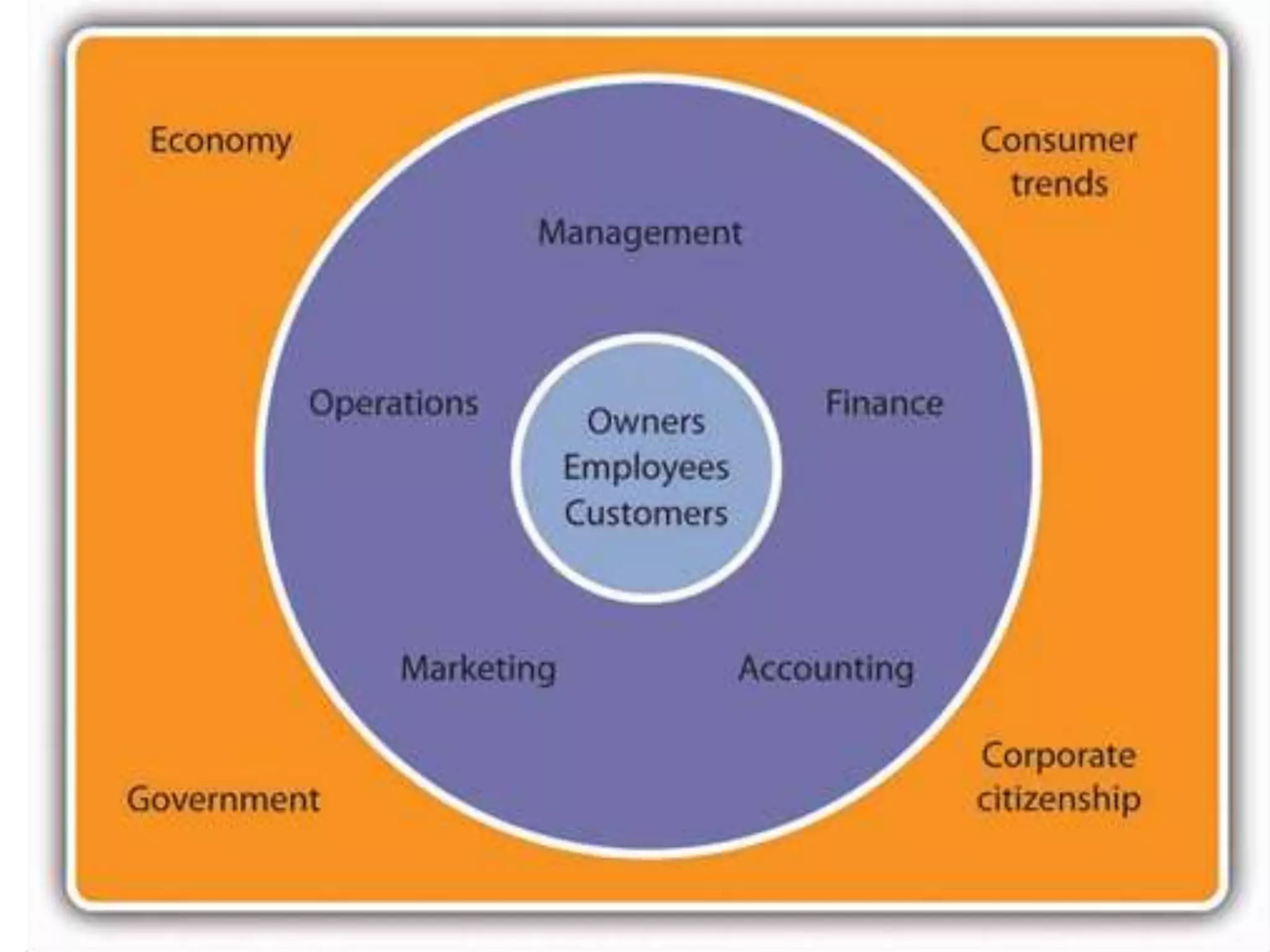
• Businesses don’t operate in a vacuum: they’re
influenced by a number of external factors.
• These include the
• Economy,
• Government,
• Consumer trends, and
• Public pressure to act as good corporate citizens. Figure
below shows "Business and Its Environment" sums up
the relationship among the participants in a business,
its functional areas, and the external forces that
influence its activities.
Cont…
• One industry that’s clearly affected by all these factors
is the fast food industry.
• A strong economy means people have more money to
eat out at places where food standards are monitored
by a government agency, the Food and Drug
Administration.
• Preferences for certain types of foods are influenced by
consumer trends (eating fried foods might be okay one
year and out the next).
• Finally, a number of decisions made by the industry
result from its desire to be a good corporate citizen.
KEY TAKEAWAYS
• The main participants in a business are its
owners, employees, and customers.
• Businesses are influenced by such external
factors as the economy, government, consumer
trends, and public pressure to act as good
corporate citizens.
• The activities needed to run a business can be
divided into five functional areas:
• 1. Management involves planning, organizing,
staffing, directing, and controlling resources to
achieve organizational goals.
• 2. Operations transforms resources (labour,
materials, money, and so on) into products.
• 3. Marketing works to identify and satisfy
customers’ needs.
• 4. Finance involves planning for, obtaining,
and managing company funds.
• 5. Accounting entails measuring, summarizing,
and communicating financial and managerial
information.
KEY TAKEAWAYS

Basic of business

  • 1.
  • 2.
  • 3.
    LEARNING OBJECTIVE • Identifythe main participants of business, • The functions that most businesses perform, and • The external forces that influence business activities
  • 4.
    Cont… • As thestory of Apple suggests, today is an interesting time to study business. • Advances in technology are bringing rapid changes in the ways we produce and deliver goods and services. • The Internet and other improvements in communication now affect the way we do business.
  • 5.
    Cont.. • Companies areexpanding international operations, and the workforce is more diverse than ever. • Corporations are being held responsible for the behaviour of their executives, and more people share the opinion that companies should be good corporate citizens.
  • 6.
    • A businessis any activity that provides goods or services to consumers for the purpose of making a profit. • When Steve Jobs and Steve Wozniak created Apple Computer in Jobs’s family garage, they started a business. • The product was the Apple , and the company’s founders hoped to sell their computers to customers for more than it cost to make and market them. • If they were successful (which they were), they’d make a profit .
  • 7.
    Cont….. • Your bankis a service company, as is your Internet provider. • Airlines, law firms, movie theaters, and hospitals are also service companies. • Many companies provide both goods and services. • For example, your local car dealership sells goods (cars) and also provides services (automobile repairs).
  • 8.
    Business Participants • Everybusiness must have one or more owners whose primary role is to invest money in the business. • When a business is being started, it’s generally the owners who polish the business idea and bring together the resources (money and people) needed to turn the idea into a business. • The owners also hire employees to work for the company and help it reach its goals.
  • 9.
    Cont.. • Owners andemployees depend on a third group of participants—customers. • Ultimately, the goal of any business is to satisfy the needs of its customers. • Therefore, the key participants in a business are its owners, employees, and customers
  • 10.
    Functional Areas ofBusiness • The activities needed to operate a business can be divided into a number of functional areas: • Management • Marketing • Operations • Procurement and Logistic management • Accounting and • Finance.
  • 11.
    Cont.. • .Let’s brieflyexplore some of these areas; • Management : Process of planning for, organizing, directing, and controlling a company’s resources so that it can achieve its goals. • Managers are responsible for the work performance of other people. • Management involves planning for, organizing, staffing, directing, and controlling a company’s resources so that it can achieve its goals.
  • 12.
    Cont.. • Managers planby setting goals and developing strategies for achieving them. They organize activities and resources to ensure that company goals are met. • They staff the organization with qualified employees and direct them to accomplish organizational goals. • Finally, managers design controls for assessing the success of plans and decisions and take corrective action when needed.
  • 13.
    Cont.. • Operations • Allcompanies must convert resources (labour, materials, money, information, and so forth) into goods or services. • Some companies, such as Apple, convert resources into tangible products—iPhones, iPods, Macs. Others, such as MM hospitals, convert resources into intangible products— health care.
  • 14.
    Cont.. • The personwho designs and oversees the transformation of resources into goods or services is called an operations manager. • This individual is also responsible for ensuring that products are of high quality.
  • 15.
    Cont.. • Marketing • Setof processes for creating, communicating, and delivering value to customers and for improving customer relationships. • Marketing consists of everything that a company does to identify customers’ needs and design products to meet those needs. • Marketers develop the benefits and features of products, including price and quality.
  • 16.
    Cont.. • They alsodecide on the best method of delivering products and the best means of promoting them to attract and keep customers. • They manage relationships with customers and make them aware of the organization’s desire and ability to satisfy their needs. • Marketing covers large area like in promotional campaigns, sales , marketing research, new products development and design and many other areas that’s go to even customer acquisition and retention.
  • 17.
    Cont.. • Accounting Managersneed accurate, relevant, timely financial information, and accountants provide it. • Accountants measure, summarize, and communicate financial and managerial information and advise other managers on financial matters. • There are two fields of accounting; financial accountants and managerial accountants • Financial accountants; prepare financial statements to help users, both inside and outside the organization, assess the financial strength of the company.
  • 18.
    Cont.. • Managerial accountants;prepare information, such as reports on the cost of materials used in the production process, for internal use only.
  • 19.
    Cont.. • Finance • Financeinvolves planning for, obtaining, and managing a company’s funds. • Finance managers address such questions as the following: • How much money does the company need? • How and where will it get the necessary money? • How and when will it pay the money back? • What should it do with its funds?
  • 20.
    Cont.. • What investmentsshould be made in plant and equipment? • How much should be spent on research and development? How should excess funds be invested? • Good financial management is particularly important when a company is first formed, because new business owners usually need to borrow money to get started.
  • 21.
    External Forces ThatInfluence Business Activities • Businesses don’t operate in a vacuum: they’re influenced by a number of external factors. • These include the • Economy, • Government, • Consumer trends, and • Public pressure to act as good corporate citizens. Figure below shows "Business and Its Environment" sums up the relationship among the participants in a business, its functional areas, and the external forces that influence its activities.
  • 22.
    Cont… • One industrythat’s clearly affected by all these factors is the fast food industry. • A strong economy means people have more money to eat out at places where food standards are monitored by a government agency, the Food and Drug Administration. • Preferences for certain types of foods are influenced by consumer trends (eating fried foods might be okay one year and out the next). • Finally, a number of decisions made by the industry result from its desire to be a good corporate citizen.
  • 24.
    KEY TAKEAWAYS • Themain participants in a business are its owners, employees, and customers. • Businesses are influenced by such external factors as the economy, government, consumer trends, and public pressure to act as good corporate citizens. • The activities needed to run a business can be divided into five functional areas: • 1. Management involves planning, organizing, staffing, directing, and controlling resources to achieve organizational goals.
  • 25.
    • 2. Operationstransforms resources (labour, materials, money, and so on) into products. • 3. Marketing works to identify and satisfy customers’ needs. • 4. Finance involves planning for, obtaining, and managing company funds. • 5. Accounting entails measuring, summarizing, and communicating financial and managerial information. KEY TAKEAWAYS