Estimation of Violin Bow Pressure
Using Photo-Reflective Sensors
Yurina Mizuho, Riku Kitamura, and Yuta Sugiura
Keio University
01 Introduction
• The violin is hard to learn
• Most performers simply adjust their
playing motions following their
senses and experience
Background
• Bowing has a strong influence on the
tone (bow speed, position, pressure)
• Related methods using strain gauges
are difficult to install on existing
instruments
Motivation
• Using photo-reflective sensors
• Quantitatively estimate and visualize
bow pressure to support practice
Approach
04 Application
• Real-time bow pressure estimation
• Visual feedback during violin playing
• Instructors: quantitatively grasp students’ bow pressure
• Amateur performers: improve their playing by comparing
the bow pressure with past results and that of professionals
• Examine the effect of bow pressure feedback on practice
• Consider other feedback methods (tactile, auditory)
• Improve the accuracy of bow pressure estimation by
tracking the bow position where the pressure is applied
• The same model cannot be used with different bow tensions
International Conference on Multimodal Interaction (ICMI) 2023 Mail: ymizuho@keio.jp
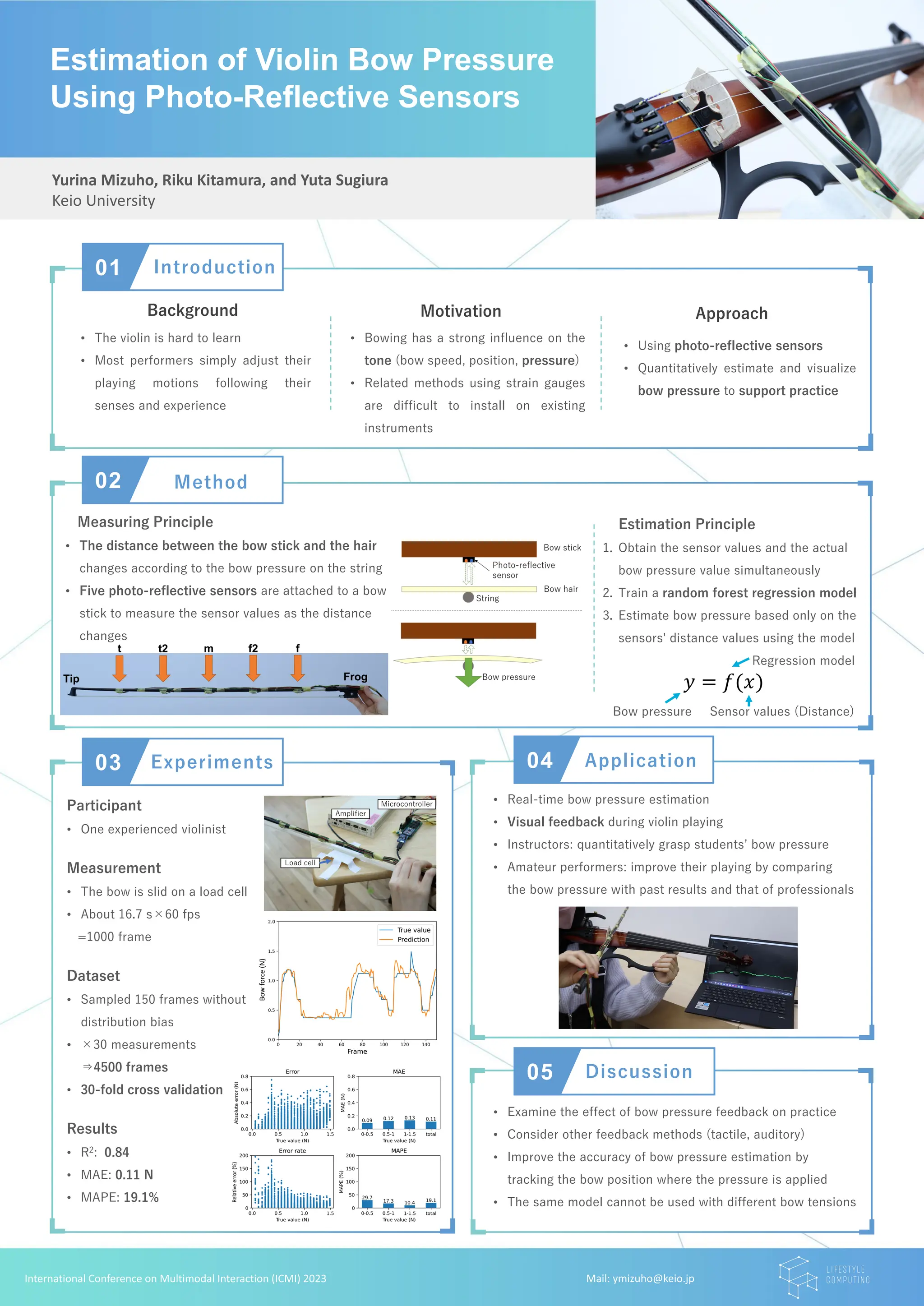
Measuring Principle
• The distance between the bow stick and the hair
changes according to the bow pressure on the string
• Five photo-reflective sensors are attached to a bow
stick to measure the sensor values as the distance
changes
Estimation Principle
1. Obtain the sensor values and the actual
bow pressure value simultaneously
2. Train a random forest regression model
3. Estimate bow pressure based only on the
sensors' distance values using the model
03 Experiments
𝑦𝑦 = 𝑓𝑓(𝑥𝑥)
Bow pressure Sensor values (Distance)
Regression model
05 Discussion
02 Method
Participant
• One experienced violinist
Measurement
• The bow is slid on a load cell
• About 16.7 s×60 fps
=1000 frame
Dataset
• Sampled 150 frames without
distribution bias
• ×30 measurements
⇒4500 frames
• 30-fold cross validation
Results
• R2: 0.84
• MAE: 0.11 N
• MAPE: 19.1%

Estimation of Violin Bow Pressure Using Photo-Reflective Sensors

  • 1.
    Estimation of ViolinBow Pressure Using Photo-Reflective Sensors Yurina Mizuho, Riku Kitamura, and Yuta Sugiura Keio University 01 Introduction • The violin is hard to learn • Most performers simply adjust their playing motions following their senses and experience Background • Bowing has a strong influence on the tone (bow speed, position, pressure) • Related methods using strain gauges are difficult to install on existing instruments Motivation • Using photo-reflective sensors • Quantitatively estimate and visualize bow pressure to support practice Approach 04 Application • Real-time bow pressure estimation • Visual feedback during violin playing • Instructors: quantitatively grasp students’ bow pressure • Amateur performers: improve their playing by comparing the bow pressure with past results and that of professionals • Examine the effect of bow pressure feedback on practice • Consider other feedback methods (tactile, auditory) • Improve the accuracy of bow pressure estimation by tracking the bow position where the pressure is applied • The same model cannot be used with different bow tensions International Conference on Multimodal Interaction (ICMI) 2023 Mail: ymizuho@keio.jp Measuring Principle • The distance between the bow stick and the hair changes according to the bow pressure on the string • Five photo-reflective sensors are attached to a bow stick to measure the sensor values as the distance changes Estimation Principle 1. Obtain the sensor values and the actual bow pressure value simultaneously 2. Train a random forest regression model 3. Estimate bow pressure based only on the sensors' distance values using the model 03 Experiments 𝑦𝑦 = 𝑓𝑓(𝑥𝑥) Bow pressure Sensor values (Distance) Regression model 05 Discussion 02 Method Participant • One experienced violinist Measurement • The bow is slid on a load cell • About 16.7 s×60 fps =1000 frame Dataset • Sampled 150 frames without distribution bias • ×30 measurements ⇒4500 frames • 30-fold cross validation Results • R2: 0.84 • MAE: 0.11 N • MAPE: 19.1%