1 
| Edition 23 | June 2014 | www.|| EEddiittiioonn 2233 || JJuunnee 22001144 || wwwwww..hhhooommmeeegggrrrooouuuppp...ooorrrggg...uuukkk ||| 
||| hhhttttttpppsss::://////bbbhhhaaammmmmmhhhcccaaarrreeerrr...hhhooommmeeegggrrrooouuuppp...ooorrrggg...uuukkk ||| 
MHCarerService@homegroup.org.uk 
www.facebook.com/HomeGrouphousing www.twitter.com/homegroup
2 
Send your photos, stories & 
artwork to us at… 
Stonham 
Birmingham Mental Health 
Carers Support Service, 
Unit 3, Holt Court North, 
Heneage Street West, 
Birmingham Science Park, 
Aston, Birmingham 
B7 4AX 
Stonham Carers Support Service 
would like to ensure that our 
Carers are at the heart of 
everything we do. 
If you would like to receive this 
pack in another format e.g. 
translated, large print, on tape or 
in Braille, please contact the 
Gateway Team on 
0121 380 4949, or email 
annette.lewis@homegroup.org.uk 
Our packs are also available to download at: 
https://bhammhcarer.homegroup.org.uk 
2 Contact Us & Contents Of This Pack 
3 PALS Contact Details & Information 
4 Fathers Day / Gypsy, Traveller Month 
5 Positive Mental Health Group Poster 
6 Birmingham City Council Numbers 
7 Stonham Walking Group Dates Poster 
8 School Term / Holiday Calendar 
9 Relaxation Exercise 
10 Carers Respite Leaflet (Funded) 
11 The Kaleidoscope Plus Group Poster 
12 Don’t Let Stress Control Your Life Poster 
13 NHS Choices – Online 
14 LGBT B-GLAD Group Dates 
15 Benefit Rates Poster 
16 T.R.U.S.T Poster 
17 Facts About Caring—Quest 
18 Depression Poster 
19 Addaction Drug Help & Support Leaflet 
20 Moodzone 
21 Men’s Health Week 9th—15th June 
22 What’s It Got To Do With You? 
23 Give Carers A Break 
24 Carers Week Information & Dates 
25 **CARERS WEEK * STONHAM EVENT** 
26 Carers Week - Members Event Poster 
27 Anxiety Information 
28 Worried About Back To School Costs 
29 Creative Writing Poster 
30 Stigma & Discrimination 
31 Stonham Carers Groups 
32 Stonham Carers Groups Continued 
33 Stonham Carers Groups Continued 
34 Fire Safety Checks Poster 
35 To Report A Hate Crime 
36 Carers Feedback Sheet
3 
PALS customer relations 
(Patient Advice & Liaison Service) 
Can provide information on a 
range of mental health matters, 
and liaison with all Trust services. 
Monday to Friday 
8am to 8pm 
Contact 
0800 953 0045 
Text 
07985883509 
Email 
pals@bsmhft.nhs.uk 
Website: 
www.bsmhft.nhs.uk 
PLEASE NOTE THAT THE PALS TEAM IS 
NOT A MEDICAL TEAM. IF YOU HAVE 
AN IMMEDIATE HEALTH PROBLEM 
PLEASE CONTACT NHS DIRECT 
(08 45 46 47) OR YOUR GP. 
The Patient Advice and 
Liaison Service (PALS) 
Works in partnership with 
patients and staff to help improve 
services for our patients. 
PALS is part of our commitment to 
give high standards of care and 
support to everyone who uses our 
services. 
As a patient, relative or carer, 
sometimes you may need to turn to 
someone for on-the-spot help, advice 
and support. 
The service aims to: 
• advise and support patients, their 
families and carers; 
• provide information about NHS 
services and the options available 
to you; 
• listen to your comments, 
compliments, concerns, 
suggestions or queries; 
• help you resolve any problems or 
concerns you may have, as quickly 
as possible; 
PALS acts independently when 
handling patient and family concerns, 
liaising with staff, managers and, 
where appropriate, relevant 
organisations to negotiate immediate 
or prompt solutions. 
THE SERVICE OFFERED BY PALS 
IS FREE, INFORMAL, IMPARTIAL 
AND CONFIDENTIAL.
Gypsy Roma and Traveller History Month was established in Britain in 2008 as a 
way of raising awareness of these communities and their contributions to society, 
4 
Gypsy Roma and Traveller 
History Month 
Jun 2014 
Gypsies, Roma and Travellers are the largest ethnic minority community in the 
European Union with over 12 million people across the EU and some 300,000 in 
the UK. They are very marginalised and suffer extreme levels of prejudice and 
discrimination. 
and to offset negative stereotyping and prejudices. 
You can find further information and resources on the 
National Association of Teachers of Travellers Website 
The Amnesty International UK website has 
Lesson Plans on Travellers' Rights 
suitable for Key Stage 4. 
This year (2014) a play called Crystal's Vardo is touring in June. It is targeted at 
upper primary and secondary school children, and there are also workshops and 
teaching materials on offer. Find out more on the 
Friends Families and Travellers Website 
This YouTube clip provides a useful 'animated history' of Gypsies / Roma / 
Travellers, and you can read more on the 
Open Society Foundations Website 
Father's Day History 
Father's Day is the day to recognise, honour 
and celebrate the sacrifices and 
accomplishments of our fathers. Children 
celebrate their fathers and father figures to 
show their love and appreciation. More 
recently, Father's Day has been used to 
educate the population as to the significant 
impact a father makes in the home of young 
children. Father's Day was created to 
complement Mother's Day and is celebrated 
on the third Sunday in June. 
International 
Gypsy Guitar 
Festival 2014 
Friday 25th to Sunday 27th 
July 2014 
Festival site: 
Tumpy Green Lane, 
Gossington, 
Gloucestershire, 
GL11 5HZ, 
MAP 
Early bird £50 for a w/e 
ticket including camping 
and parking. 
Read more at... 
http:// 
www.efestivals.co.uk/ 
festivals/ 
internationalgypsy/2014 
Father’s Day At 
Birmingham City Football Club 
Want to really spoil your dad this Father’s Day? Well why 
not treat him to Sunday lunch at the home of his 
favourite team here at St. Andrew’s on Sunday 15 June? 
Read more at 
http://www.bcfc.com/news/article/20140523-treat-your-special- 
bluenose-this-fathers-day- 
1574202.aspx#63jU2lxosVVzQ2EB.99 
The full package includes a fantastic three-course carvery 
lunch and a full behind-the-scenes stadium tour, plus 
every dad will also receive a special gift on the day. 
Lunch will be available from 12 noon and for every 30 
minutes until 3.30pm. 
This event is priced at £23.95 for adults, £16.95 for 12-16 
year olds, £9.95 for 5-11 year olds and free for under 5s. 
To book this special event for you and your dad call 
0844 557 1875 option 5 or email events@bcfc.com
5
6 
Save yourself time and do it online www.birmingham.gov.uk 
Environmental Health 
Environmental Health 303 6007 
Air Pollution 
Animal Welfare 
Dog Wardens 
Food Hygiene/Safety 
Health & Safety at Work 
Noise 
Pest Control – Rats/Wasps 
Pollution Control 
Contaminated Land Searches 303 9956 
Anti-Social Behaviour 303 1111 
Highways 
General Enquiries 303 6644 
Roads/footways 
Blocked drains 
Traffic signals and signs 
Obstructions 
Bollards and guard rails 
Flooding - highways 
Car Parking Penalty Charges 675 2000 
Dropped Kerbs 303 7577 
Emergencies 303 4149 
Public Rights of Way 464 6846 
Rivers & Brooks 303 7235 
Searches and enquiries team 303 7689 
Street naming/property 
addressing/numbering 303 7687 
Housing 
Housing Repairs 0800 073 333 
Homelessness 
(Emergencies out of hours) 303 7410 
Right to Buy 
Your Council House 303 7926 
Local Housing Team 216 3030 
For all other Housing enquiries 
see main Directory listing. 
Leisure/Libraries/Museums/Sport 
Alexander Stadium 464 8008 
Archives 303 4217 
Arts Advice 303 2434 
Banqueting/ 
Conference Facilities 303 2050 
Birmingham Museum 303 1966 
B’ham Town Hall 
Box Office 780 3333 
Gen Enquiries 200 2000 
Libraries 303 4511 
Library Services 
for the Housebound 464 1118 
Nature Centre 472 7775 
Parks & Public Open Spaces 464 8728 
Sport coaching & Development 
Programmes 464 2012 
Pitch bookings 464 6024 
Sutton Town Hall 464 8990 
Trees on Council Land 464 8728 
For details of golf courses, leisure centres, 
parks, playing fields, country parks, visitor 
centres, public halls and swimming pools, 
see main Directory listing 
Adults and Communities 
Adults & Communities 303 1234 
Access Point (ACAP) 
Monday-Thursday 8:45am to 5:15pm 
Friday 8:45am to 4:15pm 
Or you can click on 
My Care in Birmingham - 
www.mycareinbirmingham.org.uk 
• The fastest to get information and 
advice about adult social care 
• Find out how to care for yourself by 
looking at your needs and how you can 
meet them 
• Find the services you need online 
Commissioning/Front Facing Services 
Advertise your services for FREE on 
http://marketplace. 
mycareinbirmingham.org.uk 
Adult Education 675 4805 
Emergency Nightcare 464 5001 
Blue Badge/ 
Disabled Parking 303 1234 
Emergency Duty Team 675 4806 
Bharosa Helpline for 
Asian Women and Families 
(Domestic Violence) 303 0368 
or 303 0369 
Business 
Birmingham City Laboratories 303 9300 
Brasshouse Language Centre/ 
Translation Services 303 0114 
Business Rates 303 5509 
Car Boot Sales Licences/ 
Street Trading Consents 303 0254 
Hackney Carriage/Taxis 303 8442 
Licensing – General 303 9896 
Markets – Retail & Wholesale 464 8349 
Loan Sharks 0300 555 2222 
Trade/ 
Commercial Waste Services 303 2894 
Children’s Information and Advice 
Service 
Information Advice and Support 
Children’s Social Care 
Family Information Service 
School Admissions and 
Pupil placements 303 1888 
Adoption & Fostering 303 7575 
Child employment 303 8900 
Governor Support: 
North 303 2479 
Central 303 4955 
South 303 2577 
School Bus Passes: 
North 303 2450 
Central 303 4955 
South 303 4425 
School Meals 464 9002 
Student Loans 303 3648 
For list of schools 
see main Directory listing 
Planning/Development 
Acivico 303 6719 
(building design, construction 
and facilities management) 
Conservation & Listed Buildings 303 1115 
Dangerous Buildings & 
Demolition 675 7006 
Economic Strategy & 
Information 303 3760 
Land Charges 303 4839 
Planning Applications/ 
Enquiries 303 1115 
Planning/Development 303 1115 
Tree Preservation 303 1115 
Property 
Acquisitions/Disposals 303 3472 
Industrial Property 303 3935 
Property Records 303 3940 
Shops to Let 303 3952 
Survey & Mapping Facilities 464 1629 
Waste & Recycling 
Waste and Recycling 303 1112 
Abandoned Vehicles 
Asbestos Collection/Advice 
Fly Posting/Graffiti 
Public Waste Disposal Sites 
Recycling/Refuse Collection 
Street Cleansing 
Commercial Waste Services 303 2894 
Other Popular Council Services 
Council Tax 303 1113 
Council House Reception 303 2054 
City Centre Partnership 616 2894 
Customers paying invoices 464 2001 
Elections/Electoral Registration 303 2731 
Equalities Division 303 2545 
General Enquiries 303 1111 
Housing Benefit/ 
Council Tax Support 464 7000 
Insurance Claims 303 3288 
Lord Mayors Parlour 303 2040 
Neighbourhood Advice & 
Information Service Advice Line 303 1111 
Ombudsman 0845 602 1983 
Pensions 464 6800 
Press Office 303 3287 
Recruitment 303 1111 
Register Office 675 1000 
Suppliers - Invoice queries 464 7299 
Switchboard 303 9944 
Emergencies 
Anti Social Behaviour 303 1111 
Flooding (out of hours only) 303 4149 
Highways (out of hours only) 303 4149 
Homelessness 303 7410 
Pollution of Brooks & Streams 0800 807060 
Social Services 675 4806 
Transportation 303 4149 
Emergency Duty Team (OOH) 675 4806
7 
We Meet On The 2nd Thursday Of The Month, 10.30am - 1.00pm 
12th June – Brookvale Park and Lake, Park Road, Erdington, Birmingham. 
Meet Park Road entrance. 
10th July – Sheldon Country Park, Ragley Drive, Church Road, Sheldon, B26 3TU. 
Meet in the main entrance car park off Ragley Drive. 
14th August – Moseley Bog – Yardley Wood Road, Birmingham. 
Meet in the car park on Windermere Road. 
11th September – Sandwell Valley, Salter’s Lane, West Bromwich, B71 4BG. 
Meet In the main car park. 
9th October – Northfield Eco Centre and Victoria Park , 53 Church Road, B31 2LB. 
Meet in the car park. 
13th November – Gas Street Basin, Gas Street, Birmingham, B1 2JT. 
Meet in the café in the ICC. 
11th December – German Market, Victoria Square, New Street. 
Meet in the café in the ICC. 
Contact Safia Sawal on 07713 387325 
Alternatively you can call our Gateway Team on 0121 380 4949 
if you require any further Information.
8 
Birmingham Holidays 2014 - 2015 
Term and Holiday Dates for 2014 and 2015 are taken from data sourced from Birmingham City Council. We take every care to ensure our holiday data is 
accurate, but please always check with your children's schools before booking any holidays! 
http://myschoolholidays.com/gb--Birmingham
9 
Progressive Muscle Relaxation Exercise 
Progressive muscle relaxation is a technique that involves tensing specific muscle groups 
and then relaxing them to create awareness of tension and relaxation. It is termed 
progressive because it proceeds through all major muscle groups, relaxing them one at a 
time, and eventually leads to total muscle relaxation. 
Instructions: 
Step 7. Now, bring your awareness to the muscles in the hands. 
Tense the muscles in the hands by clenching it into a tight fist, 
holding for a count of four seconds and then release. With your 
awareness in the hands, now tense the muscles in your hands 
and hold for four seconds and release. Notice the tension just 
wash away when you release. With each cycle, you notice it 
becomes easier and easier to release and relax each muscle 
group. Do the same thing you did, relaxing even more with each 
breath. 
Step 8. Notice the muscles in the upper back, around the 
shoulder blades. Tense the muscles in the upper back by pressing 
the shoulder blades together and holding for a count of four 
seconds and then release. With your awareness in the shoulder 
blades, now tense and hold for four seconds, and release. Notice 
the difference between tensed muscles and relaxed muscles as 
you go through the process. With each cycle, you notice it 
becomes easier and easier to release and relax each muscle 
group Do the same thing you just did again, relaxing even more 
with each breath. 
Step 9. Now, notice the muscles in the abdomen and low back. 
Tense the muscles in the abdomen by imagining that we are 
trying to touch the belly button to the spine, pressing the low 
back to the chair and holding for a count of four seconds and 
then release. With your awareness in the abdomen, now tense 
and hold for four seconds, and release. Notice the difference 
between a tense muscle and a relaxed muscle again. 
Remembering to inhale through the nose and exhale through the 
mouth, releasing any residual tension in the low back and 
abdomen. With each cycle, you notice it becomes easier and 
easier to release and relax each muscle group. Do it again, 
relaxing even more with each breath. 
Step 10. Now on to the feet. Tense these muscles by pointing 
the toes towards the knees, and again holding for three seconds, 
and then releasing the calf muscles. With your awareness in the 
calf muscles, now tense the calves and hold for four seconds, and 
release. Notice the difference between a tense muscle and a 
relaxed muscle as you go through the process. Remembering to 
inhale through the nose and exhale through the mouth, can 
release any residual tension in the calves. With each tense and 
release cycle, you will notice it becomes easier and easier to 
release and relax each muscle group. Do the same thing you did 
before again, relaxing even more with each breath 
Remember, people respond differently to various 
activities. Some feel pleasant or refreshed, and others feel 
calm and relaxed after an activity like this one. Some 
people notice little change the first time, but with 
practice, their control increases - as well as the benefits. If 
you practice this activity, your relaxation should increase. 
Step 1. Begin by noticing your breathing, noticing your 
abdomen rise and fall with each breath (pause after each 
breath). As your breathing becomes more relaxed and restful, 
take your awareness up to your face. Then you'll start this 
process with the muscles in your face. 
Step 2. Tense the muscles in the face by making a sour face, 
like you just ate a lemon, holding that face for four seconds and 
then release the muscles in your face. Repeat the process two 
times in various muscle groups throughout the body. 
Step 3. Notice the tension just washing away. With each tense 
and release cycle, you'll notice it becomes easier and easier to 
release and relax each muscle group. Do the same thing you just 
did before, except you should be inhaling through the nose and 
exhaling through the mouth, relaxing even more with each 
breath. 
Step 4. Now, you should move your awareness to the shoulder 
and neck area. Notice the muscles in the shoulder and neck area. 
Tense the muscles in the neck by pressing the shoulders towards 
the ears and holding for a count of four seconds and then 
release. With your awareness in the neck and shoulders, now 
tense them and hold for four seconds, and release. Notice the 
difference between a tense muscle and a relaxed muscle as you 
go through the process. Remembering to inhale through the 
nose and exhale through the mouth, releasing any residual 
tension in this area, it becomes easier and easier to release and 
relax each muscle group. Do the same thing you do before, 
relaxing even more with each breath you take. 
Step 5. Bring your awareness to the muscles in the arms. Tense 
the muscles in both of your arms by curling the arms up towards 
your biceps and holding them as if you are lifting weights and 
holding it to your chest, holding for four seconds and then 
release. With your awareness in the arm, do the same thing 
again. Remembering to inhale through the nose and exhale 
through the mouth, can release any residual tension in the arm. 
With each cycle, you notice it becomes easier and easier to 
release and relax each muscle group. Do the same thing you did 
before, relaxing even more with each breath. 
Step 6. Bring your awareness to the muscles in the arms. Tense 
the muscles in both of your arms by curling the arms up towards 
your biceps and holding them as if you are lifting weights and 
holding it to your chest, holding for four seconds and then 
release. With your awareness in the arm, do the same thing 
again. Remembering to inhale through the nose and exhale 
through the mouth, can release any residual tension in the arm. 
With each cycle, you notice it becomes easier and easier to 
release and relax each muscle group. Do the same thing you did 
before, relaxing even more with each breath.
10 
There is a grant available to 
cover your stay if you are on a 
low income or on benefits, 
give them a call and ask how 
you can apply.
11
12 
Some stress is normal but if happens too often or 
lasts too long it can have bad effects: 
loss of temper, neck, shoulder and back pain or 
stiffness in your jaw, headache, high blood 
pressure, difficulty sleeping, fatigue, nausea, 
constipation or diarrhoea, skin problems, weight 
changes and poor personal relationships. 
____________________________________________________ 
COPING STRATEGIES 
Uncontrolled anxiety can make life miserable as 
well as endanger your health. That’s why you 
must learn to manage it. 
Strategies for coping include: 
 Work to resolve conflicts 
 Talk with someone you trust 
 Exercise 
 Meditate 
 Take care of yourself – Get enough 
sleep, eat well 
 Learn to say no 
 Ask for help 
____________________________________________________ 
If your symptoms of stress persist, please discuss 
your feelings with your GP. Counselling along with 
medications may help you feel better and start you 
on the road to a happier and healthier life.
13
Healthy Gay Life, 146 Bromsgrove Street, Gay Village, Birmingham City Centre. 
Call Mark On: 0121 301 1284 or 07985 882681 
B-GLAD: Birmingham Gays and Lesbians Against Depression 
We meet on alternate Thursday evenings (the second and fourth Thursday each month) 
14 
We are a friendly support and social group for those suffering from depression 
or other mental illness. 
From 7.30 to 9.30pm near Birmingham’s Gay Village area. 
We are affiliated to Depression Alliance. We have access to leaflets, 
directories and other information. 
All our members understand depression or other conditions like; 
anxiety, OCD or stress. 
TO CONTACT B-GLAD – PHONE 0121 301 1284 
www.depressionalliance.org 
INFORMATION LINE 0845 123 23 20 
12th June, 26th June 
10th July, 24th July 
14th August, 28th August 
11th September, 25th September 
9th October, 23rd October 
13th November, 27th November 
11th December 
Sunday 21st December – Christmas Meal 1pm
15 
BEREAVEMENT ALLOWANCE 
Aged 45—54 33.36—103.42 
Aged 55—pension age 111.20 
BEREAVEMENT PAYMENT (one off) 2,000.00 
CARER’S ALLOWANCE 61.35 
Adult dependant 36.10 
Child dependant (first child) 8.05 
Earnings disregard 100.00 
EPLOYMENT AND SUPPORT ALLOWANCE (contributory) 
Assessment Phase aged under 25 57.35 
Assessment Phase aged under 25 and over 72.40 
Main Phase basic allowance 72.40 
Work-related activity component 28.75 
Support component 35.75 
INCAPACITY BENEFIT 
Short term (under pension age) Lower rate 78.50 
Higher rate 92.95 
Adult dependant 47.10 
Child dependant 8.05 
Long term 104.10 
Age addition under 35 11.00 
Aged 35—44 6.15 
Adult dependant 60.45 
Child dependant 8.05 
JOBSEEKER’S ALLOWANCE (contribution based) 
Aged under 25 57.35 
Aged 25 and over 72.40 
MATERNITY ALLOWANCE (standard rate) 138.18 
Earnings threshold 30.00 
SEVERE DISABLEMENT ALLOWANCE 73.75 
Age addition aged under 40 11.00 
Aged 40—49 6.15 
Aged 50—59 6.15 
Adult dependant 36.30 
Child dependant 8.05 
STATE RETIREMENT PENSION 
Category A 113.10 
Category B spouse’s / civil partner’s 67.80 
WIDOWED PARENT#S ALLOWANCE 111.20 
Child dependant (first child) 8.05 
ATTENDANCE ALLOWANCE 
Lower rate 54.45 
Higher rate 81.30 
DISABILITY LIVING ALLOWANCE 
Care component lower rate 21.55 
Middle rate 54.45 
Higher rate 81.30 
Mobility component 21.55 
Higher rate 56.75 
GUARDIAN’S ALLOWANCE 16.35 
INDUSTRIAL INJURIES DISABLEMENT BENEFIT 
(20—100% DISABLED) 33.20—166.00 
PERSONAL INDEPENDENCE PAYMENT 
Daily Living Component standard rate 54.45 
Daily Living Component enhanced rate 81.30 
Mobility Component standard rate 21.55 
Mobility Component enhanced rate 56.75 
WINTER FUEL PAYMENTS PER WINTER 
Aged Pension Credit age—79 200.00 
Aged 80 and over 300.00 
Couples/lone parents (weekly benefit) 500.00 
Couples/lone parents (monthly benefit) 2,167.00 
Single (weekly benefit) 350.00 
Single (monthly benefit) 1,517.00 
CHILD BENEFIT 
1st child 20.50 
other child(ren) 13.55 
INCOME SUPPORT  JOBSEEKER’S ALLOWANCE (income based) 
PERSONAL ALLOWANCES 
SINGLE 
Aged under 25 57.35 
aged 25 and over 72.40 
Lone parent aged under 18 57.35 
Aged 18 and above 72.40 
COUPLE 
Both aged under 18 57.35/86.65 
One aged under 18 57.35/72.40/113.70 
Both aged 18+ 113.70 
dependent children-some pre 2004 claims 66.33 
PREIUMS: CARER 34.20 
PREMIUMS: DISABILITY 
Single/couple 31.85/45.40 
Disabled child 59.50 
PREMIUMS: ENHANCED DISABILITY 
Single person/lone parent 15.55 
Couple 22.35 
Disabled child 24.08 
PREMIUMS: FAMILY 17.45 
PREMIUMS: PENSIONER 
Single (JSA only) 75.95 
Couple 112.80 
PREMIUMS: SEVERE DISABILITY (per qualifying person) 61.10 
EMPLOYMENT AND SUPPORT ALLOWANCE (income related) 
Single/lone parent 72.40 
Except if lone parent aged under 18s/single person 
aged under 25 and in assessment phase 57.35 
couple 72.40/113.70 
work-related activity component 28.75 
Support component 35.75 
(Carer, Enhanced Disability, Pensioner and Severe Disability 
Premiums paid at the same rate as Income Support/JSA (income based)) 
PENSION CREDIT 
Minimum guarantee 
Single 148.35 
Couple 226.50 
ADDITIONAL AMOUNTS 
Severe disability (per qualifying person) 61.10 
Carer 34.20 
SAVINGS CREDIT 
Threshold—single 120.35 
Couple 192.00 
maximum—single 16.80 
Couple 20.70 
HOUSING BENEFIT 
PERSONAL ALLOWANCES 
As Income Support/Pension Credit rates except for: 
Single person/lone parent aged 65 and over 165.15 
Couple both under 18 86.65 
Couple one aged under 18 113.70 
One or both aged 65 and over 247.20 
PREMIUMS: DISABLED CHILD PREMIUM 59.50 
PREMIUMS: FAMILY—LONE PARENT RATE 22.20 
LOCAL COUNCIL TAX SUPPORT 
Variable-contact local authority 
LOCAL WELFARE PROVISION  DISCETIONARY HOUSING PAYMENTS 
Variable-contact local authority 
SOCIAL FUND SURE START MATERNITY GRANT 
One off-first child only 500.00 
SOCIAL FUND COLD WEATHER PAYMENTS 25.00 
WORKING TAX CREDIT ANNUAL RATES 
Basic element 1,940.00 
Couple/lone parent 1,990.00 
30 hours element 800.00 
Disabled worker element 2,935.00 
Severe Disability element 1,255.00 
CHILDCARE COSTS (70%) 
1 child (weekly rate) (maximum) 175.00 
2 and over children (maximum) 300.00 
CHILD TAX CREDIT ANNUAL RATES 
Family element 545.00 
Child element 2,750.00 
Disabled child element 3,100.00 
Severely disabled child element 1,255.00 
TAX CREDIT INCOME THRESHOLDS ANNUAL RATES 
1st threshold child tax credit only 16,010.00 
Some working tax credit payable 6,420.00 
Taper 41% 
Income increase disregard 5,000.00 
Income decrease disregard 2,500.00 
UNIVERSAL CREDIT MONTHLY RATES 
Standard Allowance 
SINGLE 
Aged under 25 249.28 
Aged 25 and over 314.67 
COUPLE 
Both aged under 25 391.29 
At least one aged 25 and above 493.95 
Elements 
Child Element 
1st child 274.58 
Other children 229.17 
Additional Disabled Child Element lower 124.86 
Additional Disabled Child Element higher 362.92 
Housing Costs Element variable 
Limited Capacity for Work Element 
124.86Limited Capacity for Work-related Activity Element 311.86 
Carer Element 148.61 
Childcare Costs Element (70%) 
Maximum 1 child 532.29 
2 or more children 912.50 
BENEFIT UNDER PENSION CREDIT AGE PENSION CREDIT AGE 
(£6,000 or £10,000) / £16,000 
n/a 
£6,000 / £16,000 
£10,000 / £16,000 
(note no upper limit if in receipt 
of guarantee credit) 
n/a 
£10,000 / no upper limit 
£1 (£4.35 monthly) for every £250 
above lower limit 
£1 for every £500 
Above lower limit 
Income Support/JSA (income based)/ESA 
(income related)/Universal Credit 
Income Support/JSA (income based)/ESA 
(income related) - Universal Credit (Care 
Homes) 
Housing Benefit 
Pension Credit (including Care 
Homes) 
Tariff Income rules 
£6,000 / £16,000 n/a 
STATUTORY ADOPTION, MATERNITY AND PATERNITY PAY 138.18 
STATUTORY SICK PAY 87.55 
Earnings threshold 111.00
16
17 
Facts about caring 
What is a carer? 
Carers provide unpaid care by looking after an ill, frail or disabled family member, friend or partner. Carers give 
so much to society yet as a consequence of caring, they experience ill health, poverty and discrimination. 
Caring in numbers 
• There are over 6.5 million carers in the UK. 
• Every day 6,000 people take on new caring responsibilities. 
• Every year two million people take on new caring responsibilities. 
• Most carers (5.7 million) are aged over 18 and the peak age for caring is 50 to 59. 
• 1.5 million carers are aged over the age of 60. 
• There are 175,000 young people under the age of 18 who provide care, 13,000 of these provide care for 50 
hours or more per week. 
• One in eight workers in the UK combine work with caring responsibilities for a disabled, ill or frail relative or 
friend. 
During Carers Week 2013 we published the findings of a survey of over 2,100 carers. Prepared 
to Care? explored the impact caring has on people's lives and informed our planning for the 
Carers Week Quest. 
For more information about Carers Week, or if you have any queries please contact us by 
emailing info@carers week.org or telephone us on 020 7378 4955. 
Advice  Support 
One in every eight adults in the UK is a carer. It’s something that will happen to most people at some point in 
their lives – in fact every year, over two million people become carers for the first time. Are you Prepared to 
Care? 
At the start caring can be bewildering, confusing and demanding. All carers need some support and back-up. 
Caring without support from others can present serious risks to your health and well-being. 
Carers Week is the ideal time to find out what support is available to carers in your local area. This year we are 
encouraging the greatest ever drive in the UK to reach out to carers who are missing out on support and services. 
Many people don‘t know what is out there or don’t realise that they can get support with their caring 
responsibilities. 
Here are ten simple steps to help you be prepared to care: 
1. Don't be afraid to ask questions. 
2. Find out more about the condition and treatments/medication. 
3. Think about your finances. 
4. Talk to your employer. 
5. Find out about available support. 
6. Find a balance. 
7. The best laid plans - planning for emergencies. 
8. Make time for you. 
9. Talk to other carers. 
10. Be prepared for change.
18 
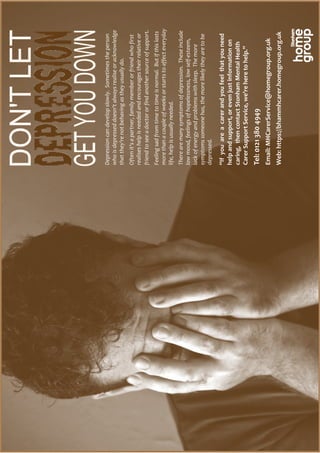
Depression can develop slowly. Sometimes the person 
who is depressed doesn't always realise or acknowledge 
that they're not behaving as they usually do. 
Often it's a partner, family member or friend who first 
realises help is needed and encourages their relative or 
friend to see a doctor or find another source of support. 
Feeling sad from time to time is normal. But if this lasts 
more than a couple of weeks or starts to affect everyday 
life, help is usually needed. 
There are many symptoms of depression. These include 
low mood, feelings of hopelessness, low self-esteem, 
lack of energy and problems with sleep. The more 
symptoms someone has, the more likely they are to be 
depressed. 
“If you are a carer and you feel that you need 
help and support, or even just information on 
caring, then contact Stonham Mental Health 
Carer Support Service, we’re here to help.” 
Tel: 0121 380 4949 
Email: MHCarerService@homegroup.org.uk 
Web: https://bhammhcarer.homegroup.org.uk
19
Stress, anxiety and depression 
Welcome to the Moodzone 
Why do I feel so down? How can I feel happier? Can I 
control my fears? 
Whatever you need to know about boosting your mood, 
coping with stress, anxiety or depression or simply 
improving your overall emotional wellbeing, the NHS 
Choices Moodzone is here to help. It offers practical, useful 
information, interactive tools and videos to support you on 
your way to feeling better. 
Before you get started 
The Moodzone covers sub-clinical mood-related content. 
This means it deals with feelings, mood and common life 
problems that are not clinical diagnoses. You might be trying 
to find help because you’ve been feeling down for a few 
days, or you’re having a stressful time at work which is 
causing you to feel worried and anxious. The best way to 
work out where to go next is to take the mood assessment 
quiz. 
If you want to talk to someone right away, the mental health 
helpline page has a list of organisations you can call for 
immediate assistance. These are helplines with specially 
trained volunteers who'll listen to you, understand what 
you're going through and help you through the immediate 
crisis. The Samaritans operates a service 24 hours a day, 365 
days a year, for people who want to talk in confidence. Call 
08457 90 90 90. 
If you’ve been feeling depressed for more than a few weeks, 
or your anxiety is becoming obstructive in your daily life, 
make an appointment to speak to your GP. 
Finding your way around 
The big blue tabs at the top of the page list the contents of 
each Moodzone section. Just hover your cursor over each 
tab and select the page you want from the drop-down 
menu. 
If you can't find what you're after in the Moodzone, try the 
Search box at the top of the page – it covers everything on 
the wider NHS Choices site, including clinical information on 
conditions and treatments, advice on how to have a 
healthier lifestyle and information for people who are 
looking after someone else. 
Be sure to check out the useful links and tools promoted on 
the right-hand side, as you may find these helpful. 
20 
Common problems 
This section explains what low mood and depression, stress, 
anger, anxiety and panic are and points you towards more 
information on getting help and things you can do, for 
yourself and for others. 
What you can do now 
Feel ready to make a change? You can begin improving your 
mood right away. Moodzone offers tips and how-to guides 
to get you started, including the steps you can take to 
achieve better mental wellbeing and information about 
available treatments. 
Moodzone also offers eight audio guides that you can listen 
for advice on how to approach common problems with 
mental wellbeing. These include: 
• Low mood and depression audio guide 
• Anxiety audio guide 
• Anxiety control training audio guide 
• Panic attacks audio guide 
• Trouble sleeping audio guide 
• Unhelpful thinking audio guide 
• Low confidence and assertiveness audio guide 
• Practical problem solving audio guide 
Do you need urgent mental health help now? 
If you've had thoughts of self-harming or are feeling 
suicidal, contact someone immediately such as your 
GP, a friend, a relative or someone you can trust. 
If you have already taken an overdose or cut yourself 
badly, dial 999. 
www.nhs.uk/conditions/stress-anxiety-depression
21
1. Questions, questions... 
Wherever you go, people want to know your business. Your age, gender, sexuality, race, religion, whether you’re disabled… Where does 
all this information go? It goes to help make things better, that’s where it goes. It tells local authorities where to direct their services; it 
shows organisations if certain people aren’t making the most of them; and it makes sure that you get the right slice of what you’re 
paying for. They can’t change things without your help. 
2. Big Brother is not watching you. Funny as that may seem. 
We’re all told to watch who we give our personal information to, what with identity theft and everything. But when you give 
information about your age, race, religion, disability, sexuality or whatever to, say, your local authority, you can be sure that it will only 
be used to make things better. In fact, they usually won’t even know it’s you! 
3. It’s not about you. Really. Sorry about that. 
Yes, occasionally you may fill in a form with your name and address. But the section with information about age, race, sexuality etc is 
almost always dealt with separately. Your personal information is about you – hello! – the rest is statistics. And if they occasionally 
keep it on your file, it will only ever be to make sure that you as a white/black older/young married/single straight/gay man/woman are 
being properly catered for. 
4. Come the revolution! 
Some people worry about giving information in case it should fall into the wrong hands. But when a public body gets your form, they 
don’t just file it away in the basement. There are very strict laws to make sure they protect those details and deal with them 
responsibly. And if you don’t trust them for whatever reason – or you don’t feel comfortable – then don’t give the information. No one 
can make you. 
5. Go ahead. Ask. 
So, what information do they want out of you? They’ll want to know whether you’re a man or a woman. They may want to know your 
ethnicity. And they’ll want to know what age category you fit into. These days, they may also want to know your sexuality: are you gay/ 
lesbian, heterosexual (they might say straight) or bisexual? They’re not after dinner and a movie. They just need to know to be able to 
do their job properly. Same with disability. Data like this helps authorities get services right. 
6. Get services right? That’ll be the day. 
Well, we can’t moan about authorities wasting money if we’re not prepared to help. Take a couple of examples. If there are lots of 
older people in an area, maybe more Dial-a-Ride services are needed. People from certain groups have particular health needs: there 
are higher rates of breast cancer among lesbians, for instance, so provision has to be made. Maybe your first language is not English and 
you’d prefer library books in your own language. You can see why they need to know. 
7. Race, sex, religion, sexuality? is that it? 
Well, who’s asking? Depending on whose form you’re filling in, you can usually see why they need the information. They might want to 
know if you’re homeless. Or have a particular condition. Or are transgender. They might also need to know your salary or how much 
you receive in benefits. They’re not being nosy – the information helps make services better by targeting them at the right people. 
And, as always, it won’t come back to you personally. 
8. Employers need to know too. 
It’s easy to see why your local council might need to know this stuff, but what about when you’re asked to fill in a form like this by a 
private company? When you’re applying for a job, for instance? The reasons are similar: to make sure they’re being fair and that people 
from all backgrounds are represented. And of course the details you give are protected by those same strict laws. 
9. You want to know my WHAT!!? 
It can seem nosier when someone is asking the questions face to face rather than getting you to fill in a form. But it’s the same. They’re 
really not interested in you personally, not in that way. They do it with everyone. And if you’d rather fill the form in yourself, just tell 
them. 
10. Stand up and be counted! 
It’s quite natural to feel protective of your personal information. It’s not only natural, it’s sensible. But if local authorities and hospitals 
and police forces and employers don’t know who’s out there, they can’t be expected to get it right. If you don’t fill in the form and then 
find that no one’s thought about YOUR needs, well, you can hardly complain, can you? 
22
23
24 
Carers are invited to 
attend the event to be 
held at the MAC in the 
performance studio 
from 10.30am-12.30pm (doors will be open at 10.00am). 
Brunch will be served at 10.30am and there will be an 
opportunity to visit information stalls, receive support and 
advice, and offer comments and opinions on the Birmingham 
Community Healthcare new carer’s charter. 
The MAC is located at Cannon Hill Park Birmingham, B12 
9QH. 
If you would like to attend the event on Thursday 12th June, or 
know a carer who you think might like to attend, places are 
limited so please book early by contacting the membership 
team on 0121 466 7023 or by email 
ft@bhamcommunity.nhs.uk. 
Please note that you do not need to book onto the event on 
Monday 9th June. 
For further information on the events or the Birmingham 
Community Healthcare NHS Trust Carers Support Team please 
contact: 
Tel: 0121 466 4314/9 
Email: carers@bhamcommunity.nhs.uk 
For more information on carers week visit: www.carersweek.org 
Carers Week 2014 
Monday 9th – Sunday 15th June 
Carers Week is a UK-wide annual awareness campaign which is 
taking place from Monday 9th June to Sunday 15th June 2014. The 
aim is to improve the lives of carers and the people they care for, by 
reaching out to thousands of people who are currently missing out 
on services that could help them in their caring role. 
This year, the week will see the launch of the Carers Week Quest – 
an exciting, new initiative to encourage organisations and 
individuals in local communities to work together to reach out to 
carers. 
In support of the Quest, the Trust’s Carer Support Team is 
organising two events for carers this year. 
Monday 9th June: the team will launch Carers Week by holding their 
annual walk for carers at Cannon Hill Park. All carers who would like 
to put their best foot forward are invited to meet in the courtyard 
(park-side entrance) of the Midlands Arts Centre (MAC) at 10.30am 
for an 11am start. The walk will be followed by a gentle exercise 
activity provided by the Health Exchange inside the MAC between 
12pm and 1pm. A member of staff from the Podiatry Service will 
also be available to talk to carers about foot care. 
Thursday 12th June: the Carer Support Team has joined forces with 
the Trust’s membership team to reach out to our known and 
unknown carers who support our service users. 
What is caring? 
When people need help with their day-to-day living they 
often turn to their family and friends. Looking after each 
other is something that we do. 
Up and down the UK there are 6.5 million people caring 
unpaid for an ill, frail or disabled family member or friend. 
These people are called carers but they would probably say 
I'm just being a husband, a wife, a mum, a dad, a son, a 
daughter, a friend or a good neighbour. 
Carers help with personal things like getting someone 
dressed, turning them in their sleep, helping them to the 
loo, helping them move about or administering their 
medication. Carers also help with things like shopping, 
laundry, cleaning, cooking, filling in forms or managing 
money. 
The reasons people might need help can vary. Maybe they 
were born with a disability or had an accident that left them 
disabled. Or they have an illness or disease. Their problems 
may be physical or mental. They might need help because 
they are getting older and frail. But what doesn't vary is that 
they need help, and if you look after someone - for 
whatever reason - caring is part of life. 
Carers Week celebrates and recognises the contribution of 
all of the UK’s 6.5 million unpaid carers. 
How does caring affect your life? 
For many people caring comes briefly, maybe helping 
someone who has come out of hospital to get back on their 
feet - a few intense months that turn your life upside down 
and then it's over. For others it may be a regular obligation 
of a few hours a week helping out. For those with disabled 
children it can be a lifelong commitment. Some people are 
caring round the clock, 24 hours a day. How caring affects 
you depends on how much you are doing, what else is going 
on in your life and to some extent what kind of a person you 
are. 
Caring can be a rich source of satisfaction in people's lives. It 
can be life-affirming. It can help deepen and strengthen 
relationships. It can teach you a multitude of skills and help 
you realise potential you never thought you had. 
But without the right support caring can have a devastating 
impact. Evidence shows that caring can cause ill health, 
poverty and social isolation. When caring is intensive and 
unsupported you can struggle to hold down a job, get a 
night's sleep, stay healthy and maintain your relationships 
with friends and family. 
When caring happens, many people are shocked to find out 
just how little support there can be. Help is often out there, 
but talk to any carer and they will tell you to be ready to 
fight tooth and nail for every bit of help you get. To find out 
more about the advice and support available click here. 
Caring is something that will affect each and every one of 
us. The statistics show three out of five of us will become 
carers at some point in our lives. 
During Carers Week events take place all around the UK to 
involve carers and make them aware of the support and 
services available.
At the start of Carers Week 2014 we will be holding an Information Day held here at 
Stonham Carers Support Service. There will be information stands from Services 
For more information on this event or other carers issues contact Stonham Mental Health 
Carers Support Service on 0121 380 4949 or email MHCarerService@homegroup.org.uk 
25 
across Birmingham including: 
BITA Pathways 
Carers Together 
CERS 
Creative Support 
D.I.S.C. 
Meriden 
Mind 
PALS 
POhWER Advocacy 
The Carers Centre 
Please feel free to come along and meet staff and other carers - you can treat 
yourself to holistic therapies and enjoy a free buffet lunch and much more. 
The theme of this years ‘Carers Week’ is , an exciting, new initiative to 
encourage organisations and individuals in local communities to work together to 
reach out to carers. 
Stonham Regional Office, Unit 3, Holt Court North, Heneage 
Street West, Birmingham Science Park, Aston, B7 4AX 
Tel: 0121 380 4949
26
Anxiety is a type of fear usually associated with the 
thought of a threat or something going wrong in the 
future, but can also arise from something happening 
right now. 
Around 1 in 6 people in the UK will experience a mental health 
problem like anxiety each year, which has steadily increased 
over the past 20 years. It is also likely that individuals do not 
seek help for significant levels of anxiety, meaning many 
remain without diagnosis or treatment. 
Signs and Symptoms 
Life is full of potential stressful events and it is normal to feel 
anxious about everyday things. There can be a single trigger or 
event that raises anxiety levels, but generally it's be a number 
of things that increase anxiety levels, including exams, work 
deadlines, how we think we look, going on a first date or 
whether we feel safe travelling home late at night. 
Anxiety has a strong effect on us because it's one of our 
natural survival responses. It causes our mind and body to 
speed up to prepare us to respond to an emergency. 
These are some of the physical things that might happen: 
• Rapid and / or irregular heartbeat 
• Fast breathing 
• Weakened / tense muscles 
• Sweating 
• Churning stomach / loose bowels 
• Dizziness 
• Dry mouth 
Anxiety also has a psychological impact, which can include: 
• Trouble sleeping 
• Lack of concentration 
• Feeling irritable 
• Feeling depressed 
• Loss of self-confidence 
It can be hard to break this cycle, but you can learn to feel less 
worried and to cope with your anxiety so it doesn’t stop you 
enjoying life. 
Causes of anxiety 
Feelings of anxiety can be caused by lots of things and vary 
according to what you’re worried about and how you act 
when you feel apprehensive. They depend on lots of things 
such as: 
• your genes 
• how you were brought up 
• what’s happened to you in your life 
• the way you learn and cope with things. 
Just knowing what makes you anxious and why can be the first 
steps to managing anxiety. 
Getting help for anxiety 
Fear and anxiety can affect all of us every now and then. Most 
people get through passing moments of anxiety with no 
lasting effect. People experiencing anxiety in their everyday 
lives often find the personal resources to cope through simple 
remedies. 
27 
Helping yourself 
Face your fear: By breaking the cycle of constantly avoiding 
situations that make you anxious, you are less likely to stop doing 
the things you want, or need, to do. The chances are the reality 
of the situation won’t be as bad as you expect, making you better 
equipped to manage, and reduce, your anxiety. 
Know yourself: Make a note of when you feel anxious, what 
happens and the potential triggers. By acknowledging these and 
arming yourself with tips to deal with these triggers, you will be 
better prepared in anxiety-inducing situations. 
Relax: Learning relaxation techniques can help you calm feelings 
of anxiety. Practices like yoga, meditation or massage will relax 
your breathing and help you manage the way you feel about 
stressful experiences. 
Exercise: Even small increases in physical activity levels can 
trigger brain chemicals that improve your mood, wellbeing and 
stress levels. This can act as a prevention and treatment for 
anxiety as well as lead to improved body-image, self-esteem and 
self-worth. 
Healthy eating: Eat lots of fruit and vegetables and try to avoid 
too much sugar. Very sweet foods cause an initial sugar ‘rush,’ 
followed by a sharp dip in blood sugar levels which can give you 
anxious feelings. Caffeine can also increase anxiety levels so try 
to avoid drinking too much tea or coffee too. 
Avoid alcohol or drink in moderation: It’s very common for 
people to drink alcohol when they feel nervous to numb their 
anxiety, however the effect that alcohol has on how you feel is 
only temporary. When it wears off you feel worse, potentially 
more anxious, and your brain will be less able to deal with 
anxiety naturally. 
Faith / spirituality: If you are religious or spiritual, it can help you 
feel connected to something bigger than yourself. It can provide 
a way of coping with everyday stress. Church and other faith 
groups can be a valuable support network. 
Talking to someone 
If you feel anxious all the time, for several weeks or if it feels like 
your anxiety is taking over your life, then it’s a good idea to ask 
for help 
Talking therapies like counselling or Cognitive Behavioural Therapy 
(CBT) are very effective for people with anxiety problems, CBT helps 
people to understand the link between negative thoughts and mood 
and how altering their behaviour can enable them to manage 
anxiety and feel in control. 
Mindfulness is a variation of CBT focusing on changing the 
relationship between the individual and their thoughts. Using 
meditation can help people be ‘mindful’ of their thoughts and break 
out a pattern of negative thinking. 
Guided self-help is usually based on CBT methods and aims to help 
the person understand the nature of their anxiety and equip them 
with the necessary skills to cope with it. This works by educating the 
individual to challenge unhelpful thinking, evaluate their symptoms 
and gradually expose themselves to the source of their anxiety. 
Medication is used to provide short-term help, rather than as a cure 
for anxiety problems. Drugs may be most useful when they are 
combined with other treatments or support, such as talking 
therapies. 
Support groups are designed for individuals to learn a lot about 
managing anxiety from asking other people who have experienced 
it. Local support or self-help groups bring together people with 
similar experiences to share stories, tips and try out new ways of 
managing their worries. Your doctor, library or local citizens advice 
bureau will have details of support groups near you.
28
29
Stigma SSStttiiigggmmmaaa  DDDDiiiissssccccrrrriiiimmmmiiiinnnnaaaattttiiiioooonnnn 
It’s quite likely that one day you, one of your friends, colleagues or family members will 
experience a mental health problem. Yet mental illness is still surrounded by prejudice, ignorance 
and fear. 
What does this mean? 
The attitudes people have towards those of us with mental health problems mean it is harder for 
them to work, make friends and in short, live a normal life. 
• People become isolated 
• They are excluded from everyday activities 
• It is harder to get or keep a job 
• People can be reluctant to seek help, which makes recovery slower and more difficult 
• Their physical health is affected. 
Many people say that being discriminated against in work and social situations can be a bigger 
burden than the illness itself. 
It has an impact on society and the economy too, when people who can work are denied the 
opportunity to, and when people are prevented from playing an active role in their communities. 
How widespread is stigma? 
Despite attitudes about sexuality, ethnicity and other similar issues improving, and despite some 
improvements since the launch of Time to Change, discrimination against people with mental 
health problems is still widespread. 
The Stigma Shout survey that we carried out at the beginning of Time to Change showed that 
almost nine out of ten people with mental health problems (87%) reported the negative impact 
of stigma and discrimination on their lives. 
The research also showed that the way family, friends, neighbours and colleagues behave can 
have a big impact on the lives of people with mental health problems. 
How can I help? 
You can help us create a society where mental health problems are not hidden in shame and 
secrecy. You can ensure your friend or relative is not afraid to speak out about their problems, 
or is left wondering where they can turn for help.. 
• Read our advice for friends and family. 
• Find out how as an individual you can take action and support Time to Change. 
• Find out how your organisation or workplace might get involved. 
• Read our magazine looking at how workplaces are tackling stigma on the office floor. 
To find out more visit: wwwwwwwwwwww....ttttiiiimmmmeeee-ttttoooo-cccchhhhaaaannnnggggeeee....oooorrrrgggg....uuuukkkk 
30
31 
Group Frequency Venue 
Address 
Type of 
Group 
When Contact 
Person 
Springhill 
Library 
Carers 
Group 
Monthly 
2nd Monday of 
each month 
Springhill Library, 
Springhill, 
Hockley, 
Birmingham, 
B18 7BH 
Reading  
Social 
Group 
9th June 
14th July 
11th Aug 
2 – 4pm 
Safia Sawal 
07713 387325 
Hall Green 
Carers Group 
St Peters 
Church B28 
0HS 
Monthly 
3rd Monday of 
each month 
Hall Green Carers 
Group St Peters 
Church 
Highfield Road Hall 
Green B28 0HS 
Social Group 16th June 
21st July 
18th Aug 
1pm—3pm 
Janet Summers 
07713 385888 
Acocks Green 
 South 
B’ham District 
Carers Group 
Monthly 
1st Tuesday of each 
month 
Acocks Green 
Library, 
Shirley Rd 
Birmingham 
B27 7XH 
Social Group 3rd June 
1st July 
5th Aug 
12.30—3.30 
Phyllis Proctar  
Eileen Skidmore 
admiral1805@blue 
yonder.co.uk 
or 
0121 624 6770 
Computer 
Group 
Our Place 
Community Hub, 
1-2 Farthing Lane, 
Sutton Coldfield, 
B72 1NR 
Computer 
Class 
Group looking for new 
members, all ability ranges 
welcome. 
Please register your interest 
by calling 0121 380 4949 
Ward End 
Library Group 
Monthly 
4th Tuesday of 
each month 
Ward End Library 
Westwood Heath Rd 
Ward End 
B8 2HF 
Social Group 24th June 
22nd July 
26th Aug 
11—1pm 
Mick Brown 
07713 385893 
Phoenix 
Centre 
Carers Group 
Weekly 
each Wednesday 
Phoenix Centre, 
Harrison Road, 
(off Erdington High 
Street) 
Erdington B24 9AD 
Social Group 4, 11, 18,  
25th June 
2, 9, 16, 23, 
 30th July 
11 - 1pm 
Mick Brown 
07713 385893 
Small Heath 
Carers 
Group 
Monthly 
1st Wednesday of 
each month 
Small Heath Health 
Centre 
42 Chapman Rd 
Small heath 
B10 0PG 
Social Group 
4th June 
2nd July 
6th Aug 
2 – 4pm 
Safia Sawal 
07713 387325 
Women Carer 
Creativity 
Group 
Monthly 
1st Wednesday of 
each month 
8 Heathfield Rd, 
Kings Heath, 
B14 7DB 
0121 464 6717 
Women's Art 
Group 
4th June 
2nd July 
6th Aug 
7pm—9pm 
Janet Summers 
07713 385888 
...If anyone has any problems contacting the numbers above, please contact the 
Gateway Team on 0121 380 4949 or, to find out more information...
32 
Group Frequency Venue 
Address 
Type of 
Group 
When Contact 
Person 
Chinese 
Carers group 
Monthly 
2nd Wednesday of 
each month 
Chinese Community 
Centre 
99 Bradford Road 
Digbeth B12 0NS 
Chinese Carers 
Only 
11th June 
9th July 
13th Aug 
10.30-12.30 
Safia Sawal 
07713 387325 
Northfield 
Carers Group 
Monthly 
1st Wednesdays of 
each month 
Creative Support, 
88 Bristol Road 
South, Northfield, 
B31 2NS 
Social Group 4th June 
2nd July 
6th Aug 
2—3.30pm 
Janet 
Summers 
07713 385888 
Longbridge 
Carers Group 
Fortnightly 
Alternate 
Wednesdays 
Longbridge Health 
 Community 
Centre, 
10 Park Way, 
Rednal, B45 
Social Group 4th  18th 
June 
2nd, 16th, 
30th July 
11 -1pm 
Janet 
Summers 
07713 385888 
Quinton 
Carers Group 
Monthly 
2nd Wednesday of 
each month 
Quinton Health 
Centre, 
Quinton Lane Health 
Centre, 
B32 2TR 
Social Group 11th June 
9th July 
13th Aug 
9.30-12pm 
Office 
0121 380 4949 
Carer for 
Carers Group 
Monthly 
3rd Wednesday of 
each month 
Zinnia Centre 
100 Showell Green 
Lane 
Sparkhill 
B11 4HL 
Social Group 
18th June 
16th July 
20th Aug 
1 – 3pm 
Safia Sawal 
07713 387325 
Newbridge 
House 
In-patient 
Carers Group 
Monthly 
Daytime  Evening 
Last Wednesday of 
each month 
Newbridge House 
130 Hob Moor Road, 
Small Heath, 
Birmingham, 
B10 9JH 
Carers with 
Patients in 
Hospital 
25th June 
30th July 
27th Aug 
2 – 4pm 
6 –8pm 
Mick Brown 
07713 385893 
Maypole 
Carers Group 
Monthly 
Last Wednesday of 
each month 
Residents Common 
Room, Bradshaw Cl. 
Housing Complex, 
Maypole B14 5NW 
Social Group 25th June 
30th July 
27th Aug 
10.30-12.30 
Safia Sawal 
07713 387325 
Stechford 
Carers Group 
Monthly 
2nd Thursday of 
each month 
The Stechford 
Club 
7 Victoria Road, 
Stechford 
Social Group 10th June 
8th July 
14th Aug 
7 - 9pm 
Mick Brown 
07713 385893 
...If anyone has any problems contacting the numbers above, please contact the 
Gateway Team on 0121 380 4949 or, to find out more information...
33 
Group Frequency Venue 
Address 
Type of 
Group 
When Contact 
Person 
Carers 
Walking 
Group 
Monthly 
2nd Thursday of 
each month 
Venue As Per Poster 
On Page 7 
Walking Group Meet 10.30 
to walk 
10.45 
12th June 
10th July 
14th Aug 
11th Sept 
9th Oct 
13th Nov 
11th Dec 
Safia Sawal 
07713 387325 
To see all 
walking group 
dates  venues 
see poster on 
page 7 for 
details 
Parent Link 
Group 
(Carers of 
Children) 
Monthly 
3rd Thursday of 
each month 
The ARC Group, 
Venue To Be 
Confirmed Contact 
Janet Summers 
07713 385888 
Social Group 19th June 
17th July 
21st Aug 
10—12pm 
Office 
0121 380 
4949 
Stirchley 
Carers Group 
Monthly 
4th Thursday of 
each month 
Hazelwell Street 
Stirchley 
Birmingham, 
B30 2JX 
Social Group 26th June 
24th July 
28th Aug 
11—1pm 
Janet 
Summers 
07713 385888 
Sutton 
Carers Group 
Monthly 
Last Thursday of 
each month 
Our Place Community 
Hub, 
1-2 Farthing Lane, 
Sutton Coldfield, 
B72 1NR 
Social Group 26th June 
31st July 
28th Aug 
6–8pm 
Mick Brown 
07713 385893 
Kinmos 
Carers Group 
Monthly 
1st Friday of each 
month 
Kinmos Centre 
1 High Street 
Kings Heath 
B14 7AR 
Social Group 6th June 
4th July 
1st Aug 
10 – 12pm 
Janet 
Summers 
07713 385888 
Take a Break 
Carers Group 
Monthly 
Last Friday of each 
month 
Creative Support 
64 Water Street 
Digbeth 
B3 1HN 
Social Group 27th June 
25th July 
29th Aug 
1 – 3pm 
Safia Sawal 
07713 387325 
New Heights 
Art Group 
Weekly 
Every Thursday 
Morning 
New Heights St Johns 
Centre Warren Farm 
Road, Kingstanding 
B44 0QN 
Art  Crafts 
Group 
5th, 12th, 
19th, 26th 
June 
10 - 12pm 
Asha Hussain 
07713 387324 
...If anyone has any problems contacting the numbers above, please contact the 
Gateway Team on 0121 380 4949 or, to find out more information...
34 
32
To Report it Dial: 999, 101, 0800 555 111, or 
35 
To Report a Hate Crime 
West Midlands Police are please to certify that 
Stonham Birmingham Mental Health Carers Support Service 
is an 
Official Third Party Reporting Centre for Hate Crime 
Have you or someone you know been a victim of a hate crime or hate incident? 
Follow us on Twitter - @true_vision_hc 
'Like' Our Facebook page – 
www.facebook.com/acpotruevision 
www.report-it.org.uk 
On this website, you can: 
Find out what hate crimes or hate 
incidents are. 
Find out about the ways you can report 
them. 
Report using the online form. 
Find information about people that can 
help and support you if you have 
been a victim. 
Reporting makes a difference – to you, your 
friends, and your community. By reporting 
hate crime when it happens, you can help stop 
it happening to someone else. You will also 
help the police to better understand the level 
of hate crime in your local area, and improve 
the way they respond to it. 
Hate crimes and incidents come in many 
different forms. It can be because of hatred on 
the grounds of your race, religion, sexual 
orientation, transgender identity or disability. 
Hate crime in any form is wrong. That is why it 
is important that if hate crime happens to you 
or someone you know, that you report it. 
True Vision is here to give you information 
about hate crime or incidents and how to 
report it.
36 
Stonham Carer Support Service 
Unit 3, Holt Court North 
Heneage Street West 
Birmingham Science Park, 
Aston, B7 4AX 
Please use for your 
comments, feedback or 
complaints  return to…

June information pack.2014

  • 1.
    1 | Edition23 | June 2014 | www.|| EEddiittiioonn 2233 || JJuunnee 22001144 || wwwwww..hhhooommmeeegggrrrooouuuppp...ooorrrggg...uuukkk ||| ||| hhhttttttpppsss::://////bbbhhhaaammmmmmhhhcccaaarrreeerrr...hhhooommmeeegggrrrooouuuppp...ooorrrggg...uuukkk ||| MHCarerService@homegroup.org.uk www.facebook.com/HomeGrouphousing www.twitter.com/homegroup
  • 2.
    2 Send yourphotos, stories & artwork to us at… Stonham Birmingham Mental Health Carers Support Service, Unit 3, Holt Court North, Heneage Street West, Birmingham Science Park, Aston, Birmingham B7 4AX Stonham Carers Support Service would like to ensure that our Carers are at the heart of everything we do. If you would like to receive this pack in another format e.g. translated, large print, on tape or in Braille, please contact the Gateway Team on 0121 380 4949, or email annette.lewis@homegroup.org.uk Our packs are also available to download at: https://bhammhcarer.homegroup.org.uk 2 Contact Us & Contents Of This Pack 3 PALS Contact Details & Information 4 Fathers Day / Gypsy, Traveller Month 5 Positive Mental Health Group Poster 6 Birmingham City Council Numbers 7 Stonham Walking Group Dates Poster 8 School Term / Holiday Calendar 9 Relaxation Exercise 10 Carers Respite Leaflet (Funded) 11 The Kaleidoscope Plus Group Poster 12 Don’t Let Stress Control Your Life Poster 13 NHS Choices – Online 14 LGBT B-GLAD Group Dates 15 Benefit Rates Poster 16 T.R.U.S.T Poster 17 Facts About Caring—Quest 18 Depression Poster 19 Addaction Drug Help & Support Leaflet 20 Moodzone 21 Men’s Health Week 9th—15th June 22 What’s It Got To Do With You? 23 Give Carers A Break 24 Carers Week Information & Dates 25 **CARERS WEEK * STONHAM EVENT** 26 Carers Week - Members Event Poster 27 Anxiety Information 28 Worried About Back To School Costs 29 Creative Writing Poster 30 Stigma & Discrimination 31 Stonham Carers Groups 32 Stonham Carers Groups Continued 33 Stonham Carers Groups Continued 34 Fire Safety Checks Poster 35 To Report A Hate Crime 36 Carers Feedback Sheet
  • 3.
    3 PALS customerrelations (Patient Advice & Liaison Service) Can provide information on a range of mental health matters, and liaison with all Trust services. Monday to Friday 8am to 8pm Contact 0800 953 0045 Text 07985883509 Email pals@bsmhft.nhs.uk Website: www.bsmhft.nhs.uk PLEASE NOTE THAT THE PALS TEAM IS NOT A MEDICAL TEAM. IF YOU HAVE AN IMMEDIATE HEALTH PROBLEM PLEASE CONTACT NHS DIRECT (08 45 46 47) OR YOUR GP. The Patient Advice and Liaison Service (PALS) Works in partnership with patients and staff to help improve services for our patients. PALS is part of our commitment to give high standards of care and support to everyone who uses our services. As a patient, relative or carer, sometimes you may need to turn to someone for on-the-spot help, advice and support. The service aims to: • advise and support patients, their families and carers; • provide information about NHS services and the options available to you; • listen to your comments, compliments, concerns, suggestions or queries; • help you resolve any problems or concerns you may have, as quickly as possible; PALS acts independently when handling patient and family concerns, liaising with staff, managers and, where appropriate, relevant organisations to negotiate immediate or prompt solutions. THE SERVICE OFFERED BY PALS IS FREE, INFORMAL, IMPARTIAL AND CONFIDENTIAL.
  • 4.
    Gypsy Roma andTraveller History Month was established in Britain in 2008 as a way of raising awareness of these communities and their contributions to society, 4 Gypsy Roma and Traveller History Month Jun 2014 Gypsies, Roma and Travellers are the largest ethnic minority community in the European Union with over 12 million people across the EU and some 300,000 in the UK. They are very marginalised and suffer extreme levels of prejudice and discrimination. and to offset negative stereotyping and prejudices. You can find further information and resources on the National Association of Teachers of Travellers Website The Amnesty International UK website has Lesson Plans on Travellers' Rights suitable for Key Stage 4. This year (2014) a play called Crystal's Vardo is touring in June. It is targeted at upper primary and secondary school children, and there are also workshops and teaching materials on offer. Find out more on the Friends Families and Travellers Website This YouTube clip provides a useful 'animated history' of Gypsies / Roma / Travellers, and you can read more on the Open Society Foundations Website Father's Day History Father's Day is the day to recognise, honour and celebrate the sacrifices and accomplishments of our fathers. Children celebrate their fathers and father figures to show their love and appreciation. More recently, Father's Day has been used to educate the population as to the significant impact a father makes in the home of young children. Father's Day was created to complement Mother's Day and is celebrated on the third Sunday in June. International Gypsy Guitar Festival 2014 Friday 25th to Sunday 27th July 2014 Festival site: Tumpy Green Lane, Gossington, Gloucestershire, GL11 5HZ, MAP Early bird £50 for a w/e ticket including camping and parking. Read more at... http:// www.efestivals.co.uk/ festivals/ internationalgypsy/2014 Father’s Day At Birmingham City Football Club Want to really spoil your dad this Father’s Day? Well why not treat him to Sunday lunch at the home of his favourite team here at St. Andrew’s on Sunday 15 June? Read more at http://www.bcfc.com/news/article/20140523-treat-your-special- bluenose-this-fathers-day- 1574202.aspx#63jU2lxosVVzQ2EB.99 The full package includes a fantastic three-course carvery lunch and a full behind-the-scenes stadium tour, plus every dad will also receive a special gift on the day. Lunch will be available from 12 noon and for every 30 minutes until 3.30pm. This event is priced at £23.95 for adults, £16.95 for 12-16 year olds, £9.95 for 5-11 year olds and free for under 5s. To book this special event for you and your dad call 0844 557 1875 option 5 or email events@bcfc.com
  • 5.
  • 6.
    6 Save yourselftime and do it online www.birmingham.gov.uk Environmental Health Environmental Health 303 6007 Air Pollution Animal Welfare Dog Wardens Food Hygiene/Safety Health & Safety at Work Noise Pest Control – Rats/Wasps Pollution Control Contaminated Land Searches 303 9956 Anti-Social Behaviour 303 1111 Highways General Enquiries 303 6644 Roads/footways Blocked drains Traffic signals and signs Obstructions Bollards and guard rails Flooding - highways Car Parking Penalty Charges 675 2000 Dropped Kerbs 303 7577 Emergencies 303 4149 Public Rights of Way 464 6846 Rivers & Brooks 303 7235 Searches and enquiries team 303 7689 Street naming/property addressing/numbering 303 7687 Housing Housing Repairs 0800 073 333 Homelessness (Emergencies out of hours) 303 7410 Right to Buy Your Council House 303 7926 Local Housing Team 216 3030 For all other Housing enquiries see main Directory listing. Leisure/Libraries/Museums/Sport Alexander Stadium 464 8008 Archives 303 4217 Arts Advice 303 2434 Banqueting/ Conference Facilities 303 2050 Birmingham Museum 303 1966 B’ham Town Hall Box Office 780 3333 Gen Enquiries 200 2000 Libraries 303 4511 Library Services for the Housebound 464 1118 Nature Centre 472 7775 Parks & Public Open Spaces 464 8728 Sport coaching & Development Programmes 464 2012 Pitch bookings 464 6024 Sutton Town Hall 464 8990 Trees on Council Land 464 8728 For details of golf courses, leisure centres, parks, playing fields, country parks, visitor centres, public halls and swimming pools, see main Directory listing Adults and Communities Adults & Communities 303 1234 Access Point (ACAP) Monday-Thursday 8:45am to 5:15pm Friday 8:45am to 4:15pm Or you can click on My Care in Birmingham - www.mycareinbirmingham.org.uk • The fastest to get information and advice about adult social care • Find out how to care for yourself by looking at your needs and how you can meet them • Find the services you need online Commissioning/Front Facing Services Advertise your services for FREE on http://marketplace. mycareinbirmingham.org.uk Adult Education 675 4805 Emergency Nightcare 464 5001 Blue Badge/ Disabled Parking 303 1234 Emergency Duty Team 675 4806 Bharosa Helpline for Asian Women and Families (Domestic Violence) 303 0368 or 303 0369 Business Birmingham City Laboratories 303 9300 Brasshouse Language Centre/ Translation Services 303 0114 Business Rates 303 5509 Car Boot Sales Licences/ Street Trading Consents 303 0254 Hackney Carriage/Taxis 303 8442 Licensing – General 303 9896 Markets – Retail & Wholesale 464 8349 Loan Sharks 0300 555 2222 Trade/ Commercial Waste Services 303 2894 Children’s Information and Advice Service Information Advice and Support Children’s Social Care Family Information Service School Admissions and Pupil placements 303 1888 Adoption & Fostering 303 7575 Child employment 303 8900 Governor Support: North 303 2479 Central 303 4955 South 303 2577 School Bus Passes: North 303 2450 Central 303 4955 South 303 4425 School Meals 464 9002 Student Loans 303 3648 For list of schools see main Directory listing Planning/Development Acivico 303 6719 (building design, construction and facilities management) Conservation & Listed Buildings 303 1115 Dangerous Buildings & Demolition 675 7006 Economic Strategy & Information 303 3760 Land Charges 303 4839 Planning Applications/ Enquiries 303 1115 Planning/Development 303 1115 Tree Preservation 303 1115 Property Acquisitions/Disposals 303 3472 Industrial Property 303 3935 Property Records 303 3940 Shops to Let 303 3952 Survey & Mapping Facilities 464 1629 Waste & Recycling Waste and Recycling 303 1112 Abandoned Vehicles Asbestos Collection/Advice Fly Posting/Graffiti Public Waste Disposal Sites Recycling/Refuse Collection Street Cleansing Commercial Waste Services 303 2894 Other Popular Council Services Council Tax 303 1113 Council House Reception 303 2054 City Centre Partnership 616 2894 Customers paying invoices 464 2001 Elections/Electoral Registration 303 2731 Equalities Division 303 2545 General Enquiries 303 1111 Housing Benefit/ Council Tax Support 464 7000 Insurance Claims 303 3288 Lord Mayors Parlour 303 2040 Neighbourhood Advice & Information Service Advice Line 303 1111 Ombudsman 0845 602 1983 Pensions 464 6800 Press Office 303 3287 Recruitment 303 1111 Register Office 675 1000 Suppliers - Invoice queries 464 7299 Switchboard 303 9944 Emergencies Anti Social Behaviour 303 1111 Flooding (out of hours only) 303 4149 Highways (out of hours only) 303 4149 Homelessness 303 7410 Pollution of Brooks & Streams 0800 807060 Social Services 675 4806 Transportation 303 4149 Emergency Duty Team (OOH) 675 4806
  • 7.
    7 We MeetOn The 2nd Thursday Of The Month, 10.30am - 1.00pm 12th June – Brookvale Park and Lake, Park Road, Erdington, Birmingham. Meet Park Road entrance. 10th July – Sheldon Country Park, Ragley Drive, Church Road, Sheldon, B26 3TU. Meet in the main entrance car park off Ragley Drive. 14th August – Moseley Bog – Yardley Wood Road, Birmingham. Meet in the car park on Windermere Road. 11th September – Sandwell Valley, Salter’s Lane, West Bromwich, B71 4BG. Meet In the main car park. 9th October – Northfield Eco Centre and Victoria Park , 53 Church Road, B31 2LB. Meet in the car park. 13th November – Gas Street Basin, Gas Street, Birmingham, B1 2JT. Meet in the café in the ICC. 11th December – German Market, Victoria Square, New Street. Meet in the café in the ICC. Contact Safia Sawal on 07713 387325 Alternatively you can call our Gateway Team on 0121 380 4949 if you require any further Information.
  • 8.
    8 Birmingham Holidays2014 - 2015 Term and Holiday Dates for 2014 and 2015 are taken from data sourced from Birmingham City Council. We take every care to ensure our holiday data is accurate, but please always check with your children's schools before booking any holidays! http://myschoolholidays.com/gb--Birmingham
  • 9.
    9 Progressive MuscleRelaxation Exercise Progressive muscle relaxation is a technique that involves tensing specific muscle groups and then relaxing them to create awareness of tension and relaxation. It is termed progressive because it proceeds through all major muscle groups, relaxing them one at a time, and eventually leads to total muscle relaxation. Instructions: Step 7. Now, bring your awareness to the muscles in the hands. Tense the muscles in the hands by clenching it into a tight fist, holding for a count of four seconds and then release. With your awareness in the hands, now tense the muscles in your hands and hold for four seconds and release. Notice the tension just wash away when you release. With each cycle, you notice it becomes easier and easier to release and relax each muscle group. Do the same thing you did, relaxing even more with each breath. Step 8. Notice the muscles in the upper back, around the shoulder blades. Tense the muscles in the upper back by pressing the shoulder blades together and holding for a count of four seconds and then release. With your awareness in the shoulder blades, now tense and hold for four seconds, and release. Notice the difference between tensed muscles and relaxed muscles as you go through the process. With each cycle, you notice it becomes easier and easier to release and relax each muscle group Do the same thing you just did again, relaxing even more with each breath. Step 9. Now, notice the muscles in the abdomen and low back. Tense the muscles in the abdomen by imagining that we are trying to touch the belly button to the spine, pressing the low back to the chair and holding for a count of four seconds and then release. With your awareness in the abdomen, now tense and hold for four seconds, and release. Notice the difference between a tense muscle and a relaxed muscle again. Remembering to inhale through the nose and exhale through the mouth, releasing any residual tension in the low back and abdomen. With each cycle, you notice it becomes easier and easier to release and relax each muscle group. Do it again, relaxing even more with each breath. Step 10. Now on to the feet. Tense these muscles by pointing the toes towards the knees, and again holding for three seconds, and then releasing the calf muscles. With your awareness in the calf muscles, now tense the calves and hold for four seconds, and release. Notice the difference between a tense muscle and a relaxed muscle as you go through the process. Remembering to inhale through the nose and exhale through the mouth, can release any residual tension in the calves. With each tense and release cycle, you will notice it becomes easier and easier to release and relax each muscle group. Do the same thing you did before again, relaxing even more with each breath Remember, people respond differently to various activities. Some feel pleasant or refreshed, and others feel calm and relaxed after an activity like this one. Some people notice little change the first time, but with practice, their control increases - as well as the benefits. If you practice this activity, your relaxation should increase. Step 1. Begin by noticing your breathing, noticing your abdomen rise and fall with each breath (pause after each breath). As your breathing becomes more relaxed and restful, take your awareness up to your face. Then you'll start this process with the muscles in your face. Step 2. Tense the muscles in the face by making a sour face, like you just ate a lemon, holding that face for four seconds and then release the muscles in your face. Repeat the process two times in various muscle groups throughout the body. Step 3. Notice the tension just washing away. With each tense and release cycle, you'll notice it becomes easier and easier to release and relax each muscle group. Do the same thing you just did before, except you should be inhaling through the nose and exhaling through the mouth, relaxing even more with each breath. Step 4. Now, you should move your awareness to the shoulder and neck area. Notice the muscles in the shoulder and neck area. Tense the muscles in the neck by pressing the shoulders towards the ears and holding for a count of four seconds and then release. With your awareness in the neck and shoulders, now tense them and hold for four seconds, and release. Notice the difference between a tense muscle and a relaxed muscle as you go through the process. Remembering to inhale through the nose and exhale through the mouth, releasing any residual tension in this area, it becomes easier and easier to release and relax each muscle group. Do the same thing you do before, relaxing even more with each breath you take. Step 5. Bring your awareness to the muscles in the arms. Tense the muscles in both of your arms by curling the arms up towards your biceps and holding them as if you are lifting weights and holding it to your chest, holding for four seconds and then release. With your awareness in the arm, do the same thing again. Remembering to inhale through the nose and exhale through the mouth, can release any residual tension in the arm. With each cycle, you notice it becomes easier and easier to release and relax each muscle group. Do the same thing you did before, relaxing even more with each breath. Step 6. Bring your awareness to the muscles in the arms. Tense the muscles in both of your arms by curling the arms up towards your biceps and holding them as if you are lifting weights and holding it to your chest, holding for four seconds and then release. With your awareness in the arm, do the same thing again. Remembering to inhale through the nose and exhale through the mouth, can release any residual tension in the arm. With each cycle, you notice it becomes easier and easier to release and relax each muscle group. Do the same thing you did before, relaxing even more with each breath.
  • 10.
    10 There isa grant available to cover your stay if you are on a low income or on benefits, give them a call and ask how you can apply.
  • 11.
  • 12.
    12 Some stressis normal but if happens too often or lasts too long it can have bad effects: loss of temper, neck, shoulder and back pain or stiffness in your jaw, headache, high blood pressure, difficulty sleeping, fatigue, nausea, constipation or diarrhoea, skin problems, weight changes and poor personal relationships. ____________________________________________________ COPING STRATEGIES Uncontrolled anxiety can make life miserable as well as endanger your health. That’s why you must learn to manage it. Strategies for coping include: Work to resolve conflicts Talk with someone you trust Exercise Meditate Take care of yourself – Get enough sleep, eat well Learn to say no Ask for help ____________________________________________________ If your symptoms of stress persist, please discuss your feelings with your GP. Counselling along with medications may help you feel better and start you on the road to a happier and healthier life.
  • 13.
  • 14.
    Healthy Gay Life,146 Bromsgrove Street, Gay Village, Birmingham City Centre. Call Mark On: 0121 301 1284 or 07985 882681 B-GLAD: Birmingham Gays and Lesbians Against Depression We meet on alternate Thursday evenings (the second and fourth Thursday each month) 14 We are a friendly support and social group for those suffering from depression or other mental illness. From 7.30 to 9.30pm near Birmingham’s Gay Village area. We are affiliated to Depression Alliance. We have access to leaflets, directories and other information. All our members understand depression or other conditions like; anxiety, OCD or stress. TO CONTACT B-GLAD – PHONE 0121 301 1284 www.depressionalliance.org INFORMATION LINE 0845 123 23 20 12th June, 26th June 10th July, 24th July 14th August, 28th August 11th September, 25th September 9th October, 23rd October 13th November, 27th November 11th December Sunday 21st December – Christmas Meal 1pm
  • 15.
    15 BEREAVEMENT ALLOWANCE Aged 45—54 33.36—103.42 Aged 55—pension age 111.20 BEREAVEMENT PAYMENT (one off) 2,000.00 CARER’S ALLOWANCE 61.35 Adult dependant 36.10 Child dependant (first child) 8.05 Earnings disregard 100.00 EPLOYMENT AND SUPPORT ALLOWANCE (contributory) Assessment Phase aged under 25 57.35 Assessment Phase aged under 25 and over 72.40 Main Phase basic allowance 72.40 Work-related activity component 28.75 Support component 35.75 INCAPACITY BENEFIT Short term (under pension age) Lower rate 78.50 Higher rate 92.95 Adult dependant 47.10 Child dependant 8.05 Long term 104.10 Age addition under 35 11.00 Aged 35—44 6.15 Adult dependant 60.45 Child dependant 8.05 JOBSEEKER’S ALLOWANCE (contribution based) Aged under 25 57.35 Aged 25 and over 72.40 MATERNITY ALLOWANCE (standard rate) 138.18 Earnings threshold 30.00 SEVERE DISABLEMENT ALLOWANCE 73.75 Age addition aged under 40 11.00 Aged 40—49 6.15 Aged 50—59 6.15 Adult dependant 36.30 Child dependant 8.05 STATE RETIREMENT PENSION Category A 113.10 Category B spouse’s / civil partner’s 67.80 WIDOWED PARENT#S ALLOWANCE 111.20 Child dependant (first child) 8.05 ATTENDANCE ALLOWANCE Lower rate 54.45 Higher rate 81.30 DISABILITY LIVING ALLOWANCE Care component lower rate 21.55 Middle rate 54.45 Higher rate 81.30 Mobility component 21.55 Higher rate 56.75 GUARDIAN’S ALLOWANCE 16.35 INDUSTRIAL INJURIES DISABLEMENT BENEFIT (20—100% DISABLED) 33.20—166.00 PERSONAL INDEPENDENCE PAYMENT Daily Living Component standard rate 54.45 Daily Living Component enhanced rate 81.30 Mobility Component standard rate 21.55 Mobility Component enhanced rate 56.75 WINTER FUEL PAYMENTS PER WINTER Aged Pension Credit age—79 200.00 Aged 80 and over 300.00 Couples/lone parents (weekly benefit) 500.00 Couples/lone parents (monthly benefit) 2,167.00 Single (weekly benefit) 350.00 Single (monthly benefit) 1,517.00 CHILD BENEFIT 1st child 20.50 other child(ren) 13.55 INCOME SUPPORT JOBSEEKER’S ALLOWANCE (income based) PERSONAL ALLOWANCES SINGLE Aged under 25 57.35 aged 25 and over 72.40 Lone parent aged under 18 57.35 Aged 18 and above 72.40 COUPLE Both aged under 18 57.35/86.65 One aged under 18 57.35/72.40/113.70 Both aged 18+ 113.70 dependent children-some pre 2004 claims 66.33 PREIUMS: CARER 34.20 PREMIUMS: DISABILITY Single/couple 31.85/45.40 Disabled child 59.50 PREMIUMS: ENHANCED DISABILITY Single person/lone parent 15.55 Couple 22.35 Disabled child 24.08 PREMIUMS: FAMILY 17.45 PREMIUMS: PENSIONER Single (JSA only) 75.95 Couple 112.80 PREMIUMS: SEVERE DISABILITY (per qualifying person) 61.10 EMPLOYMENT AND SUPPORT ALLOWANCE (income related) Single/lone parent 72.40 Except if lone parent aged under 18s/single person aged under 25 and in assessment phase 57.35 couple 72.40/113.70 work-related activity component 28.75 Support component 35.75 (Carer, Enhanced Disability, Pensioner and Severe Disability Premiums paid at the same rate as Income Support/JSA (income based)) PENSION CREDIT Minimum guarantee Single 148.35 Couple 226.50 ADDITIONAL AMOUNTS Severe disability (per qualifying person) 61.10 Carer 34.20 SAVINGS CREDIT Threshold—single 120.35 Couple 192.00 maximum—single 16.80 Couple 20.70 HOUSING BENEFIT PERSONAL ALLOWANCES As Income Support/Pension Credit rates except for: Single person/lone parent aged 65 and over 165.15 Couple both under 18 86.65 Couple one aged under 18 113.70 One or both aged 65 and over 247.20 PREMIUMS: DISABLED CHILD PREMIUM 59.50 PREMIUMS: FAMILY—LONE PARENT RATE 22.20 LOCAL COUNCIL TAX SUPPORT Variable-contact local authority LOCAL WELFARE PROVISION DISCETIONARY HOUSING PAYMENTS Variable-contact local authority SOCIAL FUND SURE START MATERNITY GRANT One off-first child only 500.00 SOCIAL FUND COLD WEATHER PAYMENTS 25.00 WORKING TAX CREDIT ANNUAL RATES Basic element 1,940.00 Couple/lone parent 1,990.00 30 hours element 800.00 Disabled worker element 2,935.00 Severe Disability element 1,255.00 CHILDCARE COSTS (70%) 1 child (weekly rate) (maximum) 175.00 2 and over children (maximum) 300.00 CHILD TAX CREDIT ANNUAL RATES Family element 545.00 Child element 2,750.00 Disabled child element 3,100.00 Severely disabled child element 1,255.00 TAX CREDIT INCOME THRESHOLDS ANNUAL RATES 1st threshold child tax credit only 16,010.00 Some working tax credit payable 6,420.00 Taper 41% Income increase disregard 5,000.00 Income decrease disregard 2,500.00 UNIVERSAL CREDIT MONTHLY RATES Standard Allowance SINGLE Aged under 25 249.28 Aged 25 and over 314.67 COUPLE Both aged under 25 391.29 At least one aged 25 and above 493.95 Elements Child Element 1st child 274.58 Other children 229.17 Additional Disabled Child Element lower 124.86 Additional Disabled Child Element higher 362.92 Housing Costs Element variable Limited Capacity for Work Element 124.86Limited Capacity for Work-related Activity Element 311.86 Carer Element 148.61 Childcare Costs Element (70%) Maximum 1 child 532.29 2 or more children 912.50 BENEFIT UNDER PENSION CREDIT AGE PENSION CREDIT AGE (£6,000 or £10,000) / £16,000 n/a £6,000 / £16,000 £10,000 / £16,000 (note no upper limit if in receipt of guarantee credit) n/a £10,000 / no upper limit £1 (£4.35 monthly) for every £250 above lower limit £1 for every £500 Above lower limit Income Support/JSA (income based)/ESA (income related)/Universal Credit Income Support/JSA (income based)/ESA (income related) - Universal Credit (Care Homes) Housing Benefit Pension Credit (including Care Homes) Tariff Income rules £6,000 / £16,000 n/a STATUTORY ADOPTION, MATERNITY AND PATERNITY PAY 138.18 STATUTORY SICK PAY 87.55 Earnings threshold 111.00
  • 16.
  • 17.
    17 Facts aboutcaring What is a carer? Carers provide unpaid care by looking after an ill, frail or disabled family member, friend or partner. Carers give so much to society yet as a consequence of caring, they experience ill health, poverty and discrimination. Caring in numbers • There are over 6.5 million carers in the UK. • Every day 6,000 people take on new caring responsibilities. • Every year two million people take on new caring responsibilities. • Most carers (5.7 million) are aged over 18 and the peak age for caring is 50 to 59. • 1.5 million carers are aged over the age of 60. • There are 175,000 young people under the age of 18 who provide care, 13,000 of these provide care for 50 hours or more per week. • One in eight workers in the UK combine work with caring responsibilities for a disabled, ill or frail relative or friend. During Carers Week 2013 we published the findings of a survey of over 2,100 carers. Prepared to Care? explored the impact caring has on people's lives and informed our planning for the Carers Week Quest. For more information about Carers Week, or if you have any queries please contact us by emailing info@carers week.org or telephone us on 020 7378 4955. Advice Support One in every eight adults in the UK is a carer. It’s something that will happen to most people at some point in their lives – in fact every year, over two million people become carers for the first time. Are you Prepared to Care? At the start caring can be bewildering, confusing and demanding. All carers need some support and back-up. Caring without support from others can present serious risks to your health and well-being. Carers Week is the ideal time to find out what support is available to carers in your local area. This year we are encouraging the greatest ever drive in the UK to reach out to carers who are missing out on support and services. Many people don‘t know what is out there or don’t realise that they can get support with their caring responsibilities. Here are ten simple steps to help you be prepared to care: 1. Don't be afraid to ask questions. 2. Find out more about the condition and treatments/medication. 3. Think about your finances. 4. Talk to your employer. 5. Find out about available support. 6. Find a balance. 7. The best laid plans - planning for emergencies. 8. Make time for you. 9. Talk to other carers. 10. Be prepared for change.
  • 18.
    18 Depression candevelop slowly. Sometimes the person who is depressed doesn't always realise or acknowledge that they're not behaving as they usually do. Often it's a partner, family member or friend who first realises help is needed and encourages their relative or friend to see a doctor or find another source of support. Feeling sad from time to time is normal. But if this lasts more than a couple of weeks or starts to affect everyday life, help is usually needed. There are many symptoms of depression. These include low mood, feelings of hopelessness, low self-esteem, lack of energy and problems with sleep. The more symptoms someone has, the more likely they are to be depressed. “If you are a carer and you feel that you need help and support, or even just information on caring, then contact Stonham Mental Health Carer Support Service, we’re here to help.” Tel: 0121 380 4949 Email: MHCarerService@homegroup.org.uk Web: https://bhammhcarer.homegroup.org.uk
  • 19.
  • 20.
    Stress, anxiety anddepression Welcome to the Moodzone Why do I feel so down? How can I feel happier? Can I control my fears? Whatever you need to know about boosting your mood, coping with stress, anxiety or depression or simply improving your overall emotional wellbeing, the NHS Choices Moodzone is here to help. It offers practical, useful information, interactive tools and videos to support you on your way to feeling better. Before you get started The Moodzone covers sub-clinical mood-related content. This means it deals with feelings, mood and common life problems that are not clinical diagnoses. You might be trying to find help because you’ve been feeling down for a few days, or you’re having a stressful time at work which is causing you to feel worried and anxious. The best way to work out where to go next is to take the mood assessment quiz. If you want to talk to someone right away, the mental health helpline page has a list of organisations you can call for immediate assistance. These are helplines with specially trained volunteers who'll listen to you, understand what you're going through and help you through the immediate crisis. The Samaritans operates a service 24 hours a day, 365 days a year, for people who want to talk in confidence. Call 08457 90 90 90. If you’ve been feeling depressed for more than a few weeks, or your anxiety is becoming obstructive in your daily life, make an appointment to speak to your GP. Finding your way around The big blue tabs at the top of the page list the contents of each Moodzone section. Just hover your cursor over each tab and select the page you want from the drop-down menu. If you can't find what you're after in the Moodzone, try the Search box at the top of the page – it covers everything on the wider NHS Choices site, including clinical information on conditions and treatments, advice on how to have a healthier lifestyle and information for people who are looking after someone else. Be sure to check out the useful links and tools promoted on the right-hand side, as you may find these helpful. 20 Common problems This section explains what low mood and depression, stress, anger, anxiety and panic are and points you towards more information on getting help and things you can do, for yourself and for others. What you can do now Feel ready to make a change? You can begin improving your mood right away. Moodzone offers tips and how-to guides to get you started, including the steps you can take to achieve better mental wellbeing and information about available treatments. Moodzone also offers eight audio guides that you can listen for advice on how to approach common problems with mental wellbeing. These include: • Low mood and depression audio guide • Anxiety audio guide • Anxiety control training audio guide • Panic attacks audio guide • Trouble sleeping audio guide • Unhelpful thinking audio guide • Low confidence and assertiveness audio guide • Practical problem solving audio guide Do you need urgent mental health help now? If you've had thoughts of self-harming or are feeling suicidal, contact someone immediately such as your GP, a friend, a relative or someone you can trust. If you have already taken an overdose or cut yourself badly, dial 999. www.nhs.uk/conditions/stress-anxiety-depression
  • 21.
  • 22.
    1. Questions, questions... Wherever you go, people want to know your business. Your age, gender, sexuality, race, religion, whether you’re disabled… Where does all this information go? It goes to help make things better, that’s where it goes. It tells local authorities where to direct their services; it shows organisations if certain people aren’t making the most of them; and it makes sure that you get the right slice of what you’re paying for. They can’t change things without your help. 2. Big Brother is not watching you. Funny as that may seem. We’re all told to watch who we give our personal information to, what with identity theft and everything. But when you give information about your age, race, religion, disability, sexuality or whatever to, say, your local authority, you can be sure that it will only be used to make things better. In fact, they usually won’t even know it’s you! 3. It’s not about you. Really. Sorry about that. Yes, occasionally you may fill in a form with your name and address. But the section with information about age, race, sexuality etc is almost always dealt with separately. Your personal information is about you – hello! – the rest is statistics. And if they occasionally keep it on your file, it will only ever be to make sure that you as a white/black older/young married/single straight/gay man/woman are being properly catered for. 4. Come the revolution! Some people worry about giving information in case it should fall into the wrong hands. But when a public body gets your form, they don’t just file it away in the basement. There are very strict laws to make sure they protect those details and deal with them responsibly. And if you don’t trust them for whatever reason – or you don’t feel comfortable – then don’t give the information. No one can make you. 5. Go ahead. Ask. So, what information do they want out of you? They’ll want to know whether you’re a man or a woman. They may want to know your ethnicity. And they’ll want to know what age category you fit into. These days, they may also want to know your sexuality: are you gay/ lesbian, heterosexual (they might say straight) or bisexual? They’re not after dinner and a movie. They just need to know to be able to do their job properly. Same with disability. Data like this helps authorities get services right. 6. Get services right? That’ll be the day. Well, we can’t moan about authorities wasting money if we’re not prepared to help. Take a couple of examples. If there are lots of older people in an area, maybe more Dial-a-Ride services are needed. People from certain groups have particular health needs: there are higher rates of breast cancer among lesbians, for instance, so provision has to be made. Maybe your first language is not English and you’d prefer library books in your own language. You can see why they need to know. 7. Race, sex, religion, sexuality? is that it? Well, who’s asking? Depending on whose form you’re filling in, you can usually see why they need the information. They might want to know if you’re homeless. Or have a particular condition. Or are transgender. They might also need to know your salary or how much you receive in benefits. They’re not being nosy – the information helps make services better by targeting them at the right people. And, as always, it won’t come back to you personally. 8. Employers need to know too. It’s easy to see why your local council might need to know this stuff, but what about when you’re asked to fill in a form like this by a private company? When you’re applying for a job, for instance? The reasons are similar: to make sure they’re being fair and that people from all backgrounds are represented. And of course the details you give are protected by those same strict laws. 9. You want to know my WHAT!!? It can seem nosier when someone is asking the questions face to face rather than getting you to fill in a form. But it’s the same. They’re really not interested in you personally, not in that way. They do it with everyone. And if you’d rather fill the form in yourself, just tell them. 10. Stand up and be counted! It’s quite natural to feel protective of your personal information. It’s not only natural, it’s sensible. But if local authorities and hospitals and police forces and employers don’t know who’s out there, they can’t be expected to get it right. If you don’t fill in the form and then find that no one’s thought about YOUR needs, well, you can hardly complain, can you? 22
  • 23.
  • 24.
    24 Carers areinvited to attend the event to be held at the MAC in the performance studio from 10.30am-12.30pm (doors will be open at 10.00am). Brunch will be served at 10.30am and there will be an opportunity to visit information stalls, receive support and advice, and offer comments and opinions on the Birmingham Community Healthcare new carer’s charter. The MAC is located at Cannon Hill Park Birmingham, B12 9QH. If you would like to attend the event on Thursday 12th June, or know a carer who you think might like to attend, places are limited so please book early by contacting the membership team on 0121 466 7023 or by email ft@bhamcommunity.nhs.uk. Please note that you do not need to book onto the event on Monday 9th June. For further information on the events or the Birmingham Community Healthcare NHS Trust Carers Support Team please contact: Tel: 0121 466 4314/9 Email: carers@bhamcommunity.nhs.uk For more information on carers week visit: www.carersweek.org Carers Week 2014 Monday 9th – Sunday 15th June Carers Week is a UK-wide annual awareness campaign which is taking place from Monday 9th June to Sunday 15th June 2014. The aim is to improve the lives of carers and the people they care for, by reaching out to thousands of people who are currently missing out on services that could help them in their caring role. This year, the week will see the launch of the Carers Week Quest – an exciting, new initiative to encourage organisations and individuals in local communities to work together to reach out to carers. In support of the Quest, the Trust’s Carer Support Team is organising two events for carers this year. Monday 9th June: the team will launch Carers Week by holding their annual walk for carers at Cannon Hill Park. All carers who would like to put their best foot forward are invited to meet in the courtyard (park-side entrance) of the Midlands Arts Centre (MAC) at 10.30am for an 11am start. The walk will be followed by a gentle exercise activity provided by the Health Exchange inside the MAC between 12pm and 1pm. A member of staff from the Podiatry Service will also be available to talk to carers about foot care. Thursday 12th June: the Carer Support Team has joined forces with the Trust’s membership team to reach out to our known and unknown carers who support our service users. What is caring? When people need help with their day-to-day living they often turn to their family and friends. Looking after each other is something that we do. Up and down the UK there are 6.5 million people caring unpaid for an ill, frail or disabled family member or friend. These people are called carers but they would probably say I'm just being a husband, a wife, a mum, a dad, a son, a daughter, a friend or a good neighbour. Carers help with personal things like getting someone dressed, turning them in their sleep, helping them to the loo, helping them move about or administering their medication. Carers also help with things like shopping, laundry, cleaning, cooking, filling in forms or managing money. The reasons people might need help can vary. Maybe they were born with a disability or had an accident that left them disabled. Or they have an illness or disease. Their problems may be physical or mental. They might need help because they are getting older and frail. But what doesn't vary is that they need help, and if you look after someone - for whatever reason - caring is part of life. Carers Week celebrates and recognises the contribution of all of the UK’s 6.5 million unpaid carers. How does caring affect your life? For many people caring comes briefly, maybe helping someone who has come out of hospital to get back on their feet - a few intense months that turn your life upside down and then it's over. For others it may be a regular obligation of a few hours a week helping out. For those with disabled children it can be a lifelong commitment. Some people are caring round the clock, 24 hours a day. How caring affects you depends on how much you are doing, what else is going on in your life and to some extent what kind of a person you are. Caring can be a rich source of satisfaction in people's lives. It can be life-affirming. It can help deepen and strengthen relationships. It can teach you a multitude of skills and help you realise potential you never thought you had. But without the right support caring can have a devastating impact. Evidence shows that caring can cause ill health, poverty and social isolation. When caring is intensive and unsupported you can struggle to hold down a job, get a night's sleep, stay healthy and maintain your relationships with friends and family. When caring happens, many people are shocked to find out just how little support there can be. Help is often out there, but talk to any carer and they will tell you to be ready to fight tooth and nail for every bit of help you get. To find out more about the advice and support available click here. Caring is something that will affect each and every one of us. The statistics show three out of five of us will become carers at some point in our lives. During Carers Week events take place all around the UK to involve carers and make them aware of the support and services available.
  • 25.
    At the startof Carers Week 2014 we will be holding an Information Day held here at Stonham Carers Support Service. There will be information stands from Services For more information on this event or other carers issues contact Stonham Mental Health Carers Support Service on 0121 380 4949 or email MHCarerService@homegroup.org.uk 25 across Birmingham including: BITA Pathways Carers Together CERS Creative Support D.I.S.C. Meriden Mind PALS POhWER Advocacy The Carers Centre Please feel free to come along and meet staff and other carers - you can treat yourself to holistic therapies and enjoy a free buffet lunch and much more. The theme of this years ‘Carers Week’ is , an exciting, new initiative to encourage organisations and individuals in local communities to work together to reach out to carers. Stonham Regional Office, Unit 3, Holt Court North, Heneage Street West, Birmingham Science Park, Aston, B7 4AX Tel: 0121 380 4949
  • 26.
  • 27.
    Anxiety is atype of fear usually associated with the thought of a threat or something going wrong in the future, but can also arise from something happening right now. Around 1 in 6 people in the UK will experience a mental health problem like anxiety each year, which has steadily increased over the past 20 years. It is also likely that individuals do not seek help for significant levels of anxiety, meaning many remain without diagnosis or treatment. Signs and Symptoms Life is full of potential stressful events and it is normal to feel anxious about everyday things. There can be a single trigger or event that raises anxiety levels, but generally it's be a number of things that increase anxiety levels, including exams, work deadlines, how we think we look, going on a first date or whether we feel safe travelling home late at night. Anxiety has a strong effect on us because it's one of our natural survival responses. It causes our mind and body to speed up to prepare us to respond to an emergency. These are some of the physical things that might happen: • Rapid and / or irregular heartbeat • Fast breathing • Weakened / tense muscles • Sweating • Churning stomach / loose bowels • Dizziness • Dry mouth Anxiety also has a psychological impact, which can include: • Trouble sleeping • Lack of concentration • Feeling irritable • Feeling depressed • Loss of self-confidence It can be hard to break this cycle, but you can learn to feel less worried and to cope with your anxiety so it doesn’t stop you enjoying life. Causes of anxiety Feelings of anxiety can be caused by lots of things and vary according to what you’re worried about and how you act when you feel apprehensive. They depend on lots of things such as: • your genes • how you were brought up • what’s happened to you in your life • the way you learn and cope with things. Just knowing what makes you anxious and why can be the first steps to managing anxiety. Getting help for anxiety Fear and anxiety can affect all of us every now and then. Most people get through passing moments of anxiety with no lasting effect. People experiencing anxiety in their everyday lives often find the personal resources to cope through simple remedies. 27 Helping yourself Face your fear: By breaking the cycle of constantly avoiding situations that make you anxious, you are less likely to stop doing the things you want, or need, to do. The chances are the reality of the situation won’t be as bad as you expect, making you better equipped to manage, and reduce, your anxiety. Know yourself: Make a note of when you feel anxious, what happens and the potential triggers. By acknowledging these and arming yourself with tips to deal with these triggers, you will be better prepared in anxiety-inducing situations. Relax: Learning relaxation techniques can help you calm feelings of anxiety. Practices like yoga, meditation or massage will relax your breathing and help you manage the way you feel about stressful experiences. Exercise: Even small increases in physical activity levels can trigger brain chemicals that improve your mood, wellbeing and stress levels. This can act as a prevention and treatment for anxiety as well as lead to improved body-image, self-esteem and self-worth. Healthy eating: Eat lots of fruit and vegetables and try to avoid too much sugar. Very sweet foods cause an initial sugar ‘rush,’ followed by a sharp dip in blood sugar levels which can give you anxious feelings. Caffeine can also increase anxiety levels so try to avoid drinking too much tea or coffee too. Avoid alcohol or drink in moderation: It’s very common for people to drink alcohol when they feel nervous to numb their anxiety, however the effect that alcohol has on how you feel is only temporary. When it wears off you feel worse, potentially more anxious, and your brain will be less able to deal with anxiety naturally. Faith / spirituality: If you are religious or spiritual, it can help you feel connected to something bigger than yourself. It can provide a way of coping with everyday stress. Church and other faith groups can be a valuable support network. Talking to someone If you feel anxious all the time, for several weeks or if it feels like your anxiety is taking over your life, then it’s a good idea to ask for help Talking therapies like counselling or Cognitive Behavioural Therapy (CBT) are very effective for people with anxiety problems, CBT helps people to understand the link between negative thoughts and mood and how altering their behaviour can enable them to manage anxiety and feel in control. Mindfulness is a variation of CBT focusing on changing the relationship between the individual and their thoughts. Using meditation can help people be ‘mindful’ of their thoughts and break out a pattern of negative thinking. Guided self-help is usually based on CBT methods and aims to help the person understand the nature of their anxiety and equip them with the necessary skills to cope with it. This works by educating the individual to challenge unhelpful thinking, evaluate their symptoms and gradually expose themselves to the source of their anxiety. Medication is used to provide short-term help, rather than as a cure for anxiety problems. Drugs may be most useful when they are combined with other treatments or support, such as talking therapies. Support groups are designed for individuals to learn a lot about managing anxiety from asking other people who have experienced it. Local support or self-help groups bring together people with similar experiences to share stories, tips and try out new ways of managing their worries. Your doctor, library or local citizens advice bureau will have details of support groups near you.
  • 28.
  • 29.
  • 30.
    Stigma SSStttiiigggmmmaaa DDDDiiiissssccccrrrriiiimmmmiiiinnnnaaaattttiiiioooonnnn It’s quite likely that one day you, one of your friends, colleagues or family members will experience a mental health problem. Yet mental illness is still surrounded by prejudice, ignorance and fear. What does this mean? The attitudes people have towards those of us with mental health problems mean it is harder for them to work, make friends and in short, live a normal life. • People become isolated • They are excluded from everyday activities • It is harder to get or keep a job • People can be reluctant to seek help, which makes recovery slower and more difficult • Their physical health is affected. Many people say that being discriminated against in work and social situations can be a bigger burden than the illness itself. It has an impact on society and the economy too, when people who can work are denied the opportunity to, and when people are prevented from playing an active role in their communities. How widespread is stigma? Despite attitudes about sexuality, ethnicity and other similar issues improving, and despite some improvements since the launch of Time to Change, discrimination against people with mental health problems is still widespread. The Stigma Shout survey that we carried out at the beginning of Time to Change showed that almost nine out of ten people with mental health problems (87%) reported the negative impact of stigma and discrimination on their lives. The research also showed that the way family, friends, neighbours and colleagues behave can have a big impact on the lives of people with mental health problems. How can I help? You can help us create a society where mental health problems are not hidden in shame and secrecy. You can ensure your friend or relative is not afraid to speak out about their problems, or is left wondering where they can turn for help.. • Read our advice for friends and family. • Find out how as an individual you can take action and support Time to Change. • Find out how your organisation or workplace might get involved. • Read our magazine looking at how workplaces are tackling stigma on the office floor. To find out more visit: wwwwwwwwwwww....ttttiiiimmmmeeee-ttttoooo-cccchhhhaaaannnnggggeeee....oooorrrrgggg....uuuukkkk 30
  • 31.
    31 Group FrequencyVenue Address Type of Group When Contact Person Springhill Library Carers Group Monthly 2nd Monday of each month Springhill Library, Springhill, Hockley, Birmingham, B18 7BH Reading Social Group 9th June 14th July 11th Aug 2 – 4pm Safia Sawal 07713 387325 Hall Green Carers Group St Peters Church B28 0HS Monthly 3rd Monday of each month Hall Green Carers Group St Peters Church Highfield Road Hall Green B28 0HS Social Group 16th June 21st July 18th Aug 1pm—3pm Janet Summers 07713 385888 Acocks Green South B’ham District Carers Group Monthly 1st Tuesday of each month Acocks Green Library, Shirley Rd Birmingham B27 7XH Social Group 3rd June 1st July 5th Aug 12.30—3.30 Phyllis Proctar Eileen Skidmore admiral1805@blue yonder.co.uk or 0121 624 6770 Computer Group Our Place Community Hub, 1-2 Farthing Lane, Sutton Coldfield, B72 1NR Computer Class Group looking for new members, all ability ranges welcome. Please register your interest by calling 0121 380 4949 Ward End Library Group Monthly 4th Tuesday of each month Ward End Library Westwood Heath Rd Ward End B8 2HF Social Group 24th June 22nd July 26th Aug 11—1pm Mick Brown 07713 385893 Phoenix Centre Carers Group Weekly each Wednesday Phoenix Centre, Harrison Road, (off Erdington High Street) Erdington B24 9AD Social Group 4, 11, 18, 25th June 2, 9, 16, 23, 30th July 11 - 1pm Mick Brown 07713 385893 Small Heath Carers Group Monthly 1st Wednesday of each month Small Heath Health Centre 42 Chapman Rd Small heath B10 0PG Social Group 4th June 2nd July 6th Aug 2 – 4pm Safia Sawal 07713 387325 Women Carer Creativity Group Monthly 1st Wednesday of each month 8 Heathfield Rd, Kings Heath, B14 7DB 0121 464 6717 Women's Art Group 4th June 2nd July 6th Aug 7pm—9pm Janet Summers 07713 385888 ...If anyone has any problems contacting the numbers above, please contact the Gateway Team on 0121 380 4949 or, to find out more information...
  • 32.
    32 Group FrequencyVenue Address Type of Group When Contact Person Chinese Carers group Monthly 2nd Wednesday of each month Chinese Community Centre 99 Bradford Road Digbeth B12 0NS Chinese Carers Only 11th June 9th July 13th Aug 10.30-12.30 Safia Sawal 07713 387325 Northfield Carers Group Monthly 1st Wednesdays of each month Creative Support, 88 Bristol Road South, Northfield, B31 2NS Social Group 4th June 2nd July 6th Aug 2—3.30pm Janet Summers 07713 385888 Longbridge Carers Group Fortnightly Alternate Wednesdays Longbridge Health Community Centre, 10 Park Way, Rednal, B45 Social Group 4th 18th June 2nd, 16th, 30th July 11 -1pm Janet Summers 07713 385888 Quinton Carers Group Monthly 2nd Wednesday of each month Quinton Health Centre, Quinton Lane Health Centre, B32 2TR Social Group 11th June 9th July 13th Aug 9.30-12pm Office 0121 380 4949 Carer for Carers Group Monthly 3rd Wednesday of each month Zinnia Centre 100 Showell Green Lane Sparkhill B11 4HL Social Group 18th June 16th July 20th Aug 1 – 3pm Safia Sawal 07713 387325 Newbridge House In-patient Carers Group Monthly Daytime Evening Last Wednesday of each month Newbridge House 130 Hob Moor Road, Small Heath, Birmingham, B10 9JH Carers with Patients in Hospital 25th June 30th July 27th Aug 2 – 4pm 6 –8pm Mick Brown 07713 385893 Maypole Carers Group Monthly Last Wednesday of each month Residents Common Room, Bradshaw Cl. Housing Complex, Maypole B14 5NW Social Group 25th June 30th July 27th Aug 10.30-12.30 Safia Sawal 07713 387325 Stechford Carers Group Monthly 2nd Thursday of each month The Stechford Club 7 Victoria Road, Stechford Social Group 10th June 8th July 14th Aug 7 - 9pm Mick Brown 07713 385893 ...If anyone has any problems contacting the numbers above, please contact the Gateway Team on 0121 380 4949 or, to find out more information...
  • 33.
    33 Group FrequencyVenue Address Type of Group When Contact Person Carers Walking Group Monthly 2nd Thursday of each month Venue As Per Poster On Page 7 Walking Group Meet 10.30 to walk 10.45 12th June 10th July 14th Aug 11th Sept 9th Oct 13th Nov 11th Dec Safia Sawal 07713 387325 To see all walking group dates venues see poster on page 7 for details Parent Link Group (Carers of Children) Monthly 3rd Thursday of each month The ARC Group, Venue To Be Confirmed Contact Janet Summers 07713 385888 Social Group 19th June 17th July 21st Aug 10—12pm Office 0121 380 4949 Stirchley Carers Group Monthly 4th Thursday of each month Hazelwell Street Stirchley Birmingham, B30 2JX Social Group 26th June 24th July 28th Aug 11—1pm Janet Summers 07713 385888 Sutton Carers Group Monthly Last Thursday of each month Our Place Community Hub, 1-2 Farthing Lane, Sutton Coldfield, B72 1NR Social Group 26th June 31st July 28th Aug 6–8pm Mick Brown 07713 385893 Kinmos Carers Group Monthly 1st Friday of each month Kinmos Centre 1 High Street Kings Heath B14 7AR Social Group 6th June 4th July 1st Aug 10 – 12pm Janet Summers 07713 385888 Take a Break Carers Group Monthly Last Friday of each month Creative Support 64 Water Street Digbeth B3 1HN Social Group 27th June 25th July 29th Aug 1 – 3pm Safia Sawal 07713 387325 New Heights Art Group Weekly Every Thursday Morning New Heights St Johns Centre Warren Farm Road, Kingstanding B44 0QN Art Crafts Group 5th, 12th, 19th, 26th June 10 - 12pm Asha Hussain 07713 387324 ...If anyone has any problems contacting the numbers above, please contact the Gateway Team on 0121 380 4949 or, to find out more information...
  • 34.
  • 35.
    To Report itDial: 999, 101, 0800 555 111, or 35 To Report a Hate Crime West Midlands Police are please to certify that Stonham Birmingham Mental Health Carers Support Service is an Official Third Party Reporting Centre for Hate Crime Have you or someone you know been a victim of a hate crime or hate incident? Follow us on Twitter - @true_vision_hc 'Like' Our Facebook page – www.facebook.com/acpotruevision www.report-it.org.uk On this website, you can: Find out what hate crimes or hate incidents are. Find out about the ways you can report them. Report using the online form. Find information about people that can help and support you if you have been a victim. Reporting makes a difference – to you, your friends, and your community. By reporting hate crime when it happens, you can help stop it happening to someone else. You will also help the police to better understand the level of hate crime in your local area, and improve the way they respond to it. Hate crimes and incidents come in many different forms. It can be because of hatred on the grounds of your race, religion, sexual orientation, transgender identity or disability. Hate crime in any form is wrong. That is why it is important that if hate crime happens to you or someone you know, that you report it. True Vision is here to give you information about hate crime or incidents and how to report it.
  • 36.
    36 Stonham CarerSupport Service Unit 3, Holt Court North Heneage Street West Birmingham Science Park, Aston, B7 4AX Please use for your comments, feedback or complaints return to…