Sampling Methods Using STATA
Fares Qeadan, Ph.D
Department of Internal Medicine
Division of Epidemiology, Biostatistics, & Preventive Medicine
University of New Mexico Health Sciences Center
September 14, 2015
Fares Qeadan, Ph.D (Department of Internal Medicine Division of Epidemiology, Biostatistics, & Pre
Sampling Methods Using STATA September 14, 2015 1 / 23
Outline
Probability (Random) Sampling
Simple random sampling (SRS)
Systematic sampling
Stratified sampling
Cluster sampling
Multistage sampling
Fares Qeadan, Ph.D (Department of Internal Medicine Division of Epidemiology, Biostatistics, & Pre
Sampling Methods Using STATA September 14, 2015 2 / 23
Outline
Probability (Random) Sampling
Simple random sampling (SRS)
Systematic sampling
Stratified sampling
Cluster sampling
Multistage sampling
Non-Probability Sampling
Convenience sampling
Volunteer sampling
Judgment (Purposive) sampling
Snowball sampling
Quota sampling
Fares Qeadan, Ph.D (Department of Internal Medicine Division of Epidemiology, Biostatistics, & Pre
Sampling Methods Using STATA September 14, 2015 2 / 23
Outline
Probability (Random) Sampling
Simple random sampling (SRS)
Systematic sampling
Stratified sampling
Cluster sampling
Multistage sampling
Non-Probability Sampling
Convenience sampling
Volunteer sampling
Judgment (Purposive) sampling
Snowball sampling
Quota sampling
Sampling Bias
Fares Qeadan, Ph.D (Department of Internal Medicine Division of Epidemiology, Biostatistics, & Pre
Sampling Methods Using STATA September 14, 2015 2 / 23
Outline
Probability (Random) Sampling
Simple random sampling (SRS)
Systematic sampling
Stratified sampling
Cluster sampling
Multistage sampling
Non-Probability Sampling
Convenience sampling
Volunteer sampling
Judgment (Purposive) sampling
Snowball sampling
Quota sampling
Sampling Bias
References
Fares Qeadan, Ph.D (Department of Internal Medicine Division of Epidemiology, Biostatistics, & Pre
Sampling Methods Using STATA September 14, 2015 2 / 23
Probability (Random) Sampling Simple Random Sampling (SRS)
Simple Random Sampling (SRS): it’s a sampling method in which each
subject of the sampling frame has an equal chance of being selected into
the sample [1]. SRS is the most popular method of random sampling.
There are two types of SRS: with replacement and without replacement.
SRS with replacement is less common.
Advantages:
Easy to use in small populations.
With an appropriate sample size, SRS provides a highly representative
sample of the target population.
Disadvantages:
Difficult to use in large populations (expensive: time and cost).
Small segments of the target population may not be present in the
sample with sufficient number of subjects.
Fares Qeadan, Ph.D (Department of Internal Medicine Division of Epidemiology, Biostatistics, & Pre
Sampling Methods Using STATA September 14, 2015 3 / 23
Probability (Random) Sampling Simple Random Sampling (SRS)
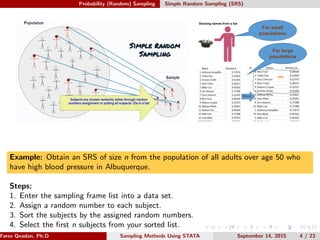
For small
populations
For large
populations
Example: Obtain an SRS of size n from the population of all adults over age 50 who
have high blood pressure in Albuquerque.
Steps:
1. Enter the sampling frame list into a data set.
2. Assign a random number to each subject.
3. Sort the subjects by the assigned random numbers.
4. Select the first n subjects from your sorted list.
Fares Qeadan, Ph.D (Department of Internal Medicine Division of Epidemiology, Biostatistics, & Pre
Sampling Methods Using STATA September 14, 2015 4 / 23
Probability (Random) Sampling Simple Random Sampling (SRS)
How to get an SRS using STATA: In the following example we will
obtain an SRS of 10 students from a BMI Population of 20 Teens.
list displays all
the variables in
STATA's current
memory
clear clears
STATA’s
memory
input is used to
create a small
dataset quickly
save is used to save the data in memory permanently,
replace would overwrite existing dataset.
/* or // are
used for
comments
set seed specifies the
initial value of the
random-number seed
sample 10, count are
used to draw a sample
without replacement of
size 10. Omitting count
will give a sample with
size equal to 10% of the
total observations of the
original data set.
We use save to save the drawn SRS in a data set created in
the specified folder/path by the user.
Fares Qeadan, Ph.D (Department of Internal Medicine Division of Epidemiology, Biostatistics, & Pre
Sampling Methods Using STATA September 14, 2015 5 / 23
Probability (Random) Sampling Systematic sampling
Systematic sampling: it’s a sampling method in which subjects are
chosen in a systematic way such that one first randomly picks the first
subject from the sampling frame and then selects each kth subject from
the list (k = N/n) [1]. If the sampling frame is randomly shuffled, then
systematic sampling is equivalent to SRS.
Advantages:
Fast and easy.
With an appropriate sample size, it provides a highly representative
sample of the target population since, by construction, the sample is
uniformly distributed over the sampling frame.
Disadvantages:
Might lead to bias if the sampling frame is arranged in a specific
pattern and the periodicity of the sampling matched the periodicity of
that pattern.
May not capture certain segments of interest from the target
population.
Fares Qeadan, Ph.D (Department of Internal Medicine Division of Epidemiology, Biostatistics, & Pre
Sampling Methods Using STATA September 14, 2015 6 / 23
Probability (Random) Sampling Systematic sampling
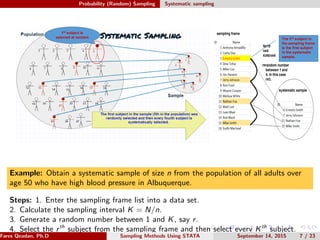
1st
subject is
selected at random The 3rd
subject in
the sampling frame
is the first subject
in the systematic
sample.
Example: Obtain a systematic sample of size n from the population of all adults over
age 50 who have high blood pressure in Albuquerque.
Steps: 1. Enter the sampling frame list into a data set.
2. Calculate the sampling interval K = N/n.
3. Generate a random number between 1 and K, say r.
4. Select the rth
subject from the sampling frame and then select every Kth
subject.
Fares Qeadan, Ph.D (Department of Internal Medicine Division of Epidemiology, Biostatistics, & Pre
Sampling Methods Using STATA September 14, 2015 7 / 23
Probability (Random) Sampling Systematic sampling
How to get a systematic sample using STATA: In the following example we will
obtain a systematic sample of 5 students from a BMI Population of 20 Teens.
Read the BMI
population data set
of N=20 subjects
from a file.
di in STATA is an abbreviation of display. In here,
we compute a random number between 1 and
K=4 to be our starting subject in the selection
process. So, the 3rd
subject in the sampling frame
will be our first subject in the sample.
drop in here deletes the first two rows
(observations) of the data set because
our starting point is the 3rd
one.
gen in STATA creates a new variable to the
data set. In here we create a new ID variable
called newID; its values start from 0.
mod in STATA is the modulus (i.e.,
the remainder after division). In
here, we create a new variable which
takes on 0 at every Kth subject.
drop in here deletes all rows
(observations) that don’t correspond to
the Kth subjects, which leaves us with
the final systematic sample of 5 subjects.
save the systematic
sample of 5 subjects
to a new data set in
a specified folder.
list displays
the
variables in
current
memory
(our final
sample)
Fares Qeadan, Ph.D (Department of Internal Medicine Division of Epidemiology, Biostatistics, & Pre
Sampling Methods Using STATA September 14, 2015 8 / 23
Probability (Random) Sampling Stratified sampling
Stratified sampling: it’s a sampling method in which a sample is obtained by firstly
dividing the population into subpopulations (strata) based on some characteristics and
then an SRS is taken from each stratum [1]. Combining the obtained SRSs will give the
final stratified sample. Minority subgroups of interest can be ensured by stratification.
There are two types of stratified sampling: proportionate and disproportionate. In the
proportionate one, we draw a sample from each stratum in proportion to its share in the
target population. By this method, each stratum should be internally homogeneous.
Advantages:
Has the highest precision among other sampling methods.
The sample is more representative as it allows certain segments of interest, from
the target population, to be captured.
We could use other sampling methods than SRS in each stratum.
Disadvantages:
Might introduce some complexities at the analysis stage.
More time consuming and effort than other sampling methods.
Requires separate sampling frames for each stratum.
Fares Qeadan, Ph.D (Department of Internal Medicine Division of Epidemiology, Biostatistics, & Pre
Sampling Methods Using STATA September 14, 2015 9 / 23
Probability (Random) Sampling Stratified sampling
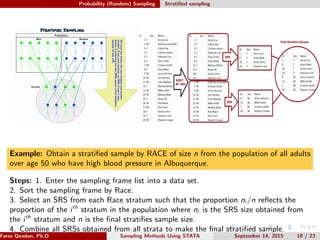
Example: Obtain a stratified sample by RACE of size n from the population of all adults
over age 50 who have high blood pressure in Albuquerque.
Steps: 1. Enter the sampling frame list into a data set.
2. Sort the sampling frame by Race.
3. Select an SRS from each Race stratum such that the proportion ni /n reflects the
proportion of the ith
stratum in the population where ni is the SRS size obtained from
the ith
stratum and n is the final stratifies sample size.
4. Combine all SRSs obtained from all strata to make the final stratified sample.
Fares Qeadan, Ph.D (Department of Internal Medicine Division of Epidemiology, Biostatistics, & Pre
Sampling Methods Using STATA September 14, 2015 10 / 23
Probability (Random) Sampling Stratified sampling
How to get a stratified sample using STATA: In the following example we will obtain
a stratified sample by Gender of 8 students from a BMI Population of 20 Teens.
sort in STATA sorts the data set.
In here we sort the data set by sex.
use in STATA reads/inputs
a data set from a specified
location. In here, we are
getting the BMI population
data of N=20.
by in STATA allow us repeat an analysis for every level of the
specified categorical variable. In here, we compute the
frequency (count) for each of the sex categories.
For every level of the
sex variable we select
an SRS of size 4
list displays the
variables in current
memory (our final
stratified sample)
We save the stratified sample in a folder. The
name of the data set is stratifiedBMI.dta
Fares Qeadan, Ph.D (Department of Internal Medicine Division of Epidemiology, Biostatistics, & Pre
Sampling Methods Using STATA September 14, 2015 11 / 23
Probability (Random) Sampling Cluster sampling
Cluster sampling: it’s a sampling method in which the target population is first divided
into naturally occurring clusters and then a random sample of clusters is obtained such
that all subjects in the randomly selected clusters are included in the sample [1].
Sometimes, we include an SRS from each selected cluster instead of including all subjects
which makes the sampling method to be called a two-stage sampling method. By this
method, clusters should be internally as heterogeneous as the target population itself.
Advantages:
Doesn’t require a sampling frame.
Time and cost efficient compared to other sampling methods.
Cluster samples have larger sample sizes.
Disadvantages:
Produces higher sampling error.
It’s the least representative of the target population among random sampling
methods.
Fares Qeadan, Ph.D (Department of Internal Medicine Division of Epidemiology, Biostatistics, & Pre
Sampling Methods Using STATA September 14, 2015 12 / 23
Probability (Random) Sampling Cluster sampling
Example: Obtain a cluster sample by Geographical Region of size n from the population
of all adults over age 50 who have high blood pressure in Albuquerque.
Steps: 1. Divide the target population into k Geographical Regions (clusters).
2. From the K clusters, select at random h clusters.
3. For each randomly selected cluster include all subjects (adults over age 50 who have
high blood pressure.
4. Combining all selected subjects from the randomly selected clusters makes the final
cluster sample.
Fares Qeadan, Ph.D (Department of Internal Medicine Division of Epidemiology, Biostatistics, & Pre
Sampling Methods Using STATA September 14, 2015 13 / 23
Probability (Random) Sampling Cluster sampling
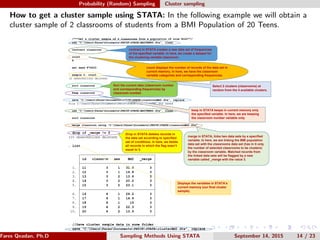
How to get a cluster sample using STATA: In the following example we will obtain a
cluster sample of 2 classrooms of students from a BMI Population of 20 Teens.
contract in STATA creates a new data set of frequencies
of the specified variable. In here, we create a dataset for
the clustering variable classroom.
count displays the number of records of the data set in
current memory. In here, we have the classroom
variable categories and corresponding frequencies.
Select 2 clusters (classrooms) at
random from the 4 available clusters.
Sort the current data (classroom number
and corresponding frequencies) by
classroom number.
keep in STATA keeps in current memory only
the specified variable. In here, we are keeping
the classroom number variable only.
merge in STATA, links two data sets by a specified
variable. In here, we are linking the BMI population
data set with the classrooms data set (has in it only
the number of selected classrooms to be clusters)
by the classroom variable. Matched records from
the linked data sets will be flagged by a new
variable called _merge with the value 3.
Drop in STATA deletes records in
the data set according to specified
set of conditions. In here, we delete
all records in which the flag wasn’t
equal to 3.
Displays the variables in STATA’s
current memory (our final cluster
sample).
Fares Qeadan, Ph.D (Department of Internal Medicine Division of Epidemiology, Biostatistics, & Pre
Sampling Methods Using STATA September 14, 2015 14 / 23
Probability (Random) Sampling Multistage sampling
Multistage sampling: It’s a sampling method in which we use combinations of two or
more sampling methods at least one of which involves randomness [2]. The most
common examples for multistage sampling are Stratified random sampling and cluster
sampling. For example, in the 2 stage cluster sampling, in Stage 1, we use cluster
sampling to choose clusters from a population. Then, in Stage 2, we use simple random
sampling to select a subset from each cluster for the final sample.
Advantages:
Cost and Time effective.
Sometimes, it does not require a sampling frame.
Multistage samples have larger sample sizes.
Disadvantages:
Difficult and complex design.
Partially subjective.
Induces lower accuracy due to higher sampling error.
Fares Qeadan, Ph.D (Department of Internal Medicine Division of Epidemiology, Biostatistics, & Pre
Sampling Methods Using STATA September 14, 2015 15 / 23
Probability (Random) Sampling Multistage sampling
Fares Qeadan, Ph.D (Department of Internal Medicine Division of Epidemiology, Biostatistics, & Pre
Sampling Methods Using STATA September 14, 2015 16 / 23
Probability (Random) Sampling Multistage sampling
Example 1: Obtain a multistage sample of size n from the population of
all adults over age 50 who have high blood pressure in Albuquerque.
Steps: 1. Divide the target population into k Geographical Regions
(clusters).
2. From the K clusters, select at random h clusters.
3. From each randomly selected cluster select an SRS.
4. Combining all selected SRSs makes the final multistage sample.
Example 2: Obtain a multistage sample of size n from the population of
all adults over age 50 who have high blood pressure in Albuquerque.
Steps: 1. Enter the sampling frame list (if available) into a data set.
2. Sort the sampling frame by Race.
3. Select an SRS from each Race stratum such that the proportion ni /n
reflects the proportion of the ith stratum in the population where ni is the
SRS size obtained from the ith stratum and n is the final stratifies sample
size.
4. Combine all SRSs obtained to make the final multistage sample.
Fares Qeadan, Ph.D (Department of Internal Medicine Division of Epidemiology, Biostatistics, & Pre
Sampling Methods Using STATA September 14, 2015 17 / 23
Probability (Random) Sampling Multistage sampling
How to get a multistage sample using STATA: In the following example we will
obtain a multistage sample of size 6 from a BMI Population of 20 Teens.
contract in STATA creates a new data set of frequencies
of the specified variable. In here, we create a dataset for
the clustering variable classroom (FOR STAGE I).
count displays the number of records of the data set in
current memory. In here, we have the classroom
variable categories and corresponding frequencies.
Select 2 clusters (classrooms) at
random from the 4 available clusters.
This is Stage 1.
Sort the current data (classroom number
and corresponding frequencies) by
classroom number.
keep in STATA keeps in current memory only
the specified variable. In here, we are keeping
the classroom number variable only.
merge in STATA, links two data sets by a specified
variable. In here, we are linking the BMI population
data set with the classrooms data set (has in it only
the number of selected classrooms to be clusters)
by the classroom variable. Matched records from
the linked data sets will be flagged by a new
variable called _merge with the value 3.
Drop in STATA deletes records in
the data set according to specified
set of conditions. In here, we delete
all records in which the flag wasn’t
equal to 3.
Displays the variables in STATA’s
current memory (our final cluster
sample).
Get an SRS of size 3 from each
randomly selected cluster (STAGE II)
Fares Qeadan, Ph.D (Department of Internal Medicine Division of Epidemiology, Biostatistics, & Pre
Sampling Methods Using STATA September 14, 2015 18 / 23
Non-Probability Sampling Convenience sampling
Convenience sampling: it’s a non-probability sampling method in which
subjects are conveniently available to the researcher [3]. This is the most
popular method of non-probability sampling and sometimes is called
accidental sampling.
Advantages:
Cheap and simple; requires no planning.
Helpful for pilot studies and hypotheses generation.
Disadvantages:
Unrepresentative of the target population.
Suffers from selection bias.
Remark: For other non-probability sampling methods please revisit [4].
Fares Qeadan, Ph.D (Department of Internal Medicine Division of Epidemiology, Biostatistics, & Pre
Sampling Methods Using STATA September 14, 2015 19 / 23
Sampling Bias Sampling Bias
Sampling Bias: Sampling bias refers to over-representation or
under-representation of some subgroups of the target population. There
are two types of sampling bias including random errors and systematic
errors [5].
Random Error: error is reduced with increased sample size. It’s due to
the sample size. Error is evenly distributed across the sampling frame.
Systematic Error (bias): error is not reduced with increased sample
size. It’s due the design; mainly non-randomness.
Fares Qeadan, Ph.D (Department of Internal Medicine Division of Epidemiology, Biostatistics, & Pre
Sampling Methods Using STATA September 14, 2015 20 / 23
References
References
[1]. Lohr, Sharon (2009). Sampling: design and analysis. Cengage
Learning.
[2]. Foreman, E. K. (1991). Survey sampling principles. CRC Press.
[3]. Trevino, J. J. (2012). Addiction Research Methods edited by Peter
G. Miller, John Strang, Peter M. Miller.
[4]. DePoy, E., and Gitlin, L. N. (2015). Introduction to research:
Understanding and applying multiple strategies. Elsevier Health
Sciences.
[5]. Norell, S. E. (1995). Workbook of epidemiology. Oxford University
Press.
Fares Qeadan, Ph.D (Department of Internal Medicine Division of Epidemiology, Biostatistics, & Pre
Sampling Methods Using STATA September 14, 2015 21 / 23
Citation
How to cite this work:
This work was funded by an NIH grant (1U54GM104944-01A1) through the
National Institute of General Medical Sciences (NIGMS) under the Institutional
Development Award (IDeA) program. Thus, to cite this work please use:
Fares Qeadan (2015). Sampling Methods Using STATA. A short course in
biostatistics for the Mountain West Clinical Translational Research
Infrastructure Network (grant 1U54GM104944). University of New
Mexico Health Sciences Center. Albuquerque, New Mexico.
Fares Qeadan, Ph.D (Department of Internal Medicine Division of Epidemiology, Biostatistics, & Pre
Sampling Methods Using STATA September 14, 2015 22 / 23
Links to Data and Syntax
Thank you.
For questions, Email: FQeadan@salud.unm.edu
For STATA:
Do file: http://www.mathalpha.com/SAMPLING/sampling.do
Fares Qeadan, Ph.D (Department of Internal Medicine Division of Epidemiology, Biostatistics, & Pre
Sampling Methods Using STATA September 14, 2015 23 / 23

sampling.pdf

  • 1.
    Sampling Methods UsingSTATA Fares Qeadan, Ph.D Department of Internal Medicine Division of Epidemiology, Biostatistics, & Preventive Medicine University of New Mexico Health Sciences Center September 14, 2015 Fares Qeadan, Ph.D (Department of Internal Medicine Division of Epidemiology, Biostatistics, & Pre Sampling Methods Using STATA September 14, 2015 1 / 23
  • 2.
    Outline Probability (Random) Sampling Simplerandom sampling (SRS) Systematic sampling Stratified sampling Cluster sampling Multistage sampling Fares Qeadan, Ph.D (Department of Internal Medicine Division of Epidemiology, Biostatistics, & Pre Sampling Methods Using STATA September 14, 2015 2 / 23
  • 3.
    Outline Probability (Random) Sampling Simplerandom sampling (SRS) Systematic sampling Stratified sampling Cluster sampling Multistage sampling Non-Probability Sampling Convenience sampling Volunteer sampling Judgment (Purposive) sampling Snowball sampling Quota sampling Fares Qeadan, Ph.D (Department of Internal Medicine Division of Epidemiology, Biostatistics, & Pre Sampling Methods Using STATA September 14, 2015 2 / 23
  • 4.
    Outline Probability (Random) Sampling Simplerandom sampling (SRS) Systematic sampling Stratified sampling Cluster sampling Multistage sampling Non-Probability Sampling Convenience sampling Volunteer sampling Judgment (Purposive) sampling Snowball sampling Quota sampling Sampling Bias Fares Qeadan, Ph.D (Department of Internal Medicine Division of Epidemiology, Biostatistics, & Pre Sampling Methods Using STATA September 14, 2015 2 / 23
  • 5.
    Outline Probability (Random) Sampling Simplerandom sampling (SRS) Systematic sampling Stratified sampling Cluster sampling Multistage sampling Non-Probability Sampling Convenience sampling Volunteer sampling Judgment (Purposive) sampling Snowball sampling Quota sampling Sampling Bias References Fares Qeadan, Ph.D (Department of Internal Medicine Division of Epidemiology, Biostatistics, & Pre Sampling Methods Using STATA September 14, 2015 2 / 23
  • 6.
    Probability (Random) SamplingSimple Random Sampling (SRS) Simple Random Sampling (SRS): it’s a sampling method in which each subject of the sampling frame has an equal chance of being selected into the sample [1]. SRS is the most popular method of random sampling. There are two types of SRS: with replacement and without replacement. SRS with replacement is less common. Advantages: Easy to use in small populations. With an appropriate sample size, SRS provides a highly representative sample of the target population. Disadvantages: Difficult to use in large populations (expensive: time and cost). Small segments of the target population may not be present in the sample with sufficient number of subjects. Fares Qeadan, Ph.D (Department of Internal Medicine Division of Epidemiology, Biostatistics, & Pre Sampling Methods Using STATA September 14, 2015 3 / 23
  • 7.
    Probability (Random) SamplingSimple Random Sampling (SRS) For small populations For large populations Example: Obtain an SRS of size n from the population of all adults over age 50 who have high blood pressure in Albuquerque. Steps: 1. Enter the sampling frame list into a data set. 2. Assign a random number to each subject. 3. Sort the subjects by the assigned random numbers. 4. Select the first n subjects from your sorted list. Fares Qeadan, Ph.D (Department of Internal Medicine Division of Epidemiology, Biostatistics, & Pre Sampling Methods Using STATA September 14, 2015 4 / 23
  • 8.
    Probability (Random) SamplingSimple Random Sampling (SRS) How to get an SRS using STATA: In the following example we will obtain an SRS of 10 students from a BMI Population of 20 Teens. list displays all the variables in STATA's current memory clear clears STATA’s memory input is used to create a small dataset quickly save is used to save the data in memory permanently, replace would overwrite existing dataset. /* or // are used for comments set seed specifies the initial value of the random-number seed sample 10, count are used to draw a sample without replacement of size 10. Omitting count will give a sample with size equal to 10% of the total observations of the original data set. We use save to save the drawn SRS in a data set created in the specified folder/path by the user. Fares Qeadan, Ph.D (Department of Internal Medicine Division of Epidemiology, Biostatistics, & Pre Sampling Methods Using STATA September 14, 2015 5 / 23
  • 9.
    Probability (Random) SamplingSystematic sampling Systematic sampling: it’s a sampling method in which subjects are chosen in a systematic way such that one first randomly picks the first subject from the sampling frame and then selects each kth subject from the list (k = N/n) [1]. If the sampling frame is randomly shuffled, then systematic sampling is equivalent to SRS. Advantages: Fast and easy. With an appropriate sample size, it provides a highly representative sample of the target population since, by construction, the sample is uniformly distributed over the sampling frame. Disadvantages: Might lead to bias if the sampling frame is arranged in a specific pattern and the periodicity of the sampling matched the periodicity of that pattern. May not capture certain segments of interest from the target population. Fares Qeadan, Ph.D (Department of Internal Medicine Division of Epidemiology, Biostatistics, & Pre Sampling Methods Using STATA September 14, 2015 6 / 23
  • 10.
    Probability (Random) SamplingSystematic sampling 1st subject is selected at random The 3rd subject in the sampling frame is the first subject in the systematic sample. Example: Obtain a systematic sample of size n from the population of all adults over age 50 who have high blood pressure in Albuquerque. Steps: 1. Enter the sampling frame list into a data set. 2. Calculate the sampling interval K = N/n. 3. Generate a random number between 1 and K, say r. 4. Select the rth subject from the sampling frame and then select every Kth subject. Fares Qeadan, Ph.D (Department of Internal Medicine Division of Epidemiology, Biostatistics, & Pre Sampling Methods Using STATA September 14, 2015 7 / 23
  • 11.
    Probability (Random) SamplingSystematic sampling How to get a systematic sample using STATA: In the following example we will obtain a systematic sample of 5 students from a BMI Population of 20 Teens. Read the BMI population data set of N=20 subjects from a file. di in STATA is an abbreviation of display. In here, we compute a random number between 1 and K=4 to be our starting subject in the selection process. So, the 3rd subject in the sampling frame will be our first subject in the sample. drop in here deletes the first two rows (observations) of the data set because our starting point is the 3rd one. gen in STATA creates a new variable to the data set. In here we create a new ID variable called newID; its values start from 0. mod in STATA is the modulus (i.e., the remainder after division). In here, we create a new variable which takes on 0 at every Kth subject. drop in here deletes all rows (observations) that don’t correspond to the Kth subjects, which leaves us with the final systematic sample of 5 subjects. save the systematic sample of 5 subjects to a new data set in a specified folder. list displays the variables in current memory (our final sample) Fares Qeadan, Ph.D (Department of Internal Medicine Division of Epidemiology, Biostatistics, & Pre Sampling Methods Using STATA September 14, 2015 8 / 23
  • 12.
    Probability (Random) SamplingStratified sampling Stratified sampling: it’s a sampling method in which a sample is obtained by firstly dividing the population into subpopulations (strata) based on some characteristics and then an SRS is taken from each stratum [1]. Combining the obtained SRSs will give the final stratified sample. Minority subgroups of interest can be ensured by stratification. There are two types of stratified sampling: proportionate and disproportionate. In the proportionate one, we draw a sample from each stratum in proportion to its share in the target population. By this method, each stratum should be internally homogeneous. Advantages: Has the highest precision among other sampling methods. The sample is more representative as it allows certain segments of interest, from the target population, to be captured. We could use other sampling methods than SRS in each stratum. Disadvantages: Might introduce some complexities at the analysis stage. More time consuming and effort than other sampling methods. Requires separate sampling frames for each stratum. Fares Qeadan, Ph.D (Department of Internal Medicine Division of Epidemiology, Biostatistics, & Pre Sampling Methods Using STATA September 14, 2015 9 / 23
  • 13.
    Probability (Random) SamplingStratified sampling Example: Obtain a stratified sample by RACE of size n from the population of all adults over age 50 who have high blood pressure in Albuquerque. Steps: 1. Enter the sampling frame list into a data set. 2. Sort the sampling frame by Race. 3. Select an SRS from each Race stratum such that the proportion ni /n reflects the proportion of the ith stratum in the population where ni is the SRS size obtained from the ith stratum and n is the final stratifies sample size. 4. Combine all SRSs obtained from all strata to make the final stratified sample. Fares Qeadan, Ph.D (Department of Internal Medicine Division of Epidemiology, Biostatistics, & Pre Sampling Methods Using STATA September 14, 2015 10 / 23
  • 14.
    Probability (Random) SamplingStratified sampling How to get a stratified sample using STATA: In the following example we will obtain a stratified sample by Gender of 8 students from a BMI Population of 20 Teens. sort in STATA sorts the data set. In here we sort the data set by sex. use in STATA reads/inputs a data set from a specified location. In here, we are getting the BMI population data of N=20. by in STATA allow us repeat an analysis for every level of the specified categorical variable. In here, we compute the frequency (count) for each of the sex categories. For every level of the sex variable we select an SRS of size 4 list displays the variables in current memory (our final stratified sample) We save the stratified sample in a folder. The name of the data set is stratifiedBMI.dta Fares Qeadan, Ph.D (Department of Internal Medicine Division of Epidemiology, Biostatistics, & Pre Sampling Methods Using STATA September 14, 2015 11 / 23
  • 15.
    Probability (Random) SamplingCluster sampling Cluster sampling: it’s a sampling method in which the target population is first divided into naturally occurring clusters and then a random sample of clusters is obtained such that all subjects in the randomly selected clusters are included in the sample [1]. Sometimes, we include an SRS from each selected cluster instead of including all subjects which makes the sampling method to be called a two-stage sampling method. By this method, clusters should be internally as heterogeneous as the target population itself. Advantages: Doesn’t require a sampling frame. Time and cost efficient compared to other sampling methods. Cluster samples have larger sample sizes. Disadvantages: Produces higher sampling error. It’s the least representative of the target population among random sampling methods. Fares Qeadan, Ph.D (Department of Internal Medicine Division of Epidemiology, Biostatistics, & Pre Sampling Methods Using STATA September 14, 2015 12 / 23
  • 16.
    Probability (Random) SamplingCluster sampling Example: Obtain a cluster sample by Geographical Region of size n from the population of all adults over age 50 who have high blood pressure in Albuquerque. Steps: 1. Divide the target population into k Geographical Regions (clusters). 2. From the K clusters, select at random h clusters. 3. For each randomly selected cluster include all subjects (adults over age 50 who have high blood pressure. 4. Combining all selected subjects from the randomly selected clusters makes the final cluster sample. Fares Qeadan, Ph.D (Department of Internal Medicine Division of Epidemiology, Biostatistics, & Pre Sampling Methods Using STATA September 14, 2015 13 / 23
  • 17.
    Probability (Random) SamplingCluster sampling How to get a cluster sample using STATA: In the following example we will obtain a cluster sample of 2 classrooms of students from a BMI Population of 20 Teens. contract in STATA creates a new data set of frequencies of the specified variable. In here, we create a dataset for the clustering variable classroom. count displays the number of records of the data set in current memory. In here, we have the classroom variable categories and corresponding frequencies. Select 2 clusters (classrooms) at random from the 4 available clusters. Sort the current data (classroom number and corresponding frequencies) by classroom number. keep in STATA keeps in current memory only the specified variable. In here, we are keeping the classroom number variable only. merge in STATA, links two data sets by a specified variable. In here, we are linking the BMI population data set with the classrooms data set (has in it only the number of selected classrooms to be clusters) by the classroom variable. Matched records from the linked data sets will be flagged by a new variable called _merge with the value 3. Drop in STATA deletes records in the data set according to specified set of conditions. In here, we delete all records in which the flag wasn’t equal to 3. Displays the variables in STATA’s current memory (our final cluster sample). Fares Qeadan, Ph.D (Department of Internal Medicine Division of Epidemiology, Biostatistics, & Pre Sampling Methods Using STATA September 14, 2015 14 / 23
  • 18.
    Probability (Random) SamplingMultistage sampling Multistage sampling: It’s a sampling method in which we use combinations of two or more sampling methods at least one of which involves randomness [2]. The most common examples for multistage sampling are Stratified random sampling and cluster sampling. For example, in the 2 stage cluster sampling, in Stage 1, we use cluster sampling to choose clusters from a population. Then, in Stage 2, we use simple random sampling to select a subset from each cluster for the final sample. Advantages: Cost and Time effective. Sometimes, it does not require a sampling frame. Multistage samples have larger sample sizes. Disadvantages: Difficult and complex design. Partially subjective. Induces lower accuracy due to higher sampling error. Fares Qeadan, Ph.D (Department of Internal Medicine Division of Epidemiology, Biostatistics, & Pre Sampling Methods Using STATA September 14, 2015 15 / 23
  • 19.
    Probability (Random) SamplingMultistage sampling Fares Qeadan, Ph.D (Department of Internal Medicine Division of Epidemiology, Biostatistics, & Pre Sampling Methods Using STATA September 14, 2015 16 / 23
  • 20.
    Probability (Random) SamplingMultistage sampling Example 1: Obtain a multistage sample of size n from the population of all adults over age 50 who have high blood pressure in Albuquerque. Steps: 1. Divide the target population into k Geographical Regions (clusters). 2. From the K clusters, select at random h clusters. 3. From each randomly selected cluster select an SRS. 4. Combining all selected SRSs makes the final multistage sample. Example 2: Obtain a multistage sample of size n from the population of all adults over age 50 who have high blood pressure in Albuquerque. Steps: 1. Enter the sampling frame list (if available) into a data set. 2. Sort the sampling frame by Race. 3. Select an SRS from each Race stratum such that the proportion ni /n reflects the proportion of the ith stratum in the population where ni is the SRS size obtained from the ith stratum and n is the final stratifies sample size. 4. Combine all SRSs obtained to make the final multistage sample. Fares Qeadan, Ph.D (Department of Internal Medicine Division of Epidemiology, Biostatistics, & Pre Sampling Methods Using STATA September 14, 2015 17 / 23
  • 21.
    Probability (Random) SamplingMultistage sampling How to get a multistage sample using STATA: In the following example we will obtain a multistage sample of size 6 from a BMI Population of 20 Teens. contract in STATA creates a new data set of frequencies of the specified variable. In here, we create a dataset for the clustering variable classroom (FOR STAGE I). count displays the number of records of the data set in current memory. In here, we have the classroom variable categories and corresponding frequencies. Select 2 clusters (classrooms) at random from the 4 available clusters. This is Stage 1. Sort the current data (classroom number and corresponding frequencies) by classroom number. keep in STATA keeps in current memory only the specified variable. In here, we are keeping the classroom number variable only. merge in STATA, links two data sets by a specified variable. In here, we are linking the BMI population data set with the classrooms data set (has in it only the number of selected classrooms to be clusters) by the classroom variable. Matched records from the linked data sets will be flagged by a new variable called _merge with the value 3. Drop in STATA deletes records in the data set according to specified set of conditions. In here, we delete all records in which the flag wasn’t equal to 3. Displays the variables in STATA’s current memory (our final cluster sample). Get an SRS of size 3 from each randomly selected cluster (STAGE II) Fares Qeadan, Ph.D (Department of Internal Medicine Division of Epidemiology, Biostatistics, & Pre Sampling Methods Using STATA September 14, 2015 18 / 23
  • 22.
    Non-Probability Sampling Conveniencesampling Convenience sampling: it’s a non-probability sampling method in which subjects are conveniently available to the researcher [3]. This is the most popular method of non-probability sampling and sometimes is called accidental sampling. Advantages: Cheap and simple; requires no planning. Helpful for pilot studies and hypotheses generation. Disadvantages: Unrepresentative of the target population. Suffers from selection bias. Remark: For other non-probability sampling methods please revisit [4]. Fares Qeadan, Ph.D (Department of Internal Medicine Division of Epidemiology, Biostatistics, & Pre Sampling Methods Using STATA September 14, 2015 19 / 23
  • 23.
    Sampling Bias SamplingBias Sampling Bias: Sampling bias refers to over-representation or under-representation of some subgroups of the target population. There are two types of sampling bias including random errors and systematic errors [5]. Random Error: error is reduced with increased sample size. It’s due to the sample size. Error is evenly distributed across the sampling frame. Systematic Error (bias): error is not reduced with increased sample size. It’s due the design; mainly non-randomness. Fares Qeadan, Ph.D (Department of Internal Medicine Division of Epidemiology, Biostatistics, & Pre Sampling Methods Using STATA September 14, 2015 20 / 23
  • 24.
    References References [1]. Lohr, Sharon(2009). Sampling: design and analysis. Cengage Learning. [2]. Foreman, E. K. (1991). Survey sampling principles. CRC Press. [3]. Trevino, J. J. (2012). Addiction Research Methods edited by Peter G. Miller, John Strang, Peter M. Miller. [4]. DePoy, E., and Gitlin, L. N. (2015). Introduction to research: Understanding and applying multiple strategies. Elsevier Health Sciences. [5]. Norell, S. E. (1995). Workbook of epidemiology. Oxford University Press. Fares Qeadan, Ph.D (Department of Internal Medicine Division of Epidemiology, Biostatistics, & Pre Sampling Methods Using STATA September 14, 2015 21 / 23
  • 25.
    Citation How to citethis work: This work was funded by an NIH grant (1U54GM104944-01A1) through the National Institute of General Medical Sciences (NIGMS) under the Institutional Development Award (IDeA) program. Thus, to cite this work please use: Fares Qeadan (2015). Sampling Methods Using STATA. A short course in biostatistics for the Mountain West Clinical Translational Research Infrastructure Network (grant 1U54GM104944). University of New Mexico Health Sciences Center. Albuquerque, New Mexico. Fares Qeadan, Ph.D (Department of Internal Medicine Division of Epidemiology, Biostatistics, & Pre Sampling Methods Using STATA September 14, 2015 22 / 23
  • 26.
    Links to Dataand Syntax Thank you. For questions, Email: FQeadan@salud.unm.edu For STATA: Do file: http://www.mathalpha.com/SAMPLING/sampling.do Fares Qeadan, Ph.D (Department of Internal Medicine Division of Epidemiology, Biostatistics, & Pre Sampling Methods Using STATA September 14, 2015 23 / 23