CHAPTER 1
Objectives of the chapter
 Understanding management concepts
 Characteristics of management
 Functions of management
MANAGEMENT
 Management is the attainment of organizational goals in
an effective and efficient manner through planning,
organizing, staffing, directing and controlling
organizational resources.
 Organizational resources include men(human beings),
money, machines and materials.
Characteristics
 Management is a distinct process.
 Management is an organized activity
 Management aims at the accomplishment of
predetermined objectives.
 Management is both a science and an art.
 Management is a group activity
 Management principles are universal in nature
 Management integrates human and other resources.
Steps in MBO
 To establish long-term and short-tem organizational goals
 To establish long-term and short-term objectives for each
manager, clarifying the key performance standards
 Periodic review of performance
 Encouraging managers to accept responsibility
Benefits of MBO
 The need for planning will be recognized
 It provides for objectives and accountability for
performance
 It encourages participative management
 It helps in job enrichment
 It provides for a good feedback system
FEATURES
 Management involves five functions
 These functions are organised to achieve organisational
goals.
 Management involves effective and efficient use of
resources
FUNCTIONS OF MANAGEMENT
 PLANNING
 ORGANIZING
 STAFFING
 DIRECTING
 CONTROLLING
• Planning is determining the objectives and formulating
the methods to achieve them. It is more simply said than
done. A job well planned is half done. During planning
one needs to ask oneself the following:
• What am I trying to accomplish i.e. what is my objective?
• What resources do I have and do I need to accomplish the
same?
• What are the methods and means to achieve the
objectives?
• Is this the optimal path?
PLANNING
• Purposes or missions,
• Objectives-It is the ultimate goal towards which the activities of the
organization are directed
• Strategies-general program of action and deployment of resources
• Policies-general statement or understanding which guide or channel
thinking in decision making
• Procedures-states a series of related steps or tasks to be performed in
a sequential way
• Rules-prescribes a course of action and explicitly states what is to be
done
• Programs-comprehensive plan that includes future use of different
resources
• Budgets-statement of expected results expressed in numerical terms
Types of Planning
 Take Time to Plan
 Planning can be Top to Down or Bottom to Top
 Involve and Communicate with all those Concerned
 Plans must be Flexible and Dynamic
 Evaluate and Revise
Principles of Planning
1. Determining the goals or objectives for the entire
organization.
2. Making assumptions on various elements of the
environment.
3. To decide the planning period.
4. Examine alternative courses of actions.
5. Evaluating the alternatives.
6. Real point of decision making
7. To make derivative plans.
Steps in Planning
 Determine what is to be done/ Division of Work:
 Assign Tasks: Departmentalization:
 Link Departments: Hierarchy Development:
 Decide how much Authority to Designate/ Authority,
Responsibility and Delegation:
 Decide the Levels at which Decisions are to be made /
Centralization vs. Decentralization:
 Decide how to Achieve Coordination:
Process of Organizing
Definition 1
 Selecting and training individuals for specific job
functions, and charging them with the associated
responsibilities.
Definition 2
 Number of employed personnel in an organization or
program. Also called workforce.
STAFFING
 Provides positive and dynamic leadership
 Provides maximum opportunities
 Provides proper motivation of personnel
 Ability to command people
DIRECTING/LEADING
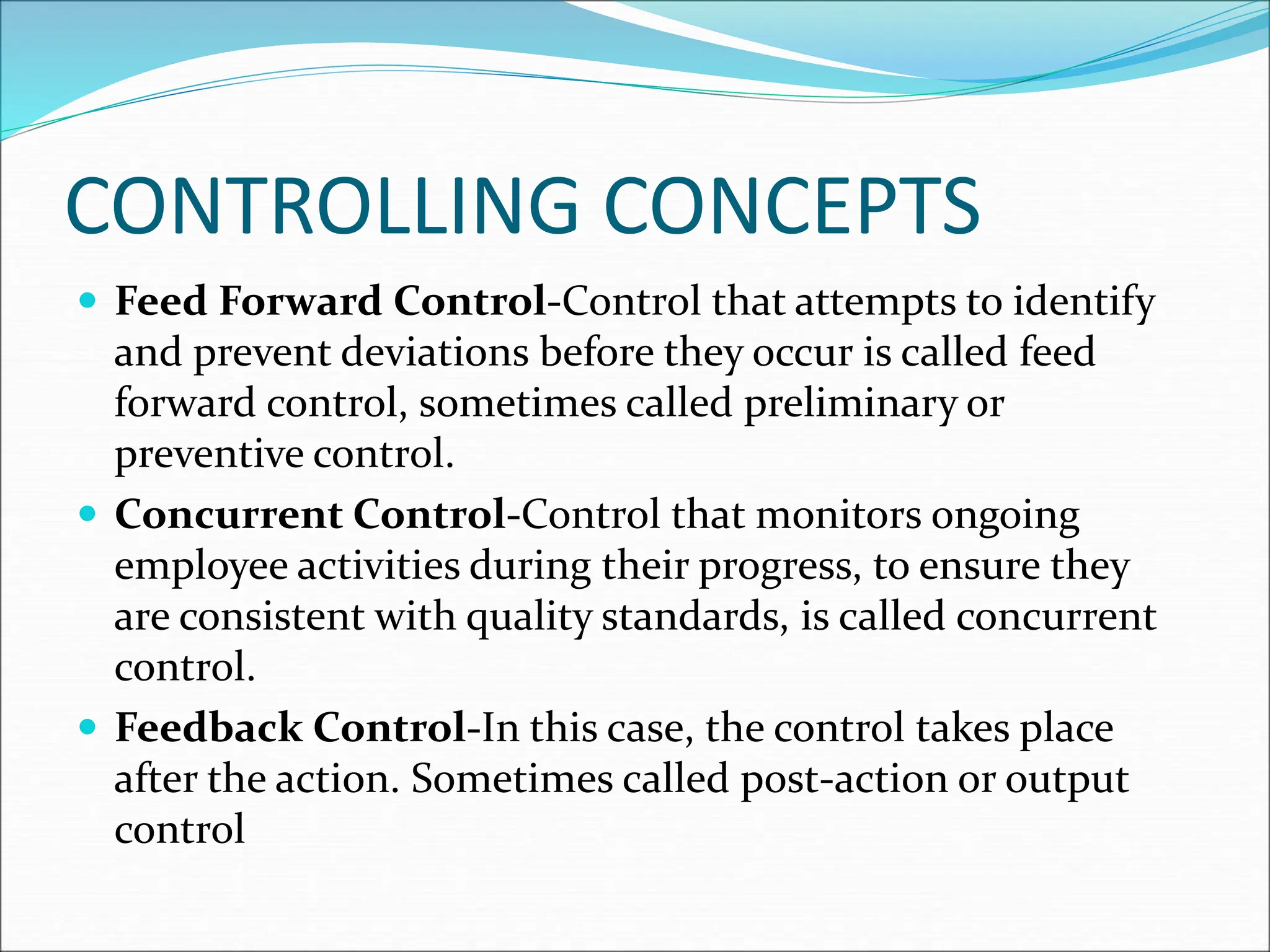
 Feed Forward Control-Control that attempts to identify
and prevent deviations before they occur is called feed
forward control, sometimes called preliminary or
preventive control.
 Concurrent Control-Control that monitors ongoing
employee activities during their progress, to ensure they
are consistent with quality standards, is called concurrent
control.
 Feedback Control-In this case, the control takes place
after the action. Sometimes called post-action or output
control
CONTROLLING CONCEPTS
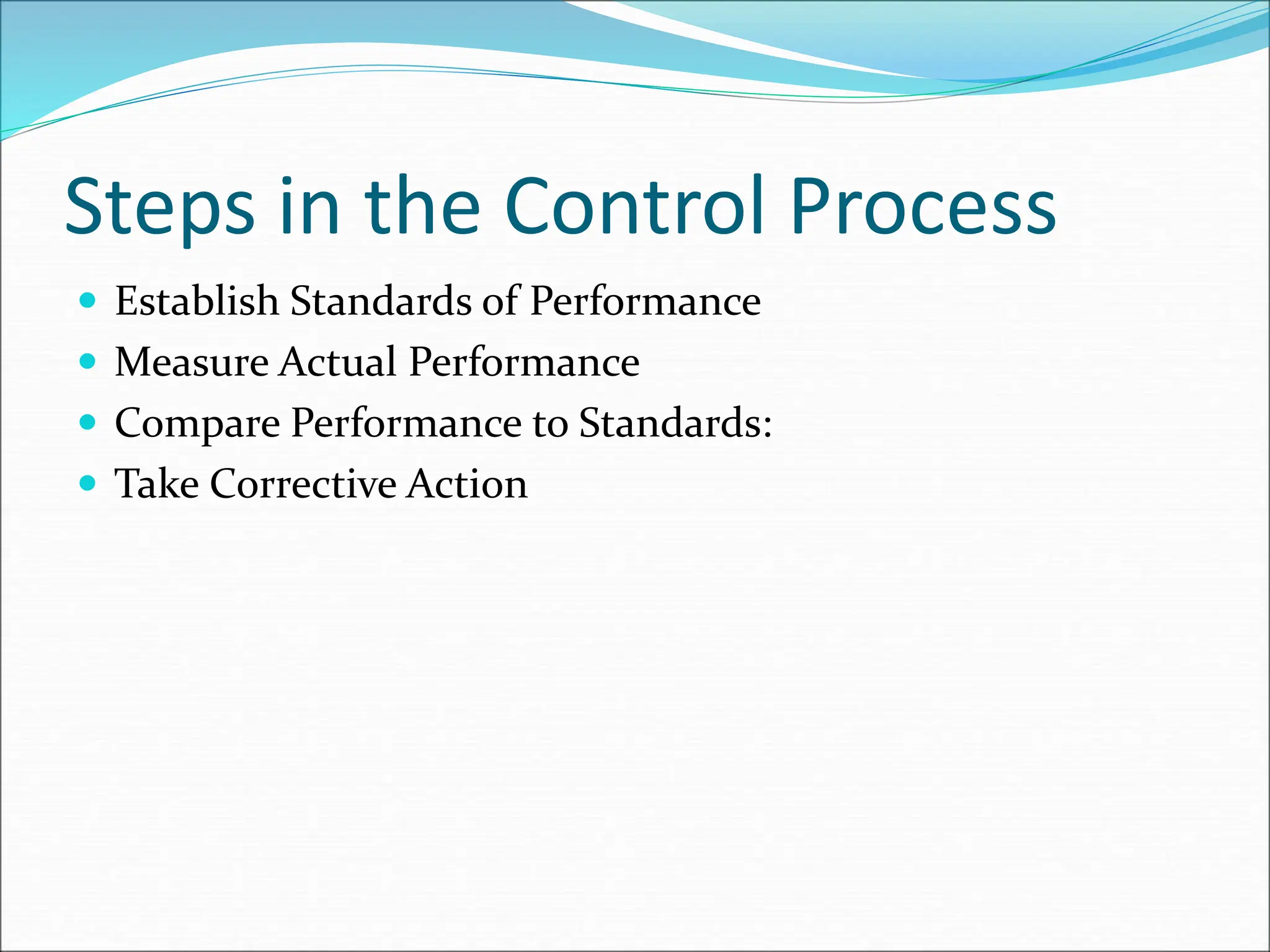
 Establish Standards of Performance
 Measure Actual Performance
 Compare Performance to Standards:
 Take Corrective Action
Steps in the Control Process
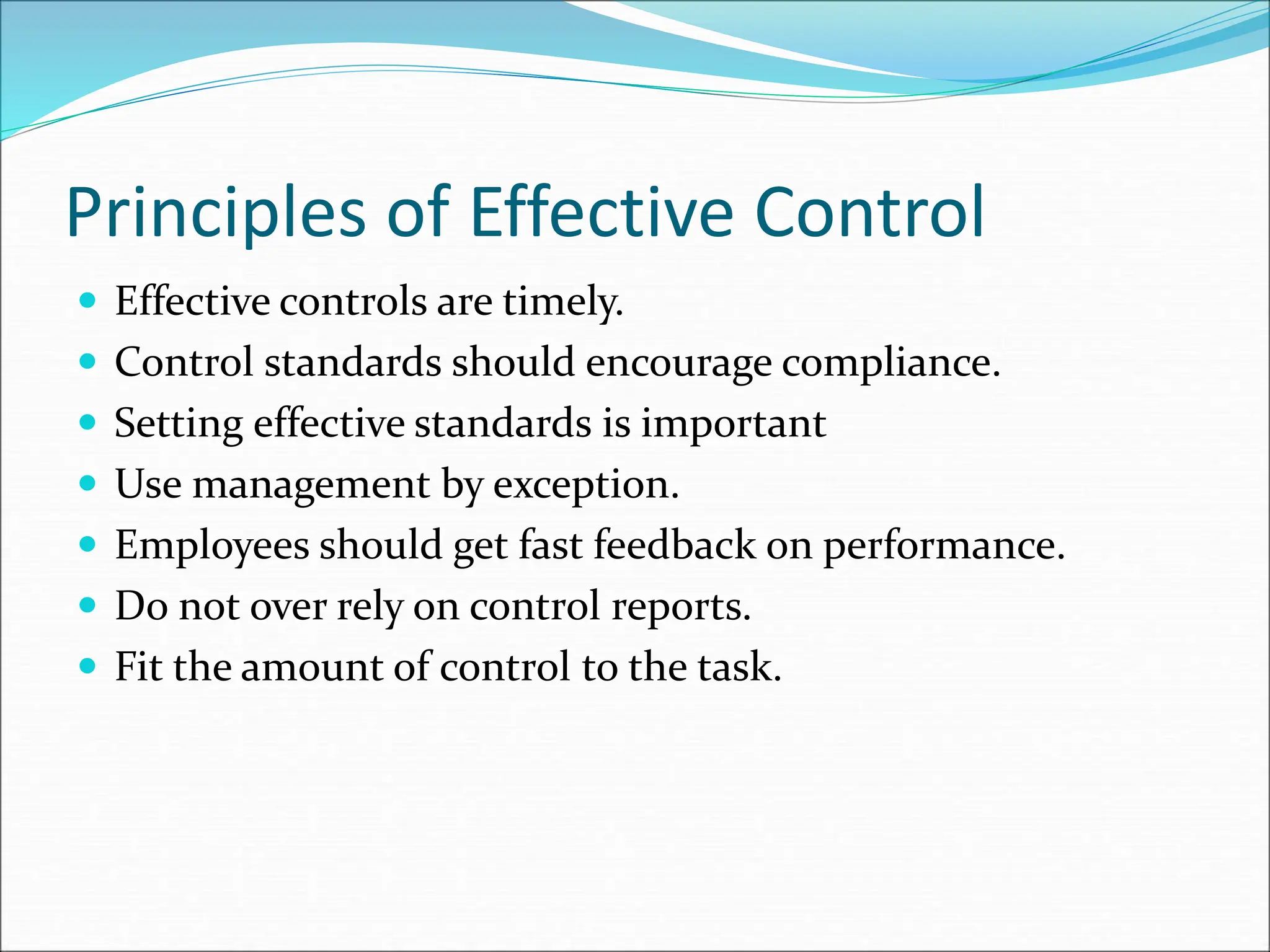
 Effective controls are timely.
 Control standards should encourage compliance.
 Setting effective standards is important
 Use management by exception.
 Employees should get fast feedback on performance.
 Do not over rely on control reports.
 Fit the amount of control to the task.
Principles of Effective Control
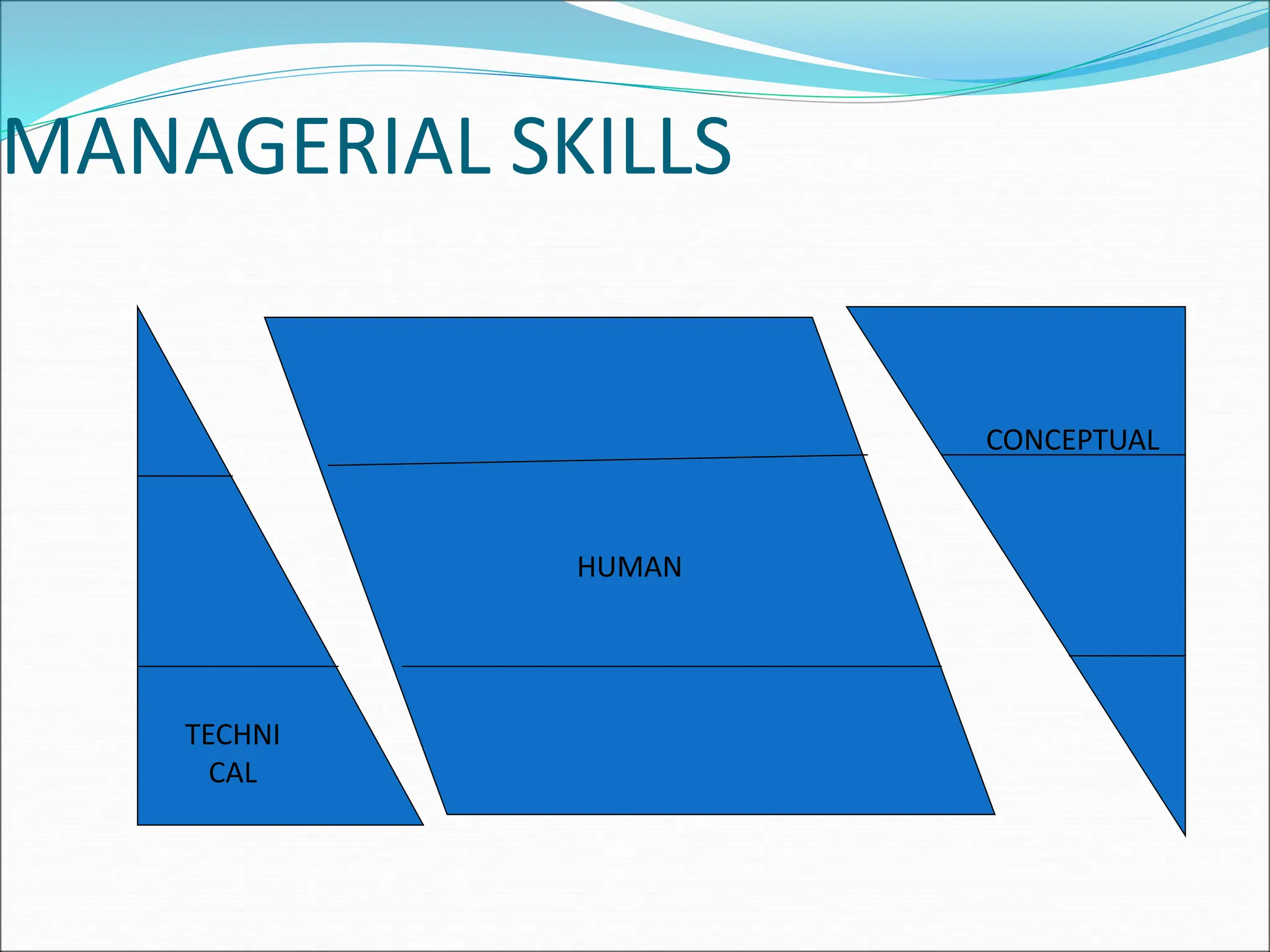
MANAGERIAL SKILLS
HUMAN
TECHNI
CAL
CONCEPTUAL
TECHNICAL SKILLS
A persons’ knowledge and ability to make effective use of any
process or technique constitutes his technical skills.
For eg: Engineer, accountant, data entry operator, lawyer,
doctor etc.
HUMAN SKILLS
An individuals’ ability to cooperate with other members of
the organization and work effectively in teams.
For eg: Interpersonal relationships, solving people’s problem
and acceptance of other employees.
CONCEPTUAL SKILLS
Ability of an individual to analyze complex situations and to
rationally process and interpret available information.
For eg: Idea generation and analytical process of information.
MANAGER’S ROLES
 Interpersonal role
 Informational role
 Decisional role
INTERPERSONAL ROLE
 Figurehead- ethical guidelines and the principles of
behavior employees are to follow in their dealings with
customers and suppliers
 Leader- give direct commands and orders to subordinates
and make decisions
 Liaison-coordinate between different departments and
establish alliances between different organizations
INFORMATIONAL ROLE
 Monitor- evaluate the performance of managers in
different functions
 Disseminator-communicate to employees the
organization’s vision and purpose
 Spokesperson- give a speech to inform the local community
about the organization’s future intentions
DECISIONAL ROLE
 Entrepreneur- commit organization resources to develop
innovative goods and services
 Disturbance handler- to take corrective action to deal with
unexpected problems facing the organization from the
external as well as internal environment
 Resource allocator- allocate existing resources among
different functions and departments
 Negotiator- work with suppliers, distributors and labor
unions
TYPES OF MANAGERS
 FIRST-LINE MANAGERS- often called supervisors stand at
the base of the managerial hierarchy
 MIDDLE MANAGERS- heads of various departments and
organise human and other resources to achieve
organizational goals
 TOP MANAGERS- set organizational goals, strategies to
implement them and make decisions
WHAT MAKE MANAGERS
SUCCESSFUL?
 Hard work
 Smart work
 Patience
 Out of box thinking
 Reading and acquiring knowledge
 Ethical consciousness
 Collaborative relationship
 Perseverance
Thank you

Management ppt.ppt

  • 1.
  • 2.
    Objectives of thechapter  Understanding management concepts  Characteristics of management  Functions of management
  • 3.
    MANAGEMENT  Management isthe attainment of organizational goals in an effective and efficient manner through planning, organizing, staffing, directing and controlling organizational resources.  Organizational resources include men(human beings), money, machines and materials.
  • 4.
    Characteristics  Management isa distinct process.  Management is an organized activity  Management aims at the accomplishment of predetermined objectives.  Management is both a science and an art.  Management is a group activity  Management principles are universal in nature  Management integrates human and other resources.
  • 5.
    Steps in MBO To establish long-term and short-tem organizational goals  To establish long-term and short-term objectives for each manager, clarifying the key performance standards  Periodic review of performance  Encouraging managers to accept responsibility
  • 6.
    Benefits of MBO The need for planning will be recognized  It provides for objectives and accountability for performance  It encourages participative management  It helps in job enrichment  It provides for a good feedback system
  • 7.
    FEATURES  Management involvesfive functions  These functions are organised to achieve organisational goals.  Management involves effective and efficient use of resources
  • 9.
    FUNCTIONS OF MANAGEMENT PLANNING  ORGANIZING  STAFFING  DIRECTING  CONTROLLING
  • 10.
    • Planning isdetermining the objectives and formulating the methods to achieve them. It is more simply said than done. A job well planned is half done. During planning one needs to ask oneself the following: • What am I trying to accomplish i.e. what is my objective? • What resources do I have and do I need to accomplish the same? • What are the methods and means to achieve the objectives? • Is this the optimal path? PLANNING
  • 11.
    • Purposes ormissions, • Objectives-It is the ultimate goal towards which the activities of the organization are directed • Strategies-general program of action and deployment of resources • Policies-general statement or understanding which guide or channel thinking in decision making • Procedures-states a series of related steps or tasks to be performed in a sequential way • Rules-prescribes a course of action and explicitly states what is to be done • Programs-comprehensive plan that includes future use of different resources • Budgets-statement of expected results expressed in numerical terms Types of Planning
  • 12.
     Take Timeto Plan  Planning can be Top to Down or Bottom to Top  Involve and Communicate with all those Concerned  Plans must be Flexible and Dynamic  Evaluate and Revise Principles of Planning
  • 13.
    1. Determining thegoals or objectives for the entire organization. 2. Making assumptions on various elements of the environment. 3. To decide the planning period. 4. Examine alternative courses of actions. 5. Evaluating the alternatives. 6. Real point of decision making 7. To make derivative plans. Steps in Planning
  • 14.
     Determine whatis to be done/ Division of Work:  Assign Tasks: Departmentalization:  Link Departments: Hierarchy Development:  Decide how much Authority to Designate/ Authority, Responsibility and Delegation:  Decide the Levels at which Decisions are to be made / Centralization vs. Decentralization:  Decide how to Achieve Coordination: Process of Organizing
  • 15.
    Definition 1  Selectingand training individuals for specific job functions, and charging them with the associated responsibilities. Definition 2  Number of employed personnel in an organization or program. Also called workforce. STAFFING
  • 16.
     Provides positiveand dynamic leadership  Provides maximum opportunities  Provides proper motivation of personnel  Ability to command people DIRECTING/LEADING
  • 17.
     Feed ForwardControl-Control that attempts to identify and prevent deviations before they occur is called feed forward control, sometimes called preliminary or preventive control.  Concurrent Control-Control that monitors ongoing employee activities during their progress, to ensure they are consistent with quality standards, is called concurrent control.  Feedback Control-In this case, the control takes place after the action. Sometimes called post-action or output control CONTROLLING CONCEPTS
  • 18.
     Establish Standardsof Performance  Measure Actual Performance  Compare Performance to Standards:  Take Corrective Action Steps in the Control Process
  • 19.
     Effective controlsare timely.  Control standards should encourage compliance.  Setting effective standards is important  Use management by exception.  Employees should get fast feedback on performance.  Do not over rely on control reports.  Fit the amount of control to the task. Principles of Effective Control
  • 20.
  • 21.
    TECHNICAL SKILLS A persons’knowledge and ability to make effective use of any process or technique constitutes his technical skills. For eg: Engineer, accountant, data entry operator, lawyer, doctor etc.
  • 22.
    HUMAN SKILLS An individuals’ability to cooperate with other members of the organization and work effectively in teams. For eg: Interpersonal relationships, solving people’s problem and acceptance of other employees.
  • 23.
    CONCEPTUAL SKILLS Ability ofan individual to analyze complex situations and to rationally process and interpret available information. For eg: Idea generation and analytical process of information.
  • 24.
    MANAGER’S ROLES  Interpersonalrole  Informational role  Decisional role
  • 25.
    INTERPERSONAL ROLE  Figurehead-ethical guidelines and the principles of behavior employees are to follow in their dealings with customers and suppliers  Leader- give direct commands and orders to subordinates and make decisions  Liaison-coordinate between different departments and establish alliances between different organizations
  • 26.
    INFORMATIONAL ROLE  Monitor-evaluate the performance of managers in different functions  Disseminator-communicate to employees the organization’s vision and purpose  Spokesperson- give a speech to inform the local community about the organization’s future intentions
  • 27.
    DECISIONAL ROLE  Entrepreneur-commit organization resources to develop innovative goods and services  Disturbance handler- to take corrective action to deal with unexpected problems facing the organization from the external as well as internal environment  Resource allocator- allocate existing resources among different functions and departments  Negotiator- work with suppliers, distributors and labor unions
  • 28.
    TYPES OF MANAGERS FIRST-LINE MANAGERS- often called supervisors stand at the base of the managerial hierarchy  MIDDLE MANAGERS- heads of various departments and organise human and other resources to achieve organizational goals  TOP MANAGERS- set organizational goals, strategies to implement them and make decisions
  • 29.
    WHAT MAKE MANAGERS SUCCESSFUL? Hard work  Smart work  Patience  Out of box thinking  Reading and acquiring knowledge  Ethical consciousness  Collaborative relationship  Perseverance
  • 30.