From 
Generation to Generation 
An Activity Guidebook 
in the Living Tradition of 
Seed Saving 
By 
Eli Rogosa Kaufman 
growseed@yahoo.com 
A Publication of Fedco Seeds
From Generation to Generation 
Contents 
2 
1. Introduction – p. 3-5 
Plant a Seed so your Heart will Grow 
Grade-by-Grade Seed Project Chart 
2. Family Garden – p. 6 
My Family - Plant Families 
Seed to Bread 
3. Wild Garden – p. 7-8 
Restoring Schoolyard Habitats 
Wild Seeds 
4. Native Garden – p. 9-10 
Growing a Three Sisters Garden 
5. Heirloom Garden – p. 11-12 
Seeds and Stories 
6. Seed and Civilization – p. 13-16 
Biodiversity and the Potato 
The Garden Community 
Planting the Future 
The Mishnah - ‘Way of Seed’ 
7. Soil and Seed - p.17 
Soil and Seed 
What Makes Good Potting Soil? 
8. Seed and Sprout p. 18 
How do Seeds Develop in Flowers? 
Sprouts 
Monocots and Dicots 
Seeking the Source 
9 . School Seed Store – p. 19-23 
Organizing the Program 
Packing Seeds - Seed Math 
Ethical Business Considerations 
10. Seed Saving – p. 24-34 
Why Save Seed? 
Seed Basics and Secrets 
Pollination 
Preserving Heritage and Diversity 
Harvesting and Testing 
11. How to Save Seeds – p. 35-38 
Self-Pollinators: Lettuce, Tomatoes, Beans 
Cross-Pollinators: Squash 
Breed Your Own Vegetables 
12. Seed-Saving Guide - p. 39-42 
13. Resources – p. 43-49 
Fedco Seed Store Catalog, Books 
“The seeds that gardeners hold in their hands 
are living links in an unbroken chain reaching 
Copyright 2001 by Eli Rogosa Kaufman 
back into antiquity.” 
Suzanne Ashworth, Seed To Seed
1. 
From Generation to Generation 
Consider the miracle of the seed. In just 100 days one tiny seed weighing no more than 1/250th of a 
gram matures into a 8 to 9 inch head of broccoli weighing a pound or more, better than a one hundred 
thousand-fold increase in just over three months. The most brazen stock market trader wouldn't dream 
of such profits! 
Too many children grow up with no conception of what nature can accomplish or where our food 
comes from. Do they think it appears spontaneously on a supermarket shelf, or worse, at their local 
fast-food establishment? How can we restore understandings about food, a most basic need? 
We dream that every child in every classroom will be given the opportunity to start seeds, grow a 
garden, experience the vital sensation of their hands working in the soil, the thrill of watching their 
seeds sprout and their plants grow, the satisfaction of working together with others to take part in a 
miracle. 
To help fulfill this dream Fedco offers From Generation to Generation, a seed education program with 
grade-by-grade activities to bring young gardeners through the full cycle from seed to seed. By 
growing gardens and saving seeds, young people can reconnect to past generations of farmers and 
gardeners, renew food and farming traditions in their own community and work together to plant a 
sustainable future. 
CR Lawn 
Fedco Seeds 
To request a catalog contact: 
FEDCO 
PO Box 520 
Waterville, ME 04903 
Phone (207) 
Order seeds through the catalog by mail, fax or internet. No phone orders please. 
3 
426-9900
“Plant a Seed so your Heart will Grow.” 
4 
Hafez 
To re-imagine farming is to see it as an act of healing, where through story, 
imagination and the strength that arises through working with the earth, 
we can repair, somehow, the wounds of the soul and those of the world. 
From Generation to Generation invites young people on a journey of discovery by working with 
nature in ways that are rare in today’s culture. Seed saving, once an essential skill passed from 
generation to generation by traditional farmers, is almost a lost art, as is the farming heritage out of 
which seed saving arose. Our food plants have evolved through a unique partnership with farmers. By 
careful observation, experimentation and selection, traditional farmers transformed wild plants into the 
foods that nourish us today. Yet how many of today’s farmers and gardeners still know how to save 
their own seed? 
Just as a healthy garden supports a vital diversity of plants and animals in an interdependent web of 
life, the seeds of culture and learning are nurtured within complex interconnected relationships in the 
living whole of the child’s inner, natural, and social community. Garden-based education can produce 
fertile minds, vital hearts and empowered young people. What experiences create an ecology of 
education for children to care for themselves, nature and community? 
By saving seeds, young people not only discover the cycle of a plant from seed to seed, but reconnect to 
the generations of farmers who have sustained our communities in the past. By saving seeds, young 
people can become stewards of native and heirloom plants in partnership with nature. 
Our From Generation to Generation Workshop series provides schools with practical support to 
create school gardens, composting and seed-saving programs adapted to the unique environment, 
community heritage and vision of their schools and communities. 
“Imagination is more important than knowledge” Einstein 
“The real deserts are deserts of the imagination” Laupo Lugari, Gaviotas 
Although we may feel overwhelmed by the challenges that surround us, nothing prevents us from 
changing ourselves, our culture of education and our schoolyard. We hold the seed in our hand. 
At the heart of a successful school gardening program are young people excited by what they can do 
on their own. More important than how many seeds we save is how we awaken the hearts of young 
people who may feel too small to make much difference. We save seeds in school not only to protect 
endangered plants, but to grow young people with a feeling that they can make a real difference in 
their world. The energy that awakens through growing and saving seeds can encourage a school 
ecology of sustainable relationships that nourish young people on many levels. 
Seed Journals 
From Generation to Generation offers resources in the art and 
science of seed saving as a pathway to hands-on science and 
school gardening. Journaling is a tool for teachers to coach 
creativity. Journaling is a way for students to map their 
journey, record their story and creative ideas. Keeping a 
journal is a first step in becoming a creative scientist or artist. 
A journal is as unique as each person. 
Extension: Research Leonardo daVinci’s journals.
Grade-by-Grade Project Chart 
From Generation to Generation provides a grade-by-grade journey of seed-saving projects that 
weave together ecology, gardening and community-on-the-land themes. 
GRADE INQUIRY THEME GARDEN 
5 
K 
Caring for 
Myself, Friends 
and Nature 
Caring for 
Nature through 
the Seasons 
Nature’s Garden 
Wheat: From Seed to Bread 
1- 2 
How do 
Homes and Families 
Nurture Individuals? 
What family is this plant ? 
Homes & 
Families 
Family Garden 
Our Families / Plant Families 
Wheat: From Seed to Bread, 
Snack Garden 
1- 2 
How do individuals in 
Natural and Human 
Ecosystems 
help each other? 
Nature 
Neighborhood 
Native Garden 
Wild Garden 
Three Sisters: 
Corn, Beans, Squash 
3 
Working together in 
a healthy community - 
How community heritage 
inspires our future 
Community 
Heirloom Garden 
Saving Seeds of 
Heirloom Vegetables 
4 
How diversity builds 
healthy communities & 
plants, soil and water 
Community 
Heritage 
On the Land 
Heritage Garden 
Seeds and Stories 
5 
Land, People,Technology. 
Human Impact - 
Landscape Ecology 
Bioregion 
Heritage Garden 
Farm to City Food Systems 
6 
Soil Stewards 
Soil & Civilization Wasteshed 
Bio-Intensive Garden 
Sustainable Food Systems, 
School Composting 
7 
Water Stewards 
Watershed 
Restoration 
Watershed 
Water Garden 
Water Quality Monitoring, 
Aquaponics, Hydroponics 
8 Seed Stewards Biodiversity 
Seed Garden 
Seed-Savers 
9- 12 Action Projects 
Community 
Problem-Solving 
Designing Sustainable 
Solutions 
Breeding New Vegetables
2. 
Family Garden 
Goal: To discover how people, plants and all creatures are all part of a mutually nurturing family 
system and all need a home or a habitat. To research how people organize plant characteristics. 
Inquiry: Where are seeds from? How can we organize food plants? What can we look at? Why? 
Activities: 
My Family Tree: Make a family tree of your brothers and sisters, parents, aunts and uncles, cousins 
and grandparents. Take time to make it as beautiful as possible. 
Gather Seeds in Fall 
Visit an organic farm or farmers’ market. 
Harvest or buy several varieties of winter 
squashes, pumpkins, sunflowers, Indian 
corn, peas in the pod, melons and other 
vegetables with large visible seeds. 
Separate, rinse, dry and display the seeds. 
Bake the squash, make pumpkin pie, grind 
the corn into flour, roast the pumpkin and 
sunflower seeds (try it with a bit of oil, 
tamari and garlic), eat the melon... 
Meet the Vegetable Families 
Organize into groups: 
Squash and Pumpkin - Tomatoes of all types - Cantaloupe and Honeydew - Beans and Peas in a pod 
Scoop out and rinse seeds. Dry in the shade on paper towels. Label. What is the same and different? 
Classify Seeds 
How can we classify seeds? Set out bowls on trays with a variety of seeds from different vegetable 
families. Feel, touch, and smell the seeds. Create a display showcasing seeds and vegetable families. 
Extension: Create your own system to organize plants and their seeds. 
Note: Use only wild or untreated seeds. Conventional seeds may have coatings of toxic fungicides. 
Reading: Seed to Seed by Susan Ashworth – a complete seed-saving guide with detailed instructions. 
6 
Seed to Bread 
Bread from many hands, from many lands 
The art and heritage of growing wheat, threshing golden sheaves, 
winnowing chaff in the wind, grinding grains into soft flour and 
baking bread has roots in almost every culture. When grains are 
golden dry, harvest by hand and thresh by rubbing between your 
hands or beating on a blanket or tarp. 
Research and recreate the folklore and arts of bread baking, wheat 
weaving and harvest festivals. Who has a family member who can 
teach how to bake: challah from Israel, pita from Palestine, scones from 
Scotland, tortillas from Tijuana, focaccia from Florence… 
Read: Bread, Bread, Bread by Ann Morris, with photos of children 
from around the world with their breads.
3. 
Wild Garden 
7 
“Every cultivated plant was once a wild plant. 
Every edible wild plant represents a possible new 
vegetable.” Carol Deppe 
Goal 
Restore wild habitats on school grounds to 
discover the hidden world of wild plants, 
insect pollinators, birds and native habitats, 
and the vital importance of wild habitats for 
healthy food gardens. 
Inquiry 
How do members in human and nature 
neighborhoods help each other? 
Are wild gardens good for food gardens? 
How can nature return to our schoolyard? 
Background 
Why should we restore a school habitat for 
wild plants, birds, butterflies, and bugs? 
Habitat loss is the greatest threat to 
biodiversity - the complex diversity of life 
on Earth. 34,000 plant species, 12% of plants 
worldwide and 29% of plants in the United 
States, have become so rare that they could 
easily disappear. In the United States over 
2400 acres of habitat are lost every day 
<www.plantsavers.org>. More and more of the 
planet’s land surface is covered by human 
settlements or farmland. As a result, wild ecosystems are lost and the diversity of life is diminishing 
daily. <www.ipmworld.umn.edu/chapters/eigenbr.htm> 
Our goal is to return the processes of agroecology to wild ecology. With diversity as the goal, design 
your food garden with abundant opportunities for nature to return. Healthy gardens need wild 
habitats for beneficial insects that control insect pests, for pollinators and for small animals. 
Activity: Create a schoolyard biodiversity sanctuary. A wild garden of native plants is a place where 
young people can explore the interconnectedness of all life. The entire school community can be 
involved in restoring a school habitat sanctuary. 
Restoring nature on school grounds is simple. Mark off an area of the schoolyard with tree stumps, 
rocks and natural borders. Let it go wild. Stop mowing. Walk only on trails. If the land is packed 
down, spade open the soil. Add wild soil gathered from a meadow or forest. Cover with mulch (straw, 
grass clippings, leaves). Soon a rich diversity of native and naturalized plants of all varieties will grow. 
Insect activity will increase. Birds especially like a small pond, brush covers and wildflowers. 
Do not be discouraged at the slow pace of growth. Many meadow plants spend the first season setting 
roots with very little leafy plant growth. Some perennial plants do not bloom in the first year. It takes 
several years to restore a healthy wild habitat.
8 
Bug Buddies 
“You don’t have a snail problem. You have a duck deficiency!” Bill Mollison 
The insects in wild gardens are essential for a healthy food garden 
community. Beneficial insects are nature’s control for the insect pests that eat 
our food plants. The tiny aphids that eat your lettuce leaves are the food for 
ladybugs. The preying mantis lives on the bugs that eat garden vegetables. 
Insect pollinators that carry the pollen grains on their legs from flower to 
flower are essential in the life cycle of plants. When we use chemicals to 
destroy garden pests, we lose the good bugs too, and hurt the garden 
ecosystem. 
Wild Seeds 
Inquiry: 
How are seeds planted in nature? If all the seeds just fell to the soil below, they would crowd each 
other out. How do seeds travel without a farmer to plant them? Can you find these seeds in the forest 
and meadow: 
Hitchhikers – burdock … 
Floaters – milkweed, dandelion… 
Poppers – jewelweed… 
Spinners – maple… 
Droppers – acorns… 
How far can a dandelion seed float? 
Activities: 
Remember: Leave the place so no one can tell you were there. 
* Seed Sock - Pull big old woolen socks over your leg and 
arm and tape them around. Walk in the meadow in fall. 
Did anyone hitchhike a ride? 
* Seed Soil - Carefully dig up meadow soil in fall. Put the 
soil in a tray inside and water. What grows? 
* Seed Gifts – Collect wild seeds and a sample mother plant in fields and meadows. Wrap seeds in 
calico fabric and give as a gift, or sell in your seed store. Press, mount and label seeds and plants. 
* Seed Stalk Display - Carefully collect wild plants gone to seed. Create a beautiful display of the seed 
stalks, with signs and posters about how nature disperses and plants its seed. 
* Find hidden pollinators. Sit quietly in a wild garden. Watch how insects visit spring flowers. 
* Make a trail guide and signs to identify wild plants and habitats on your nature trail.
4. 
Native Garden 
9 
Who are the Three Sisters? 
The Three Sisters are a special family.... 
“In late spring, we plant the corn and beans and 
squash. They're not just plants - we call them the 
three sisters. We plant them together, three kinds of 
seeds in one hill. They want to be together with each 
other, just as we Indians want to be together with 
each other. So long as the three sisters are with us we 
know we will never starve. The Creator sends them 
to us each year. We celebrate them now. We thank 
the Creator for the gifts given us today and every 
day.” 
Chief Louis Farmer (Onondaga) 
How the Three Sisters help each other 
The Three Sisters, corn, beans, and squash, are 
the traditional Native American garden foods of 
North America. Each of the Three Sisters helps 
the others grow. 
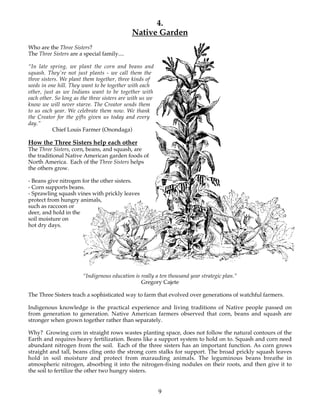
- Beans give nitrogen for the other sisters. 
- Corn supports beans. 
- Sprawling squash vines with prickly leaves 
protect from hungry animals, 
such as raccoon or 
deer, and hold in the 
soil moisture on 
hot dry days. 
“Indigenous education is really a ten thousand year strategic plan.” 
Gregory Cajete 
The Three Sisters teach a sophisticated way to farm that evolved over generations of watchful farmers. 
Indigenous knowledge is the practical experience and living traditions of Native people passed on 
from generation to generation. Native American farmers observed that corn, beans and squash are 
stronger when grown together rather than separately. 
Why? Growing corn in straight rows wastes planting space, does not follow the natural contours of the 
Earth and requires heavy fertilization. Beans like a support system to hold on to. Squash and corn need 
abundant nitrogen from the soil. Each of the three sisters has an important function. As corn grows 
straight and tall, beans cling onto the strong corn stalks for support. The broad prickly squash leaves 
hold in soil moisture and protect from marauding animals. The leguminous beans breathe in 
atmospheric nitrogen, absorbing it into the nitrogen-fixing nodules on their roots, and then give it to 
the soil to fertilize the other two hungry sisters.
Researchers are just now beginning to discover scientific reasons why the Three Sisters method is such 
an effective farming system. As our global population grows, we face critical food needs. Let us learn 
from the traditional Native farmers who understand how to farm in harmony with the Earth. 
Native people and native plants have evolved in partnership together over centuries. The people 
sustain the plants and the plants sustain the people in one total living ecosystem. Generations of Native 
gardeners have saved seeds of wild and garden crops. Many of these plants and their fragile habitats 
are destroyed every day by the heavy bulldozers and suffocating concrete of modern development. 
Where are the Native Americans today who have protected the land and plants of this place? 
“We shared a new understanding of the hard and joyous work of saving living seeds. And weeding, we shared 
weeding. Armored in long pants and long-sleeved shirts, big hats and sunscreen, wielding serrated knives and 
dandelion cutters, shovels, hoes and picks, we pulled row after row of green beings engaged in a winning struggle 
with our precious crops... 
I weed for someone who is not yet born. In the years ahead she will visit our farm. She will seek a seed that was a 
gift to us, desire a taste that has nourished generations, need to eat a word that is food. At home she will plant 
Segualca remembering her grandmother. As she harvests and prepares it, she will touch old hands, hear distant 
voices. Native Seeds/SEARCH strives to fulfill that overwhelming future need. So, I weed.” 
Source: Native Seed/SEARCH website <www.nativeseeds.org> 
Inquiry: 
How do Native American garden plants help each other ? 
How can we work with and learn from Native American teachings to protect the land today? 
Activity - Planting a Three Sisters Garden 
In Spring when the oak leaves are the size of a deer’s ear - stand with two other friends in garden soil 
ready for planting. Clasp each other’s hands to make a circle together. Place your circle three people’s 
outstretched arms from other people’s circles. Everything in your circle is part of the Three Sisters 
garden. Look up to see the birds and bugs flying above your circle. Look down to the soil creatures 
crawling under the soil. All the life in the circle above and below is part of the Three Sisters Garden. 
Make a hill of a hand height in the soil that is the same size circle as your arm-circle (about 2-3 feet 
across). In the center plant seven corn kernels a hand apart in a circle. When the corn has grown as tall 
as your hands – plant beans a hand apart in a circle around the corn. Plant seven squash seeds around 
the edge of the circle. As the beans grow gently wind them around the corn. As the squash grows, 
guide them outside the circle. 
Many Native American tribes honor the seven directions, Father Sky above, Mother Earth below, north, 
south, east, and west. Feel these directions with your feet firmly standing in this place. The seventh 
direction, the center of the circle, is in our heart. 
Books: 
Keepers of the Earth series, especially Keepers of Life, by Michael Caduto 
Native American Gardening by Michael Caduto and Joseph Bruchac 
Buffalo Bird Woman retold by Gilbert Wilson 
Indian Uses of Native Plants by Edith Allen Murphey 
Resources: 
* Native Seed /SEARCH : A nonprofit organization and seed catalogue preserving Native American 
seeds and farming traditions: nativeseeds.org 
10
5. 
Heirloom Garden 
11 
What is an heirloom? 
What are your own family heirlooms? If 
they are too precious to bring in, can you 
draw or photograph them? Ask your 
parents and grandparents. Visit or call 
older relatives. Create a class display 
showcasing the unique family histories, 
traditions and stories of family heirlooms. 
Research and write down the stories and 
tales of family heirlooms. Write a class 
book about family heirlooms and the 
history and stories that each tell. 
Does anyone in your family garden or 
grow heirloom seeds? 
What are the special vegetables, foods and 
recipes of your family and community 
heritage? 
Seeds and Stories 
Seed catalogues are new in the field of agriculture. The first seed companies in the US were established 
in the late 1700s. A hundred years ago, when our great-grandparents were born, half of the people 
were farmers - one of every two people! Today only two percent are farmers. Where did all those 
farmers get their seeds? For thousands of years people have saved their own seeds. Every farmer 
depended on the seed they and their neighbors saved to plant next year’s crop. 
The food plants that nourish us have evolved from wild plants as 
traditional farmers saved seed from vegetables that were tasty, 
easy to harvest, and survived diseases and pests. Heirloom seeds 
have been handed down as family favorites from generation to 
generation. These varieties are our vegetable heritage - a vital 
inheritance that we can grow in our garden. 
Each heirloom has a story to tell, a history of real people in real 
places. By growing heirloom crops, each of us becomes a link to 
restoring the food and farming traditions in our own community. 
When immigrants came to this country they brought cherished 
seed varieties. Europeans brought lettuce, cabbage, turnips, 
cucumbers, squash, beans, wheat, barley and more. They came to a 
new continent rich with native peoples and native food crops. 
Native North Americans introduced tomatoes, potatoes, corn, 
squash, and beans from South America. Native Americans still 
raise native food crops cultivated over centuries. Immigrant plants 
that flourished in the New World and the living traditions of 
Native American peoples are today’s heirloom plants. Many of 
these old varieties are still being grown by home gardeners. As 
fewer people farm, the heirloom seeds and the stories of the people 
who grew them are being forgotten.
The Story of Abenaki Calais Flint Corn 
The summer of 1816 was so cold in New England that there was a snow storm or severe frost every 
month. Thousands of settlers pulled up stakes and headed West seeking a more hospitable climate. In 
the remote northern Vermont valley wherein lies the village of Calais only one kind of corn survived. 
Grown by the local Abenaki Native American tribe for generations and given to settlers, the variety, 
also known as Roy’s Calais Flint Corn, was the sole sustenance for many families that year. Kept by the 
Fair family since that time, the corn was saved from extinction when Native Americans in this 
generation rescued a 10 year-old jar of seed in Roy Fair’s basement, grew it out and shared it again with 
local farmers. Later Calais farmers gave some of the seed to Vermont seedsman Tom Stearns who 
shared it with Fedco. This Abenaki treasure is used for making corn meal and Johnny Cakes - a living 
teaching of the age-old benefits of regionally adapted heirloom varieties and of the continued 
generosity of Native American farmers to this day. Source: Lorraine Landers, Dawnland Center 
12 
Inquiry: 
Why was the Abenaki corn the only crop to 
survive? 
Extensions: 
* Research ways that plants survive by 
adapting to their unique environment. 
* Write a story describing how a difficult 
experience made you stronger. 
* Visit a local restoration farm or village. 
Visit the Plimouth Plantation 
<www.plimoth.org>, a living history 
museum with a seed-saving program. 
* Visit your local historical society, research 
the farming and land use history of your 
community. 
* Make a map of your community one 
hundred years ago and today, with displays 
comparing the food system and use of 
resources. 
Debate: Do you agree or disagree: 
The colonization of native resources is 
justified on the ground that indigenous 
people do not “improve” their land and 
resources. 
Read: Biopiracy by Vandana Shiva 
Visit: <www.vshiva.net>
6. 
Seed and Civilization 
Biodiversity and Potatoes 
“75 percent of all the seeds ever used in agriculture are 
estimated to have become extinct by 1990. Ninety five percent are expected 
to be extinct by the year 2000. We are depleting our genetic base by 
overdependence on too few highly specialized varieties. When compost is 
added to soil, normal open-pollinated crop varieties produce yields equal 
to high Green Revolution-type yields with a fraction of the resources and 
fewer insect and disease problems.” John Jeavons 
Inquiry: What’s wrong with having only a handful of varieties? 
Over the past two generations many small regional seed companies have gone out of business or have 
been bought out by large multinational seed companies. As the small seed companies disappear, so are 
many of the regionally adapted open-pollinated vegetables that they maintain. Heirloom varieties, 
adapted to local climate conditions, such as early maturing vegetables suited to northern New 
England’s short summer, are too tender to withstand a 3000-mile journey from a factory farm to your 
table. Are the multinational conglomerates which now control the seed industry interested in small 
farm or local community needs? Local varieties are being replaced with a few expensive hybrids 
tailored to needs of large farms and huge food processors who dominate the production system. The 
Seed Savers Exchange estimates that 97% of the vegetable varieties grown in the US in 1900 are lost. 
13 
What caused the Irish Potato Famine ? 
The Irish potato famine led to the death or 
displacement of 2.5 million people in the 1840s. Why? 
Potatoes are not from Ireland. All Irish potatoes 
descend from a handful of potatoes brought back to 
Europe from South America in the 1600s. This potato 
monoculture proved susceptible to late blight, a 
disease caused by the fungus Phytophthora infestans. 
South American potato farmers have hundreds of 
potato varieties, many of which are resistant to the 
disease. All of the Irish farmers grew a few varieties 
which succumbed to the fungal disease. 
Strength in Diversity 
Uniformity in crops makes them vulnerable to disease. 
Did you know about the US corn blight epidemic in 
1970? All the corn hybrids were descended from one 
single blight-susceptible variety. 15% of our corn was 
lost, however most of the old open-pollinated corn varieties are resistant to the blight! 
See: <http://journeytoforever.org/seeds.html> 
Advanced Activity - Return to Resistance 
Research the innovative work of Dr. Raoul Robinson who refined how to breed disease and pest 
resistant vegetables by selecting only the hardiest plants for seed. “Our best vegetable lines now outyield 
the commercial lines. The commercial lines have been sprayed and ours have not,” says Dr. Robinson. Breeding 
that reduces the need for pesticides offers health and economic benefits for farmers world-wide. 
Pesticides are a serious health threat to agricultural workers and a major source of water and land 
pollution. See: <www.idrc.ca/books/reports/1997/17-01e.html> 
Inquiry: Can organic farming feed the world? Research bio-intensive garden methods that can feed the 
world without any chemicals: <http://solstice.crest.org/sustainable/ecology_action/index.html>
The Garden Community 
Who is part of the garden community? An ecological community includes all the microbes, plants, 
bugs, animals and people that interact with each other and share available resources within a defined 
environment. An ecological community, or ecosystem, is all the parts in the environment. The garden 
community embraces: 
* bacteria, plants, insects, animals and people 
* the elements; light, air, wind, water and soil. 
A food garden is a unique community where people are an integral part of the ecosystem. 
14 
Design for Diversity 
An ecological garden or 
farm is designed to sustain 
a high level of 
biodiversity. If a 
community sustains a 
great number of species, 
its diversity is high. The 
higher the biological 
diversity in a community, 
the greater its stability, 
adaptability and resilience 
to pests and disease or 
climate change. 
Habitats 
Each species in the garden 
occupies its own 
ecological niche or role 
that it fulfills in the 
community. Environments 
containing a variety of 
habitats are better able to 
provide for the range of 
needs in a diverse 
community. 
Activity: Webbing a Community 
Go outdoors and stand in or near the garden. Each person will choose part of the garden community 
(i.e.: sunlight, snail, earthworm, birds, sunflower). Write or draw it on an index card and tape on each 
person’s chest. Stand in a circle. Give one person a ball of yarn. Ask: “Who needs you or who do you 
need?” Hold onto the yarn and pass it to that person/part. Continue until everyone is interconnected in 
a web of life. When everyone is connected ask: What if a chemical was sprayed to kill all the bugs? 
Create Foodweb Art showing Everybody is Somebody’s Lunch: 
All of the bacteria, fungi plants, insects and animal need food to live and are food for others. Green 
plants (primary producers) draw energy from the sun to make food. Animals, such as deer or cows, eat 
plants (herbivores). Some animals eat other animals (carnivores) or eat everything (omnivores). Tiny 
microbial creatures and fungi (decomposers) consume old plants, animals and waste, and transform 
them into the humus in soil that nourishes new plants. 
Extension 
Adopt-a-Creature or Plant in the garden. Research and make posters, dioramas and displays about a 
garden community member. Create face masks and write Voices of Nature theater. Act out an 
impromptu play - Day in the Life of Our Garden.
Planting the Future 
Seed-Saving Projects 
Purpose: 
Students establish their own seed company and school garden to grow out and sell rare seeds, use 
school compost and restore native wild habitats. 
Inquiry: 
What seeds are heirlooms with a story to tell? How can we restore biodiversity and save threatened 
heirloom seeds? How can we transform our cafeteria food-waste to a profitable resource? 
Background: 
Can a small group of committed people change the world? What difference can one person make? Most 
of us feel overwhelmed by the enormity of the environmental problems. What can we do? 
If Waldoboro can do it, why not you! 
A small group of high school kids in Waldoboro, Maine decided they could make a difference. They 
started an organic school garden using compost from their lunch scraps. They contacted the Seed 
Savers Exchange, a non-profit organization that coordinates an exchange of heirloom seeds. They 
requested rare and endangered seeds. The kids researched and made displays of the places, people 
and stories connected to the seeds. They grow out more rare seeds every year, and now have an 
extensive seed catalogue that offers hundreds of endangered vegetable seeds. 
Why not send for the Medomak catalogue, buy rare seeds to grow out and see what kids can do ! 
Medomak Valley High School 
Heirloom Seed Project 
320 Manktown Road 
Waldoboro, Maine 04572 
Sample Letter to Medomak Heirloom Seed Project: or local gardeners: 
Dear Mr. Thurston, 
My name is Eli. We are starting an heirloom garden in my school, and collecting seeds and their 
stories. Would you please send me the ___ that you offer? I would appreciate if you could tell us about 
the history of the seed and why you save it. We will grow out the seed and reoffer it to the public. 
Sincerely, 
Eli 
Resources 
Seeds of Diversity <www.seeds.ca> 
Seed Savers Exchange <www.seedsavers.org> 
15
Seed and Torah 
“Of what avail is an open eye, if the heart is blind?” Rabbi Ibn-Givrol, 12th c. 
Food is central to our being, our culture and our relationship to the other living beings on our planet. 
Farming is at the core of how each person interacts with their environment. The issues raised by 
farming and food systems are among the most critical that we face as a society in the 21st century. 
Consider how our food choices and the food system that “we buy into” impacts our relationships, our 
community and economy. 
Mishnah - The Order of Seeds 
ancient teachings for today 
“He that goes forth bearing precious seeds shall return rejoicing, 
bringing home the sheaves of wheat.” Psalm 126:6 
The six volumes of the Mishnah (which means “to renew”) were written down from the second to the 
fifth century in Israel. The Mishnah documented the vast body of living traditions of ancient Israeli 
people, most of whom were farmers. The comments and questions which Rabbis wrote in the margins 
of the Mishnah have evolved into forty volumes of Talmud, which is still being commented on today! 
The first volume of the Mishnah is called Seder Zeriam which means The Order of Seeds. Why did 
ancient Rabbis think it was so important to write about seeds? What did they teach? Believe it or not, 
they wrote a lot about seed saving! Page after page describes isolation distances to maintain traditional 
vegetable varieties. The Mishnah describes many other traditional farming practices, such as leaving 
corners of the field unharvested for hungry people to partake freely: 
“This is the custom of the Hebrew farmers – when reaping the wheat field, 
leave the corners of the field for the hungry and the widow to glean.” 
Activity: 
Conduct a web-search about the Mishnah and Talmud. Write your own “mishnah” for future 
generations about the importance of protecting biodiversity and heirloom seeds. What five other 
themes would you write on? Perhaps two millennia hence someone will read it… 
Global / Local Lunch Bag 
Inquiry: Where does your food come from? 
Activity: Divide into teams and bring in or buy: 
1. a typical lunch bought at a 2. a lunch of locally grown 
supermarket foods bought at a food co-op 
16 
or farmer’s market. 
Younger: What part of the plant are your vegetables from? 
Advanced: Where in the world is your food from? Use a world map to chart the route of a food from 
the farm to your table. Try to list ALL the people and activities that bring a favorite food to you. What 
are the direct and hidden long-term costs? Discuss social, environmental and economic implications. 
Extension: Map your watershed and foodshed. Debate: who profits from chain supermarkets?
17 
7. 
Soil and Seed 
Let us nourish the soil so that it in return may nourish us; 
for any sustainable culture has its roots in the land. 
Waste is Food. 
Deep in the forest an earthworm burrows through the moist soil and covers a 
tiny seed with its rich castings. The earthworm draws nourishment from 
decomposing leaves from last season. The seed, awakened by the wetness, begins 
to germinate. Its leaves push through rotting leaves to reach towards the 
shafting light. Its roots stretch deep to the rich soil below. 
Composting transforms the food that sustained us into nutrients that sustain the earth. Although 
composting is simple (put vegetable foodscraps in a pile with leaves, soil and a bit of water, and wait 
for it to decompose), the complex foodweb in compost systems and soil are key to understanding vast 
global lifecycles of nutrients and elements. When we compost, we restore the life cycles that sustain us. 
Activity: 
Establish a school composting program to nourish your garden. Introduce composting and invite a 
motivated class to start the program. Decide who will do each job. Build a compost bin. Separate, 
collect and weigh the food scraps in a 5-gallon bucket. Use only vegetable, grain and fruit scraps - no 
meat, dairy or oils. Bring the food scraps to the compost. Mix with leaves or hay and a bit of soil. Rinse 
the buckets and return them to the cafeteria. The compost is ready when is smells like sweet forest soil. 
What makes Good Potting Soil? 
“We know more about the heavens above than the soil under our feet.” daVinci 
Inquiry: 
What is in soil? What is a good potting soil recipe? What conditions promote healthy seed germination? 
Activity: Discovering Living Soil 
1. What’s in soil? Put soil from various locations in jars. Add water. Cover. 
Shake. Watch layers settle. 
2. Gather potting soil ingredients: peat moss, soft rotted forest logs, 
decomposed leaves, 
earthworm castings, compost, 
top soil, sand, small pebbles, 
sterile potting soil…etc. 
Feel, smell and describe. 
3. Using recycled clear plastic bottles with the bottoms cut 
off, put equal amounts of the soil raw ingredients into 
upside-down bottles. Pour in equal amounts of water. 
Collect in cups placed underneath. Test for: drainage and 
water-holding capacity. 
4. Mix ingredients in measured proportions, put in 
planting containers and record recipe. Label and date. Plant. Which fosters germination? Nourishes 
robust growth? Is susceptible to damping-off? 
Extensions: Interview organic farmers for favorite recipes and tips on potting soil recipes. 
Use a magnifying glass and microscope to investigate who lives in the soil ecosystem. 
Write a myth for today based on the connection/disconnection between ‘humans’ and ‘humus’. 
Visit the Microbe Zoo: <http://commtechlab.msu.edu/sites/dlc-me/zoo> and www.soilfoodweb.com
8. 
Seed and Sprout 
18 
Background: 
Every seed encases a tiny embryonic 
plant that can rest dormant for years in 
dark, cold and dryness until the right 
conditions for growth awaken it. When 
touched by moisture, warmth and air 
the seed swells up with life. 
Every seed contains a tiny plant baby 
(embryo) and the nourishment to feed 
the tiny plant when it first starts to 
grow. The seed holds rich food with 
concentrated nutrients (protein, starch 
and minerals). When a seed germinates, 
sweet sugars are produced that nourish 
the tiny seedling. This makes sprouts 
delicious, nutritious, full of life and 
easy to digest. 
Inquiry: What’s inside a seed? Which sprouts are tasty to eat? 
Activity: Soak large bean seeds overnight. Carefully open the swollen 
seeds. Find the baby plant surrounded by its food source. Try a taste. 
Eat or compost it. 
Sprout raw sunflower seeds, alfalfa, lentils. Try many kinds of seeds. 
Soak overnight. Pour out water (save to bring outside for your 
garden). Keep sprouts in a glass jar and rinse once or twice daily. 
They are sweetest to eat in about three days. 
Monocots and Dicots 
Inquiry: Which seedlings start with two leaves? Which grow from 
only one leaf? 
Activity: Soak squash and bean, corn and wheat seeds. Place in a 
clear container supported by or covered with moist towels for good 
observation. Carefully examine daily. Using a magnifying glass, 
examine and draw each stage of growth. 
Extension: Make a flip book or cartoon strip of a plant growing. 
Seeking the Source 
Leaves are drawn to light. Roots reach down below. Whatever way you 
plant the seed, it knows which way to go. 
Inquiry: How do seeds know which way to grow? 
Activities: 
* Seed Spiral - Soak beans overnight. Place one on the center of a cardboard circle covered with a moist 
paper towel. Wrap in plastic wrap with holes for air. Open up to mist daily. Place upright and rotate 
daily. Watch the seedling germinate and reach to the light and earth. Compost it after the experiment. 
* Place a pot of seedlings on a bright window sill. Rotate and watch the leaves turn towards the light.
10. 
School Seed Store 
A seed store at your school can be a fund-raiser with a wholesome green message. Fedco offers two 
options: the packet seed store and the bulk seed store. Whichever you choose, whatever theme you 
desire for your store, we will help you select varieties for resale to parents and school supporters. 
Reselling Seed Packets 
In the packet model you purchase multiple packets and resell them at a profit. All discounts in the 
Fedco catalog apply plus an additional 10% school seed store discount. For example, an order for 250 
herb packets @ $1 would qualify for a 15% volume discount plus a 10% school discount for a total cost 
of $187.50. If you resell all these packets for $1.20 each, your school can raise $300, for a profit of 
$112.50. At $1.40 each you could raise $350, for a total profit of $162.50. 
Bulk Seed Store 
The bulk Seed Store is a little more work (and a lot more fun) and offers far greater moneymaking 
potential. Schools purchase seeds in bulk and students repack the seed to sell at their own School Seed 
Store. Students design their own seed packets, develop their marketing strategy, and learn practical 
math using scales and scoops. Students will discover the financial benefits of cooperation, learn 
19 
priceless business skills, and wrestle 
with age-old ethical questions that are 
at the core of any profit-making 
enterprise. 
For example, your school can purchase 
a 1 lb. bag of lettuce seed at $11 less 5% 
school discount. Students then divide 
the pound into 200 2g packets which 
they sell for 60¢ each, turning a $10.45 
seed investment into a $120 return. 
Note: Since there are 453.6 grams in a 
pound, this example allows for 13.4% 
“shrinkage” due to spilled seed, 
overweight packets, etc. 
Volume discounts apply for large 
orders. If you buy $10 worth of each of 
ten varieties in bulk, you can turn an 
investment of only $85 into $1,200 in 
revenue. To keep your overhead low 
Fedco provides blank resealable seed 
envelopes to you at cost, or for sturdier 
packaging we recommend small brown 
manila envelopes sold at Staples.
Organizing the Program 
The key to a successful program is to be well organized so everyone knows exactly what his/her job is, 
how to do it, and how to solve unanticipated problems in a team process. 
Materials: 
Clear containers that close tight (i.e. plastic ziplock freezer bags or plastic boxes, to hold the bulk 
seeds), balance or digital scale, measuring spoons, art supplies for seed packets 
The basic operation of a school seed store involves: 
1. Organize the program and jobs. The main jobs are: 
a. weighers and packers 
b. quality control and financial management 
c. artists - design seed packets, store signs, brochure and posters 
d. writers - write ads, radio shows for school PA system, news articles 
Everybody may want to be a salesperson. 
Carefully discuss all the details so everyone understands all the job 
responsibilities. Will the class divide into separate work-teams or will everyone 
take turns at each job? Post the (rotating) job chart. Take plenty of time so the 
work plan is fair for all. 
2. Order seeds. Will the teacher order the basic seed selections, or will the kids 
decide together for themselves? 
3. Set-up the seed store area and procure the materials. 
4. Develop a marketing strategy – seed store name, seed packet design, 
publicity, brochure, posters, parent volunteers… 
5. Seed packets: Trace the outline(s) of a seed packet on paper. Draw in the 
seed packet art in black and white in the envelope outlines on the paper. 
Photocopy, color in if you like, cut out and paste onto empty seed packets. 
Fill with seed. 
6. Refer to Packing Seed and Ethical Considerations for more details. 
Each step involves details that can be adapted to the age, number and interests of the people in a class. 
For example, in one school the lead-class had 11 children. The class divided the work into 11 jobs that 
rotated monthly. A large class may be divided into four groups each with a job. 
Extensions: Projects of increasing sophistication can be developed such as: writing a “How to Save 
Seed” brochure, conducting workshops for other classes or the community, conducting scientific and 
community-action research, writing a Seed Saving book, designing and posting a website. 
Tips: Start small. Stay small and grow slowly from success to success. 
20
Packing Seeds 
Once you repackage seeds, they cannot be resold as Fedco Seeds. They are now your seeds. To 
maintain their original quality from Fedco, store them in a dry, cool, dark place. Label your seed 
packets with the variety, germination rate, and month and year of test that is written on the bulk seed 
package. If the test date is over nine months old, you should conduct your own up-to-date germination 
test. See Seed Saving Basics for germination-testing instructions. 
Materials: 
Balance scale, measuring spoons, seed envelopes, art supplies 
Goal: 
To get a sense of seed weight, density and feel for packing 
Inquiry: 
How much seed should go into a packet? 
Seed Math 
Activity: 
All Levels - Packing Seed 
Materials: scale, measuring spoons, measuring cups, clean dry quart containers, seeds 
Feel the seeds. Run your fingers through them. Pour them. Hold them in your hand. Feel the 
connections. 
For younger grades: 
To develop a sense of weight and volume 
Density 
A teaspoon of broccoli seed weighs more than a teaspoon of lettuce seed. 
Why? Compare other kinds of seeds. 
Weight and Volume 
What is the difference between a pound and a quart? (dry - weight vs liquid - volume) 
Take different measuring scoops and fill heaping full of seeds. 
How much does each scoop weigh? 
How much does a heaping teaspoon of seeds weigh? 
How many cups of seeds are in a pound of the seed variety you are packing? 
How many heaping teaspoons in a cup of seed? 
How many heaping teaspoons in the entire pound of seed? 
If you pack a teaspoon of seeds in each packet, how much will you charge for each seed 
21 
packet to make a profit of X ? 
For middle grades: 
Conversions 
What unit of measure holds a gram of seeds? 
How big is a gram? 
How much do 100 seed packets weigh without seed? 
Divide the weight by 100 to get the weight of one empty packet. 
To figure out how much your packet should weigh when filled, add the weight of the empty packet to 
the weight on the label.
For older grades: 
Checking Accuracy - see the chart below 
Weigh the seed in its container (d). After you have completed packing, weigh the original container 
with the remaining seed (e). The difference between the two weights is the weight of seeds packed (d – 
e = f) . 
To measure the accuracy of packing compare the weight of seeds packed (f) with the total weight to 
pack (c) which equals the number of packets filled times the labeled weight of each (a x b). If (f) is 
greater than (c) the average packet has been overpacked meaning it weighs more than labeled. If (c) is 
greater than (f) the average packet has been underpacked meaning it weighs less than labeled. The 
percent of error is determined using the formula: g = (f – c) x 100 /c. If (g) is a negative value, the 
seeds have been underpacked. 
22 
Seed Name 
a. Number of packets 
filled 
b. Weight per packet 
c. Total weight to pack 
c = a x b 
d. Weight of the seed & 
container Before 
packing 
e. Weight of the seed & 
container after packing 
f. Actual weight of seed 
used 
f = d – e 
g. Percent error 
g = (f – c) x 100 / c
Ethical Business Considerations 
Underweight Packets - Truth in Packaging 
If the seed is underpacked, should you empty the packets and start over? Does it matter by how much 
it is underpacked? Can you tolerate any underpack? 0 to 1 per cent? Less than 2 per cent? 5 per cent? 
How do you feel after you bought something and then find out that the advertisement claim was not 
truthful? 
Variation of Packets and Quality Control (advanced) 
Even if your average packet checked out as accurate using the formula, you will experience variation in 
packet weights. Sample the weight of every 10th packet to see how much your packet run varies. The 
results should organize themselves as a bell curve with the largest number of packets at the desired 
weight and fewer and fewer packets at either extreme. What percentage of packets is underweight? 
How much variation is tolerable? How much do you think you need to overpack to avoid getting any 
underweight packets? Try some experiments. Try to overpack by 10% and see what results you get. 
How does Accuracy affect Profitability? (advanced) 
For example, if you buy 5 lb. bean seed for $8/lb, repack them accurately into 80 one-oz. packages @ 
1.00 each, how much is your profit? If you overpack by 25%, how many packets will you get out of the 
5 lb.? How much money will you make? Why does your profit percentage decrease by more than the 
percentage of the overpack? 
Value of your Labor (advanced) 
Keep track of how many hours labor it takes to run your seed store and how much profit you are 
making. If you divided your profits equally among your class according to how many hours worked 
(including your own hours) how much did each person make per hour? How much of your labor was 
seed packing? How many packets did you make in how many hours? How many packets per hour? If 
you doubled your packing speed, how would that affect your “wage” (profit divided by hours 
worked)? 
Germination 
What if your seed achieves a poor germination result when you test it? Should you sell it if it is below 
federal germination standard? Is it ethical to label it as such but to enclose extra seed? What if it tests 
just above federal standard but lower than you would like? 
Note: Schools that buy bulk seeds from Fedco will receive a list of the Federal germination standards. 
What is Right Livelihood? 
Can you think of other ethical business issues that you would like to explore with your class? What 
makes you trust a product or business? Is it ever okay for a business to lie (such as engaging in false or 
misleading advertising or telling a half-truth) to increase its profits? Is there such a thing as right 
livelihood? How would you define it? Visit <www.coopamerica.org> to learn about what kids can do to 
protest sneaker sweatshops, and more. 
23
Seed Saving 
Why Save Seeds? 
“Seeds are the bearer of life and culture, yet most of today's commercial seeds are hybrid seed of varieties that are 
bred for appearance, long shelf-life, and rapid growth. It is critical to preserve the diversity of traditional food 
plants by growing and saving open-pollinated seeds that produce hardy, nutritious plants not dependent on 
chemical fertilizers or pesticides.” 
CR Lawn 
“The garden seeds being dropped from the catalogues are the very best vegetable varieties we will ever see.” 
Kent Whealy, Seed Savers Exchange 
Today just ten companies control half of the global seed trade, and the largest of these, Seminis, with 
40% of the North American vegetable seed market, was recently bought out by an even larger 
corporation, Monsanto. The foundation of the world's food supply is almost as heavily concentrated as 
the seed industry. Of 7000 plants farmed or used for food, just 30 species provide 90 per cent of the 
world's caloric intake, only eight make up 75% of what we eat and just four most of the calories and 
proteins consumed by the world population through global trade. According to the Seed Savers 
Exchange <www.seedsavers.org> about 97% of vegetable and fruit varieties available in the US in 1900 
were lost in the twentieth century. Genetic diversity is evaporating twice as fast as the tropical 
rainforest! 
How do you feel when informed that 250 years ago there were no seed companies in this country? For 
most of our agricultural history (at least 10,000 years) people have saved their own seeds. Multi-national 
corporations today are patenting native and heirloom seeds developed from centuries of 
indigenous knowledge of traditional farmers. These seeds are used to breed hybrids that are difficult to 
save for seed. 
Heirloom seeds are threatened today. They are endangered because the vegetables they grow are too 
tender for a 3,000 journey from a factory farm to your table, or are not exactly the right shape to fit into 
a shipping box. They are endangered because nature is 
bountiful and heirloom seeds are easy to grow, so there is not 
enough profit to interest the big corporations in growing 
them. Yet fewer and fewer farmers and gardeners remember 
how to save seed. 
Inquiry: Have you ever seen a food plant go to seed or 
allowed a plant in your garden to go to seed? 
24
25 
Seed Basics 
“Seed saving is easy. Plants want to make seed. 
They cooperate fully. 
To save seed just let the plants produce seed and 
grab it quick before the birds and squirrels do. 
We gardeners and farmers care about our direct 
relationship with soil, plants, and food. To grow 
plants from seed bought from others is one level of 
relationship. To grow plants from our own seed, to 
save seeds from our own plants, goes to a deeper 
level. It is fulfillment and continuity-plants and 
people maintaining each other, nurturing each 
other, evolving together. It completes the circle.” 
Carol Deppe 
The first step in seed saving is to plan and 
plant a garden. Leave plenty of room between 
each plant for its seed stage growth. Plants go 
to seed naturally without any gardener's help. 
What seeds will you save? 
The first step in saving seeds is to determine if the variety is: 
open-pollinated or hybrid. 
Open-pollinated seed produce plants just like the parent plant, who resemble their grandparents and 
great-grandparents, and great-great-grandparents. Open-pollinated heritage crops have been 
developed from wild edible plants through generations of selection by nature and farmers. These seeds 
produce stable varieties like their parent-plants. 
Hybrids are seeds from two varieties of parent-plants that are genetically different, but of the same 
species. They do not produce plants like themselves, but new combinations. Their traits separate out in 
the next generations. On rare occasions, the seed will be sterile, similar to when a horse mates with a 
donkey. The next-generation mules are sterile. 
Crossing different open-pollinated varieties from the same species will produce a hybrid. 
A new cross from the same parents must be done each time to create that very same combination. Plant 
breeders produce hybrids in the hope of combining the best traits of each parent. Save seeds from 
hybrids if you are doing long-term breeding experiments, or are curious to see what will happen.
Seed Secrets 
How do Seeds Develop in Flowers? 
Background 
Pollination - the transfer of pollen from a stamen to an ovule. 
Pollen - microscopic particles from the stamen or male part of the plant. 
Stamen - part of the plant that produces pollen. 
Ovule - part of the plant that produces seed or fruit. 
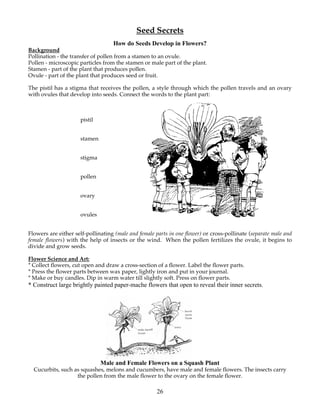
The pistil has a stigma that receives the pollen, a style through which the pollen travels and an ovary 
with ovules that develop into seeds. Connect the words to the plant part: 
26 
pistil 
stamen 
stigma 
pollen 
ovary 
ovules 
Flowers are either self-pollinating (male and female parts in one flower) or cross-pollinate (separate male and 
female flowers) with the help of insects or the wind. When the pollen fertilizes the ovule, it begins to 
divide and grow seeds. 
Flower Science and Art: 
* Collect flowers, cut open and draw a cross-section of a flower. Label the flower parts. 
* Press the flower parts between wax paper, lightly iron and put in your journal. 
* Make or buy candles. Dip in warm water till slightly soft. Press on flower parts. 
* Construct large brightly painted paper-mache flowers that open to reveal their inner secrets. 
Male and Female Flowers on a Squash Plant 
Cucurbits, such as squashes, melons and cucumbers, have male and female flowers. The insects carry 
the pollen from the male flower to the ovary on the female flower.
All flowering plants require pollination to produce seed. 
Pollination involves the transfer of pollen from the anther (male part of the flower) to the stigma 
(female part of the flower). 
Flowering plants are either: 
self-pollinated or cross-pollinated. 
Self-pollinated plants have both male and female parts in one flower so that they pollinate themselves. 
The stigma is pollinated by pollen in the same flower on the same plant. 
Cross-pollinated plants need insects or wind to carry the pollen from the anther of one flower on a 
plant to the stigma of a flower on another plant. 
How is pollen transferred? 
Cross-pollinated plants transfer pollen from the anther of one plant to the stigma of another by 
insects, wind or manual hand-pollination. 
insect pollination 
27
Insect-Pollinated Plants 
often have larger, colorful flowers that attract insects to travel from flower to flower. When saving seed 
from cross-pollinating plants, grow as many plants as you can to protect the crop’s diverse genetic traits. 
Did you ever see a cucumber, squash or melon flower? 
28 
Plant at least 200 corn 
plants when saving 
corn seed. 
Wind-Pollinated Plants 
Wind-pollinated flowers, such as corn, are 
often small since they do not need to 
attract insects. They do not produce nectar 
and do not have any scent. 
Most trees and grasses have wind-pollinated 
flowers. 
Varieties that are wind pollinated should be 
planted in dense blocks to ensure total 
pollination. 
Pollen can travel for miles depending on the 
strength of the wind.
Latin Names 
and Family Secrets 
The Latin name reveals the family secrets of who is really related to whom. The first name is the genus. 
The second name is the species. Plants can look different and have a different common name, but be of 
the same genus and species and therefore cross with each other - even if they have different common 
names. On rare occasion different species may cross. 
Beets and Swiss chard are both Beta vulgaris and will cross with each other. 
Broccoli, collards, cauliflower, cabbage, kolhrabi, kale (except Siberian Kale; Brassica napus) and 
Brussels sprouts have different common names but are all Brassica oleracea - the same genus and 
species and will cross with each other. 
Turnips, Chinese mustards and Chinese cabbages are all Brassica rapa and will cross with each other 
and wild mustard relatives. 
Any Brassica oleracea, i.e. collards, broccoli, Brussels sprouts, cauliflower, cabbage, kohlrabi and kale 
(except Siberian kale, Brassica napus), will cross with each other. Any Brassica rapa, i.e. turnips, Chinese 
mustards and Chinese cabbages, will cross. Different species rarely cross. 
Flowering Plant Reproductive Cycle 
Vegetable crops have a reproductive cycle of either one or two seasons. 
Annuals produce flowers and seed in one season. 
Biennials grow into a mature plant (that you can eat) in the first season, then over-winter and set seed 
in the second year. In areas too cold for biennials to survive the winter, plants that have their roots as 
the food part, like carrots or parsnips, need to over-winter in the ground. Plants that we eat the leafy 
part, like cabbage, can be dug up, transplanted into pots and over-wintered in a greenhouse or root 
cellar, then transplanted back to the garden in spring to flower and produce seeds. 
Perennials live and bear seed year after year. 
29
Self-Pollinating Plants 
‘selfers’ 
In self-pollinated plants the process of pollination occurs within each flower alone. Each flower has 
both the male and female part to pollinate itself. The pollen from the male-part pollinates the female-part 
30 
in one ‘perfect’ flower. 
Self-pollinated plants have flowers that have evolved to self-pollinate without assistance. There are rare 
self-pollinating plants in which cross-pollination can occur or be induced. 
'Selfers' require a smaller number of plants to ensure genetic diversity, and shorter isolation distances 
to prevent crossing than 'crossers'. 
Certain heirloom potato-leaf varieties of tomato 
have long, protruding styles which encourage 
cross-pollination. If you grow seed from 
these varieties, isolate them to prevent 
crossing. 
Lettuce will cross if you intertwine flowers from plants 
growing next to each other, and embrace them in a field with 
abundant pollinators 
Potatoes are produced by cloning the tubers, 
but if allowed to flower, will cross-pollinate.
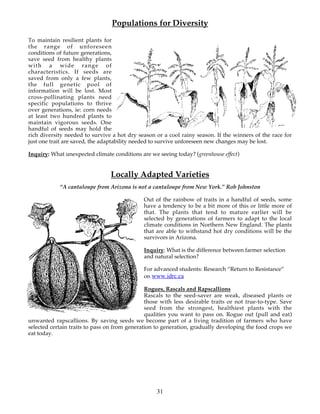
Populations for Diversity 
To maintain resilient plants for 
the range of unforeseen 
conditions of future generations, 
save seed from healthy plants 
with a wide range of 
characteristics. If seeds are 
saved from only a few plants, 
the full genetic pool of 
information will be lost. Most 
cross-pollinating plants need 
specific populations to thrive 
over generations, ie: corn needs 
at least two hundred plants to 
maintain vigorous seeds. One 
handful of seeds may hold the 
rich diversity needed to survive a hot dry season or a cool rainy season. If the winners of the race for 
just one trait are saved, the adaptability needed to survive unforeseen new changes may be lost. 
Inquiry: What unexpected climate conditions are we seeing today? (greenhouse effect) 
Locally Adapted Varieties 
“A cantaloupe from Arizona is not a cantaloupe from New York.” Rob Johnston 
Out of the rainbow of traits in a handful of seeds, some 
have a tendency to be a bit more of this or little more of 
that. The plants that tend to mature earlier will be 
selected by generations of farmers to adapt to the local 
climate conditions in Northern New England. The plants 
that are able to withstand hot dry conditions will be the 
survivors in Arizona. 
Inquiry: What is the difference between farmer selection 
and natural selection? 
For advanced students: Research “Return to Resistance” 
on www.idrc.ca 
Rogues, Rascals and Rapscallions 
Rascals to the seed-saver are weak, diseased plants or 
those with less desirable traits or not true-to-type. Save 
seed from the strongest, healthiest plants with the 
qualities you want to pass on. Rogue out (pull and eat) 
unwanted rapscallions. By saving seeds we become part of a living tradition of farmers who have 
selected certain traits to pass on from generation to generation, gradually developing the food crops we 
eat today. 
31
Preserving Our Heirloom Heritage 
Seed savers may want to preserve a plant's unique genetic heritage. To prevent different varieties of the 
same species from cross-pollinating, do not allow their pollen from reaching the flowers of each other. 
This is called ‘isolation’. 
Isolation Methods 
Distance 
Wind- pollinated crossers - separate by at least 1 mile 
Insect-pollinated crossers - separate by at least a quarter mile. 
Time 
Grow only one variety of each crop type per year. Or plant different varieties of the same species in the 
same year as long they do not flower at the same time. 
Annuals - start one variety early in the season and another several weeks later. 
Biennials -grow multiple varieties of the same species (such as onions) by staggering stages so 
only one is in its second year and going to flower. 
Cages and Physical Barriers 
If isolation by distances are not practical, isolate plants in screen houses, cover with a spun polyester 
row cover (Reemay) over a small hoop-house, or even paper bags, to prevent roving insects from 
entering. Introduce some insects inside to pollinate the plants. Pull out (rogue) any plants that cross 
accidentally and eat your mistakes! Pollinators must be introduced into the closed environment, or you 
must hand-pollinate. Intentional crossing is breeding. Plant your crosses next season to see what new 
varieties grow. 
To maintain robust plants from seed you save: 
1. Maintain large population sizes for full genetic diversity, 
2. Isolate plants from cross-pollination. 
3. Rogue plants which are “off-type” 
or undesirable. 
32
Harvesting Dry and Wet Seed 
Harvest plants as mature as possible. Seeds either mature dry on the plant in pods (beans) or on flower 
(lettuce), or in the moist fruit 
(tomato, squash, pumpkin, 
melon, and cucumber). After 
harvesting dry seed-plants, 
hang in a cool dry place until 
bone dry. Tomato, squash, 
pumpkin, and melon seeds 
are ripe when the fruit is ripe 
for eating to overripe. 
Ferment the seeds of wet-seeded 
33 
crops. Let the seeds 
sit in water for three or four 
days. Rinse the seeds and 
spread to dry. Cucumber 
seeds should be harvested 
only after allowing the fruit 
to overripen beyond the 
eating stage. 
Cleaning Wet Seeds 
Swell and harden in the garden, let them sit till they are fit, 
scoop and rinse till fit for a prince! 
Allow vegetables and fruits that encase seeds within their moist pulp, like squash, cucumbers or 
melons, to grow large and swollen, and hard enough that the rind will not dent when pressed by your 
thumbnail. Allowing extra time for the vegetable to mature on the vine and cure after harvest increases 
seed quality. Scoop out the seeds before the fruit starts to rot. 
Cleaning Dry Seeds 
With pods or without, let them dry, thresh and winnow them out. 
In pods: Brassicas (broccoli, cabbage, kale, mustards, oriental greens, radish, turnip) 
Without pods - on flowers: Alliums (onions, leeks, chives), Chenopods (spinach, beets, chards, 
lambsquarter), Composites (lettuce, many flowers), Umbelliferae (carrots, parsnips, dill, parsley), most 
flowers and herbs. Refer to books and websites in the resource section for further information.
Germination Tests 
For younger grades: In towel folded in half and in half again lengthwise into four sections, carefully 
put TEN evenly placed seeds in a row. Refold. Label date and seed variety. Place in trays and spray 
regularly with a mister. Out of the ten seeds, how many germinate into healthy seedlings after about a 
week? Use larger seeds like beans, corn, sunflower, etc. Out of ten, how many grow strong and 
healthy? Replant into pots or compost them. 
For older grades: Practice folding a towel into quarters, and then into ten equal sections – so you have 
ten sections divided into two. Working on a tray - Put ONE HUNDRED seeds evenly on the towel. 
Lightly mist to keep them in place. Gently fold up the towel or cover with another lightly misted towel. 
Check after five days, then daily. Healthy seedlings have strong root growth and sturdy leaves. 
Compare the number of healthy seeds to the stunted or dead ones. What is the percent of healthy 
seedlings? 
Seedling Vigor 
To see if the seed you saved from last season is healthy - to grow it. Start in small containers. Compare 
the vigor, growth rate and color of your seedlings. 
Storing Seed 
Store seeds in conditions opposite to what makes them sprout. Seeds store best in dry, cool, dark 
places in glass or tin containers. Unglazed earthen jars with tops are especially good. Refrigerating or 
freezing seeds is good as long as the seeds are dry and sealed in airtight containers. 
34
How to Save Seed from Self-Pollinators 
The process of pollination in self-pollinating vegetables occurs within each flower. The pollen from the 
male part of the flower falls into the female part of the same flower. 
35 
Saving Lettuce Seed 
Lettuce is self-pollinating. If you want to maintain 
absolute purity, avoid planting lettuce varieties 
next to each other. If 95% purity is sufficient, plant 
varieties next to each other. 
Start lettuce seeds early indoors about mid-March. 
Grow to a good transplanting size (4-6 weeks). 
Transplant outside about a foot apart in moist 
weather. Lettuce is hardy and can withstand 
temperatures down to the 20s. Let the lettuce 
plants grow till they send up a seed stalk. The 
seed-head is ready to harvest when half of the 
flowers have turned white. This may take up to 
two months from the time the lettuce was edible. 
Don’t wait too long or the seeds will fly away 
(shatter). To clean lettuce seed by hand carefully rub out and separate the seeds from seed-head. 
Winnow (separate the seeds from the chaff) by gently blowing away the lighter chaff; shaking up and 
down as you blow. 
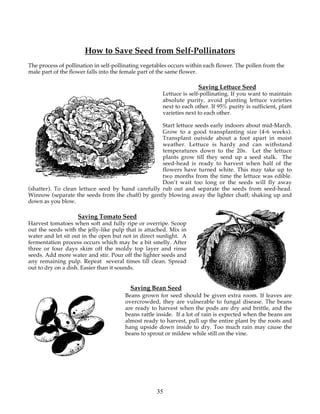
Saving Tomato Seed 
Harvest tomatoes when soft and fully ripe or overripe. Scoop 
out the seeds with the jelly-like pulp that is attached. Mix in 
water and let sit out in the open but not in direct sunlight. A 
fermentation process occurs which may be a bit smelly. After 
three or four days skim off the moldy top layer and rinse 
seeds. Add more water and stir. Pour off the lighter seeds and 
any remaining pulp. Repeat several times till clean. Spread 
out to dry on a dish. Easier than it sounds. 
Saving Bean Seed 
Beans grown for seed should be given extra room. If leaves are 
overcrowded, they are vulnerable to fungal disease. The beans 
are ready to harvest when the pods are dry and brittle, and the 
beans rattle inside. If a lot of rain is expected when the beans are 
almost ready to harvest, pull up the entire plant by the roots and 
hang upside down inside to dry. Too much rain may cause the 
beans to sprout or mildew while still on the vine.
How to Save Seeds from Cross-Pollinators 
The process of pollination in cross-pollinating vegetables occurs between different flowers. The pollen 
from the male flower is carried by the wind or by insects to the female flower either on the same or on 
another plant. To produce seeds that will grow into new plants like the parent, the flowers need to be 
isolated or separated so that wind and insect pollinators do not transfer the pollen of one variety to the 
flower of another. 
Saving Squash Seed 
Squashes are pollinated by insects, mainly bees. Varieties of the same species should be isolated by at 
least a quarter mile (1320 feet) or protected in a screen house to prevent cross-pollination. The four 
species of squash are: 
1. Pepos (five angled stem) – pie pumpkins, summer squash, delicata. 
2. Maxima (round stem) – buttercup, hubbard, red kuri, lg pumpkins 
3. Moschata (thinner 5 angled stem) – butternuts, cheeses 
4. Argyrosperma (also five sides) - cushaw 
Any variety in the same species will cross. Create new squash varieties by growing any variety in the 
same species together. Refer to the chart below and seed saving reference books for details on who is 
related to whom. See Breed Your Own Vegetable Varieties for ideas on how to create new squash 
varieties by intentional crossing. 
Summer squash should be large, hard and gourd-like, which takes up to two months after the young 
edible stage. Winter squash should be sun-cured for two weeks and then stored for at least a month to 
improve germination. Cut the fruits and scoop out seed and pulp. Separate out and rinse off the pulp 
on the seeds by hand. Mature seeds are plump and firm. Discard any that are flattened or hollow; they 
are immature and will perform poorly. Spread seeds on paper or screens to dry in a cool shady place. 
Be sure seed is thoroughly dried before storing in a container. 
36
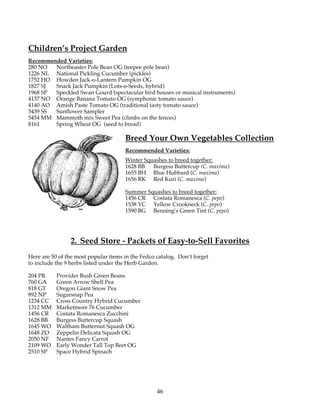
Breed Your Own Vegetables 
Can you Grow a Squmpkin ? 
Goal: Discover how traditional farmers over generations have developed vegetables by selecting and 
breeding your own new vegetables from heirloom open-pollinated vegetables. 
Background: Although we know one when we see one, botanists say there is no such thing as a 
pumpkin. They are all squashes, members of the cucurbit family, along with cucumbers, zucchinis and 
summer squash, other winter squashes, muskmelons, watermelons and gourds. 
What’s a squmpkin? If you grow a garden and compost your food waste, you've probably seen 
squmpkins. They grow out of the compost and look somewhat like pumpkins, but maybe the shape is a 
little weird or the color decidedly so. I call them squmpkins––a cross between a pumpkin and a 
squash. 
Botanists recognize four species of squash: 
Cucurbita maxima features soft, cylindrical stems and leaves with rounded lobes. It includes the 
buttercup, delicious and hubbard squashes. 
Cucurbita pepo is distinguished by its 5-angled stem which expands toward attachment to the fruit. 
Zucchinis, summer squashes, acorn, delicata and spaghetti squashes are all examples. 
Cucurbita moschata also has a 5-angled stem, but it is smaller than the stem of C. pepo, and expands 
abruptly at the fruit. The branches and leaves have small hairs. The butternut squashes are members. 
Cucurbita argyrosperma is similar to moschata, but its members won't cross with moschata. 
All varieties of a species will cross. Zucchinis cross with acorns because they are both pepos. Buttercups 
and hubbards cross because they are both maximas. It is uncommon for different species to cross. 
Seed savers who maintain the purity of their variety never plant two members of the same species near 
each other because they cross. The recommended isolation distance is a quarter mile or more. 
Activity: Breed your own vegetables by deliberately encouraging cross-pollination. Plant two or more 
members of the same species nearby each other. Plant Costata Romanesca, Green Tint patty pan and 
Yellow Crookneck summer squashes (all pepos) near each other. Save seed from each and sow the 
following spring. What do you predict will happen? What intriguing crosses grow? What cross-pollinating 
vegetables or fruits can you breed for specific traits? 
Summer Squashes that will cross: 
1456 CR - Costata Romanesca (C. pepo) 
1538 YC - Yellow Crookneck (C. pepo) 
1590 BG - Benning’s Green Tint (C. pepo) 
37
Read: Breed Your Own Vegetables by Carol Deppe. Chelsea Green – an inspiring guidebook for 
breeding science and creativity 
Breed a Better Pickle 
"On a hot day in Virginia, I know nothing more comforting than a fine spiced pickle, brought up trout-like from 
the sparkling depths of the aromatic jar below the stairs of Aunt Sally's cellar." 
Thomas Jefferson 
'5,200,000 pounds of pickles are consumed annually in the US. That's nine pounds per person per year.' 
NYFoodMuseum.org 
'Pickles are to New Yorkers what Apple Pie is to Americans - an archetypal food that reflects our unique history.' 
Cucumber Lore 
Cucumis sativus: Cucumbers were cultivated in India as long as 3000 years ago between the Bay of 
Bengal and the towering Himalayas. The cucumber was carried westward from India long before 
written history as is indicated by the profusion of ancient names for it in: Aryan, Greek, Latin, Arabic, 
Armenian, and others. Cucumbers are mentioned twice in the Torah (Numbers 11:5 and Isaiah 1:8). 
My Great Grandmother Rogosa, from Rujahn, Poland, kept a large pickle barrel in her pantry, as did 
many of America's pioneering generation and sailors aboard ship to prevent scurvy. Under frontier 
conditions, Eastern European winters, or long days at sea, pickles were the only green, succulent food 
available. Traditional Jewish kosher pickles use no vinegar, no sugar and no packaged spices. 
Selective Seed-Saving Guidelines 
For thousands of years farmers have been selectively breeding plants to combine the best traits of the 
parents. Plant several varieties of your favorite cucumbers, and try your hand at crop improvement. 
Cucumbers are insect pollinated. Isolate by at least a quarter mile to prevent cross-pollination. Plant 
about three feet apart. Taste-test the first cucumber from each plant. Rogue out the less flavorful and 
the 50% that are less robust. Keep in only the best plants. Remove the cucumbers or flowers from the 
remaining plants that may have cross-pollinated with the less desirable plants. Allow only the 
cucumbers to remain on the vines of the best plants. Do not harvest the best cucumber, but let the 
cucumbers grow as mature as possible, into swollen, yellowish brown fruits, until the vines die back or 
it frosts. Harvest and allow the mature cucumbers to cure in a dry, cool place for about 5 weeks for 
after-ripening. This helps mature the seed. Cut the fruits in half. Scoop out the seeds and add some 
water. Allow to lightly ferment for 2-3 days in a warm place, stir daily. The gel on the seeds will 
ferment off, and the heavier healthy seed will sink to the bottom. Pour off floating pulp and flat seeds. 
Strain out the heavier seed from the bottom. Remove these seeds immediately and rinse with fresh 
water. Dry seeds on a screen. 
My Aunt Esther's Pickle Recipe 
'Cut the ends a little bit. You hev to hev dill, garlic and if you can, hev cherry leaves. (black currant or grape 
leaves are good too) If you can hev, it's very good for people. In the winter it's without cherry leaves. Put the dill, 
the garlic, and the leaves in the water. Salt - as much as you want in the water. Cold water, not warm but cold 
water. Put the pickles in a jar, or whatever you hev, even in a dish. Cover with something to keep the pickles 
under the water of course. In three, four days it's very good. 
38 
'
Seed-Saving Guide 
Self-Pollinating Annual Vegetables 
39 
Beans 
Phaseolus 
vulgaris 
The beans are ready to harvest when the pods are dry and brittle, and the 
beans rattle inside. 
Eggplant Harvest when very ripe. Scoop out seeds, wash away pulp and dry. 
Lettuce 
Composite 
Cut stalks when about half of the tiny flowers are white and fluffy. Hang over 
tarp or put in buckets over tarp. Rub off seeds. Winnow. 
Peas Harvest when pods turn yellow or brown and peas rattle inside. If not 
completely dry, pull up the whole plant and hang upside down to dry indoors. 
Pepper Although peppers are self-pollinating, bees occasionally cross-pollinate. 
Separate by 50 feet. Harvest when very ripe. Scrape out seeds, rinse and dry. 
Tomato Pick the best ripest fruits. Ferment for three days. Remove floating mold, 
Rinse till clean. Dry. 
Cross-Pollinating Annual Vegetables 
(I – insect pollinated. W – wind pollinated) 
Broccoli 
Brassica oleracea, I 
Start early indoors and transplant outside for fall seed 
harvest. Cut the stalks when the seeds are dry and brittle, 
dry on trays, thresh and clean. 
Chinese cabbage, 
Pac Choi, Brassica oleracea, I 
Same as broccoli 
Corn 
Zea mays 
W 
Plant at least ten rows of twenty feet three feet apart (at 
least two hundred plants) Why? Corn needs to cross-pollinate 
with a wide population to stay strong. Pollen is carried by wind 
from tassels of one plant to silks of another. Seeds which are not 
pollinated do not form kernels. When kernels are mature and 
dry, strip down husks and hang together till dry on cob. 
Cucumber 
Cucumis sativus, I 
Let grow on vine till large, yellow/brown and hard. Cure for 
2–3 weeks. Scoop out seeds and ferment for 3-4 days. Rinse. 
Discard floating seed. Dry. Cucumbers cross each other (except 
Armenian cucumbers, C. melo) unless isolated by 1⁄2 mile . 
Mustard Greens 
(yellow flowers) 
Brassica juncea, I 
Isolate by half a mile or grow in screen shed. 
Let grow seed stalks, harvest and dry. 
Radish 
Raphanus sativus, I 
Harvest seed stalks, Hang or put in buckets with tarp 
underneath till dry. 
Spinach 
Chenopod - Spinacia oleracea, 
Pick later slower bolting seed stalks. Cut, strip off seeds.
40 
W Winnow. 
Squash, Pumpkin, Gourd 
Cucurbita pepo 
Cucurbita maxima 
Cucurbita moschata 
Cucurbita argyrosperma 
Let grow big and hard. Let sit to cure and mature for about a 
month after picking. Scoop out seeds, rinse and dry. 
Pollinated by insects. 
Sunflower, I Harvest when mature. Store and plant in shell. 
Biennial Vegetables 
Beets 
Chenopod- Beta 
vulgaris, W 
Over-winter means to dig up in the Fall, store in a box of moist sand in a 
root cellar and replant in the garden next spring. Cut stalks when seed 
clusters are dry and brown. Hang to finish drying then thresh seeds. Swiss chard 
and beets are in the same species and will cross. 
Brussel Sprout 
Brassica oleracea, 
Over-winter. Cut the stalks when dry and brittle, dry, thresh and clean. 
Cabbage 
Brassica 
oleracea, I 
Over-winter. Isolate from other B. oleracea (see list under Cabbage Family) by 
one mile. Plant 10 or more plants together. Make a shallow X in the cabbage 
head in the spring to help seed stalk grow out and push up from the head. This is 
amazing to watch. 
Carrots 
Umbelliferae 
Daucus carota, 
I 
Over-winter. When seed heads are mature and brown, cut stalks and hang 
to dry. Rub seeds from heads and clean. Wild carrots (Queen Anne's Lace) 
and cultivated carrots will cross-pollinate. Separate by 1⁄2 mile. 
Cauliflower 
Brassica 
oleracea, I 
Over-winter. Cut the stalks when the seeds are dry and brittle, dry, 
thresh and clean. Do not harvest heads for food, but let them sprout 
seeds. Grow at least ten plants together for good genetic diversity. 
Kale & 
Collard 
Brassica 
oleracea, I 
This hardy vegetable can survive a mild winter with a protective covering 
of mulch or plastic and bear seed stalks next summer. Try it. Otherwise 
dig up, over-winter indoors and replant next spring. 
Kohlrabi 
Brassica 
oleracea, I 
Over-winter. Cut the stalks when the seeds are dry and brittle, dry, 
thresh and clean. 
Leeks 
Allium 
Try over-wintering in garden protected with plenty of mulch. Otherwise 
overwinter inside.
41 
ampeloprasum, I 
Onions 
Allium, I 
Over-winter the best ones. Replant in spring. Harvest when seeds are dry. 
Bend over seedheads into sack and cut off stalk. 
Parsley 
Petroselinum 
crispum, I 
Over winter. Harvest seeds in second year. 
Parsnips 
Pastinaca sativa, I 
Leave in soil all winter. Harvest seeds next year. 
Rutabaga, 
Broccoli Raab, 
Turnip, Brassica 
rapa, I 
In mild climates, plant in fall and harvest seed the following summer. In 
cold climates dig up and over-winter inside in the root cellar or 
greenhouse and replant in spring. Harvest dry brown seedpods in early 
fall. 
Swiss Chard 
Chenopod- Beta 
vulgaris, W 
Cut stalks when seed clusters are dry and brown. Hang to finish drying then 
thresh seeds. Swiss chard and beets are in the same species and will cross. 
Herbs and Flowers 
Basil 
Ocimum 
basilicum 
Harvest seed heads when brown and brittle. 
Hang to finish drying indoors. Remove seeds 
by crumbling the flower heads then blow 
away the chaff. 
Garlic 
Amaryllid - 
Allium sativum 
A wonderful project to start the program 
because you plant the individual garlic cloves 
in the fall, and harvest a full garlic bulb next 
summer. Garlic does not commonly produce 
seeds. 
Flowers Let any annual flowers go to seed. Hang 
to dry. 
Fruits 
Cantaloupe 
Cucurbit - Cucumis melo 
The melon is ready to eat when 
it has a sweet fragrance and 
slips off the vine. These seeds 
can be harvested to save. 
Seeds from overripe melons are 
stronger. Scoop out and rinse 
the seeds. 
Watermelon 
Cucurbit -Citrulus 
vulgaris 
Practice thumb thumping on 
the melon for a resonant 
sound that tells when the 
melon is ripe. After you 
enjoy eating, separate out 
the seeds, rinse and save.
42 
Grains 
Amaranth 
Amaranthus 
Collect seed heads as they dry on the 
plants and store in closed paper bags 
to finish drying (many of the seeds 
will shed naturally). Chaff easily blows 
away after seed heads are crumbled 
(watch for thorns or prickles in some 
plants). 
Quinoa 
Chenopod - 
Quinoa 
Harvest dry seed stalks. Allow to 
dry over a tarp. Collect.
Fedco Seed Store 
Call (207) to Request a Fedco Catalog 
The Fedco Seed Catalog is a journey through the living history of farming and foods. Following is a 
trail guide for: 
1. Theme Garden Collections 
Wild Garden 
Three Sisters Garden 
Herb Garden 
Snack Garden 
Heirloom Garden 
Children’s Project Garden 
Breed Your Own Vegetables 
2. Seed Store - Packets of Easy-to-Sell Favorites 
3. Seed Store - Bulk Moneymakers 
9369- Cotton Muslin Draw-String Bags (see catalogue for sizes and prices) 
1. Theme Garden Collections 
Wild Garden 
Grow a native ecosystem! Wild habitats are being bulldozed and covered with concrete. Innocent birds, 
butterflies and bugs are hurt by pesticides on farms and lawns. By growing a Wild Garden, you will 
grow a protected natural habitat for beneficial insect friends that pollinate garden vegetables, and 
ladybug and lacewing “predators” that eat garden pests such as aphids and whiteflies. 
Recommended 
Varieties: 
6022 BM Bee Balm 
6028 BC Blue Clips Bellflower 
6034 BW Butterfly Weed 
6048 EC European Columbine 
8231 Hairy Vetch 
8301 Crimson Clover 
43 
426-9900
Native American Three Sisters Garden 
The Three Sisters—corn, beans, and squash—are the traditional Native American garden family. Each 
plant helps the others grow. 
Recommended Varieties: 
343 JO Jacob’s Cattle Bean OG 
371 CO True Red Cranberry Bean 
682 CO Abenaki Calais Flint Corn OG (formerly Roy’s) 
688 MB Mandan Bride Indian Corn 
1538 YC Yellow Crookneck Summer Squash 
1628 BB Burgess Buttercup 
1648 ZO Zeppelin Delicata Squash OG 
Herb Garden 
Recommended Varieties: 
4414 SB Sweet Basil 
4519 CO Cilantro OG 
4531 BO Bouquet Dill OG 
4556 ZF Zefa Fino Fennel 
4616 SM Sweet Marjoram 
4648 GR Greek Oregano 
4657 RM Rosemary 
4665 SO Broadleaf Sage OG 
4687 GT German Thyme 
Snack Garden 
Pick fresh garden vegetables for school lunch and snack 
Recommended Varieties: 
230 JD Jade String Beans (bush) 
781 LC Lincoln Shell Pea 
892 NP Sugarsnap Pea 
1226 NL National Pickling Cucumber 
2086 MK Mokum Carrot (hybrid) 
2550 TY Tyee Spinach 
2789 BO De Morges Braun OG (butterhead lettuce) 
2854 BO Blushed Butter Cos Lettuce OG (beautiful red/green ruffles) 
2883 CO Crisp Mint Romaine Lettuce OG 
4119 VO Peacevine Cherry Tomato OG (OP) 
4282 SG Sungold Cherry Tomato (hybrid) 
44
45 
Heirloom Garden 
Recommended Varieties: 
208 BV Black Valentine Bean 
285 KW Kentucky Wonder Pole Bean 
318 SR Scarlet Runner Bean 
340 HU Hutterite Bean 
559 GB Golden Bantam Improved Corn 
792 TT Tall Telephone Pea 
908 JL Jenny Lind Melon 
992 MO Moon & Stars Watermelon OG 
1360 BB Boothby's Blonde Cucumber 
1723 LO Long Pie Pumpkin OG 
1740 CH Cheese Pumpkin 
2042 SN Scarlet Nantes Carrot 
2186 BB Bull's Blood Beet 
2376 GB Gold Ball Turnip 
2484 AC Ailsa Craig Onion 
2712 BO Black Seeded Simpson Lettuce OG 
2731 CO Cracoviensis Lettuce OG 
3324 EJ Early Jersey Wakefield Cabbage 
3387 CP Nero Di Tuscana Kale 
3690 RB Rosa Bianca Eggplant 
3753 CO Czech Black Pepper OG 
3781 FO Fish Pepper OG 
4046 PO Garden Peach Tomato OG 
4059 CO Cherokee Purple Tomato OG 
4075 BO Brandywine Tomato OG 
4140 AO Amish Paste Tomato OG 
4525 CO Purple Coneflower OG (perennial) 
4683 SO Spilanthes OG 
5004 CS Carpet of Snow Alyssum 
5013 EO Elephant Head Amaranth OG 
5028 CR Crego Mix Aster 
5066 CB Balsam 
5148 DI Lacy Blue Didiscus 
5164 FC Tall 4 O’clock Mix 
5172 MH Marine Heliotrope 
5263 MN Mignonette 
5282 EI Empress of India Nasturtium 
5313 PH Drummondi Mix Phlox 
5442 CU Cupani Sweet Pea 
5455 MC Mrs. Collier Sweet Pea
Children’s Project Garden 
Recommended Varieties: 
280 NO Northeaster Pole Bean OG (teepee pole bean) 
1226 NL National Pickling Cucumber (pickles) 
1752 HO Howden Jack-o-Lantern Pumpkin OG 
1827 SJ Snack Jack Pumpkin (Lots-o-Seeds, hybrid) 
1968 SP Speckled Swan Gourd (spectacular bird houses or musical instruments) 
4137 NO Orange Banana Tomato OG (symphonic tomato sauce) 
4140 AO Amish Paste Tomato OG (traditional tasty tomato sauce) 
5439 SS Sunflower Sampler 
5454 MM Mammoth mix Sweet Pea (climbs on the fences) 
8161 Spring Wheat OG (seed to bread) 
Breed Your Own Vegetables Collection 
Recommended Varieties: 
Winter Squashes to breed together: 
1628 BB Burgess Buttercup (C. maxima) 
1655 BH Blue Hubbard (C. maxima) 
1656 RK Red Kuri (C. maxima) 
Summer Squashes to breed together: 
1456 CR Costata Romanesca (C. pepo) 
1538 YC Yellow Crookneck (C. pepo) 
1590 BG Benning’s Green Tint (C. pepo) 
2. Seed Store - Packets of Easy-to-Sell Favorites 
Here are 50 of the most popular items in the Fedco catalog. Don’t forget 
to include the 9 herbs listed under the Herb Garden. 
204 PR Provider Bush Green Beans 
760 GA Green Arrow Shell Pea 
818 GT Oregon Giant Snow Pea 
892 NP Sugarsnap Pea 
1234 CC Cross Country Hybrid Cucumber 
1312 MM Marketmore 76 Cucumber 
1456 CR Costata Romanesca Zucchini 
1628 BB Burgess Buttercup Squash 
1645 WO Waltham Butternut Squash OG 
1648 ZO Zeppelin Delicata Squash OG 
2050 NF Nantes Fancy Carrot 
2109 WO Early Wonder Tall Top Beet OG 
2510 SP Space Hybrid Spinach 
46
47 
2760 RS Red Sails Lettuce 
2812 BO Buttercrunch Lettuce OG 
2986 SM Summer Lettuce Mix 
2992 ME Mesclun 
3022 AR Arugula 
3036 BL Bright Lights Swiss Chard 
3158 GI Gigante D’Italia Parsley 
3475 BB Broccoli (hybrid) 
3480 LV Oliver Hybrid Brussels Sprout 
3810 AC New Ace Hybrid Pepper 
4038 CO Cosmonaut Volkov Tomato OG 
4075 BO Brandywine Tomato OG 
4140 AO Amish Paste Tomato OG 
4282 SG Sun Gold Hybrid Cherry Tomato 
5060 BM Bachelor Button Mix 
5085 PB Pacific Beauty Mix Calendula 
5140 SM Early Sensation Mix Cosmos 
5172 MH Marine Heliotrope 
5176 KO Kiss Me-Over-the-Garden Gate OG 
5243 LG Lemon Gem Marigold 
5272 HB Heavenly Blue Morning Glory 
5288 JM Jewel Mix Nasturtium 
5369 RS Rocket Mix Snapdragon (hybrid) 
5439 SS Sunflower Sampler 
5454 MM Mammoth Mix Sweet Pea 
5460 TH Torch Tithonia (Mexican Sunflower) 
5468 BP Blue Point Formula Mix Zinnia 
5884 AO Sweet Annie OG 
3. Heirloom Open Pollinated Vegetables 
Seed Store Bulk Money-Makers 
Here is a suggested collection for a bulk seed store. Page references are for the Fedco catalog. Choose 
any variety offered in bulk in the Fedco catalog. See catalog for more details on prices and discounts. 
285KW - Old Homestead Pole Beans 
$5.50 per lb. Makes 16 one oz. packets @35¢ Page 19. 
343JO - Jacobs Cattle Bean OG 
$7.50 per lb. Makes 32 1/2 oz packets @ 23¢ Page 21. 
489FO - Shirofumi Green Soy Beans OG 
$18 per lb. Makes 64 1/4 oz. packets @ 29¢ Page 21. 
688MB - Mandan Bride Indian Corn 
$7.50 per lb. Makes 16 one oz packets @ 47¢ Page 24.
792TT - Alderman Shell Peas 
$4 .80 per lb. Makes 16 one oz. packets @ 30¢ Page 26. 
925GO - Golden Gopher Muskmelon OG 
$7 per half oz. Makes 16 1/32 oz packets @ 44¢ Page 27. 
986VR - Verona Red Watermelon 
$7.50 per half oz. Makes 16 1/32 oz packets @ 47¢ Page 28. 
1226NL - National Pickling Cucumber 
$12 per lb. Makes 250 1/16 oz packets @ 5¢ Page 30. 
2712BO - Black Seeded Simpson Lettuce OG 
$24 per lb. Makes 225 2 gm packets @ 11 ¢ Page 44. 
2728RS - Red Salad Bowl Lettuce 
$11 per lb. Makes 225 2 gm packets @ 5¢ Page 45. 
3038GO - Golden Chard OG 
$16 per quarter lb. Makes 64 1/16 oz. packets @25¢ Page 49. 
3166FG - Forest Green Parsley 
$4 per quarter lb. Makes 56 2 gm packets @ 8¢ Page 51. 
3382RC - Red Russian Kale 
$6 per quarter lb. Makes 56 2 gm. Packets @11¢ Page 54. 
4119PO - Peacevine Cherry Tomato OG 
$20 per ten grams. Makes 100 .1 gram packets @ 40¢ Page 64. 
SUBTOTAL ($140.80, less 10% volume discount and 5% school discount) = $119.68 
If you sell each packet for $1, total proceeds will be $1,122, for a profit of over $1,000 ! 
48
Recommended Books 
Numbers indicate books available through Fedco 
9836 - Ashworth, Suzanne. Seed to Seed The classic seed-saving reference in the field with excellent 
detailed instructions and clear illustrations. A must for any seed-saving program. $ 24.50 
* Ausubel, Kenny: Seeds of 
Change: The Living Treasure 
* Capon, Brian. Botany for 
Gardeners. 
9678 - Coblyn, Sara French Fries 
and the Food System. A 
comprehensive year-round 
curriculum on school gardening 
and social change through 
farming. $25.00 
9878 – Connolly, Bryan. The 
Wisdom of Plant Heritage: 
Organic Seed Production and 
Saving. Good basic manual for 
Northeast seed producers. $8.00 
9635 - Deppe, Carol. Breed Your Own Vegetable Varieties. Popbeans, purple peas, and other 
innovations from the backyard garden. $27.50 
* Fleishman, Paul. Seedfolk. An inspiring modern tale about the transformative power of gardening – 
wonderful to read aloud to the kids. 
9755 - Giono, Jean. The Man Who Planted Trees. $17.50 
* Henderson, Carrol. Landscaping for Wildlife. 
9690 - Johnston, Rob. Growing Garden Seed. Excellent basic instructional booklet. $3.00 
* Lawn, CR Mow Me Less – Tales of a GE Resistant Lawn – Compelling video of CR Lawn’s keynote 
speech at the MOFGA Common Ground Fair for discussion and action projects. $7.50 
* Nabhan, Gary Paul (1989): Enduring Seeds: Native American Agriculture and Wild Plant 
Conservation, North Point Press, San Francisco. 
* Seeds of Diversity Canada, formerly “Heritage Seed Program,” produces an illustrated booklet on 
how to save your own vegetable seeds. See: <www.seeds.ca> 
* Shiva, Vandana. Stolen Harvest – The Hijacking of the Global Food Supply. 
* Weaver, William W. Heirloom Vegetable Gardening. Henry Holt and Company. ISBN 0-8050-4025-0, 
* Wilson, Gilbert. Buffalo Bird Woman. ISBN 0 – 8735-29-7 
49

From Generation to Generation: Seed Saving Guidebook

  • 1.
    From Generation toGeneration An Activity Guidebook in the Living Tradition of Seed Saving By Eli Rogosa Kaufman growseed@yahoo.com A Publication of Fedco Seeds
  • 2.
    From Generation toGeneration Contents 2 1. Introduction – p. 3-5 Plant a Seed so your Heart will Grow Grade-by-Grade Seed Project Chart 2. Family Garden – p. 6 My Family - Plant Families Seed to Bread 3. Wild Garden – p. 7-8 Restoring Schoolyard Habitats Wild Seeds 4. Native Garden – p. 9-10 Growing a Three Sisters Garden 5. Heirloom Garden – p. 11-12 Seeds and Stories 6. Seed and Civilization – p. 13-16 Biodiversity and the Potato The Garden Community Planting the Future The Mishnah - ‘Way of Seed’ 7. Soil and Seed - p.17 Soil and Seed What Makes Good Potting Soil? 8. Seed and Sprout p. 18 How do Seeds Develop in Flowers? Sprouts Monocots and Dicots Seeking the Source 9 . School Seed Store – p. 19-23 Organizing the Program Packing Seeds - Seed Math Ethical Business Considerations 10. Seed Saving – p. 24-34 Why Save Seed? Seed Basics and Secrets Pollination Preserving Heritage and Diversity Harvesting and Testing 11. How to Save Seeds – p. 35-38 Self-Pollinators: Lettuce, Tomatoes, Beans Cross-Pollinators: Squash Breed Your Own Vegetables 12. Seed-Saving Guide - p. 39-42 13. Resources – p. 43-49 Fedco Seed Store Catalog, Books “The seeds that gardeners hold in their hands are living links in an unbroken chain reaching Copyright 2001 by Eli Rogosa Kaufman back into antiquity.” Suzanne Ashworth, Seed To Seed
  • 3.
    1. From Generationto Generation Consider the miracle of the seed. In just 100 days one tiny seed weighing no more than 1/250th of a gram matures into a 8 to 9 inch head of broccoli weighing a pound or more, better than a one hundred thousand-fold increase in just over three months. The most brazen stock market trader wouldn't dream of such profits! Too many children grow up with no conception of what nature can accomplish or where our food comes from. Do they think it appears spontaneously on a supermarket shelf, or worse, at their local fast-food establishment? How can we restore understandings about food, a most basic need? We dream that every child in every classroom will be given the opportunity to start seeds, grow a garden, experience the vital sensation of their hands working in the soil, the thrill of watching their seeds sprout and their plants grow, the satisfaction of working together with others to take part in a miracle. To help fulfill this dream Fedco offers From Generation to Generation, a seed education program with grade-by-grade activities to bring young gardeners through the full cycle from seed to seed. By growing gardens and saving seeds, young people can reconnect to past generations of farmers and gardeners, renew food and farming traditions in their own community and work together to plant a sustainable future. CR Lawn Fedco Seeds To request a catalog contact: FEDCO PO Box 520 Waterville, ME 04903 Phone (207) Order seeds through the catalog by mail, fax or internet. No phone orders please. 3 426-9900
  • 4.
    “Plant a Seedso your Heart will Grow.” 4 Hafez To re-imagine farming is to see it as an act of healing, where through story, imagination and the strength that arises through working with the earth, we can repair, somehow, the wounds of the soul and those of the world. From Generation to Generation invites young people on a journey of discovery by working with nature in ways that are rare in today’s culture. Seed saving, once an essential skill passed from generation to generation by traditional farmers, is almost a lost art, as is the farming heritage out of which seed saving arose. Our food plants have evolved through a unique partnership with farmers. By careful observation, experimentation and selection, traditional farmers transformed wild plants into the foods that nourish us today. Yet how many of today’s farmers and gardeners still know how to save their own seed? Just as a healthy garden supports a vital diversity of plants and animals in an interdependent web of life, the seeds of culture and learning are nurtured within complex interconnected relationships in the living whole of the child’s inner, natural, and social community. Garden-based education can produce fertile minds, vital hearts and empowered young people. What experiences create an ecology of education for children to care for themselves, nature and community? By saving seeds, young people not only discover the cycle of a plant from seed to seed, but reconnect to the generations of farmers who have sustained our communities in the past. By saving seeds, young people can become stewards of native and heirloom plants in partnership with nature. Our From Generation to Generation Workshop series provides schools with practical support to create school gardens, composting and seed-saving programs adapted to the unique environment, community heritage and vision of their schools and communities. “Imagination is more important than knowledge” Einstein “The real deserts are deserts of the imagination” Laupo Lugari, Gaviotas Although we may feel overwhelmed by the challenges that surround us, nothing prevents us from changing ourselves, our culture of education and our schoolyard. We hold the seed in our hand. At the heart of a successful school gardening program are young people excited by what they can do on their own. More important than how many seeds we save is how we awaken the hearts of young people who may feel too small to make much difference. We save seeds in school not only to protect endangered plants, but to grow young people with a feeling that they can make a real difference in their world. The energy that awakens through growing and saving seeds can encourage a school ecology of sustainable relationships that nourish young people on many levels. Seed Journals From Generation to Generation offers resources in the art and science of seed saving as a pathway to hands-on science and school gardening. Journaling is a tool for teachers to coach creativity. Journaling is a way for students to map their journey, record their story and creative ideas. Keeping a journal is a first step in becoming a creative scientist or artist. A journal is as unique as each person. Extension: Research Leonardo daVinci’s journals.
  • 5.
    Grade-by-Grade Project Chart From Generation to Generation provides a grade-by-grade journey of seed-saving projects that weave together ecology, gardening and community-on-the-land themes. GRADE INQUIRY THEME GARDEN 5 K Caring for Myself, Friends and Nature Caring for Nature through the Seasons Nature’s Garden Wheat: From Seed to Bread 1- 2 How do Homes and Families Nurture Individuals? What family is this plant ? Homes & Families Family Garden Our Families / Plant Families Wheat: From Seed to Bread, Snack Garden 1- 2 How do individuals in Natural and Human Ecosystems help each other? Nature Neighborhood Native Garden Wild Garden Three Sisters: Corn, Beans, Squash 3 Working together in a healthy community - How community heritage inspires our future Community Heirloom Garden Saving Seeds of Heirloom Vegetables 4 How diversity builds healthy communities & plants, soil and water Community Heritage On the Land Heritage Garden Seeds and Stories 5 Land, People,Technology. Human Impact - Landscape Ecology Bioregion Heritage Garden Farm to City Food Systems 6 Soil Stewards Soil & Civilization Wasteshed Bio-Intensive Garden Sustainable Food Systems, School Composting 7 Water Stewards Watershed Restoration Watershed Water Garden Water Quality Monitoring, Aquaponics, Hydroponics 8 Seed Stewards Biodiversity Seed Garden Seed-Savers 9- 12 Action Projects Community Problem-Solving Designing Sustainable Solutions Breeding New Vegetables
  • 6.
    2. Family Garden Goal: To discover how people, plants and all creatures are all part of a mutually nurturing family system and all need a home or a habitat. To research how people organize plant characteristics. Inquiry: Where are seeds from? How can we organize food plants? What can we look at? Why? Activities: My Family Tree: Make a family tree of your brothers and sisters, parents, aunts and uncles, cousins and grandparents. Take time to make it as beautiful as possible. Gather Seeds in Fall Visit an organic farm or farmers’ market. Harvest or buy several varieties of winter squashes, pumpkins, sunflowers, Indian corn, peas in the pod, melons and other vegetables with large visible seeds. Separate, rinse, dry and display the seeds. Bake the squash, make pumpkin pie, grind the corn into flour, roast the pumpkin and sunflower seeds (try it with a bit of oil, tamari and garlic), eat the melon... Meet the Vegetable Families Organize into groups: Squash and Pumpkin - Tomatoes of all types - Cantaloupe and Honeydew - Beans and Peas in a pod Scoop out and rinse seeds. Dry in the shade on paper towels. Label. What is the same and different? Classify Seeds How can we classify seeds? Set out bowls on trays with a variety of seeds from different vegetable families. Feel, touch, and smell the seeds. Create a display showcasing seeds and vegetable families. Extension: Create your own system to organize plants and their seeds. Note: Use only wild or untreated seeds. Conventional seeds may have coatings of toxic fungicides. Reading: Seed to Seed by Susan Ashworth – a complete seed-saving guide with detailed instructions. 6 Seed to Bread Bread from many hands, from many lands The art and heritage of growing wheat, threshing golden sheaves, winnowing chaff in the wind, grinding grains into soft flour and baking bread has roots in almost every culture. When grains are golden dry, harvest by hand and thresh by rubbing between your hands or beating on a blanket or tarp. Research and recreate the folklore and arts of bread baking, wheat weaving and harvest festivals. Who has a family member who can teach how to bake: challah from Israel, pita from Palestine, scones from Scotland, tortillas from Tijuana, focaccia from Florence… Read: Bread, Bread, Bread by Ann Morris, with photos of children from around the world with their breads.
  • 7.
    3. Wild Garden 7 “Every cultivated plant was once a wild plant. Every edible wild plant represents a possible new vegetable.” Carol Deppe Goal Restore wild habitats on school grounds to discover the hidden world of wild plants, insect pollinators, birds and native habitats, and the vital importance of wild habitats for healthy food gardens. Inquiry How do members in human and nature neighborhoods help each other? Are wild gardens good for food gardens? How can nature return to our schoolyard? Background Why should we restore a school habitat for wild plants, birds, butterflies, and bugs? Habitat loss is the greatest threat to biodiversity - the complex diversity of life on Earth. 34,000 plant species, 12% of plants worldwide and 29% of plants in the United States, have become so rare that they could easily disappear. In the United States over 2400 acres of habitat are lost every day <www.plantsavers.org>. More and more of the planet’s land surface is covered by human settlements or farmland. As a result, wild ecosystems are lost and the diversity of life is diminishing daily. <www.ipmworld.umn.edu/chapters/eigenbr.htm> Our goal is to return the processes of agroecology to wild ecology. With diversity as the goal, design your food garden with abundant opportunities for nature to return. Healthy gardens need wild habitats for beneficial insects that control insect pests, for pollinators and for small animals. Activity: Create a schoolyard biodiversity sanctuary. A wild garden of native plants is a place where young people can explore the interconnectedness of all life. The entire school community can be involved in restoring a school habitat sanctuary. Restoring nature on school grounds is simple. Mark off an area of the schoolyard with tree stumps, rocks and natural borders. Let it go wild. Stop mowing. Walk only on trails. If the land is packed down, spade open the soil. Add wild soil gathered from a meadow or forest. Cover with mulch (straw, grass clippings, leaves). Soon a rich diversity of native and naturalized plants of all varieties will grow. Insect activity will increase. Birds especially like a small pond, brush covers and wildflowers. Do not be discouraged at the slow pace of growth. Many meadow plants spend the first season setting roots with very little leafy plant growth. Some perennial plants do not bloom in the first year. It takes several years to restore a healthy wild habitat.
  • 8.
    8 Bug Buddies “You don’t have a snail problem. You have a duck deficiency!” Bill Mollison The insects in wild gardens are essential for a healthy food garden community. Beneficial insects are nature’s control for the insect pests that eat our food plants. The tiny aphids that eat your lettuce leaves are the food for ladybugs. The preying mantis lives on the bugs that eat garden vegetables. Insect pollinators that carry the pollen grains on their legs from flower to flower are essential in the life cycle of plants. When we use chemicals to destroy garden pests, we lose the good bugs too, and hurt the garden ecosystem. Wild Seeds Inquiry: How are seeds planted in nature? If all the seeds just fell to the soil below, they would crowd each other out. How do seeds travel without a farmer to plant them? Can you find these seeds in the forest and meadow: Hitchhikers – burdock … Floaters – milkweed, dandelion… Poppers – jewelweed… Spinners – maple… Droppers – acorns… How far can a dandelion seed float? Activities: Remember: Leave the place so no one can tell you were there. * Seed Sock - Pull big old woolen socks over your leg and arm and tape them around. Walk in the meadow in fall. Did anyone hitchhike a ride? * Seed Soil - Carefully dig up meadow soil in fall. Put the soil in a tray inside and water. What grows? * Seed Gifts – Collect wild seeds and a sample mother plant in fields and meadows. Wrap seeds in calico fabric and give as a gift, or sell in your seed store. Press, mount and label seeds and plants. * Seed Stalk Display - Carefully collect wild plants gone to seed. Create a beautiful display of the seed stalks, with signs and posters about how nature disperses and plants its seed. * Find hidden pollinators. Sit quietly in a wild garden. Watch how insects visit spring flowers. * Make a trail guide and signs to identify wild plants and habitats on your nature trail.
  • 9.
    4. Native Garden 9 Who are the Three Sisters? The Three Sisters are a special family.... “In late spring, we plant the corn and beans and squash. They're not just plants - we call them the three sisters. We plant them together, three kinds of seeds in one hill. They want to be together with each other, just as we Indians want to be together with each other. So long as the three sisters are with us we know we will never starve. The Creator sends them to us each year. We celebrate them now. We thank the Creator for the gifts given us today and every day.” Chief Louis Farmer (Onondaga) How the Three Sisters help each other The Three Sisters, corn, beans, and squash, are the traditional Native American garden foods of North America. Each of the Three Sisters helps the others grow. - Beans give nitrogen for the other sisters. - Corn supports beans. - Sprawling squash vines with prickly leaves protect from hungry animals, such as raccoon or deer, and hold in the soil moisture on hot dry days. “Indigenous education is really a ten thousand year strategic plan.” Gregory Cajete The Three Sisters teach a sophisticated way to farm that evolved over generations of watchful farmers. Indigenous knowledge is the practical experience and living traditions of Native people passed on from generation to generation. Native American farmers observed that corn, beans and squash are stronger when grown together rather than separately. Why? Growing corn in straight rows wastes planting space, does not follow the natural contours of the Earth and requires heavy fertilization. Beans like a support system to hold on to. Squash and corn need abundant nitrogen from the soil. Each of the three sisters has an important function. As corn grows straight and tall, beans cling onto the strong corn stalks for support. The broad prickly squash leaves hold in soil moisture and protect from marauding animals. The leguminous beans breathe in atmospheric nitrogen, absorbing it into the nitrogen-fixing nodules on their roots, and then give it to the soil to fertilize the other two hungry sisters.
  • 10.
    Researchers are justnow beginning to discover scientific reasons why the Three Sisters method is such an effective farming system. As our global population grows, we face critical food needs. Let us learn from the traditional Native farmers who understand how to farm in harmony with the Earth. Native people and native plants have evolved in partnership together over centuries. The people sustain the plants and the plants sustain the people in one total living ecosystem. Generations of Native gardeners have saved seeds of wild and garden crops. Many of these plants and their fragile habitats are destroyed every day by the heavy bulldozers and suffocating concrete of modern development. Where are the Native Americans today who have protected the land and plants of this place? “We shared a new understanding of the hard and joyous work of saving living seeds. And weeding, we shared weeding. Armored in long pants and long-sleeved shirts, big hats and sunscreen, wielding serrated knives and dandelion cutters, shovels, hoes and picks, we pulled row after row of green beings engaged in a winning struggle with our precious crops... I weed for someone who is not yet born. In the years ahead she will visit our farm. She will seek a seed that was a gift to us, desire a taste that has nourished generations, need to eat a word that is food. At home she will plant Segualca remembering her grandmother. As she harvests and prepares it, she will touch old hands, hear distant voices. Native Seeds/SEARCH strives to fulfill that overwhelming future need. So, I weed.” Source: Native Seed/SEARCH website <www.nativeseeds.org> Inquiry: How do Native American garden plants help each other ? How can we work with and learn from Native American teachings to protect the land today? Activity - Planting a Three Sisters Garden In Spring when the oak leaves are the size of a deer’s ear - stand with two other friends in garden soil ready for planting. Clasp each other’s hands to make a circle together. Place your circle three people’s outstretched arms from other people’s circles. Everything in your circle is part of the Three Sisters garden. Look up to see the birds and bugs flying above your circle. Look down to the soil creatures crawling under the soil. All the life in the circle above and below is part of the Three Sisters Garden. Make a hill of a hand height in the soil that is the same size circle as your arm-circle (about 2-3 feet across). In the center plant seven corn kernels a hand apart in a circle. When the corn has grown as tall as your hands – plant beans a hand apart in a circle around the corn. Plant seven squash seeds around the edge of the circle. As the beans grow gently wind them around the corn. As the squash grows, guide them outside the circle. Many Native American tribes honor the seven directions, Father Sky above, Mother Earth below, north, south, east, and west. Feel these directions with your feet firmly standing in this place. The seventh direction, the center of the circle, is in our heart. Books: Keepers of the Earth series, especially Keepers of Life, by Michael Caduto Native American Gardening by Michael Caduto and Joseph Bruchac Buffalo Bird Woman retold by Gilbert Wilson Indian Uses of Native Plants by Edith Allen Murphey Resources: * Native Seed /SEARCH : A nonprofit organization and seed catalogue preserving Native American seeds and farming traditions: nativeseeds.org 10
  • 11.
    5. Heirloom Garden 11 What is an heirloom? What are your own family heirlooms? If they are too precious to bring in, can you draw or photograph them? Ask your parents and grandparents. Visit or call older relatives. Create a class display showcasing the unique family histories, traditions and stories of family heirlooms. Research and write down the stories and tales of family heirlooms. Write a class book about family heirlooms and the history and stories that each tell. Does anyone in your family garden or grow heirloom seeds? What are the special vegetables, foods and recipes of your family and community heritage? Seeds and Stories Seed catalogues are new in the field of agriculture. The first seed companies in the US were established in the late 1700s. A hundred years ago, when our great-grandparents were born, half of the people were farmers - one of every two people! Today only two percent are farmers. Where did all those farmers get their seeds? For thousands of years people have saved their own seeds. Every farmer depended on the seed they and their neighbors saved to plant next year’s crop. The food plants that nourish us have evolved from wild plants as traditional farmers saved seed from vegetables that were tasty, easy to harvest, and survived diseases and pests. Heirloom seeds have been handed down as family favorites from generation to generation. These varieties are our vegetable heritage - a vital inheritance that we can grow in our garden. Each heirloom has a story to tell, a history of real people in real places. By growing heirloom crops, each of us becomes a link to restoring the food and farming traditions in our own community. When immigrants came to this country they brought cherished seed varieties. Europeans brought lettuce, cabbage, turnips, cucumbers, squash, beans, wheat, barley and more. They came to a new continent rich with native peoples and native food crops. Native North Americans introduced tomatoes, potatoes, corn, squash, and beans from South America. Native Americans still raise native food crops cultivated over centuries. Immigrant plants that flourished in the New World and the living traditions of Native American peoples are today’s heirloom plants. Many of these old varieties are still being grown by home gardeners. As fewer people farm, the heirloom seeds and the stories of the people who grew them are being forgotten.
  • 12.
    The Story ofAbenaki Calais Flint Corn The summer of 1816 was so cold in New England that there was a snow storm or severe frost every month. Thousands of settlers pulled up stakes and headed West seeking a more hospitable climate. In the remote northern Vermont valley wherein lies the village of Calais only one kind of corn survived. Grown by the local Abenaki Native American tribe for generations and given to settlers, the variety, also known as Roy’s Calais Flint Corn, was the sole sustenance for many families that year. Kept by the Fair family since that time, the corn was saved from extinction when Native Americans in this generation rescued a 10 year-old jar of seed in Roy Fair’s basement, grew it out and shared it again with local farmers. Later Calais farmers gave some of the seed to Vermont seedsman Tom Stearns who shared it with Fedco. This Abenaki treasure is used for making corn meal and Johnny Cakes - a living teaching of the age-old benefits of regionally adapted heirloom varieties and of the continued generosity of Native American farmers to this day. Source: Lorraine Landers, Dawnland Center 12 Inquiry: Why was the Abenaki corn the only crop to survive? Extensions: * Research ways that plants survive by adapting to their unique environment. * Write a story describing how a difficult experience made you stronger. * Visit a local restoration farm or village. Visit the Plimouth Plantation <www.plimoth.org>, a living history museum with a seed-saving program. * Visit your local historical society, research the farming and land use history of your community. * Make a map of your community one hundred years ago and today, with displays comparing the food system and use of resources. Debate: Do you agree or disagree: The colonization of native resources is justified on the ground that indigenous people do not “improve” their land and resources. Read: Biopiracy by Vandana Shiva Visit: <www.vshiva.net>
  • 13.
    6. Seed andCivilization Biodiversity and Potatoes “75 percent of all the seeds ever used in agriculture are estimated to have become extinct by 1990. Ninety five percent are expected to be extinct by the year 2000. We are depleting our genetic base by overdependence on too few highly specialized varieties. When compost is added to soil, normal open-pollinated crop varieties produce yields equal to high Green Revolution-type yields with a fraction of the resources and fewer insect and disease problems.” John Jeavons Inquiry: What’s wrong with having only a handful of varieties? Over the past two generations many small regional seed companies have gone out of business or have been bought out by large multinational seed companies. As the small seed companies disappear, so are many of the regionally adapted open-pollinated vegetables that they maintain. Heirloom varieties, adapted to local climate conditions, such as early maturing vegetables suited to northern New England’s short summer, are too tender to withstand a 3000-mile journey from a factory farm to your table. Are the multinational conglomerates which now control the seed industry interested in small farm or local community needs? Local varieties are being replaced with a few expensive hybrids tailored to needs of large farms and huge food processors who dominate the production system. The Seed Savers Exchange estimates that 97% of the vegetable varieties grown in the US in 1900 are lost. 13 What caused the Irish Potato Famine ? The Irish potato famine led to the death or displacement of 2.5 million people in the 1840s. Why? Potatoes are not from Ireland. All Irish potatoes descend from a handful of potatoes brought back to Europe from South America in the 1600s. This potato monoculture proved susceptible to late blight, a disease caused by the fungus Phytophthora infestans. South American potato farmers have hundreds of potato varieties, many of which are resistant to the disease. All of the Irish farmers grew a few varieties which succumbed to the fungal disease. Strength in Diversity Uniformity in crops makes them vulnerable to disease. Did you know about the US corn blight epidemic in 1970? All the corn hybrids were descended from one single blight-susceptible variety. 15% of our corn was lost, however most of the old open-pollinated corn varieties are resistant to the blight! See: <http://journeytoforever.org/seeds.html> Advanced Activity - Return to Resistance Research the innovative work of Dr. Raoul Robinson who refined how to breed disease and pest resistant vegetables by selecting only the hardiest plants for seed. “Our best vegetable lines now outyield the commercial lines. The commercial lines have been sprayed and ours have not,” says Dr. Robinson. Breeding that reduces the need for pesticides offers health and economic benefits for farmers world-wide. Pesticides are a serious health threat to agricultural workers and a major source of water and land pollution. See: <www.idrc.ca/books/reports/1997/17-01e.html> Inquiry: Can organic farming feed the world? Research bio-intensive garden methods that can feed the world without any chemicals: <http://solstice.crest.org/sustainable/ecology_action/index.html>
  • 14.
    The Garden Community Who is part of the garden community? An ecological community includes all the microbes, plants, bugs, animals and people that interact with each other and share available resources within a defined environment. An ecological community, or ecosystem, is all the parts in the environment. The garden community embraces: * bacteria, plants, insects, animals and people * the elements; light, air, wind, water and soil. A food garden is a unique community where people are an integral part of the ecosystem. 14 Design for Diversity An ecological garden or farm is designed to sustain a high level of biodiversity. If a community sustains a great number of species, its diversity is high. The higher the biological diversity in a community, the greater its stability, adaptability and resilience to pests and disease or climate change. Habitats Each species in the garden occupies its own ecological niche or role that it fulfills in the community. Environments containing a variety of habitats are better able to provide for the range of needs in a diverse community. Activity: Webbing a Community Go outdoors and stand in or near the garden. Each person will choose part of the garden community (i.e.: sunlight, snail, earthworm, birds, sunflower). Write or draw it on an index card and tape on each person’s chest. Stand in a circle. Give one person a ball of yarn. Ask: “Who needs you or who do you need?” Hold onto the yarn and pass it to that person/part. Continue until everyone is interconnected in a web of life. When everyone is connected ask: What if a chemical was sprayed to kill all the bugs? Create Foodweb Art showing Everybody is Somebody’s Lunch: All of the bacteria, fungi plants, insects and animal need food to live and are food for others. Green plants (primary producers) draw energy from the sun to make food. Animals, such as deer or cows, eat plants (herbivores). Some animals eat other animals (carnivores) or eat everything (omnivores). Tiny microbial creatures and fungi (decomposers) consume old plants, animals and waste, and transform them into the humus in soil that nourishes new plants. Extension Adopt-a-Creature or Plant in the garden. Research and make posters, dioramas and displays about a garden community member. Create face masks and write Voices of Nature theater. Act out an impromptu play - Day in the Life of Our Garden.
  • 15.
    Planting the Future Seed-Saving Projects Purpose: Students establish their own seed company and school garden to grow out and sell rare seeds, use school compost and restore native wild habitats. Inquiry: What seeds are heirlooms with a story to tell? How can we restore biodiversity and save threatened heirloom seeds? How can we transform our cafeteria food-waste to a profitable resource? Background: Can a small group of committed people change the world? What difference can one person make? Most of us feel overwhelmed by the enormity of the environmental problems. What can we do? If Waldoboro can do it, why not you! A small group of high school kids in Waldoboro, Maine decided they could make a difference. They started an organic school garden using compost from their lunch scraps. They contacted the Seed Savers Exchange, a non-profit organization that coordinates an exchange of heirloom seeds. They requested rare and endangered seeds. The kids researched and made displays of the places, people and stories connected to the seeds. They grow out more rare seeds every year, and now have an extensive seed catalogue that offers hundreds of endangered vegetable seeds. Why not send for the Medomak catalogue, buy rare seeds to grow out and see what kids can do ! Medomak Valley High School Heirloom Seed Project 320 Manktown Road Waldoboro, Maine 04572 Sample Letter to Medomak Heirloom Seed Project: or local gardeners: Dear Mr. Thurston, My name is Eli. We are starting an heirloom garden in my school, and collecting seeds and their stories. Would you please send me the ___ that you offer? I would appreciate if you could tell us about the history of the seed and why you save it. We will grow out the seed and reoffer it to the public. Sincerely, Eli Resources Seeds of Diversity <www.seeds.ca> Seed Savers Exchange <www.seedsavers.org> 15
  • 16.
    Seed and Torah “Of what avail is an open eye, if the heart is blind?” Rabbi Ibn-Givrol, 12th c. Food is central to our being, our culture and our relationship to the other living beings on our planet. Farming is at the core of how each person interacts with their environment. The issues raised by farming and food systems are among the most critical that we face as a society in the 21st century. Consider how our food choices and the food system that “we buy into” impacts our relationships, our community and economy. Mishnah - The Order of Seeds ancient teachings for today “He that goes forth bearing precious seeds shall return rejoicing, bringing home the sheaves of wheat.” Psalm 126:6 The six volumes of the Mishnah (which means “to renew”) were written down from the second to the fifth century in Israel. The Mishnah documented the vast body of living traditions of ancient Israeli people, most of whom were farmers. The comments and questions which Rabbis wrote in the margins of the Mishnah have evolved into forty volumes of Talmud, which is still being commented on today! The first volume of the Mishnah is called Seder Zeriam which means The Order of Seeds. Why did ancient Rabbis think it was so important to write about seeds? What did they teach? Believe it or not, they wrote a lot about seed saving! Page after page describes isolation distances to maintain traditional vegetable varieties. The Mishnah describes many other traditional farming practices, such as leaving corners of the field unharvested for hungry people to partake freely: “This is the custom of the Hebrew farmers – when reaping the wheat field, leave the corners of the field for the hungry and the widow to glean.” Activity: Conduct a web-search about the Mishnah and Talmud. Write your own “mishnah” for future generations about the importance of protecting biodiversity and heirloom seeds. What five other themes would you write on? Perhaps two millennia hence someone will read it… Global / Local Lunch Bag Inquiry: Where does your food come from? Activity: Divide into teams and bring in or buy: 1. a typical lunch bought at a 2. a lunch of locally grown supermarket foods bought at a food co-op 16 or farmer’s market. Younger: What part of the plant are your vegetables from? Advanced: Where in the world is your food from? Use a world map to chart the route of a food from the farm to your table. Try to list ALL the people and activities that bring a favorite food to you. What are the direct and hidden long-term costs? Discuss social, environmental and economic implications. Extension: Map your watershed and foodshed. Debate: who profits from chain supermarkets?
  • 17.
    17 7. Soiland Seed Let us nourish the soil so that it in return may nourish us; for any sustainable culture has its roots in the land. Waste is Food. Deep in the forest an earthworm burrows through the moist soil and covers a tiny seed with its rich castings. The earthworm draws nourishment from decomposing leaves from last season. The seed, awakened by the wetness, begins to germinate. Its leaves push through rotting leaves to reach towards the shafting light. Its roots stretch deep to the rich soil below. Composting transforms the food that sustained us into nutrients that sustain the earth. Although composting is simple (put vegetable foodscraps in a pile with leaves, soil and a bit of water, and wait for it to decompose), the complex foodweb in compost systems and soil are key to understanding vast global lifecycles of nutrients and elements. When we compost, we restore the life cycles that sustain us. Activity: Establish a school composting program to nourish your garden. Introduce composting and invite a motivated class to start the program. Decide who will do each job. Build a compost bin. Separate, collect and weigh the food scraps in a 5-gallon bucket. Use only vegetable, grain and fruit scraps - no meat, dairy or oils. Bring the food scraps to the compost. Mix with leaves or hay and a bit of soil. Rinse the buckets and return them to the cafeteria. The compost is ready when is smells like sweet forest soil. What makes Good Potting Soil? “We know more about the heavens above than the soil under our feet.” daVinci Inquiry: What is in soil? What is a good potting soil recipe? What conditions promote healthy seed germination? Activity: Discovering Living Soil 1. What’s in soil? Put soil from various locations in jars. Add water. Cover. Shake. Watch layers settle. 2. Gather potting soil ingredients: peat moss, soft rotted forest logs, decomposed leaves, earthworm castings, compost, top soil, sand, small pebbles, sterile potting soil…etc. Feel, smell and describe. 3. Using recycled clear plastic bottles with the bottoms cut off, put equal amounts of the soil raw ingredients into upside-down bottles. Pour in equal amounts of water. Collect in cups placed underneath. Test for: drainage and water-holding capacity. 4. Mix ingredients in measured proportions, put in planting containers and record recipe. Label and date. Plant. Which fosters germination? Nourishes robust growth? Is susceptible to damping-off? Extensions: Interview organic farmers for favorite recipes and tips on potting soil recipes. Use a magnifying glass and microscope to investigate who lives in the soil ecosystem. Write a myth for today based on the connection/disconnection between ‘humans’ and ‘humus’. Visit the Microbe Zoo: <http://commtechlab.msu.edu/sites/dlc-me/zoo> and www.soilfoodweb.com
  • 18.
    8. Seed andSprout 18 Background: Every seed encases a tiny embryonic plant that can rest dormant for years in dark, cold and dryness until the right conditions for growth awaken it. When touched by moisture, warmth and air the seed swells up with life. Every seed contains a tiny plant baby (embryo) and the nourishment to feed the tiny plant when it first starts to grow. The seed holds rich food with concentrated nutrients (protein, starch and minerals). When a seed germinates, sweet sugars are produced that nourish the tiny seedling. This makes sprouts delicious, nutritious, full of life and easy to digest. Inquiry: What’s inside a seed? Which sprouts are tasty to eat? Activity: Soak large bean seeds overnight. Carefully open the swollen seeds. Find the baby plant surrounded by its food source. Try a taste. Eat or compost it. Sprout raw sunflower seeds, alfalfa, lentils. Try many kinds of seeds. Soak overnight. Pour out water (save to bring outside for your garden). Keep sprouts in a glass jar and rinse once or twice daily. They are sweetest to eat in about three days. Monocots and Dicots Inquiry: Which seedlings start with two leaves? Which grow from only one leaf? Activity: Soak squash and bean, corn and wheat seeds. Place in a clear container supported by or covered with moist towels for good observation. Carefully examine daily. Using a magnifying glass, examine and draw each stage of growth. Extension: Make a flip book or cartoon strip of a plant growing. Seeking the Source Leaves are drawn to light. Roots reach down below. Whatever way you plant the seed, it knows which way to go. Inquiry: How do seeds know which way to grow? Activities: * Seed Spiral - Soak beans overnight. Place one on the center of a cardboard circle covered with a moist paper towel. Wrap in plastic wrap with holes for air. Open up to mist daily. Place upright and rotate daily. Watch the seedling germinate and reach to the light and earth. Compost it after the experiment. * Place a pot of seedlings on a bright window sill. Rotate and watch the leaves turn towards the light.
  • 19.
    10. School SeedStore A seed store at your school can be a fund-raiser with a wholesome green message. Fedco offers two options: the packet seed store and the bulk seed store. Whichever you choose, whatever theme you desire for your store, we will help you select varieties for resale to parents and school supporters. Reselling Seed Packets In the packet model you purchase multiple packets and resell them at a profit. All discounts in the Fedco catalog apply plus an additional 10% school seed store discount. For example, an order for 250 herb packets @ $1 would qualify for a 15% volume discount plus a 10% school discount for a total cost of $187.50. If you resell all these packets for $1.20 each, your school can raise $300, for a profit of $112.50. At $1.40 each you could raise $350, for a total profit of $162.50. Bulk Seed Store The bulk Seed Store is a little more work (and a lot more fun) and offers far greater moneymaking potential. Schools purchase seeds in bulk and students repack the seed to sell at their own School Seed Store. Students design their own seed packets, develop their marketing strategy, and learn practical math using scales and scoops. Students will discover the financial benefits of cooperation, learn 19 priceless business skills, and wrestle with age-old ethical questions that are at the core of any profit-making enterprise. For example, your school can purchase a 1 lb. bag of lettuce seed at $11 less 5% school discount. Students then divide the pound into 200 2g packets which they sell for 60¢ each, turning a $10.45 seed investment into a $120 return. Note: Since there are 453.6 grams in a pound, this example allows for 13.4% “shrinkage” due to spilled seed, overweight packets, etc. Volume discounts apply for large orders. If you buy $10 worth of each of ten varieties in bulk, you can turn an investment of only $85 into $1,200 in revenue. To keep your overhead low Fedco provides blank resealable seed envelopes to you at cost, or for sturdier packaging we recommend small brown manila envelopes sold at Staples.
  • 20.
    Organizing the Program The key to a successful program is to be well organized so everyone knows exactly what his/her job is, how to do it, and how to solve unanticipated problems in a team process. Materials: Clear containers that close tight (i.e. plastic ziplock freezer bags or plastic boxes, to hold the bulk seeds), balance or digital scale, measuring spoons, art supplies for seed packets The basic operation of a school seed store involves: 1. Organize the program and jobs. The main jobs are: a. weighers and packers b. quality control and financial management c. artists - design seed packets, store signs, brochure and posters d. writers - write ads, radio shows for school PA system, news articles Everybody may want to be a salesperson. Carefully discuss all the details so everyone understands all the job responsibilities. Will the class divide into separate work-teams or will everyone take turns at each job? Post the (rotating) job chart. Take plenty of time so the work plan is fair for all. 2. Order seeds. Will the teacher order the basic seed selections, or will the kids decide together for themselves? 3. Set-up the seed store area and procure the materials. 4. Develop a marketing strategy – seed store name, seed packet design, publicity, brochure, posters, parent volunteers… 5. Seed packets: Trace the outline(s) of a seed packet on paper. Draw in the seed packet art in black and white in the envelope outlines on the paper. Photocopy, color in if you like, cut out and paste onto empty seed packets. Fill with seed. 6. Refer to Packing Seed and Ethical Considerations for more details. Each step involves details that can be adapted to the age, number and interests of the people in a class. For example, in one school the lead-class had 11 children. The class divided the work into 11 jobs that rotated monthly. A large class may be divided into four groups each with a job. Extensions: Projects of increasing sophistication can be developed such as: writing a “How to Save Seed” brochure, conducting workshops for other classes or the community, conducting scientific and community-action research, writing a Seed Saving book, designing and posting a website. Tips: Start small. Stay small and grow slowly from success to success. 20
  • 21.
    Packing Seeds Onceyou repackage seeds, they cannot be resold as Fedco Seeds. They are now your seeds. To maintain their original quality from Fedco, store them in a dry, cool, dark place. Label your seed packets with the variety, germination rate, and month and year of test that is written on the bulk seed package. If the test date is over nine months old, you should conduct your own up-to-date germination test. See Seed Saving Basics for germination-testing instructions. Materials: Balance scale, measuring spoons, seed envelopes, art supplies Goal: To get a sense of seed weight, density and feel for packing Inquiry: How much seed should go into a packet? Seed Math Activity: All Levels - Packing Seed Materials: scale, measuring spoons, measuring cups, clean dry quart containers, seeds Feel the seeds. Run your fingers through them. Pour them. Hold them in your hand. Feel the connections. For younger grades: To develop a sense of weight and volume Density A teaspoon of broccoli seed weighs more than a teaspoon of lettuce seed. Why? Compare other kinds of seeds. Weight and Volume What is the difference between a pound and a quart? (dry - weight vs liquid - volume) Take different measuring scoops and fill heaping full of seeds. How much does each scoop weigh? How much does a heaping teaspoon of seeds weigh? How many cups of seeds are in a pound of the seed variety you are packing? How many heaping teaspoons in a cup of seed? How many heaping teaspoons in the entire pound of seed? If you pack a teaspoon of seeds in each packet, how much will you charge for each seed 21 packet to make a profit of X ? For middle grades: Conversions What unit of measure holds a gram of seeds? How big is a gram? How much do 100 seed packets weigh without seed? Divide the weight by 100 to get the weight of one empty packet. To figure out how much your packet should weigh when filled, add the weight of the empty packet to the weight on the label.
  • 22.
    For older grades: Checking Accuracy - see the chart below Weigh the seed in its container (d). After you have completed packing, weigh the original container with the remaining seed (e). The difference between the two weights is the weight of seeds packed (d – e = f) . To measure the accuracy of packing compare the weight of seeds packed (f) with the total weight to pack (c) which equals the number of packets filled times the labeled weight of each (a x b). If (f) is greater than (c) the average packet has been overpacked meaning it weighs more than labeled. If (c) is greater than (f) the average packet has been underpacked meaning it weighs less than labeled. The percent of error is determined using the formula: g = (f – c) x 100 /c. If (g) is a negative value, the seeds have been underpacked. 22 Seed Name a. Number of packets filled b. Weight per packet c. Total weight to pack c = a x b d. Weight of the seed & container Before packing e. Weight of the seed & container after packing f. Actual weight of seed used f = d – e g. Percent error g = (f – c) x 100 / c
  • 23.
    Ethical Business Considerations Underweight Packets - Truth in Packaging If the seed is underpacked, should you empty the packets and start over? Does it matter by how much it is underpacked? Can you tolerate any underpack? 0 to 1 per cent? Less than 2 per cent? 5 per cent? How do you feel after you bought something and then find out that the advertisement claim was not truthful? Variation of Packets and Quality Control (advanced) Even if your average packet checked out as accurate using the formula, you will experience variation in packet weights. Sample the weight of every 10th packet to see how much your packet run varies. The results should organize themselves as a bell curve with the largest number of packets at the desired weight and fewer and fewer packets at either extreme. What percentage of packets is underweight? How much variation is tolerable? How much do you think you need to overpack to avoid getting any underweight packets? Try some experiments. Try to overpack by 10% and see what results you get. How does Accuracy affect Profitability? (advanced) For example, if you buy 5 lb. bean seed for $8/lb, repack them accurately into 80 one-oz. packages @ 1.00 each, how much is your profit? If you overpack by 25%, how many packets will you get out of the 5 lb.? How much money will you make? Why does your profit percentage decrease by more than the percentage of the overpack? Value of your Labor (advanced) Keep track of how many hours labor it takes to run your seed store and how much profit you are making. If you divided your profits equally among your class according to how many hours worked (including your own hours) how much did each person make per hour? How much of your labor was seed packing? How many packets did you make in how many hours? How many packets per hour? If you doubled your packing speed, how would that affect your “wage” (profit divided by hours worked)? Germination What if your seed achieves a poor germination result when you test it? Should you sell it if it is below federal germination standard? Is it ethical to label it as such but to enclose extra seed? What if it tests just above federal standard but lower than you would like? Note: Schools that buy bulk seeds from Fedco will receive a list of the Federal germination standards. What is Right Livelihood? Can you think of other ethical business issues that you would like to explore with your class? What makes you trust a product or business? Is it ever okay for a business to lie (such as engaging in false or misleading advertising or telling a half-truth) to increase its profits? Is there such a thing as right livelihood? How would you define it? Visit <www.coopamerica.org> to learn about what kids can do to protest sneaker sweatshops, and more. 23
  • 24.
    Seed Saving WhySave Seeds? “Seeds are the bearer of life and culture, yet most of today's commercial seeds are hybrid seed of varieties that are bred for appearance, long shelf-life, and rapid growth. It is critical to preserve the diversity of traditional food plants by growing and saving open-pollinated seeds that produce hardy, nutritious plants not dependent on chemical fertilizers or pesticides.” CR Lawn “The garden seeds being dropped from the catalogues are the very best vegetable varieties we will ever see.” Kent Whealy, Seed Savers Exchange Today just ten companies control half of the global seed trade, and the largest of these, Seminis, with 40% of the North American vegetable seed market, was recently bought out by an even larger corporation, Monsanto. The foundation of the world's food supply is almost as heavily concentrated as the seed industry. Of 7000 plants farmed or used for food, just 30 species provide 90 per cent of the world's caloric intake, only eight make up 75% of what we eat and just four most of the calories and proteins consumed by the world population through global trade. According to the Seed Savers Exchange <www.seedsavers.org> about 97% of vegetable and fruit varieties available in the US in 1900 were lost in the twentieth century. Genetic diversity is evaporating twice as fast as the tropical rainforest! How do you feel when informed that 250 years ago there were no seed companies in this country? For most of our agricultural history (at least 10,000 years) people have saved their own seeds. Multi-national corporations today are patenting native and heirloom seeds developed from centuries of indigenous knowledge of traditional farmers. These seeds are used to breed hybrids that are difficult to save for seed. Heirloom seeds are threatened today. They are endangered because the vegetables they grow are too tender for a 3,000 journey from a factory farm to your table, or are not exactly the right shape to fit into a shipping box. They are endangered because nature is bountiful and heirloom seeds are easy to grow, so there is not enough profit to interest the big corporations in growing them. Yet fewer and fewer farmers and gardeners remember how to save seed. Inquiry: Have you ever seen a food plant go to seed or allowed a plant in your garden to go to seed? 24
  • 25.
    25 Seed Basics “Seed saving is easy. Plants want to make seed. They cooperate fully. To save seed just let the plants produce seed and grab it quick before the birds and squirrels do. We gardeners and farmers care about our direct relationship with soil, plants, and food. To grow plants from seed bought from others is one level of relationship. To grow plants from our own seed, to save seeds from our own plants, goes to a deeper level. It is fulfillment and continuity-plants and people maintaining each other, nurturing each other, evolving together. It completes the circle.” Carol Deppe The first step in seed saving is to plan and plant a garden. Leave plenty of room between each plant for its seed stage growth. Plants go to seed naturally without any gardener's help. What seeds will you save? The first step in saving seeds is to determine if the variety is: open-pollinated or hybrid. Open-pollinated seed produce plants just like the parent plant, who resemble their grandparents and great-grandparents, and great-great-grandparents. Open-pollinated heritage crops have been developed from wild edible plants through generations of selection by nature and farmers. These seeds produce stable varieties like their parent-plants. Hybrids are seeds from two varieties of parent-plants that are genetically different, but of the same species. They do not produce plants like themselves, but new combinations. Their traits separate out in the next generations. On rare occasions, the seed will be sterile, similar to when a horse mates with a donkey. The next-generation mules are sterile. Crossing different open-pollinated varieties from the same species will produce a hybrid. A new cross from the same parents must be done each time to create that very same combination. Plant breeders produce hybrids in the hope of combining the best traits of each parent. Save seeds from hybrids if you are doing long-term breeding experiments, or are curious to see what will happen.
  • 26.
    Seed Secrets Howdo Seeds Develop in Flowers? Background Pollination - the transfer of pollen from a stamen to an ovule. Pollen - microscopic particles from the stamen or male part of the plant. Stamen - part of the plant that produces pollen. Ovule - part of the plant that produces seed or fruit. The pistil has a stigma that receives the pollen, a style through which the pollen travels and an ovary with ovules that develop into seeds. Connect the words to the plant part: 26 pistil stamen stigma pollen ovary ovules Flowers are either self-pollinating (male and female parts in one flower) or cross-pollinate (separate male and female flowers) with the help of insects or the wind. When the pollen fertilizes the ovule, it begins to divide and grow seeds. Flower Science and Art: * Collect flowers, cut open and draw a cross-section of a flower. Label the flower parts. * Press the flower parts between wax paper, lightly iron and put in your journal. * Make or buy candles. Dip in warm water till slightly soft. Press on flower parts. * Construct large brightly painted paper-mache flowers that open to reveal their inner secrets. Male and Female Flowers on a Squash Plant Cucurbits, such as squashes, melons and cucumbers, have male and female flowers. The insects carry the pollen from the male flower to the ovary on the female flower.
  • 27.
    All flowering plantsrequire pollination to produce seed. Pollination involves the transfer of pollen from the anther (male part of the flower) to the stigma (female part of the flower). Flowering plants are either: self-pollinated or cross-pollinated. Self-pollinated plants have both male and female parts in one flower so that they pollinate themselves. The stigma is pollinated by pollen in the same flower on the same plant. Cross-pollinated plants need insects or wind to carry the pollen from the anther of one flower on a plant to the stigma of a flower on another plant. How is pollen transferred? Cross-pollinated plants transfer pollen from the anther of one plant to the stigma of another by insects, wind or manual hand-pollination. insect pollination 27
  • 28.
    Insect-Pollinated Plants oftenhave larger, colorful flowers that attract insects to travel from flower to flower. When saving seed from cross-pollinating plants, grow as many plants as you can to protect the crop’s diverse genetic traits. Did you ever see a cucumber, squash or melon flower? 28 Plant at least 200 corn plants when saving corn seed. Wind-Pollinated Plants Wind-pollinated flowers, such as corn, are often small since they do not need to attract insects. They do not produce nectar and do not have any scent. Most trees and grasses have wind-pollinated flowers. Varieties that are wind pollinated should be planted in dense blocks to ensure total pollination. Pollen can travel for miles depending on the strength of the wind.
  • 29.
    Latin Names andFamily Secrets The Latin name reveals the family secrets of who is really related to whom. The first name is the genus. The second name is the species. Plants can look different and have a different common name, but be of the same genus and species and therefore cross with each other - even if they have different common names. On rare occasion different species may cross. Beets and Swiss chard are both Beta vulgaris and will cross with each other. Broccoli, collards, cauliflower, cabbage, kolhrabi, kale (except Siberian Kale; Brassica napus) and Brussels sprouts have different common names but are all Brassica oleracea - the same genus and species and will cross with each other. Turnips, Chinese mustards and Chinese cabbages are all Brassica rapa and will cross with each other and wild mustard relatives. Any Brassica oleracea, i.e. collards, broccoli, Brussels sprouts, cauliflower, cabbage, kohlrabi and kale (except Siberian kale, Brassica napus), will cross with each other. Any Brassica rapa, i.e. turnips, Chinese mustards and Chinese cabbages, will cross. Different species rarely cross. Flowering Plant Reproductive Cycle Vegetable crops have a reproductive cycle of either one or two seasons. Annuals produce flowers and seed in one season. Biennials grow into a mature plant (that you can eat) in the first season, then over-winter and set seed in the second year. In areas too cold for biennials to survive the winter, plants that have their roots as the food part, like carrots or parsnips, need to over-winter in the ground. Plants that we eat the leafy part, like cabbage, can be dug up, transplanted into pots and over-wintered in a greenhouse or root cellar, then transplanted back to the garden in spring to flower and produce seeds. Perennials live and bear seed year after year. 29
  • 30.
    Self-Pollinating Plants ‘selfers’ In self-pollinated plants the process of pollination occurs within each flower alone. Each flower has both the male and female part to pollinate itself. The pollen from the male-part pollinates the female-part 30 in one ‘perfect’ flower. Self-pollinated plants have flowers that have evolved to self-pollinate without assistance. There are rare self-pollinating plants in which cross-pollination can occur or be induced. 'Selfers' require a smaller number of plants to ensure genetic diversity, and shorter isolation distances to prevent crossing than 'crossers'. Certain heirloom potato-leaf varieties of tomato have long, protruding styles which encourage cross-pollination. If you grow seed from these varieties, isolate them to prevent crossing. Lettuce will cross if you intertwine flowers from plants growing next to each other, and embrace them in a field with abundant pollinators Potatoes are produced by cloning the tubers, but if allowed to flower, will cross-pollinate.
  • 31.
    Populations for Diversity To maintain resilient plants for the range of unforeseen conditions of future generations, save seed from healthy plants with a wide range of characteristics. If seeds are saved from only a few plants, the full genetic pool of information will be lost. Most cross-pollinating plants need specific populations to thrive over generations, ie: corn needs at least two hundred plants to maintain vigorous seeds. One handful of seeds may hold the rich diversity needed to survive a hot dry season or a cool rainy season. If the winners of the race for just one trait are saved, the adaptability needed to survive unforeseen new changes may be lost. Inquiry: What unexpected climate conditions are we seeing today? (greenhouse effect) Locally Adapted Varieties “A cantaloupe from Arizona is not a cantaloupe from New York.” Rob Johnston Out of the rainbow of traits in a handful of seeds, some have a tendency to be a bit more of this or little more of that. The plants that tend to mature earlier will be selected by generations of farmers to adapt to the local climate conditions in Northern New England. The plants that are able to withstand hot dry conditions will be the survivors in Arizona. Inquiry: What is the difference between farmer selection and natural selection? For advanced students: Research “Return to Resistance” on www.idrc.ca Rogues, Rascals and Rapscallions Rascals to the seed-saver are weak, diseased plants or those with less desirable traits or not true-to-type. Save seed from the strongest, healthiest plants with the qualities you want to pass on. Rogue out (pull and eat) unwanted rapscallions. By saving seeds we become part of a living tradition of farmers who have selected certain traits to pass on from generation to generation, gradually developing the food crops we eat today. 31
  • 32.
    Preserving Our HeirloomHeritage Seed savers may want to preserve a plant's unique genetic heritage. To prevent different varieties of the same species from cross-pollinating, do not allow their pollen from reaching the flowers of each other. This is called ‘isolation’. Isolation Methods Distance Wind- pollinated crossers - separate by at least 1 mile Insect-pollinated crossers - separate by at least a quarter mile. Time Grow only one variety of each crop type per year. Or plant different varieties of the same species in the same year as long they do not flower at the same time. Annuals - start one variety early in the season and another several weeks later. Biennials -grow multiple varieties of the same species (such as onions) by staggering stages so only one is in its second year and going to flower. Cages and Physical Barriers If isolation by distances are not practical, isolate plants in screen houses, cover with a spun polyester row cover (Reemay) over a small hoop-house, or even paper bags, to prevent roving insects from entering. Introduce some insects inside to pollinate the plants. Pull out (rogue) any plants that cross accidentally and eat your mistakes! Pollinators must be introduced into the closed environment, or you must hand-pollinate. Intentional crossing is breeding. Plant your crosses next season to see what new varieties grow. To maintain robust plants from seed you save: 1. Maintain large population sizes for full genetic diversity, 2. Isolate plants from cross-pollination. 3. Rogue plants which are “off-type” or undesirable. 32
  • 33.
    Harvesting Dry andWet Seed Harvest plants as mature as possible. Seeds either mature dry on the plant in pods (beans) or on flower (lettuce), or in the moist fruit (tomato, squash, pumpkin, melon, and cucumber). After harvesting dry seed-plants, hang in a cool dry place until bone dry. Tomato, squash, pumpkin, and melon seeds are ripe when the fruit is ripe for eating to overripe. Ferment the seeds of wet-seeded 33 crops. Let the seeds sit in water for three or four days. Rinse the seeds and spread to dry. Cucumber seeds should be harvested only after allowing the fruit to overripen beyond the eating stage. Cleaning Wet Seeds Swell and harden in the garden, let them sit till they are fit, scoop and rinse till fit for a prince! Allow vegetables and fruits that encase seeds within their moist pulp, like squash, cucumbers or melons, to grow large and swollen, and hard enough that the rind will not dent when pressed by your thumbnail. Allowing extra time for the vegetable to mature on the vine and cure after harvest increases seed quality. Scoop out the seeds before the fruit starts to rot. Cleaning Dry Seeds With pods or without, let them dry, thresh and winnow them out. In pods: Brassicas (broccoli, cabbage, kale, mustards, oriental greens, radish, turnip) Without pods - on flowers: Alliums (onions, leeks, chives), Chenopods (spinach, beets, chards, lambsquarter), Composites (lettuce, many flowers), Umbelliferae (carrots, parsnips, dill, parsley), most flowers and herbs. Refer to books and websites in the resource section for further information.
  • 34.
    Germination Tests Foryounger grades: In towel folded in half and in half again lengthwise into four sections, carefully put TEN evenly placed seeds in a row. Refold. Label date and seed variety. Place in trays and spray regularly with a mister. Out of the ten seeds, how many germinate into healthy seedlings after about a week? Use larger seeds like beans, corn, sunflower, etc. Out of ten, how many grow strong and healthy? Replant into pots or compost them. For older grades: Practice folding a towel into quarters, and then into ten equal sections – so you have ten sections divided into two. Working on a tray - Put ONE HUNDRED seeds evenly on the towel. Lightly mist to keep them in place. Gently fold up the towel or cover with another lightly misted towel. Check after five days, then daily. Healthy seedlings have strong root growth and sturdy leaves. Compare the number of healthy seeds to the stunted or dead ones. What is the percent of healthy seedlings? Seedling Vigor To see if the seed you saved from last season is healthy - to grow it. Start in small containers. Compare the vigor, growth rate and color of your seedlings. Storing Seed Store seeds in conditions opposite to what makes them sprout. Seeds store best in dry, cool, dark places in glass or tin containers. Unglazed earthen jars with tops are especially good. Refrigerating or freezing seeds is good as long as the seeds are dry and sealed in airtight containers. 34
  • 35.
    How to SaveSeed from Self-Pollinators The process of pollination in self-pollinating vegetables occurs within each flower. The pollen from the male part of the flower falls into the female part of the same flower. 35 Saving Lettuce Seed Lettuce is self-pollinating. If you want to maintain absolute purity, avoid planting lettuce varieties next to each other. If 95% purity is sufficient, plant varieties next to each other. Start lettuce seeds early indoors about mid-March. Grow to a good transplanting size (4-6 weeks). Transplant outside about a foot apart in moist weather. Lettuce is hardy and can withstand temperatures down to the 20s. Let the lettuce plants grow till they send up a seed stalk. The seed-head is ready to harvest when half of the flowers have turned white. This may take up to two months from the time the lettuce was edible. Don’t wait too long or the seeds will fly away (shatter). To clean lettuce seed by hand carefully rub out and separate the seeds from seed-head. Winnow (separate the seeds from the chaff) by gently blowing away the lighter chaff; shaking up and down as you blow. Saving Tomato Seed Harvest tomatoes when soft and fully ripe or overripe. Scoop out the seeds with the jelly-like pulp that is attached. Mix in water and let sit out in the open but not in direct sunlight. A fermentation process occurs which may be a bit smelly. After three or four days skim off the moldy top layer and rinse seeds. Add more water and stir. Pour off the lighter seeds and any remaining pulp. Repeat several times till clean. Spread out to dry on a dish. Easier than it sounds. Saving Bean Seed Beans grown for seed should be given extra room. If leaves are overcrowded, they are vulnerable to fungal disease. The beans are ready to harvest when the pods are dry and brittle, and the beans rattle inside. If a lot of rain is expected when the beans are almost ready to harvest, pull up the entire plant by the roots and hang upside down inside to dry. Too much rain may cause the beans to sprout or mildew while still on the vine.
  • 36.
    How to SaveSeeds from Cross-Pollinators The process of pollination in cross-pollinating vegetables occurs between different flowers. The pollen from the male flower is carried by the wind or by insects to the female flower either on the same or on another plant. To produce seeds that will grow into new plants like the parent, the flowers need to be isolated or separated so that wind and insect pollinators do not transfer the pollen of one variety to the flower of another. Saving Squash Seed Squashes are pollinated by insects, mainly bees. Varieties of the same species should be isolated by at least a quarter mile (1320 feet) or protected in a screen house to prevent cross-pollination. The four species of squash are: 1. Pepos (five angled stem) – pie pumpkins, summer squash, delicata. 2. Maxima (round stem) – buttercup, hubbard, red kuri, lg pumpkins 3. Moschata (thinner 5 angled stem) – butternuts, cheeses 4. Argyrosperma (also five sides) - cushaw Any variety in the same species will cross. Create new squash varieties by growing any variety in the same species together. Refer to the chart below and seed saving reference books for details on who is related to whom. See Breed Your Own Vegetable Varieties for ideas on how to create new squash varieties by intentional crossing. Summer squash should be large, hard and gourd-like, which takes up to two months after the young edible stage. Winter squash should be sun-cured for two weeks and then stored for at least a month to improve germination. Cut the fruits and scoop out seed and pulp. Separate out and rinse off the pulp on the seeds by hand. Mature seeds are plump and firm. Discard any that are flattened or hollow; they are immature and will perform poorly. Spread seeds on paper or screens to dry in a cool shady place. Be sure seed is thoroughly dried before storing in a container. 36
  • 37.
    Breed Your OwnVegetables Can you Grow a Squmpkin ? Goal: Discover how traditional farmers over generations have developed vegetables by selecting and breeding your own new vegetables from heirloom open-pollinated vegetables. Background: Although we know one when we see one, botanists say there is no such thing as a pumpkin. They are all squashes, members of the cucurbit family, along with cucumbers, zucchinis and summer squash, other winter squashes, muskmelons, watermelons and gourds. What’s a squmpkin? If you grow a garden and compost your food waste, you've probably seen squmpkins. They grow out of the compost and look somewhat like pumpkins, but maybe the shape is a little weird or the color decidedly so. I call them squmpkins––a cross between a pumpkin and a squash. Botanists recognize four species of squash: Cucurbita maxima features soft, cylindrical stems and leaves with rounded lobes. It includes the buttercup, delicious and hubbard squashes. Cucurbita pepo is distinguished by its 5-angled stem which expands toward attachment to the fruit. Zucchinis, summer squashes, acorn, delicata and spaghetti squashes are all examples. Cucurbita moschata also has a 5-angled stem, but it is smaller than the stem of C. pepo, and expands abruptly at the fruit. The branches and leaves have small hairs. The butternut squashes are members. Cucurbita argyrosperma is similar to moschata, but its members won't cross with moschata. All varieties of a species will cross. Zucchinis cross with acorns because they are both pepos. Buttercups and hubbards cross because they are both maximas. It is uncommon for different species to cross. Seed savers who maintain the purity of their variety never plant two members of the same species near each other because they cross. The recommended isolation distance is a quarter mile or more. Activity: Breed your own vegetables by deliberately encouraging cross-pollination. Plant two or more members of the same species nearby each other. Plant Costata Romanesca, Green Tint patty pan and Yellow Crookneck summer squashes (all pepos) near each other. Save seed from each and sow the following spring. What do you predict will happen? What intriguing crosses grow? What cross-pollinating vegetables or fruits can you breed for specific traits? Summer Squashes that will cross: 1456 CR - Costata Romanesca (C. pepo) 1538 YC - Yellow Crookneck (C. pepo) 1590 BG - Benning’s Green Tint (C. pepo) 37
  • 38.
    Read: Breed YourOwn Vegetables by Carol Deppe. Chelsea Green – an inspiring guidebook for breeding science and creativity Breed a Better Pickle "On a hot day in Virginia, I know nothing more comforting than a fine spiced pickle, brought up trout-like from the sparkling depths of the aromatic jar below the stairs of Aunt Sally's cellar." Thomas Jefferson '5,200,000 pounds of pickles are consumed annually in the US. That's nine pounds per person per year.' NYFoodMuseum.org 'Pickles are to New Yorkers what Apple Pie is to Americans - an archetypal food that reflects our unique history.' Cucumber Lore Cucumis sativus: Cucumbers were cultivated in India as long as 3000 years ago between the Bay of Bengal and the towering Himalayas. The cucumber was carried westward from India long before written history as is indicated by the profusion of ancient names for it in: Aryan, Greek, Latin, Arabic, Armenian, and others. Cucumbers are mentioned twice in the Torah (Numbers 11:5 and Isaiah 1:8). My Great Grandmother Rogosa, from Rujahn, Poland, kept a large pickle barrel in her pantry, as did many of America's pioneering generation and sailors aboard ship to prevent scurvy. Under frontier conditions, Eastern European winters, or long days at sea, pickles were the only green, succulent food available. Traditional Jewish kosher pickles use no vinegar, no sugar and no packaged spices. Selective Seed-Saving Guidelines For thousands of years farmers have been selectively breeding plants to combine the best traits of the parents. Plant several varieties of your favorite cucumbers, and try your hand at crop improvement. Cucumbers are insect pollinated. Isolate by at least a quarter mile to prevent cross-pollination. Plant about three feet apart. Taste-test the first cucumber from each plant. Rogue out the less flavorful and the 50% that are less robust. Keep in only the best plants. Remove the cucumbers or flowers from the remaining plants that may have cross-pollinated with the less desirable plants. Allow only the cucumbers to remain on the vines of the best plants. Do not harvest the best cucumber, but let the cucumbers grow as mature as possible, into swollen, yellowish brown fruits, until the vines die back or it frosts. Harvest and allow the mature cucumbers to cure in a dry, cool place for about 5 weeks for after-ripening. This helps mature the seed. Cut the fruits in half. Scoop out the seeds and add some water. Allow to lightly ferment for 2-3 days in a warm place, stir daily. The gel on the seeds will ferment off, and the heavier healthy seed will sink to the bottom. Pour off floating pulp and flat seeds. Strain out the heavier seed from the bottom. Remove these seeds immediately and rinse with fresh water. Dry seeds on a screen. My Aunt Esther's Pickle Recipe 'Cut the ends a little bit. You hev to hev dill, garlic and if you can, hev cherry leaves. (black currant or grape leaves are good too) If you can hev, it's very good for people. In the winter it's without cherry leaves. Put the dill, the garlic, and the leaves in the water. Salt - as much as you want in the water. Cold water, not warm but cold water. Put the pickles in a jar, or whatever you hev, even in a dish. Cover with something to keep the pickles under the water of course. In three, four days it's very good. 38 '
  • 39.
    Seed-Saving Guide Self-PollinatingAnnual Vegetables 39 Beans Phaseolus vulgaris The beans are ready to harvest when the pods are dry and brittle, and the beans rattle inside. Eggplant Harvest when very ripe. Scoop out seeds, wash away pulp and dry. Lettuce Composite Cut stalks when about half of the tiny flowers are white and fluffy. Hang over tarp or put in buckets over tarp. Rub off seeds. Winnow. Peas Harvest when pods turn yellow or brown and peas rattle inside. If not completely dry, pull up the whole plant and hang upside down to dry indoors. Pepper Although peppers are self-pollinating, bees occasionally cross-pollinate. Separate by 50 feet. Harvest when very ripe. Scrape out seeds, rinse and dry. Tomato Pick the best ripest fruits. Ferment for three days. Remove floating mold, Rinse till clean. Dry. Cross-Pollinating Annual Vegetables (I – insect pollinated. W – wind pollinated) Broccoli Brassica oleracea, I Start early indoors and transplant outside for fall seed harvest. Cut the stalks when the seeds are dry and brittle, dry on trays, thresh and clean. Chinese cabbage, Pac Choi, Brassica oleracea, I Same as broccoli Corn Zea mays W Plant at least ten rows of twenty feet three feet apart (at least two hundred plants) Why? Corn needs to cross-pollinate with a wide population to stay strong. Pollen is carried by wind from tassels of one plant to silks of another. Seeds which are not pollinated do not form kernels. When kernels are mature and dry, strip down husks and hang together till dry on cob. Cucumber Cucumis sativus, I Let grow on vine till large, yellow/brown and hard. Cure for 2–3 weeks. Scoop out seeds and ferment for 3-4 days. Rinse. Discard floating seed. Dry. Cucumbers cross each other (except Armenian cucumbers, C. melo) unless isolated by 1⁄2 mile . Mustard Greens (yellow flowers) Brassica juncea, I Isolate by half a mile or grow in screen shed. Let grow seed stalks, harvest and dry. Radish Raphanus sativus, I Harvest seed stalks, Hang or put in buckets with tarp underneath till dry. Spinach Chenopod - Spinacia oleracea, Pick later slower bolting seed stalks. Cut, strip off seeds.
  • 40.
    40 W Winnow. Squash, Pumpkin, Gourd Cucurbita pepo Cucurbita maxima Cucurbita moschata Cucurbita argyrosperma Let grow big and hard. Let sit to cure and mature for about a month after picking. Scoop out seeds, rinse and dry. Pollinated by insects. Sunflower, I Harvest when mature. Store and plant in shell. Biennial Vegetables Beets Chenopod- Beta vulgaris, W Over-winter means to dig up in the Fall, store in a box of moist sand in a root cellar and replant in the garden next spring. Cut stalks when seed clusters are dry and brown. Hang to finish drying then thresh seeds. Swiss chard and beets are in the same species and will cross. Brussel Sprout Brassica oleracea, Over-winter. Cut the stalks when dry and brittle, dry, thresh and clean. Cabbage Brassica oleracea, I Over-winter. Isolate from other B. oleracea (see list under Cabbage Family) by one mile. Plant 10 or more plants together. Make a shallow X in the cabbage head in the spring to help seed stalk grow out and push up from the head. This is amazing to watch. Carrots Umbelliferae Daucus carota, I Over-winter. When seed heads are mature and brown, cut stalks and hang to dry. Rub seeds from heads and clean. Wild carrots (Queen Anne's Lace) and cultivated carrots will cross-pollinate. Separate by 1⁄2 mile. Cauliflower Brassica oleracea, I Over-winter. Cut the stalks when the seeds are dry and brittle, dry, thresh and clean. Do not harvest heads for food, but let them sprout seeds. Grow at least ten plants together for good genetic diversity. Kale & Collard Brassica oleracea, I This hardy vegetable can survive a mild winter with a protective covering of mulch or plastic and bear seed stalks next summer. Try it. Otherwise dig up, over-winter indoors and replant next spring. Kohlrabi Brassica oleracea, I Over-winter. Cut the stalks when the seeds are dry and brittle, dry, thresh and clean. Leeks Allium Try over-wintering in garden protected with plenty of mulch. Otherwise overwinter inside.
  • 41.
    41 ampeloprasum, I Onions Allium, I Over-winter the best ones. Replant in spring. Harvest when seeds are dry. Bend over seedheads into sack and cut off stalk. Parsley Petroselinum crispum, I Over winter. Harvest seeds in second year. Parsnips Pastinaca sativa, I Leave in soil all winter. Harvest seeds next year. Rutabaga, Broccoli Raab, Turnip, Brassica rapa, I In mild climates, plant in fall and harvest seed the following summer. In cold climates dig up and over-winter inside in the root cellar or greenhouse and replant in spring. Harvest dry brown seedpods in early fall. Swiss Chard Chenopod- Beta vulgaris, W Cut stalks when seed clusters are dry and brown. Hang to finish drying then thresh seeds. Swiss chard and beets are in the same species and will cross. Herbs and Flowers Basil Ocimum basilicum Harvest seed heads when brown and brittle. Hang to finish drying indoors. Remove seeds by crumbling the flower heads then blow away the chaff. Garlic Amaryllid - Allium sativum A wonderful project to start the program because you plant the individual garlic cloves in the fall, and harvest a full garlic bulb next summer. Garlic does not commonly produce seeds. Flowers Let any annual flowers go to seed. Hang to dry. Fruits Cantaloupe Cucurbit - Cucumis melo The melon is ready to eat when it has a sweet fragrance and slips off the vine. These seeds can be harvested to save. Seeds from overripe melons are stronger. Scoop out and rinse the seeds. Watermelon Cucurbit -Citrulus vulgaris Practice thumb thumping on the melon for a resonant sound that tells when the melon is ripe. After you enjoy eating, separate out the seeds, rinse and save.
  • 42.
    42 Grains Amaranth Amaranthus Collect seed heads as they dry on the plants and store in closed paper bags to finish drying (many of the seeds will shed naturally). Chaff easily blows away after seed heads are crumbled (watch for thorns or prickles in some plants). Quinoa Chenopod - Quinoa Harvest dry seed stalks. Allow to dry over a tarp. Collect.
  • 43.
    Fedco Seed Store Call (207) to Request a Fedco Catalog The Fedco Seed Catalog is a journey through the living history of farming and foods. Following is a trail guide for: 1. Theme Garden Collections Wild Garden Three Sisters Garden Herb Garden Snack Garden Heirloom Garden Children’s Project Garden Breed Your Own Vegetables 2. Seed Store - Packets of Easy-to-Sell Favorites 3. Seed Store - Bulk Moneymakers 9369- Cotton Muslin Draw-String Bags (see catalogue for sizes and prices) 1. Theme Garden Collections Wild Garden Grow a native ecosystem! Wild habitats are being bulldozed and covered with concrete. Innocent birds, butterflies and bugs are hurt by pesticides on farms and lawns. By growing a Wild Garden, you will grow a protected natural habitat for beneficial insect friends that pollinate garden vegetables, and ladybug and lacewing “predators” that eat garden pests such as aphids and whiteflies. Recommended Varieties: 6022 BM Bee Balm 6028 BC Blue Clips Bellflower 6034 BW Butterfly Weed 6048 EC European Columbine 8231 Hairy Vetch 8301 Crimson Clover 43 426-9900
  • 44.
    Native American ThreeSisters Garden The Three Sisters—corn, beans, and squash—are the traditional Native American garden family. Each plant helps the others grow. Recommended Varieties: 343 JO Jacob’s Cattle Bean OG 371 CO True Red Cranberry Bean 682 CO Abenaki Calais Flint Corn OG (formerly Roy’s) 688 MB Mandan Bride Indian Corn 1538 YC Yellow Crookneck Summer Squash 1628 BB Burgess Buttercup 1648 ZO Zeppelin Delicata Squash OG Herb Garden Recommended Varieties: 4414 SB Sweet Basil 4519 CO Cilantro OG 4531 BO Bouquet Dill OG 4556 ZF Zefa Fino Fennel 4616 SM Sweet Marjoram 4648 GR Greek Oregano 4657 RM Rosemary 4665 SO Broadleaf Sage OG 4687 GT German Thyme Snack Garden Pick fresh garden vegetables for school lunch and snack Recommended Varieties: 230 JD Jade String Beans (bush) 781 LC Lincoln Shell Pea 892 NP Sugarsnap Pea 1226 NL National Pickling Cucumber 2086 MK Mokum Carrot (hybrid) 2550 TY Tyee Spinach 2789 BO De Morges Braun OG (butterhead lettuce) 2854 BO Blushed Butter Cos Lettuce OG (beautiful red/green ruffles) 2883 CO Crisp Mint Romaine Lettuce OG 4119 VO Peacevine Cherry Tomato OG (OP) 4282 SG Sungold Cherry Tomato (hybrid) 44
  • 45.
    45 Heirloom Garden Recommended Varieties: 208 BV Black Valentine Bean 285 KW Kentucky Wonder Pole Bean 318 SR Scarlet Runner Bean 340 HU Hutterite Bean 559 GB Golden Bantam Improved Corn 792 TT Tall Telephone Pea 908 JL Jenny Lind Melon 992 MO Moon & Stars Watermelon OG 1360 BB Boothby's Blonde Cucumber 1723 LO Long Pie Pumpkin OG 1740 CH Cheese Pumpkin 2042 SN Scarlet Nantes Carrot 2186 BB Bull's Blood Beet 2376 GB Gold Ball Turnip 2484 AC Ailsa Craig Onion 2712 BO Black Seeded Simpson Lettuce OG 2731 CO Cracoviensis Lettuce OG 3324 EJ Early Jersey Wakefield Cabbage 3387 CP Nero Di Tuscana Kale 3690 RB Rosa Bianca Eggplant 3753 CO Czech Black Pepper OG 3781 FO Fish Pepper OG 4046 PO Garden Peach Tomato OG 4059 CO Cherokee Purple Tomato OG 4075 BO Brandywine Tomato OG 4140 AO Amish Paste Tomato OG 4525 CO Purple Coneflower OG (perennial) 4683 SO Spilanthes OG 5004 CS Carpet of Snow Alyssum 5013 EO Elephant Head Amaranth OG 5028 CR Crego Mix Aster 5066 CB Balsam 5148 DI Lacy Blue Didiscus 5164 FC Tall 4 O’clock Mix 5172 MH Marine Heliotrope 5263 MN Mignonette 5282 EI Empress of India Nasturtium 5313 PH Drummondi Mix Phlox 5442 CU Cupani Sweet Pea 5455 MC Mrs. Collier Sweet Pea
  • 46.
    Children’s Project Garden Recommended Varieties: 280 NO Northeaster Pole Bean OG (teepee pole bean) 1226 NL National Pickling Cucumber (pickles) 1752 HO Howden Jack-o-Lantern Pumpkin OG 1827 SJ Snack Jack Pumpkin (Lots-o-Seeds, hybrid) 1968 SP Speckled Swan Gourd (spectacular bird houses or musical instruments) 4137 NO Orange Banana Tomato OG (symphonic tomato sauce) 4140 AO Amish Paste Tomato OG (traditional tasty tomato sauce) 5439 SS Sunflower Sampler 5454 MM Mammoth mix Sweet Pea (climbs on the fences) 8161 Spring Wheat OG (seed to bread) Breed Your Own Vegetables Collection Recommended Varieties: Winter Squashes to breed together: 1628 BB Burgess Buttercup (C. maxima) 1655 BH Blue Hubbard (C. maxima) 1656 RK Red Kuri (C. maxima) Summer Squashes to breed together: 1456 CR Costata Romanesca (C. pepo) 1538 YC Yellow Crookneck (C. pepo) 1590 BG Benning’s Green Tint (C. pepo) 2. Seed Store - Packets of Easy-to-Sell Favorites Here are 50 of the most popular items in the Fedco catalog. Don’t forget to include the 9 herbs listed under the Herb Garden. 204 PR Provider Bush Green Beans 760 GA Green Arrow Shell Pea 818 GT Oregon Giant Snow Pea 892 NP Sugarsnap Pea 1234 CC Cross Country Hybrid Cucumber 1312 MM Marketmore 76 Cucumber 1456 CR Costata Romanesca Zucchini 1628 BB Burgess Buttercup Squash 1645 WO Waltham Butternut Squash OG 1648 ZO Zeppelin Delicata Squash OG 2050 NF Nantes Fancy Carrot 2109 WO Early Wonder Tall Top Beet OG 2510 SP Space Hybrid Spinach 46
  • 47.
    47 2760 RSRed Sails Lettuce 2812 BO Buttercrunch Lettuce OG 2986 SM Summer Lettuce Mix 2992 ME Mesclun 3022 AR Arugula 3036 BL Bright Lights Swiss Chard 3158 GI Gigante D’Italia Parsley 3475 BB Broccoli (hybrid) 3480 LV Oliver Hybrid Brussels Sprout 3810 AC New Ace Hybrid Pepper 4038 CO Cosmonaut Volkov Tomato OG 4075 BO Brandywine Tomato OG 4140 AO Amish Paste Tomato OG 4282 SG Sun Gold Hybrid Cherry Tomato 5060 BM Bachelor Button Mix 5085 PB Pacific Beauty Mix Calendula 5140 SM Early Sensation Mix Cosmos 5172 MH Marine Heliotrope 5176 KO Kiss Me-Over-the-Garden Gate OG 5243 LG Lemon Gem Marigold 5272 HB Heavenly Blue Morning Glory 5288 JM Jewel Mix Nasturtium 5369 RS Rocket Mix Snapdragon (hybrid) 5439 SS Sunflower Sampler 5454 MM Mammoth Mix Sweet Pea 5460 TH Torch Tithonia (Mexican Sunflower) 5468 BP Blue Point Formula Mix Zinnia 5884 AO Sweet Annie OG 3. Heirloom Open Pollinated Vegetables Seed Store Bulk Money-Makers Here is a suggested collection for a bulk seed store. Page references are for the Fedco catalog. Choose any variety offered in bulk in the Fedco catalog. See catalog for more details on prices and discounts. 285KW - Old Homestead Pole Beans $5.50 per lb. Makes 16 one oz. packets @35¢ Page 19. 343JO - Jacobs Cattle Bean OG $7.50 per lb. Makes 32 1/2 oz packets @ 23¢ Page 21. 489FO - Shirofumi Green Soy Beans OG $18 per lb. Makes 64 1/4 oz. packets @ 29¢ Page 21. 688MB - Mandan Bride Indian Corn $7.50 per lb. Makes 16 one oz packets @ 47¢ Page 24.
  • 48.
    792TT - AldermanShell Peas $4 .80 per lb. Makes 16 one oz. packets @ 30¢ Page 26. 925GO - Golden Gopher Muskmelon OG $7 per half oz. Makes 16 1/32 oz packets @ 44¢ Page 27. 986VR - Verona Red Watermelon $7.50 per half oz. Makes 16 1/32 oz packets @ 47¢ Page 28. 1226NL - National Pickling Cucumber $12 per lb. Makes 250 1/16 oz packets @ 5¢ Page 30. 2712BO - Black Seeded Simpson Lettuce OG $24 per lb. Makes 225 2 gm packets @ 11 ¢ Page 44. 2728RS - Red Salad Bowl Lettuce $11 per lb. Makes 225 2 gm packets @ 5¢ Page 45. 3038GO - Golden Chard OG $16 per quarter lb. Makes 64 1/16 oz. packets @25¢ Page 49. 3166FG - Forest Green Parsley $4 per quarter lb. Makes 56 2 gm packets @ 8¢ Page 51. 3382RC - Red Russian Kale $6 per quarter lb. Makes 56 2 gm. Packets @11¢ Page 54. 4119PO - Peacevine Cherry Tomato OG $20 per ten grams. Makes 100 .1 gram packets @ 40¢ Page 64. SUBTOTAL ($140.80, less 10% volume discount and 5% school discount) = $119.68 If you sell each packet for $1, total proceeds will be $1,122, for a profit of over $1,000 ! 48
  • 49.
    Recommended Books Numbersindicate books available through Fedco 9836 - Ashworth, Suzanne. Seed to Seed The classic seed-saving reference in the field with excellent detailed instructions and clear illustrations. A must for any seed-saving program. $ 24.50 * Ausubel, Kenny: Seeds of Change: The Living Treasure * Capon, Brian. Botany for Gardeners. 9678 - Coblyn, Sara French Fries and the Food System. A comprehensive year-round curriculum on school gardening and social change through farming. $25.00 9878 – Connolly, Bryan. The Wisdom of Plant Heritage: Organic Seed Production and Saving. Good basic manual for Northeast seed producers. $8.00 9635 - Deppe, Carol. Breed Your Own Vegetable Varieties. Popbeans, purple peas, and other innovations from the backyard garden. $27.50 * Fleishman, Paul. Seedfolk. An inspiring modern tale about the transformative power of gardening – wonderful to read aloud to the kids. 9755 - Giono, Jean. The Man Who Planted Trees. $17.50 * Henderson, Carrol. Landscaping for Wildlife. 9690 - Johnston, Rob. Growing Garden Seed. Excellent basic instructional booklet. $3.00 * Lawn, CR Mow Me Less – Tales of a GE Resistant Lawn – Compelling video of CR Lawn’s keynote speech at the MOFGA Common Ground Fair for discussion and action projects. $7.50 * Nabhan, Gary Paul (1989): Enduring Seeds: Native American Agriculture and Wild Plant Conservation, North Point Press, San Francisco. * Seeds of Diversity Canada, formerly “Heritage Seed Program,” produces an illustrated booklet on how to save your own vegetable seeds. See: <www.seeds.ca> * Shiva, Vandana. Stolen Harvest – The Hijacking of the Global Food Supply. * Weaver, William W. Heirloom Vegetable Gardening. Henry Holt and Company. ISBN 0-8050-4025-0, * Wilson, Gilbert. Buffalo Bird Woman. ISBN 0 – 8735-29-7 49