®
®
Know how. Know now.
University of Nebraska–Lincoln Extension, Institute of Agriculture and Natural Resources
G2090
Vegetable Garden Seed Storage and
Germination Requirements
Dale T. Lindgren, Extension Specialist
Sarah J. Browning, Extension Educator
Leftover vegetable seeds can be used next year if
stored properly. This publication covers how to select
and store seed, and conduct germination tests.
A successful garden begins with selecting and using
high quality seed of superior varieties adapted to Nebraska’s
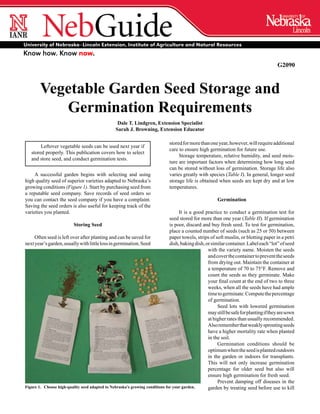
growing conditions (Figure 1). Start by purchasing seed from
a reputable seed company. Save records of seed orders so
you can contact the seed company if you have a complaint.
Saving the seed orders is also useful for keeping track of the
varieties you planted.
Storing Seed
Often seed is left over after planting and can be saved for
nextyear’sgarden,usuallywithlittlelossingermination.Seed
storedformorethanoneyear,however,willrequireadditional
care to ensure high germination for future use.
Storage temperature, relative humidity, and seed mois-
ture are important factors when determining how long seed
can be stored without loss of germination. Storage life also
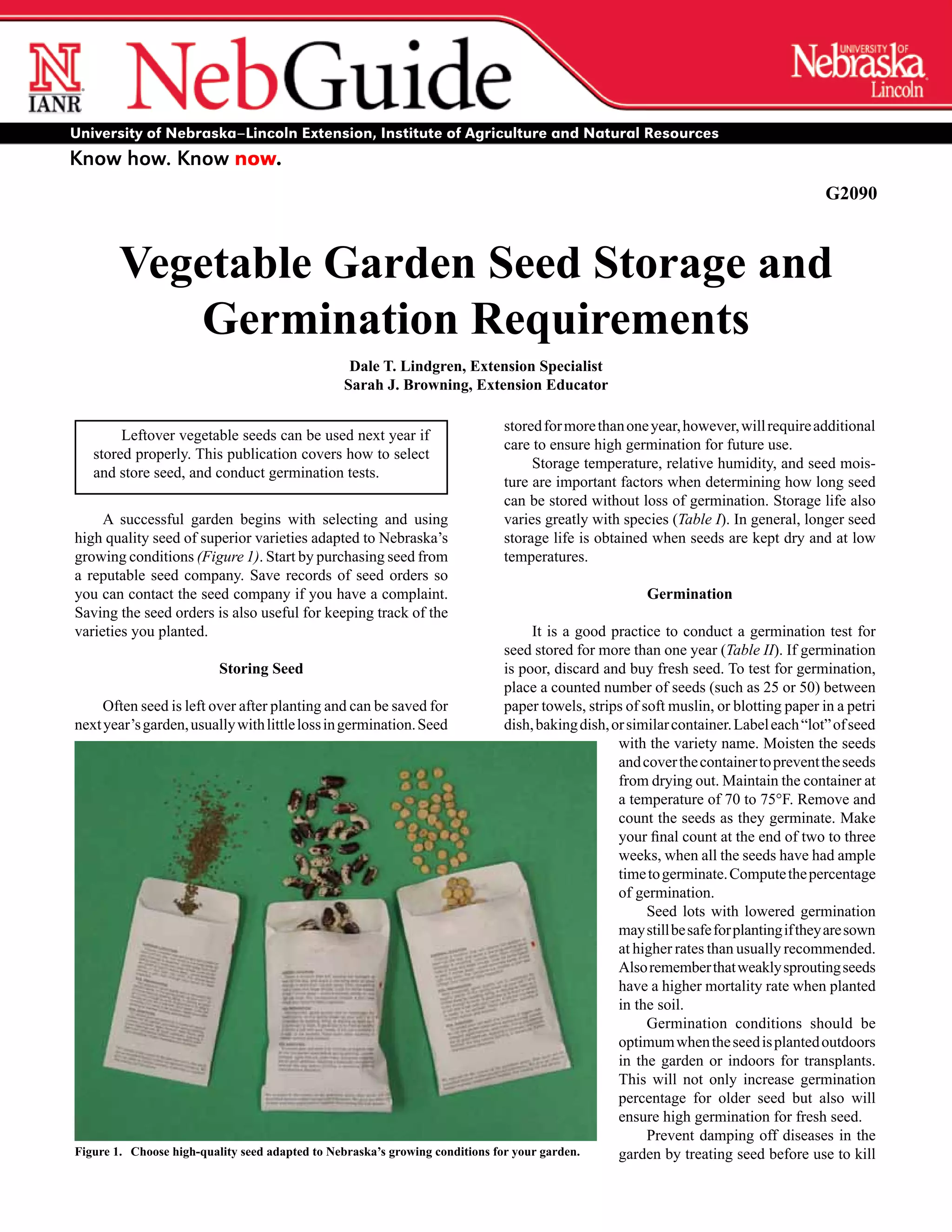
varies greatly with species (Table I). In general, longer seed
storage life is obtained when seeds are kept dry and at low
temperatures.
Germination
It is a good practice to conduct a germination test for
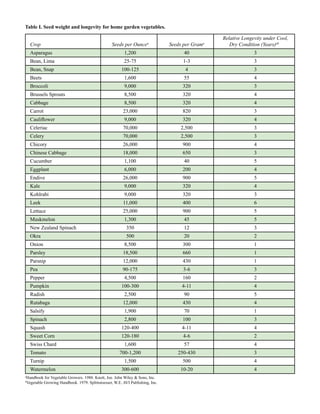
seed stored for more than one year (Table II). If germination
is poor, discard and buy fresh seed. To test for germination,
place a counted number of seeds (such as 25 or 50) between
paper towels, strips of soft muslin, or blotting paper in a petri
dish,bakingdish,orsimilarcontainer.Labeleach“lot”ofseed
with the variety name. Moisten the seeds
andcoverthecontainertopreventtheseeds
from drying out. Maintain the container at
a temperature of 70 to 75°F. Remove and
count the seeds as they germinate. Make
your final count at the end of two to three
weeks, when all the seeds have had ample
timetogerminate.Computethepercentage
of germination.
Seed lots with lowered germination
maystillbesafeforplantingiftheyaresown
at higher rates than usually recommended.
Alsorememberthatweaklysproutingseeds
have a higher mortality rate when planted
in the soil.
Germination conditions should be
optimum­whentheseedisplantedoutdoors
in the garden or indoors for transplants.
This will not only increase germination
percentage for older seed but also will
ensure high germination for fresh seed.
Prevent damping off diseases in the
garden by treating seed before use to killFigure 1.	 Choose high-quality seed adapted to Nebraska’s growing conditions for your garden.
Table I. Seed weight and longevity for home garden vegetables.
Crop Seeds per Ouncea
Seeds per Grama
Relative Longevity under Cool,
Dry Condition (Years)ab
Asparagus 1,200 40 3
Bean, Lima 25-75 1-3 3
Bean, Snap 100-125 4 3
Beets 1,600 55 4
Broccoli 9,000 320 3
Brussels Sprouts 8,500 320 4
Cabbage 8,500 320 4
Carrot 23,000 820 3
Cauliflower 9,000 320 4
Celeriac 70,000 2,500 3
Celery 70,000 2,500 3
Chicory 26,000 900 4
Chinese Cabbage 18,000 650 3
Cucumber 1,100 40 5
Eggplant 6,000 200 4
Endive 26,000 900 5
Kale 9,000 320 4
Kohlrabi 9,000 320 3
Leek 11,000 400 6
Lettuce 25,000 900 5
Muskmelon 1,300 45 5
New Zealand Spinach 350 12 3
Okra 500 20 2
Onion 8,500 300 1
Parsley 18,500 660 1
Parsnip 12,000 430 1
Pea 90-175 3-6 3
Pepper 4,500 160 2
Pumpkin 100-300 4-11 4
Radish 2,500 90 5
Rutabaga 12,000 430 4
Salsify 1,900 70 1
Spinach 2,800 100 3
Squash 120-400 4-11 4
Sweet Corn 120-180 4-6 2
Swiss Chard 1,600 57 4
Tomato 700-1,200 250-430 3
Turnip 1,500 500 4
Watermelon 300-600 10-20 4
a
Handbook for Vegetable Growers. 1988. Knott, Joe. John Wiley & Sons, Inc.
b
Vegetable Growing Handbook. 1979. Splittstoesser, W.E. AVI Publishing, Inc.
Table II. Germination data for home garden vegetable seed.
Crop
Minimum
Percent
Germinationabc
Germination Temperaturebc
Days to Germinate Under
Optimum Temperature
and Moisture Conditionsbcd
Minimum Optimum Maximum
°F °C °F °C °F °C
Asparagus 60 50 10 75 24 95 35 10
Bean, Lima 70 60 16 85 30 85 30 7
Bean, Snap 70 60 16 80 27 95 35 6
Beets 65 40 4 85 30 95 35 5
Broccoli 75 40 4 85 30 95 35 5
Brussels Sprouts 70 80 27 5
Cabbage 75 40 4 85 30 95 35 4
Carrot 55 40 4 80 27 95 35 5
Cauliflower 75 40 4 80 27 95 35 5
Celeriac 55 70 21 11
Celery 55 40 4 70 21 85 30 7
Chicory 65 80 27 6
Chinese Cabbage 75 80 27 4
Cucumber 80 60 16 95 35 105 41 2-5
Eggplant 60 60 16 85 30 95 35 6-8
Endive 70 32 0 75 24 75 24 6
Kale 75 80 27 4
Kohlrabi 75 80 27 4
Leek 60 70 21 7
Lettuce 80 35 2 75 24 75 24 2-3
Muskmelon 75 65 18 95 35 105 41 3-4
New Zealand Spinach 40 70 21 6
Okra 50 60 16 95 35 105 41 6
Onion 70 32 0 80 27 95 35 4-5
Parsley 60 40 4 75 24 90 32 13
Parsnip 60 35 2 65 18 85 30 14
Pea 80 40 4 75 24 85 30 6
Pepper 55 60 16 85 30 95 35 8
Pumpkin 75 65 18 90 32 105 41 4
Radish 75 40 4 80 27 95 35 4
Rutabaga 75 80 27 4
Salsify 75 70 21 6
Spinach 60 32 0 70 21 75 24 5
Squash 75 65 18 95 35 105 41 4
Sweet Corn 75 50 10 85 30 105 41 3
Swiss Chard 65 40 4 85 30 95 35 4
Tomato 75 50 10 80 27 95 35 6
Turnip 80 40 4 80 27 105 41 3
Watermelon
Seeded
Seedless
70 70
85
21
30
95
95
35
35
105
105
41
41
4-5
5-6
Minimum percent germination to federal standards.
a
Handbook for Vegetable Growers. 1988. Knott, J.E. John Wiley & Sons, Inc.
b
Vegetable Growing Handbook. 1979. Splittstoesser, W.E. AVI Publishing, Inc.
c
Seeds, The Yearbook of Agriculture. 1961. Stefferud, A., Editor. The United States Government Printing Office
Table II lists information about seed germination for
common vegetables. This is a guide for comparisons when
calculating germination percentages and when germinating
seed for home garden use. Germination requirements will
vary with seed source, seed storage conditions, age of seed,
and the environmental conditions under which the seed is
germinated. The minimum federal standards for vegetable
seed germination also are included.
This publication has been peer reviewed.
UNL Extension publications are available online
at http://extension.unl.edu/publications.
Index Lawn & Garden
Vegetables
Issued June 2011
Extension is a Division of the Institute of Agriculture and Natural Resources at the University of Nebraska–Lincoln
cooperating with the Counties and the United States Department of Agriculture.
University of Nebraska–Lincoln Extension educational programs abide with the nondiscrimination policies
of the University of Nebraska–Lincoln and the United States Department of Agriculture.
© 2011, The Board of Regents of the University of Nebraska on behalf of the University of Nebraska–Lincoln Extension. All rights reserved.
fungal spores that may be on the seed surface. Create a bleach
solution by mixing 1 part bleach into 9 parts water. Place the
seeds in a fabric bag and dunk them into the liquid to thor-
oughly wet the seed surfaces. Remove them from the bleach
solution and allow them to sit in the bag for 5 to 10 minutes,
thenrinsethemthoroughlyinwater.Finally,removetheseeds
from the bag, spread them out on a piece of paper and allow
them to dry before planting.

Vegetable Garden Seed Storage and Germination Requirements

  • 1.
    ® ® Know how. Knownow. University of Nebraska–Lincoln Extension, Institute of Agriculture and Natural Resources G2090 Vegetable Garden Seed Storage and Germination Requirements Dale T. Lindgren, Extension Specialist Sarah J. Browning, Extension Educator Leftover vegetable seeds can be used next year if stored properly. This publication covers how to select and store seed, and conduct germination tests. A successful garden begins with selecting and using high quality seed of superior varieties adapted to Nebraska’s growing conditions (Figure 1). Start by purchasing seed from a reputable seed company. Save records of seed orders so you can contact the seed company if you have a complaint. Saving the seed orders is also useful for keeping track of the varieties you planted. Storing Seed Often seed is left over after planting and can be saved for nextyear’sgarden,usuallywithlittlelossingermination.Seed storedformorethanoneyear,however,willrequireadditional care to ensure high germination for future use. Storage temperature, relative humidity, and seed mois- ture are important factors when determining how long seed can be stored without loss of germination. Storage life also varies greatly with species (Table I). In general, longer seed storage life is obtained when seeds are kept dry and at low temperatures. Germination It is a good practice to conduct a germination test for seed stored for more than one year (Table II). If germination is poor, discard and buy fresh seed. To test for germination, place a counted number of seeds (such as 25 or 50) between paper towels, strips of soft muslin, or blotting paper in a petri dish,bakingdish,orsimilarcontainer.Labeleach“lot”ofseed with the variety name. Moisten the seeds andcoverthecontainertopreventtheseeds from drying out. Maintain the container at a temperature of 70 to 75°F. Remove and count the seeds as they germinate. Make your final count at the end of two to three weeks, when all the seeds have had ample timetogerminate.Computethepercentage of germination. Seed lots with lowered germination maystillbesafeforplantingiftheyaresown at higher rates than usually recommended. Alsorememberthatweaklysproutingseeds have a higher mortality rate when planted in the soil. Germination conditions should be optimum­whentheseedisplantedoutdoors in the garden or indoors for transplants. This will not only increase germination percentage for older seed but also will ensure high germination for fresh seed. Prevent damping off diseases in the garden by treating seed before use to killFigure 1. Choose high-quality seed adapted to Nebraska’s growing conditions for your garden.
  • 2.
    Table I. Seedweight and longevity for home garden vegetables. Crop Seeds per Ouncea Seeds per Grama Relative Longevity under Cool, Dry Condition (Years)ab Asparagus 1,200 40 3 Bean, Lima 25-75 1-3 3 Bean, Snap 100-125 4 3 Beets 1,600 55 4 Broccoli 9,000 320 3 Brussels Sprouts 8,500 320 4 Cabbage 8,500 320 4 Carrot 23,000 820 3 Cauliflower 9,000 320 4 Celeriac 70,000 2,500 3 Celery 70,000 2,500 3 Chicory 26,000 900 4 Chinese Cabbage 18,000 650 3 Cucumber 1,100 40 5 Eggplant 6,000 200 4 Endive 26,000 900 5 Kale 9,000 320 4 Kohlrabi 9,000 320 3 Leek 11,000 400 6 Lettuce 25,000 900 5 Muskmelon 1,300 45 5 New Zealand Spinach 350 12 3 Okra 500 20 2 Onion 8,500 300 1 Parsley 18,500 660 1 Parsnip 12,000 430 1 Pea 90-175 3-6 3 Pepper 4,500 160 2 Pumpkin 100-300 4-11 4 Radish 2,500 90 5 Rutabaga 12,000 430 4 Salsify 1,900 70 1 Spinach 2,800 100 3 Squash 120-400 4-11 4 Sweet Corn 120-180 4-6 2 Swiss Chard 1,600 57 4 Tomato 700-1,200 250-430 3 Turnip 1,500 500 4 Watermelon 300-600 10-20 4 a Handbook for Vegetable Growers. 1988. Knott, Joe. John Wiley & Sons, Inc. b Vegetable Growing Handbook. 1979. Splittstoesser, W.E. AVI Publishing, Inc.
  • 3.
    Table II. Germinationdata for home garden vegetable seed. Crop Minimum Percent Germinationabc Germination Temperaturebc Days to Germinate Under Optimum Temperature and Moisture Conditionsbcd Minimum Optimum Maximum °F °C °F °C °F °C Asparagus 60 50 10 75 24 95 35 10 Bean, Lima 70 60 16 85 30 85 30 7 Bean, Snap 70 60 16 80 27 95 35 6 Beets 65 40 4 85 30 95 35 5 Broccoli 75 40 4 85 30 95 35 5 Brussels Sprouts 70 80 27 5 Cabbage 75 40 4 85 30 95 35 4 Carrot 55 40 4 80 27 95 35 5 Cauliflower 75 40 4 80 27 95 35 5 Celeriac 55 70 21 11 Celery 55 40 4 70 21 85 30 7 Chicory 65 80 27 6 Chinese Cabbage 75 80 27 4 Cucumber 80 60 16 95 35 105 41 2-5 Eggplant 60 60 16 85 30 95 35 6-8 Endive 70 32 0 75 24 75 24 6 Kale 75 80 27 4 Kohlrabi 75 80 27 4 Leek 60 70 21 7 Lettuce 80 35 2 75 24 75 24 2-3 Muskmelon 75 65 18 95 35 105 41 3-4 New Zealand Spinach 40 70 21 6 Okra 50 60 16 95 35 105 41 6 Onion 70 32 0 80 27 95 35 4-5 Parsley 60 40 4 75 24 90 32 13 Parsnip 60 35 2 65 18 85 30 14 Pea 80 40 4 75 24 85 30 6 Pepper 55 60 16 85 30 95 35 8 Pumpkin 75 65 18 90 32 105 41 4 Radish 75 40 4 80 27 95 35 4 Rutabaga 75 80 27 4 Salsify 75 70 21 6 Spinach 60 32 0 70 21 75 24 5 Squash 75 65 18 95 35 105 41 4 Sweet Corn 75 50 10 85 30 105 41 3 Swiss Chard 65 40 4 85 30 95 35 4 Tomato 75 50 10 80 27 95 35 6 Turnip 80 40 4 80 27 105 41 3 Watermelon Seeded Seedless 70 70 85 21 30 95 95 35 35 105 105 41 41 4-5 5-6 Minimum percent germination to federal standards. a Handbook for Vegetable Growers. 1988. Knott, J.E. John Wiley & Sons, Inc. b Vegetable Growing Handbook. 1979. Splittstoesser, W.E. AVI Publishing, Inc. c Seeds, The Yearbook of Agriculture. 1961. Stefferud, A., Editor. The United States Government Printing Office
  • 4.
    Table II listsinformation about seed germination for common vegetables. This is a guide for comparisons when calculating germination percentages and when germinating seed for home garden use. Germination requirements will vary with seed source, seed storage conditions, age of seed, and the environmental conditions under which the seed is germinated. The minimum federal standards for vegetable seed germination also are included. This publication has been peer reviewed. UNL Extension publications are available online at http://extension.unl.edu/publications. Index Lawn & Garden Vegetables Issued June 2011 Extension is a Division of the Institute of Agriculture and Natural Resources at the University of Nebraska–Lincoln cooperating with the Counties and the United States Department of Agriculture. University of Nebraska–Lincoln Extension educational programs abide with the nondiscrimination policies of the University of Nebraska–Lincoln and the United States Department of Agriculture. © 2011, The Board of Regents of the University of Nebraska on behalf of the University of Nebraska–Lincoln Extension. All rights reserved. fungal spores that may be on the seed surface. Create a bleach solution by mixing 1 part bleach into 9 parts water. Place the seeds in a fabric bag and dunk them into the liquid to thor- oughly wet the seed surfaces. Remove them from the bleach solution and allow them to sit in the bag for 5 to 10 minutes, thenrinsethemthoroughlyinwater.Finally,removetheseeds from the bag, spread them out on a piece of paper and allow them to dry before planting.