Breast cancer is by far the most frequent cancer among women with an
estimated
1.6 million new cases diagnosed with more than
500,000 deaths each year
(GLOBOCAN 2012)
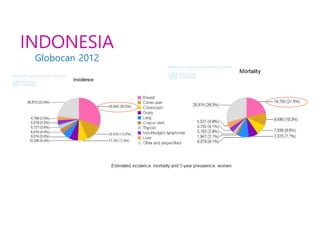
INDONESIA
Globocan 2012
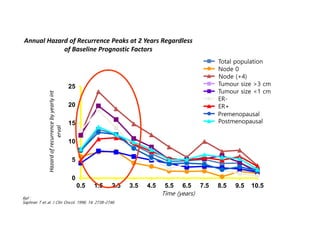
Annual Hazard of Recurrence Peaks at 2 Years Regardless
of Baseline Prognostic Factors
0
5
10
15
20
25
0.5 1.5 2.5 3.5 4.5 5.5 6.5 7.5 8.5 9.5 10.5
Hazardofrecurrencebyyearlyint
erval
Time (years)
Total population
Node 0
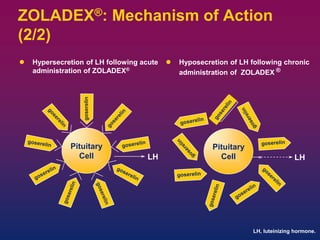
Node (+4)
Postmenopausal
Premenopausal
ER+
ER-
Tumour size <1 cm
Tumour size >3 cm
Ref :
Saphner T et al. J Clin Oncol. 1996; 14: 2738–2746
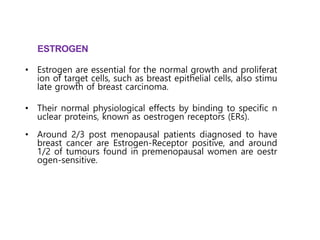
• Estrogen are essential for the normal growth and proliferat
ion of target cells, such as breast epithelial cells, also stimu
late growth of breast carcinoma.
• Their normal physiological effects by binding to specific n
uclear proteins, known as oestrogen receptors (ERs).
• Around 2/3 post menopausal patients diagnosed to have
breast cancer are Estrogen-Receptor positive, and around
1/2 of tumours found in premenopausal women are oestr
ogen-sensitive.
ESTROGEN
Ref :
Annals of Oncology 14: 1017–1025, 2003
.
Hypothalamus
Gonadotropins
(FSH + LH)
Ovary
Estrogens
Progesterone
Prolactin
Growth Hormone
Pituitary gland
Pre / Postmenopausal
Adrenal gland
Progesterone
Androgens
Estrogens
Corticosteroids
Premenopausal
Adrenocorticotropic
hormone (ACTH)
Estrogen Production in Premenopausal
and Postmenopausal Patients
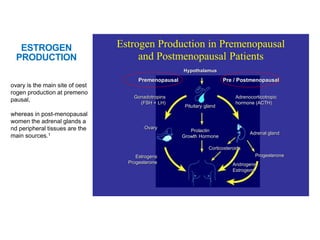
ovary is the main site of oest
rogen production at premeno
pausal,
whereas in post-menopausal
women the adrenal glands a
nd peripheral tissues are the
main sources.1
Ref :
1. NCCN Guidelines Version 1.2015
ESTROGEN
PRODUCTION
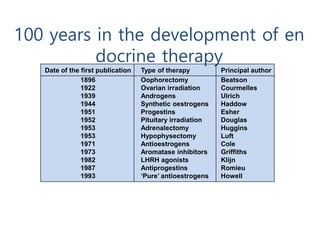
100 years in the development of en
docrine therapy
Date of the first publication
1896
1922
1939
1944
1951
1952
1953
1953
1971
1973
1982
1987
1993
Reference: Howell, A. et al. Reviews on Endocrine-related Cancer. 1993; 43: 5-21
Type of therapy
Oophorectomy
Ovarian irradiation
Androgens
Synthetic oestrogens
Progestins
Pituitary irradiation
Adrenalectomy
Hypophysectomy
Antioestrogens
Aromatase inhibitors
LHRH agonists
Antiprogestins
‘Pure’ antioestrogens
Principal author
Beatson
Courmelles
Ulrich
Haddow
Esher
Douglas
Huggins
Luft
Cole
Griffiths
Klijn
Romieu
Howell
Ref :
1. NCCN Guidelines Version 1.2015
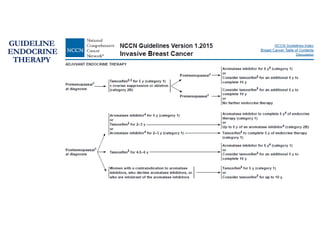
GUIDELINE
ENDOCRINE
THERAPY
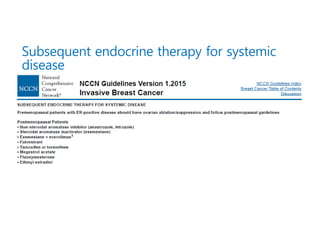
Subsequent endocrine therapy for systemic
disease
Ref :
1. NCCN Guidelines Version 1.2015
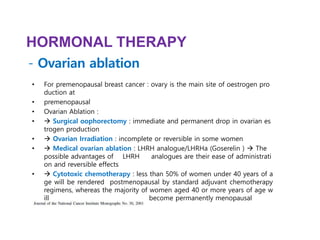
• For premenopausal breast cancer : ovary is the main site of oestrogen pro
duction at
• premenopausal
• Ovarian Ablation :
•  Surgical oophorectomy : immediate and permanent drop in ovarian es
trogen production
•  Ovarian Irradiation : incomplete or reversible in some women
•  Medical ovarian ablation : LHRH analogue/LHRHa (Goserelin )  The
possible advantages of LHRH analogues are their ease of administrati
on and reversible effects
•  Cytotoxic chemotherapy : less than 50% of women under 40 years of a
ge will be rendered postmenopausal by standard adjuvant chemotherapy
regimens, whereas the majority of women aged 40 or more years of age w
ill become permanently menopausal
HORMONAL THERAPY
- Ovarian ablation
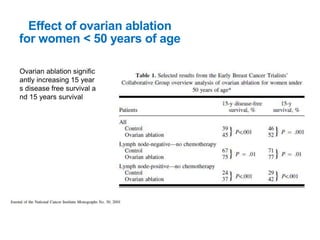
Effect of ovarian ablation
for women < 50 years of age
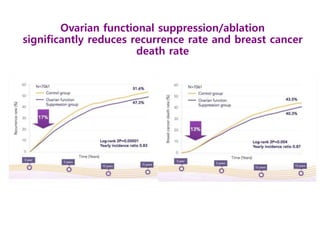
Ovarian ablation signific
antly increasing 15 year
s disease free survival a
nd 15 years survival
Ovarian functional suppression/ablation
significantly reduces recurrence rate and breast cancer
death rate
Reference :
Adapted from EBCTG. Lancet. 2005. 365 :
1687-1717
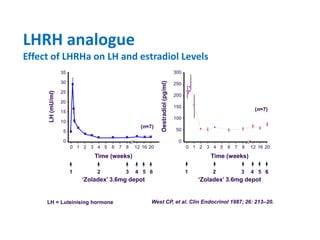
LHRH analogue
Effect of LHRHa on LH and estradiol Levels
‘Zoladex’ 3.6mg depot
0 1 2 3 4 5 6 7 8 12 16 20
35
30
25
20
15
10
5
0
LH(mU/ml)
Time (weeks)
(n=7)
1 2 3 4 5 6
West CP, et al. Clin Endocrinol 1987; 26: 213–20.
Oestradiol(pg/ml)
‘Zoladex’ 3.6mg depot
1 2 3 4 5 6
300
250
200
150
100
50
0
0 1 2 3 4 5 6 7 8 12 16 20
Time (weeks)
(n=7)
LH = Luteinising hormone
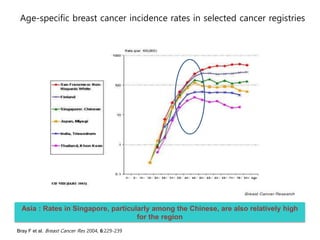
Age-specific breast cancer incidence rates in selected cancer registries
Bray F et al. Breast Cancer Res 2004, 6:229-239
Asia : Rates in Singapore, particularly among the Chinese, are also relatively high
for the region
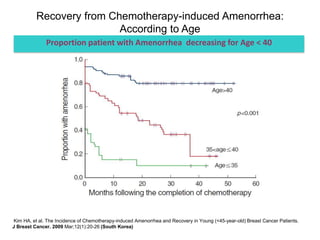
Recovery from Chemotherapy-induced Amenorrhea:
According to Age
Kim HA, et al. The Incidence of Chemotherapy-induced Amenorrhea and Recovery in Young (<45-year-old) Breast Cancer Patients.
J Breast Cancer. 2009 Mar;12(1):20-26 (South Korea)
Proportion patient with Amenorrhea decreasing for Age < 40
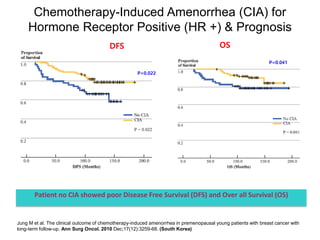
Chemotherapy-Induced Amenorrhea (CIA) for
Hormone Receptor Positive (HR +) & Prognosis
Jung M et al. The clinical outcome of chemotherapy-induced amenorrhea in premenopausal young patients with breast cancer with
long-term follow-up. Ann Surg Oncol. 2010 Dec;17(12):3259-68. (South Korea)
DFS OS
P=0.022
P=0.041
Patient no CIA showed poor Disease Free Survival (DFS) and Over all Survival (OS)
ZOLADEX® in the management
of breast cancer
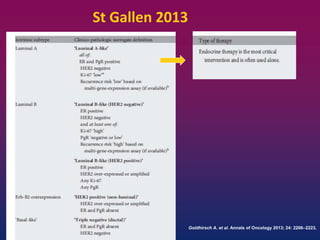
St Gallen 2013
Goldhirsch A. et al. Annals of Oncology 2013; 24: 2206–2223,
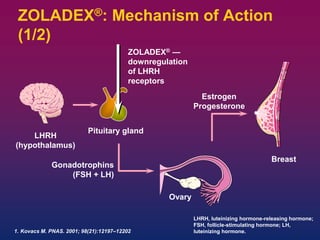
ZOLADEX®: Mechanism of Action
(1/2)
LHRH
(hypothalamus)
Pituitary gland
Estrogen
Progesterone
Ovary
ZOLADEX® —
downregulation
of LHRH
receptors
Gonadotrophins
(FSH + LH)
Breast
LHRH, luteinizing hormone-releasing hormone;
FSH, follicle-stimulating hormone; LH,
luteinizing hormone.1. Kovacs M. PNAS. 2001; 98(21):12197–12202
goserelin
Pituitary
Cell LH
Pituitary
Cell LH
ZOLADEX®: Mechanism of Action
(2/2)
 Hypersecretion of LH following acute
administration of ZOLADEX®
 Hyposecretion of LH following chronic
administration of ZOLADEX ®
LH, luteinizing hormone.
ZOLADEX® 3.6 mg suppresses serum oestradiol to
postmenopausal level by the eighth day.
Matta WH, et al. Endocrinologic and clinical evaluation following a single administration of a GnRH agonist (ZOLADEX),in a
depot formulation to premenopausal women.Fertil Steril 1988;49:163-165
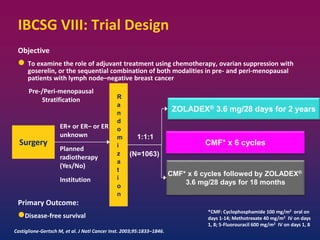
Surgery
R
a
n
d
o
m
i
z
a
t
i
o
n
ZOLADEX® 3.6 mg/28 days for 2 years
CMF* x 6 cycles
CMF* x 6 cycles followed by ZOLADEX®
3.6 mg/28 days for 18 months
ER+ or ER– or ER
unknown
Planned
radiotherapy
(Yes/No)
Institution
1:1:1
(N=1063)
Pre-/Peri-menopausal
Stratification
Castiglione-Gertsch M, et al. J Natl Cancer Inst. 2003;95:1833–1846.
*CMF: Cyclophosphamide 100 mg/m2 oral on
days 1-14; Methotrexate 40 mg/m2 IV on days
1, 8; 5-Fluorouracil 600 mg/m2 IV on days 1, 8
IBCSG VIII: Trial Design
Objective
 To examine the role of adjuvant treatment using chemotherapy, ovarian suppression with
goserelin, or the sequential combination of both modalities in pre- and peri-menopausal
patients with lymph node–negative breast cancer
Primary Outcome:
Disease-free survival
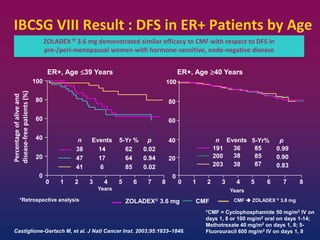
IBCSG VIII Result : DFS in ER+ Patients by Age
*Retrospective analysis CMF  ZOLADEX ® 3.6 mgZOLADEX® 3.6 mg CMF
ER+, Age 39 Years
1 2 3 4 5 6 80
0
20
40
80
100
60
7
Years
Events
14
17
6
n
38
47
41
5-Yr %
62
64
85
p
0.02
0.94
0.02
Percentageofaliveand
disease-freepatients(%)
Years
ER+, Age 40 Years
n
191
200
203
Events 5-Yr% p
36
38
38
85
85
87
0.99
0.90
0.83
0
20
40
80
100
60
1 2 3 4 5 6 80 7
Castiglione-Gertsch M, et al. J Natl Cancer Inst. 2003;95:1833–1846.
*CMF = Cyclophosphamide 50 mg/m2 IV on
days 1, 8 or 100 mg/m2 oral on days 1-14;
Methotrexate 40 mg/m2 on days 1, 8; 5-
Fluorouracil 600 mg/m2 IV on days 1, 8
ZOLADEX ® 3.6 mg demonstrated similar efficacy to CMF with respect to DFS in
pre-/peri-menopausal women with hormone-sensitive, node-negative disease
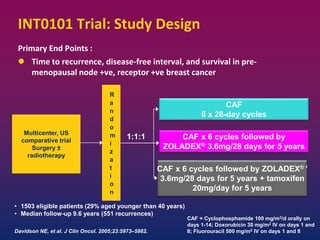
Davidson NE, et al. J Clin Oncol. 2005;23:5973–5982.
R
a
n
d
o
m
i
z
a
t
i
o
n
1:1:1
CAF
6 x 28-day cycles
CAF x 6 cycles followed by
ZOLADEX® 3.6mg/28 days for 5 years
CAF x 6 cycles followed by ZOLADEX® ’
3.6mg/28 days for 5 years + tamoxifen
20mg/day for 5 years
CAF = Cyclophosphamide 100 mg/m2/d orally on
days 1-14; Doxorubicin 30 mg/m2 IV on days 1 and
8; Fluorouracil 500 mg/m2 IV on days 1 and 8
Multicenter, US
comparative trial
Surgery ±
radiotherapy
• 1503 eligible patients (29% aged younger than 40 years)
• Median follow-up 9.6 years (551 recurrences)
INT0101 Trial: Study Design
Primary End Points :
 Time to recurrence, disease-free interval, and survival in pre-
menopausal node +ve, receptor +ve breast cancer
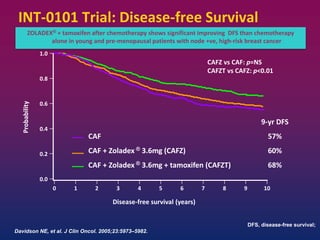
CAFZ vs CAF: p=NS
CAFZT vs CAFZ: p<0.01
0 1 2 3 4 5 6 7 8 9 10
0.0
0.2
0.4
0.6
0.8
1.0
9-yr DFS
CAF 57%
CAF + Zoladex ® 3.6mg (CAFZ) 60%
CAF + Zoladex ® 3.6mg + tamoxifen (CAFZT) 68%
INT-0101 Trial: Disease-free SurvivalProbability
Disease-free survival (years)
ZOLADEX® + tamoxifen after chemotherapy shows significant improving DFS than chemotherapy
alone in young and pre-menopausal patients with node +ve, high-risk breast cancer
Davidson NE, et al. J Clin Oncol. 2005;23:5973–5982.
DFS, disease-free survival;
1 2 3 5 6 7 8
1.0
0.8
0.6
0.4
0.2
Probability
Disease Free Survival (years)
9 100
0
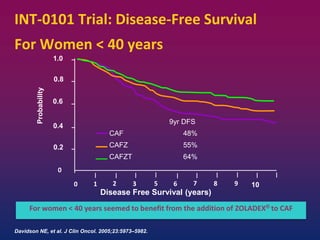
9yr DFS
CAF 48%
CAFZ 55%
CAFZT 64%
INT-0101 Trial: Disease-Free Survival
For Women < 40 years
Davidson NE, et al. J Clin Oncol. 2005;23:5973–5982.
For women < 40 years seemed to benefit from the addition of ZOLADEX® to CAF
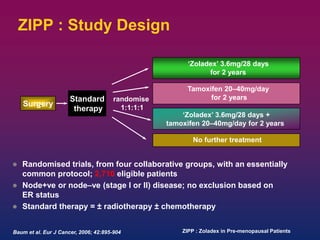
 Randomised trials, from four collaborative groups, with an essentially
common protocol; 2,710 eligible patients
 Node+ve or node–ve (stage I or II) disease; no exclusion based on
ER status
 Standard therapy = ± radiotherapy ± chemotherapy
Surgery
‘Zoladex’ 3.6mg/28 days +
tamoxifen 20–40mg/day for 2 years
Standard
therapy
.
‘Zoladex’ 3.6mg/28 days
for 2 years
Tamoxifen 20–40mg/day
for 2 years
No further treatment
randomise
1:1:1:1
Baum et al. Eur J Cancer, 2006; 42:895-904
ZIPP : Study Design
ZIPP : Zoladex in Pre-menopausal Patients
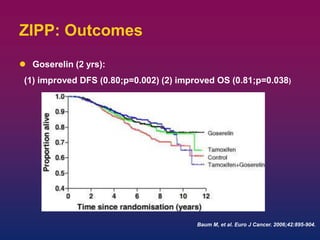
ZIPP: Outcomes
Baum M, et al. Euro J Cancer. 2006;42:895-904.
0 2 4 6 8 1210
Time since randomisation (years)
Proportionaliveand
event-free
0.0
0.2
0.4
0.6
0.8
1.0
Goserelin
Control
0 2 4 6 8 1210
Time since randomisation (years)
Proportionalive
0.0
0.2
0.4
0.6
0.8
1.0 Goserelin
Control
Number at risk:
No goserelin 1356 1062 702 381 134 22 0
Goserelin 1354 1108 772 418 156 31 0
Number at risk:
No goserelin 1356 1216 877 486 178 33 0
Goserelin 1354 1214 893 501 198 37 0
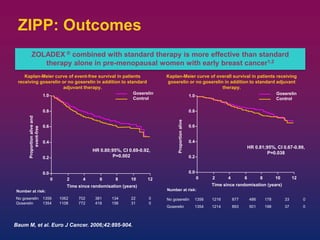
ZOLADEX ® combined with standard therapy is more effective than standard
therapy alone in pre-menopausal women with early breast cancer1,2
Kaplan-Meier curve of event-free survival in patients
receiving goserelin or no goserelin in addition to standard
adjuvant therapy.
Kaplan-Meier curve of overall survival in patients receiving
goserelin or no goserelin in addition to standard adjuvant
therapy.
HR 0.81;95%, CI 0.67-0.99,
P=0.038
HR 0.80;95%, CI 0.69-0.92,
P=0.002
 Goserelin (2 yrs):
(1) improved DFS (0.80;p=0.002) (2) improved OS (0.81;p=0.038)
Baum M, et al. Euro J Cancer. 2006;42:895-904.
ZIPP: Outcomes
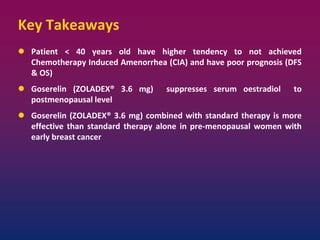
Key Takeaways
 Patient < 40 years old have higher tendency to not achieved
Chemotherapy Induced Amenorrhea (CIA) and have poor prognosis (DFS
& OS)
 Goserelin (ZOLADEX® 3.6 mg) suppresses serum oestradiol to
postmenopausal level
 Goserelin (ZOLADEX® 3.6 mg) combined with standard therapy is more
effective than standard therapy alone in pre-menopausal women with
early breast cancer

Zoladex ca mammae

  • 2.
    Breast cancer isby far the most frequent cancer among women with an estimated 1.6 million new cases diagnosed with more than 500,000 deaths each year (GLOBOCAN 2012)
  • 4.
  • 5.
    Annual Hazard ofRecurrence Peaks at 2 Years Regardless of Baseline Prognostic Factors 0 5 10 15 20 25 0.5 1.5 2.5 3.5 4.5 5.5 6.5 7.5 8.5 9.5 10.5 Hazardofrecurrencebyyearlyint erval Time (years) Total population Node 0 Node (+4) Postmenopausal Premenopausal ER+ ER- Tumour size <1 cm Tumour size >3 cm Ref : Saphner T et al. J Clin Oncol. 1996; 14: 2738–2746
  • 6.
    • Estrogen areessential for the normal growth and proliferat ion of target cells, such as breast epithelial cells, also stimu late growth of breast carcinoma. • Their normal physiological effects by binding to specific n uclear proteins, known as oestrogen receptors (ERs). • Around 2/3 post menopausal patients diagnosed to have breast cancer are Estrogen-Receptor positive, and around 1/2 of tumours found in premenopausal women are oestr ogen-sensitive. ESTROGEN Ref : Annals of Oncology 14: 1017–1025, 2003 .
  • 7.
    Hypothalamus Gonadotropins (FSH + LH) Ovary Estrogens Progesterone Prolactin GrowthHormone Pituitary gland Pre / Postmenopausal Adrenal gland Progesterone Androgens Estrogens Corticosteroids Premenopausal Adrenocorticotropic hormone (ACTH) Estrogen Production in Premenopausal and Postmenopausal Patients ovary is the main site of oest rogen production at premeno pausal, whereas in post-menopausal women the adrenal glands a nd peripheral tissues are the main sources.1 Ref : 1. NCCN Guidelines Version 1.2015 ESTROGEN PRODUCTION
  • 8.
    100 years inthe development of en docrine therapy Date of the first publication 1896 1922 1939 1944 1951 1952 1953 1953 1971 1973 1982 1987 1993 Reference: Howell, A. et al. Reviews on Endocrine-related Cancer. 1993; 43: 5-21 Type of therapy Oophorectomy Ovarian irradiation Androgens Synthetic oestrogens Progestins Pituitary irradiation Adrenalectomy Hypophysectomy Antioestrogens Aromatase inhibitors LHRH agonists Antiprogestins ‘Pure’ antioestrogens Principal author Beatson Courmelles Ulrich Haddow Esher Douglas Huggins Luft Cole Griffiths Klijn Romieu Howell
  • 9.
    Ref : 1. NCCNGuidelines Version 1.2015 GUIDELINE ENDOCRINE THERAPY
  • 10.
    Subsequent endocrine therapyfor systemic disease Ref : 1. NCCN Guidelines Version 1.2015
  • 11.
    • For premenopausalbreast cancer : ovary is the main site of oestrogen pro duction at • premenopausal • Ovarian Ablation : •  Surgical oophorectomy : immediate and permanent drop in ovarian es trogen production •  Ovarian Irradiation : incomplete or reversible in some women •  Medical ovarian ablation : LHRH analogue/LHRHa (Goserelin )  The possible advantages of LHRH analogues are their ease of administrati on and reversible effects •  Cytotoxic chemotherapy : less than 50% of women under 40 years of a ge will be rendered postmenopausal by standard adjuvant chemotherapy regimens, whereas the majority of women aged 40 or more years of age w ill become permanently menopausal HORMONAL THERAPY - Ovarian ablation
  • 12.
    Effect of ovarianablation for women < 50 years of age Ovarian ablation signific antly increasing 15 year s disease free survival a nd 15 years survival
  • 13.
    Ovarian functional suppression/ablation significantlyreduces recurrence rate and breast cancer death rate Reference : Adapted from EBCTG. Lancet. 2005. 365 : 1687-1717
  • 14.
    LHRH analogue Effect ofLHRHa on LH and estradiol Levels ‘Zoladex’ 3.6mg depot 0 1 2 3 4 5 6 7 8 12 16 20 35 30 25 20 15 10 5 0 LH(mU/ml) Time (weeks) (n=7) 1 2 3 4 5 6 West CP, et al. Clin Endocrinol 1987; 26: 213–20. Oestradiol(pg/ml) ‘Zoladex’ 3.6mg depot 1 2 3 4 5 6 300 250 200 150 100 50 0 0 1 2 3 4 5 6 7 8 12 16 20 Time (weeks) (n=7) LH = Luteinising hormone
  • 15.
    Age-specific breast cancerincidence rates in selected cancer registries Bray F et al. Breast Cancer Res 2004, 6:229-239 Asia : Rates in Singapore, particularly among the Chinese, are also relatively high for the region
  • 16.
    Recovery from Chemotherapy-inducedAmenorrhea: According to Age Kim HA, et al. The Incidence of Chemotherapy-induced Amenorrhea and Recovery in Young (<45-year-old) Breast Cancer Patients. J Breast Cancer. 2009 Mar;12(1):20-26 (South Korea) Proportion patient with Amenorrhea decreasing for Age < 40
  • 17.
    Chemotherapy-Induced Amenorrhea (CIA)for Hormone Receptor Positive (HR +) & Prognosis Jung M et al. The clinical outcome of chemotherapy-induced amenorrhea in premenopausal young patients with breast cancer with long-term follow-up. Ann Surg Oncol. 2010 Dec;17(12):3259-68. (South Korea) DFS OS P=0.022 P=0.041 Patient no CIA showed poor Disease Free Survival (DFS) and Over all Survival (OS)
  • 18.
    ZOLADEX® in themanagement of breast cancer
  • 19.
    St Gallen 2013 GoldhirschA. et al. Annals of Oncology 2013; 24: 2206–2223,
  • 20.
    ZOLADEX®: Mechanism ofAction (1/2) LHRH (hypothalamus) Pituitary gland Estrogen Progesterone Ovary ZOLADEX® — downregulation of LHRH receptors Gonadotrophins (FSH + LH) Breast LHRH, luteinizing hormone-releasing hormone; FSH, follicle-stimulating hormone; LH, luteinizing hormone.1. Kovacs M. PNAS. 2001; 98(21):12197–12202
  • 21.
    goserelin Pituitary Cell LH Pituitary Cell LH ZOLADEX®:Mechanism of Action (2/2)  Hypersecretion of LH following acute administration of ZOLADEX®  Hyposecretion of LH following chronic administration of ZOLADEX ® LH, luteinizing hormone.
  • 22.
    ZOLADEX® 3.6 mgsuppresses serum oestradiol to postmenopausal level by the eighth day. Matta WH, et al. Endocrinologic and clinical evaluation following a single administration of a GnRH agonist (ZOLADEX),in a depot formulation to premenopausal women.Fertil Steril 1988;49:163-165
  • 23.
    Surgery R a n d o m i z a t i o n ZOLADEX® 3.6 mg/28days for 2 years CMF* x 6 cycles CMF* x 6 cycles followed by ZOLADEX® 3.6 mg/28 days for 18 months ER+ or ER– or ER unknown Planned radiotherapy (Yes/No) Institution 1:1:1 (N=1063) Pre-/Peri-menopausal Stratification Castiglione-Gertsch M, et al. J Natl Cancer Inst. 2003;95:1833–1846. *CMF: Cyclophosphamide 100 mg/m2 oral on days 1-14; Methotrexate 40 mg/m2 IV on days 1, 8; 5-Fluorouracil 600 mg/m2 IV on days 1, 8 IBCSG VIII: Trial Design Objective  To examine the role of adjuvant treatment using chemotherapy, ovarian suppression with goserelin, or the sequential combination of both modalities in pre- and peri-menopausal patients with lymph node–negative breast cancer Primary Outcome: Disease-free survival
  • 24.
    IBCSG VIII Result: DFS in ER+ Patients by Age *Retrospective analysis CMF  ZOLADEX ® 3.6 mgZOLADEX® 3.6 mg CMF ER+, Age 39 Years 1 2 3 4 5 6 80 0 20 40 80 100 60 7 Years Events 14 17 6 n 38 47 41 5-Yr % 62 64 85 p 0.02 0.94 0.02 Percentageofaliveand disease-freepatients(%) Years ER+, Age 40 Years n 191 200 203 Events 5-Yr% p 36 38 38 85 85 87 0.99 0.90 0.83 0 20 40 80 100 60 1 2 3 4 5 6 80 7 Castiglione-Gertsch M, et al. J Natl Cancer Inst. 2003;95:1833–1846. *CMF = Cyclophosphamide 50 mg/m2 IV on days 1, 8 or 100 mg/m2 oral on days 1-14; Methotrexate 40 mg/m2 on days 1, 8; 5- Fluorouracil 600 mg/m2 IV on days 1, 8 ZOLADEX ® 3.6 mg demonstrated similar efficacy to CMF with respect to DFS in pre-/peri-menopausal women with hormone-sensitive, node-negative disease
  • 25.
    Davidson NE, etal. J Clin Oncol. 2005;23:5973–5982. R a n d o m i z a t i o n 1:1:1 CAF 6 x 28-day cycles CAF x 6 cycles followed by ZOLADEX® 3.6mg/28 days for 5 years CAF x 6 cycles followed by ZOLADEX® ’ 3.6mg/28 days for 5 years + tamoxifen 20mg/day for 5 years CAF = Cyclophosphamide 100 mg/m2/d orally on days 1-14; Doxorubicin 30 mg/m2 IV on days 1 and 8; Fluorouracil 500 mg/m2 IV on days 1 and 8 Multicenter, US comparative trial Surgery ± radiotherapy • 1503 eligible patients (29% aged younger than 40 years) • Median follow-up 9.6 years (551 recurrences) INT0101 Trial: Study Design Primary End Points :  Time to recurrence, disease-free interval, and survival in pre- menopausal node +ve, receptor +ve breast cancer
  • 26.
    CAFZ vs CAF:p=NS CAFZT vs CAFZ: p<0.01 0 1 2 3 4 5 6 7 8 9 10 0.0 0.2 0.4 0.6 0.8 1.0 9-yr DFS CAF 57% CAF + Zoladex ® 3.6mg (CAFZ) 60% CAF + Zoladex ® 3.6mg + tamoxifen (CAFZT) 68% INT-0101 Trial: Disease-free SurvivalProbability Disease-free survival (years) ZOLADEX® + tamoxifen after chemotherapy shows significant improving DFS than chemotherapy alone in young and pre-menopausal patients with node +ve, high-risk breast cancer Davidson NE, et al. J Clin Oncol. 2005;23:5973–5982. DFS, disease-free survival;
  • 27.
    1 2 35 6 7 8 1.0 0.8 0.6 0.4 0.2 Probability Disease Free Survival (years) 9 100 0 9yr DFS CAF 48% CAFZ 55% CAFZT 64% INT-0101 Trial: Disease-Free Survival For Women < 40 years Davidson NE, et al. J Clin Oncol. 2005;23:5973–5982. For women < 40 years seemed to benefit from the addition of ZOLADEX® to CAF
  • 28.
     Randomised trials,from four collaborative groups, with an essentially common protocol; 2,710 eligible patients  Node+ve or node–ve (stage I or II) disease; no exclusion based on ER status  Standard therapy = ± radiotherapy ± chemotherapy Surgery ‘Zoladex’ 3.6mg/28 days + tamoxifen 20–40mg/day for 2 years Standard therapy . ‘Zoladex’ 3.6mg/28 days for 2 years Tamoxifen 20–40mg/day for 2 years No further treatment randomise 1:1:1:1 Baum et al. Eur J Cancer, 2006; 42:895-904 ZIPP : Study Design ZIPP : Zoladex in Pre-menopausal Patients
  • 29.
    ZIPP: Outcomes Baum M,et al. Euro J Cancer. 2006;42:895-904. 0 2 4 6 8 1210 Time since randomisation (years) Proportionaliveand event-free 0.0 0.2 0.4 0.6 0.8 1.0 Goserelin Control 0 2 4 6 8 1210 Time since randomisation (years) Proportionalive 0.0 0.2 0.4 0.6 0.8 1.0 Goserelin Control Number at risk: No goserelin 1356 1062 702 381 134 22 0 Goserelin 1354 1108 772 418 156 31 0 Number at risk: No goserelin 1356 1216 877 486 178 33 0 Goserelin 1354 1214 893 501 198 37 0 ZOLADEX ® combined with standard therapy is more effective than standard therapy alone in pre-menopausal women with early breast cancer1,2 Kaplan-Meier curve of event-free survival in patients receiving goserelin or no goserelin in addition to standard adjuvant therapy. Kaplan-Meier curve of overall survival in patients receiving goserelin or no goserelin in addition to standard adjuvant therapy. HR 0.81;95%, CI 0.67-0.99, P=0.038 HR 0.80;95%, CI 0.69-0.92, P=0.002
  • 30.
     Goserelin (2yrs): (1) improved DFS (0.80;p=0.002) (2) improved OS (0.81;p=0.038) Baum M, et al. Euro J Cancer. 2006;42:895-904. ZIPP: Outcomes
  • 31.
    Key Takeaways  Patient< 40 years old have higher tendency to not achieved Chemotherapy Induced Amenorrhea (CIA) and have poor prognosis (DFS & OS)  Goserelin (ZOLADEX® 3.6 mg) suppresses serum oestradiol to postmenopausal level  Goserelin (ZOLADEX® 3.6 mg) combined with standard therapy is more effective than standard therapy alone in pre-menopausal women with early breast cancer