Dr. Salem Baidas
ENVIRONMENTAL SUSTAINABILITY SLIDESHOWS
FROM s2adesign.com
S2ADESIGN.COM
DEFINITION
01
BENEFITS
02
CHALLENGES
03
UN POLICY
04
INFOGRAPHICS
05
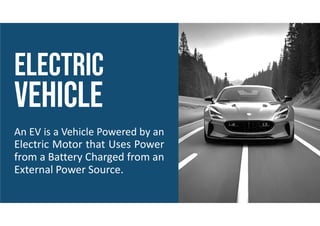
An EV is a Vehicle Powered by an
Electric Motor that Uses Power
from a Battery Charged from an
External Power Source.
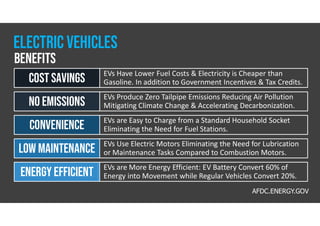
EVs Have Lower Fuel Costs & Electricity is Cheaper than
Gasoline. In addition to Government Incentives & Tax Credits.
Cost Savings
EVs Produce Zero Tailpipe Emissions Reducing Air Pollution
Mitigating Climate Change & Accelerating Decarbonization.
No Emissions
EVs are Easy to Charge from a Standard Household Socket
Eliminating the Need for Fuel Stations.
Convenience
EVs Use Electric Motors Eliminating the Need for Lubrication
or Maintenance Tasks Compared to Combustion Motors.
Low Maintenance
EVs are More Energy Efficient: EV Battery Convert 60% of
Energy into Movement while Regular Vehicles Convert 20%.
Energy Efficient
Benefits
Electric vehicles
AFDC.ENERGY.GOV
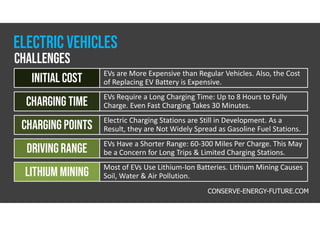
EVs are More Expensive than Regular Vehicles. Also, the Cost
of Replacing EV Battery is Expensive.
initial cost
EVs Require a Long Charging Time: Up to 8 Hours to Fully
Charge. Even Fast Charging Takes 30 Minutes.
charging time
Electric Charging Stations are Still in Development. As a
Result, they are Not Widely Spread as Gasoline Fuel Stations.
Charging points
EVs Have a Shorter Range: 60-300 Miles Per Charge. This May
be a Concern for Long Trips & Limited Charging Stations.
Drivingrange
Most of EVs Use Lithium-Ion Batteries. Lithium Mining Causes
Soil, Water & Air Pollution.
Lithium mining
Challenges
Electric vehicles
CONSERVE-ENERGY-FUTURE.COM
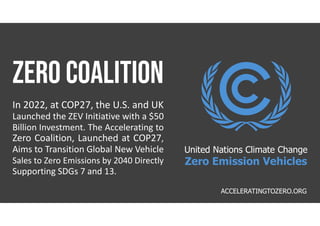
In 2022, at COP27, the U.S. and UK
Launched the ZEV Initiative with a $50
Billion Investment. The Accelerating to
Zero Coalition, Launched at COP27,
Aims to Transition Global New Vehicle
Sales to Zero Emissions by 2040 Directly
Supporting SDGs 7 and 13.
ACCELERATINGTOZERO.ORG
United Nations Climate Change
Zero Emission Vehicles
This is a placeholder text. This text
can be replaced with your own text.
This text can be replaced with your
own text. This is a placeholder text.
This text can be replaced with your
own text. This text can be replaced
with your own text.
9.7
6.6
4.1
3.6
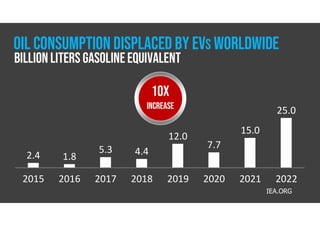
OIL CONSUMPTION DISPLACED BY EVS WORLDWIDE
2015 2016 2017 2018 2019 2020 2021 2022
2.4 1.8
5.3 4.4
12.0
7.7
15.0
25.0
IEA.ORG
10X
INCREASE
billion liters gasolineequivalent
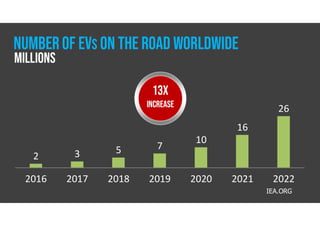
2016 2017 2018 2019 2020 2021 2022
2 3 5 7
10
16
26
IEA.ORG
13X
INCREASE
NUMBEROF EVS ON THE ROAD WORLDWIDE
Millions
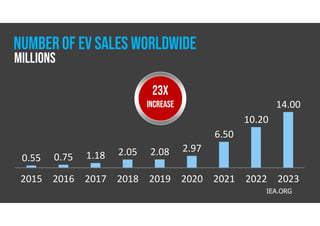
2015 2016 2017 2018 2019 2020 2021 2022 2023
0.55 0.75 1.18 2.05 2.08 2.97
6.50
10.20
14.00
IEA.ORG
23X
INCREASE
Numberof EV SALES WORLDWIDE
Millions
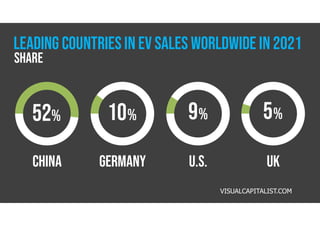
CHINA
THIS IS A PLACEHOLDERTEXT.
THIS TEXTCAN BE REPLACED
WITH YOUR OWN TEXT.
GERMANY
THIS IS A
PLACEHOLD
U.S.
THIS IS A
PLACEHOLD
UK
THIS IS A
PLACEHOLD
52% 10% 9% 5%
VISUALCAPITALIST.COM
Leading countriesin EV SALES WORLDWIDE in 2021
share
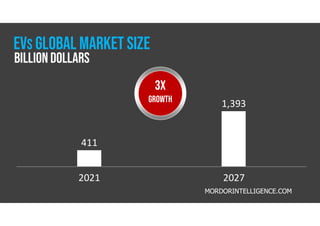
2021 2027
411
1,393
MORDORINTELLIGENCE.COM
3X
GROWTH
EVS global MARKET SIZE
BILLION DOLLARS
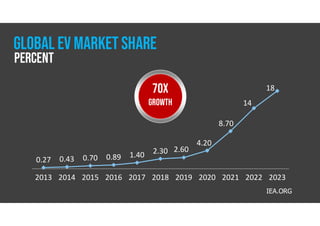
0.27 0.43 0.70 0.89 1.40 2.30 2.60
4.20
8.70
14
18
2013 2014 2015 2016 2017 2018 2019 2020 2021 2022 2023
IEA.ORG
70X
GROWTH
Global EV MARKET SHARE
PERCENT
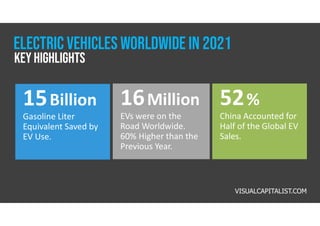
16Million
EVs were on the
Road Worldwide.
60% Higher than the
Previous Year.
52%
China Accounted for
Half of the Global EV
Sales.
15Billion
Gasoline Liter
Equivalent Saved by
EV Use.
VISUALCAPITALIST.COM
Electric vehicles WORLDWIDE in 2021
Key highlights
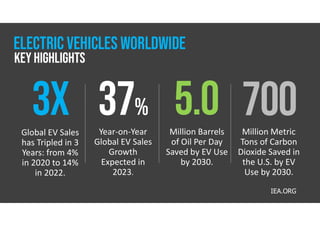
Year-on-Year
Global EV Sales
Growth
Expected in
2023.
%
Global EV Sales
has Tripled in 3
Years: from 4%
in 2020 to 14%
in 2022.
Million Metric
Tons of Carbon
Dioxide Saved in
the U.S. by EV
Use by 2030.
Million Barrels
of Oil Per Day
Saved by EV Use
by 2030.
IEA.ORG
Electric Vehicles worldwide
Key highlights
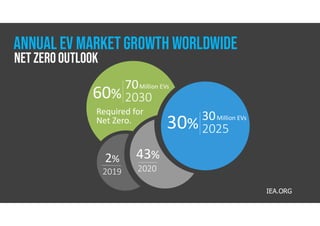
60%
70Million EVs
2030
30%
30Million EVs
2025
43%
2020
2%
2019
Required for
Net Zero.
IEA.ORG
Net zerooutlook
Annual ev MARKETgrowth worldwide
S2ADesign.com

Zero Emission Vehicle

  • 1.
  • 2.
  • 3.
  • 5.
    An EV isa Vehicle Powered by an Electric Motor that Uses Power from a Battery Charged from an External Power Source.
  • 6.
    EVs Have LowerFuel Costs & Electricity is Cheaper than Gasoline. In addition to Government Incentives & Tax Credits. Cost Savings EVs Produce Zero Tailpipe Emissions Reducing Air Pollution Mitigating Climate Change & Accelerating Decarbonization. No Emissions EVs are Easy to Charge from a Standard Household Socket Eliminating the Need for Fuel Stations. Convenience EVs Use Electric Motors Eliminating the Need for Lubrication or Maintenance Tasks Compared to Combustion Motors. Low Maintenance EVs are More Energy Efficient: EV Battery Convert 60% of Energy into Movement while Regular Vehicles Convert 20%. Energy Efficient Benefits Electric vehicles AFDC.ENERGY.GOV
  • 7.
    EVs are MoreExpensive than Regular Vehicles. Also, the Cost of Replacing EV Battery is Expensive. initial cost EVs Require a Long Charging Time: Up to 8 Hours to Fully Charge. Even Fast Charging Takes 30 Minutes. charging time Electric Charging Stations are Still in Development. As a Result, they are Not Widely Spread as Gasoline Fuel Stations. Charging points EVs Have a Shorter Range: 60-300 Miles Per Charge. This May be a Concern for Long Trips & Limited Charging Stations. Drivingrange Most of EVs Use Lithium-Ion Batteries. Lithium Mining Causes Soil, Water & Air Pollution. Lithium mining Challenges Electric vehicles CONSERVE-ENERGY-FUTURE.COM
  • 9.
    In 2022, atCOP27, the U.S. and UK Launched the ZEV Initiative with a $50 Billion Investment. The Accelerating to Zero Coalition, Launched at COP27, Aims to Transition Global New Vehicle Sales to Zero Emissions by 2040 Directly Supporting SDGs 7 and 13. ACCELERATINGTOZERO.ORG United Nations Climate Change Zero Emission Vehicles
  • 10.
    This is aplaceholder text. This text can be replaced with your own text. This text can be replaced with your own text. This is a placeholder text. This text can be replaced with your own text. This text can be replaced with your own text. 9.7 6.6 4.1 3.6
  • 11.
    OIL CONSUMPTION DISPLACEDBY EVS WORLDWIDE 2015 2016 2017 2018 2019 2020 2021 2022 2.4 1.8 5.3 4.4 12.0 7.7 15.0 25.0 IEA.ORG 10X INCREASE billion liters gasolineequivalent
  • 12.
    2016 2017 20182019 2020 2021 2022 2 3 5 7 10 16 26 IEA.ORG 13X INCREASE NUMBEROF EVS ON THE ROAD WORLDWIDE Millions
  • 13.
    2015 2016 20172018 2019 2020 2021 2022 2023 0.55 0.75 1.18 2.05 2.08 2.97 6.50 10.20 14.00 IEA.ORG 23X INCREASE Numberof EV SALES WORLDWIDE Millions
  • 14.
    CHINA THIS IS APLACEHOLDERTEXT. THIS TEXTCAN BE REPLACED WITH YOUR OWN TEXT. GERMANY THIS IS A PLACEHOLD U.S. THIS IS A PLACEHOLD UK THIS IS A PLACEHOLD 52% 10% 9% 5% VISUALCAPITALIST.COM Leading countriesin EV SALES WORLDWIDE in 2021 share
  • 15.
  • 16.
    0.27 0.43 0.700.89 1.40 2.30 2.60 4.20 8.70 14 18 2013 2014 2015 2016 2017 2018 2019 2020 2021 2022 2023 IEA.ORG 70X GROWTH Global EV MARKET SHARE PERCENT
  • 17.
    16Million EVs were onthe Road Worldwide. 60% Higher than the Previous Year. 52% China Accounted for Half of the Global EV Sales. 15Billion Gasoline Liter Equivalent Saved by EV Use. VISUALCAPITALIST.COM Electric vehicles WORLDWIDE in 2021 Key highlights
  • 18.
    Year-on-Year Global EV Sales Growth Expectedin 2023. % Global EV Sales has Tripled in 3 Years: from 4% in 2020 to 14% in 2022. Million Metric Tons of Carbon Dioxide Saved in the U.S. by EV Use by 2030. Million Barrels of Oil Per Day Saved by EV Use by 2030. IEA.ORG Electric Vehicles worldwide Key highlights
  • 19.
    60% 70Million EVs 2030 30% 30Million EVs 2025 43% 2020 2% 2019 Requiredfor Net Zero. IEA.ORG Net zerooutlook Annual ev MARKETgrowth worldwide
  • 20.