Revision of the ANSI Z400.1
     Standard for 2003

   Society for Chemical Hazard
         Communication
           Spring 2003
History of the Standard
Work Group’s Approach
The ANSI Z400.1 Standard
l Developed as a CMA Guideline in early 1990’s
   – Approved as a consensus standard by ANSI in
     1993
   – Revised in 1998

l Provides guidance to MSDS Preparers:
   – To develop consistent, understandable MSDSs,
     providing useful information to a variety of
     audiences
   – Companion to ANSI Z129.1 Labeling Standard

l Due for revision in 2003
The ANSI Process
l American National Standards Institute (ANSI)
   – Does not develop standards
   – Provides framework for development and approval
     of voluntary consensus standards

l The American Chemistry Council (ACC) is the ANSI
  accredited standards developer (sponsor) for this
  standard

l ANSI Procedures for the Development and
  Coordination of American National Standards.
The ANSI Process, cont’d
l   ACC is responsible for maintaining the standard by
    updating it as necessary on a 5-year cycle.

l   Develop consensus for the standard by using ANSI’s
    Accredited Canvass Method

l   Final approval by ANSI Board of Standards Review
ANSI’s Canvass Method
l ACC develops list of potential canvassees by
  identifying organizations having an interest in the
  standard

l These organizations are contacted, and invited to
  participate in the canvass in one of three categories:
   * Producer        * User        * General Interest

l Canvass list includes all who agree to participate
   – Previous canvass lists included about 100
     participants
ANSI’s Canvass Method, cont’d
l   The revised standard is sent to the canvass list for
    ballot and comment

l   All written comments will be considered

l   Standard is submitted to ANSI for approval

l   To be approved by ANSI, the revised standard must
    receive positive votes from a majority of the canvass
    list and at least 2/3 of those voting on the revision,
    excluding abstentions.
Who We Are
l   The MSDS Work Group is an ad hoc committee under
    the Product Stewardship Team of ACC

l   Work group is composed of representatives of 20
    member companies of the American Chemistry
    Council.

l   The group includes toxicologists, product stewardship
    managers, and hazard communication experts.

l   Membership roster available
Considerations
l   Improve hazard communication

l   Consistency with the OSHA Hazard Communication
    Standard

l   Consistency with the ANSI Labeling Standard (ANSI
    Z129.1-2000)

l   Meet the needs of MSDS authors and users
Considerations, cont’d
l Alignment with international regulations
   – Workplace Hazardous Material Information System
     (WHMIS)
   – European Council Directive 91/155/EEC
   – Globally Harmonized System (GHS)
   – ISO
   – Others

l Cost of implementation

l Enhanced clarity/readability/consistency of standard
Considerations, cont’d
l   We met with a representative of OSHA to discuss:
    – How we might improve the standard
       l More specific guidance

       l Reduction in cost of standard

    – The impact of the Globally Harmonized System
      (GHS)
Proposed Changes
Section 1:
Product and Company
    Identification


  No significant changes
Section 2: Composition
Section 3: Hazards Identification
                         (Current)
l   Reversal of information in Sections 2 and 3 so that
    Hazards Identification appears before Composition
    Information

l   References that reflect this change were made
    accordingly
Section 2: Composition
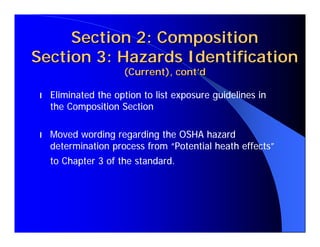
Section 3: Hazards Identification
                     (Current), cont’d

l   Eliminated the option to list exposure guidelines in
    the Composition Section

l   Moved wording regarding the OSHA hazard
    determination process from “Potential heath effects”
    to Chapter 3 of the standard.
Section 2: Composition
Section 3: Hazards Identification
                    (Current), cont’d

l   Moved OSHA Regulatory Status from Composition to
    Hazards Identification

l   Added reference to hazard symbols, if used, as
    recommended by the GHS

l   Deleted examples and edited others to increase
    consistency with the labeling standard (ANSI Z129.1-
    2000)
Section 4:
First Aid Measures


 No significant changes
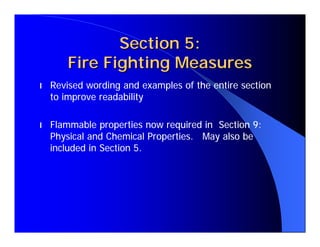
Section 5:
       Fire Fighting Measures
l   Revised wording and examples of the entire section
    to improve readability

l   Flammable properties now required in Section 9:
    Physical and Chemical Properties. May also be
    included in Section 5.
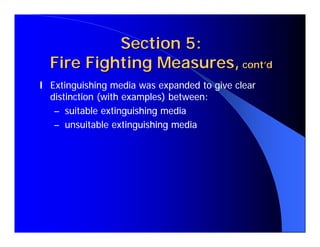
Section 5:
  Fire Fighting Measures, cont’d
l Extinguishing media was expanded to give clear
  distinction (with examples) between:
   – suitable extinguishing media
   – unsuitable extinguishing media
Section 5:
 Fire Fighting Measures, cont’d
l Protection of Firefighters was expanded into two
  separate categories:
   – “Specific hazards arising from the chemical”
   – “Special protective equipment and precautions for
     fire-fighters”
Section 6:
Accidental Release Measures


      No significant changes
Section 7:
Handling and Storage


  No significant changes
Section 8:
           Exposure Controls/
           Personal Protection
l   Rearrange subsection so that Exposure Guidelines
    appear first

l   Eliminate option to list exposure guidelines in the
    Composition Section

l   Modify Exposure Guideline example to increase
    consistency and readability
Section 9:
      Physical and Chemical
            Properties
l Flammable properties are now required in this section
   – Option to repeat them in Section 5: Fire Fighting
     Measures

l Inclusion of other properties where appropriate and
  relevant
Section 10:
       Stability and Reactivity
l   Hazardous polymerization subheading replaced with
    Possibility of Hazardous Reactions

l   Note added to Chemical Stability to define “normal”.

l   Note regarding data inclusion added to Conditions to
    Avoid with examples
Section 11:
   Toxicological Information

l More complete and accurate list of data types
  – Sensitization
  – Developmental toxicity
  – Target organ toxicity
Section 12:
      Ecological Information
l More complete list of data types
  – Ecotoxicity
  – Persistence/Degradability
  – Bioaccumlation/Accumulation
  – Mobility in Soil
  – Other Adverse Effects

l Simplified examples

l Increased consistency with Section 11: Toxicological
  Information
Section 13:
Disposal Considerations


   No significant changes
Section 14:
      Transport Information

l Revised elements that should be included, where
  applicable:
   – Marine pollutant information
   – Subsidiary hazard classes
Section 14:
  Transport Information, cont’d
l Revised optional elements that could be included,
  where applicable
   – Special precautionary information
   – Reference Emergency Response Guides
      • DOT “Emergency Response Guide”
      • ICAO “Emergency Response Guidance for
        Aircraft Incidents Involving Dangerous Goods”
      • IMO “Emergency Procedures for Ships
        Carrying Dangerous Goods”
Section 15: Regulatory
          Information
l Included Additional References
   – EU information
      lClassifications
      lSymbols
      lRisk Phrases
      lSafety Phrases
   – Product Registration Data
      lChina, Korea, Finland, Norway, Sweden,
        Switzerland, New Zealand, etc.
Section 16: Other
  Information


 No significant changes
Changes to Other Chapters

l   Information in Chapters One and Two combined into
    one chapter

l   Reduction of number of sample MSDSs

l   Update glossary

l   Update resources document

l   Removal of Annexes C and E
Path Forward
l   Goal to send draft revised standard to the canvass
    for review in the Second Quarter of 2003

l   Availability of the draft document will be noted in
    ANSI Standards Action at:
                         www.ansi.org

l   Anticipated publication of ANSI Z400.1-2003 in the
    Fourth Quarter of 2003

Z400.1 ansi msds

  • 1.
    Revision of theANSI Z400.1 Standard for 2003 Society for Chemical Hazard Communication Spring 2003
  • 2.
    History of theStandard Work Group’s Approach
  • 3.
    The ANSI Z400.1Standard l Developed as a CMA Guideline in early 1990’s – Approved as a consensus standard by ANSI in 1993 – Revised in 1998 l Provides guidance to MSDS Preparers: – To develop consistent, understandable MSDSs, providing useful information to a variety of audiences – Companion to ANSI Z129.1 Labeling Standard l Due for revision in 2003
  • 4.
    The ANSI Process lAmerican National Standards Institute (ANSI) – Does not develop standards – Provides framework for development and approval of voluntary consensus standards l The American Chemistry Council (ACC) is the ANSI accredited standards developer (sponsor) for this standard l ANSI Procedures for the Development and Coordination of American National Standards.
  • 5.
    The ANSI Process,cont’d l ACC is responsible for maintaining the standard by updating it as necessary on a 5-year cycle. l Develop consensus for the standard by using ANSI’s Accredited Canvass Method l Final approval by ANSI Board of Standards Review
  • 6.
    ANSI’s Canvass Method lACC develops list of potential canvassees by identifying organizations having an interest in the standard l These organizations are contacted, and invited to participate in the canvass in one of three categories: * Producer * User * General Interest l Canvass list includes all who agree to participate – Previous canvass lists included about 100 participants
  • 7.
    ANSI’s Canvass Method,cont’d l The revised standard is sent to the canvass list for ballot and comment l All written comments will be considered l Standard is submitted to ANSI for approval l To be approved by ANSI, the revised standard must receive positive votes from a majority of the canvass list and at least 2/3 of those voting on the revision, excluding abstentions.
  • 8.
    Who We Are l The MSDS Work Group is an ad hoc committee under the Product Stewardship Team of ACC l Work group is composed of representatives of 20 member companies of the American Chemistry Council. l The group includes toxicologists, product stewardship managers, and hazard communication experts. l Membership roster available
  • 9.
    Considerations l Improve hazard communication l Consistency with the OSHA Hazard Communication Standard l Consistency with the ANSI Labeling Standard (ANSI Z129.1-2000) l Meet the needs of MSDS authors and users
  • 10.
    Considerations, cont’d l Alignmentwith international regulations – Workplace Hazardous Material Information System (WHMIS) – European Council Directive 91/155/EEC – Globally Harmonized System (GHS) – ISO – Others l Cost of implementation l Enhanced clarity/readability/consistency of standard
  • 11.
    Considerations, cont’d l We met with a representative of OSHA to discuss: – How we might improve the standard l More specific guidance l Reduction in cost of standard – The impact of the Globally Harmonized System (GHS)
  • 12.
  • 13.
    Section 1: Product andCompany Identification No significant changes
  • 14.
    Section 2: Composition Section3: Hazards Identification (Current) l Reversal of information in Sections 2 and 3 so that Hazards Identification appears before Composition Information l References that reflect this change were made accordingly
  • 15.
    Section 2: Composition Section3: Hazards Identification (Current), cont’d l Eliminated the option to list exposure guidelines in the Composition Section l Moved wording regarding the OSHA hazard determination process from “Potential heath effects” to Chapter 3 of the standard.
  • 16.
    Section 2: Composition Section3: Hazards Identification (Current), cont’d l Moved OSHA Regulatory Status from Composition to Hazards Identification l Added reference to hazard symbols, if used, as recommended by the GHS l Deleted examples and edited others to increase consistency with the labeling standard (ANSI Z129.1- 2000)
  • 17.
    Section 4: First AidMeasures No significant changes
  • 18.
    Section 5: Fire Fighting Measures l Revised wording and examples of the entire section to improve readability l Flammable properties now required in Section 9: Physical and Chemical Properties. May also be included in Section 5.
  • 19.
    Section 5: Fire Fighting Measures, cont’d l Extinguishing media was expanded to give clear distinction (with examples) between: – suitable extinguishing media – unsuitable extinguishing media
  • 20.
    Section 5: FireFighting Measures, cont’d l Protection of Firefighters was expanded into two separate categories: – “Specific hazards arising from the chemical” – “Special protective equipment and precautions for fire-fighters”
  • 21.
    Section 6: Accidental ReleaseMeasures No significant changes
  • 22.
    Section 7: Handling andStorage No significant changes
  • 23.
    Section 8: Exposure Controls/ Personal Protection l Rearrange subsection so that Exposure Guidelines appear first l Eliminate option to list exposure guidelines in the Composition Section l Modify Exposure Guideline example to increase consistency and readability
  • 24.
    Section 9: Physical and Chemical Properties l Flammable properties are now required in this section – Option to repeat them in Section 5: Fire Fighting Measures l Inclusion of other properties where appropriate and relevant
  • 25.
    Section 10: Stability and Reactivity l Hazardous polymerization subheading replaced with Possibility of Hazardous Reactions l Note added to Chemical Stability to define “normal”. l Note regarding data inclusion added to Conditions to Avoid with examples
  • 26.
    Section 11: Toxicological Information l More complete and accurate list of data types – Sensitization – Developmental toxicity – Target organ toxicity
  • 27.
    Section 12: Ecological Information l More complete list of data types – Ecotoxicity – Persistence/Degradability – Bioaccumlation/Accumulation – Mobility in Soil – Other Adverse Effects l Simplified examples l Increased consistency with Section 11: Toxicological Information
  • 28.
  • 29.
    Section 14: Transport Information l Revised elements that should be included, where applicable: – Marine pollutant information – Subsidiary hazard classes
  • 30.
    Section 14: Transport Information, cont’d l Revised optional elements that could be included, where applicable – Special precautionary information – Reference Emergency Response Guides • DOT “Emergency Response Guide” • ICAO “Emergency Response Guidance for Aircraft Incidents Involving Dangerous Goods” • IMO “Emergency Procedures for Ships Carrying Dangerous Goods”
  • 31.
    Section 15: Regulatory Information l Included Additional References – EU information lClassifications lSymbols lRisk Phrases lSafety Phrases – Product Registration Data lChina, Korea, Finland, Norway, Sweden, Switzerland, New Zealand, etc.
  • 32.
    Section 16: Other Information No significant changes
  • 33.
    Changes to OtherChapters l Information in Chapters One and Two combined into one chapter l Reduction of number of sample MSDSs l Update glossary l Update resources document l Removal of Annexes C and E
  • 34.
    Path Forward l Goal to send draft revised standard to the canvass for review in the Second Quarter of 2003 l Availability of the draft document will be noted in ANSI Standards Action at: www.ansi.org l Anticipated publication of ANSI Z400.1-2003 in the Fourth Quarter of 2003