54
Work Dangers DRAFT — FEBRUARY 2006
Do you know what chemicals are used in your factory?
Do you know how chemicals used in your factory can
harm your health?
Are workers trained to use chemicals safely?
Chemicals
Working with dangerous chemicals
Most people use chemicals every day. Soap, plastics, and many cosmetics are made
with chemicals. Some chemicals do not cause any harm. Other chemicals can cause
minor or temporary health problems. But some chemicals are very dangerous and
can cause serious health problems and death.
Dangerous chemicals are used to make products in export factories. Some job tasks
also produce dangerous chemicals that workers breathe or absorb through their
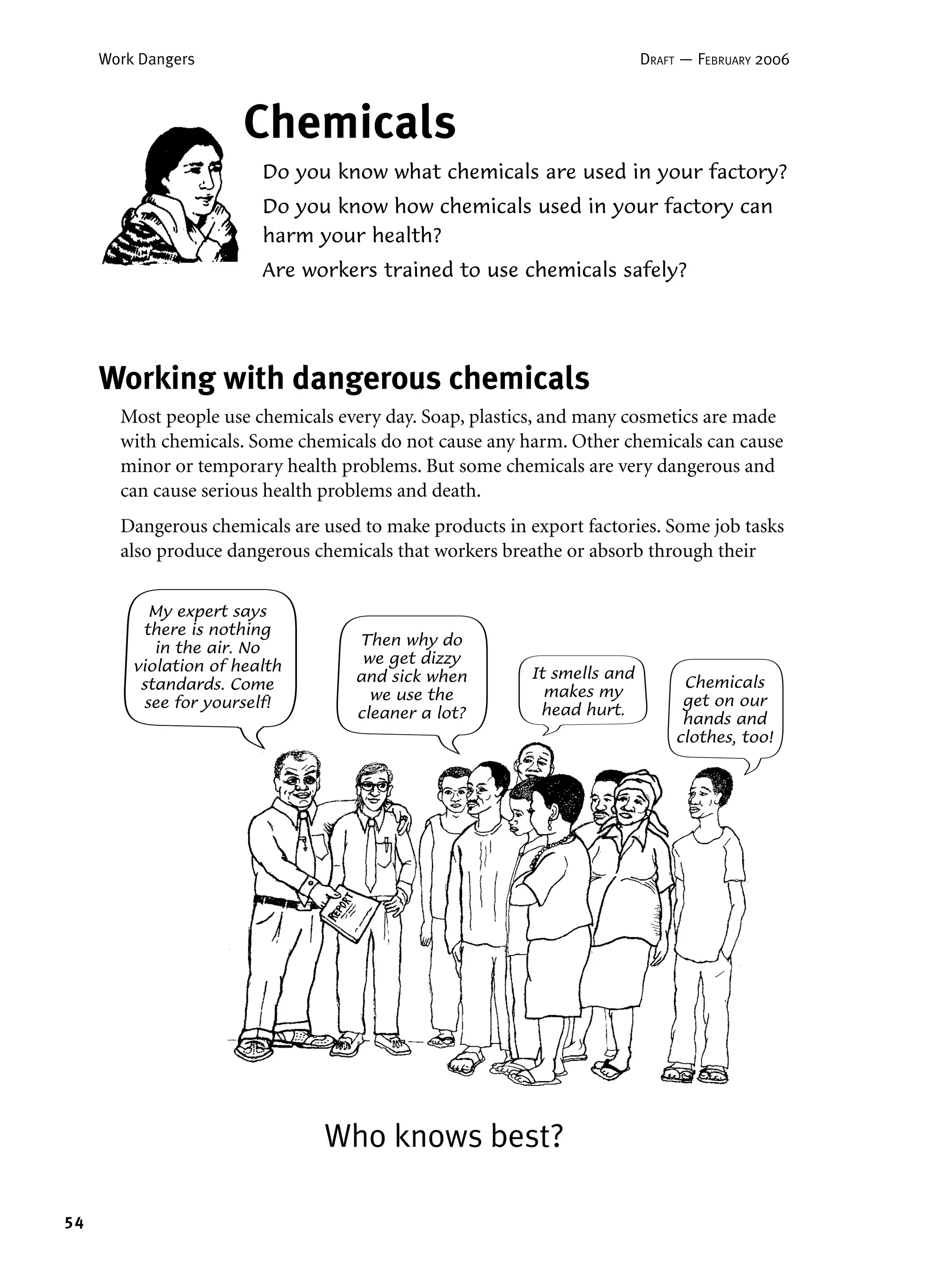
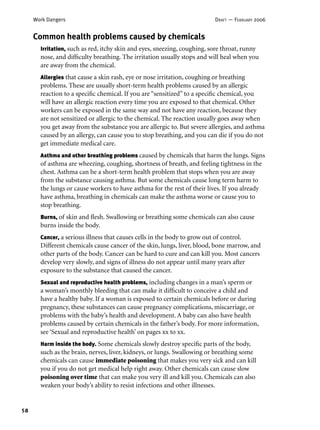
Who knows best?
My expert says
there is nothing
in the air. No
violation of health
standards. Come
see for yourself!
Chemicals
get on our
hands and
clothes, too!
Then why do
we get dizzy
and sick when
we use the
cleaner a lot?
It smells and
makes my
head hurt.
55
Chemicals
There are many different kinds of dangerous chemicals, and they can cause
different types of health problems. You can use this book in different ways to learn
more about chemicals and their effects on health. For example,
For more information about how you can be exposed to a chemical, see pages
56 to 57.
For more information about how chemicals can harm different parts of the
body, see pages 58 to 59.
For more information about the dangers of some common chemicals used in
factories, see pages 64 to 73.
For more information about how to prevent exposure from different jobs, see
pages 75 to 87 and the Health effects of chemicals chart on pages 156 to 179.
•
•
•
•
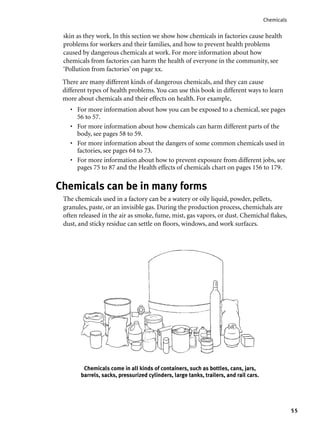
Chemicals come in all kinds of containers, such as bottles, cans, jars,
barrels, sacks, pressurized cylinders, large tanks, trailers, and rail cars.
Chemicals can be in many forms
The chemicals used in a factory can be a watery or oily liquid, powder, pellets,
granules, paste, or an invisible gas. During the production process, chemichals are
often released in the air as smoke, fume, mist, gas vapors, or dust. Chemichal flakes,
dust, and sticky residue can settle on floors, windows, and work surfaces.
skin as they work. In this section we show how chemicals in factories cause health
problems for workers and their families, and how to prevent health problems
caused by dangerous chemicals at work. For more information about how
chemicals from factories can harm the health of everyone in the community, see
‘Pollution from factories’ on page xx.
56
Work Dangers DRAFT — FEBRUARY 2006
Exposure and harm
You can be exposed to chemicals at work if you use the chemical and if you are
working around other people using chemicals. The health problems caused by
most chemicals depend on: How you are exposed to a chemical. How much of
the chemical you are exposed to. How long you are exposed to the chemical. How
dangerous the chemical is.
Chemicals can also cause long-term health problems, such as cancer or
permanent damage to the brain, nerves, or lungs. Long-term problems
happen after you have been regularly exposed to a
chemical for many months or years, and you
may not get sick until many years after
you stopped using a chemical.
Long-term problems can be mild or
serious. For example, if your hands
are exposed to isopropyl alcohol
every day for many years, the skin
will get thicker and less sensitive. But
if you breathe in a small amount of
methylene chloride every day for several years, you can develop cancer.
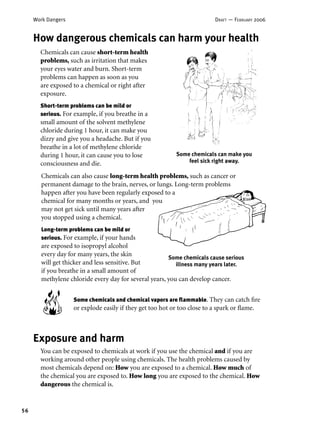
Chemicals can cause short-term health
problems, such as irritation that makes
your eyes water and burn. Short-term
problems can happen as soon as you
are exposed to a chemical or right after
exposure.
Short-term problems can be mild or
serious. For example, if you breathe in a
small amount of the solvent methylene
chloride during 1 hour, it can make you
dizzy and give you a headache. But if you
breathe in a lot of methylene chloride
during 1 hour, it can cause you to lose
consciousness and die.
Some chemicals can make you
feel sick right away.
Some chemicals cause serious
illness many years later.
How dangerous chemicals can harm your health
Some chemicals and chemical vapors are flammable. They can catch fire
or explode easily if they get too hot or too close to a spark or flame.
57
Chemicals
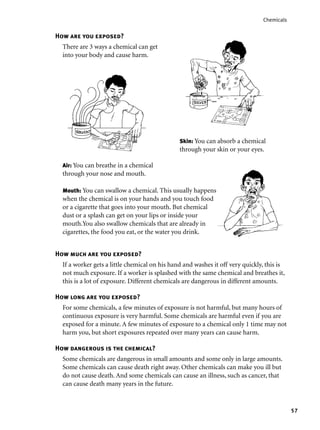
How are you exposed?
There are 3 ways a chemical can get
into your body and cause harm.
Mouth: You can swallow a chemical. This usually happens
when the chemical is on your hands and you touch food
or a cigarette that goes into your mouth. But chemical
dust or a splash can get on your lips or inside your
mouth.You also swallow chemicals that are already in
cigarettes, the food you eat, or the water you drink.
Skin: You can absorb a chemical
through your skin or your eyes.
Air: You can breathe in a chemical
through your nose and mouth.
How much are you exposed?
If a worker gets a little chemical on his hand and washes it off very quickly, this is
not much exposure. If a worker is splashed with the same chemical and breathes it,
this is a lot of exposure. Different chemicals are dangerous in different amounts.
How long are you exposed?
For some chemicals, a few minutes of exposure is not harmful, but many hours of
continuous exposure is very harmful. Some chemicals are harmful even if you are
exposed for a minute. A few minutes of exposure to a chemical only 1 time may not
harm you, but short exposures repeated over many years can cause harm.
How dangerous is the chemical?
Some chemicals are dangerous in small amounts and some only in large amounts.
Some chemicals can cause death right away. Other chemicals can make you ill but
do not cause death. And some chemicals can cause an illness, such as cancer, that
can cause death many years in the future.
58
Work Dangers DRAFT — FEBRUARY 2006
Common health problems caused by chemicals
Irritation, such as red, itchy skin and eyes, sneezing, coughing, sore throat, runny
nose, and difficulty breathing. The irritation usually stops and will heal when you
are away from the chemical.
Allergies that cause a skin rash, eye or nose irritation, coughing or breathing
problems. These are usually short-term health problems caused by an allergic
reaction to a specific chemical. If you are “sensitized” to a specific chemical, you
will have an allergic reaction every time you are exposed to that chemical. Other
workers can be exposed in the same way and not have any reaction, because they
are not sensitized or allergic to the chemical. The reaction usually goes away when
you get away from the substance you are allergic to. But severe allergies, and asthma
caused by an allergy, can cause you to stop breathing, and you can die if you do not
get immediate medical care.
Asthma and other breathing problems caused by chemicals that harm the lungs. Signs
of asthma are wheezing, coughing, shortness of breath, and feeling tightness in the
chest. Asthma can be a short-term health problem that stops when you are away
from the substance causing asthma. But some chemicals cause long term harm to
the lungs or cause workers to have asthma for the rest of their lives. If you already
have asthma, breathing in chemicals can make the asthma worse or cause you to
stop breathing.
Burns, of skin and flesh. Swallowing or breathing some chemicals can also cause
burns inside the body.
Cancer, a serious illness that causes cells in the body to grow out of control.
Different chemicals cause cancer of the skin, lungs, liver, blood, bone marrow, and
other parts of the body. Cancer can be hard to cure and can kill you. Most cancers
develop very slowly, and signs of illness do not appear until many years after
exposure to the substance that caused the cancer.
Sexual and reproductive health problems, including changes in a man’s sperm or
a woman’s monthly bleeding that can make it difficult to conceive a child and
have a healthy baby. If a woman is exposed to certain chemicals before or during
pregnancy, these substances can cause pregnancy complications, miscarriage, or
problems with the baby’s health and development. A baby can also have health
problems caused by certain chemicals in the father’s body. For more information,
see ‘Sexual and reproductive health’ on pages xx to xx.
Harm inside the body. Some chemicals slowly destroy specific parts of the body,
such as the brain, nerves, liver, kidneys, or lungs. Swallowing or breathing some
chemicals can cause immediate poisoning that makes you very sick and can kill
you if you do not get medical help right away. Other chemicals can cause slow
poisoning over time that can make you very ill and kill you. Chemicals can also
weaken your body’s ability to resist infections and other illnesses.
59
Chemicals
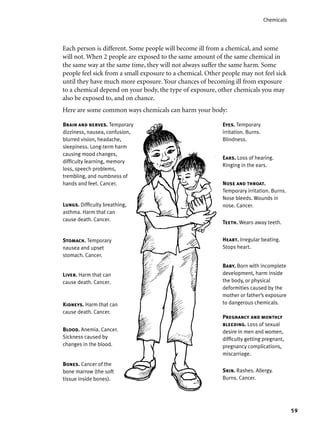
Baby. Born with incomplete
development, harm inside
the body, or physical
deformities caused by the
mother or father’s exposure
to dangerous chemicals.
Brain and nerves. Temporary
dizziness, nausea, confusion,
blurred vision, headache,
sleepiness. Long-term harm
causing mood changes,
difficulty learning, memory
loss, speech problems,
trembling, and numbness of
hands and feet. Cancer.
Eyes. Temporary
irritation. Burns.
Blindness.
Nose and throat.
Temporary irritation. Burns.
Nose bleeds. Wounds in
nose. Cancer.Lungs. Difficulty breathing,
asthma. Harm that can
cause death. Cancer.
Liver. Harm that can
cause death. Cancer.
Stomach. Temporary
nausea and upset
stomach. Cancer.
Bones. Cancer of the
bone marrow (the soft
tissue inside bones).
Skin. Rashes. Allergy.
Burns. Cancer.
Blood. Anemia. Cancer.
Sickness caused by
changes in the blood.
Pregnancy and monthly
bleeding. Loss of sexual
desire in men and women,
difficulty getting pregnant,
pregnancy complications,
miscarriage.
Kidneys. Harm that can
cause death. Cancer.
Ears. Loss of hearing.
Ringing in the ears.
Each person is different. Some people will become ill from a chemical, and some
will not. When 2 people are exposed to the same amount of the same chemical in
the same way at the same time, they will not always suffer the same harm. Some
people feel sick from a small exposure to a chemical. Other people may not feel sick
until they have much more exposure. Your chances of becoming ill from exposure
to a chemical depend on your body, the type of exposure, other chemicals you may
also be exposed to, and on chance.
Here are some common ways chemicals can harm your body:
Teeth. Wears away teeth.
Heart. Irregular beating.
Stops heart.
60
Work Dangers DRAFT — FEBRUARY 2006
How to know if you use dangerous chemicals
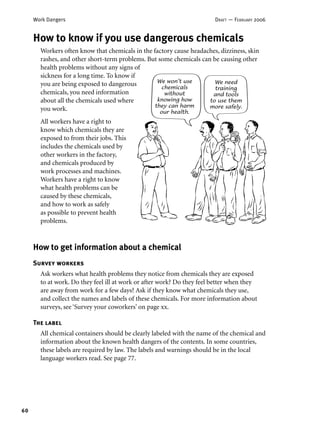
Workers often know that chemicals in the factory cause headaches, dizziness, skin
rashes, and other short-term problems. But some chemicals can be causing other
health problems without any signs of
sickness for a long time. To know if
you are being exposed to dangerous
chemicals, you need information
about all the chemicals used where
you work.
All workers have a right to
know which chemicals they are
exposed to from their jobs. This
includes the chemicals used by
other workers in the factory,
and chemicals produced by
work processes and machines.
Workers have a right to know
what health problems can be
caused by these chemicals,
and how to work as safely
as possible to prevent health
problems.
We won’t use
chemicals
without
knowing how
they can harm
our health.
We need
training
and tools
to use them
more safely.
How to get information about a chemical
Survey workers
Ask workers what health problems they notice from chemicals they are exposed
to at work. Do they feel ill at work or after work? Do they feel better when they
are away from work for a few days? Ask if they know what chemicals they use,
and collect the names and labels of these chemicals. For more information about
surveys, see ‘Survey your coworkers’ on page xx.
The label
All chemical containers should be clearly labeled with the name of the chemical and
information about the known health dangers of the contents. In some countries,
these labels are required by law. The labels and warnings should be in the local
language workers read. See page 77.
61
Chemicals
Chemical information sheet
Some companies that make chemical products also publish an information sheet
for each product. In some countries these sheets are called Material Safety Data
Sheets (MSDS). A good sheet will name all the chemicals in the product, describe
how these chemicals can affect your health, tell you whether these chemicals can
cause cancer or birth defects, describe protections you need to work safely with
the product, and give other information about the product, such as how easily it
catches fire. Sometimes the information on these sheets is wrong or incomplete,
making the product look safer than it really is.
The boss should have an information sheet for every chemical product in the
factory. If you cannot get information from the boss but you know the name of
a chemical product, you can contact the company that makes the product and
request an information sheet.
Training
It is the boss’s responsibility to give workers chemical information in a language
workers understand, and in a way workers understand it. Workers who cannot
read can learn about chemicals from pictures, videos, demonstrations, or hands-
on practice. When you start a new job or are assigned new work, your supervisor
should tell you about the chemicals you work with and how to use them safely.
Community resources
Labor unions, labor support groups, and environmental organizations may be able
to help you get information. If you know the name of a chemical, you can find
information about it in libraries and on the internet. For more information about
using community resources, see ‘XX’ on page xx.
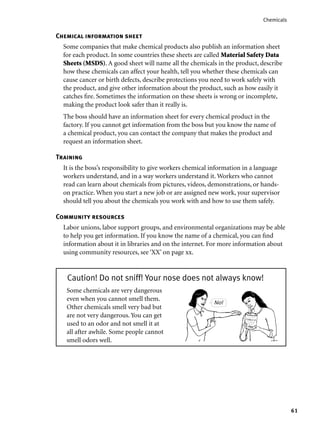
Caution! Do not sniff! Your nose does not always know!
Some chemicals are very dangerous
even when you cannot smell them.
Other chemicals smell very bad but
are not very dangerous. You can get
used to an odor and not smell it at
all after awhile. Some people cannot
smell odors well.
No!
62
Work Dangers DRAFT — FEBRUARY 2006
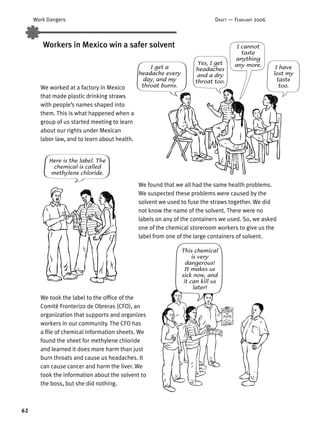
Workers in Mexico win a safer solvent
We took the label to the office of the
Comité Fronterizo de Obreras (CFO), an
organization that supports and organizes
workers in our community. The CFO has
a file of chemical information sheets. We
found the sheet for methylene chloride
and learned it does more harm than just
burn throats and cause us headaches. It
can cause cancer and harm the liver. We
took the information about the solvent to
the boss, but she did nothing.
I get a
headache every
day, and my
throat burns.
Here is the label. The
chemical is called
methylene chloride.
We found that we all had the same health problems.
We suspected these problems were caused by the
solvent we used to fuse the straws together. We did
not know the name of the solvent. There were no
labels on any of the containers we used. So, we asked
one of the chemical storeroom workers to give us the
label from one of the large containers of solvent.
I have
lost my
taste
too.
I cannot
taste
anything
any more.Yes, I get
headaches
and a dry
throat too.
We worked at a factory in Mexico
that made plastic drinking straws
with people’s names shaped into
them. This is what happened when a
group of us started meeting to learn
about our rights under Mexican
labor law, and to learn about health.
This chemical
is very
dangerous!
It makes us
sick now, and
it can kill us
later!
63
Chemicals
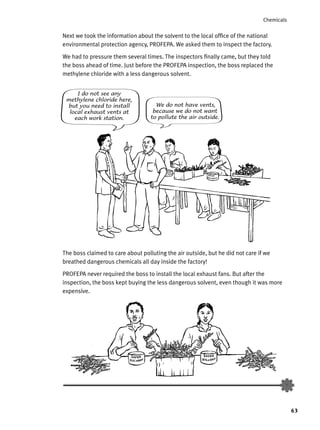
Next we took the information about the solvent to the local office of the national
environmental protection agency, PROFEPA. We asked them to inspect the factory.
We had to pressure them several times. The inspectors finally came, but they told
the boss ahead of time. Just before the PROFEPA inspection, the boss replaced the
methylene chloride with a less dangerous solvent.
I do not see any
methylene chloride here,
but you need to install
local exhaust vents at
each work station.
We do not have vents,
because we do not want
to pollute the air outside.
The boss claimed to care about polluting the air outside, but he did not care if we
breathed dangerous chemicals all day inside the factory!
PROFEPA never required the boss to install the local exhaust fans. But after the
inspection, the boss kept buying the less dangerous solvent, even though it was more
expensive.
64
Work Dangers DRAFT — FEBRUARY 2006
Dangers of chemicals common in export factories
From this page through page xx, we give information about the most common
and most dangerous chemicals workers are exposed to in export factories. These
include specific chemicals, such as formaldehyde and asbestos; groups of
chemicals, such as solvents and dyes; and chemical mixtures, such as welding
fumes and diesel exhaust. On pages xx to xx, we give examples of protections from
these chemicals.
There is not enough space here to include all the chemicals workers might be
exposed to in every factory. And this book cannot tell how the chemicals used in a
specific factory may be harming the health of workers in that factory.
For health information about more chemicals found in export factories, see ‘Health
effects of chemicals’ on pages 156 to 179. For ways to find more information about
chemicals and health, see ‘Resources’ on page xx.
Asbestos
Asbestos is a mineral mined from the earth. It does not burn or get destroyed by
other chemicals. Asbestos has been used for decades to make insulation and many
other durable products.
Asbestos causes serious long-term harm
Asbestos does not cause any short-term health effect. But millions of people
around the world have died from painful lung diseases many years after being
exposed to asbestos.
You can be exposed to asbestos by breathing in dust that has tiny asbestos fibers
in it. The fibers are too small to see. If you are exposed to a lot of asbestos dust, or
exposed to a little of it over a long period of time, you can get a deadly hardening
of the lungs called asbestosis, a cancer called mesothelioma or lung cancer. The
cancers usually do not appear until 10 or 20 years later.
Workers who breathe asbestos at work are harmed more by smoking than other
workers. Cigarette smoke and asbestos in the lungs together cause more harm than
either one alone.
Families of workers can also get these diseases from breathing in asbestos dust that
workers bring home on their hair, skin, and clothes. For more information about
protecting workers’ families from asbestos and other dangerous chemicals, see
‘Leave work clothes at work’ on page 92.
The most effective way to protect people from asbestos is to stop using it. There
is no reason for asbestos to be used in new products, machines, and buildings.
For almost all uses of asbestos, there are safer materials that can be used instead.
There is now an international campaign to ban asbestos everywhere in the world.
65
Chemicals
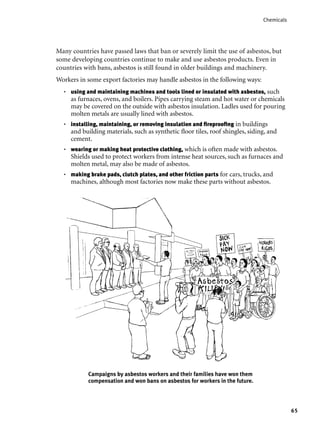
Campaigns by asbestos workers and their families have won them
compensation and won bans on asbestos for workers in the future.
Many countries have passed laws that ban or severely limit the use of asbestos, but
some developing countries continue to make and use asbestos products. Even in
countries with bans, asbestos is still found in older buildings and machinery.
Workers in some export factories may handle asbestos in the following ways:
using and maintaining machines and tools lined or insulated with asbestos, such
as furnaces, ovens, and boilers. Pipes carrying steam and hot water or chemicals
may be covered on the outside with asbestos insulation. Ladles used for pouring
molten metals are usually lined with asbestos.
installing, maintaining, or removing insulation and fireproofing in buildings
and building materials, such as synthetic floor tiles, roof shingles, siding, and
cement.
wearing or making heat protective clothing, which is often made with asbestos.
Shields used to protect workers from intense heat sources, such as furnaces and
molten metal, may also be made of asbestos.
making brake pads, clutch plates, and other friction parts for cars, trucks, and
machines, although most factories now make these parts without asbestos.
•
•
•
•
66
Work Dangers DRAFT — FEBRUARY 2006
Cleaning and garment finishing baths
Some parts or finished garments are washed in a mixture of water, detergent, and
an alkali or acid. For example,“stone-washed” and “acid washed” jeans have been
treated with bleach or acid.
Dangers of these baths include:
skin irritation from splashes or chemical mist in the air.
eye injury, including blindness, from splashes.
cancer from formaldehyde and other chemicals used on fabrics, and from
breathing BCME (bis-chloromethylether) vapor, which is created when fabric
treated with formaldehyde is acid washed.
sudden death from breathing poisonous gases that form when certain
chemicals mix with some chemical baths.
Do not use chlorinated hydrocarbon solvents near acid and alkali baths.
This can create deadly phosgene gas. Chlorinated hydrocarbons include those
with “chlor” in the name, such as methylene chloride, trichloroethylene, and
tetrachloroethylene.
•
•
•
•
Chemical baths
Some metals, plastics, and fabrics are treated with bleach or acids to change their color
or surface finish. Two types are electroplating baths and garment finishing baths.
Dangers of electroplating include:
skin irritation and burns of skin, flesh, and eyes from splashes or chemical mist
in the air.
burns inside the nose, throat, and lungs from breathing in chemical mist,
causing nose bleeds and difficulty breathing.
cancer and permanent harm to the lungs from breathing acid mists over a long
period of time.
cancer from breathing vapors from toxic metals, such as chromium and nickel,
over a long period of time.
poisoning or death from swallowing a bath mixture that contains cyanide salts.
This can happen if you are splashed by the bath, or if the bath mixture on
your hands gets into your mouth.
•
•
•
•
•
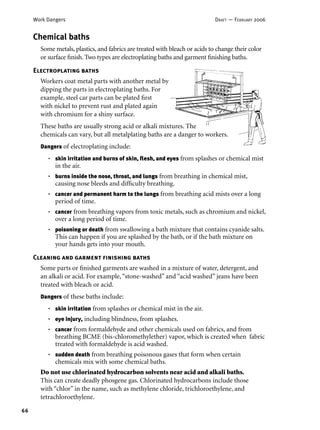
Electroplating baths
Workers coat metal parts with another metal by
dipping the parts in electroplating baths. For
example, steel car parts can be plated first
with nickel to prevent rust and plated again
with chromium for a shiny surface.
These baths are usually strong acid or alkali mixtures. The
chemicals can vary, but all metalplating baths are a danger to workers.
67
Chemicals
Metal casting: The cores of dies and molds
are usually made with resin. Formaldehyde
fume is created when molten metal touches cores that have resin in them.
Plastic processing: Formaldehyde is in plastic fume created when some types of
plastic are overheated and break down in hot process machines, such injection
molding and film blowing machines.
In some countries, formaldehyde use is strictly regulated, because it is so
dangerous. Some countries require a warning label on fabrics treated with
formaldehyde.
Dangers of formaldehyde include:
Do not use acids near alkaline cyanide baths. This can create deadly hydrogen
cyanide gas.
Formaldehyde
Workers in different industries can be exposed to
formaldehyde in treated fabric and in fume that is
sometimes created from metal casting and plastic
processing.
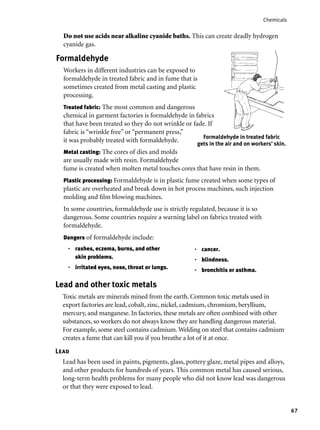
Treated fabric: The most common and dangerous
chemical in garment factories is formaldehyde in fabrics
that have been treated so they do not wrinkle or fade. If
fabric is “wrinkle free” or “permanent press,”
it was probably treated with formaldehyde.
Formaldehyde in treated fabric
gets in the air and on workers’ skin.
Lead and other toxic metals
Toxic metals are minerals mined from the earth. Common toxic metals used in
export factories are lead, cobalt, zinc, nickel, cadmium, chromium, beryllium,
mercury, and manganese. In factories, these metals are often combined with other
substances, so workers do not always know they are handling dangerous material.
For example, some steel contains cadmium. Welding on steel that contains cadmium
creates a fume that can kill you if you breathe a lot of it at once.
rashes, eczema, burns, and other
skin problems.
irritated eyes, nose, throat or lungs.
•
•
cancer.
blindness.
bronchitis or asthma.
•
•
•
Lead
Lead has been used in paints, pigments, glass, pottery glaze, metal pipes and alloys,
and other products for hundreds of years. This common metal has caused serious,
long-term health problems for many people who did not know lead was dangerous
or that they were exposed to lead.
68
Work Dangers DRAFT — FEBRUARY 2006
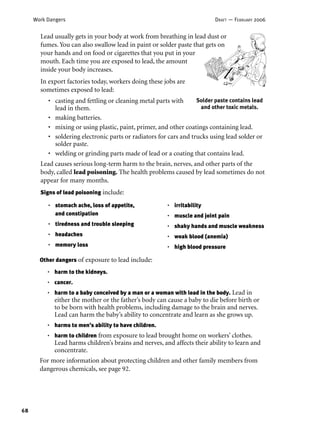
Lead usually gets in your body at work from breathing in lead dust or
fumes. You can also swallow lead in paint or solder paste that gets on
your hands and on food or cigarettes that you put in your
mouth. Each time you are exposed to lead, the amount
inside your body increases.
In export factories today, workers doing these jobs are
sometimes exposed to lead:
casting and fettling or cleaning metal parts with
lead in them.
making batteries.
mixing or using plastic, paint, primer, and other coatings containing lead.
soldering electronic parts or radiators for cars and trucks using lead solder or
solder paste.
welding or grinding parts made of lead or a coating that contains lead.
Lead causes serious long-term harm to the brain, nerves, and other parts of the
body, called lead poisoning. The health problems caused by lead sometimes do not
appear for many months.
Signs of lead poisoning include:
•
•
•
•
•
stomach ache, loss of appetite,
and constipation
tiredness and trouble sleeping
headaches
memory loss
•
•
•
•
irritability
muscle and joint pain
shaky hands and muscle weakness
weak blood (anemia)
high blood pressure
•
•
•
•
•
Other dangers of exposure to lead include:
harm to the kidneys.
cancer.
harm to a baby conceived by a man or a woman with lead in the body. Lead in
either the mother or the father’s body can cause a baby to die before birth or
to be born with health problems, including damage to the brain and nerves.
Lead can harm the baby’s ability to concentrate and learn as she grows up.
harms to men’s ability to have children.
harm to children from exposure to lead brought home on workers’ clothes.
Lead harms children’s brains and nerves, and affects their ability to learn and
concentrate.
For more information about protecting children and other family members from
dangerous chemicals, see page 92.
•
•
•
•
•
Solder paste contains lead
and other toxic metals.
69
Chemicals
Cobalt, zinc, nickel, cadmium, chromium, beryllium,
mercury, and manganese
These metals are sometimes found in pigments, metal
alloys such as steel and brass, metal coatings, metal
plating baths, electrical parts, mirror coatings,
batteries, welding rods, solder, and metalized
vapors used to coat plastic parts.
These jobs can expose workers to toxic vapor,
dust, and fume:
mixing pigments into paints and other
coatings.
applying paints and coatings to parts and poducts.
scraping, grinding, cutting, or welding coated surfaces.
die casting, welding, grinding, or cutting metal alloys.
preparing and using metal plating baths.
vacuum metalizing plastic parts.
soldering using solder made with these metals.
Breathing the fume of several of these metals causes metal fume fever. Signs of
metal fume fever include headache, fever, chills, muscle aches, nausea, vomiting,
weakness, and tiredness. These effects usually start several hours or a few days after
exposure and can last from 6 to 24 hours.
For information about the specific health dangers of each toxic metal, see the
Health effects of chemicals chart on pages 156 to 179.
•
•
•
•
•
•
•
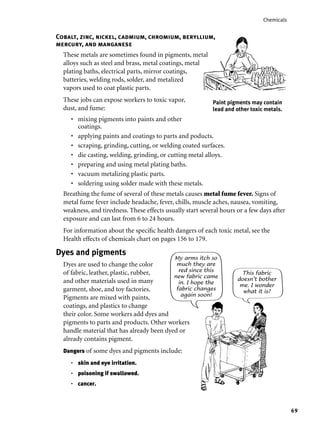
Paint pigments may contain
lead and other toxic metals.
Dyes and pigments
Dyes are used to change the color
of fabric, leather, plastic, rubber,
and other materials used in many
garment, shoe, and toy factories.
Pigments are mixed with paints,
coatings, and plastics to change
their color. Some workers add dyes and
pigments to parts and products. Other workers
handle material that has already been dyed or
already contains pigment.
Dangers of some dyes and pigments include:
skin and eye irritation.
poisoning if swallowed.
cancer.
•
•
•
My arms itch so
much they are
red since this
new fabric came
in. I hope the
fabric changes
again soon!
This fabric
doesn’t bother
me. I wonder
what it is?
70
Work Dangers DRAFT — FEBRUARY 2006
It is almost impossible to get information on the kinds of dyes and pigments used
in different paints, coatings, and fabrics. Workers often do not learn about the
danger until they get sick. For example, garment workers have noticed that dyes
in black and other dark-colored fabrics cause more irritation than dyes in light-
colored fabrics.
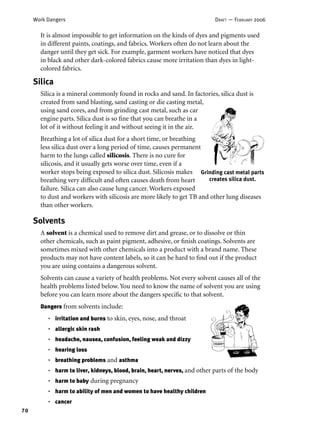
Silica
Silica is a mineral commonly found in rocks and sand. In factories, silica dust is
created from sand blasting, sand casting or die casting metal,
using sand cores, and from grinding cast metal, such as car
engine parts. Silica dust is so fine that you can breathe in a
lot of it without feeling it and without seeing it in the air.
Breathing a lot of silica dust for a short time, or breathing
less silica dust over a long period of time, causes permanent
harm to the lungs called silicosis. There is no cure for
silicosis, and it usually gets worse over time, even if a
worker stops being exposed to silica dust. Silicosis makes
breathing very difficult and often causes death from heart
failure. Silica can also cause lung cancer. Workers exposed
to dust and workers with silicosis are more likely to get TB and other lung diseases
than other workers.
Grinding cast metal parts
creates silica dust.
Solvents
A solvent is a chemical used to remove dirt and grease, or to dissolve or thin
other chemicals, such as paint pigment, adhesive, or finish coatings. Solvents are
sometimes mixed with other chemicals into a product with a brand name. These
products may not have content labels, so it can be hard to find out if the product
you are using contains a dangerous solvent.
Solvents can cause a variety of health problems. Not every solvent causes all of the
health problems listed below. You need to know the name of solvent you are using
before you can learn more about the dangers specific to that solvent.
Dangers from solvents include:
irritation and burns to skin, eyes, nose, and throat
allergic skin rash
headache, nausea, confusion, feeling weak and dizzy
hearing loss
breathing problems and asthma
harm to liver, kidneys, blood, brain, heart, nerves, and other parts of the body
harm to baby during pregnancy
harm to ability of men and women to have healthy children
cancer
•
•
•
•
•
•
•
•
•
71
Chemicals
Some “safer solvents” are more dangerous
Some solvents, such as ethanol and isopropyl alcohol, cause less serious health
problems but catch fire very easily. Other solvents, such as trichloroethylene,
methylene chloride, or 2-methoxyethanol, are often sold as “safer solvents,” because
they are less likely to catch fire. But these chemicals are more harmful to the
kidneys, liver, brain, and nerves. They also harm the ability of men and women to
have healthy children, and they are more likely to cause cancer.
Solvents cause short-term and long-term harm
A lot of solvents give workers headaches and nausea, and make them feel week,
dizzy, or confused. Solvents that cause these short-term problems can also cause
long-term harm to the brain if workers are exposed continuously for years. This
harm to the brain causes memory loss, difficulty concentrating and learning,
irritability and depression, loss of sexual desire and ability to have children,
headaches, and fatigue. This harm is permanent, cannot be cured, and does not
stop if a worker is no longer exposed to the solvent.
For information on the health effects of specific solvents, see the Health effects of
chemicals chart on pages 156 to 179.
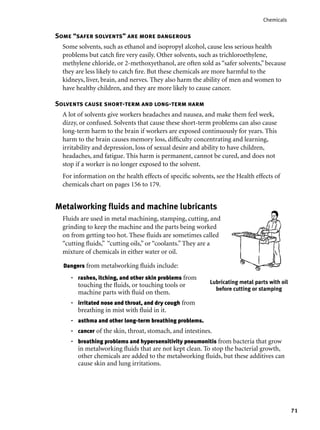
Metalworking fluids and machine lubricants
Fluids are used in metal machining, stamping, cutting, and
grinding to keep the machine and the parts being worked
on from getting too hot. These fluids are sometimes called
“cutting fluids,” “cutting oils,” or “coolants.” They are a
mixture of chemicals in either water or oil.
Lubricating metal parts with oil
before cutting or stamping
Dangers from metalworking fluids include:
rashes, itching, and other skin problems from
touching the fluids, or touching tools or
machine parts with fluid on them.
irritated nose and throat, and dry cough from
breathing in mist with fluid in it.
asthma and other long-term breathing problems.
cancer of the skin, throat, stomach, and intestines.
breathing problems and hypersensitivity pneumonitis from bacteria that grow
in metalworking fluids that are not kept clean. To stop the bacterial growth,
other chemicals are added to the metalworking fluids, but these additives can
cause skin and lung irritations.
•
•
•
•
•
72
Work Dangers DRAFT — FEBRUARY 2006
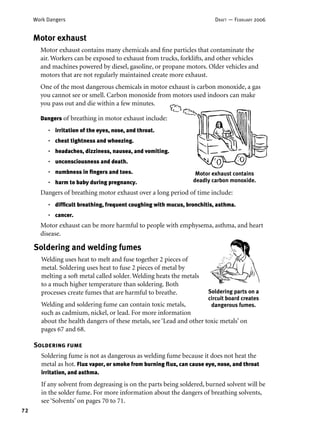
Motor exhaust
Motor exhaust contains many chemicals and fine particles that contaminate the
air. Workers can be exposed to exhaust from trucks, forklifts, and other vehicles
and machines powered by diesel, gasoline, or propane motors. Older vehicles and
motors that are not regularly maintained create more exhaust.
One of the most dangerous chemicals in motor exhaust is carbon monoxide, a gas
you cannot see or smell. Carbon monoxide from motors used indoors can make
you pass out and die within a few minutes.
Dangers of breathing in motor exhaust include:
irritation of the eyes, nose, and throat.
chest tightness and wheezing.
headaches, dizziness, nausea, and vomiting.
unconsciousness and death.
numbness in fingers and toes.
harm to baby during pregnancy.
Dangers of breathing motor exhaust over a long period of time include:
difficult breathing, frequent coughing with mucus, bronchitis, asthma.
cancer.
Motor exhaust can be more harmful to people with emphysema, asthma, and heart
disease.
•
•
•
•
•
•
•
•
Mot0r exhaust contains
deadly carbon monoxide.
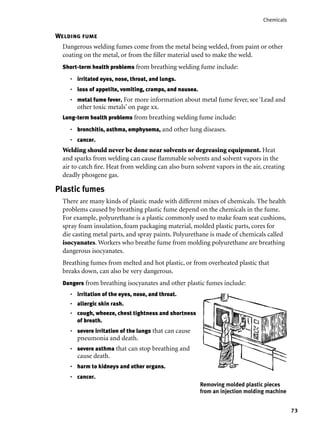
Soldering and welding fumes
Welding uses heat to melt and fuse together 2 pieces of
metal. Soldering uses heat to fuse 2 pieces of metal by
melting a soft metal called solder. Welding heats the metals
to a much higher temperature than soldering. Both
processes create fumes that are harmful to breathe.
Welding and soldering fume can contain toxic metals,
such as cadmium, nickel, or lead. For more information
about the health dangers of these metals, see ‘Lead and other toxic metals’ on
pages 67 and 68.
Soldering fume
Soldering fume is not as dangerous as welding fume because it does not heat the
metal as hot. Flux vapor, or smoke from burning flux, can cause eye, nose, and throat
irritation, and asthma.
If any solvent from degreasing is on the parts being soldered, burned solvent will be
in the solder fume. For more information about the dangers of breathing solvents,
see ‘Solvents’ on pages 70 to 71.
Soldering parts on a
circuit board creates
dangerous fumes.
73
Chemicals
Welding fume
Dangerous welding fumes come from the metal being welded, from paint or other
coating on the metal, or from the filler material used to make the weld.
Short-term health problems from breathing welding fume include:
irritated eyes, nose, throat, and lungs.
loss of appetite, vomiting, cramps, and nausea.
metal fume fever. For more information about metal fume fever, see ‘Lead and
other toxic metals’ on page xx.
Long-term health problems from breathing welding fume include:
bronchitis, asthma, emphysema, and other lung diseases.
cancer.
Welding should never be done near solvents or degreasing equipment. Heat
and sparks from welding can cause flammable solvents and solvent vapors in the
air to catch fire. Heat from welding can also burn solvent vapors in the air, creating
deadly phosgene gas.
•
•
•
•
•
Plastic fumes
There are many kinds of plastic made with different mixes of chemicals. The health
problems caused by breathing plastic fume depend on the chemicals in the fume.
For example, polyurethane is a plastic commonly used to make foam seat cushions,
spray foam insulation, foam packaging material, molded plastic parts, cores for
die casting metal parts, and spray paints. Polyurethane is made of chemicals called
isocyanates. Workers who breathe fume from molding polyurethane are breathing
dangerous isocyanates.
Breathing fumes from melted and hot plastic, or from overheated plastic that
breaks down, can also be very dangerous.
Dangers from breathing isocyanates and other plastic fumes include:
irritation of the eyes, nose, and throat.
allergic skin rash.
cough, wheeze, chest tightness and shortness
of breath.
severe irritation of the lungs that can cause
pneumonia and death.
severe asthma that can stop breathing and
cause death.
harm to kidneys and other organs.
cancer.
•
•
•
•
•
•
•
Removing molded plastic pieces
from an injection molding machine
74
Work Dangers DRAFT — FEBRUARY 2006
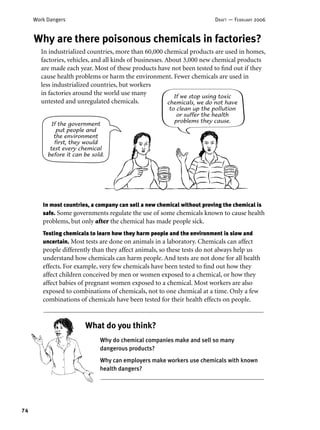
Why do chemical companies make and sell so many
dangerous products?
Why can employers make workers use chemicals with known
health dangers?
What do you think?
In most countries, a company can sell a new chemical without proving the chemical is
safe. Some governments regulate the use of some chemicals known to cause health
problems, but only after the chemical has made people sick.
Testing chemicals to learn how they harm people and the environment is slow and
uncertain. Most tests are done on animals in a laboratory. Chemicals can affect
people differently than they affect animals, so these tests do not always help us
understand how chemicals can harm people. And tests are not done for all health
effects. For example, very few chemicals have been tested to find out how they
affect children conceived by men or women exposed to a chemical, or how they
affect babies of pregnant women exposed to a chemical. Most workers are also
exposed to combinations of chemicals, not to one chemical at a time. Only a few
combinations of chemicals have been tested for their health effects on people.
Why are there poisonous chemicals in factories?
In industrialized countries, more than 60,000 chemical products are used in homes,
factories, vehicles, and all kinds of businesses. About 3,000 new chemical products
are made each year. Most of these products have not been tested to find out if they
cause health problems or harm the environment. Fewer chemicals are used in
less industrialized countries, but workers
in factories around the world use many
untested and unregulated chemicals.
If the government
put people and
the environment
first, they would
test every chemical
before it can be sold.
If we stop using toxic
chemicals, we do not have
to clean up the pollution
or suffer the health
problems they cause.
75
Chemicals
Ways to reduce workers’ exposure to chemicals
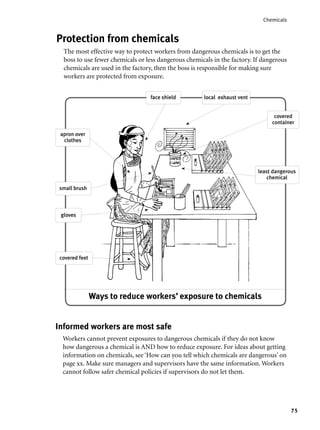
Protection from chemicals
The most effective way to protect workers from dangerous chemicals is to get the
boss to use fewer chemicals or less dangerous chemicals in the factory. If dangerous
chemicals are used in the factory, then the boss is responsible for making sure
workers are protected from exposure.
apron over
clothes
local exhaust vent
covered
container
face shield
covered feet
gloves
small brush
least dangerous
chemical
Informed workers are most safe
Workers cannot prevent exposures to dangerous chemicals if they do not know
how dangerous a chemical is AND how to reduce exposure. For ideas about getting
information on chemicals, see ‘How can you tell which chemicals are dangerous’ on
page xx. Make sure managers and supervisors have the same information. Workers
cannot follow safer chemical policies if supervisors do not let them.
76
Work Dangers DRAFT — FEBRUARY 2006
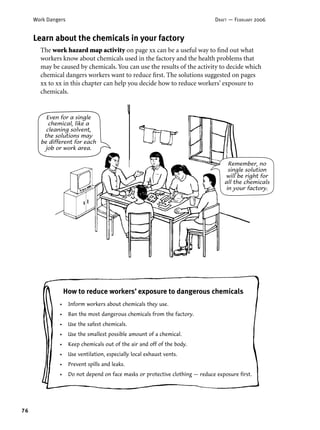
Even for a single
chemical, like a
cleaning solvent,
the solutions may
be different for each
job or work area.
Remember, no
single solution
will be right for
all the chemicals
in your factory.
• Inform workers about chemicals they use.
• Ban the most dangerous chemicals from the factory.
• Use the safest chemicals.
• Use the smallest possible amount of a chemical.
• Keep chemicals out of the air and off of the body.
• Use ventilation, especially local exhaust vents.
• Prevent spills and leaks.
• Do not depend on face masks or protective clothing — reduce exposure first.
How to reduce workers’ exposure to dangerous chemicals
Learn about the chemicals in your factory
The work hazard map activity on page xx can be a useful way to find out what
workers know about chemicals used in the factory and the health problems that
may be caused by chemicals. You can use the results of the activity to decide which
chemical dangers workers want to reduce first. The solutions suggested on pages
xx to xx in this chapter can help you decide how to reduce workers’ exposure to
chemicals.
77
Chemicals
Ban the most dangerous chemicals
Some chemicals are too dangerous to use in factories or anywhere else. Thanks
to years of protest by workers, doctors, and health advocates, these chemicals and
products are no longer used in some places:
Asbestos
Lead in pigments, dye, paint, and other coatings
Toxic metals in many pigments, dye, paints, and other coatings
Rosin or colophony flux for soldering
Solvents such as glycol ethers, methylene chloride, benzene, and carbon
tetrachloride
Diesel, gasoline, and propane engines used indoors
Sand for sand blasting
Companies now make safer products that replace some of the most dangerous
chemicals. And safer processes have been developed in some industries, so these
chemicals may also be banned in the future:
Lead, chromium, cadmium, and mercury in electronics, including solder.
Chlorinated and fluorinated (halogenated) hydrocarbon solvents.
PVC plastic made from vinyl chloride.
•
•
•
•
•
•
•
•
•
•
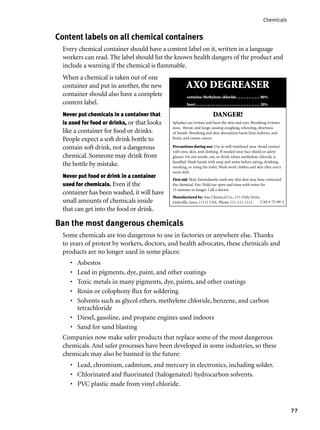
Content labels on all chemical containers
Every chemical container should have a content label on it, written in a language
workers can read. The label should list the known health dangers of the product and
include a warning if the chemical is flammable.
When a chemical is taken out of one
container and put in another, the new
container should also have a complete
content label.
Never put chemicals in a container that
is used for food or drinks, or that looks
like a container for food or drinks.
People expect a soft drink bottle to
contain soft drink, not a dangerous
chemical. Someone may drink from
the bottle by mistake.
Never put food or drink in a container
used for chemicals. Even if the
container has been washed, it will have
small amounts of chemicals inside
that can get into the food or drink.
DANGER!
Splashes can irritate and burn the skin and eyes. Breathing irritates
nose, throat, and lungs causing coughing, wheezing, shortness
of breath. Breathing and skin absorption harm liver, kidneys, and
brain, and causes cancer.
Precautions during use: Use in well ventilated area. Avoid contact
with eyes, skin, and clothing. If needed wear face shield or safety
glasses. Do not smoke, eat, or drink where methylene chloride is
handled. Wash hands with soap and water before eating, drinking,
smoking, or using the toilet. Wash work clothes and skin after every
work shift.
First aid: Skin: Immediately wash any skin that may have contacted
the chemical. Eye: Hold eye open and rinse with water for
15 minutes or longer. Call a doctor.
Manufactured by: Axo Chemical Co., 111 Only Drive,
Onlyville, Iowa, 11111 USA Phone 111-111-1111. CAS # 75-09-2
AXO DEGREASER
contains: Methylene chloride. .. .. .. .. .. .. .. .. 80%
Inert .. .. .. .. .. .. .. .. .. .. .. .. .. .. .. .. .. .. .. .. .. .. .. 20%
78
Work Dangers DRAFT — FEBRUARY 2006
Find a safer chemical
The boss should buy the mildest, safest chemical products needed to get the job
done. For example:
Electric motors can be used for indoor vehicles instead of diesel, gasoline, or
compressed gas .
Non-chlorinated hydrocarbon solvents can often be used instead of chlorinated
solvents like methylene chloride or TCE (trichloroethylene).
Water-based cleaners, glues, paints, dyes, and coatings can often be used
instead of products that contain a solvent.
Weaker strength acid and alkaline baths and washes can work just as well as
stronger ones.
Metalworking fluids made from vegetable oils, like rapeseed or canola, may be
less harmful than fluids made from mineral oils.
Small plastic or metal pellets can be used instead of sand as a blasting material
to eliminate silica dust.
•
•
•
•
•
•
Use fewer chemicals and less of them
Bosses often do not think about how to use less chemical in the factory. Workers
can help bosses see where using less chemical is better for workers, is less wasteful,
and more efficient. For example:
Cleaner, more efficient processes and techniques can reduce the need to use
chemicals for cleaning and degreasing.
Steam and detergent cleaning can work as well better than a chemical cleaner
or solvent.
Low solvent/high pigment paints and low solvent coatings
can coat the same amount of parts with less solvent.
These coatings also dry faster.
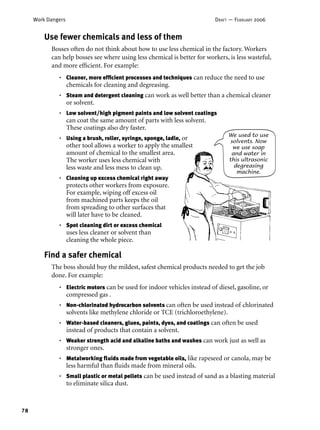
Using a brush, roller, syringe, sponge, ladle, or
other tool allows a worker to apply the smallest
amount of chemical to the smallest area.
The worker uses less chemical with
less waste and less mess to clean up.
Cleaning up excess chemical right away
protects other workers from exposure.
For example, wiping off excess oil
from machined parts keeps the oil
from spreading to other surfaces that
will later have to be cleaned.
Spot cleaning dirt or excess chemical
uses less cleaner or solvent than
cleaning the whole piece.
•
•
•
•
•
•
We used to use
solvents. Now
we use soap
and water in
this ultrasonic
degreasing
machine.
79
Chemicals
Prevent splashing, dust, and mist
When workers have the right tools and equipment, with time and training to use
them properly, they can reduce splashing, dust, and mist in the air. But workers are
often unable to prevent these problems when work areas are crowded and messy,
machines are not maintained and repaired, and the boss pushes workers and
machines to work as fast as possible.
Anti-foam agents can be added to chemical baths to keep mist from forming in
the air above the bath. Putting plastic chips or balls on the surface of electroplating
baths can also prevent mist from forming in the air above the bath.
Maintain and clean metalworking fluids
Dangerous bacteria can grow in metalworking fluids and cause lung problems for
workers. You can prevent bacteria from growing by cleaning metalworking fluids
regularly. You cannot see the bacteria in the fluid, but a trained worker can test the
fluid for bacteria levels and acidity.
Keep the coolant system running on days when there is no work to keep the
metalworking fluids circulating. Circulation puts air into the fluid that reduces
bacteria growth. This also reduces the awful smells when the cooling system is
restarted. This smell is a sign of bacteria growing in the fluid.
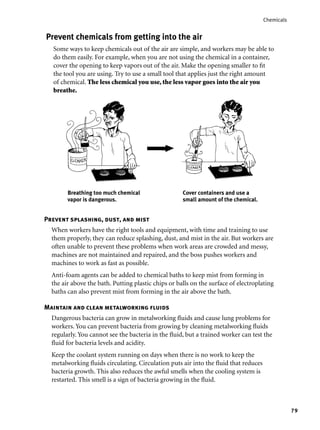
Breathing too much chemical
vapor is dangerous.
Cover containers and use a
small amount of the chemical.
Prevent chemicals from getting into the air
Some ways to keep chemicals out of the air are simple, and workers may be able to
do them easily. For example, when you are not using the chemical in a container,
cover the opening to keep vapors out of the air. Make the opening smaller to fit
the tool you are using. Try to use a small tool that applies just the right amount
of chemical. The less chemical you use, the less vapor goes into the air you
breathe.
80
Work Dangers DRAFT — FEBRUARY 2006
Reduce soldering and welding heat
Fumes are less dangerous when soldering and welding are done at the lowest
temperature needed to do the job.
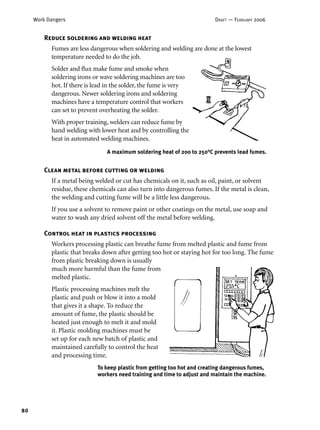
Solder and flux make fume and smoke when
soldering irons or wave soldering machines are too
hot. If there is lead in the solder, the fume is very
dangerous. Newer soldering irons and soldering
machines have a temperature control that workers
can set to prevent overheating the solder.
With proper training, welders can reduce fume by
hand welding with lower heat and by controlling the
heat in automated welding machines.
Clean metal before cutting or welding
If a metal being welded or cut has chemicals on it, such as oil, paint, or solvent
residue, these chemicals can also turn into dangerous fumes. If the metal is clean,
the welding and cutting fume will be a little less dangerous.
If you use a solvent to remove paint or other coatings on the metal, use soap and
water to wash any dried solvent off the metal before welding.
Control heat in plastics processing
Workers processing plastic can breathe fume from melted plastic and fume from
plastic that breaks down after getting too hot or staying hot for too long. The fume
from plastic breaking down is usually
much more harmful than the fume from
melted plastic.
Plastic processing machines melt the
plastic and push or blow it into a mold
that gives it a shape. To reduce the
amount of fume, the plastic should be
heated just enough to melt it and mold
it. Plastic molding machines must be
set up for each new batch of plastic and
maintained carefully to control the heat
and processing time.
A maximum soldering heat of 200 to 250°C prevents lead fumes.
To keep plastic from getting too hot and creating dangerous fumes,
workers need training and time to adjust and maintain the machine.
81
Chemicals
Flammable chemicals should never be sprayed, because they can create explosive vapors
in the air. A spark or flame can cause the vapors to catch fire.
Do not use flammable chemicals around sparks or hot processes,
such as welding or soldering, or where flames are used to heat
baths, ovens, or plastic molding machines.
Do not use asbestos
Asbestos is too dangerous to use in any factory. If you are working with asbestos, do
everything possible to get the boss to replace it with a safer material.
To keep asbestos dust out of the air, all work with asbestos should be done inside
a special box that holds the dust until the fibers are wet and mixed with other
materials, or caught in a special filter.
For more information on working with asbestos, see the ‘Resources’ on pages xx to
xx.
Avoid aerosols or sprays
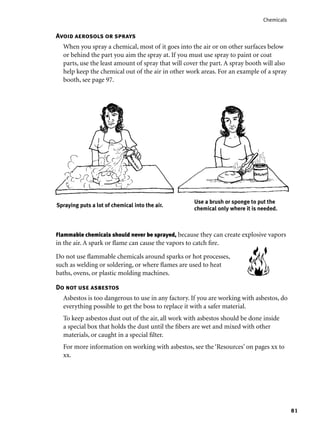
When you spray a chemical, most of it goes into the air or on other surfaces below
or behind the part you aim the spray at. If you must use spray to paint or coat
parts, use the least amount of spray that will cover the part. A spray booth will also
help keep the chemical out of the air in other work areas. For an example of a spray
booth, see page 97.
Use a brush or sponge to put the
chemical only where it is needed.
Spraying puts a lot of chemical into the air.
82
Work Dangers DRAFT — FEBRUARY 2006
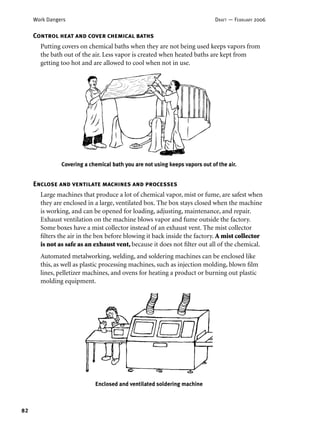
Control heat and cover chemical baths
Putting covers on chemical baths when they are not being used keeps vapors from
the bath out of the air. Less vapor is created when heated baths are kept from
getting too hot and are allowed to cool when not in use.
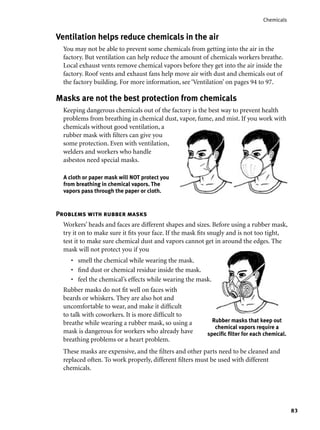
Enclose and ventilate machines and processes
Large machines that produce a lot of chemical vapor, mist or fume, are safest when
they are enclosed in a large, ventilated box. The box stays closed when the machine
is working, and can be opened for loading, adjusting, maintenance, and repair.
Exhaust ventilation on the machine blows vapor and fume outside the factory.
Some boxes have a mist collector instead of an exhaust vent. The mist collector
filters the air in the box before blowing it back inside the factory. A mist collector
is not as safe as an exhaust vent, because it does not filter out all of the chemical.
Automated metalworking, welding, and soldering machines can be enclosed like
this, as well as plastic processing machines, such as injection molding, blown film
lines, pelletizer machines, and ovens for heating a product or burning out plastic
molding equipment.
Covering a chemical bath you are not using keeps vapors out of the air.
Enclosed and ventilated soldering machine
83
Chemicals
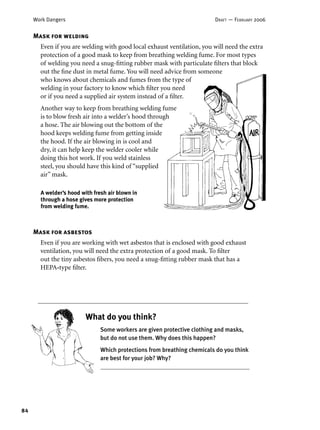
Problems with rubber masks
Workers’ heads and faces are different shapes and sizes. Before using a rubber mask,
try it on to make sure it fits your face. If the mask fits snugly and is not too tight,
test it to make sure chemical dust and vapors cannot get in around the edges. The
mask will not protect you if you
smell the chemical while wearing the mask.
find dust or chemical residue inside the mask.
feel the chemical’s effects while wearing the mask.
Rubber masks do not fit well on faces with
beards or whiskers. They are also hot and
uncomfortable to wear, and make it difficult
to talk with coworkers. It is more difficult to
breathe while wearing a rubber mask, so using a
mask is dangerous for workers who already have
breathing problems or a heart problem.
These masks are expensive, and the filters and other parts need to be cleaned and
replaced often. To work properly, different filters must be used with different
chemicals.
•
•
•
Ventilation helps reduce chemicals in the air
You may not be able to prevent some chemicals from getting into the air in the
factory. But ventilation can help reduce the amount of chemicals workers breathe.
Local exhaust vents remove chemical vapors before they get into the air inside the
factory. Roof vents and exhaust fans help move air with dust and chemicals out of
the factory building. For more information, see ‘Ventilation’ on pages 94 to 97.
Masks are not the best protection from chemicals
Keeping dangerous chemicals out of the factory is the best way to prevent health
problems from breathing in chemical dust, vapor, fume, and mist. If you work with
chemicals without good ventilation, a
rubber mask with filters can give you
some protection. Even with ventilation,
welders and workers who handle
asbestos need special masks.
A cloth or paper mask will NOT protect you
from breathing in chemical vapors. The
vapors pass through the paper or cloth.
Rubber masks that keep out
chemical vapors require a
specific filter for each chemical.
84
Work Dangers DRAFT — FEBRUARY 2006
Mask for asbestos
Even if you are working with wet asbestos that is enclosed with good exhaust
ventilation, you will need the extra protection of a good mask. To filter
out the tiny asbestos fibers, you need a snug-fitting rubber mask that has a
HEPA-type filter.
Some workers are given protective clothing and masks,
but do not use them. Why does this happen?
Which protections from breathing chemicals do you think
are best for your job? Why?
What do you think?
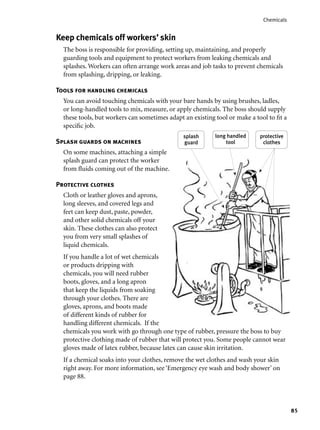
Mask for welding
Even if you are welding with good local exhaust ventilation, you will need the extra
protection of a good mask to keep from breathing welding fume. For most types
of welding you need a snug-fitting rubber mask with particulate filters that block
out the fine dust in metal fume. You will need advice from someone
who knows about chemicals and fumes from the type of
welding in your factory to know which filter you need
or if you need a supplied air system instead of a filter.
Another way to keep from breathing welding fume
is to blow fresh air into a welder’s hood through
a hose. The air blowing out the bottom of the
hood keeps welding fume from getting inside
the hood. If the air blowing in is cool and
dry, it can help keep the welder cooler while
doing this hot work. If you weld stainless
steel, you should have this kind of “supplied
air” mask.
A welder’s hood with fresh air blown in
through a hose gives more protection
from welding fume.
85
Chemicals
Keep chemicals off workers’ skin
The boss is responsible for providing, setting up, maintaining, and properly
guarding tools and equipment to protect workers from leaking chemicals and
splashes. Workers can often arrange work areas and job tasks to prevent chemicals
from splashing, dripping, or leaking.
Tools for handling chemicals
You can avoid touching chemicals with your bare hands by using brushes, ladles,
or long-handled tools to mix, measure, or apply chemicals. The boss should supply
these tools, but workers can sometimes adapt an existing tool or make a tool to fit a
specific job.
Splash guards on machines
On some machines, attaching a simple
splash guard can protect the worker
from fluids coming out of the machine.
Protective clothes
Cloth or leather gloves and aprons,
long sleeves, and covered legs and
feet can keep dust, paste, powder,
and other solid chemicals off your
skin. These clothes can also protect
you from very small splashes of
liquid chemicals.
If you handle a lot of wet chemicals
or products dripping with
chemicals, you will need rubber
boots, gloves, and a long apron
that keep the liquids from soaking
through your clothes. There are
gloves, aprons, and boots made
of different kinds of rubber for
handling different chemicals. If the
chemicals you work with go through one type of rubber, pressure the boss to buy
protective clothing made of rubber that will protect you. Some people cannot wear
gloves made of latex rubber, because latex can cause skin irritation.
If a chemical soaks into your clothes, remove the wet clothes and wash your skin
right away. For more information, see ‘Emergency eye wash and body shower’ on
page 88.
long handled
tool
protective
clothes
splash
guard
86
Work Dangers DRAFT — FEBRUARY 2006
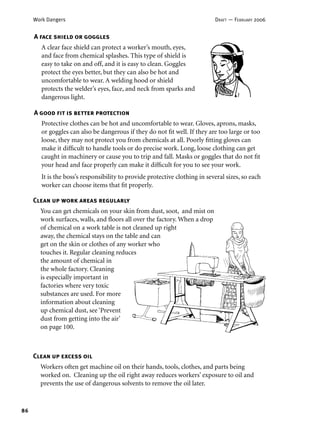
A face shield or goggles
A clear face shield can protect a worker’s mouth, eyes,
and face from chemical splashes. This type of shield is
easy to take on and off, and it is easy to clean. Goggles
protect the eyes better, but they can also be hot and
uncomfortable to wear. A welding hood or shield
protects the welder’s eyes, face, and neck from sparks and
dangerous light.
A good fit is better protection
Protective clothes can be hot and uncomfortable to wear. Gloves, aprons, masks,
or goggles can also be dangerous if they do not fit well. If they are too large or too
loose, they may not protect you from chemicals at all. Poorly fitting gloves can
make it difficult to handle tools or do precise work. Long, loose clothing can get
caught in machinery or cause you to trip and fall. Masks or goggles that do not fit
your head and face properly can make it difficult for you to see your work.
It is the boss’s responsibility to provide protective clothing in several sizes, so each
worker can choose items that fit properly.
Clean up excess oil
Workers often get machine oil on their hands, tools, clothes, and parts being
worked on. Cleaning up the oil right away reduces workers’ exposure to oil and
prevents the use of dangerous solvents to remove the oil later.
Clean up work areas regularly
You can get chemicals on your skin from dust, soot, and mist on
work surfaces, walls, and floors all over the factory. When a drop
of chemical on a work table is not cleaned up right
away, the chemical stays on the table and can
get on the skin or clothes of any worker who
touches it. Regular cleaning reduces
the amount of chemical in
the whole factory. Cleaning
is especially important in
factories where very toxic
substances are used. For more
information about cleaning
up chemical dust, see ‘Prevent
dust from getting into the air’
on page 100.
87
Chemicals
Prevent spills and leaks
It is easier and safer to prevent chemical spills and leaks than to clean them up. You
can prevent most chemical spills and leaks by:
transporting chemicals in closed containers that cannot break or shatter. If you
carry containers of liquids or powders on carts, use carts with sides and spill
trays to catch leaks.
using small containers of chemicals in work areas. Preventing and stopping
leaks is easier when bulk chemicals and large containers are kept in a separate
storage area.
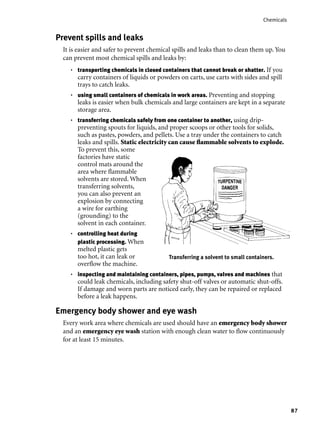
transferring chemicals safely from one container to another, using drip-
preventing spouts for liquids, and proper scoops or other tools for solids,
such as pastes, powders, and pellets. Use a tray under the containers to catch
leaks and spills. Static electricity can cause flammable solvents to explode.
To prevent this, some
factories have static
control mats around the
area where flammable
solvents are stored. When
transferring solvents,
you can also prevent an
explosion by connecting
a wire for earthing
(grounding) to the
solvent in each container.
controlling heat during
plastic processing. When
melted plastic gets
too hot, it can leak or
overflow the machine.
inspecting and maintaining containers, pipes, pumps, valves and machines that
could leak chemicals, including safety shut-off valves or automatic shut-offs.
If damage and worn parts are noticed early, they can be repaired or replaced
before a leak happens.
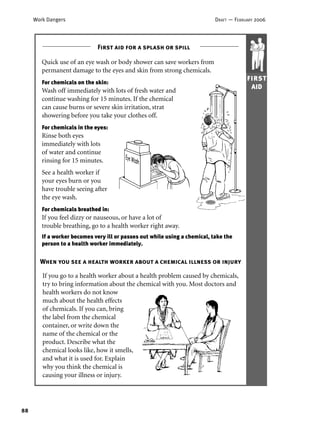
Emergency body shower and eye wash
Every work area where chemicals are used should have an emergency body shower
and an emergency eye wash station with enough clean water to flow continuously
for at least 15 minutes.
•
•
•
•
•
Transferring a solvent to small containers.
88
Work Dangers DRAFT — FEBRUARY 2006
Quick use of an eye wash or body shower can save workers from
permanent damage to the eyes and skin from strong chemicals.
For chemicals on the skin:
Wash off immediately with lots of fresh water and
continue washing for 15 minutes. If the chemical
can cause burns or severe skin irritation, strat
showering before you take your clothes off.
For chemicals in the eyes:
Rinse both eyes
immediately with lots
of water and continue
rinsing for 15 minutes.
See a health worker if
your eyes burn or you
have trouble seeing after
the eye wash.
For chemicals breathed in:
If you feel dizzy or nauseous, or have a lot of
trouble breathing, go to a health worker right away.
If a worker becomes very ill or passes out while using a chemical, take the
person to a health worker immediately.
If you go to a health worker about a health problem caused by chemicals,
try to bring information about the chemical with you. Most doctors and
health workers do not know
much about the health effects
of chemicals. If you can, bring
the label from the chemical
container, or write down the
name of the chemical or the
product. Describe what the
chemical looks like, how it smells,
and what it is used for. Explain
why you think the chemical is
causing your illness or injury.
FIRST
AID
First aid for a splash or spill
When you see a health worker about a chemical illness or injury
89
Chemicals
How to clean up a small chemical spill
A chemical spill can happen anywhere chemicals are stored and used. The harm
caused by a spill can be reduced when workers are trained to safely clean up small
spills, and to evacuate the area if a spill is too dangerous. The boss is responsible for
making sure chemicals are stored and used safely, and for making sure all workers
know what to do when a spill happens.
If there is someone more prepared than you to clean up a spill—for example, a
person who has been trained to do this work—call that person first.
Always wear protective clothing, including rubber boots and gloves, to clean up a
chemical spill.
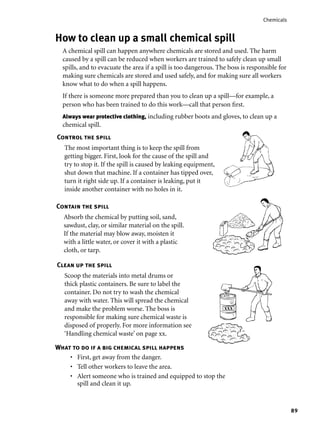
Control the spill
The most important thing is to keep the spill from
getting bigger. First, look for the cause of the spill and
try to stop it. If the spill is caused by leaking equipment,
shut down that machine. If a container has tipped over,
turn it right side up. If a container is leaking, put it
inside another container with no holes in it.
Contain the spill
Absorb the chemical by putting soil, sand,
sawdust, clay, or similar material on the spill.
If the material may blow away, moisten it
with a little water, or cover it with a plastic
cloth, or tarp.
Clean up the spill
Scoop the materials into metal drums or
thick plastic containers. Be sure to label the
container. Do not try to wash the chemical
away with water. This will spread the chemical
and make the problem worse. The boss is
responsible for making sure chemical waste is
disposed of properly. For more information see
‘Handling chemical waste’ on page xx.
XXX
What to do if a big chemical spill happens
First, get away from the danger.
Tell other workers to leave the area.
Alert someone who is trained and equipped to stop the
spill and clean it up.
•
•
•
90
Work Dangers DRAFT — FEBRUARY 2006
Healthy skin protects your body
Healthy skin helps protect the body from germs
that cause illness. When your skin is cracked or
bleeding, germs and chemicals can get into your
body more easily.
You can help protect your skin by washing only
with ordinary soap and water. Strong soaps and
chemicals for removing grease, paint, or glue can
irritate or damage your skin. Chemicals in these
cleaners can also get inside your body through the
skin and harm your health in other ways.
Rubbing oil or lotion into skin after washing
helps prevent skin from getting dry or cracked.
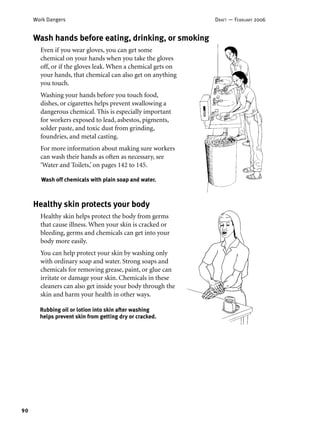
Wash hands before eating, drinking, or smoking
Even if you wear gloves, you can get some
chemical on your hands when you take the gloves
off, or if the gloves leak. When a chemical gets on
your hands, that chemical can also get on anything
you touch.
Washing your hands before you touch food,
dishes, or cigarettes helps prevent swallowing a
dangerous chemical. This is especially important
for workers exposed to lead, asbestos, pigments,
solder paste, and toxic dust from grinding,
foundries, and metal casting.
For more information about making sure workers
can wash their hands as often as necessary, see
‘Water and Toilets,’ on pages 142 to 145.
Wash off chemicals with plain soap and water.
91
Chemicals
Smoking adds danger to factory work
Smoking cigarettes in the workplace adds dangerous chemicals to the air all
workers breathe, whether they smoke or not.
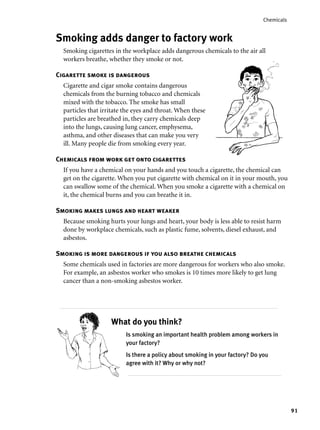
Cigarette smoke is dangerous
Cigarette and cigar smoke contains dangerous
chemicals from the burning tobacco and chemicals
mixed with the tobacco. The smoke has small
particles that irritate the eyes and throat. When these
particles are breathed in, they carry chemicals deep
into the lungs, causing lung cancer, emphysema,
asthma, and other diseases that can make you very
ill. Many people die from smoking every year.
Chemicals from work get onto cigarettes
If you have a chemical on your hands and you touch a cigarette, the chemical can
get on the cigarette. When you put cigarette with chemical on it in your mouth, you
can swallow some of the chemical. When you smoke a cigarette with a chemical on
it, the chemical burns and you can breathe it in.
Smoking makes lungs and heart weaker
Because smoking hurts your lungs and heart, your body is less able to resist harm
done by workplace chemicals, such as plastic fume, solvents, diesel exhaust, and
asbestos.
Smoking is more dangerous if you also breathe chemicals
Some chemicals used in factories are more dangerous for workers who also smoke.
For example, an asbestos worker who smokes is 10 times more likely to get lung
cancer than a non-smoking asbestos worker.
Is smoking an important health problem among workers in
your factory?
Is there a policy about smoking in your factory? Do you
agree with it? Why or why not?
What do you think?
92
Work Dangers DRAFT — FEBRUARY 2006
Protecting workers’ families
If you leave the factory with chemical dust, spills, or splashes on your clothes,
skin, or hair, other people can be harmed by touching or breathing
these chemicals. Using safer chemicals is
the best way to protect workers and
their families. But if dangerous
chemicals are used in your factory,
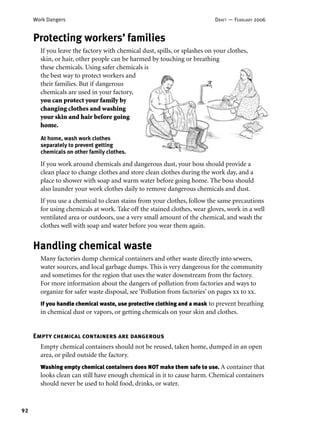
you can protect your family by
changing clothes and washing
your skin and hair before going
home.
At home, wash work clothes
separately to prevent getting
chemicals on other family clothes.
If you work around chemicals and dangerous dust, your boss should provide a
clean place to change clothes and store clean clothes during the work day, and a
place to shower with soap and warm water before going home. The boss should
also launder your work clothes daily to remove dangerous chemicals and dust.
If you use a chemical to clean stains from your clothes, follow the same precautions
for using chemicals at work. Take off the stained clothes, wear gloves, work in a well
ventilated area or outdoors, use a very small amount of the chemical, and wash the
clothes well with soap and water before you wear them again.
Handling chemical waste
Many factories dump chemical containers and other waste directly into sewers,
water sources, and local garbage dumps. This is very dangerous for the community
and sometimes for the region that uses the water downstream from the factory.
For more information about the dangers of pollution from factories and ways to
organize for safer waste disposal, see ‘Pollution from factories’ on pages xx to xx.
If you handle chemical waste, use protective clothing and a mask to prevent breathing
in chemical dust or vapors, or getting chemicals on your skin and clothes.
Empty chemical containers are dangerous
Empty chemical containers should not be reused, taken home, dumped in an open
area, or piled outside the factory.
Washing empty chemical containers does NOT make them safe to use. A container that
looks clean can still have enough chemical in it to cause harm. Chemical containers
should never be used to hold food, drinks, or water.
93
Chemicals
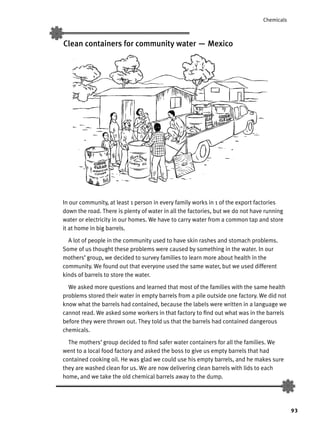
Clean containers for community water — Mexico
In our community, at least 1 person in every family works in 1 of the export factories
down the road. There is plenty of water in all the factories, but we do not have running
water or electricity in our homes. We have to carry water from a common tap and store
it at home in big barrels.
A lot of people in the community used to have skin rashes and stomach problems.
Some of us thought these problems were caused by something in the water. In our
mothers’ group, we decided to survey families to learn more about health in the
community. We found out that everyone used the same water, but we used different
kinds of barrels to store the water.
We asked more questions and learned that most of the families with the same health
problems stored their water in empty barrels from a pile outside one factory. We did not
know what the barrels had contained, because the labels were written in a language we
cannot read. We asked some workers in that factory to find out what was in the barrels
before they were thrown out. They told us that the barrels had contained dangerous
chemicals.
The mothers’ group decided to find safer water containers for all the families. We
went to a local food factory and asked the boss to give us empty barrels that had
contained cooking oil. He was glad we could use his empty barrels, and he makes sure
they are washed clean for us. We are now delivering clean barrels with lids to each
home, and we take the old chemical barrels away to the dump.

Working with Dangerous Chemicals

  • 1.
    54 Work Dangers DRAFT— FEBRUARY 2006 Do you know what chemicals are used in your factory? Do you know how chemicals used in your factory can harm your health? Are workers trained to use chemicals safely? Chemicals Working with dangerous chemicals Most people use chemicals every day. Soap, plastics, and many cosmetics are made with chemicals. Some chemicals do not cause any harm. Other chemicals can cause minor or temporary health problems. But some chemicals are very dangerous and can cause serious health problems and death. Dangerous chemicals are used to make products in export factories. Some job tasks also produce dangerous chemicals that workers breathe or absorb through their Who knows best? My expert says there is nothing in the air. No violation of health standards. Come see for yourself! Chemicals get on our hands and clothes, too! Then why do we get dizzy and sick when we use the cleaner a lot? It smells and makes my head hurt.
  • 2.
    55 Chemicals There are manydifferent kinds of dangerous chemicals, and they can cause different types of health problems. You can use this book in different ways to learn more about chemicals and their effects on health. For example, For more information about how you can be exposed to a chemical, see pages 56 to 57. For more information about how chemicals can harm different parts of the body, see pages 58 to 59. For more information about the dangers of some common chemicals used in factories, see pages 64 to 73. For more information about how to prevent exposure from different jobs, see pages 75 to 87 and the Health effects of chemicals chart on pages 156 to 179. • • • • Chemicals come in all kinds of containers, such as bottles, cans, jars, barrels, sacks, pressurized cylinders, large tanks, trailers, and rail cars. Chemicals can be in many forms The chemicals used in a factory can be a watery or oily liquid, powder, pellets, granules, paste, or an invisible gas. During the production process, chemichals are often released in the air as smoke, fume, mist, gas vapors, or dust. Chemichal flakes, dust, and sticky residue can settle on floors, windows, and work surfaces. skin as they work. In this section we show how chemicals in factories cause health problems for workers and their families, and how to prevent health problems caused by dangerous chemicals at work. For more information about how chemicals from factories can harm the health of everyone in the community, see ‘Pollution from factories’ on page xx.
  • 3.
    56 Work Dangers DRAFT— FEBRUARY 2006 Exposure and harm You can be exposed to chemicals at work if you use the chemical and if you are working around other people using chemicals. The health problems caused by most chemicals depend on: How you are exposed to a chemical. How much of the chemical you are exposed to. How long you are exposed to the chemical. How dangerous the chemical is. Chemicals can also cause long-term health problems, such as cancer or permanent damage to the brain, nerves, or lungs. Long-term problems happen after you have been regularly exposed to a chemical for many months or years, and you may not get sick until many years after you stopped using a chemical. Long-term problems can be mild or serious. For example, if your hands are exposed to isopropyl alcohol every day for many years, the skin will get thicker and less sensitive. But if you breathe in a small amount of methylene chloride every day for several years, you can develop cancer. Chemicals can cause short-term health problems, such as irritation that makes your eyes water and burn. Short-term problems can happen as soon as you are exposed to a chemical or right after exposure. Short-term problems can be mild or serious. For example, if you breathe in a small amount of the solvent methylene chloride during 1 hour, it can make you dizzy and give you a headache. But if you breathe in a lot of methylene chloride during 1 hour, it can cause you to lose consciousness and die. Some chemicals can make you feel sick right away. Some chemicals cause serious illness many years later. How dangerous chemicals can harm your health Some chemicals and chemical vapors are flammable. They can catch fire or explode easily if they get too hot or too close to a spark or flame.
  • 4.
    57 Chemicals How are youexposed? There are 3 ways a chemical can get into your body and cause harm. Mouth: You can swallow a chemical. This usually happens when the chemical is on your hands and you touch food or a cigarette that goes into your mouth. But chemical dust or a splash can get on your lips or inside your mouth.You also swallow chemicals that are already in cigarettes, the food you eat, or the water you drink. Skin: You can absorb a chemical through your skin or your eyes. Air: You can breathe in a chemical through your nose and mouth. How much are you exposed? If a worker gets a little chemical on his hand and washes it off very quickly, this is not much exposure. If a worker is splashed with the same chemical and breathes it, this is a lot of exposure. Different chemicals are dangerous in different amounts. How long are you exposed? For some chemicals, a few minutes of exposure is not harmful, but many hours of continuous exposure is very harmful. Some chemicals are harmful even if you are exposed for a minute. A few minutes of exposure to a chemical only 1 time may not harm you, but short exposures repeated over many years can cause harm. How dangerous is the chemical? Some chemicals are dangerous in small amounts and some only in large amounts. Some chemicals can cause death right away. Other chemicals can make you ill but do not cause death. And some chemicals can cause an illness, such as cancer, that can cause death many years in the future.
  • 5.
    58 Work Dangers DRAFT— FEBRUARY 2006 Common health problems caused by chemicals Irritation, such as red, itchy skin and eyes, sneezing, coughing, sore throat, runny nose, and difficulty breathing. The irritation usually stops and will heal when you are away from the chemical. Allergies that cause a skin rash, eye or nose irritation, coughing or breathing problems. These are usually short-term health problems caused by an allergic reaction to a specific chemical. If you are “sensitized” to a specific chemical, you will have an allergic reaction every time you are exposed to that chemical. Other workers can be exposed in the same way and not have any reaction, because they are not sensitized or allergic to the chemical. The reaction usually goes away when you get away from the substance you are allergic to. But severe allergies, and asthma caused by an allergy, can cause you to stop breathing, and you can die if you do not get immediate medical care. Asthma and other breathing problems caused by chemicals that harm the lungs. Signs of asthma are wheezing, coughing, shortness of breath, and feeling tightness in the chest. Asthma can be a short-term health problem that stops when you are away from the substance causing asthma. But some chemicals cause long term harm to the lungs or cause workers to have asthma for the rest of their lives. If you already have asthma, breathing in chemicals can make the asthma worse or cause you to stop breathing. Burns, of skin and flesh. Swallowing or breathing some chemicals can also cause burns inside the body. Cancer, a serious illness that causes cells in the body to grow out of control. Different chemicals cause cancer of the skin, lungs, liver, blood, bone marrow, and other parts of the body. Cancer can be hard to cure and can kill you. Most cancers develop very slowly, and signs of illness do not appear until many years after exposure to the substance that caused the cancer. Sexual and reproductive health problems, including changes in a man’s sperm or a woman’s monthly bleeding that can make it difficult to conceive a child and have a healthy baby. If a woman is exposed to certain chemicals before or during pregnancy, these substances can cause pregnancy complications, miscarriage, or problems with the baby’s health and development. A baby can also have health problems caused by certain chemicals in the father’s body. For more information, see ‘Sexual and reproductive health’ on pages xx to xx. Harm inside the body. Some chemicals slowly destroy specific parts of the body, such as the brain, nerves, liver, kidneys, or lungs. Swallowing or breathing some chemicals can cause immediate poisoning that makes you very sick and can kill you if you do not get medical help right away. Other chemicals can cause slow poisoning over time that can make you very ill and kill you. Chemicals can also weaken your body’s ability to resist infections and other illnesses.
  • 6.
    59 Chemicals Baby. Born withincomplete development, harm inside the body, or physical deformities caused by the mother or father’s exposure to dangerous chemicals. Brain and nerves. Temporary dizziness, nausea, confusion, blurred vision, headache, sleepiness. Long-term harm causing mood changes, difficulty learning, memory loss, speech problems, trembling, and numbness of hands and feet. Cancer. Eyes. Temporary irritation. Burns. Blindness. Nose and throat. Temporary irritation. Burns. Nose bleeds. Wounds in nose. Cancer.Lungs. Difficulty breathing, asthma. Harm that can cause death. Cancer. Liver. Harm that can cause death. Cancer. Stomach. Temporary nausea and upset stomach. Cancer. Bones. Cancer of the bone marrow (the soft tissue inside bones). Skin. Rashes. Allergy. Burns. Cancer. Blood. Anemia. Cancer. Sickness caused by changes in the blood. Pregnancy and monthly bleeding. Loss of sexual desire in men and women, difficulty getting pregnant, pregnancy complications, miscarriage. Kidneys. Harm that can cause death. Cancer. Ears. Loss of hearing. Ringing in the ears. Each person is different. Some people will become ill from a chemical, and some will not. When 2 people are exposed to the same amount of the same chemical in the same way at the same time, they will not always suffer the same harm. Some people feel sick from a small exposure to a chemical. Other people may not feel sick until they have much more exposure. Your chances of becoming ill from exposure to a chemical depend on your body, the type of exposure, other chemicals you may also be exposed to, and on chance. Here are some common ways chemicals can harm your body: Teeth. Wears away teeth. Heart. Irregular beating. Stops heart.
  • 7.
    60 Work Dangers DRAFT— FEBRUARY 2006 How to know if you use dangerous chemicals Workers often know that chemicals in the factory cause headaches, dizziness, skin rashes, and other short-term problems. But some chemicals can be causing other health problems without any signs of sickness for a long time. To know if you are being exposed to dangerous chemicals, you need information about all the chemicals used where you work. All workers have a right to know which chemicals they are exposed to from their jobs. This includes the chemicals used by other workers in the factory, and chemicals produced by work processes and machines. Workers have a right to know what health problems can be caused by these chemicals, and how to work as safely as possible to prevent health problems. We won’t use chemicals without knowing how they can harm our health. We need training and tools to use them more safely. How to get information about a chemical Survey workers Ask workers what health problems they notice from chemicals they are exposed to at work. Do they feel ill at work or after work? Do they feel better when they are away from work for a few days? Ask if they know what chemicals they use, and collect the names and labels of these chemicals. For more information about surveys, see ‘Survey your coworkers’ on page xx. The label All chemical containers should be clearly labeled with the name of the chemical and information about the known health dangers of the contents. In some countries, these labels are required by law. The labels and warnings should be in the local language workers read. See page 77.
  • 8.
    61 Chemicals Chemical information sheet Somecompanies that make chemical products also publish an information sheet for each product. In some countries these sheets are called Material Safety Data Sheets (MSDS). A good sheet will name all the chemicals in the product, describe how these chemicals can affect your health, tell you whether these chemicals can cause cancer or birth defects, describe protections you need to work safely with the product, and give other information about the product, such as how easily it catches fire. Sometimes the information on these sheets is wrong or incomplete, making the product look safer than it really is. The boss should have an information sheet for every chemical product in the factory. If you cannot get information from the boss but you know the name of a chemical product, you can contact the company that makes the product and request an information sheet. Training It is the boss’s responsibility to give workers chemical information in a language workers understand, and in a way workers understand it. Workers who cannot read can learn about chemicals from pictures, videos, demonstrations, or hands- on practice. When you start a new job or are assigned new work, your supervisor should tell you about the chemicals you work with and how to use them safely. Community resources Labor unions, labor support groups, and environmental organizations may be able to help you get information. If you know the name of a chemical, you can find information about it in libraries and on the internet. For more information about using community resources, see ‘XX’ on page xx. Caution! Do not sniff! Your nose does not always know! Some chemicals are very dangerous even when you cannot smell them. Other chemicals smell very bad but are not very dangerous. You can get used to an odor and not smell it at all after awhile. Some people cannot smell odors well. No!
  • 9.
    62 Work Dangers DRAFT— FEBRUARY 2006 Workers in Mexico win a safer solvent We took the label to the office of the Comité Fronterizo de Obreras (CFO), an organization that supports and organizes workers in our community. The CFO has a file of chemical information sheets. We found the sheet for methylene chloride and learned it does more harm than just burn throats and cause us headaches. It can cause cancer and harm the liver. We took the information about the solvent to the boss, but she did nothing. I get a headache every day, and my throat burns. Here is the label. The chemical is called methylene chloride. We found that we all had the same health problems. We suspected these problems were caused by the solvent we used to fuse the straws together. We did not know the name of the solvent. There were no labels on any of the containers we used. So, we asked one of the chemical storeroom workers to give us the label from one of the large containers of solvent. I have lost my taste too. I cannot taste anything any more.Yes, I get headaches and a dry throat too. We worked at a factory in Mexico that made plastic drinking straws with people’s names shaped into them. This is what happened when a group of us started meeting to learn about our rights under Mexican labor law, and to learn about health. This chemical is very dangerous! It makes us sick now, and it can kill us later!
  • 10.
    63 Chemicals Next we tookthe information about the solvent to the local office of the national environmental protection agency, PROFEPA. We asked them to inspect the factory. We had to pressure them several times. The inspectors finally came, but they told the boss ahead of time. Just before the PROFEPA inspection, the boss replaced the methylene chloride with a less dangerous solvent. I do not see any methylene chloride here, but you need to install local exhaust vents at each work station. We do not have vents, because we do not want to pollute the air outside. The boss claimed to care about polluting the air outside, but he did not care if we breathed dangerous chemicals all day inside the factory! PROFEPA never required the boss to install the local exhaust fans. But after the inspection, the boss kept buying the less dangerous solvent, even though it was more expensive.
  • 11.
    64 Work Dangers DRAFT— FEBRUARY 2006 Dangers of chemicals common in export factories From this page through page xx, we give information about the most common and most dangerous chemicals workers are exposed to in export factories. These include specific chemicals, such as formaldehyde and asbestos; groups of chemicals, such as solvents and dyes; and chemical mixtures, such as welding fumes and diesel exhaust. On pages xx to xx, we give examples of protections from these chemicals. There is not enough space here to include all the chemicals workers might be exposed to in every factory. And this book cannot tell how the chemicals used in a specific factory may be harming the health of workers in that factory. For health information about more chemicals found in export factories, see ‘Health effects of chemicals’ on pages 156 to 179. For ways to find more information about chemicals and health, see ‘Resources’ on page xx. Asbestos Asbestos is a mineral mined from the earth. It does not burn or get destroyed by other chemicals. Asbestos has been used for decades to make insulation and many other durable products. Asbestos causes serious long-term harm Asbestos does not cause any short-term health effect. But millions of people around the world have died from painful lung diseases many years after being exposed to asbestos. You can be exposed to asbestos by breathing in dust that has tiny asbestos fibers in it. The fibers are too small to see. If you are exposed to a lot of asbestos dust, or exposed to a little of it over a long period of time, you can get a deadly hardening of the lungs called asbestosis, a cancer called mesothelioma or lung cancer. The cancers usually do not appear until 10 or 20 years later. Workers who breathe asbestos at work are harmed more by smoking than other workers. Cigarette smoke and asbestos in the lungs together cause more harm than either one alone. Families of workers can also get these diseases from breathing in asbestos dust that workers bring home on their hair, skin, and clothes. For more information about protecting workers’ families from asbestos and other dangerous chemicals, see ‘Leave work clothes at work’ on page 92. The most effective way to protect people from asbestos is to stop using it. There is no reason for asbestos to be used in new products, machines, and buildings. For almost all uses of asbestos, there are safer materials that can be used instead. There is now an international campaign to ban asbestos everywhere in the world.
  • 12.
    65 Chemicals Campaigns by asbestosworkers and their families have won them compensation and won bans on asbestos for workers in the future. Many countries have passed laws that ban or severely limit the use of asbestos, but some developing countries continue to make and use asbestos products. Even in countries with bans, asbestos is still found in older buildings and machinery. Workers in some export factories may handle asbestos in the following ways: using and maintaining machines and tools lined or insulated with asbestos, such as furnaces, ovens, and boilers. Pipes carrying steam and hot water or chemicals may be covered on the outside with asbestos insulation. Ladles used for pouring molten metals are usually lined with asbestos. installing, maintaining, or removing insulation and fireproofing in buildings and building materials, such as synthetic floor tiles, roof shingles, siding, and cement. wearing or making heat protective clothing, which is often made with asbestos. Shields used to protect workers from intense heat sources, such as furnaces and molten metal, may also be made of asbestos. making brake pads, clutch plates, and other friction parts for cars, trucks, and machines, although most factories now make these parts without asbestos. • • • •
  • 13.
    66 Work Dangers DRAFT— FEBRUARY 2006 Cleaning and garment finishing baths Some parts or finished garments are washed in a mixture of water, detergent, and an alkali or acid. For example,“stone-washed” and “acid washed” jeans have been treated with bleach or acid. Dangers of these baths include: skin irritation from splashes or chemical mist in the air. eye injury, including blindness, from splashes. cancer from formaldehyde and other chemicals used on fabrics, and from breathing BCME (bis-chloromethylether) vapor, which is created when fabric treated with formaldehyde is acid washed. sudden death from breathing poisonous gases that form when certain chemicals mix with some chemical baths. Do not use chlorinated hydrocarbon solvents near acid and alkali baths. This can create deadly phosgene gas. Chlorinated hydrocarbons include those with “chlor” in the name, such as methylene chloride, trichloroethylene, and tetrachloroethylene. • • • • Chemical baths Some metals, plastics, and fabrics are treated with bleach or acids to change their color or surface finish. Two types are electroplating baths and garment finishing baths. Dangers of electroplating include: skin irritation and burns of skin, flesh, and eyes from splashes or chemical mist in the air. burns inside the nose, throat, and lungs from breathing in chemical mist, causing nose bleeds and difficulty breathing. cancer and permanent harm to the lungs from breathing acid mists over a long period of time. cancer from breathing vapors from toxic metals, such as chromium and nickel, over a long period of time. poisoning or death from swallowing a bath mixture that contains cyanide salts. This can happen if you are splashed by the bath, or if the bath mixture on your hands gets into your mouth. • • • • • Electroplating baths Workers coat metal parts with another metal by dipping the parts in electroplating baths. For example, steel car parts can be plated first with nickel to prevent rust and plated again with chromium for a shiny surface. These baths are usually strong acid or alkali mixtures. The chemicals can vary, but all metalplating baths are a danger to workers.
  • 14.
    67 Chemicals Metal casting: Thecores of dies and molds are usually made with resin. Formaldehyde fume is created when molten metal touches cores that have resin in them. Plastic processing: Formaldehyde is in plastic fume created when some types of plastic are overheated and break down in hot process machines, such injection molding and film blowing machines. In some countries, formaldehyde use is strictly regulated, because it is so dangerous. Some countries require a warning label on fabrics treated with formaldehyde. Dangers of formaldehyde include: Do not use acids near alkaline cyanide baths. This can create deadly hydrogen cyanide gas. Formaldehyde Workers in different industries can be exposed to formaldehyde in treated fabric and in fume that is sometimes created from metal casting and plastic processing. Treated fabric: The most common and dangerous chemical in garment factories is formaldehyde in fabrics that have been treated so they do not wrinkle or fade. If fabric is “wrinkle free” or “permanent press,” it was probably treated with formaldehyde. Formaldehyde in treated fabric gets in the air and on workers’ skin. Lead and other toxic metals Toxic metals are minerals mined from the earth. Common toxic metals used in export factories are lead, cobalt, zinc, nickel, cadmium, chromium, beryllium, mercury, and manganese. In factories, these metals are often combined with other substances, so workers do not always know they are handling dangerous material. For example, some steel contains cadmium. Welding on steel that contains cadmium creates a fume that can kill you if you breathe a lot of it at once. rashes, eczema, burns, and other skin problems. irritated eyes, nose, throat or lungs. • • cancer. blindness. bronchitis or asthma. • • • Lead Lead has been used in paints, pigments, glass, pottery glaze, metal pipes and alloys, and other products for hundreds of years. This common metal has caused serious, long-term health problems for many people who did not know lead was dangerous or that they were exposed to lead.
  • 15.
    68 Work Dangers DRAFT— FEBRUARY 2006 Lead usually gets in your body at work from breathing in lead dust or fumes. You can also swallow lead in paint or solder paste that gets on your hands and on food or cigarettes that you put in your mouth. Each time you are exposed to lead, the amount inside your body increases. In export factories today, workers doing these jobs are sometimes exposed to lead: casting and fettling or cleaning metal parts with lead in them. making batteries. mixing or using plastic, paint, primer, and other coatings containing lead. soldering electronic parts or radiators for cars and trucks using lead solder or solder paste. welding or grinding parts made of lead or a coating that contains lead. Lead causes serious long-term harm to the brain, nerves, and other parts of the body, called lead poisoning. The health problems caused by lead sometimes do not appear for many months. Signs of lead poisoning include: • • • • • stomach ache, loss of appetite, and constipation tiredness and trouble sleeping headaches memory loss • • • • irritability muscle and joint pain shaky hands and muscle weakness weak blood (anemia) high blood pressure • • • • • Other dangers of exposure to lead include: harm to the kidneys. cancer. harm to a baby conceived by a man or a woman with lead in the body. Lead in either the mother or the father’s body can cause a baby to die before birth or to be born with health problems, including damage to the brain and nerves. Lead can harm the baby’s ability to concentrate and learn as she grows up. harms to men’s ability to have children. harm to children from exposure to lead brought home on workers’ clothes. Lead harms children’s brains and nerves, and affects their ability to learn and concentrate. For more information about protecting children and other family members from dangerous chemicals, see page 92. • • • • • Solder paste contains lead and other toxic metals.
  • 16.
    69 Chemicals Cobalt, zinc, nickel,cadmium, chromium, beryllium, mercury, and manganese These metals are sometimes found in pigments, metal alloys such as steel and brass, metal coatings, metal plating baths, electrical parts, mirror coatings, batteries, welding rods, solder, and metalized vapors used to coat plastic parts. These jobs can expose workers to toxic vapor, dust, and fume: mixing pigments into paints and other coatings. applying paints and coatings to parts and poducts. scraping, grinding, cutting, or welding coated surfaces. die casting, welding, grinding, or cutting metal alloys. preparing and using metal plating baths. vacuum metalizing plastic parts. soldering using solder made with these metals. Breathing the fume of several of these metals causes metal fume fever. Signs of metal fume fever include headache, fever, chills, muscle aches, nausea, vomiting, weakness, and tiredness. These effects usually start several hours or a few days after exposure and can last from 6 to 24 hours. For information about the specific health dangers of each toxic metal, see the Health effects of chemicals chart on pages 156 to 179. • • • • • • • Paint pigments may contain lead and other toxic metals. Dyes and pigments Dyes are used to change the color of fabric, leather, plastic, rubber, and other materials used in many garment, shoe, and toy factories. Pigments are mixed with paints, coatings, and plastics to change their color. Some workers add dyes and pigments to parts and products. Other workers handle material that has already been dyed or already contains pigment. Dangers of some dyes and pigments include: skin and eye irritation. poisoning if swallowed. cancer. • • • My arms itch so much they are red since this new fabric came in. I hope the fabric changes again soon! This fabric doesn’t bother me. I wonder what it is?
  • 17.
    70 Work Dangers DRAFT— FEBRUARY 2006 It is almost impossible to get information on the kinds of dyes and pigments used in different paints, coatings, and fabrics. Workers often do not learn about the danger until they get sick. For example, garment workers have noticed that dyes in black and other dark-colored fabrics cause more irritation than dyes in light- colored fabrics. Silica Silica is a mineral commonly found in rocks and sand. In factories, silica dust is created from sand blasting, sand casting or die casting metal, using sand cores, and from grinding cast metal, such as car engine parts. Silica dust is so fine that you can breathe in a lot of it without feeling it and without seeing it in the air. Breathing a lot of silica dust for a short time, or breathing less silica dust over a long period of time, causes permanent harm to the lungs called silicosis. There is no cure for silicosis, and it usually gets worse over time, even if a worker stops being exposed to silica dust. Silicosis makes breathing very difficult and often causes death from heart failure. Silica can also cause lung cancer. Workers exposed to dust and workers with silicosis are more likely to get TB and other lung diseases than other workers. Grinding cast metal parts creates silica dust. Solvents A solvent is a chemical used to remove dirt and grease, or to dissolve or thin other chemicals, such as paint pigment, adhesive, or finish coatings. Solvents are sometimes mixed with other chemicals into a product with a brand name. These products may not have content labels, so it can be hard to find out if the product you are using contains a dangerous solvent. Solvents can cause a variety of health problems. Not every solvent causes all of the health problems listed below. You need to know the name of solvent you are using before you can learn more about the dangers specific to that solvent. Dangers from solvents include: irritation and burns to skin, eyes, nose, and throat allergic skin rash headache, nausea, confusion, feeling weak and dizzy hearing loss breathing problems and asthma harm to liver, kidneys, blood, brain, heart, nerves, and other parts of the body harm to baby during pregnancy harm to ability of men and women to have healthy children cancer • • • • • • • • •
  • 18.
    71 Chemicals Some “safer solvents”are more dangerous Some solvents, such as ethanol and isopropyl alcohol, cause less serious health problems but catch fire very easily. Other solvents, such as trichloroethylene, methylene chloride, or 2-methoxyethanol, are often sold as “safer solvents,” because they are less likely to catch fire. But these chemicals are more harmful to the kidneys, liver, brain, and nerves. They also harm the ability of men and women to have healthy children, and they are more likely to cause cancer. Solvents cause short-term and long-term harm A lot of solvents give workers headaches and nausea, and make them feel week, dizzy, or confused. Solvents that cause these short-term problems can also cause long-term harm to the brain if workers are exposed continuously for years. This harm to the brain causes memory loss, difficulty concentrating and learning, irritability and depression, loss of sexual desire and ability to have children, headaches, and fatigue. This harm is permanent, cannot be cured, and does not stop if a worker is no longer exposed to the solvent. For information on the health effects of specific solvents, see the Health effects of chemicals chart on pages 156 to 179. Metalworking fluids and machine lubricants Fluids are used in metal machining, stamping, cutting, and grinding to keep the machine and the parts being worked on from getting too hot. These fluids are sometimes called “cutting fluids,” “cutting oils,” or “coolants.” They are a mixture of chemicals in either water or oil. Lubricating metal parts with oil before cutting or stamping Dangers from metalworking fluids include: rashes, itching, and other skin problems from touching the fluids, or touching tools or machine parts with fluid on them. irritated nose and throat, and dry cough from breathing in mist with fluid in it. asthma and other long-term breathing problems. cancer of the skin, throat, stomach, and intestines. breathing problems and hypersensitivity pneumonitis from bacteria that grow in metalworking fluids that are not kept clean. To stop the bacterial growth, other chemicals are added to the metalworking fluids, but these additives can cause skin and lung irritations. • • • • •
  • 19.
    72 Work Dangers DRAFT— FEBRUARY 2006 Motor exhaust Motor exhaust contains many chemicals and fine particles that contaminate the air. Workers can be exposed to exhaust from trucks, forklifts, and other vehicles and machines powered by diesel, gasoline, or propane motors. Older vehicles and motors that are not regularly maintained create more exhaust. One of the most dangerous chemicals in motor exhaust is carbon monoxide, a gas you cannot see or smell. Carbon monoxide from motors used indoors can make you pass out and die within a few minutes. Dangers of breathing in motor exhaust include: irritation of the eyes, nose, and throat. chest tightness and wheezing. headaches, dizziness, nausea, and vomiting. unconsciousness and death. numbness in fingers and toes. harm to baby during pregnancy. Dangers of breathing motor exhaust over a long period of time include: difficult breathing, frequent coughing with mucus, bronchitis, asthma. cancer. Motor exhaust can be more harmful to people with emphysema, asthma, and heart disease. • • • • • • • • Mot0r exhaust contains deadly carbon monoxide. Soldering and welding fumes Welding uses heat to melt and fuse together 2 pieces of metal. Soldering uses heat to fuse 2 pieces of metal by melting a soft metal called solder. Welding heats the metals to a much higher temperature than soldering. Both processes create fumes that are harmful to breathe. Welding and soldering fume can contain toxic metals, such as cadmium, nickel, or lead. For more information about the health dangers of these metals, see ‘Lead and other toxic metals’ on pages 67 and 68. Soldering fume Soldering fume is not as dangerous as welding fume because it does not heat the metal as hot. Flux vapor, or smoke from burning flux, can cause eye, nose, and throat irritation, and asthma. If any solvent from degreasing is on the parts being soldered, burned solvent will be in the solder fume. For more information about the dangers of breathing solvents, see ‘Solvents’ on pages 70 to 71. Soldering parts on a circuit board creates dangerous fumes.
  • 20.
    73 Chemicals Welding fume Dangerous weldingfumes come from the metal being welded, from paint or other coating on the metal, or from the filler material used to make the weld. Short-term health problems from breathing welding fume include: irritated eyes, nose, throat, and lungs. loss of appetite, vomiting, cramps, and nausea. metal fume fever. For more information about metal fume fever, see ‘Lead and other toxic metals’ on page xx. Long-term health problems from breathing welding fume include: bronchitis, asthma, emphysema, and other lung diseases. cancer. Welding should never be done near solvents or degreasing equipment. Heat and sparks from welding can cause flammable solvents and solvent vapors in the air to catch fire. Heat from welding can also burn solvent vapors in the air, creating deadly phosgene gas. • • • • • Plastic fumes There are many kinds of plastic made with different mixes of chemicals. The health problems caused by breathing plastic fume depend on the chemicals in the fume. For example, polyurethane is a plastic commonly used to make foam seat cushions, spray foam insulation, foam packaging material, molded plastic parts, cores for die casting metal parts, and spray paints. Polyurethane is made of chemicals called isocyanates. Workers who breathe fume from molding polyurethane are breathing dangerous isocyanates. Breathing fumes from melted and hot plastic, or from overheated plastic that breaks down, can also be very dangerous. Dangers from breathing isocyanates and other plastic fumes include: irritation of the eyes, nose, and throat. allergic skin rash. cough, wheeze, chest tightness and shortness of breath. severe irritation of the lungs that can cause pneumonia and death. severe asthma that can stop breathing and cause death. harm to kidneys and other organs. cancer. • • • • • • • Removing molded plastic pieces from an injection molding machine
  • 21.
    74 Work Dangers DRAFT— FEBRUARY 2006 Why do chemical companies make and sell so many dangerous products? Why can employers make workers use chemicals with known health dangers? What do you think? In most countries, a company can sell a new chemical without proving the chemical is safe. Some governments regulate the use of some chemicals known to cause health problems, but only after the chemical has made people sick. Testing chemicals to learn how they harm people and the environment is slow and uncertain. Most tests are done on animals in a laboratory. Chemicals can affect people differently than they affect animals, so these tests do not always help us understand how chemicals can harm people. And tests are not done for all health effects. For example, very few chemicals have been tested to find out how they affect children conceived by men or women exposed to a chemical, or how they affect babies of pregnant women exposed to a chemical. Most workers are also exposed to combinations of chemicals, not to one chemical at a time. Only a few combinations of chemicals have been tested for their health effects on people. Why are there poisonous chemicals in factories? In industrialized countries, more than 60,000 chemical products are used in homes, factories, vehicles, and all kinds of businesses. About 3,000 new chemical products are made each year. Most of these products have not been tested to find out if they cause health problems or harm the environment. Fewer chemicals are used in less industrialized countries, but workers in factories around the world use many untested and unregulated chemicals. If the government put people and the environment first, they would test every chemical before it can be sold. If we stop using toxic chemicals, we do not have to clean up the pollution or suffer the health problems they cause.
  • 22.
    75 Chemicals Ways to reduceworkers’ exposure to chemicals Protection from chemicals The most effective way to protect workers from dangerous chemicals is to get the boss to use fewer chemicals or less dangerous chemicals in the factory. If dangerous chemicals are used in the factory, then the boss is responsible for making sure workers are protected from exposure. apron over clothes local exhaust vent covered container face shield covered feet gloves small brush least dangerous chemical Informed workers are most safe Workers cannot prevent exposures to dangerous chemicals if they do not know how dangerous a chemical is AND how to reduce exposure. For ideas about getting information on chemicals, see ‘How can you tell which chemicals are dangerous’ on page xx. Make sure managers and supervisors have the same information. Workers cannot follow safer chemical policies if supervisors do not let them.
  • 23.
    76 Work Dangers DRAFT— FEBRUARY 2006 Even for a single chemical, like a cleaning solvent, the solutions may be different for each job or work area. Remember, no single solution will be right for all the chemicals in your factory. • Inform workers about chemicals they use. • Ban the most dangerous chemicals from the factory. • Use the safest chemicals. • Use the smallest possible amount of a chemical. • Keep chemicals out of the air and off of the body. • Use ventilation, especially local exhaust vents. • Prevent spills and leaks. • Do not depend on face masks or protective clothing — reduce exposure first. How to reduce workers’ exposure to dangerous chemicals Learn about the chemicals in your factory The work hazard map activity on page xx can be a useful way to find out what workers know about chemicals used in the factory and the health problems that may be caused by chemicals. You can use the results of the activity to decide which chemical dangers workers want to reduce first. The solutions suggested on pages xx to xx in this chapter can help you decide how to reduce workers’ exposure to chemicals.
  • 24.
    77 Chemicals Ban the mostdangerous chemicals Some chemicals are too dangerous to use in factories or anywhere else. Thanks to years of protest by workers, doctors, and health advocates, these chemicals and products are no longer used in some places: Asbestos Lead in pigments, dye, paint, and other coatings Toxic metals in many pigments, dye, paints, and other coatings Rosin or colophony flux for soldering Solvents such as glycol ethers, methylene chloride, benzene, and carbon tetrachloride Diesel, gasoline, and propane engines used indoors Sand for sand blasting Companies now make safer products that replace some of the most dangerous chemicals. And safer processes have been developed in some industries, so these chemicals may also be banned in the future: Lead, chromium, cadmium, and mercury in electronics, including solder. Chlorinated and fluorinated (halogenated) hydrocarbon solvents. PVC plastic made from vinyl chloride. • • • • • • • • • • Content labels on all chemical containers Every chemical container should have a content label on it, written in a language workers can read. The label should list the known health dangers of the product and include a warning if the chemical is flammable. When a chemical is taken out of one container and put in another, the new container should also have a complete content label. Never put chemicals in a container that is used for food or drinks, or that looks like a container for food or drinks. People expect a soft drink bottle to contain soft drink, not a dangerous chemical. Someone may drink from the bottle by mistake. Never put food or drink in a container used for chemicals. Even if the container has been washed, it will have small amounts of chemicals inside that can get into the food or drink. DANGER! Splashes can irritate and burn the skin and eyes. Breathing irritates nose, throat, and lungs causing coughing, wheezing, shortness of breath. Breathing and skin absorption harm liver, kidneys, and brain, and causes cancer. Precautions during use: Use in well ventilated area. Avoid contact with eyes, skin, and clothing. If needed wear face shield or safety glasses. Do not smoke, eat, or drink where methylene chloride is handled. Wash hands with soap and water before eating, drinking, smoking, or using the toilet. Wash work clothes and skin after every work shift. First aid: Skin: Immediately wash any skin that may have contacted the chemical. Eye: Hold eye open and rinse with water for 15 minutes or longer. Call a doctor. Manufactured by: Axo Chemical Co., 111 Only Drive, Onlyville, Iowa, 11111 USA Phone 111-111-1111. CAS # 75-09-2 AXO DEGREASER contains: Methylene chloride. .. .. .. .. .. .. .. .. 80% Inert .. .. .. .. .. .. .. .. .. .. .. .. .. .. .. .. .. .. .. .. .. .. .. 20%
  • 25.
    78 Work Dangers DRAFT— FEBRUARY 2006 Find a safer chemical The boss should buy the mildest, safest chemical products needed to get the job done. For example: Electric motors can be used for indoor vehicles instead of diesel, gasoline, or compressed gas . Non-chlorinated hydrocarbon solvents can often be used instead of chlorinated solvents like methylene chloride or TCE (trichloroethylene). Water-based cleaners, glues, paints, dyes, and coatings can often be used instead of products that contain a solvent. Weaker strength acid and alkaline baths and washes can work just as well as stronger ones. Metalworking fluids made from vegetable oils, like rapeseed or canola, may be less harmful than fluids made from mineral oils. Small plastic or metal pellets can be used instead of sand as a blasting material to eliminate silica dust. • • • • • • Use fewer chemicals and less of them Bosses often do not think about how to use less chemical in the factory. Workers can help bosses see where using less chemical is better for workers, is less wasteful, and more efficient. For example: Cleaner, more efficient processes and techniques can reduce the need to use chemicals for cleaning and degreasing. Steam and detergent cleaning can work as well better than a chemical cleaner or solvent. Low solvent/high pigment paints and low solvent coatings can coat the same amount of parts with less solvent. These coatings also dry faster. Using a brush, roller, syringe, sponge, ladle, or other tool allows a worker to apply the smallest amount of chemical to the smallest area. The worker uses less chemical with less waste and less mess to clean up. Cleaning up excess chemical right away protects other workers from exposure. For example, wiping off excess oil from machined parts keeps the oil from spreading to other surfaces that will later have to be cleaned. Spot cleaning dirt or excess chemical uses less cleaner or solvent than cleaning the whole piece. • • • • • • We used to use solvents. Now we use soap and water in this ultrasonic degreasing machine.
  • 26.
    79 Chemicals Prevent splashing, dust,and mist When workers have the right tools and equipment, with time and training to use them properly, they can reduce splashing, dust, and mist in the air. But workers are often unable to prevent these problems when work areas are crowded and messy, machines are not maintained and repaired, and the boss pushes workers and machines to work as fast as possible. Anti-foam agents can be added to chemical baths to keep mist from forming in the air above the bath. Putting plastic chips or balls on the surface of electroplating baths can also prevent mist from forming in the air above the bath. Maintain and clean metalworking fluids Dangerous bacteria can grow in metalworking fluids and cause lung problems for workers. You can prevent bacteria from growing by cleaning metalworking fluids regularly. You cannot see the bacteria in the fluid, but a trained worker can test the fluid for bacteria levels and acidity. Keep the coolant system running on days when there is no work to keep the metalworking fluids circulating. Circulation puts air into the fluid that reduces bacteria growth. This also reduces the awful smells when the cooling system is restarted. This smell is a sign of bacteria growing in the fluid. Breathing too much chemical vapor is dangerous. Cover containers and use a small amount of the chemical. Prevent chemicals from getting into the air Some ways to keep chemicals out of the air are simple, and workers may be able to do them easily. For example, when you are not using the chemical in a container, cover the opening to keep vapors out of the air. Make the opening smaller to fit the tool you are using. Try to use a small tool that applies just the right amount of chemical. The less chemical you use, the less vapor goes into the air you breathe.
  • 27.
    80 Work Dangers DRAFT— FEBRUARY 2006 Reduce soldering and welding heat Fumes are less dangerous when soldering and welding are done at the lowest temperature needed to do the job. Solder and flux make fume and smoke when soldering irons or wave soldering machines are too hot. If there is lead in the solder, the fume is very dangerous. Newer soldering irons and soldering machines have a temperature control that workers can set to prevent overheating the solder. With proper training, welders can reduce fume by hand welding with lower heat and by controlling the heat in automated welding machines. Clean metal before cutting or welding If a metal being welded or cut has chemicals on it, such as oil, paint, or solvent residue, these chemicals can also turn into dangerous fumes. If the metal is clean, the welding and cutting fume will be a little less dangerous. If you use a solvent to remove paint or other coatings on the metal, use soap and water to wash any dried solvent off the metal before welding. Control heat in plastics processing Workers processing plastic can breathe fume from melted plastic and fume from plastic that breaks down after getting too hot or staying hot for too long. The fume from plastic breaking down is usually much more harmful than the fume from melted plastic. Plastic processing machines melt the plastic and push or blow it into a mold that gives it a shape. To reduce the amount of fume, the plastic should be heated just enough to melt it and mold it. Plastic molding machines must be set up for each new batch of plastic and maintained carefully to control the heat and processing time. A maximum soldering heat of 200 to 250°C prevents lead fumes. To keep plastic from getting too hot and creating dangerous fumes, workers need training and time to adjust and maintain the machine.
  • 28.
    81 Chemicals Flammable chemicals shouldnever be sprayed, because they can create explosive vapors in the air. A spark or flame can cause the vapors to catch fire. Do not use flammable chemicals around sparks or hot processes, such as welding or soldering, or where flames are used to heat baths, ovens, or plastic molding machines. Do not use asbestos Asbestos is too dangerous to use in any factory. If you are working with asbestos, do everything possible to get the boss to replace it with a safer material. To keep asbestos dust out of the air, all work with asbestos should be done inside a special box that holds the dust until the fibers are wet and mixed with other materials, or caught in a special filter. For more information on working with asbestos, see the ‘Resources’ on pages xx to xx. Avoid aerosols or sprays When you spray a chemical, most of it goes into the air or on other surfaces below or behind the part you aim the spray at. If you must use spray to paint or coat parts, use the least amount of spray that will cover the part. A spray booth will also help keep the chemical out of the air in other work areas. For an example of a spray booth, see page 97. Use a brush or sponge to put the chemical only where it is needed. Spraying puts a lot of chemical into the air.
  • 29.
    82 Work Dangers DRAFT— FEBRUARY 2006 Control heat and cover chemical baths Putting covers on chemical baths when they are not being used keeps vapors from the bath out of the air. Less vapor is created when heated baths are kept from getting too hot and are allowed to cool when not in use. Enclose and ventilate machines and processes Large machines that produce a lot of chemical vapor, mist or fume, are safest when they are enclosed in a large, ventilated box. The box stays closed when the machine is working, and can be opened for loading, adjusting, maintenance, and repair. Exhaust ventilation on the machine blows vapor and fume outside the factory. Some boxes have a mist collector instead of an exhaust vent. The mist collector filters the air in the box before blowing it back inside the factory. A mist collector is not as safe as an exhaust vent, because it does not filter out all of the chemical. Automated metalworking, welding, and soldering machines can be enclosed like this, as well as plastic processing machines, such as injection molding, blown film lines, pelletizer machines, and ovens for heating a product or burning out plastic molding equipment. Covering a chemical bath you are not using keeps vapors out of the air. Enclosed and ventilated soldering machine
  • 30.
    83 Chemicals Problems with rubbermasks Workers’ heads and faces are different shapes and sizes. Before using a rubber mask, try it on to make sure it fits your face. If the mask fits snugly and is not too tight, test it to make sure chemical dust and vapors cannot get in around the edges. The mask will not protect you if you smell the chemical while wearing the mask. find dust or chemical residue inside the mask. feel the chemical’s effects while wearing the mask. Rubber masks do not fit well on faces with beards or whiskers. They are also hot and uncomfortable to wear, and make it difficult to talk with coworkers. It is more difficult to breathe while wearing a rubber mask, so using a mask is dangerous for workers who already have breathing problems or a heart problem. These masks are expensive, and the filters and other parts need to be cleaned and replaced often. To work properly, different filters must be used with different chemicals. • • • Ventilation helps reduce chemicals in the air You may not be able to prevent some chemicals from getting into the air in the factory. But ventilation can help reduce the amount of chemicals workers breathe. Local exhaust vents remove chemical vapors before they get into the air inside the factory. Roof vents and exhaust fans help move air with dust and chemicals out of the factory building. For more information, see ‘Ventilation’ on pages 94 to 97. Masks are not the best protection from chemicals Keeping dangerous chemicals out of the factory is the best way to prevent health problems from breathing in chemical dust, vapor, fume, and mist. If you work with chemicals without good ventilation, a rubber mask with filters can give you some protection. Even with ventilation, welders and workers who handle asbestos need special masks. A cloth or paper mask will NOT protect you from breathing in chemical vapors. The vapors pass through the paper or cloth. Rubber masks that keep out chemical vapors require a specific filter for each chemical.
  • 31.
    84 Work Dangers DRAFT— FEBRUARY 2006 Mask for asbestos Even if you are working with wet asbestos that is enclosed with good exhaust ventilation, you will need the extra protection of a good mask. To filter out the tiny asbestos fibers, you need a snug-fitting rubber mask that has a HEPA-type filter. Some workers are given protective clothing and masks, but do not use them. Why does this happen? Which protections from breathing chemicals do you think are best for your job? Why? What do you think? Mask for welding Even if you are welding with good local exhaust ventilation, you will need the extra protection of a good mask to keep from breathing welding fume. For most types of welding you need a snug-fitting rubber mask with particulate filters that block out the fine dust in metal fume. You will need advice from someone who knows about chemicals and fumes from the type of welding in your factory to know which filter you need or if you need a supplied air system instead of a filter. Another way to keep from breathing welding fume is to blow fresh air into a welder’s hood through a hose. The air blowing out the bottom of the hood keeps welding fume from getting inside the hood. If the air blowing in is cool and dry, it can help keep the welder cooler while doing this hot work. If you weld stainless steel, you should have this kind of “supplied air” mask. A welder’s hood with fresh air blown in through a hose gives more protection from welding fume.
  • 32.
    85 Chemicals Keep chemicals offworkers’ skin The boss is responsible for providing, setting up, maintaining, and properly guarding tools and equipment to protect workers from leaking chemicals and splashes. Workers can often arrange work areas and job tasks to prevent chemicals from splashing, dripping, or leaking. Tools for handling chemicals You can avoid touching chemicals with your bare hands by using brushes, ladles, or long-handled tools to mix, measure, or apply chemicals. The boss should supply these tools, but workers can sometimes adapt an existing tool or make a tool to fit a specific job. Splash guards on machines On some machines, attaching a simple splash guard can protect the worker from fluids coming out of the machine. Protective clothes Cloth or leather gloves and aprons, long sleeves, and covered legs and feet can keep dust, paste, powder, and other solid chemicals off your skin. These clothes can also protect you from very small splashes of liquid chemicals. If you handle a lot of wet chemicals or products dripping with chemicals, you will need rubber boots, gloves, and a long apron that keep the liquids from soaking through your clothes. There are gloves, aprons, and boots made of different kinds of rubber for handling different chemicals. If the chemicals you work with go through one type of rubber, pressure the boss to buy protective clothing made of rubber that will protect you. Some people cannot wear gloves made of latex rubber, because latex can cause skin irritation. If a chemical soaks into your clothes, remove the wet clothes and wash your skin right away. For more information, see ‘Emergency eye wash and body shower’ on page 88. long handled tool protective clothes splash guard
  • 33.
    86 Work Dangers DRAFT— FEBRUARY 2006 A face shield or goggles A clear face shield can protect a worker’s mouth, eyes, and face from chemical splashes. This type of shield is easy to take on and off, and it is easy to clean. Goggles protect the eyes better, but they can also be hot and uncomfortable to wear. A welding hood or shield protects the welder’s eyes, face, and neck from sparks and dangerous light. A good fit is better protection Protective clothes can be hot and uncomfortable to wear. Gloves, aprons, masks, or goggles can also be dangerous if they do not fit well. If they are too large or too loose, they may not protect you from chemicals at all. Poorly fitting gloves can make it difficult to handle tools or do precise work. Long, loose clothing can get caught in machinery or cause you to trip and fall. Masks or goggles that do not fit your head and face properly can make it difficult for you to see your work. It is the boss’s responsibility to provide protective clothing in several sizes, so each worker can choose items that fit properly. Clean up excess oil Workers often get machine oil on their hands, tools, clothes, and parts being worked on. Cleaning up the oil right away reduces workers’ exposure to oil and prevents the use of dangerous solvents to remove the oil later. Clean up work areas regularly You can get chemicals on your skin from dust, soot, and mist on work surfaces, walls, and floors all over the factory. When a drop of chemical on a work table is not cleaned up right away, the chemical stays on the table and can get on the skin or clothes of any worker who touches it. Regular cleaning reduces the amount of chemical in the whole factory. Cleaning is especially important in factories where very toxic substances are used. For more information about cleaning up chemical dust, see ‘Prevent dust from getting into the air’ on page 100.
  • 34.
    87 Chemicals Prevent spills andleaks It is easier and safer to prevent chemical spills and leaks than to clean them up. You can prevent most chemical spills and leaks by: transporting chemicals in closed containers that cannot break or shatter. If you carry containers of liquids or powders on carts, use carts with sides and spill trays to catch leaks. using small containers of chemicals in work areas. Preventing and stopping leaks is easier when bulk chemicals and large containers are kept in a separate storage area. transferring chemicals safely from one container to another, using drip- preventing spouts for liquids, and proper scoops or other tools for solids, such as pastes, powders, and pellets. Use a tray under the containers to catch leaks and spills. Static electricity can cause flammable solvents to explode. To prevent this, some factories have static control mats around the area where flammable solvents are stored. When transferring solvents, you can also prevent an explosion by connecting a wire for earthing (grounding) to the solvent in each container. controlling heat during plastic processing. When melted plastic gets too hot, it can leak or overflow the machine. inspecting and maintaining containers, pipes, pumps, valves and machines that could leak chemicals, including safety shut-off valves or automatic shut-offs. If damage and worn parts are noticed early, they can be repaired or replaced before a leak happens. Emergency body shower and eye wash Every work area where chemicals are used should have an emergency body shower and an emergency eye wash station with enough clean water to flow continuously for at least 15 minutes. • • • • • Transferring a solvent to small containers.
  • 35.
    88 Work Dangers DRAFT— FEBRUARY 2006 Quick use of an eye wash or body shower can save workers from permanent damage to the eyes and skin from strong chemicals. For chemicals on the skin: Wash off immediately with lots of fresh water and continue washing for 15 minutes. If the chemical can cause burns or severe skin irritation, strat showering before you take your clothes off. For chemicals in the eyes: Rinse both eyes immediately with lots of water and continue rinsing for 15 minutes. See a health worker if your eyes burn or you have trouble seeing after the eye wash. For chemicals breathed in: If you feel dizzy or nauseous, or have a lot of trouble breathing, go to a health worker right away. If a worker becomes very ill or passes out while using a chemical, take the person to a health worker immediately. If you go to a health worker about a health problem caused by chemicals, try to bring information about the chemical with you. Most doctors and health workers do not know much about the health effects of chemicals. If you can, bring the label from the chemical container, or write down the name of the chemical or the product. Describe what the chemical looks like, how it smells, and what it is used for. Explain why you think the chemical is causing your illness or injury. FIRST AID First aid for a splash or spill When you see a health worker about a chemical illness or injury
  • 36.
    89 Chemicals How to cleanup a small chemical spill A chemical spill can happen anywhere chemicals are stored and used. The harm caused by a spill can be reduced when workers are trained to safely clean up small spills, and to evacuate the area if a spill is too dangerous. The boss is responsible for making sure chemicals are stored and used safely, and for making sure all workers know what to do when a spill happens. If there is someone more prepared than you to clean up a spill—for example, a person who has been trained to do this work—call that person first. Always wear protective clothing, including rubber boots and gloves, to clean up a chemical spill. Control the spill The most important thing is to keep the spill from getting bigger. First, look for the cause of the spill and try to stop it. If the spill is caused by leaking equipment, shut down that machine. If a container has tipped over, turn it right side up. If a container is leaking, put it inside another container with no holes in it. Contain the spill Absorb the chemical by putting soil, sand, sawdust, clay, or similar material on the spill. If the material may blow away, moisten it with a little water, or cover it with a plastic cloth, or tarp. Clean up the spill Scoop the materials into metal drums or thick plastic containers. Be sure to label the container. Do not try to wash the chemical away with water. This will spread the chemical and make the problem worse. The boss is responsible for making sure chemical waste is disposed of properly. For more information see ‘Handling chemical waste’ on page xx. XXX What to do if a big chemical spill happens First, get away from the danger. Tell other workers to leave the area. Alert someone who is trained and equipped to stop the spill and clean it up. • • •
  • 37.
    90 Work Dangers DRAFT— FEBRUARY 2006 Healthy skin protects your body Healthy skin helps protect the body from germs that cause illness. When your skin is cracked or bleeding, germs and chemicals can get into your body more easily. You can help protect your skin by washing only with ordinary soap and water. Strong soaps and chemicals for removing grease, paint, or glue can irritate or damage your skin. Chemicals in these cleaners can also get inside your body through the skin and harm your health in other ways. Rubbing oil or lotion into skin after washing helps prevent skin from getting dry or cracked. Wash hands before eating, drinking, or smoking Even if you wear gloves, you can get some chemical on your hands when you take the gloves off, or if the gloves leak. When a chemical gets on your hands, that chemical can also get on anything you touch. Washing your hands before you touch food, dishes, or cigarettes helps prevent swallowing a dangerous chemical. This is especially important for workers exposed to lead, asbestos, pigments, solder paste, and toxic dust from grinding, foundries, and metal casting. For more information about making sure workers can wash their hands as often as necessary, see ‘Water and Toilets,’ on pages 142 to 145. Wash off chemicals with plain soap and water.
  • 38.
    91 Chemicals Smoking adds dangerto factory work Smoking cigarettes in the workplace adds dangerous chemicals to the air all workers breathe, whether they smoke or not. Cigarette smoke is dangerous Cigarette and cigar smoke contains dangerous chemicals from the burning tobacco and chemicals mixed with the tobacco. The smoke has small particles that irritate the eyes and throat. When these particles are breathed in, they carry chemicals deep into the lungs, causing lung cancer, emphysema, asthma, and other diseases that can make you very ill. Many people die from smoking every year. Chemicals from work get onto cigarettes If you have a chemical on your hands and you touch a cigarette, the chemical can get on the cigarette. When you put cigarette with chemical on it in your mouth, you can swallow some of the chemical. When you smoke a cigarette with a chemical on it, the chemical burns and you can breathe it in. Smoking makes lungs and heart weaker Because smoking hurts your lungs and heart, your body is less able to resist harm done by workplace chemicals, such as plastic fume, solvents, diesel exhaust, and asbestos. Smoking is more dangerous if you also breathe chemicals Some chemicals used in factories are more dangerous for workers who also smoke. For example, an asbestos worker who smokes is 10 times more likely to get lung cancer than a non-smoking asbestos worker. Is smoking an important health problem among workers in your factory? Is there a policy about smoking in your factory? Do you agree with it? Why or why not? What do you think?
  • 39.
    92 Work Dangers DRAFT— FEBRUARY 2006 Protecting workers’ families If you leave the factory with chemical dust, spills, or splashes on your clothes, skin, or hair, other people can be harmed by touching or breathing these chemicals. Using safer chemicals is the best way to protect workers and their families. But if dangerous chemicals are used in your factory, you can protect your family by changing clothes and washing your skin and hair before going home. At home, wash work clothes separately to prevent getting chemicals on other family clothes. If you work around chemicals and dangerous dust, your boss should provide a clean place to change clothes and store clean clothes during the work day, and a place to shower with soap and warm water before going home. The boss should also launder your work clothes daily to remove dangerous chemicals and dust. If you use a chemical to clean stains from your clothes, follow the same precautions for using chemicals at work. Take off the stained clothes, wear gloves, work in a well ventilated area or outdoors, use a very small amount of the chemical, and wash the clothes well with soap and water before you wear them again. Handling chemical waste Many factories dump chemical containers and other waste directly into sewers, water sources, and local garbage dumps. This is very dangerous for the community and sometimes for the region that uses the water downstream from the factory. For more information about the dangers of pollution from factories and ways to organize for safer waste disposal, see ‘Pollution from factories’ on pages xx to xx. If you handle chemical waste, use protective clothing and a mask to prevent breathing in chemical dust or vapors, or getting chemicals on your skin and clothes. Empty chemical containers are dangerous Empty chemical containers should not be reused, taken home, dumped in an open area, or piled outside the factory. Washing empty chemical containers does NOT make them safe to use. A container that looks clean can still have enough chemical in it to cause harm. Chemical containers should never be used to hold food, drinks, or water.
  • 40.
    93 Chemicals Clean containers forcommunity water — Mexico In our community, at least 1 person in every family works in 1 of the export factories down the road. There is plenty of water in all the factories, but we do not have running water or electricity in our homes. We have to carry water from a common tap and store it at home in big barrels. A lot of people in the community used to have skin rashes and stomach problems. Some of us thought these problems were caused by something in the water. In our mothers’ group, we decided to survey families to learn more about health in the community. We found out that everyone used the same water, but we used different kinds of barrels to store the water. We asked more questions and learned that most of the families with the same health problems stored their water in empty barrels from a pile outside one factory. We did not know what the barrels had contained, because the labels were written in a language we cannot read. We asked some workers in that factory to find out what was in the barrels before they were thrown out. They told us that the barrels had contained dangerous chemicals. The mothers’ group decided to find safer water containers for all the families. We went to a local food factory and asked the boss to give us empty barrels that had contained cooking oil. He was glad we could use his empty barrels, and he makes sure they are washed clean for us. We are now delivering clean barrels with lids to each home, and we take the old chemical barrels away to the dump.