You will need access to this book. If you can’t get it let me
know and we’ll work around it somehow.
Congress, E. (2013). Assessment of adults. In M. Holosko, C.
Dulmus, & K. Sowers (Eds.),
Social work practice with individuals and families: Evidence-
informed assessments and interventions
(pp. 125–145). Hoboken, NJ: Wiley.
_____________________________________________________
___________
A comprehensive understanding of a client’s presenting
problems depends on the use of multiple types of assessment
models. Each model gathers different information based on
theoretical perspective and intent. An assessment that focuses
on one area alone not only misses vital information that may be
helpful in planning an intervention, but may encourage a biased
evaluation that could potentially lead you to an inappropriate
intervention. When gathering and reviewing a client’s history,
sometimes it is easier to focus on the problems and not the
positive attributes of the client. In social work, the use of a
strengths perspective requires that a client’s strengths, assets,
and resources must be identified and utilized. Further, using an
empowerment approach in conjunction with a strengths
perspective guides the practitioner to work with the client to
identify shared goals. You will be asked to consider these
approaches and critically analyze the multidisciplinary team’s
response to the program case study of Paula Cortez.
For this Assignment, review the program case study of the
Cortez family.
In a 2- to 4-page paper, complete a comprehensive assessment
of Paula Cortez, utilizing two of the assessment models
provided in Chapter 5 of the course text.
Using the Cowger article, identify at least two areas of
strengths in Paula’s case.
Analyze the perspectives of two members of the
multidisciplinary team, particularly relative to Paula’s
pregnancy.
Explain which model the social workers appear to be using to
make their assessment.
Describe the potential for bias when choosing an assessment
model and completing an evaluation.
Suggest strategies you, as Paula’s social worker, might try to
avoid these biases.
_____________________________________________________
___________
The Cortez Family
David Cortez: father, 46
Paula Cortez: mother, 43
Miguel Cortez: son, 20
Key to Acronyms
AIDS: Acquired Immunodeficiency Syndrome
HAART: Highly Active Antiretroviral Therapy
HIV: Human Immunodeficiency Virus
IVDU: Intravenous Drug User
SNF: Skilled Nursing Facility
SSI: Supplemental Security Insurance
WIC: Supplemental Nutrition Program for Women, Infants, and
Children
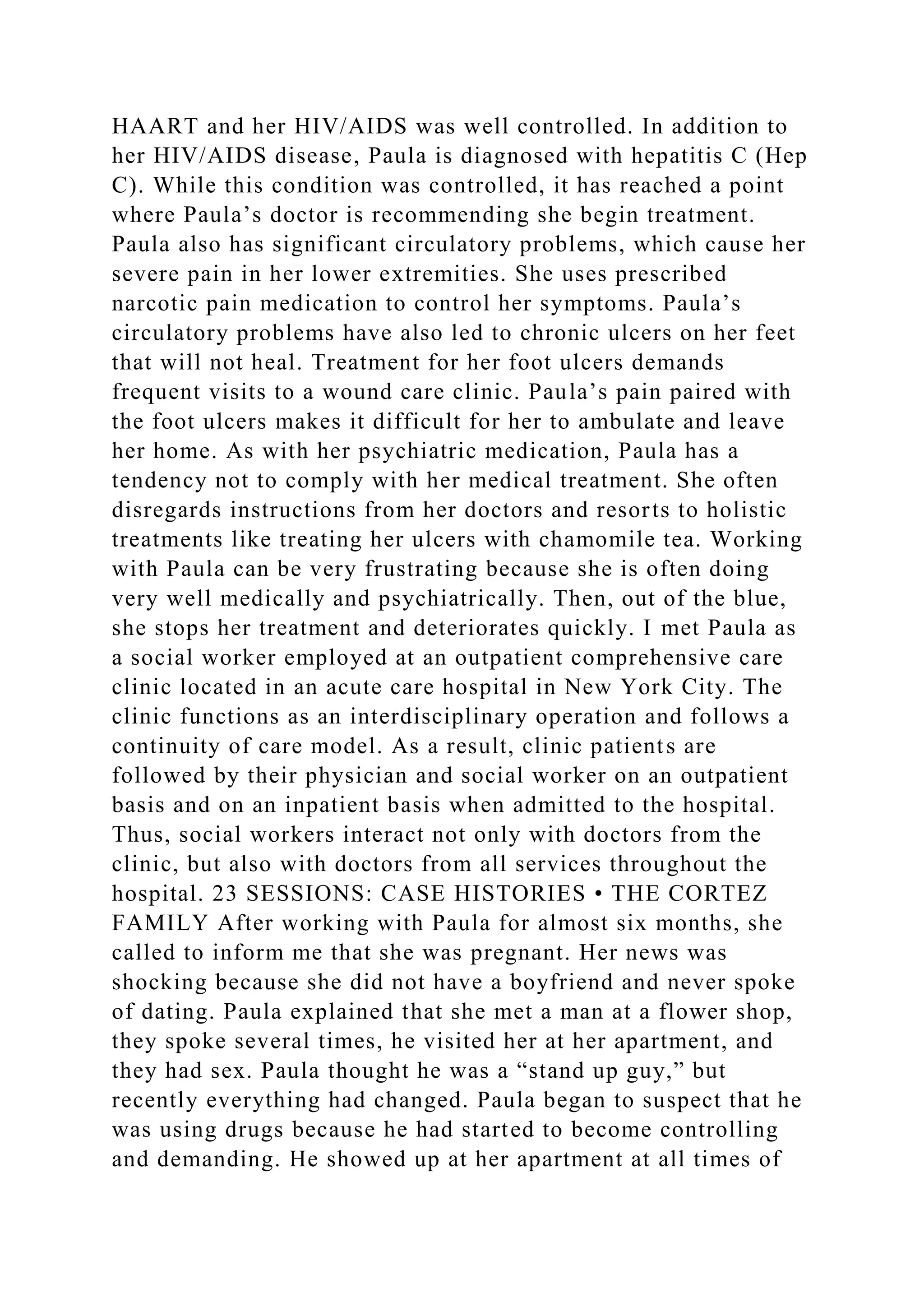
The Cortez Family Paula is a 43-year-old HIV-positive Latina
woman originally from Colombia. She is bilingual, fluent in
both Spanish and English. Paula lives alone in an apartment in
Queens, NY. She is divorced and has one son, Miguel, who is
20 years old. Paula maintains a relationship with her son and
her ex-husband, David (46). Paula raised Miguel until he was 8
years old, at which time she was forced to relinquish custody
due to her medical condition. Paula is severely socially isolated
as she has limited contact with her family in Colombia and
lacks a peer network of any kind in her neighborhood. Paula
identifies as Catholic, but she does not consider religion to be a
big part of her life. Paula came from a moderately well-to-do
family. She reports suffering physical and emotional abuse at
the hands of both her parents, who are alive and reside in
Colombia with Paula’s two siblings. Paula completed high
school in Colombia, but ran away when she was 17 years old
because she could no longer tolerate the abuse at home. Paula
became an intravenous drug user (IVDU), particularly of
cocaine and heroin. David, who was originally from New York
City, was one of Paula’s “drug buddies.” The two eloped, and
Paula followed David to the United States. Paula continued to
use drugs in the United States for several years; however, she
stopped when she got pregnant with Miguel. David continued to
use drugs, which led to the failure of their marriage. Once she
stopped using drugs, Paula attended the Fashion Institute of
Technology (FIT) in New York City. Upon completing her BA,
Paula worked for a clothing designer, but realized her true
passion was painting. She has a collection of more than 100
drawings and paintings, many of which track the course of her
personal and emotional journey. Paula held a full-time job for a
number of years before her health prevented her from working.
She is now unemployed and receives Supplemental Security
Insurance (SSI) and Medicaid. Paula was diagnosed with bipolar
disorder. She experiences rapid cycles of mania and depression
when not properly medicated, and she also has a tendency
toward paranoia. Paula has a history of not complying with her
psychiatric medication treatment because she does not like the
way it makes her feel. She often discontinues it without telling
her psychiatrist. Paula has had multiple psychiatric
hospitalizations but has remained out of the hospital for at least
five years. Paula accepts her bipolar diagnosis, but
demonstrates limited insight into the relationship between her
symptoms and her medication. Paula was diagnosed HIV
positive in 1987. Paula acquired AIDS several years later when
she was diagnosed with a severe brain infection and a T-cell
count less than 200. Paula’s brain infection left her completely
paralyzed on the right side. She lost function of her right arm
and hand, as well as the ability to walk. After a long stay in an
acute care hospital in New York City, Paula was transferred to a
skilled nursing facility (SNF) where she thought she would die.
It is at this time that Paula gave up custody of her son.
However, Paula’s condition improved gradually. After being in
the SNF for more than a year, Paula regained the ability to
walk, although she does so with a severe limp. She also
regained some function in her right arm. Her right hand (her
dominant hand) remains semi-paralyzed and limp. Over the
course of several years, Paula taught herself to paint with her
left hand and was able to return to her beloved art. In 1996,
when highly active antiretroviral therapy (HAART) became
available, Paula began treatment. She responded well to
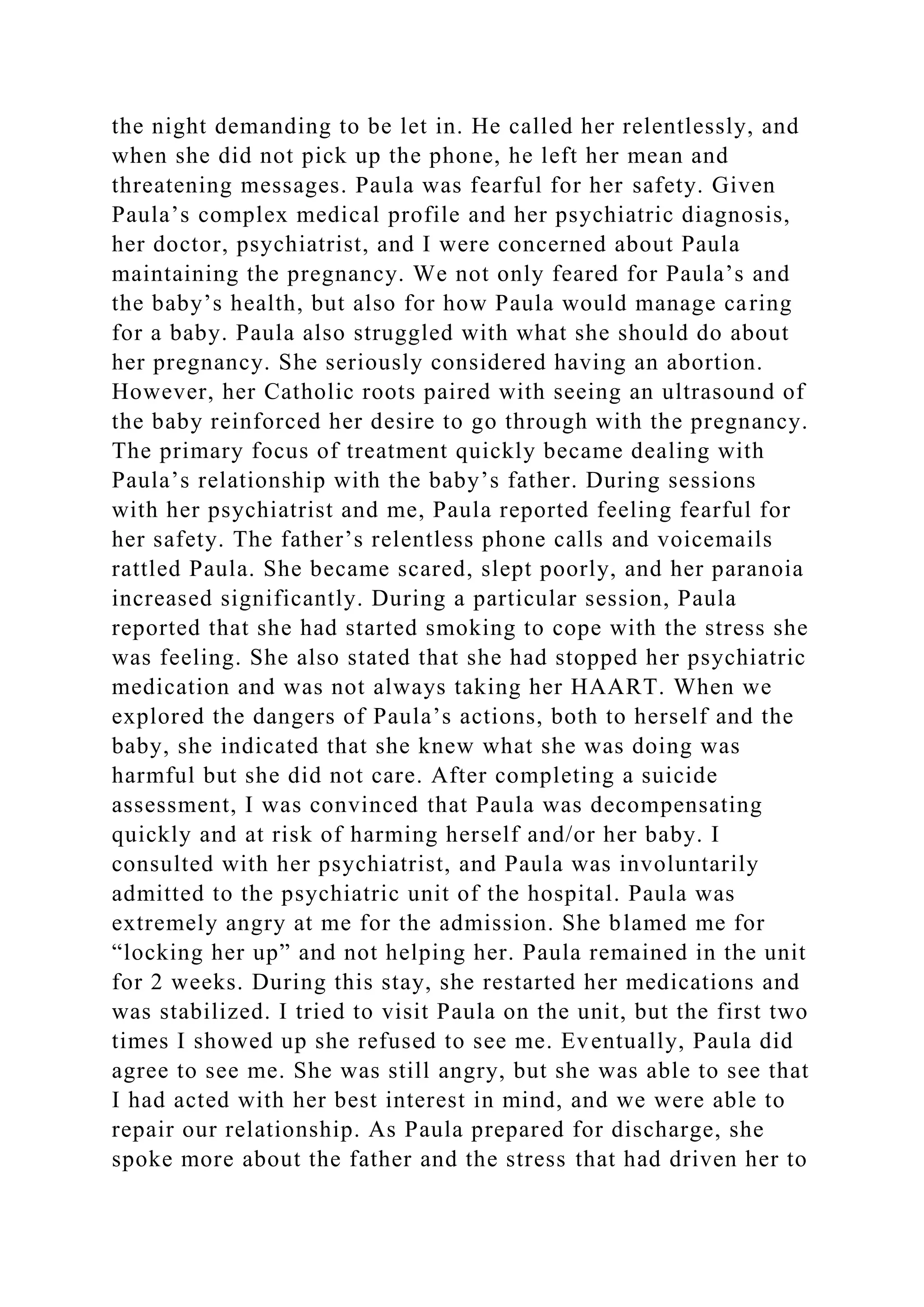
HAART and her HIV/AIDS was well controlled. In addition to
her HIV/AIDS disease, Paula is diagnosed with hepatitis C (Hep
C). While this condition was controlled, it has reached a point
where Paula’s doctor is recommending she begin treatment.
Paula also has significant circulatory problems, which cause her
severe pain in her lower extremities. She uses prescribed
narcotic pain medication to control her symptoms. Paula’s
circulatory problems have also led to chronic ulcers on her feet
that will not heal. Treatment for her foot ulcers demands
frequent visits to a wound care clinic. Paula’s pain paired with
the foot ulcers makes it difficult for her to ambulate and leave
her home. As with her psychiatric medication, Paula has a
tendency not to comply with her medical treatment. She often
disregards instructions from her doctors and resorts to holistic
treatments like treating her ulcers with chamomile tea. Working
with Paula can be very frustrating because she is often doing
very well medically and psychiatrically. Then, out of the blue,
she stops her treatment and deteriorates quickly. I met Paula as
a social worker employed at an outpatient comprehensive care
clinic located in an acute care hospital in New York City. The
clinic functions as an interdisciplinary operation and follows a
continuity of care model. As a result, clinic patients are
followed by their physician and social worker on an outpatient
basis and on an inpatient basis when admitted to the hospital.
Thus, social workers interact not only with doctors from the
clinic, but also with doctors from all services throughout the
hospital. 23 SESSIONS: CASE HISTORIES • THE CORTEZ
FAMILY After working with Paula for almost six months, she
called to inform me that she was pregnant. Her news was
shocking because she did not have a boyfriend and never spoke
of dating. Paula explained that she met a man at a flower shop,
they spoke several times, he visited her at her apartment, and
they had sex. Paula thought he was a “stand up guy,” but
recently everything had changed. Paula began to suspect that he
was using drugs because he had started to become controlling
and demanding. He showed up at her apartment at all times of
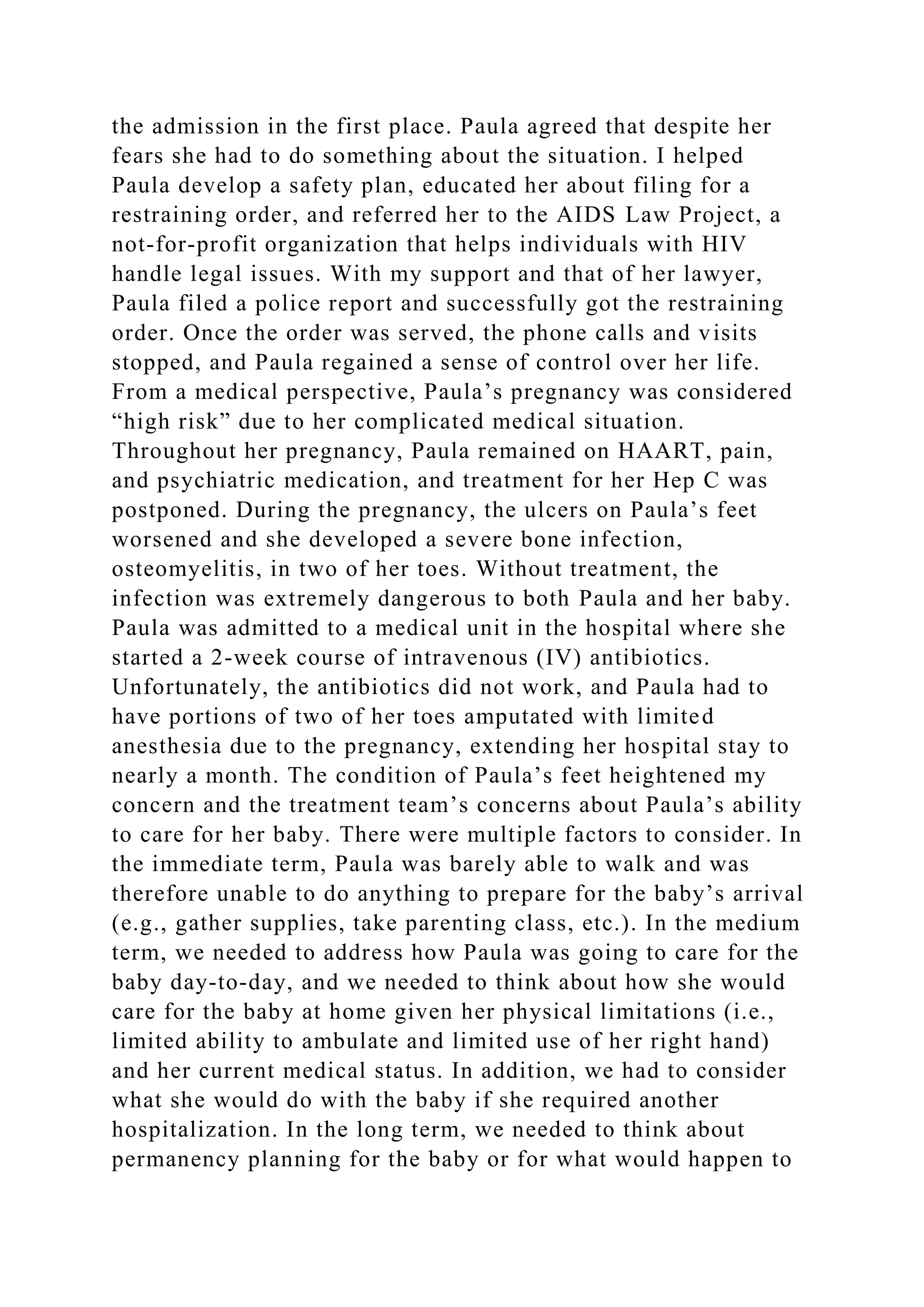
the night demanding to be let in. He called her relentlessly, and
when she did not pick up the phone, he left her mean and
threatening messages. Paula was fearful for her safety. Given
Paula’s complex medical profile and her psychiatric diagnosis,
her doctor, psychiatrist, and I were concerned about Paula
maintaining the pregnancy. We not only feared for Paula’s and
the baby’s health, but also for how Paula would manage caring
for a baby. Paula also struggled with what she should do about
her pregnancy. She seriously considered having an abortion.
However, her Catholic roots paired with seeing an ultrasound of
the baby reinforced her desire to go through with the pregnancy.
The primary focus of treatment quickly became dealing with
Paula’s relationship with the baby’s father. During sessions
with her psychiatrist and me, Paula reported feeling fearful for
her safety. The father’s relentless phone calls and voicemails
rattled Paula. She became scared, slept poorly, and her paranoia
increased significantly. During a particular session, Paula
reported that she had started smoking to cope with the stress she
was feeling. She also stated that she had stopped her psychiatric
medication and was not always taking her HAART. When we
explored the dangers of Paula’s actions, both to herself and the
baby, she indicated that she knew what she was doing was
harmful but she did not care. After completing a suicide
assessment, I was convinced that Paula was decompensating
quickly and at risk of harming herself and/or her baby. I
consulted with her psychiatrist, and Paula was involuntarily
admitted to the psychiatric unit of the hospital. Paula was
extremely angry at me for the admission. She blamed me for
“locking her up” and not helping her. Paula remained in the unit
for 2 weeks. During this stay, she restarted her medications and
was stabilized. I tried to visit Paula on the unit, but the first two
times I showed up she refused to see me. Eventually, Paula did
agree to see me. She was still angry, but she was able to see that
I had acted with her best interest in mind, and we were able to
repair our relationship. As Paula prepared for discharge, she
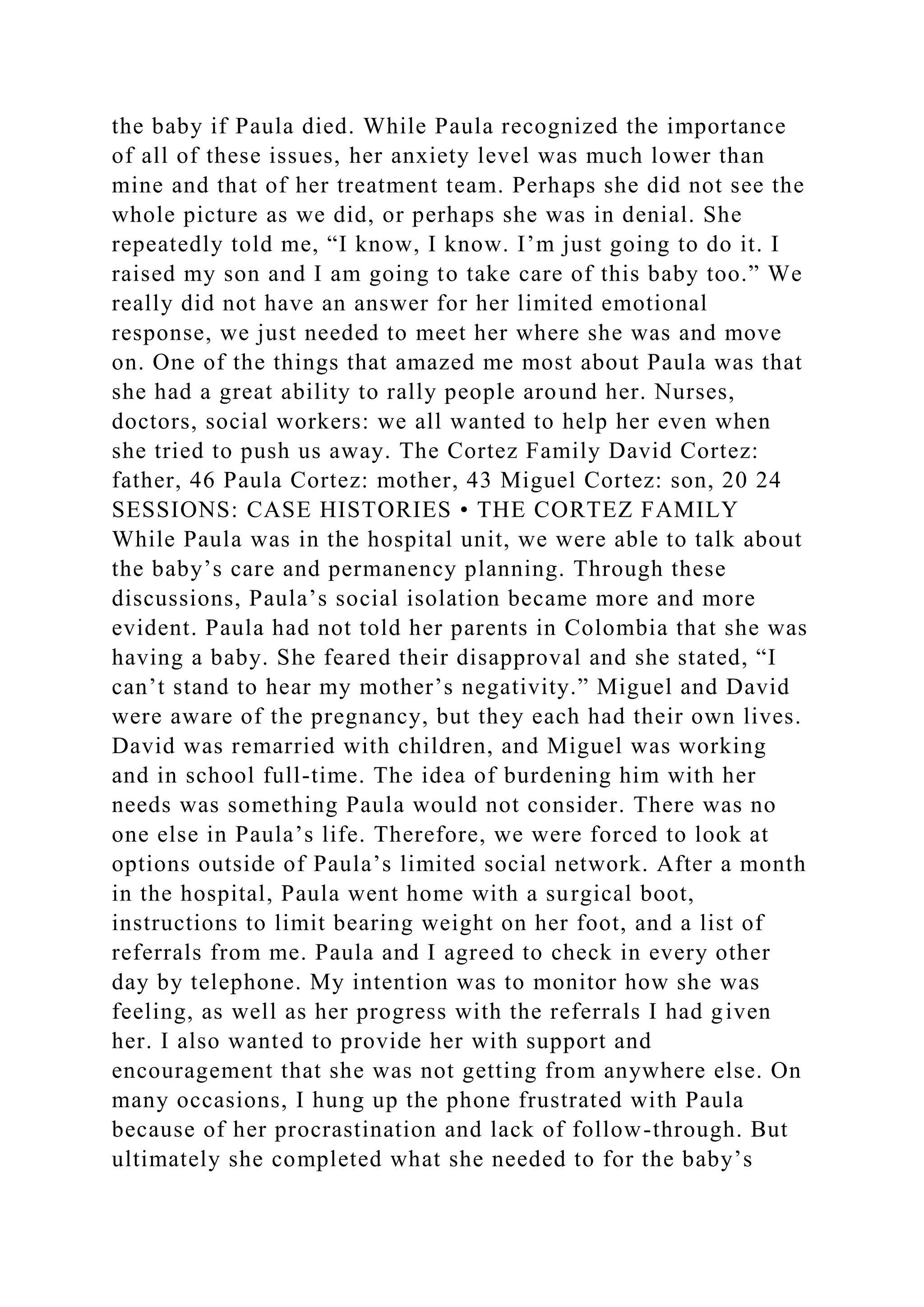
spoke more about the father and the stress that had driven her to
the admission in the first place. Paula agreed that despite her
fears she had to do something about the situation. I helped
Paula develop a safety plan, educated her about filing for a
restraining order, and referred her to the AIDS Law Project, a
not-for-profit organization that helps individuals with HIV
handle legal issues. With my support and that of her lawyer,
Paula filed a police report and successfully got the restraining
order. Once the order was served, the phone calls and visits
stopped, and Paula regained a sense of control over her life.
From a medical perspective, Paula’s pregnancy was considered
“high risk” due to her complicated medical situation.
Throughout her pregnancy, Paula remained on HAART, pain,
and psychiatric medication, and treatment for her Hep C was
postponed. During the pregnancy, the ulcers on Paula’s feet
worsened and she developed a severe bone infection,
osteomyelitis, in two of her toes. Without treatment, the
infection was extremely dangerous to both Paula and her baby.
Paula was admitted to a medical unit in the hospital where she
started a 2-week course of intravenous (IV) antibiotics.
Unfortunately, the antibiotics did not work, and Paula had to
have portions of two of her toes amputated with limited
anesthesia due to the pregnancy, extending her hospital stay to
nearly a month. The condition of Paula’s feet heightened my
concern and the treatment team’s concerns about Paula’s ability
to care for her baby. There were multiple factors to consider. In
the immediate term, Paula was barely able to walk and was
therefore unable to do anything to prepare for the baby’s arrival
(e.g., gather supplies, take parenting class, etc.). In the medium
term, we needed to address how Paula was going to care for the
baby day-to-day, and we needed to think about how she would
care for the baby at home given her physical limitations (i.e.,
limited ability to ambulate and limited use of her right hand)
and her current medical status. In addition, we had to consider
what she would do with the baby if she required another
hospitalization. In the long term, we needed to think about
permanency planning for the baby or for what would happen to
the baby if Paula died. While Paula recognized the importance
of all of these issues, her anxiety level was much lower than
mine and that of her treatment team. Perhaps she did not see the
whole picture as we did, or perhaps she was in denial. She
repeatedly told me, “I know, I know. I’m just going to do it. I
raised my son and I am going to take care of this baby too.” We
really did not have an answer for her limited emotional
response, we just needed to meet her where she was and move
on. One of the things that amazed me most about Paula was that
she had a great ability to rally people around her. Nurses,
doctors, social workers: we all wanted to help her even when
she tried to push us away. The Cortez Family David Cortez:
father, 46 Paula Cortez: mother, 43 Miguel Cortez: son, 20 24
SESSIONS: CASE HISTORIES • THE CORTEZ FAMILY
While Paula was in the hospital unit, we were able to talk about
the baby’s care and permanency planning. Through these
discussions, Paula’s social isolation became more and more
evident. Paula had not told her parents in Colombia that she was
having a baby. She feared their disapproval and she stated, “I
can’t stand to hear my mother’s negativity.” Miguel and David
were aware of the pregnancy, but they each had their own lives.
David was remarried with children, and Miguel was working
and in school full-time. The idea of burdening him with her
needs was something Paula would not consider. There was no
one else in Paula’s life. Therefore, we were forced to look at
options outside of Paula’s limited social network. After a month
in the hospital, Paula went home with a surgical boot,
instructions to limit bearing weight on her foot, and a list of
referrals from me. Paula and I agreed to check in every other
day by telephone. My intention was to monitor how she was
feeling, as well as her progress with the referrals I had given
her. I also wanted to provide her with support and
encouragement that she was not getting from anywhere else. On
many occasions, I hung up the phone frustrated with Paula
because of her procrastination and lack of follow-through. But
ultimately she completed what she needed to for the baby’s
arrival. Paula successfully applied for WIC, the federal
Supplemental Nutrition Program for Women, Infants, and
Children, and was also able to secure a crib and other baby
essentials. Paula delivered a healthy baby girl. The baby was
born HIV negative and received the appropriate HAART
treatment after birth. The baby spent a week in the neonatal
intensive care unit, as she had to detox from the effects of the
pain medication Paula took throughout her pregnancy. Given
Paula’s low income, health, and Medicaid status, Paula was able
to apply for and receive 24/7 in-home childcare assistance
through New York’s public assistance program. Depending on
Paula’s health and her need for help, this arrangement can be
modified as deemed appropriate. Miguel did take part in caring
for his half-sister, but his assistance was limited. Ultimately,
Paula completed the appropriate permanency planning
paperwork with the assistance of the organization The Family
Center. She named Miguel the baby’s guardian should
something happen to her.
_____________________________________________________
___________
Assessment for Client Empowerment
Contents
Theory of Strengths Assessment
Assessment as a Political Activity
Client Strengths and Empowerment
Importance of Assessing Strengths
Guidelines for Strengths Assessment
Conclusion
References
Full Text
The proposition that client strengths are central to the helping
relationship is simple enough and seems uncontroversial as an
important component of practice. Yet deficit, disease, and
dysfunction metaphors are deeply rooted in clinical social work,
and the emphasis of assessment has continued to be diagnosing
abnormal and pathological conditions. This article argues that
assessment in clinical practice, among other things, is a
political activity. Assessment that focuses on deficits provides
obstacles to client exercise of personal and social power and
reinforces those social structures that generate and regulate
unequal power relationships that victimize clients. Clinical
practice based on metaphors of client strengths is also political
in that it is congruent with the potential for client
empowerment. This article discusses the importance of a client
strengths perspective for assessment and proposes 12 practice
guidelines that foster a strengths perspective.
Key Words: clients; clinical assessment; empowerment; practice
effectiveness; strengths perspective
A focus on client strengths has received recent attention in the
social work practice literature (Goldstein, 1990; Hepworth &
Larsen, 1990; Saleebey, 1992; Weick, Rapp, Sullivan, &
Kisthardt, 1989). The proposition that client strengths are
central to the helping relationship is simple enough and seems
uncontroversial as an important component of practice. Yet
much of the social work literature suggests otherwise.
Review of the social work literature on human behavior and the
social environment reveals that it provides little theoretical or
empirical content on strengths. Much of the social work
literature on practice with families continue to use treatment,
dysfunction, and therapy metaphors and ignores work on family
strengths developed in other disciplines. The assessment
literature, including available assessment instruments, is
overwhelmingly concerned with individual inadequacies. Taking
a behavioral baseline of client deficits and examining the ability
of social workers to correct those deficits have become the
standard for evaluating the effectiveness of social work practice
(Kagle & Cowger, 1984). Deficit, disease, and dysfunction
metaphors are deeply rooted in social work, and the focus of
assessment has "continued to be, one way or another,
diagnosing pathological conditions" (Rodwell, 1987, p. 235).
This article discusses the importance of a client strengths
perspective for assessment and proposes 12 practice guidelines
to foster a strengths perspective. Though not addressed
specifically to a strengths perspective, work on the assessment
by Logan and Chambers (1987), Rodwell (1987), and Meyer
(1976) is particularly congruent with a strengths perspective
and has been important to the author's thinking.
Given that social work is expanding its influence into nearly
every social institution, it is not surprising that its knowledge is
diverse, lacks unity, and has significant gaps. In the excitement
of this rapid growth some people lament epistemological
problems and incongruities, whereas others proclaim they have
found the answer or, at least, an answer that will help give unity
and boundaries to the profession's purpose and knowledge base.
Although such a proclamation has its appeal, the profession is
simply too diverse, and existing paradigms that emphasize
client deficiencies are too entrenched for a strengths perspective
to become a unifying metaphor. However, a strengths
perspective does provide an alternative for practitioners who
find the constructs of the approach consistent with their own
views of the practice.
Saleebey (1992) has argued that the relevance of a strengths
perspective is generic and represents "good, basic social work
practice" (p. 43). It is particularly important for mandated or
involuntary clients because of the powerlessness implicit in the
involuntary nature of the client-worker relationship. Rapp
(1992), Kisthardt (1992), and Poertner and Ronnau (1992) have
described the use of a strengths perspective with involuntary
clients.
Theory of Strengths Assessment
This article is based on a mainstream contextual understanding
that the primary purpose of social work is to assist people in
their relationships with one another and with social institutions
in such a way as to promote social and economic justice
(Council on Social Work Education, 1984). The clinical practice
focuses on transactions between people and their environments.
However, taking seriously the element of promoting social and
economic justice in those transactions may not lead to a
mainstream conception of practice. Indeed, a clinical practice
that considers social and economic justice suggests a type of
practice that explicitly deals with power and power
relationships.
This perspective understands client empowerment as central to
clinical practice and client strengths as providing the fuel and
energy for that empowerment. Client empowerment is
characterized by two interdependent and interactive dynamics:
personal empowerment and social empowerment. Although
social work theories that split the attributes of people into the
social and the psychological have considerable limitations
(Falck, 1988), such a differentiation is made in this article to
stress the importance of each element.
The personal empowerment dynamic is similar to a traditional
clinical notion of self-determination whereby clients give
direction to the helping process, take charge and control of their
personal lives, get their "heads straight," learn new ways to
think about their situations, and adopt new behaviors that give
them more satisfying and rewarding outcomes. Personal
empowerment recognizes the uniqueness of each client.
The social empowerment dynamic recognizes that client
definitions and characteristics cannot be separated from their
context and that personal empowerment is related to the
opportunity. Social empowerment acknowledges that individual
behavior is socially derived and identity is "bound up with that
of others through social involvement" (Falck, 1988, p. 30). The
person with social empowerment is a person who has the
resources and opportunity to play an important role in his or her
environment and in the shaping of that environment.
A person achieves personal and social empowerment
simultaneously. For the client to achieve empowerment assumes
that the resources and opportunity for that empowerment are
available. Social justice, involving the distribution of society's
resources, is directly related to client social empowerment and,
therefore, simultaneously to personal empowerment.
Clinical practice based on empowerment assumes that client
power is achieved when clients make choices that give them
more control over their presenting problem situations and, in
turn, their own lives. However, the empowerment-based practice
also assumes social justice, recognizing that empowerment and
self-determination are dependent not only on people making
choices but also on people having available choices to make.
The distribution of available choices in society is political.
Societies organize systems of production and the distribution of
resources, and that affects those choices differentially. Across
societies, production and distribution are based on varying
degrees of commitment to equity and justice: "Some people get
more of everything than others" (Goroff, 1983, p. 133). Social
work practice based on the notion of choice requires attention
directed to the dynamics of personal power, the social power
endemic to the client's environment, and the relationship
between the two.
Assessment as Political Activity
Assessment that focuses on deficits provides obstacles to clients
exercising personal and social power and reinforces those social
structures that generate and regulate the unequal power
relationships that victimize clients. Goroff (1983) persuasively
argued that social work practice is a political activity and that
the attribution of individual deficiencies as the cause of human
problems is a politically conservative process that "supports the
status quo" (p. 134).
Deficit-based assessment targets the individual as "the
problem." For example, from a deficit perspective, the person
who is unemployed becomes a problem. Social work
interventions that focus on what is wrong with the person--for
example, why he or she is not working--reinforce the
powerlessness the client is already experiencing because he or
she does not have a job. At the same time, such an intervention
lets economic and social structures that do not provide an
opportunity "off the hook" and reinforces social structures that
generate unequal power. To assume that the cause of personal
pain and social problems is individual deficiency"has the
political consequences of not focusing on the social structure
(the body politic) but on the individual. Most, if not all, of the
pain we experience, is the result of the way we have organized
ourselves and how we create and allocate life-surviving
resources" (Goroff, 1983, p. 134).
Personal pain is political. Clinical social work practice is
political. Diagnostic and assessment metaphors and taxonomies
that stress individual deficiencies and sickness reinforce the
political status quo in a manner that is incongruent with a
clinical practice that attempts to promote social and economic
justice. Practice-based on pathology is subject to the "blaming
the victim" characterization of Ryan (1976). Clinical practice
based on metaphors of client strengths and empowerment is also
political in that its thrust is the development of client power and
the equitable distribution of societal resources.
Client Strengths and Empowerment
Promoting empowerment means believing that people are
capable of making their own choices and decisions. It means not
only that human beings possess the strengths and potential to
resolve their own difficult life situations, but also that they
increase their strength and contribute to society by doing so.
The role of the social worker in clinical practice is to nourish,
encourage, assist, enable, support, stimulate, and unleash the
strengths within people; to illuminate the strengths available to
people in their own environments, and to promote equity and
justice at all levels of society. To do that, the social worker
helps clients articulate the nature of their situations, identify
what they want, explore alternatives for achieving those wants,
and achieve them.
The role of the social worker is not to change people, treat
people, help people cope, or counsel people. The role is not to
empower people. As Simon (1990) argued, social workers
cannot empower others: "More than a simple linguistic nuance,
the notion that social workers do not empower others, but
instead, help people empower themselves is an ontological
distinction that frames the reality experienced by both workers
and clients" (p. 32). To assume a social worker can empower
someone else is naive and condescending and has little basis in
reality. Power is not something that social workers possess for
distribution at will. Clients, not social workers, own the power
that brings significant change in clinical practice. A clinical
social worker is merely a resource person with professional
training on the use of resources who is committed to people
empowerment and willing to share his or her knowledge in a
manner that helps people realize their own power, take control
of their own lives, and solve their own problems.
Importance of Assessing Strengths
Central to a strengths perspective is the role and place of
assessment in the practice process. How clients define difficult
situations and how they evaluate and give meaning to the
dynamic factors related to those situations set the context and
content for the duration of the helping relationship (Cowger,
1992). If the assessment focuses on deficits, it is likely that
deficits will remain the focus of both the worker and the client
during remaining contacts. Concentrating on deficits or
strengths can lead to self-fulfilling prophecies. Hepworth and
Larsen (1990) articulated how this concentration might also
impair a social worker's "ability to discern clients' potentials for
growth," reinforce "client self-doubts and feelings of
inadequacy," and predispose workers to "believe that clients
should continue to receive service longer than is necessary" (p.
195).
Emphasizing deficits has serious implications and limitations,
but focusing on strengths provides considerable advantages.
Strengths are all we have to work with. Recognition of strengths
is fundamental to the value stance and mission of the
profession. A strengths perspective provides for a leveling of
the power relationship between social workers and clients.
Clients enter the clinical setting in a vulnerable position and
with comparatively little power. Their lack of power is inherent
in the reason for which they are seeking help and in the social
structure of service. A deficit focus reinforces this vulnerability
and highlights the unequal power relationship between the
worker and the client.
A strengths perspective reinforces client competence and
thereby mitigates the significance of unequal power between the
client and social worker and, in so doing, presents an increased
potential for liberating people from stigmatizing diagnostic
classifications that reinforce "sickness" in individuals, families,
and communities (Cowger, 1992). A strengths perspective of
assessment provides structure and content for an examination of
realizable alternatives, for the mobilization of competencies
that can make things different, and for the building of self-
confidence that stimulates hope.
Guidelines for Strengths Assessment
Assessment is a process as well as a product. Assessment as a
process is helping clients define their situations (that is, clarify
the reasons they have sought assistance) and assisting clients in
evaluating and giving meaning to those factors that affect their
situations. It is particularly important to assist clients in telling
their stories. The client owns that story, and if the social worker
respects that ownership, the client will be able to more fully
share it. The word "situation" has a particularly important
meaning because it affirms the reality that problems always
exist in an environmental context.
The following guidelines are based on the notion that the
knowledge guiding the assessment process is based on a socially
constructed reality in the tradition of Berger and Luckmann
(1966). Also, the assessment should recognize that there are
multiple constructions of reality for each client situation
(Rodwell, 1987) and that problem situations are interactive,
multicausal, and ever-changing.
Give preeminence to the client's understanding of the facts. The
client's view of the situation, the meaning the client ascribes to
the situation, and the client's feelings or emotions related to that
situation are the central focus for assessment. Assessment
content on the intrapersonal, developmental, cognitive, mental,
and biophysical dynamics of the client are important only as
they enlighten the situation presented by the client. They should
be used only as a way to identify strengths that can be brought
to bear on the presenting situation or to recognize obstacles to
achieving client objectives. The use of social sciences behavior
taxonomies representing the realities of the social scientists
should not be used as something to apply to, thrust on, or label
a client. An intrapersonal and interpersonal assessment, like
data gathered on the client's past, should not have a life of its
own and is not important in its own right.
Believe the client. Central to a strengths perspective is a deeply
held belief that clients ultimately are trustworthy. There is no
evidence that people needing social work services tell untruths
any more than anyone else. To prejudge a client as being
untrustworthy is contrary to the social work-mandated values of
having respect for individuals and recognizing client dignity,
and prejudgment may lead to a self-fulfilling prophecy. Clients
may need help to articulate their problem situations, and "caring
confrontation" by the worker may facilitate that process.
However, clients' understandings of reality are no less real than
the social constructions of reality of the professionals assisting
them.
Discover what the client wants. There are two aspects of client
wants that provide the structure for the worker-client contract.
The first is, What does the client want and expect from service?
The second is, What does the client want to happen in relation
to his or her current problem situation? This latter want
involves the client's goals and is concerned with what the client
perceives to be a successful resolution to the problem situation.
Although recognizing that what the client wants and what
agencies and workers are able and willing to offer is subject to
negotiation, successful practitioners base assessments on client
motivation. Client motivation is supported by expectations of
meeting one's own goals and wants.
Move the assessment toward personal and environmental
strengths. Obviously there are personal and environmental
obstacles to the resolution of difficult situations. However, if
one believes that solutions to difficult situations lie in
strengths, dwelling on obstacles ultimately has little payoff.
Make assessment of strengths multidimensional.
Multidimensional assessment is widely supported in social
work. Practicing from a strengths perspective means believing
that the strengths and resources to resolve a difficult situation
lie within the client's interpersonal skills, motivation, emotional
strengths, and ability to think clearly. The client's external
strengths come from family networks, significant others,
voluntary organizations, community groups, and public
institutions that support and provide opportunities for clients to
act on their own behalf and institutional services that have the
potential to provide resources. Discovering these strengths is
central to assessment. A multidimensional assessment also
includes an examination of power and power relationships in
transactions between the client and the environment. An
explicit, critical examination of such relationships provides the
client and the worker with the context for evaluating alternative
solutions.
Use the assessment to discover uniqueness. The importance of
uniqueness and individualization is well articulated by Meyer
(1976): "When a family, group or a community is . . .
individualized, it is known through its uniqueness, despite all
that it holds in common with other like groups" (p. 176).
Although every person is in certain respects "like all other men
[sic], like some other men, and like no other men" (Kluckholm,
Murray, & Schneider, 1953, p. 53), foundation content in human
behavior and social environment taught in schools of social
work focuses on the first two of these, which are based on
normative behavior assumptions. Assessment that focuses on
client strengths must be individualized to understand the unique
situation the client is experiencing. Normative perspectives of
behavior are only useful insofar as they can enrich the
understanding of this uniqueness. Pray's (1991) writings on
assessment emphasize individual uniqueness as an important
element of Schon's (1983) reflective model of practice and are
particularly insightful in establishing the importance of client
uniqueness in the assessment.
Use language the client can understand. Professional and social
sciences nomenclature is incongruent with an assessment
approach based on mutual participation of the social worker and
the client. Assessment as a product should be written in simple
English and in such a way as to be self-explanatory. Goldstein
(1990) convincingly stated, "We are the inheritors of a
professional language composed of value-laden metaphors and
idioms. The language has far more to do with philosophic
assumptions about the human state, ideologies of
professionalism, and, not least, the politics of practice than they
do with objective rationality" (p. 268).
Make an assessment a joint activity between worker and client.
Social workers can minimize the power imbalance inherent
between worker and client by stressing the importance of the
client's understandings and wants. The worker's role is to
inquire and listen and to assist the client in discovering,
clarifying, and articulating. The client gives direction to the
content of the assessment. The client must feel ownership of the
process and the product and can do so only if the assessment is
open and shared. Rodwell (1987) articulated this well when she
stated that the "major stakeholders must agree with the content"
(p. 241).
Reach a mutual agreement on the assessment. Workers should
not have secret assessments. All assessments in written form
should be shared with clients. Because assessment is to provide
structure and direction for confronting client problem
situations, any privately held assessment a worker might have
makes the client vulnerable to manipulation.
Avoid blame and blaming. Assessment and blame often get
confused and convoluted. Blame is the first cousin of deficit
models of practice. Concentrating on blame or allowing it to get
a firm foothold on the process is done at the expense of getting
on with a resolution to the problem. Client situations
encountered by social workers are typically the result of the
interaction of a myriad of events: personal interactions,
intrapersonal attributes, physical health, social situations, social
organizations, and chance happenings. Things happen; people
are vulnerable to those happenings, and, therefore, they seek
assistance. What can the worker and client do after blame is
ascribed? Generally, blaming leads nowhere, and, if delegated
to the client, it may encourage low self-esteem. If assigned to
others, it may encourage learned helplessness or deter
motivation to address the problem situation.
Avoid cause-and-effect thinking Professional judgments or
assumptions of causation may well be the most detrimental
exercises perpetrated on clients. Worker notions of cause and
causal thinking should be minimized because they have the
propensity to be based on simplistic cause-and-effect thinking.
Causal thinking represents only one of many possible
perspectives of the problem situation and can easily lead to
blaming. Client problem situations are usually
multidimensional, have energy, represent multidirectional
actions, and reflect dynamics that are not well suited to simple
causal explanations.
Assess; do not diagnose. Diagnosis is incongruent with a
strengths perspective. Diagnosis is understood in the context of
pathology, deviance, and deficits and is based on social
constructions of reality that define human problem situations in
a like manner. Diagnosis is associated with a medical model of
labeling that assumes unpopular and unacceptable behavior as a
symptom of an underlying pathological condition. It has been
argued that labeling "accompanied by reinforcement of
identified behavior is a sufficient condition for chronic mental
illness" (Taber, Herbert, Mark, & Nealey, 1969, p. 354). The
preference for the use of the word "assessment" over
"diagnosis" is widely held in the social work literature.
Conclusion
Inherent in the guidelines is the recognition that to focus on
client strengths and to practice with the intent of client
empowerment is to practice with an explicit power
consciousness. Whatever else social work practice is, it is
always political, because it always encompasses power and
power relationships. The guidelines are not intended to include
all the assessment content and knowledge that a social worker
must use in practice. Indeed, important topics such as assessing
specific obstacles to empowerment, assessing power
relationships, and assessing the relationship between personal
empowerment and social empowerment of the individual client
are not considered. The use of the guidelines depends on given
practice situations, and professional judgment determines their
specific applicability. They are proposed to provide an
alternative approach to existing normative and deficit models of
diagnosis and treatment. The guidelines may also be of interest
to practitioners who wish to use them to supplement existing
assessment paradigms they do not wish to give up.
References
Berger, P. L., & Luckmann, T. A. (1966). The social
construction of reality. Garden City, NY: Doubleday.
Council on Social Work Education. (1984). Curriculum policy
for the master's degree and baccalaureate degree programs in
social work education. Washington, DC Author.
Cowger, C. D. (1992). Assessment of client strengths. In D.
Saleebey (Ed.), The strengths perspective in social work
practice: Power in the people (pp. 139147). White Plains, NY:
Longman.
Falck, H. S. (1988). Social work: The membership perspective.
New York: Springer.
Goldstein, H. (1990). Strength or pathology: Ethical and
rhetorical contrasts in approaches to practice. Families in
Society, 71 (5), 267-275.
Goroff, N. N. (1983). Social work within a political and social
context: The triumph of the therapeutic. In S. Ables & P. Ables
(Eds.), Social work with groups: Proceedings 1978 symposium
(pp. 133-145). Louisville, KY: Committee for the Advancement
of Social Work with Groups.
Hepworth, D. H., & Larsen, J. A. (1990). Direct social work
practice. Belmont, CA: Wadsworth.
Kagle, J. D., & Cowger, C. D. (1984). Blaming the client:
Implicit agenda in practice research? Social Work, 29, 347-351.
Kisthardt, W. E. (1992). A strengths model of case
management: The principles and functions of a helping
partnership with persons with persistent mental illness. In D.
Saleebey (Ed.), The strengths perspective in social work
practice: Power in the people (pp. 59-83). White Plains, NY:
Longman.
Kluckholm, C., Murray, H. A., & Schneider, D. M. (Eds.).
(1953). Personality in nature, society, and culture. New York:
Alfred A. Knopf.
Logan, S. L., & Chamgers, D. E. (1987). Practice considerations
for starting where the client is. Arete, 12(2), 1-11.
Meyer, C. H. (1976). Social work practice (2nd ed.). New York:
Free Press.
Poertner, J., & Ronnau, J. (1992). A strengths approach to
children with emotional disabilities. In D. Saleebey (Ed.), The
strengths perspective in social work practice: Power in the
people (pp. 111-112). White Plains, NY: Longman.
Pray, J. E. (1991). Respecting the uniqueness of the individual:
Social work practice within a reflective model. Social Work, 36,
80-85.
Rapp, C. A. (1992). The strengths perspective of case
management with persons suffering from severe mental illness.
In D. Saleebey (Ed.), The strengths perspective in social work
practice: Power in the people (pp. 45-58). White Plains, NY:
Longman.
Rodwell, M. K. (1987). Naturalistic inquiry: An alternative
model for social work assessment. Social Service Review,
61(2), 231-246.
Ryan, W. (1976). Blaming the victim. New York: Vintage
Books.
Saleebey, D. (Ed). (1992). The strengths perspective in social
work practice: Power in the people. White Plains, NY:
Longman.
Schon, D. A. (1983). The reflective practitioner: How
professionals think in action. New York: Basic Books.
Simon, B. L. (1990). Rethinking empowerment. Journal of
Progressive Human Services, 1 (1), 27-40.
Taber, M., Herbert, C. Q., Mark, M., & Nealey, V. (1969).
Disease ideology and mental health research. Social Problems,
16, 349-357.
Weick, A., Rapp, C., Sullivan, W. P., & Kisthardt, W. (1989). A
strengths perspective for social work practice. Social Work, 34,
350-354.

You will need access to this book. If you can’t get it let me know a.docx

  • 1.
    You will needaccess to this book. If you can’t get it let me know and we’ll work around it somehow. Congress, E. (2013). Assessment of adults. In M. Holosko, C. Dulmus, & K. Sowers (Eds.), Social work practice with individuals and families: Evidence- informed assessments and interventions (pp. 125–145). Hoboken, NJ: Wiley. _____________________________________________________ ___________ A comprehensive understanding of a client’s presenting problems depends on the use of multiple types of assessment models. Each model gathers different information based on theoretical perspective and intent. An assessment that focuses on one area alone not only misses vital information that may be helpful in planning an intervention, but may encourage a biased evaluation that could potentially lead you to an inappropriate intervention. When gathering and reviewing a client’s history, sometimes it is easier to focus on the problems and not the positive attributes of the client. In social work, the use of a strengths perspective requires that a client’s strengths, assets, and resources must be identified and utilized. Further, using an empowerment approach in conjunction with a strengths perspective guides the practitioner to work with the client to identify shared goals. You will be asked to consider these approaches and critically analyze the multidisciplinary team’s response to the program case study of Paula Cortez. For this Assignment, review the program case study of the Cortez family. In a 2- to 4-page paper, complete a comprehensive assessment of Paula Cortez, utilizing two of the assessment models
  • 2.
    provided in Chapter5 of the course text. Using the Cowger article, identify at least two areas of strengths in Paula’s case. Analyze the perspectives of two members of the multidisciplinary team, particularly relative to Paula’s pregnancy. Explain which model the social workers appear to be using to make their assessment. Describe the potential for bias when choosing an assessment model and completing an evaluation. Suggest strategies you, as Paula’s social worker, might try to avoid these biases. _____________________________________________________ ___________ The Cortez Family David Cortez: father, 46 Paula Cortez: mother, 43 Miguel Cortez: son, 20 Key to Acronyms AIDS: Acquired Immunodeficiency Syndrome HAART: Highly Active Antiretroviral Therapy
  • 3.
    HIV: Human ImmunodeficiencyVirus IVDU: Intravenous Drug User SNF: Skilled Nursing Facility SSI: Supplemental Security Insurance WIC: Supplemental Nutrition Program for Women, Infants, and Children The Cortez Family Paula is a 43-year-old HIV-positive Latina woman originally from Colombia. She is bilingual, fluent in both Spanish and English. Paula lives alone in an apartment in Queens, NY. She is divorced and has one son, Miguel, who is 20 years old. Paula maintains a relationship with her son and her ex-husband, David (46). Paula raised Miguel until he was 8 years old, at which time she was forced to relinquish custody due to her medical condition. Paula is severely socially isolated as she has limited contact with her family in Colombia and lacks a peer network of any kind in her neighborhood. Paula identifies as Catholic, but she does not consider religion to be a big part of her life. Paula came from a moderately well-to-do family. She reports suffering physical and emotional abuse at the hands of both her parents, who are alive and reside in Colombia with Paula’s two siblings. Paula completed high school in Colombia, but ran away when she was 17 years old because she could no longer tolerate the abuse at home. Paula became an intravenous drug user (IVDU), particularly of cocaine and heroin. David, who was originally from New York City, was one of Paula’s “drug buddies.” The two eloped, and Paula followed David to the United States. Paula continued to use drugs in the United States for several years; however, she stopped when she got pregnant with Miguel. David continued to use drugs, which led to the failure of their marriage. Once she
  • 4.
    stopped using drugs,Paula attended the Fashion Institute of Technology (FIT) in New York City. Upon completing her BA, Paula worked for a clothing designer, but realized her true passion was painting. She has a collection of more than 100 drawings and paintings, many of which track the course of her personal and emotional journey. Paula held a full-time job for a number of years before her health prevented her from working. She is now unemployed and receives Supplemental Security Insurance (SSI) and Medicaid. Paula was diagnosed with bipolar disorder. She experiences rapid cycles of mania and depression when not properly medicated, and she also has a tendency toward paranoia. Paula has a history of not complying with her psychiatric medication treatment because she does not like the way it makes her feel. She often discontinues it without telling her psychiatrist. Paula has had multiple psychiatric hospitalizations but has remained out of the hospital for at least five years. Paula accepts her bipolar diagnosis, but demonstrates limited insight into the relationship between her symptoms and her medication. Paula was diagnosed HIV positive in 1987. Paula acquired AIDS several years later when she was diagnosed with a severe brain infection and a T-cell count less than 200. Paula’s brain infection left her completely paralyzed on the right side. She lost function of her right arm and hand, as well as the ability to walk. After a long stay in an acute care hospital in New York City, Paula was transferred to a skilled nursing facility (SNF) where she thought she would die. It is at this time that Paula gave up custody of her son. However, Paula’s condition improved gradually. After being in the SNF for more than a year, Paula regained the ability to walk, although she does so with a severe limp. She also regained some function in her right arm. Her right hand (her dominant hand) remains semi-paralyzed and limp. Over the course of several years, Paula taught herself to paint with her left hand and was able to return to her beloved art. In 1996, when highly active antiretroviral therapy (HAART) became available, Paula began treatment. She responded well to
  • 5.
    HAART and herHIV/AIDS was well controlled. In addition to her HIV/AIDS disease, Paula is diagnosed with hepatitis C (Hep C). While this condition was controlled, it has reached a point where Paula’s doctor is recommending she begin treatment. Paula also has significant circulatory problems, which cause her severe pain in her lower extremities. She uses prescribed narcotic pain medication to control her symptoms. Paula’s circulatory problems have also led to chronic ulcers on her feet that will not heal. Treatment for her foot ulcers demands frequent visits to a wound care clinic. Paula’s pain paired with the foot ulcers makes it difficult for her to ambulate and leave her home. As with her psychiatric medication, Paula has a tendency not to comply with her medical treatment. She often disregards instructions from her doctors and resorts to holistic treatments like treating her ulcers with chamomile tea. Working with Paula can be very frustrating because she is often doing very well medically and psychiatrically. Then, out of the blue, she stops her treatment and deteriorates quickly. I met Paula as a social worker employed at an outpatient comprehensive care clinic located in an acute care hospital in New York City. The clinic functions as an interdisciplinary operation and follows a continuity of care model. As a result, clinic patients are followed by their physician and social worker on an outpatient basis and on an inpatient basis when admitted to the hospital. Thus, social workers interact not only with doctors from the clinic, but also with doctors from all services throughout the hospital. 23 SESSIONS: CASE HISTORIES • THE CORTEZ FAMILY After working with Paula for almost six months, she called to inform me that she was pregnant. Her news was shocking because she did not have a boyfriend and never spoke of dating. Paula explained that she met a man at a flower shop, they spoke several times, he visited her at her apartment, and they had sex. Paula thought he was a “stand up guy,” but recently everything had changed. Paula began to suspect that he was using drugs because he had started to become controlling and demanding. He showed up at her apartment at all times of
  • 6.
    the night demandingto be let in. He called her relentlessly, and when she did not pick up the phone, he left her mean and threatening messages. Paula was fearful for her safety. Given Paula’s complex medical profile and her psychiatric diagnosis, her doctor, psychiatrist, and I were concerned about Paula maintaining the pregnancy. We not only feared for Paula’s and the baby’s health, but also for how Paula would manage caring for a baby. Paula also struggled with what she should do about her pregnancy. She seriously considered having an abortion. However, her Catholic roots paired with seeing an ultrasound of the baby reinforced her desire to go through with the pregnancy. The primary focus of treatment quickly became dealing with Paula’s relationship with the baby’s father. During sessions with her psychiatrist and me, Paula reported feeling fearful for her safety. The father’s relentless phone calls and voicemails rattled Paula. She became scared, slept poorly, and her paranoia increased significantly. During a particular session, Paula reported that she had started smoking to cope with the stress she was feeling. She also stated that she had stopped her psychiatric medication and was not always taking her HAART. When we explored the dangers of Paula’s actions, both to herself and the baby, she indicated that she knew what she was doing was harmful but she did not care. After completing a suicide assessment, I was convinced that Paula was decompensating quickly and at risk of harming herself and/or her baby. I consulted with her psychiatrist, and Paula was involuntarily admitted to the psychiatric unit of the hospital. Paula was extremely angry at me for the admission. She blamed me for “locking her up” and not helping her. Paula remained in the unit for 2 weeks. During this stay, she restarted her medications and was stabilized. I tried to visit Paula on the unit, but the first two times I showed up she refused to see me. Eventually, Paula did agree to see me. She was still angry, but she was able to see that I had acted with her best interest in mind, and we were able to repair our relationship. As Paula prepared for discharge, she spoke more about the father and the stress that had driven her to
  • 7.
    the admission inthe first place. Paula agreed that despite her fears she had to do something about the situation. I helped Paula develop a safety plan, educated her about filing for a restraining order, and referred her to the AIDS Law Project, a not-for-profit organization that helps individuals with HIV handle legal issues. With my support and that of her lawyer, Paula filed a police report and successfully got the restraining order. Once the order was served, the phone calls and visits stopped, and Paula regained a sense of control over her life. From a medical perspective, Paula’s pregnancy was considered “high risk” due to her complicated medical situation. Throughout her pregnancy, Paula remained on HAART, pain, and psychiatric medication, and treatment for her Hep C was postponed. During the pregnancy, the ulcers on Paula’s feet worsened and she developed a severe bone infection, osteomyelitis, in two of her toes. Without treatment, the infection was extremely dangerous to both Paula and her baby. Paula was admitted to a medical unit in the hospital where she started a 2-week course of intravenous (IV) antibiotics. Unfortunately, the antibiotics did not work, and Paula had to have portions of two of her toes amputated with limited anesthesia due to the pregnancy, extending her hospital stay to nearly a month. The condition of Paula’s feet heightened my concern and the treatment team’s concerns about Paula’s ability to care for her baby. There were multiple factors to consider. In the immediate term, Paula was barely able to walk and was therefore unable to do anything to prepare for the baby’s arrival (e.g., gather supplies, take parenting class, etc.). In the medium term, we needed to address how Paula was going to care for the baby day-to-day, and we needed to think about how she would care for the baby at home given her physical limitations (i.e., limited ability to ambulate and limited use of her right hand) and her current medical status. In addition, we had to consider what she would do with the baby if she required another hospitalization. In the long term, we needed to think about permanency planning for the baby or for what would happen to
  • 8.
    the baby ifPaula died. While Paula recognized the importance of all of these issues, her anxiety level was much lower than mine and that of her treatment team. Perhaps she did not see the whole picture as we did, or perhaps she was in denial. She repeatedly told me, “I know, I know. I’m just going to do it. I raised my son and I am going to take care of this baby too.” We really did not have an answer for her limited emotional response, we just needed to meet her where she was and move on. One of the things that amazed me most about Paula was that she had a great ability to rally people around her. Nurses, doctors, social workers: we all wanted to help her even when she tried to push us away. The Cortez Family David Cortez: father, 46 Paula Cortez: mother, 43 Miguel Cortez: son, 20 24 SESSIONS: CASE HISTORIES • THE CORTEZ FAMILY While Paula was in the hospital unit, we were able to talk about the baby’s care and permanency planning. Through these discussions, Paula’s social isolation became more and more evident. Paula had not told her parents in Colombia that she was having a baby. She feared their disapproval and she stated, “I can’t stand to hear my mother’s negativity.” Miguel and David were aware of the pregnancy, but they each had their own lives. David was remarried with children, and Miguel was working and in school full-time. The idea of burdening him with her needs was something Paula would not consider. There was no one else in Paula’s life. Therefore, we were forced to look at options outside of Paula’s limited social network. After a month in the hospital, Paula went home with a surgical boot, instructions to limit bearing weight on her foot, and a list of referrals from me. Paula and I agreed to check in every other day by telephone. My intention was to monitor how she was feeling, as well as her progress with the referrals I had given her. I also wanted to provide her with support and encouragement that she was not getting from anywhere else. On many occasions, I hung up the phone frustrated with Paula because of her procrastination and lack of follow-through. But ultimately she completed what she needed to for the baby’s
  • 9.
    arrival. Paula successfullyapplied for WIC, the federal Supplemental Nutrition Program for Women, Infants, and Children, and was also able to secure a crib and other baby essentials. Paula delivered a healthy baby girl. The baby was born HIV negative and received the appropriate HAART treatment after birth. The baby spent a week in the neonatal intensive care unit, as she had to detox from the effects of the pain medication Paula took throughout her pregnancy. Given Paula’s low income, health, and Medicaid status, Paula was able to apply for and receive 24/7 in-home childcare assistance through New York’s public assistance program. Depending on Paula’s health and her need for help, this arrangement can be modified as deemed appropriate. Miguel did take part in caring for his half-sister, but his assistance was limited. Ultimately, Paula completed the appropriate permanency planning paperwork with the assistance of the organization The Family Center. She named Miguel the baby’s guardian should something happen to her. _____________________________________________________ ___________ Assessment for Client Empowerment Contents Theory of Strengths Assessment Assessment as a Political Activity Client Strengths and Empowerment Importance of Assessing Strengths Guidelines for Strengths Assessment
  • 10.
    Conclusion References Full Text The propositionthat client strengths are central to the helping relationship is simple enough and seems uncontroversial as an important component of practice. Yet deficit, disease, and dysfunction metaphors are deeply rooted in clinical social work, and the emphasis of assessment has continued to be diagnosing abnormal and pathological conditions. This article argues that assessment in clinical practice, among other things, is a political activity. Assessment that focuses on deficits provides obstacles to client exercise of personal and social power and reinforces those social structures that generate and regulate unequal power relationships that victimize clients. Clinical practice based on metaphors of client strengths is also political in that it is congruent with the potential for client empowerment. This article discusses the importance of a client strengths perspective for assessment and proposes 12 practice guidelines that foster a strengths perspective. Key Words: clients; clinical assessment; empowerment; practice effectiveness; strengths perspective A focus on client strengths has received recent attention in the social work practice literature (Goldstein, 1990; Hepworth & Larsen, 1990; Saleebey, 1992; Weick, Rapp, Sullivan, & Kisthardt, 1989). The proposition that client strengths are central to the helping relationship is simple enough and seems uncontroversial as an important component of practice. Yet much of the social work literature suggests otherwise.
  • 11.
    Review of thesocial work literature on human behavior and the social environment reveals that it provides little theoretical or empirical content on strengths. Much of the social work literature on practice with families continue to use treatment, dysfunction, and therapy metaphors and ignores work on family strengths developed in other disciplines. The assessment literature, including available assessment instruments, is overwhelmingly concerned with individual inadequacies. Taking a behavioral baseline of client deficits and examining the ability of social workers to correct those deficits have become the standard for evaluating the effectiveness of social work practice (Kagle & Cowger, 1984). Deficit, disease, and dysfunction metaphors are deeply rooted in social work, and the focus of assessment has "continued to be, one way or another, diagnosing pathological conditions" (Rodwell, 1987, p. 235). This article discusses the importance of a client strengths perspective for assessment and proposes 12 practice guidelines to foster a strengths perspective. Though not addressed specifically to a strengths perspective, work on the assessment by Logan and Chambers (1987), Rodwell (1987), and Meyer (1976) is particularly congruent with a strengths perspective and has been important to the author's thinking. Given that social work is expanding its influence into nearly every social institution, it is not surprising that its knowledge is diverse, lacks unity, and has significant gaps. In the excitement of this rapid growth some people lament epistemological problems and incongruities, whereas others proclaim they have found the answer or, at least, an answer that will help give unity and boundaries to the profession's purpose and knowledge base. Although such a proclamation has its appeal, the profession is simply too diverse, and existing paradigms that emphasize client deficiencies are too entrenched for a strengths perspective to become a unifying metaphor. However, a strengths perspective does provide an alternative for practitioners who
  • 12.
    find the constructsof the approach consistent with their own views of the practice. Saleebey (1992) has argued that the relevance of a strengths perspective is generic and represents "good, basic social work practice" (p. 43). It is particularly important for mandated or involuntary clients because of the powerlessness implicit in the involuntary nature of the client-worker relationship. Rapp (1992), Kisthardt (1992), and Poertner and Ronnau (1992) have described the use of a strengths perspective with involuntary clients. Theory of Strengths Assessment This article is based on a mainstream contextual understanding that the primary purpose of social work is to assist people in their relationships with one another and with social institutions in such a way as to promote social and economic justice (Council on Social Work Education, 1984). The clinical practice focuses on transactions between people and their environments. However, taking seriously the element of promoting social and economic justice in those transactions may not lead to a mainstream conception of practice. Indeed, a clinical practice that considers social and economic justice suggests a type of practice that explicitly deals with power and power relationships. This perspective understands client empowerment as central to clinical practice and client strengths as providing the fuel and energy for that empowerment. Client empowerment is characterized by two interdependent and interactive dynamics: personal empowerment and social empowerment. Although social work theories that split the attributes of people into the social and the psychological have considerable limitations (Falck, 1988), such a differentiation is made in this article to stress the importance of each element.
  • 13.
    The personal empowermentdynamic is similar to a traditional clinical notion of self-determination whereby clients give direction to the helping process, take charge and control of their personal lives, get their "heads straight," learn new ways to think about their situations, and adopt new behaviors that give them more satisfying and rewarding outcomes. Personal empowerment recognizes the uniqueness of each client. The social empowerment dynamic recognizes that client definitions and characteristics cannot be separated from their context and that personal empowerment is related to the opportunity. Social empowerment acknowledges that individual behavior is socially derived and identity is "bound up with that of others through social involvement" (Falck, 1988, p. 30). The person with social empowerment is a person who has the resources and opportunity to play an important role in his or her environment and in the shaping of that environment. A person achieves personal and social empowerment simultaneously. For the client to achieve empowerment assumes that the resources and opportunity for that empowerment are available. Social justice, involving the distribution of society's resources, is directly related to client social empowerment and, therefore, simultaneously to personal empowerment. Clinical practice based on empowerment assumes that client power is achieved when clients make choices that give them more control over their presenting problem situations and, in turn, their own lives. However, the empowerment-based practice also assumes social justice, recognizing that empowerment and self-determination are dependent not only on people making choices but also on people having available choices to make. The distribution of available choices in society is political. Societies organize systems of production and the distribution of resources, and that affects those choices differentially. Across
  • 14.
    societies, production anddistribution are based on varying degrees of commitment to equity and justice: "Some people get more of everything than others" (Goroff, 1983, p. 133). Social work practice based on the notion of choice requires attention directed to the dynamics of personal power, the social power endemic to the client's environment, and the relationship between the two. Assessment as Political Activity Assessment that focuses on deficits provides obstacles to clients exercising personal and social power and reinforces those social structures that generate and regulate the unequal power relationships that victimize clients. Goroff (1983) persuasively argued that social work practice is a political activity and that the attribution of individual deficiencies as the cause of human problems is a politically conservative process that "supports the status quo" (p. 134). Deficit-based assessment targets the individual as "the problem." For example, from a deficit perspective, the person who is unemployed becomes a problem. Social work interventions that focus on what is wrong with the person--for example, why he or she is not working--reinforce the powerlessness the client is already experiencing because he or she does not have a job. At the same time, such an intervention lets economic and social structures that do not provide an opportunity "off the hook" and reinforces social structures that generate unequal power. To assume that the cause of personal pain and social problems is individual deficiency"has the political consequences of not focusing on the social structure (the body politic) but on the individual. Most, if not all, of the pain we experience, is the result of the way we have organized ourselves and how we create and allocate life-surviving resources" (Goroff, 1983, p. 134).
  • 15.
    Personal pain ispolitical. Clinical social work practice is political. Diagnostic and assessment metaphors and taxonomies that stress individual deficiencies and sickness reinforce the political status quo in a manner that is incongruent with a clinical practice that attempts to promote social and economic justice. Practice-based on pathology is subject to the "blaming the victim" characterization of Ryan (1976). Clinical practice based on metaphors of client strengths and empowerment is also political in that its thrust is the development of client power and the equitable distribution of societal resources. Client Strengths and Empowerment Promoting empowerment means believing that people are capable of making their own choices and decisions. It means not only that human beings possess the strengths and potential to resolve their own difficult life situations, but also that they increase their strength and contribute to society by doing so. The role of the social worker in clinical practice is to nourish, encourage, assist, enable, support, stimulate, and unleash the strengths within people; to illuminate the strengths available to people in their own environments, and to promote equity and justice at all levels of society. To do that, the social worker helps clients articulate the nature of their situations, identify what they want, explore alternatives for achieving those wants, and achieve them. The role of the social worker is not to change people, treat people, help people cope, or counsel people. The role is not to empower people. As Simon (1990) argued, social workers cannot empower others: "More than a simple linguistic nuance, the notion that social workers do not empower others, but instead, help people empower themselves is an ontological distinction that frames the reality experienced by both workers and clients" (p. 32). To assume a social worker can empower someone else is naive and condescending and has little basis in
  • 16.
    reality. Power isnot something that social workers possess for distribution at will. Clients, not social workers, own the power that brings significant change in clinical practice. A clinical social worker is merely a resource person with professional training on the use of resources who is committed to people empowerment and willing to share his or her knowledge in a manner that helps people realize their own power, take control of their own lives, and solve their own problems. Importance of Assessing Strengths Central to a strengths perspective is the role and place of assessment in the practice process. How clients define difficult situations and how they evaluate and give meaning to the dynamic factors related to those situations set the context and content for the duration of the helping relationship (Cowger, 1992). If the assessment focuses on deficits, it is likely that deficits will remain the focus of both the worker and the client during remaining contacts. Concentrating on deficits or strengths can lead to self-fulfilling prophecies. Hepworth and Larsen (1990) articulated how this concentration might also impair a social worker's "ability to discern clients' potentials for growth," reinforce "client self-doubts and feelings of inadequacy," and predispose workers to "believe that clients should continue to receive service longer than is necessary" (p. 195). Emphasizing deficits has serious implications and limitations, but focusing on strengths provides considerable advantages. Strengths are all we have to work with. Recognition of strengths is fundamental to the value stance and mission of the profession. A strengths perspective provides for a leveling of the power relationship between social workers and clients. Clients enter the clinical setting in a vulnerable position and with comparatively little power. Their lack of power is inherent in the reason for which they are seeking help and in the social
  • 17.
    structure of service.A deficit focus reinforces this vulnerability and highlights the unequal power relationship between the worker and the client. A strengths perspective reinforces client competence and thereby mitigates the significance of unequal power between the client and social worker and, in so doing, presents an increased potential for liberating people from stigmatizing diagnostic classifications that reinforce "sickness" in individuals, families, and communities (Cowger, 1992). A strengths perspective of assessment provides structure and content for an examination of realizable alternatives, for the mobilization of competencies that can make things different, and for the building of self- confidence that stimulates hope. Guidelines for Strengths Assessment Assessment is a process as well as a product. Assessment as a process is helping clients define their situations (that is, clarify the reasons they have sought assistance) and assisting clients in evaluating and giving meaning to those factors that affect their situations. It is particularly important to assist clients in telling their stories. The client owns that story, and if the social worker respects that ownership, the client will be able to more fully share it. The word "situation" has a particularly important meaning because it affirms the reality that problems always exist in an environmental context. The following guidelines are based on the notion that the knowledge guiding the assessment process is based on a socially constructed reality in the tradition of Berger and Luckmann (1966). Also, the assessment should recognize that there are multiple constructions of reality for each client situation (Rodwell, 1987) and that problem situations are interactive, multicausal, and ever-changing.
  • 18.
    Give preeminence tothe client's understanding of the facts. The client's view of the situation, the meaning the client ascribes to the situation, and the client's feelings or emotions related to that situation are the central focus for assessment. Assessment content on the intrapersonal, developmental, cognitive, mental, and biophysical dynamics of the client are important only as they enlighten the situation presented by the client. They should be used only as a way to identify strengths that can be brought to bear on the presenting situation or to recognize obstacles to achieving client objectives. The use of social sciences behavior taxonomies representing the realities of the social scientists should not be used as something to apply to, thrust on, or label a client. An intrapersonal and interpersonal assessment, like data gathered on the client's past, should not have a life of its own and is not important in its own right. Believe the client. Central to a strengths perspective is a deeply held belief that clients ultimately are trustworthy. There is no evidence that people needing social work services tell untruths any more than anyone else. To prejudge a client as being untrustworthy is contrary to the social work-mandated values of having respect for individuals and recognizing client dignity, and prejudgment may lead to a self-fulfilling prophecy. Clients may need help to articulate their problem situations, and "caring confrontation" by the worker may facilitate that process. However, clients' understandings of reality are no less real than the social constructions of reality of the professionals assisting them. Discover what the client wants. There are two aspects of client wants that provide the structure for the worker-client contract. The first is, What does the client want and expect from service? The second is, What does the client want to happen in relation to his or her current problem situation? This latter want involves the client's goals and is concerned with what the client perceives to be a successful resolution to the problem situation.
  • 19.
    Although recognizing thatwhat the client wants and what agencies and workers are able and willing to offer is subject to negotiation, successful practitioners base assessments on client motivation. Client motivation is supported by expectations of meeting one's own goals and wants. Move the assessment toward personal and environmental strengths. Obviously there are personal and environmental obstacles to the resolution of difficult situations. However, if one believes that solutions to difficult situations lie in strengths, dwelling on obstacles ultimately has little payoff. Make assessment of strengths multidimensional. Multidimensional assessment is widely supported in social work. Practicing from a strengths perspective means believing that the strengths and resources to resolve a difficult situation lie within the client's interpersonal skills, motivation, emotional strengths, and ability to think clearly. The client's external strengths come from family networks, significant others, voluntary organizations, community groups, and public institutions that support and provide opportunities for clients to act on their own behalf and institutional services that have the potential to provide resources. Discovering these strengths is central to assessment. A multidimensional assessment also includes an examination of power and power relationships in transactions between the client and the environment. An explicit, critical examination of such relationships provides the client and the worker with the context for evaluating alternative solutions. Use the assessment to discover uniqueness. The importance of uniqueness and individualization is well articulated by Meyer (1976): "When a family, group or a community is . . . individualized, it is known through its uniqueness, despite all that it holds in common with other like groups" (p. 176). Although every person is in certain respects "like all other men
  • 20.
    [sic], like someother men, and like no other men" (Kluckholm, Murray, & Schneider, 1953, p. 53), foundation content in human behavior and social environment taught in schools of social work focuses on the first two of these, which are based on normative behavior assumptions. Assessment that focuses on client strengths must be individualized to understand the unique situation the client is experiencing. Normative perspectives of behavior are only useful insofar as they can enrich the understanding of this uniqueness. Pray's (1991) writings on assessment emphasize individual uniqueness as an important element of Schon's (1983) reflective model of practice and are particularly insightful in establishing the importance of client uniqueness in the assessment. Use language the client can understand. Professional and social sciences nomenclature is incongruent with an assessment approach based on mutual participation of the social worker and the client. Assessment as a product should be written in simple English and in such a way as to be self-explanatory. Goldstein (1990) convincingly stated, "We are the inheritors of a professional language composed of value-laden metaphors and idioms. The language has far more to do with philosophic assumptions about the human state, ideologies of professionalism, and, not least, the politics of practice than they do with objective rationality" (p. 268). Make an assessment a joint activity between worker and client. Social workers can minimize the power imbalance inherent between worker and client by stressing the importance of the client's understandings and wants. The worker's role is to inquire and listen and to assist the client in discovering, clarifying, and articulating. The client gives direction to the content of the assessment. The client must feel ownership of the process and the product and can do so only if the assessment is open and shared. Rodwell (1987) articulated this well when she stated that the "major stakeholders must agree with the content"
  • 21.
    (p. 241). Reach amutual agreement on the assessment. Workers should not have secret assessments. All assessments in written form should be shared with clients. Because assessment is to provide structure and direction for confronting client problem situations, any privately held assessment a worker might have makes the client vulnerable to manipulation. Avoid blame and blaming. Assessment and blame often get confused and convoluted. Blame is the first cousin of deficit models of practice. Concentrating on blame or allowing it to get a firm foothold on the process is done at the expense of getting on with a resolution to the problem. Client situations encountered by social workers are typically the result of the interaction of a myriad of events: personal interactions, intrapersonal attributes, physical health, social situations, social organizations, and chance happenings. Things happen; people are vulnerable to those happenings, and, therefore, they seek assistance. What can the worker and client do after blame is ascribed? Generally, blaming leads nowhere, and, if delegated to the client, it may encourage low self-esteem. If assigned to others, it may encourage learned helplessness or deter motivation to address the problem situation. Avoid cause-and-effect thinking Professional judgments or assumptions of causation may well be the most detrimental exercises perpetrated on clients. Worker notions of cause and causal thinking should be minimized because they have the propensity to be based on simplistic cause-and-effect thinking. Causal thinking represents only one of many possible perspectives of the problem situation and can easily lead to blaming. Client problem situations are usually multidimensional, have energy, represent multidirectional actions, and reflect dynamics that are not well suited to simple causal explanations.
  • 22.
    Assess; do notdiagnose. Diagnosis is incongruent with a strengths perspective. Diagnosis is understood in the context of pathology, deviance, and deficits and is based on social constructions of reality that define human problem situations in a like manner. Diagnosis is associated with a medical model of labeling that assumes unpopular and unacceptable behavior as a symptom of an underlying pathological condition. It has been argued that labeling "accompanied by reinforcement of identified behavior is a sufficient condition for chronic mental illness" (Taber, Herbert, Mark, & Nealey, 1969, p. 354). The preference for the use of the word "assessment" over "diagnosis" is widely held in the social work literature. Conclusion Inherent in the guidelines is the recognition that to focus on client strengths and to practice with the intent of client empowerment is to practice with an explicit power consciousness. Whatever else social work practice is, it is always political, because it always encompasses power and power relationships. The guidelines are not intended to include all the assessment content and knowledge that a social worker must use in practice. Indeed, important topics such as assessing specific obstacles to empowerment, assessing power relationships, and assessing the relationship between personal empowerment and social empowerment of the individual client are not considered. The use of the guidelines depends on given practice situations, and professional judgment determines their specific applicability. They are proposed to provide an alternative approach to existing normative and deficit models of diagnosis and treatment. The guidelines may also be of interest to practitioners who wish to use them to supplement existing assessment paradigms they do not wish to give up. References
  • 23.
    Berger, P. L.,& Luckmann, T. A. (1966). The social construction of reality. Garden City, NY: Doubleday. Council on Social Work Education. (1984). Curriculum policy for the master's degree and baccalaureate degree programs in social work education. Washington, DC Author. Cowger, C. D. (1992). Assessment of client strengths. In D. Saleebey (Ed.), The strengths perspective in social work practice: Power in the people (pp. 139147). White Plains, NY: Longman. Falck, H. S. (1988). Social work: The membership perspective. New York: Springer. Goldstein, H. (1990). Strength or pathology: Ethical and rhetorical contrasts in approaches to practice. Families in Society, 71 (5), 267-275. Goroff, N. N. (1983). Social work within a political and social context: The triumph of the therapeutic. In S. Ables & P. Ables (Eds.), Social work with groups: Proceedings 1978 symposium (pp. 133-145). Louisville, KY: Committee for the Advancement of Social Work with Groups. Hepworth, D. H., & Larsen, J. A. (1990). Direct social work practice. Belmont, CA: Wadsworth. Kagle, J. D., & Cowger, C. D. (1984). Blaming the client: Implicit agenda in practice research? Social Work, 29, 347-351. Kisthardt, W. E. (1992). A strengths model of case management: The principles and functions of a helping partnership with persons with persistent mental illness. In D. Saleebey (Ed.), The strengths perspective in social work
  • 24.
    practice: Power inthe people (pp. 59-83). White Plains, NY: Longman. Kluckholm, C., Murray, H. A., & Schneider, D. M. (Eds.). (1953). Personality in nature, society, and culture. New York: Alfred A. Knopf. Logan, S. L., & Chamgers, D. E. (1987). Practice considerations for starting where the client is. Arete, 12(2), 1-11. Meyer, C. H. (1976). Social work practice (2nd ed.). New York: Free Press. Poertner, J., & Ronnau, J. (1992). A strengths approach to children with emotional disabilities. In D. Saleebey (Ed.), The strengths perspective in social work practice: Power in the people (pp. 111-112). White Plains, NY: Longman. Pray, J. E. (1991). Respecting the uniqueness of the individual: Social work practice within a reflective model. Social Work, 36, 80-85. Rapp, C. A. (1992). The strengths perspective of case management with persons suffering from severe mental illness. In D. Saleebey (Ed.), The strengths perspective in social work practice: Power in the people (pp. 45-58). White Plains, NY: Longman. Rodwell, M. K. (1987). Naturalistic inquiry: An alternative model for social work assessment. Social Service Review, 61(2), 231-246. Ryan, W. (1976). Blaming the victim. New York: Vintage Books. Saleebey, D. (Ed). (1992). The strengths perspective in social
  • 25.
    work practice: Powerin the people. White Plains, NY: Longman. Schon, D. A. (1983). The reflective practitioner: How professionals think in action. New York: Basic Books. Simon, B. L. (1990). Rethinking empowerment. Journal of Progressive Human Services, 1 (1), 27-40. Taber, M., Herbert, C. Q., Mark, M., & Nealey, V. (1969). Disease ideology and mental health research. Social Problems, 16, 349-357. Weick, A., Rapp, C., Sullivan, W. P., & Kisthardt, W. (1989). A strengths perspective for social work practice. Social Work, 34, 350-354.