You talking to
me?
Bringing MT to the
world of chatbots
Jose Palomares, CTO
AMTA 2018
What is a
chatbot
A chatbot is a computer program designed to
interact with users through a messaging (chat)
service in a way that is designed to seem like a
conversation.
It provides a friendlier, more responsive way to
interact with people by letting them communicate
more naturally and without delays. In some
cases, in addition to answering the chatbot’s
questions, users can also ask the chatbot simple
questions.
NLP and AI are usually employed to achieve a
genuine conversational UX. The application can
be leveraged to both provide and gather data
from users.
Support chatbots: Early prototypes
Chatbots’
reason to be
User Experience
• Convenient access to relevant data in any
situation
• Messaging apps: Over 4 billion users
• Alleviate frustration caused by traditional
means and agents
• Always on, no wait time (and easier to
hang up on them!)
Strategic Advantage
• Reduced manual labor
• Scalability and long-term savings
• Avid data collection
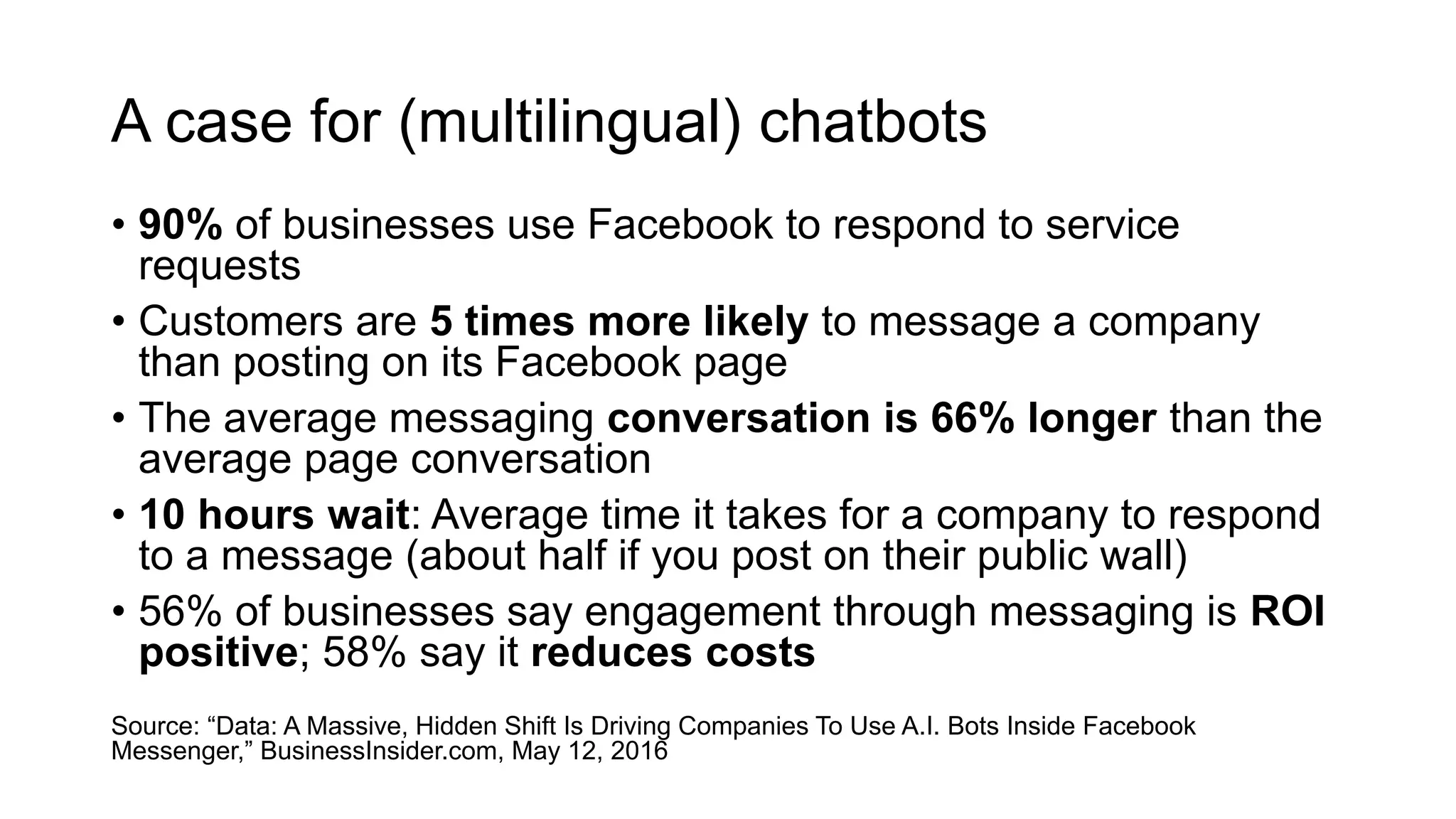
A case for (multilingual) chatbots
• 90% of businesses use Facebook to respond to service
requests
• Customers are 5 times more likely to message a company
than posting on its Facebook page
• The average messaging conversation is 66% longer than the
average page conversation
• 10 hours wait: Average time it takes for a company to respond
to a message (about half if you post on their public wall)
• 56% of businesses say engagement through messaging is ROI
positive; 58% say it reduces costs
Source: “Data: A Massive, Hidden Shift Is Driving Companies To Use A.I. Bots Inside Facebook
Messenger,” BusinessInsider.com, May 12, 2016
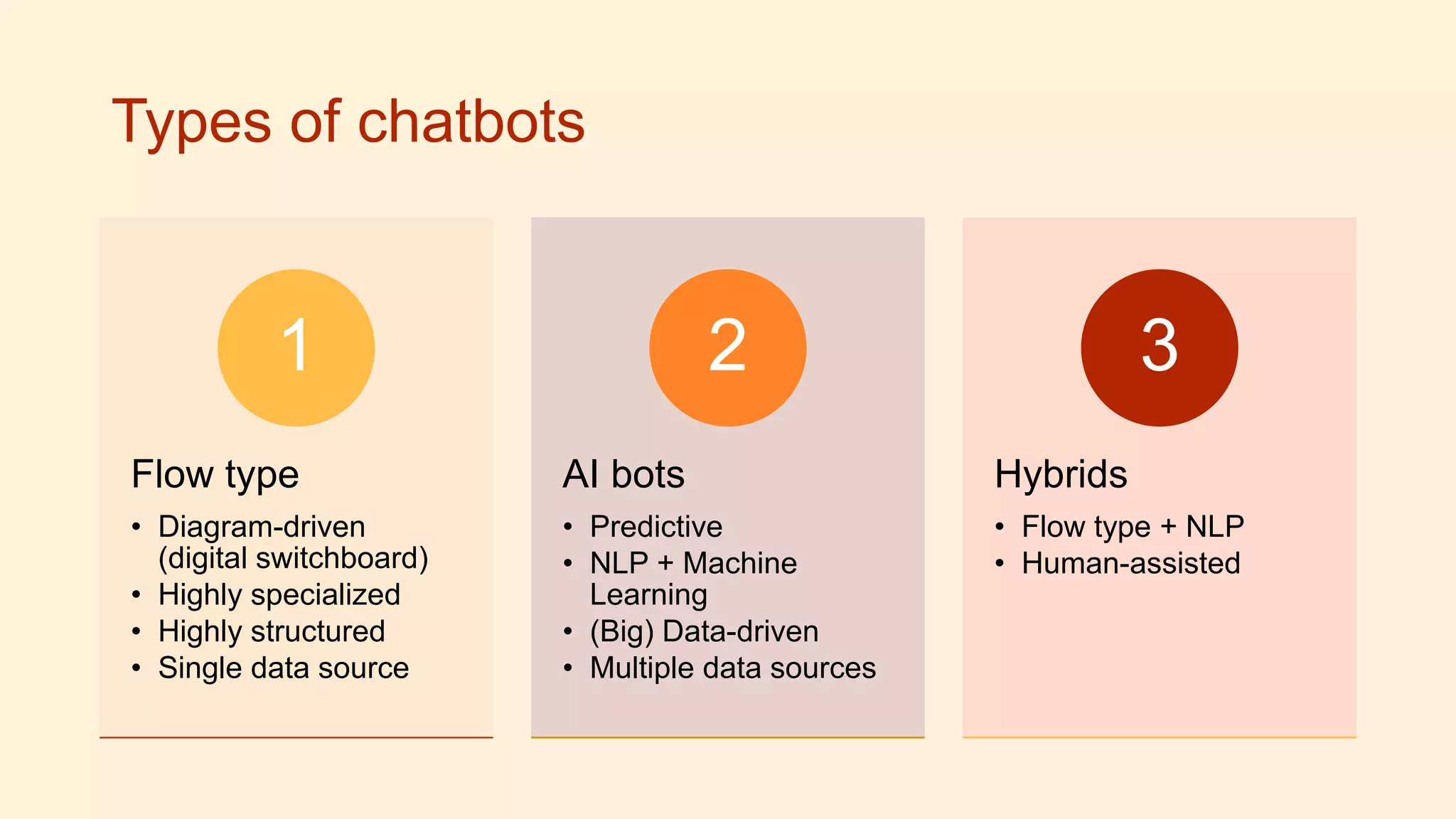
Types of chatbots
Flow type
• Diagram-driven
(digital switchboard)
• Highly specialized
• Highly structured
• Single data source
1
AI bots
• Predictive
• NLP + Machine
Learning
• (Big) Data-driven
• Multiple data sources
2
Hybrids
• Flow type + NLP
• Human-assisted
3
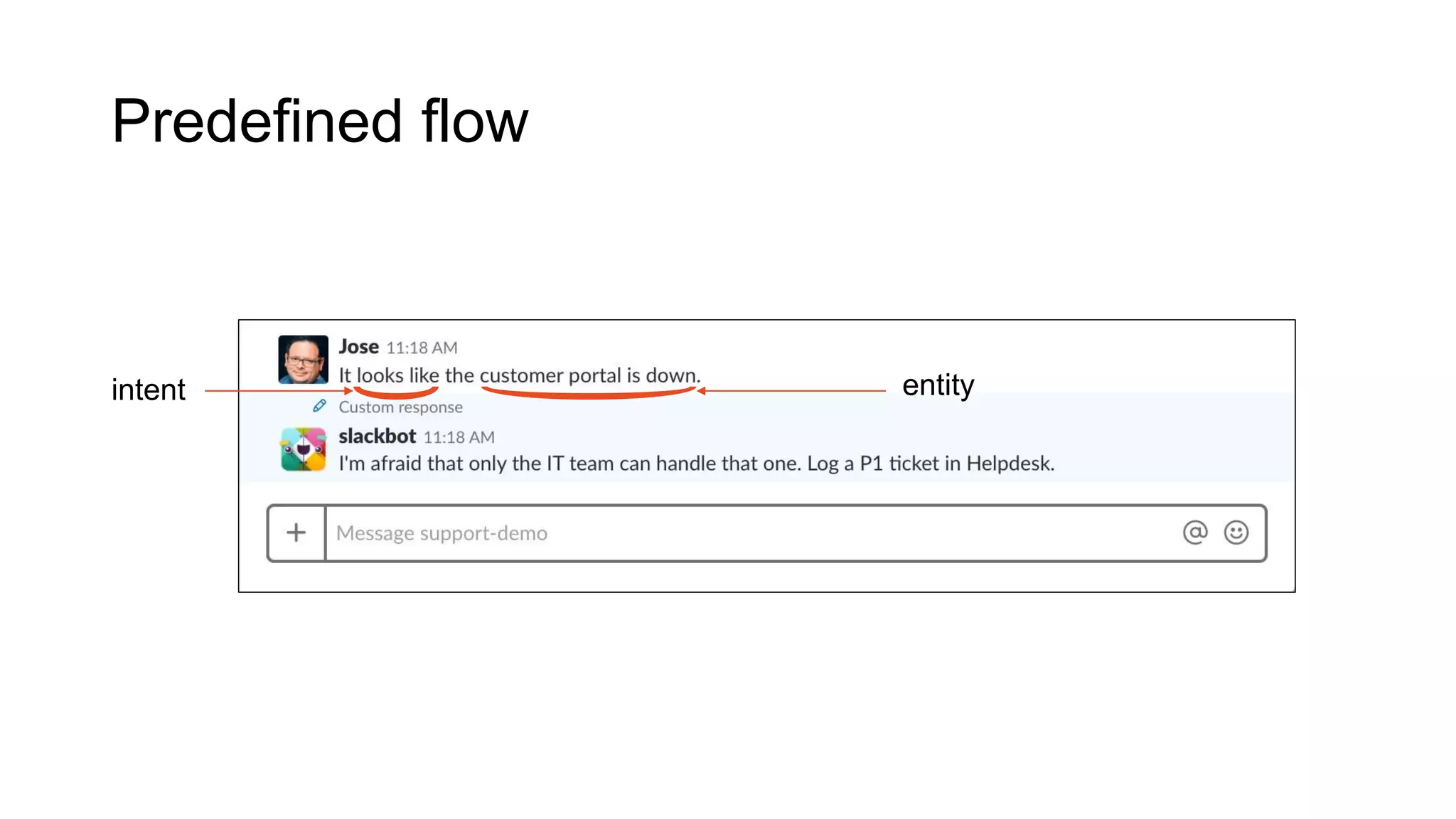
Predefined flow
intent entity
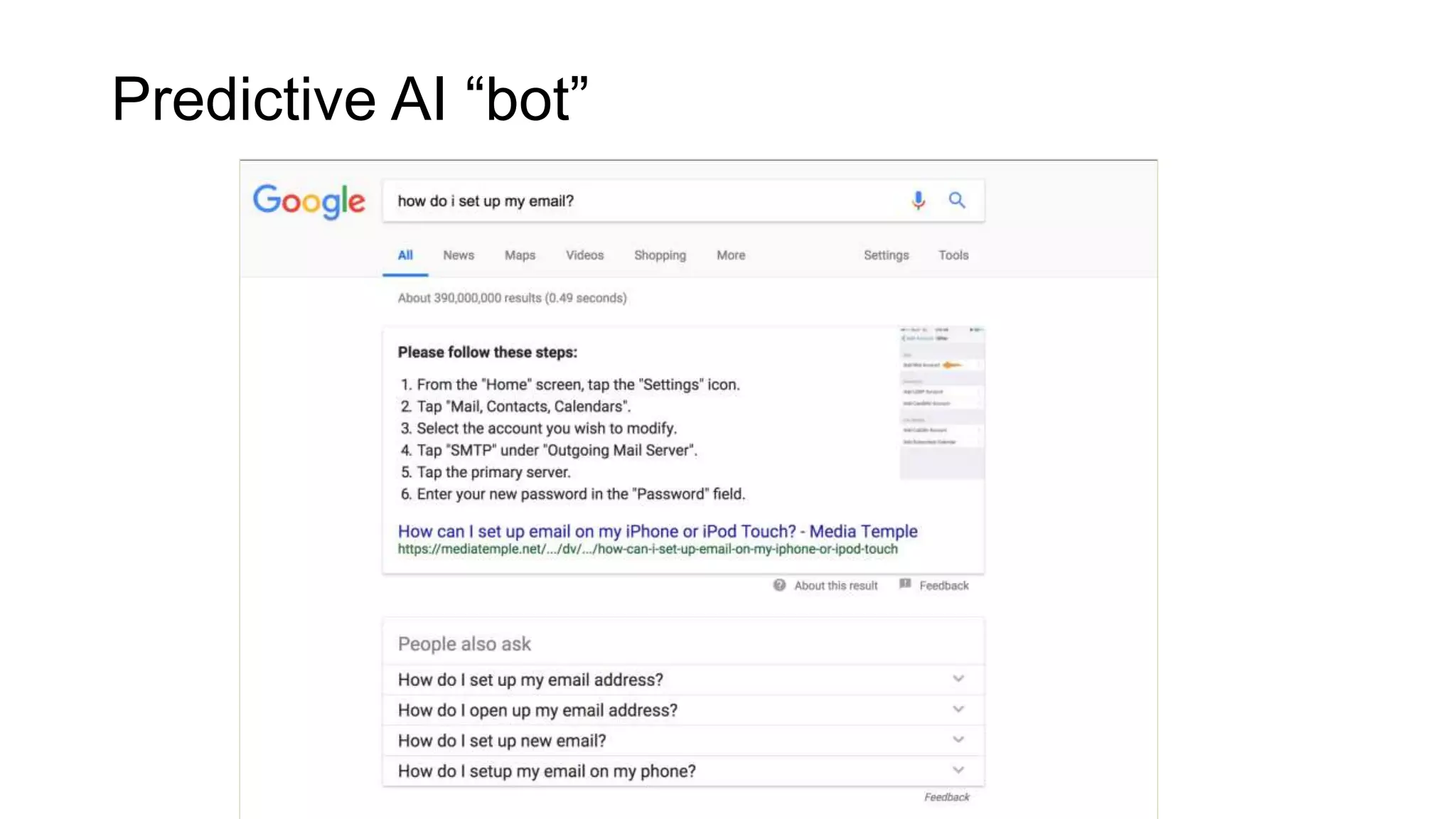
Predictive AI “bot”
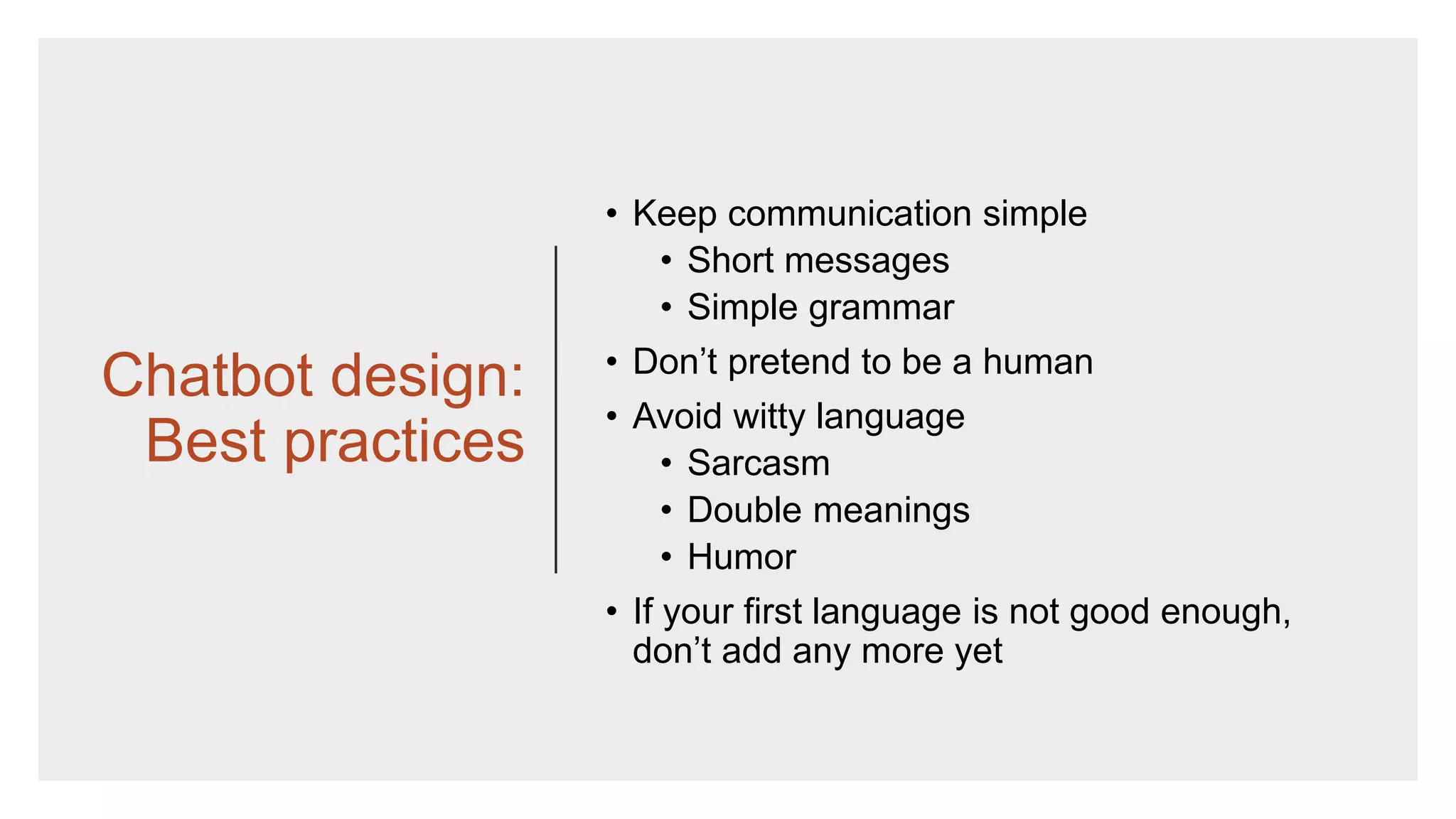
Chatbot design:
Best practices
• Keep communication simple
• Short messages
• Simple grammar
• Don’t pretend to be a human
• Avoid witty language
• Sarcasm
• Double meanings
• Humor
• If your first language is not good enough,
don’t add any more yet
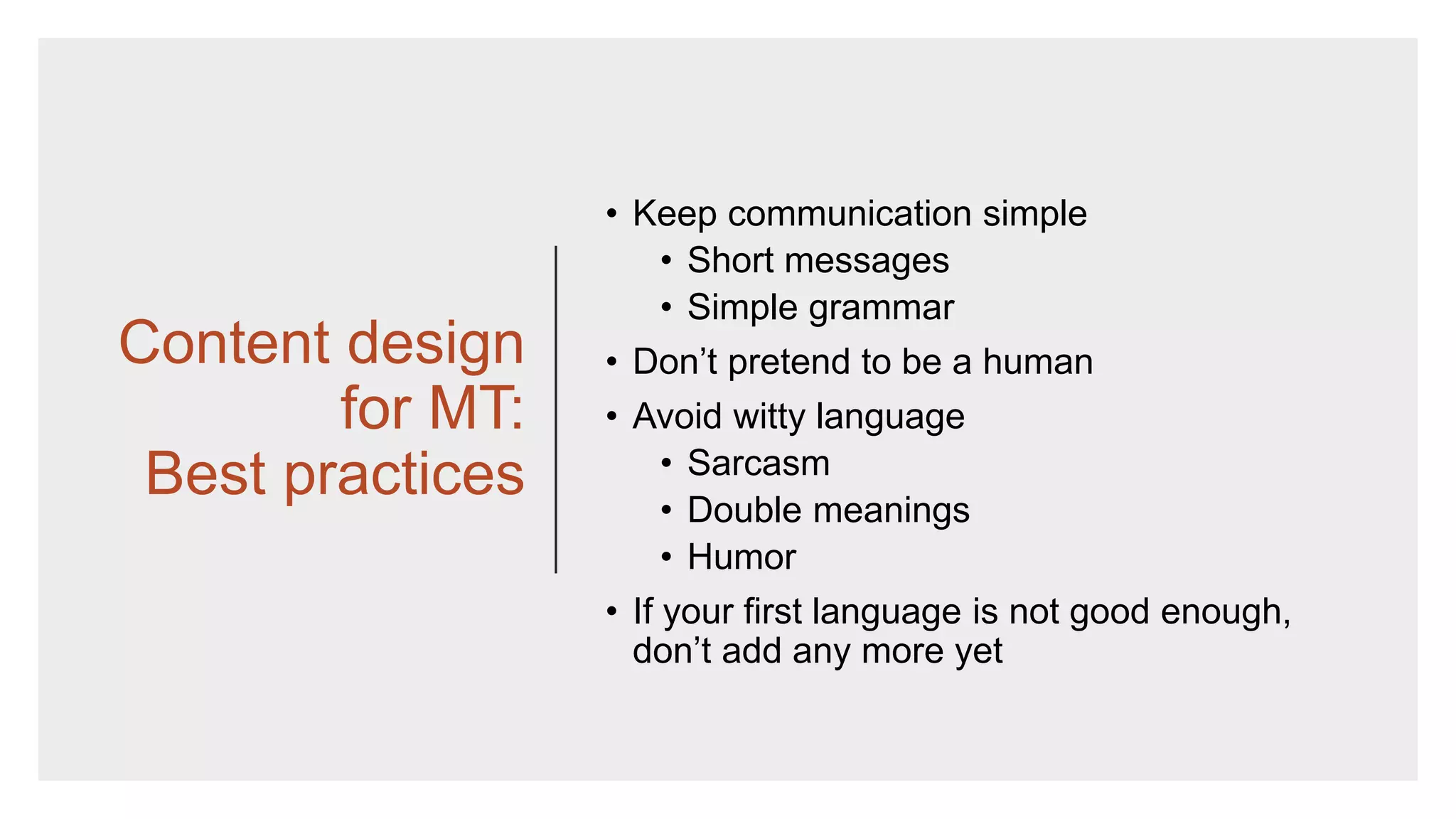
Content design
for MT:
Best practices
• Keep communication simple
• Short messages
• Simple grammar
• Don’t pretend to be a human
• Avoid witty language
• Sarcasm
• Double meanings
• Humor
• If your first language is not good enough,
don’t add any more yet
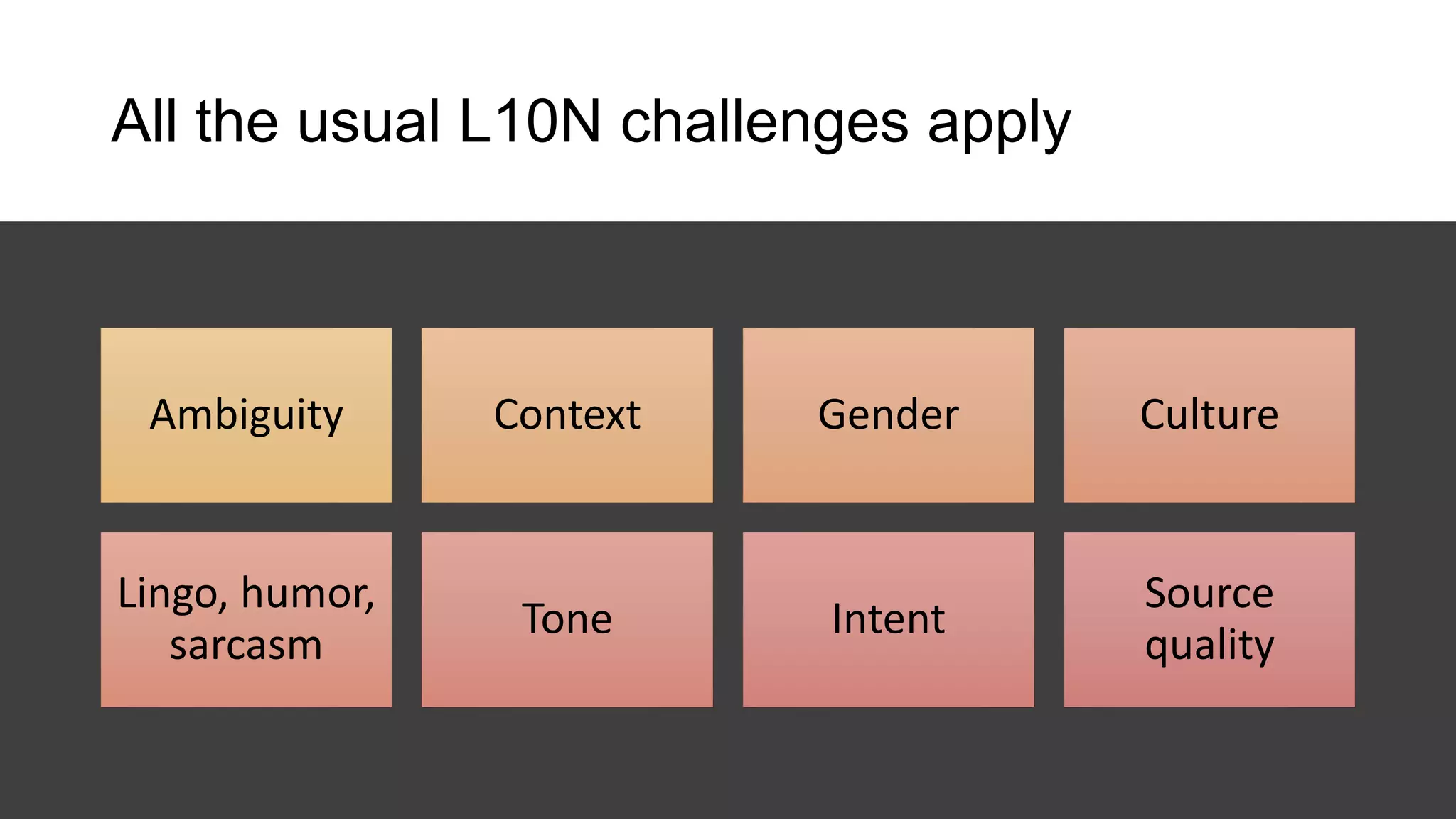
All the usual L10N challenges apply
Ambiguity Context Gender Culture
Lingo, humor,
sarcasm
Tone Intent
Source
quality
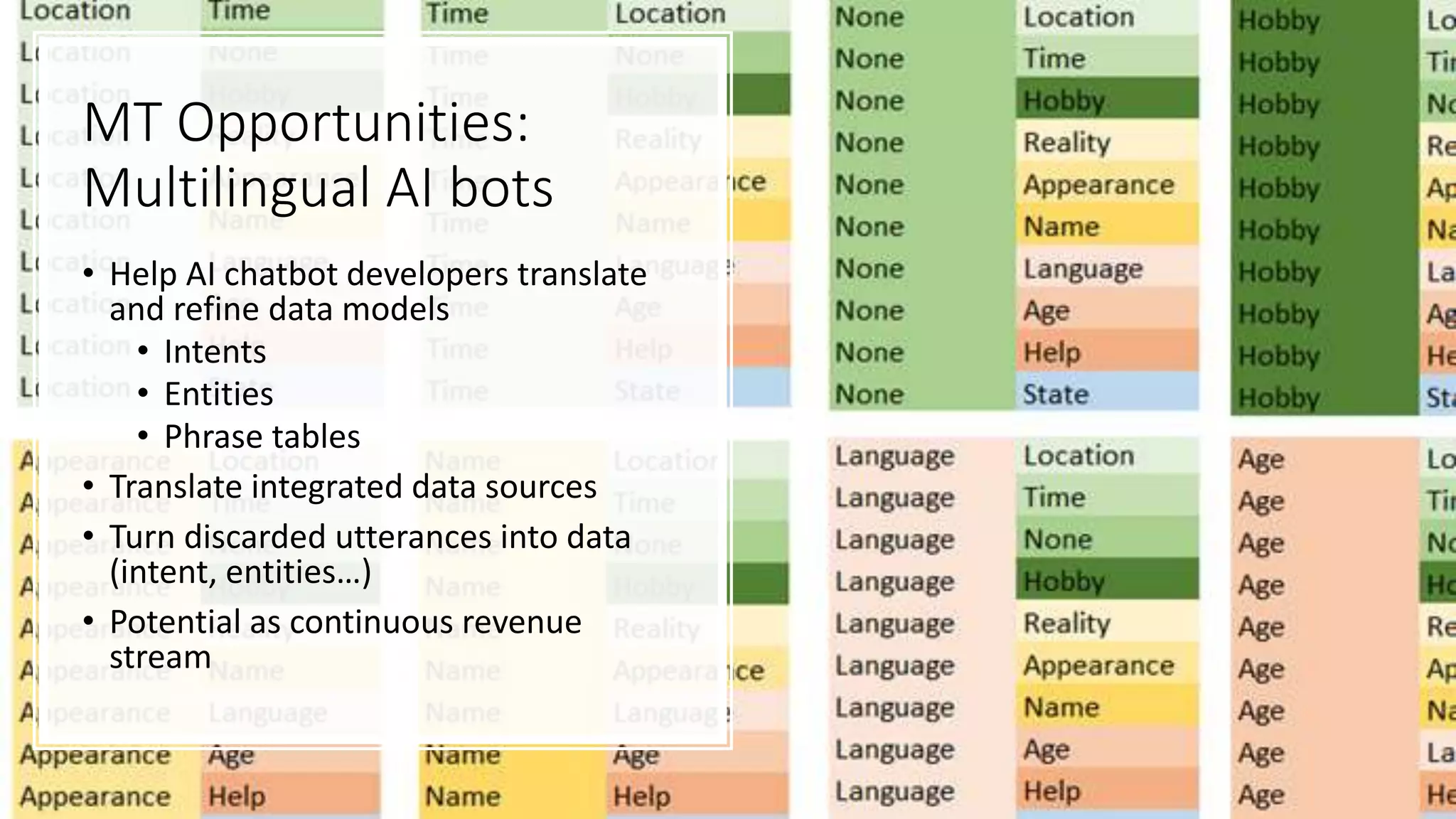
MT Opportunities:
Multilingual AI bots
• Help AI chatbot developers translate
and refine data models
• Intents
• Entities
• Phrase tables
• Translate integrated data sources
• Turn discarded utterances into data
(intent, entities…)
• Potential as continuous revenue
stream
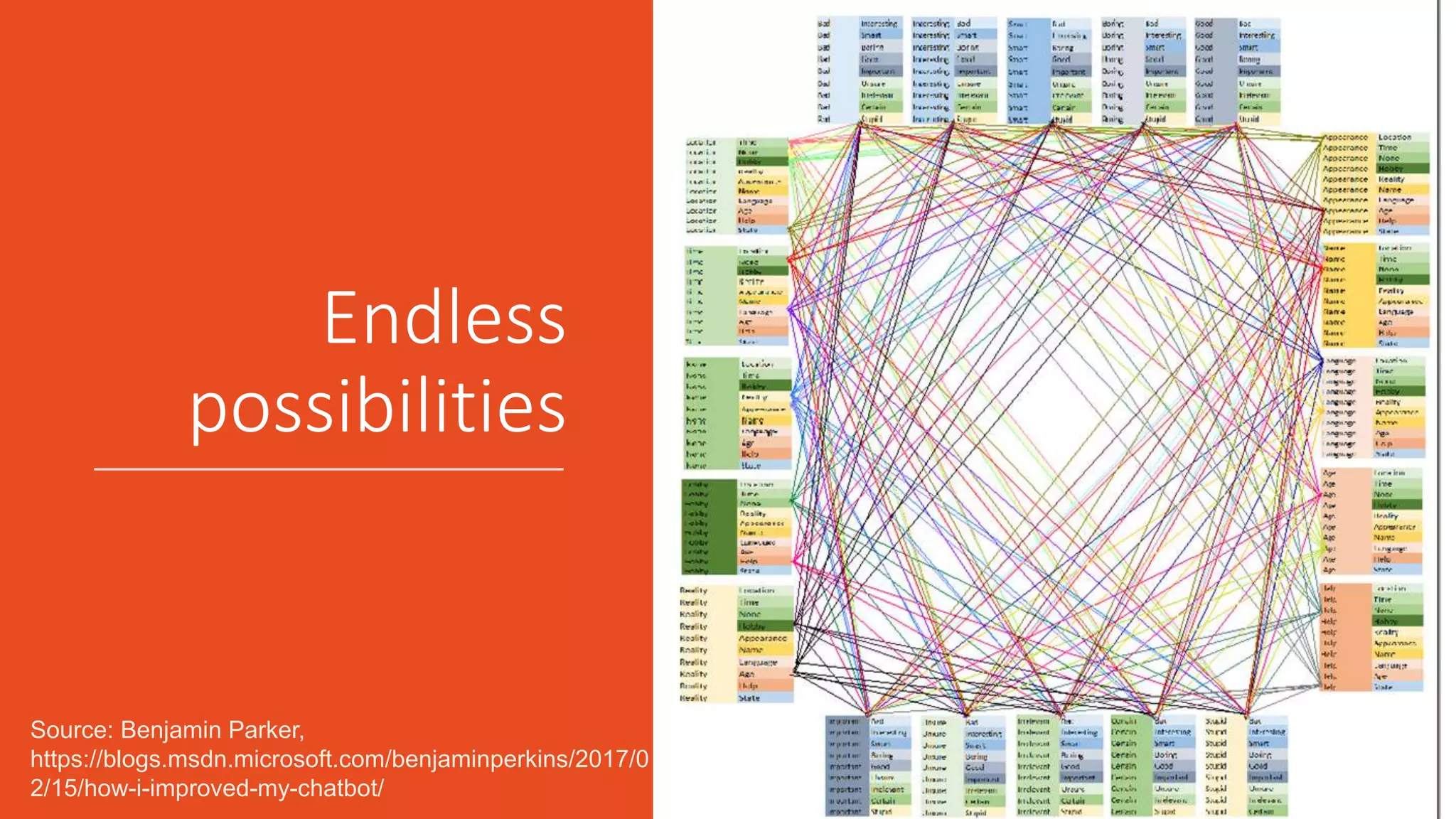
Endless
possibilities
Source: Benjamin Parker,
https://blogs.msdn.microsoft.com/benjaminperkins/2017/0
2/15/how-i-improved-my-chatbot/
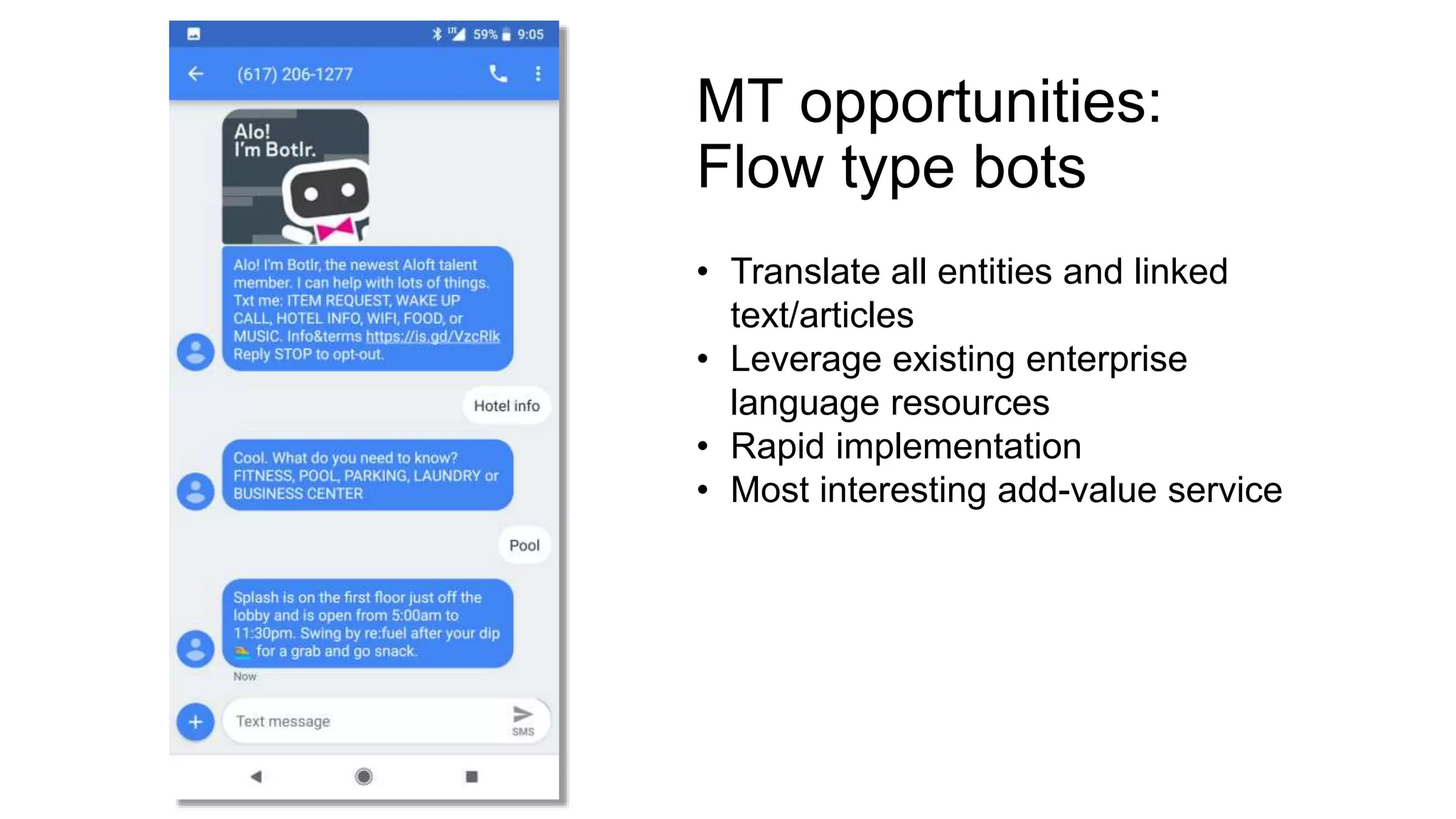
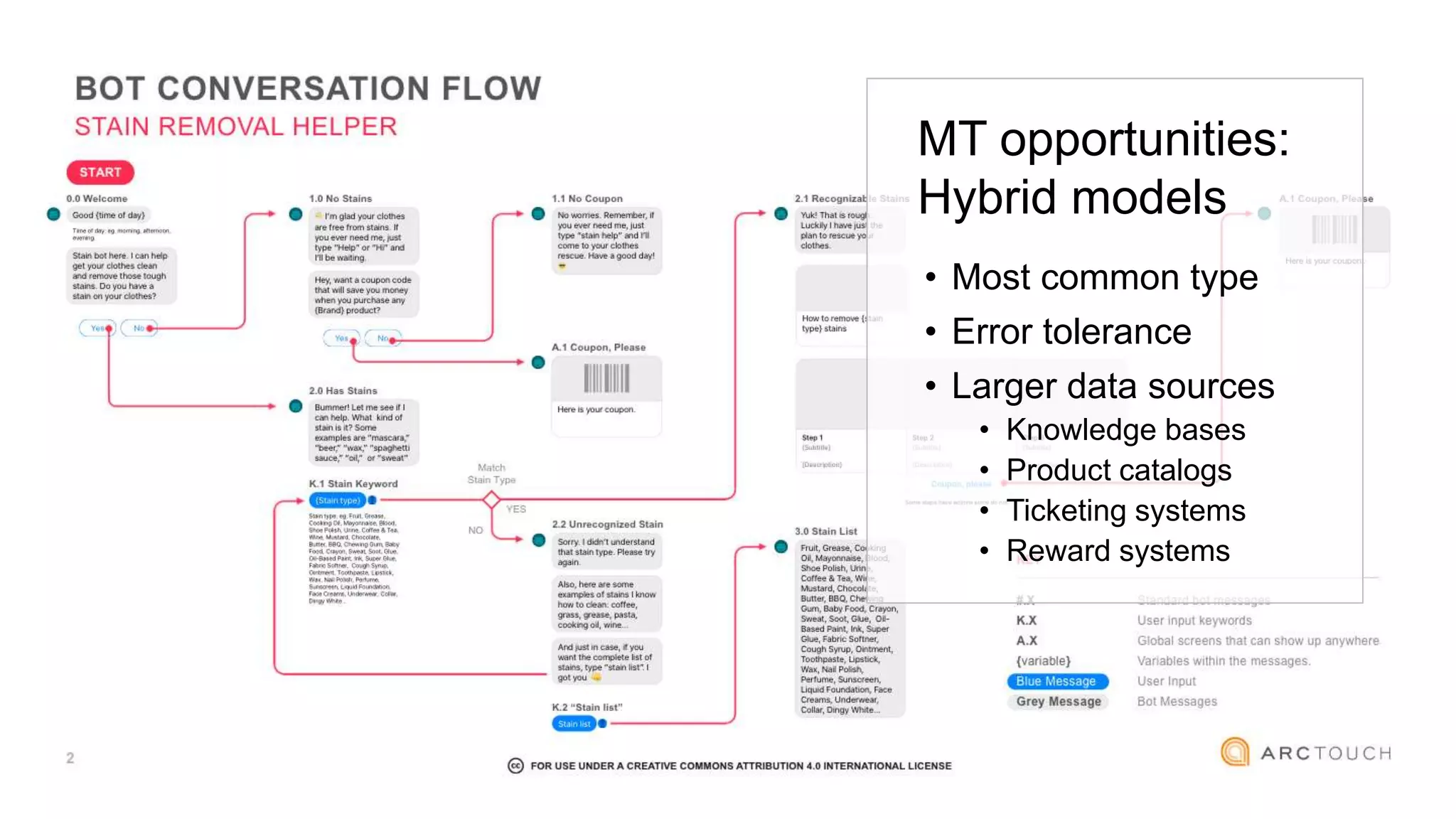
MT opportunities:
Flow type bots
• Translate all entities and linked
text/articles
• Leverage existing enterprise
language resources
• Rapid implementation
• Most interesting add-value service
MT opportunities:
Hybrid models
• Most common type
• Error tolerance
• Larger data sources
• Knowledge bases
• Product catalogs
• Ticketing systems
• Reward systems
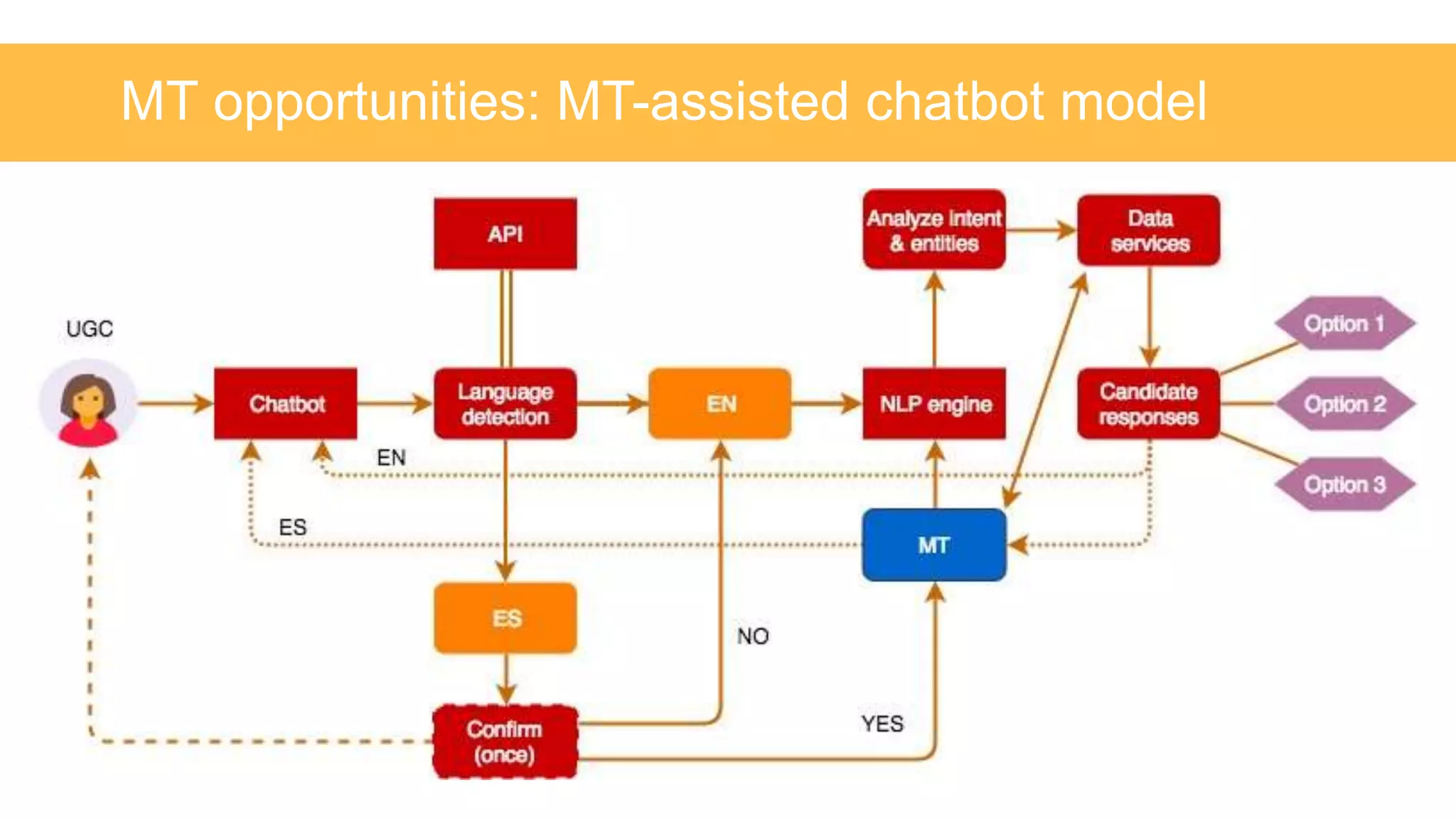
MT opportunities: MT-assisted chatbot model
EN ES
Thank you!
Jose Palomares
CTO, Venga
jose.palomares@vengaglobal.com
linkedin.com/in/josepalomares/
@localizing

‘You talking to me?’ — Bringing MT to the world of chatbots

  • 1.
    You talking to me? BringingMT to the world of chatbots Jose Palomares, CTO AMTA 2018
  • 2.
    What is a chatbot Achatbot is a computer program designed to interact with users through a messaging (chat) service in a way that is designed to seem like a conversation. It provides a friendlier, more responsive way to interact with people by letting them communicate more naturally and without delays. In some cases, in addition to answering the chatbot’s questions, users can also ask the chatbot simple questions. NLP and AI are usually employed to achieve a genuine conversational UX. The application can be leveraged to both provide and gather data from users.
  • 3.
  • 4.
    Chatbots’ reason to be UserExperience • Convenient access to relevant data in any situation • Messaging apps: Over 4 billion users • Alleviate frustration caused by traditional means and agents • Always on, no wait time (and easier to hang up on them!) Strategic Advantage • Reduced manual labor • Scalability and long-term savings • Avid data collection
  • 5.
    A case for(multilingual) chatbots • 90% of businesses use Facebook to respond to service requests • Customers are 5 times more likely to message a company than posting on its Facebook page • The average messaging conversation is 66% longer than the average page conversation • 10 hours wait: Average time it takes for a company to respond to a message (about half if you post on their public wall) • 56% of businesses say engagement through messaging is ROI positive; 58% say it reduces costs Source: “Data: A Massive, Hidden Shift Is Driving Companies To Use A.I. Bots Inside Facebook Messenger,” BusinessInsider.com, May 12, 2016
  • 8.
    Types of chatbots Flowtype • Diagram-driven (digital switchboard) • Highly specialized • Highly structured • Single data source 1 AI bots • Predictive • NLP + Machine Learning • (Big) Data-driven • Multiple data sources 2 Hybrids • Flow type + NLP • Human-assisted 3
  • 9.
  • 10.
  • 11.
    Chatbot design: Best practices •Keep communication simple • Short messages • Simple grammar • Don’t pretend to be a human • Avoid witty language • Sarcasm • Double meanings • Humor • If your first language is not good enough, don’t add any more yet
  • 12.
    Content design for MT: Bestpractices • Keep communication simple • Short messages • Simple grammar • Don’t pretend to be a human • Avoid witty language • Sarcasm • Double meanings • Humor • If your first language is not good enough, don’t add any more yet
  • 13.
    All the usualL10N challenges apply Ambiguity Context Gender Culture Lingo, humor, sarcasm Tone Intent Source quality
  • 14.
    MT Opportunities: Multilingual AIbots • Help AI chatbot developers translate and refine data models • Intents • Entities • Phrase tables • Translate integrated data sources • Turn discarded utterances into data (intent, entities…) • Potential as continuous revenue stream
  • 15.
  • 16.
    MT opportunities: Flow typebots • Translate all entities and linked text/articles • Leverage existing enterprise language resources • Rapid implementation • Most interesting add-value service
  • 17.
    MT opportunities: Hybrid models •Most common type • Error tolerance • Larger data sources • Knowledge bases • Product catalogs • Ticketing systems • Reward systems
  • 18.
  • 19.
  • 20.
    Thank you! Jose Palomares CTO,Venga jose.palomares@vengaglobal.com linkedin.com/in/josepalomares/ @localizing