Prepared By:
Rajneesh Sharma
PGT, Physical Education
Unit-3
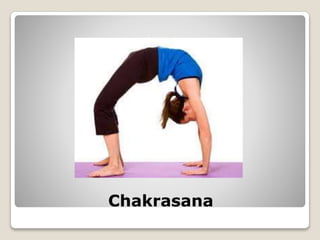
Chakrasana
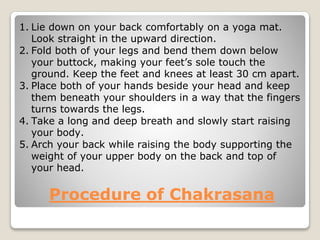
Procedure of Chakrasana
1. Lie down on your back comfortably on a yoga mat.
Look straight in the upward direction.
2. Fold both of your legs and bend them down below
your buttock, making your feet’s sole touch the
ground. Keep the feet and knees at least 30 cm apart.
3. Place both of your hands beside your head and keep
them beneath your shoulders in a way that the fingers
turns towards the legs.
4. Take a long and deep breath and slowly start raising
your body.
5. Arch your back while raising the body supporting the
weight of your upper body on the back and top of
your head.
Procedure of Chakrasana
6. Lift your head and trunk from the ground and
straighten your hands and legs as much as
possible.
7. Arch the back as high as possible but do not
strain.
8. The neck should be relaxed.
9. Lift the heels and balance on foot fingers and
hands for some seconds and slowly lower the
heels.
10. Stay in this posture while breathing normally for
as long as you feel comfortable and return to the
floor slowly while exhaling.
11. Slowly lower the body to the floor.
Precautions for Chakrasana
1. Do not practice Chakrasana directly.
2. You should practice easy postures such as
setu asana and other backward back
bending asanas as preparatory asanas
before practicing Chakrasana.
3. It should not be practiced by people
suffering from any illness.
4. Chakrasana is not suitable for weak people
having some weakness in wrist or back.
5. Women should avoid practicing Chakrasana
during pregnancy.
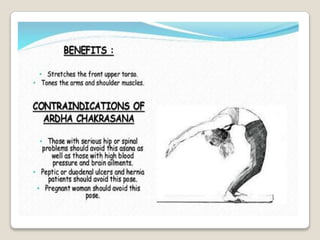
Chakrasana (Wheel Pose) Benefits
1. Increases the flexibility of the body.
2. Strengthens the bones and muscles of the body and is
mainly beneficial in strengthening the legs.
3. strengthens the respiratory system as by doing it, the
chest enhances and the lungs get oxygen to its
fullest.
4. Relives all the stress and tension as it strengthens the
nervous system and refreshes the brain.
5. Helpful in reducing the fat of the abdomen and to get
rid of the bloated belly.
6. Beneficial for the digestive system, gastric problems
and for all the disorders of the female reproductive
system.
7. Ensures better functioning of the heart, liver, spleen,
and kidneys. Helpful in curing hernia.
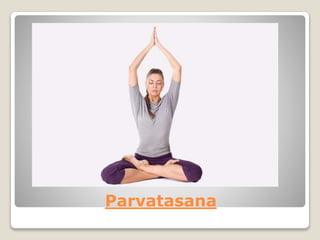
Parvatasana
Parvatasana (Procedure)
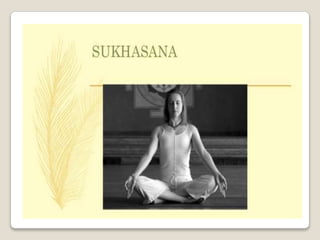
1.Sit in Padmasana / Sukhasana, keeping the
hands on their respective sides.
2.Chest thrown well forward, keep the neck
straight, the abdomen in normal contour, the
chin drawn in and eyes focused on a single point
straight ahead.
3.Inhaling, in 3 seconds, raise both the arms
together, from their respective sides, for an
upward stretch.
4.Join the palms to each other in this upward
stretched position of arms. Either interlace the
fingers or keep the palms joined.
Parvatasana (Procedure)
5. Keep the hands close to the respective
ears, abdomen maintained in normal
contour and back straight.
6. Avoid bending the arms at the elbows
and wrists, keeping them stretched and
straight.
7. Gaze fixed at a single point ahead.
8. Maintain this fully stretched position
(palms joined), for 6 seconds, retaining
the breath (final position).
Contraindications of
Parvatasana
1. People suffering from spinal injury
and spinal abnormalities.
2. Frozen shoulder and arthritis.
3. Hypertension and serious cardiac
complaints (especially Variation-3)
Benefits of Parvatasana
1.Corrects minor postural defects of the
spine and straightens the muscles of the
back.
2.Stretches all the abdominal and pelvic
muscles and loosens the hips.
3.Exercises the inactive waist zone, and
helps reduce fatty and flabby abdomen.
4.The unnatural curvature of the spine and
minor displacements of the vertebrae are
corrected.
Benefits of Parvatasana
5. Internal organs in the abdominal region get
proper massage–improved blood circulation;
viscera normally rest on the pelvic floor.
6. Prolapse (slipping down) of the uterus is
improved by providing natural support to the
viscera.
7. Blood circulation in the vertebral region
improves, and the efficiency of the nerves
coming out of the vertebra is improved.
8. The unnatural curvature of the spine and
minor displacements of the vertebrae are
corrected.
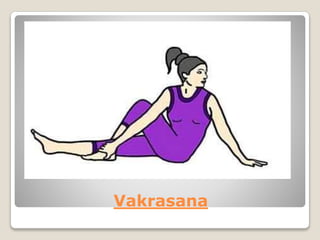
Vakrasana
Contraindications of the Vakrasana
Sore back due to an injury: it may not be a good idea
to practice this yoga pose if there is a back injury.
Sciatica: pressure on sciatic nerves can cause more
injury with this yoga pose as the pressure is on the
nerves while the body is twisted.
Pregnancy: pregnant women should avoid this yoga
pose as it will bring discomfort to the abdomen and
hence this pose is not good for the uterus.
Menstruation: not to be practiced by women during
menstruation. During this time the uterus is weak and
active and hence any pressure can cause discomfort.
Spondylitis: turning of the entire neck may make the
muscles around the neck sore for someone suffering
from weak neck muscles or upper spine.
Benefits of the Vakrasana
1. Vakrasana tones all the organs in the abdomen.
2. It improves digestion and removes constipation.
3. It is also good for the liver.
4. It improves the function of the pancreas and is good
for diabetes.
5. It gives a good twist to the spine and make the spine
flexible. Those who cannot practice Ardha
Matsyendrasana should practice Vakrasana, which is
an easier twisting pose.
6. Vakrasana helps to remove the fat around the waist.
7. It improves the functioning of the adrenal glands.
8. Vakrasana helps to remove chronic back and shoulder
pain.
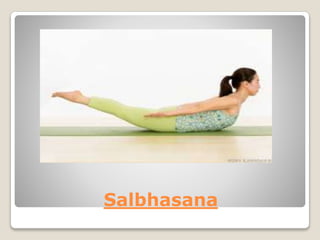
Salbhasana
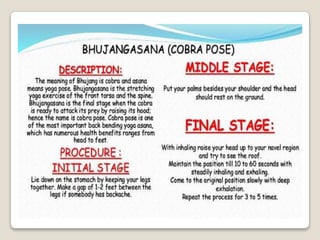
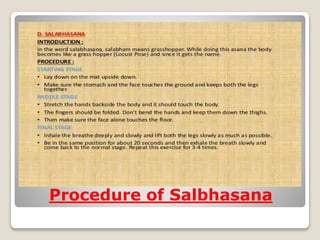
Procedure of Salbhasana
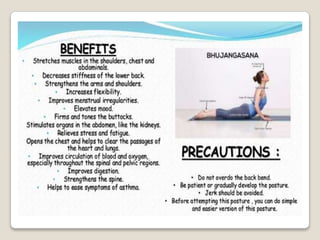
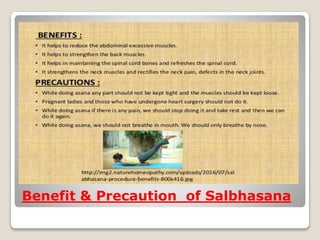
Benefit & Precaution of Salbhasana
Yoga and lifestyle class 12th presentation

Yoga and lifestyle class 12th presentation

  • 1.
    Prepared By: Rajneesh Sharma PGT,Physical Education Unit-3
  • 28.
  • 29.
    Procedure of Chakrasana 1.Lie down on your back comfortably on a yoga mat. Look straight in the upward direction. 2. Fold both of your legs and bend them down below your buttock, making your feet’s sole touch the ground. Keep the feet and knees at least 30 cm apart. 3. Place both of your hands beside your head and keep them beneath your shoulders in a way that the fingers turns towards the legs. 4. Take a long and deep breath and slowly start raising your body. 5. Arch your back while raising the body supporting the weight of your upper body on the back and top of your head.
  • 30.
    Procedure of Chakrasana 6.Lift your head and trunk from the ground and straighten your hands and legs as much as possible. 7. Arch the back as high as possible but do not strain. 8. The neck should be relaxed. 9. Lift the heels and balance on foot fingers and hands for some seconds and slowly lower the heels. 10. Stay in this posture while breathing normally for as long as you feel comfortable and return to the floor slowly while exhaling. 11. Slowly lower the body to the floor.
  • 31.
    Precautions for Chakrasana 1.Do not practice Chakrasana directly. 2. You should practice easy postures such as setu asana and other backward back bending asanas as preparatory asanas before practicing Chakrasana. 3. It should not be practiced by people suffering from any illness. 4. Chakrasana is not suitable for weak people having some weakness in wrist or back. 5. Women should avoid practicing Chakrasana during pregnancy.
  • 32.
    Chakrasana (Wheel Pose)Benefits 1. Increases the flexibility of the body. 2. Strengthens the bones and muscles of the body and is mainly beneficial in strengthening the legs. 3. strengthens the respiratory system as by doing it, the chest enhances and the lungs get oxygen to its fullest. 4. Relives all the stress and tension as it strengthens the nervous system and refreshes the brain. 5. Helpful in reducing the fat of the abdomen and to get rid of the bloated belly. 6. Beneficial for the digestive system, gastric problems and for all the disorders of the female reproductive system. 7. Ensures better functioning of the heart, liver, spleen, and kidneys. Helpful in curing hernia.
  • 36.
  • 37.
    Parvatasana (Procedure) 1.Sit inPadmasana / Sukhasana, keeping the hands on their respective sides. 2.Chest thrown well forward, keep the neck straight, the abdomen in normal contour, the chin drawn in and eyes focused on a single point straight ahead. 3.Inhaling, in 3 seconds, raise both the arms together, from their respective sides, for an upward stretch. 4.Join the palms to each other in this upward stretched position of arms. Either interlace the fingers or keep the palms joined.
  • 38.
    Parvatasana (Procedure) 5. Keepthe hands close to the respective ears, abdomen maintained in normal contour and back straight. 6. Avoid bending the arms at the elbows and wrists, keeping them stretched and straight. 7. Gaze fixed at a single point ahead. 8. Maintain this fully stretched position (palms joined), for 6 seconds, retaining the breath (final position).
  • 39.
    Contraindications of Parvatasana 1. Peoplesuffering from spinal injury and spinal abnormalities. 2. Frozen shoulder and arthritis. 3. Hypertension and serious cardiac complaints (especially Variation-3)
  • 40.
    Benefits of Parvatasana 1.Correctsminor postural defects of the spine and straightens the muscles of the back. 2.Stretches all the abdominal and pelvic muscles and loosens the hips. 3.Exercises the inactive waist zone, and helps reduce fatty and flabby abdomen. 4.The unnatural curvature of the spine and minor displacements of the vertebrae are corrected.
  • 41.
    Benefits of Parvatasana 5.Internal organs in the abdominal region get proper massage–improved blood circulation; viscera normally rest on the pelvic floor. 6. Prolapse (slipping down) of the uterus is improved by providing natural support to the viscera. 7. Blood circulation in the vertebral region improves, and the efficiency of the nerves coming out of the vertebra is improved. 8. The unnatural curvature of the spine and minor displacements of the vertebrae are corrected.
  • 59.
  • 60.
    Contraindications of theVakrasana Sore back due to an injury: it may not be a good idea to practice this yoga pose if there is a back injury. Sciatica: pressure on sciatic nerves can cause more injury with this yoga pose as the pressure is on the nerves while the body is twisted. Pregnancy: pregnant women should avoid this yoga pose as it will bring discomfort to the abdomen and hence this pose is not good for the uterus. Menstruation: not to be practiced by women during menstruation. During this time the uterus is weak and active and hence any pressure can cause discomfort. Spondylitis: turning of the entire neck may make the muscles around the neck sore for someone suffering from weak neck muscles or upper spine.
  • 61.
    Benefits of theVakrasana 1. Vakrasana tones all the organs in the abdomen. 2. It improves digestion and removes constipation. 3. It is also good for the liver. 4. It improves the function of the pancreas and is good for diabetes. 5. It gives a good twist to the spine and make the spine flexible. Those who cannot practice Ardha Matsyendrasana should practice Vakrasana, which is an easier twisting pose. 6. Vakrasana helps to remove the fat around the waist. 7. It improves the functioning of the adrenal glands. 8. Vakrasana helps to remove chronic back and shoulder pain.
  • 62.
  • 63.
  • 64.
    Benefit & Precautionof Salbhasana