yin and yang 
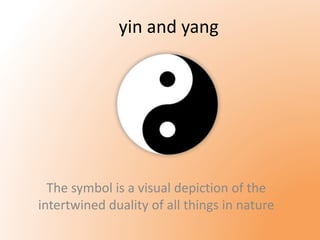
The symbol is a visual depiction of the 
intertwined duality of all things in nature
• Yin and Yang are dependent opposing forces that 
flow in a natural cycle, always seeking balance. 
Though they are opposing, they are not in 
opposition to one another. As part of the Tao, 
they are merely two aspects of a single reality. 
Each contains the seed of the other, which is why 
we see a black spot of Yin in the white Yang and 
vice versa. They do not merely replace each other 
but actually become each other through the 
constant flow of the universe.
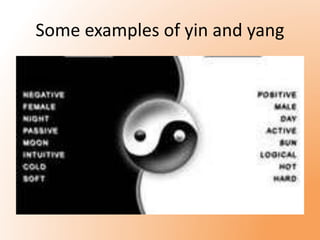
Some examples of yin and yang
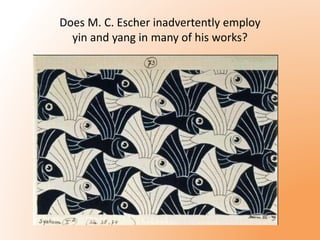
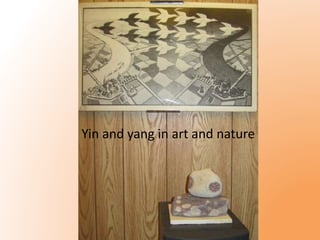
Does M. C. Escher inadvertently employ 
yin and yang in many of his works?
Yin and yang in art and nature
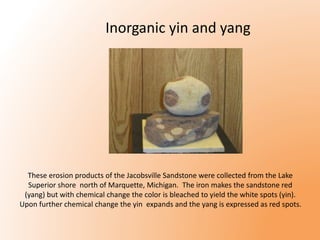
Inorganic yin and yang 
These erosion products of the Jacobsville Sandstone were collected from the Lake 
Superior shore north of Marquette, Michigan. The iron makes the sandstone red 
(yang) but with chemical change the color is bleached to yield the white spots (yin). 
Upon further chemical change the yin expands and the yang is expressed as red spots.
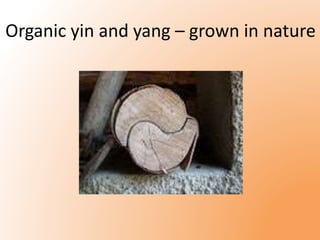
Organic yin and yang – grown in nature
Qigong 
Literally "Life Energy Cultivation") is a practice of aligning breath, 
movement, and awareness for exercise, healing, and meditation. 
With roots in Chinese medicine, martial arts, and philosophy, 
qigong is traditionally viewed as a practice to cultivate and balance 
qi (chi) or what has been translated as "intrinsic life energy”. 
Typically a qigong practice involves rhythmic breathing 
coordinated with slow stylized repetition of fluid movement, a 
calm mindful state, and visualization of guiding qi through the 
body. Qigong is now practiced throughout China and worldwide, 
and is considered by some to be exercise, and by others to be a 
type of alternative medicine or meditative practice. From a 
philosophical perspective qigong is believed to help develop 
human potential, allow access to higher realms of awareness, and 
awaken one's "true nature”.
QiGong (pronounced "chee gong" and alternatively 
spelled as "qigong," "qi gong," or "chi kung") is 
sometimes called “the new yoga” - but the practice 
dates back thousands of years to ancient China. The 
word “qi” (or “chi”) means “life force” or "vital energy 
of the body," and “gong” means accomplishment or 
skill that is cultivated through steady practice. Qi 
Gong is specifically designed to cultivate the body's 
vital energy, using it to heal and strengthen every 
system throughout the body. Thus, qi gong means 
“cultivating energy,” and it involves working with 
energy to strengthen and cleanse the body.
Confucianism 
Qigong provides a means to become a Junzi (君子) through awareness of 
morality. 
Taoism 
Qigong provides a way to achieve longevity and spiritual enlightenment. 
Buddhism 
Qigong is part of a spiritual path that leads to spiritual enlightenment or 
Buddhahood.
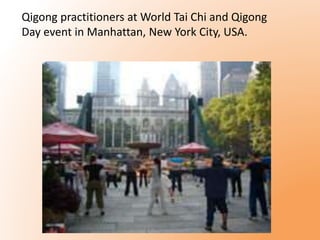
Qigong practitioners at World Tai Chi and Qigong 
Day event in Manhattan, New York City, USA.
Today, millions of people around the world 
practice qigong and believe in the benefits 
of qigong to varying degrees. Similar to its 
historical origin, those interested in qigong 
come from diverse backgrounds and 
practice it for different reasons, including 
for exercise, recreation, preventive 
medicine, self-healing, self-cultivation, 
meditation, and martial arts training.
The concepts of Yin and Yang and the Five 
Agents provided the intellectual framework of 
much of Chinese scientific thinking especially in 
fields like biology and medicine The organs of 
the body were seen to be interrelated in the 
same sorts of ways as other natural phenomena, 
and best understood by looking for correlations 
and correspondences. Illness was seen as a 
disturbance in the balance of Yin and Yang or 
the Five Agents caused by emotions, heat or 
cold, or other influences. Therapy thus 
depended on accurate diagnosis of the source of 
the imbalance.
The Five Agents are categories 
referring to the fundamental 
ingredients of the universe. They 
are named after wood, fire, earth, 
metal and water, but do not simply 
refer to these five concrete 
substances. Rather, they represent a 
basic framework or mental model 
by which all phenomena can be 
classified into five types. The Five 
Agents are the basic ingredients of 
the universe.

Yin and yang

  • 1.
    yin and yang The symbol is a visual depiction of the intertwined duality of all things in nature
  • 2.
    • Yin andYang are dependent opposing forces that flow in a natural cycle, always seeking balance. Though they are opposing, they are not in opposition to one another. As part of the Tao, they are merely two aspects of a single reality. Each contains the seed of the other, which is why we see a black spot of Yin in the white Yang and vice versa. They do not merely replace each other but actually become each other through the constant flow of the universe.
  • 3.
    Some examples ofyin and yang
  • 4.
    Does M. C.Escher inadvertently employ yin and yang in many of his works?
  • 5.
    Yin and yangin art and nature
  • 6.
    Inorganic yin andyang These erosion products of the Jacobsville Sandstone were collected from the Lake Superior shore north of Marquette, Michigan. The iron makes the sandstone red (yang) but with chemical change the color is bleached to yield the white spots (yin). Upon further chemical change the yin expands and the yang is expressed as red spots.
  • 7.
    Organic yin andyang – grown in nature
  • 8.
    Qigong Literally "LifeEnergy Cultivation") is a practice of aligning breath, movement, and awareness for exercise, healing, and meditation. With roots in Chinese medicine, martial arts, and philosophy, qigong is traditionally viewed as a practice to cultivate and balance qi (chi) or what has been translated as "intrinsic life energy”. Typically a qigong practice involves rhythmic breathing coordinated with slow stylized repetition of fluid movement, a calm mindful state, and visualization of guiding qi through the body. Qigong is now practiced throughout China and worldwide, and is considered by some to be exercise, and by others to be a type of alternative medicine or meditative practice. From a philosophical perspective qigong is believed to help develop human potential, allow access to higher realms of awareness, and awaken one's "true nature”.
  • 9.
    QiGong (pronounced "cheegong" and alternatively spelled as "qigong," "qi gong," or "chi kung") is sometimes called “the new yoga” - but the practice dates back thousands of years to ancient China. The word “qi” (or “chi”) means “life force” or "vital energy of the body," and “gong” means accomplishment or skill that is cultivated through steady practice. Qi Gong is specifically designed to cultivate the body's vital energy, using it to heal and strengthen every system throughout the body. Thus, qi gong means “cultivating energy,” and it involves working with energy to strengthen and cleanse the body.
  • 10.
    Confucianism Qigong providesa means to become a Junzi (君子) through awareness of morality. Taoism Qigong provides a way to achieve longevity and spiritual enlightenment. Buddhism Qigong is part of a spiritual path that leads to spiritual enlightenment or Buddhahood.
  • 11.
    Qigong practitioners atWorld Tai Chi and Qigong Day event in Manhattan, New York City, USA.
  • 12.
    Today, millions ofpeople around the world practice qigong and believe in the benefits of qigong to varying degrees. Similar to its historical origin, those interested in qigong come from diverse backgrounds and practice it for different reasons, including for exercise, recreation, preventive medicine, self-healing, self-cultivation, meditation, and martial arts training.
  • 13.
    The concepts ofYin and Yang and the Five Agents provided the intellectual framework of much of Chinese scientific thinking especially in fields like biology and medicine The organs of the body were seen to be interrelated in the same sorts of ways as other natural phenomena, and best understood by looking for correlations and correspondences. Illness was seen as a disturbance in the balance of Yin and Yang or the Five Agents caused by emotions, heat or cold, or other influences. Therapy thus depended on accurate diagnosis of the source of the imbalance.
  • 14.
    The Five Agentsare categories referring to the fundamental ingredients of the universe. They are named after wood, fire, earth, metal and water, but do not simply refer to these five concrete substances. Rather, they represent a basic framework or mental model by which all phenomena can be classified into five types. The Five Agents are the basic ingredients of the universe.