CREATING AN ARCHIVES OF
SERVICE USER RECORDS
PROCESS AND CHALLENGES
Yulu Griffith Klein
Registered Archivist
2016
KEY QUESTIONS
• Who is the archives for?
• What are the legislative, regulatory,
and ethical requirements which need
to be taken into account?
• Will the archives be stored centrally
or at multiple locations?
• How are records being created?
• How far back do case files go?
• What about the historical archives?
1
WHY IS THIS
CRITICAL
• Organizational mission
• Expectations
• Compliance
• Benefits
2
WHAT HAS
RECORDKEEPING GOT
TO DO WITH IT?
• Identify archives
• Timely destruction of records
3
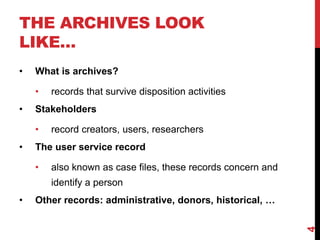
THE ARCHIVES LOOK
LIKE…
• What is archives?
• records that survive disposition activities
• Stakeholders
• record creators, users, researchers
• The user service record
• also known as case files, these records concern and
identify a person
• Other records: administrative, donors, historical, …
4
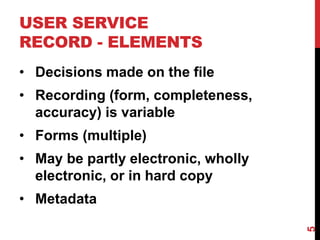
USER SERVICE
RECORD - ELEMENTS
• Decisions made on the file
• Recording (form, completeness,
accuracy) is variable
• Forms (multiple)
• May be partly electronic, wholly
electronic, or in hard copy
• Metadata
5
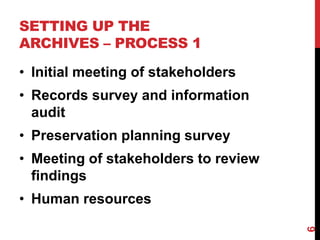
SETTING UP THE
ARCHIVES – PROCESS 1
• Initial meeting of stakeholders
• Records survey and information
audit
• Preservation planning survey
• Meeting of stakeholders to review
findings
• Human resources
6
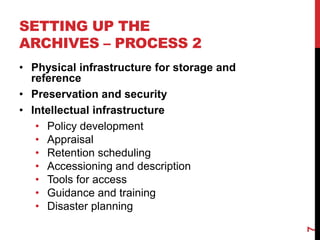
SETTING UP THE
ARCHIVES – PROCESS 2
• Physical infrastructure for storage and
reference
• Preservation and security
• Intellectual infrastructure
• Policy development
• Appraisal
• Retention scheduling
• Accessioning and description
• Tools for access
• Guidance and training
• Disaster planning
7
CHALLENGES
• Change
• Time-scale
• Legal considerations
• Funding to maintain and expand
services
• The digital environment
8
QUESTIONS?
Email us at yulu@griffithklein.com and let's see if we can
help!
9
ABOUT US
10
Experience in providing a service that is
customer driven.
Sensible and appropriate solutions.
Ability to work methodically and creatively.
Emphasis on collaboration, dialogue,
discretion, working across sectors, and
cultural awareness.
www.griffithklein.com

Ygk archives user_service_records

  • 1.
    CREATING AN ARCHIVESOF SERVICE USER RECORDS PROCESS AND CHALLENGES Yulu Griffith Klein Registered Archivist 2016
  • 2.
    KEY QUESTIONS • Whois the archives for? • What are the legislative, regulatory, and ethical requirements which need to be taken into account? • Will the archives be stored centrally or at multiple locations? • How are records being created? • How far back do case files go? • What about the historical archives? 1
  • 3.
    WHY IS THIS CRITICAL •Organizational mission • Expectations • Compliance • Benefits 2
  • 4.
    WHAT HAS RECORDKEEPING GOT TODO WITH IT? • Identify archives • Timely destruction of records 3
  • 5.
    THE ARCHIVES LOOK LIKE… •What is archives? • records that survive disposition activities • Stakeholders • record creators, users, researchers • The user service record • also known as case files, these records concern and identify a person • Other records: administrative, donors, historical, … 4
  • 6.
    USER SERVICE RECORD -ELEMENTS • Decisions made on the file • Recording (form, completeness, accuracy) is variable • Forms (multiple) • May be partly electronic, wholly electronic, or in hard copy • Metadata 5
  • 7.
    SETTING UP THE ARCHIVES– PROCESS 1 • Initial meeting of stakeholders • Records survey and information audit • Preservation planning survey • Meeting of stakeholders to review findings • Human resources 6
  • 8.
    SETTING UP THE ARCHIVES– PROCESS 2 • Physical infrastructure for storage and reference • Preservation and security • Intellectual infrastructure • Policy development • Appraisal • Retention scheduling • Accessioning and description • Tools for access • Guidance and training • Disaster planning 7
  • 9.
    CHALLENGES • Change • Time-scale •Legal considerations • Funding to maintain and expand services • The digital environment 8
  • 10.
    QUESTIONS? Email us atyulu@griffithklein.com and let's see if we can help! 9
  • 11.
    ABOUT US 10 Experience inproviding a service that is customer driven. Sensible and appropriate solutions. Ability to work methodically and creatively. Emphasis on collaboration, dialogue, discretion, working across sectors, and cultural awareness. www.griffithklein.com