Understanding the newly formed
conventions in telehealthcare: what can
the social sciences do for us?


Dr Yannis Pappas
Deputy Director, eHealth Unit
eHealth Unit - Imperial College London
Common investigative themes across eHealth
research and practice

• Optimisation of planning
• Enhancement of implementation

Different routes to reach to these objectives
Fact

• Financial viability
• Technological competence
• Managerial and organisational skills

Essential for the provision of successful telehealthcare initiatives.


What about human experience and skills?
A reasonable quote

  As Whitten, Sypher and Patterson (2000) put it, ‘we know a
  good deal about bandwidths and resolutions, but not enough
  about the human dimensions that make practice possible’.
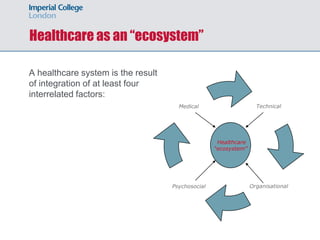
Healthcare as an “ecosystem”

A healthcare system is the result
of integration of at least four
interrelated factors:
                                      Medical                      Technical


                                                    Healthcare
                                                   “ecosystem”


                                    Psychosocial                 Organisational
What can the social sciences do for us?

  By looking at various aspects of human experience and
  conduct, the social sciences help us understand some of the
  dynamics that may determine the success or the failure of
  eHealth initiatives.
„It‟s just a PC…‟

Patients’ verbal behaviour was subject to:

1. The movement of the doctors' hands and fingers.
2. The relative intensity of keystrokes.
3. Shifts in the doctors' gaze from the keyboard to the monitor.


                                                   (Greatbatch et al., 1995).
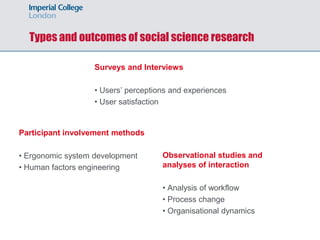
Types and outcomes of social science research

                   Surveys and Interviews

                   • Users’ perceptions and experiences
                   • User satisfaction


Participant involvement methods

• Ergonomic system development       Observational studies and
• Human factors engineering          analyses of interaction

                                     • Analysis of workflow
                                     • Process change
                                     • Organisational dynamics
A case study in real-time telemedicine


                            (Pappas & Seale, 2009)
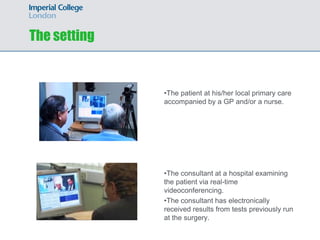
The setting


              •The patient at his/her local primary care
              accompanied by a GP and/or a nurse.


              •The consultant at a hospital examining
              the patient via real-time
              videoconferencing.
              •The consultant has electronically
              received results from tests previously run
              at the surgery.
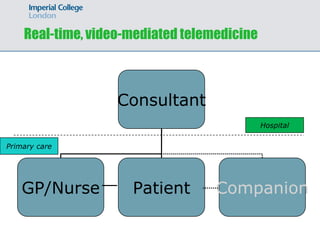
Real-time, video-mediated telemedicine


                   Consultant
                                             Hospital

Primary care


    GP/Nurse         Patient       Companion
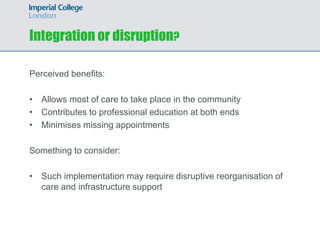
Integration or disruption?

Perceived benefits:

• Allows most of care to take place in the community
• Contributes to professional education at both ends
• Minimises missing appointments

Something to consider:

• Such implementation may require disruptive reorganisation of
  care and infrastructure support
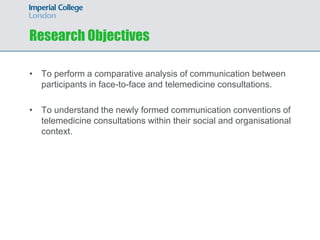
Research Objectives

• To perform a comparative analysis of communication between
  participants in face-to-face and telemedicine consultations.

• To understand the newly formed communication conventions of
  telemedicine consultations within their social and organisational
  context.
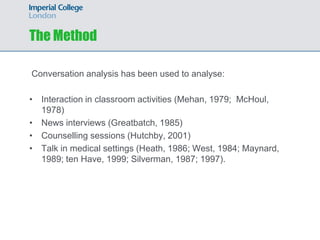
The Method

Conversation analysis has been used to analyse:

• Interaction in classroom activities (Mehan, 1979; McHoul,
  1978)
• News interviews (Greatbatch, 1985)
• Counselling sessions (Hutchby, 2001)
• Talk in medical settings (Heath, 1986; West, 1984; Maynard,
  1989; ten Have, 1999; Silverman, 1987; 1997).
Physical examination in telemedicine
(Televascular, C, P, N)
1 C: now if you could turn your legs outwards Mrs G. (2.1) and then
2 if you could go a little higher up (1.2) above the knees (0.5)
3 oka::y there are some varicose veins all the way up really on
                                                                           Consultant
4 the right[side] by the look of things
5 N:           [yeah]                                                      Green: place the patient
6 C: come down again (5.2) and there is a pigmentation in the gator        Orange: place the camera
7 a:rea
8 N: yes                                                                   Blue: online commentary
9 C: a little bit on both sides is that true H?                            Underlined: Explicit or implicit
11 (0.3)                                                                   requests for verification
12 N: yes there is
13 (0.7)                                                                   Online commentary may be
14 C: ºyesº (1.5) okay (0.7) and at the moment the left leg looks          perceived by the nurse as a
15 more swollen is that correct?                                           request for feedback
16 N: yes it i:s
17 C: alright Mrs G can I ask you to turn around and face away from
                                                                           Nurse
18 the camera?
19 (5.0)                                                                   Red: involved in physical
20 P: feet out?                                                            examination as a facilitator for
21 (1.2)                                                                   diagnosis. Physical proximity
22 C: yes that’s great (4.2) ºrightº (0.5) ºo:kayº (4.6) now there         to the patient is utilised to
23 are one or two varicose veins at the back but not an awful lot=         verify or contest the
24 N: =no:=                                                                consultant’s observations
25 C: my view at least (1.0) is that how you see it H?
26 N: yea:h it’s not too: bad rea:lly
27 C: okay if you could take a sit Mrs G to have a look at the lower leg
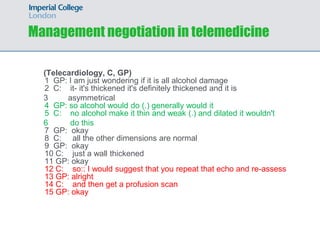
Management negotiation in telemedicine

  (Telecardiology, C, GP)
  1 GP: I am just wondering if it is all alcohol damage
  2 C: it- it's thickened it's definitely thickened and it is
  3     asymmetrical
  4 GP: so alcohol would do (.) generally would it
  5 C: no alcohol make it thin and weak (.) and dilated it wouldn't
  6      do this
  7 GP: okay
  8 C: all the other dimensions are normal
  9 GP: okay
  10 C: just a wall thickened
  11 GP: okay
  12 C: so:: I would suggest that you repeat that echo and re-assess
  13 GP: alright
  14 C: and then get a profusion scan
  15 GP: okay
Realisations

  Telemedicine is an unfamiliar terrain which requires constant
  negotiation of communication skills and roles. Participant skills
  in telemedicine are influenced by four characteristic traits of
  telemedicine consultations:

a) the novelty of the institutional setting
b) the introduction of additional persons in the consultation
c) the inability of the consultant to physically examine the patient
   and
d) the technological apparatus used
Conclusions
Telemedicine:

• Facilitates communication between primary and tertiary care.
• Takes place in an unfamiliar physical space and involves a
  degree of uncertainty in currying out various activities
• Enhances the role of the nurse in the consultation
• Produces conflicts of agendas and negotiation over the
  communicative floor between primary and tertiary care staff
• Contributes to GP and nurse education – any other professional
  in other modalities
• May exclude the patient from certain parts of the consultation
  because of extensive interprofessional talk
• Requires additional skills by consultants
Need for more social sciences research in eHealth

• Low cost
• Proven validity
• User involvement
Understanding the newly formed conventions in telehealthcare: what
can the social sciences do for us?

Dr Yannis Pappas
eHealth Unit – Imperial College London
y.pappas@imperial.ac.uk


                                          Many thanks!

Yannis Pappas

  • 1.
    Understanding the newlyformed conventions in telehealthcare: what can the social sciences do for us? Dr Yannis Pappas Deputy Director, eHealth Unit eHealth Unit - Imperial College London
  • 2.
    Common investigative themesacross eHealth research and practice • Optimisation of planning • Enhancement of implementation Different routes to reach to these objectives
  • 3.
    Fact • Financial viability •Technological competence • Managerial and organisational skills Essential for the provision of successful telehealthcare initiatives. What about human experience and skills?
  • 4.
    A reasonable quote As Whitten, Sypher and Patterson (2000) put it, ‘we know a good deal about bandwidths and resolutions, but not enough about the human dimensions that make practice possible’.
  • 5.
    Healthcare as an“ecosystem” A healthcare system is the result of integration of at least four interrelated factors: Medical Technical Healthcare “ecosystem” Psychosocial Organisational
  • 6.
    What can thesocial sciences do for us? By looking at various aspects of human experience and conduct, the social sciences help us understand some of the dynamics that may determine the success or the failure of eHealth initiatives.
  • 7.
    „It‟s just aPC…‟ Patients’ verbal behaviour was subject to: 1. The movement of the doctors' hands and fingers. 2. The relative intensity of keystrokes. 3. Shifts in the doctors' gaze from the keyboard to the monitor. (Greatbatch et al., 1995).
  • 8.
    Types and outcomesof social science research Surveys and Interviews • Users’ perceptions and experiences • User satisfaction Participant involvement methods • Ergonomic system development Observational studies and • Human factors engineering analyses of interaction • Analysis of workflow • Process change • Organisational dynamics
  • 9.
    A case studyin real-time telemedicine (Pappas & Seale, 2009)
  • 10.
    The setting •The patient at his/her local primary care accompanied by a GP and/or a nurse. •The consultant at a hospital examining the patient via real-time videoconferencing. •The consultant has electronically received results from tests previously run at the surgery.
  • 11.
    Real-time, video-mediated telemedicine Consultant Hospital Primary care GP/Nurse Patient Companion
  • 12.
    Integration or disruption? Perceivedbenefits: • Allows most of care to take place in the community • Contributes to professional education at both ends • Minimises missing appointments Something to consider: • Such implementation may require disruptive reorganisation of care and infrastructure support
  • 13.
    Research Objectives • Toperform a comparative analysis of communication between participants in face-to-face and telemedicine consultations. • To understand the newly formed communication conventions of telemedicine consultations within their social and organisational context.
  • 14.
    The Method Conversation analysishas been used to analyse: • Interaction in classroom activities (Mehan, 1979; McHoul, 1978) • News interviews (Greatbatch, 1985) • Counselling sessions (Hutchby, 2001) • Talk in medical settings (Heath, 1986; West, 1984; Maynard, 1989; ten Have, 1999; Silverman, 1987; 1997).
  • 15.
    Physical examination intelemedicine (Televascular, C, P, N) 1 C: now if you could turn your legs outwards Mrs G. (2.1) and then 2 if you could go a little higher up (1.2) above the knees (0.5) 3 oka::y there are some varicose veins all the way up really on Consultant 4 the right[side] by the look of things 5 N: [yeah] Green: place the patient 6 C: come down again (5.2) and there is a pigmentation in the gator Orange: place the camera 7 a:rea 8 N: yes Blue: online commentary 9 C: a little bit on both sides is that true H? Underlined: Explicit or implicit 11 (0.3) requests for verification 12 N: yes there is 13 (0.7) Online commentary may be 14 C: ºyesº (1.5) okay (0.7) and at the moment the left leg looks perceived by the nurse as a 15 more swollen is that correct? request for feedback 16 N: yes it i:s 17 C: alright Mrs G can I ask you to turn around and face away from Nurse 18 the camera? 19 (5.0) Red: involved in physical 20 P: feet out? examination as a facilitator for 21 (1.2) diagnosis. Physical proximity 22 C: yes that’s great (4.2) ºrightº (0.5) ºo:kayº (4.6) now there to the patient is utilised to 23 are one or two varicose veins at the back but not an awful lot= verify or contest the 24 N: =no:= consultant’s observations 25 C: my view at least (1.0) is that how you see it H? 26 N: yea:h it’s not too: bad rea:lly 27 C: okay if you could take a sit Mrs G to have a look at the lower leg
  • 16.
    Management negotiation intelemedicine (Telecardiology, C, GP) 1 GP: I am just wondering if it is all alcohol damage 2 C: it- it's thickened it's definitely thickened and it is 3 asymmetrical 4 GP: so alcohol would do (.) generally would it 5 C: no alcohol make it thin and weak (.) and dilated it wouldn't 6 do this 7 GP: okay 8 C: all the other dimensions are normal 9 GP: okay 10 C: just a wall thickened 11 GP: okay 12 C: so:: I would suggest that you repeat that echo and re-assess 13 GP: alright 14 C: and then get a profusion scan 15 GP: okay
  • 17.
    Realisations Telemedicineis an unfamiliar terrain which requires constant negotiation of communication skills and roles. Participant skills in telemedicine are influenced by four characteristic traits of telemedicine consultations: a) the novelty of the institutional setting b) the introduction of additional persons in the consultation c) the inability of the consultant to physically examine the patient and d) the technological apparatus used
  • 18.
    Conclusions Telemedicine: • Facilitates communicationbetween primary and tertiary care. • Takes place in an unfamiliar physical space and involves a degree of uncertainty in currying out various activities • Enhances the role of the nurse in the consultation • Produces conflicts of agendas and negotiation over the communicative floor between primary and tertiary care staff • Contributes to GP and nurse education – any other professional in other modalities • May exclude the patient from certain parts of the consultation because of extensive interprofessional talk • Requires additional skills by consultants
  • 19.
    Need for moresocial sciences research in eHealth • Low cost • Proven validity • User involvement
  • 20.
    Understanding the newlyformed conventions in telehealthcare: what can the social sciences do for us? Dr Yannis Pappas eHealth Unit – Imperial College London y.pappas@imperial.ac.uk Many thanks!