House Mouse 
House mice are well adapted to living in 
close contact with humans and thrive where 
food and shelter are abundant. They eat and 
contaminate food supplies and also can transmit 
disease. Their gnawing activities can damage structures 
or property. Manage them by cleaning up debris, 
removing food and shelter, eliminating entryways 
into buildings, or using traps or baits. High frequency 
electronic devices aren’t effective. 
How to detect a house mouse infestation: 
✦ Look for droppings, fresh gnaw marks, and tracks, 
which indicate areas where mice are active. 
✦ Search behind boxes, in drawers, in garages, 
or around woodpiles for nests made of finely 
shredded paper or other fibrous material. 
✦ Check for the musky odor associated with mice. 
✦ Mice are most active at night, but you also can see 
them during daylight hours. 
Discourage mice by removing food, water, 
and shelter and sealing entryways. 
✦ Good housekeeping within buildings reduces 
shelter and food for house mice. 
✦ Seal all structural cracks and openings larger than 
1⁄4 inch. Use wire screen or coarse steel wool that 
mice can’t chew through. 
✦ Ensure all doors, windows, and screens fit tightly. 
✦ Feed pets only the amount of food they will eat at 
a single feeding. 
✦ Keep all food storage and garbage containers sealed. 
✦ Thin or remove plants next to or climbing up 
buildings, since house mice are excellent climbers. 
Remove mice from your home by trapping. 
✦ Snap traps and glue boards are the safest and 
most economical traps. 
✦ Place traps in secluded areas along walls, behind 
objects, in dark corners, and in places where 
droppings have been found. 
✦ Dispose of dead rodents by burying or placing 
them in plastic bags and putting them in the 
garbage. Don’t touch mice with 
your bare hands, and wash hands 
thoroughly after handling traps. 
University of California 
Statewide Integrated Pest 
Management Program 
What about poison baits? 
✦ Avoid using baits indoors. Mice can die in hidden 
places, create bad odors, and be difficult to 
locate. Seal buildings before baiting outdoors to 
prevent mice coming indoors to die. 
✦ Baits generally take several days for effective 
control. 
✦ Place baits in tamper-proof bait stations out of 
reach of children and pets. All rodent baits are 
toxic. 
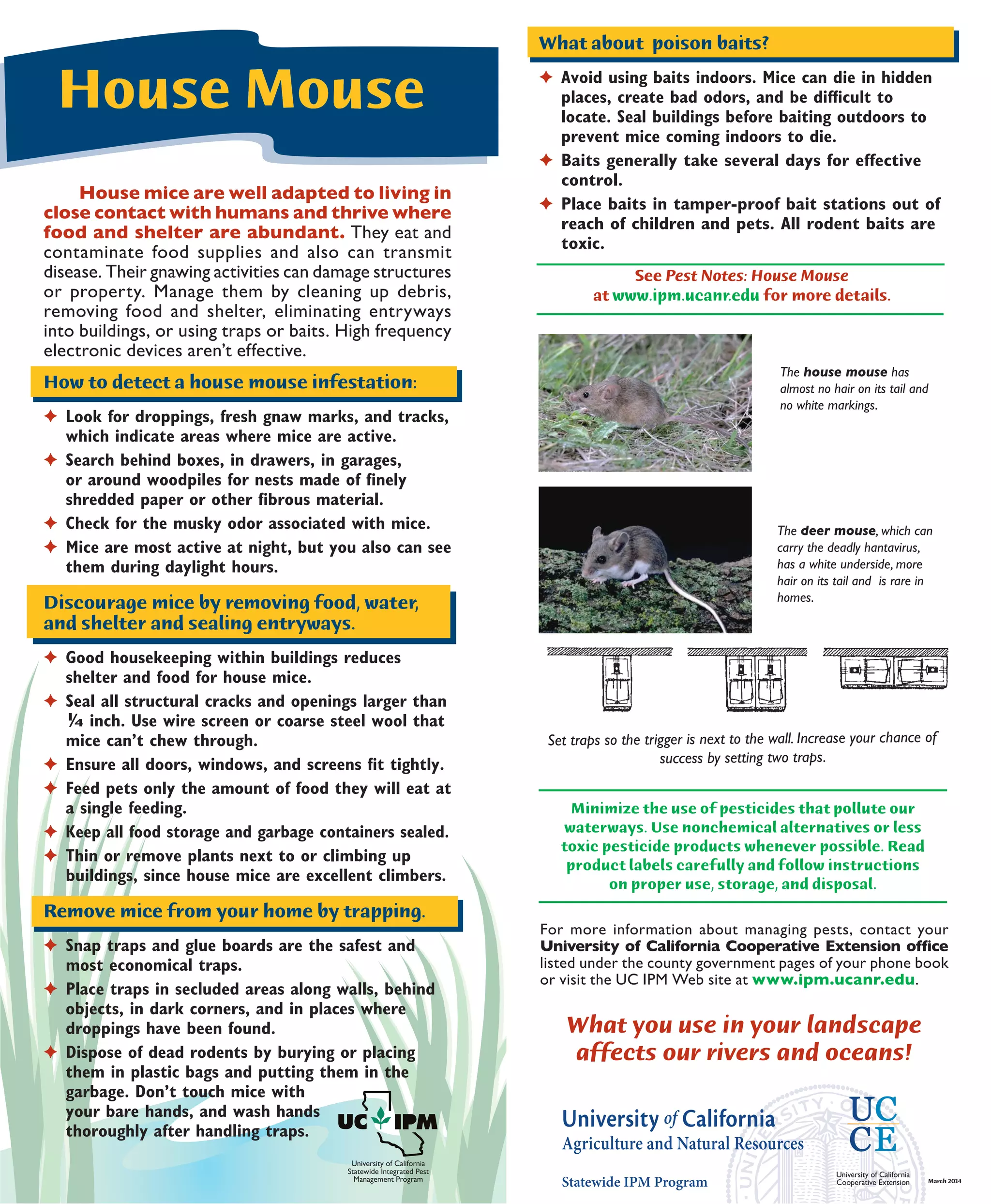
The house mouse has 
almost no hair on its tail and 
no white markings. 
The deer mouse, which can 
carry the deadly hantavirus, 
has a white underside, more 
hair on its tail and is rare in 
homes. 
Set traps so the trigger is next to the wall. Increase your chance of 
March 2014 
See Pest Notes: House Mouse 
at www.ipm.ucanr.edu for more details. 
success by setting two traps . 
Minimize the use of pesticides that pollute our 
waterways. Use nonchemical alternatives or less 
toxic pesticide products whenever possible. Read 
product labels carefully and follow instructions 
on proper use, storage, and disposal. 
For more information about managing pests, contact your 
University of California Cooperative Extension office 
listed under the county government pages of your phone book 
or visit the UC IPM Web site at www.ipm.ucanr.edu. 
What you use in your landscape 
affects our rivers and oceans! 
University of California 
Statewide IPM Program Cooperative Extension

House Mouse Quick Tips Natural Pest Control

  • 1.
    House Mouse Housemice are well adapted to living in close contact with humans and thrive where food and shelter are abundant. They eat and contaminate food supplies and also can transmit disease. Their gnawing activities can damage structures or property. Manage them by cleaning up debris, removing food and shelter, eliminating entryways into buildings, or using traps or baits. High frequency electronic devices aren’t effective. How to detect a house mouse infestation: ✦ Look for droppings, fresh gnaw marks, and tracks, which indicate areas where mice are active. ✦ Search behind boxes, in drawers, in garages, or around woodpiles for nests made of finely shredded paper or other fibrous material. ✦ Check for the musky odor associated with mice. ✦ Mice are most active at night, but you also can see them during daylight hours. Discourage mice by removing food, water, and shelter and sealing entryways. ✦ Good housekeeping within buildings reduces shelter and food for house mice. ✦ Seal all structural cracks and openings larger than 1⁄4 inch. Use wire screen or coarse steel wool that mice can’t chew through. ✦ Ensure all doors, windows, and screens fit tightly. ✦ Feed pets only the amount of food they will eat at a single feeding. ✦ Keep all food storage and garbage containers sealed. ✦ Thin or remove plants next to or climbing up buildings, since house mice are excellent climbers. Remove mice from your home by trapping. ✦ Snap traps and glue boards are the safest and most economical traps. ✦ Place traps in secluded areas along walls, behind objects, in dark corners, and in places where droppings have been found. ✦ Dispose of dead rodents by burying or placing them in plastic bags and putting them in the garbage. Don’t touch mice with your bare hands, and wash hands thoroughly after handling traps. University of California Statewide Integrated Pest Management Program What about poison baits? ✦ Avoid using baits indoors. Mice can die in hidden places, create bad odors, and be difficult to locate. Seal buildings before baiting outdoors to prevent mice coming indoors to die. ✦ Baits generally take several days for effective control. ✦ Place baits in tamper-proof bait stations out of reach of children and pets. All rodent baits are toxic. The house mouse has almost no hair on its tail and no white markings. The deer mouse, which can carry the deadly hantavirus, has a white underside, more hair on its tail and is rare in homes. Set traps so the trigger is next to the wall. Increase your chance of March 2014 See Pest Notes: House Mouse at www.ipm.ucanr.edu for more details. success by setting two traps . Minimize the use of pesticides that pollute our waterways. Use nonchemical alternatives or less toxic pesticide products whenever possible. Read product labels carefully and follow instructions on proper use, storage, and disposal. For more information about managing pests, contact your University of California Cooperative Extension office listed under the county government pages of your phone book or visit the UC IPM Web site at www.ipm.ucanr.edu. What you use in your landscape affects our rivers and oceans! University of California Statewide IPM Program Cooperative Extension