XII- COMPUTER SCIENCE
CHAPTER 1
FUNCTION
INTRODUCTION
• The most important criteria in writing and
evaluating the algorithm is the time it takes to
complete a task.
• To have a meaningful comparison of algorithms,
the duration of computation time must be
independent of the programming language,
compiler, and computer used.
• If a bulk of statements to be repeated for many
numbers of times then subroutines are used to
finish the task.
SUBROUTINES
• Subroutines are the basic building blocks of
computer programs.
• Subroutines are small sections of code that
are used to perform a particular task that can
be used repeatedly.
• In Programming languages these subroutines
are called as Functions.
Function
• A function is a unit of code that is often
defined within a greater code structure.
• A function contains a set of code that works
on many kinds of inputs, like variants,
expressions and produces a concrete output.
Function Specification
• Let us consider the example a:= (24).
a:= (24) has an expression in it but (24) is not
itself an expression.
• Definitions bind values to names, in this case
the value 24 being bound to the name ‘a’.
• Definitions are not expressions, at the same
time expressions are also not treated as
definitions.
• Definitions are distinct syntactic blocks.
Parameters (and arguments)
• Parameters are the variables in a function
definition and arguments are the values which
are passed to a function definition.
• 1. Parameter without Type
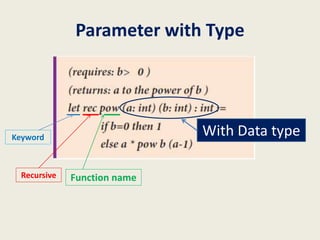
• 2. Parameter with Type
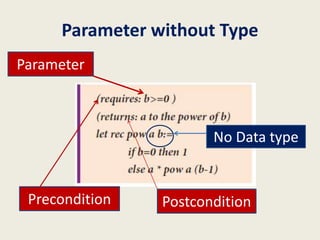
Parameter without Type
Parameter
Postcondition
Precondition
No Data type
Parameter with Type
With Data type
Keyword
Recursive Function name
Syntax for function definitions
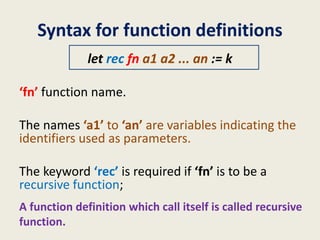
let rec fn a1 a2 ... an := k
‘fn’ function name.
The names ‘a1’ to ‘an’ are variables indicating the
identifiers used as parameters.
The keyword ‘rec’ is required if ‘fn’ is to be a
recursive function;
A function definition which call itself is called recursive
function.
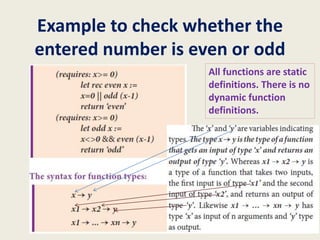
Example to check whether the
entered number is even or odd
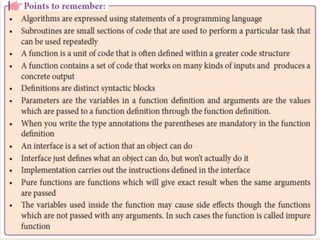
All functions are static
definitions. There is no
dynamic function
definitions.
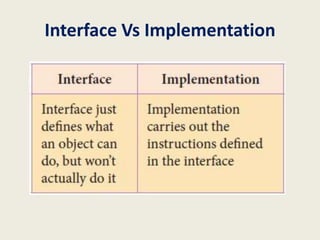
Interface Vs Implementation
• An interface is a set of action that an object
can do.
• For example when you press a light switch, the
light goes on, you may not have cared how it
splashed the light.
• an Interface is a description of all functions
that a class
Key points
• A class declaration combines the external
interface (its local state) with an
implementation of that interface (the
code that carries out the behaviour).
• An object is an instance created from the
class.
• The interface defines an object’s visibility
to the outside world.
Interface Vs Implementation
Characteristics of interface
• The class template specifies the
interfaces to enable an object to be
created and operated properly.
• An object's attributes and behaviour is
controlled by sending functions to the
object.
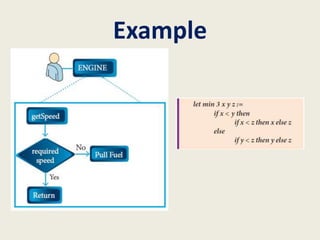
Example
Pure functions
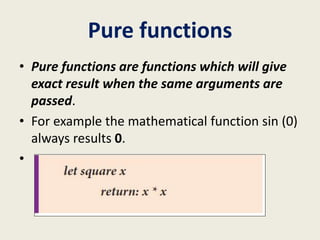
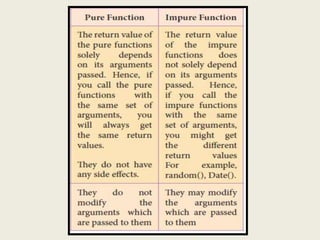
• Pure functions are functions which will give
exact result when the same arguments are
passed.
• For example the mathematical function sin (0)
always results 0.
•
Pure functions
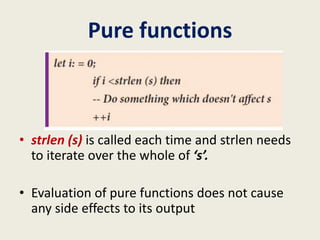
• strlen (s) is called each time and strlen needs
to iterate over the whole of ‘s’.
• Evaluation of pure functions does not cause
any side effects to its output
Impure functions
• The variables used inside the function may
cause side effects though the functions which
are not passed with any arguments. In such
cases the function is called impure function.
• For example the mathematical function
random() will give different outputs for the
same function call.
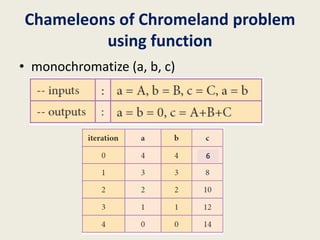
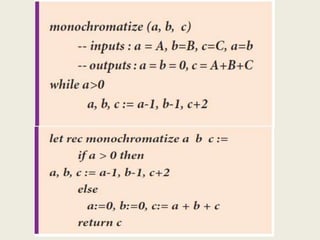
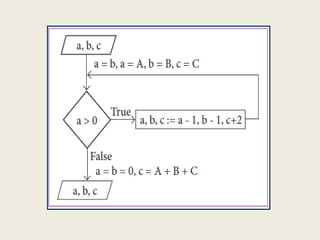
Chameleons of Chromeland problem
using function
• monochromatize (a, b, c)
6
XII  Computer Science- Chapter 1-Function

XII Computer Science- Chapter 1-Function

  • 1.
  • 2.
    INTRODUCTION • The mostimportant criteria in writing and evaluating the algorithm is the time it takes to complete a task. • To have a meaningful comparison of algorithms, the duration of computation time must be independent of the programming language, compiler, and computer used. • If a bulk of statements to be repeated for many numbers of times then subroutines are used to finish the task.
  • 3.
    SUBROUTINES • Subroutines arethe basic building blocks of computer programs. • Subroutines are small sections of code that are used to perform a particular task that can be used repeatedly. • In Programming languages these subroutines are called as Functions.
  • 4.
    Function • A functionis a unit of code that is often defined within a greater code structure. • A function contains a set of code that works on many kinds of inputs, like variants, expressions and produces a concrete output.
  • 5.
    Function Specification • Letus consider the example a:= (24). a:= (24) has an expression in it but (24) is not itself an expression. • Definitions bind values to names, in this case the value 24 being bound to the name ‘a’. • Definitions are not expressions, at the same time expressions are also not treated as definitions. • Definitions are distinct syntactic blocks.
  • 6.
    Parameters (and arguments) •Parameters are the variables in a function definition and arguments are the values which are passed to a function definition. • 1. Parameter without Type • 2. Parameter with Type
  • 7.
  • 8.
    Parameter with Type WithData type Keyword Recursive Function name
  • 9.
    Syntax for functiondefinitions let rec fn a1 a2 ... an := k ‘fn’ function name. The names ‘a1’ to ‘an’ are variables indicating the identifiers used as parameters. The keyword ‘rec’ is required if ‘fn’ is to be a recursive function; A function definition which call itself is called recursive function.
  • 10.
    Example to checkwhether the entered number is even or odd All functions are static definitions. There is no dynamic function definitions.
  • 11.
    Interface Vs Implementation •An interface is a set of action that an object can do. • For example when you press a light switch, the light goes on, you may not have cared how it splashed the light. • an Interface is a description of all functions that a class
  • 12.
    Key points • Aclass declaration combines the external interface (its local state) with an implementation of that interface (the code that carries out the behaviour). • An object is an instance created from the class. • The interface defines an object’s visibility to the outside world.
  • 13.
  • 14.
    Characteristics of interface •The class template specifies the interfaces to enable an object to be created and operated properly. • An object's attributes and behaviour is controlled by sending functions to the object.
  • 15.
  • 16.
    Pure functions • Purefunctions are functions which will give exact result when the same arguments are passed. • For example the mathematical function sin (0) always results 0. •
  • 17.
    Pure functions • strlen(s) is called each time and strlen needs to iterate over the whole of ‘s’. • Evaluation of pure functions does not cause any side effects to its output
  • 18.
    Impure functions • Thevariables used inside the function may cause side effects though the functions which are not passed with any arguments. In such cases the function is called impure function. • For example the mathematical function random() will give different outputs for the same function call.
  • 20.
    Chameleons of Chromelandproblem using function • monochromatize (a, b, c) 6