DRONACHARYA
GOVERNMENT COLLEGE
PRESENTED BY:- PRESENTED TO :-
NAME:- YASH MEENAKSHI MA’AM
CLASS :- B.COM
ROLL NO. 532
TOPIC :- WORLD TRADE ORGANISATION (WTO)
SUBJECT :- BUSSINESS ENVIRONMENT
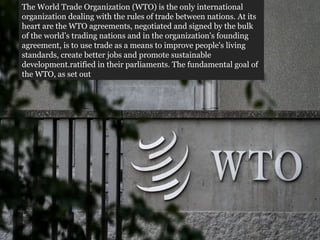
The World Trade Organization (WTO) is the only international
organization dealing with the rules of trade between nations. At its
heart are the WTO agreements, negotiated and signed by the bulk
of the world’s trading nations and in the organization's founding
agreement, is to use trade as a means to improve people's living
standards, create better jobs and promote sustainable
development.ratified in their parliaments. The fundamental goal of
the WTO, as set out
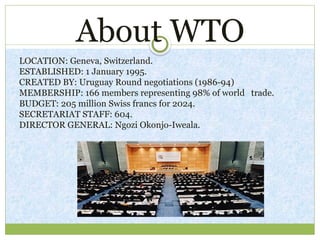
About WTO
LOCATION: Geneva, Switzerland.
ESTABLISHED: 1 January 1995.
CREATED BY: Uruguay Round negotiations (1986-94)
MEMBERSHIP: 166 members representing 98% of world trade.
BUDGET: 205 million Swiss francs for 2024.
SECRETARIAT STAFF: 604.
DIRECTOR GENERAL: Ngozi Okonjo-Iweala.
What it do
•The WTO operates the global system of trade rules and helps developing
countries improve their capacity to trade.
• It also provides a forum for its members to negotiate trade agreements
and to resolve the trade problems they face with each other.
•The overall objective of the WTO is to help its members use trade as a
means to raise living standards, create jobs and improve people’s lives.
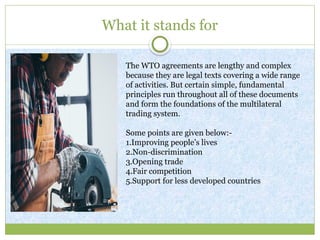
What it stands for
The WTO agreements are lengthy and complex
because they are legal texts covering a wide range
of activities. But certain simple, fundamental
principles run throughout all of these documents
and form the foundations of the multilateral
trading system.
Some points are given below:-
1.Improving people’s lives
2.Non-discrimination
3.Opening trade
4.Fair competition
5.Support for less developed countries
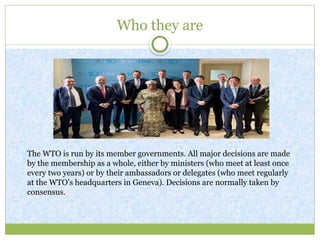
Who they are
The WTO is run by its member governments. All major decisions are made
by the membership as a whole, either by ministers (who meet at least once
every two years) or by their ambassadors or delegates (who meet regularly
at the WTO's headquarters in Geneva). Decisions are normally taken by
consensus.
FUNCTIONS
1. Administering WTO trade agreement
2. Forum for trade negotiations
3. Handling trade disputes
4. Monitoring national trade policies
5. Technical assistances and training for
developing countries
6. Cooperation with other international
organisation
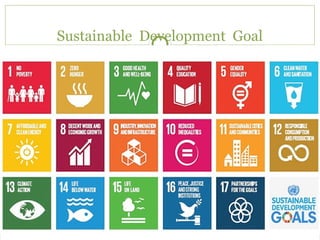
Sustainable Development Goal
AGREEMENTS
The WTO oversees about 60 different agreements which
have the status of international legal texts. Member
countries must sign and ratify all WTO agreements on
accession.
Some of which are mentioned below:-
1. Agreement on Agriculture (AOA)
2. General Agreement on trade in services (GATS)
3. Trade-Related aspects of intellectual property rights
Agreements (TRIPS)
WTO AND ITS IMPACT
1. Taiwan ‘s accession to the World Trade Organization (WTO)
january 2002 created new opportunities for growth by providing
wider access to global market under the most-favored- nation
trading status .
2. The simple average nominal duty rate for Taiwan ‘s industrial
sectors was 6.03 percent before its accession to the WTO . THE rate
was cut to 5.79 percent in 2002 and will be reduced futher to 4.15
percent by the end of 2004 ,when the scheduled tariff concession
(covering ) 3,470 industrial item ) are completely phased in .
MISSION
1. The WTO ‘s stated goal is to improve the welfare of
the peaple of its Member countries ,specifically by
lowering trade barrier and providing a Platforn for
negotiation of trade .
2. Its main mission is “ to ensure that trade flows as
smoothly predictably and freely as possible “. This
main mission is further specified in certain core
Function serving and safeguarding five fundamental
principales ,which are the foundation of the
multilateral trading system
wto new........................ (1).pptx

wto new........................ (1).pptx

  • 1.
    DRONACHARYA GOVERNMENT COLLEGE PRESENTED BY:-PRESENTED TO :- NAME:- YASH MEENAKSHI MA’AM CLASS :- B.COM ROLL NO. 532 TOPIC :- WORLD TRADE ORGANISATION (WTO) SUBJECT :- BUSSINESS ENVIRONMENT
  • 2.
    The World TradeOrganization (WTO) is the only international organization dealing with the rules of trade between nations. At its heart are the WTO agreements, negotiated and signed by the bulk of the world’s trading nations and in the organization's founding agreement, is to use trade as a means to improve people's living standards, create better jobs and promote sustainable development.ratified in their parliaments. The fundamental goal of the WTO, as set out
  • 3.
    About WTO LOCATION: Geneva,Switzerland. ESTABLISHED: 1 January 1995. CREATED BY: Uruguay Round negotiations (1986-94) MEMBERSHIP: 166 members representing 98% of world trade. BUDGET: 205 million Swiss francs for 2024. SECRETARIAT STAFF: 604. DIRECTOR GENERAL: Ngozi Okonjo-Iweala.
  • 4.
    What it do •TheWTO operates the global system of trade rules and helps developing countries improve their capacity to trade. • It also provides a forum for its members to negotiate trade agreements and to resolve the trade problems they face with each other. •The overall objective of the WTO is to help its members use trade as a means to raise living standards, create jobs and improve people’s lives.
  • 5.
    What it standsfor The WTO agreements are lengthy and complex because they are legal texts covering a wide range of activities. But certain simple, fundamental principles run throughout all of these documents and form the foundations of the multilateral trading system. Some points are given below:- 1.Improving people’s lives 2.Non-discrimination 3.Opening trade 4.Fair competition 5.Support for less developed countries
  • 6.
    Who they are TheWTO is run by its member governments. All major decisions are made by the membership as a whole, either by ministers (who meet at least once every two years) or by their ambassadors or delegates (who meet regularly at the WTO's headquarters in Geneva). Decisions are normally taken by consensus.
  • 7.
    FUNCTIONS 1. Administering WTOtrade agreement 2. Forum for trade negotiations 3. Handling trade disputes 4. Monitoring national trade policies 5. Technical assistances and training for developing countries 6. Cooperation with other international organisation
  • 8.
  • 9.
    AGREEMENTS The WTO overseesabout 60 different agreements which have the status of international legal texts. Member countries must sign and ratify all WTO agreements on accession. Some of which are mentioned below:- 1. Agreement on Agriculture (AOA) 2. General Agreement on trade in services (GATS) 3. Trade-Related aspects of intellectual property rights Agreements (TRIPS)
  • 10.
    WTO AND ITSIMPACT 1. Taiwan ‘s accession to the World Trade Organization (WTO) january 2002 created new opportunities for growth by providing wider access to global market under the most-favored- nation trading status . 2. The simple average nominal duty rate for Taiwan ‘s industrial sectors was 6.03 percent before its accession to the WTO . THE rate was cut to 5.79 percent in 2002 and will be reduced futher to 4.15 percent by the end of 2004 ,when the scheduled tariff concession (covering ) 3,470 industrial item ) are completely phased in .
  • 11.
    MISSION 1. The WTO‘s stated goal is to improve the welfare of the peaple of its Member countries ,specifically by lowering trade barrier and providing a Platforn for negotiation of trade . 2. Its main mission is “ to ensure that trade flows as smoothly predictably and freely as possible “. This main mission is further specified in certain core Function serving and safeguarding five fundamental principales ,which are the foundation of the multilateral trading system