WSD as Distributed Constraint
Optimization Problem

    Author: Siva Reddy, Abhilash Inumella
    Publication: ACL 2010
    Presenter: Po-Han Lin (林伯翰)
Outline

   Background
   WSD as a DCOP
   Experiment
   Conclusion and Future
   References
Outline

   Background
       WSD
       COP
       DCOP
   WSD as a DCOP
   Experiment
   Conclusion and Future
   References
Word Sense Disambiguation

   Word Sense Disambiguation (WSD)
       The problem of WSD can be defined as the task
        of assigning the most appropriate sense to the
        word within a given context.
       WSD is one of the oldest problems in
        computational linguistics which dates back to
        early 1950’s.
       Example:
           Noun orange has at least two senses:
               color or fruit.
Constraint Optimization Problem

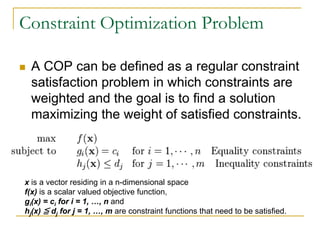
   A COP can be defined as a regular constraint
    satisfaction problem in which constraints are
    weighted and the goal is to find a solution
    maximizing the weight of satisfied constraints.


x is a vector residing in a n-dimensional space
f(x) is a scalar valued objective function,
gi(x) = ci for i = 1, …, n and
hj(x) ≦ dj for j = 1, …, m are constraint functions that need to be satisfied.
Distributed Constraint Optimization
Problem
   DCOP is the distributed analogue to
    constraint optimization.
   DCOP is a problem in which a group of
    agents must distributedly choose values for a
    set of variables such that the cost of a set of
    constraints over the variables is either
    minimized or maximized.
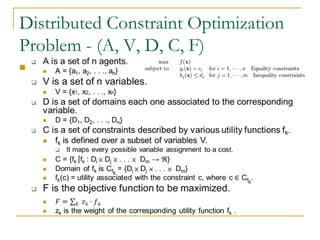
       DCOP can be formalized as a tuple
           (A, V, D, C, F)
Distributed Constraint Optimization
Problem - (A, V, D, C, F)

Outline

   Background
   WSD as a DCOP
   Experiment
   Conclusion and Future
   References
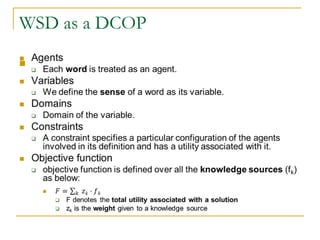
WSD as a DCOP


Detial about Constraints
   Part-of-speech (POS 詞性)
       Different POS can decide different domain of words.
           Ex: play has 47 senses, but only 17 senses correspond to noun category.
   Morphology (構詞學)
       Word form (字形)
       Vocabulary (字詞)
           orange has color and fruit two senses, but oranges only be used in the fruit sense.
   Domain information
       Information can be captured using a unary utility function defined for every word.
   Sense Relatedness
       Sense relatedness between senses of two words wi, wj is captured by a function f, where f
        returns sense relatedness (utility) between senses based on sense taxonomy and gloss
        overlaps.
   Discourse
       Many different word, but same sense.
   Collocations
       co-occur word.
       Ex: bank:
           financial institution
           the edge of a river
           if in a given context bank co-occur with money, “financial institution”
Outline

   Background
   WSD as a DCOP
   Experiment
   Conclusion and Future
   References
Experiment

   Experiment Data
       SENSEVAL-2
       SENSEVAL-3
           Ex:
           <instance id="activate.v.bnc.00024693" docsrc="BNC">
               <answer instance="activate.v.bnc.00024693"
                senseid="38201"/>
               <context>
                … which you step on to <head>activate</head> it . Used
                correctly , … .
               </context>
           </instance>
   Answer
       <lexelt item="activate.v">
       <sense id="38201" source="ws"
        wn="activate%2:36:00::" synset="activate actuate
        energize start stimulate" gloss="to initiate action in;
        make active."/>
       <sense id="38202" source="ws"
        wn="activate%2:30:03::" synset="activate" gloss="in
        chemistry, to make more reactive, as by heating."/>
       …
       </lexelt>
Experiment
   Experiment Results
       Dcop:
           This paper method
       Sinha07
           Sinha and Mihalcea, 2007
           page rank algorithm
       Agirre09
           Agirre and Soroa, 2009
           page rank algorithm
           used additional knowledge
               extended WordNet relations
               sense disambiguated gloss.
       MFS
           most frequent sense
           popular back-off heuristic in
            WSD system.
Outline

   Background
   WSD as a DCOP
   Experiment
   Conclusion and Future
   References
Conclusion

   Modelling WSD in a distributed constraint
    optimization framework.
   Showed that this framework is powerful
    enough to encode information from various
    knowledge sources.
FutureWork

   Only used relatedness based utility functions
    derived from WordNet.
   Effect of other knowledge sources remains to
    be evaluated individually and in combination.
   The best possible combination of weights (zk)
    of knowledge sources is yet to be
    engineered.
Outline

   Background
   WSD as a DCOP
   Experiment
   Conclusion and Future
   References
References
   WSD as a Distributed Constraint Optimization Problem
       http://dl.acm.org/citation.cfm?id=1858916
   Distributed Constraint Optimization Problem
       http://www.doc88.com/p-23745051258.html
       http://en.wikipedia.org/wiki/Distributed_constraint_optimization
   Constraint optimization
       http://en.wikipedia.org/wiki/Constraint_optimization
   Word Sense Disambiguation
       http://wordnet.princeton.edu/
       http://203.64.42.21/course/2005/tgbcl/poko/ohcl-13.htm
       http://www.scholarpedia.org/article/Word_sense_disambiguation
   SENSEVAL
       http://www.senseval.org/

Wsd as distributed constraint optimization problem

  • 1.
    WSD as DistributedConstraint Optimization Problem Author: Siva Reddy, Abhilash Inumella Publication: ACL 2010 Presenter: Po-Han Lin (林伯翰)
  • 2.
    Outline  Background  WSD as a DCOP  Experiment  Conclusion and Future  References
  • 3.
    Outline  Background  WSD  COP  DCOP  WSD as a DCOP  Experiment  Conclusion and Future  References
  • 4.
    Word Sense Disambiguation  Word Sense Disambiguation (WSD)  The problem of WSD can be defined as the task of assigning the most appropriate sense to the word within a given context.  WSD is one of the oldest problems in computational linguistics which dates back to early 1950’s.  Example:  Noun orange has at least two senses:  color or fruit.
  • 5.
    Constraint Optimization Problem  A COP can be defined as a regular constraint satisfaction problem in which constraints are weighted and the goal is to find a solution maximizing the weight of satisfied constraints. x is a vector residing in a n-dimensional space f(x) is a scalar valued objective function, gi(x) = ci for i = 1, …, n and hj(x) ≦ dj for j = 1, …, m are constraint functions that need to be satisfied.
  • 6.
    Distributed Constraint Optimization Problem  DCOP is the distributed analogue to constraint optimization.  DCOP is a problem in which a group of agents must distributedly choose values for a set of variables such that the cost of a set of constraints over the variables is either minimized or maximized.  DCOP can be formalized as a tuple  (A, V, D, C, F)
  • 7.
  • 8.
    Outline  Background  WSD as a DCOP  Experiment  Conclusion and Future  References
  • 9.
    WSD as aDCOP 
  • 10.
    Detial about Constraints  Part-of-speech (POS 詞性)  Different POS can decide different domain of words.  Ex: play has 47 senses, but only 17 senses correspond to noun category.  Morphology (構詞學)  Word form (字形)  Vocabulary (字詞)  orange has color and fruit two senses, but oranges only be used in the fruit sense.  Domain information  Information can be captured using a unary utility function defined for every word.  Sense Relatedness  Sense relatedness between senses of two words wi, wj is captured by a function f, where f returns sense relatedness (utility) between senses based on sense taxonomy and gloss overlaps.  Discourse  Many different word, but same sense.  Collocations  co-occur word.  Ex: bank:  financial institution  the edge of a river  if in a given context bank co-occur with money, “financial institution”
  • 11.
    Outline  Background  WSD as a DCOP  Experiment  Conclusion and Future  References
  • 12.
    Experiment  Experiment Data  SENSEVAL-2  SENSEVAL-3  Ex:  <instance id="activate.v.bnc.00024693" docsrc="BNC">  <answer instance="activate.v.bnc.00024693" senseid="38201"/>  <context> … which you step on to <head>activate</head> it . Used correctly , … .  </context>  </instance>
  • 13.
    Answer  <lexelt item="activate.v">  <sense id="38201" source="ws" wn="activate%2:36:00::" synset="activate actuate energize start stimulate" gloss="to initiate action in; make active."/>  <sense id="38202" source="ws" wn="activate%2:30:03::" synset="activate" gloss="in chemistry, to make more reactive, as by heating."/>  …  </lexelt>
  • 14.
    Experiment  Experiment Results  Dcop:  This paper method  Sinha07  Sinha and Mihalcea, 2007  page rank algorithm  Agirre09  Agirre and Soroa, 2009  page rank algorithm  used additional knowledge  extended WordNet relations  sense disambiguated gloss.  MFS  most frequent sense  popular back-off heuristic in WSD system.
  • 15.
    Outline  Background  WSD as a DCOP  Experiment  Conclusion and Future  References
  • 16.
    Conclusion  Modelling WSD in a distributed constraint optimization framework.  Showed that this framework is powerful enough to encode information from various knowledge sources.
  • 17.
    FutureWork  Only used relatedness based utility functions derived from WordNet.  Effect of other knowledge sources remains to be evaluated individually and in combination.  The best possible combination of weights (zk) of knowledge sources is yet to be engineered.
  • 18.
    Outline  Background  WSD as a DCOP  Experiment  Conclusion and Future  References
  • 19.
    References  WSD as a Distributed Constraint Optimization Problem  http://dl.acm.org/citation.cfm?id=1858916  Distributed Constraint Optimization Problem  http://www.doc88.com/p-23745051258.html  http://en.wikipedia.org/wiki/Distributed_constraint_optimization  Constraint optimization  http://en.wikipedia.org/wiki/Constraint_optimization  Word Sense Disambiguation  http://wordnet.princeton.edu/  http://203.64.42.21/course/2005/tgbcl/poko/ohcl-13.htm  http://www.scholarpedia.org/article/Word_sense_disambiguation  SENSEVAL  http://www.senseval.org/