Writing Nagios plugins with Perl help
Jose Luis Martinez
JLMARTIN
jlmartinez@capside.com
www.pplusdomain.net
Nagios
What is Nagios?
Nagios
• Monitoring tool that doesn’t know how to
monitor anything!?!?
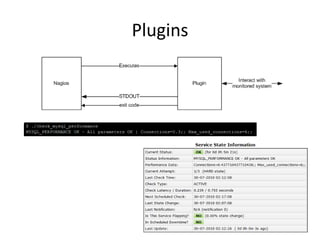
– The real monitoring is done by plugins
• Just external programs with a defined interface to
communicate with Nagios
• Written in any language
Plugins
Writing your plugins
First rule
• Is it already done?
– www.nagiosplugins.org
• Nagios official plugins

– www.monitoringexchange.org
• User contributed

– exchange.nagios.org
• User contributed

– Google “xxx nagios”
We’ll take a look at
•
•
•
•

Nagios::Plugin
Nagios::Plugin::DieNicely
Nagios::Plugin::WWW::Mechanize
Nagios::Plugin::SNMP

• Nagios::Plugin::Differences
Nagios::Plugin
• Lots of common functionality for free!
– When writing a plugin you have to
• Handle arguments
• Get and manipulate the data
• Calculate state (OK, WARNING, CRITICAL)
• Output performance data
Nagios::Plugin
• Lots of common functionality for free!
– When writing a good plugin you have to
• Handle arguments
– Standard –v –h
– Help has to contain documentation

• Get and manipulate the data
• Calculate state (OK, WARNING, CRITICAL)
– In f(x) of arguments -> STATE in a FLEXIBLE way

• Output performance data
– And worry about the format
That’s a lot of work
I just wanted to monitor my app!
Nagios::Plugin
• Lots of common functionality for free!
– When writing a good plugin you have to
• Handle arguments
– Standard –v –h

• Get and manipulate the data
• Calculate state (OK, WARNING, CRITICAL)
– In f(x) of arguments -> STATE

• Output performance data
– And worry about the format
3 Simple Steps
• Setup
• Data collection
• State calculation
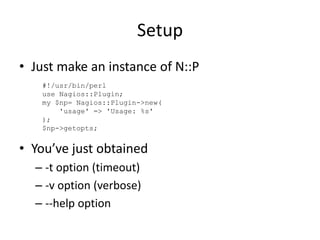
Setup
• Just make an instance of N::P
#!/usr/bin/perl
use Nagios::Plugin;
my $np= Nagios::Plugin->new(
'usage' => 'Usage: %s'
);
$np->getopts;

• You’ve just obtained
– -t option (timeout)
– -v option (verbose)
– --help option
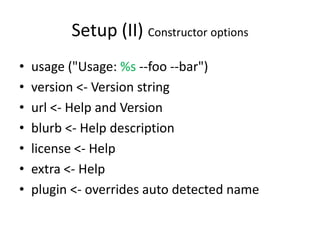
Setup (II) Constructor options
•
•
•
•
•
•
•

usage ("Usage: %s --foo --bar")
version <- Version string
url <- Help and Version
blurb <- Help description
license <- Help
extra <- Help
plugin <- overrides auto detected name
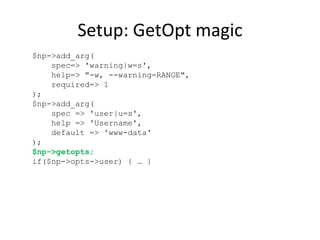
Setup: GetOpt magic
$np->add_arg(
spec=> 'warning|w=s',
help=> "-w, --warning=RANGE",
required=> 1
);
$np->add_arg(
spec => 'user|u=s',
help => 'Username',
default => 'www-data'
);
$np->getopts;
if($np->opts->user) { … }
Collect data
Now you have to work
State calculation
Ranges
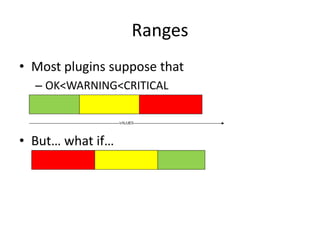
• Most plugins suppose that
– OK<WARNING<CRITICAL

• But… what if…
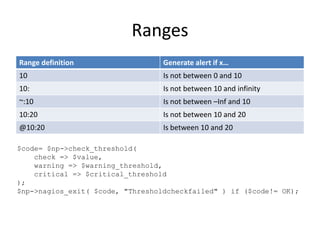
Ranges
Range definition

Generate alert if x…

10

Is not between 0 and 10

10:

Is not between 10 and infinity

~:10

Is not between –Inf and 10

10:20

Is not between 10 and 20

@10:20

Is between 10 and 20

$code= $np->check_threshold(
check => $value,
warning => $warning_threshold,
critical => $critical_threshold
);
$np->nagios_exit( $code, "Thresholdcheckfailed" ) if ($code!= OK);
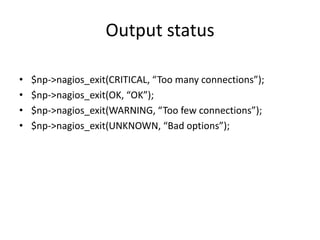
Output status
•
•
•
•

$np->nagios_exit(CRITICAL, “Too many connections”);
$np->nagios_exit(OK, “OK”);
$np->nagios_exit(WARNING, “Too few connections”);
$np->nagios_exit(UNKNOWN, “Bad options”);
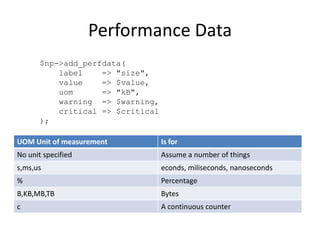
Performance Data
$np->add_perfdata(
label
=> "size",
value
=> $value,
uom
=> "kB",
warning => $warning,
critical => $critical
);
UOM Unit of measurement

Is for

No unit specified

Assume a number of things

s,ms,us

econds, miliseconds, nanoseconds

%

Percentage

B,KB,MB,TB

Bytes

c

A continuous counter
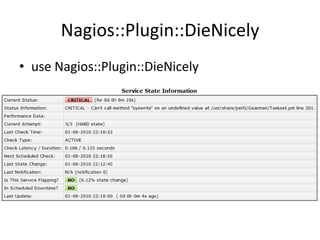
Nagios::Plugin::DieNicely
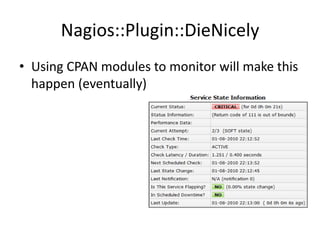
• Using CPAN modules to monitor will make this
happen (eventually)
Nagios::Plugin::DieNicely
• What happened?
Nagios::Plugin::DieNicely
• What happened?
– Output went to STDERR
• Nagios doesn’t care

– Exit code follows Perls rules
• Nagios understands 0-3
Nagios::Plugin::DieNicely
• use Nagios::Plugin::DieNicely
Nagios::Plugin::WWW::Mechanize
Nagios::Plugin
+
WWW::Mechanize
Nagios::Plugin::WWW::Mechanize
Nagios::Plugin
+
WWW::Mechanize

You where going to do it anyway!
Nagios::Plugin::WWW::Mechanize
• Again... Just create an instance. Use it as a
Nagios::Plugin object
• Automatically tracks response time for you

• $np->mech
• $np->content
• $np->get, $np->submit_form
Nagios::Plugin::WWW::Mechanize
• A couple of tricks
– Gzipped content
my $np = Nagios::Plugin::WWW::Mechanize->new(
'mech' => WWW::Mechanize::GZip->new(autocheck => 0)
);

– Proxy
my $proxy = $np->opts->proxy;
if (defined $proxy){
$np->mech->proxy(['http', 'https'], $proxy);
}
Nagios::Plugin::SNMP
Nagios::Plugin
+
Net::SNMP
Nagios::Plugin::SNMP
• Again... Just create an instance. Use it as a
Nagios::Plugin object
• Sets up a lot of arguments
• Does delta between values of counters
A module in the works
• Nagios::Plugin::Differences
– In the works. Help out with continuously growing
counters
Any Questions?

Thanks to:
Ton Voon for his hard work on Nagios::Plugin
Icanhazcheezburger for the cats

Writing nagios plugins in perl