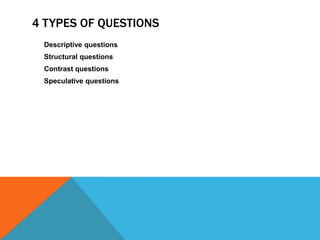
4 TYPES OF QUESTIONS
Descriptive questions
Structural questions
Contrast questions
Speculative questions
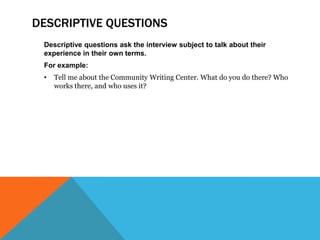
DESCRIPTIVE QUESTIONS
Descriptive questions ask the interview subject to talk about their
experience in their own terms.
For example:
• Tell me about the Community Writing Center. What do you do there? Who
works there, and who uses it?
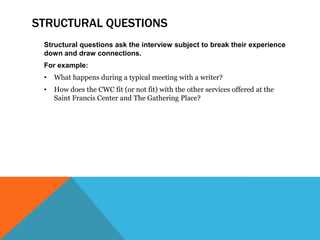
STRUCTURAL QUESTIONS
Structural questions ask the interview subject to break their experience
down and draw connections.
For example:
• What happens during a typical meeting with a writer?
• How does the CWC fit (or not fit) with the other services offered at the
Saint Francis Center and The Gathering Place?
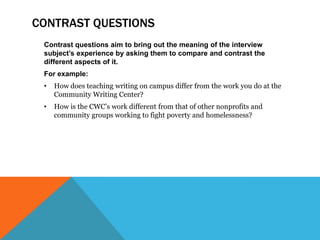
CONTRAST QUESTIONS
Contrast questions aim to bring out the meaning of the interview
subject’s experience by asking them to compare and contrast the
different aspects of it.
For example:
• How does teaching writing on campus differ from the work you do at the
Community Writing Center?
• How is the CWC’s work different from that of other nonprofits and
community groups working to fight poverty and homelessness?
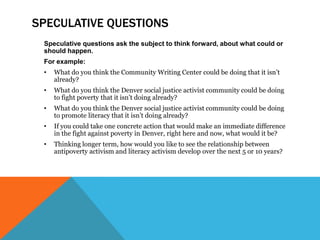
SPECULATIVE QUESTIONS
Speculative questions ask the subject to think forward, about what could or
should happen.
For example:
• What do you think the Community Writing Center could be doing that it isn’t
already?
• What do you think the Denver social justice activist community could be doing
to fight poverty that it isn’t doing already?
• What do you think the Denver social justice activist community could be doing
to promote literacy that it isn’t doing already?
• If you could take one concrete action that would make an immediate difference
in the fight against poverty in Denver, right here and now, what would it be?
• Thinking longer term, how would you like to see the relationship between
antipoverty activism and literacy activism develop over the next 5 or 10 years?

Writing interview questions

  • 2.
    4 TYPES OFQUESTIONS Descriptive questions Structural questions Contrast questions Speculative questions
  • 3.
    DESCRIPTIVE QUESTIONS Descriptive questionsask the interview subject to talk about their experience in their own terms. For example: • Tell me about the Community Writing Center. What do you do there? Who works there, and who uses it?
  • 4.
    STRUCTURAL QUESTIONS Structural questionsask the interview subject to break their experience down and draw connections. For example: • What happens during a typical meeting with a writer? • How does the CWC fit (or not fit) with the other services offered at the Saint Francis Center and The Gathering Place?
  • 5.
    CONTRAST QUESTIONS Contrast questionsaim to bring out the meaning of the interview subject’s experience by asking them to compare and contrast the different aspects of it. For example: • How does teaching writing on campus differ from the work you do at the Community Writing Center? • How is the CWC’s work different from that of other nonprofits and community groups working to fight poverty and homelessness?
  • 6.
    SPECULATIVE QUESTIONS Speculative questionsask the subject to think forward, about what could or should happen. For example: • What do you think the Community Writing Center could be doing that it isn’t already? • What do you think the Denver social justice activist community could be doing to fight poverty that it isn’t doing already? • What do you think the Denver social justice activist community could be doing to promote literacy that it isn’t doing already? • If you could take one concrete action that would make an immediate difference in the fight against poverty in Denver, right here and now, what would it be? • Thinking longer term, how would you like to see the relationship between antipoverty activism and literacy activism develop over the next 5 or 10 years?