Clean Code Best Practices
…….by Robert C. Martin
Background
• Studied
• Clean Code: A Handbook of Agile Software
Craftsmanship
• Presentation provide the summary of clean code best
practices given by Robert C martin
Meaningful Names
• Naming Rules
• Avoid mental mapping when naming methods, classes or variables
• Classes and objects should have noun or noun phrase names like
Customer, WikiPage, Account, and AddressParser etc
• Methods should have verb or verb phrase names like postPayment,
deletePage, or save .
• Accessors, mutators and predicates should be named for their value
and prefixed with get, set, and is according to the javabean standard.
• Don’t Add Gratuitous Context
• If your application Name is GSD then do not prefix GSD to class names like
GSDMailing , GSDAccountProcessing .
Meaningful Names
• Use Pronounceable Names
• The length of a name should correspond to the size of its scope
• Variables i , j could be used as loop variables
• Avoid Disinformation
• Use Intention-Revealing Names
• The name of a variable, function, or class should answer
Why it exists ? What it does ? and how it is used ?
• int d; vs int elapsedTimeInDays or int daysSinceCreation
• Variables named as hp, aix and sco should be avoided
Functions
• Should Be small
• Handle One Abstraction per function
• Function should do One Thing ,they should do it well , they should
do it only
• Prefer exceptions than Returning error codes
• Remove code duplication
• Function should not produce side effects
Comments
• Should be used when required like
• Legal terms and conditions
• Provides information about the intent
• Clarification
• Warning of consequences
• TODO comments
• Java Docs in public API
Comments
• Following comments would be considered as Bad
comments if they are
• Redundant
• Misleading
• Java docs in non public code
• Journal
• Noise
• Closing brace
• Dead code
Formatting
• Team should decide the formatting/indentation strategy and
everyone in the team should follow this strategy
• Strategy could be about
• Vertical formatting . Recommended No. of Lines per Java source File
• Vertical Openness between concepts
• Variable declaration – Local variables and instance variables
• Dependant functions should be just below the caller
• Horizontal formatting – line should be less than 120 chars
• Indentation - should not break indentation for small if or loop
statements
Objects and Data Structures
• Data/Object Anti-Symmetry
• Objects hide their data behind abstractions and expose
functions that operate on that data
• Data structure expose their data and have no meaningful
functions.
• Sometimes you really do want simple data structures with
procedures operating on them. Data Structures like Value
Objects, Beans , DTO’s recommends having setters and
getters
• Data structures Should not contain business rule methods
Objects and Data Structures
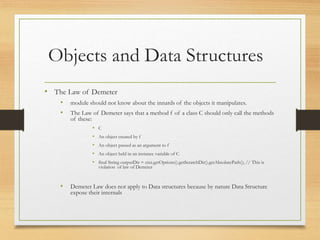
• The Law of Demeter
• module should not know about the innards of the objects it manipulates.
• The Law of Demeter says that a method f of a class C should only call the methods
of these:
• C
• An object created by f
• An object passed as an argument to f
• An object held in an instance variable of C
• final String outputDir = ctxt.getOptions().getScratchDir().getAbsolutePath(); // This is
violation of law of Demeter
• Demeter Law does not apply to Data structures because by nature Data Structure
expose their internals
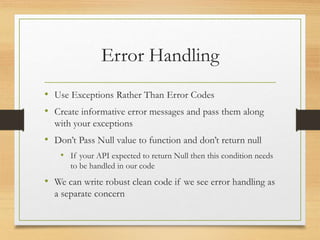
Error Handling
• Use Exceptions Rather Than Error Codes
• Create informative error messages and pass them along
with your exceptions
• Don’t Pass Null value to function and don’t return null
• If your API expected to return Null then this condition needs
to be handled in our code
• We can write robust clean code if we see error handling as
a separate concern
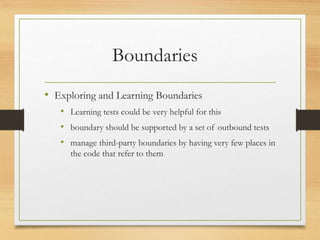
Boundaries
• Exploring and Learning Boundaries
• Learning tests could be very helpful for this
• boundary should be supported by a set of outbound tests
• manage third-party boundaries by having very few places in
the code that refer to them
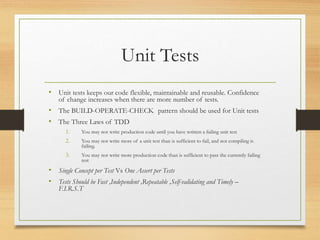
Unit Tests
• Unit tests keeps our code flexible, maintainable and reusable. Confidence
of change increases when there are more number of tests.
• The BUILD-OPERATE-CHECK pattern should be used for Unit tests
• The Three Laws of TDD
1. You may not write production code until you have written a failing unit test
2. You may not write more of a unit test than is sufficient to fail, and not compiling is
failing.
3. You may not write more production code than is sufficient to pass the currently failing
test
• Single Concept per Test Vs One Assert per Tests
• Tests Should be Fast ,Independent ,Repeatable ,Self-validating and Timely –
F.I.R.S.T
Classes
• Classes should Be small
• Single Responsibility Principal – There should be only one
reason to change the class
• Open Close Principal – Class should be Open for
extension and close for modification
• Classes should have High Cohesion and Loose Coupling
References
• Clean Code book by Robert C Martin

Writing Clean Code (Recommendations by Robert Martin)

  • 1.
    Clean Code BestPractices …….by Robert C. Martin
  • 2.
    Background • Studied • CleanCode: A Handbook of Agile Software Craftsmanship • Presentation provide the summary of clean code best practices given by Robert C martin
  • 3.
    Meaningful Names • NamingRules • Avoid mental mapping when naming methods, classes or variables • Classes and objects should have noun or noun phrase names like Customer, WikiPage, Account, and AddressParser etc • Methods should have verb or verb phrase names like postPayment, deletePage, or save . • Accessors, mutators and predicates should be named for their value and prefixed with get, set, and is according to the javabean standard. • Don’t Add Gratuitous Context • If your application Name is GSD then do not prefix GSD to class names like GSDMailing , GSDAccountProcessing .
  • 4.
    Meaningful Names • UsePronounceable Names • The length of a name should correspond to the size of its scope • Variables i , j could be used as loop variables • Avoid Disinformation • Use Intention-Revealing Names • The name of a variable, function, or class should answer Why it exists ? What it does ? and how it is used ? • int d; vs int elapsedTimeInDays or int daysSinceCreation • Variables named as hp, aix and sco should be avoided
  • 5.
    Functions • Should Besmall • Handle One Abstraction per function • Function should do One Thing ,they should do it well , they should do it only • Prefer exceptions than Returning error codes • Remove code duplication • Function should not produce side effects
  • 6.
    Comments • Should beused when required like • Legal terms and conditions • Provides information about the intent • Clarification • Warning of consequences • TODO comments • Java Docs in public API
  • 7.
    Comments • Following commentswould be considered as Bad comments if they are • Redundant • Misleading • Java docs in non public code • Journal • Noise • Closing brace • Dead code
  • 8.
    Formatting • Team shoulddecide the formatting/indentation strategy and everyone in the team should follow this strategy • Strategy could be about • Vertical formatting . Recommended No. of Lines per Java source File • Vertical Openness between concepts • Variable declaration – Local variables and instance variables • Dependant functions should be just below the caller • Horizontal formatting – line should be less than 120 chars • Indentation - should not break indentation for small if or loop statements
  • 9.
    Objects and DataStructures • Data/Object Anti-Symmetry • Objects hide their data behind abstractions and expose functions that operate on that data • Data structure expose their data and have no meaningful functions. • Sometimes you really do want simple data structures with procedures operating on them. Data Structures like Value Objects, Beans , DTO’s recommends having setters and getters • Data structures Should not contain business rule methods
  • 10.
    Objects and DataStructures • The Law of Demeter • module should not know about the innards of the objects it manipulates. • The Law of Demeter says that a method f of a class C should only call the methods of these: • C • An object created by f • An object passed as an argument to f • An object held in an instance variable of C • final String outputDir = ctxt.getOptions().getScratchDir().getAbsolutePath(); // This is violation of law of Demeter • Demeter Law does not apply to Data structures because by nature Data Structure expose their internals
  • 11.
    Error Handling • UseExceptions Rather Than Error Codes • Create informative error messages and pass them along with your exceptions • Don’t Pass Null value to function and don’t return null • If your API expected to return Null then this condition needs to be handled in our code • We can write robust clean code if we see error handling as a separate concern
  • 12.
    Boundaries • Exploring andLearning Boundaries • Learning tests could be very helpful for this • boundary should be supported by a set of outbound tests • manage third-party boundaries by having very few places in the code that refer to them
  • 13.
    Unit Tests • Unittests keeps our code flexible, maintainable and reusable. Confidence of change increases when there are more number of tests. • The BUILD-OPERATE-CHECK pattern should be used for Unit tests • The Three Laws of TDD 1. You may not write production code until you have written a failing unit test 2. You may not write more of a unit test than is sufficient to fail, and not compiling is failing. 3. You may not write more production code than is sufficient to pass the currently failing test • Single Concept per Test Vs One Assert per Tests • Tests Should be Fast ,Independent ,Repeatable ,Self-validating and Timely – F.I.R.S.T
  • 14.
    Classes • Classes shouldBe small • Single Responsibility Principal – There should be only one reason to change the class • Open Close Principal – Class should be Open for extension and close for modification • Classes should have High Cohesion and Loose Coupling
  • 15.
    References • Clean Codebook by Robert C Martin