
Get it Write the First Time
Writing Better User Stories
Chris Urban, Engagement Manager
chris.urban@acquia.com
@_urban_ d.o:urbanlegend
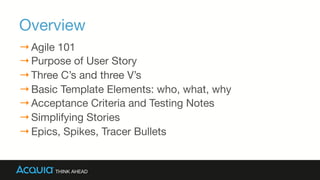
Overview
→ Agile 101
→ Purpose of User Story
→ Three C’s and three V’s
→ Basic Template Elements: who, what, why
→ Acceptance Criteria and Testing Notes
→ Simplifying Stories
→ Epics, Spikes, Tracer Bullets
FOUNDATION
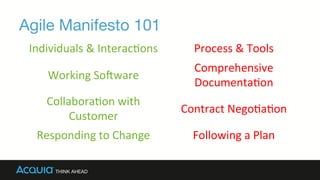
Agile Manifesto 101
Individuals	
  &	
  Interac0ons	
   Process	
  &	
  Tools	
  
Working	
  So8ware	
  
Comprehensive	
  
Documenta0on	
  
Collabora0on	
  with	
  
Customer	
  
Contract	
  Nego0a0on	
  
Responding	
  to	
  Change	
   Following	
  a	
  Plan	
  
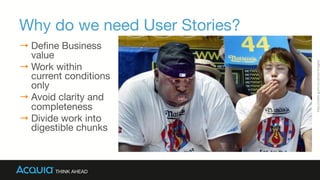
Why do we need User Stories?
→ Define Business
value
→ Work within
current conditions
only
→ Avoid clarity and
completeness
→ Divide work into
digestible chunks
hCp://sta0c.guim.co.uk/sys-­‐images/	
  
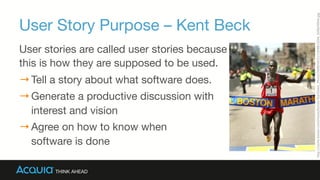
User Story Purpose – Kent Beck
User stories are called user stories because 

this is how they are supposed to be used.
→ Tell a story about what software does.
→ Generate a productive discussion with

interest and vision
→ Agree on how to know when 

software is done
hCp://cache.boston.com/resize/bonzai-­‐Ja/Globe_Photo/2008/04/21/1208810294_9299/499w.jpg	
  
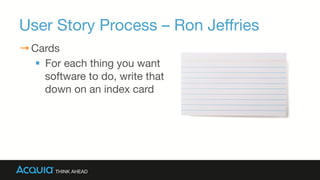
User Story Process – Ron Jeffries
→ Cards
§  For each thing you want
software to do, write that
down on an index card
User Story Process – Ron Jeffries
→ Conversation
§  Reconcile what the person writing the story 

and the person building it both understand
§  Discuss to discover different interpretations
§  Clarify and refine the story
§  Discuss to explore solution scenarios
User Story Process – Ron Jeffries
→ Confirmation
§  Once it is built, how do you check that it’s done?
§  Check against a list of things (acceptance criteria)
§  Demonstrate functionality
hCp://thumbs.dreams0me.com/z/birthday-­‐cake-­‐14569616.jpg	
  
hCp://www.freelargeimages.com/wp-­‐content/uploads/2014/11/Happy_birthday_cake-­‐6.jpg	
  
Product Owners
→ VISION – Define the goals for the product
→ VALUE – What is it worth to the business
→ VERBAGE – Business language and logic
Template Zombies
Template Zombies – Tom DeMarco
→ The project team allows its work to be driven by
template instead of by the thought process necessary to
deliver products.
→ The value of writing user stories is not what’s written
down, it is what we learn as we tell the story.
→ Think about the core value the story helps to achieve
Best Practices
→ Don’t be a template zombie – think about the story, not
the template
→ Personas 
→ Define goals clearly
→ Simplify the story
Let’s look at examples!
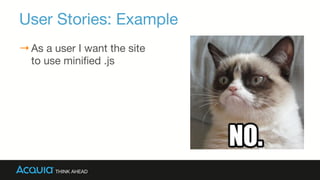
User Stories: Example
→ As a user I want the site
to use minified .js
User Story Template
WHO
→ Personas - not just a ‘user’ but a broader kind of user
§  Business customer, Stakeholders
§  Anonymous users, authenticated users
§  Specific use case if it helps to explain the story better
§  Content editor, content creator
User Story Template
WHAT
→ Explains the desired end result or the task to be
accomplished 
→ Basic tasks
→ Underlying systems and services
→ UI and UX
→ Understanding process
User Story Template
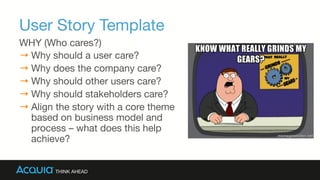
WHY (Who cares?)
→ Why should a user care?
→ Why does the company care?
→ Why should other users care?
→ Why should stakeholders care?
→ Align the story with a core theme
based on business model and
process – what does this help
achieve?
User Story Template
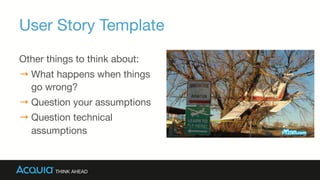
Other things to think about:
→ What happens when things
go wrong?
→ Question your assumptions
→ Question technical
assumptions
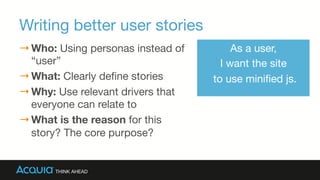
Writing better user stories
→ Who: Using personas instead of
“user”
→ What: Clearly define stories
→ Why: Use relevant drivers that
everyone can relate to
→ What is the reason for this
story? The core purpose?
As a user, 
I want the site
to use minified js.
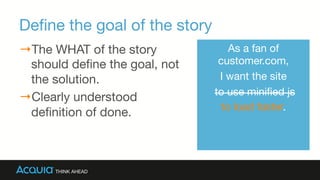
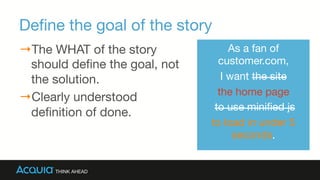
Define the goal of the story
→ The WHAT of the story
should define the goal, not
the solution.
→ Clearly understood
definition of done.
As a fan of
customer.com, 
I want the site
to use minified js 
to load faster.
Define the goal of the story
→ The WHAT of the story
should define the goal, not
the solution.
→ Clearly understood
definition of done.
As a fan of
customer.com, 
I want the site
the home page
to use minified js 
to load in under 5
seconds.
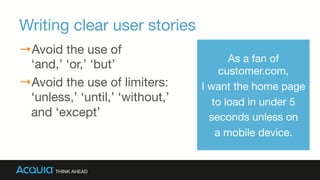
Writing clear user stories
→ Avoid the use of

‘and,’ ‘or,’ ‘but’
→ Avoid the use of limiters:
‘unless,’ ‘until,’ ‘without,’
and ‘except’
As a fan of
customer.com, 
I want the home page 
to load in under 5 
seconds unless on
a mobile device.
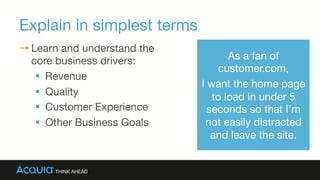
Explain in simplest terms
→ Learn and understand the
core business drivers:
§  Revenue
§  Quality
§  Customer Experience
§  Other Business Goals
As a fan of
customer.com, 
I want the home page
to load in under 5
seconds so that I’m
not easily distracted
and leave the site.
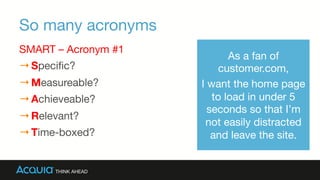
So many acronyms
SMART – Acronym #1
→ Specific?
→ Measureable?
→ Achieveable?
→ Relevant?
→ Time-boxed?
As a fan of
customer.com, 
I want the home page
to load in under 5
seconds so that I’m
not easily distracted
and leave the site.
So many acronyms
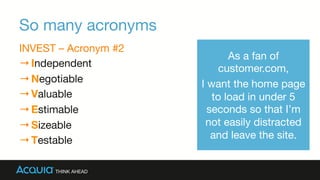
INVEST – Acronym #2
→ Independent
→ Negotiable
→ Valuable
→ Estimable
→ Sizeable
→ Testable
As a fan of
customer.com, 
I want the home page
to load in under 5
seconds so that I’m
not easily distracted
and leave the site.
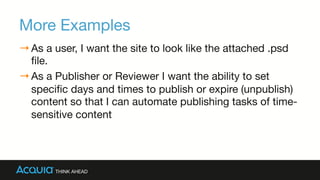
More Examples
→ As a user, I want the site to look like the attached .psd
file.
→ As a Publisher or Reviewer I want the ability to set
specific days and times to publish or expire (unpublish)
content so that I can automate publishing tasks of time-
sensitive content
Acceptance Criteria
→ Easiest format to remember:
→ Given that [someone wants to do something]
→ When s/he [performs action]
→ Then [something happens that can be verified]
Testing Notes
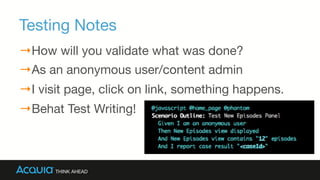
→ How will you validate what was done?
→ As an anonymous user/content admin
→ I visit page, click on link, something happens.
→ Behat Test Writing!
Other Tips & Tricks
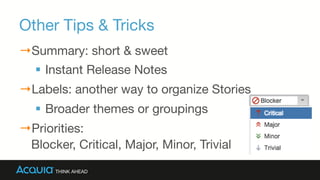
→ Summary: short & sweet
§  Instant Release Notes
→ Labels: another way to organize Stories
§  Broader themes or groupings
→ Priorities: 

Blocker, Critical, Major, Minor, Trivial
Reducing Stories Down
→ Consider CRUD
§  Create, Read, Update, Delete
→ Consider Personas
§  Users, Content Editors, Administrators
→ Consider Business Value
§  Logic, Added Value, New Product
hCp://1.bp.blogspot.com/-­‐3D_G06zTDow/TnchxEt8CjI/AAAAAAAAFdw/nuts-­‐
UTz_Ho/s1600/TenCommand3_034Pyxurz.jpg	
  
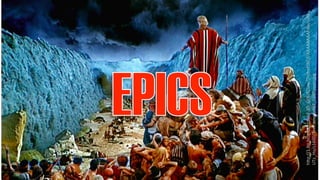
Epic Organization
→ Section of a site
→ Loose group of associated tickets
→ Key deliverable in a site
hCp://st.depositphotos.com/1704023/3783/i/950/depositphotos_37838161-­‐separated-­‐two-­‐building-­‐
construc0on-­‐phases.jpg	
  
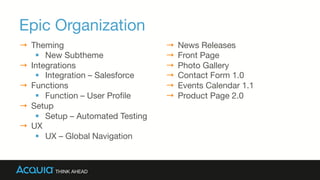
Epic Organization
→  Theming
§  New Subtheme
→  Integrations
§  Integration – Salesforce
→  Functions
§  Function – User Profile
→  Setup
§  Setup – Automated Testing
→  UX
§  UX – Global Navigation
→  News Releases
→  Front Page
→  Photo Gallery
→  Contact Form 1.0
→  Events Calendar 1.1
→  Product Page 2.0
hCp://3.bp.blogspot.com/_kVBIKsx0ZqQ/SyWVYZealAI/AAAAAAAACUU/ACt1mZ0aUIQ/
s400/1120330742_1883557605_bio-­‐tvography-­‐buffy-­‐the-­‐vampire-­‐slayer-­‐lf11.jpg	
  
Best Practices: Spikes


→ Research task
→ Usually timeboxed
→ Answers if something is possible
→ Not deliverable code, but throwaway work
:	
  hCps://russellex.wordpress.com/category/experimental-­‐film-­‐research/	
  
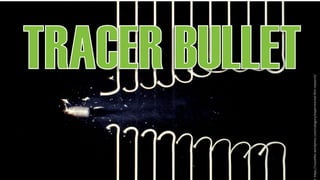
Best Practices: Tracer Bullet


→ Narrow slice through layers of an epic
→ Single focused goal
→ Solve key architecture or design issues
→ Could be [the basis of] deliverable code
ONE MORE THING
SUB-TASKS
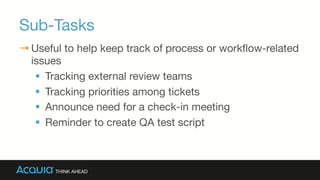
Sub-Tasks
→ Useful to help keep track of process or workflow-related
issues
§  Tracking external review teams
§  Tracking priorities among tickets
§  Announce need for a check-in meeting
§  Reminder to create QA test script
JIRA Components
→ Associate with content types “Content: Article”
→ Organizes tickets to optimize traceability
→ Subset QA Testing
→ Utilize general use cases “Content Editing,” “Image
Editing”
→ Add others based on Epics “Analytics,” “Advertising,”
“Metadata,” “Global Menu,” “Footer”
What You Learned
→ Agile Manifesto
→ Not to be a Zombie
→ User Stories: 3Cs and 3Vs
→ User Stories: 

SMART INVESTING
→ How to Simplify & Clarify
→ Personas

→ Epics
→ Spikes
→ Tracer Bullets
→ Use Components
→ Sub-Tasks
→ Other tips & tricks
Questions?
Chris Urban, Engagement Manager
chris.urban@acquia.com
@_urban_ d.o:urbanlegend

Writing better user stories

  • 1.
    Get it Writethe First Time Writing Better User Stories Chris Urban, Engagement Manager chris.urban@acquia.com @_urban_ d.o:urbanlegend
  • 3.
    Overview → Agile 101 → Purpose ofUser Story → Three C’s and three V’s → Basic Template Elements: who, what, why → Acceptance Criteria and Testing Notes → Simplifying Stories → Epics, Spikes, Tracer Bullets
  • 4.
  • 5.
    Agile Manifesto 101 Individuals  &  Interac0ons   Process  &  Tools   Working  So8ware   Comprehensive   Documenta0on   Collabora0on  with   Customer   Contract  Nego0a0on   Responding  to  Change   Following  a  Plan  
  • 6.
    Why do weneed User Stories? → Define Business value → Work within current conditions only → Avoid clarity and completeness → Divide work into digestible chunks hCp://sta0c.guim.co.uk/sys-­‐images/  
  • 7.
    User Story Purpose– Kent Beck User stories are called user stories because 
 this is how they are supposed to be used. → Tell a story about what software does. → Generate a productive discussion with
 interest and vision → Agree on how to know when 
 software is done hCp://cache.boston.com/resize/bonzai-­‐Ja/Globe_Photo/2008/04/21/1208810294_9299/499w.jpg  
  • 8.
    User Story Process– Ron Jeffries → Cards §  For each thing you want software to do, write that down on an index card
  • 9.
    User Story Process– Ron Jeffries → Conversation §  Reconcile what the person writing the story 
 and the person building it both understand §  Discuss to discover different interpretations §  Clarify and refine the story §  Discuss to explore solution scenarios
  • 10.
    User Story Process– Ron Jeffries → Confirmation §  Once it is built, how do you check that it’s done? §  Check against a list of things (acceptance criteria) §  Demonstrate functionality
  • 12.
  • 13.
  • 15.
    Product Owners → VISION –Define the goals for the product → VALUE – What is it worth to the business → VERBAGE – Business language and logic
  • 16.
  • 17.
    Template Zombies –Tom DeMarco → The project team allows its work to be driven by template instead of by the thought process necessary to deliver products. → The value of writing user stories is not what’s written down, it is what we learn as we tell the story. → Think about the core value the story helps to achieve
  • 18.
    Best Practices → Don’t bea template zombie – think about the story, not the template → Personas → Define goals clearly → Simplify the story Let’s look at examples!
  • 20.
    User Stories: Example → Asa user I want the site to use minified .js
  • 21.
    User Story Template WHO → Personas- not just a ‘user’ but a broader kind of user §  Business customer, Stakeholders §  Anonymous users, authenticated users §  Specific use case if it helps to explain the story better §  Content editor, content creator
  • 22.
    User Story Template WHAT → Explainsthe desired end result or the task to be accomplished → Basic tasks → Underlying systems and services → UI and UX → Understanding process
  • 23.
    User Story Template WHY(Who cares?) → Why should a user care? → Why does the company care? → Why should other users care? → Why should stakeholders care? → Align the story with a core theme based on business model and process – what does this help achieve?
  • 24.
    User Story Template Otherthings to think about: → What happens when things go wrong? → Question your assumptions → Question technical assumptions
  • 25.
    Writing better userstories → Who: Using personas instead of “user” → What: Clearly define stories → Why: Use relevant drivers that everyone can relate to → What is the reason for this story? The core purpose? As a user, I want the site to use minified js.
  • 26.
    Define the goalof the story → The WHAT of the story should define the goal, not the solution. → Clearly understood definition of done. As a fan of customer.com, I want the site to use minified js to load faster.
  • 27.
    Define the goalof the story → The WHAT of the story should define the goal, not the solution. → Clearly understood definition of done. As a fan of customer.com, I want the site the home page to use minified js to load in under 5 seconds.
  • 28.
    Writing clear userstories → Avoid the use of
 ‘and,’ ‘or,’ ‘but’ → Avoid the use of limiters: ‘unless,’ ‘until,’ ‘without,’ and ‘except’ As a fan of customer.com, I want the home page to load in under 5 seconds unless on a mobile device.
  • 29.
    Explain in simplestterms → Learn and understand the core business drivers: §  Revenue §  Quality §  Customer Experience §  Other Business Goals As a fan of customer.com, I want the home page to load in under 5 seconds so that I’m not easily distracted and leave the site.
  • 30.
    So many acronyms SMART– Acronym #1 → Specific? → Measureable? → Achieveable? → Relevant? → Time-boxed? As a fan of customer.com, I want the home page to load in under 5 seconds so that I’m not easily distracted and leave the site.
  • 31.
    So many acronyms INVEST– Acronym #2 → Independent → Negotiable → Valuable → Estimable → Sizeable → Testable As a fan of customer.com, I want the home page to load in under 5 seconds so that I’m not easily distracted and leave the site.
  • 32.
    More Examples → As auser, I want the site to look like the attached .psd file. → As a Publisher or Reviewer I want the ability to set specific days and times to publish or expire (unpublish) content so that I can automate publishing tasks of time- sensitive content
  • 33.
    Acceptance Criteria → Easiest formatto remember: → Given that [someone wants to do something] → When s/he [performs action] → Then [something happens that can be verified]
  • 34.
    Testing Notes → How willyou validate what was done? → As an anonymous user/content admin → I visit page, click on link, something happens. → Behat Test Writing!
  • 35.
    Other Tips &Tricks → Summary: short & sweet §  Instant Release Notes → Labels: another way to organize Stories §  Broader themes or groupings → Priorities: 
 Blocker, Critical, Major, Minor, Trivial
  • 36.
    Reducing Stories Down → ConsiderCRUD §  Create, Read, Update, Delete → Consider Personas §  Users, Content Editors, Administrators → Consider Business Value §  Logic, Added Value, New Product
  • 37.
  • 38.
    Epic Organization → Section ofa site → Loose group of associated tickets → Key deliverable in a site
  • 39.
  • 40.
    Epic Organization →  Theming § New Subtheme →  Integrations §  Integration – Salesforce →  Functions §  Function – User Profile →  Setup §  Setup – Automated Testing →  UX §  UX – Global Navigation →  News Releases →  Front Page →  Photo Gallery →  Contact Form 1.0 →  Events Calendar 1.1 →  Product Page 2.0
  • 41.
  • 42.
    Best Practices: Spikes
 → Researchtask → Usually timeboxed → Answers if something is possible → Not deliverable code, but throwaway work
  • 43.
  • 44.
    Best Practices: TracerBullet
 → Narrow slice through layers of an epic → Single focused goal → Solve key architecture or design issues → Could be [the basis of] deliverable code
  • 45.
  • 46.
  • 47.
    Sub-Tasks → Useful to helpkeep track of process or workflow-related issues §  Tracking external review teams §  Tracking priorities among tickets §  Announce need for a check-in meeting §  Reminder to create QA test script
  • 49.
    JIRA Components → Associate withcontent types “Content: Article” → Organizes tickets to optimize traceability → Subset QA Testing → Utilize general use cases “Content Editing,” “Image Editing” → Add others based on Epics “Analytics,” “Advertising,” “Metadata,” “Global Menu,” “Footer”
  • 50.
    What You Learned → AgileManifesto → Not to be a Zombie → User Stories: 3Cs and 3Vs → User Stories: 
 SMART INVESTING → How to Simplify & Clarify → Personas → Epics → Spikes → Tracer Bullets → Use Components → Sub-Tasks → Other tips & tricks
  • 51.
    Questions? Chris Urban, EngagementManager chris.urban@acquia.com @_urban_ d.o:urbanlegend