Welcome everybody
Worldwide Responsible Accredited Production.
WRAP
Bangladesh Institute of Management
Conducted By
Md. Motaher Hossain
Lead Auditor ISO 9001:2008
Lead Auditor SA8000
Lead Auditor WRAP
Lead Auditor OHSAS 18001
Lead Auditor ISO 14001
Social Compliance System Trainer
THE WRAP PROGRAM
The objective of the WRAP Certification Program is to
promote and certify lawful, human and ethical working
conditions in manufacturing, processing and service
industries throughout the world.
WRAP – Background and origins
• Unified response to public attacks on the Apparel
Industry and the desire by industry to be socially
responsible.
• Over 85% of US/EU apparel produced OFF SHORE –
shifts focus on to suppliers.
• Enable lawful, ethical, and humane manufacturing
conditions
WRAP- Background and origins
• Recognition of diverse (sovereign) laws, cultures, &
workplace conditions.
WRAP- Background and origins
• Supported by American Apparel & Footwear Association
• Input from brands, suppliers, NGOs, academics &
governments
• Reviewed corporate, industry, multi-lateral organization
codes & national laws.
• ILO & U.N. Human Rights conventions.
WRAP- Background and origins
• Administered by non-profit organization
• Designed for sewn manufacturing industry; in particular –
apparel/textile and footwear.
• NOT a membership club.
• Based on universally recognized minimum standards – ILO
Conventions
• Compliance to national laws and respect for local cultures.
WRAP Program Features
• Voluntary factory participation
• Compliance verified by WRAP accredited independent
monitors.
• Oversight and certification by independent Board of
Directors.
• Technical training support as needed.
WRAP Program Features
On-going updating of program through input by
International Advisory Group
Who is who in WRAP
• Avedis Seferian President & CEO
• Stuart Webster Director of Training
• Hong Mei Compliance Certification Manager
• Yin Yin Communications Specialist
• Dawn Williams Office Manager
• Venda Cheung Hong Kong Office Manager
• Joseph Lok Manager, Training & Compliance
• Francis Yuk Senior Vice President
WRAP Principles
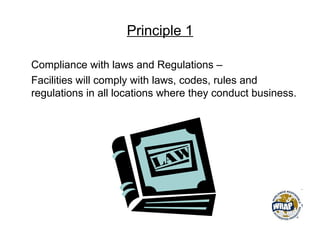
Principle 1
Compliance with laws and Regulations –
Facilities will comply with laws, codes, rules and
regulations in all locations where they conduct business.
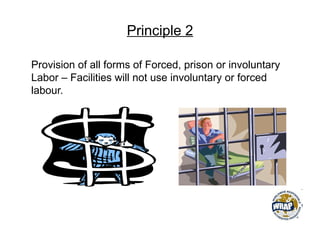
Principle 2
Provision of all forms of Forced, prison or involuntary
Labor – Facilities will not use involuntary or forced
labour.
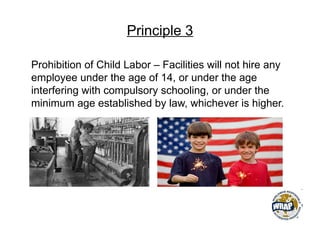
Principle 3
Prohibition of Child Labor – Facilities will not hire any
employee under the age of 14, or under the age
interfering with compulsory schooling, or under the
minimum age established by law, whichever is higher.
Principle 4
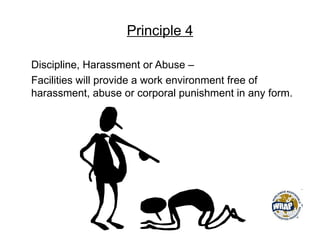
Discipline, Harassment or Abuse –
Facilities will provide a work environment free of
harassment, abuse or corporal punishment in any form.
Principle 5
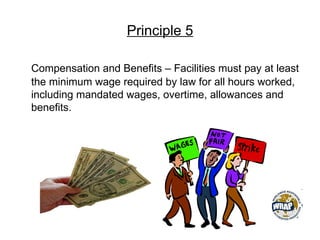
Compensation and Benefits – Facilities must pay at least
the minimum wage required by law for all hours worked,
including mandated wages, overtime, allowances and
benefits.
Principle 6
Hours of Work – Hours worked each day, and days
worked each week, shall not exceed the legal limitations
of the countries in which facility is located. Facilities will
provide at least one day off in every seven-day period,
except as required to meet urgent business needs.
Principle 7
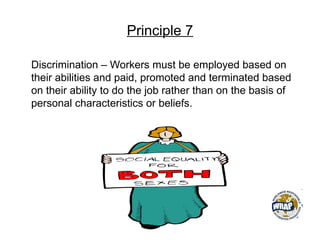
Discrimination – Workers must be employed based on
their abilities and paid, promoted and terminated based
on their ability to do the job rather than on the basis of
personal characteristics or beliefs.
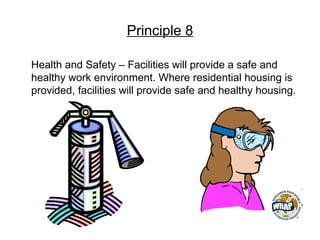
Principle 8
Health and Safety – Facilities will provide a safe and
healthy work environment. Where residential housing is
provided, facilities will provide safe and healthy housing.
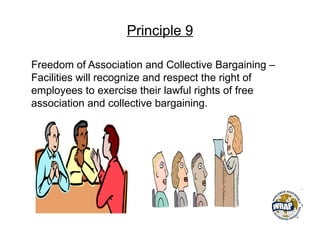
Principle 9
Freedom of Association and Collective Bargaining –
Facilities will recognize and respect the right of
employees to exercise their lawful rights of free
association and collective bargaining.
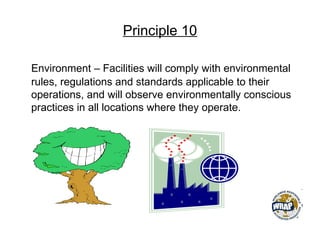
Principle 10
Environment – Facilities will comply with environmental
rules, regulations and standards applicable to their
operations, and will observe environmentally conscious
practices in all locations where they operate.
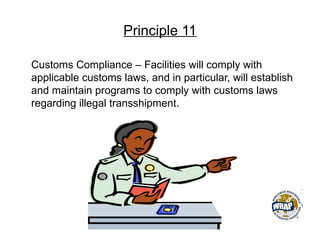
Principle 11
Customs Compliance – Facilities will comply with
applicable customs laws, and in particular, will establish
and maintain programs to comply with customs laws
regarding illegal transshipment.
Principle 12
Security – facilities will maintain facility security
procedures to guard against the introduction of non-
manifested cargo into outbound shipments (i.e. drugs,
explosives biohazards and /or other contraband).
WRAP
CERTIFICATION
PROCESS
How do you achieve Certification?
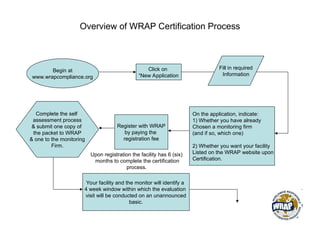
Overview of WRAP Certification Process
Begin at
www.wrapcompliance.org
Click on
“New Application
On the application, indicate:
1) Whether you have already
Chosen a monitoring firm
(and if so, which one)
2) Whether you want your facility
Listed on the WRAP website upon
Certification.
Register with WRAP
by paying the
registration fee
Your facility and the monitor will identify a
4 week window within which the evaluation
visit will be conducted on an unannounced
basic.
Fill in required
Information
Complete the self
assessment process
& submit one copy of
the packet to WRAP
& one to the monitoring
Firm.
Upon registration the facility has 6 (six)
months to complete the certification
process.
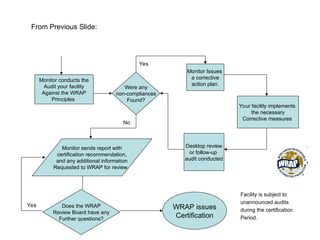
From Previous Slide:
Monitor conducts the
Audit your facility
Against the WRAP
Principles
Were any
non-compliances
Found?
Yes
Monitor Issues
a corrective
action plan.
Your facility implements
the necessary
Corrective measures
Desktop review
or follow-up
audit conducted
Monitor sends report with
certification recommendation,
and any additional information
Requested to WRAP for review.
No
Does the WRAP
Review Board have any
Further questions?
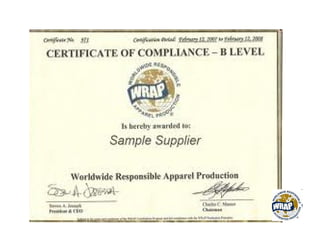
Yes WRAP issues
Certification
Facility is subject to
unannounced audits
during the certification
Period.
The End

WRAP Worldwide Responsible Accredited Production

  • 1.
    Welcome everybody Worldwide ResponsibleAccredited Production. WRAP Bangladesh Institute of Management Conducted By Md. Motaher Hossain Lead Auditor ISO 9001:2008 Lead Auditor SA8000 Lead Auditor WRAP Lead Auditor OHSAS 18001 Lead Auditor ISO 14001 Social Compliance System Trainer
  • 2.
    THE WRAP PROGRAM Theobjective of the WRAP Certification Program is to promote and certify lawful, human and ethical working conditions in manufacturing, processing and service industries throughout the world.
  • 3.
    WRAP – Backgroundand origins • Unified response to public attacks on the Apparel Industry and the desire by industry to be socially responsible. • Over 85% of US/EU apparel produced OFF SHORE – shifts focus on to suppliers. • Enable lawful, ethical, and humane manufacturing conditions
  • 4.
    WRAP- Background andorigins • Recognition of diverse (sovereign) laws, cultures, & workplace conditions.
  • 5.
    WRAP- Background andorigins • Supported by American Apparel & Footwear Association • Input from brands, suppliers, NGOs, academics & governments • Reviewed corporate, industry, multi-lateral organization codes & national laws. • ILO & U.N. Human Rights conventions.
  • 6.
    WRAP- Background andorigins • Administered by non-profit organization • Designed for sewn manufacturing industry; in particular – apparel/textile and footwear. • NOT a membership club. • Based on universally recognized minimum standards – ILO Conventions • Compliance to national laws and respect for local cultures.
  • 7.
    WRAP Program Features •Voluntary factory participation • Compliance verified by WRAP accredited independent monitors. • Oversight and certification by independent Board of Directors. • Technical training support as needed.
  • 8.
    WRAP Program Features On-goingupdating of program through input by International Advisory Group
  • 9.
    Who is whoin WRAP • Avedis Seferian President & CEO • Stuart Webster Director of Training • Hong Mei Compliance Certification Manager • Yin Yin Communications Specialist • Dawn Williams Office Manager • Venda Cheung Hong Kong Office Manager • Joseph Lok Manager, Training & Compliance • Francis Yuk Senior Vice President
  • 10.
  • 11.
    Principle 1 Compliance withlaws and Regulations – Facilities will comply with laws, codes, rules and regulations in all locations where they conduct business.
  • 12.
    Principle 2 Provision ofall forms of Forced, prison or involuntary Labor – Facilities will not use involuntary or forced labour.
  • 13.
    Principle 3 Prohibition ofChild Labor – Facilities will not hire any employee under the age of 14, or under the age interfering with compulsory schooling, or under the minimum age established by law, whichever is higher.
  • 14.
    Principle 4 Discipline, Harassmentor Abuse – Facilities will provide a work environment free of harassment, abuse or corporal punishment in any form.
  • 15.
    Principle 5 Compensation andBenefits – Facilities must pay at least the minimum wage required by law for all hours worked, including mandated wages, overtime, allowances and benefits.
  • 16.
    Principle 6 Hours ofWork – Hours worked each day, and days worked each week, shall not exceed the legal limitations of the countries in which facility is located. Facilities will provide at least one day off in every seven-day period, except as required to meet urgent business needs.
  • 17.
    Principle 7 Discrimination –Workers must be employed based on their abilities and paid, promoted and terminated based on their ability to do the job rather than on the basis of personal characteristics or beliefs.
  • 18.
    Principle 8 Health andSafety – Facilities will provide a safe and healthy work environment. Where residential housing is provided, facilities will provide safe and healthy housing.
  • 19.
    Principle 9 Freedom ofAssociation and Collective Bargaining – Facilities will recognize and respect the right of employees to exercise their lawful rights of free association and collective bargaining.
  • 20.
    Principle 10 Environment –Facilities will comply with environmental rules, regulations and standards applicable to their operations, and will observe environmentally conscious practices in all locations where they operate.
  • 21.
    Principle 11 Customs Compliance– Facilities will comply with applicable customs laws, and in particular, will establish and maintain programs to comply with customs laws regarding illegal transshipment.
  • 22.
    Principle 12 Security –facilities will maintain facility security procedures to guard against the introduction of non- manifested cargo into outbound shipments (i.e. drugs, explosives biohazards and /or other contraband).
  • 23.
  • 24.
    How do youachieve Certification?
  • 25.
    Overview of WRAPCertification Process Begin at www.wrapcompliance.org Click on “New Application On the application, indicate: 1) Whether you have already Chosen a monitoring firm (and if so, which one) 2) Whether you want your facility Listed on the WRAP website upon Certification. Register with WRAP by paying the registration fee Your facility and the monitor will identify a 4 week window within which the evaluation visit will be conducted on an unannounced basic. Fill in required Information Complete the self assessment process & submit one copy of the packet to WRAP & one to the monitoring Firm. Upon registration the facility has 6 (six) months to complete the certification process.
  • 26.
    From Previous Slide: Monitorconducts the Audit your facility Against the WRAP Principles Were any non-compliances Found? Yes Monitor Issues a corrective action plan. Your facility implements the necessary Corrective measures Desktop review or follow-up audit conducted Monitor sends report with certification recommendation, and any additional information Requested to WRAP for review. No Does the WRAP Review Board have any Further questions? Yes WRAP issues Certification Facility is subject to unannounced audits during the certification Period.
  • 28.