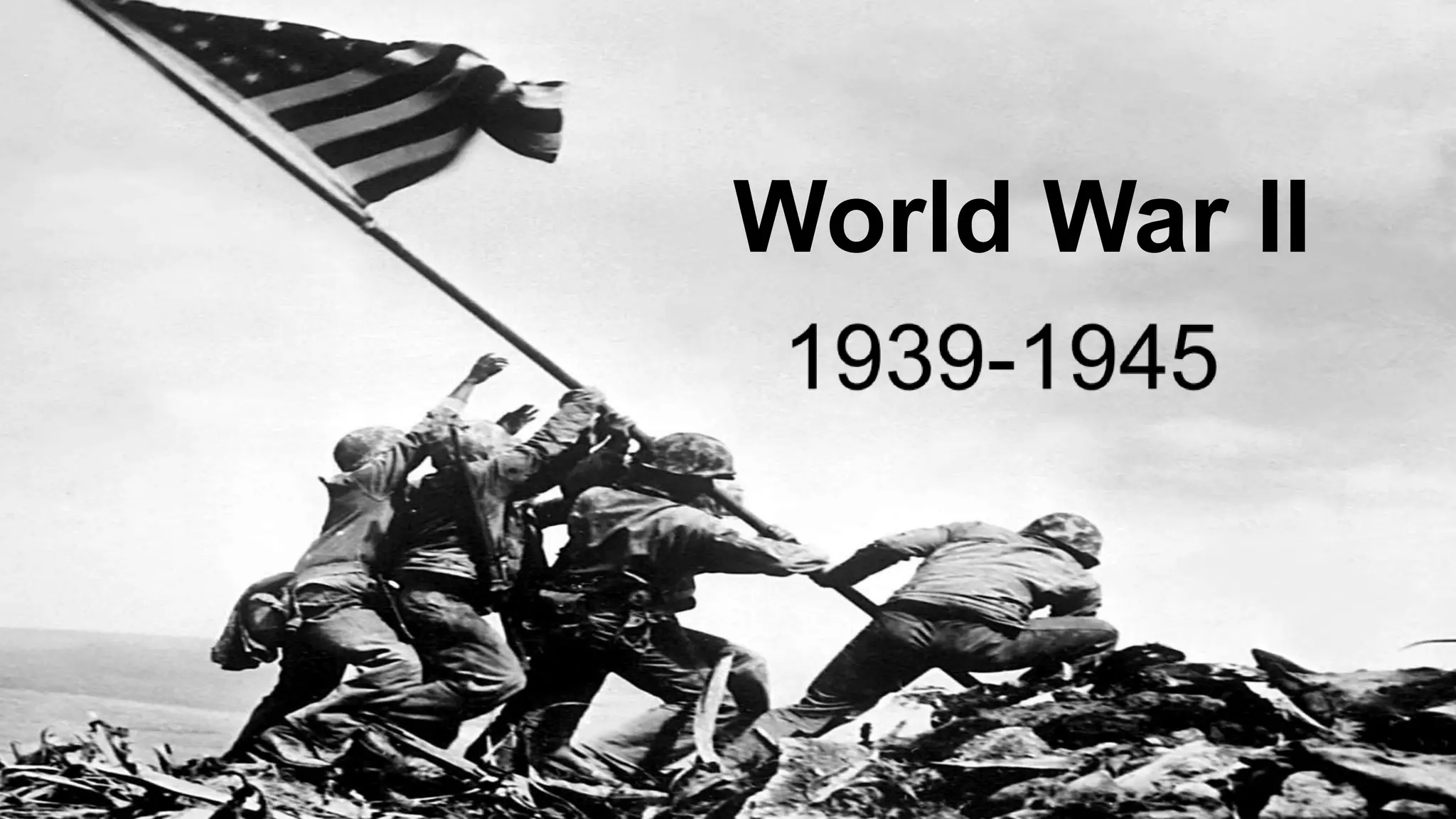
World War II
World War II, also known as the Second World War, was a global war that lasted
from 1939 to 1945, although related conflicts began earlier. It involved the vast
majority of the world's countries—including all of the great powers—eventually
forming two opposing military alliances: the Allies and the Axis. It was the most
widespread war in history, and directly involved more than 100 million people
from over 30 countries. In a state of "total war", the major participants threw
their entire economic, industrial, and scientific capabilities behind the war effort,
erasing the distinction between civilian and military resources. Marked by mass
deaths of civilians, including the Holocaust (in which approximately 11 million
people were killed)and the strategic bombing of industrial and population centres
(in which approximately one million were killed, and which included the atomic
bombings of Hiroshima and Nagasaki), it resulted in an estimated 50 million to 85
million fatalities. These made World War II the deadliest conflict in human history.
Introduction
Major Countries involved in World War II
The United States Of
America: Entered the
war Dec. 8, 1941
Russia: Entered the
war in 1939
Britain: Entered the
war September 3rd,
1939
France: Entered the
war September 3rd
1939
Canada: Entered
the war September
10th, 1939
Allies:
The Axis
Powers:
Germany: Started the
war September 1939
Italy: Entered the war
June 10th 1940
Japan: Entered the
war December 7 1941
1939
Hitler invades Poland on 1 September. Britain and France declare war on Germany
two days later.
1940
Rationing starts in the UK.
German 'Blitzkrieg' overwhelms Belgium, Holland and France.
Churchill becomes Prime Minister of Britain.
British Expeditionary Force evacuated from Dunkirk.
British victory in Battle of Britain forces Hitler to postpone invasion plans.
1941
Hitler begins Operation Barbarossa - the invasion of Russia.
The Blitz continues against Britain's major cities.
Allies take Tobruk in North Africa, and resist German attacks.
Japan attacks Pearl Harbour, and the US enters the war.
Major events of world war II
1943
Surrender at Stalingrad marks Germany's first major defeat.
Allied victory in North Africa enables invasion of Italy to be launched.
Italy surrenders, but Germany takes over the battle.
British and Indian forces fight Japanese in Burma.
1944
Allies land at Anzio and bomb monastery at Monte Cassino.
Soviet offensive gathers pace in Eastern Europe.
1942
Germany suffers setbacks at Stalingrad and El Alamein.
Singapore falls to the Japanese in February - around 25,000
prisoners taken.
American naval victory at Battle of Midway, in June, marks
turning point in Pacific War.
Mass murder of Jewish people at Auschwitz begins.
1945
Auschwitz liberated by Soviet troops.
Russians reach Berlin: Hitler commits suicide and Germany surrenders on 7 May.
Truman becomes President of the US on Roosevelt's death, and Attlee replaces
Churchill.
After atomic bombs are dropped on Hiroshima and Nagasaki, Japan surrenders on 14
August.
D Day: The Allied invasion of France. Paris is liberated in August.
Guam liberated by the US Okinawa, and Iwo Jima bombed.
Made by
Ahmed Mufti
World war ii

World war ii

  • 1.
  • 2.
    World War II,also known as the Second World War, was a global war that lasted from 1939 to 1945, although related conflicts began earlier. It involved the vast majority of the world's countries—including all of the great powers—eventually forming two opposing military alliances: the Allies and the Axis. It was the most widespread war in history, and directly involved more than 100 million people from over 30 countries. In a state of "total war", the major participants threw their entire economic, industrial, and scientific capabilities behind the war effort, erasing the distinction between civilian and military resources. Marked by mass deaths of civilians, including the Holocaust (in which approximately 11 million people were killed)and the strategic bombing of industrial and population centres (in which approximately one million were killed, and which included the atomic bombings of Hiroshima and Nagasaki), it resulted in an estimated 50 million to 85 million fatalities. These made World War II the deadliest conflict in human history. Introduction
  • 3.
    Major Countries involvedin World War II The United States Of America: Entered the war Dec. 8, 1941 Russia: Entered the war in 1939 Britain: Entered the war September 3rd, 1939 France: Entered the war September 3rd 1939 Canada: Entered the war September 10th, 1939 Allies: The Axis Powers: Germany: Started the war September 1939 Italy: Entered the war June 10th 1940 Japan: Entered the war December 7 1941
  • 4.
    1939 Hitler invades Polandon 1 September. Britain and France declare war on Germany two days later. 1940 Rationing starts in the UK. German 'Blitzkrieg' overwhelms Belgium, Holland and France. Churchill becomes Prime Minister of Britain. British Expeditionary Force evacuated from Dunkirk. British victory in Battle of Britain forces Hitler to postpone invasion plans. 1941 Hitler begins Operation Barbarossa - the invasion of Russia. The Blitz continues against Britain's major cities. Allies take Tobruk in North Africa, and resist German attacks. Japan attacks Pearl Harbour, and the US enters the war. Major events of world war II
  • 5.
    1943 Surrender at Stalingradmarks Germany's first major defeat. Allied victory in North Africa enables invasion of Italy to be launched. Italy surrenders, but Germany takes over the battle. British and Indian forces fight Japanese in Burma. 1944 Allies land at Anzio and bomb monastery at Monte Cassino. Soviet offensive gathers pace in Eastern Europe. 1942 Germany suffers setbacks at Stalingrad and El Alamein. Singapore falls to the Japanese in February - around 25,000 prisoners taken. American naval victory at Battle of Midway, in June, marks turning point in Pacific War. Mass murder of Jewish people at Auschwitz begins.
  • 6.
    1945 Auschwitz liberated bySoviet troops. Russians reach Berlin: Hitler commits suicide and Germany surrenders on 7 May. Truman becomes President of the US on Roosevelt's death, and Attlee replaces Churchill. After atomic bombs are dropped on Hiroshima and Nagasaki, Japan surrenders on 14 August. D Day: The Allied invasion of France. Paris is liberated in August. Guam liberated by the US Okinawa, and Iwo Jima bombed.
  • 7.