Working Capital Management
(Team D)
MANAGEMENT OF
WORKING CAPITAL
Eicher Group (founded by Lal Family) and is a catalyst in the green revolution in India with the
production of India’s first agricultural tractor in 1959. Incorporated in 1982, Eicher Motors is the
flagship company of the Eicher Group in India and a leading player of the Indian automobile
industry. Company has a market capitalization of INR 88,000 Crore.
- Own flagship brand “Royal Enfield” is among the oldest manufacturing models of bikes in the
country in mid‐size category.
- Commercial vehicles in collaboration with Volvo.
- Personal utility vehicles through the recent collaboration with Polaris.
- Introduction of a new product line of electric motorcycles.
- Capacity enhancement
- Expanding market base to international markets for its existing and new proposed product.
About the company
Expansion plans
Existing Products

2019
Preparing for future growth
Capacity
Product
Development
Vallam Vadagal would start its productionin August 2017
Total capacity available in FY 17-18 will be 8,25,000
Peak capacity to ramp up to 9,00,000 by FY2018-19
2 Technologycentresin ChennaiandUK
1 newproductplatformindevelopmentstagein250cc-750cc
range, likely to roll out by the end of FY2017-18
Distribution
Capital expenditure planned for FY17-18 ~ INR 1,100 Crore for Capacity Expansion, Technology Centre,
Infrastructure, Product Development and expanding distribution network
NewexclusivestoresformatintroducedinIndia&International
Market
No. of dealers in India to increase to 825 by March ‘18
From Investor Presentation

Opportunity – International Business
The Oddity of the Motorcycle Industry Globally.., is an opportunity
Mid
>750cc
Leisure
Motorcycles
SegmentCAGR: 7%
Period:2012-16
250-750cc Royal Enfield's ambition is to
lead and grow the under-served
global mid-sized motorcycle
segment (250-750cc)
Mature
Markets
<250cc
INVESTORPRESENTATION
MAY2017
Most Industries Motorcycles
Industry
250-750cc
Developing
Markets
>750cc
SegmentCAGR: -2%
Period:2012-16
<250cc
Mass Commuter
Motorcycles
Premium
Motorcycle Industry
Mass
18
Premiu
mMid
From Investor Presentation
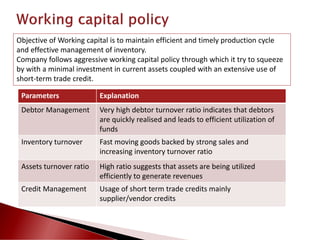
Parameters Explanation
Debtor Management Very high debtor turnover ratio indicates that debtors
are quickly realised and leads to efficient utilization of
funds
Inventory turnover Fast moving goods backed by strong sales and
increasing inventory turnover ratio
Assets turnover ratio High ratio suggests that assets are being utilized
efficiently to generate revenues
Credit Management Usage of short term trade credits mainly
supplier/vendor credits
Objective of Working capital is to maintain efficient and timely production cycle
and effective management of inventory.
Company follows aggressive working capital policy through which it try to squeeze
by with a minimal investment in current assets coupled with an extensive use of
short-term trade credit.
Per Share Ratios Mar-17 Mar-16 Dec-14 Dec-13
Basic EPS 573.75 453.2 206.38 103.15
Book Value 1,441.60 791.89 455.23 303.75
PBDIT Margin (%) 34.57 30.84 28.03 23.13
PBIT Margin (%) 32.39 28.61 26.38 21.34
PBT Margin (%) 32.35 28.59 26.32 21.33
Net Profit Margin (%) 22.16 19.87 18.43 16.36
Return on Networth / Equity (%) 39.77 57.18 45.3 33.92
Return on Capital Employed (%) 38.34 55.35 43.93 32.84
Return on Assets (%) 28.25 35.98 25.07 18.78
Total Debt/Equity (X) 0 0.01 0 0
Asset Turnover Ratio (%) 127.45 181.04 135.99 114.78
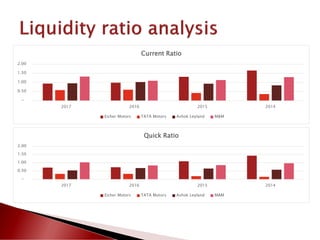
Current Ratio (X) 0.94 0.98 1.31 1.65
Quick Ratio (X) 0.71 0.73 1.09 1.43
Inventory Turnover Ratio (X) 21.83 20.6 14.78 11.84
Debtors Turnover ratio 147.42 216.90 264.10 184.99
Working Capital Turnover ratio -75.11 -285.86 10.25 4.09
Working Capital of Company -93.30 -21.56 293.99 414.31
Current Assets 1,360.36 1,174.81 1,250.81 1,049.26
Current Liabilities 1,453.66 1,196.37 956.82 634.95
Net Working Capital -93.30 -21.56 293.99 414.31
Eicher Motors
Profitability Ratios
Liquidity Ratios
-
0.50
1.00
1.50
2.00
2017 2016 2015 2014
Current Ratio
Eicher Motors TATA Motors Ashok Leyland M&M
-
0.50
1.00
1.50
2.00
2017 2016 2015 2014
Quick Ratio
Eicher Motors TATA Motors Ashok Leyland M&M
-
10.00
20.00
30.00
Eicher Motors TATA Motors Ashok Leyland M&M
Inventory Turnover Ratio
Inventory turnover Ratio 2017 Inventory turnover Ratio 2016
Inventory turnover Ratio 2015 Inventory turnover Ratio 2014
-
100.00
200.00
300.00
2017 2016 2015 2014
Debtors turnover Ratio
Eicher Motors TATA Motors Ashok Leyland M&M
Projected Working Capital Requirement March'20 March'19 March'18
Current Investments 800.00 100.00 100.00
Inventories 1,359.51 1,071.18 821.18
Trade Receivables 1,393.57 1,211.80 1,053.74
Cash and Cash Equivalents 29.55 29.78 42.61
Short Term Loans And Advances 10.00 20.00 10.00
Other Current Assets 110.00 100.00 90.00
3,702.64 2,532.76 2,117.53
Less: Current Liabilities
Trade Payables 1,028.00 894.00 812.00
Other Current Liabilities 157.00 138.00 122.00
Short Term Provisions 80.00 70.00 60.00
1,265.00 1,102.00 994.00
Projected Net Working Capital Requirement 2,437.64 1,430.76 1,123.53
Less: Own Funding 2437.64 630.76 323.53
Short term borrowings 0.00 800.00 800.00
-200.00
0.00
200.00
400.00
600.00
800.00
1,000.00
1,200.00
1,400.00
1,600.00
Mar-17 Mar-16 Mar-15 Mar-14 Mar-13
Chart Title
Current Assets Current Liabilities Net Working Capital
Options Description Cost of borrowings Availed/Not availed
Working Capital Loan
Short term borrowings from banks.
Disbursement upto sanctioned amount
11.50% Availed
Cash Credit/Overdraft
Short-term lending power from banks
capped at limit for withdrawals in excess of
bank balance
10% Availed
Forfaiting
Selling of medium term export receivables
to third parties (bank/ financial
institutions). Non recourse financing
option
1.5%+ LIBOR Availed
Packing Credit
Loan for procurement of materials before
shipment against confirmed sales order
from customer
2%+ LIBOR Availed
Factoring
Selling of receivables to third party
(Available for domestic customers)
4% per month Not availed
Commercial Papers
Unsecured long term promissory note. Can
be used to meet short term working capital
requirements
7% Not availed
Asset Refinancing
Amount borrowed depends on the value of
the items used to secure funding
Not assessed Not availed
Factors that affected our working capital requirements:
Factors Impact on Working Capital
1. Industry practice of cash basis sales to
dealers/ distributors
Reduction in WC due to fast liquidity
of the receivables
2. Strong supply chain management
system
Reduction in WC due to reduction in
the inventory holding period
3. Introduction of the new product Line-
Liberal Credit policy of company
Company’s strategy for market
penetration will require the company
to have liberal credit policy increasing
the WC
4. Introduction of the new product Line-
Higher cash flow requirements
Company will require extra funds to
finance its procurements from new
vendors
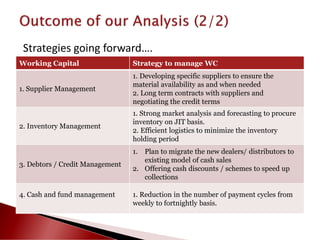
Strategies going forward….
Working Capital Strategy to manage WC
1. Supplier Management
1. Developing specific suppliers to ensure the
material availability as and when needed
2. Long term contracts with suppliers and
negotiating the credit terms
2. Inventory Management
1. Strong market analysis and forecasting to procure
inventory on JIT basis.
2. Efficient logistics to minimize the inventory
holding period
3. Debtors / Credit Management
1. Plan to migrate the new dealers/ distributors to
existing model of cash sales
2. Offering cash discounts / schemes to speed up
collections
4. Cash and fund management 1. Reduction in the number of payment cycles from
weekly to fortnightly basis.
Working capital

Working capital

  • 1.
    Working Capital Management (TeamD) MANAGEMENT OF WORKING CAPITAL
  • 2.
    Eicher Group (foundedby Lal Family) and is a catalyst in the green revolution in India with the production of India’s first agricultural tractor in 1959. Incorporated in 1982, Eicher Motors is the flagship company of the Eicher Group in India and a leading player of the Indian automobile industry. Company has a market capitalization of INR 88,000 Crore. - Own flagship brand “Royal Enfield” is among the oldest manufacturing models of bikes in the country in mid‐size category. - Commercial vehicles in collaboration with Volvo. - Personal utility vehicles through the recent collaboration with Polaris. - Introduction of a new product line of electric motorcycles. - Capacity enhancement - Expanding market base to international markets for its existing and new proposed product. About the company Expansion plans Existing Products
  • 3.
     2019 Preparing for futuregrowth Capacity Product Development Vallam Vadagal would start its productionin August 2017 Total capacity available in FY 17-18 will be 8,25,000 Peak capacity to ramp up to 9,00,000 by FY2018-19 2 Technologycentresin ChennaiandUK 1 newproductplatformindevelopmentstagein250cc-750cc range, likely to roll out by the end of FY2017-18 Distribution Capital expenditure planned for FY17-18 ~ INR 1,100 Crore for Capacity Expansion, Technology Centre, Infrastructure, Product Development and expanding distribution network NewexclusivestoresformatintroducedinIndia&International Market No. of dealers in India to increase to 825 by March ‘18 From Investor Presentation
  • 4.
     Opportunity – InternationalBusiness The Oddity of the Motorcycle Industry Globally.., is an opportunity Mid >750cc Leisure Motorcycles SegmentCAGR: 7% Period:2012-16 250-750cc Royal Enfield's ambition is to lead and grow the under-served global mid-sized motorcycle segment (250-750cc) Mature Markets <250cc INVESTORPRESENTATION MAY2017 Most Industries Motorcycles Industry 250-750cc Developing Markets >750cc SegmentCAGR: -2% Period:2012-16 <250cc Mass Commuter Motorcycles Premium Motorcycle Industry Mass 18 Premiu mMid From Investor Presentation
  • 5.
    Parameters Explanation Debtor ManagementVery high debtor turnover ratio indicates that debtors are quickly realised and leads to efficient utilization of funds Inventory turnover Fast moving goods backed by strong sales and increasing inventory turnover ratio Assets turnover ratio High ratio suggests that assets are being utilized efficiently to generate revenues Credit Management Usage of short term trade credits mainly supplier/vendor credits Objective of Working capital is to maintain efficient and timely production cycle and effective management of inventory. Company follows aggressive working capital policy through which it try to squeeze by with a minimal investment in current assets coupled with an extensive use of short-term trade credit.
  • 6.
    Per Share RatiosMar-17 Mar-16 Dec-14 Dec-13 Basic EPS 573.75 453.2 206.38 103.15 Book Value 1,441.60 791.89 455.23 303.75 PBDIT Margin (%) 34.57 30.84 28.03 23.13 PBIT Margin (%) 32.39 28.61 26.38 21.34 PBT Margin (%) 32.35 28.59 26.32 21.33 Net Profit Margin (%) 22.16 19.87 18.43 16.36 Return on Networth / Equity (%) 39.77 57.18 45.3 33.92 Return on Capital Employed (%) 38.34 55.35 43.93 32.84 Return on Assets (%) 28.25 35.98 25.07 18.78 Total Debt/Equity (X) 0 0.01 0 0 Asset Turnover Ratio (%) 127.45 181.04 135.99 114.78 Current Ratio (X) 0.94 0.98 1.31 1.65 Quick Ratio (X) 0.71 0.73 1.09 1.43 Inventory Turnover Ratio (X) 21.83 20.6 14.78 11.84 Debtors Turnover ratio 147.42 216.90 264.10 184.99 Working Capital Turnover ratio -75.11 -285.86 10.25 4.09 Working Capital of Company -93.30 -21.56 293.99 414.31 Current Assets 1,360.36 1,174.81 1,250.81 1,049.26 Current Liabilities 1,453.66 1,196.37 956.82 634.95 Net Working Capital -93.30 -21.56 293.99 414.31 Eicher Motors Profitability Ratios Liquidity Ratios
  • 7.
    - 0.50 1.00 1.50 2.00 2017 2016 20152014 Current Ratio Eicher Motors TATA Motors Ashok Leyland M&M - 0.50 1.00 1.50 2.00 2017 2016 2015 2014 Quick Ratio Eicher Motors TATA Motors Ashok Leyland M&M
  • 8.
    - 10.00 20.00 30.00 Eicher Motors TATAMotors Ashok Leyland M&M Inventory Turnover Ratio Inventory turnover Ratio 2017 Inventory turnover Ratio 2016 Inventory turnover Ratio 2015 Inventory turnover Ratio 2014 - 100.00 200.00 300.00 2017 2016 2015 2014 Debtors turnover Ratio Eicher Motors TATA Motors Ashok Leyland M&M
  • 9.
    Projected Working CapitalRequirement March'20 March'19 March'18 Current Investments 800.00 100.00 100.00 Inventories 1,359.51 1,071.18 821.18 Trade Receivables 1,393.57 1,211.80 1,053.74 Cash and Cash Equivalents 29.55 29.78 42.61 Short Term Loans And Advances 10.00 20.00 10.00 Other Current Assets 110.00 100.00 90.00 3,702.64 2,532.76 2,117.53 Less: Current Liabilities Trade Payables 1,028.00 894.00 812.00 Other Current Liabilities 157.00 138.00 122.00 Short Term Provisions 80.00 70.00 60.00 1,265.00 1,102.00 994.00 Projected Net Working Capital Requirement 2,437.64 1,430.76 1,123.53 Less: Own Funding 2437.64 630.76 323.53 Short term borrowings 0.00 800.00 800.00
  • 10.
    -200.00 0.00 200.00 400.00 600.00 800.00 1,000.00 1,200.00 1,400.00 1,600.00 Mar-17 Mar-16 Mar-15Mar-14 Mar-13 Chart Title Current Assets Current Liabilities Net Working Capital
  • 11.
    Options Description Costof borrowings Availed/Not availed Working Capital Loan Short term borrowings from banks. Disbursement upto sanctioned amount 11.50% Availed Cash Credit/Overdraft Short-term lending power from banks capped at limit for withdrawals in excess of bank balance 10% Availed Forfaiting Selling of medium term export receivables to third parties (bank/ financial institutions). Non recourse financing option 1.5%+ LIBOR Availed Packing Credit Loan for procurement of materials before shipment against confirmed sales order from customer 2%+ LIBOR Availed Factoring Selling of receivables to third party (Available for domestic customers) 4% per month Not availed Commercial Papers Unsecured long term promissory note. Can be used to meet short term working capital requirements 7% Not availed Asset Refinancing Amount borrowed depends on the value of the items used to secure funding Not assessed Not availed
  • 12.
    Factors that affectedour working capital requirements: Factors Impact on Working Capital 1. Industry practice of cash basis sales to dealers/ distributors Reduction in WC due to fast liquidity of the receivables 2. Strong supply chain management system Reduction in WC due to reduction in the inventory holding period 3. Introduction of the new product Line- Liberal Credit policy of company Company’s strategy for market penetration will require the company to have liberal credit policy increasing the WC 4. Introduction of the new product Line- Higher cash flow requirements Company will require extra funds to finance its procurements from new vendors
  • 13.
    Strategies going forward…. WorkingCapital Strategy to manage WC 1. Supplier Management 1. Developing specific suppliers to ensure the material availability as and when needed 2. Long term contracts with suppliers and negotiating the credit terms 2. Inventory Management 1. Strong market analysis and forecasting to procure inventory on JIT basis. 2. Efficient logistics to minimize the inventory holding period 3. Debtors / Credit Management 1. Plan to migrate the new dealers/ distributors to existing model of cash sales 2. Offering cash discounts / schemes to speed up collections 4. Cash and fund management 1. Reduction in the number of payment cycles from weekly to fortnightly basis.