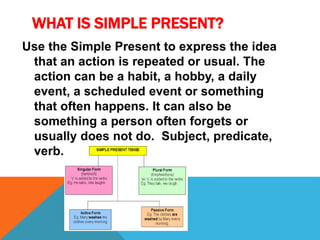
WHAT IS SIMPLE PRESENT? 
Use the Simple Present to express the idea 
that an action is repeated or usual. The 
action can be a habit, a hobby, a daily 
event, a scheduled event or something 
that often happens. It can also be 
something a person often forgets or 
usually does not do. Subject, predicate, 
verb.
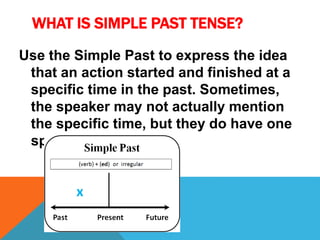
WHAT IS SIMPLE PAST TENSE? 
Use the Simple Past to express the idea 
that an action started and finished at a 
specific time in the past. Sometimes, 
the speaker may not actually mention 
the specific time, but they do have one 
specific time in mind.
EXAMPLES 
I play tennis. 
She does not play tennis. 
Does he play tennis? 
I saw a movie yesterday. 
I didn't see a play yesterday. 
Last year, I traveled to Japan.
ACTIVITIES 
http://www.englishexercises.org/mak 
eagame/viewgame.asp?id=2023.
COMMON AND PROPER NAONS
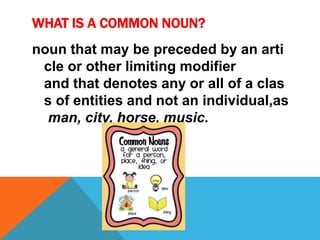
WHAT IS A COMMON NOUN? 
noun that may be preceded by an arti 
cle or other limiting modifier 
and that denotes any or all of a clas 
s of entities and not an individual,as 
man, city, horse, music.
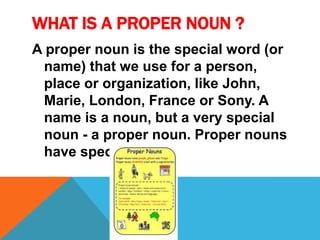
WHAT IS A PROPER NOUN ? 
A proper noun is the special word (or 
name) that we use for a person, 
place or organization, like John, 
Marie, London, France or Sony. A 
name is a noun, but a very special 
noun - a proper noun. Proper nouns 
have special rules.
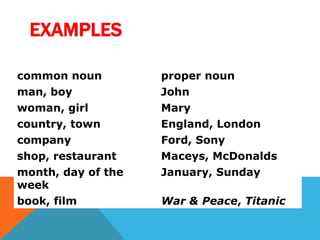
EXAMPLES 
common noun proper noun 
man, boy John 
woman, girl Mary 
country, town England, London 
company Ford, Sony 
shop, restaurant Maceys, McDonalds 
month, day of the 
January, Sunday 
week 
book, film War & Peace, Titanic
ACTIVITIES 
http://www.mcwdn.org/gramm 
ar/nouncompropquiz/nounco 
mpropquiz.html
Word ending –ed or s

Word ending –ed or s

  • 2.
    WHAT IS SIMPLEPRESENT? Use the Simple Present to express the idea that an action is repeated or usual. The action can be a habit, a hobby, a daily event, a scheduled event or something that often happens. It can also be something a person often forgets or usually does not do. Subject, predicate, verb.
  • 3.
    WHAT IS SIMPLEPAST TENSE? Use the Simple Past to express the idea that an action started and finished at a specific time in the past. Sometimes, the speaker may not actually mention the specific time, but they do have one specific time in mind.
  • 4.
    EXAMPLES I playtennis. She does not play tennis. Does he play tennis? I saw a movie yesterday. I didn't see a play yesterday. Last year, I traveled to Japan.
  • 5.
  • 6.
  • 7.
    WHAT IS ACOMMON NOUN? noun that may be preceded by an arti cle or other limiting modifier and that denotes any or all of a clas s of entities and not an individual,as man, city, horse, music.
  • 8.
    WHAT IS APROPER NOUN ? A proper noun is the special word (or name) that we use for a person, place or organization, like John, Marie, London, France or Sony. A name is a noun, but a very special noun - a proper noun. Proper nouns have special rules.
  • 9.
    EXAMPLES common nounproper noun man, boy John woman, girl Mary country, town England, London company Ford, Sony shop, restaurant Maceys, McDonalds month, day of the January, Sunday week book, film War & Peace, Titanic
  • 10.