Past Simple Tense: A
Comprehensive Guide
This presentation will provide a detailed overview of the past simple tense,
covering its definition, formation, usage, and common errors.
by Игорь Бырченко
If you're looking for English flashcards for learning, Welcome to my Etsy Shop !
Etsy
DreamScapeUA - Etsy
Shop Your dreams, our designs by DreamScapeUA located in Florida, United
States.
Definition and Usage of the Past Simple Tense
Definition
The past simple tense describes actions or events that
happened at a specific time in the past, and are now finished.
It's used for single actions, repeated actions, and events that
occurred over a period of time.
Usage
The past simple is used for completed actions in the past,
such as: "I went to the store yesterday," or "We studied for the
exam last night."
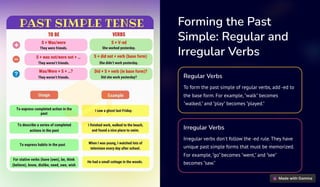
Forming the Past
Simple: Regular and
Irregular Verbs
Regular Verbs
To form the past simple of regular verbs, add -ed to
the base form. For example,"walk" becomes
"walked," and "play" becomes "played."
Irregular Verbs
Irregular verbs don't follow the -ed rule. They have
unique past simple forms that must be memorized.
For example,"go" becomes "went," and "see"
becomes "saw."
Expressing Completed
Actions in the Past
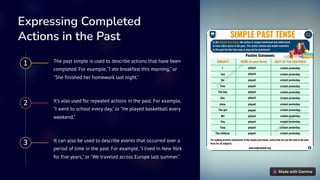
1 The past simple is used to describe actions that have been
completed. For example,"I ate breakfast this morning," or
"She finished her homework last night."
2 It's also used for repeated actions in the past. For example,
"I went to school every day," or "He played basketball every
weekend."
3 It can also be used to describe events that occurred over a
period of time in the past. For example,"I lived in New York
for five years," or "We traveled across Europe last summer."
Past Simple vs. Past
Continuous
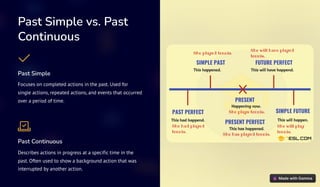
Past Simple
Focuses on completed actions in the past. Used for
single actions, repeated actions, and events that occurred
over a period of time.
Past Continuous
Describes actions in progress at a specific time in the
past. Often used to show a background action that was
interrupted by another action.
Common Past Simple Verbs
and Their Meanings
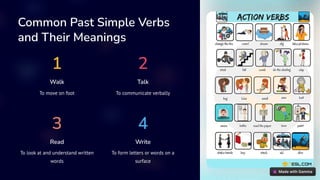
1
Walk
To move on foot
2
Talk
To communicate verbally
3
Read
To look at and understand written
words
4
Write
To form letters or words on a
surface
Negative and Interrogative Forms of the Past
Simple
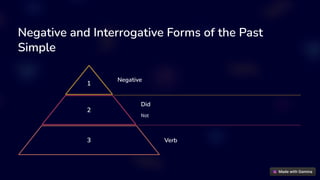
1
Negative
2
Did
Not
3 Verb
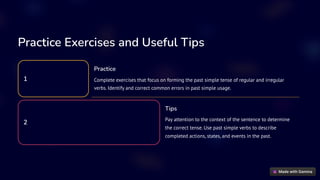
Practice Exercises and Useful Tips
1
Practice
Complete exercises that focus on forming the past simple tense of regular and irregular
verbs. Identify and correct common errors in past simple usage.
2
Tips
Pay attention to the context of the sentence to determine
the correct tense. Use past simple verbs to describe
completed actions, states, and events in the past.

Past Simple Tense - Blueprint/Guide for you

  • 1.
    Past Simple Tense:A Comprehensive Guide This presentation will provide a detailed overview of the past simple tense, covering its definition, formation, usage, and common errors. by Игорь Бырченко
  • 2.
    If you're lookingfor English flashcards for learning, Welcome to my Etsy Shop ! Etsy DreamScapeUA - Etsy Shop Your dreams, our designs by DreamScapeUA located in Florida, United States.
  • 3.
    Definition and Usageof the Past Simple Tense Definition The past simple tense describes actions or events that happened at a specific time in the past, and are now finished. It's used for single actions, repeated actions, and events that occurred over a period of time. Usage The past simple is used for completed actions in the past, such as: "I went to the store yesterday," or "We studied for the exam last night."
  • 4.
    Forming the Past Simple:Regular and Irregular Verbs Regular Verbs To form the past simple of regular verbs, add -ed to the base form. For example,"walk" becomes "walked," and "play" becomes "played." Irregular Verbs Irregular verbs don't follow the -ed rule. They have unique past simple forms that must be memorized. For example,"go" becomes "went," and "see" becomes "saw."
  • 5.
    Expressing Completed Actions inthe Past 1 The past simple is used to describe actions that have been completed. For example,"I ate breakfast this morning," or "She finished her homework last night." 2 It's also used for repeated actions in the past. For example, "I went to school every day," or "He played basketball every weekend." 3 It can also be used to describe events that occurred over a period of time in the past. For example,"I lived in New York for five years," or "We traveled across Europe last summer."
  • 6.
    Past Simple vs.Past Continuous Past Simple Focuses on completed actions in the past. Used for single actions, repeated actions, and events that occurred over a period of time. Past Continuous Describes actions in progress at a specific time in the past. Often used to show a background action that was interrupted by another action.
  • 7.
    Common Past SimpleVerbs and Their Meanings 1 Walk To move on foot 2 Talk To communicate verbally 3 Read To look at and understand written words 4 Write To form letters or words on a surface
  • 8.
    Negative and InterrogativeForms of the Past Simple 1 Negative 2 Did Not 3 Verb
  • 9.
    Practice Exercises andUseful Tips 1 Practice Complete exercises that focus on forming the past simple tense of regular and irregular verbs. Identify and correct common errors in past simple usage. 2 Tips Pay attention to the context of the sentence to determine the correct tense. Use past simple verbs to describe completed actions, states, and events in the past.