12
Wine
Attributes
Feature
Selection
Logistic
Regression
Decision Tree
Support
Vector
Machine
Wine Classification Problem
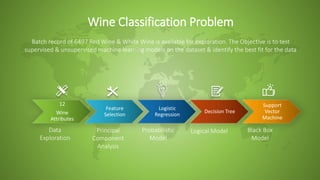
Batch record of 6497 Red Wine & White Wine is available for exploration. The Objective is to test
supervised & unsupervised machine learning models on the dataset & identify the best fit for the data
Data
Exploration
Principal
Component
Analysis
Probabilistic
Model
Logical Model Black Box
Model
Input & Output Model Concept
Red Wine
&
White Wine
Free & Total SO2
Chlorides & Sulphates
Density & Quality
Citric acid & pH
Alcohol & Residual Sugar
Fixed & Volatile Acidity
Machine
Learning Model
Dependent Variables
Dependent Variables
Preprocessing Standardization Feature
Importance
Initial Data
Exploration
Noise Elimination Inferencing
Logistic
Regression
Split
0.2
Decision Tree
Split
0.2
SVM
Kernel
Model Result
OTHER METRICS
98%
Accuracy
98%
Accuracy
98%
Accuracy
L
Precision: 0.99
Recall: 0.98
Precision: 0.99
Recall: 0.99
OTHER METRICS
Precision: 0.99
Recall: 0.99
OTHER METRICS
Confusion Matrix
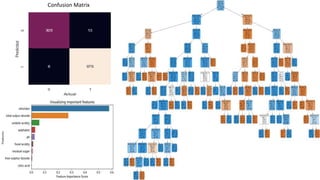
Inference : For the shortest Branch of the tree
If Chloride </=0.06,
Total SO2</=54, </=88.5
Volatile acidity<=0.465,
Sulphates</=0.705, </=1.35
Then Yes the Wine is White
Low Acidity along with Chloride, SO2 & Sulphate gives
White Wine
White Wines are loved for their Zesty acidity, floral
aromas & pure fruit note (No Oxidation)
Min –Max
Chloride - 0.009-0.611
Total SO2 - 6-440
Volatile Acidity - 0.08-1.58
Sulphates - 0.22-2
White Wine & Red Wine
White Wines are loved for their Zesty acidity,
floral aromas & pure fruit note (No Oxidation)
Red wine is made when the crushed grapes are
fermented for one or two weeks in Oak barrels;
whereas white wine is made when the skin and
seeds of white grapes are removed and mixed
with yeast and aged in stainless steel vats for
fermentation.

Wine Classification(2).pptx

  • 1.
    12 Wine Attributes Feature Selection Logistic Regression Decision Tree Support Vector Machine Wine ClassificationProblem Batch record of 6497 Red Wine & White Wine is available for exploration. The Objective is to test supervised & unsupervised machine learning models on the dataset & identify the best fit for the data Data Exploration Principal Component Analysis Probabilistic Model Logical Model Black Box Model
  • 2.
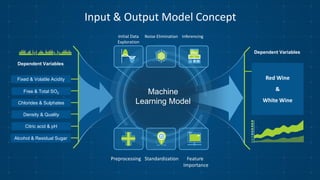
    Input & OutputModel Concept Red Wine & White Wine Free & Total SO2 Chlorides & Sulphates Density & Quality Citric acid & pH Alcohol & Residual Sugar Fixed & Volatile Acidity Machine Learning Model Dependent Variables Dependent Variables Preprocessing Standardization Feature Importance Initial Data Exploration Noise Elimination Inferencing
  • 3.
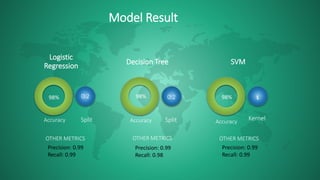
    Logistic Regression Split 0.2 Decision Tree Split 0.2 SVM Kernel Model Result OTHERMETRICS 98% Accuracy 98% Accuracy 98% Accuracy L Precision: 0.99 Recall: 0.98 Precision: 0.99 Recall: 0.99 OTHER METRICS Precision: 0.99 Recall: 0.99 OTHER METRICS
  • 4.
  • 5.
    Inference : Forthe shortest Branch of the tree If Chloride </=0.06, Total SO2</=54, </=88.5 Volatile acidity<=0.465, Sulphates</=0.705, </=1.35 Then Yes the Wine is White Low Acidity along with Chloride, SO2 & Sulphate gives White Wine White Wines are loved for their Zesty acidity, floral aromas & pure fruit note (No Oxidation) Min –Max Chloride - 0.009-0.611 Total SO2 - 6-440 Volatile Acidity - 0.08-1.58 Sulphates - 0.22-2
  • 6.
    White Wine &Red Wine White Wines are loved for their Zesty acidity, floral aromas & pure fruit note (No Oxidation) Red wine is made when the crushed grapes are fermented for one or two weeks in Oak barrels; whereas white wine is made when the skin and seeds of white grapes are removed and mixed with yeast and aged in stainless steel vats for fermentation.