Windrush Child
Exploring issues of migration, racism,
inequality, colonialism and ‘Britishness’
Year 7 Geography
Name: _______________________
Form: _________
Teacher: ___________________
“Do you know where history starts? …. It starts now.. It starts with you and me”
1
KEJ Geography - ‘Windrush Child’
Introduction
This book explores the life of Leonard: one of the Windrush Generation.
The ‘Windrush’ generation describes the people who arrived in the UK from Caribbean
countries between 1948 and 1973. Many took up jobs in the NHS and other sectors
affected by Britain’s post-war labour shortage. The name ‘Windrush’ derives from the
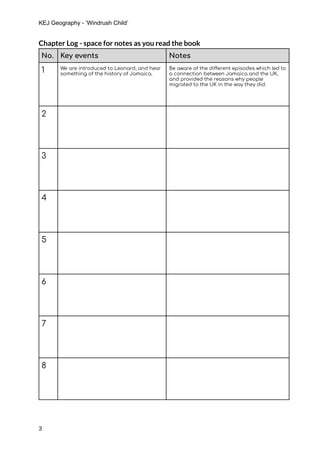
‘HMT Empire Windrush’ ship which brought one of the first large groups of Caribbean
people to the UK in 1948. As the Caribbean was, at the time, a part of the British
Commonwealth, those who arrived were automatically British subjects and free to
permanently live and work in the UK. Prior to the Commonwealth, Jamaica had been a
British colony. The government was keen to welcome people from these countries
although they were not always made to feel welcome. The new arrivals quickly found work
as there were many job vacancies following the Second World War which needed to be
filled. Many worked in transport, retail or the NHS and lived in large cities such as London,
Birmingham and Manchester. They found they were subject to racism and intolerance,
which persists to this day.
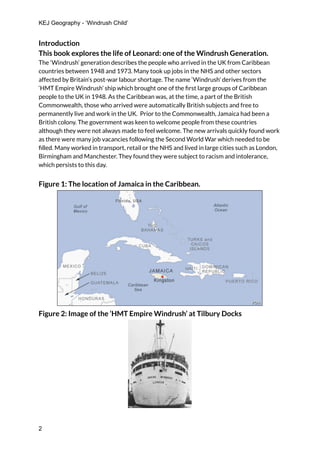
Figure 1: The location of Jamaica in the Caribbean.
Figure 2: Image of the ‘HMT Empire Windrush’ at Tilbury Docks
2
KEJ Geography - ‘Windrush Child’
Chapter Log - space for notes as you read the book
No. Key events Notes
1 We are introduced to Leonard, and hear
something of the history of Jamaica.
Be aware of the different episodes which led to
a connection between Jamaica and the UK,
and provided the reasons why people
migrated to the UK in the way they did.
2
3
4
5
6
7
8
3
KEJ Geography - ‘Windrush Child’
9
10
11
12
13
14 This chapter contains potentially offensive
language which the author explains in the
Author’s Note at the start of the book.
15
16
4
KEJ Geography - ‘Windrush Child’
17
18
19
20
21
22
23
24
5
KEJ Geography - ‘Windrush Child’
25
26
27
28
29
30
31
32
6
KEJ Geography - ‘Windrush Child’
Complete the factfile as you read the book:
Factfile: Leonard
Birthplace:
Birth date:
Family members & their influence on Leonard:
Mum:
Dad:
Brother Book:
Grandma:
Family jobs:
School experiences:
Middle age - new family members
Work colleagues
7
KEJ Geography - ‘Windrush Child’
Chapter 1 - Introducing Leonard
How was Leonard’s education in Jamaica influenced by British colonial rule in Jamaica?
What are some of the key episodes in Jamaican history described on pp.2-4
Source: http://jamaicatimeline.com/history.html
Chapter 2, 3 & 4 - Life in Maroon Town
Describe life in Maroon Town? What is the landscape and climate like? How do people
earn a living and get food?
Where is Leonard’s father at this point in the book?
8
KEJ Geography - ‘Windrush Child’
How is the Caribbean described? Consider its history and its geography.
Chapter 5 , 6 & 7 - Leaving Jamaica
What advice does Leonard’s Grandma give him?
How does Kingston vary from what Leonard has been used to?
Describe the journey from Jamaica to London, which starts on April the 13th, 1958 on
the Arosa Star.
“That’s what the Queen says, and if that’s what de Queen says, that’s de way it is…”
9
KEJ Geography - ‘Windrush Child’
On p.33, Leonard asks his mum about the passport that she has and why he hasn’t got
one. What does she say? We will return to the significance of this moment later in the
book.
Chapter 8 - Arrival
How is London described? What are Leonard’s first impressions of England?
Figure 3: Welcoming Jamaican immigrants
Jamaican immigrants are welcomed by RAF officials from the Colonial Office after the ex-troopship
HMT Empire Windrush landed them at Tilbury. Photograph: PA
10
KEJ Geography - ‘Windrush Child’
Chapter 9
Where do Leonard and his mum go after their arrival at the docks?
What does Leonard notice about English place names?
What does Leonard notice about the UK on the train journey to Manchester?
Chapter 10, 11 - Settling in to Manchester
Describe some events that occur as Leonard settles into life in Manchester.
How does Leonard and his mum’s new house compare with the house back in Maroon
Town? - pp.58-64
11
KEJ Geography - ‘Windrush Child’
How does Manchester compare with Maroon Town as a place to live?
Chapter 12 - The Colour Bar
What is the ‘colour bar’, and how does it affect Leonard and his family in this chapter?
Find out a little bit more about this piece of legislation which was also used in other
countries outside of the UK.
Chapter 13 - Starting school
“I just got fed up of telling them that I didn’t know what the capital of Africa was.”
What are Leonard’s experiences at Hyde Primary School? How is he treated by other
students, and his friend Mark?
Chapter 14 & 15 - Summer holidays
What occurs in Notting Hill during Leonard’s summer break and how does it begin to
impact his life in Manchester?
12
KEJ Geography - ‘Windrush Child’
How does the incident in the shop on p.90 make Leonard feel?
On p.92, Leonard receives some bad news. How does he take it?
Chapter 16 & 17 - School problems, and improvements
“We are here now. We must make the most of it and move forward.”
Describe the changes in Leonard’s life, and his relationship with other students during
the following school year as he moves up into Anson Secondary school.
Describe the connections between Leonard’s family and the Barry family who live
downstairs at their new home.
13
KEJ Geography - ‘Windrush Child’
How does Rosie and Michael’s friendship help Leonard?
On p.103, Leonard begins to get homesick for Jamaica. What do his parents tell him at
this point which they haven’t told him before?
“Count your blessings son. It might be cold but it is safe here.”
On p.104-108, Leonard’s dad tells him some of the reasons why he moved to Britain.
How does this change Leonard’s view of Britain?
Chapter 18, 19 & 20
What happens to Leonard’s dad Morris in this section of the book? How common was
this during the late 1950s and early 60s?
14
KEJ Geography - ‘Windrush Child’
What else do we learn about Leonard’s dad in these chapters?
Chapter 21 & 22
Leonard’s mum Rita leaves. What does she say in her letter about her reasons for
leaving? What happens next to the family?
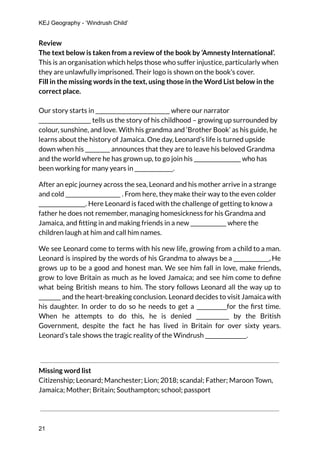
Figure 4: Colourised image from 1948 of Caribbean migrants in the UK
Chapter 23
What do we discover about Rita on pp.134 & 5?
15
KEJ Geography - ‘Windrush Child’
We discover on p.135-8 that Leonard’s father was one of the passengers on the
‘Empire Windrush’ - what did he do when he first arrived in the UK?
Chapter 24 & 25
What do we learn about Leonard’s family and their relationship with the Barry’s during
these chapters?
On p.148 we hear about Jamaica’s independence.
How does this change the relationship between Jamaica and Britain? What were the
events that led up to Jamaica’s independence
Figure 5: Nanny of the Maroons on a Jamaican banknote.
16
KEJ Geography - ‘Windrush Child’
Figure 6: The Jamaican flag before independence
Figure 7: The Jamaican flag after independence
Chapter 26
Leonard leaves school and starts work - how does that go for him? What job does he
find?
What job does his mum get?
Who is Anna and how does Leonard meet her?
17
KEJ Geography - ‘Windrush Child’
What newspaper story does Leonard read on p.163 and how does it change
things once again for him?
Chapter 27
What is the message in the poem that Leonard reads out at the family event in this
chapter?
Chapter 28
Leonard is now Fred’s apprentice and learns more about him. How has Leonard’s
attitude towards Britain changed?
18
KEJ Geography - ‘Windrush Child’
Chapter 29
What happens to Leonard in this chapter which changes his life? How does his personal
life develop over the next few decades?
Chapter 30
Leonard married Marie in 1971. What do we learn about Marie during this chapter?
Leonard’s mum returns to Jamaica. How does Leonard’s day go overall?
Chapter 31
How does Grace change Leonard’s life?
19
KEJ Geography - ‘Windrush Child’
What do we learn about the black community in the UK, and their daily experiences?
Chapter 32
What happens when Leonard and Marie take the decision to go and see Leonard’s
mum? This is the conclusion to the book and is the reason why the author decided that
he had to tell the story of the Windrush generation.
Follow up questions
Answer these in your book or on your device.
1. What was life like for new arrivals in the UK like Leonard and his family?
2. What were the reasons Leonard’s father originally moved to the UK and
asked his family to join him?
3. What forms of prejudice did Leonard and his family face? How common
was this for people from the Caribbean? How did they deal with it?
4. Benjamin Zephaniah describes the book as “about 30%” based on events
that really happened to him”. In a recent interview he said “We get lost in
statistics and forget there are real people behind those statistics”. What
are some of the key statistics in terms of numbers of people who arrived,
and the numbers of those who were affected by the Windrush scandal
etc.
5. Have a go at writing Chapter 33 - what happens next?
20
KEJ Geography - ‘Windrush Child’
Review
The text below is taken from a review of the book by ‘Amnesty International’.
This is an organisation which helps those who suffer injustice, particularly when
they are unlawfully imprisoned. Their logo is shown on the book’s cover.
Fill in the missing words in the text, using those in the Word List below in the
correct place.
Our story starts in ___________________________ where our narrator
___________________ tells us the story of his childhood – growing up surrounded by
colour, sunshine, and love. With his grandma and ‘Brother Book’ as his guide, he
learns about the history of Jamaica. One day, Leonard’s life is turned upside
down when his _________ announces that they are to leave his beloved Grandma
and the world where he has grown up, to go join his _________________ who has
been working for many years in ______________.
After an epic journey across the sea, Leonard and his mother arrive in a strange
and cold ____________________ . From here, they make their way to the even colder
_________________. Here Leonard is faced with the challenge of getting to know a
father he does not remember, managing homesickness for his Grandma and
Jamaica, and fitting in and making friends in a new _____________ where the
children laugh at him and call him names.
We see Leonard come to terms with his new life, growing from a child to a man.
Leonard is inspired by the words of his Grandma to always be a _____________, He
grows up to be a good and honest man. We see him fall in love, make friends,
grow to love Britain as much as he loved Jamaica; and see him come to define
what being British means to him. The story follows Leonard all the way up to
________ and the heart-breaking conclusion. Leonard decides to visit Jamaica with
his daughter. In order to do so he needs to get a ___________for the first time.
When he attempts to do this, he is denied ____________ by the British
Government, despite the fact he has lived in Britain for over sixty years.
Leonard’s tale shows the tragic reality of the Windrush _______________.
Missing word list
Citizenship; Leonard; Manchester; Lion; 2018; scandal; Father; Maroon Town,
Jamaica; Mother; Britain; Southampton; school; passport
21
KEJ Geography - ‘Windrush Child’
Windrush Generation
22nd June each year is now known as Windrush Day
https://www.windrushday.org.uk/
During the opening ceremony of the London 2012 Olympics, Danny Boyle, who
organised the event - was asked to tell the story of Britain. We saw NHS nurses,
suffragettes, punks, people on marches protesting, and the first wave of
Commonwealth immigrants from the Caribbean marching behind a huge model of the
ship that brought some of them to the UK: the ‘Empire Windrush’.
Nanny of the Maroons
Leonard lives in Maroon Town before leaving to move to Britain, and describes it
The area was famously the home of Nanny of the Maroons, who we saw on a banknote.
Find out more about her, and her importance in Jamaican history here:
http://slaveryandremembrance.org/people/person/?id=PP023
Further reading
‘Black and British’ - School edition & full edition - David Olusoga (2021)
https://www.theguardian.com/uk-news/2019/jun/16/windrush-scandal-the-long-betrayal-archived-do
cuments-david-olusoga
In 1945, there were probably fewer than 20 000 Black people in Britain.
https://www.museumoflondon.org.uk/discover/listening-london-and-windrush-generation
https://www.english-heritage.org.uk/visit/inspire-me/the-story-of-windrush/
Pinterest images: https://www.pinterest.co.uk/geoblogs/windrush-resource/
Bristol
https://www.bristolmuseums.org.uk/stories/bristols-windrush-generation/
Role of Caribbean immigrants in public transport:
https://www.ourmigrationstory.org.uk/oms/london-on-the-move-west-indian-transport-workers
Figure 9: Trainee bus driver, 1970s.
(Woman bus driver training at Chiswick works in the 1970s. Courtesy of London Transport, ref. 2014/8404)
22
KEJ Geography - ‘Windrush Child’
Amnesty International
https://www.amnesty.org.uk/blogs/rights-and-realities/windrush-lessons-be-learned
Key Dates linked to ‘HMT Windrush’
Hamburg, 1930: The German-Jewish shipbuilders Blohm & Voss build a transatlantic ocean
cruiser that they christen the Monte Rosa.
Norway, 1940: The Monte Rosa is sent to the fjords to assist the dreaded Tirpitz as she
bombards British ships.
Auschwitz, 1942:. Forty-six Jews wait at the gates, after the Monte Rosa had transported them
from Oslo.
Kiel, 1945. The Monte Rosa is captured by the British and given a new name: the HMT Empire
Windrush.
London, 1948: Empire Windrush docks in England, carrying 600 migrants from the Caribbean.
Figure 10: Bus driver and conductor, 1970s
Leonard’s father works as a bus driver, and makes a friend called Rita on arrival. Many Caribbean
migrants found work with London Transport and other public bodies such as the NHS.
The present day
In 2013, the Home Secretary was Theresa May, who would later become the Prime
Minister for a short time. Controversial vans, which carried signs reading "In the UK
illegally? Go home or face arrest", were driven around areas with large immigrant
communities in the summer of 2013. During the campaign, the vans drove around the
London boroughs of Barking and Dagenham, Redbridge, Barnet, Brent, Ealing and
Hounslow - all ethnically diverse areas where it was thought a lot of illegal immigrants
live and work.
23
KEJ Geography - ‘Windrush Child’
Figure 11: Home Office vans
The Windrush Scandal emerged in April 2018 when people who had arrived as
Commonwealth immigrants were wrongly declared as illegal.
Many didn’t have the papers that were now required, as they were told they didn’t
need them sixty years previously (remember Leonard’s passport question to his mum)
The Home Office kept no record of those granted leave to remain and issued no
paperwork - making it very difficult for Windrush arrivals to prove their legal status.
In 2010, the Home Office destroyed landing cards belonging to Windrush migrants.
An inquiry was launched. The Windrush Compensation Scheme was established in
April 2019. By the end of March 2020, 1,275 people had applied for financial
compensation, with 60 people receiving payments totalling £363,000.
About 15,000 claims are expected to be lodged in the future, worth an estimated
£200m, before the April 2023 application deadline.
A separate task force was also established to give individual people their correct
documentation, with more than 12,000 receiving their new passports or citizenship
documentation since April 2018.
There is more work to be done to help repay people who were unfairly treated.
Further reading:
https://www.theguardian.com/uk-news/2018/apr/16/mps-urge-may-to-resolve-immig
ration-status-of-windrush-children
https://www.bbc.co.uk/news/uk-43782241
The death of George Floyd in May 2020 brought the issue of racial inequality further
into the public eye and reminded many that racism is an everyday reality for many.
24
KEJ Geography - ‘Windrush Child’
Extension question (this
requires some additional
research)
Research the positive impact
on British society that migrants
have brought, with respect to
one particular area of our daily
lives:
- Food
- Music
- Fashion
This does not have to be
restricted to migrants from the
Caribbean, although you may
want to start with people from
that part of the world.
How important was music to the
identity of Black British citizens?
There are several songs
mentioned in the book, which
we will listen to as we go along.
Playlist https://open.spotify.com/playlist/7AdR48h3nOBws1A70J3hze
Music: Lord Kitchener: https://youtu.be/7AprO_Z13LM
https://youtu.be/nsIW06zugd8 - Q and A with the author
About the book’s author
Benjamin Obadiah Iqbal Zephaniah is a
British writer and dub poet. He was included
in The Times list of Britain's top 50 post-war
writers in 2008. He was born in Birmingham
in 1958. His father was from Jamaica and his
mother from Barbados. Benjamin is a poet
and performer, who tours with his band.
25
KEJ Geography - ‘Windrush Child’
Here is one of Benjamin’s poems on the same theme of identity: what do we mean
when we say that someone is British?
‘The British - serves 60 million’
Take some Picts, Celts and Silures
And let them settle,
Then overrun them with Roman conquerors.
Remove the Romans after approximately 400 years
Add lots of Norman French to some
Angles, Saxons, Jutes and Vikings, then stir vigorously.
Mix some hot Chileans, cool Jamaicans, Dominicans,
Trinidadians and Bajans with some Ethiopians, Chinese,
Vietnamese and Sudanese.
Then take a blend of Somalians, Sri Lankans, Nigerians
And Pakistanis,
Combine with some Guyanese
And turn up the heat.
Sprinkle some fresh Indians, Malaysians, Bosnians,
Iraqis and Bangladeshis together with some
Afghans, Spanish, Turkish, Kurdish, Japanese
And Palestinians
Then add to the melting pot.
Leave the ingredients to simmer.
As they mix and blend allow their languages to flourish
Binding them together with English.
Allow time to be cool.
Add some unity, understanding, and respect for the future,
Serve with justice
And enjoy.
Note: All the ingredients are equally important. Treating one ingredient better than
another will leave a bitter unpleasant taste.
26
KEJ Geography - ‘Windrush Child’
Warning: An unequal spread of justice will damage the people and cause pain. Give
justice and equality to all.
https://classroom.thenational.academy/units/the-british-by-benjamin-zephaniah-034
2
https://classroom.thenational.academy/lessons/to-read-and-analyse-a-poem-68u30c
https://poemanalysis.com/benjamin-zephaniah/the-british-serves-60-million/
Amnesty International
Amnesty International works to protect people wherever justice, freedom, truth and dignity
are denied. As a global movement of over ten million people, Amnesty International is the
world's largest grassroots human rights organisation.
They investigate and expose abuses, educate and mobilise the public, and help transform
societies to create a safer, more just world. They have received the Nobel Peace Prize for
their life-saving work.
Migration is still happening in 2021
What are the major movements of people in the world currently?
Where are they moving to and from, and why?
What are the economic benefits of migration for the host country and the
country they have left? (investigate something called ‘remittances’.
https://data2.unhcr.org/en/situations/mediterranean
27
KEJ Geography - ‘Windrush Child’
Windrush arrivals had landing cards which they filled in.
Some of these were destroyed, which for many was their only proof of British
citizenship.
The project on the webpage below has recreated these landing cards:
https://www.gold.ac.uk/windrush/passenger-list/
Visit the page and identify a passenger from the list and spend a few minutes
imagining their life after arrival in the UK.
28

Windrush Child - Student Workbook

  • 1.
    Windrush Child Exploring issuesof migration, racism, inequality, colonialism and ‘Britishness’ Year 7 Geography Name: _______________________ Form: _________ Teacher: ___________________ “Do you know where history starts? …. It starts now.. It starts with you and me” 1
  • 2.
    KEJ Geography -‘Windrush Child’ Introduction This book explores the life of Leonard: one of the Windrush Generation. The ‘Windrush’ generation describes the people who arrived in the UK from Caribbean countries between 1948 and 1973. Many took up jobs in the NHS and other sectors affected by Britain’s post-war labour shortage. The name ‘Windrush’ derives from the ‘HMT Empire Windrush’ ship which brought one of the first large groups of Caribbean people to the UK in 1948. As the Caribbean was, at the time, a part of the British Commonwealth, those who arrived were automatically British subjects and free to permanently live and work in the UK. Prior to the Commonwealth, Jamaica had been a British colony. The government was keen to welcome people from these countries although they were not always made to feel welcome. The new arrivals quickly found work as there were many job vacancies following the Second World War which needed to be filled. Many worked in transport, retail or the NHS and lived in large cities such as London, Birmingham and Manchester. They found they were subject to racism and intolerance, which persists to this day. Figure 1: The location of Jamaica in the Caribbean. Figure 2: Image of the ‘HMT Empire Windrush’ at Tilbury Docks 2
  • 3.
    KEJ Geography -‘Windrush Child’ Chapter Log - space for notes as you read the book No. Key events Notes 1 We are introduced to Leonard, and hear something of the history of Jamaica. Be aware of the different episodes which led to a connection between Jamaica and the UK, and provided the reasons why people migrated to the UK in the way they did. 2 3 4 5 6 7 8 3
  • 4.
    KEJ Geography -‘Windrush Child’ 9 10 11 12 13 14 This chapter contains potentially offensive language which the author explains in the Author’s Note at the start of the book. 15 16 4
  • 5.
    KEJ Geography -‘Windrush Child’ 17 18 19 20 21 22 23 24 5
  • 6.
    KEJ Geography -‘Windrush Child’ 25 26 27 28 29 30 31 32 6
  • 7.
    KEJ Geography -‘Windrush Child’ Complete the factfile as you read the book: Factfile: Leonard Birthplace: Birth date: Family members & their influence on Leonard: Mum: Dad: Brother Book: Grandma: Family jobs: School experiences: Middle age - new family members Work colleagues 7
  • 8.
    KEJ Geography -‘Windrush Child’ Chapter 1 - Introducing Leonard How was Leonard’s education in Jamaica influenced by British colonial rule in Jamaica? What are some of the key episodes in Jamaican history described on pp.2-4 Source: http://jamaicatimeline.com/history.html Chapter 2, 3 & 4 - Life in Maroon Town Describe life in Maroon Town? What is the landscape and climate like? How do people earn a living and get food? Where is Leonard’s father at this point in the book? 8
  • 9.
    KEJ Geography -‘Windrush Child’ How is the Caribbean described? Consider its history and its geography. Chapter 5 , 6 & 7 - Leaving Jamaica What advice does Leonard’s Grandma give him? How does Kingston vary from what Leonard has been used to? Describe the journey from Jamaica to London, which starts on April the 13th, 1958 on the Arosa Star. “That’s what the Queen says, and if that’s what de Queen says, that’s de way it is…” 9
  • 10.
    KEJ Geography -‘Windrush Child’ On p.33, Leonard asks his mum about the passport that she has and why he hasn’t got one. What does she say? We will return to the significance of this moment later in the book. Chapter 8 - Arrival How is London described? What are Leonard’s first impressions of England? Figure 3: Welcoming Jamaican immigrants Jamaican immigrants are welcomed by RAF officials from the Colonial Office after the ex-troopship HMT Empire Windrush landed them at Tilbury. Photograph: PA 10
  • 11.
    KEJ Geography -‘Windrush Child’ Chapter 9 Where do Leonard and his mum go after their arrival at the docks? What does Leonard notice about English place names? What does Leonard notice about the UK on the train journey to Manchester? Chapter 10, 11 - Settling in to Manchester Describe some events that occur as Leonard settles into life in Manchester. How does Leonard and his mum’s new house compare with the house back in Maroon Town? - pp.58-64 11
  • 12.
    KEJ Geography -‘Windrush Child’ How does Manchester compare with Maroon Town as a place to live? Chapter 12 - The Colour Bar What is the ‘colour bar’, and how does it affect Leonard and his family in this chapter? Find out a little bit more about this piece of legislation which was also used in other countries outside of the UK. Chapter 13 - Starting school “I just got fed up of telling them that I didn’t know what the capital of Africa was.” What are Leonard’s experiences at Hyde Primary School? How is he treated by other students, and his friend Mark? Chapter 14 & 15 - Summer holidays What occurs in Notting Hill during Leonard’s summer break and how does it begin to impact his life in Manchester? 12
  • 13.
    KEJ Geography -‘Windrush Child’ How does the incident in the shop on p.90 make Leonard feel? On p.92, Leonard receives some bad news. How does he take it? Chapter 16 & 17 - School problems, and improvements “We are here now. We must make the most of it and move forward.” Describe the changes in Leonard’s life, and his relationship with other students during the following school year as he moves up into Anson Secondary school. Describe the connections between Leonard’s family and the Barry family who live downstairs at their new home. 13
  • 14.
    KEJ Geography -‘Windrush Child’ How does Rosie and Michael’s friendship help Leonard? On p.103, Leonard begins to get homesick for Jamaica. What do his parents tell him at this point which they haven’t told him before? “Count your blessings son. It might be cold but it is safe here.” On p.104-108, Leonard’s dad tells him some of the reasons why he moved to Britain. How does this change Leonard’s view of Britain? Chapter 18, 19 & 20 What happens to Leonard’s dad Morris in this section of the book? How common was this during the late 1950s and early 60s? 14
  • 15.
    KEJ Geography -‘Windrush Child’ What else do we learn about Leonard’s dad in these chapters? Chapter 21 & 22 Leonard’s mum Rita leaves. What does she say in her letter about her reasons for leaving? What happens next to the family? Figure 4: Colourised image from 1948 of Caribbean migrants in the UK Chapter 23 What do we discover about Rita on pp.134 & 5? 15
  • 16.
    KEJ Geography -‘Windrush Child’ We discover on p.135-8 that Leonard’s father was one of the passengers on the ‘Empire Windrush’ - what did he do when he first arrived in the UK? Chapter 24 & 25 What do we learn about Leonard’s family and their relationship with the Barry’s during these chapters? On p.148 we hear about Jamaica’s independence. How does this change the relationship between Jamaica and Britain? What were the events that led up to Jamaica’s independence Figure 5: Nanny of the Maroons on a Jamaican banknote. 16
  • 17.
    KEJ Geography -‘Windrush Child’ Figure 6: The Jamaican flag before independence Figure 7: The Jamaican flag after independence Chapter 26 Leonard leaves school and starts work - how does that go for him? What job does he find? What job does his mum get? Who is Anna and how does Leonard meet her? 17
  • 18.
    KEJ Geography -‘Windrush Child’ What newspaper story does Leonard read on p.163 and how does it change things once again for him? Chapter 27 What is the message in the poem that Leonard reads out at the family event in this chapter? Chapter 28 Leonard is now Fred’s apprentice and learns more about him. How has Leonard’s attitude towards Britain changed? 18
  • 19.
    KEJ Geography -‘Windrush Child’ Chapter 29 What happens to Leonard in this chapter which changes his life? How does his personal life develop over the next few decades? Chapter 30 Leonard married Marie in 1971. What do we learn about Marie during this chapter? Leonard’s mum returns to Jamaica. How does Leonard’s day go overall? Chapter 31 How does Grace change Leonard’s life? 19
  • 20.
    KEJ Geography -‘Windrush Child’ What do we learn about the black community in the UK, and their daily experiences? Chapter 32 What happens when Leonard and Marie take the decision to go and see Leonard’s mum? This is the conclusion to the book and is the reason why the author decided that he had to tell the story of the Windrush generation. Follow up questions Answer these in your book or on your device. 1. What was life like for new arrivals in the UK like Leonard and his family? 2. What were the reasons Leonard’s father originally moved to the UK and asked his family to join him? 3. What forms of prejudice did Leonard and his family face? How common was this for people from the Caribbean? How did they deal with it? 4. Benjamin Zephaniah describes the book as “about 30%” based on events that really happened to him”. In a recent interview he said “We get lost in statistics and forget there are real people behind those statistics”. What are some of the key statistics in terms of numbers of people who arrived, and the numbers of those who were affected by the Windrush scandal etc. 5. Have a go at writing Chapter 33 - what happens next? 20
  • 21.
    KEJ Geography -‘Windrush Child’ Review The text below is taken from a review of the book by ‘Amnesty International’. This is an organisation which helps those who suffer injustice, particularly when they are unlawfully imprisoned. Their logo is shown on the book’s cover. Fill in the missing words in the text, using those in the Word List below in the correct place. Our story starts in ___________________________ where our narrator ___________________ tells us the story of his childhood – growing up surrounded by colour, sunshine, and love. With his grandma and ‘Brother Book’ as his guide, he learns about the history of Jamaica. One day, Leonard’s life is turned upside down when his _________ announces that they are to leave his beloved Grandma and the world where he has grown up, to go join his _________________ who has been working for many years in ______________. After an epic journey across the sea, Leonard and his mother arrive in a strange and cold ____________________ . From here, they make their way to the even colder _________________. Here Leonard is faced with the challenge of getting to know a father he does not remember, managing homesickness for his Grandma and Jamaica, and fitting in and making friends in a new _____________ where the children laugh at him and call him names. We see Leonard come to terms with his new life, growing from a child to a man. Leonard is inspired by the words of his Grandma to always be a _____________, He grows up to be a good and honest man. We see him fall in love, make friends, grow to love Britain as much as he loved Jamaica; and see him come to define what being British means to him. The story follows Leonard all the way up to ________ and the heart-breaking conclusion. Leonard decides to visit Jamaica with his daughter. In order to do so he needs to get a ___________for the first time. When he attempts to do this, he is denied ____________ by the British Government, despite the fact he has lived in Britain for over sixty years. Leonard’s tale shows the tragic reality of the Windrush _______________. Missing word list Citizenship; Leonard; Manchester; Lion; 2018; scandal; Father; Maroon Town, Jamaica; Mother; Britain; Southampton; school; passport 21
  • 22.
    KEJ Geography -‘Windrush Child’ Windrush Generation 22nd June each year is now known as Windrush Day https://www.windrushday.org.uk/ During the opening ceremony of the London 2012 Olympics, Danny Boyle, who organised the event - was asked to tell the story of Britain. We saw NHS nurses, suffragettes, punks, people on marches protesting, and the first wave of Commonwealth immigrants from the Caribbean marching behind a huge model of the ship that brought some of them to the UK: the ‘Empire Windrush’. Nanny of the Maroons Leonard lives in Maroon Town before leaving to move to Britain, and describes it The area was famously the home of Nanny of the Maroons, who we saw on a banknote. Find out more about her, and her importance in Jamaican history here: http://slaveryandremembrance.org/people/person/?id=PP023 Further reading ‘Black and British’ - School edition & full edition - David Olusoga (2021) https://www.theguardian.com/uk-news/2019/jun/16/windrush-scandal-the-long-betrayal-archived-do cuments-david-olusoga In 1945, there were probably fewer than 20 000 Black people in Britain. https://www.museumoflondon.org.uk/discover/listening-london-and-windrush-generation https://www.english-heritage.org.uk/visit/inspire-me/the-story-of-windrush/ Pinterest images: https://www.pinterest.co.uk/geoblogs/windrush-resource/ Bristol https://www.bristolmuseums.org.uk/stories/bristols-windrush-generation/ Role of Caribbean immigrants in public transport: https://www.ourmigrationstory.org.uk/oms/london-on-the-move-west-indian-transport-workers Figure 9: Trainee bus driver, 1970s. (Woman bus driver training at Chiswick works in the 1970s. Courtesy of London Transport, ref. 2014/8404) 22
  • 23.
    KEJ Geography -‘Windrush Child’ Amnesty International https://www.amnesty.org.uk/blogs/rights-and-realities/windrush-lessons-be-learned Key Dates linked to ‘HMT Windrush’ Hamburg, 1930: The German-Jewish shipbuilders Blohm & Voss build a transatlantic ocean cruiser that they christen the Monte Rosa. Norway, 1940: The Monte Rosa is sent to the fjords to assist the dreaded Tirpitz as she bombards British ships. Auschwitz, 1942:. Forty-six Jews wait at the gates, after the Monte Rosa had transported them from Oslo. Kiel, 1945. The Monte Rosa is captured by the British and given a new name: the HMT Empire Windrush. London, 1948: Empire Windrush docks in England, carrying 600 migrants from the Caribbean. Figure 10: Bus driver and conductor, 1970s Leonard’s father works as a bus driver, and makes a friend called Rita on arrival. Many Caribbean migrants found work with London Transport and other public bodies such as the NHS. The present day In 2013, the Home Secretary was Theresa May, who would later become the Prime Minister for a short time. Controversial vans, which carried signs reading "In the UK illegally? Go home or face arrest", were driven around areas with large immigrant communities in the summer of 2013. During the campaign, the vans drove around the London boroughs of Barking and Dagenham, Redbridge, Barnet, Brent, Ealing and Hounslow - all ethnically diverse areas where it was thought a lot of illegal immigrants live and work. 23
  • 24.
    KEJ Geography -‘Windrush Child’ Figure 11: Home Office vans The Windrush Scandal emerged in April 2018 when people who had arrived as Commonwealth immigrants were wrongly declared as illegal. Many didn’t have the papers that were now required, as they were told they didn’t need them sixty years previously (remember Leonard’s passport question to his mum) The Home Office kept no record of those granted leave to remain and issued no paperwork - making it very difficult for Windrush arrivals to prove their legal status. In 2010, the Home Office destroyed landing cards belonging to Windrush migrants. An inquiry was launched. The Windrush Compensation Scheme was established in April 2019. By the end of March 2020, 1,275 people had applied for financial compensation, with 60 people receiving payments totalling £363,000. About 15,000 claims are expected to be lodged in the future, worth an estimated £200m, before the April 2023 application deadline. A separate task force was also established to give individual people their correct documentation, with more than 12,000 receiving their new passports or citizenship documentation since April 2018. There is more work to be done to help repay people who were unfairly treated. Further reading: https://www.theguardian.com/uk-news/2018/apr/16/mps-urge-may-to-resolve-immig ration-status-of-windrush-children https://www.bbc.co.uk/news/uk-43782241 The death of George Floyd in May 2020 brought the issue of racial inequality further into the public eye and reminded many that racism is an everyday reality for many. 24
  • 25.
    KEJ Geography -‘Windrush Child’ Extension question (this requires some additional research) Research the positive impact on British society that migrants have brought, with respect to one particular area of our daily lives: - Food - Music - Fashion This does not have to be restricted to migrants from the Caribbean, although you may want to start with people from that part of the world. How important was music to the identity of Black British citizens? There are several songs mentioned in the book, which we will listen to as we go along. Playlist https://open.spotify.com/playlist/7AdR48h3nOBws1A70J3hze Music: Lord Kitchener: https://youtu.be/7AprO_Z13LM https://youtu.be/nsIW06zugd8 - Q and A with the author About the book’s author Benjamin Obadiah Iqbal Zephaniah is a British writer and dub poet. He was included in The Times list of Britain's top 50 post-war writers in 2008. He was born in Birmingham in 1958. His father was from Jamaica and his mother from Barbados. Benjamin is a poet and performer, who tours with his band. 25
  • 26.
    KEJ Geography -‘Windrush Child’ Here is one of Benjamin’s poems on the same theme of identity: what do we mean when we say that someone is British? ‘The British - serves 60 million’ Take some Picts, Celts and Silures And let them settle, Then overrun them with Roman conquerors. Remove the Romans after approximately 400 years Add lots of Norman French to some Angles, Saxons, Jutes and Vikings, then stir vigorously. Mix some hot Chileans, cool Jamaicans, Dominicans, Trinidadians and Bajans with some Ethiopians, Chinese, Vietnamese and Sudanese. Then take a blend of Somalians, Sri Lankans, Nigerians And Pakistanis, Combine with some Guyanese And turn up the heat. Sprinkle some fresh Indians, Malaysians, Bosnians, Iraqis and Bangladeshis together with some Afghans, Spanish, Turkish, Kurdish, Japanese And Palestinians Then add to the melting pot. Leave the ingredients to simmer. As they mix and blend allow their languages to flourish Binding them together with English. Allow time to be cool. Add some unity, understanding, and respect for the future, Serve with justice And enjoy. Note: All the ingredients are equally important. Treating one ingredient better than another will leave a bitter unpleasant taste. 26
  • 27.
    KEJ Geography -‘Windrush Child’ Warning: An unequal spread of justice will damage the people and cause pain. Give justice and equality to all. https://classroom.thenational.academy/units/the-british-by-benjamin-zephaniah-034 2 https://classroom.thenational.academy/lessons/to-read-and-analyse-a-poem-68u30c https://poemanalysis.com/benjamin-zephaniah/the-british-serves-60-million/ Amnesty International Amnesty International works to protect people wherever justice, freedom, truth and dignity are denied. As a global movement of over ten million people, Amnesty International is the world's largest grassroots human rights organisation. They investigate and expose abuses, educate and mobilise the public, and help transform societies to create a safer, more just world. They have received the Nobel Peace Prize for their life-saving work. Migration is still happening in 2021 What are the major movements of people in the world currently? Where are they moving to and from, and why? What are the economic benefits of migration for the host country and the country they have left? (investigate something called ‘remittances’. https://data2.unhcr.org/en/situations/mediterranean 27
  • 28.
    KEJ Geography -‘Windrush Child’ Windrush arrivals had landing cards which they filled in. Some of these were destroyed, which for many was their only proof of British citizenship. The project on the webpage below has recreated these landing cards: https://www.gold.ac.uk/windrush/passenger-list/ Visit the page and identify a passenger from the list and spend a few minutes imagining their life after arrival in the UK. 28