
PART I-NETWORKING
Divided into 5 parts
1.Network Interfaces
2.Protocols
3.Redirectors And Servers
4.Domains
5.Active Directory
1.1 NETWORK INTERFACES
Network Device Interface Specification(NDIS)
-Developed by Microsoft and 3Com to disconnect
n/w adapters from transport protocols.
-Between DLL and Network Layer
Transport Driver Interface(TDI)
-Provides Abstraction Layer in the N/W
-Between Transport Layer And Session Layer
-Easier to make transport drivers.
1.2 PROTOCOLS
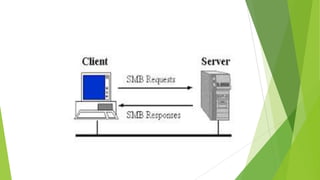
1.Server-Message Block(SMB)
-Used to send I/O requests over the N/W
-Published initially as Common Internet File System(CIFS)
2.TCP/IP
-Internet Protocol
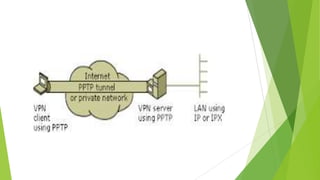
3.Point To Point Tunneling Protocol(PPTP)
-Remote access server modules run on Windows server
machines and other client systems.Used over the Internet.
1.2 PROTOCOLS
4.HTTP PROTOCOL
-Used in WWW.Implemented as kernel-mode driver
5.WebDAV
-Web Distributing and Authoring And Versioning
protocol
-HTTP based protocol for collaborative authoring
6.Named Pipes
-Used for IPC on same machine
1.2 PROTOCOLS
7.Remote Procedure Calls(RPC)
-IPC on two different machines
-Hides architectural differences
8.Component Object Model(COM)
-Microsoft’s OLE uses it to insert
spreadsheets into MS Word
1.3 Redirectors And Servers
1.4 DOMAINS
A domain is basically a collection of user accounts and computer
accounts that are grouped together so that they can be centrally
managed. It is the job of the
domain controller to facilitate this central management of
domain resources.
1.5 ACTIVE DIRECTORY
The LDAP services are implemented in Windows called as Active Directory
PART II-PROGRAMMER INTERFACE
Win32 API is the basic interface to the abilities of Windows
.NET Framework is the modern api developed by MS
C A T E G O R I E S :
 1.Access to Kernel Objects
 2.Sharing of objects between processes
 3.Process management
 4.Memory Management
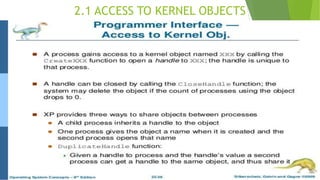
2.1 ACCESS TO KERNEL OBJECTS
2.2 SHARING OBJECTS BETWEEN PROCESSES
1st technique:
Child process inherits a handle to the object.If shared then used for communication between child
and parent.
2nd technique:
One process gives object name and 2nd one opens it.
2.3 PROCESS MGMT.
 Scheduling Rule
1.IDLE PRIORITY CLASS(NT PRIORITY LEVEL 4)
2.NORMAL PRIORITY CLASS(NT PRIORITY LEVEL 3)
3.HIGH PRIORITY CLASS(NT PRIORITY LEVEL 2)
4.REAL-TIME PRIORITY CLASS(NT PRIORITY LEVEL 1)
2.3 PROCESS MGMT.
 THREAD PRIORITIES:
Priority of thread is determined by:
1. Priority class of its process
2. Priority level of the thread
2.3 PROCESS MGMT.
PRIORITY LEVELS OF THREAD:
 THREAD_PRIORITY_IDLE
 THREAD_PRIORITY LOWEST
 THREAD_PRIORITY_BELOW_NORMAL
 THREAD_PRIORITY_NORMAL
 THREAD_PRIORITY_ABOVE_NORMAL
 THREAD_PRIORITY_HIGHEST
 THREAD_PRIORITY_TIME_CRITICAL
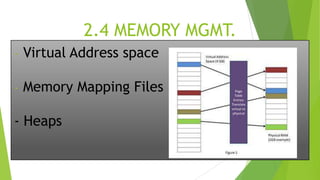
2.4 MEMORY MGMT.
- Virtual Address space
- Memory Mapping Files
- Heaps
Windows Networking Introduction

Windows Networking Introduction

  • 3.
    PART I-NETWORKING Divided into5 parts 1.Network Interfaces 2.Protocols 3.Redirectors And Servers 4.Domains 5.Active Directory
  • 4.
    1.1 NETWORK INTERFACES NetworkDevice Interface Specification(NDIS) -Developed by Microsoft and 3Com to disconnect n/w adapters from transport protocols. -Between DLL and Network Layer
  • 5.
    Transport Driver Interface(TDI) -ProvidesAbstraction Layer in the N/W -Between Transport Layer And Session Layer -Easier to make transport drivers.
  • 7.
    1.2 PROTOCOLS 1.Server-Message Block(SMB) -Usedto send I/O requests over the N/W -Published initially as Common Internet File System(CIFS)
  • 9.
    2.TCP/IP -Internet Protocol 3.Point ToPoint Tunneling Protocol(PPTP) -Remote access server modules run on Windows server machines and other client systems.Used over the Internet.
  • 11.
    1.2 PROTOCOLS 4.HTTP PROTOCOL -Usedin WWW.Implemented as kernel-mode driver 5.WebDAV -Web Distributing and Authoring And Versioning protocol -HTTP based protocol for collaborative authoring 6.Named Pipes -Used for IPC on same machine
  • 12.
    1.2 PROTOCOLS 7.Remote ProcedureCalls(RPC) -IPC on two different machines -Hides architectural differences 8.Component Object Model(COM) -Microsoft’s OLE uses it to insert spreadsheets into MS Word
  • 13.
  • 14.
  • 16.
    1.4 DOMAINS A domainis basically a collection of user accounts and computer accounts that are grouped together so that they can be centrally managed. It is the job of the domain controller to facilitate this central management of domain resources.
  • 18.
    1.5 ACTIVE DIRECTORY TheLDAP services are implemented in Windows called as Active Directory
  • 19.
  • 20.
    PART II-PROGRAMMER INTERFACE Win32API is the basic interface to the abilities of Windows .NET Framework is the modern api developed by MS C A T E G O R I E S :  1.Access to Kernel Objects  2.Sharing of objects between processes  3.Process management  4.Memory Management
  • 21.
    2.1 ACCESS TOKERNEL OBJECTS
  • 22.
    2.2 SHARING OBJECTSBETWEEN PROCESSES 1st technique: Child process inherits a handle to the object.If shared then used for communication between child and parent. 2nd technique: One process gives object name and 2nd one opens it.
  • 23.
    2.3 PROCESS MGMT. Scheduling Rule 1.IDLE PRIORITY CLASS(NT PRIORITY LEVEL 4) 2.NORMAL PRIORITY CLASS(NT PRIORITY LEVEL 3) 3.HIGH PRIORITY CLASS(NT PRIORITY LEVEL 2) 4.REAL-TIME PRIORITY CLASS(NT PRIORITY LEVEL 1)
  • 24.
    2.3 PROCESS MGMT. THREAD PRIORITIES: Priority of thread is determined by: 1. Priority class of its process 2. Priority level of the thread
  • 25.
    2.3 PROCESS MGMT. PRIORITYLEVELS OF THREAD:  THREAD_PRIORITY_IDLE  THREAD_PRIORITY LOWEST  THREAD_PRIORITY_BELOW_NORMAL  THREAD_PRIORITY_NORMAL  THREAD_PRIORITY_ABOVE_NORMAL  THREAD_PRIORITY_HIGHEST  THREAD_PRIORITY_TIME_CRITICAL
  • 26.
    2.4 MEMORY MGMT. -Virtual Address space - Memory Mapping Files - Heaps