www.urbanagriculture.org.au
1	
  
What	
  are	
  wicking	
  beds	
  and	
  why	
  would	
  I	
  use	
  them?	
  	
  
Wicking	
  bed	
  systems	
  give	
  us	
  self-­‐watering,	
  productive	
  and	
  protected	
  places	
  to	
  grow	
  plants,	
  
and	
  are	
  great	
  for	
  growing	
  fruit,	
  vegetables	
  and	
  herbs.	
  	
  They	
  are	
  in	
  essence	
  a	
  garden	
  bed	
  
built	
  over	
  a	
  water	
  reservoir;	
  with	
  water	
  wicking	
  up	
  from	
  the	
  reservoir	
  into	
  the	
  soil	
  to	
  where	
  
your	
  plants	
  use	
  it	
  –	
  at	
  the	
  roots.	


   Fact Sheet 2.08	
  
Why	
  use	
  wicking	
  beds?	
  
Wicking	
  beds,	
  a	
  concept	
  developed	
  by	
  Colin	
  Austin,	
  
are	
  highly	
  water	
  efficient	
  as	
  plants	
  are	
  watered	
  
from	
  below	
  by	
  capillary	
  action.	
  Water	
  wicks	
  up	
  a	
  
certain	
  height	
  –	
  about	
  300mm	
  and	
  the	
  moisture	
  
levels	
  reduce	
  up	
  the	
  soil	
  profile.	
  This	
  leaves	
  the	
  
surface	
  fairly	
  dry	
  which	
  reduces	
  evaporation	
  –	
  more	
  
food	
  with	
  less	
  water!	


They	
  are	
  minimum	
  impact,	
  transportable	
  
(depending	
  on	
  size),	
  can	
  be	
  made	
  easily	
  and	
  
cheaply	
  to	
  any	
  size	
  from	
  a	
  range	
  of	
  materials,	
  allow	
  
you	
  to	
  grow	
  more	
  in	
  a	
  smaller	
  space	
  (and	
  with	
  
fewer	
  resources),	
  and	
  can	
  be	
  installed	
  on	
  any	
  flat	
  
surface	
  including	
  a	
  concrete	
  driveway,	
  couch	
  lawn	
  
or	
  area	
  affected	
  by	
  tree	
  roots	
  or	
  contamination.	


Different	
  height	
  beds	
  can	
  be	
  used	
  for	
  different	
  
purposes:	
  shallower	
  for	
  seedlings,	
  deeper	
  for	
  
vegetables.	
  	
  
Wicking	
  bed	
  materials	
  
Materials	
  include,	
  for	
  example:	


• framework:	
  sleepers,	
  fence	
  palings,	
  veggie	
  box,	
  
or	
  an	
  old	
  bath	
  tub	
  (you	
  need	
  sturdy	
  sides)	
  
• waterproof	
  lining	
  to	
  line	
  inside	
  the	
  container	
  
base	
  and	
  sides	
  (200	
  µm	
  black	
  plastic)	
  for	
  
reservoir	
  base	
  and	
  sides	


• pipe:	
  Ag	
  pipe	
  or	
  25mm	
  pipe	
  and	
  hose,	
  for	
  water	
  
inlet	
  and	
  drainage	
  
• reservoir:	
  	
  washed	
  river	
  sand,	
  6mm	
  road	
  base,	
  
pea	
  shingle,	
  scoria,	
  straw	
  or	
  autumn	
  leaves,	
  or	
  
similar	
  
• geotextile:	
  cut	
  	
  to	
  size	
  or	
  sugar	
  cane	
  mulch	
  
• growing	
  medium:	
  	
  lightweight	
  free	
  draining	
  
vegetable	
  mix,	
  sandy	
  loam,	
  compost	
  (or	
  
mixture)	
  
• Mulch:	
  eg	
  pea	
  straw,	
  sugar	
  cane,	
  eucalypt	
  
• Worm	
  tower	
  tube	
  or	
  tub	
  and	
  worms	
  
• Plants	


Building	
  a	
  Wicking	
  Bed	
  
Using	
  wicking	
  beds	
  addresses	
  many	
  Permaculture	
  
Principles,	
  including	
  ‘obtain	
  a	
  yield’	
  ‘produce	
  no	
  
waste’,	
  and	
  ‘use	
  and	
  value	
  diversity’.	
  	
  
A	
  wide	
  range	
  of	
  edible	
  plants	
  can	
  be	
  grown	
  in	
  small	
  
spaces,	
  using	
  minimal	
  water.	
  A	
  variety	
  of	
  materials	
  can	
  
be	
  used	
  in	
  innovative	
  ways	
  to	
  construct	
  the	
  beds.	
  
www.urbanagriculture.org.au
2	
  
Further	
  information	
  
There	
  is	
  so	
  much	
  information	
  on	
  the	
  internet	
  –	
  search	
  for	
  wicking	
  beds,	
  wicking	
  pots	
  or	
  wicking	
  worm	
  bed.	
  For	
  
example:	
   www.wickingbed.com	


www.sgaonline.org.au/?p=6618	
  	
  
www.childsplaypermaculture.com.au/wick-­‐gardening.html	
  
www.milkwood.net/2010/05/11/how_to_make_a_wicking_bed/	
  
www.urbanfoodgarden.org/main/wicking-­‐beds/wicking-­‐beds.htm	
  
www.permaculturenews.org/2011/06/20/from-­‐the-­‐bottom-­‐up-­‐a-­‐diy-­‐guide-­‐to-­‐wicking-­‐beds/	
  
www.sbs.com.au/shows/costa/listings/detail/i/1/article/6172/wicking-­‐garden-­‐beds	
  
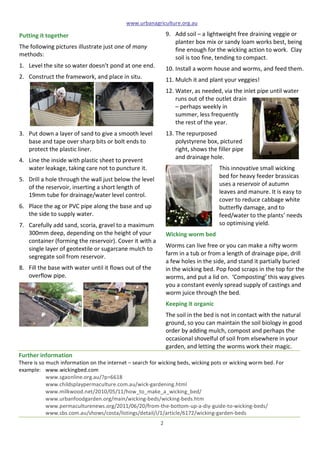
Putting	
  it	
  together	
  	
  
The	
  following	
  pictures	
  illustrate	
  just	
  one	
  of	
  many	
  
methods:	
  
1. Level	
  the	
  site	
  so	
  water	
  doesn’t	
  pond	
  at	
  one	
  end.	
  	
  
2. Construct	
  the	
  framework,	
  and	
  place	
  in	
  situ.	


3. Put	
  down	
  a	
  layer	
  of	
  sand	
  to	
  give	
  a	
  smooth	
  level	
  
base	
  and	
  tape	
  over	
  sharp	
  bits	
  or	
  bolt	
  ends	
  to	
  
protect	
  the	
  plastic	
  liner.	
  	
  
4. Line	
  the	
  inside	
  with	
  plastic	
  sheet	
  to	
  prevent	
  
water	
  leakage,	
  taking	
  care	
  not	
  to	
  puncture	
  it.	
  
5. Drill	
  a	
  hole	
  through	
  the	
  wall	
  just	
  below	
  the	
  level	
  
of	
  the	
  reservoir,	
  inserting	
  a	
  short	
  length	
  of	
  
19mm	
  tube	
  for	
  drainage/water	
  level	
  control.	
  	
  
6. Place	
  the	
  ag	
  or	
  PVC	
  pipe	
  along	
  the	
  base	
  and	
  up	
  
the	
  side	
  to	
  supply	
  water.	


7. Carefully	
  add	
  sand,	
  scoria,	
  gravel	
  to	
  a	
  maximum	
  
300mm	
  deep,	
  depending	
  on	
  the	
  height	
  of	
  your	
  
container	
  (forming	
  the	
  reservoir).	
  Cover	
  it	
  with	
  a	
  
single	
  layer	
  of	
  geotextile	
  or	
  sugarcane	
  mulch	
  to	
  
segregate	
  soil	
  from	
  reservoir.	


8. Fill	
  the	
  base	
  with	
  water	
  until	
  it	
  flows	
  out	
  of	
  the	
  
overflow	
  pipe.	


9. Add	
  soil	
  –	
  a	
  lightweight	
  free	
  draining	
  veggie	
  or	
  
planter	
  box	
  mix	
  or	
  sandy	
  loam	
  works	
  best,	
  being	
  
fine	
  enough	
  for	
  the	
  wicking	
  action	
  to	
  work.	
  	
  Clay	
  
soil	
  is	
  too	
  fine,	
  tending	
  to	
  compact.	
  
10. Install	
  a	
  worm	
  house	
  and	
  worms,	
  and	
  feed	
  them.	
  
11. Mulch	
  it	
  and	
  plant	
  your	
  veggies!	
  	
  
12. Water,	
  as	
  needed,	
  via	
  the	
  inlet	
  pipe	
  until	
  water	
  
runs	
  out	
  of	
  the	
  outlet	
  drain	
  
–	
  perhaps	
  weekly	
  in	
  
summer,	
  less	
  frequently	
  
the	
  rest	
  of	
  the	
  year.	
  	
  
13. The	
  repurposed	
  
polystyrene	
  box,	
  pictured	
  
right,	
  shows	
  the	
  filler	
  pipe	
  
and	
  drainage	
  hole.	
  
This	
  innovative	
  small	
  wicking	
  
bed	
  for	
  heavy	
  feeder	
  brassicas	
  
uses	
  a	
  reservoir	
  of	
  autumn	
  
leaves	
  and	
  manure.	
  It	
  is	
  easy	
  to	
  
cover	
  to	
  reduce	
  cabbage	
  white	
  
butterfly	
  damage,	
  and	
  to	
  
feed/water	
  to	
  the	
  plants’	
  needs	
  
so	
  optimising	
  yield.	
  
Wicking	
  worm	
  bed	
  
Worms	
  can	
  live	
  free	
  or	
  you	
  can	
  make	
  a	
  nifty	
  worm	
  
farm	
  in	
  a	
  tub	
  or	
  from	
  a	
  length	
  of	
  drainage	
  pipe,	
  drill	
  
a	
  few	
  holes	
  in	
  the	
  side,	
  and	
  stand	
  it	
  partially	
  buried	
  
in	
  the	
  wicking	
  bed.	
  Pop	
  food	
  scraps	
  in	
  the	
  top	
  for	
  the	
  
worms,	
  and	
  put	
  a	
  lid	
  on.	
  	
  ‘Composting’	
  this	
  way	
  gives	
  
you	
  a	
  constant	
  evenly	
  spread	
  supply	
  of	
  castings	
  and	
  
worm	
  juice	
  through	
  the	
  bed.	
  
Keeping	
  it	
  organic	
  
The	
  soil	
  in	
  the	
  bed	
  is	
  not	
  in	
  contact	
  with	
  the	
  natural	
  
ground,	
  so	
  you	
  can	
  maintain	
  the	
  soil	
  biology	
  in	
  good	
  
order	
  by	
  adding	
  mulch,	
  compost	
  and	
  perhaps	
  the	
  
occasional	
  shovelful	
  of	
  soil	
  from	
  elsewhere	
  in	
  your	
  
garden,	
  and	
  letting	
  the	
  worms	
  work	
  their	
  magic.	


Building a Wicking Bed for Drought Gardening

  • 1.
    www.urbanagriculture.org.au 1   What  are  wicking  beds  and  why  would  I  use  them?     Wicking  bed  systems  give  us  self-­‐watering,  productive  and  protected  places  to  grow  plants,   and  are  great  for  growing  fruit,  vegetables  and  herbs.    They  are  in  essence  a  garden  bed   built  over  a  water  reservoir;  with  water  wicking  up  from  the  reservoir  into  the  soil  to  where   your  plants  use  it  –  at  the  roots.       Fact Sheet 2.08   Why  use  wicking  beds?   Wicking  beds,  a  concept  developed  by  Colin  Austin,   are  highly  water  efficient  as  plants  are  watered   from  below  by  capillary  action.  Water  wicks  up  a   certain  height  –  about  300mm  and  the  moisture   levels  reduce  up  the  soil  profile.  This  leaves  the   surface  fairly  dry  which  reduces  evaporation  –  more   food  with  less  water!       They  are  minimum  impact,  transportable   (depending  on  size),  can  be  made  easily  and   cheaply  to  any  size  from  a  range  of  materials,  allow   you  to  grow  more  in  a  smaller  space  (and  with   fewer  resources),  and  can  be  installed  on  any  flat   surface  including  a  concrete  driveway,  couch  lawn   or  area  affected  by  tree  roots  or  contamination.       Different  height  beds  can  be  used  for  different   purposes:  shallower  for  seedlings,  deeper  for   vegetables.     Wicking  bed  materials   Materials  include,  for  example:       • framework:  sleepers,  fence  palings,  veggie  box,   or  an  old  bath  tub  (you  need  sturdy  sides)   • waterproof  lining  to  line  inside  the  container   base  and  sides  (200  µm  black  plastic)  for   reservoir  base  and  sides       • pipe:  Ag  pipe  or  25mm  pipe  and  hose,  for  water   inlet  and  drainage   • reservoir:    washed  river  sand,  6mm  road  base,   pea  shingle,  scoria,  straw  or  autumn  leaves,  or   similar   • geotextile:  cut    to  size  or  sugar  cane  mulch   • growing  medium:    lightweight  free  draining   vegetable  mix,  sandy  loam,  compost  (or   mixture)   • Mulch:  eg  pea  straw,  sugar  cane,  eucalypt   • Worm  tower  tube  or  tub  and  worms   • Plants       Building  a  Wicking  Bed   Using  wicking  beds  addresses  many  Permaculture   Principles,  including  ‘obtain  a  yield’  ‘produce  no   waste’,  and  ‘use  and  value  diversity’.     A  wide  range  of  edible  plants  can  be  grown  in  small   spaces,  using  minimal  water.  A  variety  of  materials  can   be  used  in  innovative  ways  to  construct  the  beds.  
  • 2.
    www.urbanagriculture.org.au 2   Further  information   There  is  so  much  information  on  the  internet  –  search  for  wicking  beds,  wicking  pots  or  wicking  worm  bed.  For   example:   www.wickingbed.com         www.sgaonline.org.au/?p=6618     www.childsplaypermaculture.com.au/wick-­‐gardening.html   www.milkwood.net/2010/05/11/how_to_make_a_wicking_bed/   www.urbanfoodgarden.org/main/wicking-­‐beds/wicking-­‐beds.htm   www.permaculturenews.org/2011/06/20/from-­‐the-­‐bottom-­‐up-­‐a-­‐diy-­‐guide-­‐to-­‐wicking-­‐beds/   www.sbs.com.au/shows/costa/listings/detail/i/1/article/6172/wicking-­‐garden-­‐beds   Putting  it  together     The  following  pictures  illustrate  just  one  of  many   methods:   1. Level  the  site  so  water  doesn’t  pond  at  one  end.     2. Construct  the  framework,  and  place  in  situ.         3. Put  down  a  layer  of  sand  to  give  a  smooth  level   base  and  tape  over  sharp  bits  or  bolt  ends  to   protect  the  plastic  liner.     4. Line  the  inside  with  plastic  sheet  to  prevent   water  leakage,  taking  care  not  to  puncture  it.   5. Drill  a  hole  through  the  wall  just  below  the  level   of  the  reservoir,  inserting  a  short  length  of   19mm  tube  for  drainage/water  level  control.     6. Place  the  ag  or  PVC  pipe  along  the  base  and  up   the  side  to  supply  water.       7. Carefully  add  sand,  scoria,  gravel  to  a  maximum   300mm  deep,  depending  on  the  height  of  your   container  (forming  the  reservoir).  Cover  it  with  a   single  layer  of  geotextile  or  sugarcane  mulch  to   segregate  soil  from  reservoir.       8. Fill  the  base  with  water  until  it  flows  out  of  the   overflow  pipe.                       9. Add  soil  –  a  lightweight  free  draining  veggie  or   planter  box  mix  or  sandy  loam  works  best,  being   fine  enough  for  the  wicking  action  to  work.    Clay   soil  is  too  fine,  tending  to  compact.   10. Install  a  worm  house  and  worms,  and  feed  them.   11. Mulch  it  and  plant  your  veggies!     12. Water,  as  needed,  via  the  inlet  pipe  until  water   runs  out  of  the  outlet  drain   –  perhaps  weekly  in   summer,  less  frequently   the  rest  of  the  year.     13. The  repurposed   polystyrene  box,  pictured   right,  shows  the  filler  pipe   and  drainage  hole.   This  innovative  small  wicking   bed  for  heavy  feeder  brassicas   uses  a  reservoir  of  autumn   leaves  and  manure.  It  is  easy  to   cover  to  reduce  cabbage  white   butterfly  damage,  and  to   feed/water  to  the  plants’  needs   so  optimising  yield.   Wicking  worm  bed   Worms  can  live  free  or  you  can  make  a  nifty  worm   farm  in  a  tub  or  from  a  length  of  drainage  pipe,  drill   a  few  holes  in  the  side,  and  stand  it  partially  buried   in  the  wicking  bed.  Pop  food  scraps  in  the  top  for  the   worms,  and  put  a  lid  on.    ‘Composting’  this  way  gives   you  a  constant  evenly  spread  supply  of  castings  and   worm  juice  through  the  bed.   Keeping  it  organic   The  soil  in  the  bed  is  not  in  contact  with  the  natural   ground,  so  you  can  maintain  the  soil  biology  in  good   order  by  adding  mulch,  compost  and  perhaps  the   occasional  shovelful  of  soil  from  elsewhere  in  your   garden,  and  letting  the  worms  work  their  magic.