React Native is the main version of the most popular JavaScript library maintained by
other developers on Facebook and Instagram. Over the years, React Native has gained
popularity among the developer community at large. This is the fourteenth largest
and important starred project on GitHub so far, with Google stating many times that it
was searched for more than ‘iOS development' and 'Android development' as a
'reactive native' search term.
While a new JavaScript framework or library is doing the rounds day by day, React
Native Library has effectively maintained its position in the world. In which we have
been dubbing with React Library for some time, with the help of which many
applications are made. Everyone knows that the future of React Mobile Development
will be very good.
Introduction
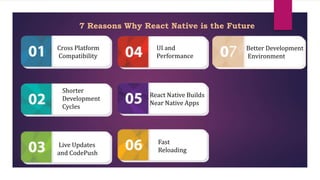
7 Reasons Why React Native is the Future
Cross Platform
Compatibility
Shorter
Development
Cycles
Live Updates
and CodePush
UI and
Performance
React Native Builds
Near Native Apps
Fast
Reloading
Better Development
Environment
Cross Platform Compatibility
Talking about Reactive Native, this API is a cross-platform
which means that you will be able to run your component on
both iOS and Android. You will be able to build full-fledged
applications without writing a single line of platform-specific
code. Reactive Native has different design implications on
Android and iOS. It does a significant job of providing for
such cases with its platform-specific and platform module
extensions. The Platform module detects the OS on which OS
this application is running that can be well used to define a
platform-specific implementation. This allows you to define
files from specific platforms with your file extension. This
response automatically makes the good file dependent on the
OS the app is running.
Shorter Development Cycles
This helps to make the process of developing a
React Native mobile application much faster with
a large developer community to support and is
an open-source project with a lot of components
available for use. We have accelerated the pace of
development using it Has made it much faster.
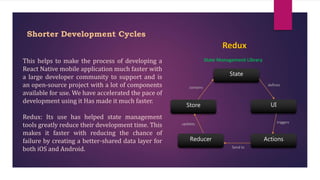
Redux: Its use has helped state management
tools greatly reduce their development time. This
makes it faster with reducing the chance of
failure by creating a better-shared data layer for
both iOS and Android.
Reducer
Store UI
Actions
State
defines
triggers
Send to
updates
State Management Library
Redux
contains
Live Updates and CodePush
The best advantage of developing native mobile apps with the help of Reactive Native is live update. In this, all
developers can update and push their users' phones without going through the App Store update cycle which
has been possible mainly due to widespread use of JavaScript.
Talking about Microsoft Live update service, this service is CodePush SDK which is integrated with React
Native Apps, with the help of which you can push and update your apps, the biggest drawback is that it only
updates JavaScript file and assets. Can. Any user touching the native OS side will have to update through the
regular App Store or Play Store update process.
UI and Performance
A combination of JavaScript, CSS, and
HTML should be widely used to write
React Mobile applications
development to you. These
applications will maintain high
performance without adjusting based
on their capability as it works
independently of the React UI
approach.
React Native Builds Near Native Apps
Mobile apps created using React Native as well as any
native app, while Java Script is not as fast as the native
language. It can run even the most complex of apps with
time response JavaScript. Part of the JavaScript code in it
runs on its thread due to which the UI animation of your
apps is not heavy enough to compile unless,
This is, of course, the processes overlap.
When it comes to React Native, they are quite
individualistic from native apps. It has the same UI
building blocks used for native applications that put
together using React and JavaScript. It also provides an
option for developers to write code in native
languages ​​according to their requirement. Switching to
Java's Swift is easy when fixing the main fixed component.
Fast Reloading
Reactive Native Application helps boost productivity and significantly reduces overall mobile
application development time with the start of reload. It keeps all applications running while
applying new versions and tweaking the UI.
Better Development Environment
In today's time, developers are giving
good time to develop more on reactive
native environment. From the worldly
cycle to the removal of earthly re-creation
and deployment one experiences pleasant
development. React Native uses the
Flexbox layout engine for both platforms,
Android and iOS, the biggest advantage is
that you need to learn just one layout
engine to mobile application develop
on both platforms.
https://www.nexmobility.com/
info@nexmobility.com
+91 80 009 20081
Why React Native is the Future?

Why React Native is the Future?

  • 2.
    React Native isthe main version of the most popular JavaScript library maintained by other developers on Facebook and Instagram. Over the years, React Native has gained popularity among the developer community at large. This is the fourteenth largest and important starred project on GitHub so far, with Google stating many times that it was searched for more than ‘iOS development' and 'Android development' as a 'reactive native' search term. While a new JavaScript framework or library is doing the rounds day by day, React Native Library has effectively maintained its position in the world. In which we have been dubbing with React Library for some time, with the help of which many applications are made. Everyone knows that the future of React Mobile Development will be very good. Introduction
  • 3.
    7 Reasons WhyReact Native is the Future Cross Platform Compatibility Shorter Development Cycles Live Updates and CodePush UI and Performance React Native Builds Near Native Apps Fast Reloading Better Development Environment
  • 4.
    Cross Platform Compatibility Talkingabout Reactive Native, this API is a cross-platform which means that you will be able to run your component on both iOS and Android. You will be able to build full-fledged applications without writing a single line of platform-specific code. Reactive Native has different design implications on Android and iOS. It does a significant job of providing for such cases with its platform-specific and platform module extensions. The Platform module detects the OS on which OS this application is running that can be well used to define a platform-specific implementation. This allows you to define files from specific platforms with your file extension. This response automatically makes the good file dependent on the OS the app is running.
  • 5.
    Shorter Development Cycles Thishelps to make the process of developing a React Native mobile application much faster with a large developer community to support and is an open-source project with a lot of components available for use. We have accelerated the pace of development using it Has made it much faster. Redux: Its use has helped state management tools greatly reduce their development time. This makes it faster with reducing the chance of failure by creating a better-shared data layer for both iOS and Android. Reducer Store UI Actions State defines triggers Send to updates State Management Library Redux contains
  • 6.
    Live Updates andCodePush The best advantage of developing native mobile apps with the help of Reactive Native is live update. In this, all developers can update and push their users' phones without going through the App Store update cycle which has been possible mainly due to widespread use of JavaScript. Talking about Microsoft Live update service, this service is CodePush SDK which is integrated with React Native Apps, with the help of which you can push and update your apps, the biggest drawback is that it only updates JavaScript file and assets. Can. Any user touching the native OS side will have to update through the regular App Store or Play Store update process.
  • 7.
    UI and Performance Acombination of JavaScript, CSS, and HTML should be widely used to write React Mobile applications development to you. These applications will maintain high performance without adjusting based on their capability as it works independently of the React UI approach.
  • 8.
    React Native BuildsNear Native Apps Mobile apps created using React Native as well as any native app, while Java Script is not as fast as the native language. It can run even the most complex of apps with time response JavaScript. Part of the JavaScript code in it runs on its thread due to which the UI animation of your apps is not heavy enough to compile unless, This is, of course, the processes overlap. When it comes to React Native, they are quite individualistic from native apps. It has the same UI building blocks used for native applications that put together using React and JavaScript. It also provides an option for developers to write code in native languages ​​according to their requirement. Switching to Java's Swift is easy when fixing the main fixed component.
  • 9.
    Fast Reloading Reactive NativeApplication helps boost productivity and significantly reduces overall mobile application development time with the start of reload. It keeps all applications running while applying new versions and tweaking the UI.
  • 10.
    Better Development Environment Intoday's time, developers are giving good time to develop more on reactive native environment. From the worldly cycle to the removal of earthly re-creation and deployment one experiences pleasant development. React Native uses the Flexbox layout engine for both platforms, Android and iOS, the biggest advantage is that you need to learn just one layout engine to mobile application develop on both platforms.
  • 11.