Why Do We Dream? To Ease Painful
Memories, Study Hints
REM sleep acts like "overnight therapy," expert suggests.
Christine Dell'Amore
National Geographic News
Published November 29, 2011

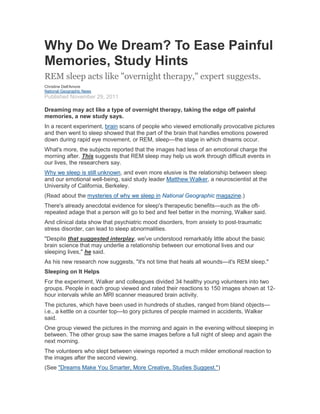
Dreaming may act like a type of overnight therapy, taking the edge off painful
memories, a new study says.
In a recent experiment, brain scans of people who viewed emotionally provocative pictures
and then went to sleep showed that the part of the brain that handles emotions powered
down during rapid eye movement, or REM, sleep—the stage in which dreams occur.
What's more, the subjects reported that the images had less of an emotional charge the
morning after. This suggests that REM sleep may help us work through difficult events in
our lives, the researchers say.
Why we sleep is still unknown, and even more elusive is the relationship between sleep
and our emotional well-being, said study leader Matthew Walker, a neuroscientist at the
University of California, Berkeley.
(Read about the mysteries of why we sleep in National Geographic magazine.)
There's already anecdotal evidence for sleep's therapeutic benefits—such as the oft-
repeated adage that a person will go to bed and feel better in the morning, Walker said.
And clinical data show that psychiatric mood disorders, from anxiety to post-traumatic
stress disorder, can lead to sleep abnormalities.
"Despite that suggested interplay, we've understood remarkably little about the basic
brain science that may underlie a relationship between our emotional lives and our
sleeping lives," he said.
As his new research now suggests, "it's not time that heals all wounds—it's REM sleep."
Sleeping on It Helps
For the experiment, Walker and colleagues divided 34 healthy young volunteers into two
groups. People in each group viewed and rated their reactions to 150 images shown at 12-
hour intervals while an MRI scanner measured brain activity.
The pictures, which have been used in hundreds of studies, ranged from bland objects—
i.e., a kettle on a counter top—to gory pictures of people maimed in accidents, Walker
said.
One group viewed the pictures in the morning and again in the evening without sleeping in
between. The other group saw the same images before a full night of sleep and again the
next morning.
The volunteers who slept between viewings reported a much milder emotional reaction to
the images after the second viewing.
(See "Dreams Make You Smarter, More Creative, Studies Suggest.")
MRI scans performed during REM sleep revealed that brain activity fell in the amygdala—
the emotion-processing part of the brain—possibly allowing the more rational prefrontal
cortex to soften the images' impact. (See an interactive brain map.)
In addition, recordings of the subjects' electrical brain activity during sleep made with
electroencephalograms showed a decrease in the levels of brain chemicals linked to
stress.
When people experience an emotional event, stress chemicals are released to flag and
prioritize that event, essentially reminding the brain to work through it during sleep,
according to Walker, whose study appeared November 23 in the journal Current Biology.
"Somewhere between the initial event and the later point of recollecting, the brain has
performed an elegant trick of divorcing emotions from memory, so it's no longer itself
emotional," Walker said.
"That's what we mean by overnight therapy."
(Take National Geographic magazine's sleep quiz.)
Dreaming Not an Emotional Cure-All?
But sleep expert David Kuhlmann said the team may have "overstepped its bounds slightly
on the conclusions."
For instance, dreaming is not a cure-all for emotional stress, said Kuhlmann, medical
director for sleep medicine at Bothwell Regional Health Center in Sedalia, Missouri.
Though dreaming "helps improve the ability to handle stressful situations," it's unlikely that
REM sleep will make bad memories totally dissipate, he said.
However, he said "it certainly is an interesting finding in this limited subject size in an
artificial environment."
Both experts agreed that sleep is often ignored in the medical profession, even as
research has been revealing its multiple health benefits.
(Related: "Naps Clear Brain's Inbox, Improve Learning.")
And study leader Walker noted that the latest work is "yet another reminder that sleep is
not a state where our brain is dormant and not doing anything."
Instead research is showing that sleep has many important functions, "and one of those
benefits is to help us maintain our emotional and mental health."
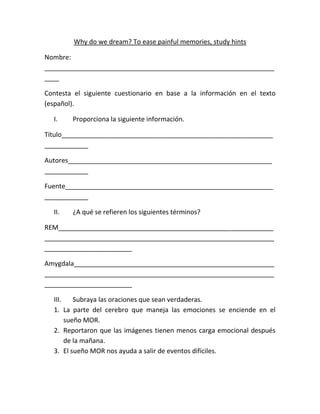
Why do we dream? To ease painful memories, study hints

Nombre:
_______________________________________________________________
____

Contesta el siguiente cuestionario en base a la información en el texto
(español).

  I.    Proporciona la siguiente información.

Título__________________________________________________________
____________

Autores________________________________________________________
____________

Fuente_________________________________________________________
____________

  II.   ¿A qué se refieren los siguientes términos?

REM___________________________________________________________
_______________________________________________________________
________________________

Amygdala_______________________________________________________
_______________________________________________________________
________________________

  III.    Subraya las oraciones que sean verdaderas.
  1. La parte del cerebro que maneja las emociones se enciende en el
       sueño MOR.
  2. Reportaron que las imágenes tienen menos carga emocional después
       de la mañana.
  3. El sueño MOR nos ayuda a salir de eventos difíciles.
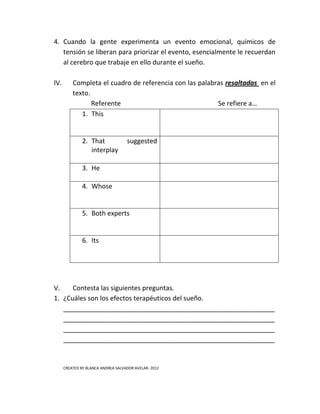
4. Cuando la gente experimenta un evento emocional, químicos de
   tensión se liberan para priorizar el evento, esencialmente le recuerdan
   al cerebro que trabaje en ello durante el sueño.

IV.       Completa el cuadro de referencia con las palabras resaltadas en el
          texto.
                 Referente                               Se refiere a…
             1. This


               2. That              suggested
                  interplay

               3. He

               4. Whose


               5. Both experts


               6. Its


V.    Contesta las siguientes preguntas.
1. ¿Cuáles son los efectos terapéuticos del sueño.
   __________________________________________________________
   __________________________________________________________
   __________________________________________________________
   __________________________________________________________


      CREATED BY BLANCA ANDREA SALVADOR AVELAR- 2012
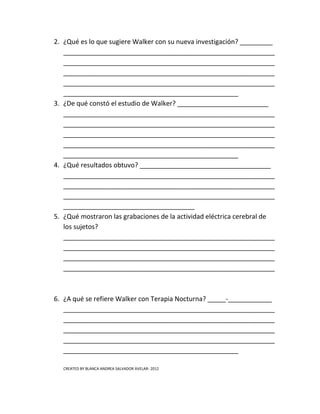
2. ¿Qué es lo que sugiere Walker con su nueva investigación? _________
   __________________________________________________________
   __________________________________________________________
   __________________________________________________________
   __________________________________________________________
   ________________________________________________
3. ¿De qué constó el estudio de Walker? _________________________
   __________________________________________________________
   __________________________________________________________
   __________________________________________________________
   __________________________________________________________
   ________________________________________________
4. ¿Qué resultados obtuvo? ____________________________________
   __________________________________________________________
   __________________________________________________________
   __________________________________________________________
   ____________________________________
5. ¿Qué mostraron las grabaciones de la actividad eléctrica cerebral de
   los sujetos?
   __________________________________________________________
   __________________________________________________________
   __________________________________________________________
   __________________________________________________________


6. ¿A qué se refiere Walker con Terapia Nocturna? _____-____________
   __________________________________________________________
   __________________________________________________________
   __________________________________________________________
   __________________________________________________________
   ________________________________________________

   CREATED BY BLANCA ANDREA SALVADOR AVELAR- 2012
7. ¿Por qué el sueño no es la cura para todo el estrés emocional? ______
   __________________________________________________________
   __________________________________________________________
   __________________________________________________________
   __________________________________________________________
   _______________________________________________


   CREATED BY BLANCA ANDREA SALVADOR AVELAR- 2012

Why do we dream ?

  • 1.
    Why Do WeDream? To Ease Painful Memories, Study Hints REM sleep acts like "overnight therapy," expert suggests. Christine Dell'Amore National Geographic News Published November 29, 2011 Dreaming may act like a type of overnight therapy, taking the edge off painful memories, a new study says. In a recent experiment, brain scans of people who viewed emotionally provocative pictures and then went to sleep showed that the part of the brain that handles emotions powered down during rapid eye movement, or REM, sleep—the stage in which dreams occur. What's more, the subjects reported that the images had less of an emotional charge the morning after. This suggests that REM sleep may help us work through difficult events in our lives, the researchers say. Why we sleep is still unknown, and even more elusive is the relationship between sleep and our emotional well-being, said study leader Matthew Walker, a neuroscientist at the University of California, Berkeley. (Read about the mysteries of why we sleep in National Geographic magazine.) There's already anecdotal evidence for sleep's therapeutic benefits—such as the oft- repeated adage that a person will go to bed and feel better in the morning, Walker said. And clinical data show that psychiatric mood disorders, from anxiety to post-traumatic stress disorder, can lead to sleep abnormalities. "Despite that suggested interplay, we've understood remarkably little about the basic brain science that may underlie a relationship between our emotional lives and our sleeping lives," he said. As his new research now suggests, "it's not time that heals all wounds—it's REM sleep." Sleeping on It Helps For the experiment, Walker and colleagues divided 34 healthy young volunteers into two groups. People in each group viewed and rated their reactions to 150 images shown at 12- hour intervals while an MRI scanner measured brain activity. The pictures, which have been used in hundreds of studies, ranged from bland objects— i.e., a kettle on a counter top—to gory pictures of people maimed in accidents, Walker said. One group viewed the pictures in the morning and again in the evening without sleeping in between. The other group saw the same images before a full night of sleep and again the next morning. The volunteers who slept between viewings reported a much milder emotional reaction to the images after the second viewing. (See "Dreams Make You Smarter, More Creative, Studies Suggest.")
  • 2.
    MRI scans performedduring REM sleep revealed that brain activity fell in the amygdala— the emotion-processing part of the brain—possibly allowing the more rational prefrontal cortex to soften the images' impact. (See an interactive brain map.) In addition, recordings of the subjects' electrical brain activity during sleep made with electroencephalograms showed a decrease in the levels of brain chemicals linked to stress. When people experience an emotional event, stress chemicals are released to flag and prioritize that event, essentially reminding the brain to work through it during sleep, according to Walker, whose study appeared November 23 in the journal Current Biology. "Somewhere between the initial event and the later point of recollecting, the brain has performed an elegant trick of divorcing emotions from memory, so it's no longer itself emotional," Walker said. "That's what we mean by overnight therapy." (Take National Geographic magazine's sleep quiz.) Dreaming Not an Emotional Cure-All? But sleep expert David Kuhlmann said the team may have "overstepped its bounds slightly on the conclusions." For instance, dreaming is not a cure-all for emotional stress, said Kuhlmann, medical director for sleep medicine at Bothwell Regional Health Center in Sedalia, Missouri. Though dreaming "helps improve the ability to handle stressful situations," it's unlikely that REM sleep will make bad memories totally dissipate, he said. However, he said "it certainly is an interesting finding in this limited subject size in an artificial environment." Both experts agreed that sleep is often ignored in the medical profession, even as research has been revealing its multiple health benefits. (Related: "Naps Clear Brain's Inbox, Improve Learning.") And study leader Walker noted that the latest work is "yet another reminder that sleep is not a state where our brain is dormant and not doing anything." Instead research is showing that sleep has many important functions, "and one of those benefits is to help us maintain our emotional and mental health."
  • 3.
    Why do wedream? To ease painful memories, study hints Nombre: _______________________________________________________________ ____ Contesta el siguiente cuestionario en base a la información en el texto (español). I. Proporciona la siguiente información. Título__________________________________________________________ ____________ Autores________________________________________________________ ____________ Fuente_________________________________________________________ ____________ II. ¿A qué se refieren los siguientes términos? REM___________________________________________________________ _______________________________________________________________ ________________________ Amygdala_______________________________________________________ _______________________________________________________________ ________________________ III. Subraya las oraciones que sean verdaderas. 1. La parte del cerebro que maneja las emociones se enciende en el sueño MOR. 2. Reportaron que las imágenes tienen menos carga emocional después de la mañana. 3. El sueño MOR nos ayuda a salir de eventos difíciles.
  • 4.
    4. Cuando lagente experimenta un evento emocional, químicos de tensión se liberan para priorizar el evento, esencialmente le recuerdan al cerebro que trabaje en ello durante el sueño. IV. Completa el cuadro de referencia con las palabras resaltadas en el texto. Referente Se refiere a… 1. This 2. That suggested interplay 3. He 4. Whose 5. Both experts 6. Its V. Contesta las siguientes preguntas. 1. ¿Cuáles son los efectos terapéuticos del sueño. __________________________________________________________ __________________________________________________________ __________________________________________________________ __________________________________________________________ CREATED BY BLANCA ANDREA SALVADOR AVELAR- 2012
  • 5.
    2. ¿Qué eslo que sugiere Walker con su nueva investigación? _________ __________________________________________________________ __________________________________________________________ __________________________________________________________ __________________________________________________________ ________________________________________________ 3. ¿De qué constó el estudio de Walker? _________________________ __________________________________________________________ __________________________________________________________ __________________________________________________________ __________________________________________________________ ________________________________________________ 4. ¿Qué resultados obtuvo? ____________________________________ __________________________________________________________ __________________________________________________________ __________________________________________________________ ____________________________________ 5. ¿Qué mostraron las grabaciones de la actividad eléctrica cerebral de los sujetos? __________________________________________________________ __________________________________________________________ __________________________________________________________ __________________________________________________________ 6. ¿A qué se refiere Walker con Terapia Nocturna? _____-____________ __________________________________________________________ __________________________________________________________ __________________________________________________________ __________________________________________________________ ________________________________________________ CREATED BY BLANCA ANDREA SALVADOR AVELAR- 2012
  • 6.
    7. ¿Por quéel sueño no es la cura para todo el estrés emocional? ______ __________________________________________________________ __________________________________________________________ __________________________________________________________ __________________________________________________________ _______________________________________________ CREATED BY BLANCA ANDREA SALVADOR AVELAR- 2012