Presentation Title
Subtitle
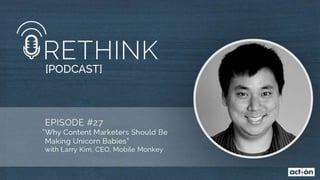
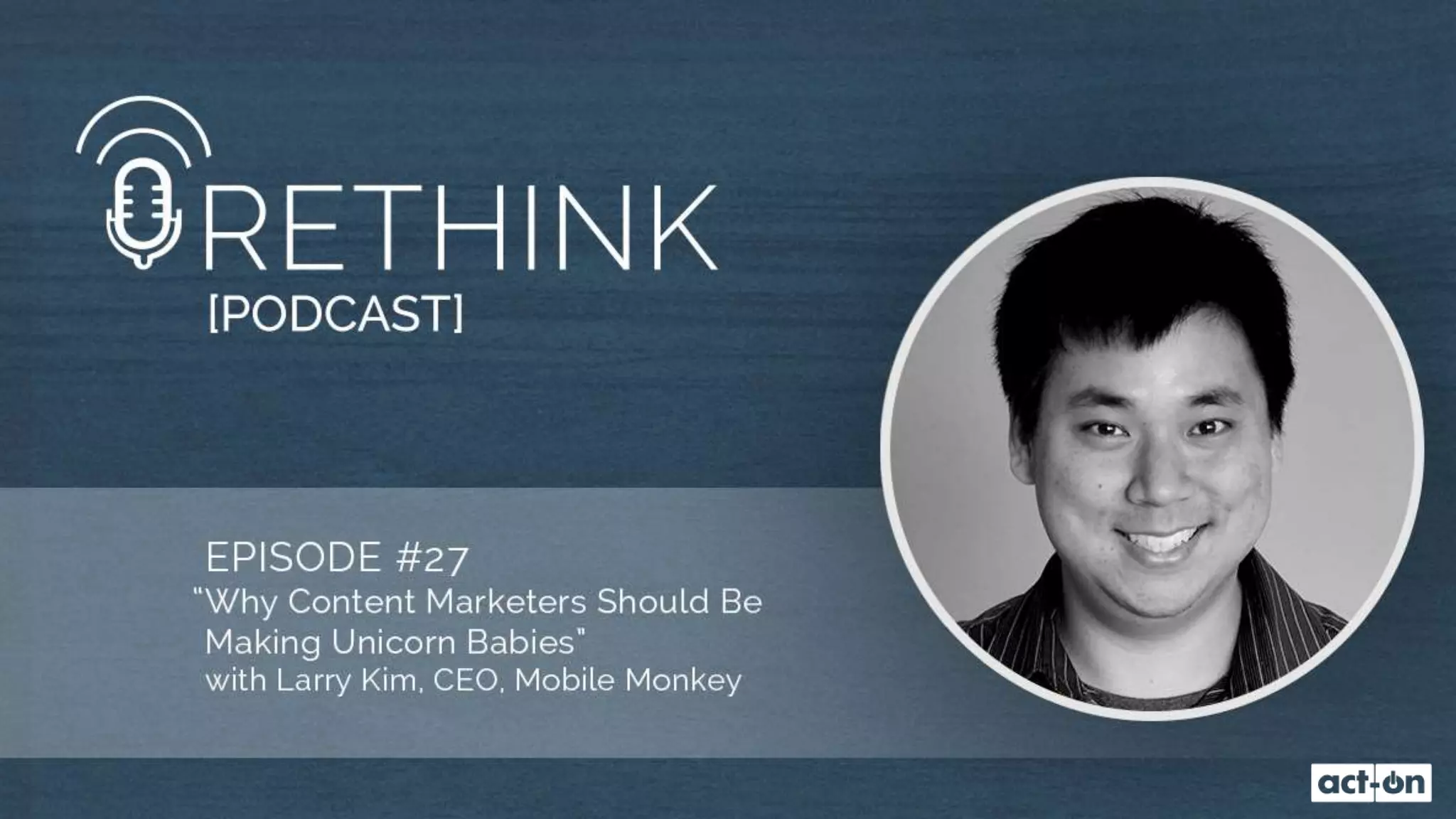
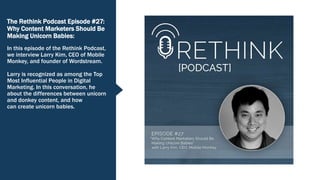
The Rethink Podcast Episode #27:
Why Content Marketers Should Be
Making Unicorn Babies:
In this episode of the Rethink Podcast,
we interview Larry Kim, CEO of Mobile
Monkey, and founder of Wordstream.
Larry is recognized as among the Top
Most Influential People in Digital
Marketing. In this conversation, he
about the differences between unicorn
and donkey content, and how
can create unicorn babies.
Content marketers are very
clueless when it comes to
defining what exactly is
quality content.
Quality content isn't defined by our
own biased opinions, it's based on
the outcomes. If this content is such
great quality, why does 99.9 percent
of it go nowhere?
The answer is it's not quality.
It actually stinks.
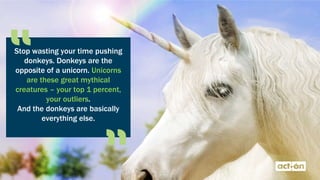
Stop wasting your time pushing
donkeys. Donkeys are the
opposite of a unicorn. Unicorns
are these great mythical
creatures – your top 1 percent,
your outliers.
And the donkeys are basically
everything else.
The mistake people make is they'll
keep pushing on the donkeys because
they can't overcome their own biases.
They think ‘Oh well, this campaign
didn't do well on an email blast, but
let's do another email blast.’
…If it didn't do well in the first 5,000
emails, it's not going to do any better
in the next 10,000 emails.
Content marketers are too eager to jump back
on the content marketing treadmill to produce
the next thing on the calendar, rather than
milking the hand that they've been played for all
it's worth when it's valuable.
Are you just going play it once and then move on
to the next donkey? No. What you need to do is
go all in on it and make unicorn babies.
It’s a little bit like how CNN
goes all in whenever there's
a plane crash that's a
mystery. They clear the
decks. They don't care what
else was on the calendar.
And they just go all in on
that one really engaging
topic.
When you isolate the [unicorn] content outliers,
they have one thing in common. And that is they
have high user engagement rates.
The algorithms that control our fate, our success and failure as
content marketers – the search algorithms, the quality score
algorithms, the email filter, what gets shown to people in their inbox
versus what ends up in the spam filter, the Google search rankings,
the paid Facebook algorithms – these all are dramatically weighted
on user engagement signals more than ever.
If you're not pushing the unicorns, then your content won't even be
seen in the first place. And then I would ask, what was the purpose of
creating this if not to be consumed? I don't see any alternative.
The Two Types of Unicorns
Temporal: “The reason why it did well was because it was
kind of new and novel. And the reason why it stopped doing
well is because the news cycle moved on.”
Evergreen: “There's certain types of content that just never
die. They're like zombies. They just keep on living forever.
The purpose of content
marketing is to create a bias.
But in order for this to work,
your content has to be
memorable. And the unicorns
and the donkeys that I talk
about, that just remarkably
increases the
memorable-ness of the content
that I produce.
The Rethink Podcast
Episode #27:
An Interview with Larry
Kim
• Podcast: Rethink Podcast Episode #27:
Interview with Larry Kim
• Rethink Podcast Website: www.act-
on.com/podcast
• iTunes: The Act-On Rethink Podcast
Contact Us:
+1 (877) 530-1555 | sales@act-on.com
www.act-on.com | #ActOnSW | @ActOnSoftware
Links & Resources
• Mobile Monkey:
https://www.mobilemonkey.com/
• Act-On website: www.act-on.com
• Larry Kim on Twitter: @LarryKim
• Act-On on Twitter: ActOnSoftware

Why Content Marketers Should Be Making Unicorn Babies

  • 1.
  • 2.
    The Rethink PodcastEpisode #27: Why Content Marketers Should Be Making Unicorn Babies: In this episode of the Rethink Podcast, we interview Larry Kim, CEO of Mobile Monkey, and founder of Wordstream. Larry is recognized as among the Top Most Influential People in Digital Marketing. In this conversation, he about the differences between unicorn and donkey content, and how can create unicorn babies.
  • 3.
    Content marketers arevery clueless when it comes to defining what exactly is quality content.
  • 4.
    Quality content isn'tdefined by our own biased opinions, it's based on the outcomes. If this content is such great quality, why does 99.9 percent of it go nowhere? The answer is it's not quality. It actually stinks.
  • 5.
    Stop wasting yourtime pushing donkeys. Donkeys are the opposite of a unicorn. Unicorns are these great mythical creatures – your top 1 percent, your outliers. And the donkeys are basically everything else.
  • 6.
    The mistake peoplemake is they'll keep pushing on the donkeys because they can't overcome their own biases. They think ‘Oh well, this campaign didn't do well on an email blast, but let's do another email blast.’ …If it didn't do well in the first 5,000 emails, it's not going to do any better in the next 10,000 emails.
  • 7.
    Content marketers aretoo eager to jump back on the content marketing treadmill to produce the next thing on the calendar, rather than milking the hand that they've been played for all it's worth when it's valuable. Are you just going play it once and then move on to the next donkey? No. What you need to do is go all in on it and make unicorn babies.
  • 8.
    It’s a littlebit like how CNN goes all in whenever there's a plane crash that's a mystery. They clear the decks. They don't care what else was on the calendar. And they just go all in on that one really engaging topic.
  • 9.
    When you isolatethe [unicorn] content outliers, they have one thing in common. And that is they have high user engagement rates.
  • 10.
    The algorithms thatcontrol our fate, our success and failure as content marketers – the search algorithms, the quality score algorithms, the email filter, what gets shown to people in their inbox versus what ends up in the spam filter, the Google search rankings, the paid Facebook algorithms – these all are dramatically weighted on user engagement signals more than ever. If you're not pushing the unicorns, then your content won't even be seen in the first place. And then I would ask, what was the purpose of creating this if not to be consumed? I don't see any alternative.
  • 11.
    The Two Typesof Unicorns Temporal: “The reason why it did well was because it was kind of new and novel. And the reason why it stopped doing well is because the news cycle moved on.” Evergreen: “There's certain types of content that just never die. They're like zombies. They just keep on living forever.
  • 12.
    The purpose ofcontent marketing is to create a bias. But in order for this to work, your content has to be memorable. And the unicorns and the donkeys that I talk about, that just remarkably increases the memorable-ness of the content that I produce.
  • 13.
    The Rethink Podcast Episode#27: An Interview with Larry Kim • Podcast: Rethink Podcast Episode #27: Interview with Larry Kim • Rethink Podcast Website: www.act- on.com/podcast • iTunes: The Act-On Rethink Podcast
  • 14.
    Contact Us: +1 (877)530-1555 | sales@act-on.com www.act-on.com | #ActOnSW | @ActOnSoftware
  • 15.
    Links & Resources •Mobile Monkey: https://www.mobilemonkey.com/ • Act-On website: www.act-on.com • Larry Kim on Twitter: @LarryKim • Act-On on Twitter: ActOnSoftware

Editor's Notes

  • #4 [Note: Use our stock image resources to update/customize the background image]
  • #5 [Note: Use our stock image resources to update/customize the background image]
  • #6 [Note: Use our stock image resources to update/customize the background image]
  • #7 [Note: Use our stock image resources to update/customize the background image]
  • #8 [Note: Use our stock image resources to update/customize the background image]
  • #9 [Note: Use our stock image resources to update/customize the background image]
  • #10 [Note: Use our stock image resources to update/customize the background image]
  • #11 [Note: Use our stock image resources to update/customize the background image]
  • #12 [Note: Use our stock image resources to update/customize the background image]
  • #13 [Note: Use our stock image resources to update/customize the background image]
  • #15 Q&A –