Why an Industry 4.0 Smart Manufacturing
Program is Essential for Modern Engineers?
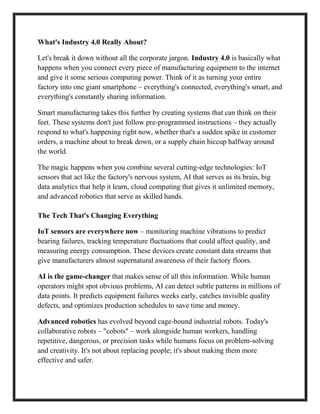
Picture this: You walk into a factory today, and it looks nothing like the industrial
plants your parents might have worked in. Machines are talking to each other,
robots are collaborating with human workers like seasoned teammates, and
everything from production schedules to maintenance alerts is being optimized by
artificial intelligence in real-time. Welcome to Industry 4.0 – and if you're an
engineer who wants to stay relevant, you need to understand what's happening
here.
The manufacturing world has completely flipped the script over the last decade.
We're not just talking about shinier equipment or faster production lines. This is a
fundamental shift in how we think about making things, and engineers who don't
get on board risk being left behind.
What's Industry 4.0 Really About?
Let's break it down without all the corporate jargon. Industry 4.0 is basically what
happens when you connect every piece of manufacturing equipment to the internet
and give it some serious computing power. Think of it as turning your entire
factory into one giant smartphone – everything's connected, everything's smart, and
everything's constantly sharing information.
Smart manufacturing takes this further by creating systems that can think on their
feet. These systems don't just follow pre-programmed instructions – they actually
respond to what's happening right now, whether that's a sudden spike in customer
orders, a machine about to break down, or a supply chain hiccup halfway around
the world.
The magic happens when you combine several cutting-edge technologies: IoT
sensors that act like the factory's nervous system, AI that serves as its brain, big
data analytics that help it learn, cloud computing that gives it unlimited memory,
and advanced robotics that serve as skilled hands.
The Tech That's Changing Everything
IoT sensors are everywhere now – monitoring machine vibrations to predict
bearing failures, tracking temperature fluctuations that could affect quality, and
measuring energy consumption. These devices create constant data streams that
give manufacturers almost supernatural awareness of their factory floors.
AI is the game-changer that makes sense of all this information. While human
operators might spot obvious problems, AI can detect subtle patterns in millions of
data points. It predicts equipment failures weeks early, catches invisible quality
defects, and optimizes production schedules to save time and money.
Advanced robotics has evolved beyond cage-bound industrial robots. Today's
collaborative robots – "cobots" – work alongside human workers, handling
repetitive, dangerous, or precision tasks while humans focus on problem-solving
and creativity. It's not about replacing people; it's about making them more
effective and safer.
Skills That Actually Matter
If you're considering a career in modern manufacturing, here's what you really
need:
Digital fluency isn't optional. You need comfort with enterprise resource
planning systems, manufacturing execution software, and digital twin technologies
that create virtual replicas of physical systems. These tools are becoming as
essential as CAD software was a generation ago.
Data skills are crucial. Smart manufacturing generates terabytes of information
daily. Engineers who can collect, analyze, and turn data into actionable insights are
worth their weight in gold. You don't need to become a data scientist, but you must
be comfortable working with numbers and understanding their meaning.
Understanding automation and robotics is essential. This means familiarity with
sensor networks, programming automated systems, understanding safety protocols
for human-robot interaction, and troubleshooting when things go wrong.
Knowledge of 3D printing and additive manufacturing also sets you apart.
Why Companies Are Going All-In?
The numbers tell a compelling story. Companies implementing comprehensive
smart manufacturing programs see 50% improvements in detecting production
defects and 20% increases in overall yields. These aren't marginal improvements –
they're game-changing differences.
The financial impact is striking. McKinsey research found that companies can
boost operating profits by 40% while spending less than 10% of the original
planned expenditure by adopting Industry 4.0. Energy efficiency improvements of
15-25% save millions while meeting environmental goals.
The Job Market is Red Hot
Here's good news for adaptable engineers: the job market for Industry 4.0 skills is
booming. The global Industry 4.0 market was worth $146.14 billion in 2022 and is
expected to grow at nearly 20% annually through 2030.
For manufacturing engineers specifically, projections show 35,600 new jobs by
2029. These aren't just any manufacturing jobs – they're positions requiring
expertise in automation systems, data analysis, robotics programming, and cross-
functional collaboration.
Universities have noticed this trend, launching specialized programs in smart
manufacturing and Industry 4.0. These combine theoretical foundations with
hands-on experience using the latest technologies, so graduates can contribute
immediately.
The Skills Gap is an Opportunity
Here's reality: most of the current workforce isn't ready for this transition. About
two-thirds of workers lack Industry 4.0 skills, and manufacturers everywhere
struggle to find qualified people. This gap holds back companies but represents a
huge opportunity for willing engineers.
Effective training programs address this by covering multiple integrated
technology areas. Participants learn AI concepts, robotics principles, cloud
computing, and data analytics. More importantly, they learn how these
technologies work together to create comprehensive manufacturing solutions
through hands-on learning with real industry case studies.
The Future is Now
The shift toward intelligent manufacturing is accelerating. Future environments
will need engineers who can manage AI-driven systems, interpret complex data
visualizations, and optimize automated production lines. The most successful will
combine deep technical knowledge with creative problem-solving and cross-
functional leadership.
As automation handles routine tasks, engineers move toward more strategic,
creative work. Instead of repetitive calculations or manual data collection, they can
focus on innovation and complex problem-solving. This represents a real career
growth opportunity, but only for engineers with the right skills.
The Bottom Line
An Industry 4.0 smart manufacturing program isn't just a resume addition – it's
essential for engineers who want to remain relevant. These programs provide
technical skills, practical experience, and strategic understanding needed to
succeed in the fourth industrial revolution.
As manufacturing continues its digital transformation, engineers with smart
manufacturing expertise will drive innovation, optimize operations, and create
competitive advantages. The question isn't whether you should develop these
capabilities; it's how quickly you can start. The opportunities have never been
better, and the choice is clear: get ahead of this trend or watch it pass you by.

Why an Industry 4.0 Smart Manufacturing Program is Essential for Modern Engineers?

  • 1.
    Why an Industry4.0 Smart Manufacturing Program is Essential for Modern Engineers? Picture this: You walk into a factory today, and it looks nothing like the industrial plants your parents might have worked in. Machines are talking to each other, robots are collaborating with human workers like seasoned teammates, and everything from production schedules to maintenance alerts is being optimized by artificial intelligence in real-time. Welcome to Industry 4.0 – and if you're an engineer who wants to stay relevant, you need to understand what's happening here. The manufacturing world has completely flipped the script over the last decade. We're not just talking about shinier equipment or faster production lines. This is a fundamental shift in how we think about making things, and engineers who don't get on board risk being left behind.
  • 2.
    What's Industry 4.0Really About? Let's break it down without all the corporate jargon. Industry 4.0 is basically what happens when you connect every piece of manufacturing equipment to the internet and give it some serious computing power. Think of it as turning your entire factory into one giant smartphone – everything's connected, everything's smart, and everything's constantly sharing information. Smart manufacturing takes this further by creating systems that can think on their feet. These systems don't just follow pre-programmed instructions – they actually respond to what's happening right now, whether that's a sudden spike in customer orders, a machine about to break down, or a supply chain hiccup halfway around the world. The magic happens when you combine several cutting-edge technologies: IoT sensors that act like the factory's nervous system, AI that serves as its brain, big data analytics that help it learn, cloud computing that gives it unlimited memory, and advanced robotics that serve as skilled hands. The Tech That's Changing Everything IoT sensors are everywhere now – monitoring machine vibrations to predict bearing failures, tracking temperature fluctuations that could affect quality, and measuring energy consumption. These devices create constant data streams that give manufacturers almost supernatural awareness of their factory floors. AI is the game-changer that makes sense of all this information. While human operators might spot obvious problems, AI can detect subtle patterns in millions of data points. It predicts equipment failures weeks early, catches invisible quality defects, and optimizes production schedules to save time and money. Advanced robotics has evolved beyond cage-bound industrial robots. Today's collaborative robots – "cobots" – work alongside human workers, handling repetitive, dangerous, or precision tasks while humans focus on problem-solving and creativity. It's not about replacing people; it's about making them more effective and safer.
  • 3.
    Skills That ActuallyMatter If you're considering a career in modern manufacturing, here's what you really need: Digital fluency isn't optional. You need comfort with enterprise resource planning systems, manufacturing execution software, and digital twin technologies that create virtual replicas of physical systems. These tools are becoming as essential as CAD software was a generation ago. Data skills are crucial. Smart manufacturing generates terabytes of information daily. Engineers who can collect, analyze, and turn data into actionable insights are worth their weight in gold. You don't need to become a data scientist, but you must be comfortable working with numbers and understanding their meaning. Understanding automation and robotics is essential. This means familiarity with sensor networks, programming automated systems, understanding safety protocols for human-robot interaction, and troubleshooting when things go wrong. Knowledge of 3D printing and additive manufacturing also sets you apart. Why Companies Are Going All-In? The numbers tell a compelling story. Companies implementing comprehensive smart manufacturing programs see 50% improvements in detecting production defects and 20% increases in overall yields. These aren't marginal improvements – they're game-changing differences. The financial impact is striking. McKinsey research found that companies can boost operating profits by 40% while spending less than 10% of the original planned expenditure by adopting Industry 4.0. Energy efficiency improvements of 15-25% save millions while meeting environmental goals. The Job Market is Red Hot Here's good news for adaptable engineers: the job market for Industry 4.0 skills is booming. The global Industry 4.0 market was worth $146.14 billion in 2022 and is expected to grow at nearly 20% annually through 2030.
  • 4.
    For manufacturing engineersspecifically, projections show 35,600 new jobs by 2029. These aren't just any manufacturing jobs – they're positions requiring expertise in automation systems, data analysis, robotics programming, and cross- functional collaboration. Universities have noticed this trend, launching specialized programs in smart manufacturing and Industry 4.0. These combine theoretical foundations with hands-on experience using the latest technologies, so graduates can contribute immediately. The Skills Gap is an Opportunity Here's reality: most of the current workforce isn't ready for this transition. About two-thirds of workers lack Industry 4.0 skills, and manufacturers everywhere struggle to find qualified people. This gap holds back companies but represents a huge opportunity for willing engineers. Effective training programs address this by covering multiple integrated technology areas. Participants learn AI concepts, robotics principles, cloud computing, and data analytics. More importantly, they learn how these technologies work together to create comprehensive manufacturing solutions through hands-on learning with real industry case studies. The Future is Now The shift toward intelligent manufacturing is accelerating. Future environments will need engineers who can manage AI-driven systems, interpret complex data visualizations, and optimize automated production lines. The most successful will combine deep technical knowledge with creative problem-solving and cross- functional leadership. As automation handles routine tasks, engineers move toward more strategic, creative work. Instead of repetitive calculations or manual data collection, they can focus on innovation and complex problem-solving. This represents a real career growth opportunity, but only for engineers with the right skills.
  • 5.
    The Bottom Line AnIndustry 4.0 smart manufacturing program isn't just a resume addition – it's essential for engineers who want to remain relevant. These programs provide technical skills, practical experience, and strategic understanding needed to succeed in the fourth industrial revolution. As manufacturing continues its digital transformation, engineers with smart manufacturing expertise will drive innovation, optimize operations, and create competitive advantages. The question isn't whether you should develop these capabilities; it's how quickly you can start. The opportunities have never been better, and the choice is clear: get ahead of this trend or watch it pass you by.