Transportation and Real Estate: Making the Connections                                                                      1


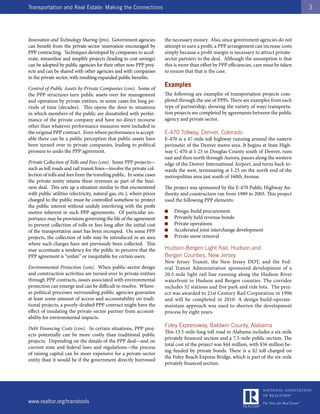
Table of Contents


FOREWORD                                                     ■   High-speed Rail
                                                             ■   Highway Trust Fund
INTRODUCTION                                                 ■   Hot Lanes
                                                             ■   Induced Travel Demand
The Importance of Transportation to Real Estate and Com-
                                                             ■   Intelligent Transportation Systems
munities
                                                             ■   Inter-city Rail
                                                             ■   Intermodal
CURRENT TOPICS IN TRANSPORTATION                             ■   Light Rail
■   Survey: The Public Wants More Options                    ■   Metropolitan Planning Organization (MPO)
■   Fast Growing Light Rail Adds to Transportation Choices   ■   New Starts
■   Bus Rapid Transit Offers a Fast Low-Cost Alternative     ■   Paratransit
■   The Federal Transportation Program: NAR’s Position       ■   PMT
■   Transportation Costs Can Wipe Out Housing Savings        ■   Reverse Commute
■   Developers Build Walkable Neighborhoods Around           ■   Small Starts
    Transit                                                  ■   Transportation Demand Management
■   Federal Stimulus Will Boost Inter-city Rail Projects     ■   VMT
■   The Federal Government Increases Commitment to
    Better Roads and Transit                                 FREQUENTLY ASKED QUESTIONS
■   Complete Streets for All Travelers
                                                             ■   What can be done about congestion besides building
■   High-Occupancy Toll (HOT) Lanes
                                                                 more roads?
■   Managing Transportation Demand
                                                             ■   How are roads paid for?
■   Public/Private Partnerships
                                                             ■   How is transit paid for?
■   Public Transportation Boosts Property Values
                                                             ■   How are transportation and land use issues related?
■   Good Transportation Policy Accounts for Induced
                                                             ■   What effect do transportation improvements have on
    Demand
                                                                 real estate?
                                                             ■   How does my state receive federal transportation funds?
GLOSSARY OF TRANSPORTATION TERMS                             ■   Who plans the transportation system?
■   AASHTO                                                   ■   Are there any financial incentives to commute by transit
■   Alternative Fuel Vehicle                                     or bicycle?
■   APTA                                                     ■   Why are people talking about raising gas taxes?
■   Budgetary Firewall                                       ■   What is a vehicle mileage tax?
■   Bus Rapid Transit                                        ■   How much more will I pay if a mileage tax is levied?
■   Commuter Rail                                            ■   If people can pay to use HOV lanes, won’t this just
■   Complete Streets                                             benefit the rich?
■   Congestion Pricing/Value Pricing                         ■   Have travel trends changed recently?
■   Fair Lanes
■   FHWA                                                     NAR POLICY ON TRANSPORTATION
■   FTA
■   Headway


www.realtor.org/transtools
Transportation and Real Estate: Making the Connections                                                                                 1


Foreword: An Updated Edition
For Today’s Challenges

A   lot has changed since the first Transportation Toolkit was
    published in 2004. Since we at the National Association
of REALTORS® believe that transportation is an issue of vital
importance to real estate and communities, we thought it was
time to update our members on the new challenges, issues,
and concepts in the field.

For one thing, when fuel prices spiked in the summer of 2008,
people started driving less. For the first time since the Second
World War, the number of miles that Americans drove actu-
ally declined from the previous year. Fuel prices moderated
in the fall of 2008, but the country slid into a sharp economic
recession and driving has still not increased.

Meanwhile transit use is skyrocketing—in 2008 it reached its
highest level in 52 years, according to the American Public
Transportation Association. In the face of a faltering econo-
my, rising unemployment, and falling gas prices, the number
of transit trips rose 4 percent between 2007 and 2008, to a
total of 10.7 billion. Unfortunately, at just the time that tran-   tablished 55 years ago to build the Interstate Highway System.
sit demand is surging, the recession is killing transit agencies’   As the interstate system is now complete, the federal role and
revenue streams, leaving them with massive budget problems          mission in transportation needs to be clearly defined in order
and forcing them to cut back their services.                        to justify continued expenditure of tax dollars. Taxpayers and
                                                                    transportation users will expect greater accountability and
Another major set of changes concerns the policies of the           tangible value for each dollar spent.
federal government. The federal government has adopted
policies to improve fuel economy and reduce dependence on           Finally, even as recently as 2004, the issues of climate change
foreign oil (e.g., “cash for clunkers”). Perversely, these poli-    and greenhouse gases were only small parts of the transporta-
cies may have the effect of reducing the revenues available for     tion policy discussion. Today, for a host of reasons, they are
transportation. The chief source of revenue for transportation      a central part of the debate over the future of transportation
infrastructure is the tax on gasoline we pay at the pump. That      infrastructure. The transportation sector, which accounts
tax has been bringing in less and less money as vehicle fuel        for approximately a third of greenhouse gas emissions in the
efficiency has increased, the amount of driving has plateaued,      United States, will be expected to do its part to achieve reduc-
and use of alternative-fuel vehicles and hybrids has increased.     tion targets.
Today the Highway Trust Fund, which pays for federal trans-
portation programs, is essentially bankrupt. Unless and until       This Transportation Toolkit contains a series of concise papers
the political will is found to either increase the gas tax, find    on these topics and more. We will add, update, or remove
new sources of funds, or both, it will continue to require large    papers from time to time to keep this resource timely. In ad-
infusions of general fund revenues.                                 dition, we have included a glossary of transportation terms,
                                                                    FAQs, and NAR’s official statement of policy. We hope you
In addition, federal transportation programs must now search        will find it not merely informative but useful for advocacy in
for a new political rationale. The Highway Trust Fund was es-       your own community.


www.realtor.org/transtools
Transportation and Real Estate: Making the Connections                                                                                      1


The Importance of Transportation to
Real Estate and Communities


    Why is transportation important to real estate and communities?
    As any REALTOR® can tell you, transportation figures prominently in most housing decisions. Buying
    a house isn’t just about a structure and a lot, it’s also about becoming connected to a place. In the
    back of every potential homebuyer’s mind, there’s a series of calculations always going on: How long
    will my commute be? How far am I from where I’m going to shop? How congested are the roads here?
    How close are the nearest hiking trails? How will my kids get to school?


S    avvy homebuyers even look to the future, keeping in mind
     that planned transportation changes can affect a proper-
ty’s value over time. Will the rail transit station that’s expected
                                                                      These three elements can start a vicious cycle, producing more
                                                                      and more congestion over longer stretches of road—a situa-
                                                                      tion that becomes even more costly to deal with over time.
to open down the street add value to my home? How about               The final result can be an exodus of investment from local
the cross-county connector that local officials have been talk-       neighborhoods and a decline in real estate values.
ing about building for the last seven years?
                                                                      But shrinking real estate value isn’t the only reason REAL-
But there’s yet another level on which transportation is impor-       TORS® have a stake in these issues. In order to get a handle
tant to real estate: Transportation provides access to employ-        on growth, some state and local governments have been pur-
ment, and employment is what allows people to buy homes.              suing “concurrency” regulations—basically prohibiting any
A sound transportation system creates the foundation for a            development unless the infrastructure (including transporta-
community’s long-term economic well-being.                            tion infrastructure) is already in place. At the federal level, the
                                                                      Clean Air Act (CAA) can jeopardize a community’s develop-
The Larger Stakes
Robert Fishman, a University of Michigan architecture pro-
fessor, once asked 150 leading urban specialists to rank the
top ten influences on the American metropolis during the
past 50 years. What topped their list? The interstate highway
system and the dominance of the automobile. Looking into
their crystal balls, these urban experts predicted that trans-
portation will play an equally large role over the next 50 years.
Of course, whether the effect will be good or bad is still un-
known. Clearly, the outcome will depend on our ability to
make wise policy choices.

REALTORS® have a major stake in these issues. The biggest
complaint from homeowners and homebuyers today is traffic
congestion, a malady found wherever sprawl and rapid popu-
lation growth combine with an unbalanced transportation
system.


www.realtor.org/transtools
Transportation and Real Estate: Making the Connections                                                                                  2


ment plans if vehicle emissions associated with its long-range     volved in their communities, REALTORS® can put forward
transportation plan exceed its pollution “budget.” And this        practical ideas about how transportation can be improved in
isn’t an idle threat. In Atlanta, federal highway funds were cut   a way that balances all of the factors critical for a healthy com-
off for a period in the late 1990s due to a “conformity lapse”     munity, including housing, economic development, and jobs.
with CAA requirements.                                             However, as in any discipline, to be an effective advocate one
                                                                   has to be conversant in the issues and knowledgeable about
But transportation doesn’t have to be only a negative con-         the state-of-the-art solutions.
sideration. Incorporated correctly, it can be a tool for better
communities and a higher quality of life. There are transpor-      That’s what this Toolkit is designed to do—to give REAL-
tation projects, for example, that improve air quality, bring      TORS® a grounding in the current challenges to mobility,
affordable housing closer to job opportunities, and expand         especially congestion, and a working familiarity with the lat-
access to suburban employment centers. Want to create more         est transportation concepts such as congestion pricing, HOT
vibrant urban centers or counteract a loss of open space?          lanes, bus rapid transit, transit-oriented development, walk-
Transportation projects can help with those things as well.        able neighborhoods, and more.
Transportation can even be an aid to home ownership if it
reduces transportation costs and frees up more income for          Real estate of all types flourishes best in livable communi-
putting together a down payment and sustaining a monthly           ties with efficient systems of transportation. NAR’s goal is to
mortgage payment.                                                  make sure REALTORS® have all the tools they need to foster
                                                                   a positive nexus between housing and transportation—one
The bottom line: transportation can be a constructive force in     that truly promotes quality in the community and in the lives
building quality communities. It all comes down to choices.        of residents.
And that’s where REALTORS® fit in. By being intimately in-


www.realtor.org/transtools
Transportation and Real Estate: Making the Connections                                                                                       1


Survey Reveals That the Public Wants
More Options for Mass Transportation


    The 2009 Growth and Transportation Survey, sponsored by the National Association of REALTORS®
    and Transportation America, asked Americans how their communities are handling development,
    how development affects them, and how the transportation needs of communities can best be met.
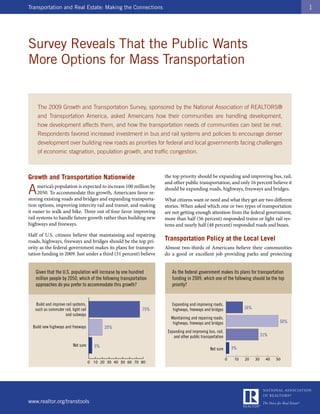
    Respondents favored increased investment in bus and rail systems and policies to encourage denser
    development over building new roads as priorities for federal and local governments facing challenges
    of economic stagnation, population growth, and traffic congestion.


Growth and Transportation Nationwide                                the top priority should be expanding and improving bus, rail,
                                                                    and other public transportation, and only 16 percent believe it
A    merica’s population is expected to increase 100 million by
     2050. To accommodate this growth, Americans favor re-
storing existing roads and bridges and expanding transporta-
                                                                    should be expanding roads, highways, freeways and bridges.

                                                                    What citizens want or need and what they get are two different
tion options, improving intercity rail and transit, and making      stories. When asked which one or two types of transportation
it easier to walk and bike. Three out of four favor improving       are not getting enough attention from the federal government,
rail systems to handle future growth rather than building new       more than half (56 percent) responded trains or light rail sys-
highways and freeways.                                              tems and nearly half (48 percent) responded roads and buses.
Half of U.S. citizens believe that maintaining and repairing
roads, highways, freeways and bridges should be the top pri-        Transportation Policy at the Local Level
ority as the federal government makes its plans for transpor-       Almost two-thirds of Americans believe their communities
tation funding in 2009. Just under a third (31 percent) believe     do a good or excellent job providing parks and protecting


   Given that the U.S. population will increase by one hundred         As the federal government makes its plans for transportation
   million people by 2050, which of the following transportation       funding in 2009, which one of the following should be the top
   approaches do you prefer to accommodate this growth?                priority?


    Build and improve rail systems,                                    Expanding and improving roads,
   such as commuter rail, light rail                          75%      highways, freeways and bridges               16%
                      and subways
                                                                       Maintaining and repairing roads,
                                                                        highways, freeways and bridges                                 50%
  Build new highways and freeways             20%
                                                                     Expanding and improving bus, rail,
                                                                        and other public transportation                        31%

                           Not sure      5%
                                                                                              Not sure        3%

                                                                                                          0    10   20    30     40   50
                                       0 10 20 30 40 50 60 70 80


www.realtor.org/transtools
Transportation and Real Estate: Making the Connections                                                                                     2


open space (65 percent), and more than half believe their             cent), the development and improvement of public transpor-
communities do a good or excellent job providing good pub-            tation (83 percent), and developing and expanding parks that
lic schools (58 percent). When it comes to transportation,            preserve green space and recreation areas in communities (71
however, a majority of those surveyed think their communi-            percent) to be included.
ties do a poor or only fair job.
                                                                      Respondents also agreed that economic stimulus activities
For instance, 56 percent think their community is doing a fair        should be less focused on immediate needs and more on long-
or poor job managing growth and new development. Only                 term economic growth. Specifically, 80 percent of Americans
7 percent believe their community is doing an excellent job           want transportation and other infrastructure spending in-
providing practical and convenient public transportation.             cluded in the economic stimulus bill to go to projects that
                                                                      achieve multiple goals including creating new jobs, improv-
When it comes to traffic congestion in their communities,             ing the environment, increasing transportation choices, and
two-thirds (67 percent) want to address the problem with im-          reducing dependence on foreign oil, even if it means jobs are
proved public transportation, including trains and buses, and         created over a longer period of time. The top transportation-
more options for walking and biking, while only a quarter (27         related goal in respondents’ eyes is promoting long-term eco-
percent) want more roads built and existing roads expanded.           nomic growth (41 percent).
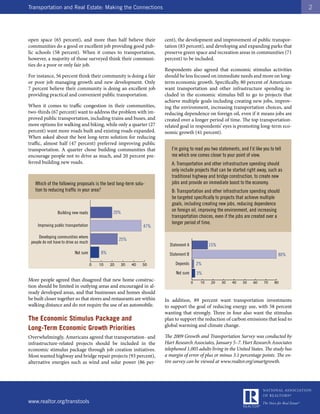
When asked about the best long-term solution for reducing
traffic, almost half (47 percent) preferred improving public
transportation. A quarter chose building communities that                I’m going to read you two statements, and I’d like you to tell
encourage people not to drive as much, and 20 percent pre-               me which one comes closer to your point of view.
ferred building new roads.                                               A: Transportation and other infrastructure spending should
                                                                         only include projects that can be started right away, such as
                                                                         traditional highway and bridge construction, to create new
   Which of the following proposals is the best long-term solu-          jobs and provide an immediate boost to the economy.
   tion to reducing traffic in your area?                                B: Transportation and other infrastructure spending should
                                                                         be targeted specifically to projects that achieve multiple
                                                                         goals, including creating new jobs, reducing dependence
                 Building new roads              20%
                                                                         on foreign oil, improving the environment, and increasing
                                                                         transportation choices, even if the jobs are created over a
                                                                         longer period of time.
     Improving public transportation                            47%

     Developing communities where
                                                     25%
 people do not have to drive as much
                                                                        Statement A             15%
                           Not sure        8%                           Statement B                                                  80%

                                       0   10   20   30    40   50         Depends        2%
                                                                           Not sure       3%
More people agreed than disagreed that new home construc-                             0    10   20    30   40    50    60    70    80
tion should be limited in outlying areas and encouraged in al-
ready developed areas, and that businesses and homes should
be built closer together so that stores and restaurants are within    In addition, 89 percent want transportation investments
walking distance and do not require the use of an automobile.         to support the goal of reducing energy use, with 58 percent
                                                                      wanting that strongly. Three in four also want the stimulus
The Economic Stimulus Package and                                     plan to support the reduction of carbon emissions that lead to
                                                                      global warming and climate change.
Long-Term Economic Growth Priorities
Overwhelmingly, Americans agreed that transportation- and             The 2009 Growth and Transportation Survey was conducted by
infrastructure-related projects should be included in the             Hart Research Associates, January 5–7. Hart Research Associates
economic stimulus package through job creation initiatives.           telephoned 1,005 adults living in the United States. The study has
Most wanted highway and bridge repair projects (93 percent),          a margin of error of plus or minus 3.1 percentage points. The en-
alternative energies such as wind and solar power (86 per-            tire survey can be viewed at www.realtor.org/smartgrowth.


www.realtor.org/transtools
Transportation and Real Estate: Making the Connections                                                                                1


Fast-Growing Light Rail Adds to Transportation
Choices and Can Stimulate Local Economies

                                                                    The transportation environment is changing rapidly, howev-
                                                                    er. Light rail’s success is leading transportation planners and
    Light rail systems are trains that are lighter                  local government officials across the country to propose new
                                                                    systems for their communities, and light rail is now growing
    and shorter than commuter rail or heavy rail                    faster than other modes. The American Public Transporta-
    systems. Although light rail represents only                    tion Association (APTA) reported that light rail and streetcar
                                                                    ridership increased by 8.3 percent in 2008, highest among all
    a small portion of the public transportation
                                                                    modes of public transportation. Total ridership for the year
    market, it is the fastest growing mode of pub-                  was 465.1 million. APTA reported double-digit increases in
    lic transportation and has been shown to                        light rail ridership last year in Charlotte, Buffalo, Philadel-
                                                                    phia, Sacramento, Baltimore, Minneapolis, Salt Lake City,
    provide a significant stimulus to surrounding                   New Jersey, Denver, and Dallas. Denver is already exceeding
    economies. But the recession is slowing light                   its ridership projections for 2020.
    rail expansion plans and forcing service cut-                   The newest light rail system in the United States is Sound
    backs and fare hikes.                                           Transit’s 15.6-mile Central Link in Seattle, which opened in
                                                                    July 2009. Nearly 62 percent of the voters approved an exten-
                                                                    sion of Seattle’s system in the 2008 election. Before that the
                                                                    latest was the METRO in sprawling, congested Phoenix. Prior
                                                                    to the launch of the METRO in December 2008, Phoenix, the
T    he term “light rail” is commonly applied to trains that
     operate on rights-of-way off the streets or on urban-area
streets, have several cars, and are lighter and shorter than
                                                                    fifth-largest American city, was the largest with no passenger
                                                                    rail service of any kind. Amtrak didn’t even stop there. In the
                                                                    first two days of operation, 200,000 rail-starved people rode
commuter rail trains or heavy rail systems. There is generally
                                                                    METRO’s 20-mile starter line.
some distance between light rail stations, perhaps as much
as a mile, except in urban centers. Streetcars, also known as
trolleys, usually share city streets with cars, trucks and buses,   A Boost to Local Economies
have one or two cars and stop every few blocks. In most cases,      Light rail has proven to be a major stimulus to the econo-
light rail and streetcars run on electricity delivered by over-     mies of communities that have built new systems in recent
head power lines.                                                   years. Transit-oriented development (TOD) is built into the
                                                                    planning for some systems, but is not a consistent factor in
In 1981, the first light rail system in the United States opened    the growth of light rail. (See “Developers Are Building More
in San Diego. Nearly 30 years later, 34 light rail systems are      Walkable Neighborhoods Around Transit Systems.”)
serving communities from coast to coast. Many of them are
involved in major expansions of their lines, and three dozen        “Transit-oriented” refers to developments clustered around
more communities are in various stages of planning and de-          transit stations with amenities designed for safe, convenient
veloping light rail.                                                use by pedestrians. One agency that actively promoted TOD
                                                                    was Dallas Area Rapid Transit (DART), which currently op-
Light rail and streetcars (including trolleys) still comprise       erates two lines on 45 miles of track in Dallas and its sub-
a small part of the public transportation market across the         urbs and is planning to add a third, 28-mile line by December
country: light rail ridership accounted for less than 1 percent     2010.
of total transit trips last year, much less than major public
transit modes like buses or commuter rail. Most Americans,          In November 2007, the Center for Economic Development
meanwhile, still hop in their cars to commute to work, go           and Research at the University of North Texas issued a report
shopping, take in a movie or haul the kids to soccer practice.      on the potential fiscal impacts of TOD in the DART service


www.realtor.org/transtools
Transportation and Real Estate: Making the Connections                                                                                   2


area. The report came to this startling conclusion: “The to-         The federal government has provided major support for con-
tal value of projects that are attributable to the presence of       struction of light rail systems, coming up with 50 percent
a DART Rail station since 1999 is $4.26 billion.” The study          of the cost in many instances. Art Guzzetti, vice president
reported that homes near rail stations increased in value by 39      of policy at APTA, notes, however, that the federal govern-
percent more than homes not served by light rail.                    ment pays 80 percent of the cost of highway construction. He
                                                                     says federal support has been increasing, but the government
In Charlotte, transit officials say that more than $291 million      needs to do a lot more.
in new development has been built near stations on a 10-mile
rail line that opened last year, with an additional $1.6 billion     “I would look at it another way and say they have been under-
in development to come. Denver transit officials say 11,000          funding,” says Guzzetti. “There are a lot of good projects out
residential units and 8.4 million square feet of new retail, of-     there, and there should be a higher level of investment.”
fice, and government space have been built along its existing
35-mile rail network. A U.S. Department of Commerce mod-             The federal economic stimulus plan will help, providing $1
el estimates that the University Link, a 3.7-mile connection         billion in capital investment grants for light rail, heavy rail,
from downtown Seattle to the University of Washington, will          commuter rail, and high-occupancy vehicle projects. Phoe-
generate economic activity equivalent to 22,800 jobs.                nix, New Jersey, and Charlotte have already received light rail
                                                                     stimulus grants.
The Cost Factor
                                                                     Case Study: Denver
Even as light rail is growing in popularity and ridership, how-
ever, the global recession is creating funding issues that could     Of all the cities where light rail is winning public transporta-
put expansion plans on hold, or scale them back, until the           tion converts and pulling people out of their cars, none has
economy recovers. Many systems are considering fare in-              bigger ambitions than Denver. The RTD, the regional trans-
creases, service cuts, and layoffs.                                  portation agency that serves the Mile High City and all or
                                                                     part of eight adjacent counties, is planning to expand its exist-
Light rail construction is financed largely by local tax increas-    ing 34-mile light rail system to 122 miles by 2017.
es and federal construction grants with other federal, state,
and local funds added into the mix. Fares comprise a small           Unfortunately, the cost of the expansion is pegged at $6.9 bil-
portion of revenue—for example, just 19 percent of operat-           lion—$2.3 billion more than voters were told it would be in
ing expenses for Denver’s Regional Transportation District           2004 when they passed, for the second time, a sales tax in-
(RTD).                                                               crease to help pay for light rail. Denver residents and visitors
                                                                     now pay a 1 percent sales tax to support light rail.
“It’s not a money-making proposition,” says Matt Cohen, a
Denver REALTOR® who serves on the RTD Board. “It’s not               A majority of the 15 members of the RTD Board of Directors
going to pay for itself in the present model.”                       favor asking the voters to double the portion of the sales tax
                                                                     dedicated to the FasTracks expansion, as the proposed system
“We’re always seeking federal grant sources,” RTD General            is called, to eight-tenths of a percent.
Manager Cal Marsella says. “We’ve cut costs here in every way
we can. We’re always looking at the state budget. So the only        “The consensus was, essentially, we will vote to ask the voters
place you can look to really is federal grants, if they’re there,    for a tax increase, but we don’t know whether it will be in 2009
and raising the sales tax.”                                          or 2010,” says Cohen. “The best case scenario is the voters will
                                                                     approve a four-tenths of one percent increase in the FasTracks
But the sales tax increases approved by local voters in referen-     sales tax, and the feds will approve $1 billion in funding as
dums are producing less revenue because of the recession.            we explore public-private partnerships. If the tax is approved
                                                                     and the feds approve $1 billion in funding, we build out the
Charlotte’s LYNX light rail system is funded in part with a          system by 2017.”
half-cent sales tax approved by voters in 1998 with 57 percent
of the vote. Last year, 70 percent of the voters rejected a ballot   Without the additional local and federal funding, it will likely
issue pushed by light rail opponents to repeal the sales tax. Yet    take until 2034 to complete FasTracks. As this goes to print
even so, LYNX’s shortfall has been projected at $260 million         the board has not decided when it will vote on taking the tax
over 10 years.                                                       increase to the voters.


www.realtor.org/transtools
Transportation and Real Estate: Making the Connections                                                                                 1


Bus Rapid Transit Offers a Fast,
Low-Cost Alternative

                                                                    ■   Specialized, articulated buses that carry more passengers
                                                                        than regular buses
    With Americans seeking out new forms of                         ■   Improved fare collection systems
    transportation in congested urban areas, Bus                    ■   Advanced technology that allows vehicles to change up-
                                                                        coming traffic signals and provide real-time travel infor-
    Rapid Transit (BRT) is emerging as a relative-                      mation to passengers
    ly low-cost alternative. The 25 BRT systems                     ■   Improved service such as faster trips and better reliability
                                                                    ■   Branding and marketing, including special signs, distinc-
    now in operation across the United States
                                                                        tive logos, and colors for the buses and stations
    vary considerably, but most share character-
                                                                    Most of the 25 metropolitan areas across the United States
    istics such as dedicated lanes, larger capaci-                  with Bus Rapid Transit don’t incorporate all seven features.
    ties than regular buses, faster trips, and more                 Cities as varied in size as Los Angeles; Hartford, Connecti-
    rail-like stations. Although new BRT systems                    cut; Charlotte, North Carolina; and Eugene, Oregon, operate
                                                                    BRT programs that conform to the needs of the area. Some
    in places like Boston and Eugene, Oregon,                       systems are doing little more than calling a bus route BRT,
    have proved highly popular, some opponents                      while others meet several qualifications, such as running on
                                                                    a dedicated lane during peak traffic times and being able to
    contend that light rail systems are generally                   affect traffic signals.
    a better choice.
                                                                    An elaborate BRT system can cost $300 million to $400 mil-
                                                                    lion. But even small changes that might cost as little as $1
                                                                    to $2 million, such as upgrading bus shelters and running a

A    s any frequent driver knows all too well, American road-       bus that stops at every other stop, can make a difference, says
     ways are crowded. And with the population expected to          Dennis Hinebaugh, director of the National Bus Rapid Tran-
increase 100 million by 2050, it’s a problem that’s only going      sit Institute in Tampa, Florida. “Take the best route on your
to become more pressing. Nearly half of those surveyed in the       system and make it more rapid,” he suggested.
2009 Growth and Transportation survey, sponsored by the
National Association of REALTORS® and Transportation for            Encouraging Beginnings
America, thought that improving public transit was the best         Early versions of Bus Rapid Transit date back several decades,
way to cut down on local traffic. So communities from Puyal-        but only in the past five to 10 years have communities around
lup, Washington, to Chicago to Bergen County, New Jersey,           the United States engaged in earnest discussions to adopt
are turning to Bus Rapid Transit, an affordable, efficient alter-   these systems. Most have been implemented just in the past
native to intercity rail. Supporters say that Bus Rapid Transit,    three years.
or BRT, can cut down on congestion while improving access
to employment centers and cultural attractions.                     One model of a BRT system is the TransMilenio in Bogota,
                                                                    Colombia, launched in late 2000. According to a World Bank
Strictly defined, BRT has seven characteristics:                    report, by early 2004 TransMilenio was running as many
■   Dedicated lanes on streets or highways                          as 280 buses an hour in each direction and providing up to
■   Stations that go beyond bus shelters, with benches, light-      900,000 passenger trips on an average weekday, or about 16
    ing, ticket vending machines, and information on arrival        percent of the city’s public transportation trips. According to
    times for the next buses                                        TransMilenio, air pollution along its corridors decreased 40
                                                                    percent in the system’s first year of operation.


www.realtor.org/transtools
Transportation and Real Estate: Making the Connections                                                                                  2


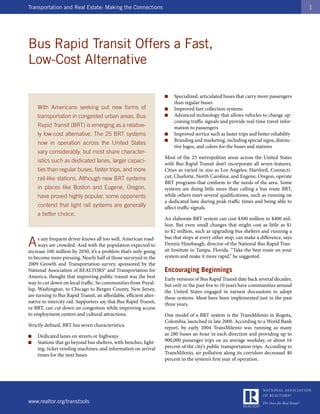
In the United States, Cleveland’s Euclid Corridor Transpor-         have to walk a little farther, which may be more difficult for
tation Project is the newest full-scale BRT. Launched in fall       older or disabled passengers, but few have voiced concerns,
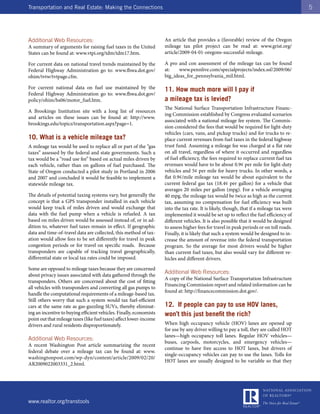
2008, the BRT, called the HealthLine System, uses 63-foot,          according to Vobora. One benefit is faster travel time. The
hybrid diesel-electric, articulated buses that can hold as many     regular bus traversed the route in 22 minutes while the EmX
as 111 passengers (seated and standing) and have two interior       takes 16 minutes or less.
bicycle racks. The seven-mile route, through one of Cleve-
land’s oldest areas, uses special median bus lanes and is being     Skeptics may ask if it was worth spending $24 million to create
adorned with $1.2 million worth of public art. The corridor         the four-mile EmX stretch just to save six minutes. Vobora’s
links downtown Cleveland to major hospitals and Case West-          reply: “Even that is pretty significant in terms of operational
ern Reserve University, as well as to cultural attractions. Since   cost savings.” In other words, fewer buses are needed to pro-
the HealthLine System began running last October, ridership         vide the same service. And the real impact will be felt when a
is up nearly 40 percent.                                            7.5-mile, $41 million extension opens in 2010.

                                                                    Eugene’s EmX quickly drew recognition from around the
A Burgeoning Success in Eugene                                      United States. The BRT system received an Honorable Men-
 It didn’t take long for people in the Eugene and Springfield,      tion from the 2008 Sustainable Transport Awards, sponsored
Oregon, areas to take to their Bus Rapid Transit system. After      by the Institute for Transportation and Development Policy in
12 years of community discussion and planning, the Emerald          New York. Eugene was the only United States city nominated
Express, or EmX, debuted in January 2007, replacing what            for the awards, whose top honors went to London and Paris.
had been a regular bus line. Before the EmX, the route drew
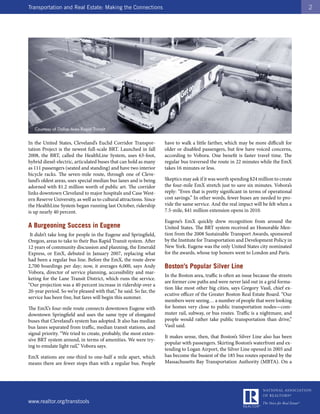
2,700 boardings per day; now, it averages 6,000, says Andy          Boston’s Popular Silver Line
Vobora, director of service planning, accessibility and mar-
                                                                    In the Boston area, traffic is often an issue because the streets
keting for the Lane Transit District, which runs the service.
                                                                    are former cow paths and were never laid out in a grid forma-
“Our projection was a 40 percent increase in ridership over a
                                                                    tion like most other big cities, says Gregory Vasil, chief ex-
20-year period. So we’re pleased with that,” he said. So far, the
                                                                    ecutive officer of the Greater Boston Real Estate Board. “Our
service has been free, but fares will begin this summer.
                                                                    members were seeing… a number of people that were looking
The EmX’s four-mile route connects downtown Eugene with             for homes very close to public transportation nodes—com-
downtown Springfield and uses the same type of elongated            muter rail, subway, or bus routes. Traffic is a nightmare, and
buses that Cleveland’s system has adopted. It also has median       people would rather take public transportation than drive,”
bus lanes separated from traffic, median transit stations, and      Vasil said.
signal priority. “We tried to create, probably, the most exten-
                                                                    It makes sense, then, that Boston’s Silver Line also has been
sive BRT system around, in terms of amenities. We were try-
                                                                    popular with passengers. Skirting Boston’s waterfront and ex-
ing to emulate light rail,” Vobora says.
                                                                    tending to Logan Airport, the Silver Line opened in 2005 and
EmX stations are one-third to one-half a mile apart, which          has become the busiest of the 185 bus routes operated by the
means there are fewer stops than with a regular bus. People         Massachusetts Bay Transportation Authority (MBTA). On a


www.realtor.org/transtools
Transportation and Real Estate: Making the Connections                                                                                  3


typical weekday, the Silver Line has 14,200 boardings com-
pared to 800 to 13,000 a day on the other bus routes.

The Silver Line is just one part of a massive transit system in
the Boston area that also includes light rail and subways. Joe
Pesaturo, director of communications, notes when planning
was underway, some people thought the Silver Line should
be a light rail or trolley system, but the cost would have been
substantially higher. “And trolleys still compete with traffic,”
he says. “All it takes is one car, one accident and trolleys have
to come to a stop.” A bus can veer around a crash scene and
keep going.

BRT vs. Light Rail
Opponents say Bus Rapid Transit doesn’t measure up to light
rail when it comes to long-term labor costs, fuel use, or eco-
nomic development. “You can’t make a bus into a train and
that’s what’s been promoted,” said Dave Dobbs, publisher of
LightRailNow.org, based in Austin, Texas.

A study by the California Center for Innovative Transporta-
tion showed the Orange Line, a BRT route that travels from
the end of a subway line across the San Fernando Valley, has
reduced traffic congestion on the parallel U.S. Highway 101
by 14 percent. Dobbs says he thinks the Orange Line prob-
ably could have been converted to light rail for a relatively
small cost “and would carry even more people than it does
today.” According to Dobbs, about 50 United States cities ei-
ther have light rail lines or are considering building them;
France is building an electric-powered light rail system in ev-
ery city of 100,000 or more. “Operational costs of light rail,
over time, are much lower than a bus,” Dobbs said. He said
a study by LightRailNow.org shows energy consumption on             Boston’s Silver Line
a per-passenger-mile basis is lower with light rail than with
cars or buses.                                                      Space constraints can also pose problems for BRT, where
                                                                    downtown streets in big cities may be narrow, says Aimee
Dobbs also contends that Bus Rapid Transit does little to en-       Gauthier, communications director for the Institute for Trans-
courage economic development along its routes because bus           portation Development Policy. “What we want is for [com-
routes are less permanent than rail lines and can be changed.       munities] to implement a good quality, customer-oriented
“A bus tends to be an afterthought. Buses are followers where-      mass transit system. Most cities can’t afford to pay for light
as trains and rails are leaders,” he says. “A bus stop can go       rail or heavy rail. But Bus Rapid Transit is not only affordable,
anywhere it wants to go tomorrow.”                                  you can also provide the same level of service and demand
                                                                    as rail.”


www.realtor.org/transtools
Transportation and Real Estate: Making the Connections                                                                              1


The Federal Transportation Program:
NAR Adopts a Policy Position

                                                                   Highway Act, an ambitious program that linked America’s
                                                                   cities and states with a network of long-distance superhigh-
    With the six-year federal transportation spend-                ways. Faced with what seemed like a never-ending demand
    ing bill up for renewal this year, major changes               for automobile travel, the government created policies that
                                                                   accommodated and even promoted the growth of suburbs
    could be in the offing. For the first time ever                and sprawling car-dependent urban areas.
    Congress is entering this reauthorization debate
                                                                   What worked 50 years ago, however, is causing major prob-
    with its main repository of federal transportation             lems today. Volatile gas prices burden household budgets and
    funds, the Highway Trust Fund, insolvent. At the               roil the real estate market; spread-out metro areas require a
                                                                   car to reach services and jobs; older Americans and members
    same time America is changing demographi-
                                                                   of low-income communities find themselves increasingly
    cally and socially, leading to shifts in the kinds             isolated due to unreliable public transportation networks.
    of transportation options that people want. Con-               Americans no longer live how—or where—they did 50 years
                                                                   ago, and future transportation policies will need to address
    gress will have to meet these new needs and                    the new needs of a changing population.
    find new sources of funding. Because these
    issues affect community livability so much, for                Shifts in Travel Needs
    the first time the National Association of REAL-               It is estimated that by 2030, one in four Americans will be
                                                                   65 or older. As older Americans leave the work force, stop
    TORS® has adopted a detailed policy position                   commuting and begin to restrict the hours and distances they
    on the reauthorization of the federal bill.                    travel from home, they generally drive less than the popula-
                                                                   tion as a whole. In the baby-boom era of car-oriented suburbs,
                                                                   half of all households had a mom, dad, and kids. Today that
                                                                   share has shrunk to less than a third, while the proportion of

E    very few generations, innovations in transportation spur
     a revolution in how people and goods move around, with
profound implications for how and where we build our cities
                                                                   single-person households edged past it. Fewer soccer moms
                                                                   and dads shuttling the kids around also will mean fewer miles
                                                                   driven overall.
and towns, and ultimately, how we live. In 2009 the federal
transportation law is up for reauthorization, and in the face      Another significant change from the 1950s is that 75 percent
of a population dissatisfied with our current car-based trans-     of Americans now live in metropolitan areas. The largest 100
portation system, it may be time for some big steps. In the last   metropolitan areas alone account for 65 percent of the popu-
year, two Congressionally-appointed commissions, key mem-          lation and 78 percent of economic activity. In coming years,
bers of Congress, road builders, the U.S. Chamber of Com-          the population is projected to become even more heavily con-
merce and large advocacy coalitions such as Transportation         centrated in urban areas. The challenge these days is not so
for America all have declared the current program exhausted        much getting between cities, or from farm to market, as trav-
and in need of a major rethink. Many of those following the        eling within increasingly crowded metro areas.
issue believe that this year may be a turning point akin to that
of 50 years ago.                                                   Americans’ driving habits are also increasingly shaped by re-
                                                                   alities of climate and limited energy supply. As oil becomes
                                                                   less plentiful and more hotly contested in coming decades,
The Interstate Highway Act                                         reducing per-person consumption will be part of the nation’s
In 1956, when gasoline was just 20 cents a gallon, President       plan to insulate ourselves from volatile energy markets and
Eisenhower signed what came to be called the Interstate            potentially hostile oil-producing countries. Proposed mea-


www.realtor.org/transtools
Transportation and Real Estate: Making the Connections                                                                                2


                                                                   “The market has begun to shift,” Leinberger says. “For 50
                                                                   years there was pent-up demand for drivable suburban prod-
                                                                   uct, and it was a new product. We had a very good run of that,
                                                                   but now the pendulum has swung. Today there is pent-up de-
                                                                   mand for another product we haven’t addressed for decades—
                                                                   walkable urban.”

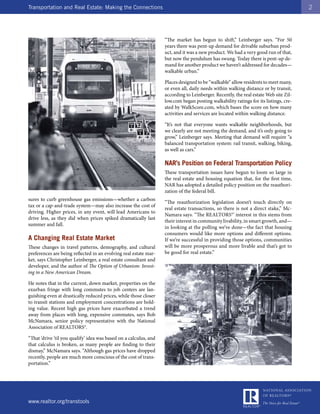
                                                                   Places designed to be “walkable” allow residents to meet many,
                                                                   or even all, daily needs within walking distance or by transit,
                                                                   according to Leinberger. Recently, the real estate Web site Zil-
                                                                   low.com began posting walkability ratings for its listings, cre-
                                                                   ated by WalkScore.com, which bases the score on how many
                                                                   activities and services are located within walking distance.

                                                                   “It’s not that everyone wants walkable neighborhoods, but
                                                                   we clearly are not meeting the demand, and it’s only going to
                                                                   grow,” Leinberger says. Meeting that demand will require “a
                                                                   balanced transportation system: rail transit, walking, biking,
                                                                   as well as cars.”

                                                                   NAR’s Position on Federal Transportation Policy
                                                                   These transportation issues have begun to loom so large in
                                                                   the real estate and housing equation that, for the first time,
                                                                   NAR has adopted a detailed policy position on the reauthori-
                                                                   zation of the federal bill.
sures to curb greenhouse gas emissions—whether a carbon
                                                                   “The reauthorization legislation doesn’t touch directly on
tax or a cap-and-trade system—may also increase the cost of
                                                                   real estate transactions, so there is not a direct stake,” Mc-
driving. Higher prices, in any event, will lead Americans to
                                                                   Namara says. “The REALTORS®’ interest in this stems from
drive less, as they did when prices spiked dramatically last
                                                                   their interest in community livability, in smart growth, and—
summer and fall.
                                                                   in looking at the polling we’ve done—the fact that housing
                                                                   consumers would like more options and different options.
A Changing Real Estate Market                                      If we’re successful in providing those options, communities
These changes in travel patterns, demography, and cultural         will be more prosperous and more livable and that’s got to
preferences are being reflected in an evolving real estate mar-    be good for real estate.”
ket, says Christopher Leinberger, a real estate consultant and
developer, and the author of The Option of Urbanism: Invest-
ing in a New American Dream.

He notes that in the current, down market, properties on the
exurban fringe with long commutes to job centers are lan-
guishing even at drastically reduced prices, while those closer
to transit stations and employment concentrations are hold-
ing value. Recent high gas prices have exacerbated a trend
away from places with long, expensive commutes, says Bob
McNamara, senior policy representative with the National
Association of REALTORS®.

“That ‘drive ’til you qualify’ idea was based on a calculus, and
that calculus is broken, as many people are finding to their
dismay,” McNamara says. “Although gas prices have dropped
recently, people are much more conscious of the cost of trans-
portation.”


www.realtor.org/transtools
Transportation and Real Estate: Making the Connections                                                                                  3


In another first, the NAR also has joined a diverse coalition       ■   How finally to start to coordinate development and
of nearly 300 national, state and local organizations with a            growth patterns with transportation investment, to en-
stake in the federal transportation bill. The Transportation for        sure that people can find homes near jobs, that highways
America coalition (online at T4America.org) aims to repre-              don’t become overburdened by bad planning, and that
sent the broad range of transportation system users, as dis-            we make the most of transit investments; and
tinct from the industry groups that usually follow the debate
closely. The T4America coalition includes well-known orga-          ■   How to streamline the programs and delivery systems—
nizations such as AARP, the American Public Health Asso-                the transport agencies at all levels who must implement
ciation and the National Trust for Historic Preservation, as            the new vision—so that projects get built quickly, yet still
well as key groups with a focus on issues including rural and           according to smart planning.
small town concerns, affordable housing, the environment,
                                                                    And the biggie, of course: How to pay for it all.
social equity, public transportation, bicycling, and walking.
A number of elected officials and state and local entities are      “This is the first time we’ve gone into an authorization debate
also involved.                                                      with the highway trust fund insolvent,” notes John Horsley,
                                                                    executive director of AASHTO, the association of state de-
Major Questions                                                     partments of transportation. “Usually there have been re-
James Corless, the director                                         serves deep enough that congress could take its time and keep
of T4America, says the big                                          extending the existing law till they reached agreement.” But
challenge for coming de-                                            even as the insolvency question adds to the urgency: “There is
cades will be developing and                                        a desire by the White House and the Congressional leadership
funding a program to build “the second half ” of the trans-         to make a transformational bill.”
portation system—the intercity trains, light rail and bus lines,    Horsley says he thinks Congress should debate a vision and
and walking and biking infrastructure that have lagged over         establish funding authorizations at a level sufficient to fulfill
the years—while maintaining and maximizing the efficiency           it, an estimated half-trillion dollars (nearly double the current
of existing highways, bridges, and transit lines. Such steps will   level), then work through the politics of actually raising the
make communities more livable, helping to address the pent-         money in the next couple of years. The bill itself should en-
up demand for real estate with good access to transportation        courage experimentation with new funding sources: charging
options. Some major policy questions include:                       a “vehicle-miles traveled” tax based on how much you drive,
■   How to meet the pent-up demand for public transit, par-         rather than how much fuel you buy; funding some rail transit
    ticularly rail, rapid bus and streetcar projects, many of       projects by recapturing increased land values; charging “con-
    which have local funding but must wait years for their          gestion tolls” for those driving at peak times; and plowing that
    federal match;                                                  money into providing alternative modes of travel in the same
                                                                    corridor.
■   How to give metropolitan areas the latitude to solve their
    congestion and mobility issues, while holding them ac-          Whatever the mechanism, Corless says, Americans are likely
    countable for being fair and inclusive and making timely        to pay if it results in giving them cleaner, smarter, cheaper,
    progress on national goals;                                     and more convenient options.

■   How better to serve rural areas and small towns, which          “In the end, you should still be able to choose to drive,” he
    were especially hard hit when gas prices soared, and            says, “but it shouldn’t be your only option.”
    whose chronically underfunded bus and shuttle services
    leave many stranded;


www.realtor.org/transtools
Transportation and Real Estate: Making the Connections                                                                           1


Transportation Costs Can Wipe Out
Housing Savings for Far-Flung Suburbanites


    For many years, families with lower incomes have moved farther from city centers to find affordable
    housing. But the recent spike in gas prices has brought national attention to the cost of transportation
    to and from these distant neighborhoods. Studies have shown that for some families, transportation
    costs can even exceed housing costs. New indices aim to elucidate the tradeoffs between these two
    sets of costs and help families find truly affordable places to live.


I  n the housing market, distance matters. As the odometer
   turns, house payments fall. That makes homes farther from
city centers less expensive, but does it make them more af-
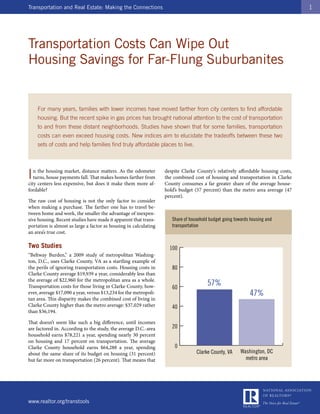
                                                                  despite Clarke County’s relatively affordable housing costs,
                                                                  the combined cost of housing and transportation in Clarke
                                                                  County consumes a far greater share of the average house-
fordable?                                                         hold’s budget (57 percent) than the metro area average (47
                                                                  percent).
The raw cost of housing is not the only factor to consider
when making a purchase. The farther one has to travel be-
tween home and work, the smaller the advantage of inexpen-
sive housing. Recent studies have made it apparent that trans-       Share of household budget going towards housing and
portation is almost as large a factor as housing in calculating      transportation
an area’s true cost.

Two Studies                                                         100
“Beltway Burden,” a 2009 study of metropolitan Washing-
ton, D.C., uses Clarke County, VA as a startling example of
the perils of ignoring transportation costs. Housing costs in        80
Clarke County average $19,939 a year, considerably less than
the average of $22,960 for the metropolitan area as a whole.
Transportation costs for those living in Clarke County, how-         60
                                                                                       57%
ever, average $17,090 a year, versus $13,234 for the metropoli-                                             47%
tan area. This disparity makes the combined cost of living in
Clarke County higher than the metro average: $37,029 rather          40
than $36,194.

That doesn’t seem like such a big difference, until incomes
are factored in. According to the study, the average D.C.-area       20
household earns $78,221 a year, spending nearly 30 percent
on housing and 17 percent on transportation. The average
Clarke County household earns $64,288 a year, spending                0
about the same share of its budget on housing (31 percent)                       Clarke County, VA      Washington, DC
but far more on transportation (26 percent). That means that                                              metro area


www.realtor.org/transtools
Transportation and Real Estate: Making the Connections                                                                                   2


                                                                    The Housing and Transportation Affordability Index (online
                                                                    at http://htaindex.cnt.org/) —developed by the Center for
                                                                    Transit-Oriented Development (CTOD) and CNT on be-
                                                                    half of The Brookings Institution—illuminates the tradeoff
                                                                    between housing and transportation in 42 cities across the
                                                                    country. The index adds average housing costs and average
                                                                    transportation costs and divides the total by average income.
                                                                    (Transportation costs are calculated using a model that takes
                                                                    into account density, walkability, and transit availability of in-
                                                                    dividual neighborhoods.)

                                                                    The Housing and Transportation Affordability Index con-
                                                                    cludes a family should spend no more than 47 percent of its
                                                                    income on housing and transportation. That figure is based
                                                                    on the national average expenditure of 19 percent for trans-
                                                                    portation plus the mortgage underwriting standard of 28 per-
                                                                    cent for housing. Using 47 percent as a benchmark, the index
                                                                    can tell families—and/or their REALTOR®—which neighbor-
                                                                    hoods are affordable based on a family’s particular income.

                                                                    Another set of such indices is under development by the U.S.
                                                                    Department of Transportation (DOT) and the Department
                                                                    of Housing and Urban Development (HUD). In the spring
                                                                    of 2009 the secretaries of those agencies announced they will
                                                                    collaborate to expand affordable housing and transportation
                                                                    choices. High on their agenda: helping metro areas develop
                                                                    indexes that roll housing and transportation costs into a sin-
Similar findings emerged from a 2006 study by the Center            gle measure of affordability.
for Housing Policy (CHP), the Center for Neighborhood
Technology (CNT), and the Institute of Transportation at            “This idea had no traction for a long time, and suddenly the
the University of California, Berkeley. That study, “A Heavy        Obama administration seems to be seeing the importance,”
Load,” examined the budgets of households earning between           Ohlman says. “I think this is the first time DOT and HUD
$20,000 and $50,000 in 28 different metropolitan areas. When        have partnered on a project in something like 40 years.”
compared to households of all incomes, these families spent
the same percentage on housing (27.7 percent) but far more          Bringing Costs Down
on transportation (29.6 percent versus 20.2 percent). “A
Heavy Load” concluded: “In their search for lower cost hous-        People choose where to live based on more than simply cost
ing, working families often locate far from their place of work,    of housing and length of commute, so for some, other factors
dramatically increasing their transportation costs and com-         are the ones that tip the scales. “It’s a more complicated issue
mute times. Indeed, for many such families their transporta-        than just how much you’re paying,” says Jeffrey Lubell, execu-
tion costs exceed their housing costs.”                             tive director of CHP. “People also move because they want a
                                                                    bigger house, a safer neighborhood, better schools.”
Hidden Costs                                                        Fortunately, transportation cost is not purely correlated to
Rising gas prices last year brought national attention to often     distance from city centers. Mass transit can mitigate the oth-
unobtrusive transportation costs. Gloria Ohlman, the com-           erwise steep price of a daily commute, and a healthy aware-
munications director at Reconnecting America, points out the        ness of the cost of distance may be more valuable to the
reason transportation expenses are often overlooked: “Families      home-buying process than any binary imperative. As Lubell
pay for housing in monthly lump sums, either rent or mort-          says, “Ultimately, it’s about creating more walkable and tran-
gage, but they pay their transportation costs in bits and pieces.   sit-oriented communities where more of the things people
Who knows how much they spend on gas, repairs, insurance?           need to do are closer together.”
It’s all these disaggregated costs. I don’t think people are very
cognizant of how much they spend on transportation.”


www.realtor.org/transtools
Transportation and Real Estate: Making the Connections                                                                                 1


Developers Are Building More Walkable
Neighborhoods Around Transit Systems

                                                                   transit advocacy organization. “Minneapolis-St. Paul is in-
                                                                   vesting in a new light rail system. In Los Angeles, voters ap-
    Responding to Americans’ changing prefer-                      proved a tax to pay for the expansion of the current system.”
    ences, developers are helping transform the                    Charlotte and Phoenix are also investing in transit.
    way cities grow with projects huddled near                     Following close behind is real estate development clustered
    transit hubs. Such projects are increasingly                   near light rail stations, at subway stations, and near street-
                                                                   cars—called transit-oriented development, or TOD. These
    popular, and are likely to become more so                      are projects like the Lake Highlands Town Center in Dallas, a
    as concerns about climate change and gas                       nearly 2-million-square-foot, mixed-use project that will in-
    prices continue to rise. They also have drawn                  clude a Dallas Area Rapid Transit (DART) light rail station.
                                                                   “A growing number of developers really get transit-oriented
    support from the federal government. But                       development,” says Jud Pankey, chief executive officer of
    in many ways they can be more challenging                      Prescott Realty Group, which is building the Lake Highlands
                                                                   Town Center. “It’s a whole new way of doing business.”
    than traditional developments on virgin land.
                                                                   “Transit-Oriented” vs. “Transit-Adjacent”
                                                                   Transit-oriented development is not just any land use located

A   lthough some cities like New York and Chicago have
    long-entrenched public transit systems, in most places
Americans’ attachment to their cars made new public transit
                                                                   adjacent to or near a rail station. To be “transit-oriented” the
                                                                   nearby land uses must be readily accessible to and from sta-
                                                                   tions and must be designed for safe, convenient use by pedes-
a hard sell for decades.                                           trians. True TOD has an organic relationship with transit. It
                                                                   increases transit ridership and it directly benefits from high
But attitudes are changing. Concerns about global warming
                                                                   pedestrian activity levels associated with the transit line. Suc-
and increasingly volatile gas prices have led to increased in-
                                                                   cessful TOD districts generally display pronounced elements
terest in environmentally friendly transportation. The weak-
                                                                   of “place” in the sense that people willingly spend time there
ened economy is forcing Americans to scrutinize every penny
                                                                   (not just waiting for transit) and the district has a neighbor-
they spend on housing and commuting. And ever-worsening
                                                                   hood name and is well-known to the area population as a des-
traffic gridlock may also be converting nonbelievers into
                                                                   tination.
transit evangelists. When asked the best approach to solving
traffic problems, 47 percent of respondents to a 2009 National     The land use mix required to achieve these characteristics can
Association of REALTORS® and Transportation for Ameri-             vary depending on the transit mode and on the location of the
ca (online at T4America.org) poll favored improving public         station within the metropolitan area. Generally, at least three
transportation, 25 percent preferred building communities          major land uses should be immediately present. Residential,
that make it possible for people not to drive, and only 20 per-    retail, restaurant, and civic uses would represent a common
cent advocated building new roads.                                 TOD mix. Hotels, office buildings, and other places of em-
                                                                   ployment may also be present.
Real Estate Development Follows Transit
                                                                   There are many rail transit stations in the United States (in-
Increasingly, this shift in attitudes is leading cities to build   cluding some in and around major cities) that have no signifi-
new public transit systems or expand their existing ones. “In      cant organic relationship with their surrounding land uses.
Denver, voters agreed to tax themselves to pay for a regional      This is most common for suburban commuter rail stations
light rail system,” says Allison Brooks, managing director of      that serve primarily to provide park-and-ride access to the
Reconnecting America, an Oakland, California, nonprofit            transit line, but it can also be true of major employment cen-


www.realtor.org/transtools
Transportation and Real Estate: Making the Connections                                                                                 2


ters served by a transit stop. In other cases, auto-oriented de-    They’ve united to cut those costs by creating affordable, sus-
velopment patterns and infrastructure design have negated           tainable communities that rely heavily on transit. DOT also
any land use benefit from the transit service. These sites are      announced $100 million in federal funding for transit proj-
generally referred to as “transit-adjacent” and may represent       ects that reduce energy consumption or greenhouse gases.
a significant missed opportunity.
                                                                    “In the last six months, we’ve seen national interest at the
Transit-oriented districts are mainly located within a quarter      policy level that we haven’t seen before,” says Abby Thorne-
to a half mile of a high-capacity transit station. This radius is   Lyman, a principal at Strategic Economics, an economic and
related to pedestrian walking distances, since public transit       real estate consulting firm, and a staff member for the Center
most influences those land uses that can be reached on foot         for Transit-Oriented Development, a nonprofit research and
in five to ten minutes. It is important to note that the size of    advocacy group in Berkeley, California. “It’s become a nation-
a TOD area can be larger or smaller than this depending on          al movement, not just of developers but also of policymakers
the quality of the walking environment and the presence or          realizing they have a role to play and that transit has large
absence of significant barriers to walking.                         benefits in terms of greenhouse gas reduction and economic
                                                                    development.”
A Growing Trend
Those who have mastered TOD say the phenomenon will                 Challenges
only expand. “In five years, properties along transit routes        But even with increased federal support, TOD can be much
will have increased in value because people will pay a pre-         more difficult and complex than development on virgin land.
mium to live where they can walk to a transit station, even if      It can be difficult to assemble the necessary parcels, and the
they’re not using it every day,” says Carl Dranoff, president of    approval process can present a maze of zoning and permitting
Dranoff Properties in Philadelphia. “Those will be the most         restrictions. “You’ve got multiple public entities and public
sought-after locations.” One of Dranoff ’s projects, a 163-unit     constituencies to work with,” says Pankey. “You have not only
condominium development in Philadelphia’s cultural hub, is          the transit authority, but other public improvements may also
within steps of a subway entrance and the Kimmel Center for         have to be done, and that could mean working with the city,
the Performing Arts. That project is now 90 percent sold. “We       county, and a tax increment financing (TIF) district. Those
were able to hold our prices, and our fall-out ratio of people      members represent various constituencies, and you have to
who cancelled contracts while waiting for their unit to be          be able to navigate that process and articulate the benefit of
finished was only 7 percent,” says Dranoff. “We were able to        transit living.”
go against the grain because sales on projects near transit are
better than those further away.”                                    Lenders often don’t understand the large and intricate—and
                                                                    long-term—nature of TOD projects. Often a developer must
“I’ve been doing TOD since the late 1990s, and I continue to        borrow in order to acquire property and then hold that prop-
ask myself whether it’s going to go away,” says G.B. Arrington,     erty until the transit service matures and the demand it brings
vice president and principal practice leader for PB PlaceMak-       can support the development. This means lenders, which of-
ing, a Portland, Oregon, design and planning firm specializ-        ten include public entities alongside private banks, must be
ing in TOD. “But the interest and demand in both the public         willing to wait a long time.
and private sectors continues to grow because developers who
follow the principles of TOD will create places that are more       Local residents may also lay down early opposition to high-
resilient in the face of gas prices and climate change.”            er-density developments. Not-in-my-backyard (NIMBY)
                                                                    concerns are nothing new to developers, but TOD presents
                                                                    added complications. Dan Johnson, deputy city manager and
Federal Policy Support                                              chief operating officer for Richardson, Texas, which is adding
Federal policymakers seem to agree. In March 2009, the U.S.         four stations to the DART rail line that runs through the city,
Department of Housing and Urban Development (HUD) and               says early planning is one way to avert NIMBY sentiments.
the U.S. Department of Transportation (DOT) announced a             “Several years before the rail was developed, we were active
joint “livable communities” initiative to help Americans gain       with our city council and speaking in public sessions,” he says.
better access to affordable housing, find transportation op-        “We were also selected by the Urban Land Institute for a panel
tions, and lower their transportation costs. According to the       study in which a task force of professionals conducted plan-
two agencies, the average working American family spends            ning and visioning sessions. A lot of problems were circum-
nearly 60 percent of its budget on housing and transportation.      vented by having that session early on.”


www.realtor.org/transtools
Transportation and Real Estate: Making the Connections                                                                              1


Federal Stimulus Package Will Boost
Intercity Rail Projects in Multiple States

                                                                  to work, it gets people to work in a way that moves us toward
                                                                  our long-term goals of energy security and more livable com-
    At President Obama’s request, Congress has                    munities,” said LaHood.
    appropriated more than $10 billion for the                    Indeed, economic studies done for a high speed rail project
    construction of new intercity rail lines. Eco-                to link Sacramento to San Diego, by way of San Francisco and
    nomic studies suggest that these new trains                   Los Angeles, suggest that the train would increase land value
                                                                  by facilitating denser development. A study of economic ben-
    could increase real estate values. California is              efits in Los Angeles concludes that demand to be near these
    the most likely state to receive federal funds,               new intercity rail stations will lead to more commercial/resi-
                                                                  dential infill developments, pushing up property values. An-
    to help complete a high-speed rail corridor                   other study points out that the cities of Ontario and Riverside
    linking Sacramento to San Diego. Florida                      in Southern California are already looking to create transit-
                                                                  oriented business and housing developments in order to put
    may receive funds for a route linking Tam-
                                                                  customers, jobs, and retail outlets in close proximity to one
    pa and Orlando. Texas, Virginia, Wisconsin,                   another.
    North Carolina, and Ohio are other possible                   Advocates for passenger rail service stress that the stimulus
    grantees.                                                     package money won’t suddenly create a network of bullet
                                                                  trains across the country. Instead, the money can be used by
                                                                  any train that achieves speeds of 110 mph, which is consider-
                                                                  ably less than ones already operating abroad.
E   arly in 2009 Congress passed a stimulus package at Presi-
    dent Obama’s request that included $9.3 billion for the
construction of new passenger train lines. The president fol-
                                                                  “It’s unprecedented but it will not do what people say it will
                                                                  do, which is run bullet trains,” said Ross Capon, president of
lowed that up with an additional budget request of $1 billion     the National Association of Railroad Passengers.
a year for the next five years. The 2009 Omnibus Appropria-
tions Act includes $90 million in matching grants for intercity   The Federal Railroad Administration states that the idea is to
passenger rail travel.                                            provide service that is “time competitive” with both air and
                                                                  auto travel within 100 to 500 miles. But the FRA also states
The federal support could help the United States reduce its       that it wants to hand out money to “ready-to-go” projects for
automobile dependence. Unlike other modern industrial             which planning, environmental impact studies, and prelimi-
countries like Japan or those in Europe, the country lacks a      nary engineering activities have been completed.
true high speed rail train. The $787 billion stimulus package
included $1.3 billion for Amtrak and $8 billion for passenger     California in the Lead
train capital grants, including money to develop high speed
rail in 11 corridors across the country.                          The state already the farthest along is California. Voters in
                                                                  that state approved a $9-billion bond referendum in Novem-
                                                                  ber 2008 to help pay for an 800-mile high speed rail system
Clear Benefits                                                    that would traverse the state from Sacramento to San Diego.
In remarks to the National League of Cities this past spring,     The referendum also included an additional $950 million to
U.S. Transportation Secretary Ray LaHood stressed that the        pay for urban, intercity, and commuter rail lines to link up
goal behind all the transportation money included in the          with the high-speed trains. The state is already moving ahead
stimulus bill was not only to create jobs but to help make com-   with the first phase of the project, expected to link the Los
munities more sustainable. “This effort not only puts people      Angeles-Anaheim area to San Francisco. Travel between San


www.realtor.org/transtools
Transportation and Real Estate: Making the Connections                                                                                 2


A conceptual view of California’s proposed high-speed rail.

Francisco and downtown Los Angeles would take roughly                The Florida High Speed Rail Authority now anticipates that
two and a half hours once the train starts running.                  it could begin construction within the next two years, and
                                                                     the Florida Department of Transportation says it has federal
 Judge Quentin Kopp, chairman of the California High Speed           grants in hand that could be used to finish the work needed to
Rail Authority, said he is “confident” that his state can get a      draw down stimulus money.
large share of the federal money because it is pressing ahead
with a train capable of 200 mph. “I think it’s wonderful and
I’m reasonably confident of getting a substantial amount of
                                                                     Other States Not Far Behind
allocated grants from that,” Kopp said. “California is unique.”      California and Florida will not be alone in trying to land bil-
                                                                     lions in federal assistance for passenger train travel.
Kopp said that the state could finish sections of this first 520-
mile phase by 2013, with an estimated completion date of             ■   Texas wants to expand the rail corridor connecting Fort
2018–2020. The entire $45-billion system is expected to be               Worth, Houston, and San Antonio.
finished by 2025.
                                                                     ■   Virginia and North Carolina have already done a lot of
Capon agrees that these aggressive efforts place California far          the groundwork on a route to link Charlotte and Raleigh,
ahead of other states.                                                   N.C., to Washington, D.C.

“Clearly they have done more for laying the foundation for           ■   Wisconsin wants to move ahead with trains that would
true high speed rail,” he said. “It could provide a significant          link Milwaukee and Madison, and to improve the exist-
boost to the California high speed project. The fact is that             ing route from Chicago to Milwaukee.
most of the other states are working on what we call incre-
mental upgrades in conventional services.”                           ■   Ohio wants federal money to restart passenger rail ser-
                                                                         vice along the so-called “3C” corridor that would link the
                                                                         cities of Cleveland, Columbus, and Cincinnati. Private
Florida Another Likely Prospect                                          passenger rail travel along this corridor ended in 1971.
In 2004, then-Gov. Jeb Bush, concerned about the potential               Jolene Molitoris, director of the Ohio Department of
cost, led a charge to repeal a constitutional amendment which            Transportation, testified before Congress that with fed-
had mandated that Florida create a high speed rail system to             eral stimulus help, Ohio could be in “operation quickly”
tie its major cities together. Before the state’s bullet train was       on existing tracks at conventional speeds, laying a foun-
axed by voters, the state had spent $30 million and pursued              dation for high speed rail in the future.
critical environmental studies for a route connecting Tampa
to Orlando.


www.realtor.org/transtools
Transportation and Real Estate: Making the Connections                                                                                1


Federal Government Increases Its Commitment
to Better Roads and Transit, but Slowly

                                                                   Depression-era construction of highways, parks, dams, civic
                                                                   buildings, and more, much of which we still use today.
    Transportation infrastructure is drawing sig-
    nificant attention from the new administra-                    The Stimulus Bill
    tion. President Obama’s first major legislative                Those aspirations ran head-on into the screen applied by
    effort, the economic stimulus bill, allocated                  President Obama’s economic advisers, led by Lawrence Sum-
                                                                   mers. In order to provide the hoped-for, near-term stimulus,
    nearly $50 billion to transportation projects.                 Summers’s team urged spending on “shovel-ready” projects
    His first budget, for fiscal year 2010, includ-                that could put people to work almost immediately. There was
                                                                   no time to do the planning and big-picture thinking necessary
    ed plans for a national infrastructure bank                    for “transformational” investments. This meant that much of
    that would be the first large new funding                      the money would have to be pushed out through existing
    source for such projects in many years. The                    programs, for projects—highways, primarily—already in the
                                                                   pipeline. It was a major disappointment for those hoping that
    new secretaries of the Department of Trans-                    the stimulus would mean a major infusion for oil-saving, low-
    portation, Ray LaHood, and Housing and                         carbon transportation systems, such as rail and other public
                                                                   transit, that could become the spines of more walkable or
    Urban Development, Shaun Donovan, have                         bike-friendly neighborhoods.
    announced a plan to work together to build
                                                                   “We had all been talking about this potential new vision, but
    housing and “livable” neighborhoods in con-                    when we did the recovery package it was, ‘Shovel the money
    junction with mass transit. And Obama has                      out the door and forget about the consequences,’” lamented
                                                                   Robert Puentes, who tracks transportation issues for the
    announced a plan to connect the country’s
                                                                   Brookings Institution. “In the end we fell back on the same
    major economic centers with high speed and                     processes, the same projects, and the same interests.”
    upgraded conventional rail.                                    In leaning on yesterday’s priorities for expediency’s sake, the
                                                                   nation postponed the debate on priorities for the future until
                                                                   the renewal of the federal transportation program later this
                                                                   year, Puentes said.
S    hortly after his election, President Obama began pushing
     for a massive economic stimulus package, which Con-
gress ultimately passed on February 13, 2009. In speeches
                                                                   Still, the final stimulus bill, dubbed the American Recovery
                                                                   and Reinvestment Act, did break some new ground with un-
during the transition, he called for an investment in transpor-    precedented flexibility in how the money can be spent. With
tation infrastructure not seen since the creation of the federal   nearly 40 percent of the transportation dollars dedicated to
highway system in the 1950s. At the same time, he said the         intercity rail and public transit construction and rehabilita-
stimulus investments should be “transformational,” helping         tion, the bill broke with the past custom that highways al-
to put the country on a path to energy independence, curb          ways receive at least 80 percent of transportation funds. After
climate-damaging emissions, and provide the underpinnings          White House Chief of Staff Rahm Emanuel intervened on the
of an emerging new economy that would be dynamic, mobile,          president’s behalf, $8 billion was added for high speed rail and
and less dependent on fossil fuels. Many envisioned a “new         “higher speed” conventional rail, as well as nearly $1.5 billion
New Deal,” a federal building program on the scale of the          for Amtrak.


www.realtor.org/transtools
Transportation and Real Estate: Making the Connections                                                                                2


Even the $27.5 billion ostensibly designated for highways was
put largely into a funding category, the Surface Transportation
Program, that can be used for transit, ports, and other trans-
portation modes. About 30 percent of the money was assigned
to metropolitan area planning agencies for allocation as they
see fit. Congress resisted entreaties to require state Depart-
ments of Transportation to fix their worst highways and bridg-
es before building big, new projects. Even so, the requirement
that the funds be spent quickly has meant that most DOTs are
fast-tracking maintenance and rehabilitation, resurfacings, and
bridge painting. These are the types of projects that can move
without a lot of engineering and approval processes.

The bill also designates $8.4 billion for public transit capital
projects. It was a bittersweet moment for transit supporters:
Overjoyed at receiving the capital dollars at a moment when
transit ridership was at a 50-year high, they were disappoint-
ed that there were no funds to preserve existing service in the
face of economic devastation that was requiring major cuts in
operations.                                                        Not everyone in Congress loves the idea. Sen. Max Baucus,
                                                                   the Montana Democrat who chairs the Finance Commit-
                                                                   tee, which would have a say on creating the legislation, has
The 2010 Budget                                                    voiced opposition. “I think that bank idea will rob the fu-
If the stimulus debate sent mixed messages about the nation’s      ture growth of the highway program and that will destroy
direction on transportation infrastructure, President Obama’s      the national scope of our highway program,” he said dur-
first full-year budget, for fiscal year 2010, seemed to give       ing an April hearing on transportation spending held by the
clearer indications of future priorities. The narrative in the     Senate Environment and Public Works Committee. Baucus
budget overview emphasized investments that advance envi-          indicated that he believes that wealthier states would be bet-
ronmental sustainability, livable communities, and produc-         ter suited to compete for the funds, which would have to be
tive growth. It charted new territory by proposing to require      paid back.
more rigorous economic analysis and performance measures
for transportation projects. The president’s budget document       A New Direction for the U.S. DOT
also linked cleaner transportation options like public transit
to climate and air-quality issues.                                 At the Department of Transportation, Secretary Ray La-
                                                                   Hood—the former Illinois congressman who was the second
President Obama also called for $25.2 billion to create and        Republican in the administration—came into office promis-
operate a national infrastructure bank through 2019. Like the      ing to promote “livability” as the watchword of his tenure.
Federal Reserve Bank, the infrastructure bank would operate
under an independent board, evaluating and funding infra-          “The era of one-size-fits-all transportation projects must give
structure of national significance, including water and sewer      way to ones where preserving and enhancing unique com-
plants, public transit systems, roads and bridges, and afford-     munity characteristics, be they rural or urban, is a primary
able housing. The bank essentially would be a revolving loan       goal rather than an afterthought,” LaHood said at his Senate
fund, allowing transportation projects to be debt-financed.        confirmation hearing.
Most federal projects today are funded on a pay-as-you-go          He followed that with a joint announcement with Housing
basis from gas tax receipts.                                       and Urban Development Secretary Shaun Donovan that the
In a February 2009 interview President Obama said, “The            two departments would begin to coordinate on transit plan-
idea [is] that we get engineers, and not just elected officials,   ning and housing development, and that they would exam-
involved in thinking about and planning how we’re spend-           ine federal rules that either promote or thwart the creation
ing these dollars … The needs are massive and we can’t do          of walkable neighborhoods. Smart growth principles would
everything. It would be nice if we said here are the 10 most       animate this initiative, the two said. They aim to build afford-
important projects and let’s do those first, instead of maybe      able housing near public transportation, create shorter neigh-
doing the 10 least important projects, but the ones that have      borhood street blocks to promote walking, and expand bus
the most political pull.”                                          routes to reach more areas.


www.realtor.org/transtools
Transportation and Real Estate: Making the Connections                                                                             3


Reviving Rail Networks                                             The administration plan outlined 10 corridors that have
                                                                   passed muster in various studies: a northern New England
On April 16, with LaHood and Vice President Joseph Biden           line; an Empire line running east to west in New York State;
by his side, President Obama pulled back the curtain on his        a Keystone corridor in Pennsylvania connecting Philadelphia
vision for a revived rail network for America, including de-       and Pittsburgh; a Chicago hub network; a southeast network
velopment of high speed passenger rail lines in at least 10 re-    connecting Washington, D.C., to Florida and the Gulf Coast;
gions. This would be the first such transnational effort since     a Gulf Coast line extending from eastern Texas to western
the Interstate Highway System was launched in 1956. To             Alabama; a corridor in central and southern Florida; a Texas-
jumpstart the project, he said that he would add $1 billion        to-Oklahoma line; a Portland-Seattle-Vancouver corridor in
a year for five years to the $8 billion to be spent in two years   the Northwest; and a California corridor from San Francisco
under the stimulus bill.                                           to Los Angeles that was part of the voter-approved financing
In announcing the plan, he noted that clogged highways,            initiative last fall.
struggling airlines and overburdened airways, along with un-       “Imagine whisking through towns at speeds more than 100
certain energy costs and the need to reduce oil consumption,       miles per hour, walking only a few steps to public transpor-
threatened the long-term viability of intercity travel in the      tation, and ending up just blocks from your destination,”
United States.                                                     President Obama said. “It is happening right now; it’s been
“What we need, then, is a smart transportation system equal        happening for decades. The problem is, it’s been happening
to the needs of the 21st century,” the president said, “a system   elsewhere, not here.” He noted that Japan, France and Spain
that reduces travel times and increases mobility, a system that    all were ahead of us. But, he added: “There’s no reason why
reduces congestion and boosts productivity, a system that re-      we can’t do this.”
duces destructive emissions and creates jobs.”


www.realtor.org/transtools
Transportation and Real Estate: Making the Connections                                                                                    1


Complete Streets Address
the Needs of All Travelers

                                                                   They looked for opportunities to install bike lanes during re-
                                                                   paving projects and to put in pads to provide space for county
    “Complete streets” refers to the concept that                  bus shelters. Then they started making more radical changes.
    roads should meet everyone’s needs, not just
                                                                   “People from outside University Place comment about how
    motorists but also walkers, bicycle riders,                    much they love driving down Bridgeport Way,” says Steve
    and bus riders. A growing number of com-                       Sugg, deputy city manager, describing one of the first streets
                                                                   to get a full complete streets treatment. “There is a sense of
    munities are using complete streets policies                   calm.” The redesigned road features a landscaped median,
    to reduce accidents, get people more physi-                    new pedestrian crossings, bicycle lanes, a multi-use path and
                                                                   improved sidewalks. Sugg notes that when Trader Joe’s was
    cally active, and promote walkable neighbor-                   looking for a place to locate a store in the Tacoma region, they
    hoods, which have held their property val-                     picked a site on Bridgeport Way, perhaps because of the ex-
    ues during the current downturn. Complete                      tensive street improvements.

    streets policies will increase in importance as                University Place has added 23 miles of sidewalks to its streets
                                                                   since incorporation and has installed several modern round-
    a greater proportion of Americans reach old
                                                                   abouts, the first in Washington State. Now the town is work-
    age and are forced to give up driving.                         ing with citizens on planning a Town Center to realize broad-
                                                                   er smart growth principles.

                                                                   In Jefferson City, Missouri, in March 2009, disability advo-

“C       omplete streets” policies set out to make road projects   cates, trail-building organizations, bicycle advocates, health
         meet the needs of everyone using the road, not just       groups, and even a REALTOR© spoke at a state House hear-
motorists, but also people walking, riding bicycles, or catch-     ing or wrote letters in support of a complete streets bill. In
ing the bus. Across the country, a growing number of commu-        Hawaii, bicycle advocates and the state AARP chapter made
nities are using this deceptively simple tool to change the way    common cause this spring to push for a similar bill with a
they approach transportation. Adopted as a state law, local        particularly Hawaiian twist—they’ve linked it to a Hawaiian
ordinance, or even as a city council resolution, these policies    tradition known as “the splintered paddle”—a native myth
set a new vision for transportation investments. More than 85      that asserts everyone’s right to travel safely. State legislators in
states, regions, and cities have adopted such policies, includ-    Connecticut, Texas, West Virginia, and Maine have also in-
ing new state laws passed in California and Illinois and policy    troduced complete streets bills.
resolutions or ordinances in major cities including St. Paul,
Miami, Chicago, Seattle, Sacramento, and Charlotte. And the        Complete Streets on Capitol Hill
pace is accelerating.
                                                                   Complete streets policies are also getting federal attention.
                                                                   Sen. Tom Harkin and Rep. Doris Matsui have introduced the
Complete Streets across the Country                                Complete Streets Act of 2009 into the U.S. House and Senate
When tiny University Place outside of Tacoma, Washington,          (S.584, H.R.1443). “We need to ensure streets, intersections,
incorporated in the mid-1990s, one of its first priorities was     and trails are designed to make them easier to use and maxi-
adding sidewalks to the former county roads. The town start-       mize their safety,” said Sen. Harkin upon introduction of the
ed by cajoling the gas company to split costs for transforming     bill. “This legislation will encourage Americans to be more
gravel shoulders into sidewalks during gas line replacements.      active, while also providing more travel options and cutting
                                                                   down on traffic congestion.”


www.realtor.org/transtools
Transportation and Real Estate: Making the Connections                                                                                  2


The bill would require states and metropolitan planning orga-        of Minnesota has been supporting “active living” initiatives
nizations to adopt complete streets policies to be applied to fed-   across the state, based on research that shows that people who
erally funded road projects. It is expected to become part of the    live in walkable environments, or who regularly take public
upcoming authorization of the federal transportation bill.           transportation, are more likely to be active enough to ward
                                                                     off chronic disease. BCBS sponsored three Complete Streets
Demographic Changes                                                  Workshops in December to help planners and engineers un-
                                                                     derstand how to broaden their scope when planning road
Complete streets policies are gaining all this ground for fun-       projects to take into account the needs of pedestrians, bicy-
damental reasons of demographics and safety. By 2025, nearly         clists, and public transportation users.
one in five Americans will be over the age of 65, and they will
make up one-quarter of the driving population. As they age,
many will face disabilities that will force them to give up driv-    Higher Property Values
ing during the last decade of their lives. Yet they may be reluc-    For some supporters, the economic impact is a primary rea-
tant to give up the keys when they face neighborhoods with           son to support a complete streets approach.
infrequent and inadequate crosswalks, no sidewalks, poorly
designed bus stops, and inadequate speed control.                    Chris Leinberger, author of “The Option of Urbanism: Invest-
                                                                     ing in a New American Dream,” watched the recent down-
A recent AARP poll found that 47 percent of older adults said        ward trajectory of home prices and notes that most of the dive
they did not feel safe crossing a major street near their home.      took place in places built for “drivable suburbanism,” where
In another large survey, AARP found that nearly two-thirds           the road network features high speed arterials designed only
of the more than 1,000 planners and engineers surveyed have          for cars. “Places that are walkable urban neighborhoods have
not yet begun considering the needs of older users in their          held their value over the last two years,” says Leinberger.
multimodal planning.
                                                                     An indicator of the potential importance of a multimodal
AARP recently issued a report based on this research, “Com-          transportation network to property values can be found in
plete Streets for an Aging America,” that makes three broad          the real estate tool Walk Score. Walk Score uses the magic
recommendations for transforming road design to better               of Google Maps to give every address in the nation a score
cope with an aging population, summarized as “Slow Down,             from 0 to 100, based on the number and variety of destina-
Make it Easy, and Enjoy the View.” It recommends reengi-             tions within walking distance. Front Seat, the firm behind
neering streets for slower travel speeds, making intersections       Walk Score, has commissioned research to determine if a
less complex while providing lower-speed routes, and reduc-          higher Walk Score correlates to a higher home value. The pre-
ing visual clutter.                                                  liminary results show that each additional point on the Walk
                                                                     Score scale correlates with increased housing values on the
It is no coincidence that the recent push for complete streets       order of $1,000 or more, depending on the regional market.
comes against a backdrop of a decline in the amount of driving       Two major real estate Web sites, Zip Realty and Zillow, now
and a rise in the use of public transportation, even as more peo-    feature Walk Score on property listings.
ple take part in Bike to Work Day activities every year.
                                                                     Walk Score is based on the crow-fly distance to nearby desti-
Safer and Healthier Streets                                          nations, so it doesn’t take into account the disconnected street
                                                                     network common in many newer developments, or the lack
Research is starting to show that a complete streets approach        of sidewalks and crosswalks that can make walking unpleas-
also leads to fewer crashes and increased physical activity. A       ant, impractical, or dangerous.
recently released study of a new pedestrian pathway along a
major bridge in Charleston, South Carolina, found that two-          But connected, complete streets are a prerequisite to true
thirds of the users of the bridge said the new facility had led      walkable urbanism, according to Leinberger. “If you have an
them to get more exercise.                                           eight-lane arterial without complete streets infrastructure,
                                                                     you will never see high-density walkable urbanism take place
Promoting physical activity as a part of daily life has been at      along that corridor. Complete streets will be a precondition
the center of a strong move in Minnesota toward complete             before you can get walkable urban development that will help
streets, with three jurisdictions adopting policies in the first     meet the pent-up demand for this type of neighborhood.”
months of 2009: Hennepin County (Minneapolis), Saint Paul,
and Rochester. The insurer Blue Cross/Blue Shield (BCBS)


www.realtor.org/transtools
Transportation and Real Estate: Making the Connections                                                                              1


High-Occupancy Toll Lanes May Be
a Solution for Urban Congestion

                                                                 Buses travel in HOT lanes for free, as do emergency trans-
                                                                 portation vehicles and motorcycles. Traditional lanes always
    Cities looking to lessen congestion on their                 remain available for folks who don’t want to pay for the privi-
                                                                 lege. The fees collected from HOT lanes provide a source of
    highways are increasingly considering high-                  government revenue for road improvements, and have the
    occupancy toll (HOT) lanes as a way to solve                 added benefit of making people understand the value of mov-
                                                                 ing in congestion-free traffic. HOT lanes also provide incen-
    traffic issues, reduce air pollution, and in-
                                                                 tives for people to use buses. Indeed, the hope is that HOT
    crease transportation budgets. HOT lanes                     lanes will boost mass transit services. “When you’re sitting
    are free for carpoolers, but single-occupancy                there in your car with your coffee stuck in a traffic jam watch-
                                                                 ing the buses whip by … well, that’s a great marketing tool,”
    vehicles must pay a toll. They are already in                said Stephen Reich at the University of South Florida Center
    place in southern California, Minnesota and                  for Urban Transportation Research in Tampa.
    Houston, and under construction in South                     Money, space constraints, and environmental concerns are
    Florida.                                                     pushing aside the historical interest in roads in favor of more
                                                                 innovative ideas like congestion pricing and HOT lanes, Re-
                                                                 ich explained. Many HOT lanes are converted from highway
                                                                 medians or high occupancy vehicle (HOV) lanes. However,
                                                                 HOT lanes are not one-size-fits-all. Decisions like how many
S   upply and demand is perhaps the most basic economic
    principle. Cell phone companies charge their customers
more in peak times, restaurants offer early bird specials, and
                                                                 people must be in a car and whether financial breaks should
                                                                 be given to owners of fuel-efficient hybrids are made at the
                                                                 local level.
theaters give discounts for matinees.

This principle—the backbone of a market economy—is being         Beginnings in California
used to help manage gridlock on our nation’s roads. High-oc-     The first HOT lane was SR 91 in Orange County, Calif. A
cupancy toll (HOT) lanes are increasingly being considered       four-lane, 10-mile stretch of toll road was built in the median
to better control the flow of traffic and reduce the amount of   of California’s Riverside Freeway between the Orange/River-
time people spend idling in their cars. Instead of focusing on   side County line and the Costa Mesa Freeway (State Route
the supply side by creating new roads, transportation engi-      55). Since it opened nearly 15 years ago, more than 64 million
neers, city planners and governments are switching gears and     vehicle trips have been made, saving customers more than 32
focusing on demand.                                              million hours of commuting time.

What Are HOT Lanes?                                              Unlike some other states’ HOT lanes, California’s SR 91 lanes
                                                                 do not have variable dynamic pricing, according to Orange
HOT lanes combine two of the more effective highway man-
                                                                 County Transit Authority Interim Executive Chief Officer
agement tools: value pricing and lane management (restricted
                                                                 James Kenan. The Orange County Transit Authority turned
access to designated highway lanes based on occupancy or ve-
                                                                 away a federal grant that would have allowed the roads to
hicle type). The idea behind them is simple: drive for free in
                                                                 convert to dynamic pricing, in which drivers don’t know the
a HOT lane if you have enough people in your car or van, or
                                                                 costs of the lanes in advance. “They want to know the toll be-
pay a premium to use the lane if you don’t meet the minimum
                                                                 fore they enter that toll lane,” Kenan said, noting that when
passenger requirements.
                                                                 OCTA asked its customers about dynamic pricing they re-
                                                                 jected the idea.


www.realtor.org/transtools
Transportation and Real Estate: Making the Connections                                                                                 2


To ensure that the roads are appropriately priced, charges are
reviewed quarterly and adjusted to ensure the smooth flow
of traffic, he said. The highest cost for the 10-mile stretch is
levied on Thursday afternoons between 4 and 5 p.m., when
commuters are leaving their jobs and traveling eastbound
to bedroom communities. On average, 2,900 cars travel the
lanes between those hours. In the first quarter of 2009, work-
ers eager to return home paid $9.55 for that stretch of conges-
tion-free lanes. Conversely, the least expensive time to travel
on the road is between 2 a.m. and 3 a.m. The HOT lanes for
westbound traffic cost $1.25 in the first quarter of 2009 and
have averaged about 10 cars during that hour, according to
Kenan.

The Future in Florida
There are similar success stories for HOT lanes in Minneapolis
(I-394), San Diego (I-15) and Houston (I-10). So perhaps it’s
no surprise that South Florida, with its notoriously congested
arteries (a Texas Transportation Institute Report released in
2007 showed that drivers in Miami wasted 50 hours and 35
gallons of gas sitting in traffic in 2005) has turned to the use
of HOT lanes to help solve its traffic woes.

Interstate 95 Express in Miami-Dade County is being con-
structed in two phases and, when complete, will offer HOT           Not for Everybody
lanes for northbound and southbound traffic on I-95 from SR         While congestion pricing is the hot solution for some cities,
112 to the Golden Glades areas. Eventually 95 Express HOT           it’s not the silver bullet for traffic flow problems everywhere
lanes will also connect Miami to Ft. Lauderdale. In Miami-          and, politically, can still prove a tough sell.
Dade, the approach is to offer toll-free options for carpool
drivers as well as hybrid car drivers who are willing to register   When New York City Mayor Michael Bloomberg tried a con-
with South Florida Commuter Services. Jennifer Ryan, mar-           gestion pricing corridor for most trucks and cars entering the
keting director for South Florida Commuter Services, said           city, he was soundly beaten back. The initiative was modeled
that since summer 2008, 2,712 hybrid car owners have regis-         after one in London, which adopted a congestion pricing
tered with the agency to use the lanes, as have 1,206 carpools      scheme in 2003 as a way to reduce traffic congestion and raise
and 212 vanpools.                                                   revenues to fund transport improvements. Bloomberg main-
                                                                    tained that congestion pricing would reduce traffic conges-
At the Ft. Lauderdale end of the project, plans call for three      tion in the city by 6.3 percent and raise $491 million for mass
reversible HOT lanes in the median along 10.5 miles of I-595        transit there. But the plan—which Bloomberg sought to fund
running east-west across populous Broward County. Conges-           in part with a $354.5 million grant from the federal govern-
tion pricing will be used, but the amount of the tolls hasn’t       ment—was never approved by the General Assembly.
yet been decided by Florida transportation officials. In all, the
Broward project will cost about $1.8 billion. Construction is       New York State Assemblyman David McDonough is a
expected to begin this summer and be completed by 2014,             member of the Committee on Transportation and opposed
according to Barbara Kelleher, public information officer for       Bloomberg’s proposal. McDonough said that while he under-
the DOT’s offices in Ft. Lauderdale.                                stands the congestion problems facing New York City, he felt
                                                                    the proposal would have been too big a financial burden on
Early buzz on the HOT lanes in Ft. Lauderdale has been posi-        area residents. As successful congestion pricing initiatives are
tive. “There hasn’t been a pushback,” said Kelleher, adding         designed, built and implemented, however, the future may
that the construction project actually has gotten local busi-       hold more options for overly congested commutes across the
nesses excited that the project will bring new jobs. “The focus     country.
really has been jobs, jobs, jobs.”


www.realtor.org/transtools
Transportation and Real Estate: Making the Connections                                                                                1


Managing Transportation Demand
Puts Livable Communities Within Reach

I n years past, transportation planners would look at projec-
  tions for population growth and land use changes in their
communities and use that information to estimate the future
                                                                 But simply tolerating the current situation is out of the ques-
                                                                 tion. Congestion and delay on the roadways degrade the qual-
                                                                 ity of life in our communities. Because REALTORS® are com-
demand for roads. Then they’d draw up construction plans to      mitted to protecting and improving quality of life, we support
meet that demand.                                                efforts to find creative solutions to traffic congestion.

But that approach won’t serve anymore. For one thing, Ameri-     Transportation Demand Management (TDM) is the term
cans’ appetite for driving has far outpaced population growth:   given to programs, policies, and strategies to reduce demand
since 1980, the number of miles Americans drive each year        for car travel in urban regions and corridors. TDM measures
has grown three times faster than the U.S. population. While     help bring the supply/demand relationship back into better
transportation demand models can account for the addition-       balance, thereby reducing costs for public infrastructure and
al driving, policymakers have begun to question the wisdom       transportation service.
of reflexively meeting the demand by simply building more
roads. Instead, they have looked for ways to address the prob-   In practice, TDM measures fall into six broad categories:
lem from the demand side, for a number of reasons.               mode shift, time shift, ride sharing, virtual travel, pricing, and
                                                                 support measures.
For one thing, simply building more and more new roads is
expensive. Inflation in the construction industry has been       Mode Shift Measures
steeper over the years than inflation in the economy as a
whole, thanks to increased demand for materials like concrete    One of the primary strategies to reduce vehicular travel, es-
and steel from rapidly growing economies such as India and       pecially in peak travel periods, is to increase transit ridership.
China. At the same time, many towns and states are facing        In many urban areas, it is also possible to shift vehicle trips to
a maintenance backlog that is also squeezing their transpor-     walking and bicycling. The potential market for transit trips
tation budgets. The federal government can help with some        tends to be in the five- to 25-mile range (and longer), while
major transportation projects, but much of the burden for        the primary market for bike trips is one to five miles, and for
road building falls on state and local governments. While        walking, two miles or less. In many urban areas, some of the
state and local governments can fund roads with fuel taxes       transit market will originate at park ’n ride lots, so the impact
and toll revenue, when these funds are short they may look       on vehicular travel is not as great as where people can walk or
to other sources such as property taxes, and other levies on     bike to transit.
real estate such as transportation impact fees charged to new    Transit service improvements. These include improvements
construction.                                                    in fixed routes, scheduled public transit service such as ex-
Also, in many communities there is simply not that much          panded route coverage, increased service frequency, extend-
space to build new roads or add new lanes. True, eminent         ed service hours, increased system capacity, and increased
domain could be used to take needed land from private prop-      corridor speeds. Implementation of high capacity transit
erty owners, but that is politically unpopular and usually a     (rail and bus rapid transit) also offers the potential to elevate
last resort. Even if communities do find the money and the       property values and spur development and redevelopment
land for new roads, in many cases it doesn’t fix their prob-     around stations.
lem, as new capacity is often consumed quickly through an        Shuttles. Special shuttles (vans and small buses) can be oper-
occurrence that planners refer to as “induced demand,” for       ated by employers to bring employees to work, by resorts or
example when drivers take trips they’d otherwise forgo if the    hotels to help guests get around, or by downtowns and activ-
roads were crowded (see “Good Transportation Policy Must         ity centers to create a “park once” environment where people
Plan for Induced Demand”).


www.realtor.org/transtools
Transportation and Real Estate: Making the Connections                                                                                      2


do not drive for short trips within the area. All of these have        1970s. While such measures probably have little impact at a
the effect of decreasing vehicular travel.                             regional scale, they can be quite beneficial in specific corridors
                                                                       where the impact of one or more major employers is large. By
Pedestrian and bicycle infrastructure. Where convenient and            staggering arrival and departure times, larger companies (as
safe walking and bicycling environments and facilities are             well as universities and other traffic-intensive destinations)
provided, walking and bicycling increase, with associated de-          can reduce peak period congestion at nearby intersections,
creases in motor vehicle travel. About one-fourth of motor             with significant benefit to the general public as well as to their
vehicle trips in the United States are less than a mile in length,     employees.
so the potential impacts are significant. Increasing walking
and biking activity brings additional potential benefits in the        Compressed work weeks. Compressed work weeks (e.g., four
form of improved public health. Other benefits accrue from             10-hour days, or nine days on/five days off) are also com-
the fact that short vehicle trips have a disproportionate im-          mon and have the dual effect of shifting some commuting
pact on air quality, carbon emissions, and traffic congestion.         out of peak periods and reducing the amount of commuting.
Finally, shifting short trips to nonmotorized circulation frees        Theoretically, a “four tens” schedule practiced by all employ-
capacity on street networks for longer trips, including com-           ees (on different days) would reduce commute travel to that
muter travel.                                                          employer by 20 percent. Again the benefits will be more sig-
                                                                       nificant at the corridor and intersection level than they will
For employers, providing convenient, secure bike parking and           be regionally.
showers and lockers at the work site can significantly increase
bicycle commuting. Many downtowns and destination areas                Special events management. Sports venues, concert facilities,
have inadequate or inconvenient bicycle parking and correct-           fairgrounds, and special events that generate intensive traffic
ing this deficiency can relieve some demand for auto parking,          over short time periods have access to a variety of tools for
especially all-day employee parking.                                   reducing peak traffic. In addition to event scheduling, these
                                                                       include encouraging guests to arrive early and/or delay de-
Urban design. Much of suburban America was built under                 parture by providing pre- or postevent programming.
zoning provisions that require separation of uses. Conse-
quently, residential areas built since World War II have few
or no embedded retail, service, institutional, or employment
                                                                       Ride Sharing Measures
land uses, while most commercial land use has no embedded              These programs encourage ride sharing through carpools and
residential component. The result is that access to destinations       vanpools. The measures are focused on commuters and are
requires motor vehicle travel. It is possible through mixed use        administered by employers, Transportation Management As-
zoning, transit-oriented development and other urban design            sociations (see below), or local or regional public agencies.
strategies to reduce vehicular trips significantly. In addition
to traffic alleviation, this reduces parking demand, generating        Ride-matching services. Ride-matching programs help com-
significant savings. The most essential element in modern ur-          muters find others who work near them, live near them and
ban design is providing a high-quality walking environment.            are interested in participating in carpools or vanpools. A com-
This not only produces transportation benefits, but adds val-          muter database can be used to match origins, destinations,
ue to property and generates other public benefits, including          and schedules. Carpooling offers benefits to employees by
improved public health.                                                reducing the household costs of commuting. Employers ben-
                                                                       efit from reduced parking demand at the job site. The public
                                                                       benefits from reduced traffic in commute corridors. Carpool-
Time Shift Measures                                                    ing measures have the lowest per-mile cost of any category
In most metropolitan regions, a significant amount of total            of TDM and consequently generate the highest net value per
daily travel occurs during peak travel periods, usually be-            dollar invested.
tween 7 a.m. and 9 a.m. and again between 3 p.m. and 7 p.m.
Highways and streets operate at lower efficiency when flooded          Vanpools. Vanpools allow groups of people to share a ride
with traffic, so there is strong justification for trying to “spread   between home (or a meeting location) and work (or other
the peak” by shifting some travel out of these congestion time         common destination). Vehicles may be provided by one of the
periods. Most time shift techniques are either pricing mea-            vanpool participants, by a public or private support program,
sures (discussed below) or work schedule measures focused              or by an employer. Vanpools have special value and appeal for
on major employers, discussed here.                                    those who work far from home.

Flex time or staggered shifts. Flex time and staggered shifts          Preferential parking. Providing vanpool and carpool park-
have been common practice at large employers since the                 ing closer to the work site or in a preferred location (e.g.,


www.realtor.org/transtools
Transportation and Real Estate: Making the Connections                                                                                   3


covered parking) not only encourages participation in ride         Parking pricing. Parking is expensive to build and maintain,
share programs but also raises the visibility and status of        yet most parking is free to the user. Imposing or increasing
these programs.                                                    parking costs is an effective tool for reducing driving. Al-
                                                                   though controversial, parking pricing can increase non-auto
Virtual Travel Measures                                            mode shares for downtowns and other destination areas. Em-
                                                                   ployers can impose parking fees in a cost-neutral way by also
The development of the Internet and associated digital sys-        offering an equivalent “cash-out” option for those who choose
tems has opened up new ways for people to avoid certain            not to drive.
trips entirely. The first two measures described below—tele-
commuting and virtual meetings—are sometimes combined              Employer transportation allowance. Transportation allowanc-
under the title “telework.”                                        es are employer benefits that companies provide for all em-
                                                                   ployees, including those who drive alone, to defray the costs
Telecommuting. Telecommuting had its origins as an employ-         of travel. Allowances can provide a positive economic incen-
ment practice in the 1950s, long before desktop PCs and the        tive to shift from driving alone to ride sharing, transit, or oth-
Internet were available. For workers in knowledge and service      er commute techniques, because employees whose travel cost
sectors, telecommuting offers significant potential benefits in    is less than the allowance are allowed to pocket the difference.
reduced travel and the opportunity to reduce auto ownership.       This is generally coupled with a parking cash-out (described
For employers, telecommuting offers some potential to reduce       above). Transportation allowances of up to $120 per month
commute traffic and parking demand. For some years there           ($230 for March–December 2009) are nontaxable benefits for
has been interest in “telecommute” centers or “remote office”      employees but can be expensed by employers.
buildings where employees can have access to the equipment
and services of a regular office worksite at a location close to
where they live. While some of these do exist—either entirely
for a single company or as multicompany shared facilities—            Daily miles of vehicle travel per capita (U.S.)
they have not been as popular as originally expected.

Virtual meetings. Most companies and employers make at                    Commute Trips
                                                                                                            8.7                +2.5
least some use of virtual meetings, from simple teleconfer-
                                                                                                                        7.7
encing to advanced interactive “webinars” and videoconfer-
                                                                                                  6.5
encing systems. These techniques reduce local and regional
travel, which can be beneficial in metropolitan regions with                   5.2       5.0
crowded highways. But they have the greatest impact on long
distance travel, reducing business expenses for air travel and
per diem travel costs. In many cities, for-hire videoconfer-
ence and Web-based meeting facilities have been developed
to provide smaller companies with access to these systems.                     1977     1983      1990     1995         2001

Teleshopping. Home delivery of pizza was only the beginning.
Most cities now have grocery stores, drycleaners, and other               Other Trips
                                                                                                                        32.6   +11.8
businesses that will accept Internet or telephone orders and
                                                                                                           30.0
make home deliveries. While this can reduce trips, it also of-                                    28.4
fers benefits to people with limited access to transportation
and people who cannot or do not drive.                                        20.8      20.1


Pricing Measures
Most travel in the United States is discretionary. In other
words, many trips are nonessential and can be rescheduled or
avoided entirely. In fact, commuting to work represents less                   1977     1983      1990     1995         2001
than one-fourth of daily travel. Much of the growth in traffic
                                                                      Note: Data are from National Household Transportation Surveys.
over the past 50 years has been in response to roadway expan-         The NHTS survey was conducted again in 2008 and new data will be
sion, and 80 percent of this growth has been in noncommute            made available late in 2009.
travel. (See figure, right.)


www.realtor.org/transtools
Transportation and Real Estate: Making the Connections                                                                                 4


Congestion pricing. Congestion pricing is the practice of           rides home (see below) can be bundled into the pass. In ad-
charging motorists higher tolls to use freeways, bridges, or        dition to encouraging transit ridership, passes are an effective
tunnels during peak travel periods. Toll prices are varied stra-    employee recruitment and retention tool, and employer costs
tegically to reduce traffic in congested corridors or at congest-   are tax deductible up to prescribed limits.
ed times of day. The dynamics of traffic congestion are such
that small increases or decreases in traffic on congested facili-   Transportation Management Associations (TMAs) and Or-
ties have a large impact on speeds and flow. Variable tolls can     ganizations (TMOs). These are nonprofit organizations that
be based on real-time traffic data to maintain targeted levels      promote the more efficient use of transportation and parking
of service.                                                         resources in a particular area and help commuters take ad-
                                                                    vantage of TDM programs. TMAs are usually public-private
Mileage fees. Recently there have been proposals for “VMT           partnerships consisting of a group of employers in a specific
fees” to replace all or part of the “gas taxes” assessed by the     district or corridor with local or regional government sup-
federal and state governments. Such a fee would be a “road          port. TMAs work with their members to provide information
use fee” based on actual vehicle miles of travel (VMT) by each      and education on commuting alternatives and may coordi-
vehicle, rather than on gallons of fuel purchased. The concept      nate the actual delivery of TDM programs, such as the sale or
is that a GPS transponder installed in each vehicle would keep      distribution of transit passes.
track of miles driven and would exchange that data with the
fuel pump when a vehicle is refueled. A fee based on miles          Guaranteed Ride Home (GRH). Usually GRH programs are
driven would be assessed instead of fuel taxes, or in addition      tied to transit passes, employee transportation allowances, or
to whatever fuel taxes remained in effect. If geographic data       other similar TDM measures. They provide access to a free
and time-of-travel data were collected, this method of taxa-        or subsidized ride home in the event of an illness, a family
tion would allow fees to be set differently for travel in peak      emergency, or another unforeseen event. The ride is usually
congestion periods or for travel in specific corridors. Al-         provided by taxi, although some programs involve company
though the state of Oregon has tested a VMT fee and there           vehicles or rental cars. The potential need for access to a per-
are some state annual mileage fees for heavy trucks, no such        sonal car is a major disincentive to carpooling, riding pub-
system is currently in use in the United States for general mo-     lic transit, and other commute-related TDM measures, so a
tor vehicle travel.                                                 GRH element in TDM programs can have significant impact.
                                                                    In actual practice the ride home is not used very often by em-
                                                                    ployees, so the cost per employee for well-administered pro-
Support Measures                                                    grams is low.
There are a wide variety of programs and strategies that do
not necessarily reduce vehicular travel directly, but encourage     Special events, promotions and TDM marketing. Most TDM
the use of measures in the first five categories or increase the    programs—whether administered by employers, TMAs, or
magnitude of their impact.                                          public agencies—include a marketing element that among
                                                                    other things schedules annual “bike-to-work” days, commut-
High Occupancy Vehicle (HOV) lanes. HOV lanes provide               er fairs, and other events designed to increase awareness of
time advantages in congested corridors for people who car-          alternatives to driving alone. TMAs often publish newsletters
pool, vanpool, or take bus transit. In many corridors, the ef-      and often serve as clearinghouses for information about new
fectiveness of HOV lanes can be further increased by provid-        transit routes, changes in parking prices, transportation al-
ing commuter parking lots close to interchanges.                    lowances, and related benefits.
Car sharing. Car-share programs are becoming common in              Program reporting. Successful TDM programs require ongo-
larger urban areas. They are a type of car rental where mem-        ing monitoring and reporting of program participation and
bers of the program rent vehicles for a short period of time        results. Benchmarks and objectives should be identified and
(often by the hour). Urban car sharing is often promoted as         reporting should be timely, frank, and transparent.
an alternative to owning a car where transit, walking, and bi-
cycling can be used for most trips and a car is only needed for     Examples and Resources
out of town trips, moving large items, or special occasions.
Car sharing can also be used as an alternative to owning mul-       City TDM Program—GO Boulder
tiple vehicles for households with more than one driver.            The City of Boulder’s “Great Options” TDM program was es-
                                                                    tablished in 1990 and has served as a model for many other
Transit passes. Transit passes may be offered through employ-       city TDM programs around the United States. GO Boul-
ers, universities, neighborhoods, or other groups. Various          der is part of the City’s Transportation Division in the De-
related benefits, including access to parking and guaranteed


www.realtor.org/transtools
Transportation and Real Estate: Making the Connections                                                                             5


partment of Public Works. General information about GO           and approval. Every two years, employers must conduct em-
Boulder may be found at: http://www.bouldercolorado.gov/         ployee commute surveys or supply equivalent data showing
index.php?option=com_content&task=view&id=8774&                  their progress toward the commute trip reduction goals. If an
Itemid=2973.                                                     employer does not meet the reduction goals, the jurisdiction
                                                                 can require the employer to modify its program.
A description of the City’s TDM program priorities and
strategies may be found at: http://www.bouldercolorado.gov/      More information about this program can be found at: http://
index.php?option=com_content&task=view&id=413&                   www.seattle.gov/Transportation/commute.htm.
Itemid=331.
                                                                 This website provides information about the Washington state
Denver Regional Transportation District (RTD)                    law creating the program as well as program performance.
Eco Pass Program                                                 A number of related websites also can be accessed from this
The Denver region’s transit agency (RTD) initiated its innova-   page.
tive Eco Pass program in the early 1990s as a regional TDM
measure, at the urging of the City of Boulder and with the       King County, Washington “AIMs High”
support of the Denver Regional Council of Governments.           Performance Management Reporting
The Eco Pass is an annual photo ID transit pass purchased by     King County is an urban county in the Puget Sound region
employers for their employees. Information about RTD’s Eco       encompassing a number of cities, including Seattle. King
Pass program may be found at: http://www.rtd-denver.com/         County’s Office of Strategic Planning and Performance Man-
EcoPass.shtml.                                                   agement reports its “Annual Indicators and Measures” which
                                                                 include several mobility and demand management mea-
The City of Boulder has aggressively supported the Eco Pass      sures. Current data and information on the AIM system may
program through its GO Boulder office (see above). Informa-      be found at: http://your.kingcounty.gov/aimshigh/search2.
tion about Boulder’s Eco Pass efforts may be found at: http://   asp?BEMobility.
www.bouldercolorado.gov/index.php?option=com_content
&task=view&id=8834&Itemid=3001.                                  Lloyd District Transportation
                                                                 Management Association (LDTMA)
RTD is also one of the nation’s leading transit agencies and     The Lloyd District is an area of office employers, retail busi-
is currently engaged in implementation of the FasTracks rail     nesses, and a convention center located across the Willamette
transit network. Information about RTD and FasTracks may         River from downtown Portland. The Lloyd District is directly
be found at: http://www.rtd-denver.com.                          served by the MAX line of the Tri-Met light rail transit net-
                                                                 work. LDTMA represents an excellent example of a progres-
Seattle Regional Commute Trip Reduction Program                  sive TMA embedded within a city and region that also have
(Note: The following text uses direct quotes from the website    strong TDM programs. Information about LDTMA may be
cited below.)                                                    found at: http://www.lloydtma.com/index.html.

In 1991, the Washington State Legislature passed the Com-
mute Trip Reduction (CTR) Law requiring employers to
                                                                 Other Resources and Information
work with employees to reduce the number and length of           Publication 15-B, Employer’s Tax Guide to Fringe Benefits,
drive-alone commute trips made to the worksite. The CTR          is available from the IRS and describes current taxing provi-
Law (RCW 70.94.524 - 551) was adopted in 1991 as part of         sions relative to employer transportation benefits programs,
the Washington Clean Air Act. The purpose of the law is to       including parking cash-out, transit passes, and transportation
reduce air pollution, traffic congestion, and energy consump-    allowances. A copy can be downloaded at: www.irs.gov/pub/
tion. Motor vehicles generate more than 50 percent of all air    irs-pdf/p15b.pdf.
pollution in Washington.
                                                                 The Victoria Transport Policy Institute, a research and advo-
The law requires major employers (those with over 100 em-        cacy organization, maintains a website that includes a useful
ployees) to develop and implement commute trip reduction         “Online TDM Encyclopedia”at: http://www.vtpi.org/tdm.
programs. The programs must be designed to meet the com-
mute trip reduction goals set for the employer’s commute
trip reduction zone. The employer must submit an annual
employer program report to the local jurisdiction for review


www.realtor.org/transtools
Transportation and Real Estate: Making the Connections                                                                                     1


Public Private Partnerships Can
Save Public Funds and Lower Costs

                                                                     transportation policy context, PPP refers to special agree-
                                                                     ments that assign a greater degree of responsibility to the pri-
    As America’s transportation system runs low
                                                                     vate entity. Thus, PPPs delegate some of what has historically
    on money, one way to bridge the gap between                      been thought of as a public agency role to a private entity.
    needs and available funds is through public-                     PPPs embody elements of “outsourcing” and may also entail
                                                                     partial or full “privatization” of public resources or assets.
    private partnerships (PPPs). PPPs may be
                                                                     The public-sector entity involved in a PPP may be a federal
    initiated to construct new facilities, to operate
                                                                     agency, a state agency, a regional agency, or a local govern-
    and maintain existing ones, or both. On the                      ment. The private-sector entity may be a single company
    positive side of the ledger, they may reduce                     (corporation or partnership) or, more often, a consortium or
                                                                     team of companies. These private-sector entities have money
    project costs and give government improved                       to be invested that far exceeds government’s current capacity
    access to innovation and technology. But on                      to tax its citizens and build infrastructure itself. In some cases,
                                                                     their profit motives may also make them more efficient and
    the other hand the public can grow dissatis-
                                                                     better at containing costs than government.
    fied when the control of public assets rests
                                                                     Public-private partnerships have been common for many
    with private companies and those companies                       years in Canada and Europe and have been used widely for
    set and collect tolls and fees. Debt financ-                     certain specific activities in the United States. PPPs are now
                                                                     becoming much more common in the United States and are
    ing and environmental protection issues may
                                                                     being used for a broader range of contractual arrangements,
    also be more problematic with PPP projects.                      although they are still most commonly used to deliver very
                                                                     large projects (over $1 billion).

                                                                     There are important policy issues associated with PPPs that

A    merica’s transportation system is running out of money.
     The gas tax, the primary source of revenue for the High-
way Trust Fund, has not been raised in 15 years. When state
                                                                     can and do lead to intense public debates about protection
                                                                     of the public interest. In most cases, public-sector rules
                                                                     governing procurement processes and contractual terms re-
and local governments run short on money from fuel taxes             quire revision to provide a secure legal framework for PPP
and tolls for transportation improvements, they may look to          arrangements.
other sources, such as property taxes and other levies on real
estate (e.g., transportation impact fees charged to new con-
struction). In any case it is generally agreed to be a bad idea to
                                                                     Types of Public-Private Partnerships
raise taxes during a recession.                                      PPPs have been used on a wide variety of transportation proj-
                                                                     ects, especially in the transit and highway modes, and the
Yet America continues to need to build new transportation in-        terminology used to describe the various types of PPP agree-
frastructure and to maintain the infrastructure we already have.     ments can be confusing. The Federal Highway Administra-
                                                                     tion (FHWA) has been active in defining PPPs and in provid-
One possible way to bridge the gap between needs and                 ing guidance for their use on highway projects. The following
available funds is through public-private partnerships. A            discussion is based on a classification system developed by
“public-private partnership” (PPP) is a contract between a           the FHWA. (A source citation for this is provided below.)
public-sector entity and a private-sector entity. In the current


www.realtor.org/transtools
Transportation and Real Estate: Making the Connections                                                                                 2


Construction of New Facilities. PPPs formed to build new facili-     develop-operate structure, whereby a private-sector entity is
ties (freeways, rail lines, etc.) can be structured in three ways:   granted a lease to operate and expand an existing facility and
                                                                     can expect a return from the investments at the end of the
■   design-build;                                                    lease. Other PPPs include build-own-operate, build-operate-
■   design-build-operate-maintain; and                               transfer, buy-build-operate, and build-develop-operate. These
■   design-build-finance-operate.                                    partnerships are not often used for transportation facilities
                                                                     and may present challenging public policy issues.
Design-build is a project delivery method through which a
public agency executes a single, fixed-fee contract for both
architectural/engineering services and construction. The             Pros and Cons of Public-Private Partnerships
design-build entity may be a single firm, a consortium, joint        The use of PPPs in transportation has been the subject of
venture, or other organization assembled for a particular            some controversy and ongoing public policy debate, includ-
project. In a design-build partnership, the private-sector en-       ing as part of the pending surface transportation reauthori-
tity is responsible for the design and construction phases of        zation legislation. Public-private partnerships are not ap-
the project, while the public agency is responsible for the          propriate for every project and the public agency issuing the
financing and subsequent operation and maintenance of the            agreement must be in a position to procure and manage the
new facility.                                                        PPP responsibly. While the use of PPPs is clearly increasing,
                                                                     agencies considering venturing into this area should be aware
In a design-build-operate-maintain PPP, a private-sector en-         that there are pros and cons related to PPPs. Arguments in
tity (firm, consortium, joint venture, etc.) is responsible for      favor of and against PPPs are described below. In general the
the design and construction phases of the project and also for       assumption behind these is that competitive forces in the pri-
operation and maintenance once the project is built, usually         vate sector give rise to greater creativity, more rigorous man-
for a stated period of time.                                         agement, and reduced costs.
In a design-build-finance-operate PPP, significant authority is      Accelerated Project Completion (pro). The public is accus-
delegated to the private entity, which will not only undertake       tomed to, but impatient with, delays in the completion of
the design and construction work and accept responsibility           public infrastructure projects. Most design-build and other
for operation and maintenance, but will also provide a por-          PPP contract types include specific completion dates that
tion of project financing. These are becoming more common            can be enforced through liquidated damages provisions and
for toll roads, rail transit lines, parking garages, and other       similar means. While such provisions also could be used in
revenue-producing transportation facilities. These PPP con-          regular design and construction contracts (and are), the time
tracts have a stated term or duration. In most but not all cases     savings in PPP projects come from rolling the entire process
a public agency retains the underlying ownership.                    into a single agreement. Thus, while a transportation agency
Existing Facilities. PPP agreements are also used to provide         might have planning, design, and construction management
for operations and maintenance of existing facilities. Such          departments that tend to operate through linear project de-
PPPs are generally structured in one of two ways: as an opera-       velopment processes, private-sector companies are (arguably)
tions and maintenance concession or as a long-term lease. In         less bureaucratic and better able to manage multiple tasks in
an operations and maintenance concession, a private-sector           parallel processes that can accelerate completion.
entity is hired by a public agency to oversee operations and         Reduced Project Costs (pro). When public-sector agencies put
maintenance of a capital asset and may have other manage-            construction projects out for bid, most design decisions have
ment and public service responsibilities.                            already been made. Contractors bidding on the contract are
Transportation facilities that generate revenues can also be         limited in how much creativity and innovation they can bring
leased through PPPs to a private-sector entity that pays an          to bear on the project. They can try to reduce the unit costs
upfront fee to lease a publicly-financed facility from the pub-      of project materials, or they can develop construction tech-
lic agency for a specified length of time. The private-sector        niques that save time and labor. But when projects are put out
entity is authorized to collect tolls or fares on the asset while    for design-build competition, the potential range of innova-
overseeing its operation and maintenance. This arrangement           tions companies can bring to bear is substantially increased.
places greater responsibility on the private sector for the pub-     This generally does result in lower total project costs. More
lic service performance of the facility.                             importantly, when the design entity and the construction en-
                                                                     tity are the same, a motivation is created to seek cost savings
Hybrid PPPs. A variety of other PPP structures have been             through design that may not be present when these two func-
developed. In one scenario, a PPP may be arranged in a lease-        tions are performed by different entities.


www.realtor.org/transtools
Transportation and Real Estate: Making the Connections                                                                                    3


Innovation and Technology Sharing (pro). Government agencies           the necessary money. Also, since government agencies do not
can benefit from the private-sector innovation encouraged by           attempt to earn a profit, a PPP arrangement can increase costs
PPP contracting. Techniques developed by companies to accel-           simply because a profit margin is necessary to attract private-
erate, streamline and simplify projects (leading to cost savings)      sector partners to the deal. Although the assumption is that
can be adopted by public agencies for their other non-PPP proj-        this is more than offset by PPP efficiencies, care must be taken
ects and can be shared with other agencies and with companies          to ensure that that is the case.
in the private sector, with resulting expanded public benefits.

Control of Public Assets by Private Companies (con). Some of
                                                                       Examples
the PPP structures turn public assets over for management              The following are examples of transportation projects com-
and operation by private entities, in some cases for long pe-          pleted through the use of PPPs. There are examples from each
riods of time (decades). This opens the door to situations             type of partnership, showing the variety of ways transporta-
in which members of the public are dissatisfied with perfor-           tion projects are completed by agreements between the public
mance of the private company and have no direct recourse               agency and private sector.
other than whatever performance measures were included in
the original PPP contract. Even where performance is accept-           E-470 Tollway, Denver, Colorado
able there can be a public perception that public assets have          E-470 is a 47-mile toll highway running around the eastern
been turned over to private companies, leading to political            perimeter of the Denver metro area. It begins at State High-
pressure to undo the PPP agreement.                                    way C-470 at I-25 in Douglas County south of Denver, runs
                                                                       east and then north through Aurora, passes along the western
Private Collection of Tolls and Fees (con). Some PPP projects—         edge of the Denver International Airport, and turns back to-
such as toll roads and rail transit lines—involve the private col-     wards the west, terminating at I-25 on the north end of the
lection of tolls and fees from the traveling public. In some cases     metropolitan area just south of 160th Avenue.
the private entity retains these revenues as part of the busi-
ness deal. This sets up a situation similar to that encountered        The project was sponsored by the E-470 Public Highway Au-
with public utilities (electricity, natural gas, etc.), where prices   thority and construction ran from 1989 to 2003. This project
charged to the public must be controlled somehow to protect            used the following PPP elements:
the public interest without unduly interfering with the profit
motive inherent in such PPP agreements. Of particular im-              ■   Design-build procurement
portance may be provisions governing the life of the agreement         ■   Privately held revenue bonds
to prevent collection of tolls or fees long after the initial cost     ■   Private operations
of the transportation asset has been recouped. On some PPP             ■   Accelerated joint interchange development
projects, the collection of tolls may be introduced in an area         ■   Private snow removal
where such charges have not previously been collected. This
may accentuate a tendency for the public to perceive that the          Hudson-Bergen Light Rail, Hudson and
PPP agreement is “unfair” or inequitable for certain users.            Bergen Counties, New Jersey
                                                                       New Jersey Transit, the New Jersey DOT, and the Fed-
Environmental Protection (con). When public-sector design              eral Transit Administration sponsored development of a
and construction activities are turned over to private entities        20.5-mile light rail line running along the Hudson River
through PPP contracts, issues associated with environmental            waterfront in Hudson and Bergen counties. The corridor
protection can emerge and can be difficult to resolve. Where-          includes 32 stations and five park and ride lots. The proj-
as political processes surrounding public agencies guarantee           ect was awarded to 21st Century Rail Corporation in 1996
at least some amount of access and accountability on tradi-            and will be completed in 2010. A design-build-operate-
tional projects, a poorly-drafted PPP contract might have the          maintain approach was used to shorten the development
effect of insulating the private-sector partner from account-          process by eight years.
ability for environmental impacts.
                                                                       Foley Expressway, Baldwin County, Alabama
Debt Financing Costs (con). In certain situations, PPP proj-
                                                                       This 13.5-mile-long toll road in Alabama includes a six-mile
ects potentially can be more costly than traditional public
                                                                       privately financed section and a 7.5-mile public section. The
projects. Depending on the details of the PPP deal—and on
                                                                       total cost of the project was $44 million, with $36 million be-
current state and federal laws and regulations—the process
                                                                       ing funded by private bonds. There is a $2 toll charged on
of raising capital can be more expensive for a private-sector
                                                                       the Foley Beach Express Bridge, which is part of the six-mile
entity than it would be if the government directly borrowed
                                                                       privately financed section.


www.realtor.org/transtools
Transportation and Real Estate: Making the Connections                                                                              4


DC Streets, Washington, D.C.
The District of Columbia Division of Transportation, in coop-
eration with FHWA, entered into a five-year, $69.6 million con-
tract with VMS, Inc. for the maintenance of city streets, tun-
nels, pavements, bridges, roadside features, pedestrian bridges,
roadside vegetations, guardrails, barriers, impact attenuators,
and signs in Washington, D.C. The operating concession also
includes citywide snow and ice control responsibilities. The
contract, running from 2000 to 2005, was the first urban ap-
plication of street maintenance outsourcing to the private sec-
tor. The maintenance contract was performance-based and
required the contractor to apply asset management practices
with the goal of using innovative methods and procedures for
maintenance. Rather than define maintenance practices, the
contract set up performance measures, leaving open the poten-
tial for private-sector innovation and cost savings.

Chicago Skyway
The Chicago Skyway is a 7.8-mile elevated toll road connect-
ing I-94 in Chicago to I-90 at the Indiana border. In 2004 the
City of Chicago awarded a 99-year concession to Cintra/Mac-
quarie, who bid $1.83 billion dollars to assume operations of      An interchange on the Pocahontas Parkway.
the skyway and the right to fare revenues. Skyway Conces-
sions Company, LLC (SSC) was selected to act as the opera-
                                                                   The National Council for Public-Private Partnerships main-
tions company, to take responsibility for maintenance costs,
                                                                   tains another pro-PPP website: http://www.ncppp.org. A
and to retain toll and concession revenues. This agreement
                                                                   report “For the Good of the People: Using Public-Private
between SCC and the City of Chicago was the first long-term
                                                                   Partnerships to Meet America’s Essential Needs” (2002) is
lease of an existing toll road in the United States.
                                                                   available on this website at http://www.ncppp.org/presskit/
                                                                   ncpppwhitepaper.pdf.
Pocahontas Parkway, Greater Richmond, Virginia
Construction began on the 8.8-mile Pocahontas Parkway in           U.S. Department of Transportation. Report to Congress on
1998. The roadway opened to traffic in stages beginning in         Public-Private Partnerships. 2004. http://www.fhwa.dot.gov/
2002. The Virginia DOT entered into an Amended and Re-             reports/pppdec2004/#2b
stated Comprehensive Agreement with Transurban, who has
an Asset Purchase Agreement with the Pocahontas Parkway            Werner, Frederick J. Public-Private Partnerships: Introduction
Association (PPA). Under the terms of those agreements,            to PPPs. Federal Highway Administration – National Resource
Transurban has acquired the sole rights to enhance, manage,        Center. 2006. http://www.thetbwg.org/meetings/200612/
operate, maintain and collect tolls on the Parkway for a pe-       Fred%20Werner%20-%20Intro%20to%20PPPs.ppt
riod of 99 years.
                                                                   PPP contracts that privatize roadways have come under ex-
                                                                   tensive public policy scrutiny. A report on this subject was
Suggested Websites and Research Reports                            put out by the U.S. Public Interest Research Group’s Edu-
The following websites and research reports are available online   cation Fund in 2007. This may be found at: http://www.
for more in-depth discussions of public-private partnerships.      uspirg.org/home/reports/report-archives/transportation/
                                                                   transportation2/road-privatization-explaining-the-trend-
The Federal Highway Administration maintains a website             assessing-the-facts-and-protecting-the-public.
that is generally pro-PPP, but provides useful information,
including the PPP classification system used above and the
project examples: http://www.fhwa.dot.gov/PPP.


www.realtor.org/transtools
Transportation and Real Estate: Making the Connections                                                                                 1


Public Transit Boosts Property Values,
If Conditions are Right


    Public transit can increase the development potential of real estate near high-capacity transit lines
    and stations, and thereby increase property values. This “transit premium” can range from as little
    as a few percent increase to over 150 percent. The amount depends largely on the local regulatory
    environment, regional connections, and national and regional economics. Achieving the potential for
    this increased value of property also generally requires building more complex, mixed-use projects at
    higher densities, which entails higher costs of development and higher risks. Developers will be more
    likely to take on those risks if other transit-oriented development projects in the city have already suc-
    ceeded. Unbridled, subsidized development in suburban and rural areas around a transit city also
    prevents transit stations from enhancing property values.


O     ver the past four decades cities in the United States (with
      federal assistance) have invested heavily in high capac-
ity urban public transit systems—commuter rail, metro rail,
                                                                    Around Transit Systems”). Billions of dollars of transit invest-
                                                                    ment and associated private sector development investment have
                                                                    clarified the transit-development relationship.
light rail, and bus rapid transit. Now it appears there will be a
renewed federal, state, and local interest in intercity passen-     A first step in addressing this topic is to focus on high-ca-
ger rail and even in high speed rail. Cities from Washington,       pacity transit. Not every kind of local public transit service
D.C. to Dallas to San Diego to Portland have seen their transit     generates a development response or increased land values.
systems spur robust development and redevelopment in as-            Most transportation planners believe bus transit routes do
sociation with these transit systems.                               not attract significant land development investments. This
                                                                    is true in part because bus routes are perceived as imperma-
It has become clear that public transit can increase the de-        nent services that could change to other locations and in part
velopment potential of real estate near stations and transit        because of our cultural history, which has led to an associa-
lines, and as a result can increase property values. However,       tion between bus transit and low-income and disadvantaged
the extent of this cause-effect relationship is affected by many    populations. Although this perception is generally inaccurate
factors and conditions. Accurately anticipating the impacts of      and outdated, we still do not see significant land development
transit investments on property values requires understand-         or investment as a result of bus transit services.
ing not only the local development markets but the nature of
the relationship between public transit and land values.            “High-capacity transit” is a term used for public transit sys-
                                                                    tems that offer significantly higher travel speeds and ridership
                                                                    capacity than traditional urban bus services. For most practi-
Development around High-Capacity Transit                            cal purposes, four transit modes are included in the defini-
The term used to describe infill development, redevelopment         tion of high-capacity urban transit: commuter rail, metro rail,
and new development associated with public transit stations and     light rail, and bus rapid transit.
lines is “transit oriented development” or TOD. A growing re-
search literature (coupled with a rapidly-advancing professional    Commuter Rail. Commuter rail is a type of passenger rail tran-
planning and design practice) has been associated with TOD          sit service that operates between suburban areas and metro-
(see “Developers Are Building More Walkable Neighborhoods           politan centers and is intended primarily (but not exclusively)


www.realtor.org/transtools
Transportation and Real Estate: Making the Connections                                                                                         2


to carry travelers commuting to work. Most commuter rail            stations, with station or stop spacing ranging from a few hun-
equipment is designed to operate safely on the same tracks          dred feet up to two miles. LRT has been the most popular
that freight trains use. In the United States most commuter         form of urban rail transit in North America since the 1980s,
rail systems use diesel-powered locomotives, but in Europe          with new systems implemented in many U.S. cities. Light rail
most are powered through overhead electric lines. The lo-           systems have been credited with significant urban redevelop-
comotives are driven by human train operators and pull (or          ment benefits.
push) two to six passenger cars. Commuter trains operate at
speeds up to about 125 m.p.h. Commuter rail lines tend to           Bus Rapid Transit (BRT). BRT is a type of urban transit ser-
be longer than other types of urban rail transit, with corri-       vice where buses operate in exclusive travel lanes or “transit-
dor lengths ranging from 10 to 125 miles. Stations are spaced       ways” that separate buses from regular traffic. BRT operates
farther apart than other rail transit modes, with stations com-     at higher speeds than regular bus service and combines some
monly placed at one to three mile intervals in developed areas      of the characteristics of rail transit with some of the flexibility
and longer spacing on sections away from city centers (up to        of bus service. Most BRT systems also employ other advanced
15 miles in some locations).                                        technologies, infrastructure, and operational investments to
                                                                    provide a higher level of service than is possible with tradi-
Metro Rail. The term “metro rail” describes a type of rapid         tional bus service. BRT systems use “stations” or platforms
rail transit that operates in a grade-separated envelope, either    much like those used for urban rail systems. Typical station
in subway tunnels or on elevated structures (or both). Metro        spacing ranges from a half mile to two miles.
systems are the oldest type of high-capacity transit. Much
of London’s initial system was originally built in the 1860s.       Other Transit Modes. Other transit modes operating in the
The technology spread quickly in Europe and also came to            United States include trams (streetcars), elevated people mov-
several of the larger U.S. cities, with the first U.S. system in-   ers, and monorails. These are important transit modes with
stalled in New York City in the 1860s (initially using steam        roles to play in our cities, but they are generally not as com-
locomotives). Later these systems were electrified to solve the     mon and do not have the high-speed, high-capacity charac-
problem of coal smoke from the locomotives. Today, metro            teristics of the four modes described above.
systems operate in many U.S. cities, including New York City,
Washington, D.C., Atlanta, Miami, Philadelphia, Chicago,            The Impact of Transit on Property Values
and San Francisco. Most metro systems draw electric power           The amount of the “transit premium”—value added to prop-
from “third rails” that carry high voltage alternating current      erty by proximity to high-capacity transit—may vary sig-
that is deadly to humans. They tend to be high-capacity sys-        nificantly depending a number of factors. These factors have
tems with hourly passenger capacities over 25,000 and poten-        been analyzed in the research reports cited at the end of this
tial operating speeds over 55 m.p.h. Most but not all metro         paper. The table below was excerpted and reformatted from
systems use steel wheels on steel rails. Some metro systems         a report prepared by Reconnecting America for the Federal
have human train operators while others employ automated            Transit Administration (see Resources).
train control systems. Metro stations are generally spaced at
half-mile to two-mile intervals, although this can vary widely       Land Use                     Transit Premium Range
depending on the density of the operating environment.                                          Low                         High

Light Rail Transit (LRT). LRT refers to a class of urban rail        Single Family
                                                                                      + 2 percent within 200      + 32 percent within 100
                                                                                      feet of station (San        feet of station (St. Louis
transit that is faster (up to 65 m.p.h.) and of greater capacity     Residential
                                                                                      Diego LRT, 1992)            LRT, 2004)
than streetcar or tram systems, but slower and of less capacity                       + 2 percent within          + 18 percent within
than heavy rail or metro systems. The use of the word “light” is     Condominium      2,640 feet of station       2,640 feet of station
                                                                                      (San Diego LRT, 2001)       (San Diego LRT, 2001)
a misnomer since light rail vehicles (LRVs) are not necessar-
ily lighter in weight than vehicles used by other modes. LRT                          0 percent to + 4 per-
                                                                                                                  + 45 percent within
                                                                                      cent within 2,640 feet of
systems draw electric power from overhead wires and oper-            Apartment
                                                                                      station (San Diego LRT,
                                                                                                                  1,320 feet of station
                                                                                                                  (VTA LRT, 2004)
ate in exclusive rights of way, although some lines may oper-                         2001)
ate for short distances on streets in mixed traffic. LRT lines                        + 9 percent within 300
                                                                                                                  + 120 percent within
may use low-floor vehicles or may board from high platforms.                          feet of station (Wash-
                                                                     Office                                       1,320 feet of station
                                                                                      ington, D.C. Metrorail,
LRVs are designed with motors in each vehicle enabling op-                            1981)
                                                                                                                  (VTA LRT, 2004)

eration either as single vehicles or in multivehicle trains and                       + 1 percent within 500      + 167 percent within
are controlled by human train operators. They are generally          Retail           feet of station (BART,      200 feet of station (San
                                                                                      1978)                       Diego LRT, 2004)
designed with full functionality for travel in either direction.
LRT stations are generally closer together than commuter rail


www.realtor.org/transtools
Transportation and Real Estate: Making the Connections                                                                                    3


The idea of a “transit premium” is an extension of location              also provide many other kinds of connections that gener-
theory, which has a long tradition going back to work done by            ate business volume and increase property value propor-
Johann Heinrich von Thünen early in the 19th century. Basi-              tional to the total area and population served. So single
cally the idea of location theory as it applies to transit is that       transit lines serving a small city or a small portion of a
property values are increased by the directness of connections           metro region will have less impact on property values
to other properties with synergistic land uses. The amount of            than an extensive network of transit lines connecting an
this transit premium appears to be strongly influenced by the            entire metro region.
following factors:
                                                                     ■   National and Regional Economics. Transit adds value in
■   Local Regulatory Framework. The nature and extent of                 strong markets, but cannot “swim against the tide” in
    the relationships between public transit and nearby land             weak economic conditions. The health of the national
    uses depends greatly on the regulatory framework, in-                and regional economies is obviously critical to the tim-
    cluding local government zoning ordinances, subdivi-                 ing of TOD land acquisition and TOD development
    sion regulations, and other administrative requirements.             projects. The benefits of a TOD location will probably
    In particular, the potential for transit-oriented develop-           not outweigh the effects of a general recession such as
    ment patterns and associated benefits for land values                the country faced in 2008 and 2009. Similarly, transit
    can be negated by inappropriate zoning such as single                cannot overcome the basic structure of regional econo-
    use districts. Many cities do not have workable mixed-               mies or the inherent characteristics of local development
    use zone districts in their zoning classification systems            markets. If office space is overbuilt in a region, then office
    or have severely restricted their use. Resolving this may            space in a TOD area may perform poorly. It might out-
    require a rewrite of the zoning ordinance or development             compete other new office space, but the amount of the
    of a “TOD overlay district” to override limitations in the           “transit premium” may be small and the viability of the
    underlying zone district. Other regulatory barriers may              development may be questionable.
    include outdated street design standards that mandate
    high-speed auto-oriented streets inappropriate in urban,         Cost of Development and Risk
    transit-served places.
                                                                     Achieving the potential for increased value of property in
    Many cities in the United States have been actively en-          a transit-oriented district generally requires building more
    gaged over the past couple of decades in updating their          complex (mixed-use) projects at higher densities. Such proj-
    ordinances and regulations to encourage the formation            ects naturally entail higher costs of development and higher
    of vibrant, economically vital TOD districts, and there          risks. In many places, the per-square-foot cost of multistory
    are many fine examples of urban institutional settings           buildings and structured parking is significantly higher than
    where TOD can succeed. Some cities, however, includ-             the cost of low-rise buildings with surface parking, even tak-
    ing those just now working on their first significant high-      ing into account the cost of the land. Until property values
    capacity transit lines, may not have adequately addressed        and rents are high enough to tip the balance toward vertical
    this need yet. Until those issues are resolved, the poten-       development, such projects will not be feasible.
    tial for land value appreciation associated with transit
    lines in such cities may be limited. One particularly im-        So one of the impacts of the transit premium is to make
    portant factor influencing TOD economics is the local            mixed-use, high-density projects potentially more profitable
    parking ordinance. Urban TOD districts should not be             than they would be in the absence of transit. But while this
    required to supply off-street parking at suburban ratios.        can increase the total return on an investment in TOD prop-
    Where this has not been addressed through a TOD zone             erty, it also makes the development of a TOD site inherently
    district or overlay, the viability of TOD development pat-       more risky due to the higher costs of development. Local gov-
    terns will be limited.                                           ernments wishing to encourage mixed-use, high-density de-
                                                                     velopment near their transit stations should take steps to help
■   Regional Connections. Research indicates that as the size        developers manage and limit the costs and risks associated
    of the area and population directly connected by transit         with such projects.
    to a given station location increases, the potential value
    added to nearby property increases. Regional high-               One of the most important strategies for reducing the costs
    capacity transit networks provide fast, direct connec-           of TOD development is the adoption of appropriate park-
    tions between workforce populations and employment               ing supply requirements. The reduced parking demand as-
    centers, and commuting is the largest category of urban          sociated with dense urban development—and with TOD in
    transit ridership, especially on rail lines. Such networks       particular—offers significant potential cost savings by reduc-
                                                                     ing the amount of high-cost structured parking required.


www.realtor.org/transtools
Transportation and Real Estate: Making the Connections                                                                                   4


Out-of-date suburban parking ordinances that require four            While there is room for debate about what are the best pub-
new off-street parking spaces for every 1,000 square feet of         lic policies in light of property rights and other issues, there
commercial space, or two parking spaces for every apartment,         is little doubt that high-density TOD projects (producing an
will present a major barrier to TOD development. Revising            associated “transit premium”) are unlikely to occur where
the parking requirements for TOD projects through a shared           low-cost suburban and rural development is dominating the
parking provision or a TOD zoning overlay district can re-           market with low rents and low property prices.
duce the cost and risk of TOD projects, which in turn can
increase the size of the “transit premium.”                          Local, Successful Predecessor Projects
Another factor that can affect development cost and risk is          Finally, it is important to acknowledge the role that previous
the tendency for speculation in TOD property to occur early          successful projects play. Developers must manage risk care-
in the life of a transit line, long before the transit line opens.   fully and are often reluctant to introduce a new “product” that
A run-up in land prices associated with TOD speculation can          has not been tested in a regional market. TOD projects are
actually discourage transit-oriented development because the         inherently risky (see above) and may require types of devel-
inflated land costs require higher returns from development          opment that developers are not experienced at implementing.
than may be possible in a regional economy. This appears to          For example, many local developers specialize in residential
have happened in the Midtown area of Houston along the               projects or in a particular kind of commercial project. Such
Red Line and is occurring now in the Denver region around            companies will be reluctant to pursue complex, vertical,
stations on the 113-mile FasTracks rail system. An interest-         mixed-use projects.
ing side effect of this can be seen where transit-induced de-
velopment occurs near, but somewhat removed from transit             Similarly, even though most of today’s financial institutions
stations (due to less speculation and lower land costs) before       are part of large national conglomerates, their staffs are often
development occurs adjacent to the same stations.                    local. Complex vertical projects with shared parking adjacent
                                                                     to transit stations may have little appeal to local bankers until
                                                                     there are some local successful examples. Because the “transit
Competition with Suburban and                                        premium” cannot manifest itself until there is development
Rural Development                                                    interest in TOD properties, the amount of transit-added
                                                                     property value may be low in the early years of transit in a
One sure way to discourage TOD development and to thwart
                                                                     given city or region.
enhanced property values around transit stations is to allow
unbridled, subsidized development in suburban and rural ar-
eas around a transit city. For many years following the open-        Case Study: Dallas Area Rapid Transit
ing of the MARTA metro-rail system in Atlanta, lands near            The Dallas area transit agency—DART—manages a multi-
the MARTA stations failed to appreciate significantly in value       modal transit system with bus, HOV, commuter rail and light
and dense development failed to occur. In fact, throughout           rail elements. The LRT system began operating in 1996, cur-
much of the 1980s and early 1990s, the MARTA experience              rently includes over 45 miles of light rail lines, and is being
was frequently cited as “proof ” that urban development              expanded. Ridership response to the LRT system has been
would not respond to public transit investments.                     strong and development response at transit stations has been
                                                                     robust.
The underlying arithmetic is simple. Land at the fringe is usu-
ally much less expensive than land at urban locations near           A research team from the Center for Economic Development
transit stations. And in many jurisdictions, transportation          and Research at the University of North Texas conducted
costs associated with “greenfield” projects are not fully as-        a study for DART that provided an assessment of the fiscal
sessed to the developer but rather are borne by state and local      impacts of transit-oriented development associated with de-
governments (in the absence of impact fees or growth man-            velopment of the Dallas Area Rapid Transit light rail system.
agement systems). In that kind of market, high-cost, vertical        The objectives of the research were primarily to estimate the
TOD projects on expensive land near transit stations will be         fiscal impacts of TOD—property tax and sales tax revenues—
competing against simpler projects offering lower rents and          but a necessary first step in estimating the fiscal impacts was
prices elsewhere in the same region. The best example of a           estimating the property appreciation associated with proxim-
situation that was close to the opposite of Atlanta in the 1980s     ity to the LRT stations. The analysis considered development
was Portland in the 1990s, where robust, coordinated regional        near existing and planned light rail stations. The findings sup-
growth management measures limited the availability of low-          ported the conclusion that the transit-oriented developments
cost rural lands for development, increasing the pace of TOD         associated with DART Rail stations offered substantial fiscal
development around stations on the expanding LRT network.            impacts for local taxing entities. The paper, entitled “Assess-


www.realtor.org/transtools
Transportation and Real Estate: Making the Connections                                                                                5


ment of the Potential Fiscal Impacts of Existing and Proposed     Transit has its greatest impact on mode share at large, mixed-
Transit-Oriented Development in the Dallas Area Rapid             use destinations that are also major employment centers. A
Transit Service Area” may be downloaded at: http://www.           paper documenting this relationship written by Dr. Gary
dart.org/about/WeinsteinClowerTODNov07.pdf.                       Barnes at the University of Minnesota, entitled “The Impor-
                                                                  tance of Trip Destination in Determining Transit Share,” may
Case Study: Portland Streetcar                                    be downloaded at: http://www.hhh.umn.edu/centers/slp/
                                                                  transportation/transreports/pdf/landuse_policy_address_
The metropolitan region around Portland, Oregon has been          congestion.pdf.
one of the leading places for transit-oriented development
and innovation in the United States for the past three decades.   One of the factors that will influence property values near tran-
The Portland MAX LRT line from downtown to Gresham was            sit in the future is the impact that motor fuel prices have on
one of the early successful LRT projects in the United States     choice of housing location. A thought-provoking white paper
and helped set the stage for many similar projects in places      on the relationships between the market for suburban housing
like Sacramento, St. Louis, and Denver.                           and gas prices, written by Joe Cortright for CEOs for Cities,
                                                                  entitled “Driven to the Brink: How the Gas Price Spike Popped
Beginning in 1992 the city initiated development of a street-     the Housing Bubble and Devalued the Suburbs” may be down-
car line connecting the main part of downtown with the Pearl      loaded at: http://www.ceosforcities.org/pubs_projects.
District—an old warehouse and manufacturing area next to
downtown. Ultimately the system was extended to the South
Waterfront area and the Portland Aerial Tram. Further ex-         Further Reading
tension across the river into a multidistrict loop is underway    The following documents represent source material for the
now. The City has kept track of the development impact of the     reports cited above. They are all readily available for down-
streetcar, with about $3.5 billion in new development occur-      load.
ring within two blocks of the streetcar alignment. A brief fac-
tual analysis of the impact that the Portland Streetcar has had   Cambridge Systematics, Economic Impact Analysis of Tran-
on development and property values in the central city area of    sit Investments: Guidebook for Practitioners, TRB Report 35,
Portland Oregon, entitled “Portland Streetcar Development         Transit Cooperative Research Program, Transportation Re-
Oriented Transit” may be downloaded at: http://www.port-          search Board (www.trb.org), 1998. http://onlinepubs.trb.org/
landstreetcar.org/pdf/development_200804_report.pdf.              Onlinepubs/tcrp/tcrp_rpt_35.pdf

                                                                  Diaz, Roderick B., Impacts of Rail Transit on Property
Suggested Websites and Research Reports                           Values, American Public Transit Association Rapid Tran-
The following are websites and research reports that are avail-   sit Conference Proceedings Paper, May 1999. http://www.
able for more in-depth discussions of the relationships be-       rtd-fastracks.com/media/uploads/nm/impacts_of_rail_
tween transit and property values.                                transif_on_property_values.pdf

A summary analysis of the relationships between transit in-       Parsons Brinckerhoff, The Effect of Rail Transit on Prop-
vestments (primarily rail) and nearby property values was         erty Values: A Summary of Studies, Project 21439S, Task 7,
included in a report prepared for the Federal Transit Ad-         NEORail II, 2001. http://www.reconnectingamerica.org/
ministration by Reconnecting America. This report, entitled       public/show/bestpractice162
“Capturing the Value of Transit” (as well as several similar
documents on related subjects) may be downloaded from the         Smith, Jeffery and Thomas Gihring, Financing Transit Sys-
Reconnecting America website at: http://www.reconnect-            tems Through Value Capture, Victoria Transport Policy Insti-
ingamerica.org/public/reports?page=2.                             tute, 2006. http://www.vtpi.org/smith.pdf

An overview of practical TOD implementation, focusing on
relationships between real estate development and various
forms of transit, was prepared by Reconnecting America for
the Local Initiatives Support Corporation: http://www.lisc.
org/files/8185_file_phoenix_tod.pdf.


www.realtor.org/transtools
Transportation and Real Estate: Making the Connections                                                                                  1


Good Transportation Policy
Must Plan for Induced Demand

                                                                   But the fact that induced travel demand tends to work against
                                                                   the desired efficiency of newly developed roads or mass tran-
    “Induced travel demand” is the additional                      sit does not mean that the creation of new transportation
    travel and traffic generated by improvements                   infrastructure should be avoided. Demand for new trans-
    in transportation capacity and service levels.                 portation cannot simply be ignored. Instead, planners must
                                                                   take induced travel demand into account as they decide what
    Induced travel demand results in new travel                    kinds of new transportation are necessary. At the same time,
    above and beyond the increase in travel that                   they should take advantage of transportation demand man-
                                                                   agement (see “Managing Transportation Demand Puts Liv-
    was originally forecast in the planning pro-                   able Communities Within Reach”) to make sure that shifts in
    cess, as a result of changes in travel route,                  the use of one kind of transportation are properly balanced
                                                                   by accompanying shifts in other kinds; and they should adjust
    travel mode, time of travel, amount of travel,
                                                                   land use plans to alter traffic as desired.
    and location. Transportation planners have
    developed ways of predicting the induced                       What Causes Induced Demand?
    demand that results from all of these chang-                   Induced travel results from two primary factors. First, in most
                                                                   places today there is a significant amount of latent demand for
    es. Governments should take induced travel
                                                                   travel—trips that people do not make because they will take
    into account in transportation planning.                       too long or cost too much. For example, a skier might decide
                                                                   not to ski on a certain Saturday knowing that the highway
                                                                   leading to the ski resort will be crowded. Or a family might
                                                                   choose a less desirable daycare facility because it is close to
R    EALTORS® are interested in existing property, of course,
     but there is also good reason for them to be interested in
the development of new property and in community growth
                                                                   their home whereas a better daycare would require too much
                                                                   driving and increase the cost of gasoline. If transportation im-
                                                                   provements are made (widening the highway to the ski resort,
generally. New transportation infrastructure benefits commu-       or building a light rail line that provides access to the more
nities, among other ways, by providing opportunities for real-     distant day care facility) people may decide to make trips they
estate development. Real estate development, in turn, often        previously avoided, or to make longer trips, both of which
leads to an increased demand for transportation—whether in         would increase total travel.
the form of new roads, expanded roads, or various kinds of
mass transit.                                                      Second, in a growth environment where new homes and busi-
                                                                   nesses are being built, “live and work” location choices take into
The creation of new transportation infrastructure, however,        account current and future travel times, congestion and similar
often has the paradoxical effect of creating further transpor-     factors. One effect of a new roadway or transit line is reduced
tation demand above and beyond that predicted in the plan-         travel times in specific corridors, encouraging the development
ning process. This phenomenon is known as “induced travel          of new homes and businesses farther from existing city centers.
demand”: the additional travel and traffic generated by im-
provements in transportation capacity and service levels.          Induced travel is a public policy concern for several reasons.
                                                                   By generating additional traffic, a widened highway might
Induced demand is a multimodal concept; the phenomenon             provide much less congestion relief for existing travelers than
occurs with motor vehicle traffic, public transit ridership, and   was expected, raising questions about whether the investment
walking and bicycling. The idea is that when roadways are          was beneficial. By providing high-quality, high-speed access
widened (or faster transit is implemented) people choose to        to areas outside a city, a commuter rail line might encourage
make more trips or travel farther than they did before.


www.realtor.org/transtools
Transportation and Real Estate: Making the Connections                                                                                    2


suburban growth far from jobs and services (paradoxically           dency for travelers to shift travel mode in response to changes
increasing auto traffic). For many years, as settlement moved       in traffic corridors is limited to shorter trips for the pedestrian
westward across the country and later as we built our cities        and bicycle modes. However, pronounced mode shifts away
and suburbs, increased travel was seen in positive terms—a          from walking and biking can occur where the impact of road
sign of progress. But today, with rampant highway congestion,       construction is to make walking and bicycling less safe and
high cost of travel in family budgets, a national dependence        convenient—a common outcome.
on imported petroleum and emerging issues associated with
climate change, we are more likely to question the wisdom of        Changes in time of travel. In small cities and young suburban
inducing new travel. Serving new travel demand is one thing;        areas, traffic flow peaks during daily “rush hours”—usually
causing it might be something else entirely.                        7:30 a.m. to 8:30 a.m. and 4:30 p.m. to 5:30 p.m. However, in
                                                                    larger cities and metropolitan regions, this peaking effect is
                                                                    spread over longer periods of time. This occurs because as traf-
Sources of Induced Demand                                           fic grows and congestion increases, some travel during peak
There are five primary sources of induced travel demand.            periods is discouraged. Popular perception is that rush hour
These apply to all modes (auto, transit, pedestrian, bicycle),      traffic is made up primarily of commuters going to work or go-
but only auto and transit induced travel have been studied ex-      ing back home from work. Actually, however, in many cities
tensively. They are presented here in the context of auto travel    commuting represents less than 25 percent of daily travel and
for purposes of simplicity.                                         less than 50 percent of traffic in the afternoon peak period.
Changes in travel route. The roads and streets of an area com-      The remaining travel—shopping, social and recreational trav-
prise a network. We tend to ignore this fact and focus only on      el, deliveries, school-related trips and so forth—represents
specific corridors, or even just on specific segments of cor-       “discretionary” travel for which drivers have more flexibility
ridors, but every street is connected into a larger network.        to choose their time of travel to avoid congestion. In congest-
Some networks are more complete than others, but in most            ed areas, some of these trips shift to “shoulder periods” earlier
networks there will be alternative parallel routes for any spe-     in the afternoon or later, in the early evening. As a result, in
cific corridor we might consider widening or otherwise “im-         larger urban areas, the afternoon “rush hour” actually lasts
proving.” When average speeds (or travel flow) are increased        as long as three to four hours. When highways are widened
(by reducing congestion, or by eliminating intersections, etc.)     or new freeways are built, some of that shoulder travel shifts
daily traffic on the local network will readjust to the new con-    back into the peak period. Because most traffic engineering
dition. Part of that adjustment process includes the shifting of    is focused on providing capacity for peak travel periods, this
travel from alternative parallel routes to the newly improved       time shift is an important form of induced travel that causes
route. This occurs very quickly, often in a matter of days.         the public and policy makers to seek further street and road-
                                                                    way expansion. This is troubling to traffic engineers who
Changes in travel mode. The relationship between the travel         know that concentrating traffic in peak periods represents an
times of different modes is an important factor in determin-        inherently inefficient use of the public’s roadway investment.
ing the “mode share” in an area or in a corridor. (Mode share
is a term used to describe the percentage of trips made by          Changes in amount of travel. Humans are inherently mobile
each mode.) One sure way to increase transit mode share is          beings—a result of shared DNA reflecting our heritage as
to speed up transit connections between a set of origins and        hunter-gatherers who roamed over large areas daily and sea-
destinations by implementing express bus service, installing        sonally. And, our society and economy require high levels of
special bus lanes, or building a rail line. Conversely, when in-    mobility and transportation service to run the way we want
vestments are made in a street or highway to increase traffic       them to. As a consequence, there is almost always a signifi-
flow and speeds, the result can be a shift from transit back to     cant amount of latent demand for travel, even in rural places.
driving. This is referred to as an induced mode shift. Simi-        What prevents latent travel demand from becoming actual
larly, one reason people carpool is to alleviate the difficulty     travel is primarily time and cost. So when travel times are re-
of making long trips in congested corridors by driving alone.       duced by construction of new routes or delay is (temporarily)
However, the extension of a new freeway without HOV lanes           reduced by widening or otherwise improving existing routes,
can reduce the incentive to carpool, raising the single occu-       some of the latent demand for travel becomes actual travel.
pant vehicle (SOV) mode share and increasing traffic.
                                                                    This conversion of latent demand to new traffic is a major
For walking and bicycling, trip length is an important factor       source of induced travel. To get some idea of how significant
in potential mode shifts. People will walk or bicycle only rela-    it is, the graphic below shows the growth in U.S. population
tively short distances for most trips (generally less than a mile   and in total U.S. daily vehicle miles of travel (VMT) over the
for walking and less than five miles for bicycling). So the ten-


www.realtor.org/transtools
Transportation and Real Estate: Making the Connections                                                                                        3


                                                                     also in part been due to technical shortcomings, which are
   United States Population & VMT                                    described below.

                                                                     Changes in travel route. The redistribution of traffic over a
                                                       3.0           network in response to changes in capacity and travel speed
      500                                                    2.5     in certain corridors is something we know how to estimate. In
             178%         500%
                                                                     fact, almost any city or urban region has the capability of do-
      400                                                    2.0     ing this using “traffic models” that are readily available and in
              Pop.         VMT
              millions    millions                                   general use. (See text box.) However, many roadway projects
      300                                                    1.5     are planned and designed as corridor improvements, ignoring
                                           1.5   296
                                                                     their impacts on the larger network. Federal transportation
      200                            227                     1.0
                                                                     policy has discouraged this myopic approach for major proj-
             166                                                     ects since at least 1991, but many smaller projects—especially
      100                0.6                                 0.5
                                                                     the widening of arterial intersections—escape the planning
                                                                     process without ever being subjected to network-level analy-
                  1955                 1980        2005              sis or traffic modeling.

past half century. This substantial increase in per-capita VMT       Changes in travel mode. It
                                                                     is common for large cities          How Traffic Models Work
is in part a result of roadway investments and induced travel.
                                                                     and metropolitan regions
Changes in location. Every day in the United States millions         to develop more robust              Transportation planners fore-
of “location choices” are made: where to live, where to work,        transportation models that
                                                                                                         cast travel demand in response
where to send the kids to school, where to shop, where to invest     forecast not only motor ve-
                                                                                                         to land uses using computer
in commercial real estate, where to lease office space, and so       hicle traffic, but also tran-
forth. Since at least the 17th century economists have known         sit ridership. These more           software that we refer to as
that access, connectivity, travel distances, and travel costs play   complex models include              “traffic models.” Planners
major roles in determining land values and development po-           equations that predict how          input population forecasts
tential. When new transportation facilities are built that im-       much travel demand will             and other demographic data
prove connectivity or reduce travel times, they “open up” new        be captured by transit.
                                                                                                         into the models, assigning the
areas for development. When freeways or commuter rail lines          (Usually such models are
                                                                                                         numbers to “traffic analysis
are extended out from cities, new possibilities are made avail-      developed in connection
able to people for places to live and work. As we now know,          with planning for rail tran-        zones,” and then estimate the
one result of the past hundred years of transportation invest-       sit systems.) Theoretically,        travel demand that will result.
ment in this country has been the expansion of suburban and          these models could be               Algorithms are used to assign
exurban development, including new residential subdivisions          used to forecast the reverse        these trips to a network, result-
and commercial sites farther from existing city centers. For         change—the         increased
                                                                                                         ing in forecasts of future traffic
most of our history, this has been seen as a good thing—as           capture of travel demand
                                                                                                         in specific corridors.
progress. However, the irony that many people are beginning          by the automobile mode
to see is that much of this investment was originally justi-         in response to improved
fied to “alleviate congestion” in existing corridors for existing    traffic speeds and reduced
travelers. In practice, however, the induced travel associated       traffic delay. In practice, this is almost never done. So mode
with location decision-making has consumed much or all of            share analysis is done in connection with evaluation of future
the new capacity in many if not most of these corridors.             transit investments (where federal policy requires it), but not
                                                                     in connection with evaluation of future roadway investments
Measuring and Forecasting Induced Demand                             (where federal policy does not require it).

In order for cities and regions to grow according to plan, it is     Changes in time of travel. Most urban transportation demand
important for planners and policy makers not only to under-          analysis (traffic modeling) focuses on “peak travel periods.”
stand induced travel demand but to be able to quantify and           Thus, the evaluation of traffic demand in relation to roadway
forecast it. In fact, most transportation planning and most ur-      capacity addresses a PM peak hour or a PM peak period (e.g.,
ban land use planning has ignored induced demand. This has           4 p.m. to 6 p.m.). In virtually all cases, the percentage of travel
occurred in part due to the structure of the planning process        occurring in this peak travel period is static in the traffic model:
and how transportation investment decisions are made. It has         once estimated, it is not later adjusted. So although we know


www.realtor.org/transtools
Transportation and Real Estate: Making the Connections                                                                                     4


that people adjust their time of travel in response to congestion
and delay, we generally do not take that fact into account in
                                                                               Land Uses                                 Transportation
designing our traffic models and forecasting travel demand.                                     Travel Demand
                                                                                                                            System


Changes in amount of travel. An early step in the transportation
planning process involves the estimation of “trip generation”
associated with specific land uses. This is a significant char-                Land Uses            Development Demand   Transportation
                                                                                                                            System
acteristic of traffic models because it determines how much
traffic the model predicts will be produced in the future based
on forecast land uses. For example, a traffic model may be de-
signed to predict that each single-family residential dwelling       Transportation planning in the United States generally takes
will “generate” eight daily vehicle trips somewhere on the net-      account of the upper set of relationships but not the lower. We
work. Unfortunately, the trip generation inputs used in most         can readily predict how the transportation system will respond
traffic models are static and are not adjusted to reflect levels     to land use patterns because we control the outcome: we de-
of congestion or other factors. In fact, many traffic models do      cide publicly what corridors to build, where to provide inter-
not even use local data for trip generation, relying instead on      changes and so forth. It is more difficult to forecast how de-
national tables published by the Institute of Transportation         velopment trends will respond to transportation investments.
Engineers or other sources. So although we know that there is        The response of land development patterns to transportation
latent demand for travel and that people will adjust how much        investment is the sum of many decisions made by many land
they travel in response to congestion and other variables, we        owners and developers. These decisions are influenced not only
do not take that into account in designing our traffic models        by transportation spending, but by economic conditions, land
and thus we do not take this into account in developing trans-       use characteristics (topography, etc.), and other infrastructure
portation improvement programs.                                      programs (especially sanitary sewer line placement), as well as
Changes in location. The final category of induced demand is         by a wide range of poorly understood factors—culture, devel-
the impact of the transportation system on land development          opment inertia, mortgage lending trends and so forth.
patterns and, then, the impact of land development patterns on
traffic and travel. A number of specific factors are at work here.   Policy Implications of Induced Travel Demand
At the most obvious level, when a commuter rail line or free-        At a time when relationships between vehicular travel trends
way is extended into the countryside outside a city there will be    and such issues as climate change, energy dependency, and
increased demand for residential development near the stations       air quality are increasingly important, the implications of in-
or interchanges. Of course, other more subtle forces are also        duced travel demand have taken on greater importance. Most
at work. For example, if a state Department of Transportation        highway investment programs are presented to the public in
has rigorous rules and procedures governing access manage-           terms of “congestion relief ” or traffic alleviation. What if the
ment (the addition of new driveways and intersections), that         actual impact of building new or expanded highways is to in-
will shape how commercial development responds to highway            crease traffic and not to alleviate congestion?
corridor investments. There might be less of a tendency for
commercial strip development to occur, which might in turn           The policy implications of induced demand are tied in part to
encourage more of a village pattern for commercial businesses,       the objectives of transportation investment in the first place.
which in turn will affect where traffic goes.                        If the purpose of a particular project or program of projects is
                                                                     to increase land development or redevelopment in a particu-
However, the major factors driving induced demand will be            lar area, then induced traffic would presumably be expected
the influence of new or expanded facilities on where people          and accepted as an outcome. However, if a project or program
choose to live, where employers locate new office complexes or       is promoted based on congestion alleviation, that particular
industrial facilities, and where commercial enterprises choose       benefit may not be realized and the project or program may
to locate stores and businesses. These in turn will produce new      be judged to have failed.
traffic at new locations that will consume at least part of the
new capacity provided by the new or expanded facilities.             Some researchers have taken pains to make it clear that even when
                                                                     the impact of a transportation capacity investment is to produce
The figure below depicts this dual nature of the transpor-           unanticipated development and induced traffic, someone may still
tation-land use relationship. We know that land use drives           benefit. For a short period of time, traffic may flow better. Maybe
transportation demand. But at the same time, expansion of            a landowner is able to sell land for development and use the pro-
the transportation system influences development.                    ceeds to send family members to college. Perhaps housing con-


www.realtor.org/transtools
Transportation and Real Estate: Making the Connections                                                                                  5


tractors will have more demand to build new houses and that will      Further Reading
create jobs. So the policy implications of induced travel demand
                                                                      The following are websites and research reports that are avail-
are complicated not only by technical challenges associated with
                                                                      able for more in-depth discussions of induced travel demand.
measuring and forecasting but also by different perspectives on
how desirable or undesirable the outcomes of induced traffic are.     Cervero, R. 2001. Road Expansion, Urban Growth, and
                                                                      Induced Travel: A Path Analysis, University of California-
Generally, policy makers can agree on at least one principle:
                                                                      Berkeley. http://www.uctc.net/papers/520.pdf
local, regional, and state governments should take induced
travel into account in planning and should make transporta-           Fulton, L., Meszler, D., Noland, R. and Thomas, J. 2000.
tion decisions in the light of factual information about the          A Statistical Analysis of Induced Travel Effects in the U.S.
secondary effects of transportation investments.                      Mid-Atlantic Region, Journal of Transportation and Sta-
                                                                      tistics. http://www.cts.cv.ic.ac.uk/documents/publications/
Examples and Resources                                                iccts00003.pdf

Blueprint Planning Processes                                          Goodwin, P. 1996. “Empirical Evidence on Induced Traffic:
                                                                      A Review and Synthesis,” Transportation, Vol. 23, pp 35-54.
One of the more interesting and productive approaches to
rationalizing transportation planning in light of induced de-         Hansen, M. and Huang, Y. 1997. “Road Supply and Traffic in
mand considerations is the Blueprint Planning Process imple-          Urban Areas: A Panel Study.” Transportation Research, Vol.
mented by the State of California. Initiated in 2005, the Blue-       31A, pp. 205-218. http://www.bape.gouv.qc.ca/sections/man-
print Planning process was designed to enable public officials        dats/du_vallon/documents/DC2.pdf
and other participants to more realistically evaluate future
land use patterns and their potential impacts on the region’s         Heanue, K. 1997. “Highway Capacity and Induced Travel:
transportation system, housing supply, jobs-housing proxim-           Issues, Evidence and Implications.” Transportation Research
ity and balance, environment, and natural resources. This in-         Circular, Vol. 418, pp. 33-45.
tegrative approach to land use and transportation planning is
also known more generally as “scenario planning.”                     Johnston, R. and Ceerla, R. 1996. “The Effects of New High-
                                                                      Occupancy Vehicle Lanes on Travel and Emissions.” Trans-
California initiated a grant program to transportation planning       portation Research, Vol. 30A, No. 1, 35-50.
regions of the state that was designed to create a planning process
that would better inform regional and local decision-making           Litman, T. 2009. “Generated Traffic and Induced Travel:
through proactive engagement of all segments of the population        Implications for Transport Planning.” Victoria Transport Pol-
to foster consensus on a vision and preferred land use pattern.       icy Institute. http://www.vtpi.org/gentraf.pdf
Most importantly, the process was designed specifically to ad-
                                                                      Noland, R. 1999. “Relationships Between Highway Capac-
dress potential land use responses to different transportation in-
                                                                      ity and Induced Vehicle Travel.” Washington, D.C. Paper
vestment programs and the implications of resulting land devel-
                                                                      presented at the 38th Annual Meeting of the Western Re-
opment patterns for the efficacy of transportation investments.
                                                                      gional Science Association. http://www.preservationist.net/
The process was also designed to take into account the regional
                                                                      transportation/induced_travel/pdf/epa_induced_traffic.pdf
nature of these issues by allowing and funding collaboration be-
tween neighboring regional transportation planning agencies.          Noland, R. and Cowart, W. 2000. “Analysis of Metropolitan
Some examples of Blueprint Plans produced through the Cali-           Highway Capacity and the Growth in Vehicle Miles of Travel.”
fornia process can be found at these websites:                        Washington, D.C. Paper presented at the 79th Annual Meet-
                                                                      ing of the Transportation Research Board. http://www.cts.
The Southern California Association of Government’s
                                                                      cv.ic.ac.uk/staff/wp1-noland.pdf
“Compass Blueprint” process is described at http://www.
compassblueprint.org/about/vision.                                    Transtech Management, Inc. and Hagler Bailly. 2000. “As-
                                                                      sessing the Issue of Induced Travel: A Briefing on Evidence &
The Sacramento regional approach to Blueprint Plan-
                                                                      Implications from the Literature.” Washington Metropolitan
ning is documented at http://www.sacregionblueprint.org/
                                                                      Council of Governments. http://www.entrancesolution.com/
sacregionblueprint/home.cfm.
                                                                      Text/Induced%20Travel.pdf
A useful overview of “scenario planning” can be found in a
paper written by Keith Bartholomew at http://www.arch.utah.
edu/bartholomew/SP_SummaryRpt_Web.pdf.


www.realtor.org/transtools
Transportation and Real Estate: Making the Connections                                                                                    1


Practical Applications of
Transportation Demand Management

T   ransportation demand management (TDM) programs
    have been around as major components of urban trans-
portation systems since the 1970s and a significant body of
knowledge has been built over this time. In practice, TDM
programs range from light-duty marketing campaigns that
accomplish little to robust, integrated systems that have mea-
surable impacts on traffic volumes in specific corridors or
districts.

Scale and Integration
One of the keys to successful TDM programs is understand-
ing how to manage the scale of TDM programs and how to
work within a complex urban environment with multiple
agencies and organizations interacting, sometimes with com-
peting goals.

Different TDM measures are appropriate for implementation
by different entities at different scales. There is little a single
employer can do to improve regional public transit service, for
example. Regional transit agencies with regional tax bases pro-
vide transit service and they typically participate in ancillary
programs designed to promote transit patronage, including             not just to transit, but to other kinds of TDM systems and ser-
setting up pass programs. Cities within those transit regions         vices. In design of any type of TDM program, it is important
may be represented on the transit board and can influence             to map out vertical and horizontal relationships and to target
transit decision making. In some cases, cities may operate lo-        resources strategically to those measures that realistically fall
cal circulators and shuttles as adjuncts to the regional transit      within the influence of the implementing entity. This requires
system. Groups of employers, operating through a Transpor-            collaboration and coordination among private companies and
tation Management Association (TMA), can implement an                 public entities. It also benefits from open communication.
employee transit pass program, sharing costs and creating an          While there are many reasons why private employers can and
efficient marketing effort with an information clearinghouse.         should compete with each other, TDM programs are inher-
They can work with the transit agency and city to obtain bet-         ently cooperative in nature. Success requires that the entities
ter service or improved transit stops near their worksites, or        involved work together to build the scale of effort required to
to run a local circulator. In many cases, the state department        achieve measurable results.
of transportation or a metropolitan planning organization
(MPO) may have funds available to help start up TMAs and              So, what a single employer can do is: help form a TMA, par-
to support their efforts. In fact, many metropolitan areas have       ticipate actively in that TMA, lobby the city and transit agency
a regional commute trip reduction program designed to pro-            for better transit service and other support, and then work to
vide services and resources to TMAs.                                  ensure that employees are aware of their transit options and
                                                                      have ready access to transit passes and other program fea-
Successful deployment of a regional transit system to reduce          tures, perhaps by implementing a parking cash-out or trans-
driving by commuters entails vertical integration and coop-           portation allowance as part of an employee benefits package.
eration among these different entities. This principle applies


www.realtor.org/transtools
Transportation and Real Estate: Making the Connections                                                                                  2


Measurement and Reporting of Results                               where TDM programs may be less effective, so regional com-
                                                                   mute trip reductions, even with highly successful programs,
TDM programs cost money that could be invested in other            are generally less than 10 percent.
things. To ensure that programs have continued support,
whether from public boards and elected bodies or from the          Generally, it makes sense to set modest objectives and to de-
managers of private companies, it is essential to describe pro-    sign an initial program that integrates multiple TDM mea-
gram objectives and expectations in measurable terms and           sures to achieve those objectives. Then, following annual re-
then to monitor and report outcomes.                               porting and analysis, the implementing entity should focus
                                                                   in on those strategies that appear to be working and also di-
Most successful TDM programs have well-structured systems          agnose why others are not working. Over time a good TDM
of objectives and performance measures that are reported           program is a learning system that improves and becomes
monthly, quarterly, and annually. The best monitoring sys-         more efficient.
tems include outcomes (such as trips reduced) as well as diag-
nostic information (such as percent of employees with transit      TDM programs are generally designed to “reduce traffic” or
passes). These data, coupled with cost reporting and a frank       “manage congestion.” Measuring their actual performance
assessment of program performance, enable program manag-           toward these objectives must take into account the fact that
ers to improve the program steadily and also ensure contin-        what these programs do is build on the performance of other
ued support for the required investment from management.           programs.
Measurement and reporting systems for TDM programs vary            Take, for example, a company that provides transit passes
widely, but common elements of most programs report re-            and offers an employee transportation allowance program
sults using such measures as:                                      designed to encourage transit ridership. This employer pro-
                                                                   gram is making use of transit investments made by others. In
■   Average weekday transit ridership                              this case, there may already have been some transit ridership
■   Mode share (percent of trips made by driving alone, car-       before the company instituted the program and the actual
    pooling, transit, walking, bicycling)                          impact of the program would be to increase the amount of
■   Traffic levels in specific corridors, at entrances to work-    transit ridership. Measuring the performance of this program
    sites, or across cordon lines                                  would require establishing a baseline measurement prior to
■   Number of participants signed up for parking cash-out          program implementation so that the amount of change could
    or transportation allowances                                   be measured. It would also be important to acknowledge that
■   Peak observed parking demand                                   many other factors could also be changing during the mea-
■   Various financial measures of program costs and rev-           surement period, such as the level of transit service being pro-
    enues                                                          vided, the price of gasoline and so forth. Good measurement
The most common measure of TDM results is stated in terms          systems would explicitly note and document these other fac-
of vehicle trip reduction. This is useful because it focuses di-   tors and their likely effects.
rectly on what is normally the most important objective—           Measurement and reporting systems may focus on a specific
managing traffic congestion. To measure and report vehicle         type of travel. For example employers will measure “commute
trip reduction, it is necessary to set a benchmark or baseline     trips” to and from their worksite. Cities may measure all daily
that is based on actual measurement of the current situation       travel by residents, or all commute travel by people employed
or status quo. This normally includes counting vehicles at pre-    within their city. Downtowns and other activity centers may
set locations and surveying employees or other travelers to        measure travel behavior by trip purpose, separating work
determine travel behavior.                                         trips from shopping trips. Potential outcomes for different
In setting objectives, scale is important. A 40 percent tran-      potential frames of measurement are summarized below.
sit mode share for commute trips into a downtown or major          Employers. In urban regions where good transit service is
employment center is achievable assuming good transit ser-         available directly to the worksite, arterial streets are congested
vice coupled with a smart TDM program. However, for all            during peak hours, and walking and bicycling are safe and
trip purposes citywide a 4 percent transit mode share would        convenient, large employers can sometimes show commute
be considered high in most U.S. cities. Large office parks with    trip reductions (reduced auto trips by employees) above 50
good transit service and congested highways—say, in San            percent. By contrast, small employers in suburban locations
Francisco or Seattle—have achieved commute trip reductions         with little transit service and poor walking and bicycling en-
of as much as 55 percent to 60 percent. But a high percent-        vironments would have to rely entirely on carpools and might
age of employment in most regions works in small companies         succeed in reducing commute auto trips by only a few per-


www.realtor.org/transtools
Transportation and Real Estate: Making the Connections                                                                                3


centage points. Table 1 shows the commute trip reduction
objectives that the Seattle region’s Commute Trip Reduction
(CTR) program has set for large employers (over 100 employ-
ees). The program sets objectives to be reached within a set
number of years following company formation or after other-
wise qualifying under the CTR regulations.

  Table 1. Seattle Region Commute Trip Reduction Objectives

       Vehicle Trip Reduction                   Within
               15%                              2 years
               20%                              4 years
               25%                              6 years
               35%                             12 years


Office Park or TMA. Office parks or groups of employers             of people who hold jobs in Boulder, some of whom live out-
within a defined geographic area often work through a TMA           side the city.
to achieve results similar to those shown in the table above.
                                                                    Boulder is an unusual place; these results might not be achiev-
However, in many urban regions the results at this level would
                                                                    able in many cities. The high walk/bike mode share shown in
be more modest, with many TMAs reporting commute trip
                                                                    Table 2 (32.5 percent in 2006) reflects the City’s investments
reductions in the 10 percent to 25 percent range.
                                                                    in walking and biking infrastructure, but also reflects the
Municipality. Some cities around the United States have set         presence of the University of Colorado campus with almost
trip reduction or similar objectives and are monitoring and         30,000 students attending classes.
measuring their progress. One of the earliest cities to adopt
a citywide TDM program was the City of Boulder, Colorado,             Table 3.
which established its “GO Boulder” (Great Options) pro-               Boulder-Based Job Commute Mode Share—Percentage of All Trips
gram in 1990. Boulder’s population today is just over 100,000,                     Mode                   1991           2006
which is a manageable size for such a program—large enough
                                                                          Single Occupant Vehicle         73.0%          66.6%
to deploy a sophisticated demand management effort, but
small enough to have meaningful city-wide TDM program                     Multiple Occupant Vehicle       11.8%          8.0%
administration. Data from Boulder’s monitoring program is                        Pedestrian               3.5%           3.0%
shown in Tables 2 and 3.                                                          Bicycle                 8.4%           6.9%
                                                                                   Transit                1.7%           7.8%
  Table 2. Boulder Resident Mode Share—Percentage of All Trips                 Multiple Modes              NA            5.3%
                Mode                    1990               2006                Work at Home               1.6%           1.9%
       Single Occupant Vehicle          44.2%             38.4%                     Other                  NA            0.5%
      Multiple Occupant Vehicle         26.3%             25.0%                    TOTAL                 100.0%         100.0%
             Pedestrian                 18.2%             18.9%
               Bicycle                  9.1%              13.6%
                                                                    The remarkable increases in transit mode share—both for
               Transit                  1.6%              4.0%      resident trips and for work commutes—resulted from an
                Other                   0.4%              0.1%      ambitious expansion of transit service funded in part by the
               TOTAL                   100.0%             100.0%    City through its Community Transit Network, which aug-
                                                                    ments the services of the Regional Transportation District
                                                                    (RTD) with local, high-frequency bus routes. Probably the
Table 2 provides data for residents of the city and all trip pur-   most important TDM measure initiated by the City (in coor-
poses, using the common “mode share” measurement based              dination with RTD) is the Eco Pass program which provides
on a resident travel diary administered as a random sample          discounted transit passes to companies that opt into the Eco
survey. Table 3 provides data for the commute travel behavior       Pass program.


www.realtor.org/transtools
Transportation and Real Estate: Making the Connections                                                                                  4


Boulder’s total non-single-occupancy-vehicle mode shares            Program Duration and Lifecycle
shown in Tables 2 and 3 represent performance that is near
the upper end of what can be achieved in a U.S. city today.         TDM programs are inherently operational in nature. They re-
                                                                    quire continuing effort and long term commitment. If a TDM
The City of Portland, Oregon has established objectives for bi-     program is deemphasized or loses management focus, even
cycle mode share as part of a city-wide effort to “make bicycle     for a short period of time, program performance will suffer
ridership a part of daily life in Portland.” Although the City      measurable declines.
does not conduct a comprehensive survey like Boulder, Port-
land does undertake a “Bicycle Count” program that is cali-         The durability of TDM programs is also affected by the chang-
brated against U.S. Census data. Portland’s bike mode share         ing cast of people involved in the programs. Even the most
objectives are shown in Table 4. As of 2008 the City believed it    stable companies have employee turnover, including in the
was on track to achieve the 2011 objectives. If it succeeds, this   ranks of the people administering the TDM program. TMA
will set a new standard for bicycling in an American city.          employees also come and go. Elected leadership in most cit-
                                                                    ies changes over time, which affects not just who holds of-
                                                                    fice but also what policies are considered important and what
  Table 4. Portland Bicycle Mode Share Benchmarks (percentage of
                                                                    programs are funded. Finally, actual program participants—
  Daily Resident Trips)
                                                                    the carpoolers, transit riders, and so forth—change jobs and
          Year               Inner Portland       Citywide          housing frequently. For example, the average life of a carpool
         2001                     5%                3%              in some markets may be less than a year.
         2006                    10%                6%              Consequently, a primary challenge in running a successful
         2011                    15%                10%             TDM program is maintaining satisfactory performance in the
                                                                    face of changing personnel, shifting priorities, and organiza-
                                                                    tional inertia. At the scale of individual employers or office
Region. Most urban regions have significant transportation          parks it is common for performance to peak after two to four
demand management programs designed to provide support              years of effort and then to go into decline as priorities and at-
to cities, TMAs, employers and commuters. These regional            tention are focused elsewhere. At the local or regional scale,
programs are often housed at a Metropolitan Planning Or-            policies and priorities migrate over time to new programs and
ganization (MPO) or a Regional Planning Council (RPC).              new ideas sometimes leaving established TDM programs in
Many MPOs and RPCs conduct periodic travel behavior re-             their wake. For these reasons, transportation officials at all
search projects to monitor personal travel in their regions.        levels of government tend to be skeptical of the prospects for
Typical reporting measures would include per capita daily           TDM programs to play a permanent or significant role in al-
vehicle miles of travel, single occupant vehicle mode share for     leviating traffic or managing congestion.
commute travel (also available every ten years from Census
data packages), and transit mode share. Table 5 provides data       Thus, an important design feature of any successful TDM
for the Seattle region published by the Puget Sound Regional        program is the institution of long-term commitments and
Council.                                                            requirements that bind future agencies, employers, property
                                                                    owners and others to continued investment and active par-
  Table 5. Puget Sound Regional Council—2006 Seattle Area
                                                                    ticipation in the program.
  Regional Mode Share

            Mode                  Work Trips    Non-Work Trips
   Single Occupant Vehicle           80%             46%
      Carpool, Vanpool                 7%            44%
        Public Transit                 8%             2%
           Bicycle                     2%             1%
         Pedestrian                    3%             7%


www.realtor.org/transtools
Transportation and Real Estate: Making the Connections                                                                                 1


Glossary of Transportation Terms


American Association of State Highway                               Bus Rapid Transit (BRT)
and Transportation Officials (AASHTO)                               A type of urban transit service where buses operate in ex-
                                                                    clusive travel lanes or “transitways” that separate them from
AASHTO is a nonprofit, nonpartisan association represent-
                                                                    regular traffic. BRT operates at higher speeds than regular
ing highway and transportation departments in the 50 states,
                                                                    bus service and combines some of the characteristics of rail
the District of Columbia, and Puerto Rico. It represents the
                                                                    transit with some of the flexibility of bus service. Most BRT
five vehicular transportation modes: air, highways, public
                                                                    systems also use other advanced technologies, infrastructure,
transportation, rail, and water.
                                                                    and operational investments to provide a higher level of ser-
                                                                    vice than is possible with traditional bus service.
Alternative Fuel Vehicles
Vehicles that run on “alternative fuels” (fuels other than gaso-    Commuter Rail
line and diesel fuel) including ethanol, methanol, compressed
                                                                    A type of passenger rail transit service that operates between
natural gas, electricity, hydrogen, liquefied natural gas, lique-
                                                                    suburban areas and metropolitan centers and is intended pri-
fied petroleum gas, biodiesel, and liquids made from coal.
                                                                    marily (but not exclusively) to carry travelers commuting to
                                                                    work. Most commuter rail equipment is designed to operate
American Public Transportation                                      safely on the same tracks that freight trains use. In the United
Association (APTA)                                                  States most commuter rail systems use diesel powered loco-
                                                                    motives, but in Europe most are powered through overhead
APTA is a nonprofit international association of over 1,500         electric lines. Commuter trains operate at speeds up to about
public and private members including transit agencies, ve-          125 m.p.h. Commuter rail lines generally are longer than oth-
hicle manufacturers, and other suppliers and contractors in         er types of urban rail transit, with lengths ranging from 10 to
the transit industry. Founded in 1882, APTA serves as an ad-        125 miles. Commuter rail stations tend to be spaced farther
vocate for public transportation programs and initiatives in        apart than other rail transit modes, with stations commonly
the United States.                                                  placed at one to three mile intervals in developed areas and
                                                                    farther apart on sections away from city centers.
Budgetary Firewall
A technique in the federal transportation program whereby           Complete Streets
spending for certain discretionary programs is capped to            A term used to describe streets that are designed for safe ac-
protect regular formula programs from the possibility that          cess and convenient use by all surface modes of travel, includ-
they might lose funding to those discretionary programs.            ing pedestrians, bicyclists, public transit, and motor vehicles.
In the 2005 surface transportation authorization legislation        The term is used in contrast to streets designed primarily or
(SAFETEA-LU), highway and mass transit firewalls were               exclusively for truck and auto use. Examples of design fea-
established to protect certain highway, highway safety, and         tures that characterize complete streets are well-designed
transit programs from having to compete with the discretion-        sidewalks, on-street bike lanes or wide shoulders, frequent
ary programs through which specific projects are earmarked.         crosswalks, raised crosswalks, refuge medians, bus pullouts
Highway or transit program funding could still be reduced,          at bus stops with shelters and waiting areas, bus-only lanes,
but such reductions would not allow increases in discretion-        audible pedestrian signals at intersections, and curb exten-
ary programs.                                                       sions (bulb-outs).


www.realtor.org/transtools
Transportation and Real Estate: Making the Connections                                                                                  2


Congestion Pricing                                                  Federal Transit Administration (FTA)
The practice of charging motorists higher tolls to use a road-      The FTA is one of the primary agencies within the United
way, bridge, or tunnel during peak travel periods. Tolls are        States Department of Transportation. It is responsible for
varied strategically to reduce traffic in congested corridors       public transit. The FTA administers the federal funding of
or at congested times of day. The underlying principle is that      local and regional transit systems through formula and dis-
higher tolls will encourage some drivers to travel at a differ-     cretionary programs totaling more than $10 billion annually.
ent time of day or to take a different route. The dynamics of       Federal transit funding is used to support a variety of locally
traffic congestion are such that small increases or decreases       planned, constructed, and operated public transportation sys-
in traffic have a large impact on speeds and flow. Congestion-      tems throughout the United States, including buses, subways,
based tolls can be based on real-time traffic data to maintain      light rail, commuter rail, streetcars, monorail, passenger ferry
targeted levels of service. Because tolls are theoretically used    boats, inclined railways, and people movers.
to connect the price paid to use a highway with the value of
highway service, congestion pricing is also sometimes re-           Headway
ferred to as “value pricing.”
                                                                    The time interval between transit vehicles traveling in the
                                                                    same direction on a given route passing a specified location.
Fast and Intertwined Regular (FAIR) Lanes                           For example, where buses on a route come along in a cer-
FAIR Lanes are a technique for addressing income-based eq-          tain direction every ten minutes, that represents a ten-minute
uity issues associated with congestion pricing tolls (see Con-      headway, which would be twice as much service as the same
gestion Pricing) and High Occupancy Toll lane systems (see          system operating at a twenty-minute headway. Headways
HOT Lanes). To date, FAIR Lanes exist only as concepts on           vary by route, day of the week, and time of day.
paper or as experimental projects. A FAIR system would use
electronic monitoring devices placed along freeways to moni-        High-Speed Rail
tor travel in “regular” lanes and in “fast” express lanes where
tolls are charged. Drivers (with transponders in their cars) us-    An intercity rail passenger transportation system operating at
ing toll lanes would pay tolls, while similarly equipped drivers    higher speeds than regular intercity rail transit (see Intercity
using regular lanes would receive toll credits. Tolls in the fast   Rail). High-speed rail (HSR) can be traditional steel-on-steel
lanes could vary dynamically to manage demand (see Con-             technology (steel wheels on steel rails) or can use magnet-
gestion Pricing). In the regular lanes, congested flow would        ically-levitated trains. Steel-on-steel systems are generally
occur and drivers with transponders would be compensated            powered using overhead electric wires. Maglev systems use a
with credits. These toll credits could be used for toll payments    central beam below the trains both for levitation and to deliv-
at other times, or to pay for transit, paratransit, or parking at   er power. The minimum velocity required to qualify as “high
commuter park-and-ride lots.                                        speed” varies internationally. In the United States, trains op-
                                                                    erating at speeds of 90 miles per hour or greater qualify as
                                                                    high speed, while the minimum in Europe is 125 m.p.h. The
Federal Highway Administration (FHWA)                               fastest systems in Europe operate up to 220 m.p.h. and in Asia
The FHWA is one of the primary agencies within the United           up to 280 m.p.h. Test runs have been made on some systems
States Department of Transportation. It is responsible for          at speeds up to 350 m.p.h.
highway transportation. The FHWA administers the Feder-
al-Aid Highway Program, which provides about $42 billion            Highway Trust Fund
in annual funding to construct and maintain the Interstate
Highways, U.S.-numbered routes, and many state-numbered             The Federal Highway Trust Fund (HTF) was originally es-
routes. Federal highway funding comes primarily from the            tablished in 1956 to provide funding for construction of the
Federal Highway Trust Fund, which receives revenues from            Interstate Highway System. As the federal highway program
federal fuel taxes and various other federal excise taxes           has grown, the HTF has been expanded to provide funding
(truck sales, tires, etc.). The FHWA oversees federally-fund-       for the entire Federal Aid Highway program. Since 1983 there
ed highway projects to ensure that requirements for project         has also been a Mass Transit account within the HTF used to
eligibility, contract administration, and construction stan-        provide funding for public transit systems. The HTF receives
dards are met.                                                      revenues from federal taxes on the highway use of motor fuels
                                                                    (18.4 cents per gallon of gasoline and 24.4 cents per gallon of
                                                                    diesel fuel) as well as other truck-related excise taxes on truck
                                                                    tires, sales of trucks and trailers, and heavy vehicle use. At
                                                                    mid-decade the HTF was taking in about $39 billion annually,


www.realtor.org/transtools
Transportation and Real Estate: Making the Connections                                                                                 3


but receipts have been lower since 2006, resulting in shortfalls   wildlife-warning systems. Public transit ITS systems connect
relative to congressionally authorized funding levels. Late in     transponders in buses and trains to central computers that
2008, Congress appropriated $8 billion in general funds to         provide data on their location and expected arrival time via
cover a revenue shortage in the HTF, and a similar amount          Web sites or displays at bus stops and transit stations. The
may be needed late in 2009.                                        type and use of ITS systems in all modes of transportation is
                                                                   expected to grow significantly in coming decades.
High Occupancy Toll (HOT) Lanes
When high occupancy vehicle (HOV) lanes are opened up              Intercity Rail
for use by any driver willing to pay a toll, they are called HOT   Rail passenger transportation service between cities. In Eu-
lanes—high occupancy toll lanes. Regular HOV vehicles—             rope, some countries in Asia, and other parts of the world,
buses, carpools, motorcycles, and emergency vehicles—con-          dense networks of passenger rail services have been developed
tinue to have free access to HOT lanes, but drivers of single      that include local trains, regional trains, express trains, and
occupancy vehicles can also pay to use them. Tolls for HOT         high speed rail (see High Speed Rail). In the United States, the
lanes are usually designed to vary, so that they can be set in     primary network of intercity rail passenger routes is operated
“real time” to reflect current traffic conditions. This allows     by Amtrak, the National Railroad Passenger Corporation,
planners to regulate demand and keep the HOT/HOV system            which is owned by the U.S. government. In some corridors,
free of congestion—even during peak hours (see Congestion          however, commuter rail services (see Commuter Rail) con-
Pricing). Implementation of HOT lanes requires a remote            nect cities along a line and have begun to take on some of
sensing system for data collection and a billing system that       the characteristics of intercity rail. For intercity rail to com-
includes transponders installed in vehicles and monitoring         pete with auto travel, operating speeds should average over
devices installed along or above the toll lanes.                   60 m.p.h. and stations should be located close to city centers
                                                                   and other destinations. Most of the world’s non–high speed
Induced Travel                                                     intercity rail lines have a corridor length between 60 and 300
                                                                   miles. Services shorter than 60 miles are generally considered
The travel or traffic that is created when additional capacity     commuter rail systems and services longer than 300 miles
is provided in transportation networks or corridors. Induced       generally function as excursion systems or are transformed
travel is travel growth in addition to the originally forecast     into high speed rail systems to compete with air travel. (Ex-
travel growth. The source of induced travel is latent travel de-   cursion travel represents much of Amtrak’s ridership outside
mand: the travel that people would like to undertake but fore-     the Northeast Corridor.)
go because of expected congestion and delay. In most cities
today there is significant latent demand for travel, so capac-
ity additions tend to generate increased travel, especially in     Intermodal
peak travel periods. The induced travel phenomenon occurs          A term used to describe transportation facilities, systems,
in all surface transportation modes—walking, bicycling, pub-       and services that integrate multiple transportation modes.
lic transit, and auto—but is an issue primarily with respect       In freight transportation, the term describes facilities for
to highway traffic. Induced highway traffic can consume a          transferring freight between trains and trucks, or between
significant percentage of any new capacity provided through        ocean-going vessels and ground transportation systems, or
roadway construction and thus may thwart forecasts of im-          from truck and rail to river barge. Facilities where parcels are
proved traffic conditions (reduced congestion).                    transferred between airlines and trucks are also intermodal.
                                                                   Rail trains carrying truck trailers on flatcars (TOFC) or con-
Intelligent Transportation Systems (ITS)                           tainer boxes on flatcars are said to be providing intermodal
                                                                   services. For passenger transportation, the term applies to
A broad category of technical systems used in transportation       locations and facilities where people transfer from mode to
corridors to improve flow, mitigate the impacts of conges-         another—rail stations, transit centers, and so forth. The term
tion, and improve safety. Highway technologies in current          is also used to describe corridors that offer more than one
use include real-time monitoring systems (cameras, traffic         mode of service. A highway route with a transit system in the
counters, etc.) connected to variable message signs, radio         median is an intermodal corridor, for example. In large cities,
broadcasts, and Internet messaging systems. Many new cars          the term is used to describe transit systems that offer more
are equipped with onboard navigation systems that connect          than one type of transit. Toronto’s intermodal transit system
to Internet sites providing current data on corridor conges-       includes buses, streetcars, subways, and intercity rail services,
tion. Other applications include variable road tolls (see Con-     for example, and in the future will include light rail lines. Fi-
gestion Pricing), emergency vehicle notification systems, au-      nally, the term is used in more general ways to convey the in-
tomatic road enforcement equipment (photo radar, etc.), and


www.realtor.org/transtools
Transportation and Real Estate: Making the Connections                                                                                   4


tent to integrate modes. A transportation plan or a transpor-        cal governments and between them and the state DOT. Most
tation funding program may be described as intermodal. The           MPOs have permanent staff; in large urban regions they may
term is almost but not quite synonymous with “multimodal.”           have multiple departments. In some regions MPOs have been
The difference is that “multimodal” denotes the presence and         combined with regional councils of government, and in some
accommodation of more than one mode, while “intermodal”              cases MPOs may share staff with one or more of their mem-
implies integration and coordination among those modes. In           ber cities or counties. Under current federal law MPOs are
practice the terms tend to be used interchangeably.                  given significant authority and responsibility to set priorities
                                                                     among transportation projects for federal funding within that
Light Rail (LRT)                                                     metropolitan region.
LRT refers to a class of urban rail transit that offers greater
capacity than streetcar or tram systems and is faster than           New Starts
them (up to 65 mph), but has less capacity and is slower than        A type of transit capital project funded through the federal
heavy rail or metro systems. The use of the word “light” is a        transit program and administered by the Federal Transit Ad-
misnomer since light rail vehicles (LRVs) are not necessar-          ministration (FTA). Congress created and FTA manages a
ily lighter in weight than vehicles used by other modes. LRT         New Starts Program that is the federal government’s primary
systems draw power from overhead electric wires and oper-            financial resource for participating in the capital costs of lo-
ate in exclusive rights of way, although some lines may oper-        cal high-capacity transit projects, including but not limited
ate for short distances on streets in mixed traffic. LRT lines       to urban rail transit projects. The New Starts Program is a
may use low-floor vehicles or may board from high platforms.         discretionary program, which means Congress appropriates
LRVs are designed with motors in each vehicle so that they           funds for specific projects rather than through formula grants
can be operated either as single vehicles or in multivehicle         to transit agencies. New Starts projects face an extensive set
trains, and LRVs are generally designed with full functional-        of regulatory requirements and guidelines that must be navi-
ity for travel in either direction. LRT stations are generally       gated over a period of years to qualify for federal cost par-
closer together than commuter rail (see Commuter Rail) or            ticipation. This has led some transit agencies or cities to pro-
intercity rail (see Intercity Rail) stations, with station or stop   ceed with projects that have the characteristics of new starts
spacing ranging from a few hundred feet up to one or two             projects but that are built without federal funds in order to
miles. LRT has been the most popular form of new urban rail          accelerate the implementation process and reduce project de-
transit in North America since the 1980s, with new systems           velopment costs.
in many U.S. cities. Light rail systems have been credited with
significant urban redevelopment benefits because several of          Paratransit
the new lines have induced significant amounts of private
sector investment in “transit-oriented developments” at and          This term has more than one common definition. Originally,
around stations.                                                     paratransit meant a type of local public transit service that
                                                                     did not follow a fixed route or run on a set schedule. Vehicles
                                                                     were typically smaller than regular urban buses, using vans
Metropolitan Planning Organization (MPO)                             and various types of smaller “minibuses” to operate in cor-
MPOs are urban transportation planning and policy-mak-               ridors and service areas where ridership was not high enough
ing agencies that are required by federal law in any city or         to justify regular scheduled service. In recent years the term
urbanized area with a population of more than 50,000 as a            has evolved, as federal legislation has required public transit
condition of receiving federal transportation funds. MPOs            agencies to provide specialized services to persons with phys-
were originally established by Congress in 1962 as a means           ical disabilities. Now paratransit is often used to describe the
of improving urban transportation planning. Before then, ur-         special services that public transit agencies and other transit
ban transportation plans were often little more than lists of        providers offer to meet the needs of passengers with physi-
projects. Some characteristics of MPOs are set by federal law,       cal disabilities. The term is also used to describe other special
but other features vary from state to state and from city to city.   services operated by social service agencies, such as shuttles
Generally an MPO includes a policy body, made up of elected          serving assisted living facilities or special rural services pro-
officials from member cities, towns, and counties and the state      viding access to doctors and essential services for people who
department of transportation (DOT), which sets policy and            cannot drive. Finally, paratransit also is used to describe the
approves plans. Usually it also includes a technical committee       kinds of vehicles typically used in paratransit services.
made up of staff from the member cities, towns, and counties
and the state DOT that meets regularly to guide the transpor-
tation planning process and provide coordination among lo-


www.realtor.org/transtools
Transportation and Real Estate: Making the Connections                                                                                5


Passenger-Miles Traveled (PMT)                                    Transportation Demand Management (TDM)
A measure of travel volume or activity that measures the total    TDM describes a wide range of programs, strategies and
miles traveled by passengers in one or more modes of travel.      measures, although the term (which is interchangeable with
It may be stated in terms of daily or annual travel. PMT for      Travel Demand Management) is most commonly used to
public transit is estimated by multiplying the number of pas-     describe techniques for reducing demand for motor vehicle
sengers on each bus or train by the average miles traveled.       travel in urban areas and corridors. In this sense TDM mea-
PMT for auto travel is similarly calculated by multiplying ve-    sures may include variable tolls (see Congestion Pricing),
hicle miles of travel in autos (see Vehicle Miles of Travel) by   improved transit services, bus passes, better bicycle facilities,
average vehicle occupancy. PMT is useful as a measure of per-     bike parking, preferential parking for carpools, and commut-
sonal travel that allows comparisons across routes, systems,      er benefits designed to encourage means of travel other than
or modes of travel.                                               driving alone. The underlying concept is that integrated, com-
                                                                  prehensive transportation system management requires both
Reverse Commute                                                   “supply-side” measures (e.g., highway construction) and de-
                                                                  mand-management measures (such as encouraging carpool-
In many urban corridors, commute travel is heavier in spe-        ing). Technically, the TDM concept also applies to a broader
cific directions at certain times of day. There may be heavy      category of measures to manage the timing and amount of de-
traffic into a downtown in the morning, while outbound traf-      mand for all types of transportation service. So, for example,
fic flows may be heavier in the afternoon. Reverse commute        variable fares on transit systems designed to affect the time or
describes the nondominant direction of commuter travel in a       direction of peak travel are a form of TDM.
corridor or area. The concept has a number of uses. For ex-
ample, most public transit systems are designed to serve the
peak direction of travel demand, so reverse commute buses or      Vehicle Miles Traveled (VMT)
trains may be needed to improve service for passengers who        A measure of vehicular travel volume or activity. VMT is the
live in center cities and work in suburbs. The term may also      sum of the miles traveled by all vehicles on all routes during
be used in connection with regional growth strategies that at-    a day, week, month, or year. The Federal Highway Adminis-
tempt to balance the location of housing and employment to        tration tracks and reports total VMT by class of vehicle and
take advantage of reverse commute freeway capacity.               by type of roadway in its annual Highway Statistics reports,
                                                                  providing data on total annual VMT in the United States and
Small Starts                                                      in each state. Some cities estimate VMT within their bound-
                                                                  aries annually as a measure of system performance. VMT is
A type of transit capital project funded through the federal      also estimated and reported on a per-capita basis. As a mea-
transit program administered by the Federal Transit Admin-        surement of transportation performance, VMT is similar to
istration (FTA). Small Starts projects are basically new starts   daily traffic but takes into account trip length and thus is a
projects (see New Starts) that are smaller in scale. To qualify   better predictor of total fuel use and emissions of air pollut-
as a small start, the federal cost participation requested must   ants and greenhouse gases. Nationally, VMT grew steadily
be less than $75 million and the total project cost must be       after World War II period until mid-2006, when it began to
less than $250 million. Because the regulatory requirements       level off, perhaps in response to increased fuel prices. Some
imposed on new starts projects can be especially onerous for      data indicate that VMT may grow less quickly in the United
smaller projects, Congress simplified the project evaluation      States in the future because of underlying demographic and
and rating process used by the Federal Transit Administra-        economic trends.
tion (FTA).


www.realtor.org/transtools
Transportation and Real Estate: Making the Connections                                                                                       1


Frequently Asked Questions
about Transportation

1. What can be done about congestion                                Additional Web Resources:
                                                                    The Municipal Research and Services Center of the State of
besides building more roads?                                        Washington has introductory information about conges-
Increasing road and street capacity is just one tool available      tion management on its website at: www.mrsc.org/Subjects/
for addressing congestion.* In fact, road-building may not al-      Transpo/CongestionMgt.aspx.
ways be the best strategy, since in some cases it can produce
enough new traffic to consume all the new capacity.** A dif-        A thoughtful discussion of induced traffic demand can be
ferent strategy would be to improve transit service, which not      found on a British site: www.absoluteastronomy.com/topics/
only removes traffic from streets but also allows travelers to      Induced_demand.
avoid having to drive in traffic congestion. In many places it
                                                                    The Victoria Transport Policy Institute has a great deal of
makes sense to improve walking and bicycling environments,
                                                                    information about transportation demand management at:
particularly since about 25 percent of auto trips in the United
                                                                    www.vtpi.org/tdm.
States are less than a mile long. Making it possible for people
to walk and bike for short trips improves quality of life and
public health and increases property values.***                      2. How are roads funded?
                                                                    Each public road or street is the responsibility of a specific munici-
Some strategies don’t require transportation investments in         pality, county, or state agency.* State highways are funded by state
“supply” but rather focus on the demand side. Where neighbor-       departments of transportation (DOTs) with money from state fuel
hoods are more “complete,” for example, the demand for road         taxes, vehicle registration fees, and other state-enacted sources.
space can be reduced dramatically. “Complete” neighborhoods
have schools, shopping, and services all within walking dis-        State DOTs also receive federal funds from Congress. These
tance of their homes. Research has shown that when residents        federal highway funds are appropriated from sources that in-
can walk and bike to nearby schools, retail stores, and services,   clude fuel taxes and various excise taxes on vehicles and tires,
household driving is reduced by 20 percent or more. Another         as well as other fees and taxes.
“demand-side” strategy sets tolls and other forms of roadway
pricing at higher rates during peak travel periods, thereby re-     In most states, counties and municipalities are responsible for
ducing congestion in certain corridors. Finally, new tools are      local streets within their jurisdictions and pay for them with
available that increase the information available to travelers,     funds from a variety of sources including property taxes, sales
enabling them to use on-board navigation systems and hand-          taxes, real estate excise taxes, permit fees, local option gas
held devices with Internet connections to anticipate congested      taxes, and general funds. (In a few states, county or munici-
corridors and choke points and find alternative routes. States      pal streets are the responsibility of the state DOT.) Counties
and cities can make investments that provide data and infra-        and municipalities usually also receive some state and federal
structure in support of these information systems, thereby im-      funding from their state DOT. In some cases, construction of
proving traffic flows without building new lanes.                   state and local roads or streets may be funded in part through
                                                                    tolls or through impact fees paid by developers.
Notes:
                                                                    Finally, some roads in national parks or forests or on other
* “Increasing road and street capacity” includes adding lanes
                                                                    public lands are the responsibility of the federal or state agen-
in existing corridors, building new interchanges and major
                                                                    cies that manage them and that receive funding from public
intersections, and building new roads on new alignments.
                                                                    lands and recreation programs.
** This effect is known as “induced traffic.”
                                                                    Notes:
*** Such transit and walk/bike measures are known as “mode          * Some private roads and streets are built by developers and
shift” strategies because they change the mode of some trips.       maintained by special districts or property owners’ associations.


www.realtor.org/transtools
Transportation and Real Estate: Making the Connections                                                                                    2


Additional Web Resources:                                              The National Conference of State Legislatures has a website
                                                                       devoted to state transportation funding issues at: www.ncsl.
The National Conference of State Legislatures has a site de-           org/default.aspx?tabid=13606.
voted to state transportation funding issues at: www.ncsl.org/
default.aspx?tabid=13606.                                              Congress appointed a National Transportation Policy and
                                                                       Revenue Study Commission to examine how transportation is
Congress appointed a National Transportation Policy and                funded at the federal level. The final report of the Commission
Revenue Study Commission to examine how transportation is              can be found here: http://transportationfortomorrow.org.
funded at the federal level. The final report of the Commission
can be found here: http://transportationfortomorrow.org.
                                                                       4. How are transportation and land use
The American Association of State Highway and Trans-                   issues related?
portation Officials (AASHTO) maintains a “Bottom Line”
website devoted to surface transportation funding issues at:           Land uses generate transportation demand and transporta-
http://bottomline.transportation.org/ataglance.html.                   tion systems and corridors generate demand for land uses.

                                                                       Land development patterns have a significant effect on travel
3. How is public transit funded?                                       demand. Where land uses are separated—with homes in one
Public transit systems* are funded in part through fares, passes       area and retail stores in another, for example—traffic levels
and other direct “operating” revenues. Local or state agencies         will be high. Where land uses are mixed and densities are
that manage public transit systems also receive funding through        moderate or higher, transit ridership will be high. Where
local or regional public sources such as sales taxes, property tax-    there is a horizontal mix of land uses in neighborhoods with a
es, and other taxes and fees. Transit agencies supplement these        well-connected street network, walking and bicycling activity
sources with grants from state DOTs and federal agencies. In           will be high.
most states, state transit grants come from state general funds
or a state sales tax, although in a few states public transit grants   At the same time, transportation is necessary to supporting
come out of the state highway or transportation fund. Federal          development and redevelopment of land uses. Roads and
public transit grants are appropriated by Congress from federal        streets and transit systems provide essential access to land.
general funds and from the federal highway fund. It is uncom-          Further, the capacity and operational characteristics of streets
mon for public transit systems to receive funding from impact          and transit systems determine travel times in specific corri-
fees, although some municipalities may obtain money for new            dors, which in turn influence where development pressure
buses or rail stations through exactions or special districts. In      will be focused. Transportation connects destinations to-
some states a state DOT or state transit agency may have direct        gether, creating economic synergies that significantly influ-
responsibility for the operation of specific services or corridors.    ence where employment centers and retail centers are built.
Finally, it is important to note that many state, regional, and        Freight access determines where businesses can thrive, which
local public transit providers contract with private transit com-      in turn influences where commercial development can occur.
panies for specific services, but that generally does not change       Neither private sector investment strategy nor public policy
how those services are paid for.                                       can address these two issues successfully unless they are un-
                                                                       derstood as integrated elements of urban form.
Notes:
* Public transit systems are owned and operated by the public          Additional Web Resources:
through some sort of transit agency. There are also a variety          The website of Reconnecting America and the Center for
of private transit systems, including hotel shuttles, airport          Transit-Oriented Development (CTOD) provides extensive
shuttles, intercity bus companies, and various other forms of          information on the relationship between transit and land use:
for-hire transit.                                                      www.reconnectingamerica.org.

                                                                       For information about how the transportation/land use
Additional Web Resources:                                              relationship influences greenhouse gas emissions and
For a website with general information about public transit, includ-   climate change, go to the “Growing Cooler” website at:
ing transit funding issues, go to: www.publictransportation.org.       www.smartgrowthamerica.org/gcindex.html.
The American Public Transportation Association website                 For information about the relationships between transportation
provides extensive information about public transit and pub-           systems and urban sprawl, go to: www.smartgrowthamerica.org/
lic transit funding: www.apta.com.                                     transportation.html.


www.realtor.org/transtools
Transportation and Real Estate: Making the Connections                                                                                 3


A Transportation Research Board report on transportation           tion called the “Safe, Accountable, Flexible, Efficient Transpor-
and land use in rural areas can be downloaded at: www.trb.         tation Equity Act: A Legacy for Users” (SAFETEA-LU). This
org/news/blurb_detail.asp?id=8243.                                 surface transportation program authorized funding for high-
                                                                   ways, highway safety, and public transportation totaling about
5. What effects do transportation                                  $244 billion over a five-year period ending September 30,
                                                                   2009, when the program must be reauthorized or extended by
improvements have on real estate?                                  Congress. This money is not actually available each year until
The effects of transportation investments on real estate are       Congress passes the annual appropriation bills that determine
myriad. On the one hand, a new road or street can add sig-         the specific amounts to be provided in each program. Most
nificant value to property by providing the access that makes      federal highway funds are distributed to the state departments
development possible. At a regional scale, investments in          of transportation (DOTs) according to formulas and criteria
roadway and transit capacity influence travel times in specific    in SAFETEA-LU. These funds are then either used directly for
corridors, which can in turn influence the development po-         state DOT projects or allocated to local and regional agencies
tential of sectors and regions.                                    according to provisions in both federal and state laws. Federal
                                                                   public transit funds, on the other hand, are primarily distrib-
On the other hand, the design and operation of transporta-         uted directly to “designated transit providers”—regional and
tion facilities and systems have direct effects on abutting and    local transit agencies. Federal funds for walking and bicycling
nearby properties. These effects may be positive, such as when     facilities are made available to the state DOTs through alloca-
a street is made more attractive with modern paving, street        tions within the federal highway program, including the “en-
trees, and curb extensions, or when a new light rail station       hancements” program, which provides significant funding for
and line is built nearby. Or they may be negative, such as         new walking and bicycling facilities.
when a street is expanded to create a wide, high-speed cor-
ridor with few visual amenities, thereby detracting from the       Additional Web Resources:
value of the properties along it.                                  Information about the current federal transportation autho-
                                                                   rization legislation (SAFETEA-LU) can be found on the Fed-
Certain kinds of real estate require specific transportation
                                                                   eral Highway Administration website at: www.fhwa.dot.gov/
improvements. Warehousing and distribution centers need
                                                                   safetealu.
direct access to freeways and rail sidings. Office parks and
other employment centers need good transit commuter ser-           The Federal Transit Administration also provides a website
vices. Successful residential developments need pedestrian-        on the current authorization and related implementation at:
and bicycle-friendly streets. And downtowns and other store-       www.fta.dot.gov/index_4696.html.
front business districts need low-speed streets with plentiful
on-street parking. One common rule uniting all these rela-         The Iowa Department of Transportation provides a useful
tionships is that when a key transportation facility is changed    Web page and links with information about how transporta-
significantly, the abutting and nearby lands will be affected in   tion funds are used in that state: www.iowadot.gov/pol_leg_
ways that may add or subtract from the value of those lands.       services/fed_trans_funding.html.

Additional Web Resources:                                          7. Who plans the transportation system?
A recent report on the impacts of transit on real estate val-
                                                                   Planning for transportation systems is carried out by state,
ues published by the Center for Transit-Oriented Develop-
                                                                   regional, and local agencies. State departments of transporta-
ment can be downloaded at: www.reconnectingamerica.org/
                                                                   tion (DOTs) have the primary responsibility for planning the
public/projects/318.
                                                                   state highway system, especially freeways and major arterials.
The Transportation Alternatives organization in New York           Many state DOTs have multimodal transportation plans that
City recently released a report on the relationships among         address more than just highways, although this varies widely
walking, bicycling, and real estate values that can be down-       from state to state.
loaded at: http://transalt.org/newsroom/releases/2491.
                                                                   All urban areas with populations of more than 50,000 have
                                                                   a federally-designated Metropolitan Planning Organization
6. How does my state receive                                       (MPO) that conducts multimodal transportation planning for
federal transportation funds?                                      its area. Within their metropolitan areas MPOs have signifi-
                                                                   cant authority to set priorities for the expenditure of federal
The U.S. Department of Transportation currently distributes        funds on transportation projects, including state highways
transportation funds to states pursuant to 2005 federal legisla-   and major transit projects.


www.realtor.org/transtools
Transportation and Real Estate: Making the Connections                                                                                   4


Local governments—counties and municipalities—plan their           muters can receive both a transit and a parking benefit (up
local transportation systems in cooperation with their state       to $460 per month). Finally, employers can allow employees
DOTs and (if applicable) MPOs. In most states, these local         to use pretax dollars to pay for transit passes, vanpool fares,
governments have the primary responsibility for planning           and parking.
their local streets, sidewalks, and trail systems. They may also
be involved in planning and delivering public transit services.    Additional Web Resources:
In larger urban areas, however, additional public transit plan-    For information on how to calculate savings based upon trip
ning may be conducted by regional transit agencies.                length and frequency go to: www.smarttrips.org/transportation/
                                                                   savingsCalculator.aspx.
Finally, in most cities organized citizen groups are involved
in the planning processes for transportation and may de-           For annually updated data on the cost of owning and operat-
velop plans for specific projects or corridors that they then      ing a car go to: www.aaapublicaffairs.com/Main.
promote to the state or to local or regional agencies. In all
cases, residents have a responsibility to be knowledgeable         For a summary of commuter tax benefits go to: www.nctr.usf.
about transportation needs and issues in their region and to       edu/clearinghouse/commutebenefits.htm.
be involved in the state, regional, and local transportation
planning processes.                                                9. Why are people talking
Additional Web Resources:
                                                                   about raising gas taxes?
A “briefing book” describing the transportation planning pro-      Motor fuel excise taxes (or “gas taxes”) include taxes on both
cess that was developed jointly by the Federal Highway Ad-         gasoline and diesel fuel. Revenues from these taxes are a sig-
ministration and Federal Transit Administration is available at:   nificant source of funding for federal, state and local transpor-
www.planning.dot.gov/documents/briefingbook/bbook.htm.             tation programs, especially road and street projects. Current
                                                                   federal tax rates are 18.4¢ per gallon of gasoline and 24.4¢ per
A useful website for one of the major Metropolitan Plan-           gallon of diesel fuel. Fuel taxes also are assessed by all fifty
ning Organizations (the MPO for the St. Louis region) can be       states, with the average state gasoline tax at 28.6¢ and the av-
found at: www.ewgateway.org.                                       erage state diesel tax at 29.2¢. Some counties and municipali-
                                                                   ties also impose taxes on fuel sales.
The Association of Metropolitan Planning Organizations’
website provides information about MPOs and their activi-          As motor vehicle travel in the United States has reached a
ties at: www.ampo.org.                                             plateau (after sixty years of steady growth), revenues from
                                                                   fuel taxes have peaked. Because federal and state taxes are
A useful website showing one example of how state depart-          assessed on a cents-per-gallon rather than a percentage-of-
ments of transportation approach the planning process can          price basis, increases in pump prices tend to drive tax rev-
be found at: www.wsdot.wa.gov/planning/2009economicstim            enues downward as higher prices reduce consumption. That,
ulusprogram.htm.                                                   coupled with rapid increases in the costs of materials used in
                                                                   transportation projects (asphalt, concrete, fuel, steel, etc.), has
8. Are there any financial incentives                              caused the “real” dollars available for transportation improve-
to commute by transit or bicycle?                                  ments to shrink dramatically. As a result, the federal highway
                                                                   trust fund has not been able to meet financial obligations in
The most direct incentives are cost savings. Someone who           each of the past two budget years and state departments of
commutes a round trip distance of 16 miles daily in a car          transportation have reduced their construction programs to
alone (the national average) is spending almost $3,000 annu-       the lowest level in decades.
ally on the costs of driving to work.
                                                                   The need to provide funding for transportation projects has
Many employers also offer additional tax-free incentives. The      led to calls for increases in both federal and state fuel taxes.
bicycle tax credit was passed as part of the American Recov-       Other arguments for higher fuel taxes include the need to
ery and Reinvestment Act and became effective January 2009.        encourage more efficient motor vehicles and the need to re-
This legislation allows employers to reimburse employees up        duce greenhouse gas emissions. At the same time there is a
to $20 per month for bicycle-commuting-related expenses.           growing interest in replacing per-gallon fuel taxes with new
The employer can claim a tax deduction for the reimburse-          taxes based on actual miles driven, which would reduce the
ments. Employers may also provide workers with up to $230          dependency of transportation programs on petroleum-based
per month in tax-free transit and vanpool benefits. Com-           revenue sources.


www.realtor.org/transtools
Transportation and Real Estate: Making the Connections                                                                                     5


Additional Web Resources:                                            An article that provides a (favorable) review of the Oregon
A summary of arguments for raising fuel taxes in the United          mileage tax pilot project can be read at: www.grist.org/
States can be found at: www.vtpi.org/tdm/tdm17.htm.                  article/2009-04-01-oregons-successful-mileage.

For current data on national travel trends maintained by the         A pro and con assessment of the mileage tax can be found
Federal Highway Administration go to: www.fhwa.dot.gov/              at:    www.pennlive.com/specialprojects/index.ssf/2009/06/
ohim/tvtw/tvtpage.cfm.                                               big_ideas_for_pennsylvania_mil.html.

For current national data on fuel use maintained by the              11. How much more will I pay if
Federal Highway Administration go to: www.fhwa.dot.gov/
policy/ohim/hs06/motor_fuel.htm.                                     a mileage tax is levied?
                                                                     The National Surface Transportation Infrastructure Financ-
A Brookings Institution site with a long list of resources
                                                                     ing Commission established by Congress evaluated scenarios
and articles on these issues can be found at: http://www.
                                                                     associated with a national mileage fee system. The Commis-
brookings.edu/topics/transportation.aspx?page=1.
                                                                     sion considered the fees that would be required for light-duty
                                                                     vehicles (cars, vans, and pickup trucks) and for trucks to re-
10. What is a vehicle mileage tax?                                   place current revenues from fuel taxes in the federal highway
A mileage tax would be used to replace all or part of the “gas       trust fund. Assuming a mileage fee was charged at a flat rate
taxes” assessed by the federal and state governments. Such a         on all travel, regardless of where it occurred and regardless
tax would be a “road use fee” based on actual miles driven by        of fuel efficiency, the fees required to replace current fuel tax
each vehicle, rather than on gallons of fuel purchased. The          revenues would have to be about 0.9¢ per mile for light-duty
State of Oregon conducted a pilot study in Portland in 2006          vehicles and 5¢ per mile for heavy trucks. In other words, a
and 2007 and concluded it would be feasible to implement a           flat 0.9¢/mile mileage tax would be about equivalent to the
statewide mileage tax.                                               current federal gas tax (18.4¢ per gallon) for a vehicle that
                                                                     averages 20 miles per gallon (mpg). For a vehicle averaging
The details of potential taxing systems vary, but generally the      40 mpg, the mileage tax would be twice as high as the current
concept is that a GPS transponder installed in each vehicle          tax, assuming no compensation for fuel efficiency was built
would keep track of miles driven and would exchange that             into the tax rate. It is likely, though, that if a mileage tax were
data with the fuel pump when a vehicle is refueled. A tax            implemented it would be set up to reflect the fuel efficiency of
based on miles driven would be assessed instead of, or in ad-        different vehicles. It is also possible that it would be designed
dition to, whatever fuel taxes remain in effect. If geographic       to assess higher fees for travel in peak periods or on toll roads.
data and time-of-travel data are collected, this method of tax-      Finally, it is likely that such a system would be designed to in-
ation would allow fees to be set differently for travel in peak      crease the amount of revenue into the federal transportation
congestion periods or for travel on specific roads. Because          program. So the average for most drivers would be higher
transponders are capable of tracking travel geographically,          than current fuel taxes, but also would vary for different ve-
differential state or local tax rates could be imposed.              hicles and different drivers.
Some are opposed to mileage taxes because they are concerned
about privacy issues associated with data gathered through the
                                                                     Additional Web Resources:
                                                                     A copy of the National Surface Transportation Infrastructure
transponders. Others are concerned about the cost of fitting
                                                                     Financing Commission report and related information can be
all vehicles with transponders and converting all gas pumps to
                                                                     found at: http://financecommission.dot.gov/.
handle the computational requirements of a mileage-based tax.
Still others worry that such a system would tax fuel-efficient
cars at the same rate as gas-guzzling SUVs, thereby eliminat-        12. If people can pay to use HOV lanes,
ing an incentive to buying efficient vehicles. Finally, economists   won’t this just benefit the rich?
point out that mileage taxes (like fuel taxes) affect lower-income
drivers and rural residents disproportionately.                      When high occupancy vehicle (HOV) lanes are opened up
                                                                     for use by any driver willing to pay a toll, they are called HOT
                                                                     lanes—high occupancy toll lanes. Regular HOV vehicles—
Additional Web Resources:
                                                                     buses, carpools, motorcycles, and emergency vehicles—
A recent Washington Post article summarizing the recent
                                                                     continue to have free access to HOT lanes, but drivers of
federal debate over a mileage tax can be found at: www.
                                                                     single-occupancy vehicles can pay to use the lanes. Tolls for
washingtonpost.com/wp-dyn/content/article/2009/02/20/
                                                                     HOT lanes are usually designed to be variable so that they
AR2009022003331_2.html.


www.realtor.org/transtools
Transportation and Real Estate: Making the Connections                                                                                     6


can be set in “real time” to reflect current traffic conditions,      At the same time that VMT growth has leveled out, public transit
as a way to regulate demand and keep the HOT/HOV sys-                 ridership has been increasing. There were about 11 billion trips
tem congestion-free even during peak hours. Historically it           on public transportation in the United States in 2008, a 4 percent
has been thought that HOV systems tend to benefit lower-              increase over the number of trips taken in 2007. Urban light rail
income people because they are more likely to ride transit or         systems have been especially popular, with double-digit ridership
carpool. In most cities today, however, commuters with wide-          increases in cities including Buffalo, Philadelphia, Sacramento,
ranging incomes take advantage of transit and ridesharing,            Baltimore, Minneapolis, Salt Lake City, Denver, and Dallas. Now
so the benefits are spread across income categories. Likewise,        the restructuring of homebuilding and home mortgage markets
introducing the HOT lane concept would theoretically ben-             may be leading to resurgence in urban living, with the “drive ’til
efit people who can afford to pay the tolls, especially during        you qualify” era of suburban expansion no longer feasible due
peak hours. But researchers have found that HOT lane use is           higher fuel prices and changing home buyer preferences. If the
more a function of travel conditions and trip importance than         far-flung suburbs turn out not to be marketable to either retiring
income. A study of HOT lanes along California State Route 91          Baby Boomers or the new generation entering the workforce, this
undertaken by researchers at Cal Poly San Luis Obispo found           could bring about a long-term decline in daily per-capita VMT
that all income categories were represented in the HOT lane           and possibly even a long-term leveling-off of total VMT.
traffic stream. A HOT lanes user panel survey conducted in
Minnesota found that support for HOT lanes was fairly con-            Additional Web Resources:
sistent across all income groups—71 percent higher income,            “The Road Less Traveled: An Analysis of Vehicle Miles Trav-
61 percent middle income, and 64 percent lower income. In-            eled Trends in the U.S.” is available for download at this site:
terestingly, when asked a more specific question (Do HOT              www.brookings.edu/~/media/Files/rc/reports/2008/1216_
lanes only benefit the rich?), a higher percentage of high-in-        transportation_tomer_puentes/vehicle_miles_traveled_
come drivers (13 percent) than low-income drivers (11 per-            report.pdf.
cent) responded “yes.”
                                                                      A report on VMT trends prepared for the East-West Gate-
Additional Web Resources:                                             way Council of Governments can be downloaded at: www.
For a website with impartial information on HOV and HOT               ewgateway.org/pdffiles/library/trans/trafficvolumes/vmtrpt.pdf.
lanes as well as numerous links to other sites devoted to spe-
                                                                      For data and trends on transit ridership in the United States,
cific facilities, go to: www.mtc.ca.gov/planning/hov/faq.htm.
                                                                      go to the American Public Transit Association’s page at: http://
Data from the ongoing Minnesota study of HOT lanes users              www.apta.com/resources/statistics/Pages/ridershipreport.
can be found at: www.hhh.umn.edu/centers/slp/reports.html.            aspx.

                                                                      For monthly reporting on the VMT trend in the United
13. Have travel trends changed recently?                              States, with data for each of the states, go to: www.fhwa.dot.
We appear to be entering a period of significant change in the        gov/ohim/tvtw/tvtpage.cfm.
way people travel. Annual vehicle miles traveled (VMT) in-
creased most years between 1956 and 2004 in the United States,
with growth averaging about 2.4 percent per year between 1991
and 2004. Beginning in 2004, however, daily VMT began to level
off. That was followed by actual declines in VMT in both 2007
and 2008. If this trend continues, it will represent the first sus-
tained drop in national VMT since the end of World War II.

The decline in vehicular travel may have been caused in part
by rising fuel prices and by the ongoing recession, but there is
also evidence that more fundamental forces are at work. These
include a decline in the working-age population (due to the ag-
ing of Baby Boomers) and a related decline in the number of
two-parent households with children. In addition, for decades
the steady increase in women’s labor-force participation was a
major source of increased driving and increased auto owner-
ship per household. That trend has peaked in recent years.


www.realtor.org/transtools
Transportation and Real Estate: Making the Connections                                                                                   1


NAR Official Policy on Transportation
Adopted by the NAR Board of Directors on May 17, 2008


T   he timely provision of safe, convenient and efficient trans-
    portation infrastructure enhances the quality of com-
munities, supports property values, and mitigates the effects
                                                                       7.   The federal share of funding for new transit capital proj-
                                                                            ects should remain on a par with the federal share of
                                                                            funding for highway projects.
of traffic congestion that accompany growth. REALTORS®
support improving mobility in communities so that all citi-            8.   Transportation planning and implementation should be
zens have access to transportation means best suited to their               fully integrated into a comprehensive community plan-
needs. Changing travel patterns, shrinking petroleum sup-                   ning effort, coordinated with state and metropolitan
plies, and continuing technological innovation will challenge               planning processes, using substantial citizen involve-
traditional means of transportation planning, construction                  ment and civic leadership to achieve the consensus vision
and funding. With these challenges in mind, NAR urges the                   of the community.
federal government to incorporate the following principles in
                                                                       9.   The federal transportation funding bill should provide
future transportation authorization legislation.
                                                                            a predictable level of funding that avoids large changes
1.   Federal spending for transportation infrastructure should              from one year to the next.
     be sufficient to maintain the current physical condition and
                                                                       10. All federal taxes levied on any fuel or alternative energy
     level of performance of highways and transit systems and
                                                                           source used for surface transportation should be depos-
     to make improvements to reduce congestion and to foster
                                                                           ited in the Highway Trust Fund.
     economic development. To finance increased transporta-
     tion spending, NAR supports both a modest increase in             11. The time required for environmental review of transpor-
     the federal transportation user charge tax rate and indexing          tation projects should be significantly reduced without
     the tax rate to account for inflation. In addition, the federal       compromising environmental protection.
     government should explore a variety of means to ensure a
     reliable stream of revenue for transportation funding so that     12. Federal Surface Transportation Programs for states
     revenues grow in step with increasing travel demand.                  should be structured so that:

2.   High occupancy toll lanes should be permitted on roads                 ■   State and local transportation planning is not biased
     financed with federal assistance. All tolls collected on                   in favor of one mode or another because of differ-
     such lanes should be dedicated to transportation purpos-                   ences in federal program requirements.
     es in the same community in which they are collected.
                                                                            ■   Proportionately more funds are available in parts of
3.   Taxes levied on transportation users should be deposited                   a state with greater transportation needs.
     in a trust account for spending exclusively on transporta-
     tion purposes.                                                         ■   Emphasis is placed on providing seamless connec-
                                                                                tions between transportation modes.
4.   Interest on balances in the Highway Trust Fund should
     accrue to the Fund and be spent exclusively for transpor-              ■   Priority in spending is given to maintaining the in-
     tation purposes.                                                           tegrity and performance of existing investments in
                                                                                national transportation infrastructure.
5.   States should have a large measure of flexibility in de-
     termining how Highway Trust Fund monies are spent                 13. Transportation improvement planning should consider
     within their borders.                                                 the needs of all transportation users along a transporta-
                                                                           tion corridor and provisions should be made to accom-
6.   Highway Trust Fund revenues should continue to be                     modate a variety of users in transportation projects, where
     used for projects designed to mitigate air pollution by               possible.
     reducing travel demand.


www.realtor.org/transtools

National Association of Realtors® Transportation Tool Kit 2010

  • 1.
    Transportation and RealEstate: Making the Connections 1 Table of Contents FOREWORD ■ High-speed Rail ■ Highway Trust Fund INTRODUCTION ■ Hot Lanes ■ Induced Travel Demand The Importance of Transportation to Real Estate and Com- ■ Intelligent Transportation Systems munities ■ Inter-city Rail ■ Intermodal CURRENT TOPICS IN TRANSPORTATION ■ Light Rail ■ Survey: The Public Wants More Options ■ Metropolitan Planning Organization (MPO) ■ Fast Growing Light Rail Adds to Transportation Choices ■ New Starts ■ Bus Rapid Transit Offers a Fast Low-Cost Alternative ■ Paratransit ■ The Federal Transportation Program: NAR’s Position ■ PMT ■ Transportation Costs Can Wipe Out Housing Savings ■ Reverse Commute ■ Developers Build Walkable Neighborhoods Around ■ Small Starts Transit ■ Transportation Demand Management ■ Federal Stimulus Will Boost Inter-city Rail Projects ■ VMT ■ The Federal Government Increases Commitment to Better Roads and Transit FREQUENTLY ASKED QUESTIONS ■ Complete Streets for All Travelers ■ What can be done about congestion besides building ■ High-Occupancy Toll (HOT) Lanes more roads? ■ Managing Transportation Demand ■ How are roads paid for? ■ Public/Private Partnerships ■ How is transit paid for? ■ Public Transportation Boosts Property Values ■ How are transportation and land use issues related? ■ Good Transportation Policy Accounts for Induced ■ What effect do transportation improvements have on Demand real estate? ■ How does my state receive federal transportation funds? GLOSSARY OF TRANSPORTATION TERMS ■ Who plans the transportation system? ■ AASHTO ■ Are there any financial incentives to commute by transit ■ Alternative Fuel Vehicle or bicycle? ■ APTA ■ Why are people talking about raising gas taxes? ■ Budgetary Firewall ■ What is a vehicle mileage tax? ■ Bus Rapid Transit ■ How much more will I pay if a mileage tax is levied? ■ Commuter Rail ■ If people can pay to use HOV lanes, won’t this just ■ Complete Streets benefit the rich? ■ Congestion Pricing/Value Pricing ■ Have travel trends changed recently? ■ Fair Lanes ■ FHWA NAR POLICY ON TRANSPORTATION ■ FTA ■ Headway www.realtor.org/transtools
  • 2.
    Transportation and RealEstate: Making the Connections 1 Foreword: An Updated Edition For Today’s Challenges A lot has changed since the first Transportation Toolkit was published in 2004. Since we at the National Association of REALTORS® believe that transportation is an issue of vital importance to real estate and communities, we thought it was time to update our members on the new challenges, issues, and concepts in the field. For one thing, when fuel prices spiked in the summer of 2008, people started driving less. For the first time since the Second World War, the number of miles that Americans drove actu- ally declined from the previous year. Fuel prices moderated in the fall of 2008, but the country slid into a sharp economic recession and driving has still not increased. Meanwhile transit use is skyrocketing—in 2008 it reached its highest level in 52 years, according to the American Public Transportation Association. In the face of a faltering econo- my, rising unemployment, and falling gas prices, the number of transit trips rose 4 percent between 2007 and 2008, to a total of 10.7 billion. Unfortunately, at just the time that tran- tablished 55 years ago to build the Interstate Highway System. sit demand is surging, the recession is killing transit agencies’ As the interstate system is now complete, the federal role and revenue streams, leaving them with massive budget problems mission in transportation needs to be clearly defined in order and forcing them to cut back their services. to justify continued expenditure of tax dollars. Taxpayers and transportation users will expect greater accountability and Another major set of changes concerns the policies of the tangible value for each dollar spent. federal government. The federal government has adopted policies to improve fuel economy and reduce dependence on Finally, even as recently as 2004, the issues of climate change foreign oil (e.g., “cash for clunkers”). Perversely, these poli- and greenhouse gases were only small parts of the transporta- cies may have the effect of reducing the revenues available for tion policy discussion. Today, for a host of reasons, they are transportation. The chief source of revenue for transportation a central part of the debate over the future of transportation infrastructure is the tax on gasoline we pay at the pump. That infrastructure. The transportation sector, which accounts tax has been bringing in less and less money as vehicle fuel for approximately a third of greenhouse gas emissions in the efficiency has increased, the amount of driving has plateaued, United States, will be expected to do its part to achieve reduc- and use of alternative-fuel vehicles and hybrids has increased. tion targets. Today the Highway Trust Fund, which pays for federal trans- portation programs, is essentially bankrupt. Unless and until This Transportation Toolkit contains a series of concise papers the political will is found to either increase the gas tax, find on these topics and more. We will add, update, or remove new sources of funds, or both, it will continue to require large papers from time to time to keep this resource timely. In ad- infusions of general fund revenues. dition, we have included a glossary of transportation terms, FAQs, and NAR’s official statement of policy. We hope you In addition, federal transportation programs must now search will find it not merely informative but useful for advocacy in for a new political rationale. The Highway Trust Fund was es- your own community. www.realtor.org/transtools
  • 3.
    Transportation and RealEstate: Making the Connections 1 The Importance of Transportation to Real Estate and Communities Why is transportation important to real estate and communities? As any REALTOR® can tell you, transportation figures prominently in most housing decisions. Buying a house isn’t just about a structure and a lot, it’s also about becoming connected to a place. In the back of every potential homebuyer’s mind, there’s a series of calculations always going on: How long will my commute be? How far am I from where I’m going to shop? How congested are the roads here? How close are the nearest hiking trails? How will my kids get to school? S avvy homebuyers even look to the future, keeping in mind that planned transportation changes can affect a proper- ty’s value over time. Will the rail transit station that’s expected These three elements can start a vicious cycle, producing more and more congestion over longer stretches of road—a situa- tion that becomes even more costly to deal with over time. to open down the street add value to my home? How about The final result can be an exodus of investment from local the cross-county connector that local officials have been talk- neighborhoods and a decline in real estate values. ing about building for the last seven years? But shrinking real estate value isn’t the only reason REAL- But there’s yet another level on which transportation is impor- TORS® have a stake in these issues. In order to get a handle tant to real estate: Transportation provides access to employ- on growth, some state and local governments have been pur- ment, and employment is what allows people to buy homes. suing “concurrency” regulations—basically prohibiting any A sound transportation system creates the foundation for a development unless the infrastructure (including transporta- community’s long-term economic well-being. tion infrastructure) is already in place. At the federal level, the Clean Air Act (CAA) can jeopardize a community’s develop- The Larger Stakes Robert Fishman, a University of Michigan architecture pro- fessor, once asked 150 leading urban specialists to rank the top ten influences on the American metropolis during the past 50 years. What topped their list? The interstate highway system and the dominance of the automobile. Looking into their crystal balls, these urban experts predicted that trans- portation will play an equally large role over the next 50 years. Of course, whether the effect will be good or bad is still un- known. Clearly, the outcome will depend on our ability to make wise policy choices. REALTORS® have a major stake in these issues. The biggest complaint from homeowners and homebuyers today is traffic congestion, a malady found wherever sprawl and rapid popu- lation growth combine with an unbalanced transportation system. www.realtor.org/transtools
  • 4.
    Transportation and RealEstate: Making the Connections 2 ment plans if vehicle emissions associated with its long-range volved in their communities, REALTORS® can put forward transportation plan exceed its pollution “budget.” And this practical ideas about how transportation can be improved in isn’t an idle threat. In Atlanta, federal highway funds were cut a way that balances all of the factors critical for a healthy com- off for a period in the late 1990s due to a “conformity lapse” munity, including housing, economic development, and jobs. with CAA requirements. However, as in any discipline, to be an effective advocate one has to be conversant in the issues and knowledgeable about But transportation doesn’t have to be only a negative con- the state-of-the-art solutions. sideration. Incorporated correctly, it can be a tool for better communities and a higher quality of life. There are transpor- That’s what this Toolkit is designed to do—to give REAL- tation projects, for example, that improve air quality, bring TORS® a grounding in the current challenges to mobility, affordable housing closer to job opportunities, and expand especially congestion, and a working familiarity with the lat- access to suburban employment centers. Want to create more est transportation concepts such as congestion pricing, HOT vibrant urban centers or counteract a loss of open space? lanes, bus rapid transit, transit-oriented development, walk- Transportation projects can help with those things as well. able neighborhoods, and more. Transportation can even be an aid to home ownership if it reduces transportation costs and frees up more income for Real estate of all types flourishes best in livable communi- putting together a down payment and sustaining a monthly ties with efficient systems of transportation. NAR’s goal is to mortgage payment. make sure REALTORS® have all the tools they need to foster a positive nexus between housing and transportation—one The bottom line: transportation can be a constructive force in that truly promotes quality in the community and in the lives building quality communities. It all comes down to choices. of residents. And that’s where REALTORS® fit in. By being intimately in- www.realtor.org/transtools
  • 5.
    Transportation and RealEstate: Making the Connections 1 Survey Reveals That the Public Wants More Options for Mass Transportation The 2009 Growth and Transportation Survey, sponsored by the National Association of REALTORS® and Transportation America, asked Americans how their communities are handling development, how development affects them, and how the transportation needs of communities can best be met. Respondents favored increased investment in bus and rail systems and policies to encourage denser development over building new roads as priorities for federal and local governments facing challenges of economic stagnation, population growth, and traffic congestion. Growth and Transportation Nationwide the top priority should be expanding and improving bus, rail, and other public transportation, and only 16 percent believe it A merica’s population is expected to increase 100 million by 2050. To accommodate this growth, Americans favor re- storing existing roads and bridges and expanding transporta- should be expanding roads, highways, freeways and bridges. What citizens want or need and what they get are two different tion options, improving intercity rail and transit, and making stories. When asked which one or two types of transportation it easier to walk and bike. Three out of four favor improving are not getting enough attention from the federal government, rail systems to handle future growth rather than building new more than half (56 percent) responded trains or light rail sys- highways and freeways. tems and nearly half (48 percent) responded roads and buses. Half of U.S. citizens believe that maintaining and repairing roads, highways, freeways and bridges should be the top pri- Transportation Policy at the Local Level ority as the federal government makes its plans for transpor- Almost two-thirds of Americans believe their communities tation funding in 2009. Just under a third (31 percent) believe do a good or excellent job providing parks and protecting Given that the U.S. population will increase by one hundred As the federal government makes its plans for transportation million people by 2050, which of the following transportation funding in 2009, which one of the following should be the top approaches do you prefer to accommodate this growth? priority? Build and improve rail systems, Expanding and improving roads, such as commuter rail, light rail 75% highways, freeways and bridges 16% and subways Maintaining and repairing roads, highways, freeways and bridges 50% Build new highways and freeways 20% Expanding and improving bus, rail, and other public transportation 31% Not sure 5% Not sure 3% 0 10 20 30 40 50 0 10 20 30 40 50 60 70 80 www.realtor.org/transtools
  • 6.
    Transportation and RealEstate: Making the Connections 2 open space (65 percent), and more than half believe their cent), the development and improvement of public transpor- communities do a good or excellent job providing good pub- tation (83 percent), and developing and expanding parks that lic schools (58 percent). When it comes to transportation, preserve green space and recreation areas in communities (71 however, a majority of those surveyed think their communi- percent) to be included. ties do a poor or only fair job. Respondents also agreed that economic stimulus activities For instance, 56 percent think their community is doing a fair should be less focused on immediate needs and more on long- or poor job managing growth and new development. Only term economic growth. Specifically, 80 percent of Americans 7 percent believe their community is doing an excellent job want transportation and other infrastructure spending in- providing practical and convenient public transportation. cluded in the economic stimulus bill to go to projects that achieve multiple goals including creating new jobs, improv- When it comes to traffic congestion in their communities, ing the environment, increasing transportation choices, and two-thirds (67 percent) want to address the problem with im- reducing dependence on foreign oil, even if it means jobs are proved public transportation, including trains and buses, and created over a longer period of time. The top transportation- more options for walking and biking, while only a quarter (27 related goal in respondents’ eyes is promoting long-term eco- percent) want more roads built and existing roads expanded. nomic growth (41 percent). When asked about the best long-term solution for reducing traffic, almost half (47 percent) preferred improving public transportation. A quarter chose building communities that I’m going to read you two statements, and I’d like you to tell encourage people not to drive as much, and 20 percent pre- me which one comes closer to your point of view. ferred building new roads. A: Transportation and other infrastructure spending should only include projects that can be started right away, such as traditional highway and bridge construction, to create new Which of the following proposals is the best long-term solu- jobs and provide an immediate boost to the economy. tion to reducing traffic in your area? B: Transportation and other infrastructure spending should be targeted specifically to projects that achieve multiple goals, including creating new jobs, reducing dependence Building new roads 20% on foreign oil, improving the environment, and increasing transportation choices, even if the jobs are created over a longer period of time. Improving public transportation 47% Developing communities where 25% people do not have to drive as much Statement A 15% Not sure 8% Statement B 80% 0 10 20 30 40 50 Depends 2% Not sure 3% More people agreed than disagreed that new home construc- 0 10 20 30 40 50 60 70 80 tion should be limited in outlying areas and encouraged in al- ready developed areas, and that businesses and homes should be built closer together so that stores and restaurants are within In addition, 89 percent want transportation investments walking distance and do not require the use of an automobile. to support the goal of reducing energy use, with 58 percent wanting that strongly. Three in four also want the stimulus The Economic Stimulus Package and plan to support the reduction of carbon emissions that lead to global warming and climate change. Long-Term Economic Growth Priorities Overwhelmingly, Americans agreed that transportation- and The 2009 Growth and Transportation Survey was conducted by infrastructure-related projects should be included in the Hart Research Associates, January 5–7. Hart Research Associates economic stimulus package through job creation initiatives. telephoned 1,005 adults living in the United States. The study has Most wanted highway and bridge repair projects (93 percent), a margin of error of plus or minus 3.1 percentage points. The en- alternative energies such as wind and solar power (86 per- tire survey can be viewed at www.realtor.org/smartgrowth. www.realtor.org/transtools
  • 7.
    Transportation and RealEstate: Making the Connections 1 Fast-Growing Light Rail Adds to Transportation Choices and Can Stimulate Local Economies The transportation environment is changing rapidly, howev- er. Light rail’s success is leading transportation planners and Light rail systems are trains that are lighter local government officials across the country to propose new systems for their communities, and light rail is now growing and shorter than commuter rail or heavy rail faster than other modes. The American Public Transporta- systems. Although light rail represents only tion Association (APTA) reported that light rail and streetcar ridership increased by 8.3 percent in 2008, highest among all a small portion of the public transportation modes of public transportation. Total ridership for the year market, it is the fastest growing mode of pub- was 465.1 million. APTA reported double-digit increases in lic transportation and has been shown to light rail ridership last year in Charlotte, Buffalo, Philadel- phia, Sacramento, Baltimore, Minneapolis, Salt Lake City, provide a significant stimulus to surrounding New Jersey, Denver, and Dallas. Denver is already exceeding economies. But the recession is slowing light its ridership projections for 2020. rail expansion plans and forcing service cut- The newest light rail system in the United States is Sound backs and fare hikes. Transit’s 15.6-mile Central Link in Seattle, which opened in July 2009. Nearly 62 percent of the voters approved an exten- sion of Seattle’s system in the 2008 election. Before that the latest was the METRO in sprawling, congested Phoenix. Prior to the launch of the METRO in December 2008, Phoenix, the T he term “light rail” is commonly applied to trains that operate on rights-of-way off the streets or on urban-area streets, have several cars, and are lighter and shorter than fifth-largest American city, was the largest with no passenger rail service of any kind. Amtrak didn’t even stop there. In the first two days of operation, 200,000 rail-starved people rode commuter rail trains or heavy rail systems. There is generally METRO’s 20-mile starter line. some distance between light rail stations, perhaps as much as a mile, except in urban centers. Streetcars, also known as trolleys, usually share city streets with cars, trucks and buses, A Boost to Local Economies have one or two cars and stop every few blocks. In most cases, Light rail has proven to be a major stimulus to the econo- light rail and streetcars run on electricity delivered by over- mies of communities that have built new systems in recent head power lines. years. Transit-oriented development (TOD) is built into the planning for some systems, but is not a consistent factor in In 1981, the first light rail system in the United States opened the growth of light rail. (See “Developers Are Building More in San Diego. Nearly 30 years later, 34 light rail systems are Walkable Neighborhoods Around Transit Systems.”) serving communities from coast to coast. Many of them are involved in major expansions of their lines, and three dozen “Transit-oriented” refers to developments clustered around more communities are in various stages of planning and de- transit stations with amenities designed for safe, convenient veloping light rail. use by pedestrians. One agency that actively promoted TOD was Dallas Area Rapid Transit (DART), which currently op- Light rail and streetcars (including trolleys) still comprise erates two lines on 45 miles of track in Dallas and its sub- a small part of the public transportation market across the urbs and is planning to add a third, 28-mile line by December country: light rail ridership accounted for less than 1 percent 2010. of total transit trips last year, much less than major public transit modes like buses or commuter rail. Most Americans, In November 2007, the Center for Economic Development meanwhile, still hop in their cars to commute to work, go and Research at the University of North Texas issued a report shopping, take in a movie or haul the kids to soccer practice. on the potential fiscal impacts of TOD in the DART service www.realtor.org/transtools
  • 8.
    Transportation and RealEstate: Making the Connections 2 area. The report came to this startling conclusion: “The to- The federal government has provided major support for con- tal value of projects that are attributable to the presence of struction of light rail systems, coming up with 50 percent a DART Rail station since 1999 is $4.26 billion.” The study of the cost in many instances. Art Guzzetti, vice president reported that homes near rail stations increased in value by 39 of policy at APTA, notes, however, that the federal govern- percent more than homes not served by light rail. ment pays 80 percent of the cost of highway construction. He says federal support has been increasing, but the government In Charlotte, transit officials say that more than $291 million needs to do a lot more. in new development has been built near stations on a 10-mile rail line that opened last year, with an additional $1.6 billion “I would look at it another way and say they have been under- in development to come. Denver transit officials say 11,000 funding,” says Guzzetti. “There are a lot of good projects out residential units and 8.4 million square feet of new retail, of- there, and there should be a higher level of investment.” fice, and government space have been built along its existing 35-mile rail network. A U.S. Department of Commerce mod- The federal economic stimulus plan will help, providing $1 el estimates that the University Link, a 3.7-mile connection billion in capital investment grants for light rail, heavy rail, from downtown Seattle to the University of Washington, will commuter rail, and high-occupancy vehicle projects. Phoe- generate economic activity equivalent to 22,800 jobs. nix, New Jersey, and Charlotte have already received light rail stimulus grants. The Cost Factor Case Study: Denver Even as light rail is growing in popularity and ridership, how- ever, the global recession is creating funding issues that could Of all the cities where light rail is winning public transporta- put expansion plans on hold, or scale them back, until the tion converts and pulling people out of their cars, none has economy recovers. Many systems are considering fare in- bigger ambitions than Denver. The RTD, the regional trans- creases, service cuts, and layoffs. portation agency that serves the Mile High City and all or part of eight adjacent counties, is planning to expand its exist- Light rail construction is financed largely by local tax increas- ing 34-mile light rail system to 122 miles by 2017. es and federal construction grants with other federal, state, and local funds added into the mix. Fares comprise a small Unfortunately, the cost of the expansion is pegged at $6.9 bil- portion of revenue—for example, just 19 percent of operat- lion—$2.3 billion more than voters were told it would be in ing expenses for Denver’s Regional Transportation District 2004 when they passed, for the second time, a sales tax in- (RTD). crease to help pay for light rail. Denver residents and visitors now pay a 1 percent sales tax to support light rail. “It’s not a money-making proposition,” says Matt Cohen, a Denver REALTOR® who serves on the RTD Board. “It’s not A majority of the 15 members of the RTD Board of Directors going to pay for itself in the present model.” favor asking the voters to double the portion of the sales tax dedicated to the FasTracks expansion, as the proposed system “We’re always seeking federal grant sources,” RTD General is called, to eight-tenths of a percent. Manager Cal Marsella says. “We’ve cut costs here in every way we can. We’re always looking at the state budget. So the only “The consensus was, essentially, we will vote to ask the voters place you can look to really is federal grants, if they’re there, for a tax increase, but we don’t know whether it will be in 2009 and raising the sales tax.” or 2010,” says Cohen. “The best case scenario is the voters will approve a four-tenths of one percent increase in the FasTracks But the sales tax increases approved by local voters in referen- sales tax, and the feds will approve $1 billion in funding as dums are producing less revenue because of the recession. we explore public-private partnerships. If the tax is approved and the feds approve $1 billion in funding, we build out the Charlotte’s LYNX light rail system is funded in part with a system by 2017.” half-cent sales tax approved by voters in 1998 with 57 percent of the vote. Last year, 70 percent of the voters rejected a ballot Without the additional local and federal funding, it will likely issue pushed by light rail opponents to repeal the sales tax. Yet take until 2034 to complete FasTracks. As this goes to print even so, LYNX’s shortfall has been projected at $260 million the board has not decided when it will vote on taking the tax over 10 years. increase to the voters. www.realtor.org/transtools
  • 9.
    Transportation and RealEstate: Making the Connections 1 Bus Rapid Transit Offers a Fast, Low-Cost Alternative ■ Specialized, articulated buses that carry more passengers than regular buses With Americans seeking out new forms of ■ Improved fare collection systems transportation in congested urban areas, Bus ■ Advanced technology that allows vehicles to change up- coming traffic signals and provide real-time travel infor- Rapid Transit (BRT) is emerging as a relative- mation to passengers ly low-cost alternative. The 25 BRT systems ■ Improved service such as faster trips and better reliability ■ Branding and marketing, including special signs, distinc- now in operation across the United States tive logos, and colors for the buses and stations vary considerably, but most share character- Most of the 25 metropolitan areas across the United States istics such as dedicated lanes, larger capaci- with Bus Rapid Transit don’t incorporate all seven features. ties than regular buses, faster trips, and more Cities as varied in size as Los Angeles; Hartford, Connecti- rail-like stations. Although new BRT systems cut; Charlotte, North Carolina; and Eugene, Oregon, operate BRT programs that conform to the needs of the area. Some in places like Boston and Eugene, Oregon, systems are doing little more than calling a bus route BRT, have proved highly popular, some opponents while others meet several qualifications, such as running on a dedicated lane during peak traffic times and being able to contend that light rail systems are generally affect traffic signals. a better choice. An elaborate BRT system can cost $300 million to $400 mil- lion. But even small changes that might cost as little as $1 to $2 million, such as upgrading bus shelters and running a A s any frequent driver knows all too well, American road- bus that stops at every other stop, can make a difference, says ways are crowded. And with the population expected to Dennis Hinebaugh, director of the National Bus Rapid Tran- increase 100 million by 2050, it’s a problem that’s only going sit Institute in Tampa, Florida. “Take the best route on your to become more pressing. Nearly half of those surveyed in the system and make it more rapid,” he suggested. 2009 Growth and Transportation survey, sponsored by the National Association of REALTORS® and Transportation for Encouraging Beginnings America, thought that improving public transit was the best Early versions of Bus Rapid Transit date back several decades, way to cut down on local traffic. So communities from Puyal- but only in the past five to 10 years have communities around lup, Washington, to Chicago to Bergen County, New Jersey, the United States engaged in earnest discussions to adopt are turning to Bus Rapid Transit, an affordable, efficient alter- these systems. Most have been implemented just in the past native to intercity rail. Supporters say that Bus Rapid Transit, three years. or BRT, can cut down on congestion while improving access to employment centers and cultural attractions. One model of a BRT system is the TransMilenio in Bogota, Colombia, launched in late 2000. According to a World Bank Strictly defined, BRT has seven characteristics: report, by early 2004 TransMilenio was running as many ■ Dedicated lanes on streets or highways as 280 buses an hour in each direction and providing up to ■ Stations that go beyond bus shelters, with benches, light- 900,000 passenger trips on an average weekday, or about 16 ing, ticket vending machines, and information on arrival percent of the city’s public transportation trips. According to times for the next buses TransMilenio, air pollution along its corridors decreased 40 percent in the system’s first year of operation. www.realtor.org/transtools
  • 10.
    Transportation and RealEstate: Making the Connections 2 In the United States, Cleveland’s Euclid Corridor Transpor- have to walk a little farther, which may be more difficult for tation Project is the newest full-scale BRT. Launched in fall older or disabled passengers, but few have voiced concerns, 2008, the BRT, called the HealthLine System, uses 63-foot, according to Vobora. One benefit is faster travel time. The hybrid diesel-electric, articulated buses that can hold as many regular bus traversed the route in 22 minutes while the EmX as 111 passengers (seated and standing) and have two interior takes 16 minutes or less. bicycle racks. The seven-mile route, through one of Cleve- land’s oldest areas, uses special median bus lanes and is being Skeptics may ask if it was worth spending $24 million to create adorned with $1.2 million worth of public art. The corridor the four-mile EmX stretch just to save six minutes. Vobora’s links downtown Cleveland to major hospitals and Case West- reply: “Even that is pretty significant in terms of operational ern Reserve University, as well as to cultural attractions. Since cost savings.” In other words, fewer buses are needed to pro- the HealthLine System began running last October, ridership vide the same service. And the real impact will be felt when a is up nearly 40 percent. 7.5-mile, $41 million extension opens in 2010. Eugene’s EmX quickly drew recognition from around the A Burgeoning Success in Eugene United States. The BRT system received an Honorable Men- It didn’t take long for people in the Eugene and Springfield, tion from the 2008 Sustainable Transport Awards, sponsored Oregon, areas to take to their Bus Rapid Transit system. After by the Institute for Transportation and Development Policy in 12 years of community discussion and planning, the Emerald New York. Eugene was the only United States city nominated Express, or EmX, debuted in January 2007, replacing what for the awards, whose top honors went to London and Paris. had been a regular bus line. Before the EmX, the route drew 2,700 boardings per day; now, it averages 6,000, says Andy Boston’s Popular Silver Line Vobora, director of service planning, accessibility and mar- In the Boston area, traffic is often an issue because the streets keting for the Lane Transit District, which runs the service. are former cow paths and were never laid out in a grid forma- “Our projection was a 40 percent increase in ridership over a tion like most other big cities, says Gregory Vasil, chief ex- 20-year period. So we’re pleased with that,” he said. So far, the ecutive officer of the Greater Boston Real Estate Board. “Our service has been free, but fares will begin this summer. members were seeing… a number of people that were looking The EmX’s four-mile route connects downtown Eugene with for homes very close to public transportation nodes—com- downtown Springfield and uses the same type of elongated muter rail, subway, or bus routes. Traffic is a nightmare, and buses that Cleveland’s system has adopted. It also has median people would rather take public transportation than drive,” bus lanes separated from traffic, median transit stations, and Vasil said. signal priority. “We tried to create, probably, the most exten- It makes sense, then, that Boston’s Silver Line also has been sive BRT system around, in terms of amenities. We were try- popular with passengers. Skirting Boston’s waterfront and ex- ing to emulate light rail,” Vobora says. tending to Logan Airport, the Silver Line opened in 2005 and EmX stations are one-third to one-half a mile apart, which has become the busiest of the 185 bus routes operated by the means there are fewer stops than with a regular bus. People Massachusetts Bay Transportation Authority (MBTA). On a www.realtor.org/transtools
  • 11.
    Transportation and RealEstate: Making the Connections 3 typical weekday, the Silver Line has 14,200 boardings com- pared to 800 to 13,000 a day on the other bus routes. The Silver Line is just one part of a massive transit system in the Boston area that also includes light rail and subways. Joe Pesaturo, director of communications, notes when planning was underway, some people thought the Silver Line should be a light rail or trolley system, but the cost would have been substantially higher. “And trolleys still compete with traffic,” he says. “All it takes is one car, one accident and trolleys have to come to a stop.” A bus can veer around a crash scene and keep going. BRT vs. Light Rail Opponents say Bus Rapid Transit doesn’t measure up to light rail when it comes to long-term labor costs, fuel use, or eco- nomic development. “You can’t make a bus into a train and that’s what’s been promoted,” said Dave Dobbs, publisher of LightRailNow.org, based in Austin, Texas. A study by the California Center for Innovative Transporta- tion showed the Orange Line, a BRT route that travels from the end of a subway line across the San Fernando Valley, has reduced traffic congestion on the parallel U.S. Highway 101 by 14 percent. Dobbs says he thinks the Orange Line prob- ably could have been converted to light rail for a relatively small cost “and would carry even more people than it does today.” According to Dobbs, about 50 United States cities ei- ther have light rail lines or are considering building them; France is building an electric-powered light rail system in ev- ery city of 100,000 or more. “Operational costs of light rail, over time, are much lower than a bus,” Dobbs said. He said a study by LightRailNow.org shows energy consumption on Boston’s Silver Line a per-passenger-mile basis is lower with light rail than with cars or buses. Space constraints can also pose problems for BRT, where downtown streets in big cities may be narrow, says Aimee Dobbs also contends that Bus Rapid Transit does little to en- Gauthier, communications director for the Institute for Trans- courage economic development along its routes because bus portation Development Policy. “What we want is for [com- routes are less permanent than rail lines and can be changed. munities] to implement a good quality, customer-oriented “A bus tends to be an afterthought. Buses are followers where- mass transit system. Most cities can’t afford to pay for light as trains and rails are leaders,” he says. “A bus stop can go rail or heavy rail. But Bus Rapid Transit is not only affordable, anywhere it wants to go tomorrow.” you can also provide the same level of service and demand as rail.” www.realtor.org/transtools
  • 12.
    Transportation and RealEstate: Making the Connections 1 The Federal Transportation Program: NAR Adopts a Policy Position Highway Act, an ambitious program that linked America’s cities and states with a network of long-distance superhigh- With the six-year federal transportation spend- ways. Faced with what seemed like a never-ending demand ing bill up for renewal this year, major changes for automobile travel, the government created policies that accommodated and even promoted the growth of suburbs could be in the offing. For the first time ever and sprawling car-dependent urban areas. Congress is entering this reauthorization debate What worked 50 years ago, however, is causing major prob- with its main repository of federal transportation lems today. Volatile gas prices burden household budgets and funds, the Highway Trust Fund, insolvent. At the roil the real estate market; spread-out metro areas require a car to reach services and jobs; older Americans and members same time America is changing demographi- of low-income communities find themselves increasingly cally and socially, leading to shifts in the kinds isolated due to unreliable public transportation networks. of transportation options that people want. Con- Americans no longer live how—or where—they did 50 years ago, and future transportation policies will need to address gress will have to meet these new needs and the new needs of a changing population. find new sources of funding. Because these issues affect community livability so much, for Shifts in Travel Needs the first time the National Association of REAL- It is estimated that by 2030, one in four Americans will be 65 or older. As older Americans leave the work force, stop TORS® has adopted a detailed policy position commuting and begin to restrict the hours and distances they on the reauthorization of the federal bill. travel from home, they generally drive less than the popula- tion as a whole. In the baby-boom era of car-oriented suburbs, half of all households had a mom, dad, and kids. Today that share has shrunk to less than a third, while the proportion of E very few generations, innovations in transportation spur a revolution in how people and goods move around, with profound implications for how and where we build our cities single-person households edged past it. Fewer soccer moms and dads shuttling the kids around also will mean fewer miles driven overall. and towns, and ultimately, how we live. In 2009 the federal transportation law is up for reauthorization, and in the face Another significant change from the 1950s is that 75 percent of a population dissatisfied with our current car-based trans- of Americans now live in metropolitan areas. The largest 100 portation system, it may be time for some big steps. In the last metropolitan areas alone account for 65 percent of the popu- year, two Congressionally-appointed commissions, key mem- lation and 78 percent of economic activity. In coming years, bers of Congress, road builders, the U.S. Chamber of Com- the population is projected to become even more heavily con- merce and large advocacy coalitions such as Transportation centrated in urban areas. The challenge these days is not so for America all have declared the current program exhausted much getting between cities, or from farm to market, as trav- and in need of a major rethink. Many of those following the eling within increasingly crowded metro areas. issue believe that this year may be a turning point akin to that of 50 years ago. Americans’ driving habits are also increasingly shaped by re- alities of climate and limited energy supply. As oil becomes less plentiful and more hotly contested in coming decades, The Interstate Highway Act reducing per-person consumption will be part of the nation’s In 1956, when gasoline was just 20 cents a gallon, President plan to insulate ourselves from volatile energy markets and Eisenhower signed what came to be called the Interstate potentially hostile oil-producing countries. Proposed mea- www.realtor.org/transtools
  • 13.
    Transportation and RealEstate: Making the Connections 2 “The market has begun to shift,” Leinberger says. “For 50 years there was pent-up demand for drivable suburban prod- uct, and it was a new product. We had a very good run of that, but now the pendulum has swung. Today there is pent-up de- mand for another product we haven’t addressed for decades— walkable urban.” Places designed to be “walkable” allow residents to meet many, or even all, daily needs within walking distance or by transit, according to Leinberger. Recently, the real estate Web site Zil- low.com began posting walkability ratings for its listings, cre- ated by WalkScore.com, which bases the score on how many activities and services are located within walking distance. “It’s not that everyone wants walkable neighborhoods, but we clearly are not meeting the demand, and it’s only going to grow,” Leinberger says. Meeting that demand will require “a balanced transportation system: rail transit, walking, biking, as well as cars.” NAR’s Position on Federal Transportation Policy These transportation issues have begun to loom so large in the real estate and housing equation that, for the first time, NAR has adopted a detailed policy position on the reauthori- zation of the federal bill. sures to curb greenhouse gas emissions—whether a carbon “The reauthorization legislation doesn’t touch directly on tax or a cap-and-trade system—may also increase the cost of real estate transactions, so there is not a direct stake,” Mc- driving. Higher prices, in any event, will lead Americans to Namara says. “The REALTORS®’ interest in this stems from drive less, as they did when prices spiked dramatically last their interest in community livability, in smart growth, and— summer and fall. in looking at the polling we’ve done—the fact that housing consumers would like more options and different options. A Changing Real Estate Market If we’re successful in providing those options, communities These changes in travel patterns, demography, and cultural will be more prosperous and more livable and that’s got to preferences are being reflected in an evolving real estate mar- be good for real estate.” ket, says Christopher Leinberger, a real estate consultant and developer, and the author of The Option of Urbanism: Invest- ing in a New American Dream. He notes that in the current, down market, properties on the exurban fringe with long commutes to job centers are lan- guishing even at drastically reduced prices, while those closer to transit stations and employment concentrations are hold- ing value. Recent high gas prices have exacerbated a trend away from places with long, expensive commutes, says Bob McNamara, senior policy representative with the National Association of REALTORS®. “That ‘drive ’til you qualify’ idea was based on a calculus, and that calculus is broken, as many people are finding to their dismay,” McNamara says. “Although gas prices have dropped recently, people are much more conscious of the cost of trans- portation.” www.realtor.org/transtools
  • 14.
    Transportation and RealEstate: Making the Connections 3 In another first, the NAR also has joined a diverse coalition ■ How finally to start to coordinate development and of nearly 300 national, state and local organizations with a growth patterns with transportation investment, to en- stake in the federal transportation bill. The Transportation for sure that people can find homes near jobs, that highways America coalition (online at T4America.org) aims to repre- don’t become overburdened by bad planning, and that sent the broad range of transportation system users, as dis- we make the most of transit investments; and tinct from the industry groups that usually follow the debate closely. The T4America coalition includes well-known orga- ■ How to streamline the programs and delivery systems— nizations such as AARP, the American Public Health Asso- the transport agencies at all levels who must implement ciation and the National Trust for Historic Preservation, as the new vision—so that projects get built quickly, yet still well as key groups with a focus on issues including rural and according to smart planning. small town concerns, affordable housing, the environment, And the biggie, of course: How to pay for it all. social equity, public transportation, bicycling, and walking. A number of elected officials and state and local entities are “This is the first time we’ve gone into an authorization debate also involved. with the highway trust fund insolvent,” notes John Horsley, executive director of AASHTO, the association of state de- Major Questions partments of transportation. “Usually there have been re- James Corless, the director serves deep enough that congress could take its time and keep of T4America, says the big extending the existing law till they reached agreement.” But challenge for coming de- even as the insolvency question adds to the urgency: “There is cades will be developing and a desire by the White House and the Congressional leadership funding a program to build “the second half ” of the trans- to make a transformational bill.” portation system—the intercity trains, light rail and bus lines, Horsley says he thinks Congress should debate a vision and and walking and biking infrastructure that have lagged over establish funding authorizations at a level sufficient to fulfill the years—while maintaining and maximizing the efficiency it, an estimated half-trillion dollars (nearly double the current of existing highways, bridges, and transit lines. Such steps will level), then work through the politics of actually raising the make communities more livable, helping to address the pent- money in the next couple of years. The bill itself should en- up demand for real estate with good access to transportation courage experimentation with new funding sources: charging options. Some major policy questions include: a “vehicle-miles traveled” tax based on how much you drive, ■ How to meet the pent-up demand for public transit, par- rather than how much fuel you buy; funding some rail transit ticularly rail, rapid bus and streetcar projects, many of projects by recapturing increased land values; charging “con- which have local funding but must wait years for their gestion tolls” for those driving at peak times; and plowing that federal match; money into providing alternative modes of travel in the same corridor. ■ How to give metropolitan areas the latitude to solve their congestion and mobility issues, while holding them ac- Whatever the mechanism, Corless says, Americans are likely countable for being fair and inclusive and making timely to pay if it results in giving them cleaner, smarter, cheaper, progress on national goals; and more convenient options. ■ How better to serve rural areas and small towns, which “In the end, you should still be able to choose to drive,” he were especially hard hit when gas prices soared, and says, “but it shouldn’t be your only option.” whose chronically underfunded bus and shuttle services leave many stranded; www.realtor.org/transtools
  • 15.
    Transportation and RealEstate: Making the Connections 1 Transportation Costs Can Wipe Out Housing Savings for Far-Flung Suburbanites For many years, families with lower incomes have moved farther from city centers to find affordable housing. But the recent spike in gas prices has brought national attention to the cost of transportation to and from these distant neighborhoods. Studies have shown that for some families, transportation costs can even exceed housing costs. New indices aim to elucidate the tradeoffs between these two sets of costs and help families find truly affordable places to live. I n the housing market, distance matters. As the odometer turns, house payments fall. That makes homes farther from city centers less expensive, but does it make them more af- despite Clarke County’s relatively affordable housing costs, the combined cost of housing and transportation in Clarke County consumes a far greater share of the average house- fordable? hold’s budget (57 percent) than the metro area average (47 percent). The raw cost of housing is not the only factor to consider when making a purchase. The farther one has to travel be- tween home and work, the smaller the advantage of inexpen- sive housing. Recent studies have made it apparent that trans- Share of household budget going towards housing and portation is almost as large a factor as housing in calculating transportation an area’s true cost. Two Studies 100 “Beltway Burden,” a 2009 study of metropolitan Washing- ton, D.C., uses Clarke County, VA as a startling example of the perils of ignoring transportation costs. Housing costs in 80 Clarke County average $19,939 a year, considerably less than the average of $22,960 for the metropolitan area as a whole. Transportation costs for those living in Clarke County, how- 60 57% ever, average $17,090 a year, versus $13,234 for the metropoli- 47% tan area. This disparity makes the combined cost of living in Clarke County higher than the metro average: $37,029 rather 40 than $36,194. That doesn’t seem like such a big difference, until incomes are factored in. According to the study, the average D.C.-area 20 household earns $78,221 a year, spending nearly 30 percent on housing and 17 percent on transportation. The average Clarke County household earns $64,288 a year, spending 0 about the same share of its budget on housing (31 percent) Clarke County, VA Washington, DC but far more on transportation (26 percent). That means that metro area www.realtor.org/transtools
  • 16.
    Transportation and RealEstate: Making the Connections 2 The Housing and Transportation Affordability Index (online at http://htaindex.cnt.org/) —developed by the Center for Transit-Oriented Development (CTOD) and CNT on be- half of The Brookings Institution—illuminates the tradeoff between housing and transportation in 42 cities across the country. The index adds average housing costs and average transportation costs and divides the total by average income. (Transportation costs are calculated using a model that takes into account density, walkability, and transit availability of in- dividual neighborhoods.) The Housing and Transportation Affordability Index con- cludes a family should spend no more than 47 percent of its income on housing and transportation. That figure is based on the national average expenditure of 19 percent for trans- portation plus the mortgage underwriting standard of 28 per- cent for housing. Using 47 percent as a benchmark, the index can tell families—and/or their REALTOR®—which neighbor- hoods are affordable based on a family’s particular income. Another set of such indices is under development by the U.S. Department of Transportation (DOT) and the Department of Housing and Urban Development (HUD). In the spring of 2009 the secretaries of those agencies announced they will collaborate to expand affordable housing and transportation choices. High on their agenda: helping metro areas develop indexes that roll housing and transportation costs into a sin- Similar findings emerged from a 2006 study by the Center gle measure of affordability. for Housing Policy (CHP), the Center for Neighborhood Technology (CNT), and the Institute of Transportation at “This idea had no traction for a long time, and suddenly the the University of California, Berkeley. That study, “A Heavy Obama administration seems to be seeing the importance,” Load,” examined the budgets of households earning between Ohlman says. “I think this is the first time DOT and HUD $20,000 and $50,000 in 28 different metropolitan areas. When have partnered on a project in something like 40 years.” compared to households of all incomes, these families spent the same percentage on housing (27.7 percent) but far more Bringing Costs Down on transportation (29.6 percent versus 20.2 percent). “A Heavy Load” concluded: “In their search for lower cost hous- People choose where to live based on more than simply cost ing, working families often locate far from their place of work, of housing and length of commute, so for some, other factors dramatically increasing their transportation costs and com- are the ones that tip the scales. “It’s a more complicated issue mute times. Indeed, for many such families their transporta- than just how much you’re paying,” says Jeffrey Lubell, execu- tion costs exceed their housing costs.” tive director of CHP. “People also move because they want a bigger house, a safer neighborhood, better schools.” Hidden Costs Fortunately, transportation cost is not purely correlated to Rising gas prices last year brought national attention to often distance from city centers. Mass transit can mitigate the oth- unobtrusive transportation costs. Gloria Ohlman, the com- erwise steep price of a daily commute, and a healthy aware- munications director at Reconnecting America, points out the ness of the cost of distance may be more valuable to the reason transportation expenses are often overlooked: “Families home-buying process than any binary imperative. As Lubell pay for housing in monthly lump sums, either rent or mort- says, “Ultimately, it’s about creating more walkable and tran- gage, but they pay their transportation costs in bits and pieces. sit-oriented communities where more of the things people Who knows how much they spend on gas, repairs, insurance? need to do are closer together.” It’s all these disaggregated costs. I don’t think people are very cognizant of how much they spend on transportation.” www.realtor.org/transtools
  • 17.
    Transportation and RealEstate: Making the Connections 1 Developers Are Building More Walkable Neighborhoods Around Transit Systems transit advocacy organization. “Minneapolis-St. Paul is in- vesting in a new light rail system. In Los Angeles, voters ap- Responding to Americans’ changing prefer- proved a tax to pay for the expansion of the current system.” ences, developers are helping transform the Charlotte and Phoenix are also investing in transit. way cities grow with projects huddled near Following close behind is real estate development clustered transit hubs. Such projects are increasingly near light rail stations, at subway stations, and near street- cars—called transit-oriented development, or TOD. These popular, and are likely to become more so are projects like the Lake Highlands Town Center in Dallas, a as concerns about climate change and gas nearly 2-million-square-foot, mixed-use project that will in- prices continue to rise. They also have drawn clude a Dallas Area Rapid Transit (DART) light rail station. “A growing number of developers really get transit-oriented support from the federal government. But development,” says Jud Pankey, chief executive officer of in many ways they can be more challenging Prescott Realty Group, which is building the Lake Highlands Town Center. “It’s a whole new way of doing business.” than traditional developments on virgin land. “Transit-Oriented” vs. “Transit-Adjacent” Transit-oriented development is not just any land use located A lthough some cities like New York and Chicago have long-entrenched public transit systems, in most places Americans’ attachment to their cars made new public transit adjacent to or near a rail station. To be “transit-oriented” the nearby land uses must be readily accessible to and from sta- tions and must be designed for safe, convenient use by pedes- a hard sell for decades. trians. True TOD has an organic relationship with transit. It increases transit ridership and it directly benefits from high But attitudes are changing. Concerns about global warming pedestrian activity levels associated with the transit line. Suc- and increasingly volatile gas prices have led to increased in- cessful TOD districts generally display pronounced elements terest in environmentally friendly transportation. The weak- of “place” in the sense that people willingly spend time there ened economy is forcing Americans to scrutinize every penny (not just waiting for transit) and the district has a neighbor- they spend on housing and commuting. And ever-worsening hood name and is well-known to the area population as a des- traffic gridlock may also be converting nonbelievers into tination. transit evangelists. When asked the best approach to solving traffic problems, 47 percent of respondents to a 2009 National The land use mix required to achieve these characteristics can Association of REALTORS® and Transportation for Ameri- vary depending on the transit mode and on the location of the ca (online at T4America.org) poll favored improving public station within the metropolitan area. Generally, at least three transportation, 25 percent preferred building communities major land uses should be immediately present. Residential, that make it possible for people not to drive, and only 20 per- retail, restaurant, and civic uses would represent a common cent advocated building new roads. TOD mix. Hotels, office buildings, and other places of em- ployment may also be present. Real Estate Development Follows Transit There are many rail transit stations in the United States (in- Increasingly, this shift in attitudes is leading cities to build cluding some in and around major cities) that have no signifi- new public transit systems or expand their existing ones. “In cant organic relationship with their surrounding land uses. Denver, voters agreed to tax themselves to pay for a regional This is most common for suburban commuter rail stations light rail system,” says Allison Brooks, managing director of that serve primarily to provide park-and-ride access to the Reconnecting America, an Oakland, California, nonprofit transit line, but it can also be true of major employment cen- www.realtor.org/transtools
  • 18.
    Transportation and RealEstate: Making the Connections 2 ters served by a transit stop. In other cases, auto-oriented de- They’ve united to cut those costs by creating affordable, sus- velopment patterns and infrastructure design have negated tainable communities that rely heavily on transit. DOT also any land use benefit from the transit service. These sites are announced $100 million in federal funding for transit proj- generally referred to as “transit-adjacent” and may represent ects that reduce energy consumption or greenhouse gases. a significant missed opportunity. “In the last six months, we’ve seen national interest at the Transit-oriented districts are mainly located within a quarter policy level that we haven’t seen before,” says Abby Thorne- to a half mile of a high-capacity transit station. This radius is Lyman, a principal at Strategic Economics, an economic and related to pedestrian walking distances, since public transit real estate consulting firm, and a staff member for the Center most influences those land uses that can be reached on foot for Transit-Oriented Development, a nonprofit research and in five to ten minutes. It is important to note that the size of advocacy group in Berkeley, California. “It’s become a nation- a TOD area can be larger or smaller than this depending on al movement, not just of developers but also of policymakers the quality of the walking environment and the presence or realizing they have a role to play and that transit has large absence of significant barriers to walking. benefits in terms of greenhouse gas reduction and economic development.” A Growing Trend Those who have mastered TOD say the phenomenon will Challenges only expand. “In five years, properties along transit routes But even with increased federal support, TOD can be much will have increased in value because people will pay a pre- more difficult and complex than development on virgin land. mium to live where they can walk to a transit station, even if It can be difficult to assemble the necessary parcels, and the they’re not using it every day,” says Carl Dranoff, president of approval process can present a maze of zoning and permitting Dranoff Properties in Philadelphia. “Those will be the most restrictions. “You’ve got multiple public entities and public sought-after locations.” One of Dranoff ’s projects, a 163-unit constituencies to work with,” says Pankey. “You have not only condominium development in Philadelphia’s cultural hub, is the transit authority, but other public improvements may also within steps of a subway entrance and the Kimmel Center for have to be done, and that could mean working with the city, the Performing Arts. That project is now 90 percent sold. “We county, and a tax increment financing (TIF) district. Those were able to hold our prices, and our fall-out ratio of people members represent various constituencies, and you have to who cancelled contracts while waiting for their unit to be be able to navigate that process and articulate the benefit of finished was only 7 percent,” says Dranoff. “We were able to transit living.” go against the grain because sales on projects near transit are better than those further away.” Lenders often don’t understand the large and intricate—and long-term—nature of TOD projects. Often a developer must “I’ve been doing TOD since the late 1990s, and I continue to borrow in order to acquire property and then hold that prop- ask myself whether it’s going to go away,” says G.B. Arrington, erty until the transit service matures and the demand it brings vice president and principal practice leader for PB PlaceMak- can support the development. This means lenders, which of- ing, a Portland, Oregon, design and planning firm specializ- ten include public entities alongside private banks, must be ing in TOD. “But the interest and demand in both the public willing to wait a long time. and private sectors continues to grow because developers who follow the principles of TOD will create places that are more Local residents may also lay down early opposition to high- resilient in the face of gas prices and climate change.” er-density developments. Not-in-my-backyard (NIMBY) concerns are nothing new to developers, but TOD presents added complications. Dan Johnson, deputy city manager and Federal Policy Support chief operating officer for Richardson, Texas, which is adding Federal policymakers seem to agree. In March 2009, the U.S. four stations to the DART rail line that runs through the city, Department of Housing and Urban Development (HUD) and says early planning is one way to avert NIMBY sentiments. the U.S. Department of Transportation (DOT) announced a “Several years before the rail was developed, we were active joint “livable communities” initiative to help Americans gain with our city council and speaking in public sessions,” he says. better access to affordable housing, find transportation op- “We were also selected by the Urban Land Institute for a panel tions, and lower their transportation costs. According to the study in which a task force of professionals conducted plan- two agencies, the average working American family spends ning and visioning sessions. A lot of problems were circum- nearly 60 percent of its budget on housing and transportation. vented by having that session early on.” www.realtor.org/transtools
  • 19.
    Transportation and RealEstate: Making the Connections 1 Federal Stimulus Package Will Boost Intercity Rail Projects in Multiple States to work, it gets people to work in a way that moves us toward our long-term goals of energy security and more livable com- At President Obama’s request, Congress has munities,” said LaHood. appropriated more than $10 billion for the Indeed, economic studies done for a high speed rail project construction of new intercity rail lines. Eco- to link Sacramento to San Diego, by way of San Francisco and nomic studies suggest that these new trains Los Angeles, suggest that the train would increase land value by facilitating denser development. A study of economic ben- could increase real estate values. California is efits in Los Angeles concludes that demand to be near these the most likely state to receive federal funds, new intercity rail stations will lead to more commercial/resi- dential infill developments, pushing up property values. An- to help complete a high-speed rail corridor other study points out that the cities of Ontario and Riverside linking Sacramento to San Diego. Florida in Southern California are already looking to create transit- oriented business and housing developments in order to put may receive funds for a route linking Tam- customers, jobs, and retail outlets in close proximity to one pa and Orlando. Texas, Virginia, Wisconsin, another. North Carolina, and Ohio are other possible Advocates for passenger rail service stress that the stimulus grantees. package money won’t suddenly create a network of bullet trains across the country. Instead, the money can be used by any train that achieves speeds of 110 mph, which is consider- ably less than ones already operating abroad. E arly in 2009 Congress passed a stimulus package at Presi- dent Obama’s request that included $9.3 billion for the construction of new passenger train lines. The president fol- “It’s unprecedented but it will not do what people say it will do, which is run bullet trains,” said Ross Capon, president of lowed that up with an additional budget request of $1 billion the National Association of Railroad Passengers. a year for the next five years. The 2009 Omnibus Appropria- tions Act includes $90 million in matching grants for intercity The Federal Railroad Administration states that the idea is to passenger rail travel. provide service that is “time competitive” with both air and auto travel within 100 to 500 miles. But the FRA also states The federal support could help the United States reduce its that it wants to hand out money to “ready-to-go” projects for automobile dependence. Unlike other modern industrial which planning, environmental impact studies, and prelimi- countries like Japan or those in Europe, the country lacks a nary engineering activities have been completed. true high speed rail train. The $787 billion stimulus package included $1.3 billion for Amtrak and $8 billion for passenger California in the Lead train capital grants, including money to develop high speed rail in 11 corridors across the country. The state already the farthest along is California. Voters in that state approved a $9-billion bond referendum in Novem- ber 2008 to help pay for an 800-mile high speed rail system Clear Benefits that would traverse the state from Sacramento to San Diego. In remarks to the National League of Cities this past spring, The referendum also included an additional $950 million to U.S. Transportation Secretary Ray LaHood stressed that the pay for urban, intercity, and commuter rail lines to link up goal behind all the transportation money included in the with the high-speed trains. The state is already moving ahead stimulus bill was not only to create jobs but to help make com- with the first phase of the project, expected to link the Los munities more sustainable. “This effort not only puts people Angeles-Anaheim area to San Francisco. Travel between San www.realtor.org/transtools
  • 20.
    Transportation and RealEstate: Making the Connections 2 A conceptual view of California’s proposed high-speed rail. Francisco and downtown Los Angeles would take roughly The Florida High Speed Rail Authority now anticipates that two and a half hours once the train starts running. it could begin construction within the next two years, and the Florida Department of Transportation says it has federal Judge Quentin Kopp, chairman of the California High Speed grants in hand that could be used to finish the work needed to Rail Authority, said he is “confident” that his state can get a draw down stimulus money. large share of the federal money because it is pressing ahead with a train capable of 200 mph. “I think it’s wonderful and I’m reasonably confident of getting a substantial amount of Other States Not Far Behind allocated grants from that,” Kopp said. “California is unique.” California and Florida will not be alone in trying to land bil- lions in federal assistance for passenger train travel. Kopp said that the state could finish sections of this first 520- mile phase by 2013, with an estimated completion date of ■ Texas wants to expand the rail corridor connecting Fort 2018–2020. The entire $45-billion system is expected to be Worth, Houston, and San Antonio. finished by 2025. ■ Virginia and North Carolina have already done a lot of Capon agrees that these aggressive efforts place California far the groundwork on a route to link Charlotte and Raleigh, ahead of other states. N.C., to Washington, D.C. “Clearly they have done more for laying the foundation for ■ Wisconsin wants to move ahead with trains that would true high speed rail,” he said. “It could provide a significant link Milwaukee and Madison, and to improve the exist- boost to the California high speed project. The fact is that ing route from Chicago to Milwaukee. most of the other states are working on what we call incre- mental upgrades in conventional services.” ■ Ohio wants federal money to restart passenger rail ser- vice along the so-called “3C” corridor that would link the cities of Cleveland, Columbus, and Cincinnati. Private Florida Another Likely Prospect passenger rail travel along this corridor ended in 1971. In 2004, then-Gov. Jeb Bush, concerned about the potential Jolene Molitoris, director of the Ohio Department of cost, led a charge to repeal a constitutional amendment which Transportation, testified before Congress that with fed- had mandated that Florida create a high speed rail system to eral stimulus help, Ohio could be in “operation quickly” tie its major cities together. Before the state’s bullet train was on existing tracks at conventional speeds, laying a foun- axed by voters, the state had spent $30 million and pursued dation for high speed rail in the future. critical environmental studies for a route connecting Tampa to Orlando. www.realtor.org/transtools
  • 21.
    Transportation and RealEstate: Making the Connections 1 Federal Government Increases Its Commitment to Better Roads and Transit, but Slowly Depression-era construction of highways, parks, dams, civic buildings, and more, much of which we still use today. Transportation infrastructure is drawing sig- nificant attention from the new administra- The Stimulus Bill tion. President Obama’s first major legislative Those aspirations ran head-on into the screen applied by effort, the economic stimulus bill, allocated President Obama’s economic advisers, led by Lawrence Sum- mers. In order to provide the hoped-for, near-term stimulus, nearly $50 billion to transportation projects. Summers’s team urged spending on “shovel-ready” projects His first budget, for fiscal year 2010, includ- that could put people to work almost immediately. There was no time to do the planning and big-picture thinking necessary ed plans for a national infrastructure bank for “transformational” investments. This meant that much of that would be the first large new funding the money would have to be pushed out through existing source for such projects in many years. The programs, for projects—highways, primarily—already in the pipeline. It was a major disappointment for those hoping that new secretaries of the Department of Trans- the stimulus would mean a major infusion for oil-saving, low- portation, Ray LaHood, and Housing and carbon transportation systems, such as rail and other public transit, that could become the spines of more walkable or Urban Development, Shaun Donovan, have bike-friendly neighborhoods. announced a plan to work together to build “We had all been talking about this potential new vision, but housing and “livable” neighborhoods in con- when we did the recovery package it was, ‘Shovel the money junction with mass transit. And Obama has out the door and forget about the consequences,’” lamented Robert Puentes, who tracks transportation issues for the announced a plan to connect the country’s Brookings Institution. “In the end we fell back on the same major economic centers with high speed and processes, the same projects, and the same interests.” upgraded conventional rail. In leaning on yesterday’s priorities for expediency’s sake, the nation postponed the debate on priorities for the future until the renewal of the federal transportation program later this year, Puentes said. S hortly after his election, President Obama began pushing for a massive economic stimulus package, which Con- gress ultimately passed on February 13, 2009. In speeches Still, the final stimulus bill, dubbed the American Recovery and Reinvestment Act, did break some new ground with un- during the transition, he called for an investment in transpor- precedented flexibility in how the money can be spent. With tation infrastructure not seen since the creation of the federal nearly 40 percent of the transportation dollars dedicated to highway system in the 1950s. At the same time, he said the intercity rail and public transit construction and rehabilita- stimulus investments should be “transformational,” helping tion, the bill broke with the past custom that highways al- to put the country on a path to energy independence, curb ways receive at least 80 percent of transportation funds. After climate-damaging emissions, and provide the underpinnings White House Chief of Staff Rahm Emanuel intervened on the of an emerging new economy that would be dynamic, mobile, president’s behalf, $8 billion was added for high speed rail and and less dependent on fossil fuels. Many envisioned a “new “higher speed” conventional rail, as well as nearly $1.5 billion New Deal,” a federal building program on the scale of the for Amtrak. www.realtor.org/transtools
  • 22.
    Transportation and RealEstate: Making the Connections 2 Even the $27.5 billion ostensibly designated for highways was put largely into a funding category, the Surface Transportation Program, that can be used for transit, ports, and other trans- portation modes. About 30 percent of the money was assigned to metropolitan area planning agencies for allocation as they see fit. Congress resisted entreaties to require state Depart- ments of Transportation to fix their worst highways and bridg- es before building big, new projects. Even so, the requirement that the funds be spent quickly has meant that most DOTs are fast-tracking maintenance and rehabilitation, resurfacings, and bridge painting. These are the types of projects that can move without a lot of engineering and approval processes. The bill also designates $8.4 billion for public transit capital projects. It was a bittersweet moment for transit supporters: Overjoyed at receiving the capital dollars at a moment when transit ridership was at a 50-year high, they were disappoint- ed that there were no funds to preserve existing service in the face of economic devastation that was requiring major cuts in operations. Not everyone in Congress loves the idea. Sen. Max Baucus, the Montana Democrat who chairs the Finance Commit- tee, which would have a say on creating the legislation, has The 2010 Budget voiced opposition. “I think that bank idea will rob the fu- If the stimulus debate sent mixed messages about the nation’s ture growth of the highway program and that will destroy direction on transportation infrastructure, President Obama’s the national scope of our highway program,” he said dur- first full-year budget, for fiscal year 2010, seemed to give ing an April hearing on transportation spending held by the clearer indications of future priorities. The narrative in the Senate Environment and Public Works Committee. Baucus budget overview emphasized investments that advance envi- indicated that he believes that wealthier states would be bet- ronmental sustainability, livable communities, and produc- ter suited to compete for the funds, which would have to be tive growth. It charted new territory by proposing to require paid back. more rigorous economic analysis and performance measures for transportation projects. The president’s budget document A New Direction for the U.S. DOT also linked cleaner transportation options like public transit to climate and air-quality issues. At the Department of Transportation, Secretary Ray La- Hood—the former Illinois congressman who was the second President Obama also called for $25.2 billion to create and Republican in the administration—came into office promis- operate a national infrastructure bank through 2019. Like the ing to promote “livability” as the watchword of his tenure. Federal Reserve Bank, the infrastructure bank would operate under an independent board, evaluating and funding infra- “The era of one-size-fits-all transportation projects must give structure of national significance, including water and sewer way to ones where preserving and enhancing unique com- plants, public transit systems, roads and bridges, and afford- munity characteristics, be they rural or urban, is a primary able housing. The bank essentially would be a revolving loan goal rather than an afterthought,” LaHood said at his Senate fund, allowing transportation projects to be debt-financed. confirmation hearing. Most federal projects today are funded on a pay-as-you-go He followed that with a joint announcement with Housing basis from gas tax receipts. and Urban Development Secretary Shaun Donovan that the In a February 2009 interview President Obama said, “The two departments would begin to coordinate on transit plan- idea [is] that we get engineers, and not just elected officials, ning and housing development, and that they would exam- involved in thinking about and planning how we’re spend- ine federal rules that either promote or thwart the creation ing these dollars … The needs are massive and we can’t do of walkable neighborhoods. Smart growth principles would everything. It would be nice if we said here are the 10 most animate this initiative, the two said. They aim to build afford- important projects and let’s do those first, instead of maybe able housing near public transportation, create shorter neigh- doing the 10 least important projects, but the ones that have borhood street blocks to promote walking, and expand bus the most political pull.” routes to reach more areas. www.realtor.org/transtools
  • 23.
    Transportation and RealEstate: Making the Connections 3 Reviving Rail Networks The administration plan outlined 10 corridors that have passed muster in various studies: a northern New England On April 16, with LaHood and Vice President Joseph Biden line; an Empire line running east to west in New York State; by his side, President Obama pulled back the curtain on his a Keystone corridor in Pennsylvania connecting Philadelphia vision for a revived rail network for America, including de- and Pittsburgh; a Chicago hub network; a southeast network velopment of high speed passenger rail lines in at least 10 re- connecting Washington, D.C., to Florida and the Gulf Coast; gions. This would be the first such transnational effort since a Gulf Coast line extending from eastern Texas to western the Interstate Highway System was launched in 1956. To Alabama; a corridor in central and southern Florida; a Texas- jumpstart the project, he said that he would add $1 billion to-Oklahoma line; a Portland-Seattle-Vancouver corridor in a year for five years to the $8 billion to be spent in two years the Northwest; and a California corridor from San Francisco under the stimulus bill. to Los Angeles that was part of the voter-approved financing In announcing the plan, he noted that clogged highways, initiative last fall. struggling airlines and overburdened airways, along with un- “Imagine whisking through towns at speeds more than 100 certain energy costs and the need to reduce oil consumption, miles per hour, walking only a few steps to public transpor- threatened the long-term viability of intercity travel in the tation, and ending up just blocks from your destination,” United States. President Obama said. “It is happening right now; it’s been “What we need, then, is a smart transportation system equal happening for decades. The problem is, it’s been happening to the needs of the 21st century,” the president said, “a system elsewhere, not here.” He noted that Japan, France and Spain that reduces travel times and increases mobility, a system that all were ahead of us. But, he added: “There’s no reason why reduces congestion and boosts productivity, a system that re- we can’t do this.” duces destructive emissions and creates jobs.” www.realtor.org/transtools
  • 24.
    Transportation and RealEstate: Making the Connections 1 Complete Streets Address the Needs of All Travelers They looked for opportunities to install bike lanes during re- paving projects and to put in pads to provide space for county “Complete streets” refers to the concept that bus shelters. Then they started making more radical changes. roads should meet everyone’s needs, not just “People from outside University Place comment about how motorists but also walkers, bicycle riders, much they love driving down Bridgeport Way,” says Steve and bus riders. A growing number of com- Sugg, deputy city manager, describing one of the first streets to get a full complete streets treatment. “There is a sense of munities are using complete streets policies calm.” The redesigned road features a landscaped median, to reduce accidents, get people more physi- new pedestrian crossings, bicycle lanes, a multi-use path and improved sidewalks. Sugg notes that when Trader Joe’s was cally active, and promote walkable neighbor- looking for a place to locate a store in the Tacoma region, they hoods, which have held their property val- picked a site on Bridgeport Way, perhaps because of the ex- ues during the current downturn. Complete tensive street improvements. streets policies will increase in importance as University Place has added 23 miles of sidewalks to its streets since incorporation and has installed several modern round- a greater proportion of Americans reach old abouts, the first in Washington State. Now the town is work- age and are forced to give up driving. ing with citizens on planning a Town Center to realize broad- er smart growth principles. In Jefferson City, Missouri, in March 2009, disability advo- “C omplete streets” policies set out to make road projects cates, trail-building organizations, bicycle advocates, health meet the needs of everyone using the road, not just groups, and even a REALTOR© spoke at a state House hear- motorists, but also people walking, riding bicycles, or catch- ing or wrote letters in support of a complete streets bill. In ing the bus. Across the country, a growing number of commu- Hawaii, bicycle advocates and the state AARP chapter made nities are using this deceptively simple tool to change the way common cause this spring to push for a similar bill with a they approach transportation. Adopted as a state law, local particularly Hawaiian twist—they’ve linked it to a Hawaiian ordinance, or even as a city council resolution, these policies tradition known as “the splintered paddle”—a native myth set a new vision for transportation investments. More than 85 that asserts everyone’s right to travel safely. State legislators in states, regions, and cities have adopted such policies, includ- Connecticut, Texas, West Virginia, and Maine have also in- ing new state laws passed in California and Illinois and policy troduced complete streets bills. resolutions or ordinances in major cities including St. Paul, Miami, Chicago, Seattle, Sacramento, and Charlotte. And the Complete Streets on Capitol Hill pace is accelerating. Complete streets policies are also getting federal attention. Sen. Tom Harkin and Rep. Doris Matsui have introduced the Complete Streets across the Country Complete Streets Act of 2009 into the U.S. House and Senate When tiny University Place outside of Tacoma, Washington, (S.584, H.R.1443). “We need to ensure streets, intersections, incorporated in the mid-1990s, one of its first priorities was and trails are designed to make them easier to use and maxi- adding sidewalks to the former county roads. The town start- mize their safety,” said Sen. Harkin upon introduction of the ed by cajoling the gas company to split costs for transforming bill. “This legislation will encourage Americans to be more gravel shoulders into sidewalks during gas line replacements. active, while also providing more travel options and cutting down on traffic congestion.” www.realtor.org/transtools
  • 25.
    Transportation and RealEstate: Making the Connections 2 The bill would require states and metropolitan planning orga- of Minnesota has been supporting “active living” initiatives nizations to adopt complete streets policies to be applied to fed- across the state, based on research that shows that people who erally funded road projects. It is expected to become part of the live in walkable environments, or who regularly take public upcoming authorization of the federal transportation bill. transportation, are more likely to be active enough to ward off chronic disease. BCBS sponsored three Complete Streets Demographic Changes Workshops in December to help planners and engineers un- derstand how to broaden their scope when planning road Complete streets policies are gaining all this ground for fun- projects to take into account the needs of pedestrians, bicy- damental reasons of demographics and safety. By 2025, nearly clists, and public transportation users. one in five Americans will be over the age of 65, and they will make up one-quarter of the driving population. As they age, many will face disabilities that will force them to give up driv- Higher Property Values ing during the last decade of their lives. Yet they may be reluc- For some supporters, the economic impact is a primary rea- tant to give up the keys when they face neighborhoods with son to support a complete streets approach. infrequent and inadequate crosswalks, no sidewalks, poorly designed bus stops, and inadequate speed control. Chris Leinberger, author of “The Option of Urbanism: Invest- ing in a New American Dream,” watched the recent down- A recent AARP poll found that 47 percent of older adults said ward trajectory of home prices and notes that most of the dive they did not feel safe crossing a major street near their home. took place in places built for “drivable suburbanism,” where In another large survey, AARP found that nearly two-thirds the road network features high speed arterials designed only of the more than 1,000 planners and engineers surveyed have for cars. “Places that are walkable urban neighborhoods have not yet begun considering the needs of older users in their held their value over the last two years,” says Leinberger. multimodal planning. An indicator of the potential importance of a multimodal AARP recently issued a report based on this research, “Com- transportation network to property values can be found in plete Streets for an Aging America,” that makes three broad the real estate tool Walk Score. Walk Score uses the magic recommendations for transforming road design to better of Google Maps to give every address in the nation a score cope with an aging population, summarized as “Slow Down, from 0 to 100, based on the number and variety of destina- Make it Easy, and Enjoy the View.” It recommends reengi- tions within walking distance. Front Seat, the firm behind neering streets for slower travel speeds, making intersections Walk Score, has commissioned research to determine if a less complex while providing lower-speed routes, and reduc- higher Walk Score correlates to a higher home value. The pre- ing visual clutter. liminary results show that each additional point on the Walk Score scale correlates with increased housing values on the It is no coincidence that the recent push for complete streets order of $1,000 or more, depending on the regional market. comes against a backdrop of a decline in the amount of driving Two major real estate Web sites, Zip Realty and Zillow, now and a rise in the use of public transportation, even as more peo- feature Walk Score on property listings. ple take part in Bike to Work Day activities every year. Walk Score is based on the crow-fly distance to nearby desti- Safer and Healthier Streets nations, so it doesn’t take into account the disconnected street network common in many newer developments, or the lack Research is starting to show that a complete streets approach of sidewalks and crosswalks that can make walking unpleas- also leads to fewer crashes and increased physical activity. A ant, impractical, or dangerous. recently released study of a new pedestrian pathway along a major bridge in Charleston, South Carolina, found that two- But connected, complete streets are a prerequisite to true thirds of the users of the bridge said the new facility had led walkable urbanism, according to Leinberger. “If you have an them to get more exercise. eight-lane arterial without complete streets infrastructure, you will never see high-density walkable urbanism take place Promoting physical activity as a part of daily life has been at along that corridor. Complete streets will be a precondition the center of a strong move in Minnesota toward complete before you can get walkable urban development that will help streets, with three jurisdictions adopting policies in the first meet the pent-up demand for this type of neighborhood.” months of 2009: Hennepin County (Minneapolis), Saint Paul, and Rochester. The insurer Blue Cross/Blue Shield (BCBS) www.realtor.org/transtools
  • 26.
    Transportation and RealEstate: Making the Connections 1 High-Occupancy Toll Lanes May Be a Solution for Urban Congestion Buses travel in HOT lanes for free, as do emergency trans- portation vehicles and motorcycles. Traditional lanes always Cities looking to lessen congestion on their remain available for folks who don’t want to pay for the privi- lege. The fees collected from HOT lanes provide a source of highways are increasingly considering high- government revenue for road improvements, and have the occupancy toll (HOT) lanes as a way to solve added benefit of making people understand the value of mov- ing in congestion-free traffic. HOT lanes also provide incen- traffic issues, reduce air pollution, and in- tives for people to use buses. Indeed, the hope is that HOT crease transportation budgets. HOT lanes lanes will boost mass transit services. “When you’re sitting are free for carpoolers, but single-occupancy there in your car with your coffee stuck in a traffic jam watch- ing the buses whip by … well, that’s a great marketing tool,” vehicles must pay a toll. They are already in said Stephen Reich at the University of South Florida Center place in southern California, Minnesota and for Urban Transportation Research in Tampa. Houston, and under construction in South Money, space constraints, and environmental concerns are Florida. pushing aside the historical interest in roads in favor of more innovative ideas like congestion pricing and HOT lanes, Re- ich explained. Many HOT lanes are converted from highway medians or high occupancy vehicle (HOV) lanes. However, HOT lanes are not one-size-fits-all. Decisions like how many S upply and demand is perhaps the most basic economic principle. Cell phone companies charge their customers more in peak times, restaurants offer early bird specials, and people must be in a car and whether financial breaks should be given to owners of fuel-efficient hybrids are made at the local level. theaters give discounts for matinees. This principle—the backbone of a market economy—is being Beginnings in California used to help manage gridlock on our nation’s roads. High-oc- The first HOT lane was SR 91 in Orange County, Calif. A cupancy toll (HOT) lanes are increasingly being considered four-lane, 10-mile stretch of toll road was built in the median to better control the flow of traffic and reduce the amount of of California’s Riverside Freeway between the Orange/River- time people spend idling in their cars. Instead of focusing on side County line and the Costa Mesa Freeway (State Route the supply side by creating new roads, transportation engi- 55). Since it opened nearly 15 years ago, more than 64 million neers, city planners and governments are switching gears and vehicle trips have been made, saving customers more than 32 focusing on demand. million hours of commuting time. What Are HOT Lanes? Unlike some other states’ HOT lanes, California’s SR 91 lanes do not have variable dynamic pricing, according to Orange HOT lanes combine two of the more effective highway man- County Transit Authority Interim Executive Chief Officer agement tools: value pricing and lane management (restricted James Kenan. The Orange County Transit Authority turned access to designated highway lanes based on occupancy or ve- away a federal grant that would have allowed the roads to hicle type). The idea behind them is simple: drive for free in convert to dynamic pricing, in which drivers don’t know the a HOT lane if you have enough people in your car or van, or costs of the lanes in advance. “They want to know the toll be- pay a premium to use the lane if you don’t meet the minimum fore they enter that toll lane,” Kenan said, noting that when passenger requirements. OCTA asked its customers about dynamic pricing they re- jected the idea. www.realtor.org/transtools
  • 27.
    Transportation and RealEstate: Making the Connections 2 To ensure that the roads are appropriately priced, charges are reviewed quarterly and adjusted to ensure the smooth flow of traffic, he said. The highest cost for the 10-mile stretch is levied on Thursday afternoons between 4 and 5 p.m., when commuters are leaving their jobs and traveling eastbound to bedroom communities. On average, 2,900 cars travel the lanes between those hours. In the first quarter of 2009, work- ers eager to return home paid $9.55 for that stretch of conges- tion-free lanes. Conversely, the least expensive time to travel on the road is between 2 a.m. and 3 a.m. The HOT lanes for westbound traffic cost $1.25 in the first quarter of 2009 and have averaged about 10 cars during that hour, according to Kenan. The Future in Florida There are similar success stories for HOT lanes in Minneapolis (I-394), San Diego (I-15) and Houston (I-10). So perhaps it’s no surprise that South Florida, with its notoriously congested arteries (a Texas Transportation Institute Report released in 2007 showed that drivers in Miami wasted 50 hours and 35 gallons of gas sitting in traffic in 2005) has turned to the use of HOT lanes to help solve its traffic woes. Interstate 95 Express in Miami-Dade County is being con- structed in two phases and, when complete, will offer HOT Not for Everybody lanes for northbound and southbound traffic on I-95 from SR While congestion pricing is the hot solution for some cities, 112 to the Golden Glades areas. Eventually 95 Express HOT it’s not the silver bullet for traffic flow problems everywhere lanes will also connect Miami to Ft. Lauderdale. In Miami- and, politically, can still prove a tough sell. Dade, the approach is to offer toll-free options for carpool drivers as well as hybrid car drivers who are willing to register When New York City Mayor Michael Bloomberg tried a con- with South Florida Commuter Services. Jennifer Ryan, mar- gestion pricing corridor for most trucks and cars entering the keting director for South Florida Commuter Services, said city, he was soundly beaten back. The initiative was modeled that since summer 2008, 2,712 hybrid car owners have regis- after one in London, which adopted a congestion pricing tered with the agency to use the lanes, as have 1,206 carpools scheme in 2003 as a way to reduce traffic congestion and raise and 212 vanpools. revenues to fund transport improvements. Bloomberg main- tained that congestion pricing would reduce traffic conges- At the Ft. Lauderdale end of the project, plans call for three tion in the city by 6.3 percent and raise $491 million for mass reversible HOT lanes in the median along 10.5 miles of I-595 transit there. But the plan—which Bloomberg sought to fund running east-west across populous Broward County. Conges- in part with a $354.5 million grant from the federal govern- tion pricing will be used, but the amount of the tolls hasn’t ment—was never approved by the General Assembly. yet been decided by Florida transportation officials. In all, the Broward project will cost about $1.8 billion. Construction is New York State Assemblyman David McDonough is a expected to begin this summer and be completed by 2014, member of the Committee on Transportation and opposed according to Barbara Kelleher, public information officer for Bloomberg’s proposal. McDonough said that while he under- the DOT’s offices in Ft. Lauderdale. stands the congestion problems facing New York City, he felt the proposal would have been too big a financial burden on Early buzz on the HOT lanes in Ft. Lauderdale has been posi- area residents. As successful congestion pricing initiatives are tive. “There hasn’t been a pushback,” said Kelleher, adding designed, built and implemented, however, the future may that the construction project actually has gotten local busi- hold more options for overly congested commutes across the nesses excited that the project will bring new jobs. “The focus country. really has been jobs, jobs, jobs.” www.realtor.org/transtools
  • 28.
    Transportation and RealEstate: Making the Connections 1 Managing Transportation Demand Puts Livable Communities Within Reach I n years past, transportation planners would look at projec- tions for population growth and land use changes in their communities and use that information to estimate the future But simply tolerating the current situation is out of the ques- tion. Congestion and delay on the roadways degrade the qual- ity of life in our communities. Because REALTORS® are com- demand for roads. Then they’d draw up construction plans to mitted to protecting and improving quality of life, we support meet that demand. efforts to find creative solutions to traffic congestion. But that approach won’t serve anymore. For one thing, Ameri- Transportation Demand Management (TDM) is the term cans’ appetite for driving has far outpaced population growth: given to programs, policies, and strategies to reduce demand since 1980, the number of miles Americans drive each year for car travel in urban regions and corridors. TDM measures has grown three times faster than the U.S. population. While help bring the supply/demand relationship back into better transportation demand models can account for the addition- balance, thereby reducing costs for public infrastructure and al driving, policymakers have begun to question the wisdom transportation service. of reflexively meeting the demand by simply building more roads. Instead, they have looked for ways to address the prob- In practice, TDM measures fall into six broad categories: lem from the demand side, for a number of reasons. mode shift, time shift, ride sharing, virtual travel, pricing, and support measures. For one thing, simply building more and more new roads is expensive. Inflation in the construction industry has been Mode Shift Measures steeper over the years than inflation in the economy as a whole, thanks to increased demand for materials like concrete One of the primary strategies to reduce vehicular travel, es- and steel from rapidly growing economies such as India and pecially in peak travel periods, is to increase transit ridership. China. At the same time, many towns and states are facing In many urban areas, it is also possible to shift vehicle trips to a maintenance backlog that is also squeezing their transpor- walking and bicycling. The potential market for transit trips tation budgets. The federal government can help with some tends to be in the five- to 25-mile range (and longer), while major transportation projects, but much of the burden for the primary market for bike trips is one to five miles, and for road building falls on state and local governments. While walking, two miles or less. In many urban areas, some of the state and local governments can fund roads with fuel taxes transit market will originate at park ’n ride lots, so the impact and toll revenue, when these funds are short they may look on vehicular travel is not as great as where people can walk or to other sources such as property taxes, and other levies on bike to transit. real estate such as transportation impact fees charged to new Transit service improvements. These include improvements construction. in fixed routes, scheduled public transit service such as ex- Also, in many communities there is simply not that much panded route coverage, increased service frequency, extend- space to build new roads or add new lanes. True, eminent ed service hours, increased system capacity, and increased domain could be used to take needed land from private prop- corridor speeds. Implementation of high capacity transit erty owners, but that is politically unpopular and usually a (rail and bus rapid transit) also offers the potential to elevate last resort. Even if communities do find the money and the property values and spur development and redevelopment land for new roads, in many cases it doesn’t fix their prob- around stations. lem, as new capacity is often consumed quickly through an Shuttles. Special shuttles (vans and small buses) can be oper- occurrence that planners refer to as “induced demand,” for ated by employers to bring employees to work, by resorts or example when drivers take trips they’d otherwise forgo if the hotels to help guests get around, or by downtowns and activ- roads were crowded (see “Good Transportation Policy Must ity centers to create a “park once” environment where people Plan for Induced Demand”). www.realtor.org/transtools
  • 29.
    Transportation and RealEstate: Making the Connections 2 do not drive for short trips within the area. All of these have 1970s. While such measures probably have little impact at a the effect of decreasing vehicular travel. regional scale, they can be quite beneficial in specific corridors where the impact of one or more major employers is large. By Pedestrian and bicycle infrastructure. Where convenient and staggering arrival and departure times, larger companies (as safe walking and bicycling environments and facilities are well as universities and other traffic-intensive destinations) provided, walking and bicycling increase, with associated de- can reduce peak period congestion at nearby intersections, creases in motor vehicle travel. About one-fourth of motor with significant benefit to the general public as well as to their vehicle trips in the United States are less than a mile in length, employees. so the potential impacts are significant. Increasing walking and biking activity brings additional potential benefits in the Compressed work weeks. Compressed work weeks (e.g., four form of improved public health. Other benefits accrue from 10-hour days, or nine days on/five days off) are also com- the fact that short vehicle trips have a disproportionate im- mon and have the dual effect of shifting some commuting pact on air quality, carbon emissions, and traffic congestion. out of peak periods and reducing the amount of commuting. Finally, shifting short trips to nonmotorized circulation frees Theoretically, a “four tens” schedule practiced by all employ- capacity on street networks for longer trips, including com- ees (on different days) would reduce commute travel to that muter travel. employer by 20 percent. Again the benefits will be more sig- nificant at the corridor and intersection level than they will For employers, providing convenient, secure bike parking and be regionally. showers and lockers at the work site can significantly increase bicycle commuting. Many downtowns and destination areas Special events management. Sports venues, concert facilities, have inadequate or inconvenient bicycle parking and correct- fairgrounds, and special events that generate intensive traffic ing this deficiency can relieve some demand for auto parking, over short time periods have access to a variety of tools for especially all-day employee parking. reducing peak traffic. In addition to event scheduling, these include encouraging guests to arrive early and/or delay de- Urban design. Much of suburban America was built under parture by providing pre- or postevent programming. zoning provisions that require separation of uses. Conse- quently, residential areas built since World War II have few or no embedded retail, service, institutional, or employment Ride Sharing Measures land uses, while most commercial land use has no embedded These programs encourage ride sharing through carpools and residential component. The result is that access to destinations vanpools. The measures are focused on commuters and are requires motor vehicle travel. It is possible through mixed use administered by employers, Transportation Management As- zoning, transit-oriented development and other urban design sociations (see below), or local or regional public agencies. strategies to reduce vehicular trips significantly. In addition to traffic alleviation, this reduces parking demand, generating Ride-matching services. Ride-matching programs help com- significant savings. The most essential element in modern ur- muters find others who work near them, live near them and ban design is providing a high-quality walking environment. are interested in participating in carpools or vanpools. A com- This not only produces transportation benefits, but adds val- muter database can be used to match origins, destinations, ue to property and generates other public benefits, including and schedules. Carpooling offers benefits to employees by improved public health. reducing the household costs of commuting. Employers ben- efit from reduced parking demand at the job site. The public benefits from reduced traffic in commute corridors. Carpool- Time Shift Measures ing measures have the lowest per-mile cost of any category In most metropolitan regions, a significant amount of total of TDM and consequently generate the highest net value per daily travel occurs during peak travel periods, usually be- dollar invested. tween 7 a.m. and 9 a.m. and again between 3 p.m. and 7 p.m. Highways and streets operate at lower efficiency when flooded Vanpools. Vanpools allow groups of people to share a ride with traffic, so there is strong justification for trying to “spread between home (or a meeting location) and work (or other the peak” by shifting some travel out of these congestion time common destination). Vehicles may be provided by one of the periods. Most time shift techniques are either pricing mea- vanpool participants, by a public or private support program, sures (discussed below) or work schedule measures focused or by an employer. Vanpools have special value and appeal for on major employers, discussed here. those who work far from home. Flex time or staggered shifts. Flex time and staggered shifts Preferential parking. Providing vanpool and carpool park- have been common practice at large employers since the ing closer to the work site or in a preferred location (e.g., www.realtor.org/transtools
  • 30.
    Transportation and RealEstate: Making the Connections 3 covered parking) not only encourages participation in ride Parking pricing. Parking is expensive to build and maintain, share programs but also raises the visibility and status of yet most parking is free to the user. Imposing or increasing these programs. parking costs is an effective tool for reducing driving. Al- though controversial, parking pricing can increase non-auto Virtual Travel Measures mode shares for downtowns and other destination areas. Em- ployers can impose parking fees in a cost-neutral way by also The development of the Internet and associated digital sys- offering an equivalent “cash-out” option for those who choose tems has opened up new ways for people to avoid certain not to drive. trips entirely. The first two measures described below—tele- commuting and virtual meetings—are sometimes combined Employer transportation allowance. Transportation allowanc- under the title “telework.” es are employer benefits that companies provide for all em- ployees, including those who drive alone, to defray the costs Telecommuting. Telecommuting had its origins as an employ- of travel. Allowances can provide a positive economic incen- ment practice in the 1950s, long before desktop PCs and the tive to shift from driving alone to ride sharing, transit, or oth- Internet were available. For workers in knowledge and service er commute techniques, because employees whose travel cost sectors, telecommuting offers significant potential benefits in is less than the allowance are allowed to pocket the difference. reduced travel and the opportunity to reduce auto ownership. This is generally coupled with a parking cash-out (described For employers, telecommuting offers some potential to reduce above). Transportation allowances of up to $120 per month commute traffic and parking demand. For some years there ($230 for March–December 2009) are nontaxable benefits for has been interest in “telecommute” centers or “remote office” employees but can be expensed by employers. buildings where employees can have access to the equipment and services of a regular office worksite at a location close to where they live. While some of these do exist—either entirely for a single company or as multicompany shared facilities— Daily miles of vehicle travel per capita (U.S.) they have not been as popular as originally expected. Virtual meetings. Most companies and employers make at Commute Trips 8.7 +2.5 least some use of virtual meetings, from simple teleconfer- 7.7 encing to advanced interactive “webinars” and videoconfer- 6.5 encing systems. These techniques reduce local and regional travel, which can be beneficial in metropolitan regions with 5.2 5.0 crowded highways. But they have the greatest impact on long distance travel, reducing business expenses for air travel and per diem travel costs. In many cities, for-hire videoconfer- ence and Web-based meeting facilities have been developed to provide smaller companies with access to these systems. 1977 1983 1990 1995 2001 Teleshopping. Home delivery of pizza was only the beginning. Most cities now have grocery stores, drycleaners, and other Other Trips 32.6 +11.8 businesses that will accept Internet or telephone orders and 30.0 make home deliveries. While this can reduce trips, it also of- 28.4 fers benefits to people with limited access to transportation and people who cannot or do not drive. 20.8 20.1 Pricing Measures Most travel in the United States is discretionary. In other words, many trips are nonessential and can be rescheduled or avoided entirely. In fact, commuting to work represents less 1977 1983 1990 1995 2001 than one-fourth of daily travel. Much of the growth in traffic Note: Data are from National Household Transportation Surveys. over the past 50 years has been in response to roadway expan- The NHTS survey was conducted again in 2008 and new data will be sion, and 80 percent of this growth has been in noncommute made available late in 2009. travel. (See figure, right.) www.realtor.org/transtools
  • 31.
    Transportation and RealEstate: Making the Connections 4 Congestion pricing. Congestion pricing is the practice of rides home (see below) can be bundled into the pass. In ad- charging motorists higher tolls to use freeways, bridges, or dition to encouraging transit ridership, passes are an effective tunnels during peak travel periods. Toll prices are varied stra- employee recruitment and retention tool, and employer costs tegically to reduce traffic in congested corridors or at congest- are tax deductible up to prescribed limits. ed times of day. The dynamics of traffic congestion are such that small increases or decreases in traffic on congested facili- Transportation Management Associations (TMAs) and Or- ties have a large impact on speeds and flow. Variable tolls can ganizations (TMOs). These are nonprofit organizations that be based on real-time traffic data to maintain targeted levels promote the more efficient use of transportation and parking of service. resources in a particular area and help commuters take ad- vantage of TDM programs. TMAs are usually public-private Mileage fees. Recently there have been proposals for “VMT partnerships consisting of a group of employers in a specific fees” to replace all or part of the “gas taxes” assessed by the district or corridor with local or regional government sup- federal and state governments. Such a fee would be a “road port. TMAs work with their members to provide information use fee” based on actual vehicle miles of travel (VMT) by each and education on commuting alternatives and may coordi- vehicle, rather than on gallons of fuel purchased. The concept nate the actual delivery of TDM programs, such as the sale or is that a GPS transponder installed in each vehicle would keep distribution of transit passes. track of miles driven and would exchange that data with the fuel pump when a vehicle is refueled. A fee based on miles Guaranteed Ride Home (GRH). Usually GRH programs are driven would be assessed instead of fuel taxes, or in addition tied to transit passes, employee transportation allowances, or to whatever fuel taxes remained in effect. If geographic data other similar TDM measures. They provide access to a free and time-of-travel data were collected, this method of taxa- or subsidized ride home in the event of an illness, a family tion would allow fees to be set differently for travel in peak emergency, or another unforeseen event. The ride is usually congestion periods or for travel in specific corridors. Al- provided by taxi, although some programs involve company though the state of Oregon has tested a VMT fee and there vehicles or rental cars. The potential need for access to a per- are some state annual mileage fees for heavy trucks, no such sonal car is a major disincentive to carpooling, riding pub- system is currently in use in the United States for general mo- lic transit, and other commute-related TDM measures, so a tor vehicle travel. GRH element in TDM programs can have significant impact. In actual practice the ride home is not used very often by em- ployees, so the cost per employee for well-administered pro- Support Measures grams is low. There are a wide variety of programs and strategies that do not necessarily reduce vehicular travel directly, but encourage Special events, promotions and TDM marketing. Most TDM the use of measures in the first five categories or increase the programs—whether administered by employers, TMAs, or magnitude of their impact. public agencies—include a marketing element that among other things schedules annual “bike-to-work” days, commut- High Occupancy Vehicle (HOV) lanes. HOV lanes provide er fairs, and other events designed to increase awareness of time advantages in congested corridors for people who car- alternatives to driving alone. TMAs often publish newsletters pool, vanpool, or take bus transit. In many corridors, the ef- and often serve as clearinghouses for information about new fectiveness of HOV lanes can be further increased by provid- transit routes, changes in parking prices, transportation al- ing commuter parking lots close to interchanges. lowances, and related benefits. Car sharing. Car-share programs are becoming common in Program reporting. Successful TDM programs require ongo- larger urban areas. They are a type of car rental where mem- ing monitoring and reporting of program participation and bers of the program rent vehicles for a short period of time results. Benchmarks and objectives should be identified and (often by the hour). Urban car sharing is often promoted as reporting should be timely, frank, and transparent. an alternative to owning a car where transit, walking, and bi- cycling can be used for most trips and a car is only needed for Examples and Resources out of town trips, moving large items, or special occasions. Car sharing can also be used as an alternative to owning mul- City TDM Program—GO Boulder tiple vehicles for households with more than one driver. The City of Boulder’s “Great Options” TDM program was es- tablished in 1990 and has served as a model for many other Transit passes. Transit passes may be offered through employ- city TDM programs around the United States. GO Boul- ers, universities, neighborhoods, or other groups. Various der is part of the City’s Transportation Division in the De- related benefits, including access to parking and guaranteed www.realtor.org/transtools
  • 32.
    Transportation and RealEstate: Making the Connections 5 partment of Public Works. General information about GO and approval. Every two years, employers must conduct em- Boulder may be found at: http://www.bouldercolorado.gov/ ployee commute surveys or supply equivalent data showing index.php?option=com_content&task=view&id=8774& their progress toward the commute trip reduction goals. If an Itemid=2973. employer does not meet the reduction goals, the jurisdiction can require the employer to modify its program. A description of the City’s TDM program priorities and strategies may be found at: http://www.bouldercolorado.gov/ More information about this program can be found at: http:// index.php?option=com_content&task=view&id=413& www.seattle.gov/Transportation/commute.htm. Itemid=331. This website provides information about the Washington state Denver Regional Transportation District (RTD) law creating the program as well as program performance. Eco Pass Program A number of related websites also can be accessed from this The Denver region’s transit agency (RTD) initiated its innova- page. tive Eco Pass program in the early 1990s as a regional TDM measure, at the urging of the City of Boulder and with the King County, Washington “AIMs High” support of the Denver Regional Council of Governments. Performance Management Reporting The Eco Pass is an annual photo ID transit pass purchased by King County is an urban county in the Puget Sound region employers for their employees. Information about RTD’s Eco encompassing a number of cities, including Seattle. King Pass program may be found at: http://www.rtd-denver.com/ County’s Office of Strategic Planning and Performance Man- EcoPass.shtml. agement reports its “Annual Indicators and Measures” which include several mobility and demand management mea- The City of Boulder has aggressively supported the Eco Pass sures. Current data and information on the AIM system may program through its GO Boulder office (see above). Informa- be found at: http://your.kingcounty.gov/aimshigh/search2. tion about Boulder’s Eco Pass efforts may be found at: http:// asp?BEMobility. www.bouldercolorado.gov/index.php?option=com_content &task=view&id=8834&Itemid=3001. Lloyd District Transportation Management Association (LDTMA) RTD is also one of the nation’s leading transit agencies and The Lloyd District is an area of office employers, retail busi- is currently engaged in implementation of the FasTracks rail nesses, and a convention center located across the Willamette transit network. Information about RTD and FasTracks may River from downtown Portland. The Lloyd District is directly be found at: http://www.rtd-denver.com. served by the MAX line of the Tri-Met light rail transit net- work. LDTMA represents an excellent example of a progres- Seattle Regional Commute Trip Reduction Program sive TMA embedded within a city and region that also have (Note: The following text uses direct quotes from the website strong TDM programs. Information about LDTMA may be cited below.) found at: http://www.lloydtma.com/index.html. In 1991, the Washington State Legislature passed the Com- mute Trip Reduction (CTR) Law requiring employers to Other Resources and Information work with employees to reduce the number and length of Publication 15-B, Employer’s Tax Guide to Fringe Benefits, drive-alone commute trips made to the worksite. The CTR is available from the IRS and describes current taxing provi- Law (RCW 70.94.524 - 551) was adopted in 1991 as part of sions relative to employer transportation benefits programs, the Washington Clean Air Act. The purpose of the law is to including parking cash-out, transit passes, and transportation reduce air pollution, traffic congestion, and energy consump- allowances. A copy can be downloaded at: www.irs.gov/pub/ tion. Motor vehicles generate more than 50 percent of all air irs-pdf/p15b.pdf. pollution in Washington. The Victoria Transport Policy Institute, a research and advo- The law requires major employers (those with over 100 em- cacy organization, maintains a website that includes a useful ployees) to develop and implement commute trip reduction “Online TDM Encyclopedia”at: http://www.vtpi.org/tdm. programs. The programs must be designed to meet the com- mute trip reduction goals set for the employer’s commute trip reduction zone. The employer must submit an annual employer program report to the local jurisdiction for review www.realtor.org/transtools
  • 33.
    Transportation and RealEstate: Making the Connections 1 Public Private Partnerships Can Save Public Funds and Lower Costs transportation policy context, PPP refers to special agree- ments that assign a greater degree of responsibility to the pri- As America’s transportation system runs low vate entity. Thus, PPPs delegate some of what has historically on money, one way to bridge the gap between been thought of as a public agency role to a private entity. needs and available funds is through public- PPPs embody elements of “outsourcing” and may also entail partial or full “privatization” of public resources or assets. private partnerships (PPPs). PPPs may be The public-sector entity involved in a PPP may be a federal initiated to construct new facilities, to operate agency, a state agency, a regional agency, or a local govern- and maintain existing ones, or both. On the ment. The private-sector entity may be a single company positive side of the ledger, they may reduce (corporation or partnership) or, more often, a consortium or team of companies. These private-sector entities have money project costs and give government improved to be invested that far exceeds government’s current capacity access to innovation and technology. But on to tax its citizens and build infrastructure itself. In some cases, their profit motives may also make them more efficient and the other hand the public can grow dissatis- better at containing costs than government. fied when the control of public assets rests Public-private partnerships have been common for many with private companies and those companies years in Canada and Europe and have been used widely for set and collect tolls and fees. Debt financ- certain specific activities in the United States. PPPs are now becoming much more common in the United States and are ing and environmental protection issues may being used for a broader range of contractual arrangements, also be more problematic with PPP projects. although they are still most commonly used to deliver very large projects (over $1 billion). There are important policy issues associated with PPPs that A merica’s transportation system is running out of money. The gas tax, the primary source of revenue for the High- way Trust Fund, has not been raised in 15 years. When state can and do lead to intense public debates about protection of the public interest. In most cases, public-sector rules governing procurement processes and contractual terms re- and local governments run short on money from fuel taxes quire revision to provide a secure legal framework for PPP and tolls for transportation improvements, they may look to arrangements. other sources, such as property taxes and other levies on real estate (e.g., transportation impact fees charged to new con- struction). In any case it is generally agreed to be a bad idea to Types of Public-Private Partnerships raise taxes during a recession. PPPs have been used on a wide variety of transportation proj- ects, especially in the transit and highway modes, and the Yet America continues to need to build new transportation in- terminology used to describe the various types of PPP agree- frastructure and to maintain the infrastructure we already have. ments can be confusing. The Federal Highway Administra- tion (FHWA) has been active in defining PPPs and in provid- One possible way to bridge the gap between needs and ing guidance for their use on highway projects. The following available funds is through public-private partnerships. A discussion is based on a classification system developed by “public-private partnership” (PPP) is a contract between a the FHWA. (A source citation for this is provided below.) public-sector entity and a private-sector entity. In the current www.realtor.org/transtools
  • 34.
    Transportation and RealEstate: Making the Connections 2 Construction of New Facilities. PPPs formed to build new facili- develop-operate structure, whereby a private-sector entity is ties (freeways, rail lines, etc.) can be structured in three ways: granted a lease to operate and expand an existing facility and can expect a return from the investments at the end of the ■ design-build; lease. Other PPPs include build-own-operate, build-operate- ■ design-build-operate-maintain; and transfer, buy-build-operate, and build-develop-operate. These ■ design-build-finance-operate. partnerships are not often used for transportation facilities and may present challenging public policy issues. Design-build is a project delivery method through which a public agency executes a single, fixed-fee contract for both architectural/engineering services and construction. The Pros and Cons of Public-Private Partnerships design-build entity may be a single firm, a consortium, joint The use of PPPs in transportation has been the subject of venture, or other organization assembled for a particular some controversy and ongoing public policy debate, includ- project. In a design-build partnership, the private-sector en- ing as part of the pending surface transportation reauthori- tity is responsible for the design and construction phases of zation legislation. Public-private partnerships are not ap- the project, while the public agency is responsible for the propriate for every project and the public agency issuing the financing and subsequent operation and maintenance of the agreement must be in a position to procure and manage the new facility. PPP responsibly. While the use of PPPs is clearly increasing, agencies considering venturing into this area should be aware In a design-build-operate-maintain PPP, a private-sector en- that there are pros and cons related to PPPs. Arguments in tity (firm, consortium, joint venture, etc.) is responsible for favor of and against PPPs are described below. In general the the design and construction phases of the project and also for assumption behind these is that competitive forces in the pri- operation and maintenance once the project is built, usually vate sector give rise to greater creativity, more rigorous man- for a stated period of time. agement, and reduced costs. In a design-build-finance-operate PPP, significant authority is Accelerated Project Completion (pro). The public is accus- delegated to the private entity, which will not only undertake tomed to, but impatient with, delays in the completion of the design and construction work and accept responsibility public infrastructure projects. Most design-build and other for operation and maintenance, but will also provide a por- PPP contract types include specific completion dates that tion of project financing. These are becoming more common can be enforced through liquidated damages provisions and for toll roads, rail transit lines, parking garages, and other similar means. While such provisions also could be used in revenue-producing transportation facilities. These PPP con- regular design and construction contracts (and are), the time tracts have a stated term or duration. In most but not all cases savings in PPP projects come from rolling the entire process a public agency retains the underlying ownership. into a single agreement. Thus, while a transportation agency Existing Facilities. PPP agreements are also used to provide might have planning, design, and construction management for operations and maintenance of existing facilities. Such departments that tend to operate through linear project de- PPPs are generally structured in one of two ways: as an opera- velopment processes, private-sector companies are (arguably) tions and maintenance concession or as a long-term lease. In less bureaucratic and better able to manage multiple tasks in an operations and maintenance concession, a private-sector parallel processes that can accelerate completion. entity is hired by a public agency to oversee operations and Reduced Project Costs (pro). When public-sector agencies put maintenance of a capital asset and may have other manage- construction projects out for bid, most design decisions have ment and public service responsibilities. already been made. Contractors bidding on the contract are Transportation facilities that generate revenues can also be limited in how much creativity and innovation they can bring leased through PPPs to a private-sector entity that pays an to bear on the project. They can try to reduce the unit costs upfront fee to lease a publicly-financed facility from the pub- of project materials, or they can develop construction tech- lic agency for a specified length of time. The private-sector niques that save time and labor. But when projects are put out entity is authorized to collect tolls or fares on the asset while for design-build competition, the potential range of innova- overseeing its operation and maintenance. This arrangement tions companies can bring to bear is substantially increased. places greater responsibility on the private sector for the pub- This generally does result in lower total project costs. More lic service performance of the facility. importantly, when the design entity and the construction en- tity are the same, a motivation is created to seek cost savings Hybrid PPPs. A variety of other PPP structures have been through design that may not be present when these two func- developed. In one scenario, a PPP may be arranged in a lease- tions are performed by different entities. www.realtor.org/transtools
  • 35.
    Transportation and RealEstate: Making the Connections 3 Innovation and Technology Sharing (pro). Government agencies the necessary money. Also, since government agencies do not can benefit from the private-sector innovation encouraged by attempt to earn a profit, a PPP arrangement can increase costs PPP contracting. Techniques developed by companies to accel- simply because a profit margin is necessary to attract private- erate, streamline and simplify projects (leading to cost savings) sector partners to the deal. Although the assumption is that can be adopted by public agencies for their other non-PPP proj- this is more than offset by PPP efficiencies, care must be taken ects and can be shared with other agencies and with companies to ensure that that is the case. in the private sector, with resulting expanded public benefits. Control of Public Assets by Private Companies (con). Some of Examples the PPP structures turn public assets over for management The following are examples of transportation projects com- and operation by private entities, in some cases for long pe- pleted through the use of PPPs. There are examples from each riods of time (decades). This opens the door to situations type of partnership, showing the variety of ways transporta- in which members of the public are dissatisfied with perfor- tion projects are completed by agreements between the public mance of the private company and have no direct recourse agency and private sector. other than whatever performance measures were included in the original PPP contract. Even where performance is accept- E-470 Tollway, Denver, Colorado able there can be a public perception that public assets have E-470 is a 47-mile toll highway running around the eastern been turned over to private companies, leading to political perimeter of the Denver metro area. It begins at State High- pressure to undo the PPP agreement. way C-470 at I-25 in Douglas County south of Denver, runs east and then north through Aurora, passes along the western Private Collection of Tolls and Fees (con). Some PPP projects— edge of the Denver International Airport, and turns back to- such as toll roads and rail transit lines—involve the private col- wards the west, terminating at I-25 on the north end of the lection of tolls and fees from the traveling public. In some cases metropolitan area just south of 160th Avenue. the private entity retains these revenues as part of the busi- ness deal. This sets up a situation similar to that encountered The project was sponsored by the E-470 Public Highway Au- with public utilities (electricity, natural gas, etc.), where prices thority and construction ran from 1989 to 2003. This project charged to the public must be controlled somehow to protect used the following PPP elements: the public interest without unduly interfering with the profit motive inherent in such PPP agreements. Of particular im- ■ Design-build procurement portance may be provisions governing the life of the agreement ■ Privately held revenue bonds to prevent collection of tolls or fees long after the initial cost ■ Private operations of the transportation asset has been recouped. On some PPP ■ Accelerated joint interchange development projects, the collection of tolls may be introduced in an area ■ Private snow removal where such charges have not previously been collected. This may accentuate a tendency for the public to perceive that the Hudson-Bergen Light Rail, Hudson and PPP agreement is “unfair” or inequitable for certain users. Bergen Counties, New Jersey New Jersey Transit, the New Jersey DOT, and the Fed- Environmental Protection (con). When public-sector design eral Transit Administration sponsored development of a and construction activities are turned over to private entities 20.5-mile light rail line running along the Hudson River through PPP contracts, issues associated with environmental waterfront in Hudson and Bergen counties. The corridor protection can emerge and can be difficult to resolve. Where- includes 32 stations and five park and ride lots. The proj- as political processes surrounding public agencies guarantee ect was awarded to 21st Century Rail Corporation in 1996 at least some amount of access and accountability on tradi- and will be completed in 2010. A design-build-operate- tional projects, a poorly-drafted PPP contract might have the maintain approach was used to shorten the development effect of insulating the private-sector partner from account- process by eight years. ability for environmental impacts. Foley Expressway, Baldwin County, Alabama Debt Financing Costs (con). In certain situations, PPP proj- This 13.5-mile-long toll road in Alabama includes a six-mile ects potentially can be more costly than traditional public privately financed section and a 7.5-mile public section. The projects. Depending on the details of the PPP deal—and on total cost of the project was $44 million, with $36 million be- current state and federal laws and regulations—the process ing funded by private bonds. There is a $2 toll charged on of raising capital can be more expensive for a private-sector the Foley Beach Express Bridge, which is part of the six-mile entity than it would be if the government directly borrowed privately financed section. www.realtor.org/transtools
  • 36.
    Transportation and RealEstate: Making the Connections 4 DC Streets, Washington, D.C. The District of Columbia Division of Transportation, in coop- eration with FHWA, entered into a five-year, $69.6 million con- tract with VMS, Inc. for the maintenance of city streets, tun- nels, pavements, bridges, roadside features, pedestrian bridges, roadside vegetations, guardrails, barriers, impact attenuators, and signs in Washington, D.C. The operating concession also includes citywide snow and ice control responsibilities. The contract, running from 2000 to 2005, was the first urban ap- plication of street maintenance outsourcing to the private sec- tor. The maintenance contract was performance-based and required the contractor to apply asset management practices with the goal of using innovative methods and procedures for maintenance. Rather than define maintenance practices, the contract set up performance measures, leaving open the poten- tial for private-sector innovation and cost savings. Chicago Skyway The Chicago Skyway is a 7.8-mile elevated toll road connect- ing I-94 in Chicago to I-90 at the Indiana border. In 2004 the City of Chicago awarded a 99-year concession to Cintra/Mac- quarie, who bid $1.83 billion dollars to assume operations of An interchange on the Pocahontas Parkway. the skyway and the right to fare revenues. Skyway Conces- sions Company, LLC (SSC) was selected to act as the opera- The National Council for Public-Private Partnerships main- tions company, to take responsibility for maintenance costs, tains another pro-PPP website: http://www.ncppp.org. A and to retain toll and concession revenues. This agreement report “For the Good of the People: Using Public-Private between SCC and the City of Chicago was the first long-term Partnerships to Meet America’s Essential Needs” (2002) is lease of an existing toll road in the United States. available on this website at http://www.ncppp.org/presskit/ ncpppwhitepaper.pdf. Pocahontas Parkway, Greater Richmond, Virginia Construction began on the 8.8-mile Pocahontas Parkway in U.S. Department of Transportation. Report to Congress on 1998. The roadway opened to traffic in stages beginning in Public-Private Partnerships. 2004. http://www.fhwa.dot.gov/ 2002. The Virginia DOT entered into an Amended and Re- reports/pppdec2004/#2b stated Comprehensive Agreement with Transurban, who has an Asset Purchase Agreement with the Pocahontas Parkway Werner, Frederick J. Public-Private Partnerships: Introduction Association (PPA). Under the terms of those agreements, to PPPs. Federal Highway Administration – National Resource Transurban has acquired the sole rights to enhance, manage, Center. 2006. http://www.thetbwg.org/meetings/200612/ operate, maintain and collect tolls on the Parkway for a pe- Fred%20Werner%20-%20Intro%20to%20PPPs.ppt riod of 99 years. PPP contracts that privatize roadways have come under ex- tensive public policy scrutiny. A report on this subject was Suggested Websites and Research Reports put out by the U.S. Public Interest Research Group’s Edu- The following websites and research reports are available online cation Fund in 2007. This may be found at: http://www. for more in-depth discussions of public-private partnerships. uspirg.org/home/reports/report-archives/transportation/ transportation2/road-privatization-explaining-the-trend- The Federal Highway Administration maintains a website assessing-the-facts-and-protecting-the-public. that is generally pro-PPP, but provides useful information, including the PPP classification system used above and the project examples: http://www.fhwa.dot.gov/PPP. www.realtor.org/transtools
  • 37.
    Transportation and RealEstate: Making the Connections 1 Public Transit Boosts Property Values, If Conditions are Right Public transit can increase the development potential of real estate near high-capacity transit lines and stations, and thereby increase property values. This “transit premium” can range from as little as a few percent increase to over 150 percent. The amount depends largely on the local regulatory environment, regional connections, and national and regional economics. Achieving the potential for this increased value of property also generally requires building more complex, mixed-use projects at higher densities, which entails higher costs of development and higher risks. Developers will be more likely to take on those risks if other transit-oriented development projects in the city have already suc- ceeded. Unbridled, subsidized development in suburban and rural areas around a transit city also prevents transit stations from enhancing property values. O ver the past four decades cities in the United States (with federal assistance) have invested heavily in high capac- ity urban public transit systems—commuter rail, metro rail, Around Transit Systems”). Billions of dollars of transit invest- ment and associated private sector development investment have clarified the transit-development relationship. light rail, and bus rapid transit. Now it appears there will be a renewed federal, state, and local interest in intercity passen- A first step in addressing this topic is to focus on high-ca- ger rail and even in high speed rail. Cities from Washington, pacity transit. Not every kind of local public transit service D.C. to Dallas to San Diego to Portland have seen their transit generates a development response or increased land values. systems spur robust development and redevelopment in as- Most transportation planners believe bus transit routes do sociation with these transit systems. not attract significant land development investments. This is true in part because bus routes are perceived as imperma- It has become clear that public transit can increase the de- nent services that could change to other locations and in part velopment potential of real estate near stations and transit because of our cultural history, which has led to an associa- lines, and as a result can increase property values. However, tion between bus transit and low-income and disadvantaged the extent of this cause-effect relationship is affected by many populations. Although this perception is generally inaccurate factors and conditions. Accurately anticipating the impacts of and outdated, we still do not see significant land development transit investments on property values requires understand- or investment as a result of bus transit services. ing not only the local development markets but the nature of the relationship between public transit and land values. “High-capacity transit” is a term used for public transit sys- tems that offer significantly higher travel speeds and ridership capacity than traditional urban bus services. For most practi- Development around High-Capacity Transit cal purposes, four transit modes are included in the defini- The term used to describe infill development, redevelopment tion of high-capacity urban transit: commuter rail, metro rail, and new development associated with public transit stations and light rail, and bus rapid transit. lines is “transit oriented development” or TOD. A growing re- search literature (coupled with a rapidly-advancing professional Commuter Rail. Commuter rail is a type of passenger rail tran- planning and design practice) has been associated with TOD sit service that operates between suburban areas and metro- (see “Developers Are Building More Walkable Neighborhoods politan centers and is intended primarily (but not exclusively) www.realtor.org/transtools
  • 38.
    Transportation and RealEstate: Making the Connections 2 to carry travelers commuting to work. Most commuter rail stations, with station or stop spacing ranging from a few hun- equipment is designed to operate safely on the same tracks dred feet up to two miles. LRT has been the most popular that freight trains use. In the United States most commuter form of urban rail transit in North America since the 1980s, rail systems use diesel-powered locomotives, but in Europe with new systems implemented in many U.S. cities. Light rail most are powered through overhead electric lines. The lo- systems have been credited with significant urban redevelop- comotives are driven by human train operators and pull (or ment benefits. push) two to six passenger cars. Commuter trains operate at speeds up to about 125 m.p.h. Commuter rail lines tend to Bus Rapid Transit (BRT). BRT is a type of urban transit ser- be longer than other types of urban rail transit, with corri- vice where buses operate in exclusive travel lanes or “transit- dor lengths ranging from 10 to 125 miles. Stations are spaced ways” that separate buses from regular traffic. BRT operates farther apart than other rail transit modes, with stations com- at higher speeds than regular bus service and combines some monly placed at one to three mile intervals in developed areas of the characteristics of rail transit with some of the flexibility and longer spacing on sections away from city centers (up to of bus service. Most BRT systems also employ other advanced 15 miles in some locations). technologies, infrastructure, and operational investments to provide a higher level of service than is possible with tradi- Metro Rail. The term “metro rail” describes a type of rapid tional bus service. BRT systems use “stations” or platforms rail transit that operates in a grade-separated envelope, either much like those used for urban rail systems. Typical station in subway tunnels or on elevated structures (or both). Metro spacing ranges from a half mile to two miles. systems are the oldest type of high-capacity transit. Much of London’s initial system was originally built in the 1860s. Other Transit Modes. Other transit modes operating in the The technology spread quickly in Europe and also came to United States include trams (streetcars), elevated people mov- several of the larger U.S. cities, with the first U.S. system in- ers, and monorails. These are important transit modes with stalled in New York City in the 1860s (initially using steam roles to play in our cities, but they are generally not as com- locomotives). Later these systems were electrified to solve the mon and do not have the high-speed, high-capacity charac- problem of coal smoke from the locomotives. Today, metro teristics of the four modes described above. systems operate in many U.S. cities, including New York City, Washington, D.C., Atlanta, Miami, Philadelphia, Chicago, The Impact of Transit on Property Values and San Francisco. Most metro systems draw electric power The amount of the “transit premium”—value added to prop- from “third rails” that carry high voltage alternating current erty by proximity to high-capacity transit—may vary sig- that is deadly to humans. They tend to be high-capacity sys- nificantly depending a number of factors. These factors have tems with hourly passenger capacities over 25,000 and poten- been analyzed in the research reports cited at the end of this tial operating speeds over 55 m.p.h. Most but not all metro paper. The table below was excerpted and reformatted from systems use steel wheels on steel rails. Some metro systems a report prepared by Reconnecting America for the Federal have human train operators while others employ automated Transit Administration (see Resources). train control systems. Metro stations are generally spaced at half-mile to two-mile intervals, although this can vary widely Land Use Transit Premium Range depending on the density of the operating environment. Low High Light Rail Transit (LRT). LRT refers to a class of urban rail Single Family + 2 percent within 200 + 32 percent within 100 feet of station (San feet of station (St. Louis transit that is faster (up to 65 m.p.h.) and of greater capacity Residential Diego LRT, 1992) LRT, 2004) than streetcar or tram systems, but slower and of less capacity + 2 percent within + 18 percent within than heavy rail or metro systems. The use of the word “light” is Condominium 2,640 feet of station 2,640 feet of station (San Diego LRT, 2001) (San Diego LRT, 2001) a misnomer since light rail vehicles (LRVs) are not necessar- ily lighter in weight than vehicles used by other modes. LRT 0 percent to + 4 per- + 45 percent within cent within 2,640 feet of systems draw electric power from overhead wires and oper- Apartment station (San Diego LRT, 1,320 feet of station (VTA LRT, 2004) ate in exclusive rights of way, although some lines may oper- 2001) ate for short distances on streets in mixed traffic. LRT lines + 9 percent within 300 + 120 percent within may use low-floor vehicles or may board from high platforms. feet of station (Wash- Office 1,320 feet of station ington, D.C. Metrorail, LRVs are designed with motors in each vehicle enabling op- 1981) (VTA LRT, 2004) eration either as single vehicles or in multivehicle trains and + 1 percent within 500 + 167 percent within are controlled by human train operators. They are generally Retail feet of station (BART, 200 feet of station (San 1978) Diego LRT, 2004) designed with full functionality for travel in either direction. LRT stations are generally closer together than commuter rail www.realtor.org/transtools
  • 39.
    Transportation and RealEstate: Making the Connections 3 The idea of a “transit premium” is an extension of location also provide many other kinds of connections that gener- theory, which has a long tradition going back to work done by ate business volume and increase property value propor- Johann Heinrich von Thünen early in the 19th century. Basi- tional to the total area and population served. So single cally the idea of location theory as it applies to transit is that transit lines serving a small city or a small portion of a property values are increased by the directness of connections metro region will have less impact on property values to other properties with synergistic land uses. The amount of than an extensive network of transit lines connecting an this transit premium appears to be strongly influenced by the entire metro region. following factors: ■ National and Regional Economics. Transit adds value in ■ Local Regulatory Framework. The nature and extent of strong markets, but cannot “swim against the tide” in the relationships between public transit and nearby land weak economic conditions. The health of the national uses depends greatly on the regulatory framework, in- and regional economies is obviously critical to the tim- cluding local government zoning ordinances, subdivi- ing of TOD land acquisition and TOD development sion regulations, and other administrative requirements. projects. The benefits of a TOD location will probably In particular, the potential for transit-oriented develop- not outweigh the effects of a general recession such as ment patterns and associated benefits for land values the country faced in 2008 and 2009. Similarly, transit can be negated by inappropriate zoning such as single cannot overcome the basic structure of regional econo- use districts. Many cities do not have workable mixed- mies or the inherent characteristics of local development use zone districts in their zoning classification systems markets. If office space is overbuilt in a region, then office or have severely restricted their use. Resolving this may space in a TOD area may perform poorly. It might out- require a rewrite of the zoning ordinance or development compete other new office space, but the amount of the of a “TOD overlay district” to override limitations in the “transit premium” may be small and the viability of the underlying zone district. Other regulatory barriers may development may be questionable. include outdated street design standards that mandate high-speed auto-oriented streets inappropriate in urban, Cost of Development and Risk transit-served places. Achieving the potential for increased value of property in Many cities in the United States have been actively en- a transit-oriented district generally requires building more gaged over the past couple of decades in updating their complex (mixed-use) projects at higher densities. Such proj- ordinances and regulations to encourage the formation ects naturally entail higher costs of development and higher of vibrant, economically vital TOD districts, and there risks. In many places, the per-square-foot cost of multistory are many fine examples of urban institutional settings buildings and structured parking is significantly higher than where TOD can succeed. Some cities, however, includ- the cost of low-rise buildings with surface parking, even tak- ing those just now working on their first significant high- ing into account the cost of the land. Until property values capacity transit lines, may not have adequately addressed and rents are high enough to tip the balance toward vertical this need yet. Until those issues are resolved, the poten- development, such projects will not be feasible. tial for land value appreciation associated with transit lines in such cities may be limited. One particularly im- So one of the impacts of the transit premium is to make portant factor influencing TOD economics is the local mixed-use, high-density projects potentially more profitable parking ordinance. Urban TOD districts should not be than they would be in the absence of transit. But while this required to supply off-street parking at suburban ratios. can increase the total return on an investment in TOD prop- Where this has not been addressed through a TOD zone erty, it also makes the development of a TOD site inherently district or overlay, the viability of TOD development pat- more risky due to the higher costs of development. Local gov- terns will be limited. ernments wishing to encourage mixed-use, high-density de- velopment near their transit stations should take steps to help ■ Regional Connections. Research indicates that as the size developers manage and limit the costs and risks associated of the area and population directly connected by transit with such projects. to a given station location increases, the potential value added to nearby property increases. Regional high- One of the most important strategies for reducing the costs capacity transit networks provide fast, direct connec- of TOD development is the adoption of appropriate park- tions between workforce populations and employment ing supply requirements. The reduced parking demand as- centers, and commuting is the largest category of urban sociated with dense urban development—and with TOD in transit ridership, especially on rail lines. Such networks particular—offers significant potential cost savings by reduc- ing the amount of high-cost structured parking required. www.realtor.org/transtools
  • 40.
    Transportation and RealEstate: Making the Connections 4 Out-of-date suburban parking ordinances that require four While there is room for debate about what are the best pub- new off-street parking spaces for every 1,000 square feet of lic policies in light of property rights and other issues, there commercial space, or two parking spaces for every apartment, is little doubt that high-density TOD projects (producing an will present a major barrier to TOD development. Revising associated “transit premium”) are unlikely to occur where the parking requirements for TOD projects through a shared low-cost suburban and rural development is dominating the parking provision or a TOD zoning overlay district can re- market with low rents and low property prices. duce the cost and risk of TOD projects, which in turn can increase the size of the “transit premium.” Local, Successful Predecessor Projects Another factor that can affect development cost and risk is Finally, it is important to acknowledge the role that previous the tendency for speculation in TOD property to occur early successful projects play. Developers must manage risk care- in the life of a transit line, long before the transit line opens. fully and are often reluctant to introduce a new “product” that A run-up in land prices associated with TOD speculation can has not been tested in a regional market. TOD projects are actually discourage transit-oriented development because the inherently risky (see above) and may require types of devel- inflated land costs require higher returns from development opment that developers are not experienced at implementing. than may be possible in a regional economy. This appears to For example, many local developers specialize in residential have happened in the Midtown area of Houston along the projects or in a particular kind of commercial project. Such Red Line and is occurring now in the Denver region around companies will be reluctant to pursue complex, vertical, stations on the 113-mile FasTracks rail system. An interest- mixed-use projects. ing side effect of this can be seen where transit-induced de- velopment occurs near, but somewhat removed from transit Similarly, even though most of today’s financial institutions stations (due to less speculation and lower land costs) before are part of large national conglomerates, their staffs are often development occurs adjacent to the same stations. local. Complex vertical projects with shared parking adjacent to transit stations may have little appeal to local bankers until there are some local successful examples. Because the “transit Competition with Suburban and premium” cannot manifest itself until there is development Rural Development interest in TOD properties, the amount of transit-added property value may be low in the early years of transit in a One sure way to discourage TOD development and to thwart given city or region. enhanced property values around transit stations is to allow unbridled, subsidized development in suburban and rural ar- eas around a transit city. For many years following the open- Case Study: Dallas Area Rapid Transit ing of the MARTA metro-rail system in Atlanta, lands near The Dallas area transit agency—DART—manages a multi- the MARTA stations failed to appreciate significantly in value modal transit system with bus, HOV, commuter rail and light and dense development failed to occur. In fact, throughout rail elements. The LRT system began operating in 1996, cur- much of the 1980s and early 1990s, the MARTA experience rently includes over 45 miles of light rail lines, and is being was frequently cited as “proof ” that urban development expanded. Ridership response to the LRT system has been would not respond to public transit investments. strong and development response at transit stations has been robust. The underlying arithmetic is simple. Land at the fringe is usu- ally much less expensive than land at urban locations near A research team from the Center for Economic Development transit stations. And in many jurisdictions, transportation and Research at the University of North Texas conducted costs associated with “greenfield” projects are not fully as- a study for DART that provided an assessment of the fiscal sessed to the developer but rather are borne by state and local impacts of transit-oriented development associated with de- governments (in the absence of impact fees or growth man- velopment of the Dallas Area Rapid Transit light rail system. agement systems). In that kind of market, high-cost, vertical The objectives of the research were primarily to estimate the TOD projects on expensive land near transit stations will be fiscal impacts of TOD—property tax and sales tax revenues— competing against simpler projects offering lower rents and but a necessary first step in estimating the fiscal impacts was prices elsewhere in the same region. The best example of a estimating the property appreciation associated with proxim- situation that was close to the opposite of Atlanta in the 1980s ity to the LRT stations. The analysis considered development was Portland in the 1990s, where robust, coordinated regional near existing and planned light rail stations. The findings sup- growth management measures limited the availability of low- ported the conclusion that the transit-oriented developments cost rural lands for development, increasing the pace of TOD associated with DART Rail stations offered substantial fiscal development around stations on the expanding LRT network. impacts for local taxing entities. The paper, entitled “Assess- www.realtor.org/transtools
  • 41.
    Transportation and RealEstate: Making the Connections 5 ment of the Potential Fiscal Impacts of Existing and Proposed Transit has its greatest impact on mode share at large, mixed- Transit-Oriented Development in the Dallas Area Rapid use destinations that are also major employment centers. A Transit Service Area” may be downloaded at: http://www. paper documenting this relationship written by Dr. Gary dart.org/about/WeinsteinClowerTODNov07.pdf. Barnes at the University of Minnesota, entitled “The Impor- tance of Trip Destination in Determining Transit Share,” may Case Study: Portland Streetcar be downloaded at: http://www.hhh.umn.edu/centers/slp/ transportation/transreports/pdf/landuse_policy_address_ The metropolitan region around Portland, Oregon has been congestion.pdf. one of the leading places for transit-oriented development and innovation in the United States for the past three decades. One of the factors that will influence property values near tran- The Portland MAX LRT line from downtown to Gresham was sit in the future is the impact that motor fuel prices have on one of the early successful LRT projects in the United States choice of housing location. A thought-provoking white paper and helped set the stage for many similar projects in places on the relationships between the market for suburban housing like Sacramento, St. Louis, and Denver. and gas prices, written by Joe Cortright for CEOs for Cities, entitled “Driven to the Brink: How the Gas Price Spike Popped Beginning in 1992 the city initiated development of a street- the Housing Bubble and Devalued the Suburbs” may be down- car line connecting the main part of downtown with the Pearl loaded at: http://www.ceosforcities.org/pubs_projects. District—an old warehouse and manufacturing area next to downtown. Ultimately the system was extended to the South Waterfront area and the Portland Aerial Tram. Further ex- Further Reading tension across the river into a multidistrict loop is underway The following documents represent source material for the now. The City has kept track of the development impact of the reports cited above. They are all readily available for down- streetcar, with about $3.5 billion in new development occur- load. ring within two blocks of the streetcar alignment. A brief fac- tual analysis of the impact that the Portland Streetcar has had Cambridge Systematics, Economic Impact Analysis of Tran- on development and property values in the central city area of sit Investments: Guidebook for Practitioners, TRB Report 35, Portland Oregon, entitled “Portland Streetcar Development Transit Cooperative Research Program, Transportation Re- Oriented Transit” may be downloaded at: http://www.port- search Board (www.trb.org), 1998. http://onlinepubs.trb.org/ landstreetcar.org/pdf/development_200804_report.pdf. Onlinepubs/tcrp/tcrp_rpt_35.pdf Diaz, Roderick B., Impacts of Rail Transit on Property Suggested Websites and Research Reports Values, American Public Transit Association Rapid Tran- The following are websites and research reports that are avail- sit Conference Proceedings Paper, May 1999. http://www. able for more in-depth discussions of the relationships be- rtd-fastracks.com/media/uploads/nm/impacts_of_rail_ tween transit and property values. transif_on_property_values.pdf A summary analysis of the relationships between transit in- Parsons Brinckerhoff, The Effect of Rail Transit on Prop- vestments (primarily rail) and nearby property values was erty Values: A Summary of Studies, Project 21439S, Task 7, included in a report prepared for the Federal Transit Ad- NEORail II, 2001. http://www.reconnectingamerica.org/ ministration by Reconnecting America. This report, entitled public/show/bestpractice162 “Capturing the Value of Transit” (as well as several similar documents on related subjects) may be downloaded from the Smith, Jeffery and Thomas Gihring, Financing Transit Sys- Reconnecting America website at: http://www.reconnect- tems Through Value Capture, Victoria Transport Policy Insti- ingamerica.org/public/reports?page=2. tute, 2006. http://www.vtpi.org/smith.pdf An overview of practical TOD implementation, focusing on relationships between real estate development and various forms of transit, was prepared by Reconnecting America for the Local Initiatives Support Corporation: http://www.lisc. org/files/8185_file_phoenix_tod.pdf. www.realtor.org/transtools
  • 42.
    Transportation and RealEstate: Making the Connections 1 Good Transportation Policy Must Plan for Induced Demand But the fact that induced travel demand tends to work against the desired efficiency of newly developed roads or mass tran- “Induced travel demand” is the additional sit does not mean that the creation of new transportation travel and traffic generated by improvements infrastructure should be avoided. Demand for new trans- in transportation capacity and service levels. portation cannot simply be ignored. Instead, planners must take induced travel demand into account as they decide what Induced travel demand results in new travel kinds of new transportation are necessary. At the same time, above and beyond the increase in travel that they should take advantage of transportation demand man- agement (see “Managing Transportation Demand Puts Liv- was originally forecast in the planning pro- able Communities Within Reach”) to make sure that shifts in cess, as a result of changes in travel route, the use of one kind of transportation are properly balanced by accompanying shifts in other kinds; and they should adjust travel mode, time of travel, amount of travel, land use plans to alter traffic as desired. and location. Transportation planners have developed ways of predicting the induced What Causes Induced Demand? demand that results from all of these chang- Induced travel results from two primary factors. First, in most places today there is a significant amount of latent demand for es. Governments should take induced travel travel—trips that people do not make because they will take into account in transportation planning. too long or cost too much. For example, a skier might decide not to ski on a certain Saturday knowing that the highway leading to the ski resort will be crowded. Or a family might choose a less desirable daycare facility because it is close to R EALTORS® are interested in existing property, of course, but there is also good reason for them to be interested in the development of new property and in community growth their home whereas a better daycare would require too much driving and increase the cost of gasoline. If transportation im- provements are made (widening the highway to the ski resort, generally. New transportation infrastructure benefits commu- or building a light rail line that provides access to the more nities, among other ways, by providing opportunities for real- distant day care facility) people may decide to make trips they estate development. Real estate development, in turn, often previously avoided, or to make longer trips, both of which leads to an increased demand for transportation—whether in would increase total travel. the form of new roads, expanded roads, or various kinds of mass transit. Second, in a growth environment where new homes and busi- nesses are being built, “live and work” location choices take into The creation of new transportation infrastructure, however, account current and future travel times, congestion and similar often has the paradoxical effect of creating further transpor- factors. One effect of a new roadway or transit line is reduced tation demand above and beyond that predicted in the plan- travel times in specific corridors, encouraging the development ning process. This phenomenon is known as “induced travel of new homes and businesses farther from existing city centers. demand”: the additional travel and traffic generated by im- provements in transportation capacity and service levels. Induced travel is a public policy concern for several reasons. By generating additional traffic, a widened highway might Induced demand is a multimodal concept; the phenomenon provide much less congestion relief for existing travelers than occurs with motor vehicle traffic, public transit ridership, and was expected, raising questions about whether the investment walking and bicycling. The idea is that when roadways are was beneficial. By providing high-quality, high-speed access widened (or faster transit is implemented) people choose to to areas outside a city, a commuter rail line might encourage make more trips or travel farther than they did before. www.realtor.org/transtools
  • 43.
    Transportation and RealEstate: Making the Connections 2 suburban growth far from jobs and services (paradoxically dency for travelers to shift travel mode in response to changes increasing auto traffic). For many years, as settlement moved in traffic corridors is limited to shorter trips for the pedestrian westward across the country and later as we built our cities and bicycle modes. However, pronounced mode shifts away and suburbs, increased travel was seen in positive terms—a from walking and biking can occur where the impact of road sign of progress. But today, with rampant highway congestion, construction is to make walking and bicycling less safe and high cost of travel in family budgets, a national dependence convenient—a common outcome. on imported petroleum and emerging issues associated with climate change, we are more likely to question the wisdom of Changes in time of travel. In small cities and young suburban inducing new travel. Serving new travel demand is one thing; areas, traffic flow peaks during daily “rush hours”—usually causing it might be something else entirely. 7:30 a.m. to 8:30 a.m. and 4:30 p.m. to 5:30 p.m. However, in larger cities and metropolitan regions, this peaking effect is spread over longer periods of time. This occurs because as traf- Sources of Induced Demand fic grows and congestion increases, some travel during peak There are five primary sources of induced travel demand. periods is discouraged. Popular perception is that rush hour These apply to all modes (auto, transit, pedestrian, bicycle), traffic is made up primarily of commuters going to work or go- but only auto and transit induced travel have been studied ex- ing back home from work. Actually, however, in many cities tensively. They are presented here in the context of auto travel commuting represents less than 25 percent of daily travel and for purposes of simplicity. less than 50 percent of traffic in the afternoon peak period. Changes in travel route. The roads and streets of an area com- The remaining travel—shopping, social and recreational trav- prise a network. We tend to ignore this fact and focus only on el, deliveries, school-related trips and so forth—represents specific corridors, or even just on specific segments of cor- “discretionary” travel for which drivers have more flexibility ridors, but every street is connected into a larger network. to choose their time of travel to avoid congestion. In congest- Some networks are more complete than others, but in most ed areas, some of these trips shift to “shoulder periods” earlier networks there will be alternative parallel routes for any spe- in the afternoon or later, in the early evening. As a result, in cific corridor we might consider widening or otherwise “im- larger urban areas, the afternoon “rush hour” actually lasts proving.” When average speeds (or travel flow) are increased as long as three to four hours. When highways are widened (by reducing congestion, or by eliminating intersections, etc.) or new freeways are built, some of that shoulder travel shifts daily traffic on the local network will readjust to the new con- back into the peak period. Because most traffic engineering dition. Part of that adjustment process includes the shifting of is focused on providing capacity for peak travel periods, this travel from alternative parallel routes to the newly improved time shift is an important form of induced travel that causes route. This occurs very quickly, often in a matter of days. the public and policy makers to seek further street and road- way expansion. This is troubling to traffic engineers who Changes in travel mode. The relationship between the travel know that concentrating traffic in peak periods represents an times of different modes is an important factor in determin- inherently inefficient use of the public’s roadway investment. ing the “mode share” in an area or in a corridor. (Mode share is a term used to describe the percentage of trips made by Changes in amount of travel. Humans are inherently mobile each mode.) One sure way to increase transit mode share is beings—a result of shared DNA reflecting our heritage as to speed up transit connections between a set of origins and hunter-gatherers who roamed over large areas daily and sea- destinations by implementing express bus service, installing sonally. And, our society and economy require high levels of special bus lanes, or building a rail line. Conversely, when in- mobility and transportation service to run the way we want vestments are made in a street or highway to increase traffic them to. As a consequence, there is almost always a signifi- flow and speeds, the result can be a shift from transit back to cant amount of latent demand for travel, even in rural places. driving. This is referred to as an induced mode shift. Simi- What prevents latent travel demand from becoming actual larly, one reason people carpool is to alleviate the difficulty travel is primarily time and cost. So when travel times are re- of making long trips in congested corridors by driving alone. duced by construction of new routes or delay is (temporarily) However, the extension of a new freeway without HOV lanes reduced by widening or otherwise improving existing routes, can reduce the incentive to carpool, raising the single occu- some of the latent demand for travel becomes actual travel. pant vehicle (SOV) mode share and increasing traffic. This conversion of latent demand to new traffic is a major For walking and bicycling, trip length is an important factor source of induced travel. To get some idea of how significant in potential mode shifts. People will walk or bicycle only rela- it is, the graphic below shows the growth in U.S. population tively short distances for most trips (generally less than a mile and in total U.S. daily vehicle miles of travel (VMT) over the for walking and less than five miles for bicycling). So the ten- www.realtor.org/transtools
  • 44.
    Transportation and RealEstate: Making the Connections 3 also in part been due to technical shortcomings, which are United States Population & VMT described below. Changes in travel route. The redistribution of traffic over a 3.0 network in response to changes in capacity and travel speed 500 2.5 in certain corridors is something we know how to estimate. In 178% 500% fact, almost any city or urban region has the capability of do- 400 2.0 ing this using “traffic models” that are readily available and in Pop. VMT millions millions general use. (See text box.) However, many roadway projects 300 1.5 are planned and designed as corridor improvements, ignoring 1.5 296 their impacts on the larger network. Federal transportation 200 227 1.0 policy has discouraged this myopic approach for major proj- 166 ects since at least 1991, but many smaller projects—especially 100 0.6 0.5 the widening of arterial intersections—escape the planning process without ever being subjected to network-level analy- 1955 1980 2005 sis or traffic modeling. past half century. This substantial increase in per-capita VMT Changes in travel mode. It is common for large cities How Traffic Models Work is in part a result of roadway investments and induced travel. and metropolitan regions Changes in location. Every day in the United States millions to develop more robust Transportation planners fore- of “location choices” are made: where to live, where to work, transportation models that cast travel demand in response where to send the kids to school, where to shop, where to invest forecast not only motor ve- to land uses using computer in commercial real estate, where to lease office space, and so hicle traffic, but also tran- forth. Since at least the 17th century economists have known sit ridership. These more software that we refer to as that access, connectivity, travel distances, and travel costs play complex models include “traffic models.” Planners major roles in determining land values and development po- equations that predict how input population forecasts tential. When new transportation facilities are built that im- much travel demand will and other demographic data prove connectivity or reduce travel times, they “open up” new be captured by transit. into the models, assigning the areas for development. When freeways or commuter rail lines (Usually such models are numbers to “traffic analysis are extended out from cities, new possibilities are made avail- developed in connection able to people for places to live and work. As we now know, with planning for rail tran- zones,” and then estimate the one result of the past hundred years of transportation invest- sit systems.) Theoretically, travel demand that will result. ment in this country has been the expansion of suburban and these models could be Algorithms are used to assign exurban development, including new residential subdivisions used to forecast the reverse these trips to a network, result- and commercial sites farther from existing city centers. For change—the increased ing in forecasts of future traffic most of our history, this has been seen as a good thing—as capture of travel demand in specific corridors. progress. However, the irony that many people are beginning by the automobile mode to see is that much of this investment was originally justi- in response to improved fied to “alleviate congestion” in existing corridors for existing traffic speeds and reduced travelers. In practice, however, the induced travel associated traffic delay. In practice, this is almost never done. So mode with location decision-making has consumed much or all of share analysis is done in connection with evaluation of future the new capacity in many if not most of these corridors. transit investments (where federal policy requires it), but not in connection with evaluation of future roadway investments Measuring and Forecasting Induced Demand (where federal policy does not require it). In order for cities and regions to grow according to plan, it is Changes in time of travel. Most urban transportation demand important for planners and policy makers not only to under- analysis (traffic modeling) focuses on “peak travel periods.” stand induced travel demand but to be able to quantify and Thus, the evaluation of traffic demand in relation to roadway forecast it. In fact, most transportation planning and most ur- capacity addresses a PM peak hour or a PM peak period (e.g., ban land use planning has ignored induced demand. This has 4 p.m. to 6 p.m.). In virtually all cases, the percentage of travel occurred in part due to the structure of the planning process occurring in this peak travel period is static in the traffic model: and how transportation investment decisions are made. It has once estimated, it is not later adjusted. So although we know www.realtor.org/transtools
  • 45.
    Transportation and RealEstate: Making the Connections 4 that people adjust their time of travel in response to congestion and delay, we generally do not take that fact into account in Land Uses Transportation designing our traffic models and forecasting travel demand. Travel Demand System Changes in amount of travel. An early step in the transportation planning process involves the estimation of “trip generation” associated with specific land uses. This is a significant char- Land Uses Development Demand Transportation System acteristic of traffic models because it determines how much traffic the model predicts will be produced in the future based on forecast land uses. For example, a traffic model may be de- signed to predict that each single-family residential dwelling Transportation planning in the United States generally takes will “generate” eight daily vehicle trips somewhere on the net- account of the upper set of relationships but not the lower. We work. Unfortunately, the trip generation inputs used in most can readily predict how the transportation system will respond traffic models are static and are not adjusted to reflect levels to land use patterns because we control the outcome: we de- of congestion or other factors. In fact, many traffic models do cide publicly what corridors to build, where to provide inter- not even use local data for trip generation, relying instead on changes and so forth. It is more difficult to forecast how de- national tables published by the Institute of Transportation velopment trends will respond to transportation investments. Engineers or other sources. So although we know that there is The response of land development patterns to transportation latent demand for travel and that people will adjust how much investment is the sum of many decisions made by many land they travel in response to congestion and other variables, we owners and developers. These decisions are influenced not only do not take that into account in designing our traffic models by transportation spending, but by economic conditions, land and thus we do not take this into account in developing trans- use characteristics (topography, etc.), and other infrastructure portation improvement programs. programs (especially sanitary sewer line placement), as well as Changes in location. The final category of induced demand is by a wide range of poorly understood factors—culture, devel- the impact of the transportation system on land development opment inertia, mortgage lending trends and so forth. patterns and, then, the impact of land development patterns on traffic and travel. A number of specific factors are at work here. Policy Implications of Induced Travel Demand At the most obvious level, when a commuter rail line or free- At a time when relationships between vehicular travel trends way is extended into the countryside outside a city there will be and such issues as climate change, energy dependency, and increased demand for residential development near the stations air quality are increasingly important, the implications of in- or interchanges. Of course, other more subtle forces are also duced travel demand have taken on greater importance. Most at work. For example, if a state Department of Transportation highway investment programs are presented to the public in has rigorous rules and procedures governing access manage- terms of “congestion relief ” or traffic alleviation. What if the ment (the addition of new driveways and intersections), that actual impact of building new or expanded highways is to in- will shape how commercial development responds to highway crease traffic and not to alleviate congestion? corridor investments. There might be less of a tendency for commercial strip development to occur, which might in turn The policy implications of induced demand are tied in part to encourage more of a village pattern for commercial businesses, the objectives of transportation investment in the first place. which in turn will affect where traffic goes. If the purpose of a particular project or program of projects is to increase land development or redevelopment in a particu- However, the major factors driving induced demand will be lar area, then induced traffic would presumably be expected the influence of new or expanded facilities on where people and accepted as an outcome. However, if a project or program choose to live, where employers locate new office complexes or is promoted based on congestion alleviation, that particular industrial facilities, and where commercial enterprises choose benefit may not be realized and the project or program may to locate stores and businesses. These in turn will produce new be judged to have failed. traffic at new locations that will consume at least part of the new capacity provided by the new or expanded facilities. Some researchers have taken pains to make it clear that even when the impact of a transportation capacity investment is to produce The figure below depicts this dual nature of the transpor- unanticipated development and induced traffic, someone may still tation-land use relationship. We know that land use drives benefit. For a short period of time, traffic may flow better. Maybe transportation demand. But at the same time, expansion of a landowner is able to sell land for development and use the pro- the transportation system influences development. ceeds to send family members to college. Perhaps housing con- www.realtor.org/transtools
  • 46.
    Transportation and RealEstate: Making the Connections 5 tractors will have more demand to build new houses and that will Further Reading create jobs. So the policy implications of induced travel demand The following are websites and research reports that are avail- are complicated not only by technical challenges associated with able for more in-depth discussions of induced travel demand. measuring and forecasting but also by different perspectives on how desirable or undesirable the outcomes of induced traffic are. Cervero, R. 2001. Road Expansion, Urban Growth, and Induced Travel: A Path Analysis, University of California- Generally, policy makers can agree on at least one principle: Berkeley. http://www.uctc.net/papers/520.pdf local, regional, and state governments should take induced travel into account in planning and should make transporta- Fulton, L., Meszler, D., Noland, R. and Thomas, J. 2000. tion decisions in the light of factual information about the A Statistical Analysis of Induced Travel Effects in the U.S. secondary effects of transportation investments. Mid-Atlantic Region, Journal of Transportation and Sta- tistics. http://www.cts.cv.ic.ac.uk/documents/publications/ Examples and Resources iccts00003.pdf Blueprint Planning Processes Goodwin, P. 1996. “Empirical Evidence on Induced Traffic: A Review and Synthesis,” Transportation, Vol. 23, pp 35-54. One of the more interesting and productive approaches to rationalizing transportation planning in light of induced de- Hansen, M. and Huang, Y. 1997. “Road Supply and Traffic in mand considerations is the Blueprint Planning Process imple- Urban Areas: A Panel Study.” Transportation Research, Vol. mented by the State of California. Initiated in 2005, the Blue- 31A, pp. 205-218. http://www.bape.gouv.qc.ca/sections/man- print Planning process was designed to enable public officials dats/du_vallon/documents/DC2.pdf and other participants to more realistically evaluate future land use patterns and their potential impacts on the region’s Heanue, K. 1997. “Highway Capacity and Induced Travel: transportation system, housing supply, jobs-housing proxim- Issues, Evidence and Implications.” Transportation Research ity and balance, environment, and natural resources. This in- Circular, Vol. 418, pp. 33-45. tegrative approach to land use and transportation planning is also known more generally as “scenario planning.” Johnston, R. and Ceerla, R. 1996. “The Effects of New High- Occupancy Vehicle Lanes on Travel and Emissions.” Trans- California initiated a grant program to transportation planning portation Research, Vol. 30A, No. 1, 35-50. regions of the state that was designed to create a planning process that would better inform regional and local decision-making Litman, T. 2009. “Generated Traffic and Induced Travel: through proactive engagement of all segments of the population Implications for Transport Planning.” Victoria Transport Pol- to foster consensus on a vision and preferred land use pattern. icy Institute. http://www.vtpi.org/gentraf.pdf Most importantly, the process was designed specifically to ad- Noland, R. 1999. “Relationships Between Highway Capac- dress potential land use responses to different transportation in- ity and Induced Vehicle Travel.” Washington, D.C. Paper vestment programs and the implications of resulting land devel- presented at the 38th Annual Meeting of the Western Re- opment patterns for the efficacy of transportation investments. gional Science Association. http://www.preservationist.net/ The process was also designed to take into account the regional transportation/induced_travel/pdf/epa_induced_traffic.pdf nature of these issues by allowing and funding collaboration be- tween neighboring regional transportation planning agencies. Noland, R. and Cowart, W. 2000. “Analysis of Metropolitan Some examples of Blueprint Plans produced through the Cali- Highway Capacity and the Growth in Vehicle Miles of Travel.” fornia process can be found at these websites: Washington, D.C. Paper presented at the 79th Annual Meet- ing of the Transportation Research Board. http://www.cts. The Southern California Association of Government’s cv.ic.ac.uk/staff/wp1-noland.pdf “Compass Blueprint” process is described at http://www. compassblueprint.org/about/vision. Transtech Management, Inc. and Hagler Bailly. 2000. “As- sessing the Issue of Induced Travel: A Briefing on Evidence & The Sacramento regional approach to Blueprint Plan- Implications from the Literature.” Washington Metropolitan ning is documented at http://www.sacregionblueprint.org/ Council of Governments. http://www.entrancesolution.com/ sacregionblueprint/home.cfm. Text/Induced%20Travel.pdf A useful overview of “scenario planning” can be found in a paper written by Keith Bartholomew at http://www.arch.utah. edu/bartholomew/SP_SummaryRpt_Web.pdf. www.realtor.org/transtools
  • 47.
    Transportation and RealEstate: Making the Connections 1 Practical Applications of Transportation Demand Management T ransportation demand management (TDM) programs have been around as major components of urban trans- portation systems since the 1970s and a significant body of knowledge has been built over this time. In practice, TDM programs range from light-duty marketing campaigns that accomplish little to robust, integrated systems that have mea- surable impacts on traffic volumes in specific corridors or districts. Scale and Integration One of the keys to successful TDM programs is understand- ing how to manage the scale of TDM programs and how to work within a complex urban environment with multiple agencies and organizations interacting, sometimes with com- peting goals. Different TDM measures are appropriate for implementation by different entities at different scales. There is little a single employer can do to improve regional public transit service, for example. Regional transit agencies with regional tax bases pro- vide transit service and they typically participate in ancillary programs designed to promote transit patronage, including not just to transit, but to other kinds of TDM systems and ser- setting up pass programs. Cities within those transit regions vices. In design of any type of TDM program, it is important may be represented on the transit board and can influence to map out vertical and horizontal relationships and to target transit decision making. In some cases, cities may operate lo- resources strategically to those measures that realistically fall cal circulators and shuttles as adjuncts to the regional transit within the influence of the implementing entity. This requires system. Groups of employers, operating through a Transpor- collaboration and coordination among private companies and tation Management Association (TMA), can implement an public entities. It also benefits from open communication. employee transit pass program, sharing costs and creating an While there are many reasons why private employers can and efficient marketing effort with an information clearinghouse. should compete with each other, TDM programs are inher- They can work with the transit agency and city to obtain bet- ently cooperative in nature. Success requires that the entities ter service or improved transit stops near their worksites, or involved work together to build the scale of effort required to to run a local circulator. In many cases, the state department achieve measurable results. of transportation or a metropolitan planning organization (MPO) may have funds available to help start up TMAs and So, what a single employer can do is: help form a TMA, par- to support their efforts. In fact, many metropolitan areas have ticipate actively in that TMA, lobby the city and transit agency a regional commute trip reduction program designed to pro- for better transit service and other support, and then work to vide services and resources to TMAs. ensure that employees are aware of their transit options and have ready access to transit passes and other program fea- Successful deployment of a regional transit system to reduce tures, perhaps by implementing a parking cash-out or trans- driving by commuters entails vertical integration and coop- portation allowance as part of an employee benefits package. eration among these different entities. This principle applies www.realtor.org/transtools
  • 48.
    Transportation and RealEstate: Making the Connections 2 Measurement and Reporting of Results where TDM programs may be less effective, so regional com- mute trip reductions, even with highly successful programs, TDM programs cost money that could be invested in other are generally less than 10 percent. things. To ensure that programs have continued support, whether from public boards and elected bodies or from the Generally, it makes sense to set modest objectives and to de- managers of private companies, it is essential to describe pro- sign an initial program that integrates multiple TDM mea- gram objectives and expectations in measurable terms and sures to achieve those objectives. Then, following annual re- then to monitor and report outcomes. porting and analysis, the implementing entity should focus in on those strategies that appear to be working and also di- Most successful TDM programs have well-structured systems agnose why others are not working. Over time a good TDM of objectives and performance measures that are reported program is a learning system that improves and becomes monthly, quarterly, and annually. The best monitoring sys- more efficient. tems include outcomes (such as trips reduced) as well as diag- nostic information (such as percent of employees with transit TDM programs are generally designed to “reduce traffic” or passes). These data, coupled with cost reporting and a frank “manage congestion.” Measuring their actual performance assessment of program performance, enable program manag- toward these objectives must take into account the fact that ers to improve the program steadily and also ensure contin- what these programs do is build on the performance of other ued support for the required investment from management. programs. Measurement and reporting systems for TDM programs vary Take, for example, a company that provides transit passes widely, but common elements of most programs report re- and offers an employee transportation allowance program sults using such measures as: designed to encourage transit ridership. This employer pro- gram is making use of transit investments made by others. In ■ Average weekday transit ridership this case, there may already have been some transit ridership ■ Mode share (percent of trips made by driving alone, car- before the company instituted the program and the actual pooling, transit, walking, bicycling) impact of the program would be to increase the amount of ■ Traffic levels in specific corridors, at entrances to work- transit ridership. Measuring the performance of this program sites, or across cordon lines would require establishing a baseline measurement prior to ■ Number of participants signed up for parking cash-out program implementation so that the amount of change could or transportation allowances be measured. It would also be important to acknowledge that ■ Peak observed parking demand many other factors could also be changing during the mea- ■ Various financial measures of program costs and rev- surement period, such as the level of transit service being pro- enues vided, the price of gasoline and so forth. Good measurement The most common measure of TDM results is stated in terms systems would explicitly note and document these other fac- of vehicle trip reduction. This is useful because it focuses di- tors and their likely effects. rectly on what is normally the most important objective— Measurement and reporting systems may focus on a specific managing traffic congestion. To measure and report vehicle type of travel. For example employers will measure “commute trip reduction, it is necessary to set a benchmark or baseline trips” to and from their worksite. Cities may measure all daily that is based on actual measurement of the current situation travel by residents, or all commute travel by people employed or status quo. This normally includes counting vehicles at pre- within their city. Downtowns and other activity centers may set locations and surveying employees or other travelers to measure travel behavior by trip purpose, separating work determine travel behavior. trips from shopping trips. Potential outcomes for different In setting objectives, scale is important. A 40 percent tran- potential frames of measurement are summarized below. sit mode share for commute trips into a downtown or major Employers. In urban regions where good transit service is employment center is achievable assuming good transit ser- available directly to the worksite, arterial streets are congested vice coupled with a smart TDM program. However, for all during peak hours, and walking and bicycling are safe and trip purposes citywide a 4 percent transit mode share would convenient, large employers can sometimes show commute be considered high in most U.S. cities. Large office parks with trip reductions (reduced auto trips by employees) above 50 good transit service and congested highways—say, in San percent. By contrast, small employers in suburban locations Francisco or Seattle—have achieved commute trip reductions with little transit service and poor walking and bicycling en- of as much as 55 percent to 60 percent. But a high percent- vironments would have to rely entirely on carpools and might age of employment in most regions works in small companies succeed in reducing commute auto trips by only a few per- www.realtor.org/transtools
  • 49.
    Transportation and RealEstate: Making the Connections 3 centage points. Table 1 shows the commute trip reduction objectives that the Seattle region’s Commute Trip Reduction (CTR) program has set for large employers (over 100 employ- ees). The program sets objectives to be reached within a set number of years following company formation or after other- wise qualifying under the CTR regulations. Table 1. Seattle Region Commute Trip Reduction Objectives Vehicle Trip Reduction Within 15% 2 years 20% 4 years 25% 6 years 35% 12 years Office Park or TMA. Office parks or groups of employers of people who hold jobs in Boulder, some of whom live out- within a defined geographic area often work through a TMA side the city. to achieve results similar to those shown in the table above. Boulder is an unusual place; these results might not be achiev- However, in many urban regions the results at this level would able in many cities. The high walk/bike mode share shown in be more modest, with many TMAs reporting commute trip Table 2 (32.5 percent in 2006) reflects the City’s investments reductions in the 10 percent to 25 percent range. in walking and biking infrastructure, but also reflects the Municipality. Some cities around the United States have set presence of the University of Colorado campus with almost trip reduction or similar objectives and are monitoring and 30,000 students attending classes. measuring their progress. One of the earliest cities to adopt a citywide TDM program was the City of Boulder, Colorado, Table 3. which established its “GO Boulder” (Great Options) pro- Boulder-Based Job Commute Mode Share—Percentage of All Trips gram in 1990. Boulder’s population today is just over 100,000, Mode 1991 2006 which is a manageable size for such a program—large enough Single Occupant Vehicle 73.0% 66.6% to deploy a sophisticated demand management effort, but small enough to have meaningful city-wide TDM program Multiple Occupant Vehicle 11.8% 8.0% administration. Data from Boulder’s monitoring program is Pedestrian 3.5% 3.0% shown in Tables 2 and 3. Bicycle 8.4% 6.9% Transit 1.7% 7.8% Table 2. Boulder Resident Mode Share—Percentage of All Trips Multiple Modes NA 5.3% Mode 1990 2006 Work at Home 1.6% 1.9% Single Occupant Vehicle 44.2% 38.4% Other NA 0.5% Multiple Occupant Vehicle 26.3% 25.0% TOTAL 100.0% 100.0% Pedestrian 18.2% 18.9% Bicycle 9.1% 13.6% The remarkable increases in transit mode share—both for Transit 1.6% 4.0% resident trips and for work commutes—resulted from an Other 0.4% 0.1% ambitious expansion of transit service funded in part by the TOTAL 100.0% 100.0% City through its Community Transit Network, which aug- ments the services of the Regional Transportation District (RTD) with local, high-frequency bus routes. Probably the Table 2 provides data for residents of the city and all trip pur- most important TDM measure initiated by the City (in coor- poses, using the common “mode share” measurement based dination with RTD) is the Eco Pass program which provides on a resident travel diary administered as a random sample discounted transit passes to companies that opt into the Eco survey. Table 3 provides data for the commute travel behavior Pass program. www.realtor.org/transtools
  • 50.
    Transportation and RealEstate: Making the Connections 4 Boulder’s total non-single-occupancy-vehicle mode shares Program Duration and Lifecycle shown in Tables 2 and 3 represent performance that is near the upper end of what can be achieved in a U.S. city today. TDM programs are inherently operational in nature. They re- quire continuing effort and long term commitment. If a TDM The City of Portland, Oregon has established objectives for bi- program is deemphasized or loses management focus, even cycle mode share as part of a city-wide effort to “make bicycle for a short period of time, program performance will suffer ridership a part of daily life in Portland.” Although the City measurable declines. does not conduct a comprehensive survey like Boulder, Port- land does undertake a “Bicycle Count” program that is cali- The durability of TDM programs is also affected by the chang- brated against U.S. Census data. Portland’s bike mode share ing cast of people involved in the programs. Even the most objectives are shown in Table 4. As of 2008 the City believed it stable companies have employee turnover, including in the was on track to achieve the 2011 objectives. If it succeeds, this ranks of the people administering the TDM program. TMA will set a new standard for bicycling in an American city. employees also come and go. Elected leadership in most cit- ies changes over time, which affects not just who holds of- fice but also what policies are considered important and what Table 4. Portland Bicycle Mode Share Benchmarks (percentage of programs are funded. Finally, actual program participants— Daily Resident Trips) the carpoolers, transit riders, and so forth—change jobs and Year Inner Portland Citywide housing frequently. For example, the average life of a carpool 2001 5% 3% in some markets may be less than a year. 2006 10% 6% Consequently, a primary challenge in running a successful 2011 15% 10% TDM program is maintaining satisfactory performance in the face of changing personnel, shifting priorities, and organiza- tional inertia. At the scale of individual employers or office Region. Most urban regions have significant transportation parks it is common for performance to peak after two to four demand management programs designed to provide support years of effort and then to go into decline as priorities and at- to cities, TMAs, employers and commuters. These regional tention are focused elsewhere. At the local or regional scale, programs are often housed at a Metropolitan Planning Or- policies and priorities migrate over time to new programs and ganization (MPO) or a Regional Planning Council (RPC). new ideas sometimes leaving established TDM programs in Many MPOs and RPCs conduct periodic travel behavior re- their wake. For these reasons, transportation officials at all search projects to monitor personal travel in their regions. levels of government tend to be skeptical of the prospects for Typical reporting measures would include per capita daily TDM programs to play a permanent or significant role in al- vehicle miles of travel, single occupant vehicle mode share for leviating traffic or managing congestion. commute travel (also available every ten years from Census data packages), and transit mode share. Table 5 provides data Thus, an important design feature of any successful TDM for the Seattle region published by the Puget Sound Regional program is the institution of long-term commitments and Council. requirements that bind future agencies, employers, property owners and others to continued investment and active par- Table 5. Puget Sound Regional Council—2006 Seattle Area ticipation in the program. Regional Mode Share Mode Work Trips Non-Work Trips Single Occupant Vehicle 80% 46% Carpool, Vanpool 7% 44% Public Transit 8% 2% Bicycle 2% 1% Pedestrian 3% 7% www.realtor.org/transtools
  • 51.
    Transportation and RealEstate: Making the Connections 1 Glossary of Transportation Terms American Association of State Highway Bus Rapid Transit (BRT) and Transportation Officials (AASHTO) A type of urban transit service where buses operate in ex- clusive travel lanes or “transitways” that separate them from AASHTO is a nonprofit, nonpartisan association represent- regular traffic. BRT operates at higher speeds than regular ing highway and transportation departments in the 50 states, bus service and combines some of the characteristics of rail the District of Columbia, and Puerto Rico. It represents the transit with some of the flexibility of bus service. Most BRT five vehicular transportation modes: air, highways, public systems also use other advanced technologies, infrastructure, transportation, rail, and water. and operational investments to provide a higher level of ser- vice than is possible with traditional bus service. Alternative Fuel Vehicles Vehicles that run on “alternative fuels” (fuels other than gaso- Commuter Rail line and diesel fuel) including ethanol, methanol, compressed A type of passenger rail transit service that operates between natural gas, electricity, hydrogen, liquefied natural gas, lique- suburban areas and metropolitan centers and is intended pri- fied petroleum gas, biodiesel, and liquids made from coal. marily (but not exclusively) to carry travelers commuting to work. Most commuter rail equipment is designed to operate American Public Transportation safely on the same tracks that freight trains use. In the United Association (APTA) States most commuter rail systems use diesel powered loco- motives, but in Europe most are powered through overhead APTA is a nonprofit international association of over 1,500 electric lines. Commuter trains operate at speeds up to about public and private members including transit agencies, ve- 125 m.p.h. Commuter rail lines generally are longer than oth- hicle manufacturers, and other suppliers and contractors in er types of urban rail transit, with lengths ranging from 10 to the transit industry. Founded in 1882, APTA serves as an ad- 125 miles. Commuter rail stations tend to be spaced farther vocate for public transportation programs and initiatives in apart than other rail transit modes, with stations commonly the United States. placed at one to three mile intervals in developed areas and farther apart on sections away from city centers. Budgetary Firewall A technique in the federal transportation program whereby Complete Streets spending for certain discretionary programs is capped to A term used to describe streets that are designed for safe ac- protect regular formula programs from the possibility that cess and convenient use by all surface modes of travel, includ- they might lose funding to those discretionary programs. ing pedestrians, bicyclists, public transit, and motor vehicles. In the 2005 surface transportation authorization legislation The term is used in contrast to streets designed primarily or (SAFETEA-LU), highway and mass transit firewalls were exclusively for truck and auto use. Examples of design fea- established to protect certain highway, highway safety, and tures that characterize complete streets are well-designed transit programs from having to compete with the discretion- sidewalks, on-street bike lanes or wide shoulders, frequent ary programs through which specific projects are earmarked. crosswalks, raised crosswalks, refuge medians, bus pullouts Highway or transit program funding could still be reduced, at bus stops with shelters and waiting areas, bus-only lanes, but such reductions would not allow increases in discretion- audible pedestrian signals at intersections, and curb exten- ary programs. sions (bulb-outs). www.realtor.org/transtools
  • 52.
    Transportation and RealEstate: Making the Connections 2 Congestion Pricing Federal Transit Administration (FTA) The practice of charging motorists higher tolls to use a road- The FTA is one of the primary agencies within the United way, bridge, or tunnel during peak travel periods. Tolls are States Department of Transportation. It is responsible for varied strategically to reduce traffic in congested corridors public transit. The FTA administers the federal funding of or at congested times of day. The underlying principle is that local and regional transit systems through formula and dis- higher tolls will encourage some drivers to travel at a differ- cretionary programs totaling more than $10 billion annually. ent time of day or to take a different route. The dynamics of Federal transit funding is used to support a variety of locally traffic congestion are such that small increases or decreases planned, constructed, and operated public transportation sys- in traffic have a large impact on speeds and flow. Congestion- tems throughout the United States, including buses, subways, based tolls can be based on real-time traffic data to maintain light rail, commuter rail, streetcars, monorail, passenger ferry targeted levels of service. Because tolls are theoretically used boats, inclined railways, and people movers. to connect the price paid to use a highway with the value of highway service, congestion pricing is also sometimes re- Headway ferred to as “value pricing.” The time interval between transit vehicles traveling in the same direction on a given route passing a specified location. Fast and Intertwined Regular (FAIR) Lanes For example, where buses on a route come along in a cer- FAIR Lanes are a technique for addressing income-based eq- tain direction every ten minutes, that represents a ten-minute uity issues associated with congestion pricing tolls (see Con- headway, which would be twice as much service as the same gestion Pricing) and High Occupancy Toll lane systems (see system operating at a twenty-minute headway. Headways HOT Lanes). To date, FAIR Lanes exist only as concepts on vary by route, day of the week, and time of day. paper or as experimental projects. A FAIR system would use electronic monitoring devices placed along freeways to moni- High-Speed Rail tor travel in “regular” lanes and in “fast” express lanes where tolls are charged. Drivers (with transponders in their cars) us- An intercity rail passenger transportation system operating at ing toll lanes would pay tolls, while similarly equipped drivers higher speeds than regular intercity rail transit (see Intercity using regular lanes would receive toll credits. Tolls in the fast Rail). High-speed rail (HSR) can be traditional steel-on-steel lanes could vary dynamically to manage demand (see Con- technology (steel wheels on steel rails) or can use magnet- gestion Pricing). In the regular lanes, congested flow would ically-levitated trains. Steel-on-steel systems are generally occur and drivers with transponders would be compensated powered using overhead electric wires. Maglev systems use a with credits. These toll credits could be used for toll payments central beam below the trains both for levitation and to deliv- at other times, or to pay for transit, paratransit, or parking at er power. The minimum velocity required to qualify as “high commuter park-and-ride lots. speed” varies internationally. In the United States, trains op- erating at speeds of 90 miles per hour or greater qualify as high speed, while the minimum in Europe is 125 m.p.h. The Federal Highway Administration (FHWA) fastest systems in Europe operate up to 220 m.p.h. and in Asia The FHWA is one of the primary agencies within the United up to 280 m.p.h. Test runs have been made on some systems States Department of Transportation. It is responsible for at speeds up to 350 m.p.h. highway transportation. The FHWA administers the Feder- al-Aid Highway Program, which provides about $42 billion Highway Trust Fund in annual funding to construct and maintain the Interstate Highways, U.S.-numbered routes, and many state-numbered The Federal Highway Trust Fund (HTF) was originally es- routes. Federal highway funding comes primarily from the tablished in 1956 to provide funding for construction of the Federal Highway Trust Fund, which receives revenues from Interstate Highway System. As the federal highway program federal fuel taxes and various other federal excise taxes has grown, the HTF has been expanded to provide funding (truck sales, tires, etc.). The FHWA oversees federally-fund- for the entire Federal Aid Highway program. Since 1983 there ed highway projects to ensure that requirements for project has also been a Mass Transit account within the HTF used to eligibility, contract administration, and construction stan- provide funding for public transit systems. The HTF receives dards are met. revenues from federal taxes on the highway use of motor fuels (18.4 cents per gallon of gasoline and 24.4 cents per gallon of diesel fuel) as well as other truck-related excise taxes on truck tires, sales of trucks and trailers, and heavy vehicle use. At mid-decade the HTF was taking in about $39 billion annually, www.realtor.org/transtools
  • 53.
    Transportation and RealEstate: Making the Connections 3 but receipts have been lower since 2006, resulting in shortfalls wildlife-warning systems. Public transit ITS systems connect relative to congressionally authorized funding levels. Late in transponders in buses and trains to central computers that 2008, Congress appropriated $8 billion in general funds to provide data on their location and expected arrival time via cover a revenue shortage in the HTF, and a similar amount Web sites or displays at bus stops and transit stations. The may be needed late in 2009. type and use of ITS systems in all modes of transportation is expected to grow significantly in coming decades. High Occupancy Toll (HOT) Lanes When high occupancy vehicle (HOV) lanes are opened up Intercity Rail for use by any driver willing to pay a toll, they are called HOT Rail passenger transportation service between cities. In Eu- lanes—high occupancy toll lanes. Regular HOV vehicles— rope, some countries in Asia, and other parts of the world, buses, carpools, motorcycles, and emergency vehicles—con- dense networks of passenger rail services have been developed tinue to have free access to HOT lanes, but drivers of single that include local trains, regional trains, express trains, and occupancy vehicles can also pay to use them. Tolls for HOT high speed rail (see High Speed Rail). In the United States, the lanes are usually designed to vary, so that they can be set in primary network of intercity rail passenger routes is operated “real time” to reflect current traffic conditions. This allows by Amtrak, the National Railroad Passenger Corporation, planners to regulate demand and keep the HOT/HOV system which is owned by the U.S. government. In some corridors, free of congestion—even during peak hours (see Congestion however, commuter rail services (see Commuter Rail) con- Pricing). Implementation of HOT lanes requires a remote nect cities along a line and have begun to take on some of sensing system for data collection and a billing system that the characteristics of intercity rail. For intercity rail to com- includes transponders installed in vehicles and monitoring pete with auto travel, operating speeds should average over devices installed along or above the toll lanes. 60 m.p.h. and stations should be located close to city centers and other destinations. Most of the world’s non–high speed Induced Travel intercity rail lines have a corridor length between 60 and 300 miles. Services shorter than 60 miles are generally considered The travel or traffic that is created when additional capacity commuter rail systems and services longer than 300 miles is provided in transportation networks or corridors. Induced generally function as excursion systems or are transformed travel is travel growth in addition to the originally forecast into high speed rail systems to compete with air travel. (Ex- travel growth. The source of induced travel is latent travel de- cursion travel represents much of Amtrak’s ridership outside mand: the travel that people would like to undertake but fore- the Northeast Corridor.) go because of expected congestion and delay. In most cities today there is significant latent demand for travel, so capac- ity additions tend to generate increased travel, especially in Intermodal peak travel periods. The induced travel phenomenon occurs A term used to describe transportation facilities, systems, in all surface transportation modes—walking, bicycling, pub- and services that integrate multiple transportation modes. lic transit, and auto—but is an issue primarily with respect In freight transportation, the term describes facilities for to highway traffic. Induced highway traffic can consume a transferring freight between trains and trucks, or between significant percentage of any new capacity provided through ocean-going vessels and ground transportation systems, or roadway construction and thus may thwart forecasts of im- from truck and rail to river barge. Facilities where parcels are proved traffic conditions (reduced congestion). transferred between airlines and trucks are also intermodal. Rail trains carrying truck trailers on flatcars (TOFC) or con- Intelligent Transportation Systems (ITS) tainer boxes on flatcars are said to be providing intermodal services. For passenger transportation, the term applies to A broad category of technical systems used in transportation locations and facilities where people transfer from mode to corridors to improve flow, mitigate the impacts of conges- another—rail stations, transit centers, and so forth. The term tion, and improve safety. Highway technologies in current is also used to describe corridors that offer more than one use include real-time monitoring systems (cameras, traffic mode of service. A highway route with a transit system in the counters, etc.) connected to variable message signs, radio median is an intermodal corridor, for example. In large cities, broadcasts, and Internet messaging systems. Many new cars the term is used to describe transit systems that offer more are equipped with onboard navigation systems that connect than one type of transit. Toronto’s intermodal transit system to Internet sites providing current data on corridor conges- includes buses, streetcars, subways, and intercity rail services, tion. Other applications include variable road tolls (see Con- for example, and in the future will include light rail lines. Fi- gestion Pricing), emergency vehicle notification systems, au- nally, the term is used in more general ways to convey the in- tomatic road enforcement equipment (photo radar, etc.), and www.realtor.org/transtools
  • 54.
    Transportation and RealEstate: Making the Connections 4 tent to integrate modes. A transportation plan or a transpor- cal governments and between them and the state DOT. Most tation funding program may be described as intermodal. The MPOs have permanent staff; in large urban regions they may term is almost but not quite synonymous with “multimodal.” have multiple departments. In some regions MPOs have been The difference is that “multimodal” denotes the presence and combined with regional councils of government, and in some accommodation of more than one mode, while “intermodal” cases MPOs may share staff with one or more of their mem- implies integration and coordination among those modes. In ber cities or counties. Under current federal law MPOs are practice the terms tend to be used interchangeably. given significant authority and responsibility to set priorities among transportation projects for federal funding within that Light Rail (LRT) metropolitan region. LRT refers to a class of urban rail transit that offers greater capacity than streetcar or tram systems and is faster than New Starts them (up to 65 mph), but has less capacity and is slower than A type of transit capital project funded through the federal heavy rail or metro systems. The use of the word “light” is a transit program and administered by the Federal Transit Ad- misnomer since light rail vehicles (LRVs) are not necessar- ministration (FTA). Congress created and FTA manages a ily lighter in weight than vehicles used by other modes. LRT New Starts Program that is the federal government’s primary systems draw power from overhead electric wires and oper- financial resource for participating in the capital costs of lo- ate in exclusive rights of way, although some lines may oper- cal high-capacity transit projects, including but not limited ate for short distances on streets in mixed traffic. LRT lines to urban rail transit projects. The New Starts Program is a may use low-floor vehicles or may board from high platforms. discretionary program, which means Congress appropriates LRVs are designed with motors in each vehicle so that they funds for specific projects rather than through formula grants can be operated either as single vehicles or in multivehicle to transit agencies. New Starts projects face an extensive set trains, and LRVs are generally designed with full functional- of regulatory requirements and guidelines that must be navi- ity for travel in either direction. LRT stations are generally gated over a period of years to qualify for federal cost par- closer together than commuter rail (see Commuter Rail) or ticipation. This has led some transit agencies or cities to pro- intercity rail (see Intercity Rail) stations, with station or stop ceed with projects that have the characteristics of new starts spacing ranging from a few hundred feet up to one or two projects but that are built without federal funds in order to miles. LRT has been the most popular form of new urban rail accelerate the implementation process and reduce project de- transit in North America since the 1980s, with new systems velopment costs. in many U.S. cities. Light rail systems have been credited with significant urban redevelopment benefits because several of Paratransit the new lines have induced significant amounts of private sector investment in “transit-oriented developments” at and This term has more than one common definition. Originally, around stations. paratransit meant a type of local public transit service that did not follow a fixed route or run on a set schedule. Vehicles were typically smaller than regular urban buses, using vans Metropolitan Planning Organization (MPO) and various types of smaller “minibuses” to operate in cor- MPOs are urban transportation planning and policy-mak- ridors and service areas where ridership was not high enough ing agencies that are required by federal law in any city or to justify regular scheduled service. In recent years the term urbanized area with a population of more than 50,000 as a has evolved, as federal legislation has required public transit condition of receiving federal transportation funds. MPOs agencies to provide specialized services to persons with phys- were originally established by Congress in 1962 as a means ical disabilities. Now paratransit is often used to describe the of improving urban transportation planning. Before then, ur- special services that public transit agencies and other transit ban transportation plans were often little more than lists of providers offer to meet the needs of passengers with physi- projects. Some characteristics of MPOs are set by federal law, cal disabilities. The term is also used to describe other special but other features vary from state to state and from city to city. services operated by social service agencies, such as shuttles Generally an MPO includes a policy body, made up of elected serving assisted living facilities or special rural services pro- officials from member cities, towns, and counties and the state viding access to doctors and essential services for people who department of transportation (DOT), which sets policy and cannot drive. Finally, paratransit also is used to describe the approves plans. Usually it also includes a technical committee kinds of vehicles typically used in paratransit services. made up of staff from the member cities, towns, and counties and the state DOT that meets regularly to guide the transpor- tation planning process and provide coordination among lo- www.realtor.org/transtools
  • 55.
    Transportation and RealEstate: Making the Connections 5 Passenger-Miles Traveled (PMT) Transportation Demand Management (TDM) A measure of travel volume or activity that measures the total TDM describes a wide range of programs, strategies and miles traveled by passengers in one or more modes of travel. measures, although the term (which is interchangeable with It may be stated in terms of daily or annual travel. PMT for Travel Demand Management) is most commonly used to public transit is estimated by multiplying the number of pas- describe techniques for reducing demand for motor vehicle sengers on each bus or train by the average miles traveled. travel in urban areas and corridors. In this sense TDM mea- PMT for auto travel is similarly calculated by multiplying ve- sures may include variable tolls (see Congestion Pricing), hicle miles of travel in autos (see Vehicle Miles of Travel) by improved transit services, bus passes, better bicycle facilities, average vehicle occupancy. PMT is useful as a measure of per- bike parking, preferential parking for carpools, and commut- sonal travel that allows comparisons across routes, systems, er benefits designed to encourage means of travel other than or modes of travel. driving alone. The underlying concept is that integrated, com- prehensive transportation system management requires both Reverse Commute “supply-side” measures (e.g., highway construction) and de- mand-management measures (such as encouraging carpool- In many urban corridors, commute travel is heavier in spe- ing). Technically, the TDM concept also applies to a broader cific directions at certain times of day. There may be heavy category of measures to manage the timing and amount of de- traffic into a downtown in the morning, while outbound traf- mand for all types of transportation service. So, for example, fic flows may be heavier in the afternoon. Reverse commute variable fares on transit systems designed to affect the time or describes the nondominant direction of commuter travel in a direction of peak travel are a form of TDM. corridor or area. The concept has a number of uses. For ex- ample, most public transit systems are designed to serve the peak direction of travel demand, so reverse commute buses or Vehicle Miles Traveled (VMT) trains may be needed to improve service for passengers who A measure of vehicular travel volume or activity. VMT is the live in center cities and work in suburbs. The term may also sum of the miles traveled by all vehicles on all routes during be used in connection with regional growth strategies that at- a day, week, month, or year. The Federal Highway Adminis- tempt to balance the location of housing and employment to tration tracks and reports total VMT by class of vehicle and take advantage of reverse commute freeway capacity. by type of roadway in its annual Highway Statistics reports, providing data on total annual VMT in the United States and Small Starts in each state. Some cities estimate VMT within their bound- aries annually as a measure of system performance. VMT is A type of transit capital project funded through the federal also estimated and reported on a per-capita basis. As a mea- transit program administered by the Federal Transit Admin- surement of transportation performance, VMT is similar to istration (FTA). Small Starts projects are basically new starts daily traffic but takes into account trip length and thus is a projects (see New Starts) that are smaller in scale. To qualify better predictor of total fuel use and emissions of air pollut- as a small start, the federal cost participation requested must ants and greenhouse gases. Nationally, VMT grew steadily be less than $75 million and the total project cost must be after World War II period until mid-2006, when it began to less than $250 million. Because the regulatory requirements level off, perhaps in response to increased fuel prices. Some imposed on new starts projects can be especially onerous for data indicate that VMT may grow less quickly in the United smaller projects, Congress simplified the project evaluation States in the future because of underlying demographic and and rating process used by the Federal Transit Administra- economic trends. tion (FTA). www.realtor.org/transtools
  • 56.
    Transportation and RealEstate: Making the Connections 1 Frequently Asked Questions about Transportation 1. What can be done about congestion Additional Web Resources: The Municipal Research and Services Center of the State of besides building more roads? Washington has introductory information about conges- Increasing road and street capacity is just one tool available tion management on its website at: www.mrsc.org/Subjects/ for addressing congestion.* In fact, road-building may not al- Transpo/CongestionMgt.aspx. ways be the best strategy, since in some cases it can produce enough new traffic to consume all the new capacity.** A dif- A thoughtful discussion of induced traffic demand can be ferent strategy would be to improve transit service, which not found on a British site: www.absoluteastronomy.com/topics/ only removes traffic from streets but also allows travelers to Induced_demand. avoid having to drive in traffic congestion. In many places it The Victoria Transport Policy Institute has a great deal of makes sense to improve walking and bicycling environments, information about transportation demand management at: particularly since about 25 percent of auto trips in the United www.vtpi.org/tdm. States are less than a mile long. Making it possible for people to walk and bike for short trips improves quality of life and public health and increases property values.*** 2. How are roads funded? Each public road or street is the responsibility of a specific munici- Some strategies don’t require transportation investments in pality, county, or state agency.* State highways are funded by state “supply” but rather focus on the demand side. Where neighbor- departments of transportation (DOTs) with money from state fuel hoods are more “complete,” for example, the demand for road taxes, vehicle registration fees, and other state-enacted sources. space can be reduced dramatically. “Complete” neighborhoods have schools, shopping, and services all within walking dis- State DOTs also receive federal funds from Congress. These tance of their homes. Research has shown that when residents federal highway funds are appropriated from sources that in- can walk and bike to nearby schools, retail stores, and services, clude fuel taxes and various excise taxes on vehicles and tires, household driving is reduced by 20 percent or more. Another as well as other fees and taxes. “demand-side” strategy sets tolls and other forms of roadway pricing at higher rates during peak travel periods, thereby re- In most states, counties and municipalities are responsible for ducing congestion in certain corridors. Finally, new tools are local streets within their jurisdictions and pay for them with available that increase the information available to travelers, funds from a variety of sources including property taxes, sales enabling them to use on-board navigation systems and hand- taxes, real estate excise taxes, permit fees, local option gas held devices with Internet connections to anticipate congested taxes, and general funds. (In a few states, county or munici- corridors and choke points and find alternative routes. States pal streets are the responsibility of the state DOT.) Counties and cities can make investments that provide data and infra- and municipalities usually also receive some state and federal structure in support of these information systems, thereby im- funding from their state DOT. In some cases, construction of proving traffic flows without building new lanes. state and local roads or streets may be funded in part through tolls or through impact fees paid by developers. Notes: Finally, some roads in national parks or forests or on other * “Increasing road and street capacity” includes adding lanes public lands are the responsibility of the federal or state agen- in existing corridors, building new interchanges and major cies that manage them and that receive funding from public intersections, and building new roads on new alignments. lands and recreation programs. ** This effect is known as “induced traffic.” Notes: *** Such transit and walk/bike measures are known as “mode * Some private roads and streets are built by developers and shift” strategies because they change the mode of some trips. maintained by special districts or property owners’ associations. www.realtor.org/transtools
  • 57.
    Transportation and RealEstate: Making the Connections 2 Additional Web Resources: The National Conference of State Legislatures has a website devoted to state transportation funding issues at: www.ncsl. The National Conference of State Legislatures has a site de- org/default.aspx?tabid=13606. voted to state transportation funding issues at: www.ncsl.org/ default.aspx?tabid=13606. Congress appointed a National Transportation Policy and Revenue Study Commission to examine how transportation is Congress appointed a National Transportation Policy and funded at the federal level. The final report of the Commission Revenue Study Commission to examine how transportation is can be found here: http://transportationfortomorrow.org. funded at the federal level. The final report of the Commission can be found here: http://transportationfortomorrow.org. 4. How are transportation and land use The American Association of State Highway and Trans- issues related? portation Officials (AASHTO) maintains a “Bottom Line” website devoted to surface transportation funding issues at: Land uses generate transportation demand and transporta- http://bottomline.transportation.org/ataglance.html. tion systems and corridors generate demand for land uses. Land development patterns have a significant effect on travel 3. How is public transit funded? demand. Where land uses are separated—with homes in one Public transit systems* are funded in part through fares, passes area and retail stores in another, for example—traffic levels and other direct “operating” revenues. Local or state agencies will be high. Where land uses are mixed and densities are that manage public transit systems also receive funding through moderate or higher, transit ridership will be high. Where local or regional public sources such as sales taxes, property tax- there is a horizontal mix of land uses in neighborhoods with a es, and other taxes and fees. Transit agencies supplement these well-connected street network, walking and bicycling activity sources with grants from state DOTs and federal agencies. In will be high. most states, state transit grants come from state general funds or a state sales tax, although in a few states public transit grants At the same time, transportation is necessary to supporting come out of the state highway or transportation fund. Federal development and redevelopment of land uses. Roads and public transit grants are appropriated by Congress from federal streets and transit systems provide essential access to land. general funds and from the federal highway fund. It is uncom- Further, the capacity and operational characteristics of streets mon for public transit systems to receive funding from impact and transit systems determine travel times in specific corri- fees, although some municipalities may obtain money for new dors, which in turn influence where development pressure buses or rail stations through exactions or special districts. In will be focused. Transportation connects destinations to- some states a state DOT or state transit agency may have direct gether, creating economic synergies that significantly influ- responsibility for the operation of specific services or corridors. ence where employment centers and retail centers are built. Finally, it is important to note that many state, regional, and Freight access determines where businesses can thrive, which local public transit providers contract with private transit com- in turn influences where commercial development can occur. panies for specific services, but that generally does not change Neither private sector investment strategy nor public policy how those services are paid for. can address these two issues successfully unless they are un- derstood as integrated elements of urban form. Notes: * Public transit systems are owned and operated by the public Additional Web Resources: through some sort of transit agency. There are also a variety The website of Reconnecting America and the Center for of private transit systems, including hotel shuttles, airport Transit-Oriented Development (CTOD) provides extensive shuttles, intercity bus companies, and various other forms of information on the relationship between transit and land use: for-hire transit. www.reconnectingamerica.org. For information about how the transportation/land use Additional Web Resources: relationship influences greenhouse gas emissions and For a website with general information about public transit, includ- climate change, go to the “Growing Cooler” website at: ing transit funding issues, go to: www.publictransportation.org. www.smartgrowthamerica.org/gcindex.html. The American Public Transportation Association website For information about the relationships between transportation provides extensive information about public transit and pub- systems and urban sprawl, go to: www.smartgrowthamerica.org/ lic transit funding: www.apta.com. transportation.html. www.realtor.org/transtools
  • 58.
    Transportation and RealEstate: Making the Connections 3 A Transportation Research Board report on transportation tion called the “Safe, Accountable, Flexible, Efficient Transpor- and land use in rural areas can be downloaded at: www.trb. tation Equity Act: A Legacy for Users” (SAFETEA-LU). This org/news/blurb_detail.asp?id=8243. surface transportation program authorized funding for high- ways, highway safety, and public transportation totaling about 5. What effects do transportation $244 billion over a five-year period ending September 30, 2009, when the program must be reauthorized or extended by improvements have on real estate? Congress. This money is not actually available each year until The effects of transportation investments on real estate are Congress passes the annual appropriation bills that determine myriad. On the one hand, a new road or street can add sig- the specific amounts to be provided in each program. Most nificant value to property by providing the access that makes federal highway funds are distributed to the state departments development possible. At a regional scale, investments in of transportation (DOTs) according to formulas and criteria roadway and transit capacity influence travel times in specific in SAFETEA-LU. These funds are then either used directly for corridors, which can in turn influence the development po- state DOT projects or allocated to local and regional agencies tential of sectors and regions. according to provisions in both federal and state laws. Federal public transit funds, on the other hand, are primarily distrib- On the other hand, the design and operation of transporta- uted directly to “designated transit providers”—regional and tion facilities and systems have direct effects on abutting and local transit agencies. Federal funds for walking and bicycling nearby properties. These effects may be positive, such as when facilities are made available to the state DOTs through alloca- a street is made more attractive with modern paving, street tions within the federal highway program, including the “en- trees, and curb extensions, or when a new light rail station hancements” program, which provides significant funding for and line is built nearby. Or they may be negative, such as new walking and bicycling facilities. when a street is expanded to create a wide, high-speed cor- ridor with few visual amenities, thereby detracting from the Additional Web Resources: value of the properties along it. Information about the current federal transportation autho- rization legislation (SAFETEA-LU) can be found on the Fed- Certain kinds of real estate require specific transportation eral Highway Administration website at: www.fhwa.dot.gov/ improvements. Warehousing and distribution centers need safetealu. direct access to freeways and rail sidings. Office parks and other employment centers need good transit commuter ser- The Federal Transit Administration also provides a website vices. Successful residential developments need pedestrian- on the current authorization and related implementation at: and bicycle-friendly streets. And downtowns and other store- www.fta.dot.gov/index_4696.html. front business districts need low-speed streets with plentiful on-street parking. One common rule uniting all these rela- The Iowa Department of Transportation provides a useful tionships is that when a key transportation facility is changed Web page and links with information about how transporta- significantly, the abutting and nearby lands will be affected in tion funds are used in that state: www.iowadot.gov/pol_leg_ ways that may add or subtract from the value of those lands. services/fed_trans_funding.html. Additional Web Resources: 7. Who plans the transportation system? A recent report on the impacts of transit on real estate val- Planning for transportation systems is carried out by state, ues published by the Center for Transit-Oriented Develop- regional, and local agencies. State departments of transporta- ment can be downloaded at: www.reconnectingamerica.org/ tion (DOTs) have the primary responsibility for planning the public/projects/318. state highway system, especially freeways and major arterials. The Transportation Alternatives organization in New York Many state DOTs have multimodal transportation plans that City recently released a report on the relationships among address more than just highways, although this varies widely walking, bicycling, and real estate values that can be down- from state to state. loaded at: http://transalt.org/newsroom/releases/2491. All urban areas with populations of more than 50,000 have a federally-designated Metropolitan Planning Organization 6. How does my state receive (MPO) that conducts multimodal transportation planning for federal transportation funds? its area. Within their metropolitan areas MPOs have signifi- cant authority to set priorities for the expenditure of federal The U.S. Department of Transportation currently distributes funds on transportation projects, including state highways transportation funds to states pursuant to 2005 federal legisla- and major transit projects. www.realtor.org/transtools
  • 59.
    Transportation and RealEstate: Making the Connections 4 Local governments—counties and municipalities—plan their muters can receive both a transit and a parking benefit (up local transportation systems in cooperation with their state to $460 per month). Finally, employers can allow employees DOTs and (if applicable) MPOs. In most states, these local to use pretax dollars to pay for transit passes, vanpool fares, governments have the primary responsibility for planning and parking. their local streets, sidewalks, and trail systems. They may also be involved in planning and delivering public transit services. Additional Web Resources: In larger urban areas, however, additional public transit plan- For information on how to calculate savings based upon trip ning may be conducted by regional transit agencies. length and frequency go to: www.smarttrips.org/transportation/ savingsCalculator.aspx. Finally, in most cities organized citizen groups are involved in the planning processes for transportation and may de- For annually updated data on the cost of owning and operat- velop plans for specific projects or corridors that they then ing a car go to: www.aaapublicaffairs.com/Main. promote to the state or to local or regional agencies. In all cases, residents have a responsibility to be knowledgeable For a summary of commuter tax benefits go to: www.nctr.usf. about transportation needs and issues in their region and to edu/clearinghouse/commutebenefits.htm. be involved in the state, regional, and local transportation planning processes. 9. Why are people talking Additional Web Resources: about raising gas taxes? A “briefing book” describing the transportation planning pro- Motor fuel excise taxes (or “gas taxes”) include taxes on both cess that was developed jointly by the Federal Highway Ad- gasoline and diesel fuel. Revenues from these taxes are a sig- ministration and Federal Transit Administration is available at: nificant source of funding for federal, state and local transpor- www.planning.dot.gov/documents/briefingbook/bbook.htm. tation programs, especially road and street projects. Current federal tax rates are 18.4¢ per gallon of gasoline and 24.4¢ per A useful website for one of the major Metropolitan Plan- gallon of diesel fuel. Fuel taxes also are assessed by all fifty ning Organizations (the MPO for the St. Louis region) can be states, with the average state gasoline tax at 28.6¢ and the av- found at: www.ewgateway.org. erage state diesel tax at 29.2¢. Some counties and municipali- ties also impose taxes on fuel sales. The Association of Metropolitan Planning Organizations’ website provides information about MPOs and their activi- As motor vehicle travel in the United States has reached a ties at: www.ampo.org. plateau (after sixty years of steady growth), revenues from fuel taxes have peaked. Because federal and state taxes are A useful website showing one example of how state depart- assessed on a cents-per-gallon rather than a percentage-of- ments of transportation approach the planning process can price basis, increases in pump prices tend to drive tax rev- be found at: www.wsdot.wa.gov/planning/2009economicstim enues downward as higher prices reduce consumption. That, ulusprogram.htm. coupled with rapid increases in the costs of materials used in transportation projects (asphalt, concrete, fuel, steel, etc.), has 8. Are there any financial incentives caused the “real” dollars available for transportation improve- to commute by transit or bicycle? ments to shrink dramatically. As a result, the federal highway trust fund has not been able to meet financial obligations in The most direct incentives are cost savings. Someone who each of the past two budget years and state departments of commutes a round trip distance of 16 miles daily in a car transportation have reduced their construction programs to alone (the national average) is spending almost $3,000 annu- the lowest level in decades. ally on the costs of driving to work. The need to provide funding for transportation projects has Many employers also offer additional tax-free incentives. The led to calls for increases in both federal and state fuel taxes. bicycle tax credit was passed as part of the American Recov- Other arguments for higher fuel taxes include the need to ery and Reinvestment Act and became effective January 2009. encourage more efficient motor vehicles and the need to re- This legislation allows employers to reimburse employees up duce greenhouse gas emissions. At the same time there is a to $20 per month for bicycle-commuting-related expenses. growing interest in replacing per-gallon fuel taxes with new The employer can claim a tax deduction for the reimburse- taxes based on actual miles driven, which would reduce the ments. Employers may also provide workers with up to $230 dependency of transportation programs on petroleum-based per month in tax-free transit and vanpool benefits. Com- revenue sources. www.realtor.org/transtools
  • 60.
    Transportation and RealEstate: Making the Connections 5 Additional Web Resources: An article that provides a (favorable) review of the Oregon A summary of arguments for raising fuel taxes in the United mileage tax pilot project can be read at: www.grist.org/ States can be found at: www.vtpi.org/tdm/tdm17.htm. article/2009-04-01-oregons-successful-mileage. For current data on national travel trends maintained by the A pro and con assessment of the mileage tax can be found Federal Highway Administration go to: www.fhwa.dot.gov/ at: www.pennlive.com/specialprojects/index.ssf/2009/06/ ohim/tvtw/tvtpage.cfm. big_ideas_for_pennsylvania_mil.html. For current national data on fuel use maintained by the 11. How much more will I pay if Federal Highway Administration go to: www.fhwa.dot.gov/ policy/ohim/hs06/motor_fuel.htm. a mileage tax is levied? The National Surface Transportation Infrastructure Financ- A Brookings Institution site with a long list of resources ing Commission established by Congress evaluated scenarios and articles on these issues can be found at: http://www. associated with a national mileage fee system. The Commis- brookings.edu/topics/transportation.aspx?page=1. sion considered the fees that would be required for light-duty vehicles (cars, vans, and pickup trucks) and for trucks to re- 10. What is a vehicle mileage tax? place current revenues from fuel taxes in the federal highway A mileage tax would be used to replace all or part of the “gas trust fund. Assuming a mileage fee was charged at a flat rate taxes” assessed by the federal and state governments. Such a on all travel, regardless of where it occurred and regardless tax would be a “road use fee” based on actual miles driven by of fuel efficiency, the fees required to replace current fuel tax each vehicle, rather than on gallons of fuel purchased. The revenues would have to be about 0.9¢ per mile for light-duty State of Oregon conducted a pilot study in Portland in 2006 vehicles and 5¢ per mile for heavy trucks. In other words, a and 2007 and concluded it would be feasible to implement a flat 0.9¢/mile mileage tax would be about equivalent to the statewide mileage tax. current federal gas tax (18.4¢ per gallon) for a vehicle that averages 20 miles per gallon (mpg). For a vehicle averaging The details of potential taxing systems vary, but generally the 40 mpg, the mileage tax would be twice as high as the current concept is that a GPS transponder installed in each vehicle tax, assuming no compensation for fuel efficiency was built would keep track of miles driven and would exchange that into the tax rate. It is likely, though, that if a mileage tax were data with the fuel pump when a vehicle is refueled. A tax implemented it would be set up to reflect the fuel efficiency of based on miles driven would be assessed instead of, or in ad- different vehicles. It is also possible that it would be designed dition to, whatever fuel taxes remain in effect. If geographic to assess higher fees for travel in peak periods or on toll roads. data and time-of-travel data are collected, this method of tax- Finally, it is likely that such a system would be designed to in- ation would allow fees to be set differently for travel in peak crease the amount of revenue into the federal transportation congestion periods or for travel on specific roads. Because program. So the average for most drivers would be higher transponders are capable of tracking travel geographically, than current fuel taxes, but also would vary for different ve- differential state or local tax rates could be imposed. hicles and different drivers. Some are opposed to mileage taxes because they are concerned about privacy issues associated with data gathered through the Additional Web Resources: A copy of the National Surface Transportation Infrastructure transponders. Others are concerned about the cost of fitting Financing Commission report and related information can be all vehicles with transponders and converting all gas pumps to found at: http://financecommission.dot.gov/. handle the computational requirements of a mileage-based tax. Still others worry that such a system would tax fuel-efficient cars at the same rate as gas-guzzling SUVs, thereby eliminat- 12. If people can pay to use HOV lanes, ing an incentive to buying efficient vehicles. Finally, economists won’t this just benefit the rich? point out that mileage taxes (like fuel taxes) affect lower-income drivers and rural residents disproportionately. When high occupancy vehicle (HOV) lanes are opened up for use by any driver willing to pay a toll, they are called HOT lanes—high occupancy toll lanes. Regular HOV vehicles— Additional Web Resources: buses, carpools, motorcycles, and emergency vehicles— A recent Washington Post article summarizing the recent continue to have free access to HOT lanes, but drivers of federal debate over a mileage tax can be found at: www. single-occupancy vehicles can pay to use the lanes. Tolls for washingtonpost.com/wp-dyn/content/article/2009/02/20/ HOT lanes are usually designed to be variable so that they AR2009022003331_2.html. www.realtor.org/transtools
  • 61.
    Transportation and RealEstate: Making the Connections 6 can be set in “real time” to reflect current traffic conditions, At the same time that VMT growth has leveled out, public transit as a way to regulate demand and keep the HOT/HOV sys- ridership has been increasing. There were about 11 billion trips tem congestion-free even during peak hours. Historically it on public transportation in the United States in 2008, a 4 percent has been thought that HOV systems tend to benefit lower- increase over the number of trips taken in 2007. Urban light rail income people because they are more likely to ride transit or systems have been especially popular, with double-digit ridership carpool. In most cities today, however, commuters with wide- increases in cities including Buffalo, Philadelphia, Sacramento, ranging incomes take advantage of transit and ridesharing, Baltimore, Minneapolis, Salt Lake City, Denver, and Dallas. Now so the benefits are spread across income categories. Likewise, the restructuring of homebuilding and home mortgage markets introducing the HOT lane concept would theoretically ben- may be leading to resurgence in urban living, with the “drive ’til efit people who can afford to pay the tolls, especially during you qualify” era of suburban expansion no longer feasible due peak hours. But researchers have found that HOT lane use is higher fuel prices and changing home buyer preferences. If the more a function of travel conditions and trip importance than far-flung suburbs turn out not to be marketable to either retiring income. A study of HOT lanes along California State Route 91 Baby Boomers or the new generation entering the workforce, this undertaken by researchers at Cal Poly San Luis Obispo found could bring about a long-term decline in daily per-capita VMT that all income categories were represented in the HOT lane and possibly even a long-term leveling-off of total VMT. traffic stream. A HOT lanes user panel survey conducted in Minnesota found that support for HOT lanes was fairly con- Additional Web Resources: sistent across all income groups—71 percent higher income, “The Road Less Traveled: An Analysis of Vehicle Miles Trav- 61 percent middle income, and 64 percent lower income. In- eled Trends in the U.S.” is available for download at this site: terestingly, when asked a more specific question (Do HOT www.brookings.edu/~/media/Files/rc/reports/2008/1216_ lanes only benefit the rich?), a higher percentage of high-in- transportation_tomer_puentes/vehicle_miles_traveled_ come drivers (13 percent) than low-income drivers (11 per- report.pdf. cent) responded “yes.” A report on VMT trends prepared for the East-West Gate- Additional Web Resources: way Council of Governments can be downloaded at: www. For a website with impartial information on HOV and HOT ewgateway.org/pdffiles/library/trans/trafficvolumes/vmtrpt.pdf. lanes as well as numerous links to other sites devoted to spe- For data and trends on transit ridership in the United States, cific facilities, go to: www.mtc.ca.gov/planning/hov/faq.htm. go to the American Public Transit Association’s page at: http:// Data from the ongoing Minnesota study of HOT lanes users www.apta.com/resources/statistics/Pages/ridershipreport. can be found at: www.hhh.umn.edu/centers/slp/reports.html. aspx. For monthly reporting on the VMT trend in the United 13. Have travel trends changed recently? States, with data for each of the states, go to: www.fhwa.dot. We appear to be entering a period of significant change in the gov/ohim/tvtw/tvtpage.cfm. way people travel. Annual vehicle miles traveled (VMT) in- creased most years between 1956 and 2004 in the United States, with growth averaging about 2.4 percent per year between 1991 and 2004. Beginning in 2004, however, daily VMT began to level off. That was followed by actual declines in VMT in both 2007 and 2008. If this trend continues, it will represent the first sus- tained drop in national VMT since the end of World War II. The decline in vehicular travel may have been caused in part by rising fuel prices and by the ongoing recession, but there is also evidence that more fundamental forces are at work. These include a decline in the working-age population (due to the ag- ing of Baby Boomers) and a related decline in the number of two-parent households with children. In addition, for decades the steady increase in women’s labor-force participation was a major source of increased driving and increased auto owner- ship per household. That trend has peaked in recent years. www.realtor.org/transtools
  • 62.
    Transportation and RealEstate: Making the Connections 1 NAR Official Policy on Transportation Adopted by the NAR Board of Directors on May 17, 2008 T he timely provision of safe, convenient and efficient trans- portation infrastructure enhances the quality of com- munities, supports property values, and mitigates the effects 7. The federal share of funding for new transit capital proj- ects should remain on a par with the federal share of funding for highway projects. of traffic congestion that accompany growth. REALTORS® support improving mobility in communities so that all citi- 8. Transportation planning and implementation should be zens have access to transportation means best suited to their fully integrated into a comprehensive community plan- needs. Changing travel patterns, shrinking petroleum sup- ning effort, coordinated with state and metropolitan plies, and continuing technological innovation will challenge planning processes, using substantial citizen involve- traditional means of transportation planning, construction ment and civic leadership to achieve the consensus vision and funding. With these challenges in mind, NAR urges the of the community. federal government to incorporate the following principles in 9. The federal transportation funding bill should provide future transportation authorization legislation. a predictable level of funding that avoids large changes 1. Federal spending for transportation infrastructure should from one year to the next. be sufficient to maintain the current physical condition and 10. All federal taxes levied on any fuel or alternative energy level of performance of highways and transit systems and source used for surface transportation should be depos- to make improvements to reduce congestion and to foster ited in the Highway Trust Fund. economic development. To finance increased transporta- tion spending, NAR supports both a modest increase in 11. The time required for environmental review of transpor- the federal transportation user charge tax rate and indexing tation projects should be significantly reduced without the tax rate to account for inflation. In addition, the federal compromising environmental protection. government should explore a variety of means to ensure a reliable stream of revenue for transportation funding so that 12. Federal Surface Transportation Programs for states revenues grow in step with increasing travel demand. should be structured so that: 2. High occupancy toll lanes should be permitted on roads ■ State and local transportation planning is not biased financed with federal assistance. All tolls collected on in favor of one mode or another because of differ- such lanes should be dedicated to transportation purpos- ences in federal program requirements. es in the same community in which they are collected. ■ Proportionately more funds are available in parts of 3. Taxes levied on transportation users should be deposited a state with greater transportation needs. in a trust account for spending exclusively on transporta- tion purposes. ■ Emphasis is placed on providing seamless connec- tions between transportation modes. 4. Interest on balances in the Highway Trust Fund should accrue to the Fund and be spent exclusively for transpor- ■ Priority in spending is given to maintaining the in- tation purposes. tegrity and performance of existing investments in national transportation infrastructure. 5. States should have a large measure of flexibility in de- termining how Highway Trust Fund monies are spent 13. Transportation improvement planning should consider within their borders. the needs of all transportation users along a transporta- tion corridor and provisions should be made to accom- 6. Highway Trust Fund revenues should continue to be modate a variety of users in transportation projects, where used for projects designed to mitigate air pollution by possible. reducing travel demand. www.realtor.org/transtools