RIAB – RIG-IN-A BOX
A White Paper
Hitachi Consulting
MURUGAN RANGANATHAN
Contents
1.Introduction / Background....................................................................................................2
2.Abstract / Business Case.......................................................................................................2
3.Business Challenge ................................................................................................2
4.Proposed Solution(s) ............................................................................................................3
a.Introduction of Solution........................................................................................................3
b.Functional Architecture ........................................................................................................5
5.Production System ...............................................................................................................6
6. Monitoring ......................................................................................................................6
7. Productive Events.............................................................................................................7
8.Results / Conclusion..............................................................................................................7
Appendices...............................................................................................................................9
Appendix A – Scenarios...........................................................................................................9
Appendix C – Authors.............................................................................................................9
Appendix D – References.........................................................................................................9
1
1. Introduction / Background
Digital Oil Fields is envisioned as an integrated solution to remotely monitor and
manage End-to-End Oil & Gas operations. Powered by Hitachi HHAP, a rapid application
development framework to enable Analytics-as-a-Service, it will initially target upstream
oil and gas operations.
- Exploration
- Drilling
- Completions
- Production
- Distribution
- EOR (Enhanced Oil Recovery)
- Maintenance
With a thin client interface the solution allows for quick accessibility – be it from a full-
fledged Remote Operations Centre or Desktops, Laptops and even tablets.
2. Abstract / Business Case
In this Whitepaper we will highlight the specific trends impacting the future of
Digital Oil Fields, will take a deep dive into the challenges and opportunities for Digital
Oil Fields as well as quantifying the relevant opportunities and their impact from our
extensive research in this market.
3. Business Challenge
 There is a market need for solutions in Oil & Gas domain for
 Reducing Non Productive Time (NPT)
 Improving Operational Efficiencies by optimizing processes
 Discovering Knowledge for training workforce
 Management of large Physical Systems present an opportunity in transforming
Systems-of-Records to Systems-of-Engagement focused on
 Visualizing streaming data
2
 Mining data for patterns and events
 Discovering anomalies, correlations, root causes
 Detecting and predicting patterns and events in real time
 Alerting operations staff to take appropriate and timely actions
4. Proposed Solution(s)
a. Introduction of Solution
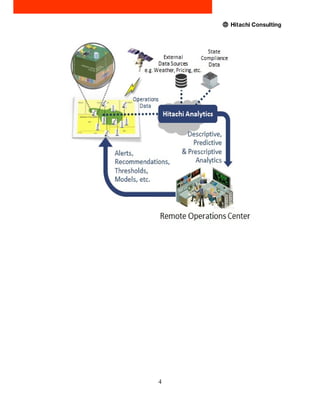
Typical big data analytics solution for operational intelligence focused on
descriptive, predictive & prescriptive analytics.
Business outcome oriented model driven by research and IP-based, high-margin hybrid
business models. Maximize differentiation with core Hitachi Portfolio
3
4
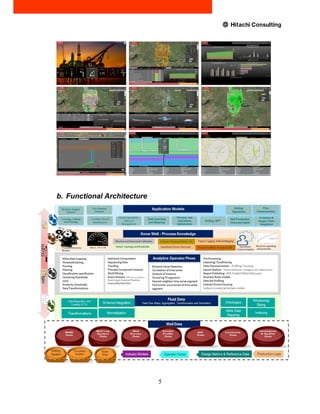
b. Functional Architecture
5
5. Production System
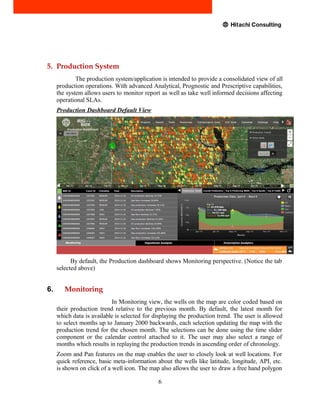
The production system/application is intended to provide a consolidated view of all
production operations. With advanced Analytical, Prognostic and Prescriptive capabilities,
the system allows users to monitor report as well as take well informed decisions affecting
operational SLAs.
Production Dashboard Default View
By default, the Production dashboard shows Monitoring perspective. (Notice the tab
selected above)
6. Monitoring
In Monitoring view, the wells on the map are color coded based on
their production trend relative to the previous month. By default, the latest month for
which data is available is selected for displaying the production trend. The user is allowed
to select months up to January 2000 backwards, each selection updating the map with the
production trend for the chosen month. The selections can be done using the time slider
component or the calendar control attached to it. The user may also select a range of
months which results in replaying the production trends in ascending order of chronology.
Zoom and Pan features on the map enables the user to closely look at well locations. For
quick reference, basic meta-information about the wells like latitude, longitude, API, etc.
is shown on click of a well icon. The map also allows the user to draw a free hand polygon
6
to focus on the wells of interest. The hide/unhide buttons provided on the legend provide
extra filtering options for viewing the wells on the map. By default all maps are enabled
with county and field layers that allows user to invoke analytics pertaining to the selected
context.
In addition to map based filtering, a filter panel is also provided to that supports basic and
advanced filtering options to narrow down on the wells of interest. Basic filtering allows
API No and File No based searches. Advanced Filtering provides searching on County,
Pool, Depth Range, Well Bore, Well Type, Well Status, Spud Period and Operator. In
general, all components in the Monitoring tab update based on the filters applied by the
user.
7. Productive Events
Events of interest in oil production, water expulsion, gas production and gas flared
are computed from production data. Sample events include sharp change
(increase/decline) in oil production, increase in gas flared etc. Events are categorized into
high, medium, and low criticality. By default, all events are displayed (automatic scroll
with fixed delay) for the month selected. If the user applies any filters on the wells to be
displayed on map, the corresponding events are displayed.
Technology: Event correlation is computed through association rule mining where we
assign a confidence value to the correlation. A Complex Event Processor is used to
generate and co-relate events.
Key Performance Indicators are computed with regards to the selected month and
displayed using easy to interpret as well as interactive visualizations. Some KPI
visualizations also show outlier values and allow drill down to the next level of
information.
The KPIs currently implemented include:
Production Trend: Cumulative Production trend for the last six months.
County Production: Top counties in terms of oil production for the last six months.
Drill down: Production trend for the selected county
Top K Producing Wells: Top wells in terms of oil production for the last six months.
Top K Spuds: Top regions/fields where maximum number of new wells were spud.
Top K Fields: Top regions in terms of oil production for the last 6 months.
Drill down: Top K Operators for the selected field.
Technology: The key performance indicators are automatically generated from an OLAP
cube. Outliers are detected as points which fall outside the expected envelop learned from
the historical data. ARIMA method is used to learn the envelop.
8. Results / Conclusion
Through this solution the following can be achieved
7
• Provide wide range of Analytics to user about the specific business cases to any complex
level and ensure the predictive approach on each move of their business aspects
• Operational Efficiencies by optimizing processes.
• Streaming data visualization as good as real time instance view
• Management of large Physical Systems present an opportunity in transforming Systems-
of-Records to Systems-of-Engagement focused on
• Alerting operations staff to take appropriate and timely actions
8
Appendices
Appendix A – Scenarios
Scenarios:
Appendix C – Authors
Murugan Ranganathan
Anil Dev
Appendix D – References
• www.hitachi.com
About the Author/s:
9
Murugan Ranganathan Manager in Testing and having 14+ year of experience in Software
testing and Test Project Management with wider domain knowledge on BFSI, Oracle Retail and
ELearning and Power plant design as well as technology side IOT and BIG DATA.
murugan.ranganathan@hitachiconsulting.com
www.hitachiconsulting.com
DISCLAIMER: By registering for this case study event, the participant understands that
the submissions to this case study are the Intellectual Property of Hitachi Consulting. This
document is not to be distributed outside Hitachi Consulting. This template is to be used
solely for the submission of Case Studies for Hitachi Consulting’s Technology Fair - Tech
Vantage 2016
10

White Paper_RIAB

  • 1.
    RIAB – RIG-IN-ABOX A White Paper Hitachi Consulting MURUGAN RANGANATHAN
  • 2.
    Contents 1.Introduction / Background....................................................................................................2 2.Abstract/ Business Case.......................................................................................................2 3.Business Challenge ................................................................................................2 4.Proposed Solution(s) ............................................................................................................3 a.Introduction of Solution........................................................................................................3 b.Functional Architecture ........................................................................................................5 5.Production System ...............................................................................................................6 6. Monitoring ......................................................................................................................6 7. Productive Events.............................................................................................................7 8.Results / Conclusion..............................................................................................................7 Appendices...............................................................................................................................9 Appendix A – Scenarios...........................................................................................................9 Appendix C – Authors.............................................................................................................9 Appendix D – References.........................................................................................................9 1
  • 3.
    1. Introduction /Background Digital Oil Fields is envisioned as an integrated solution to remotely monitor and manage End-to-End Oil & Gas operations. Powered by Hitachi HHAP, a rapid application development framework to enable Analytics-as-a-Service, it will initially target upstream oil and gas operations. - Exploration - Drilling - Completions - Production - Distribution - EOR (Enhanced Oil Recovery) - Maintenance With a thin client interface the solution allows for quick accessibility – be it from a full- fledged Remote Operations Centre or Desktops, Laptops and even tablets. 2. Abstract / Business Case In this Whitepaper we will highlight the specific trends impacting the future of Digital Oil Fields, will take a deep dive into the challenges and opportunities for Digital Oil Fields as well as quantifying the relevant opportunities and their impact from our extensive research in this market. 3. Business Challenge  There is a market need for solutions in Oil & Gas domain for  Reducing Non Productive Time (NPT)  Improving Operational Efficiencies by optimizing processes  Discovering Knowledge for training workforce  Management of large Physical Systems present an opportunity in transforming Systems-of-Records to Systems-of-Engagement focused on  Visualizing streaming data 2
  • 4.
     Mining datafor patterns and events  Discovering anomalies, correlations, root causes  Detecting and predicting patterns and events in real time  Alerting operations staff to take appropriate and timely actions 4. Proposed Solution(s) a. Introduction of Solution Typical big data analytics solution for operational intelligence focused on descriptive, predictive & prescriptive analytics. Business outcome oriented model driven by research and IP-based, high-margin hybrid business models. Maximize differentiation with core Hitachi Portfolio 3
  • 5.
  • 6.
  • 7.
    5. Production System Theproduction system/application is intended to provide a consolidated view of all production operations. With advanced Analytical, Prognostic and Prescriptive capabilities, the system allows users to monitor report as well as take well informed decisions affecting operational SLAs. Production Dashboard Default View By default, the Production dashboard shows Monitoring perspective. (Notice the tab selected above) 6. Monitoring In Monitoring view, the wells on the map are color coded based on their production trend relative to the previous month. By default, the latest month for which data is available is selected for displaying the production trend. The user is allowed to select months up to January 2000 backwards, each selection updating the map with the production trend for the chosen month. The selections can be done using the time slider component or the calendar control attached to it. The user may also select a range of months which results in replaying the production trends in ascending order of chronology. Zoom and Pan features on the map enables the user to closely look at well locations. For quick reference, basic meta-information about the wells like latitude, longitude, API, etc. is shown on click of a well icon. The map also allows the user to draw a free hand polygon 6
  • 8.
    to focus onthe wells of interest. The hide/unhide buttons provided on the legend provide extra filtering options for viewing the wells on the map. By default all maps are enabled with county and field layers that allows user to invoke analytics pertaining to the selected context. In addition to map based filtering, a filter panel is also provided to that supports basic and advanced filtering options to narrow down on the wells of interest. Basic filtering allows API No and File No based searches. Advanced Filtering provides searching on County, Pool, Depth Range, Well Bore, Well Type, Well Status, Spud Period and Operator. In general, all components in the Monitoring tab update based on the filters applied by the user. 7. Productive Events Events of interest in oil production, water expulsion, gas production and gas flared are computed from production data. Sample events include sharp change (increase/decline) in oil production, increase in gas flared etc. Events are categorized into high, medium, and low criticality. By default, all events are displayed (automatic scroll with fixed delay) for the month selected. If the user applies any filters on the wells to be displayed on map, the corresponding events are displayed. Technology: Event correlation is computed through association rule mining where we assign a confidence value to the correlation. A Complex Event Processor is used to generate and co-relate events. Key Performance Indicators are computed with regards to the selected month and displayed using easy to interpret as well as interactive visualizations. Some KPI visualizations also show outlier values and allow drill down to the next level of information. The KPIs currently implemented include: Production Trend: Cumulative Production trend for the last six months. County Production: Top counties in terms of oil production for the last six months. Drill down: Production trend for the selected county Top K Producing Wells: Top wells in terms of oil production for the last six months. Top K Spuds: Top regions/fields where maximum number of new wells were spud. Top K Fields: Top regions in terms of oil production for the last 6 months. Drill down: Top K Operators for the selected field. Technology: The key performance indicators are automatically generated from an OLAP cube. Outliers are detected as points which fall outside the expected envelop learned from the historical data. ARIMA method is used to learn the envelop. 8. Results / Conclusion Through this solution the following can be achieved 7
  • 9.
    • Provide widerange of Analytics to user about the specific business cases to any complex level and ensure the predictive approach on each move of their business aspects • Operational Efficiencies by optimizing processes. • Streaming data visualization as good as real time instance view • Management of large Physical Systems present an opportunity in transforming Systems- of-Records to Systems-of-Engagement focused on • Alerting operations staff to take appropriate and timely actions 8
  • 10.
    Appendices Appendix A –Scenarios Scenarios: Appendix C – Authors Murugan Ranganathan Anil Dev Appendix D – References • www.hitachi.com About the Author/s: 9
  • 11.
    Murugan Ranganathan Managerin Testing and having 14+ year of experience in Software testing and Test Project Management with wider domain knowledge on BFSI, Oracle Retail and ELearning and Power plant design as well as technology side IOT and BIG DATA. murugan.ranganathan@hitachiconsulting.com www.hitachiconsulting.com DISCLAIMER: By registering for this case study event, the participant understands that the submissions to this case study are the Intellectual Property of Hitachi Consulting. This document is not to be distributed outside Hitachi Consulting. This template is to be used solely for the submission of Case Studies for Hitachi Consulting’s Technology Fair - Tech Vantage 2016 10