Dr S.Nemati
assist. Prof
Tehran Azad university
Dr S.Nemati 13 CRD congress
 After man dominated fire
 Women (more observant)
 Clay will harden near fire
Dr S.Nemati 13 CRD congress
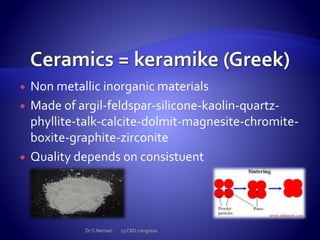
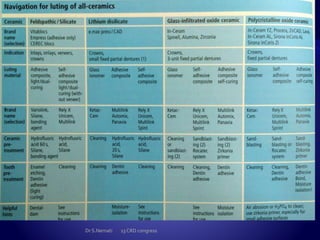
 Non metallic inorganic materials
 Made of argil-feldspar-silicone-kaolin-quartz-
phyllite-talk-calcite-dolmit-magnesite-chromite-
boxite-graphite-zirconite
 Quality depends on consistuent
Dr S.Nemati 13 CRD congress
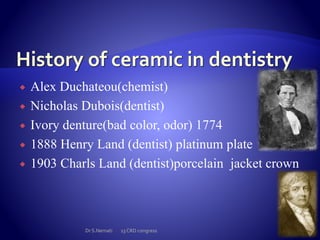
 Alex Duchateou(chemist)
 Nicholas Dubois(dentist)
 Ivory denture(bad color, odor) 1774
 1888 Henry Land (dentist) platinum plate
 1903 Charls Land (dentist)porcelain jacket crown
Dr S.Nemati 13 CRD congress
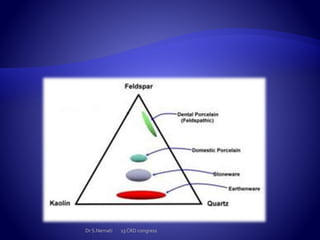
 Feldspathic ceramics:
 Silicone (SiO2)
 Potassium feldspath (K2O.Al2O3.6SiO2)
 Sodium feldspath (Na2O.Al2O3.6SiO2)
Dr S.Nemati 13 CRD congress
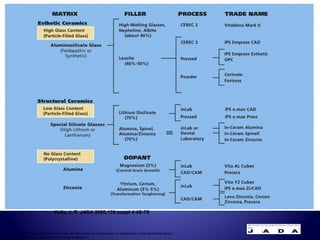
Kelly, J. R. JADA 2008;139:suppl 4:4S-7S
Copyright © 2013 American Dental Association. All rights reserved. Reproduction or republication strictly prohibited without
prior written permission of the American Dental Association.
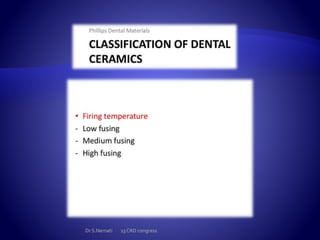
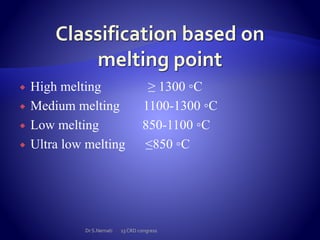
 High melting ≥ 1300 ◦C
 Medium melting 1100-1300 ◦C
 Low melting 850-1100 ◦C
 Ultra low melting ≤850 ◦C
Dr S.Nemati 13 CRD congress
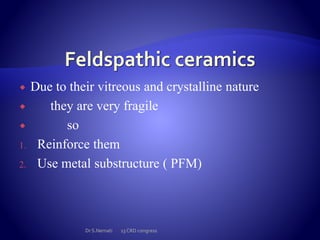
 Due to their vitreous and crystalline nature
 they are very fragile
 so
1. Reinforce them
2. Use metal substructure ( PFM)
Dr S.Nemati 13 CRD congress
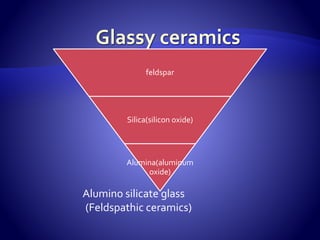
Alumino silicate glass
(Feldspathic ceramics)
feldspar
Silica(silicon oxide)
Alumina(aluminum
oxide)
 Strategies
1. Structurally reinforced ceramic
2. Adhesive ceramics
both provide a support structure with adequate
strength and rigidity to protect covering crown
Dr S.Nemati 13 CRD congress
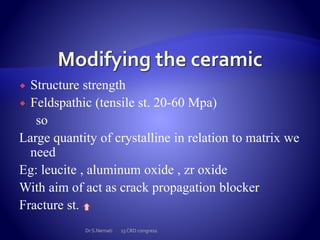
 Structure strength
 Feldspathic (tensile st. 20-60 Mpa)
so
Large quantity of crystalline in relation to matrix we
need
Eg: leucite , aluminum oxide , zr oxide
With aim of act as crack propagation blocker
Fracture st.
Dr S.Nemati 13 CRD congress
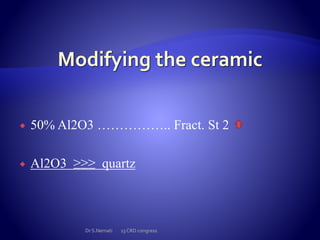
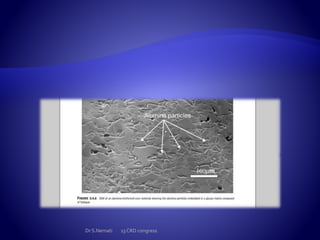
 50% Al2O3 …………….. Fract. St 2
 Al2O3 ≥≥≥ quartz
Dr S.Nemati 13 CRD congress
 1985
 Aluminum stub infiltrated by glass
(lanthanum oxide)
 High resistant sys. = in-ceram Alumina
 In Ceram fr.st. 4 Aluminous porcelain
 But Translucency
 As a substitute to metal for core
 METALL FREE CERAMICS
Dr S.Nemati 13 CRD congress
 To increase translucency
 In-Ceram Spinell (MgAl2O3)
 Translucency 2 In-Ceram
 Frac. St. 20%
 LIMITING to single ant restorations
Dr S.Nemati 13 CRD congress
 In-Ceram Zirconia 69% Al2O3,31% ZrO2
 Flec.st. (700 Mpa)
 Translucency
 LIMITING to post. Single /3 unit rest.
Dr S.Nemati 13 CRD congress
 Procera -all ceram Use a CAD/CAM
 Purified Al2O3 substructure
99.5%
Zr-Yt base
Zr as Tetragonal Zirconia Polycrystal (TZP)
Strongest ceramic.Ant .Post single/3 unit restoration
Implant abutment
Dr S.Nemati 13 CRD congress
 Strategies
1. Structurally reinforced ceramic
2. Adhesive ceramics
both provide a support structure with adequate
strength and rigidity to protect covering crown
Dr S.Nemati 13 CRD congress
 Systems with high saturations and structure
density
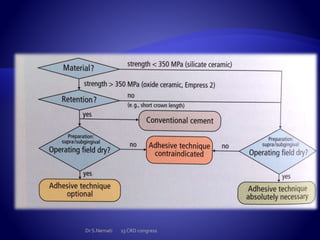
1. Not compatible with adhesive procedure
2. Can not be etched
3. Can not be bonded
Dr S.Nemati 13 CRD congress
 Bonding is based on
1. Acid etching(micromechanical)
2. Silane agent(chemical)
SiO2----Silane----Organic Matrix(resin)
Dr S.Nemati 13 CRD congress
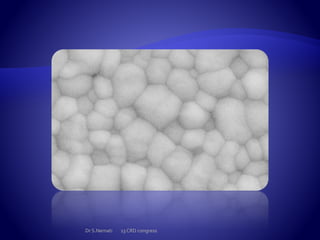
 Also called vitrified ceramics
 =viterous phase + crystalline phase (dispersed)
Ceramization process
Dr S.Nemati 13 CRD congress
 Size and quantity of crystals can be controlled
 Stress generating points: surface defects=fracture
 Viterous phase prone to fracture
 The smaller the crystals = the larger the volume
= the less the distance between = the greater the
strength
Dr S.Nemati 13 CRD congress
 Reinforced with leucite crystals
(SiO2-K2O-Al2O3)
 IPS Empress (ivoclar-Vivadent)
 Use lost wax tech.
 Limit to :single crown-inlay/onlay.PLV (flex.st )
Dr S.Nemati 13 CRD congress
 Vitrified ceramic based on Li disilicate crystals
(SiO2-LiO2)
to prevent crack propagation
IPS Empress 2
Flex.st. IPS Empress 2 ≥ IPS Empress
Single crn.PLV.Inlay/onlay. 3Unit Brg up to 2nd pm
Dr S.Nemati 13 CRD congress
 Refraction index ≠ tooth structure
 Better esthetics
Dr S.Nemati 13 CRD congress
 Viterous
 Leucite reinforced ceramic
 Processing tech : optimized characteristics =
better str. & better translucency
 Limit to single crown(as with all leucite ceramics)
Dr S.Nemati 13 CRD congress
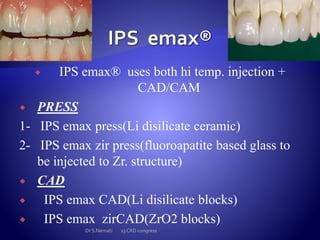
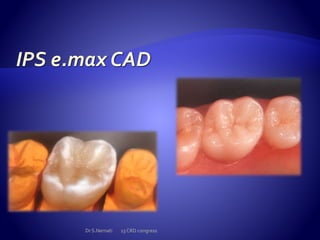
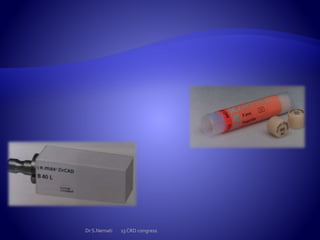
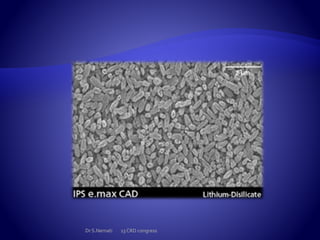
 IPS emax® uses both hi temp. injection +
CAD/CAM
 PRESS
1- IPS emax press(Li disilicate ceramic)
2- IPS emax zir press(fluoroapatite based glass to
be injected to Zr. structure)
 CAD
 IPS emax CAD(Li disilicate blocks)
 IPS emax zirCAD(ZrO2 blocks)
Dr S.Nemati 13 CRD congress
1. Ceramic with metal support(PFM)
2. Ceramic reinforced with highly resistant
crystals(Empress2 . Emax)
3. Al2O3 reinforced ceramics (high opacity)
4. ZrO2 reinforced ceramics
Dr S.Nemati 13 CRD congress
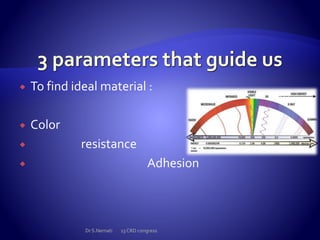
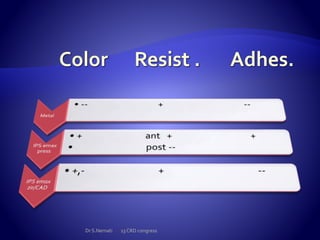
 To find ideal material :
 Color
 resistance
 Adhesion
Dr S.Nemati 13 CRD congress
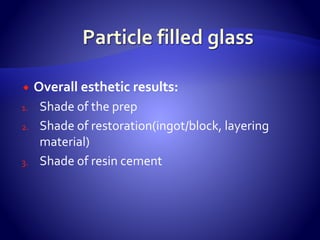
 Overall esthetic results:
1. Shade of the prep
2. Shade of restoration(ingot/block, layering
material)
3. Shade of resin cement
1. Which restoration?
2. How much tooth has been lost?
3. Where is the finish line?
4. Is it ant. or post?
5. Is there any para function?
6. Static and dynamic occlusal load? Should it be
changed?
7. Is the restoration adhesively bonded?
8. Is there discoloration?
9. How much the tooth is visible?
Dr S.Nemati 13 CRD congress
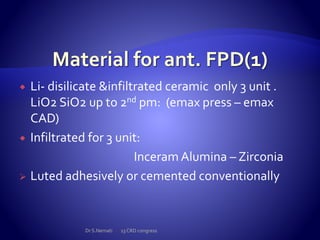
 Li- disilicate &infiltrated ceramic only 3 unit .
LiO2 SiO2 up to 2nd pm: (emax press – emax
CAD)
 Infiltrated for 3 unit:
Inceram Alumina – Zirconia
 Luted adhesively or cemented conventionally
Dr S.Nemati 13 CRD congress
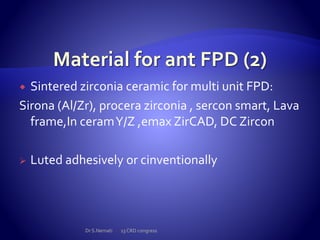
 Sintered zirconia ceramic for multi unit FPD:
Sirona (Al/Zr), procera zirconia , sercon smart, Lava
frame,In ceramY/Z ,emax ZirCAD, DC Zircon
 Luted adhesively or cinventionally
Dr S.Nemati 13 CRD congress
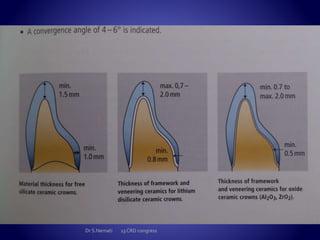
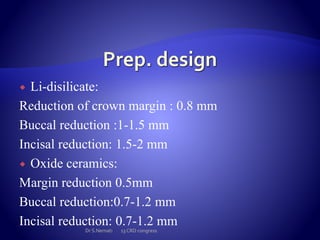
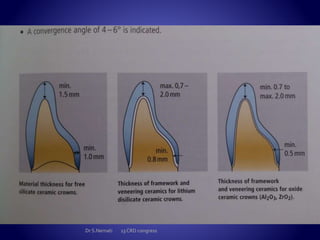
 Li-disilicate:
Reduction of crown margin : 0.8 mm
Buccal reduction :1-1.5 mm
Incisal reduction: 1.5-2 mm
 Oxide ceramics:
Margin reduction 0.5mm
Buccal reduction:0.7-1.2 mm
Incisal reduction: 0.7-1.2 mm
Dr S.Nemati 13 CRD congress
 Margins : chamfer / rounded shoulder
 Finish line : even gingivae
 Rounded line angles , no sharp edges
Dr S.Nemati 13 CRD congress
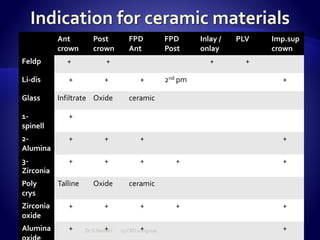
Ant
crown
Post
crown
FPD
Ant
FPD
Post
Inlay /
onlay
PLV Imp.sup
crown
Feldp + + + +
Li-dis + + + 2nd pm +
Glass Infiltrate Oxide ceramic
1-
spinell
+
2-
Alumina
+ + + +
3-
Zirconia
+ + + + +
Poly
crys
Talline Oxide ceramic
Zirconia
oxide
+ + + + +
Alumina + + + +Dr S.Nemati 13 CRD congress
Dr S.Nemati 13 CRD congress

Which porcelain (2)

  • 1.
    Dr S.Nemati assist. Prof TehranAzad university Dr S.Nemati 13 CRD congress
  • 2.
     After mandominated fire  Women (more observant)  Clay will harden near fire Dr S.Nemati 13 CRD congress
  • 3.
     Non metallicinorganic materials  Made of argil-feldspar-silicone-kaolin-quartz- phyllite-talk-calcite-dolmit-magnesite-chromite- boxite-graphite-zirconite  Quality depends on consistuent Dr S.Nemati 13 CRD congress
  • 4.
     Alex Duchateou(chemist) Nicholas Dubois(dentist)  Ivory denture(bad color, odor) 1774  1888 Henry Land (dentist) platinum plate  1903 Charls Land (dentist)porcelain jacket crown Dr S.Nemati 13 CRD congress
  • 5.
    Dr S.Nemati 13CRD congress
  • 6.
     Feldspathic ceramics: Silicone (SiO2)  Potassium feldspath (K2O.Al2O3.6SiO2)  Sodium feldspath (Na2O.Al2O3.6SiO2) Dr S.Nemati 13 CRD congress
  • 7.
    Dr S.Nemati 13CRD congress
  • 8.
    Dr S.Nemati 13CRD congress
  • 9.
    Dr S.Nemati 13CRD congress
  • 10.
    Dr S.Nemati 13CRD congress
  • 11.
    Dr S.Nemati 13CRD congress
  • 12.
    Dr S.Nemati 13CRD congress
  • 13.
    Kelly, J. R.JADA 2008;139:suppl 4:4S-7S Copyright © 2013 American Dental Association. All rights reserved. Reproduction or republication strictly prohibited without prior written permission of the American Dental Association.
  • 14.
     High melting≥ 1300 ◦C  Medium melting 1100-1300 ◦C  Low melting 850-1100 ◦C  Ultra low melting ≤850 ◦C Dr S.Nemati 13 CRD congress
  • 15.
     Due totheir vitreous and crystalline nature  they are very fragile  so 1. Reinforce them 2. Use metal substructure ( PFM) Dr S.Nemati 13 CRD congress
  • 16.
    Alumino silicate glass (Feldspathicceramics) feldspar Silica(silicon oxide) Alumina(aluminum oxide)
  • 17.
     Strategies 1. Structurallyreinforced ceramic 2. Adhesive ceramics both provide a support structure with adequate strength and rigidity to protect covering crown Dr S.Nemati 13 CRD congress
  • 18.
     Structure strength Feldspathic (tensile st. 20-60 Mpa) so Large quantity of crystalline in relation to matrix we need Eg: leucite , aluminum oxide , zr oxide With aim of act as crack propagation blocker Fracture st. Dr S.Nemati 13 CRD congress
  • 19.
     50% Al2O3…………….. Fract. St 2  Al2O3 ≥≥≥ quartz Dr S.Nemati 13 CRD congress
  • 20.
     1985  Aluminumstub infiltrated by glass (lanthanum oxide)  High resistant sys. = in-ceram Alumina  In Ceram fr.st. 4 Aluminous porcelain  But Translucency  As a substitute to metal for core  METALL FREE CERAMICS Dr S.Nemati 13 CRD congress
  • 21.
     To increasetranslucency  In-Ceram Spinell (MgAl2O3)  Translucency 2 In-Ceram  Frac. St. 20%  LIMITING to single ant restorations Dr S.Nemati 13 CRD congress
  • 22.
     In-Ceram Zirconia69% Al2O3,31% ZrO2  Flec.st. (700 Mpa)  Translucency  LIMITING to post. Single /3 unit rest. Dr S.Nemati 13 CRD congress
  • 23.
     Procera -allceram Use a CAD/CAM  Purified Al2O3 substructure 99.5% Zr-Yt base Zr as Tetragonal Zirconia Polycrystal (TZP) Strongest ceramic.Ant .Post single/3 unit restoration Implant abutment Dr S.Nemati 13 CRD congress
  • 24.
    Dr S.Nemati 13CRD congress
  • 25.
     Strategies 1. Structurallyreinforced ceramic 2. Adhesive ceramics both provide a support structure with adequate strength and rigidity to protect covering crown Dr S.Nemati 13 CRD congress
  • 26.
     Systems withhigh saturations and structure density 1. Not compatible with adhesive procedure 2. Can not be etched 3. Can not be bonded Dr S.Nemati 13 CRD congress
  • 27.
     Bonding isbased on 1. Acid etching(micromechanical) 2. Silane agent(chemical) SiO2----Silane----Organic Matrix(resin) Dr S.Nemati 13 CRD congress
  • 28.
     Also calledvitrified ceramics  =viterous phase + crystalline phase (dispersed) Ceramization process Dr S.Nemati 13 CRD congress
  • 29.
     Size andquantity of crystals can be controlled  Stress generating points: surface defects=fracture  Viterous phase prone to fracture  The smaller the crystals = the larger the volume = the less the distance between = the greater the strength Dr S.Nemati 13 CRD congress
  • 30.
     Reinforced withleucite crystals (SiO2-K2O-Al2O3)  IPS Empress (ivoclar-Vivadent)  Use lost wax tech.  Limit to :single crown-inlay/onlay.PLV (flex.st ) Dr S.Nemati 13 CRD congress
  • 31.
     Vitrified ceramicbased on Li disilicate crystals (SiO2-LiO2) to prevent crack propagation IPS Empress 2 Flex.st. IPS Empress 2 ≥ IPS Empress Single crn.PLV.Inlay/onlay. 3Unit Brg up to 2nd pm Dr S.Nemati 13 CRD congress
  • 32.
     Refraction index≠ tooth structure  Better esthetics Dr S.Nemati 13 CRD congress
  • 33.
     Viterous  Leucitereinforced ceramic  Processing tech : optimized characteristics = better str. & better translucency  Limit to single crown(as with all leucite ceramics) Dr S.Nemati 13 CRD congress
  • 34.
     IPS emax®uses both hi temp. injection + CAD/CAM  PRESS 1- IPS emax press(Li disilicate ceramic) 2- IPS emax zir press(fluoroapatite based glass to be injected to Zr. structure)  CAD  IPS emax CAD(Li disilicate blocks)  IPS emax zirCAD(ZrO2 blocks) Dr S.Nemati 13 CRD congress
  • 35.
    Dr S.Nemati 13CRD congress
  • 36.
    Dr S.Nemati 13CRD congress
  • 37.
    Dr S.Nemati 13CRD congress
  • 38.
    Dr S.Nemati 13CRD congress
  • 39.
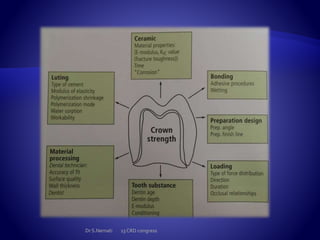
    1. Ceramic withmetal support(PFM) 2. Ceramic reinforced with highly resistant crystals(Empress2 . Emax) 3. Al2O3 reinforced ceramics (high opacity) 4. ZrO2 reinforced ceramics Dr S.Nemati 13 CRD congress
  • 40.
     To findideal material :  Color  resistance  Adhesion Dr S.Nemati 13 CRD congress
  • 41.
    Dr S.Nemati 13CRD congress
  • 42.
    Dr S.Nemati 13CRD congress
  • 43.
     Overall estheticresults: 1. Shade of the prep 2. Shade of restoration(ingot/block, layering material) 3. Shade of resin cement
  • 44.
    1. Which restoration? 2.How much tooth has been lost? 3. Where is the finish line? 4. Is it ant. or post? 5. Is there any para function? 6. Static and dynamic occlusal load? Should it be changed? 7. Is the restoration adhesively bonded? 8. Is there discoloration? 9. How much the tooth is visible? Dr S.Nemati 13 CRD congress
  • 45.
    Dr S.Nemati 13CRD congress
  • 46.
    Dr S.Nemati 13CRD congress
  • 47.
    Dr S.Nemati 13CRD congress
  • 48.
    Dr S.Nemati 13CRD congress
  • 49.
    Dr S.Nemati 13CRD congress
  • 50.
    Dr S.Nemati 13CRD congress
  • 51.
     Li- disilicate&infiltrated ceramic only 3 unit . LiO2 SiO2 up to 2nd pm: (emax press – emax CAD)  Infiltrated for 3 unit: Inceram Alumina – Zirconia  Luted adhesively or cemented conventionally Dr S.Nemati 13 CRD congress
  • 52.
     Sintered zirconiaceramic for multi unit FPD: Sirona (Al/Zr), procera zirconia , sercon smart, Lava frame,In ceramY/Z ,emax ZirCAD, DC Zircon  Luted adhesively or cinventionally Dr S.Nemati 13 CRD congress
  • 53.
     Li-disilicate: Reduction ofcrown margin : 0.8 mm Buccal reduction :1-1.5 mm Incisal reduction: 1.5-2 mm  Oxide ceramics: Margin reduction 0.5mm Buccal reduction:0.7-1.2 mm Incisal reduction: 0.7-1.2 mm Dr S.Nemati 13 CRD congress
  • 54.
     Margins :chamfer / rounded shoulder  Finish line : even gingivae  Rounded line angles , no sharp edges Dr S.Nemati 13 CRD congress
  • 55.
    Ant crown Post crown FPD Ant FPD Post Inlay / onlay PLV Imp.sup crown Feldp+ + + + Li-dis + + + 2nd pm + Glass Infiltrate Oxide ceramic 1- spinell + 2- Alumina + + + + 3- Zirconia + + + + + Poly crys Talline Oxide ceramic Zirconia oxide + + + + + Alumina + + + +Dr S.Nemati 13 CRD congress
  • 56.
    Dr S.Nemati 13CRD congress
  • 57.
    Dr S.Nemati 13CRD congress
  • 58.
    Dr S.Nemati 13CRD congress
  • 59.
    Dr S.Nemati 13CRD congress

Editor's Notes

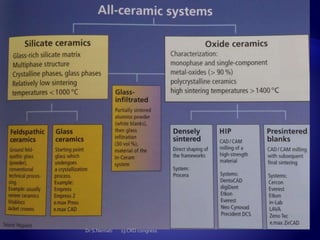
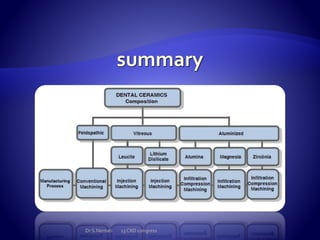
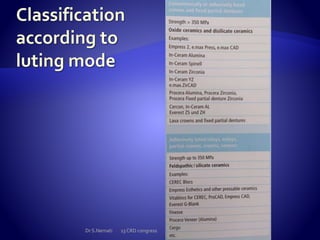
  • #14 Organizational chart of dental ceramics for all-ceramic systems according to matrix material, filler or dopant (atomic-level filler) and fabrication process. CEREC 3 is manufactured by Sirona Dental Systems GmbH, Bensheim, Germany; InLab, Sirona Dental Systems GmbH; Vitablocs Mark II, Vita Zahnfabrik, Bad Säckingen, Germany; IPS Empress CAD and IPS Empress Esthetic, Ivoclar Vivadent; Amherst, N.Y.; OPC, Pentron Ceramics, Somerset, N.J.; Cerinate, Den-Mat, Santa Maria, Calif.; Fortress, Mirage Dental Systems, Kansas City, Kan.; IPS e.max CAD and IPS e.max Press, Ivoclar Vivadent; In-Ceram Alumina, Spinell and Zirconia, Vita Zahnfabrik; Vita AL Cubes, Vita Zahnfabrik; Procera, Nobel Biocare, Göteborg, Sweden; Vita YZ Cubes, Vita Zahnfabrik; IPS e.max ZirCAD, Ivoclar Vivadent; Lava Zirconia, 3M ESPE, St. Paul, Minn.; Cercon Zirconia, Dentsply Prosthetics, York, Pa.; Procera, Nobel Biocare. (Adapted with permission of Quintessenz Verlags-GmbH, Berlin, from Kelly.3)‏