What’s new in PHP 7.1
And why you really shouldn’t be using PHP5 anymore…
PHP Cambridge, 12th December 2016
Simon Jones, Studio 24
PHP 7.1
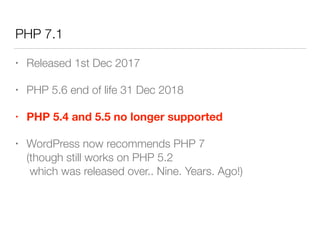
• Released 1st Dec 2017
• PHP 5.6 end of life 31 Dec 2018
• PHP 5.4 and 5.5 no longer supported
• WordPress now recommends PHP 7 

(though still works on PHP 5.2

which was released over.. Nine. Years. Ago!)
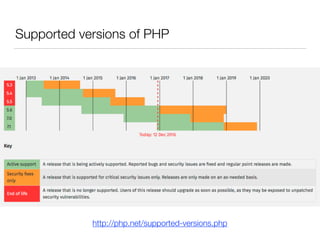
Supported versions of PHP
http://php.net/supported-versions.php
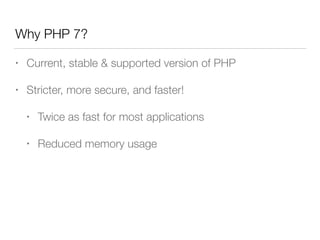
Why PHP 7?
• Current, stable & supported version of PHP
• Stricter, more secure, and faster!
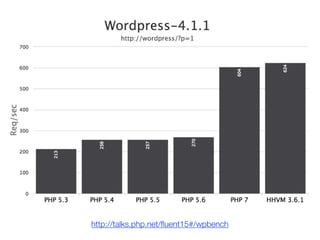
• Twice as fast for most applications
• Reduced memory usage
http://talks.php.net/fluent15#/wpbench
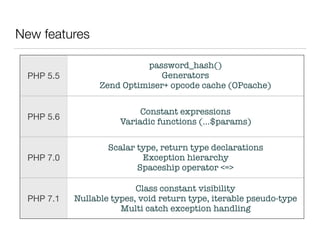
New features
PHP 5.5
password_hash()

Generators

Zend Optimiser+ opcode cache (OPcache)
PHP 5.6
Constant expressions
Variadic functions (...$params)
PHP 7.0
Scalar type, return type declarations
Exception hierarchy
Spaceship operator <=>
PHP 7.1
Class constant visibility

Nullable types, void return type, iterable pseudo-type
Multi catch exception handling
• Removed from PHP..
• mysql_* functions (use PDO)
• mssql_* functions (use PDO)
• ereg_* functions (use preg_*)
• ASP & script style tags 

<% %> 

<script language=“php”> </script>
• foreach no longer changes the internal array pointer
What breaks / changes in PHP 7.0?
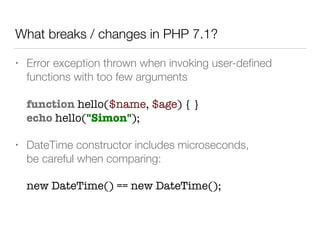
• Error exception thrown when invoking user-defined
functions with too few arguments


function hello($name, $age) { }

echo hello("Simon");
• DateTime constructor includes microseconds, 

be careful when comparing:


new DateTime() == new DateTime();
What breaks / changes in PHP 7.1?
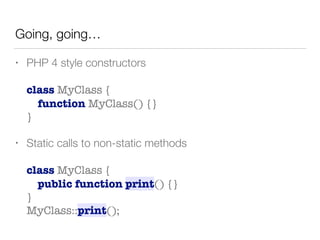
Going, going…
• PHP 4 style constructors


class MyClass {

function MyClass() {}

}
• Static calls to non-static methods


class MyClass {

public function print() {}

}

MyClass::print();
Two new features

Error exceptions & type hinting
• Fatal errors throw exceptions. Yay!
• Custom error handlers may no longer work
Changes to error handling
http://php.net/manual/en/language.errors.php7.php
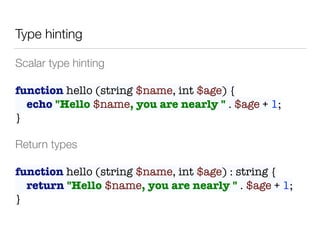
Type hinting
Scalar type hinting

function hello (string $name, int $age) {

echo "Hello $name, you are nearly " . $age + 1;

}
Return types

function hello (string $name, int $age) : string {

return "Hello $name, you are nearly " . $age + 1;

}
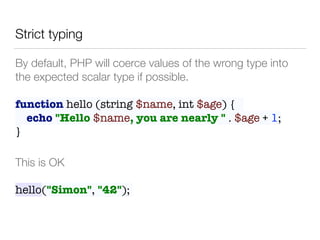
Strict typing
By default, PHP will coerce values of the wrong type into
the expected scalar type if possible. 

function hello (string $name, int $age) { 

echo "Hello $name, you are nearly " . $age + 1;

}

This is OK

hello("Simon", "42");
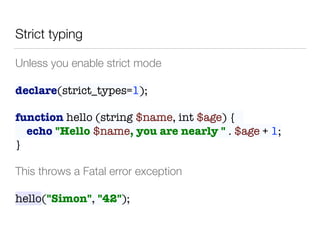
Strict typing
Unless you enable strict mode

declare(strict_types=1);

function hello (string $name, int $age) { 

echo "Hello $name, you are nearly " . $age + 1;

}
This throws a Fatal error exception

hello("Simon", "42");
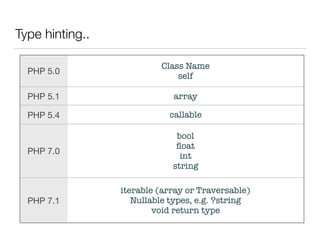
Type hinting..
PHP 5.0
Class Name

self
PHP 5.1 array
PHP 5.4 callable
PHP 7.0
bool
float
int
string
PHP 7.1
iterable (array or Traversable)

Nullable types, e.g. ?string
void return type
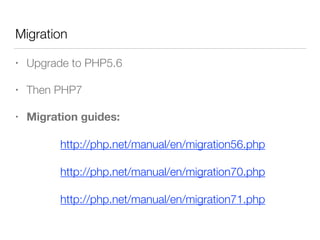
Migration
• Upgrade to PHP5.6
• Then PHP7
• Migration guides:

http://php.net/manual/en/migration56.php

http://php.net/manual/en/migration70.php

http://php.net/manual/en/migration71.php
Thanks!

What's new in PHP 7.1

  • 1.
    What’s new inPHP 7.1 And why you really shouldn’t be using PHP5 anymore… PHP Cambridge, 12th December 2016 Simon Jones, Studio 24
  • 2.
    PHP 7.1 • Released1st Dec 2017 • PHP 5.6 end of life 31 Dec 2018 • PHP 5.4 and 5.5 no longer supported • WordPress now recommends PHP 7 
 (though still works on PHP 5.2
 which was released over.. Nine. Years. Ago!)
  • 3.
    Supported versions ofPHP http://php.net/supported-versions.php
  • 4.
    Why PHP 7? •Current, stable & supported version of PHP • Stricter, more secure, and faster! • Twice as fast for most applications • Reduced memory usage
  • 5.
  • 6.
    New features PHP 5.5 password_hash()
 Generators
 ZendOptimiser+ opcode cache (OPcache) PHP 5.6 Constant expressions Variadic functions (...$params) PHP 7.0 Scalar type, return type declarations Exception hierarchy Spaceship operator <=> PHP 7.1 Class constant visibility
 Nullable types, void return type, iterable pseudo-type Multi catch exception handling
  • 7.
    • Removed fromPHP.. • mysql_* functions (use PDO) • mssql_* functions (use PDO) • ereg_* functions (use preg_*) • ASP & script style tags 
 <% %> 
 <script language=“php”> </script> • foreach no longer changes the internal array pointer What breaks / changes in PHP 7.0?
  • 8.
    • Error exceptionthrown when invoking user-defined functions with too few arguments
 
 function hello($name, $age) { }
 echo hello("Simon"); • DateTime constructor includes microseconds, 
 be careful when comparing:
 
 new DateTime() == new DateTime(); What breaks / changes in PHP 7.1?
  • 9.
    Going, going… • PHP4 style constructors
 
 class MyClass {
 function MyClass() {}
 } • Static calls to non-static methods
 
 class MyClass {
 public function print() {}
 }
 MyClass::print();
  • 10.
    Two new features
 Errorexceptions & type hinting
  • 11.
    • Fatal errorsthrow exceptions. Yay! • Custom error handlers may no longer work Changes to error handling http://php.net/manual/en/language.errors.php7.php
  • 12.
    Type hinting Scalar typehinting
 function hello (string $name, int $age) {
 echo "Hello $name, you are nearly " . $age + 1;
 } Return types
 function hello (string $name, int $age) : string {
 return "Hello $name, you are nearly " . $age + 1;
 }
  • 13.
    Strict typing By default,PHP will coerce values of the wrong type into the expected scalar type if possible. 
 function hello (string $name, int $age) { 
 echo "Hello $name, you are nearly " . $age + 1;
 }
 This is OK
 hello("Simon", "42");
  • 14.
    Strict typing Unless youenable strict mode
 declare(strict_types=1);
 function hello (string $name, int $age) { 
 echo "Hello $name, you are nearly " . $age + 1;
 } This throws a Fatal error exception
 hello("Simon", "42");
  • 15.
    Type hinting.. PHP 5.0 ClassName
 self PHP 5.1 array PHP 5.4 callable PHP 7.0 bool float int string PHP 7.1 iterable (array or Traversable)
 Nullable types, e.g. ?string void return type
  • 16.
    Migration • Upgrade toPHP5.6 • Then PHP7 • Migration guides:
 http://php.net/manual/en/migration56.php
 http://php.net/manual/en/migration70.php
 http://php.net/manual/en/migration71.php
  • 17.